
Judge, 1892-10-15 · page 7 of 16
Judge — October 15, 1892 — page 7: what you’re looking at
What you’re looking at
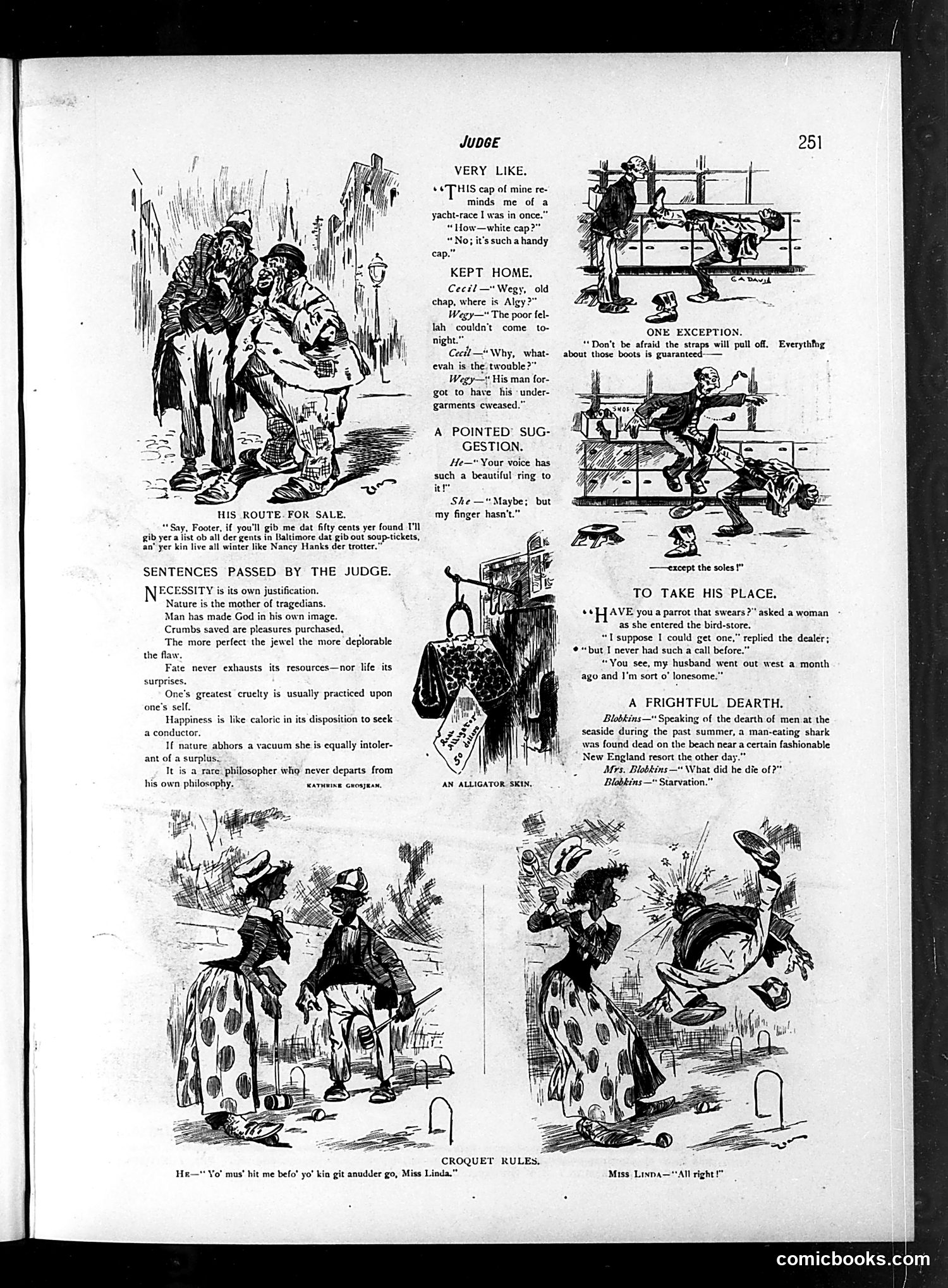
This page contains several unrelated satirical sketches typical of Judge magazine's format: **"His Route for Sale"** mocks urban poverty, depicting a beggar offering to sell information about Baltimore charitable soup-ticket distributors to another poor man—implying survival depends on exploiting welfare systems. **"Kept Home"** satirizes upper-class affectation, where a man cannot attend social events because his servant forgot to press his undergarments, mocking the leisure class's dependence on servants for basic tasks. **"One Exception"** jokes about shoe quality—the boots are "guaranteed" except for the soles, the very component that wears out, poking fun at fraudulent advertising claims. **"To Take His Place"** presents dark humor: a woman seeking a parrot to replace her absent husband suggests wives viewed husbands as mere companionship providers. **"A Frightful Dearth"** offers grim comedy about a man-eating shark starving at a beach resort, implying the shortage of suitable men (for romance/marriage) is so severe that even predators cannot find victims. The "Sentences by the Judge" are philosophical aphorisms offering general commentary on human nature and fate.
📄 Transcribed text from this page (OCR, searchable)
Machine-transcribed from the original scan — historical spelling and the odd misread are preserved.
HIS ROUTE. FOR SALE. “Say, Footer, if you'll gib me dat fifty cents yer found T'll a list ob all der gents in Baltimore dat gib out soup-tickets, an’ yer kin live all winter like Nancy Hanks der trotter.” SENTENCES PASSED BY THE JUDGE. ESSITY is its own justification. Nature is the mother of tragedians. Man has made God in his own image. Crumbs saved are pleasures purchased, The more perfect the jewel the more deplorable the flaw. Fate never exhausts its resources—nor life its surprises. One’s greatest cruelty is usually practiced upon one's self. Happiness is like caloric in its disposition to seek a conductor. If nature abhors a vacuum she is equally intoler- ant of a surplus. It is a rare philosopher who never departs from his own philosophy. MATHWINE GROS]EAN. JUDGE VERY LIKE, Se HIS cap of mine re- minds me of a yacht-race I was in once.” * How—white cap?” “No; it's such a handy cap.’ KEPT HOME. Cecil —" Wegy, old chap, where is Algy?” Wegy—" The poor fel- lah couldn't come to- night."” Cecil —* Why, what- evah is the,twouble?” Wegy—!' His man for- got to have his -under- garments cweased.” A POINTED SUG- GESTION. He—" Your voice has such a beautiful ring to itt” She —"May CROQUET He—" Yo! mus’ hit me befo' yo" kin git anudder go, Miss Linda.” ONE EXCEPTION. “Don't be afraid the straps will poll off. Everyththg about those boots is guaranteed- —except the soles !” TO TAKE HIS PLACE, + SLAVE youa parrot that swears?” asked a woman as she entered the bird-store. “Tsuppose I could get one,” replied the dealer; but I never had such a call before.” “You see, my husband went out west a. month ago and I'm sort 0° lonesome.” A FRIGHTFUL DEARTH. Blobkins— Speaking of the dearth of men.at the seaside during the past summer, a man-eating shark was found dead on the beach near a certain fashionable New England resort the other day.” Mrs. Blobkins—" What did he die of?” Blobkins —" Starvation.” Miss Livna—“‘All right comicbooks.com