
A complete issue · 16 pages · 1892
Judge — September 3, 1892
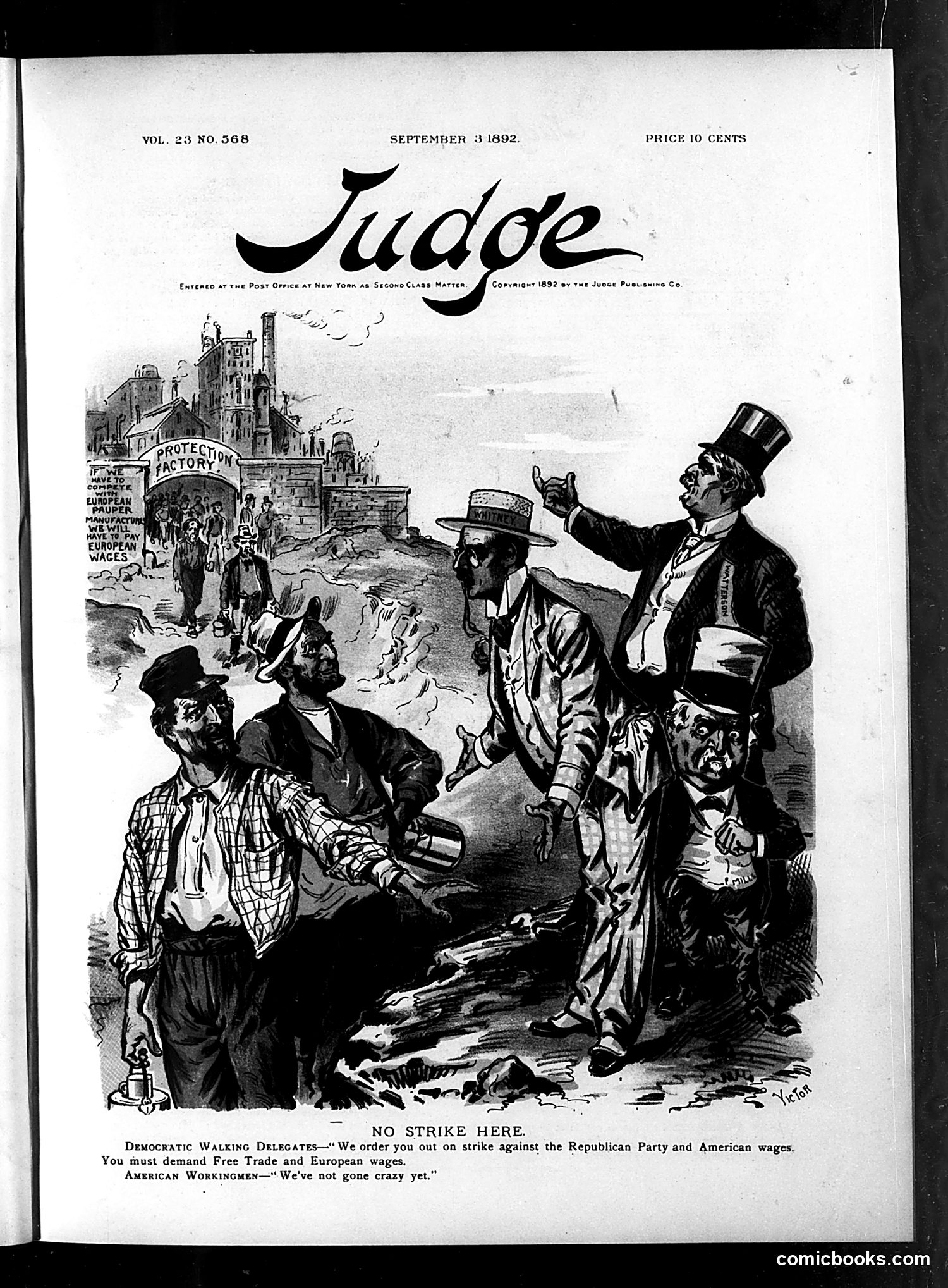
This political cartoon satirizes the 1892 presidential election conflict between labor interests and the Republican Party. The "Protection Factory" (left) represents Republican tariff policies, while the central figures depict the tension between Democratic delegates advocating labor strikes against Republican "American wages" policy, and American workingmen refusing to participate. The caricatured figures—likely representing Democratic politicians and labor leaders—attempt to convince working-class Americans (portrayed with exaggerated features typical of period satirical art) to strike against the GOP. The workingmen's refusal ("We've not gone crazy yet") suggests Judge's position: that workers wouldn't be fooled into supporting Democrats, despite labor's appeals based on wage protections and free trade rhetoric. The cartoon mocks Democratic campaign strategy targeting working-class voters.
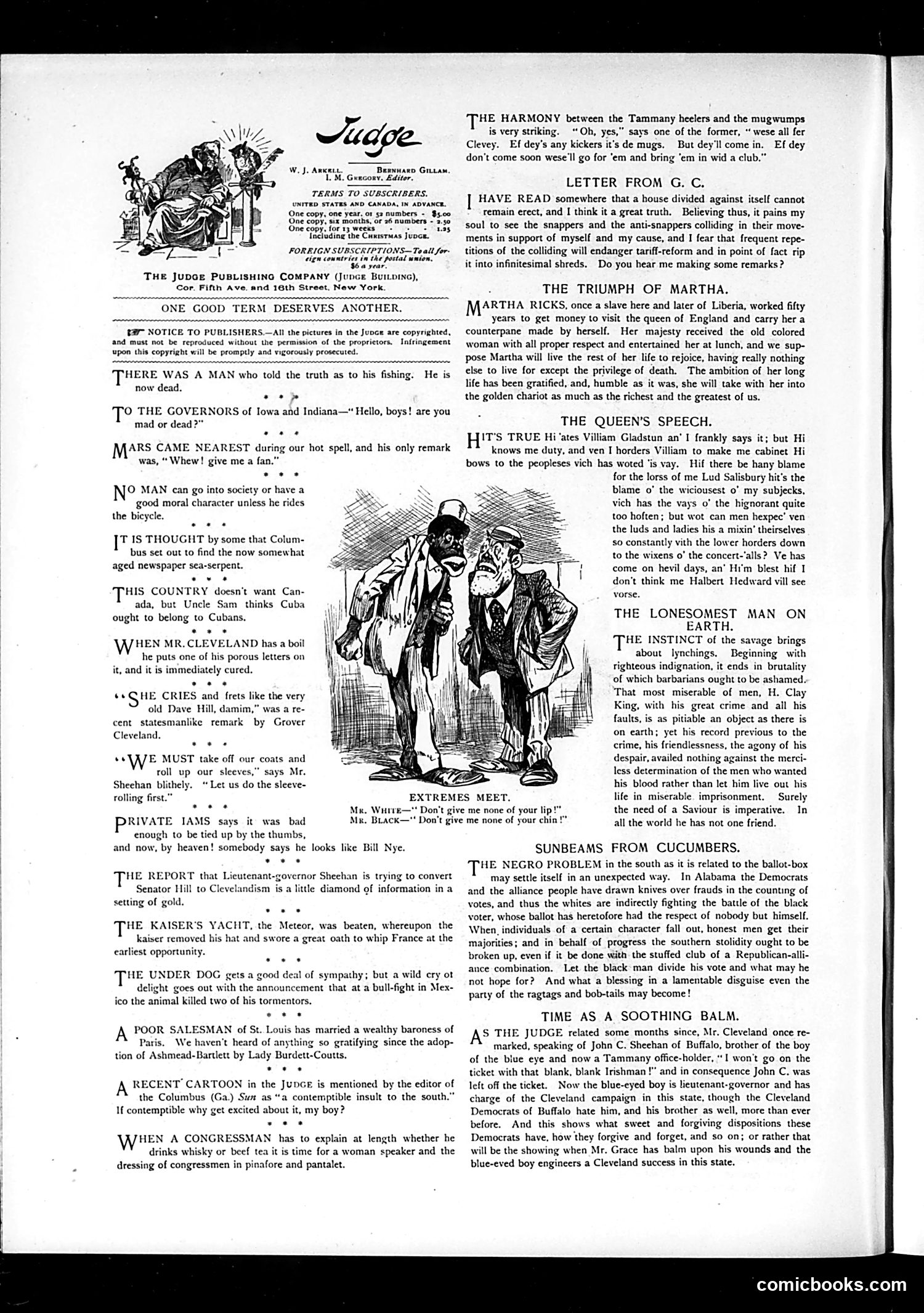
The main cartoon titled "EXTREMES MEET" depicts two disheveled figures in conversation. Based on the caption ("Don't give me none of your lip!" / "Don't give me none of your chin!"), this appears to be satirizing opposing political or social figures who are essentially indistinguishable despite their antagonism toward each other. The surrounding text contains brief satirical commentary on contemporary issues, including references to Cleveland's administration, Cuban affairs, and various social matters. Without clearer identification of the specific figures or dating information, the exact political targets remain unclear, though the overall tone suggests critique of hypocrisy or false dichotomies between opposing camps during what appears to be the Gilded Age period.
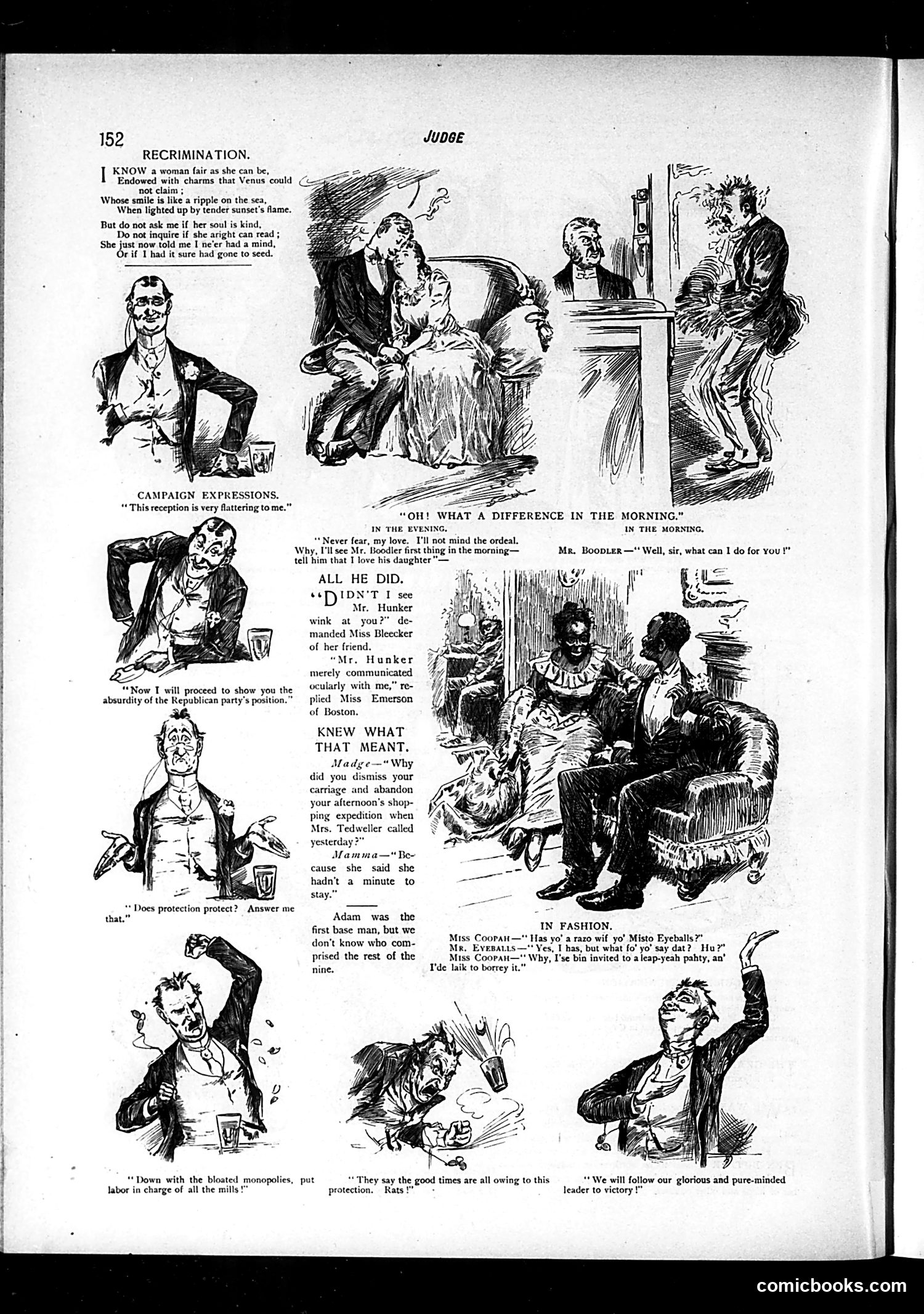
This page satirizes American political and social hypocrisy during the Gilded Age. The "Campaign Expressions" section mocks politicians who make grand public statements while privately engaging in corruption—specifically bribing officials ("I'll see Mr. Boodler first thing in the morning"). The "Recrimination" poem critiques women as superficially charming but intellectually dismissible, reflecting period gender attitudes. Other sketches target Republican protectionist economic policies ("Does protection protect?") and monopoly control of industry, while depicting blind partisan loyalty ("We will follow our glorious...leader"). The "In Fashion" section uses racial caricature to satirize African American dialect and social pretensions—reflecting the magazine's casual racism typical of 1880s-90s American publications. Overall, Judge attacks political corruption, economic inequality, and partisan zealotry while reinforcing contemporary prejudices.
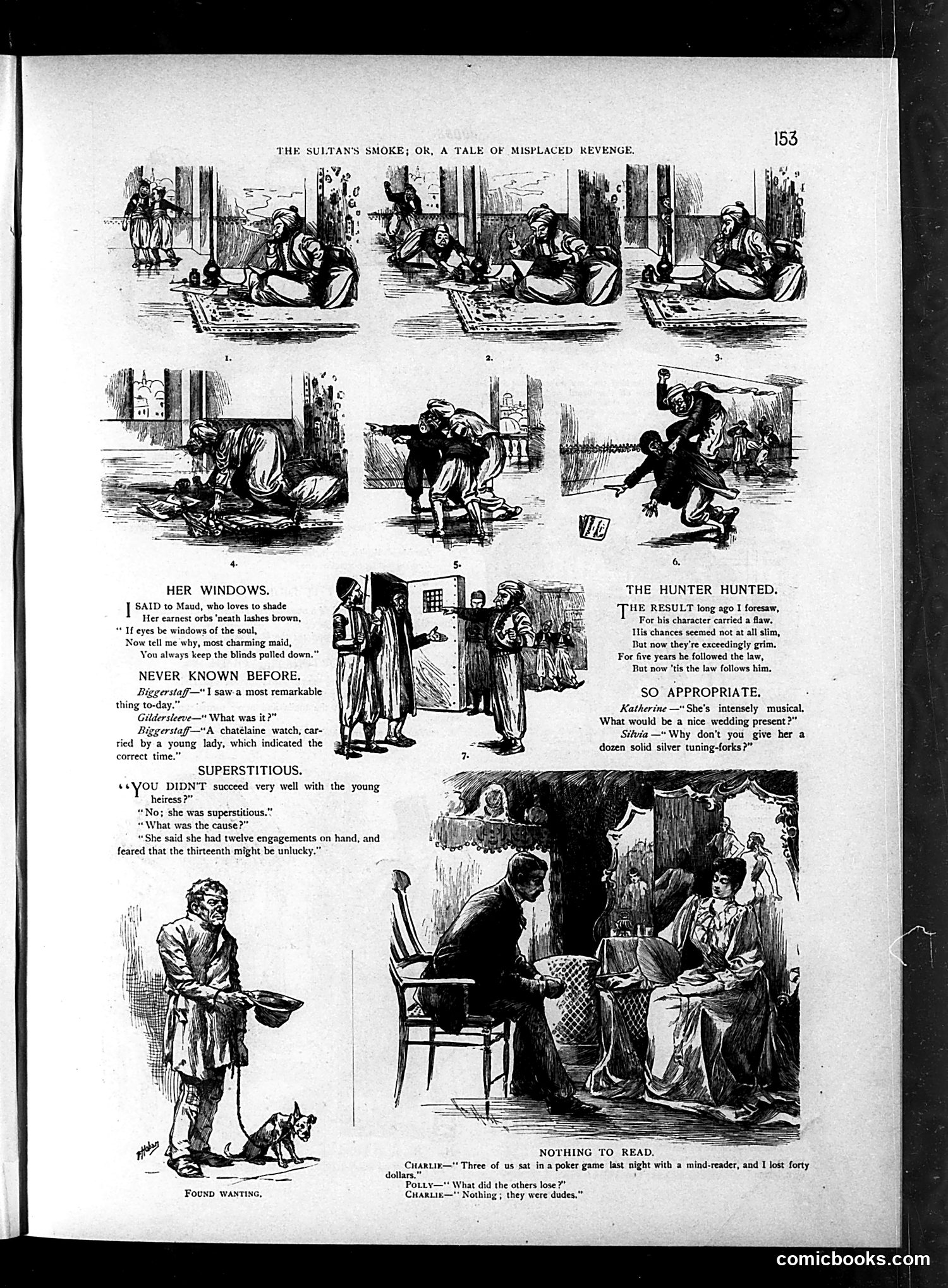
This page contains six separate humorous sketches typical of late-19th-century American satirical magazines: 1. **"Her Windows"** jokes about a woman's mysterious demeanor using the "eyes as windows to the soul" metaphor. 2. **"Never Known Before"** satirizes unreliable timekeeping by mocking a watch that actually keeps correct time—presented as shockingly rare. 3. **"Superstitious"** mocks a woman rejecting a suitor because she already has twelve engagements and fears thirteen as unlucky, satirizing both superstition and women's dating prospects. 4. **"The Hunter Hunted"** presents a morality tale about a man fleeing the law after five years of supposedly reformed behavior. 5. **"So Appropriate"** jokes about giving a musical woman solid silver tuning-forks as a wedding gift—a pun on her interests. 6. **"Nothing to Read"** mocks "dudes" (fashionable but empty-headed men) who lost nothing in a poker game because they had nothing to lose, implying intellectual emptiness. The page showcases Judge's blend of social commentary and genteel humor targeting Victorian-era foibles.
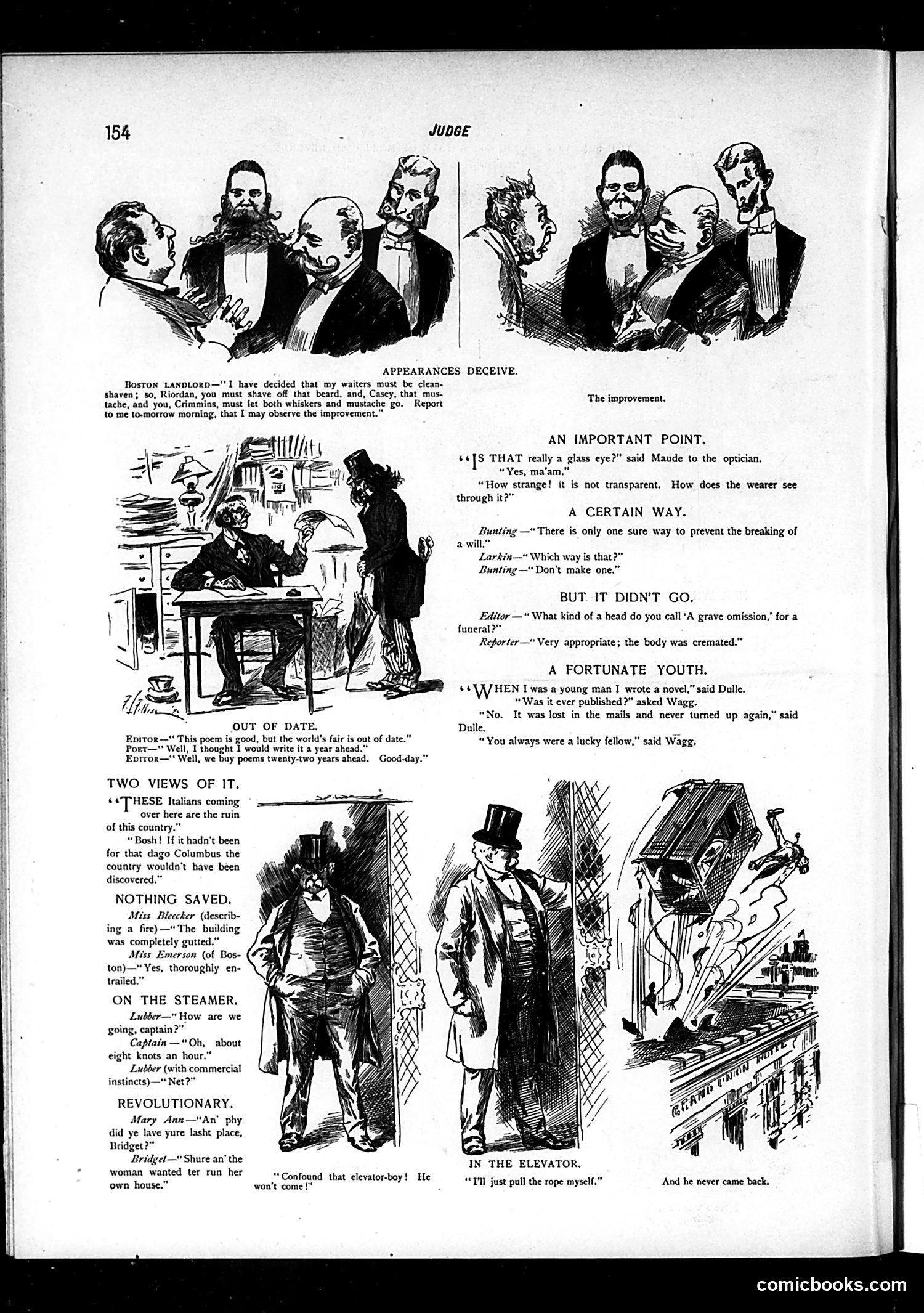
This page contains multiple unrelated satirical sketches typical of Judge's humor format: **"Appearances Deceive"** mocks a Boston landlord who orders his waiters to shave, expecting improvement. The joke suggests appearances don't reflect quality—clean-shaven waiters won't serve better. **"Two Views of It"** presents Irish immigrant stereotypes debating Italian immigration. One criticizes "dagos" as ruinous; the other ironically notes Columbus (himself Italian) discovered America—satirizing contradictory anti-immigrant sentiment. **"Out of Date"** jokes about editorial timelessness: a poet's work becomes dated within a year, yet editors buy poems "twenty-two years ahead." **"On the Steamer"** features a landlubber asking ship's speed; when told "eight knots an hour," he asks "Net?"—confusing nautical terminology with commercial accounting. **"In the Elevator"** darkly depicts an elevator operator who pulls the rope himself and "never came back"—suggesting suicide or fatal accident, played for grim humor. Other brief sketches satirize pretension, malapropisms, and misfortune in typical turn-of-century Judge fashion.
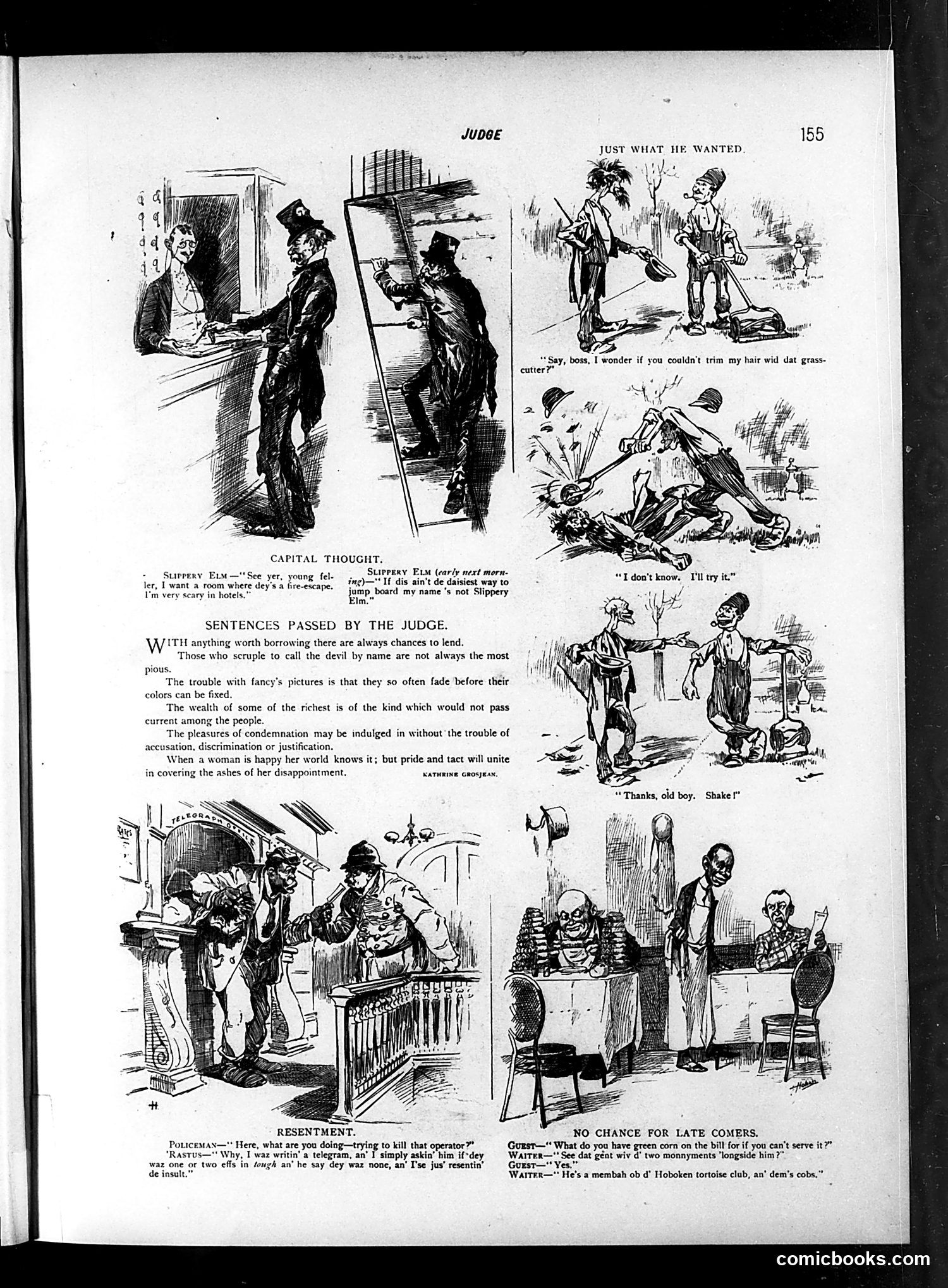
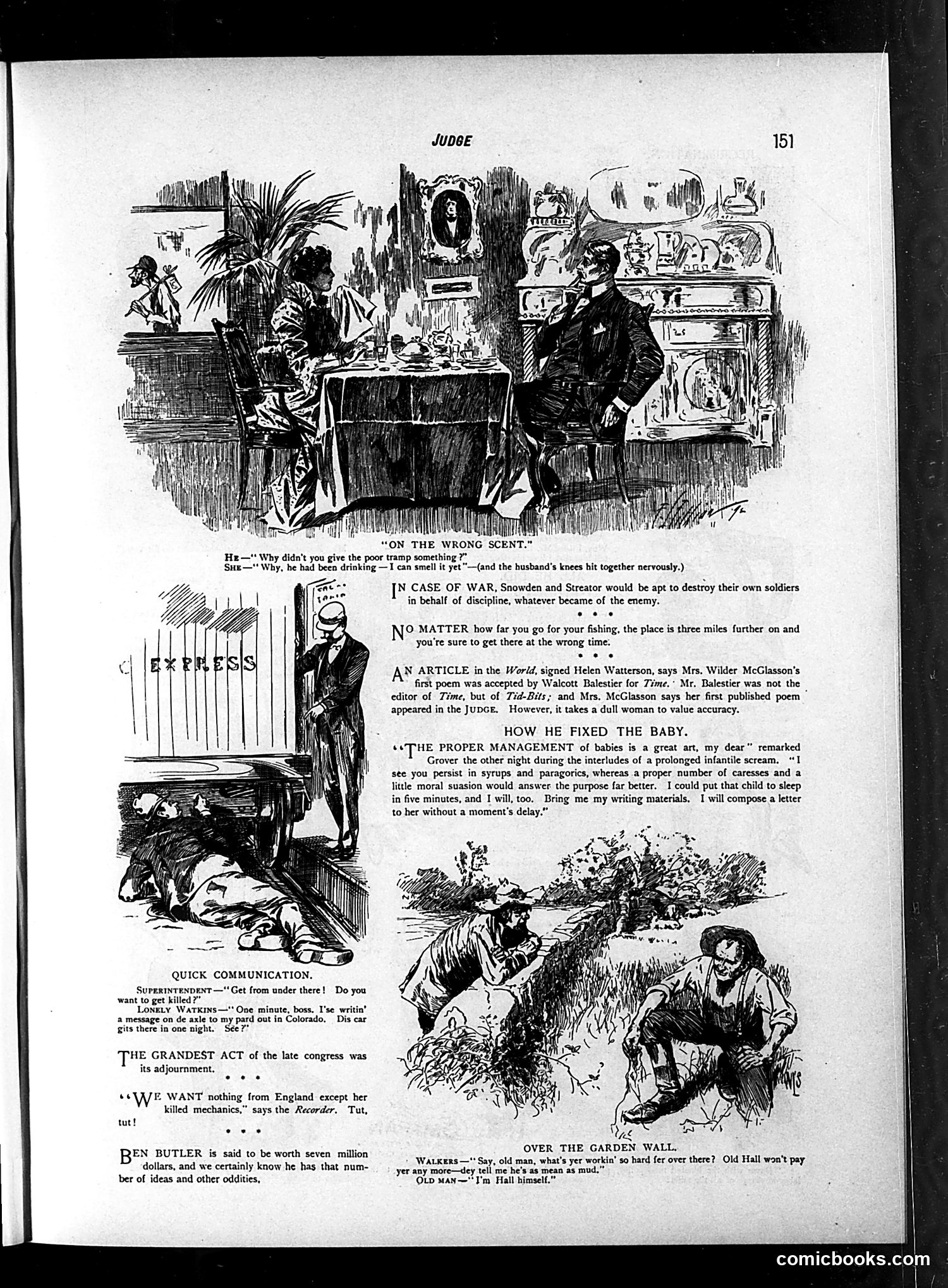
This page from *Judge* contains multiple satirical comics and moral observations from the early 20th century. The main cartoons depict everyday frustrations: a nervous hotel guest seeking a room with escape routes; a man complaining about telegram operators; a diner upset about corn on a restaurant bill; and a waiter's dig at a patron accompanied by two conspicuous men (the "monuments" reference suggests gangsters or thugs, implying the guest keeps dubious company). The "Sentences Passed by the Judge" section offers philosophical observations about human nature—wealth, hypocrisy, and emotional restraint—rather than legal judgments. The humor relies on class-based mockery (servants, workers), ethnic dialect stereotypes in the speech patterns, and period-specific references to hotels, telegrams, and social anxieties. The tone is cynical about human character and morality, typical of *Judge*'s satirical approach to American society.
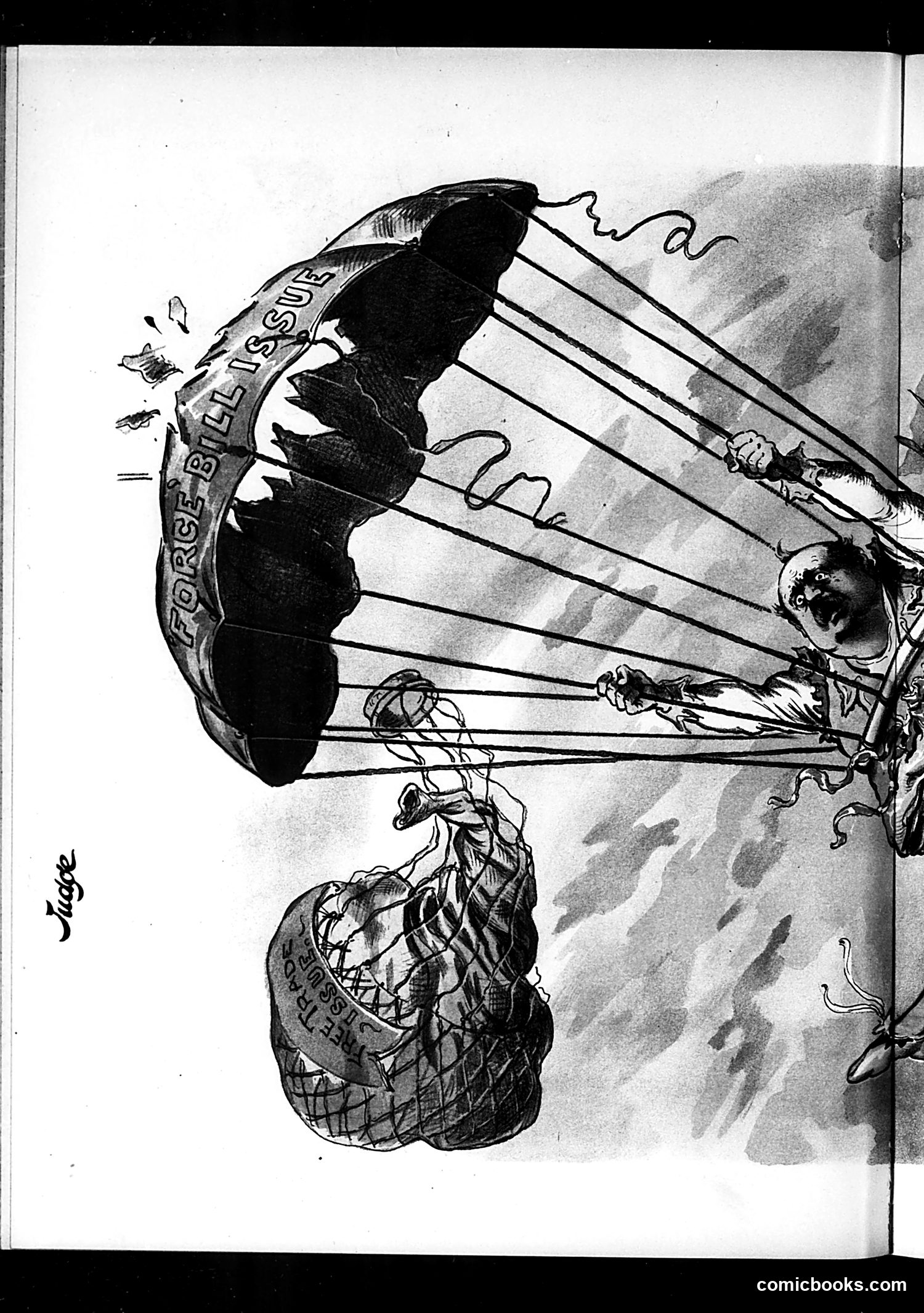
This appears to be a political cartoon from *Judge* magazine showing a large balloon or dirigible labeled "FOREIGN ISSUES" being manipulated by multiple figures pulling strings, with a basket below labeled "PULLED BY STRINGS" (or similar). The satire suggests that American foreign policy is being controlled by outside forces or special interests rather than developing organically. The figures pulling the strings likely represent various foreign powers, lobby groups, or political factions competing for influence over U.S. international affairs. The cartoon critiques the idea that American decision-making on foreign matters is being puppeteered rather than independently determined. Without a clear date visible, the specific historical context remains uncertain, though this reflects recurring anxieties about foreign influence in American politics.
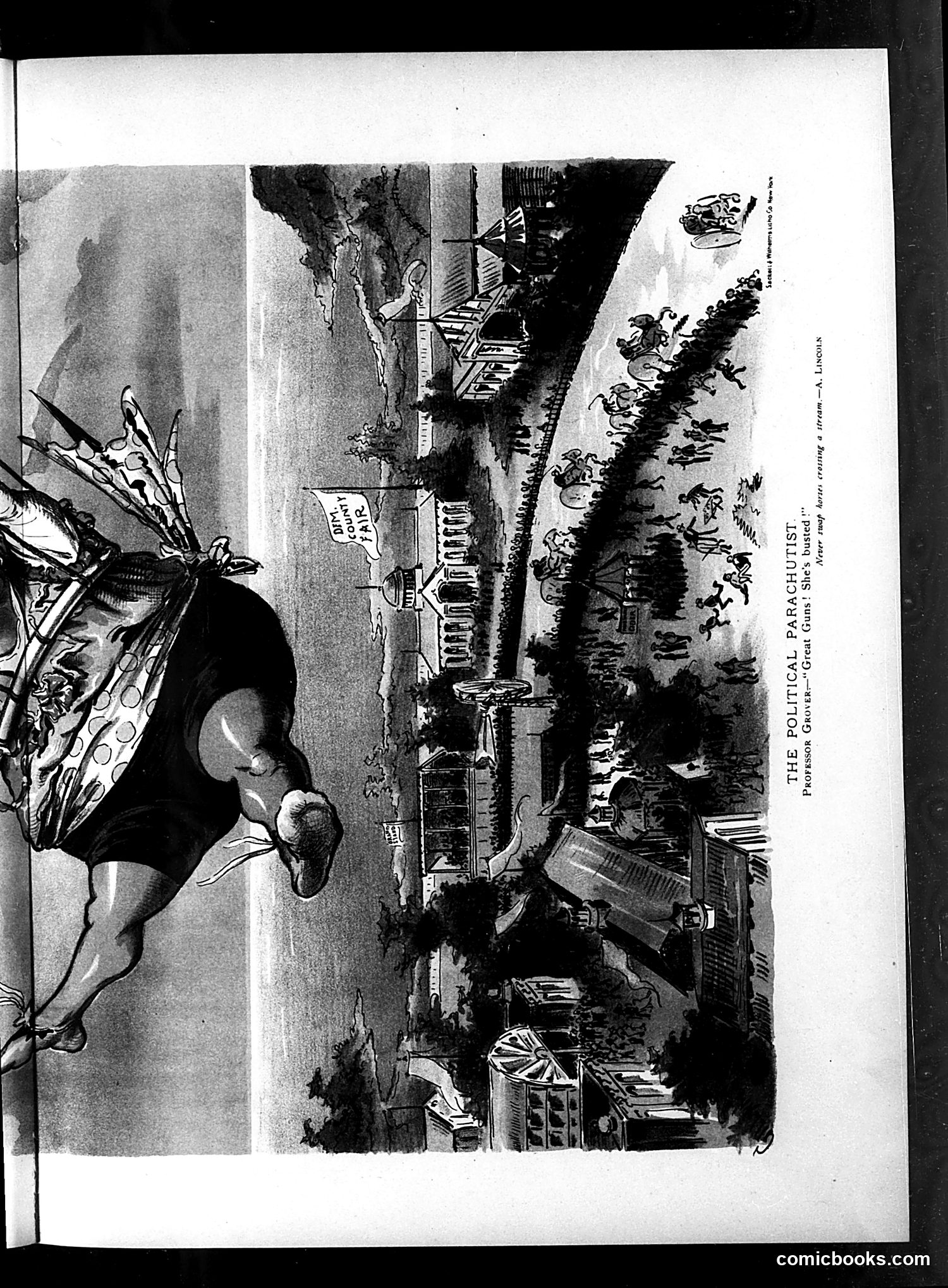
I cannot reliably read the OCR text on this page—it appears garbled or corrupted. The image itself, when viewed rotated, shows what appears to be a street scene with multiple figures and period architecture, consistent with Judge magazine's satirical style. However, without legible text identifying the specific figures, events, or political references, I cannot accurately explain what particular people or situations are being caricatured or what point the satire makes. To provide accurate historical context, I would need either clearer OCR text or additional identifying information about the publication date and subject matter.
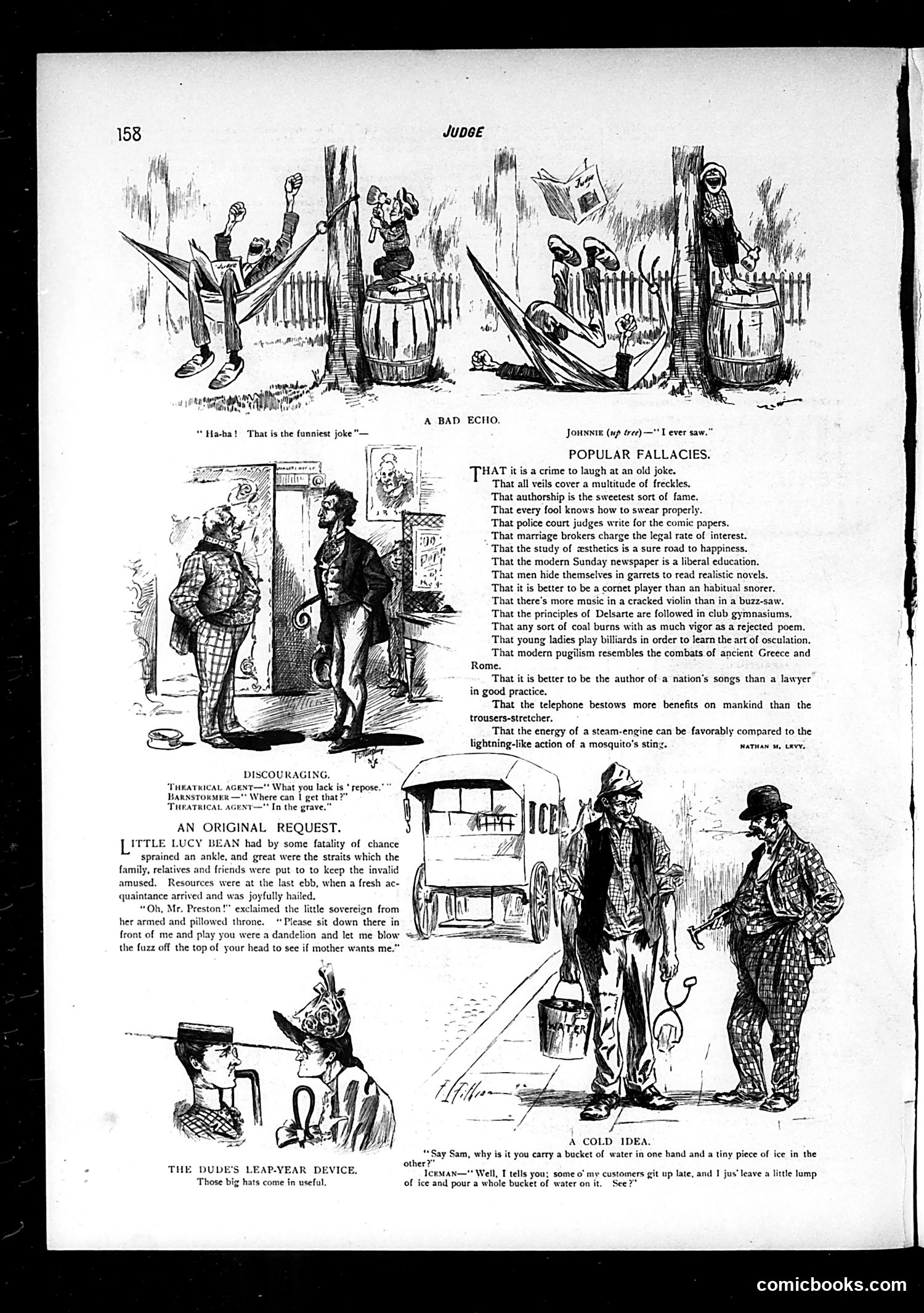
This page from Judge magazine contains several unrelated satirical pieces typical of the publication's humor: **"A Bad Echo"** (top): Visual gags about people's reactions to jokes, playing on the phrase "bad echo." **"Popular Fallacies"** (center): A list of common misconceptions that Judge ridicules—ranging from literary pretensions ("authorship is the sweetest sort of fame") to social absurdities (young ladies playing billiards to learn "osculation"/kissing). The satire mocks both high-minded cultural claims and absurd social customs. **"An Original Request"**: A humorous anecdote about an injured child asking a guest to pretend to be a dandelion so she can blow the fuzz off his head. **"A Cold Idea"** (bottom): An ice seller explains his scheme to lazy customers—leaving a small piece of ice with a bucket of water, implying it will melt slowly enough while they sleep in. The page reflects late 19th/early 20th-century American humor: observational satire about social pretension, domestic life, and working-class characters. No specific political figures are caricatured here.
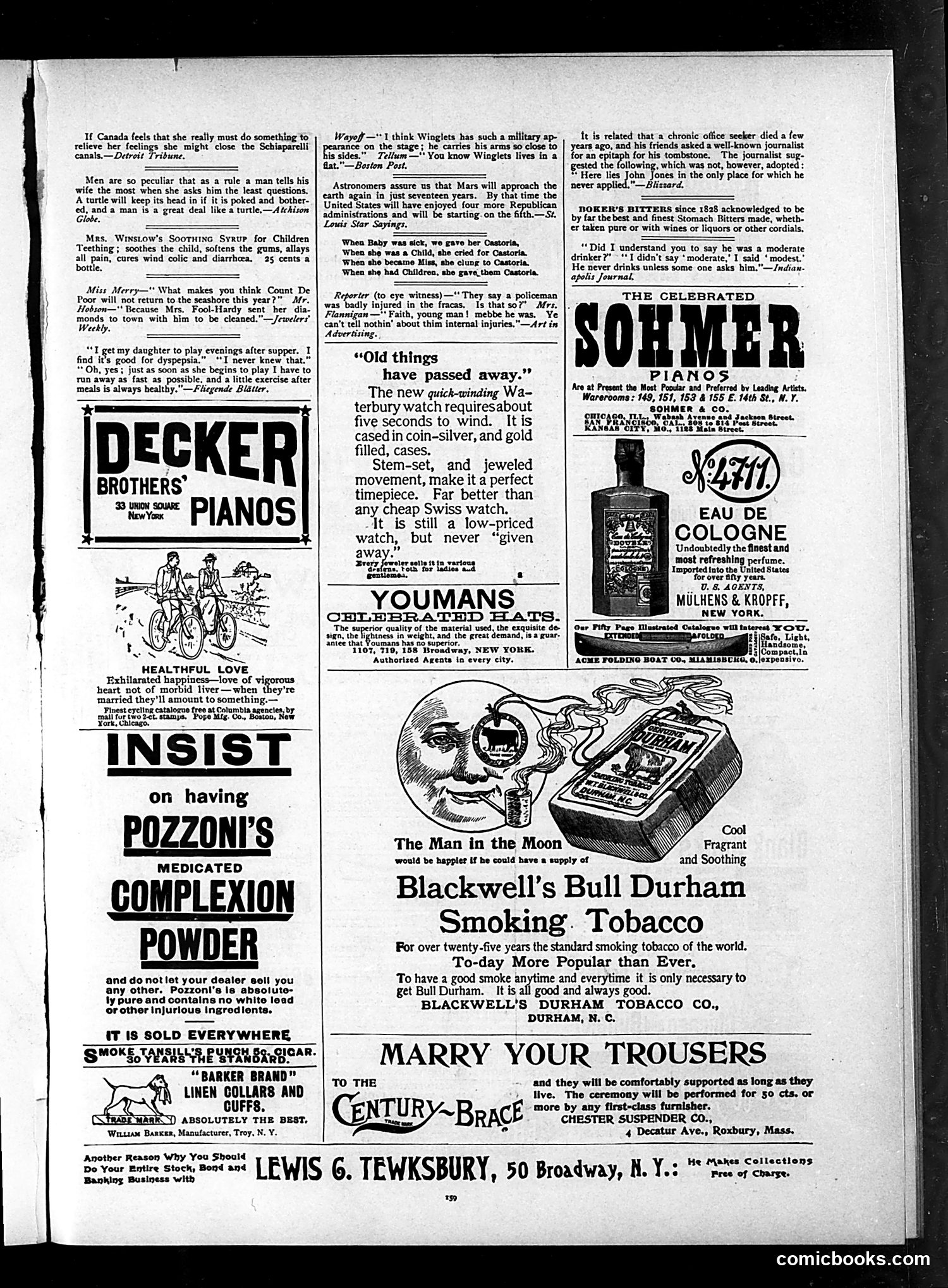
This page is primarily **advertising**, typical of Judge magazine's revenue model. However, several brief satirical items appear: **Political satire:** - A joke about Mars approaching Earth in seventeen years references Republican administrations—suggesting four more GOP terms would occur before then. This reflects late 19th-century partisan humor. - A quip about Canada closing the "Schiaparelli canals" references the contemporary astronomical controversy over whether Mars had artificial canals, mixing current science with political jest. **Social humor:** - Jokes about marriage, dyspepsia, and domestic life reflect period middle-class concerns. - A bitter epitaph about an "office seeker" who never succeeded satirizes jobless political appointees. **Advertisements** dominate: pianos, complexion powder, watches, hats, tobacco, and patent medicines—products marketed to affluent readers. The ads reveal era-specific anxieties about appearance, health, and respectability. The content reflects Judge's typical blend of light political commentary and commercial messaging for an educated, prosperous audience.
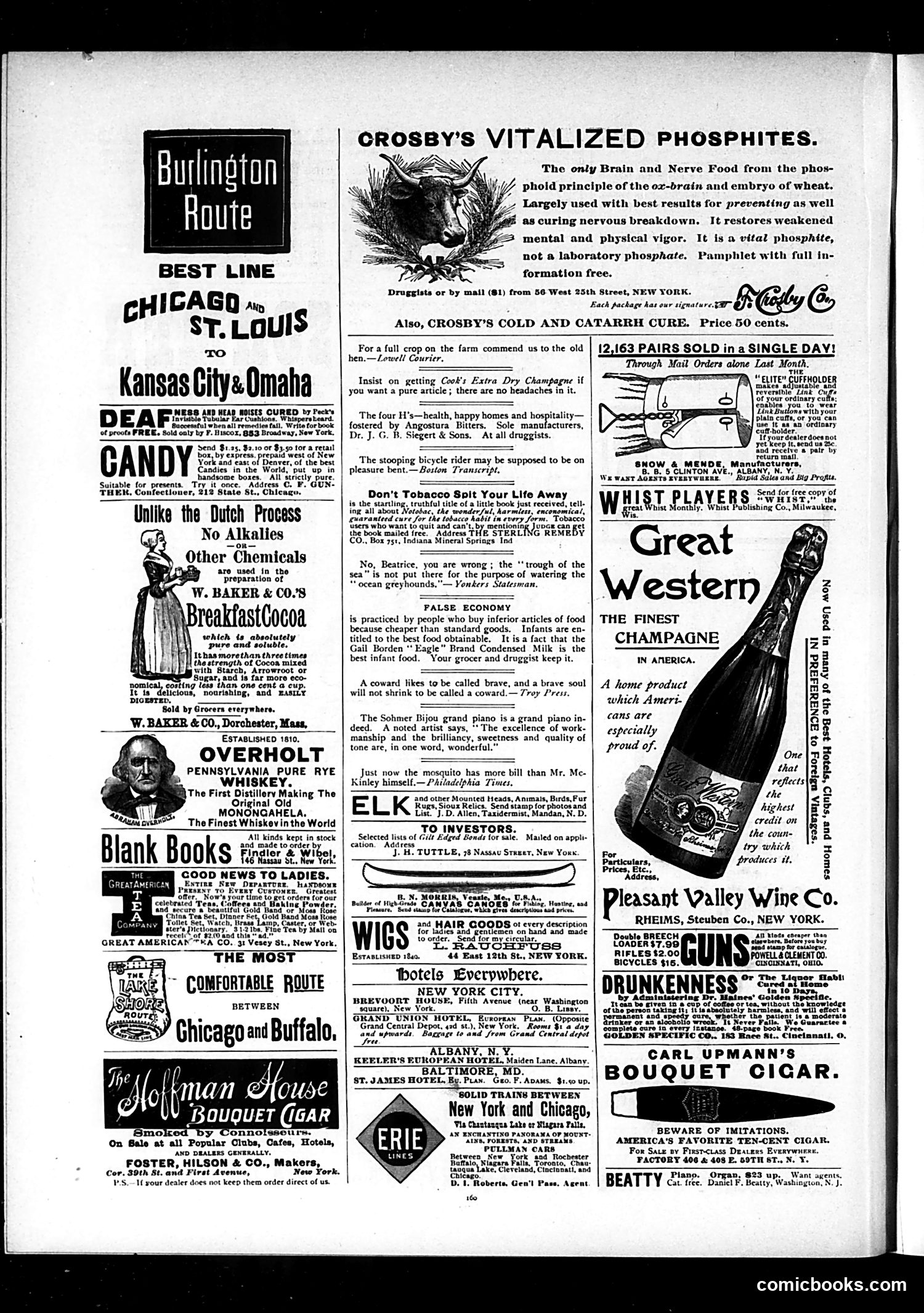
This page is primarily **advertising**, with no significant political cartoons or satirical content to analyze. The advertisements reflect late-19th/early-20th-century consumer culture: patent medicines (Crosby's Phosphites for "nervous breakdown"), alcohol (champagne, rye whiskey), tobacco products, and domestic goods. Several ads target women with "scientific" products (Ear Cushions, face creams). The few short humorous snippets are mild observational jokes—a bicycle rider "on pleasure bent," confusion about ocean terminology, distinctions between cowardice and bravery—unrelated to politics or social satire. The page also includes transportation ads (Burlington Route, Erie Lines) and hotel listings, typical of Judge's revenue model. This appears to be a standard revenue-focused issue page rather than one devoted to satirical commentary on current events or public figures.
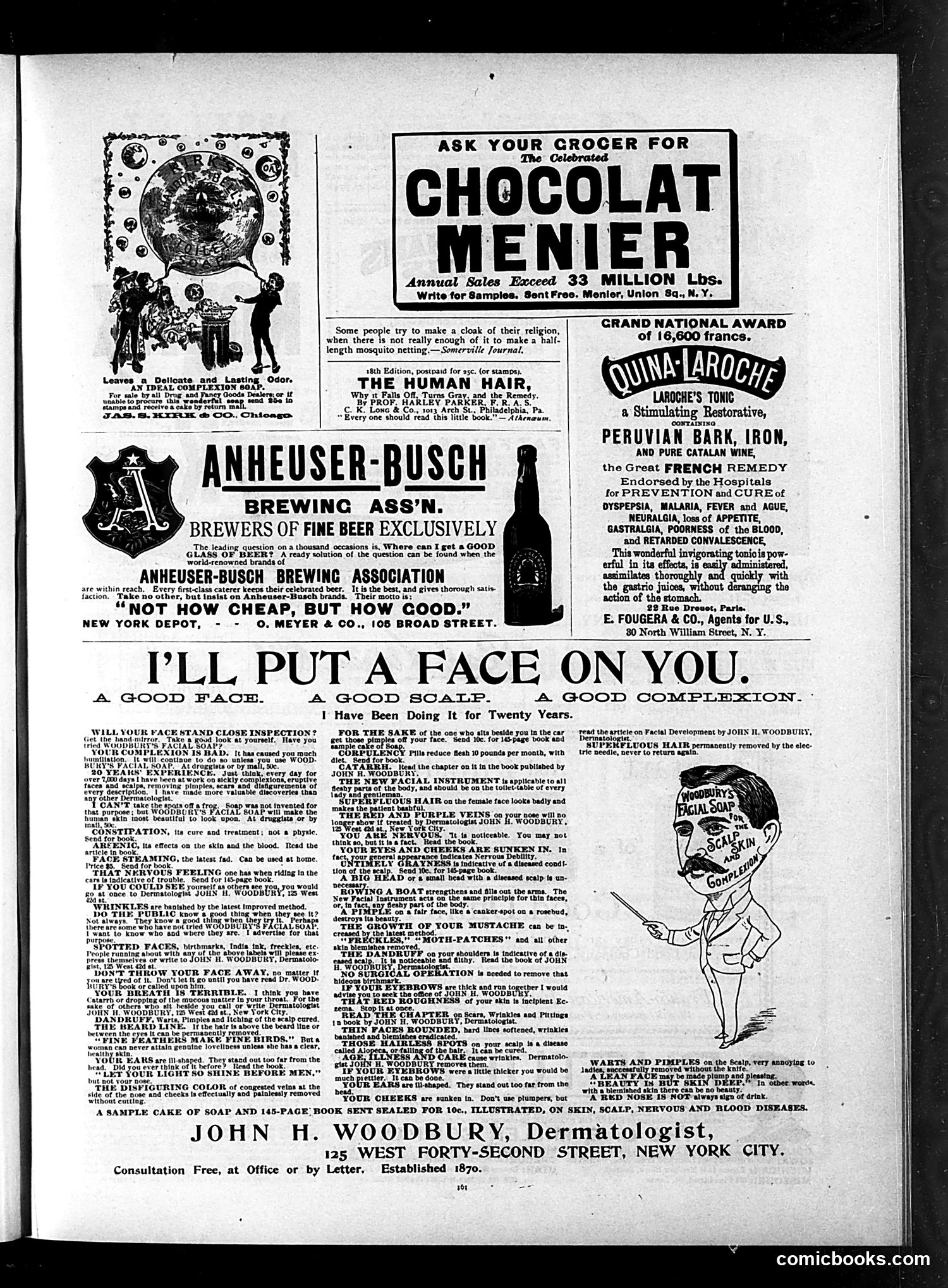
This page is primarily **advertising**, not editorial satire. The dominant feature is a large advertisement for John H. Woodbury's dermatological products and services, occupying the lower two-thirds of the page. The Woodbury ad uses a quasi-scientific approach to sell facial soap, treatments for "superfluous hair," skin conditions, and various remedies—promising to improve appearance, complexion, and even reduce weight. The illustrations show a cartoonish face treatment scenario. The smaller ads above include: - **Chocolat Menier** (chocolate) - **Anheuser-Busch** brewing - **Quina-Laroche** tonic wine (marketed as remedy for malaria, fever, digestive issues) The single satirical quote at top—about people using religion as a thin "cloak" when they lack real substance—appears unrelated to the advertisements below. The page reflects late 19th-century American magazine culture, where advertising and editorial content mixed freely, and dubious health/beauty claims were standard marketing practice.
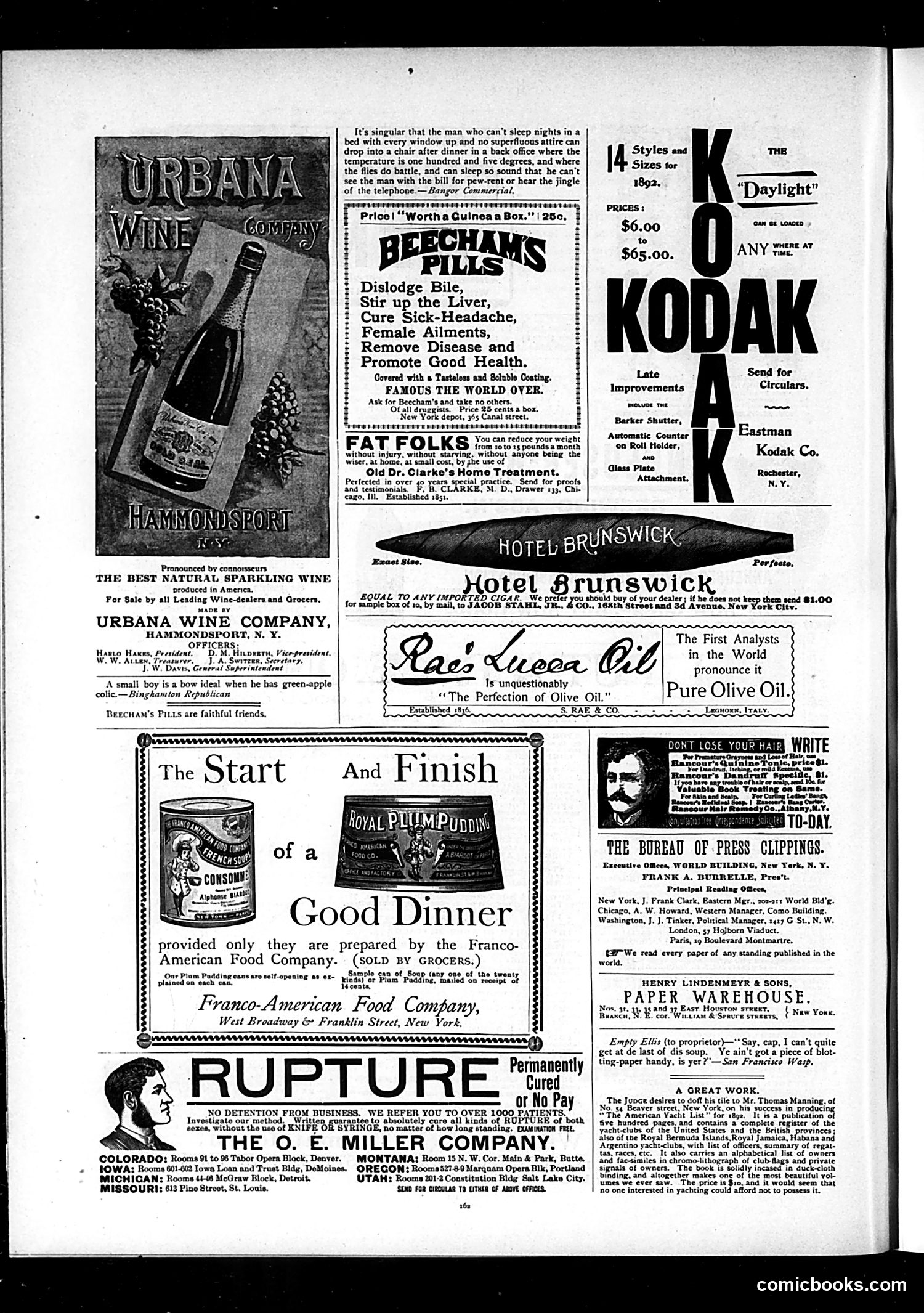
This page is primarily filled with advertisements rather than political cartoons or satire. The few humorous items present are brief observations rather than developed commentaries: **"The Singular Sleep" vignette** (top): A short joke noting the irony that a man unable to sleep in his comfortable bed can doze soundly in a sweltering back office—likely poking gentle fun at human inconsistency and discomfort. **"A Small Boy" quip** (middle): A brief, affectionate joke about boys and stomach ailments from green apples—a common childhood experience. **"Empty Ellis" cartoon** (bottom): A working-class man complains to a restaurant proprietor about soup consistency—straightforward working-class humor without clear political satire. The page is dominated by patent medicine ads (Beecham's Pills, weight-reduction treatments), food company advertisements, and business service announcements. No identifiable political figures or clear satirical targets are visible. This appears to be a typical Judge magazine page mixing light humor with commercial advertisements.
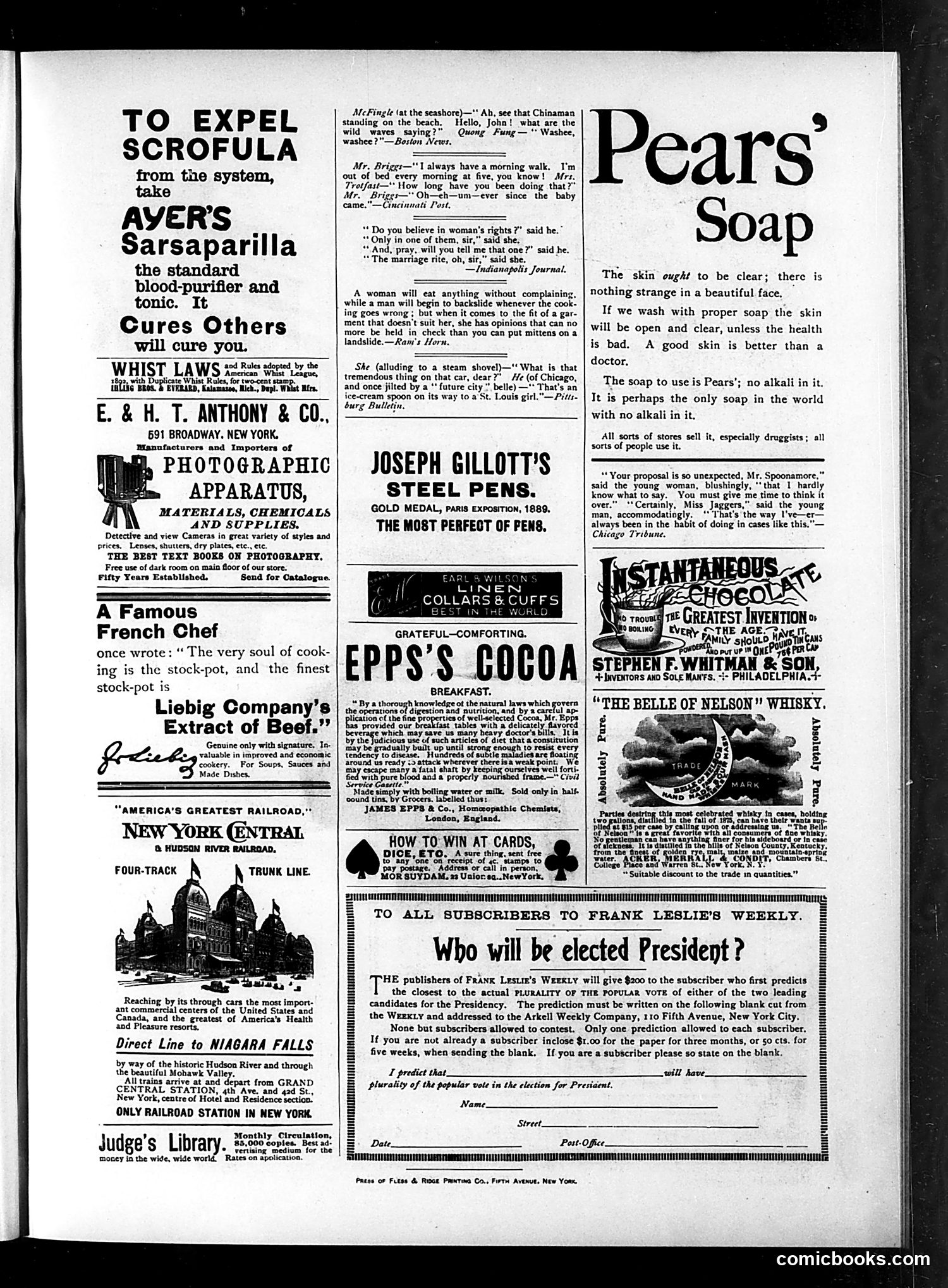
This page is primarily **advertising**, with scattered brief humorous snippets—typical of Judge's format. **Notable Content:** The ads showcase late-19th-century commercial products: blood purifiers (Ayer's Sarsaparilla), photographic equipment, railroad services, cocoa, steel pens, and soap. Pears' Soap receives prominent display. **Humor pieces** are brief, reflecting period attitudes: - A "Chinaman" stereotype joke about laundry - A woman's rights joke reducing women's equality to marriage ceremonies - Observations about gender differences in cooking/clothing complaints **No significant political cartoons appear**—the page lacks the satirical commentary Judge was known for. The "Who will be elected President?" contest at bottom offers cash prizes for predictions but provides no cartoon analysis. The page represents Judge as primarily a vehicle for advertising revenue, with light humor filler rather than substantive satire. The brief jokes reflect casual Victorian-era racial and gender stereotypes normalized in period publications.
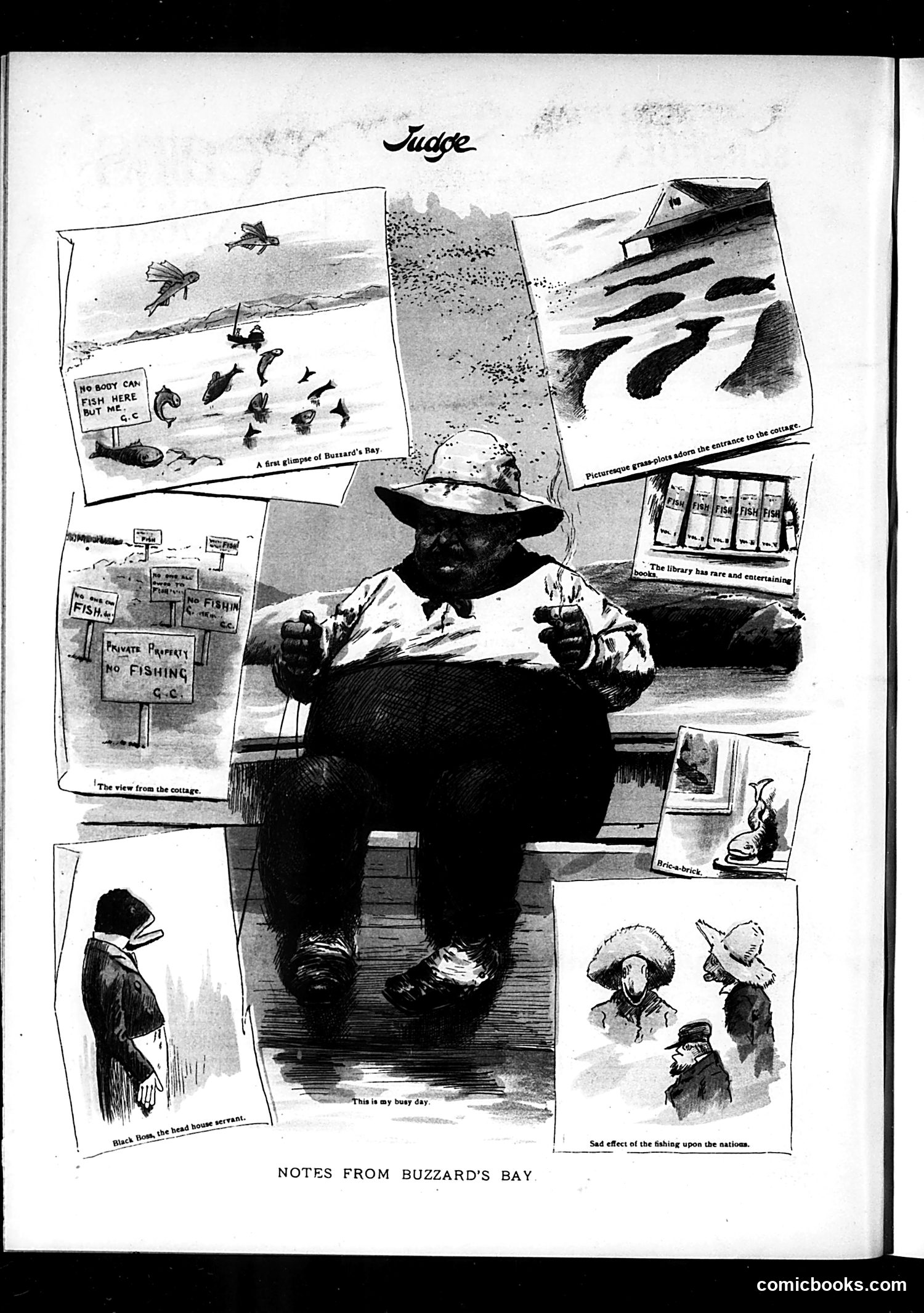
This Judge cartoon satirizes a fishing vacation at Buzzard's Bay (Massachusetts). The central figure is a heavyset man in a wide-brimmed hat sitting on a dock, surrounded by various vignettes depicting his fishing trip's failures and disappointments: empty catch, "No Fishing" signs, sparse fish in the bay, and a cottage view that proves underwhelming. The humor lies in contrasting vacation expectations with reality. Captions like "This is my busy day" and references to the "sad effect of fishing upon the natives" suggest the fisherman's boredom and the locals' weary tolerance of seasonal tourists. The "library has rare and entertaining" books reference implies even intellectual diversions fail to entertain. Overall, it mocks the disappointment of American leisure travel and fishing vacations.