
A complete issue · 16 pages · 1892
Judge — July 16, 1892
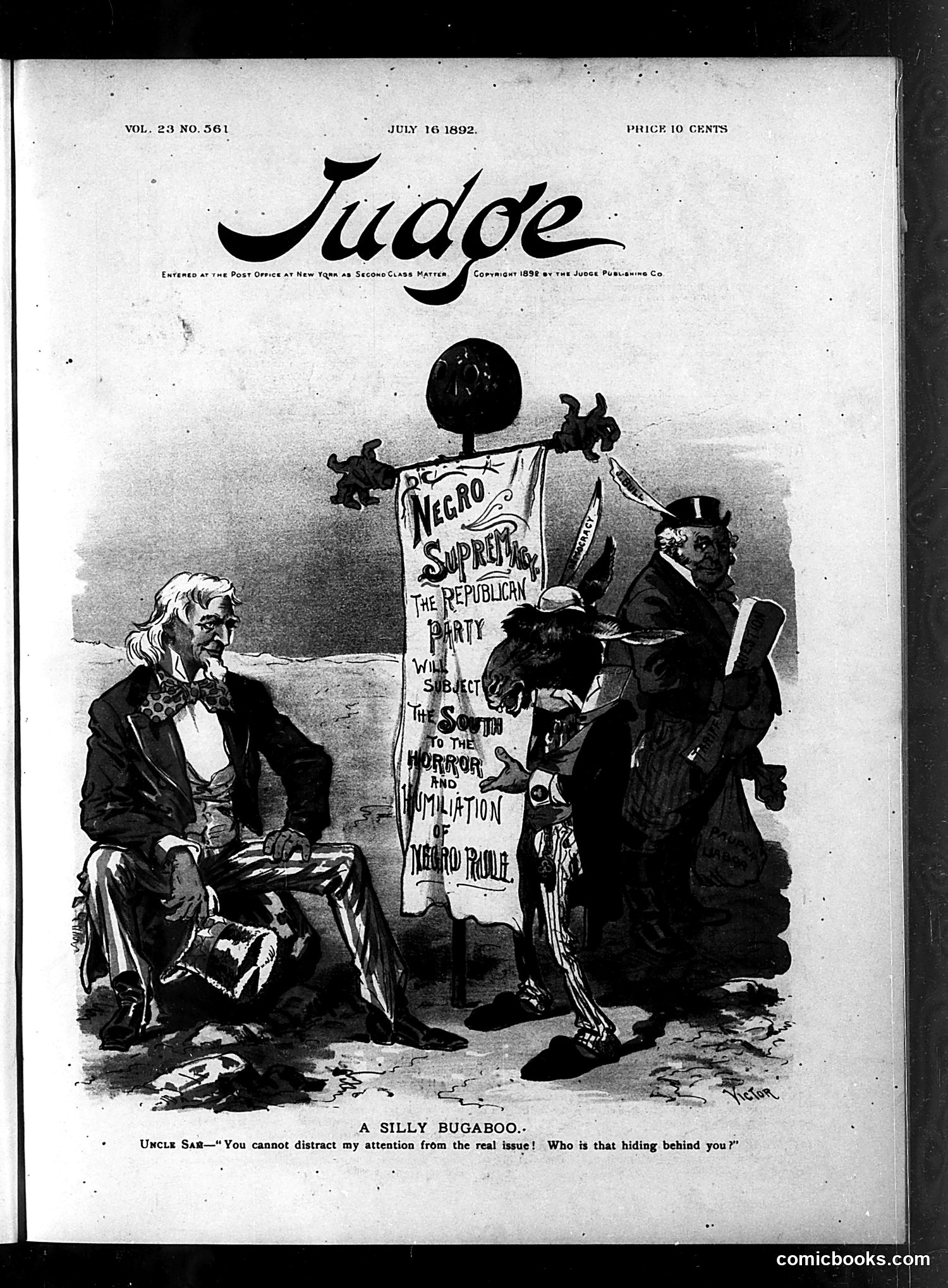
This political cartoon satirizes Republican anxieties about the 1892 election. "Uncle Sam" (left, representing the nation) sits calmly while caricatured Republican figures panic around a banner reading "NEGRO SUPREMACY" and referencing "THE REPUBLICAN PARTY" subject to "HORROR AND HUMILIATION OF NEGRO RULE." The cartoon's message: Republicans are needlessly alarmed by fears of Black political power—hence "bugaboo" (a phantom threat). The hidden figure behind Uncle Sam represents the actual issue being distracted from. The satire mocks how Republicans invoke racial panic while ignoring genuine political problems. This reflects the polarized racial politics of the 1890s Gilded Age, when competing parties weaponized racial anxieties.
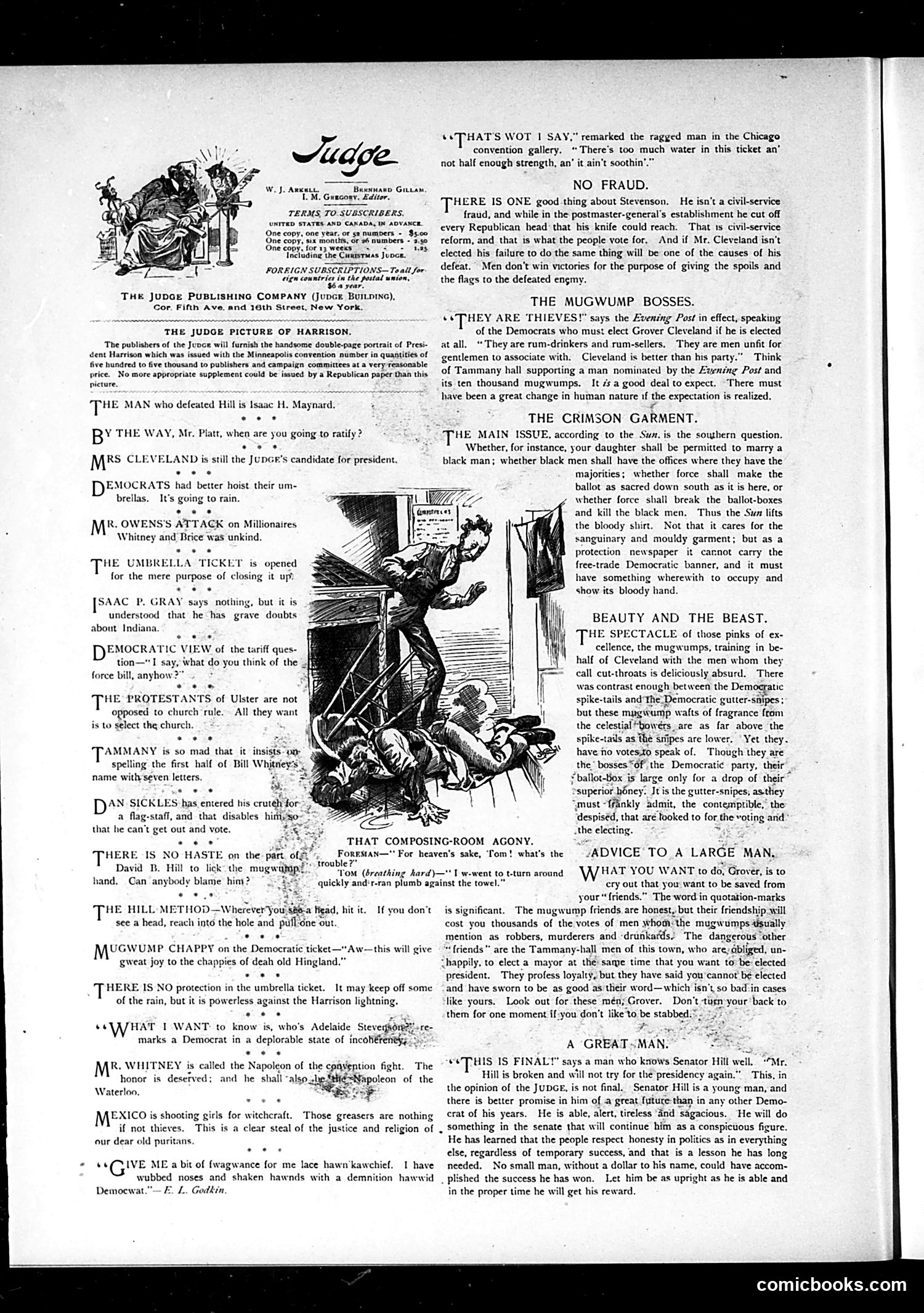
This page contains editorial commentary on the 1884 presidential election, with references to Grover Cleveland and Republican candidates. The central cartoon depicts a figure struggling with an "Umbrella Ticket" - likely symbolizing the Democratic party's fractured unity. Key targets of satire include: - **Cleveland's candidacy** despite moral questions about his personal conduct - **Mugwumps** (Republicans who switched to Cleveland) described as hypocritical - **Democratic inconsistency** on race and Southern issues - the "crimson garment" section criticizes Democratic tolerance of racial violence while claiming moral superiority The cartoon's grotesque imagery suggests Judge's view that Democratic claims of reform ring hollow given their actual positions on crucial issues. The satire is sharp-edged political commentary rather than humor.
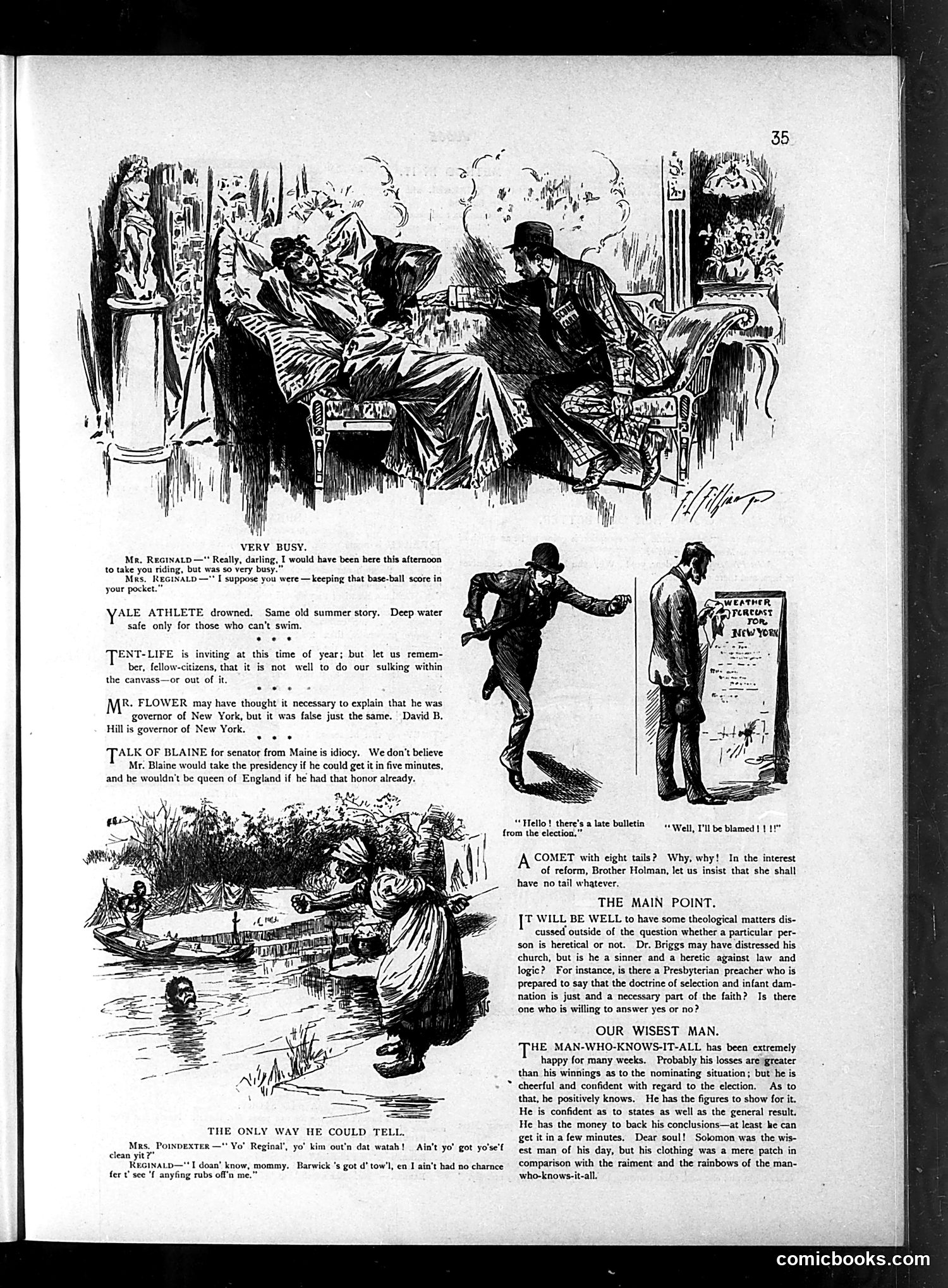
This page contains several satirical sketches and commentary on contemporary political figures and issues. **Top cartoon ("Very Busy")**: Shows two men in conversation, likely depicting political figures of the era discussing their schedules. **Middle cartoons**: Include sketches of a man checking a "Weather Forecast for New York" and another receiving election news ("Hello! there's a late bulletin from the election"). **Text sections**: Include commentary on New York's governor (mentions "Mr. Flower" and "David B. Hill" as New York governors), and discussion of Mr. Blaine's potential presidential ambitions. "The Main Point" section discusses theological matters—whether someone is a heretic—suggesting debate over religious orthodoxy. **"Our Wisest Man"** critiques "the man-who-knows-it-all," portraying someone confident in political predictions despite uncertain outcomes. The satire targets political overconfidence and pretension during what appears to be an election season.
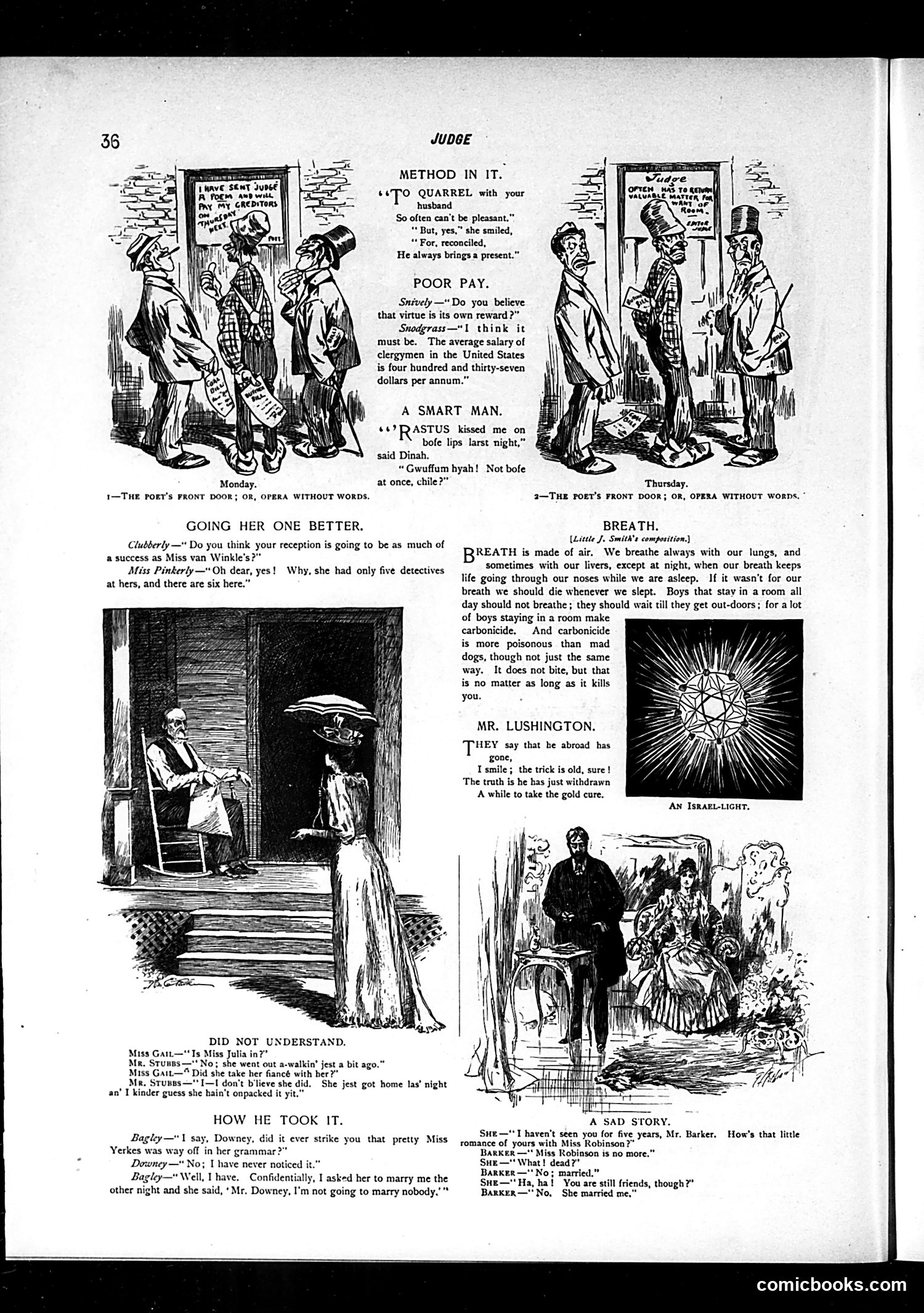
This page from Judge presents several brief satirical sketches typical of late 19th-century American humor: **"Method in It"** mocks marital discord by suggesting wives deliberately quarrel to receive reconciliation gifts—satirizing both domestic friction and materialistic relationships. **"Poor Pay"** criticizes clergy salaries, with a minister claiming virtue's own reward must suffice since clergymen earn only $437 annually—social commentary on undercompensated religious workers. **"A Smart Man"** uses racist dialect humor (common to the era) featuring a Black character named Rastus, reflecting period prejudices. **"Going Her One Better"** jokes about a socialite's reception being more prestigious because she hired six detectives versus five at a rival's event—mocking wealthy pretension. **"Breath"** appears to be a humorous child's composition about breathing, likely satirizing innocently flawed children's essays. **"Mr. Lushington"** suggests a man claiming to be abroad has actually entered an alcohol treatment facility—the "gold cure" being a contemporary medical treatment for alcoholism. **"A Sad Story"** presents a brief, ironic dialogue about a woman who married someone else. The page is primarily humor rather than political satire.
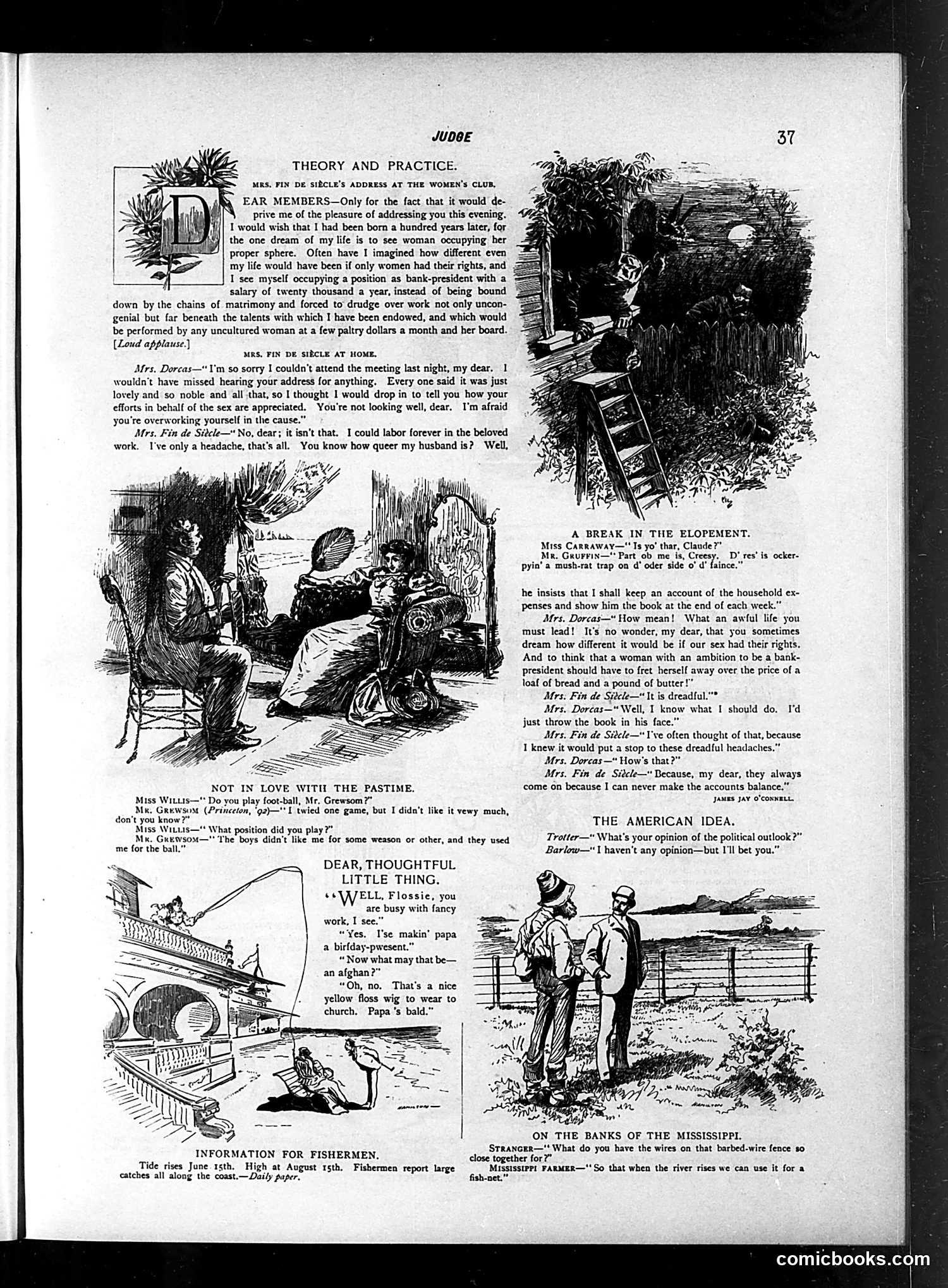
This page satirizes the hypocrisy of "New Woman" feminism in the 1890s fin-de-siècle era. Mrs. Fin de Siècle delivers a rousing speech to a women's club about female equality and ambition—dreaming of becoming a bank president instead of being bound by matrimony and domestic drudgery. The satire's punch: immediately afterward, at home, she's revealed as precisely the woman she theoretically opposes. She's exhausted managing household expenses and accounting for bread and butter costs. Her headaches stem from inability to balance household books—not oppression, but practical incompetence. When her friend suggests throwing the ledger at her husband, Mrs. Fin de Siècle realizes that's already her impulse, suggesting her "feminist" ideals collapse under actual domestic reality. The cartoon mocks privileged women activists whose grand rhetoric about women's rights masks they haven't actually challenged their own marriages or domestic roles. Their feminism remains performative theory disconnected from lived practice.
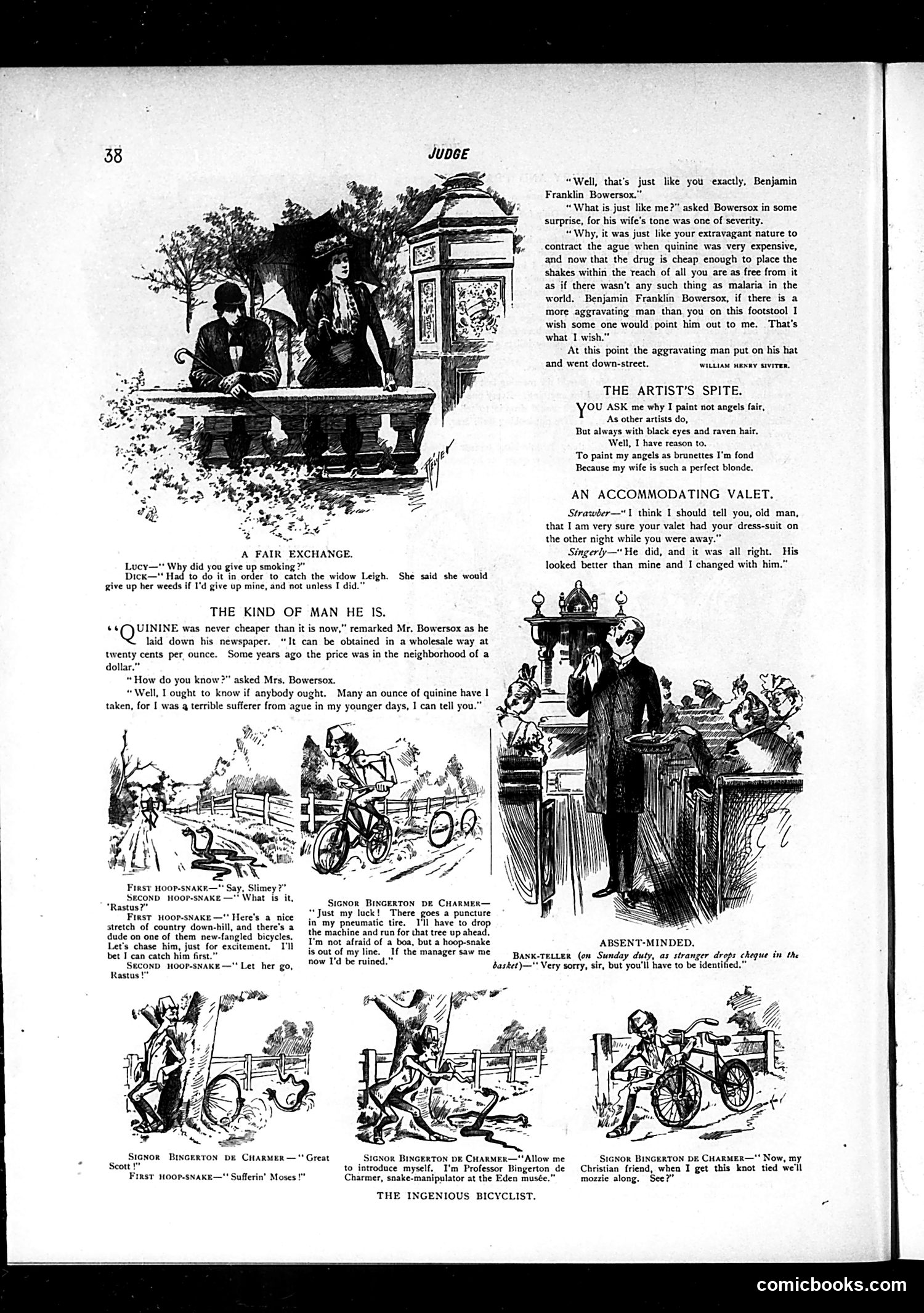
This page contains several brief satirical pieces typical of late-19th-century American humor: **"A Fair Exchange"** mocks romantic compromise—a man quits smoking so a widow will quit "weeds" (her vices). **"The Kind of Man He Is"** depicts Mr. Bowersox boasting about past quinine use for ague (malaria), prompting his wife to sarcastically note his convenient timing: he suffered when quinine was expensive, now he's healthy when it's cheap. The satire targets hypocritical male behavior and marital exasperation. **Hoop-snake cartoons** show slapstick encounters with the creature—a folkloric American tall tale. The final panel features "Signor Bingerton de Charmer," a circus snake-handler, trapped by the mythical snake. **Remaining pieces** include brief jokes: an artist painting dark-haired angels from spite toward his blonde wife; a valet borrowing his employer's suit; and a bank-teller's absent-mindedness on Sunday duty. The page emphasizes domestic comedy and physical humor rather than political commentary.
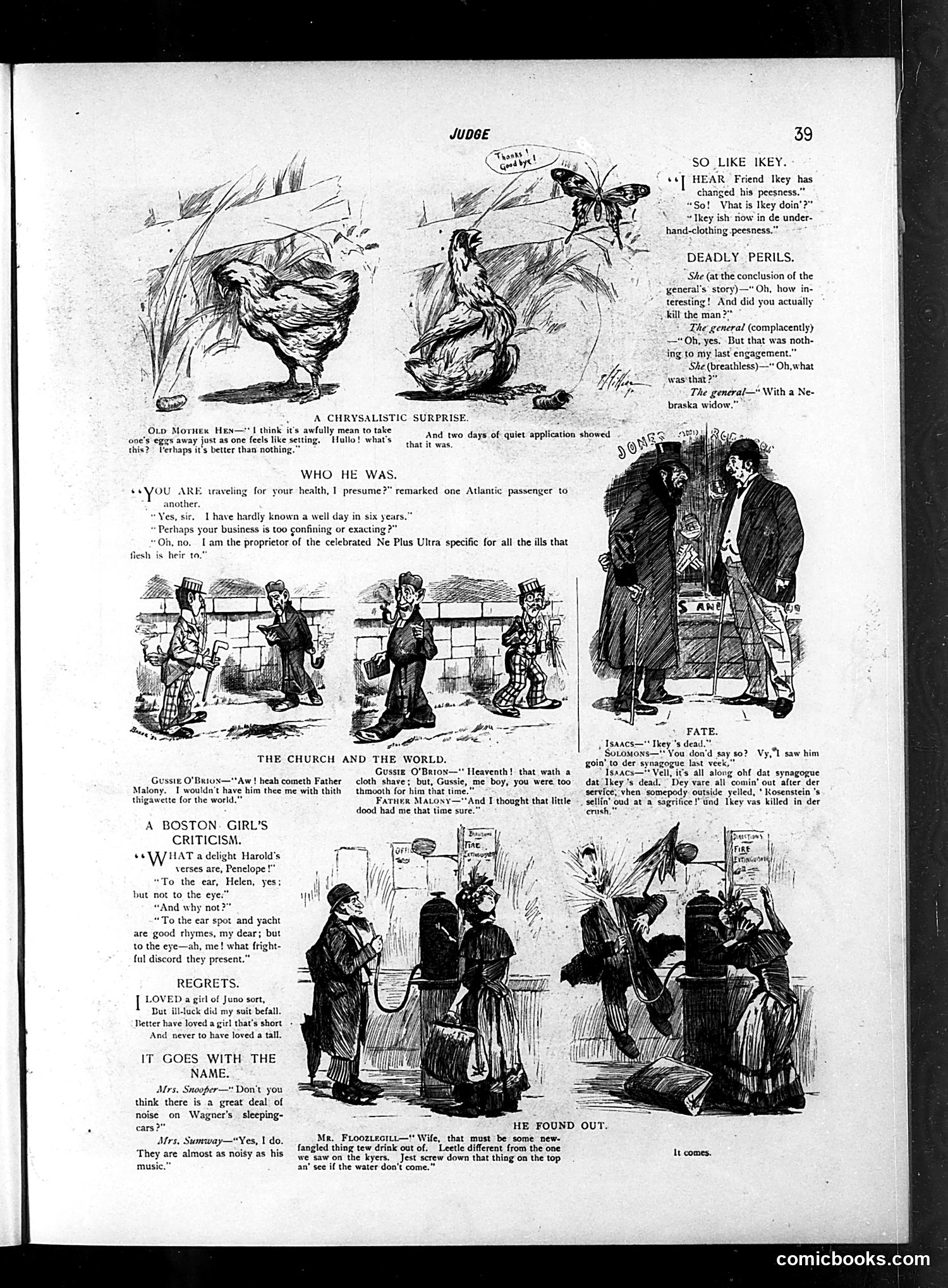
This page contains multiple brief satirical cartoons and jokes typical of Judge's humor: **"So Like Ikey"** mocks Jewish immigrants through dialect humor, depicting someone named Ikey changing from one business to another (the "under-hand-clothing peesness"). **"Deadly Perils"** is a mild joke about a general's romantic misadventure with a widow. **"Who He Was"** satirizes patent medicine quacks—a man travels claiming ill health while actually profiting from selling a fake cure-all called "Ne Plus Ultra." **"The Church and the World"** uses Irish and Jewish stereotypes (Gussie O'Brien, Father Malony, Ikey) in religious humor. **"A Boston Girl's Criticism"** gently mocks overly pedantic literary criticism based on visual appearance rather than sound. The remaining sketches employ similar light domestic humor and ethnic stereotyping common to the era. The page reflects Judge's reliance on crude caricature and dialect-based comedy targeting immigrants.
This political cartoon appears to depict a chaotic underwater or submerged scene with multiple figures wielding weapons or tools, suggesting conflict or struggle. Several caricatured characters are shown in animated, aggressive poses amid what appears to be distorted architectural elements or waves. The OCR text is largely illegible, providing no caption or title to clarify the specific political or social reference. Without visible text identifying the figures or event being satirized, I cannot definitively state what political situation, policy debate, or public figures this cartoon targets. The style and artistic quality suggest early-to-mid 20th century Judge magazine content, but determining the precise satirical point requires either clearer OCR results or additional contextual information about the publication date and issue.
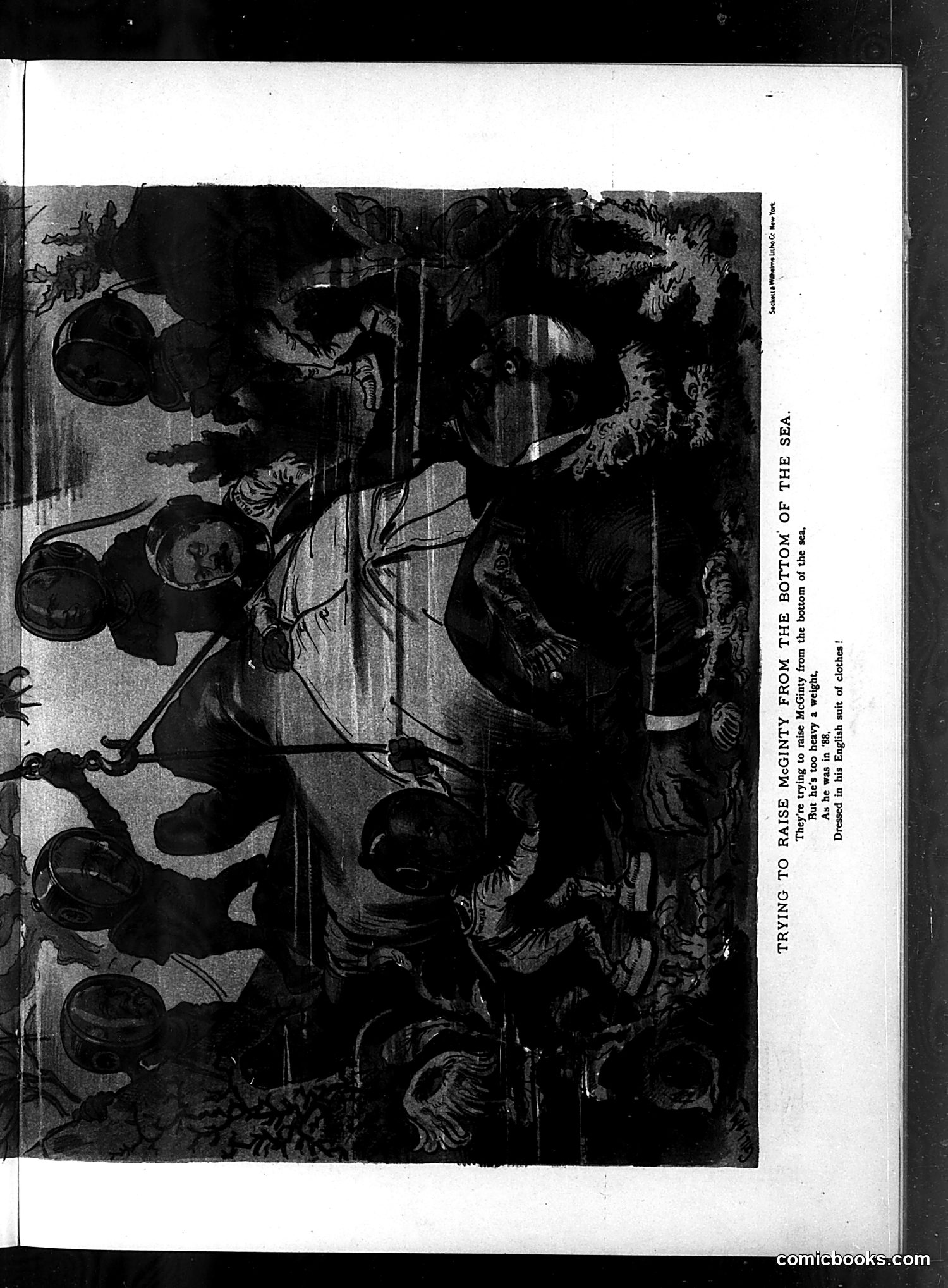
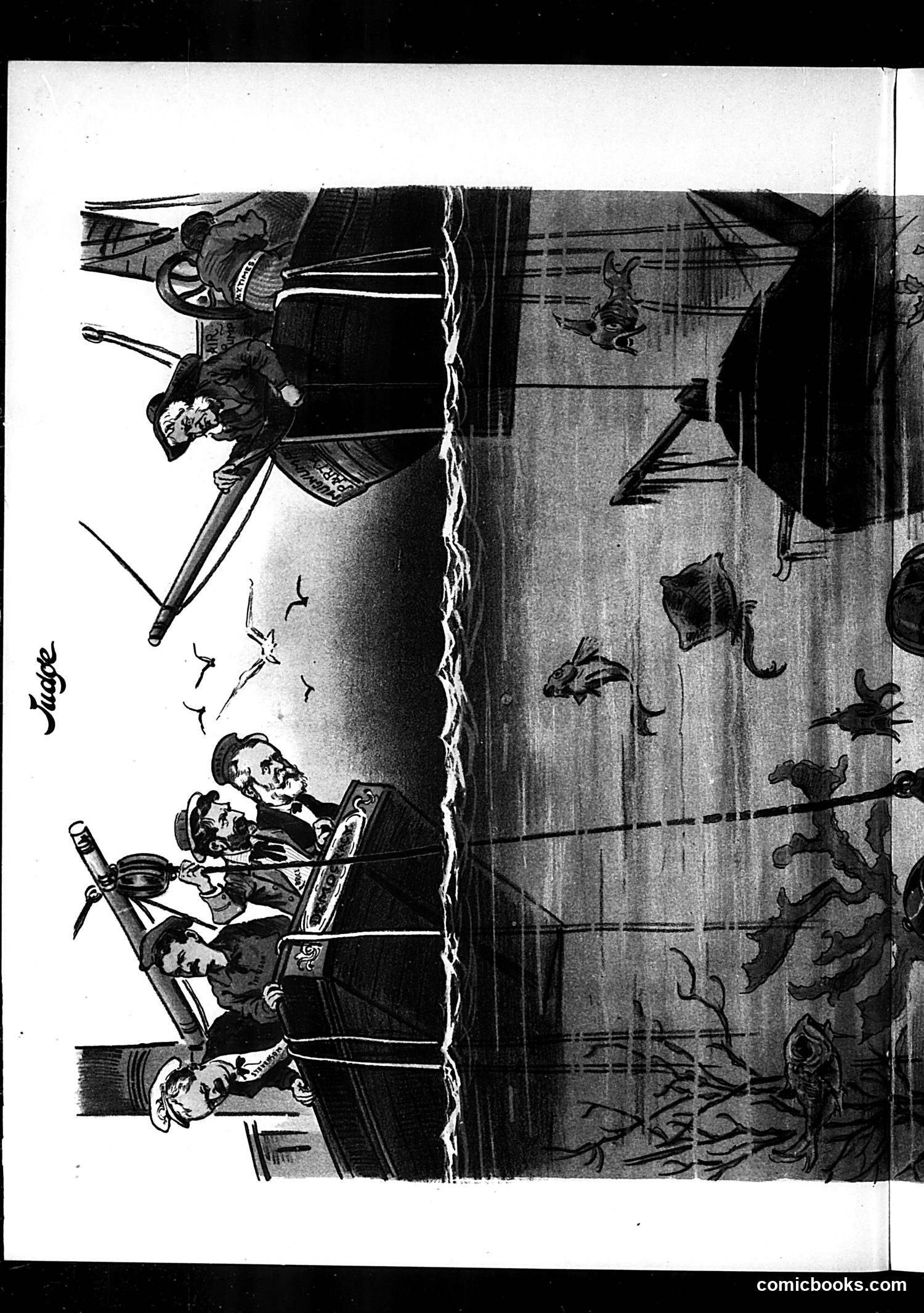
I cannot reliably read the OCR text on this page—it appears corrupted or improperly processed, making it impossible to identify the specific political or social references. From the IMAGE alone, I can see this is a dark, detailed engraving showing multiple figures in what appears to be a naval or maritime setting, with sailors or naval personnel visible. The caption reads "TRYING TO RAISE BAGAVIT FROM THE BOTTOM OF THE SEA," though the full context and historical reference are unclear to me. Without legible text or certain identification of "Bagavit," I cannot confidently explain what political event or figure this satirizes. To accurately explain this cartoon's meaning to a modern reader, I would need either clearer source text or additional contextual information about Judge magazine's publication date and contemporary events.
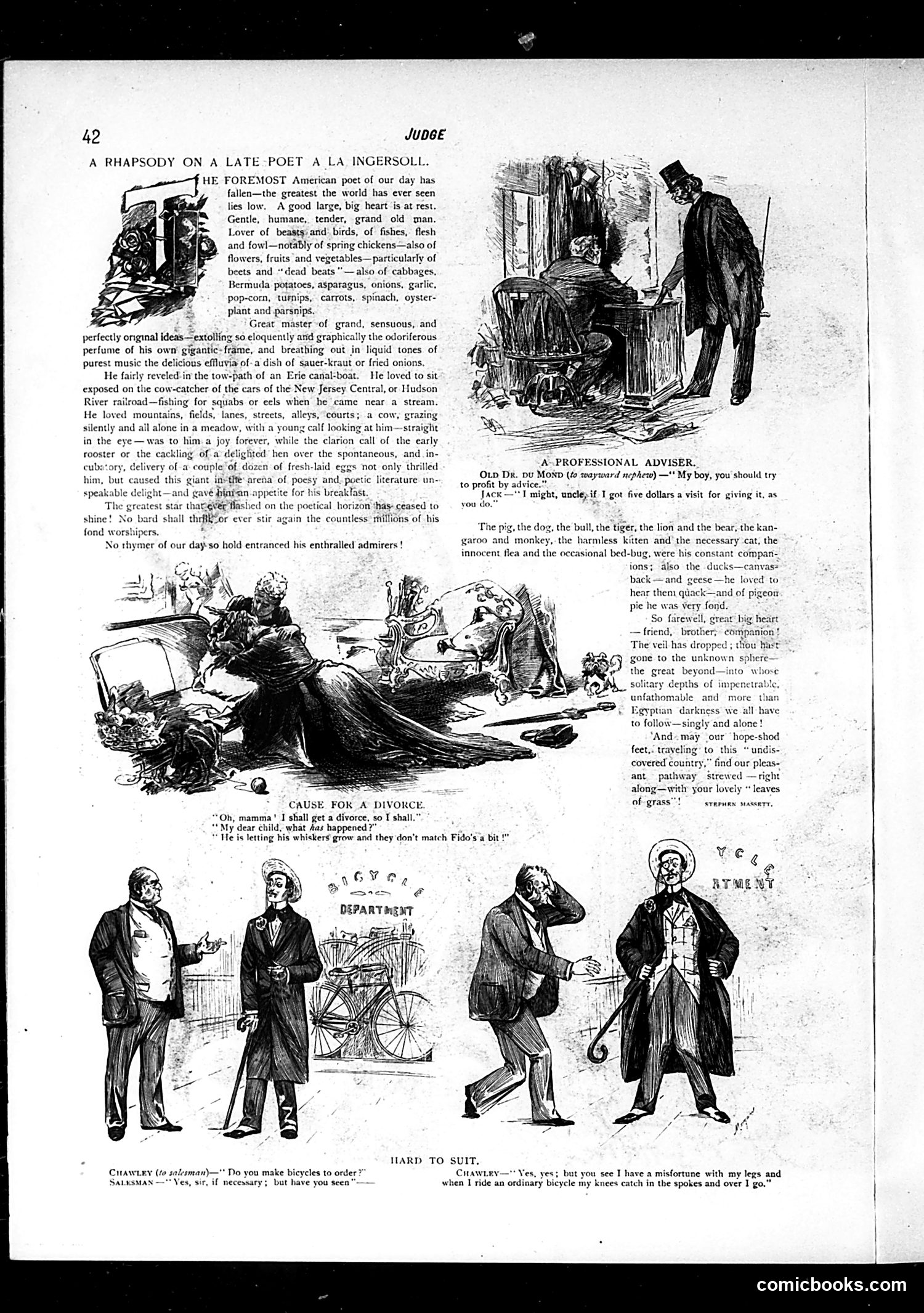
This satirical page mocks **Walt Whitman** (though unnamed, referenced as "a late poet à la Ingersoll"—likely invoking Robert Ingersoll, who eulogized Whitman). The lengthy opening piece mockingly praises Whitman's supposed obsession with physical sensations, bodily functions, and common animals/foods rather than elevated poetic subjects. It parodies his verbose, cataloguing style while suggesting his poetry celebrates crude materialism. The smaller cartoons are unrelated satirical vignettes: "A Professional Adviser" jokes about a nephew seeking payment for medical visits; "Cause for a Divorce" ridicules a woman threatening divorce over her husband's mismatched whiskers versus their dog's; "Hard to Suit" depicts a bicycle customer with leg problems incompatible with ordinary bicycles. The page exemplifies *Judge's* use of exaggeration and mockery to critique both public figures and contemporary social absurdities through text and illustration combined.
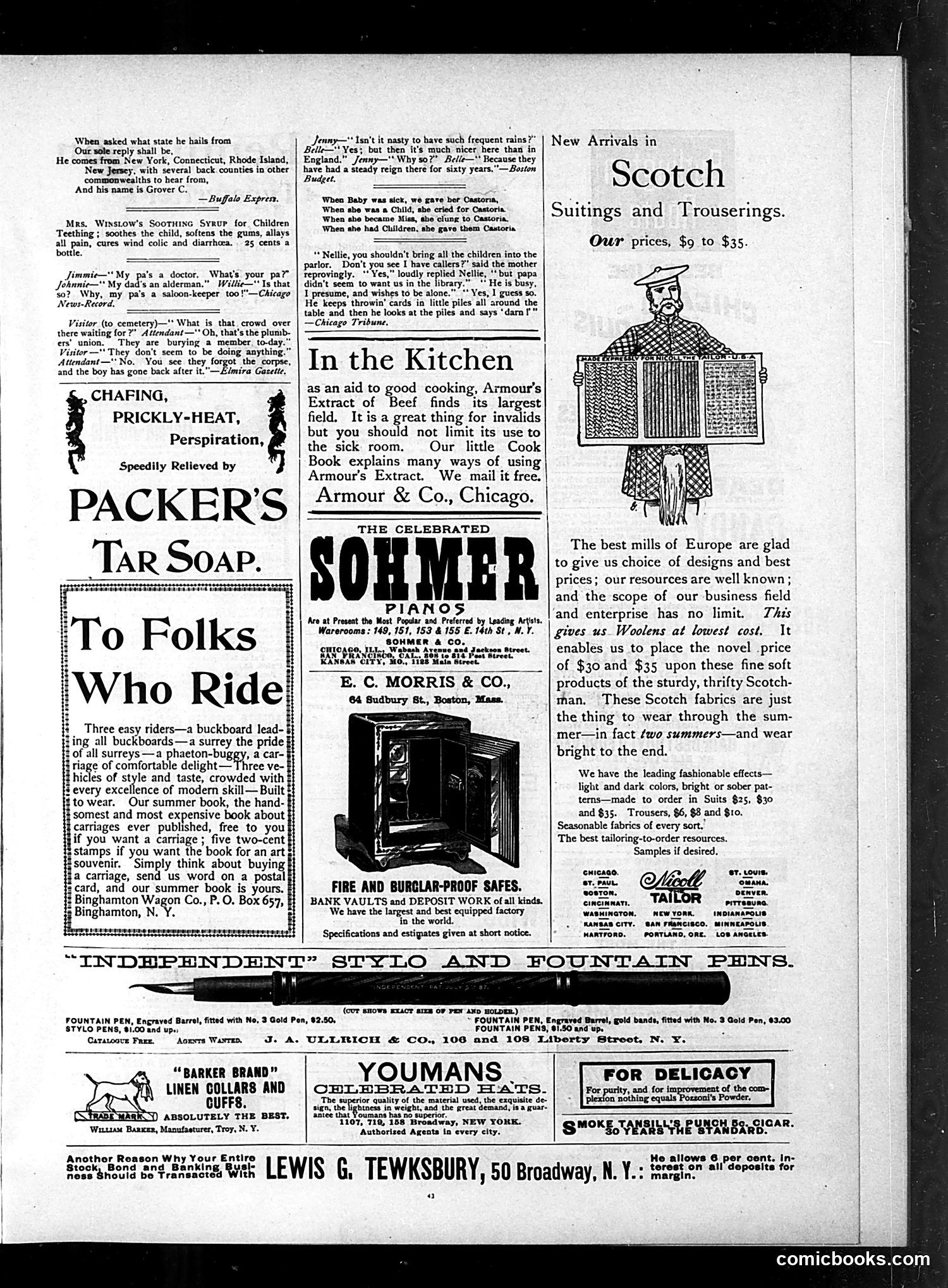
This is primarily an **advertising page** from Judge magazine, with several small comic anecdotes interspersed. The cartoons/jokes are brief, disconnected items rather than political commentary: **Notable Content:** - Several one-liner jokes about occupations (a doctor's son whose father is actually a salesman; plumbers burying a colleague but forgetting the corpse) - A sarcastic jab at British weather/monarchy ("steady reign there for sixty years") - A child's innocent comment about a card-playing visitor ("throwing cards in little piles") **Advertisements dominate**, promoting: - Remedies (teething syrup, tar soap for chafing) - Carriages and vehicles - Sohmer pianos - Safes and bank vaults - Scotch fabric suiting **Political/Social Context:** The humor reflects late-19th/early-20th century American attitudes: occupational stereotyping (plumbers as unreliable), British mockery, and domestic/commercial concerns. No significant political satire appears on this page.
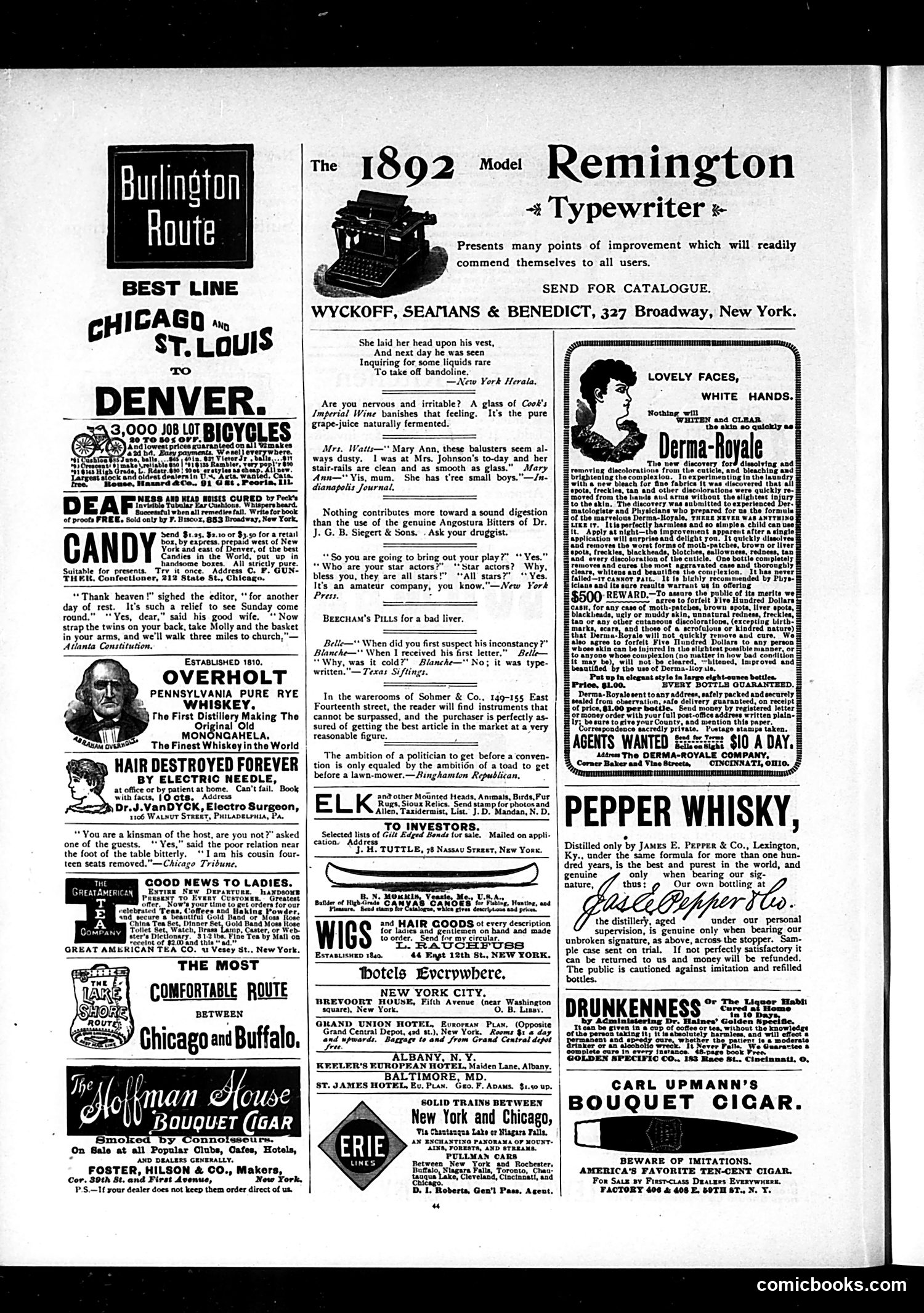
This page is primarily **advertisements and brief humorous anecdotes**, not political cartoons. The content reflects late 19th-century consumer culture and social humor. **Key Elements:** The **Remington 1892 Model Typewriter** advertisement emphasizes technological progress—typewriters were still relatively new luxury items. Multiple **patent medicine and beauty product ads** (Derma-Royale, Beecham's Pills, Cook's Wine) reflect the era's unregulated health industry, promoting dubious remedies for common complaints. The **brief jokes** mock domestic life and social pretension—a poor relation seated far away at dinner, an editor grateful Sunday arrives, a woman with dusty stairs (implying children are messy). These are gentle observations on class and family life. **Whiskey and cigar advertisements** occupy significant space, showing these were acceptable, advertised products in mainstream magazines. The page demonstrates 1890s commercial culture more than political satire—Judge's editorial content appears elsewhere in the issue.
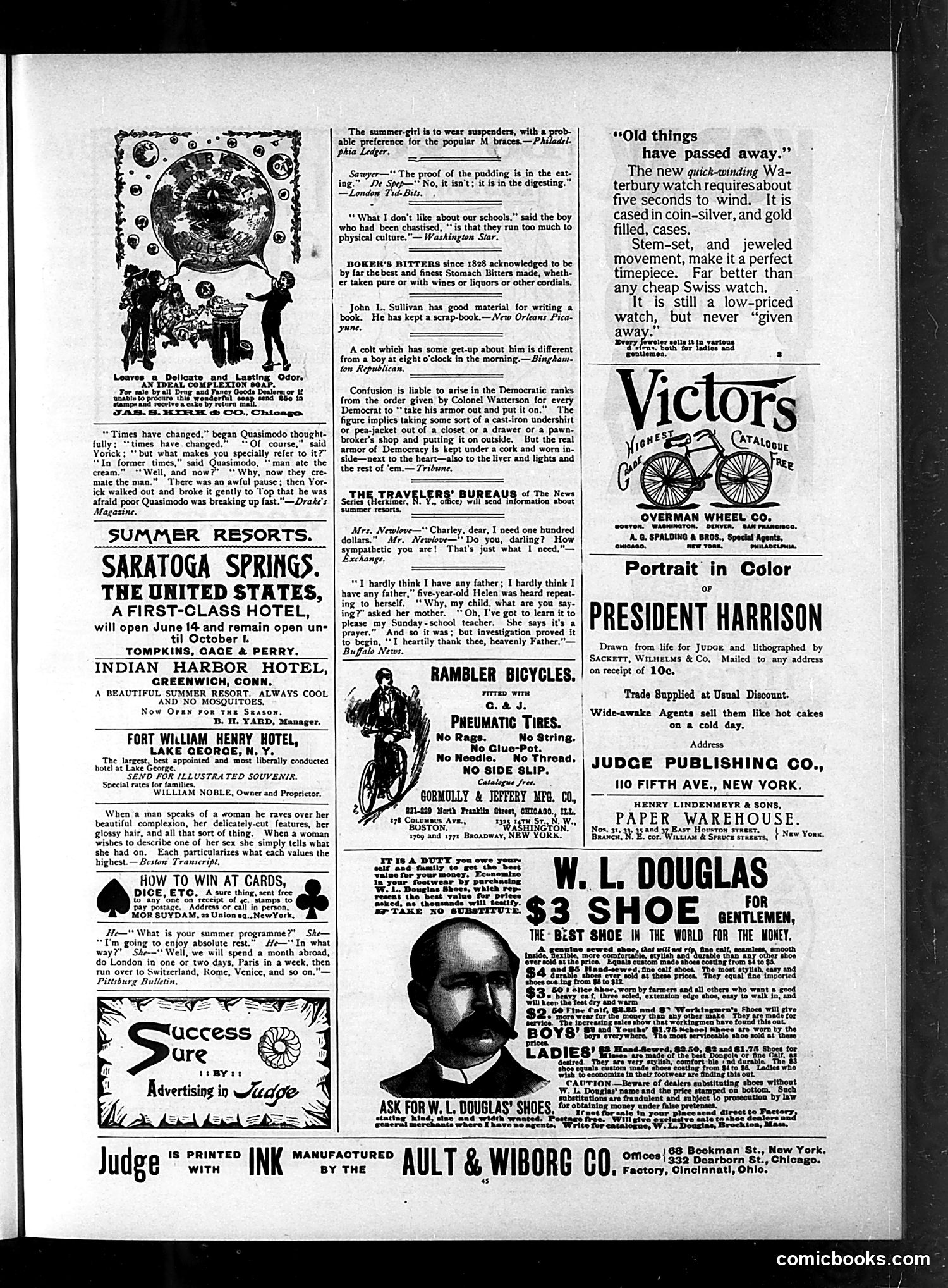
This is primarily an **advertising and humor miscellany page**, not a political cartoon page. The visible content includes: **Humor items**: Brief jokes about contemporary life—a Quasimodo/Yorick dialogue about cremation, quips about schools, Democratic politics (Colonel Watterson's order to "take armor"), and social observations about gender differences in conversation. **One political reference**: A jab at Democratic Party unity under Colonel Watterson's leadership, mocking the metaphor of Democrats taking up armor as contradictory and confused. **Summer resort advertisements**: Saratoga Springs, Indian Harbor Hotel, and Fort William Henry Hotel. **Product ads**: Boker's Bitters (stomach remedy), Victors bicycles, W.L. Douglas shoes, and Judge Publishing Company materials. The page reflects **1890s-era satirical humor**—light, topical jokes about fashion, education, family life, and politics—rather than sustained political cartooning. The Watterson reference suggests a late-19th-century publication date.
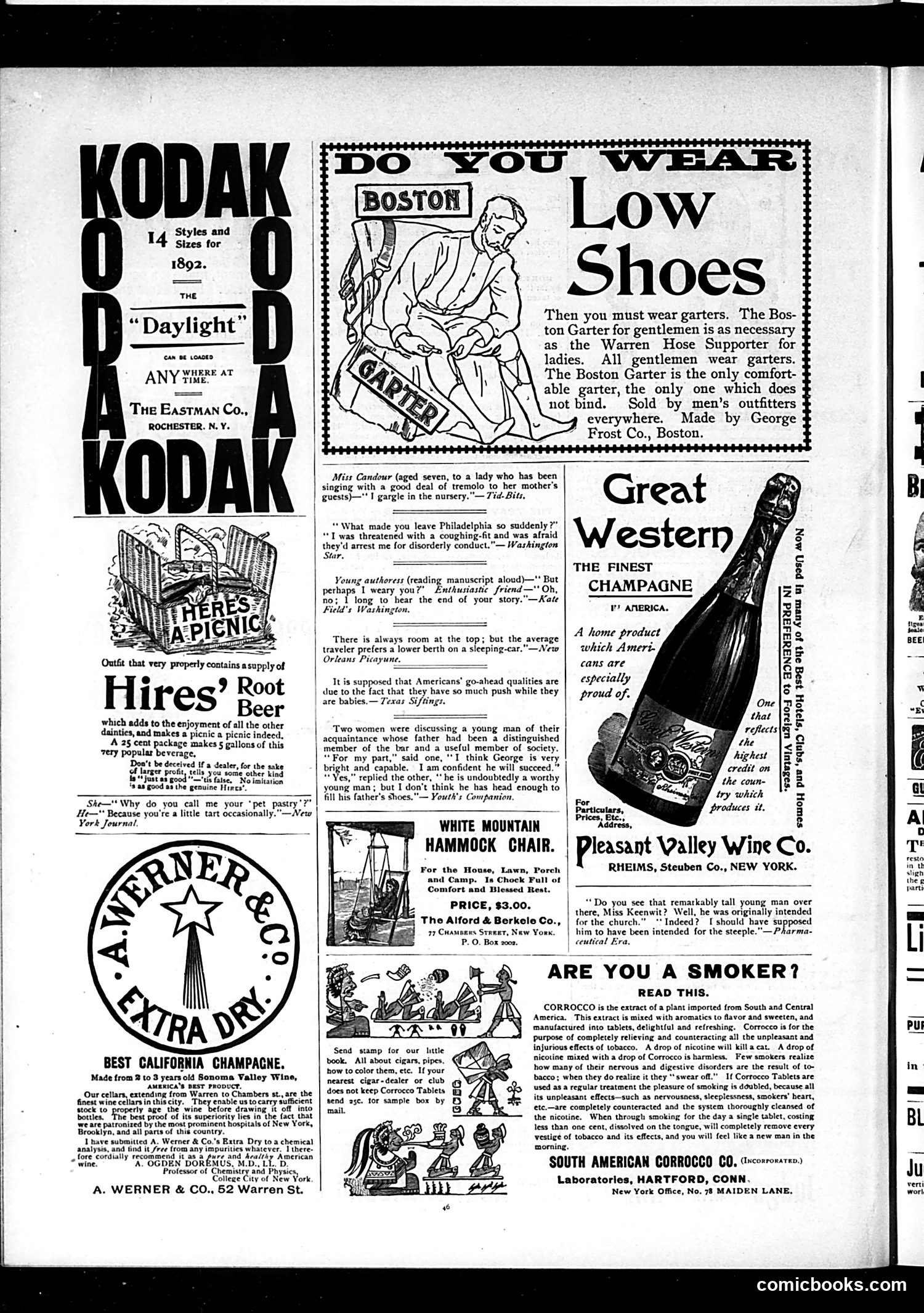
This page is primarily **advertising**, typical of Judge's revenue model. Notable content includes: **Main Advertisements:** - Kodak cameras ("Daylight" model) - Hires Root Beer (positioned as picnic essential) - Boston Garter and Warren Hose Supporter (gendered intimate apparel) - A. Werner & Co. California champagne (endorsed by a chemistry professor) - White Mountain Hammock Chair - Pleasant Valley Wine Co. - South American Tobacco Co. **Humor Content:** The page includes several short jokes and anecdotes typical of Judge's satirical style—wordplay about women's "tartness," observations on American character, and social commentary on ambition and class. One recurring joke format plays on double meanings ("head enough to fill his father's shoes"). **Social Context:** The advertisements reveal 1890s consumer culture: ready-made products, leisure goods, alcohol promotion (pre-Prohibition), and gendered marketing. The humor reflects era-typical attitudes toward women, ambition, and social climbing. The page contains no political cartoons—it's a commercial/humor miscellany typical of this magazine format.
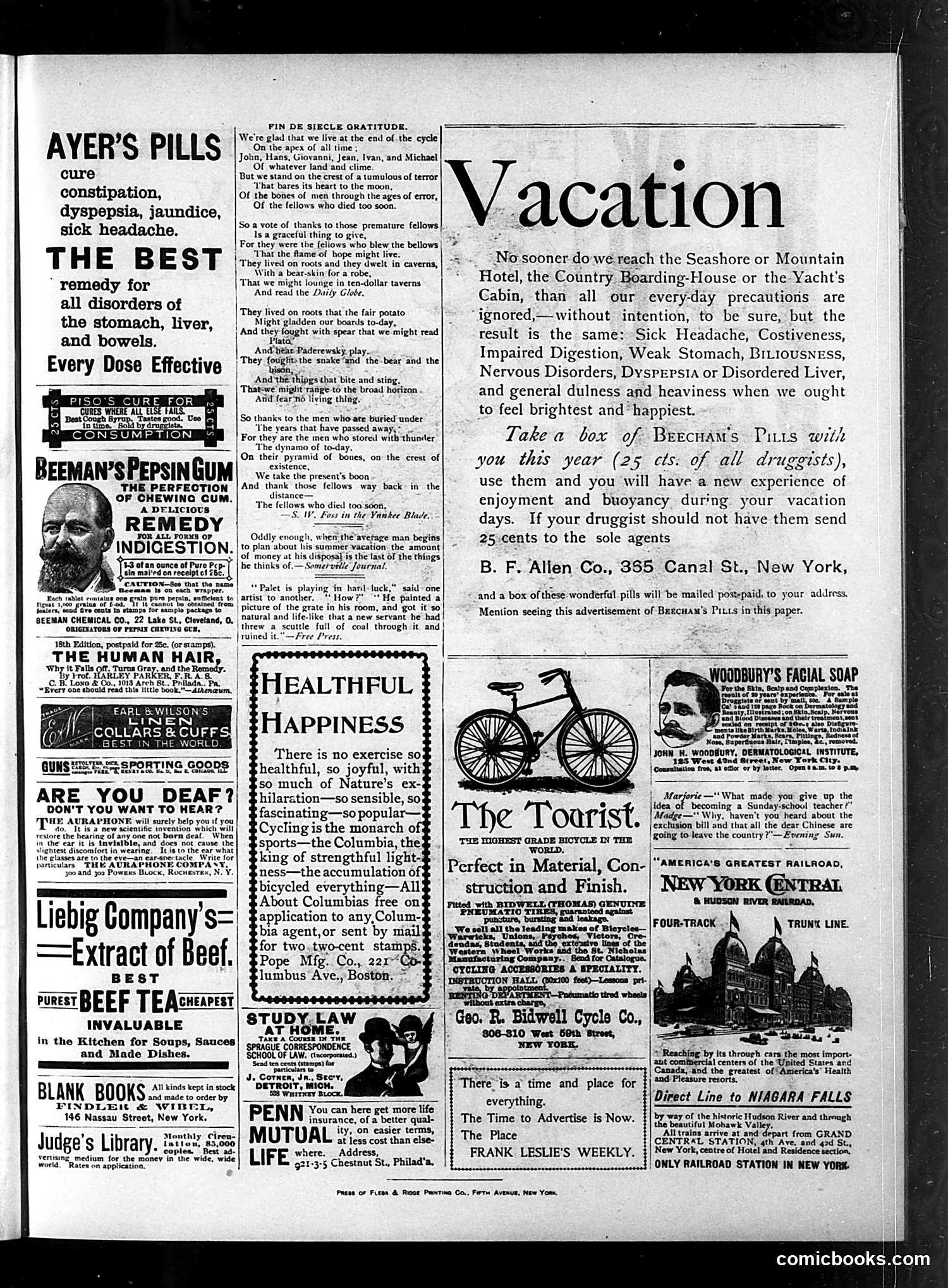
This poem, credited to W. Foss in the *Yankee Blade*, satirizes the sentimental gratitude of the 1890s toward past generations. The piece uses ironic exaggeration: modern people praise their ancestors for enduring primitive hardships—living in caves, fighting wild animals, eating roots—so that contemporary readers could enjoy comfort: taverns, newspapers, classical music, and leisure. The satire cuts both ways. It mocks both the romanticization of the "noble savage" past and the complacency of fin-de-siècle society, which congratulates itself for progress while conveniently forgetting its debt to human suffering. The title "Fin de Siècle Gratitude" suggests a shallow, fashionable sentimentality typical of the 1890s. The page itself is primarily **advertising**—pills, soaps, bicycles, beef extract—with this poem as filler content characteristic of period magazines.
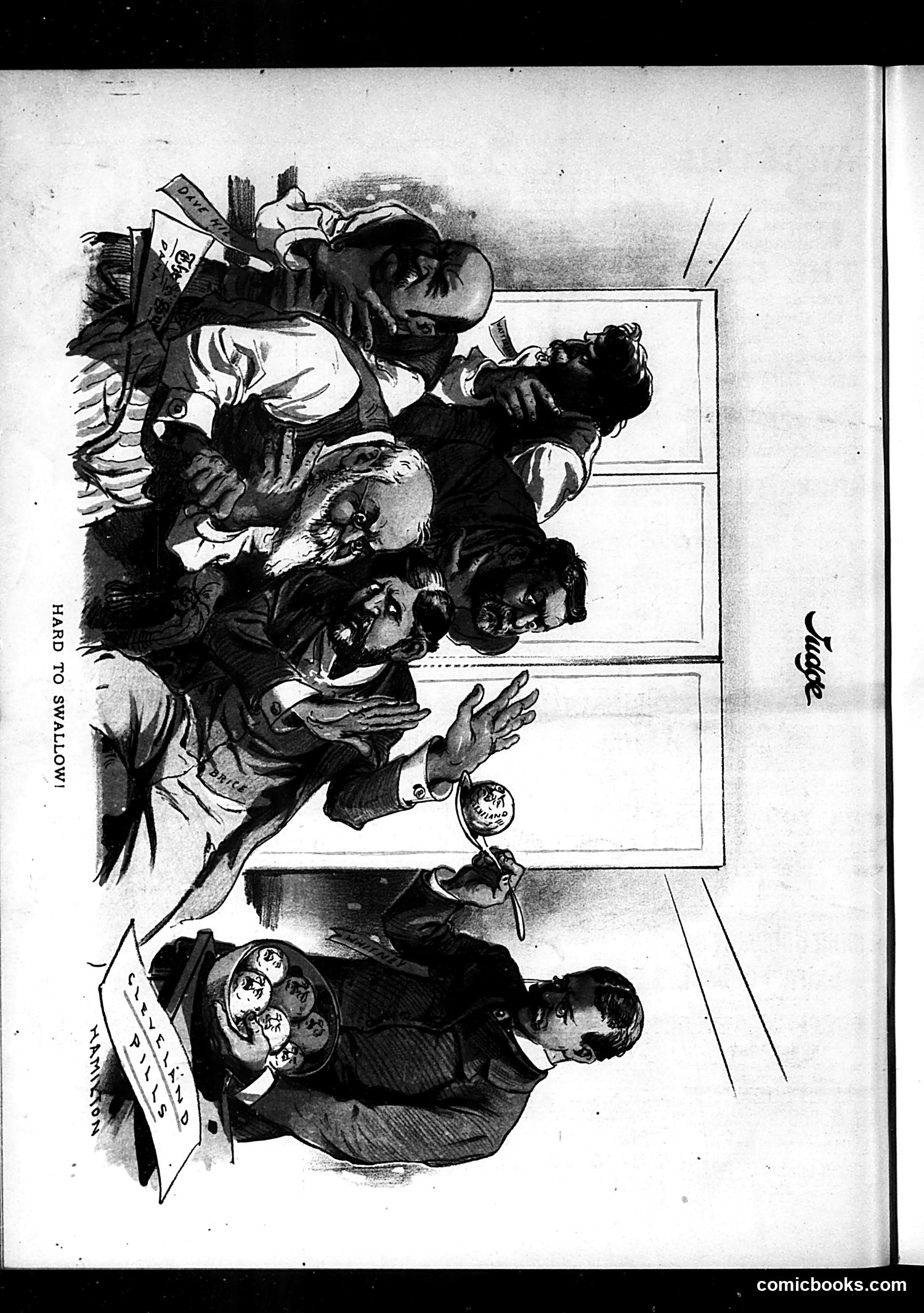
This page appears to be from *Judge* magazine and shows a political cartoon titled "Hard to Swallow" (visible on the left margin). The image depicts figures in what appears to be an interior setting, with one character prominently displaying what looks like a decorated plate or platter containing multiple faces or heads. The cartoon likely satirizes a political situation involving forced acceptance or digestion of unpopular policies or political figures. The "hard to swallow" metaphor suggests something distasteful that must nonetheless be accepted. However, without clearer identification of the specific faces depicted or the historical date of publication, I cannot definitively identify which political figures or events are being referenced. The style and printing suggest early-to-mid 20th century origin.