
A complete issue · 18 pages · 1891
Judge — November 7, 1891
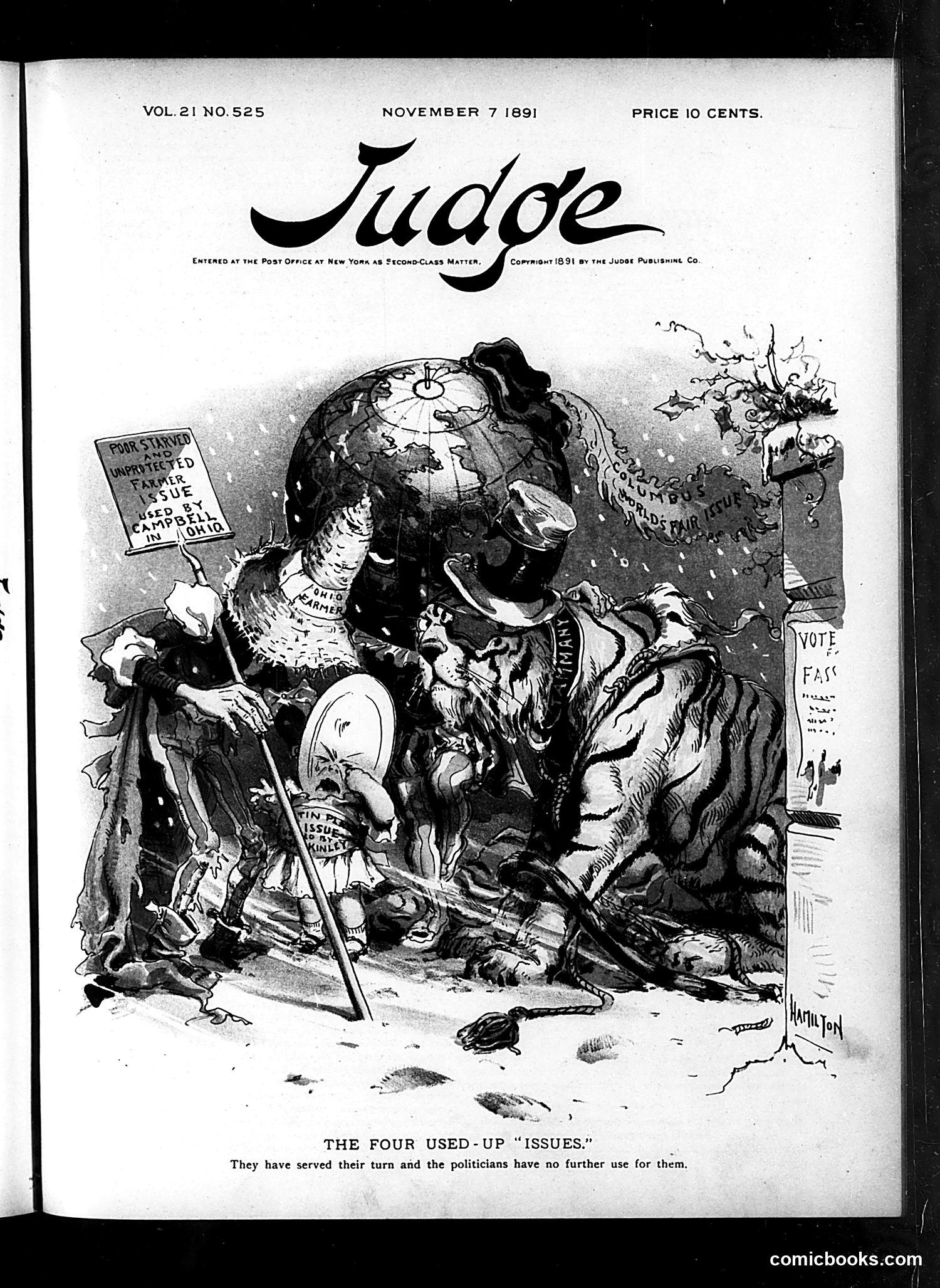
This November 1891 *Judge* cartoon satirizes four political topics that the artist believes have been exhausted by debate and are no longer useful to politicians. The large globe represents worldwide political discourse, while four caricatured figures—appearing to represent different political factions or parties—surround it holding worn-out signs labeled as spent "issues." The signs visible include references to tariffs and other campaign topics. The caption states these issues "have served their turn and the politicians have no further use for them," suggesting the artist mocks politicians for cycling through rhetorical topics cynically rather than addressing genuine concerns. The style is typical of *Judge's* partisan satirical commentary on American electoral politics of the Gilded Age.
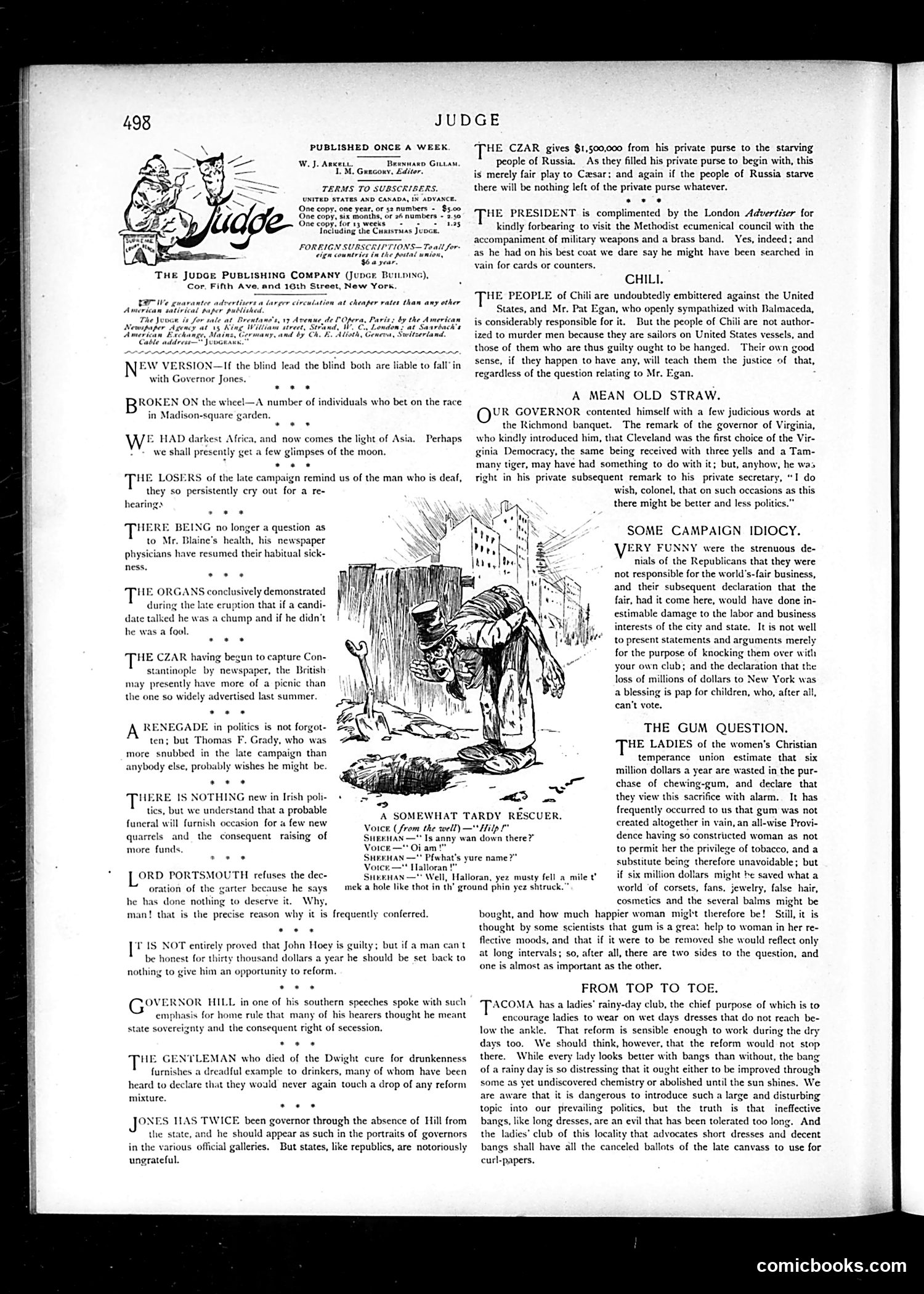
The main cartoon titled "A Somewhat Tardy Rescuer" depicts a figure in tattered clothes discovering another person lying on the ground in an urban setting. Based on the surrounding text discussing Cleveland and Virginia Democracy, this appears to be political commentary about a Democratic politician arriving late to address some crisis or injustice. The page contains multiple brief satirical items critiquing contemporary political figures and events, including references to: - The Czar's charitable donations to Russia - Campaign tactics and political hypocrisy - Issues affecting women (the "Gum Question" discusses cosmetics and dress reform) Without clearer identification of specific figures or knowing the exact publication date, the precise political targets remain uncertain, though the overall tone mocks Democratic leadership and social reformers of the period.
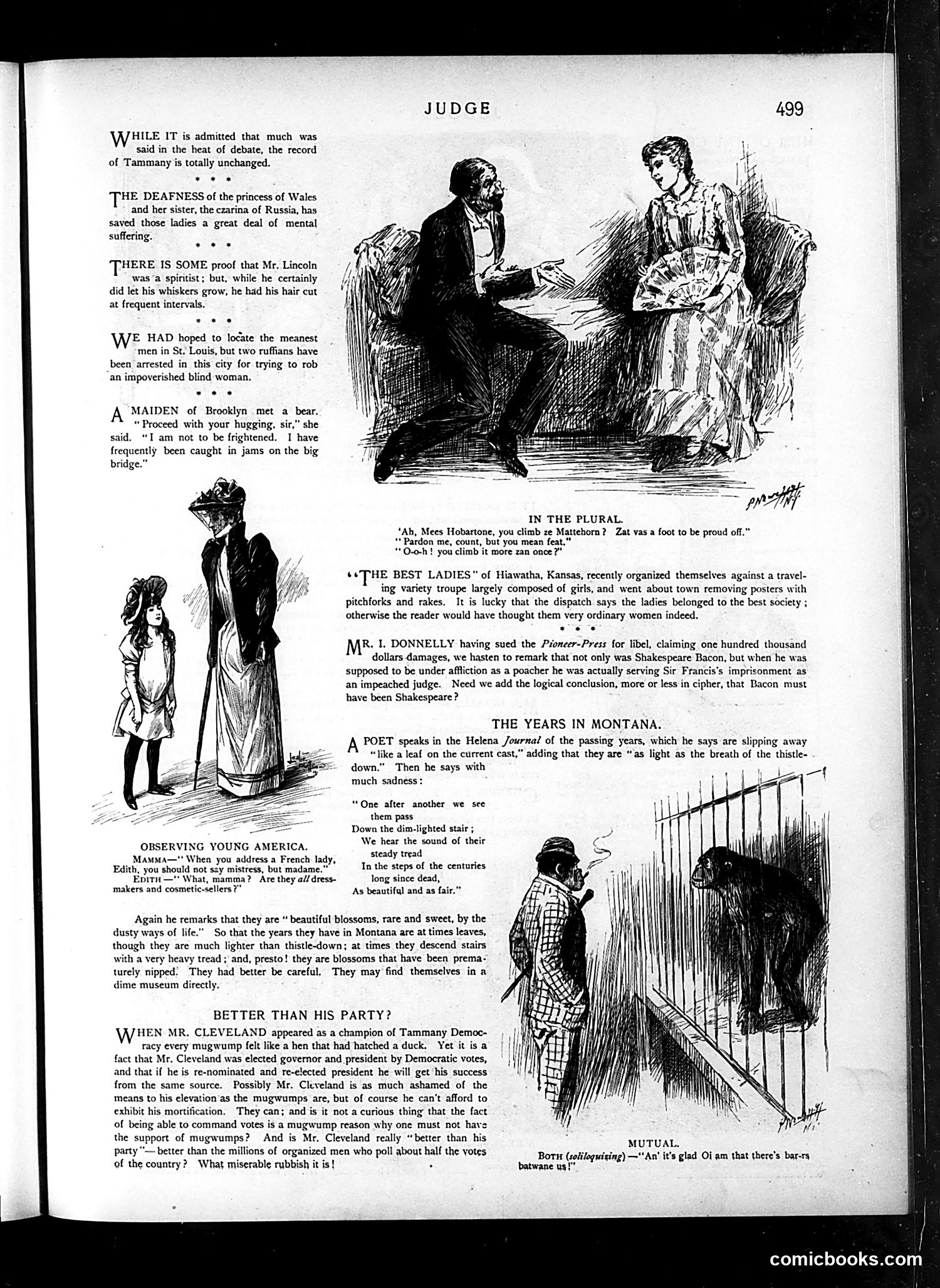
This page contains several brief satirical commentary sections typical of Judge magazine's format. **Top cartoon**: Depicts two men in what appears to be a legal or business consultation, likely satirizing courtroom or financial dealings of the era. **"In the Plural"**: A joke about someone climbing stairs, playing on double meanings. **"The Best Ladies" section**: Mocks women's activist groups in Hiawatha, Kansas who organized against traveling variety shows, satirizing their moral crusading as excessive prudishness. **"Better Than His Party?"**: Discusses Mr. Cleveland's political position, suggesting tension between personal electoral success and party loyalty—likely referencing Grover Cleveland's complex relationship with Democratic Party support during his presidency. The page exemplifies Judge's style: mixing visual humor with political commentary on contemporary social movements, gender politics, and electoral dynamics.
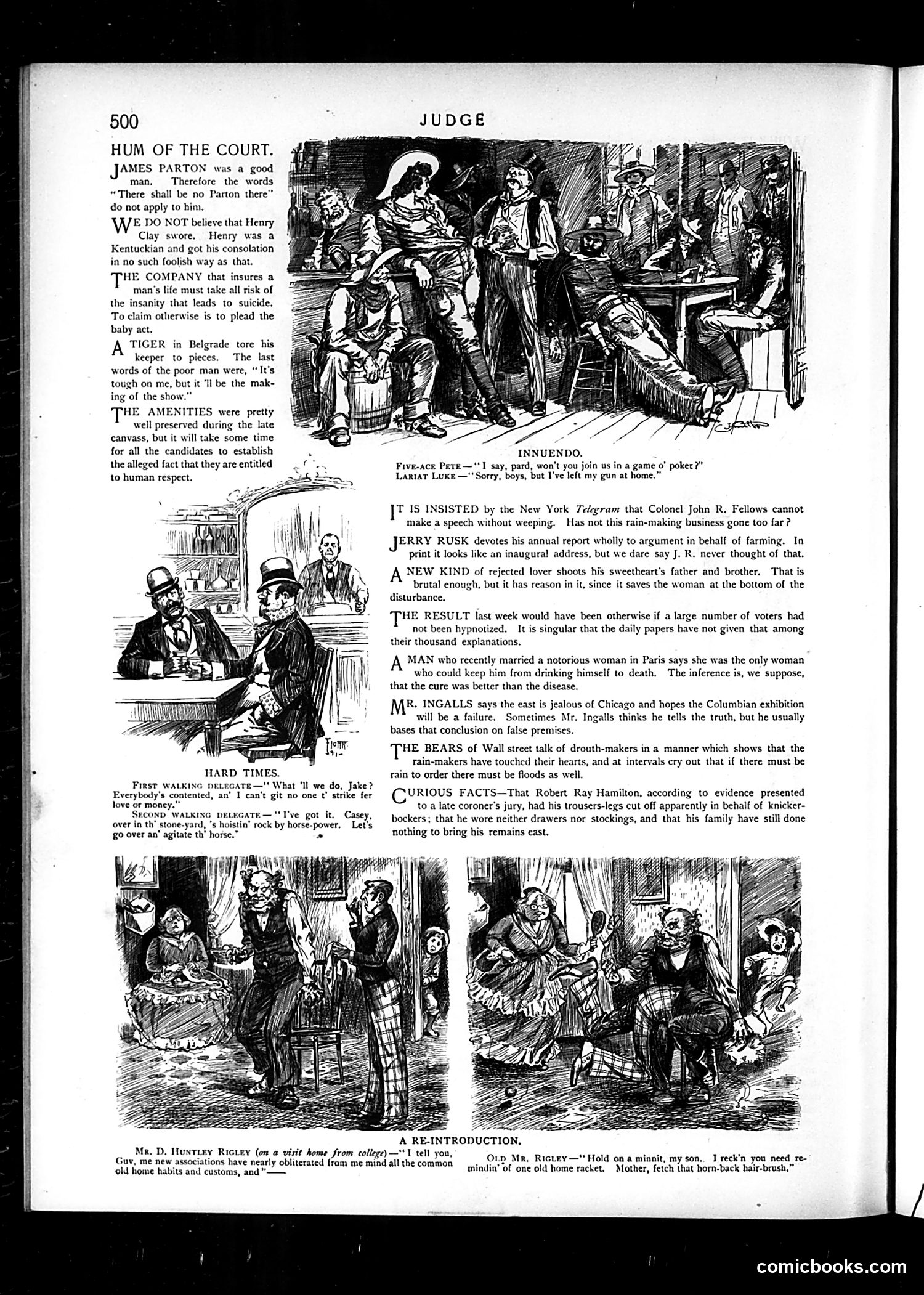
This page combines brief satirical quips with humorous illustrations addressing late 19th-century American concerns. The "Hum of the Court" section offers cynical observations on contemporary figures and issues: James Parton (a biographer), Henry Clay (the Kentucky statesman), and Colonel John R. Fellows (a public figure allegedly prone to emotional speeches). The cartoons depict working-class life: "Hard Times" shows labor organizers struggling to incite strikes when workers are content; "A Re-introduction" humorously portrays a college-educated man returning home, initially embarrassed by rural customs before being reminded of simple pleasures. Other items satirize trends like hypnosis influencing voters, sensationalized crime (rejected lovers killing rivals' families), and speculative Wall Street traders. The overall tone reflects Judge's skeptical, often sardonic approach to American society, politics, and human nature during the Gilded Age.
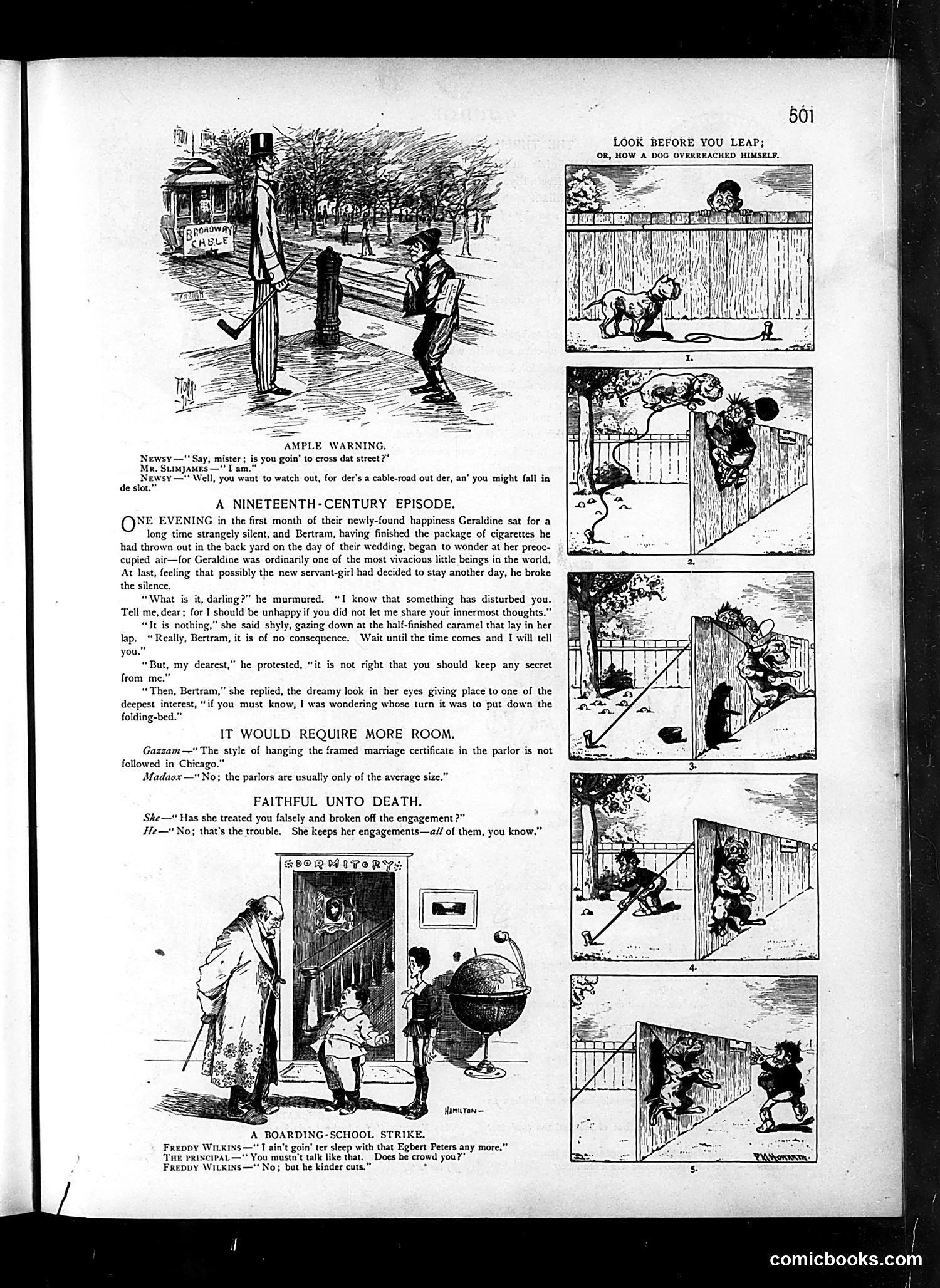
This page contains several short satirical pieces typical of late-19th-century humor magazines: **"Ample Warning"** mocks dialect humor—a street warning about cable-car dangers, using exaggerated African American vernacular popular in period comedy. **"A Nineteenth-Century Episode"** satirizes romantic newlyweds by subverting sentimental expectations: after flowery declarations of sharing "innermost thoughts," the wife's concern is mundane—whose turn is it to put down the folding bed? The joke deflates romantic idealism with domestic practicality. **"It Would Require More Room"** jokes about Chicago housing: marriage certificates hung in parlors are impractical because Chicago apartments are too small—a jab at urban crowding. **"Faithful Unto Death"** presents ironic reversal: the woman keeps *all* her engagements (social obligations), making the man jealous—she's faithful but unavailable. **"A Boarding-School Strike"** uses child dialect humor about sleeping arrangements at school. **"Look Before You Leap"** (right panel) appears to be a visual narrative about a dog's mishap near a fence. The page emphasizes period-typical humor: dialect comedy, domestic irony, and physical comedy.
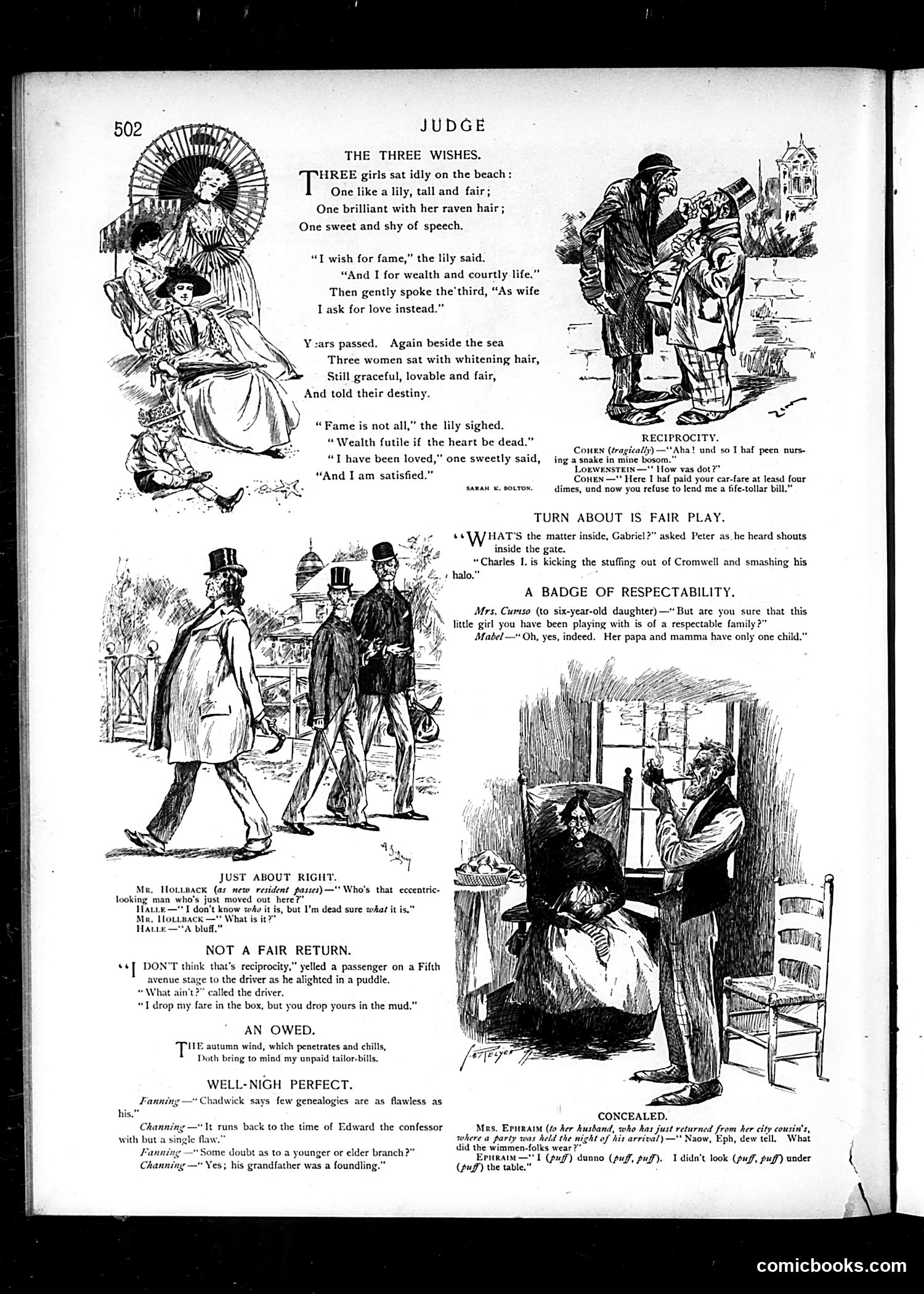
This page from the satirical magazine *Judge* contains multiple brief comedic sketches mocking social pretensions and human nature. **"The Three Wishes"** presents a sentimental poem contrasting youthful aspirations (fame, wealth, love) with elderly wisdom—the woman who sought love finds fulfillment while those pursuing fame and wealth discover emptiness. It's gentle moralizing about life priorities. **"Reciprocity"** satirizes immigrant speech patterns and ingratitude: a character who's received small favors refuses to lend money, claiming the earlier help was insufficient. **"Turn About is Fair Play"** makes a heavenly joke: in the afterlife, historical enemies Charles I and Cromwell (English Civil War figures) reverse roles—the king now beats his former persecutor. **"A Badge of Respectability"** mocks bourgeois class anxiety: parents measure respectability by whether a child is an only child, suggesting middle-class families equate exclusivity with decency. The remaining sketches mock eccentricity, unfair treatment, unpaid debts, and genealogical pretension—typical *Judge* fare targeting Victorian social hypocrisy and absurdity.
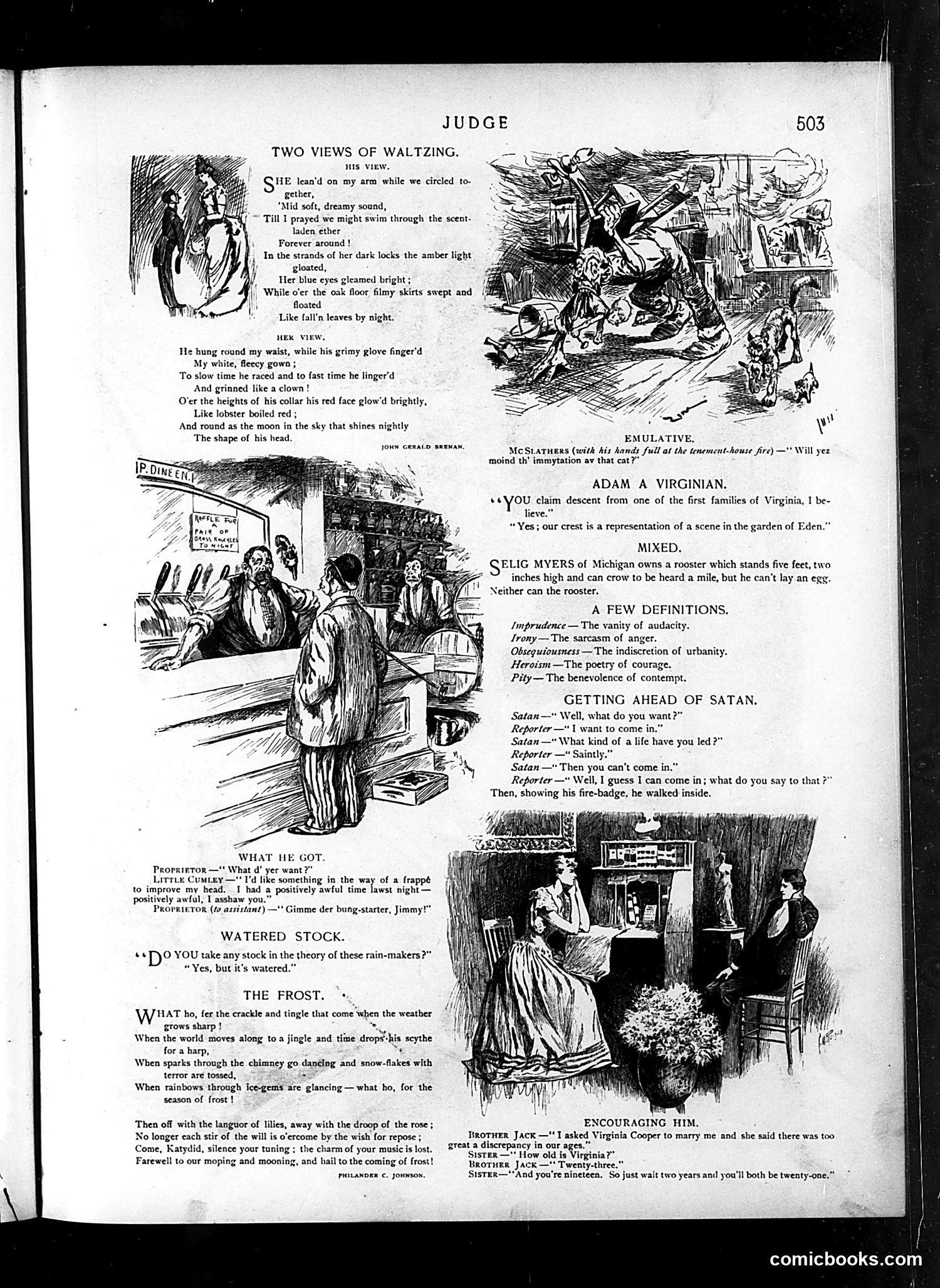
This page contains multiple satirical pieces typical of Judge magazine's humor: **"Two Views of Waltzing"** contrasts romantic male perception with crude reality—a woman's dreamy account of dancing versus a man's ungainly, sweaty version. The satire mocks male obliviousness to their own unattractiveness. **"Adam a Virginian"** jokes about Southern aristocratic pretension, suggesting Virginia families falsely claim descent from "first families" while their coat of arms depicts the Garden of Eden—implying Adam as their ancestor, an absurd genealogical claim. **"Getting Ahead of Satan"** features a reporter using a "fire-badge" (press credential) to gain entry to Hell itself—satirizing journalistic persistence and perhaps press corruption/access. Other brief humor pieces target absurdities: a rooster that can't lay eggs, "watered stock" as financial pun, and age-gap romance logic. The cartoons throughout use exaggerated Victorian-era drawing styles to highlight the jokes' targets—pretension, vanity, and social absurdity among different classes.
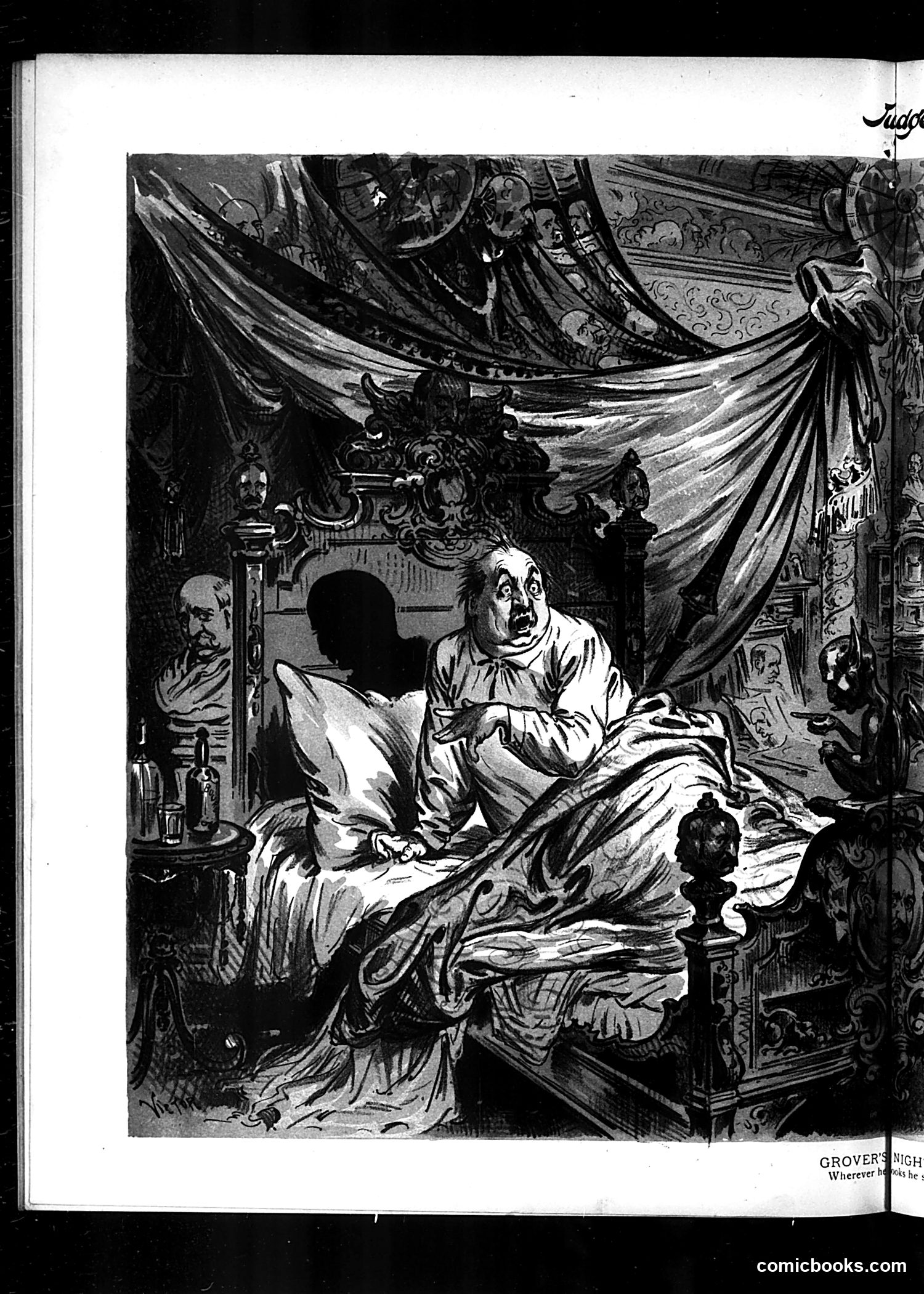
This appears to be an illustration from Judge magazine's "Grover's Night" series (text visible at bottom right). The engraving depicts a bedroom scene with elaborate period furnishings and drapery. A man in nightclothes sits on a bed looking startled or distressed, while another figure (partially shadowed) reclines nearby. The ornate setting suggests wealth or aristocratic pretension. The fragmentary OCR text "Wherever he looks he..." suggests the caption contains commentary, though it's incomplete here. Without the full caption or date, the specific political or social satire remains unclear. This likely lampoons either a public figure's personal scandal, hypocrisy, or peculiar behavior, typical of Judge's satirical approach. The dramatic, theatrical composition emphasizes the absurdity of the scene for comedic effect.
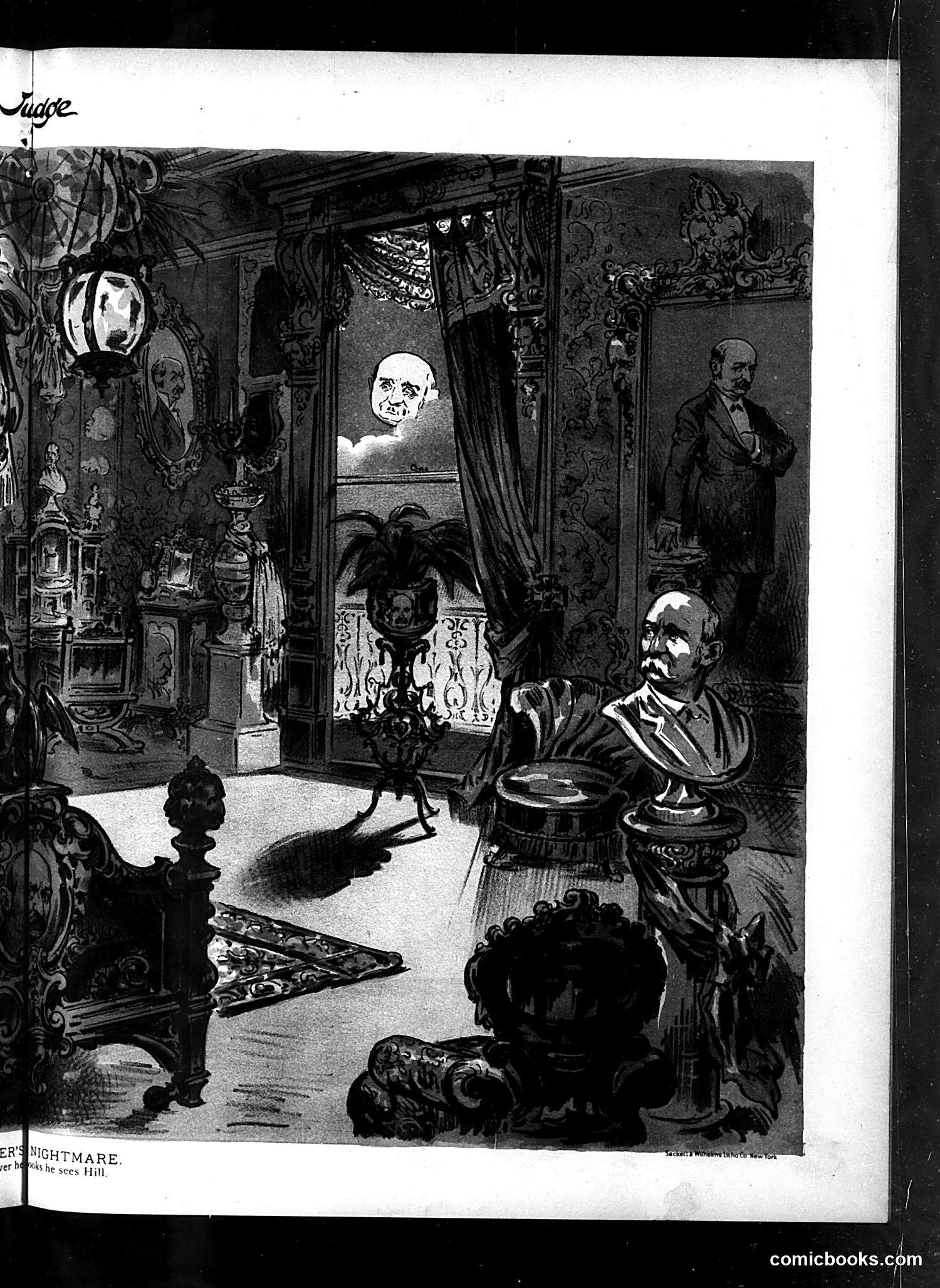
This appears to be a satirical cartoon titled "A Nightmare" or similar, showing a wealthy man in an ornate, luxuriously decorated room experiencing a disturbing vision. Through the window behind him floats a skeletal or death-like face, suggesting he's haunted by consequences of his actions or wealth. The cartoon likely critiques wealthy industrialists or politicians of the Gilded Age/Progressive Era, portraying their anxieties about social upheaval, labor movements, or their own mortality. The elaborate furnishings emphasize his material excess, while the supernatural apparition suggests guilt or fear of retribution. Without the complete caption and publication date, the specific target remains unclear, but Judge magazine typically satirized wealth inequality and social injustice during this period.
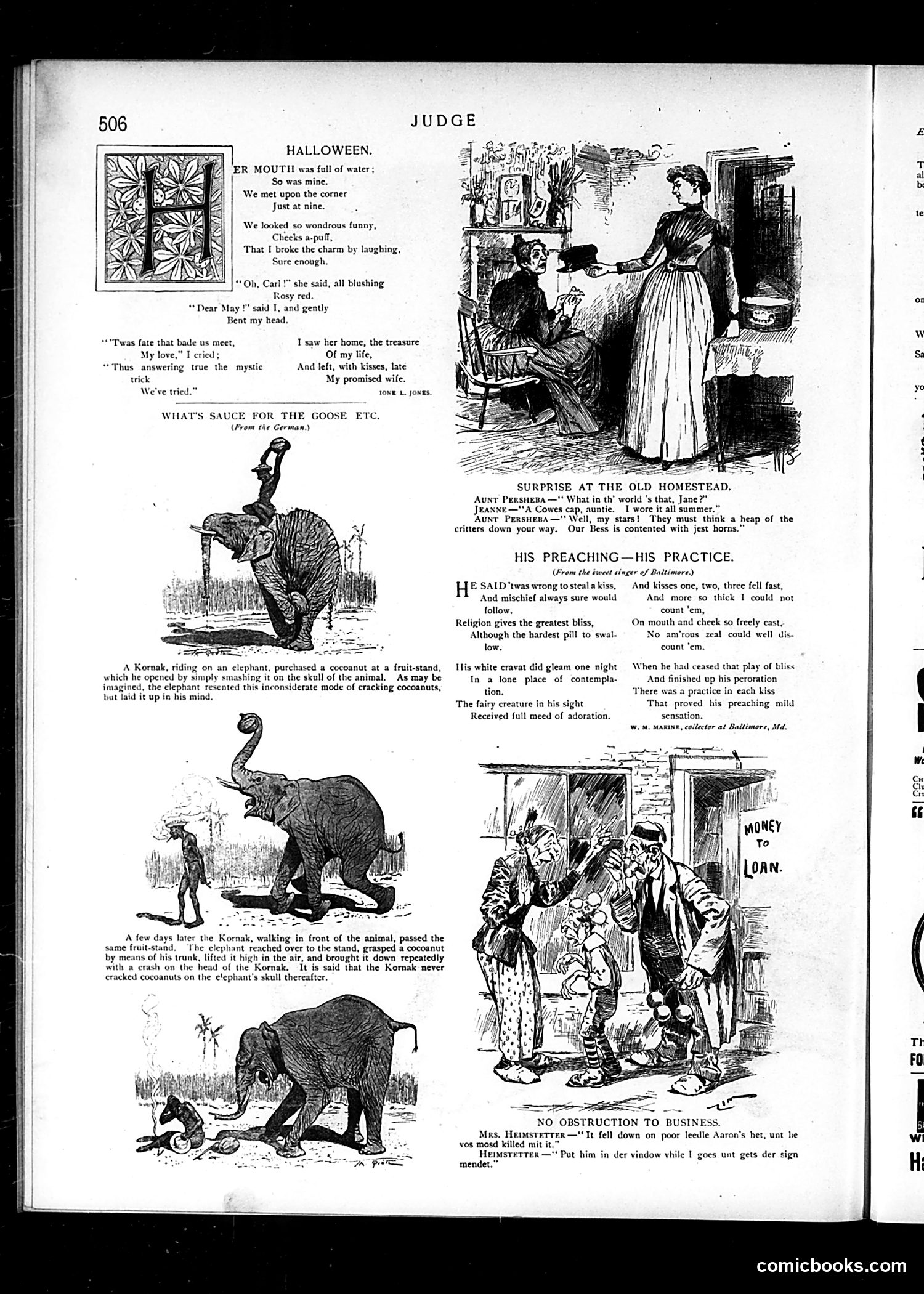
This page contains several short humorous pieces typical of late-19th/early-20th-century satirical magazines: **"Halloween"** is a sentimental romantic verse about two young people meeting by chance. **"What's Sauce for the Goose"** is a fable about an elephant that retaliates against a Kornak (Indian mahout) who used its head to crack coconuts—the elephant later does the same to the man. The moral: turnabout is fair play. **"His Preaching—His Practice"** satirizes hypocrisy: a preacher condemns stealing kisses as sinful, yet freely bestows them on a young woman in private. The "practice" contradicts the "preaching." **"No Obstruction to Business"** features a Yiddish-dialect couple; their child is hit by a falling sign, but the husband is more concerned about getting the sign fixed than checking on the boy—darkly comic commentary on misplaced priorities. The page mixes sentiment, animal fables, religious hypocrisy, and immigrant comedy stereotypes typical of Judge's content.
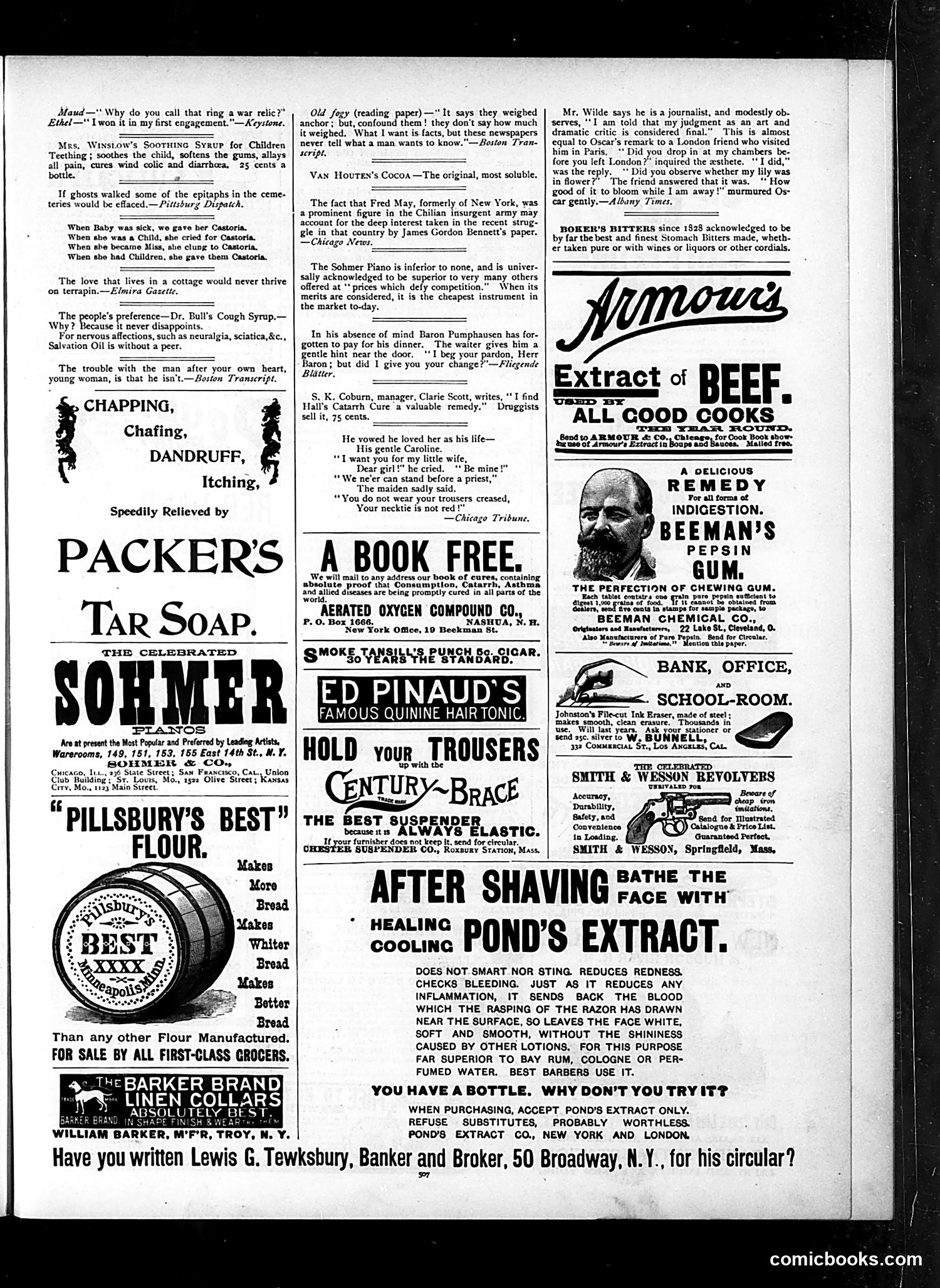
This page is primarily **advertisements with minimal editorial content**. The few short joke items scattered throughout are typical Judge filler material: - A brief engagement ring joke - Observations about epitaphs and newspapers - A domestic humor piece about a Baron forgetting to pay for dinner - A poem mocking a suitor whose trousers aren't creased and necktie isn't red The page's dominant feature is **late 19th-century patent medicine and consumer product advertising**—Castoria, cough syrup, Salvation Oil, Packer's Tar Soap, Pillsbury's Flour, pianos, hair tonic, suspenders, and Pond's Extract. These ads reflect the era's lack of FDA regulation and widespread promotion of dubious remedies. One item references **Oscar Wilde's vanity**, consistent with his celebrity during his American lecture tour (1882). The "Mr. Wilde" reference appears incomplete in the OCR text. This is a typical late-19th-century Judge issue: satirical magazine format overlaid with commercial content funding publication.
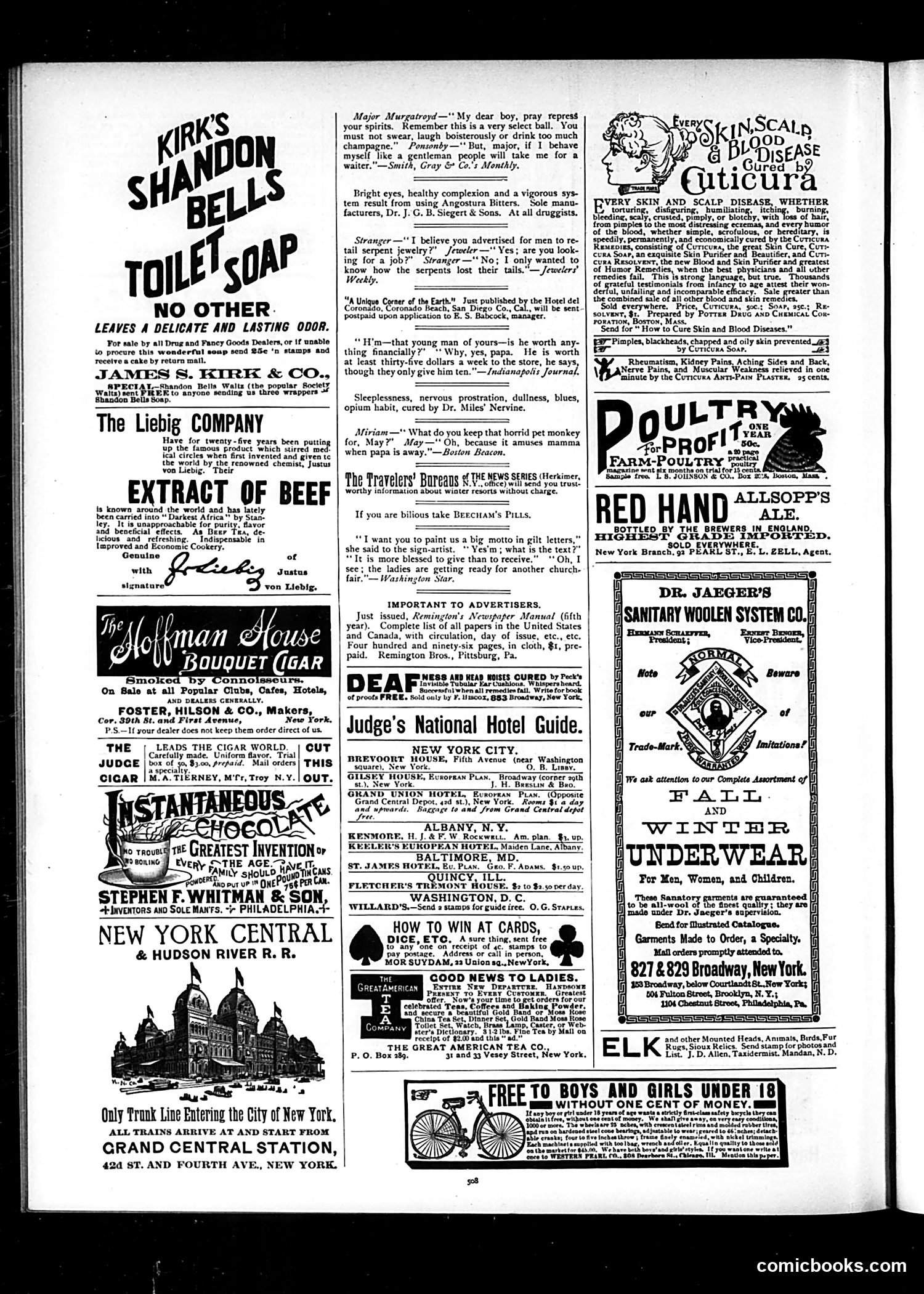
This is primarily an **advertising page** from Judge magazine, with minimal editorial cartoon content. The few small comedic items that appear are brief "joke" vignettes rather than political cartoons: 1. **"Major Murgatroyd"** depicts a social climbing joke: a young man (Ponsonby) claims he can't behave gentlemanly at a ball because people will mistake him for a waiter—suggesting that proper decorum and serving are so similar that respectability and servitude are indistinguishable for lower classes. 2. **The jeweler exchange** is a simple pun about "serpent jewelry" losing its tail. 3. **The young man's worth** pokes fun at economic pretense—the clerk claims to be worth $35/week but is actually paid $10. The page is dominated by product advertisements (Kirk's Shandon Bells Soap, Liebig's Extract of Beef, Whitman's chocolates, railroad schedules, hotels, cigars), typical of late-19th-century magazine layout. The jokes reflect period social anxieties about class distinction and economic worth rather than political satire.
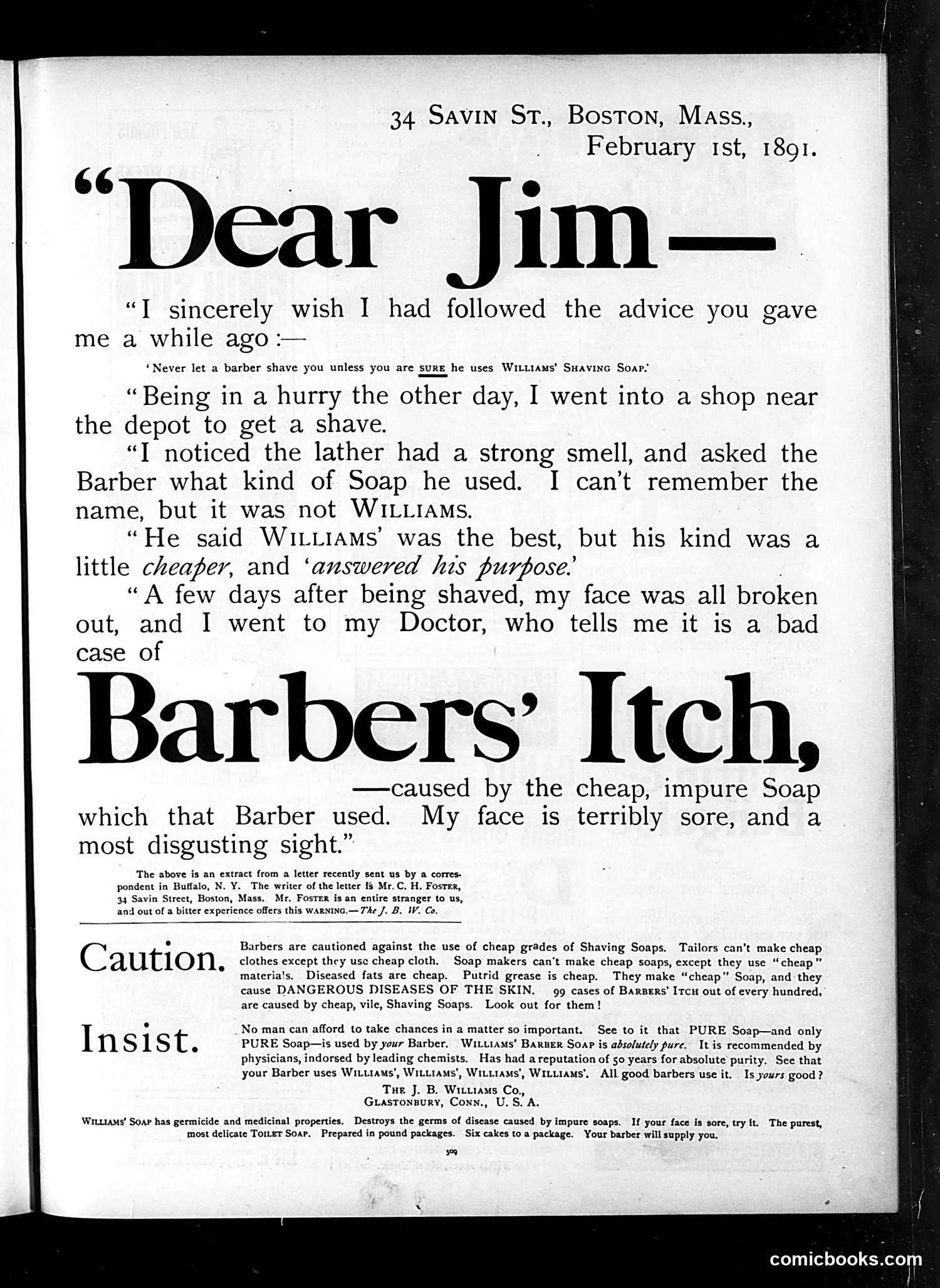
This page is **not a cartoon or satire**—it's a full-page advertisement for Williams' Shaving Soap, disguised as a testimonial letter. The ad presents a cautionary narrative: a man named C.H. Foster (identified as a "real" correspondent from Buffalo) ignored advice to use Williams' soap, went to a cheap barber who used inferior soap, and contracted "Barbers' Itch"—a genuine skin infection caused by poor hygiene and low-quality products. The advertisement then pivots to warnings: barbers using cheap soap cause disease; physicians recommend Williams' as "absolutely pure"; and the product has a "50-year reputation." **The appeal is fear-based marketing**. Rather than celebrating the product's merits directly, it warns against the danger of alternatives, establishing Williams' soap as the safe, medical choice. This reflects 1891 advertising practices before modern consumer protection laws—using unverified testimonials and health claims to drive sales. There is **no political satire or social commentary**; this is straightforward product marketing in Judge magazine's advertising section.
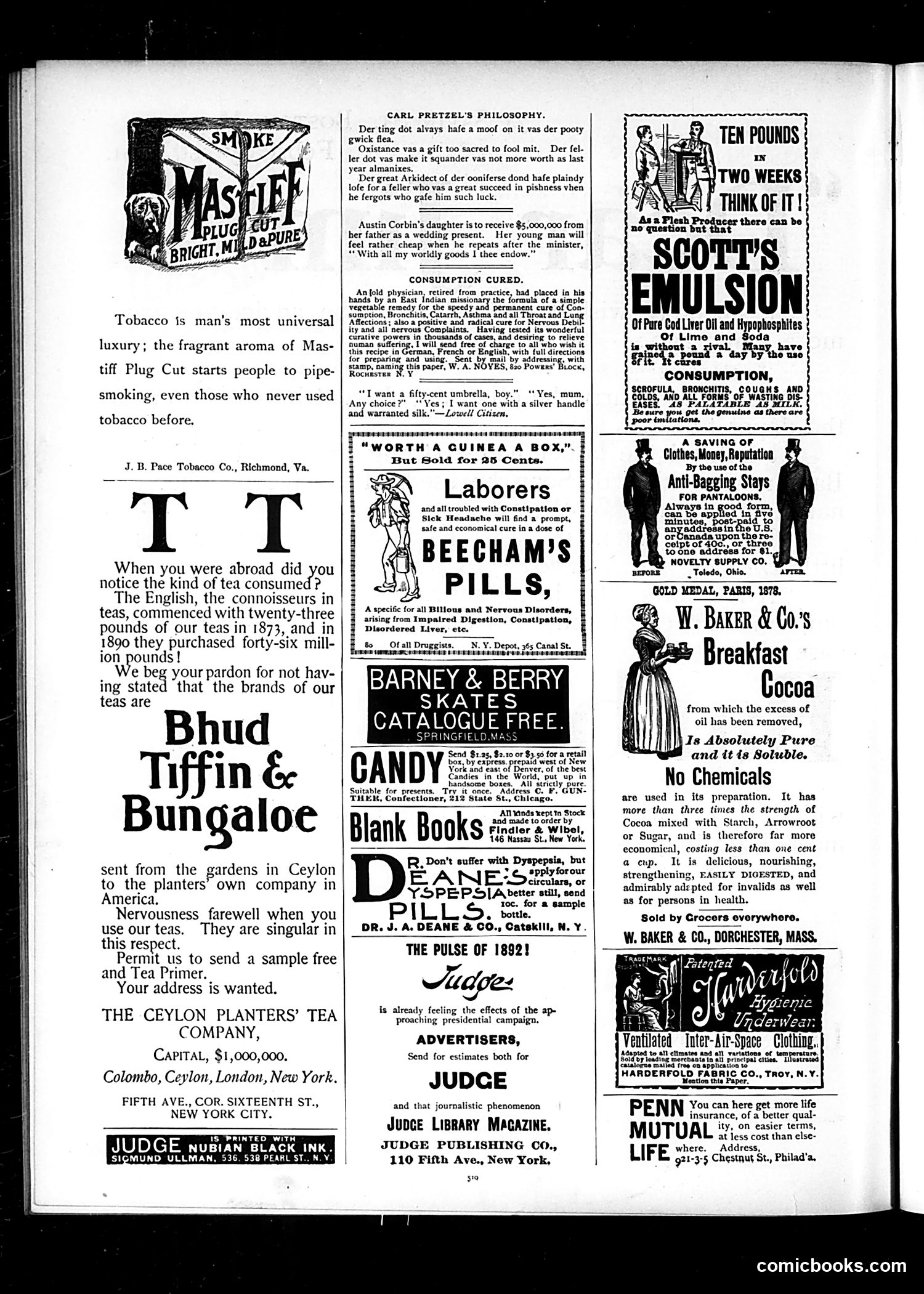
This is primarily a **late-19th century advertisement page** (marked "THE PULSE OF 1892"), not a political cartoon. The single satirical element is a brief joke column titled "CARL PRETZEL'S PHILOSOPHY" — a character sketch featuring stereotypical German-accented immigrant wisdom about life's vanities, using phonetic dialect writing ("Der ting dot alvays hafe a moof..."). The page also includes a pointed **social observation**: a quip about Austin Corbin's daughter receiving a $3,000,000 wedding gift while her groom repeats traditional vows about sharing "worldly goods"—mocking the absurdity of extreme wealth inequality and empty marriage rhetoric. The bulk of the page consists of period patent medicines and consumer goods advertising (cocoa, pills, skates, blank books), reflecting the magazine's commercial function and the era's unregulated medical claims marketing.
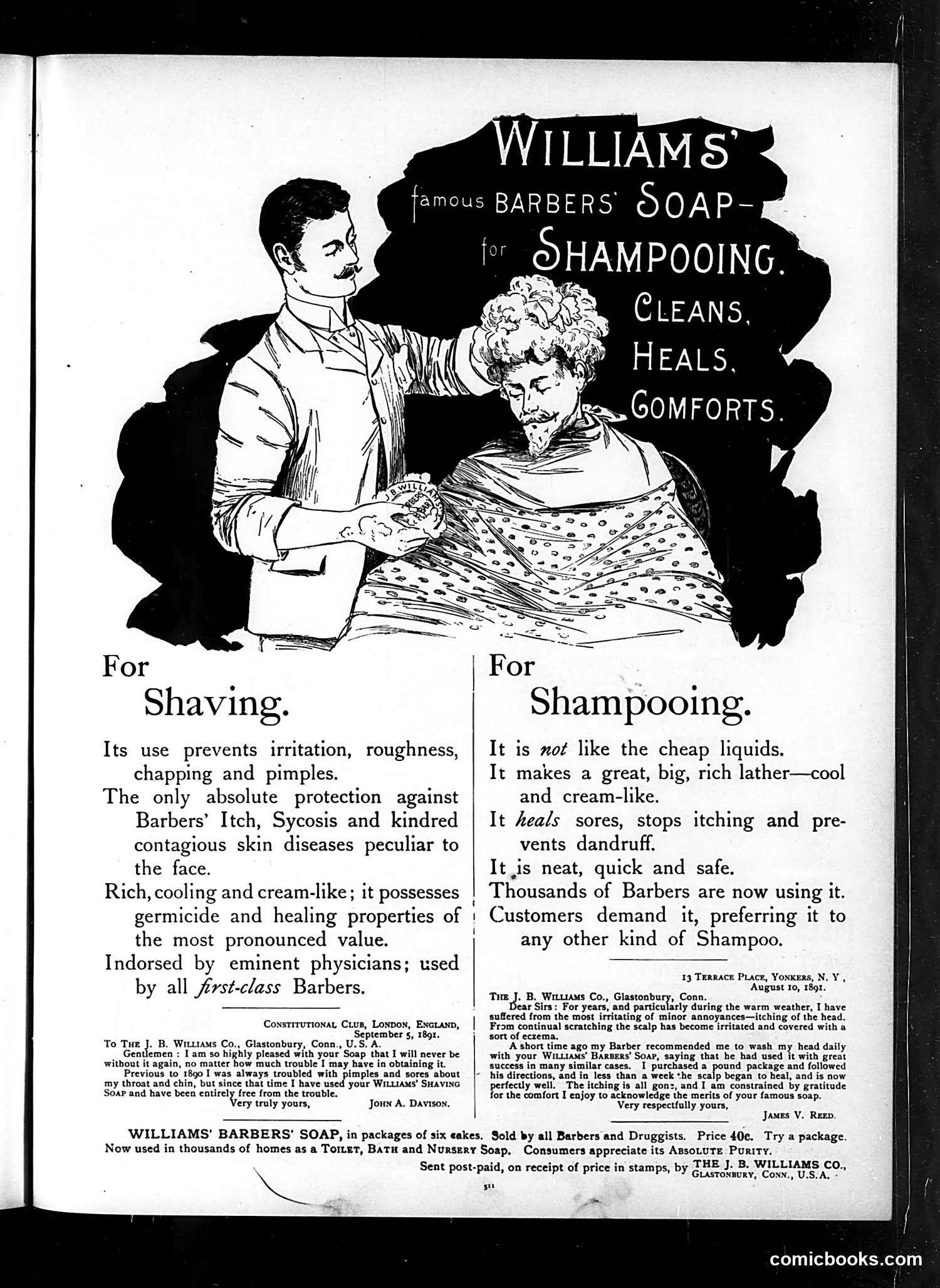
This is primarily **advertising copy**, not satire or political commentary. The page promotes Williams' Barbers' Soap from the J.B. Williams Company (Glastonbury, Connecticut), dated 1891. The advertisement claims the soap treats common 19th-century male grooming problems: "Barbers' Itch" and sycosis (facial skin infections common in barbershops). It emphasizes the product's germicidal properties and endorsement by "eminent physicians" and "first-class Barbers." The illustration shows a barber applying the soap to a customer's face. Two testimonial letters from satisfied users (dated September and August 1891) vouch for its effectiveness against pimples, sores, itching, and dandruff. The advertisement notes the soap also works as a toilet and nursery soap, appealing to broader household markets. This reflects the late-Victorian era's concern with hygiene and medicinal grooming products, before modern dermatology and antibiotics.
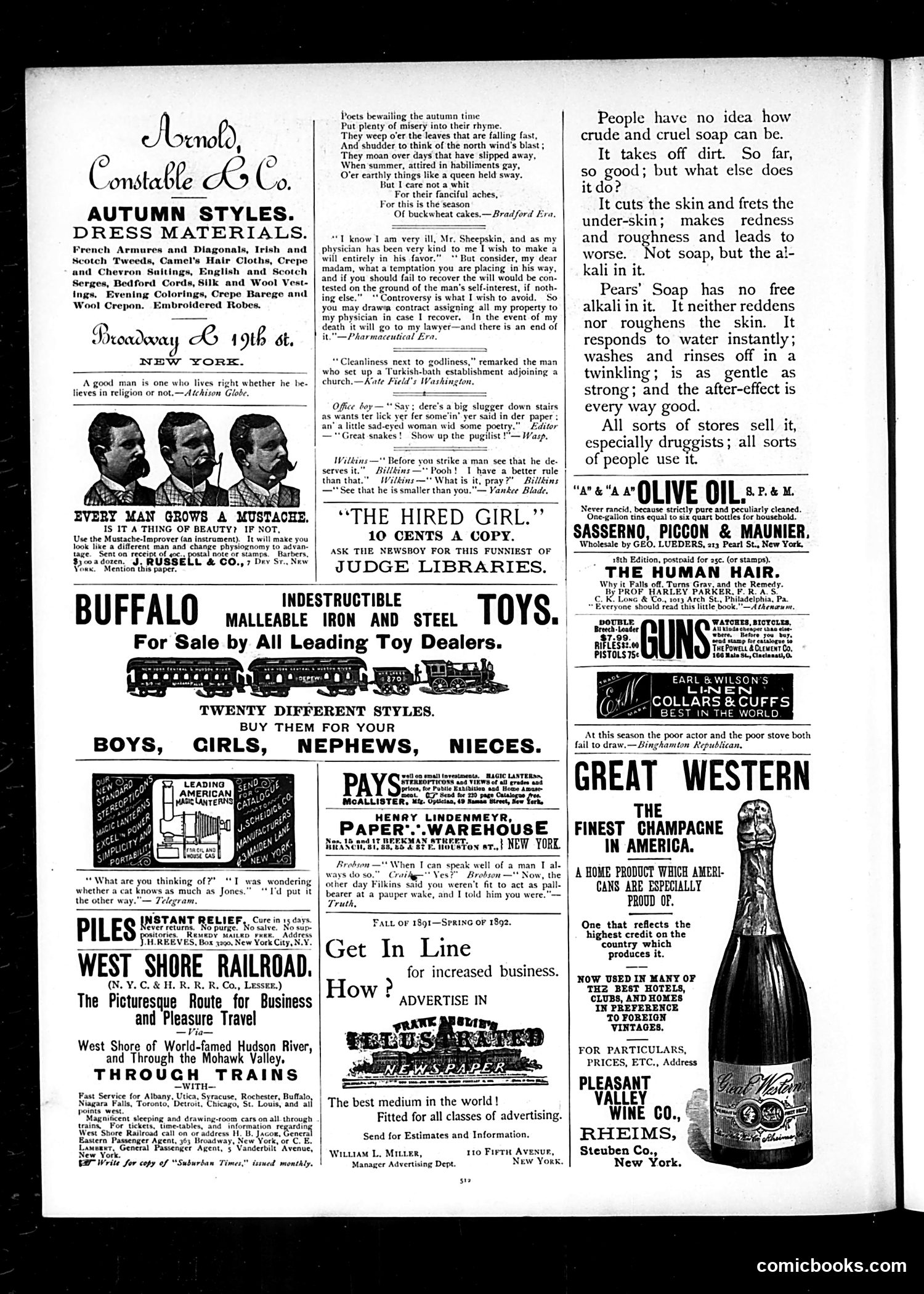
This page is primarily **advertising and filler content** rather than political satire. It contains: **Notable Elements:** 1. **Three male head profiles** (top left) - appear to be generic illustrations for a mustache-improvement device advertisement, not political figures. 2. **Brief humorous anecdotes** scattered throughout (about physicians, Turkish baths, office boys, etc.) - these are light social humor rather than political satire. 3. **The "Hired Girl" reference** - points to a separate Judge publication, likely domestic/servant comedy material typical of the era. 4. **Heavy advertising** - toys, railroads, champagne, hair products, and stationery dominate the page. **Verdict:** This appears to be a **filler/advertising page** from Judge magazine (likely 1891-1892 based on content), not a focused satirical article. The humor is genteel and domestic rather than politically pointed. Without clearer caricatures or explicit political references, specific satirical targets cannot be identified with certainty.
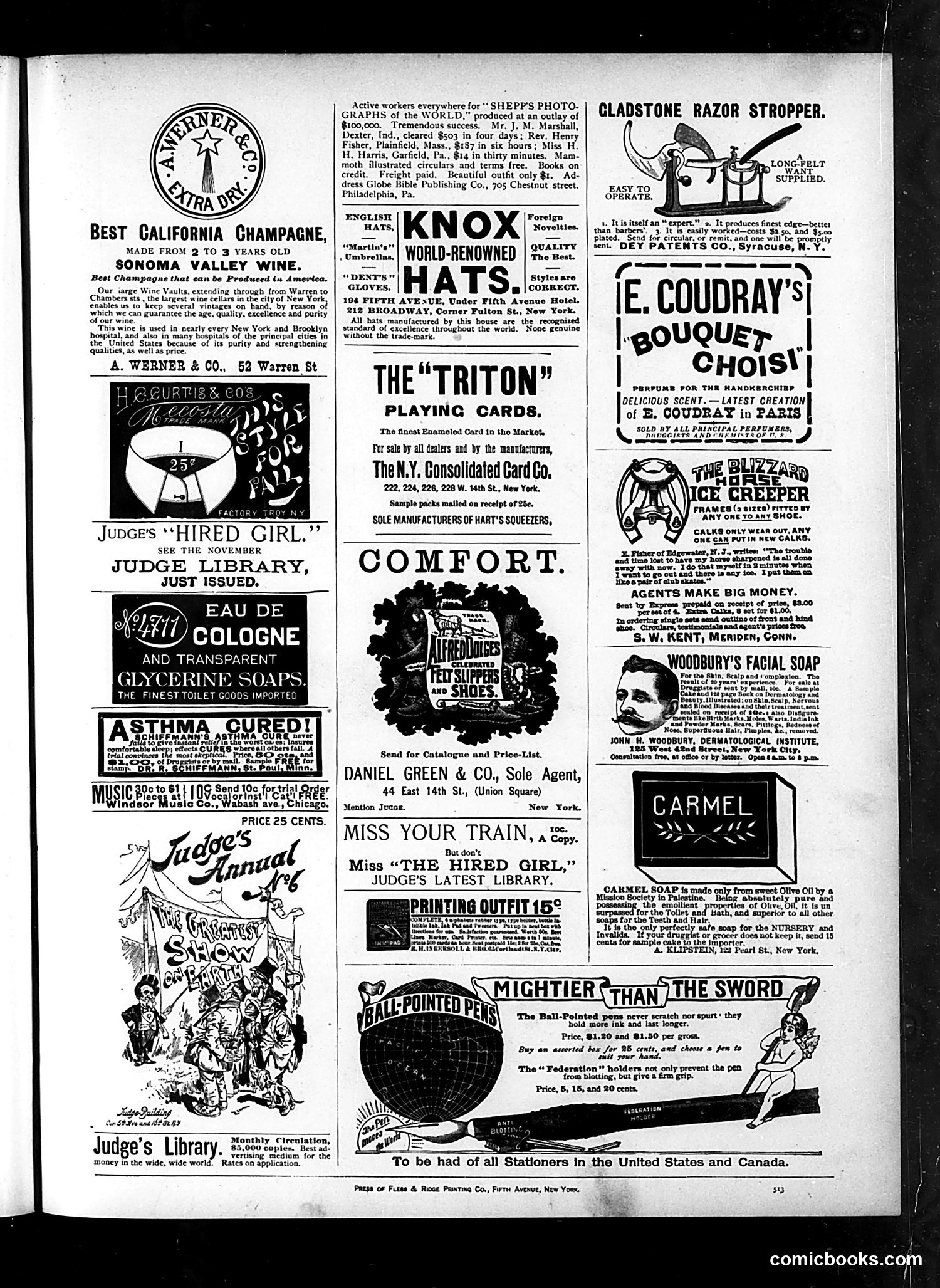
This is primarily an **advertising page** from Judge magazine, not a satirical cartoon page. The content consists almost entirely of commercial advertisements from the late 19th or early 20th century. Notable ads include: - **California champagne and wine** (Werner & Co.) - **Knox hats** — positioned as the world standard - **Playing cards, gloves, and footwear** - **Toiletries** (Eau de Cologne, Carmel soap, Woodbury's facial soap) - **Writing instruments** (ball-pointed pens) - A **razor stropper** and other grooming products The only potentially satirical reference is promotion for Judge's own "Hired Girl" library publication, appearing multiple times. The page reflects Judge's business model: a humor magazine funded heavily by advertisements for consumer goods aimed at middle and upper-class readers. There is **no evident political satire or social commentary** on this particular page — it's a straightforward commercial advertising section typical of magazines from this era.
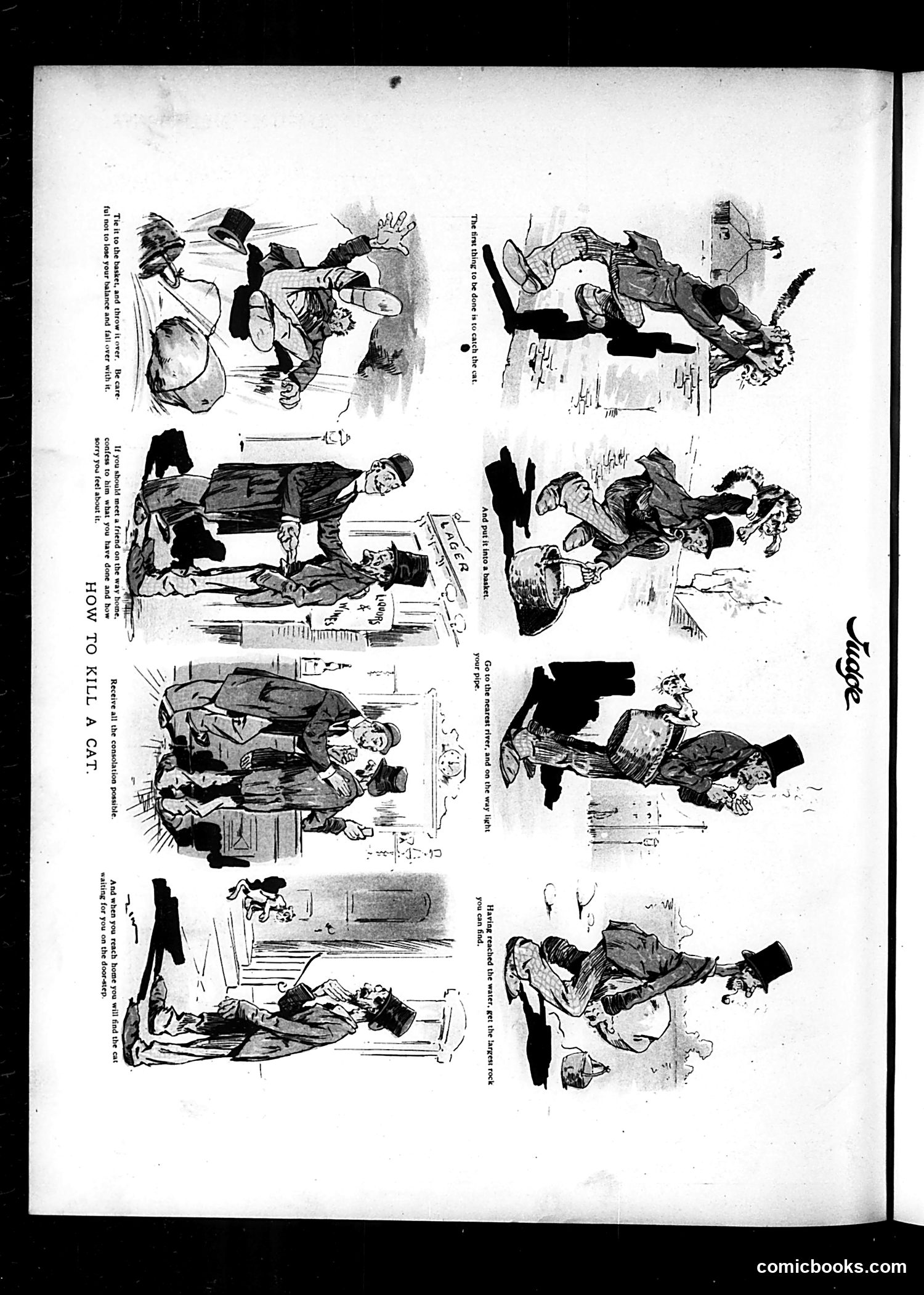
This appears to be a darkly satirical instructional comic sequence titled "How to Kill a Cat," showing a figure performing increasingly violent actions culminating in drowning. The OCR'd text references finding "the largest rock" and reaching "home" with something "waiting for you on the door-step." The satirical point likely mocks cruel folk remedies or superstitions about pest control that were common in earlier eras. Judge magazine frequently used grotesque visual humor to critique social problems and backward practices. The final panel's implication—that karma or consequence awaits the perpetrator—suggests the cartoon's moral commentary: such cruelty brings its own punishment. The style is consistent with late-19th or early-20th century American satirical cartooning, using exaggeration and dark humor as social critique.