
A complete issue · 16 pages · 1891
Judge — August 8, 1891
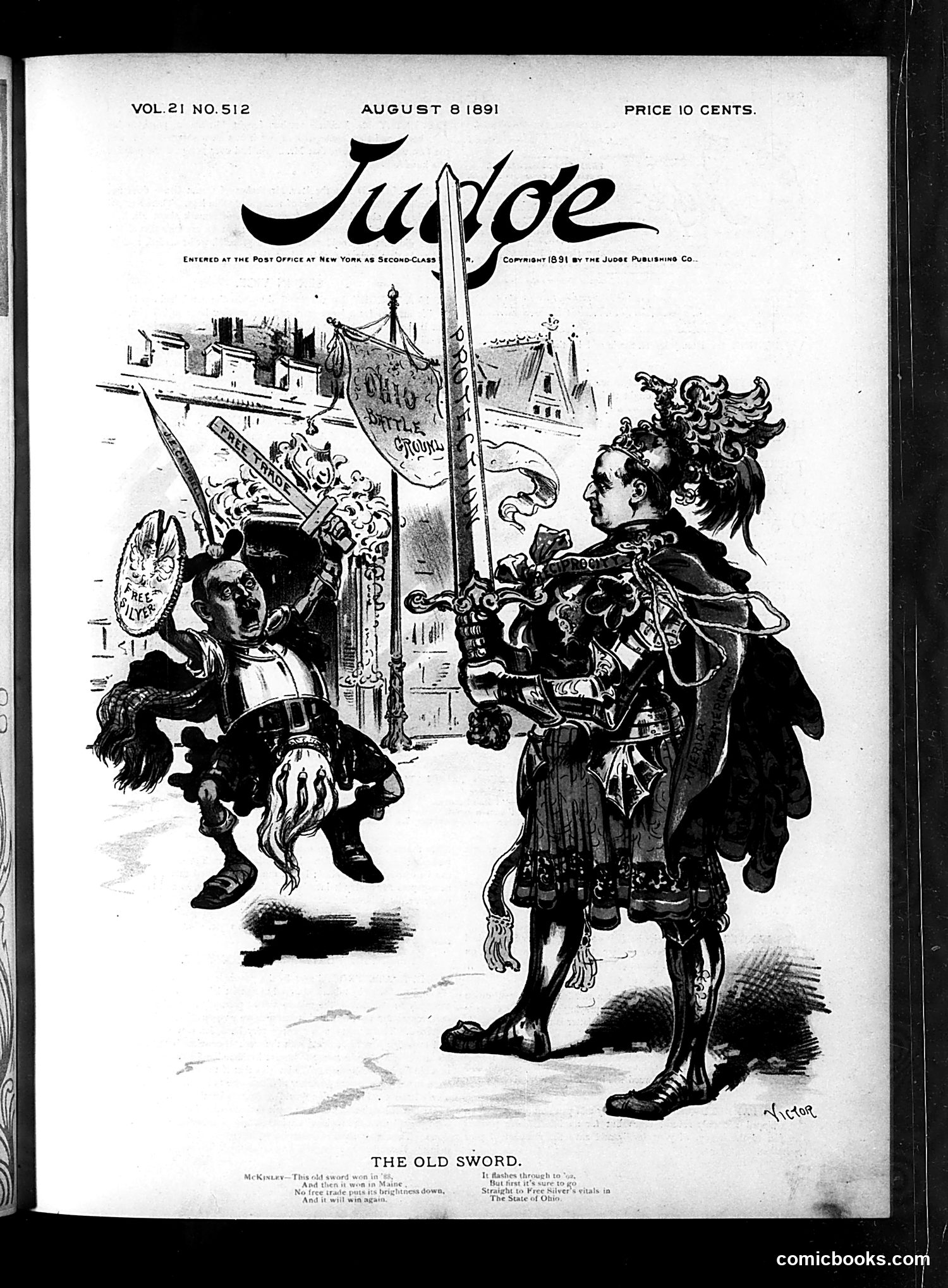
This cartoon appears to satirize political conflict, likely involving McKinley (referenced in the OCR text mentioning Maine). The image shows two figures in ornate military dress confronting each other over a sword—a symbol of political power or authority. The figure on the left appears caricatured with exaggerated features, while the right figure displays elaborate plumage and aristocratic bearing. The "old sword" likely represents established political power or tradition being contested. Without clearer identification of all figures, the exact political dispute remains unclear, but the militaristic imagery and confrontational pose suggest a struggle over control or leadership during this period of American politics. The ornate styling suggests parody of pretentious authority.
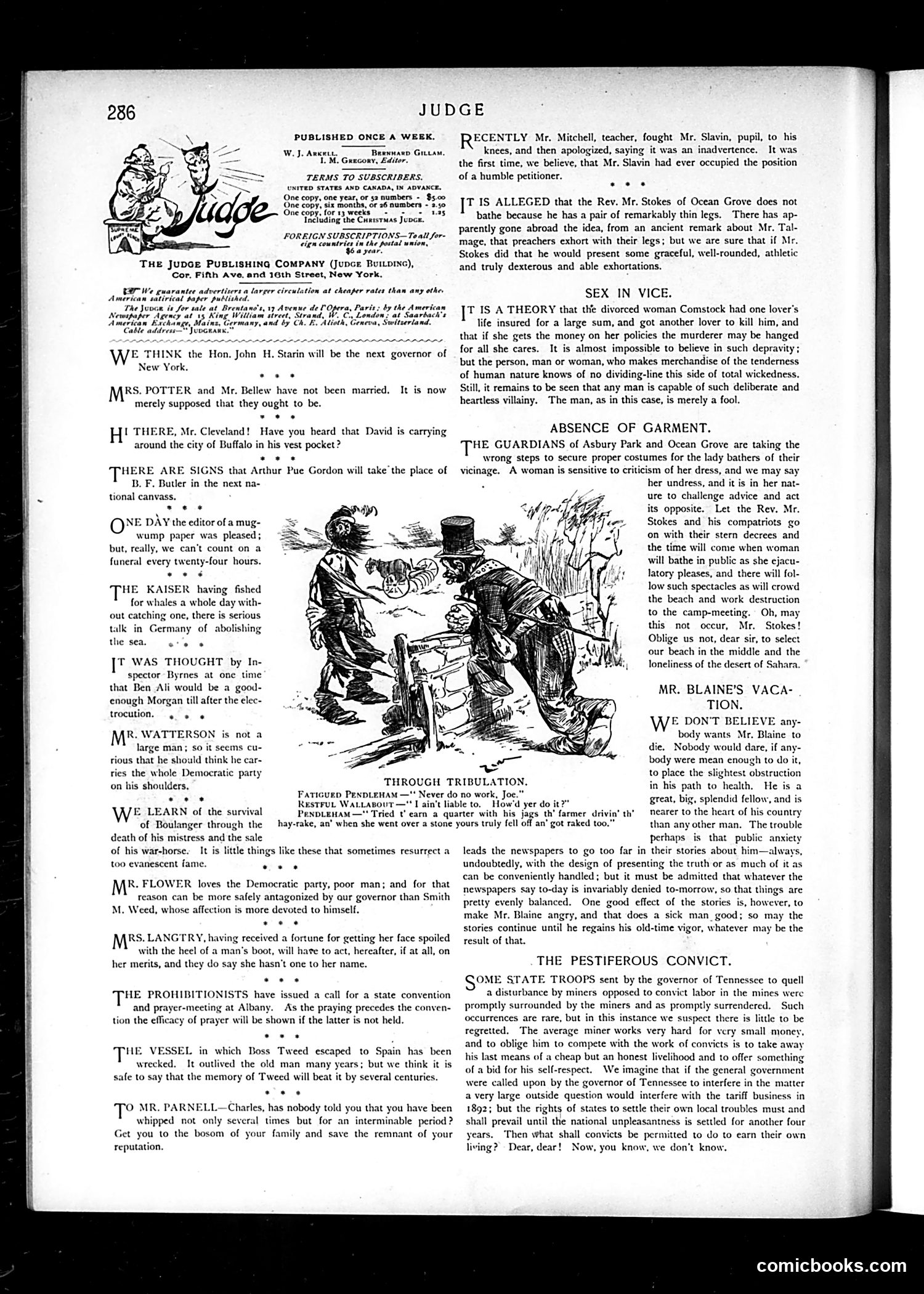
The main cartoon titled "Fatigued Pendulum" depicts three figures in apparent discussion or confrontation. Based on the caption "Never do any work, Joe" and "I ain't liable to... How'd yer do it?" with references to "a quarter with his pigs" and "drivin' in hayride," this appears to satirize working-class labor disputes or attitudes toward employment during the industrial era. The surrounding text items are brief satirical notes on contemporary figures and situations—including comments on political figures, social customs, and domestic arrangements. Without more specific historical context or clearer identification of the figures depicted, the exact political references remain somewhat unclear, though the tone suggests commentary on class relations, work ethics, and social pretension typical of Judge magazine's satirical approach.
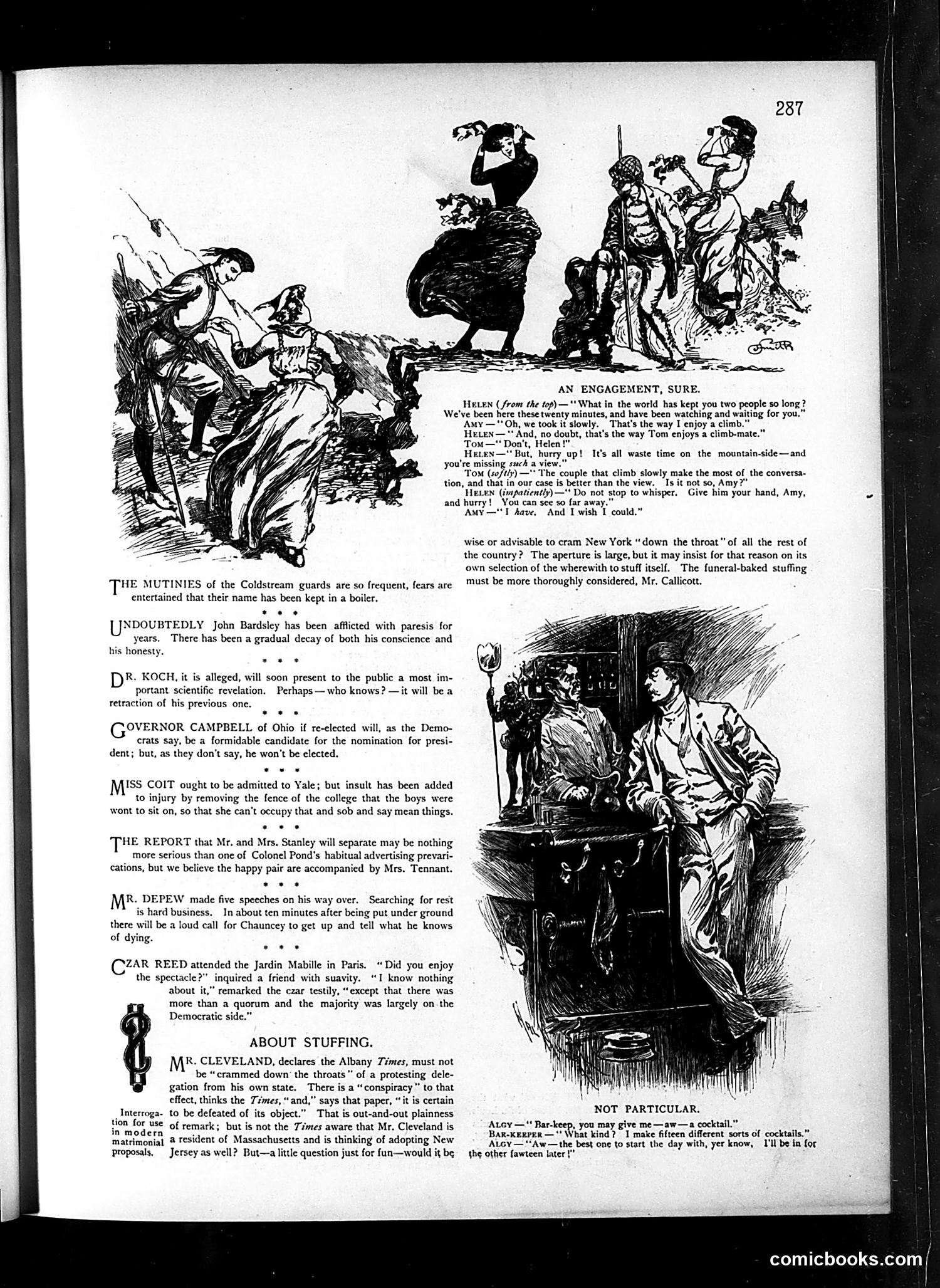
**Top Cartoon: "An Engagement Sure"** depicts a couple on a mountain climb. Helen and Amy discuss their slow progress; Amy argues they should rush to enjoy the view, while Helen insists on taking time for the experience itself. The satire mocks impatience and the American obsession with speed over substance—a common critique in early 20th-century satirical magazines. **Bottom Section: "Not Particular"** Shows two men discussing cocktails at what appears to be a bar. One offers various drinks; the other accepts any option indiscriminately. This likely satirizes either Prohibition-era drinking culture or post-Prohibition casual attitudes toward alcohol. **Middle Text:** Contains brief political gossip items about figures like John Bardsley, Dr. Koch, Governor Campbell, and others, typical of Judge's satirical news commentary.
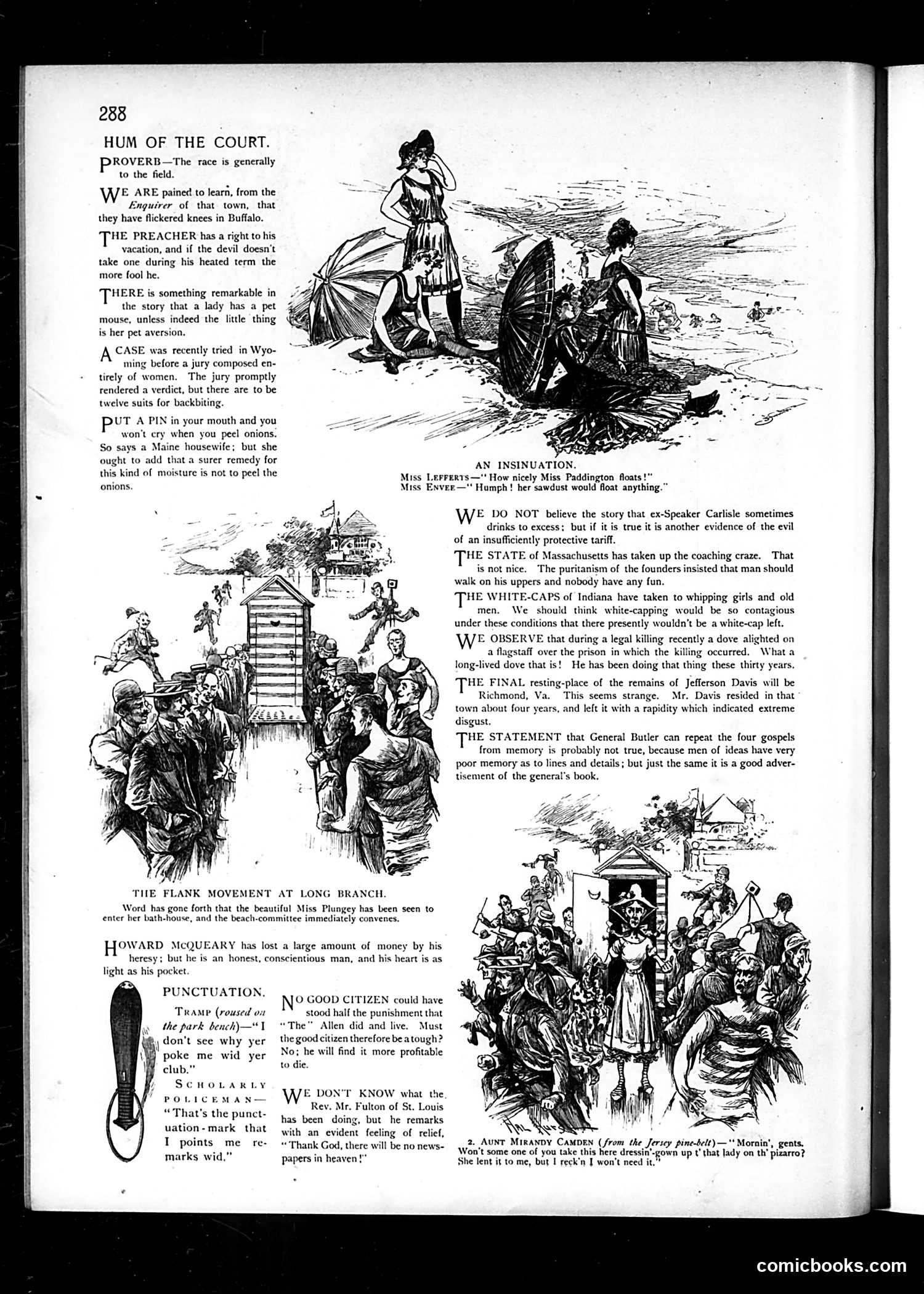
This page contains several brief satirical commentaries typical of Judge's "Hum of the Court" section, mixing social observation with political jabs: **"The Flank Movement at Long Branch"** appears to mock beach social dynamics, suggesting men congregate when an attractive woman enters the bathhouse—satirizing Victorian courtship rituals. **Political references** include criticism of ex-Speaker Carlisle's alleged drinking (linking it to tariff policy), Massachusetts adopting coaching (mocking Puritan strictness), and Indiana's "White-Caps" (the vigilante group known for violent intimidation). The reference to Jefferson Davis fleeing Richmond suggests lingering post-Civil War resentment. **Social satire** targets women jurors (implying cattiness), protective tariffs, and religious hypocrisy (Rev. Fulton hoping for no newspapers in heaven). **The cartoons** illustrate mundane scenarios: police brutality, beach etiquette, and rural life, rendered in typical Judge's mock-genteel style. The humor relies on period-specific class anxieties and assumes readers' familiarity with contemporary scandals now obscure.
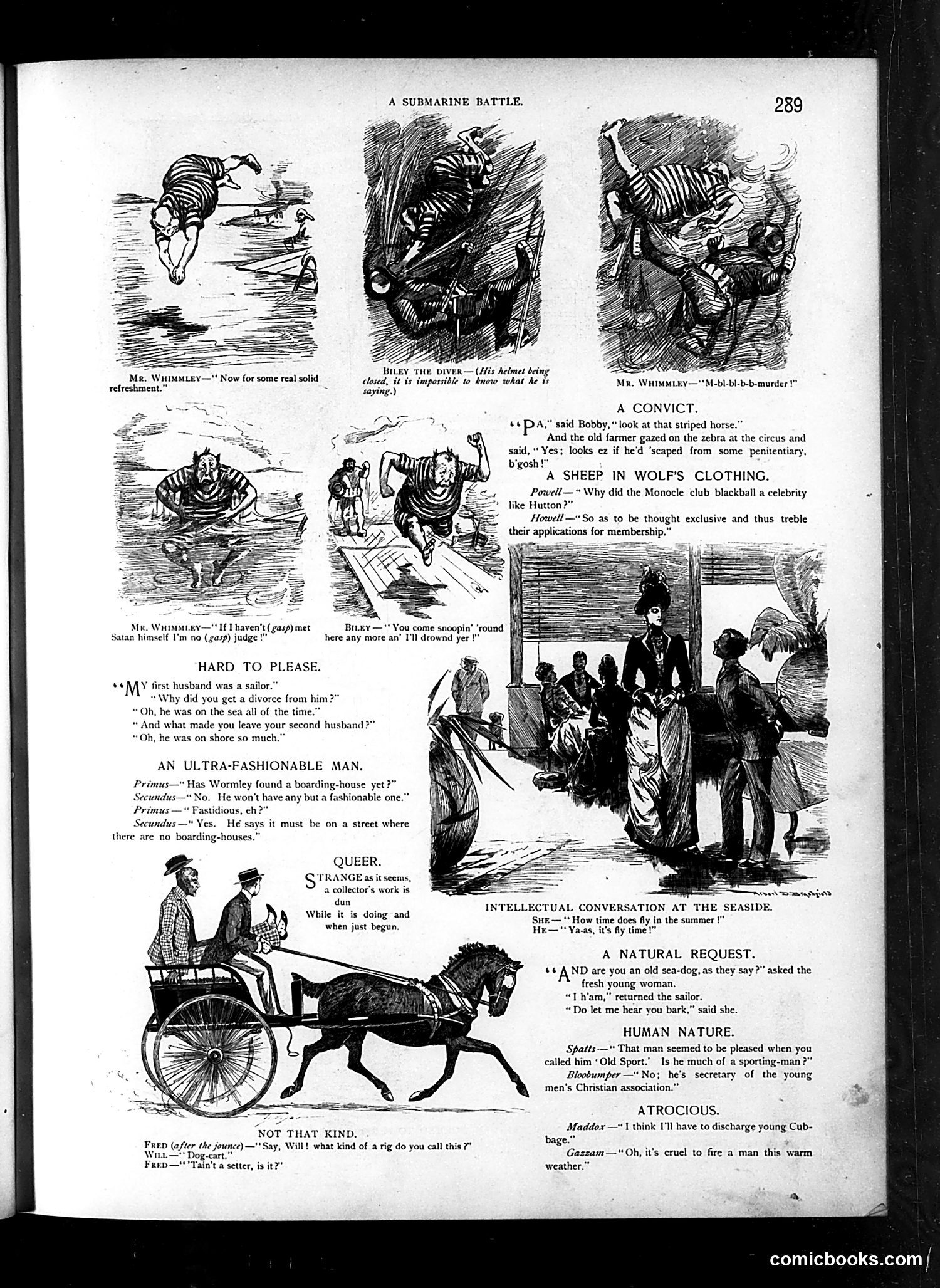
This page contains multiple short satirical jokes and cartoons typical of early 20th-century American humor: **Key Sketches:** - **"A Submarine Battle"** and **"Hard to Please"**: Domestic humor about wives and husbands, reflecting period anxieties about marriage and gender roles. - **"A Convict"**: A child mistakes a zebra for an escaped convict, satirizing rural ignorance or the exotic nature of circus animals to unsophisticated viewers. - **"A Sheep in Wolf's Clothing"**: Social satire on exclusive clubs like the Monocle Club rejecting celebrities to appear elite, then paradoxically attracting *more* applicants through exclusivity. - **"An Ultra-Fashionable Man"**: Mock of fashion-obsessed snobs who prioritize location over quality. - **"Intellectual Conversation at the Seaside"**: Punny satire on banal summer conversation ("fly time" as both pun and season reference). - **"Human Nature"** and **"Atrocious"**: Light jokes on hypocrisy and practical concern outweighing moral duty. The page exemplifies *Judge*'s focus on sarcastic commentary about social pretension, marital dynamics, and human foibles rather than political content.
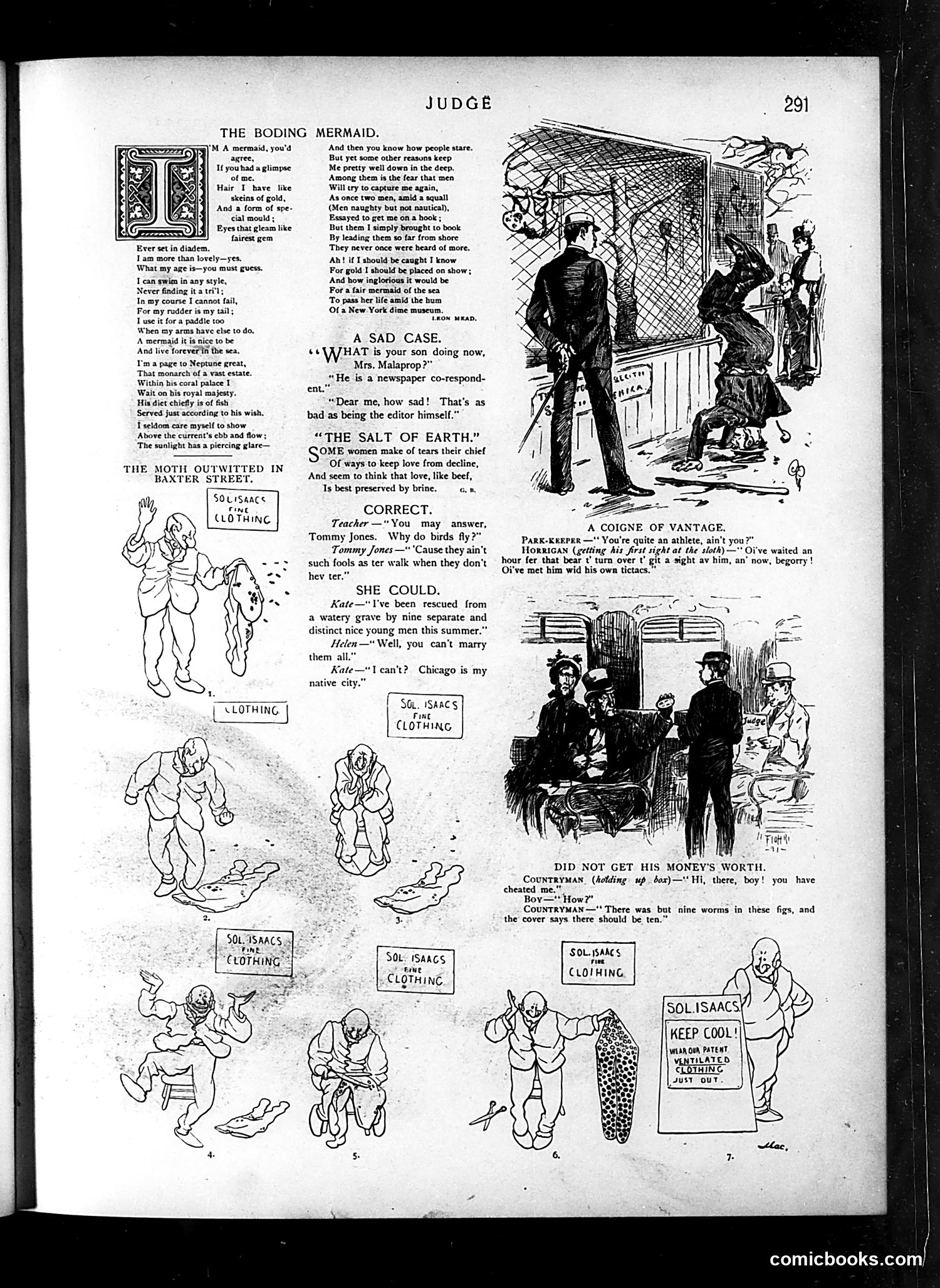
This page contains multiple satirical pieces typical of Judge magazine's humor: **"The Boding Mermaid"** is a poem mocking sensational entertainment and commercialism. The mermaid fears being captured and displayed in a "New York dime museum"—referencing the era's popular "freak show" attractions (like P.T. Barnum's exhibits). The satire targets both the exploitation of curiosities for profit and the public's appetite for such spectacles. **"A Sad Case"** jokes about newspaper correspondents' difficult working conditions through a pun: a correspondent's "diet chiefly is of fish," implying harsh assignment to maritime/undesirable beats. **"The Salt of Earth"** satirizes women who use emotional manipulation (tears) to preserve romantic relationships—comparing love to preserved beef requiring "brine." The remaining pieces are brief comic quips about school children, Chicago, and country folk. **Sol. Isaacs Fine Clothing** advertisements run throughout, suggesting this publication was commercial in nature, mixing editorial humor with paid advertising—standard for magazines of this period.
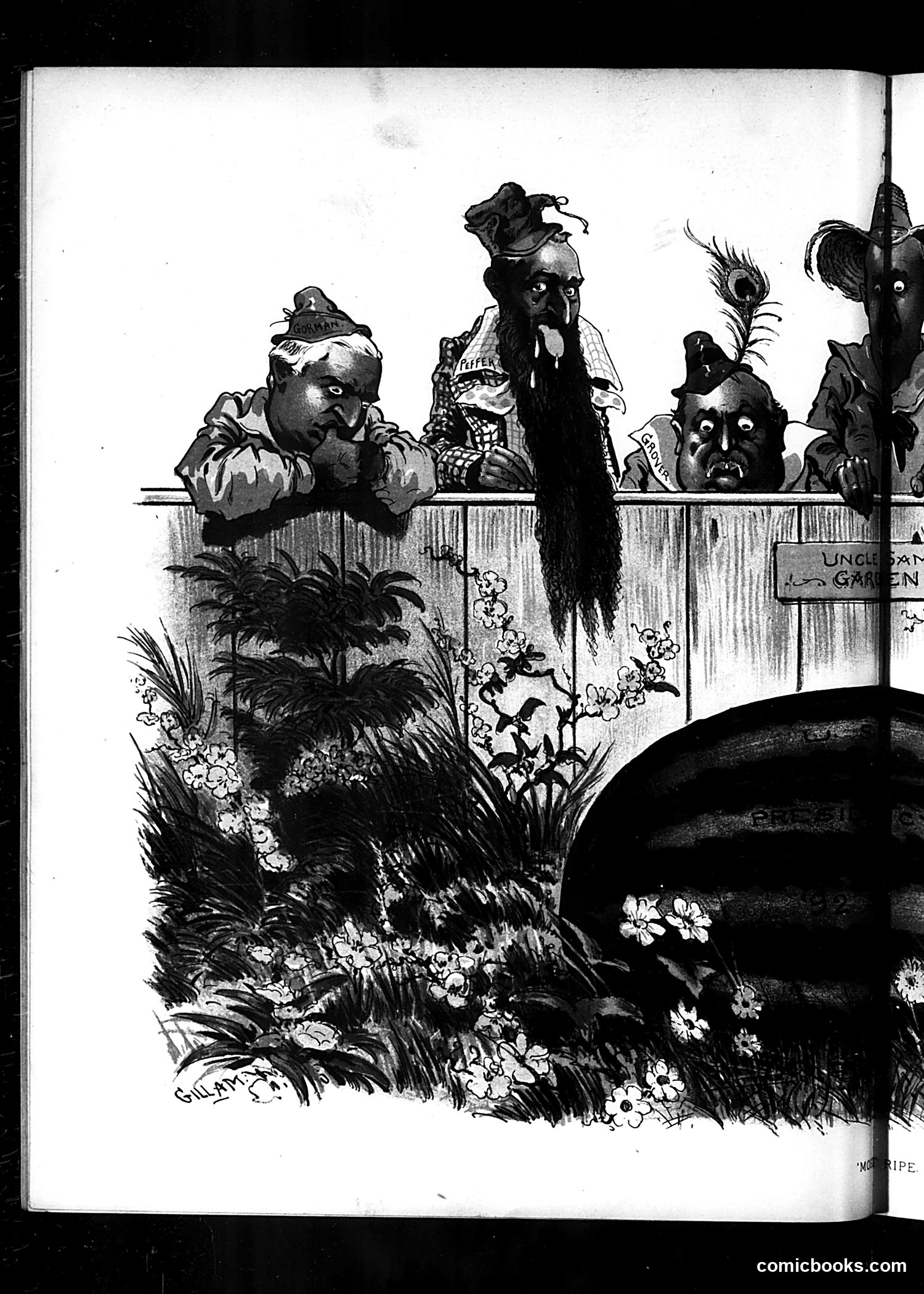
This appears to be a satirical illustration from *Judge* magazine featuring grotesquely caricatured figures wearing ornate military dress and feathered headpieces, leaning over a railing. The exaggerated facial features and theatrical costumes suggest these are meant to represent foreign or exotic dignitaries—possibly depicting imperial or colonial figures in a mocking way. The foreground shows decorative flowers and foliage, with what appears to be a dark object (possibly a hat or vessel) in the lower right. The overall composition and artistic style is typical of early 20th-century American political satire. However, without readable text or clear identifying labels visible in the image, I cannot definitively identify the specific figures or the exact political event being satirized. The intent appears to be ridiculing pomposity or foreign affairs, but the precise context remains unclear.
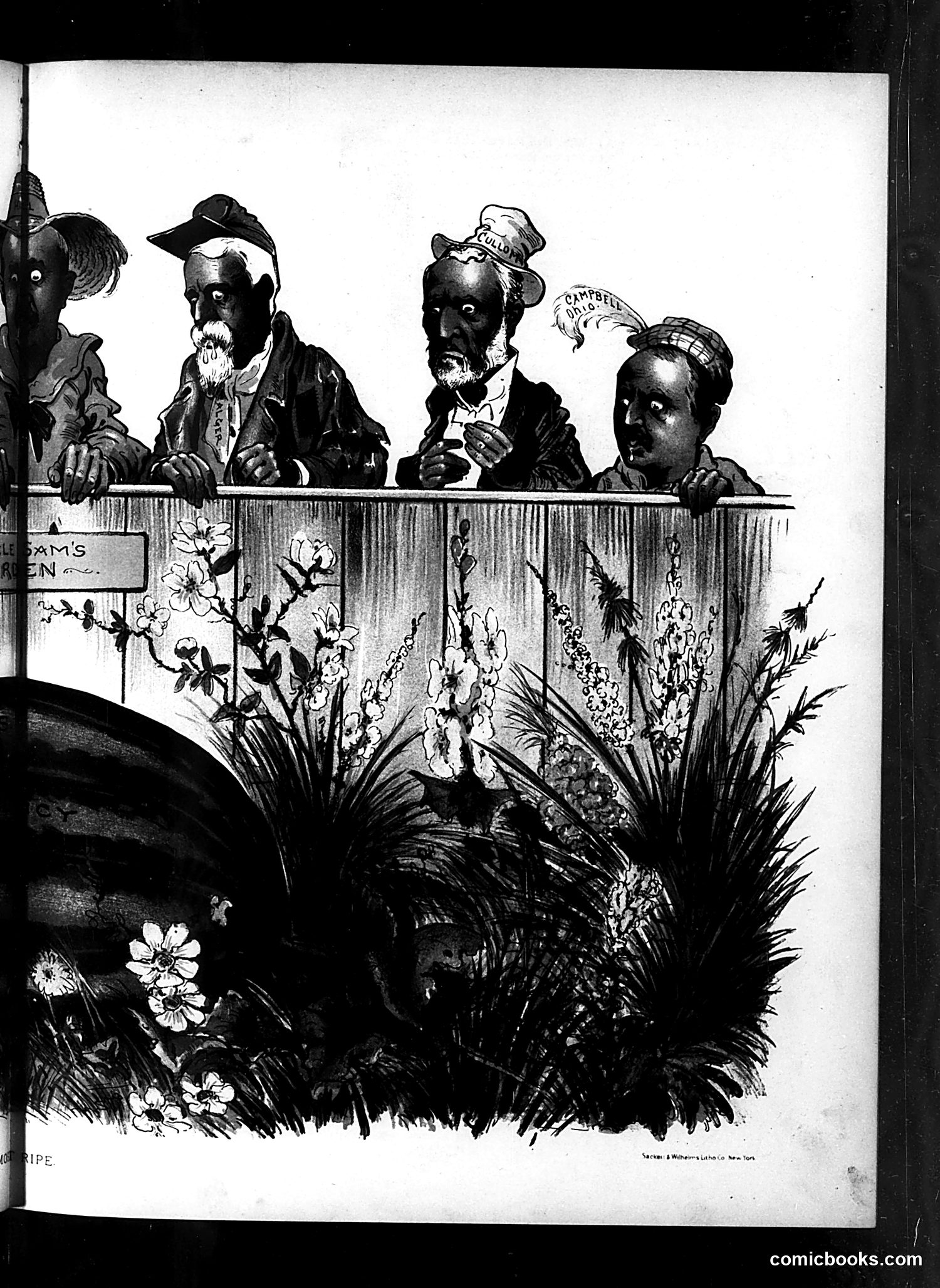
This is a political cartoon from **Judge magazine** depicting four men in caricatured form standing at a railing, overlooking flowering plants and grasses. The figures appear to be caricatured with exaggerated facial features typical of early-to-mid 20th century satirical art. Without clearer text identification on the visible portion, I cannot definitively name the specific political figures depicted. However, the setup—multiple prominent men displayed together at a railing—suggests commentary on contemporary politicians or public figures, likely commenting on their policies or public statements. The elaborate floral foreground may symbolize something being cultivated, hidden, or obscured by these figures. The overall composition suggests political satire, but the specific target and message require additional context not fully legible in this image.
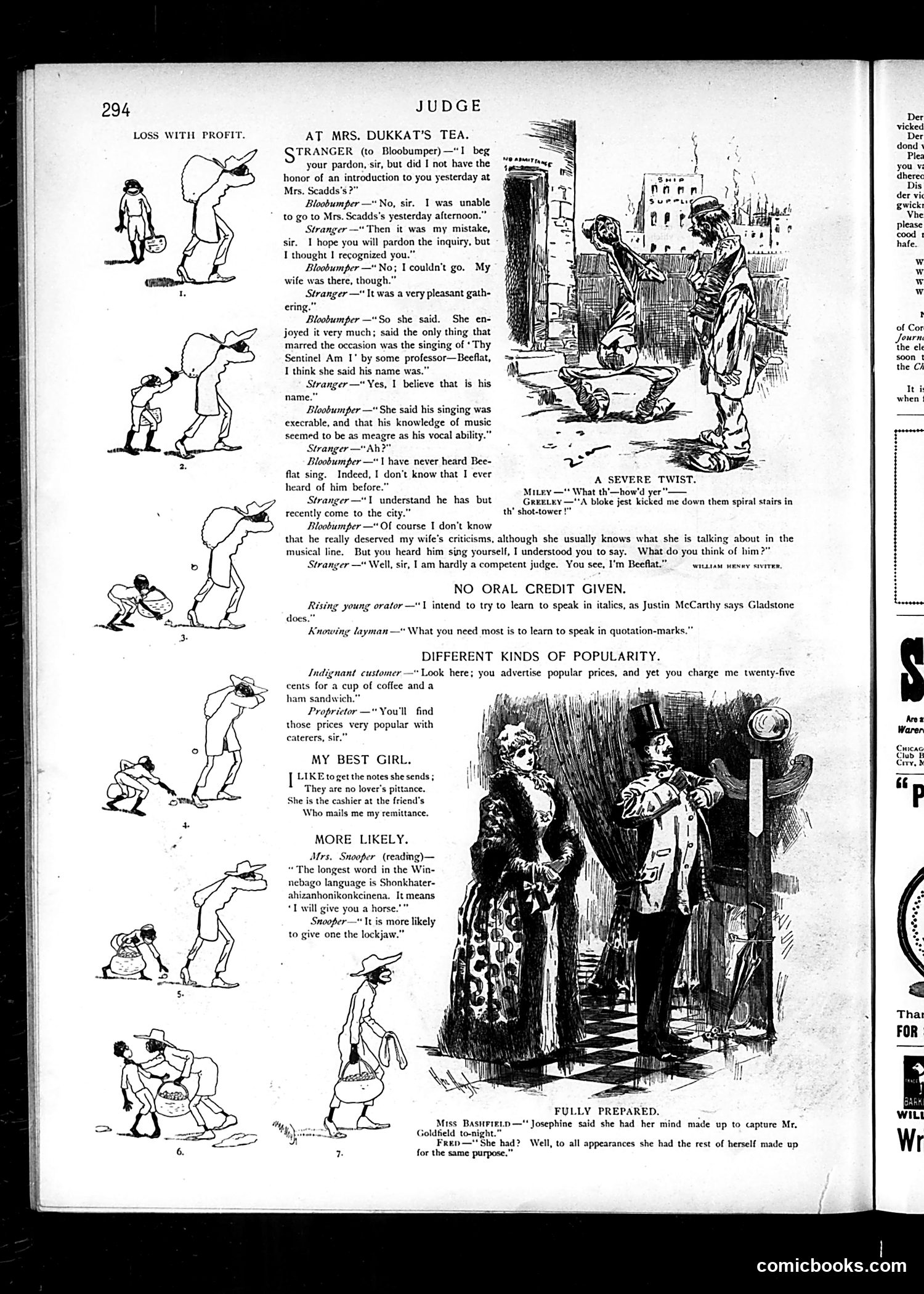
This page contains multiple satirical sketches typical of late-19th/early-20th-century American humor magazines: **"At Mrs. Dukkat's Tea"** mocks social pretense: A stranger claims to have met Bloobumper at a previous social event, but was actually elsewhere. The joke hinges on Bloobumper's wife attending and criticizing a singer named "Beeflat"—whom the stranger then reveals *he* is. The satire targets both social snobbery and people judging others they don't actually know. **Other sketches** include: a customer complaining about "popular prices" that aren't actually cheap; romantic notes valued only because they're from a cashier; a pun about the longest Winnebago word causing "lockjaw"; and a woman who "prepared" for seduction by applying makeup. The **left column illustrations** show physical comedy of someone repeatedly falling or being knocked down—slapstick humor common to the era. The overall tone satirizes social climbing, pretense, and shallow courtship customs of the period. These are workplace/romantic jokes aimed at middle-class readers.
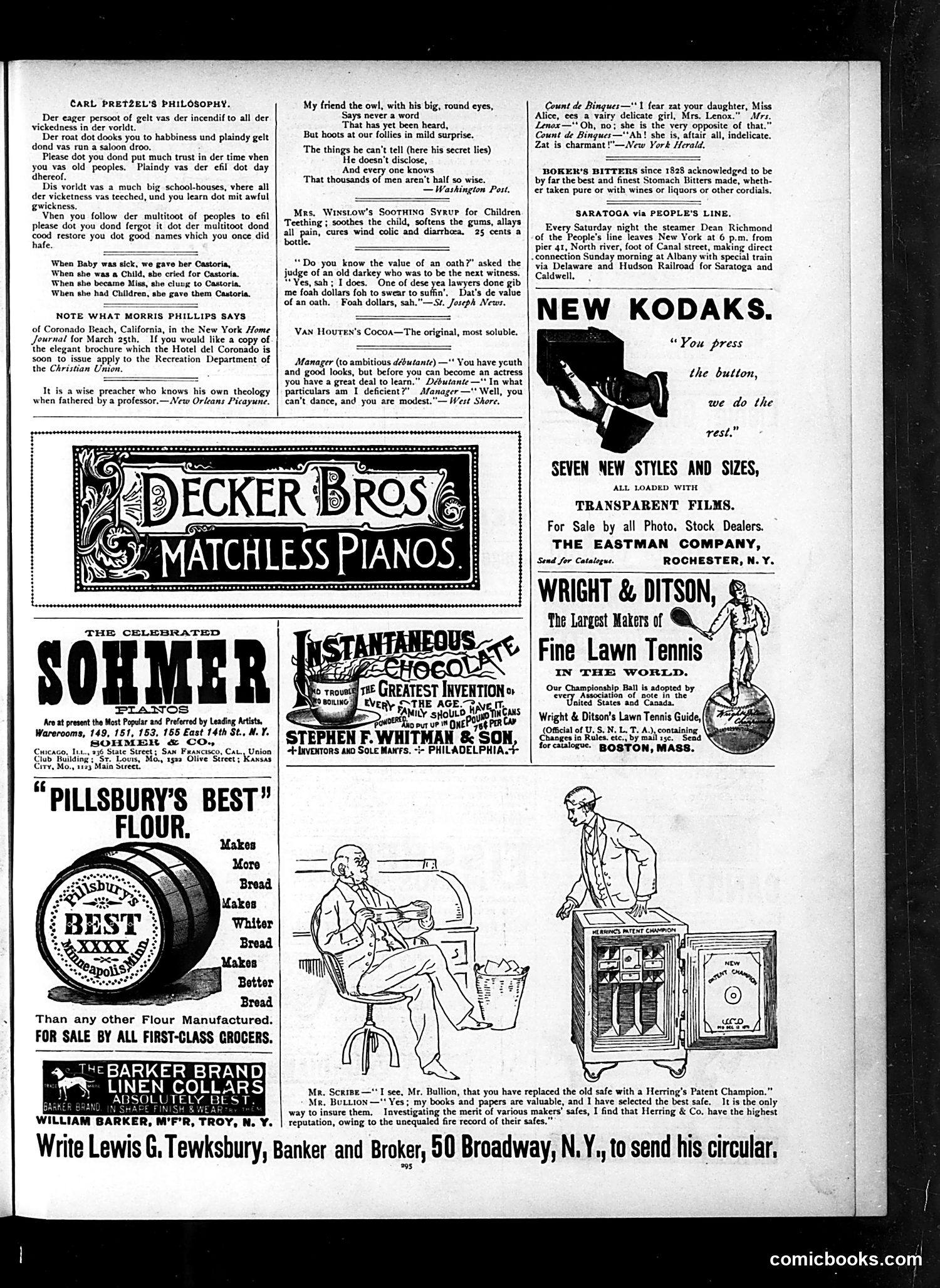
This is primarily an **advertising page** with minimal satirical content. The notable material includes: **"Carl Pretzel's Philosophy"** — A recurring character speaking in exaggerated German-immigrant dialect, offering cynical observations about wealth, morality, and human nature. The humor derives from both the philosophical cynicism and the comedic ethnic stereotype of the German speaker. **Social Commentary Snippets** — Brief humorous anecdotes scattered throughout (the judge questioning an elderly Black witness about oath-taking, the theater manager telling a debutante she's "too modest") reflect period attitudes toward race and gender roles without sustained satirical critique. **Advertisements** — The bulk of the page promotes pianos, flour, lawn tennis equipment, cameras (new Kodak models), chocolate, and various patent medicines. These reflect late-19th-century consumer products and marketing approaches. The page lacks cohesive political satire or sustained cartoon commentary. It's essentially a **miscellany of advertisements interspersed with light humor and ethnic stereotypes** typical of the era's popular magazines.
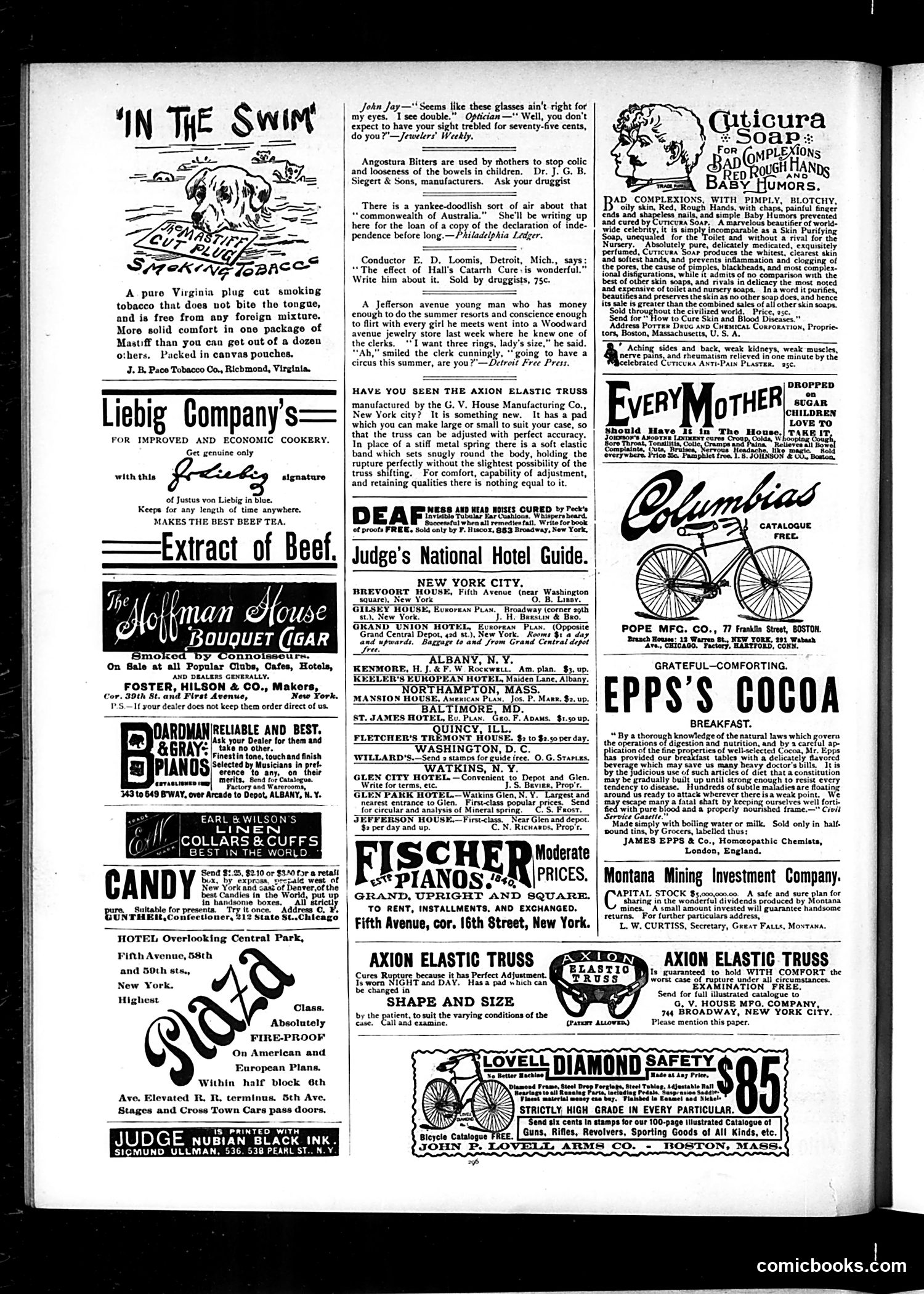
This page is primarily **advertisements with one small comic caption** at the top. The cartoon "In the Swim" depicts a humorous exchange between a customer named John Jay and an optician. Jay complains that eyeglasses make him see double; the optician quips that Jay shouldn't expect his vision "trebled" (tripled) for just seventy-five cents. The joke plays on the customer's complaint—he claims to see *double* (two images), yet sarcastically expects that for cheap payment he'd somehow get *triple* vision improvement. It's simple wordplay humor mocking both customers' unrealistic expectations and the low price they're willing to pay for optical services. The rest of the page consists almost entirely of period advertisements for tobacco, beef extract, pianos, hotels, trusses, and other goods—typical Judge magazine filler content alongside editorial humor.
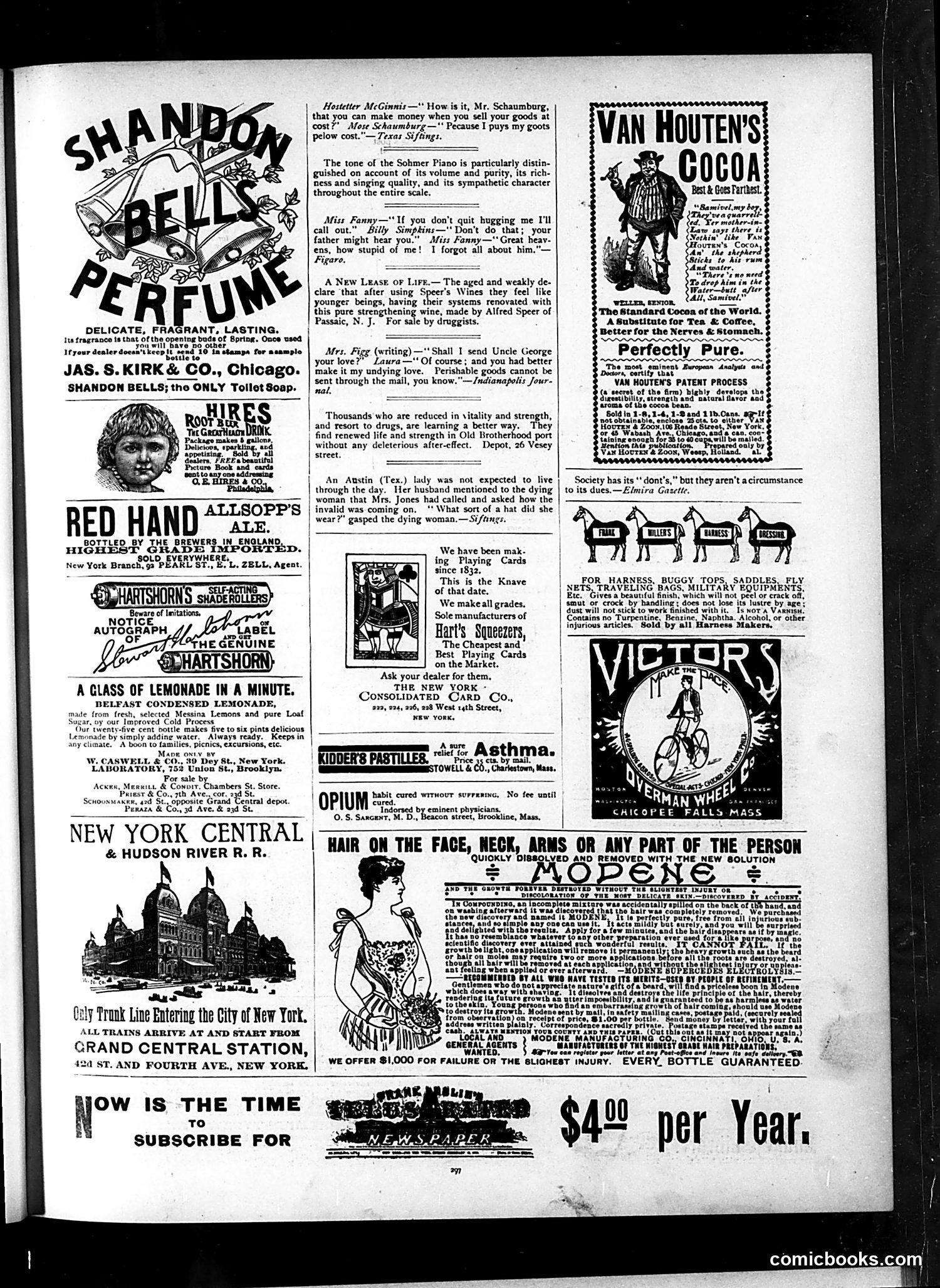
This page is primarily **advertising**, typical of late 19th-century American magazines. The content consists almost entirely of product advertisements with minimal editorial cartoons. The few humorous items visible are short joke fillers between ads: - **"Hostetter McGinnis" exchange**: A joke about Mose Schaumburg undercutting competitors by buying goods below cost—satirizing cutthroat business practices of the era. - **Romance jokes**: Brief comedic snippets about courtship and marriage, reflecting period attitudes (e.g., a woman's concern about a rival's hat even while dying). The ads themselves reflect 1880s-90s consumer culture: patent medicines (Modene hair removal, opium pastilles for asthma), beverages (cocoa, wine, lemonade), playing cards, and transportation (railroad services). Many products made dubious health claims typical of the pre-FDA regulation era. **No major political satire** is evident on this particular page—it's standard magazine filler content mixing light humor with commercial promotion.
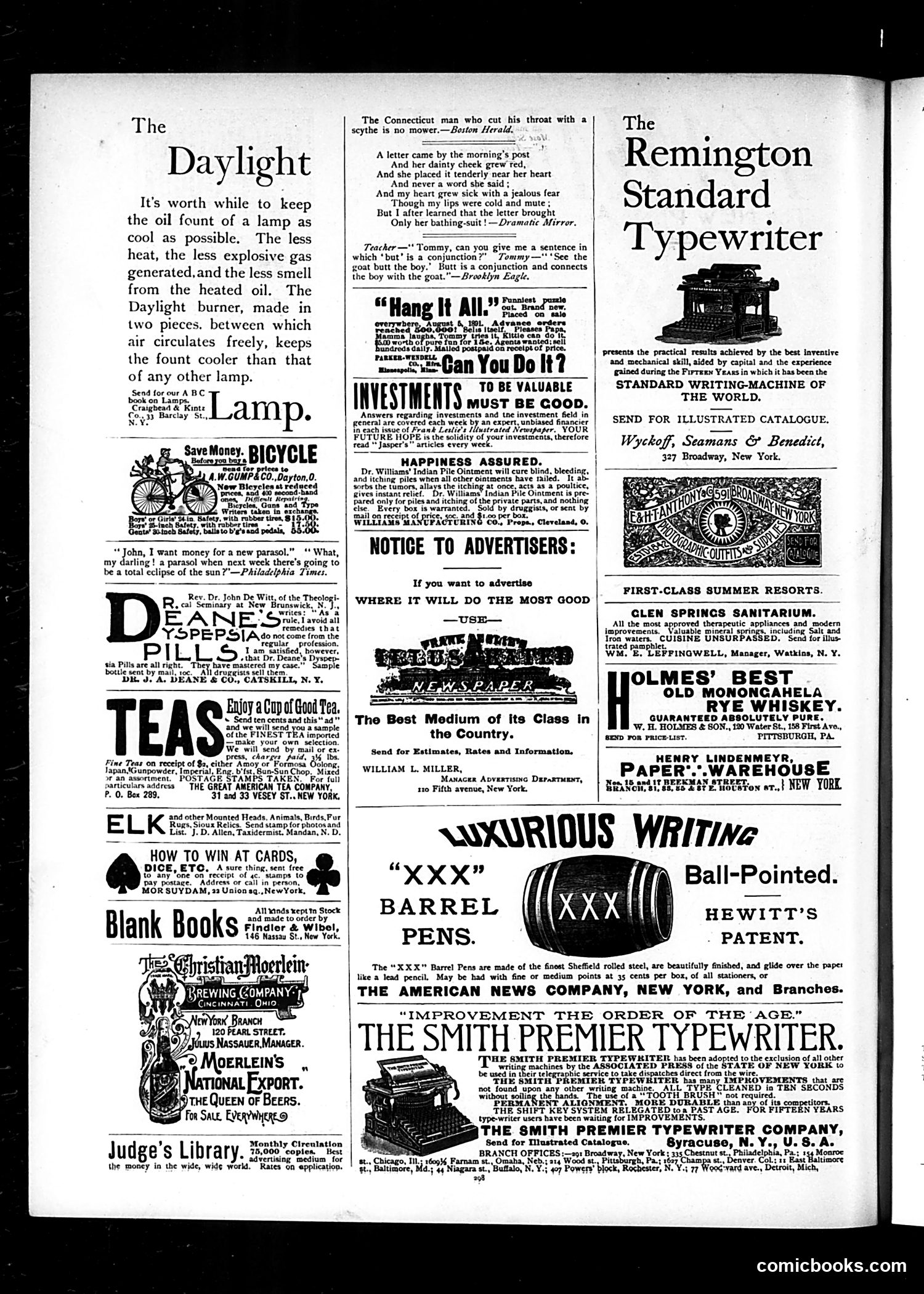
This page is primarily **advertising** rather than editorial cartoons or satire. It contains multiple commercial advertisements typical of late 19th-century publications. The few jokes that appear are brief, conventional items: 1. A Connecticut suicide pun ("no mower") 2. A love-letter misunderstanding (the letter contains only a bathing suit) 3. A child's grammar confusion (mistaking "butt" the verb for a conjunction) 4. A joke about a man asking his wife for parasol money before a total eclipse These are mild, domestic humor pieces with no clear political commentary. The page showcases products including the Remington typewriter, bicycles, teas, patent medicines (Dr. Deane's pills for dyspepsia), and various remedies. This reflects Judge's dual nature as both satirical magazine and advertising vehicle for merchants seeking affluent readers.
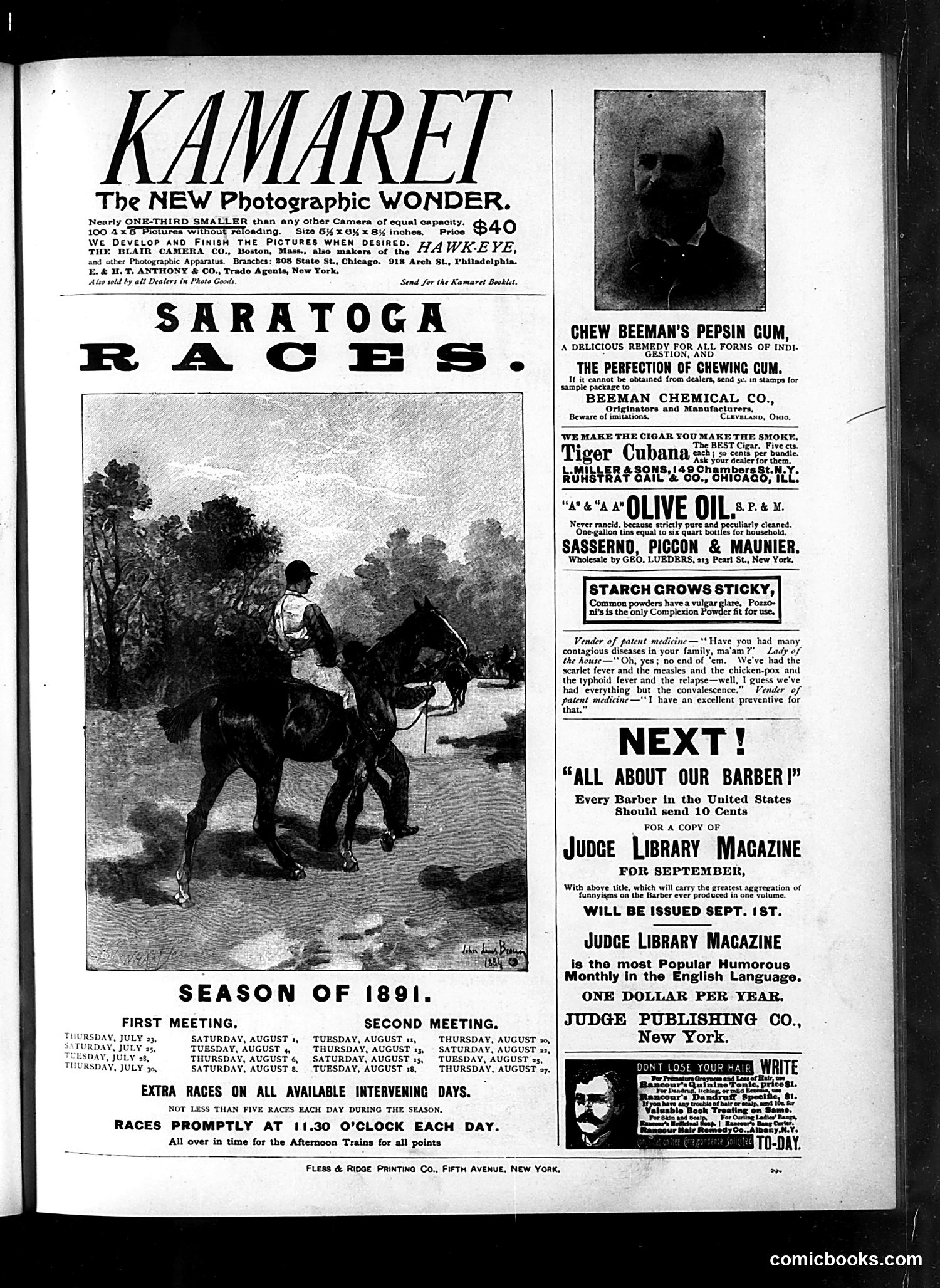
This page is primarily **advertising**, not political satire. The dominant content is a large illustration promoting the **Saratoga horse racing season of 1891**, showing a mounted rider on horseback—likely advertising the famous Saratoga Race Track in upstate New York, a major entertainment destination. The page is filled with period product advertisements (cameras, chewing gum, cigars, olive oil, starch) typical of late-19th-century magazines. The only joke content is a small **patent medicine vendor cartoon** at bottom-right, satirizing quack medicine salesmen who claimed to prevent contagious diseases. The humor relies on the lady listing every major illness imaginable ("scarlet fever," "measles," "typhoid"), then noting she missed only "convalescence" (recovery)—mocking both gullible customers and fraudulent remedies. The page also promotes Judge's September issue featuring barber-related humor, reflecting the magazine's focus on accessible, everyday comedy for general audiences.
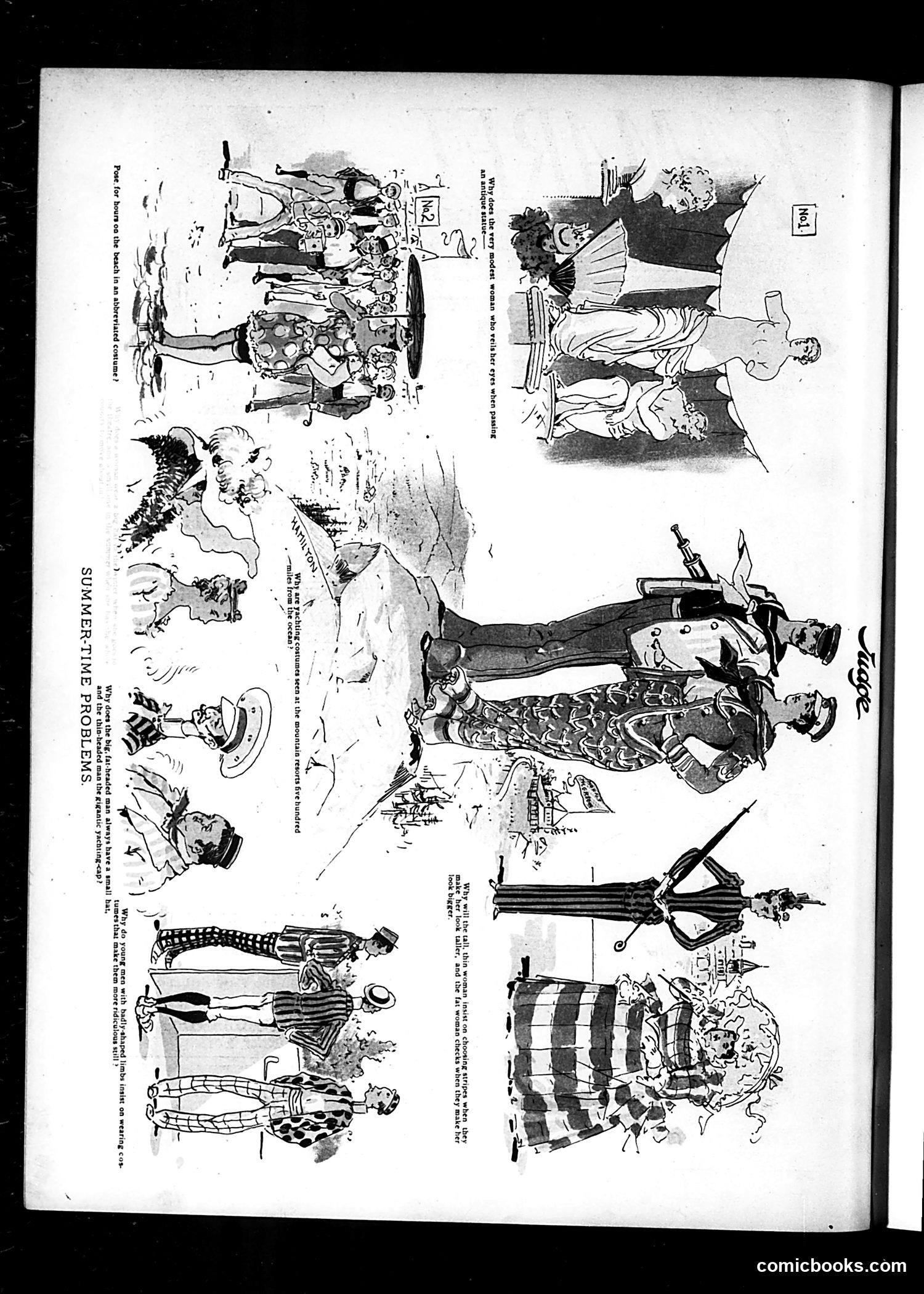
This page presents a series of comedic illustrations addressing fashion and body-image absurdities of the summer season. The cartoons mock mismatches between people's physical attributes and their clothing choices: The satirical questions highlight vanity and poor judgment: why do thin men wear costumes that emphasize their skeletal frames? Why do overweight women choose horizontal stripes that add visual width? Why do poorly-proportioned men parade in revealing beach wear? The humor relies on exaggerated caricature—showing individuals whose body types seem to actively contradict their fashion selections. This reflects Judge magazine's typical approach: using grotesque illustration to ridicule social pretensions and poor taste, particularly regarding how Americans present themselves during leisure season. The satire suggests that vanity blinds people to their own unflattering appearance—a timeless theme, though expressed through the specific fashion anxieties of Judge's era.