
A complete issue · 16 pages · 1891
Judge — February 14, 1891
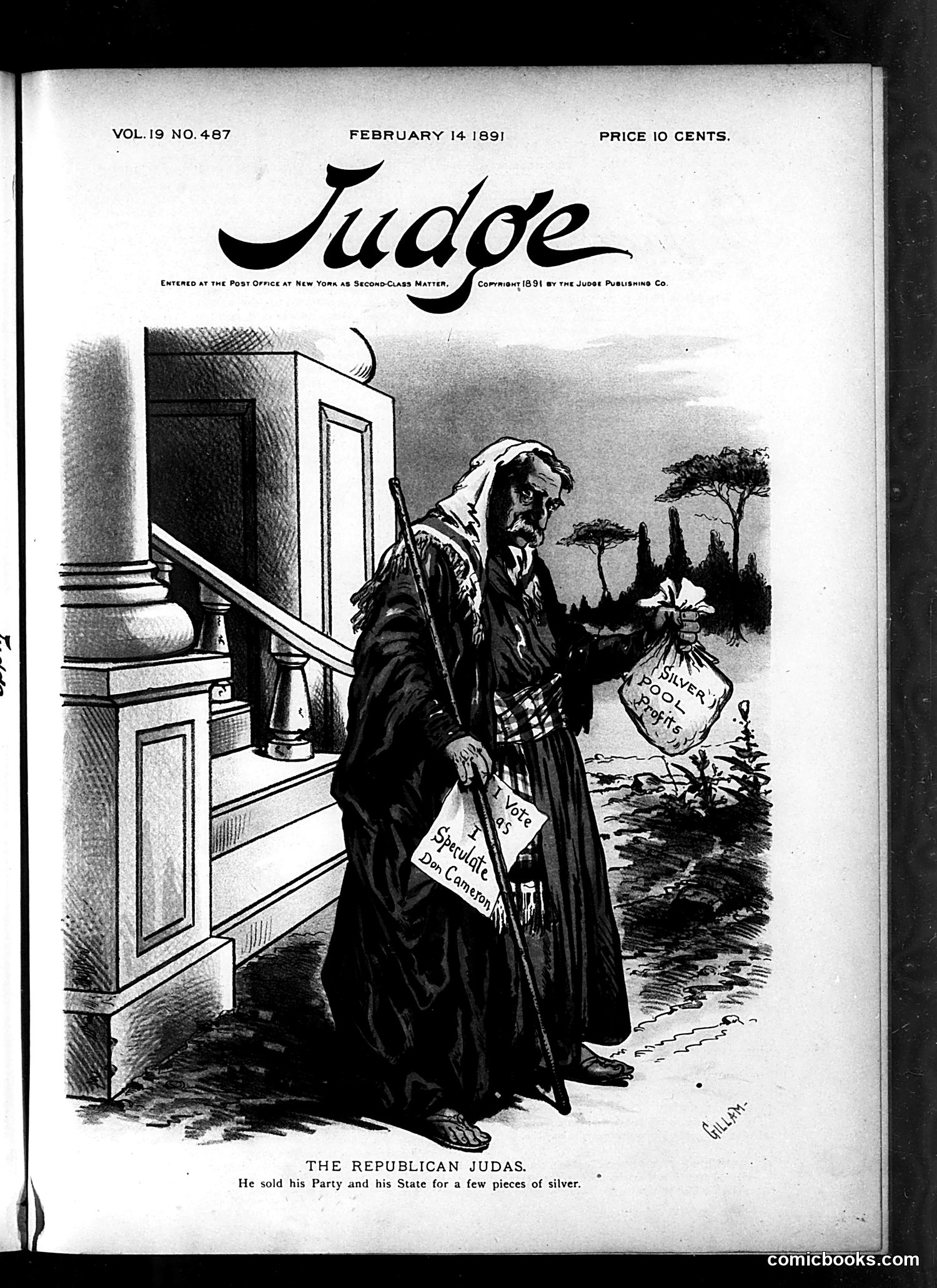
This political cartoon depicts a bearded figure in tattered clothing labeled "The Republican Judas," carrying bags marked "Silver Pool Spoils" and what appears to be a document about Dan Connerton. The caption states: "He sold his Party and his State for a few pieces of silver." The cartoon satirizes a Republican politician (likely Dan Connerton) who allegedly betrayed his party and state for financial gain related to silver dealings. The biblical Judas reference emphasizes the perceived treachery—selling out principles for money, paralleling Judas's betrayal of Christ for silver coins. This likely relates to 1890s debates over monetary policy (silver vs. gold standard) when some Republicans were seen as switching positions for financial interests.
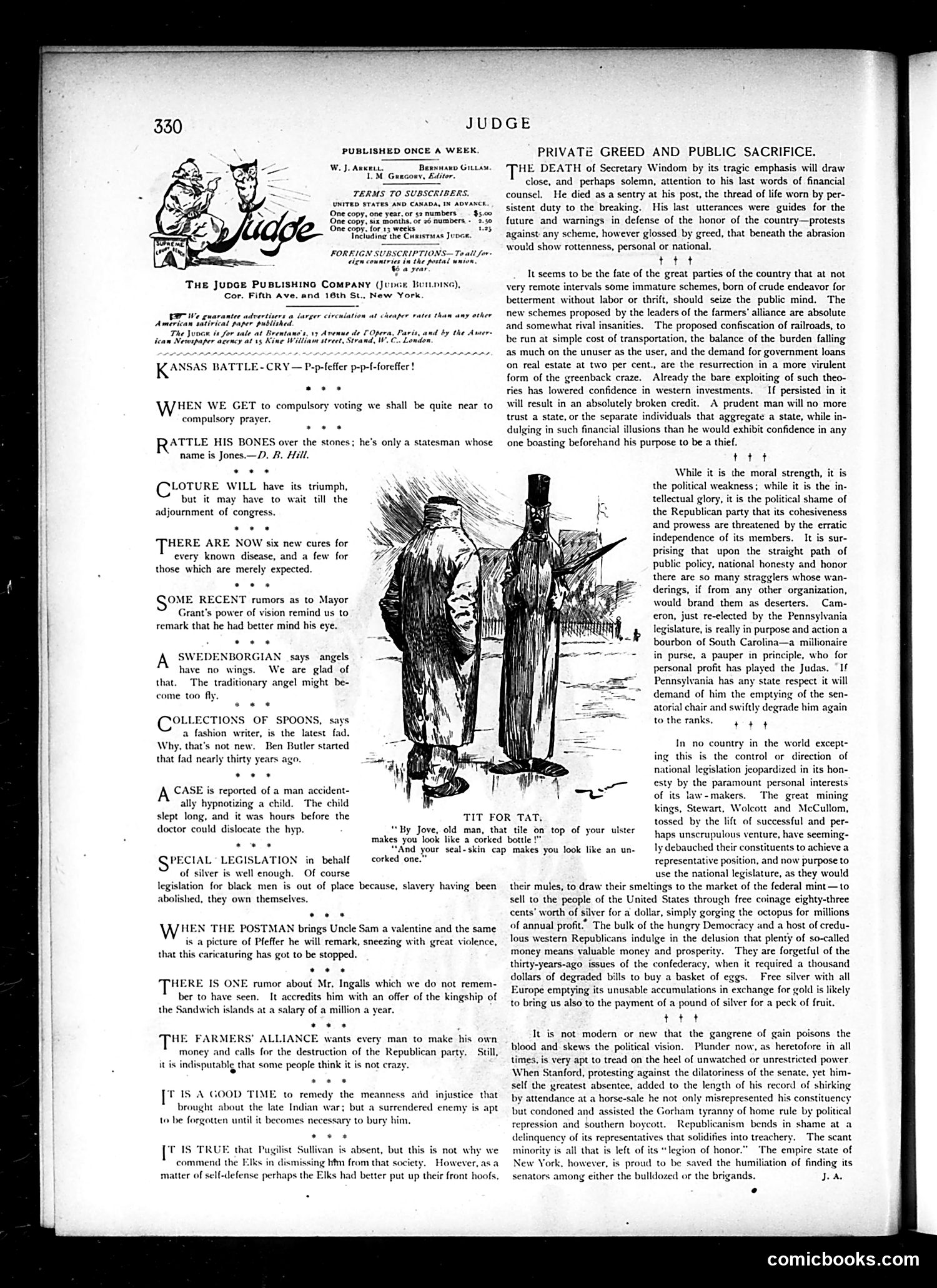
The central cartoon depicts two figures in formal dress confronting each other, with the caption "Tit for Tat" and dialogue about a "sea-skin cap" making someone look "like an uncouth one." **What we can determine:** The cartoon appears to satirize political hypocrisy or mutual recrimination between rivals. The "sea-skin cap" reference suggests mockery of appearance or ethnic/cultural markers used as insults. Without clearer identification of the figures or dated context, the specific political conflict remains unclear—it could reference a 1890s-era political dispute, but the exact figures and situation require additional historical documentation to confirm with certainty. The satire's point centers on tit-for-tat personal attacks rather than substantive debate.
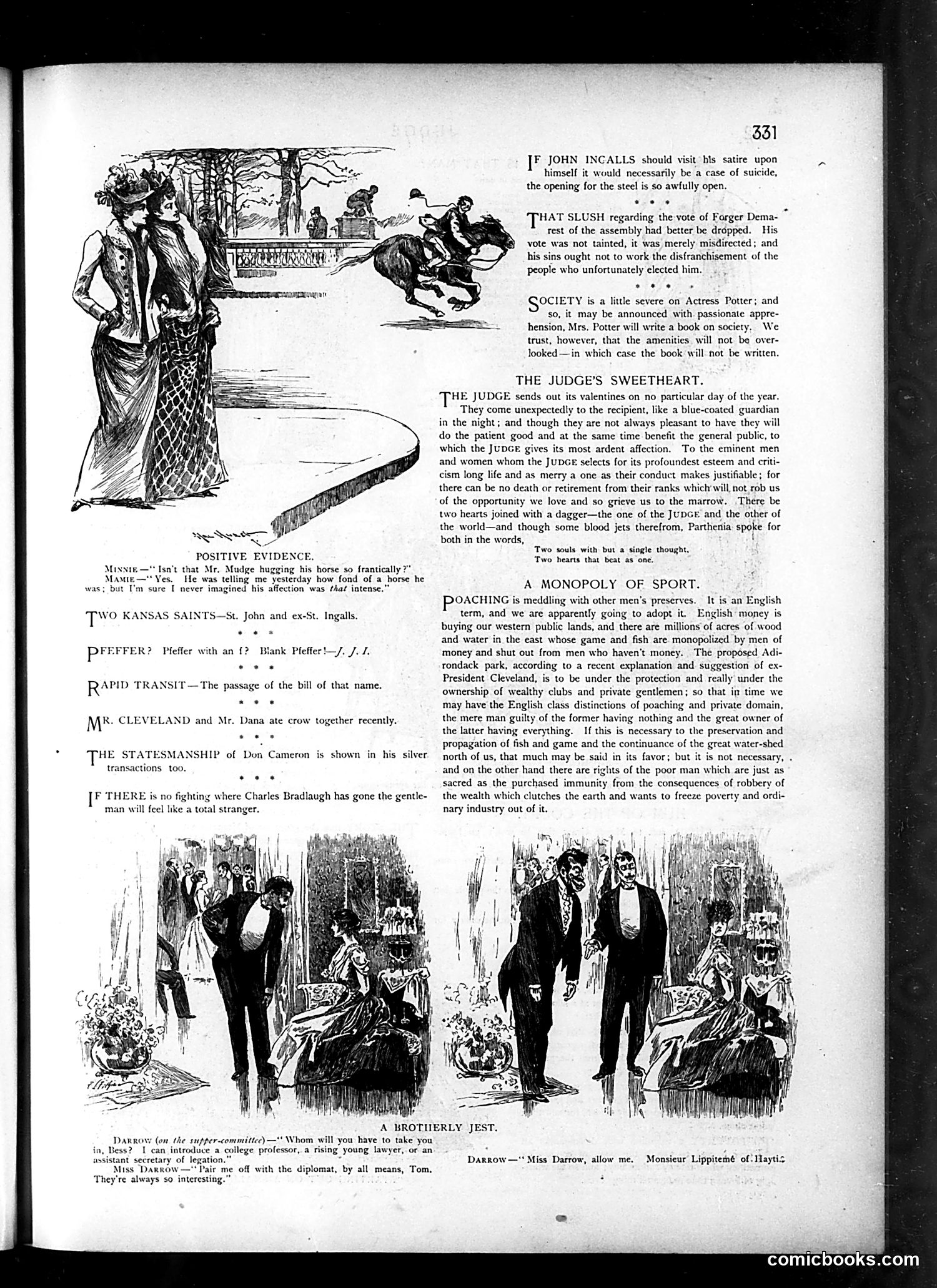
This page contains several brief satirical items and illustrations rather than one unified cartoon: **"The Judge's Sweetheart"** appears to be a humorous piece about judicial valentines sent unexpectedly to various recipients, celebrating how judges distribute affection broadly. **"A Monopoly of Sport"** criticizes wealthy individuals and clubs monopolizing hunting and fishing on western lands. It references President Cleveland and suggests wealthy club owners exclude common people from natural resources, comparing English class distinctions to American practices. **"A Brotherly Jest"** shows two nearly identical panels with a man (Darrow) introducing a college professor or young lawyer, suggesting humor in their interchangeability or absurd credentials. The illustrations use typical late-19th-century engraving style. The overall tone mocks class privilege, judicial whimsy, and professional pretension characteristic of Judge's satirical approach.
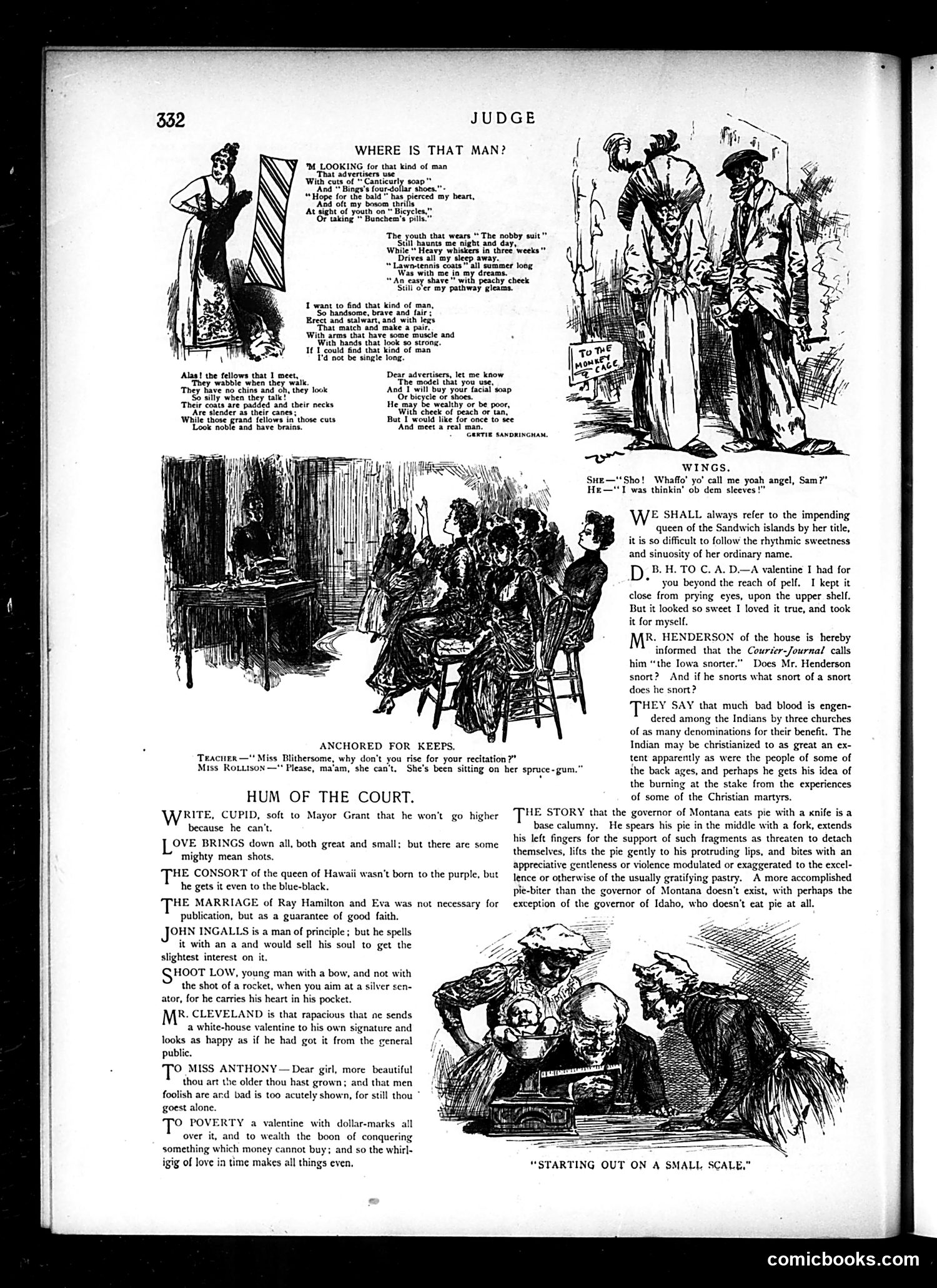
This page satirizes the unrealistic male ideals promoted in contemporary advertisements. The main poem (left) depicts a woman seeking the handsome, muscular men featured in ads for products like soap, shoes, and bicycles. She contrasts these fictional paragons with real men she encounters—who are awkward, chinless, and physically unimpressive. The satire targets both advertisers' deceptive marketing practices and consumers' gullibility in believing such exaggerated imagery. The accompanying illustrations show the gap between advertised fantasy and reality. Other items on the page include brief political jabs at public figures: Mayor Grant, Ray Hamilton and Eva (unclear context), John Ingalls, and Cleveland—typical of *Judge* magazine's satirical commentary on contemporary politicians and social figures. The piece fundamentally mocks advertising's false promises and the vanity they exploit.
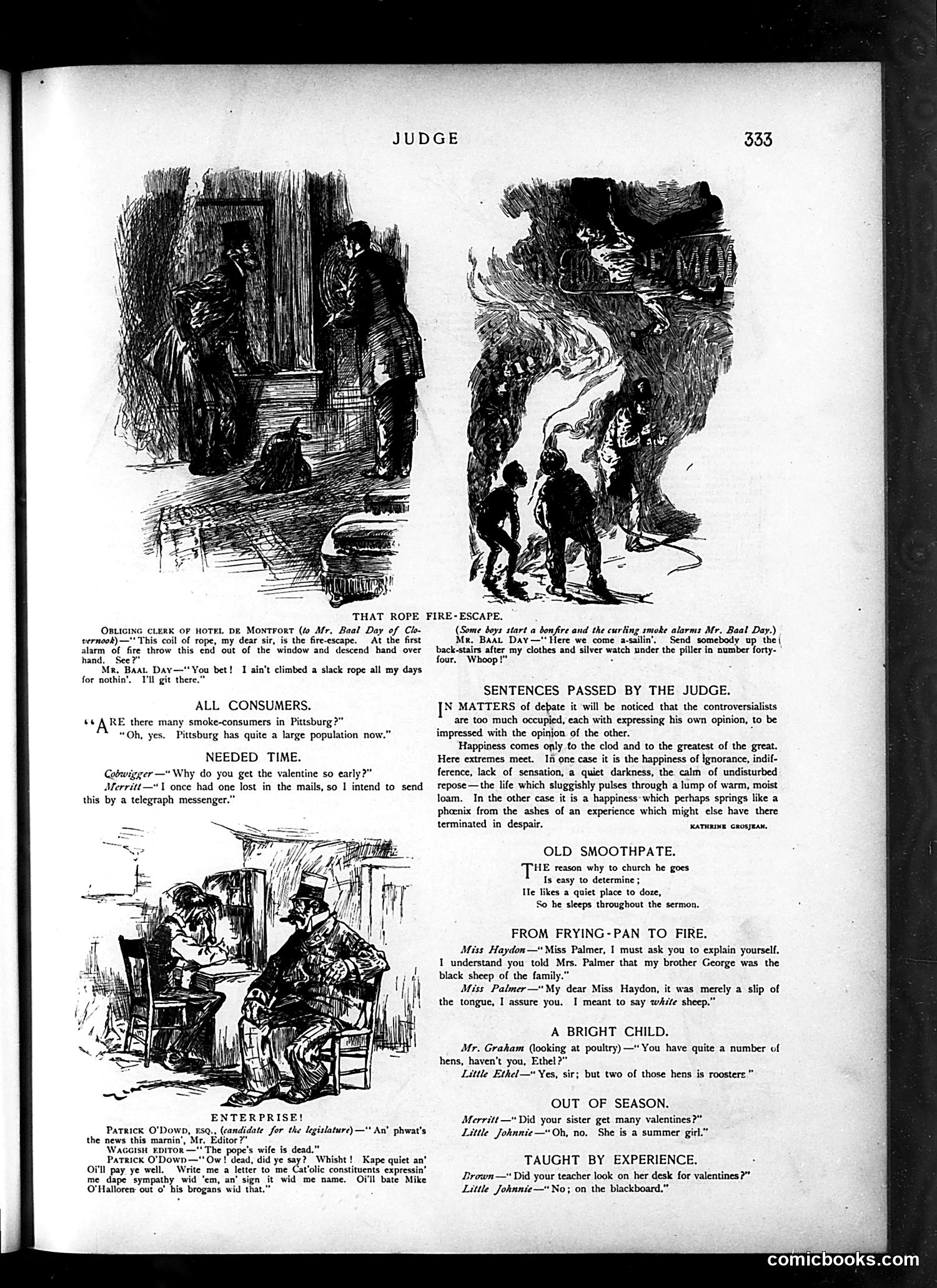
This page from *Judge* magazine features multiple short comic sketches satirizing American life. The main illustrated cartoon, "That Rope Fire-Escape," mocks inadequate hotel safety measures—a practical concern in the era before modern building codes. Mr. Baal Day, a country visitor, is reassured by a clerk that a coiled rope serves as the fire escape, which he naively trusts. The accompanying text pieces employ ethnic stereotypes typical of the period: "Enterprise!" portrays an Irish political candidate (Patrick O'Down) exploiting a fabricated story about the Pope's wife dying to gain Catholic votes—satirizing opportunistic machine politics and voter manipulation. Other brief jokes target contemporary issues: Pittsburgh's industrial pollution ("smoke-consumers"), telegraph messenger service reliability, and Valentine's Day customs. The humor relies on wordplay, misunderstandings, and light social observation rather than complex political commentary. The "Sentences Passed by the Judge" section offers philosophical reflections on happiness and human nature, suggesting the magazine balanced satire with moral commentary.
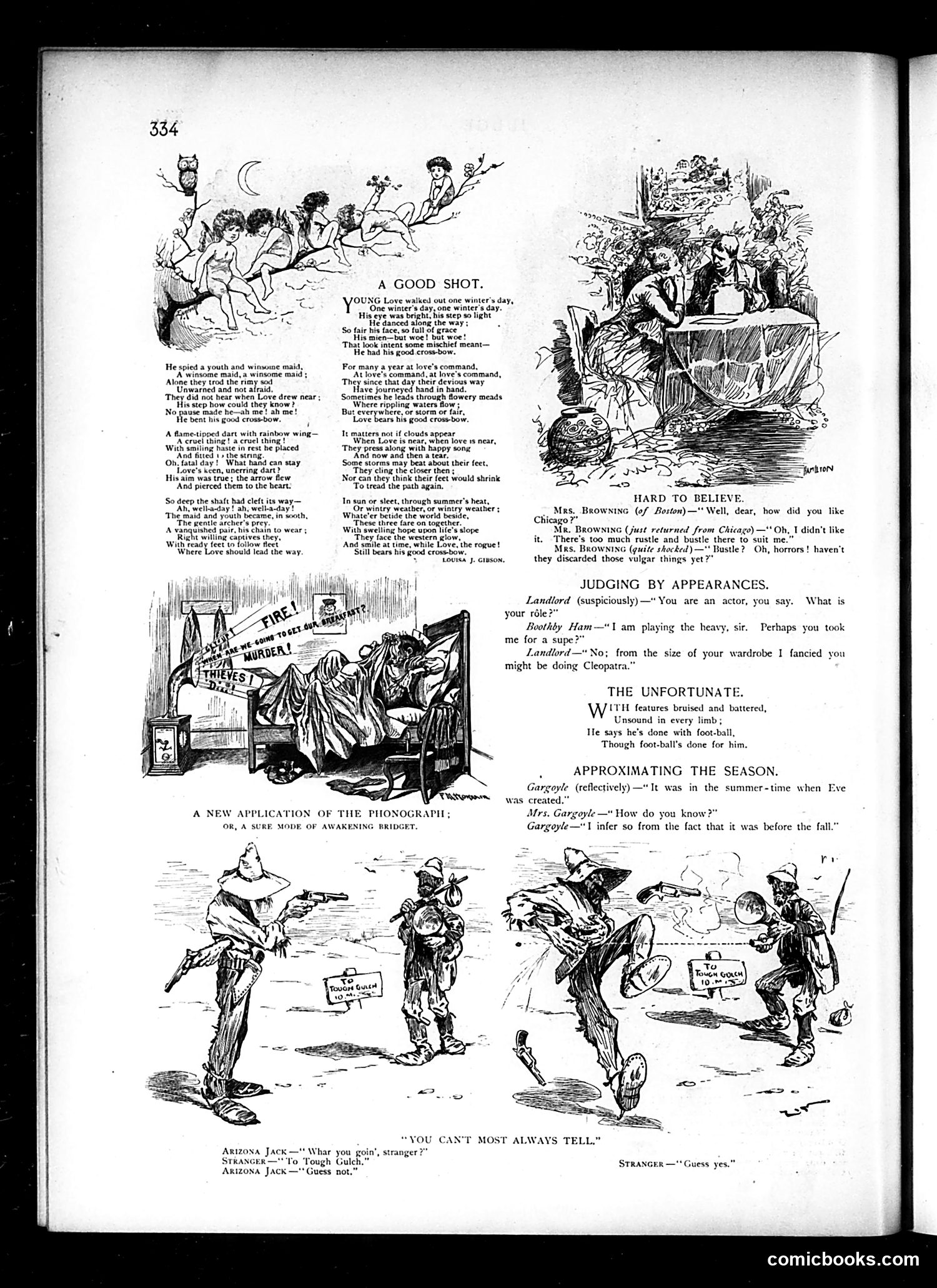
This page contains multiple unrelated humorous pieces typical of Judge's satirical format: **"A Good Shot"** (poem with illustration): A romantic allegory where Cupid's arrow strikes young lovers, binding them together through life's seasons. The narrative sentimentalizes love's "wound" as they journey through fair and foul weather together—a sentimental Victorian treatment of romance. **"Hard to Believe"**: Mrs. Browning (likely referencing poet Elizabeth Barrett Browning) expresses shock that Chicago women still wear bustles, which she considers outdated fashion. **"Judging by Appearances"**: A theatrical joke where a landlord mistakes an actor's minimal wardrobe for playing Cleopatra (implying he's extremely thin/small), when he actually plays "the heavy" (dramatic leading roles). **"The Unfortunate"**: A brief caption about a football player whose injuries end his athletic career. **"Approximating the Season"**: A pun where Gargoyle infers Eve's creation occurred in summer because it happened "before the fall" (Biblical fall of man). The page demonstrates Judge's mix of sentimental poetry, fashion satire, theatrical humor, and wordplay typical of late-19th-century American comedy magazines.
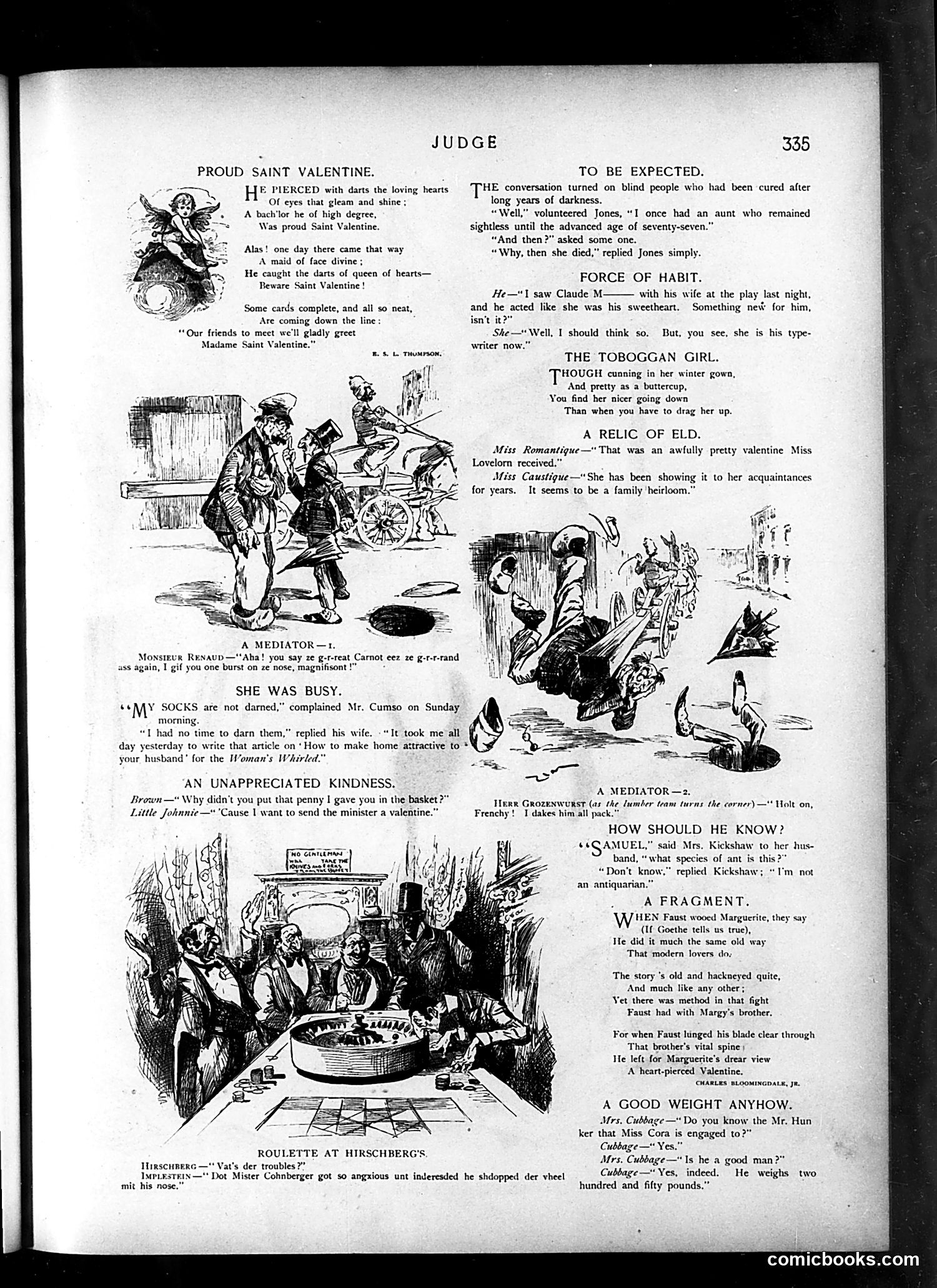
This page contains **humorous short pieces and cartoons** typical of Judge's satirical format. Key content includes: **"Proud Saint Valentine"**: A poem-illustrated piece about Cupid falling in love himself, playing on the irony of the mythological figure experiencing what he inflicts on others. **Social satire pieces** on domestic life: "Force of Habit" mocks a husband acting affectionate toward his wife only because she resembles his "type"; "She Was Busy" ironizes women's magazine advice about marriage by showing a wife too busy writing about making home attractive to actually maintain her husband's socks. **"Toboggan Girl"**: A cheeky comment on female attractiveness, suggesting women are more appealing when passive ("going down") than when requiring effort. **Political reference**: A brief dialogue includes a Frenchman ("Monsieur Renaud") discussing Carnot—likely French Prime Minister Sadi Carnot, suggesting contemporary political commentary. **"Roulette at Hirschberg's"**: A dialect joke about a nervous customer dropping the roulette wheel. The humor targets marriage dynamics, gender expectations, and immigrant stereotypes—typical Judge content from this era.
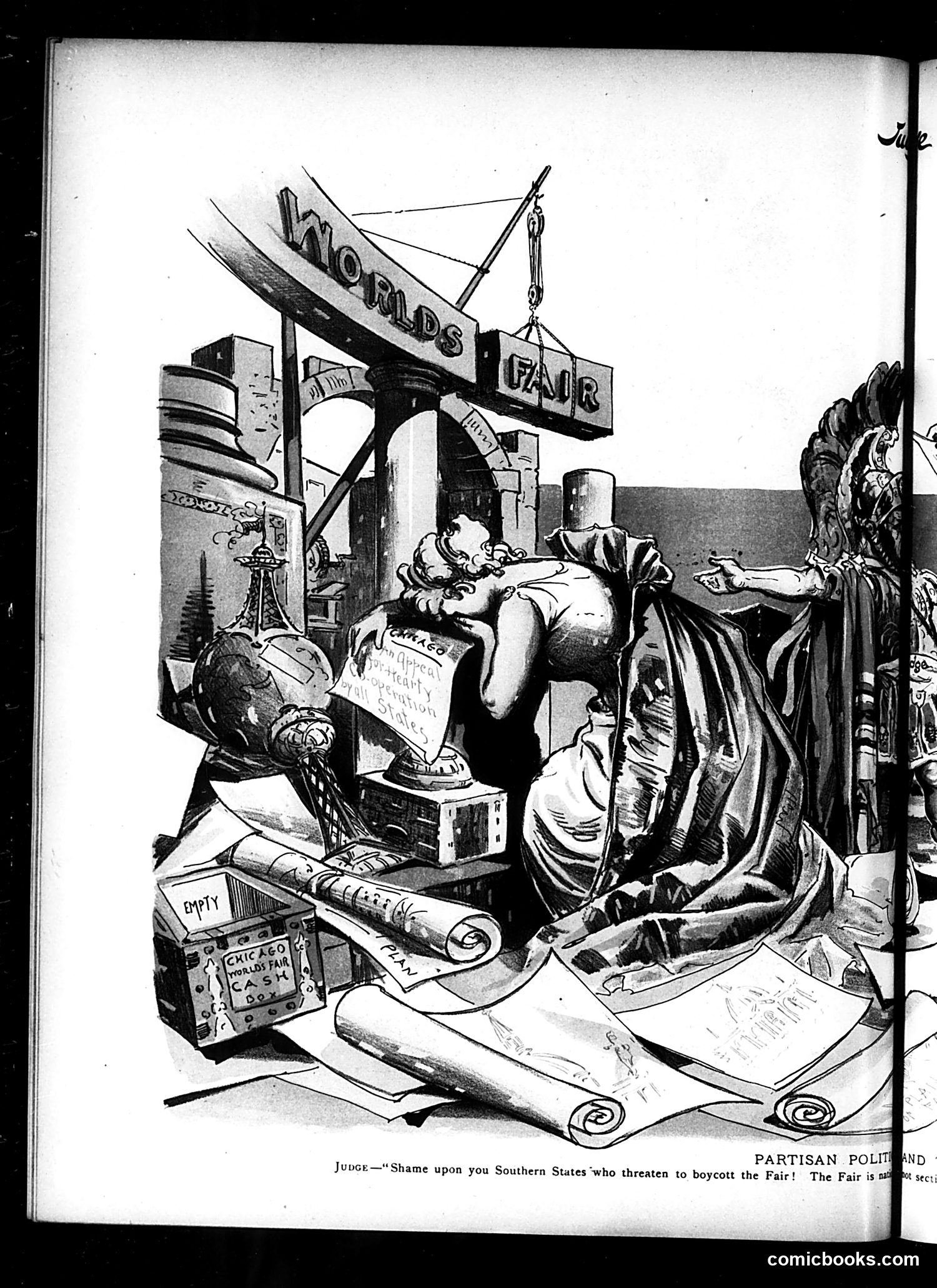
This Judge magazine cartoon satirizes Southern states threatening to boycott what appears to be a major fair—likely the World's Columbian Exposition (1893 Chicago World's Fair). The central figure of "Justice" (depicted as a woman with scales) scolds the Southern states for their boycott threat. The cartoon critiques Southern opposition to the fair, probably related to racial or sectional disputes of the Gilded Age. Various symbolic elements surround Justice—including papers, architectural plans, and what appear to be regional references—illustrating the fair's national importance. The satire argues that boycotting damages not just the fair itself but national progress and unity. The Southern states' threatened withdrawal is portrayed as petty and shameful, subordinating regional interests to national advancement.
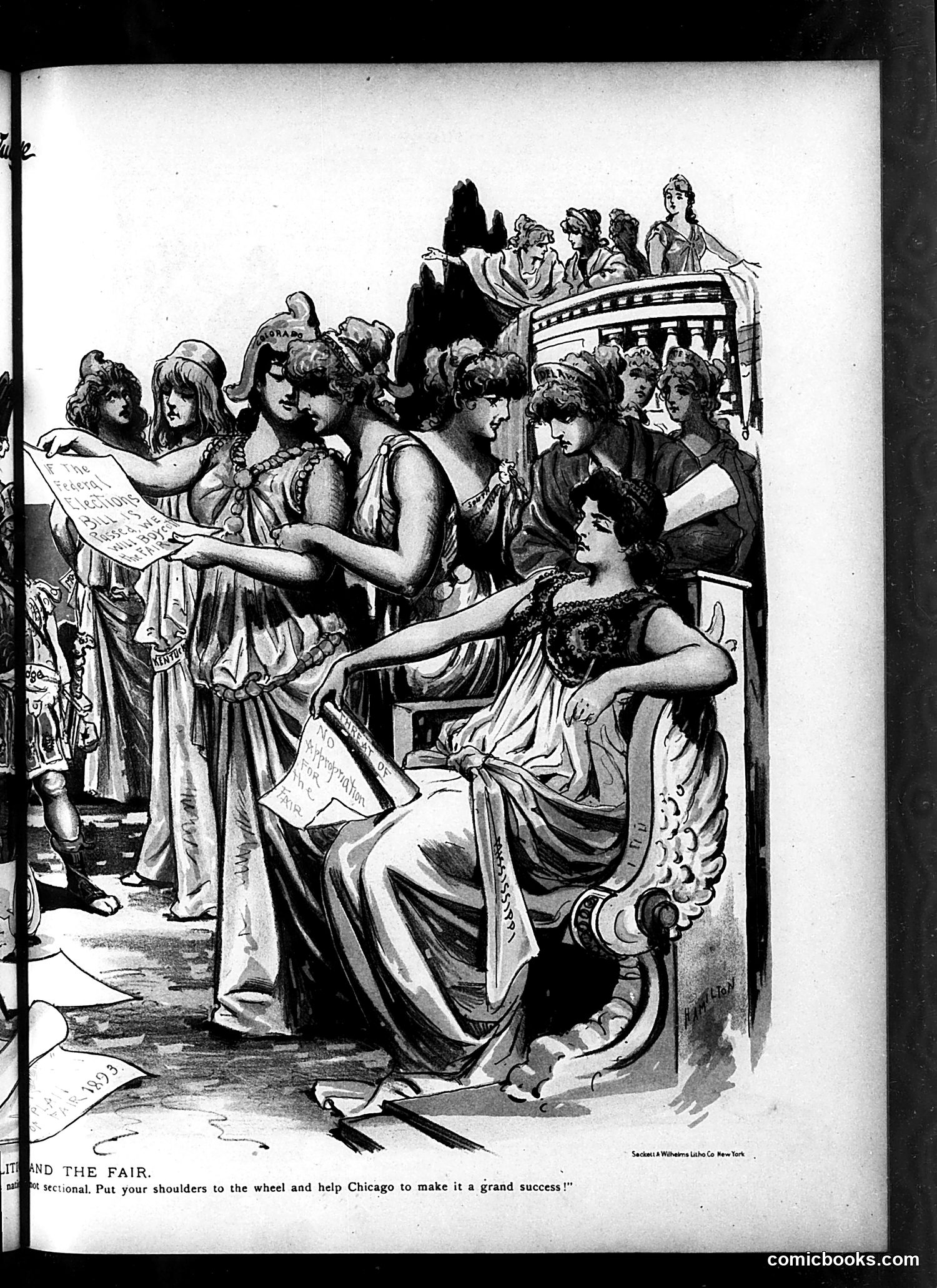
This cartoon depicts women in classical dress being urged to support Chicago's fair (likely the 1893 World's Columbian Exposition). The seated figure in the foreground represents Chicago or the fair itself, while standing women around her appear to represent different states or regions ("sectional"). The caption's call to "put your shoulders to the wheel" is a rallying cry for nationwide cooperation in making the fair successful. The satire likely mocks the grandiose promotional efforts and the expectation that women—who couldn't vote and had limited political power—should enthusiastically labor for civic projects. The classical allegorical style was common in Judge magazine's political commentary, using feminine personifications of cities and concepts to critique contemporary social dynamics and power structures.
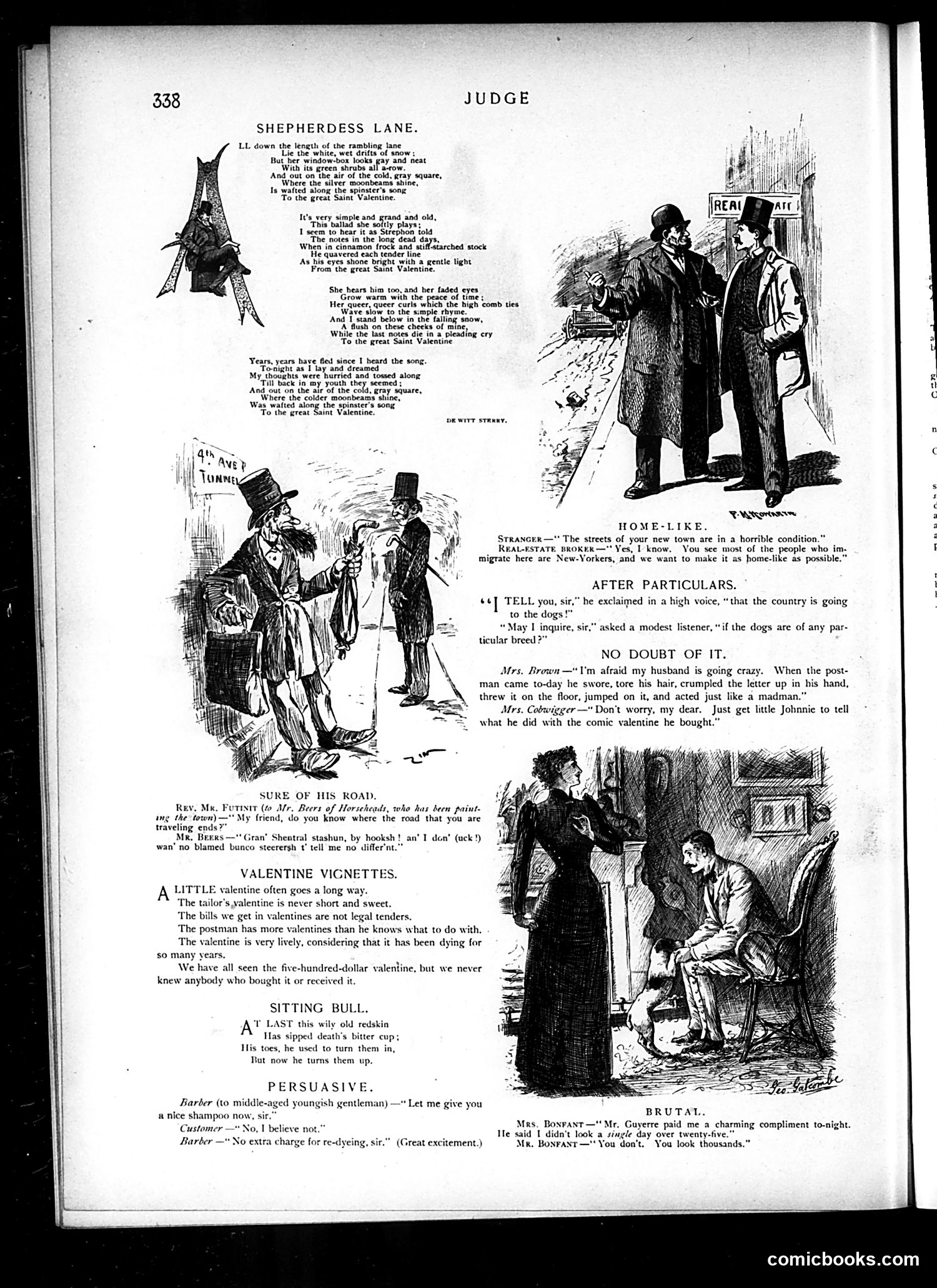
This page from *Judge* contains multiple short satirical pieces typical of the magazine's humor: **"Home-Like"** jokes about New York City's poor infrastructure. A real estate broker tells a stranger that migrants from New York want their new town to have similarly bad streets—satire on New York's notoriously filthy, neglected streets in the late 19th century. **"No Doubt of It"** uses the comic valentine (a popular insulting novelty) as the punchline—implying a husband's rage over receiving one suggests his son bought a cruel valentine, explaining his angry behavior. **"Sitting Bull"** is an obituary poem about the Lakota leader, killed in 1890. The crude joke about his death posture is typical of the era's dismissive treatment of Native Americans. **"Persuasive"** depicts a barber offering to re-dye a customer's hair after a compliment about his youthful appearance—implying vanity and the cosmetic deceptions of aging. The page also includes sentimental poetry ("Shepherdess Lane") and brief comic vignettes about Valentine's Day customs, reflecting the magazine's February publication date.
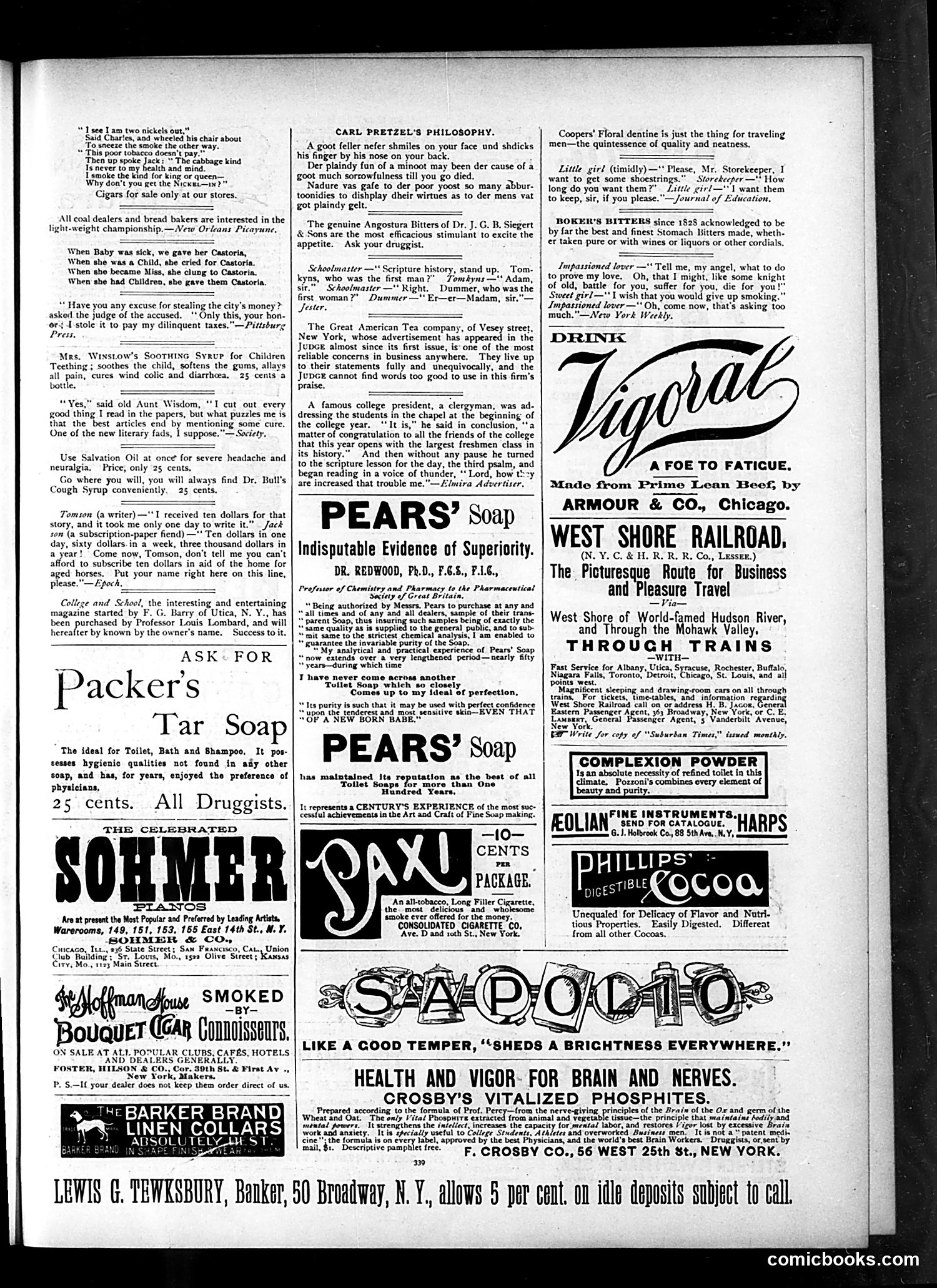
This page is primarily **advertising**, not political satire. It contains numerous product advertisements (Pears' Soap, Castoria, Sohming Pianos, etc.) typical of late 19th-century publications. The satirical content is minimal. "Carl Pretzel's Philosophy" appears to be a recurring humor column featuring a German-accented character dispensing folksy wisdom ("A good feller never smiles on your face and sticks his finger by his nose on your back"). Several brief jokes are scattered throughout—including one about a defendant claiming he stole city money to pay delinquent taxes, and another about a writer being pressured to donate to a horse charity. These are generic humor pieces without specific political targets. The page lacks identifiable caricatures or commentary on contemporary political figures or events. It primarily represents Judge's business model: mixing light satirical humor with extensive paid advertising to reach middle-class readers.
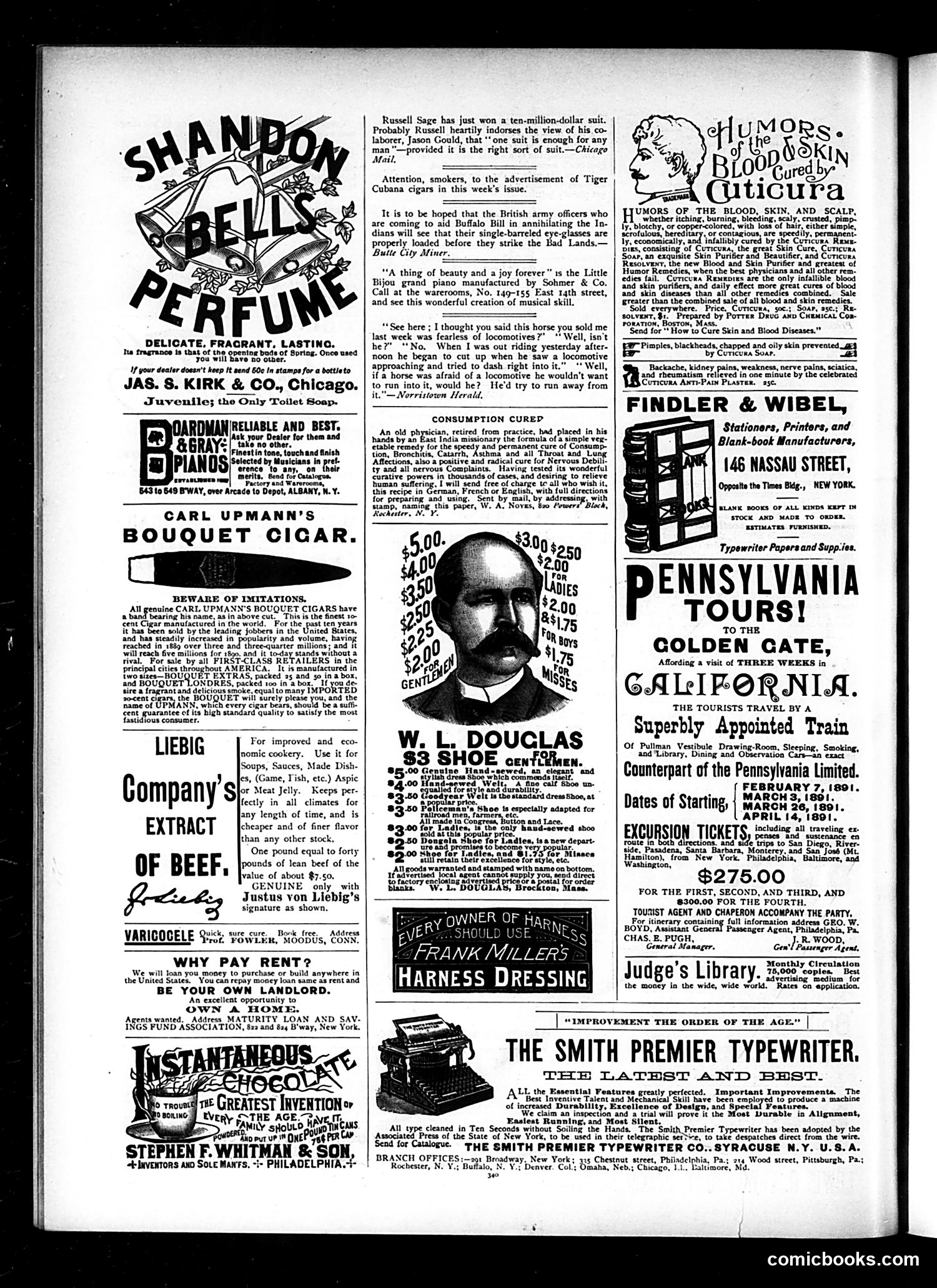
This page is primarily **advertisements with brief satirical notes**, not a single cohesive cartoon. The notable satirical content appears in the text snippets scattered among ads: 1. **Russell Sage/Jason Gould joke**: References wealthy financiers Russell Sage and Jay Gould. Sage won a $10 million lawsuit; the joke plays on "suit" (legal case vs. clothing)—suggesting one expensive suit is enough if it's the "right sort" (legal victory). Modern readers should know these were Gilded Age robber barons. 2. **British officers/Buffalo Bill**: Mocks visiting British army officers who will help Buffalo Bill's Wild West show fight Native Americans. The jab at their "single-barreled eye-glasses" (monocles) stereotypes them as effete and unprepared for frontier combat. 3. **Horse anecdote**: A humorous dialogue about a supposedly fearless horse that actually *wants* to run into locomotives—absurdist humor playing with logical contradiction. The page is primarily commercial, advertising cigars, pianos, soaps, and patent medicines typical of 1891 Judge magazine.
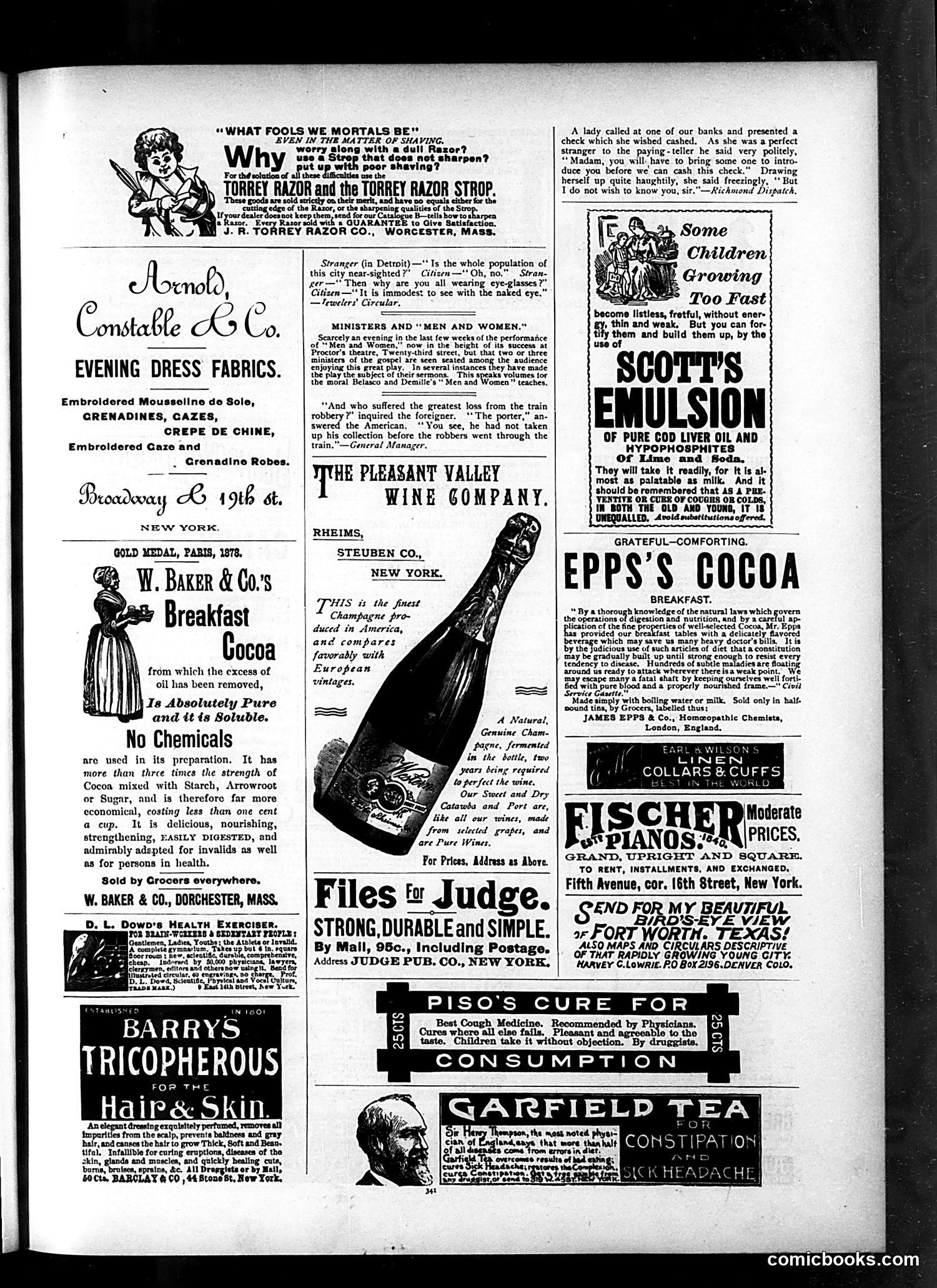
This page is primarily **advertising** with brief satirical content interspersed. The main cartoon at top concerns the **Torrey Razor** and shaving, with the heading "What Fools We Mortals Be"—a Shakespeare reference mocking human vanity about grooming. Two small jokes appear: 1. A **Detroit eye-glasses joke**: A stranger notices everyone wearing spectacles; the local explains it's "immodest to see with the naked eye"—satirizing either affectation or poor air quality in industrial Detroit. 2. A **train robbery joke**: A minister loses his collection plate before robbers strike; the humor lies in the porter's misfortune being financial rather than physical. The rest consists of period advertisements for luxury goods: evening fabrics, cocoa, champagne, pianos, patent medicines, and hair products—typical of Judge's revenue model. These ads reflect Gilded Age consumer culture targeting affluent readers.
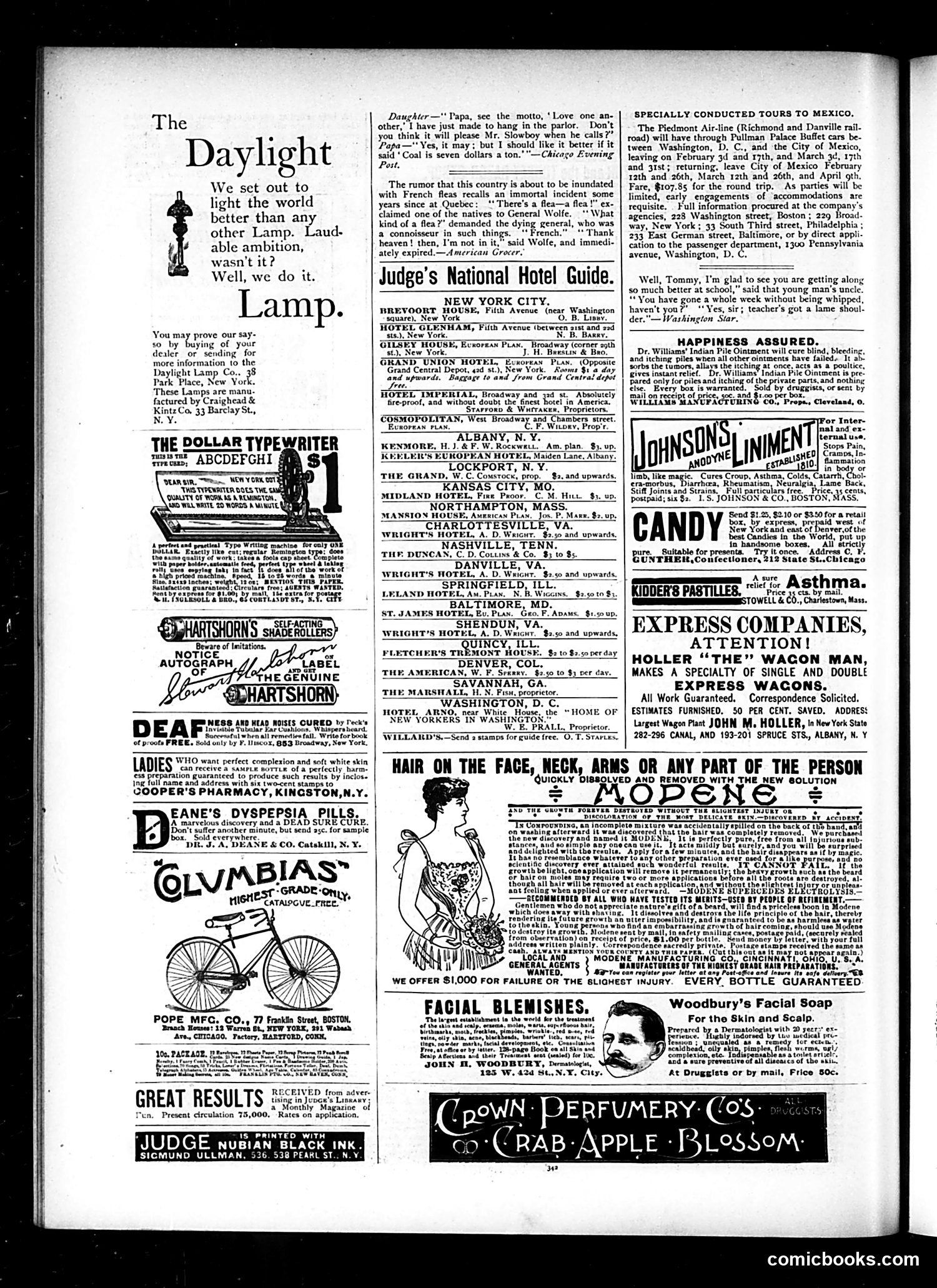
This appears to be primarily an **advertising and notices page** rather than a satirical cartoon page. The bulk of the content consists of: **Hotel Directory:** A "Judge's National Hotel Guide" listing accommodations across American cities (New York, Albany, Kansas City, Nashville, etc.), typical of period travel advertisements. **Product Advertisements:** Multiple ads for consumer goods—typewriters, lamps, hair removal products (Modene), perfume, bicycles, and medicinal items. **One Dated Joke:** A brief anecdote about General Wolfe and French fleas, playing on anti-French stereotypes common in the era. **Travel Notice:** Information about conducted tours to Mexico via the Piedmont Air-line. The page demonstrates how 19th-century magazines integrated editorial content with extensive advertising. While Judge was known for political satire, this particular page lacks substantive cartoons or political commentary—it's primarily a commercial and informational section, reflecting the magazine's role as both satirical publication and lifestyle guide for its affluent readership.
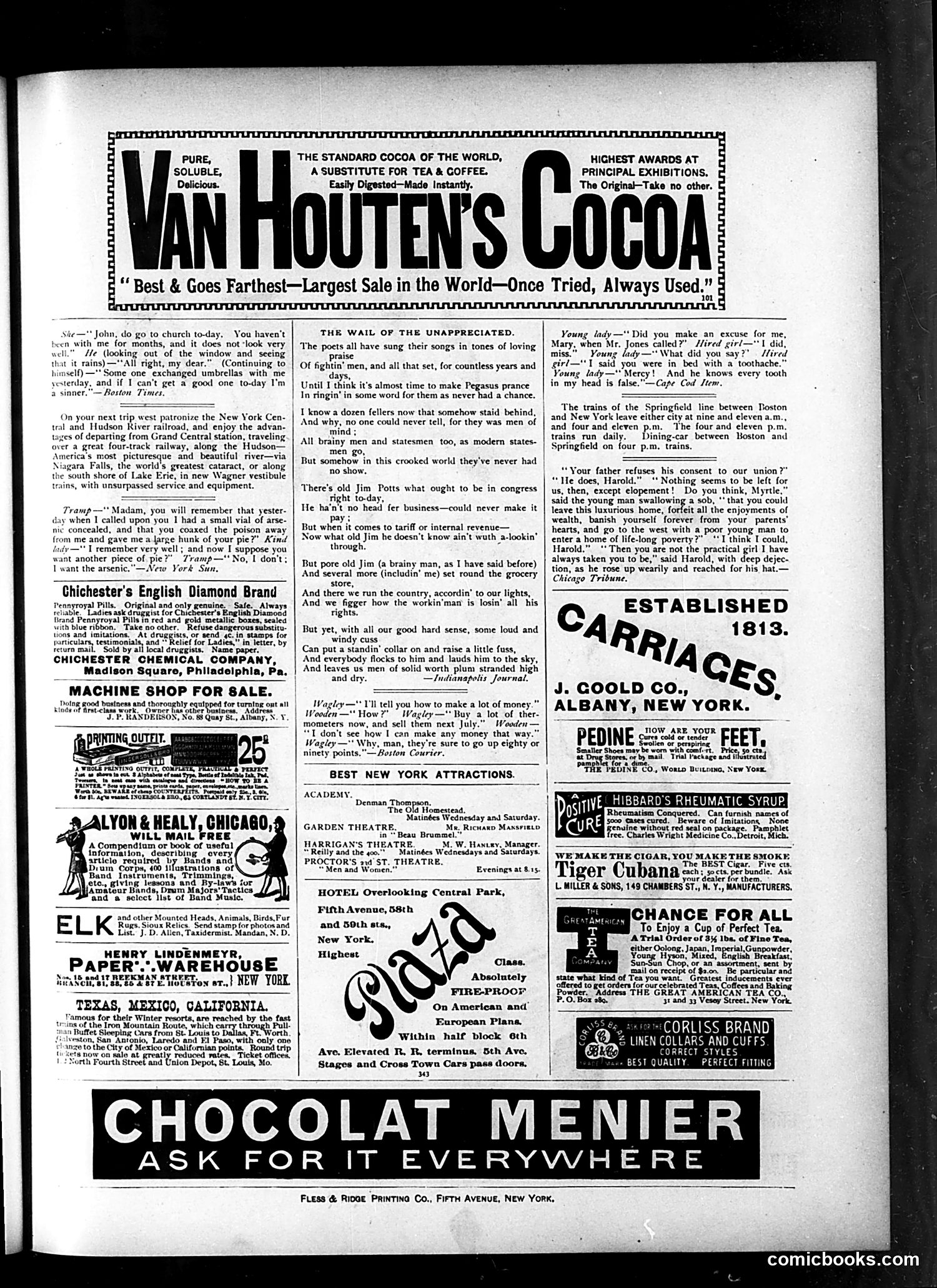
This is primarily an **advertising page** with minimal editorial content. The page features various product advertisements (cocoa, carriages, chocolate, etc.) typical of late 19th/early 20th-century magazines. The only substantive satirical content appears as small **humorous anecdotes**: 1. A brief joke about a husband reluctant to attend church, using a lost umbrella as an excuse—mocking male resistance to religious observance. 2. A darker piece about a tramp who previously threatened a kind woman with arsenic, now returning to demand the poison back instead of pie—satirizing the supposed ingratitude or moral confusion of vagrants. 3. An incomplete poem titled "The Wail of the Unappreciated" lamenting that unsung political/military figures deserve recognition—likely satirizing political patronage or overlooked public figures, though the text cuts off. The page's primary purpose is **commercial**, not satirical. These brief joke-items serve as filler between advertisements rather than serving as Judge's main content.
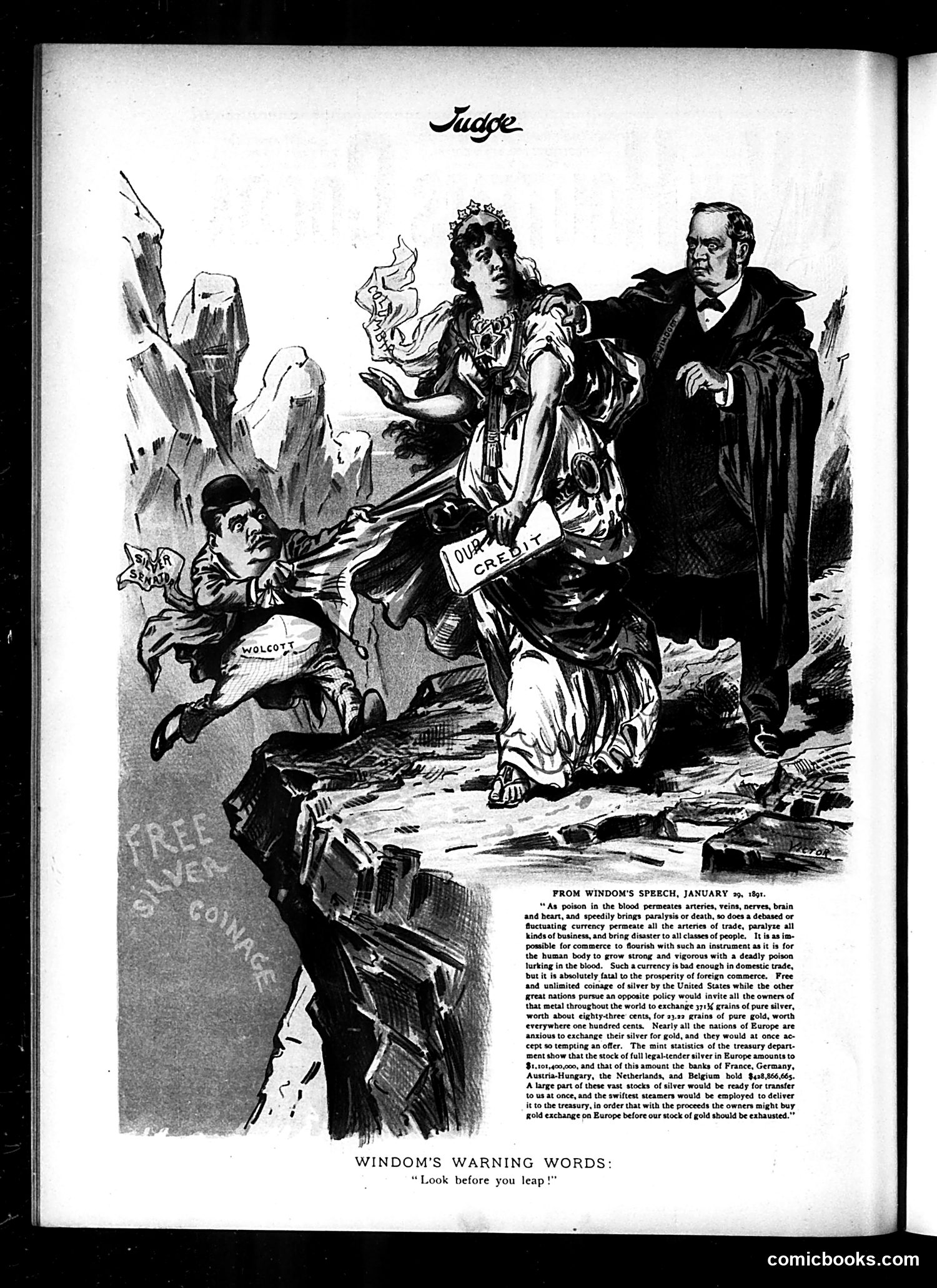
This Judge cartoon illustrates Treasury Secretary William Windom's 1891 speech opposing free silver coinage. The cartoon depicts Lady Liberty (center, with torch labeled "OUR CREDIT") surrounded by figures representing monetary chaos and danger. **The Satire:** Windom warns that unlimited silver coinage would flood America with foreign silver, draining U.S. gold reserves and destroying the nation's financial credit. The speech excerpted below the image uses poisoning metaphors—debased currency acts like deadly toxin in the body politic. **Key Figures:** The well-dressed man on right (likely Windom or a conservative politician) watches Lady Liberty struggle as a demonic or chaotic figure (representing free silver advocates or economic disaster) threatens her. The burning buildings and chaos symbolize financial ruin. **The Point:** The cartoon endorses Windom's hard-money position against populist demands for free silver, warning that this policy would invite economic catastrophe and international exploitation.