
A complete issue · 16 pages · 1890
Judge — November 1, 1890
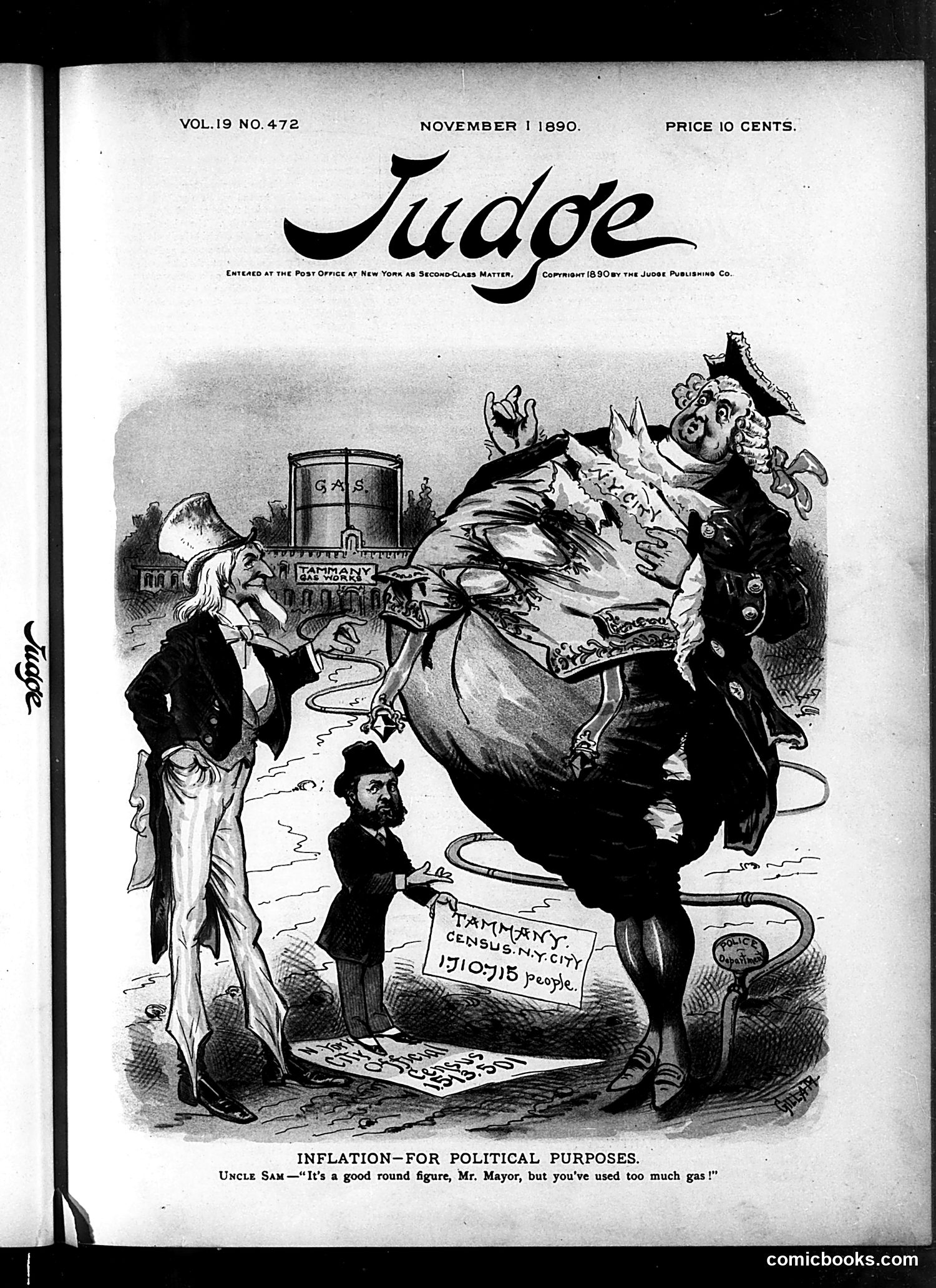
This November 1890 *Judge* cartoon satirizes census manipulation in New York City. Uncle Sam (left) confronts a bloated Mayor figure who's inflated the official population count to 1,910,715 people for political gain. The cartoon's title and Sam's caption ("you've used too much gas!") suggest the Mayor artificially inflated census numbers like an overblown balloon—exaggerating the city's size to increase political representation and federal resources. The gas tank labeled "GAS" and industrial backdrop reference actual inflation of numbers rather than helium. This appears to critique Tammany Hall political machine practices—using false census data for patronage advantages. The satire targets dishonest municipal governance and population data manipulation for political power.
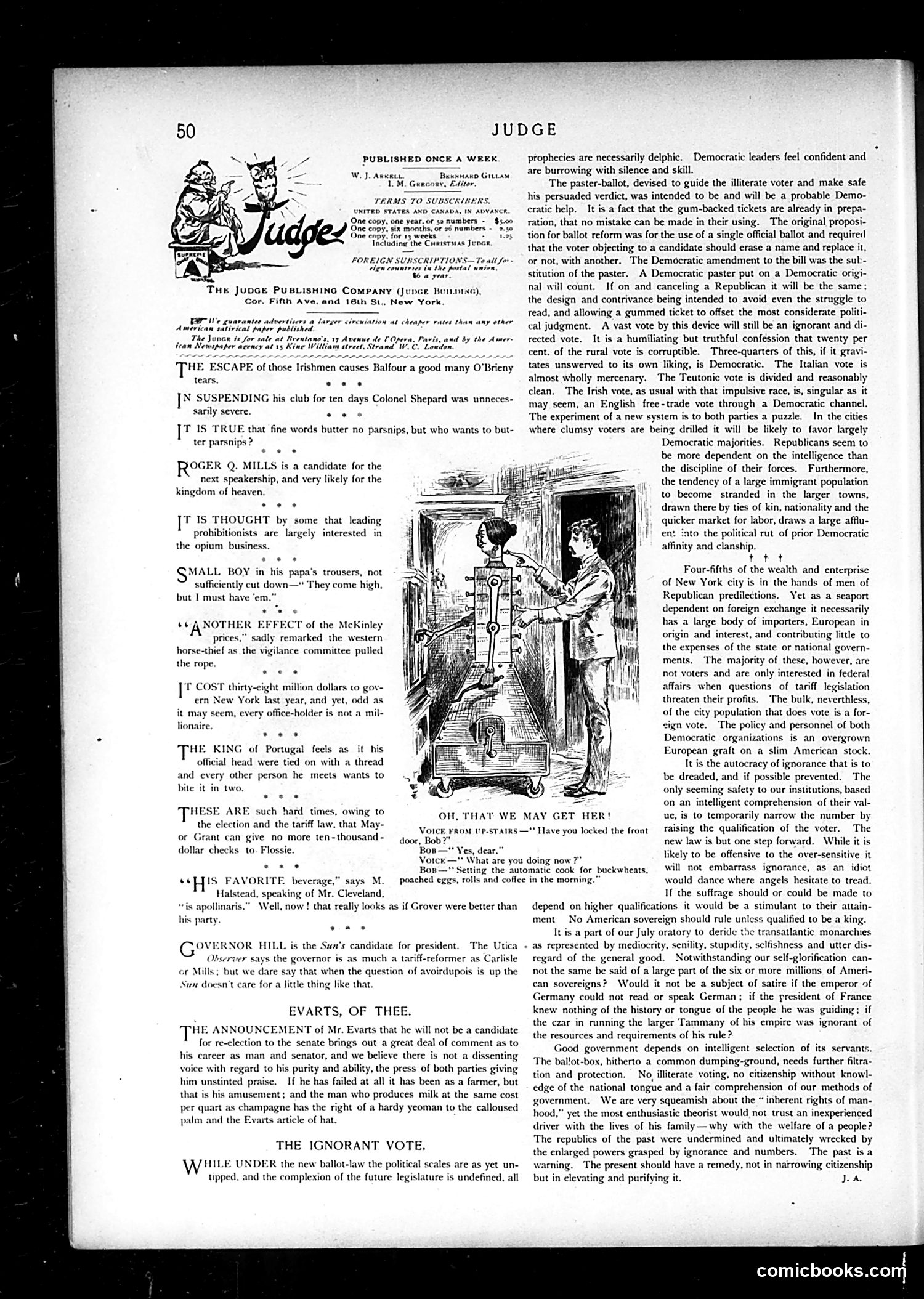
This page contains political commentary and satirical pieces rather than comics. The main illustrated cartoon depicts a domestic scene where a woman operates what appears to be an early automatic cooking device while a man observes—likely satirizing new household technology or changing gender roles. The text pieces critique various political issues: voter ignorance and ballot reform; immigrant voting patterns affecting Democratic politics; corruption in New York governance; and McKinley administration policies. One piece mocks Colonel Shepard's club suspension, while "The Ignorant Vote" section argues that expanded suffrage without civic education threatens institutions. The satire targets both political parties' reliance on uninformed voters and foreign-born populations, reflecting late-19th-century anxieties about immigration and democratic participation.
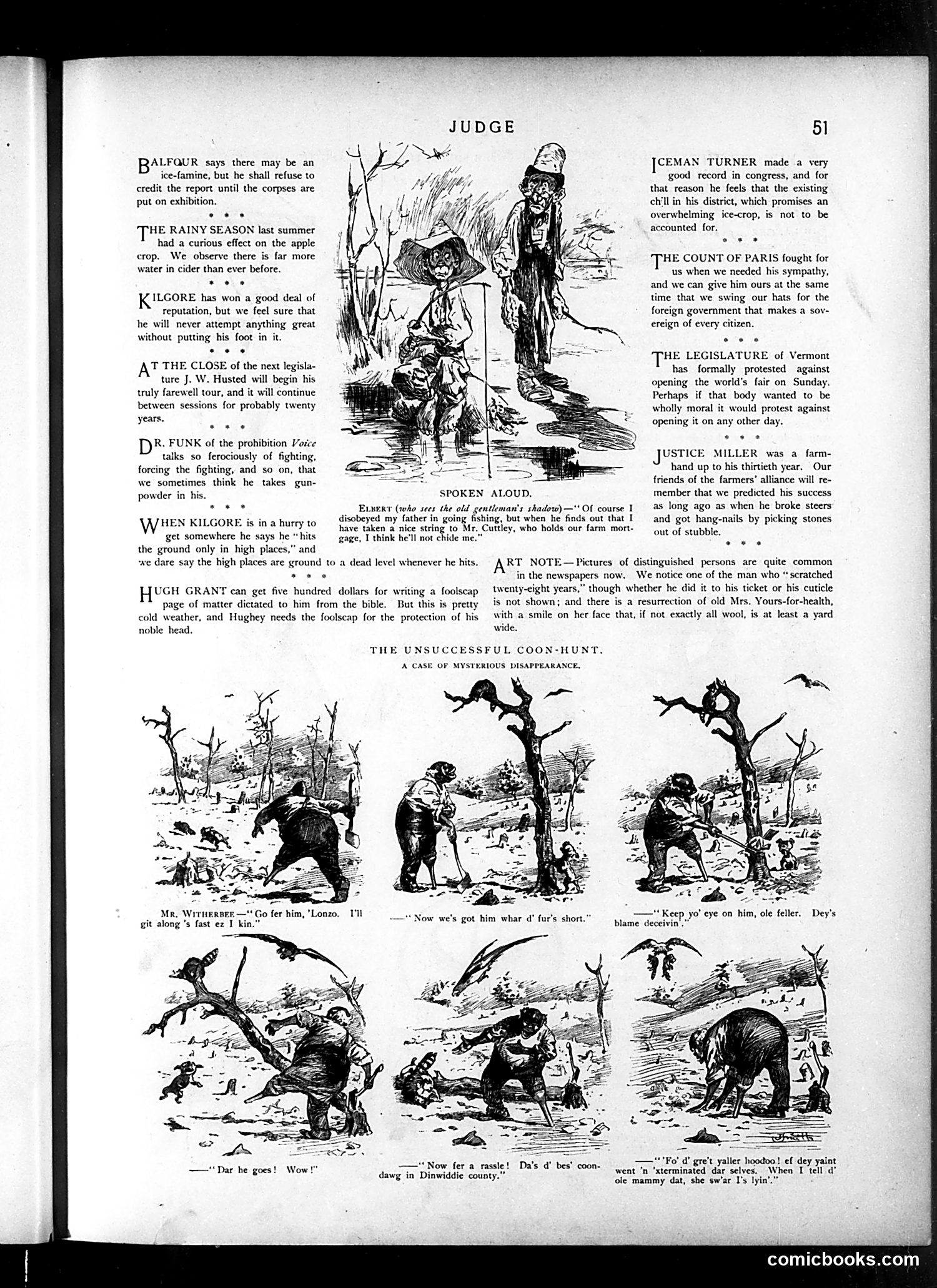
This satirical comic strip depicts a hunting expedition gone wrong. The repeated panels show hunters (labeled "Mr. Witheridge") pursuing what the title calls a "coon" (raccoon), with the animal repeatedly eluding them through increasingly absurd mishaps—falling from trees, tumbling over logs, and getting tangled in pursuit. The humor relies on slapstick physical comedy: incompetent hunters repeatedly failing despite their determined efforts. Each panel caption emphasizes their frustration ("Dar he goes!" "Now we's got him") as the raccoon vanishes mysteriously between attempts. This represents typical late-19th/early-20th-century Judge magazine humor: rural hunting misadventures played for laughs through visual gags and exaggerated dialect.
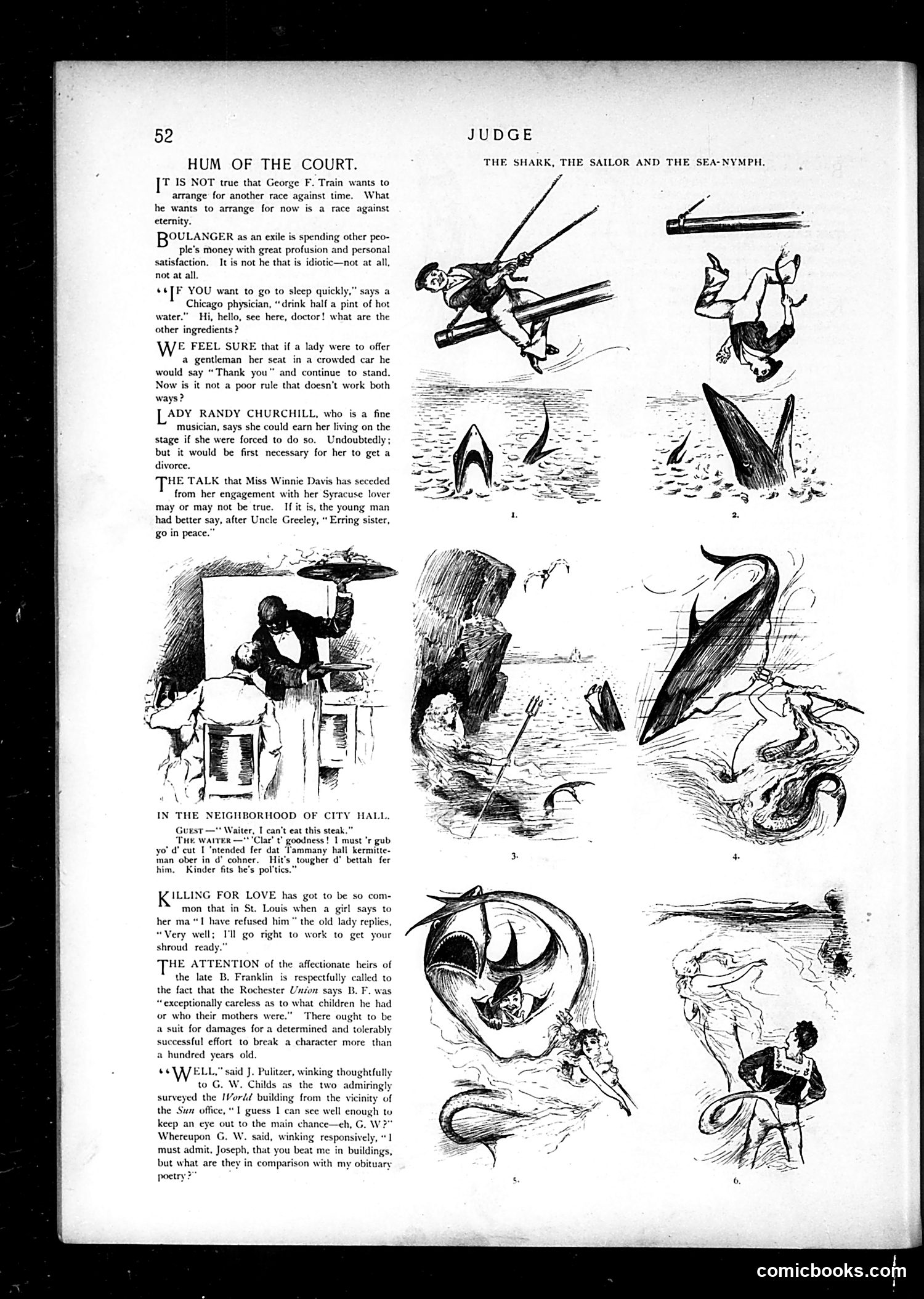
This page contains brief satirical commentary and six whimsical sea-creature illustrations titled "The Shark, the Sailor and the Sea-Nymph." The text snippets mock contemporary figures and social issues: - **George F. Train**: A notorious eccentric and reformer mocked for his obsession with racing and time - **Boulanger**: Likely General Georges Boulanger, the exiled French military figure - **Lady Randolph Churchill**: The famous society figure, satirized regarding forced theater work and divorce - **Winnie Davis**: Daughter of Jefferson Davis; her broken engagement is gossiped about Social commentary targets: - Chicago medical advice (sleeping remedy) - Urban etiquette (women offering seats to men in crowded cars) - St. Louis violence ("killing for love") - Benjamin Franklin's reputation regarding illegitimate children The six numbered illustrations appear decorative rather than directly illustrating specific commentary, depicting fantastical ocean scenes with sharks, sailors, and mythological creatures.
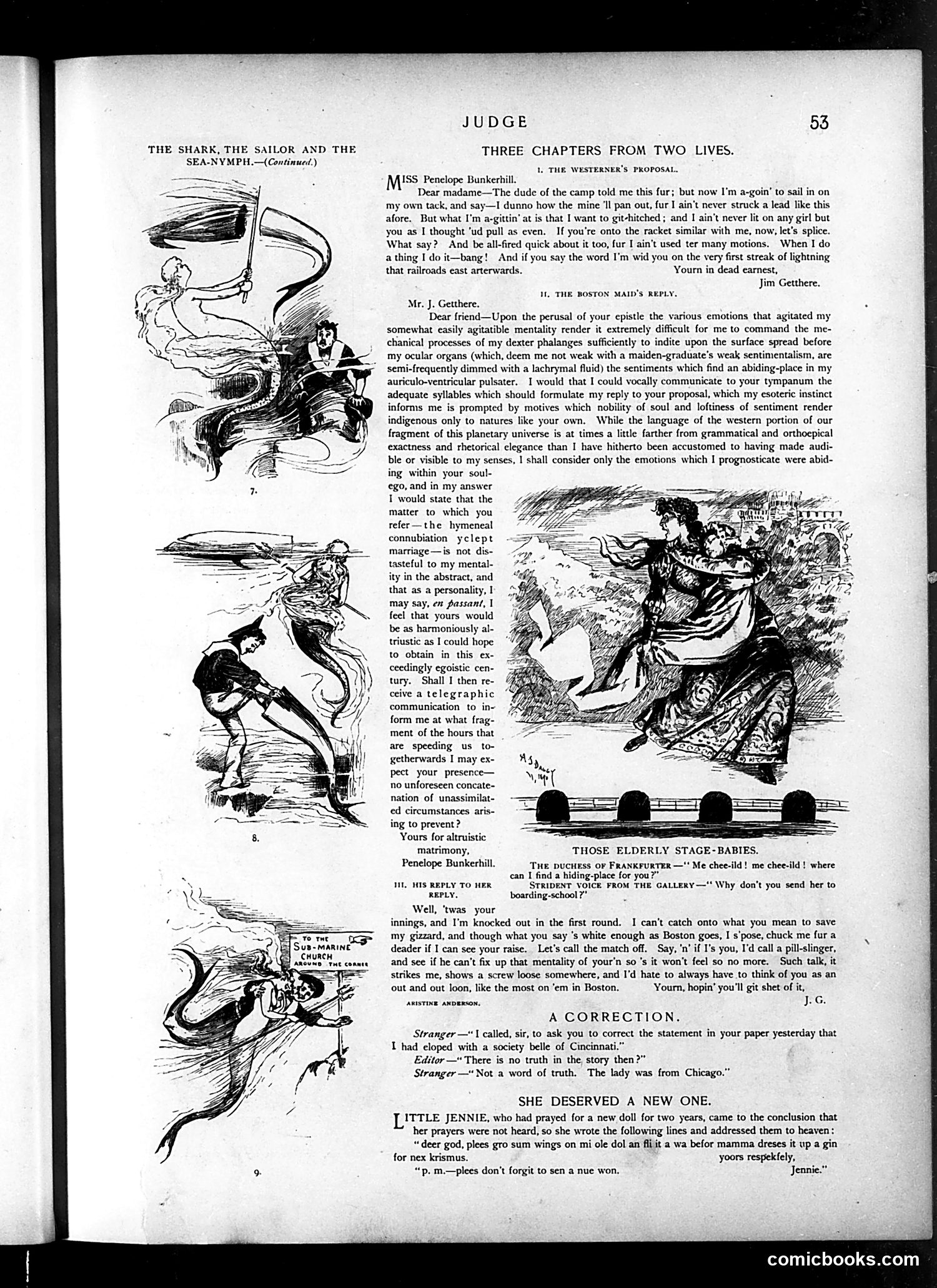
This page satirizes the clash between American regional dialects and social classes through a mock courtship exchange. A plainspoken Western prospector ("Jim Getthere") proposes marriage to a Boston aristocrat ("Miss Penelope Bunkerhill") in colloquial mining-camp language. She responds with absurdly pretentious, flowery prose laden with Latin phrases and medical terminology ("auriculo-ventricular pulsater," "hymeneal connubiation"). The joke: her overwrought verbosity completely baffles him—he finds her incomprehensible and withdraws his proposal, advising she see a doctor for her mental condition. Judge ridicules both the affected speech of educated Bostonians and the ignorance of frontier types, but the satire primarily targets upper-class pretension: her elaborate language conveys nothing except her own pomposity. The accompanying sketches illustrate maritime and stage-related scenes, likely supporting the "shark" and theatrical themes in the title.
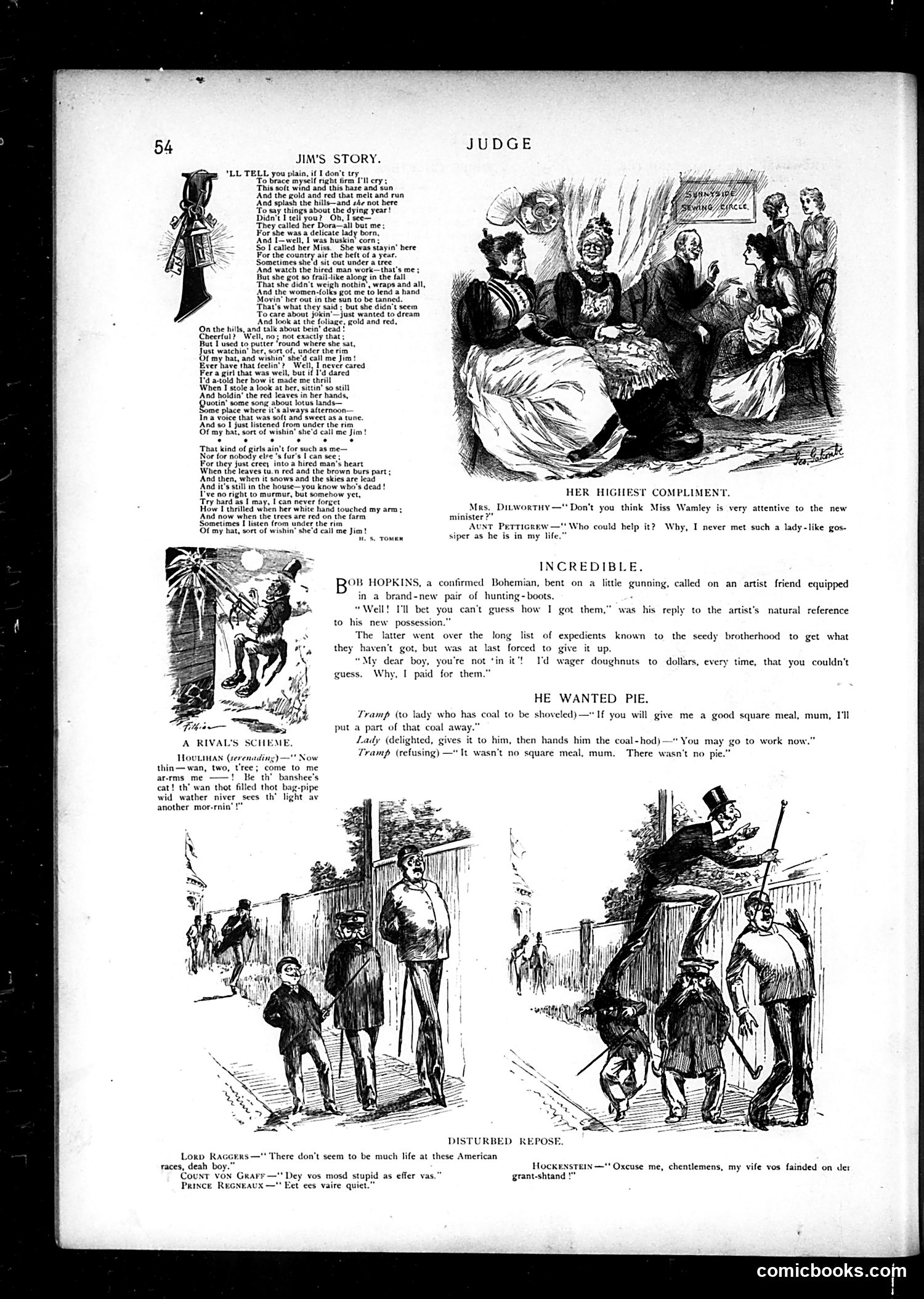
This page contains multiple satirical vignettes typical of Judge magazine's humor: **"Jim's Story"** (left): A sentimental poem about a farm laborer's unrequited love for a delicate, refined woman ("Dora") visiting for her health. The satire targets the romanticization of consumption (tuberculosis)—she's described as frail, dreaming of "lotus lands" and singing about death. The humor lies in the contrast between Jim's crude rural existence and his yearning for an unattainable, sickly upper-class woman. **"Incredible"** and **"He Wanted Pie"**: Brief comic sketches about bohemians and tramps—social outsiders made fun of for their poverty and scheming. **"A Rival's Scheme"** and **"Disturbed Repose"**: Ethnic stereotype humor involving exaggerated accents (German, Irish characters), standard for period American comic magazines. The page primarily uses working-class and immigrant figures as objects of ridicule, reflecting Judge's audience of educated, prosperous readers.
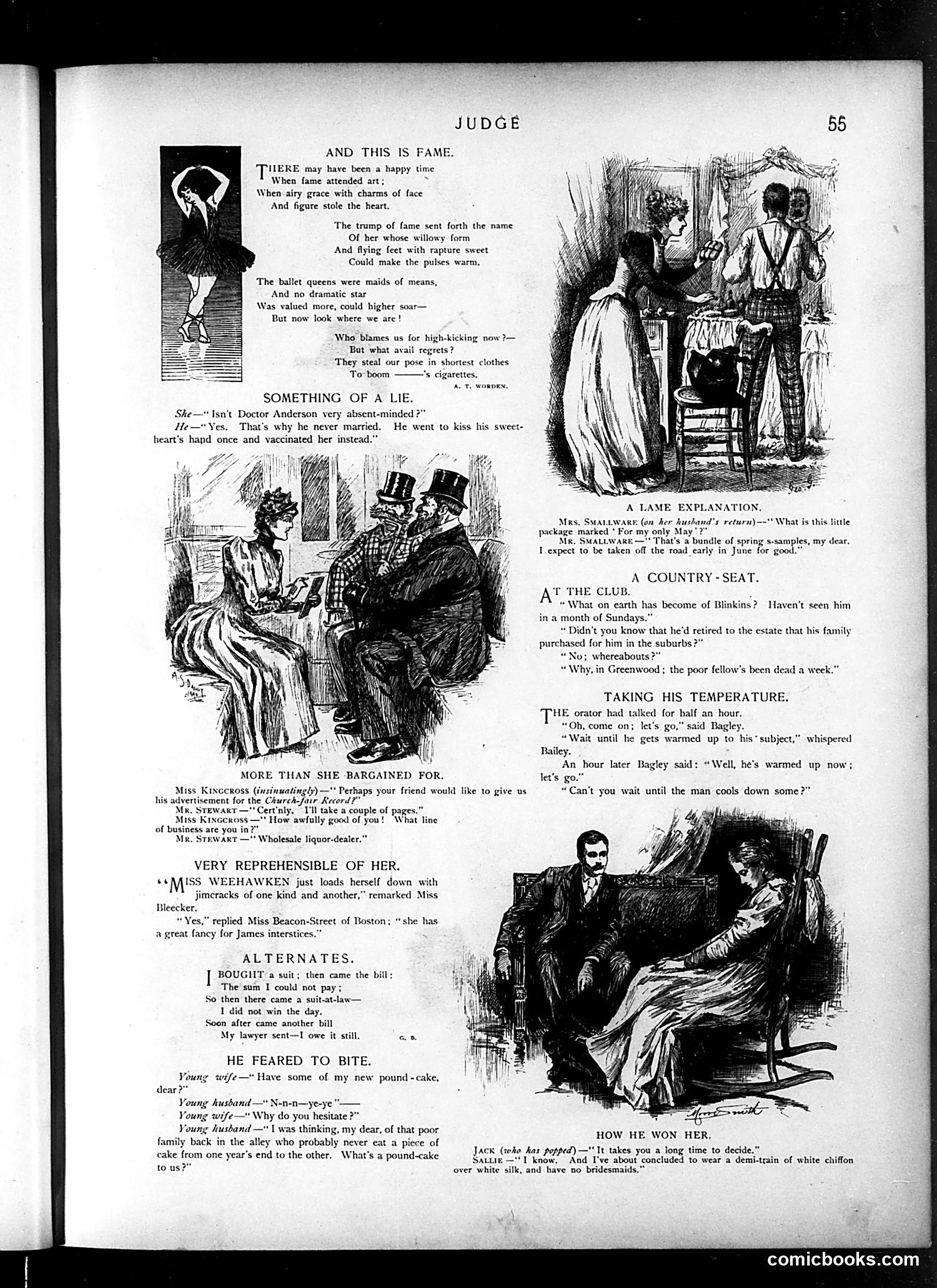
This page contains multiple short satirical pieces typical of late 19th/early 20th-century American humor: **"And This Is Fame"** laments how theatrical performers have lost dignity. Once, ballet dancers were respected artists; now they're reduced to advertising cigarettes in scanty costumes—commentary on commercialism degrading art. **Other vignettes mock everyday absurdities**: a doctor who vaccinated his sweetheart instead of kissing her; a man claiming spring samples justify his road absence; dark humor about a man's "retirement" to a cemetery; an interminable bore of an orator; a woman mortified to learn her friend advertises liquor; and a young husband's guilt-ridden hesitation over pound cake because poor neighbors starve. **"How He Won Her"** shows a man finally winning agreement through fashion minutiae—satirizing women's supposed obsession with wedding dress details. The humor targets vanity, commercialism, social pretension, and gender stereotypes. No specific political figures appear; instead, these are universal social critiques meant for educated middle-class readers.
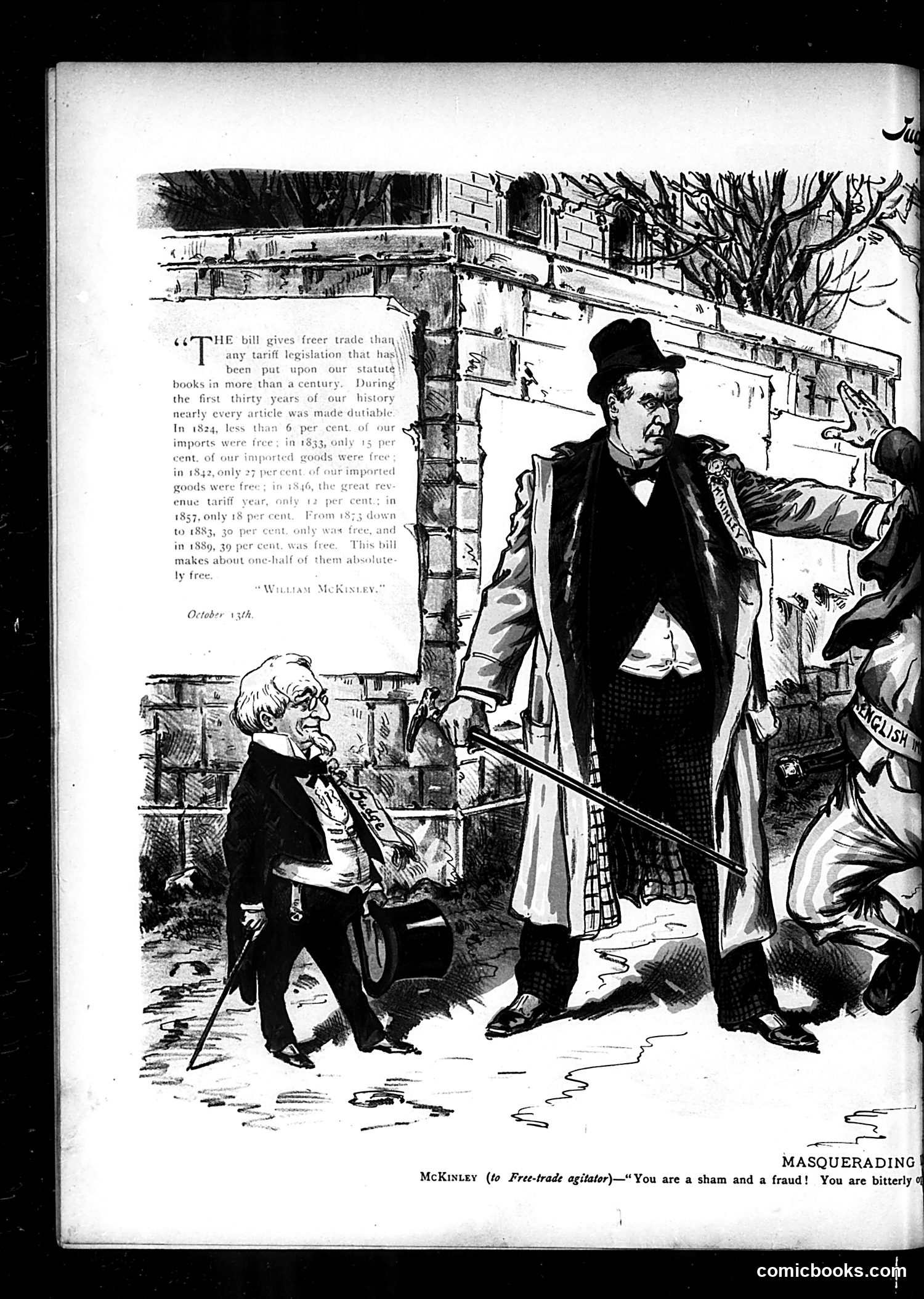
This political cartoon satirizes the debate over free trade versus protective tariffs in late 19th-century America. The figure labeled "McKinley" (likely President William McKinley, known for protectionist policies) confronts a "free-trade agitator," accusing him of being "a sham and a fraud." The accompanying text from William McKinley discusses tariff history, noting that import duties have fluctuated dramatically—from near-zero in 1824 to 50% by 1890. McKinley advocates for protective tariffs despite their unpopularity with free-trade advocates. The cartoon's joke: McKinley suggests the free-trader is hypocritically masquerading as something he isn't, while McKinley himself champions the tariff position. The satire likely critiques both sides' rhetorical dishonesty in this heated economic policy debate.
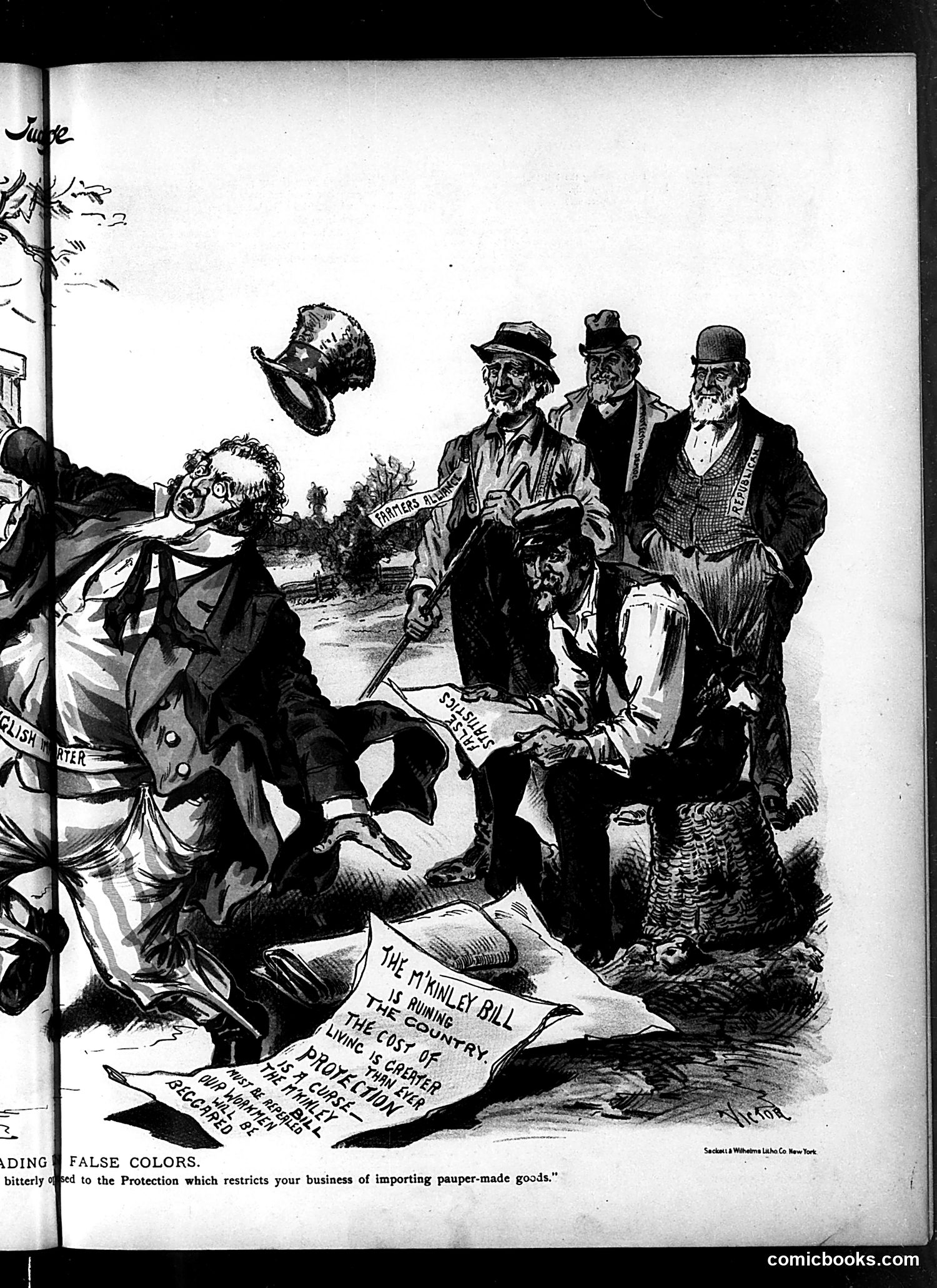
This Judge magazine cartoon satirizes American protectionist trade policy. A figure labeled "BRITISH MANUFACTURER" (left, gesturing dramatically) complains to three well-dressed gentlemen (likely American politicians or business interests) about tariffs restricting imports of cheap British goods. The cartoon's title "FALSE COLORS" suggests the British manufacturer is hypocritically claiming victimhood—he profits from exploiting workers ("pauper-made goods") while objecting to protective tariffs designed to shield American workers and manufacturers. The dead body at bottom labeled "McKINLEY BILL" references actual tariff legislation. The satire critiques both British manufacturing practices using exploited labor and American political figures who might sympathize with British complaints against American protectionism. The cartoon defends tariff protection as morally justified resistance to cheap labor competition.
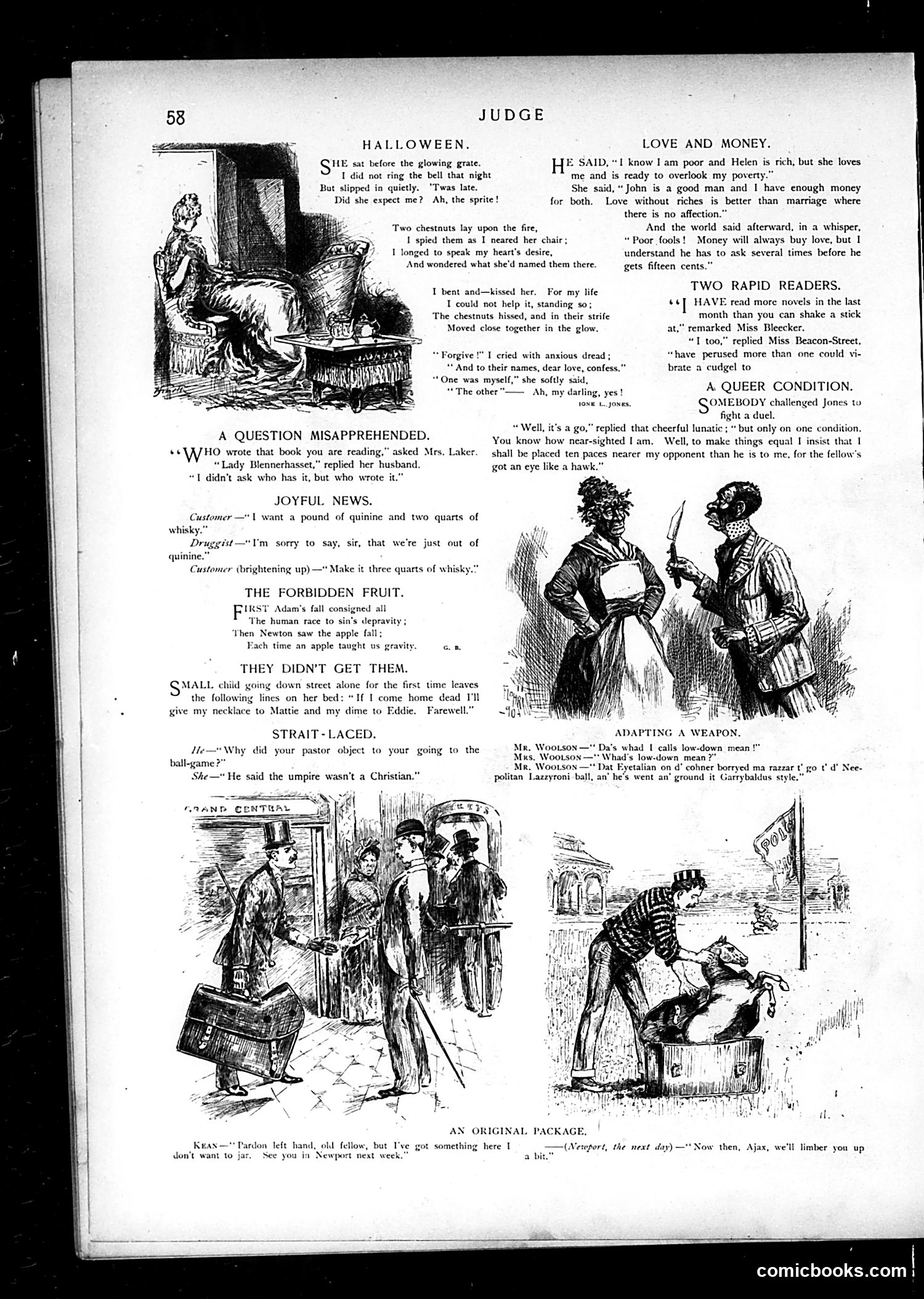
This page contains multiple short satirical pieces typical of late-19th century American humor: **"Halloween"** and **"Love and Money"** are romantic poems contrasting passionate love with mercenary concerns—the satirical point being that the world dismisses poor lovers as "fools" while they dismiss the lovers' poverty. **"Two Rapid Readers"** mocks women who brag about reading vast quantities of novels, suggesting such claims are exaggerated boasting. **"A Queer Condition"** jokes about a myopic (nearsighted) man challenged to a duel who demands unfair positioning advantage to compensate. The humor pieces mock various social pretensions: marital misunderstandings, excessive druggist requests, and malapropisms (the final piece appears to feature an Italian immigrant's mangled English about borrowing a razor). **"The Forbidden Fruit"** makes a clever comparison between Adam's biblical fall and Newton's gravity discovery via falling apples. The illustrations feature Victorian-era figures in domestic and social situations, typical of Judge's visual satire targeting genteel society's absurdities.
This is primarily an **advertising page** with several small jokes interspersed. The cartoons and humor are minor: **The Jokes:** - A preacher reads scripture about giving bread; a jeweler mishears "carats" (diamonds) instead—mocking jewelers' obsession with gems - A politician brags about voting repeatedly since the polls opened that morning—satirizing electoral fraud and voter manipulation, a recognized problem in late 19th-century America - A drummer (traveling salesman) carries "concentrated lie" to maintain his sales pitch—cynical commentary on commercial dishonesty - References to "spooney pairs" (romantic couples) preferring covered bridges to scenic landscapes—gentle romantic humor - A sailor's anecdote about bailing out a raft as his first water work—folksy humor **Context:** This reflects Judge's typical mix of satirical jabs at everyday American life: commercial fraud, electoral corruption, and romantic sentimentality. The advertising dominates, indicating the magazine's revenue model.
This page is primarily **advertising with some satirical filler content**, typical of late-19th-century magazines. The main illustrated cartoon appears to be the "Shandoin Revlon Perfume" ad at top-left, showing decorative branding rather than political satire. The **small cartoons embedded in text** include: 1. A dialogue joke contrasting two married women's views on remarriage—one from Oregon says it's "unnatural," one from Chicago argues "habit is second nature"—a mild jab at regional attitudes. 2. A theater anecdote about a playwright rejected by a committee that can't agree which of three acts to cut—mocking committee indecision. 3. A Scotch dialect story about a farm boy cleverly refusing to provide a character reference, saying he'll bring his employer's instead—a joke about turnabout fairness. These are **lightweight, apolitical humor** pieces. The page is dominated by ads for railroads, pianos, bicycles ("Columbias"), linen collars, and patent medicines—characteristic of Judge magazine's revenue model.
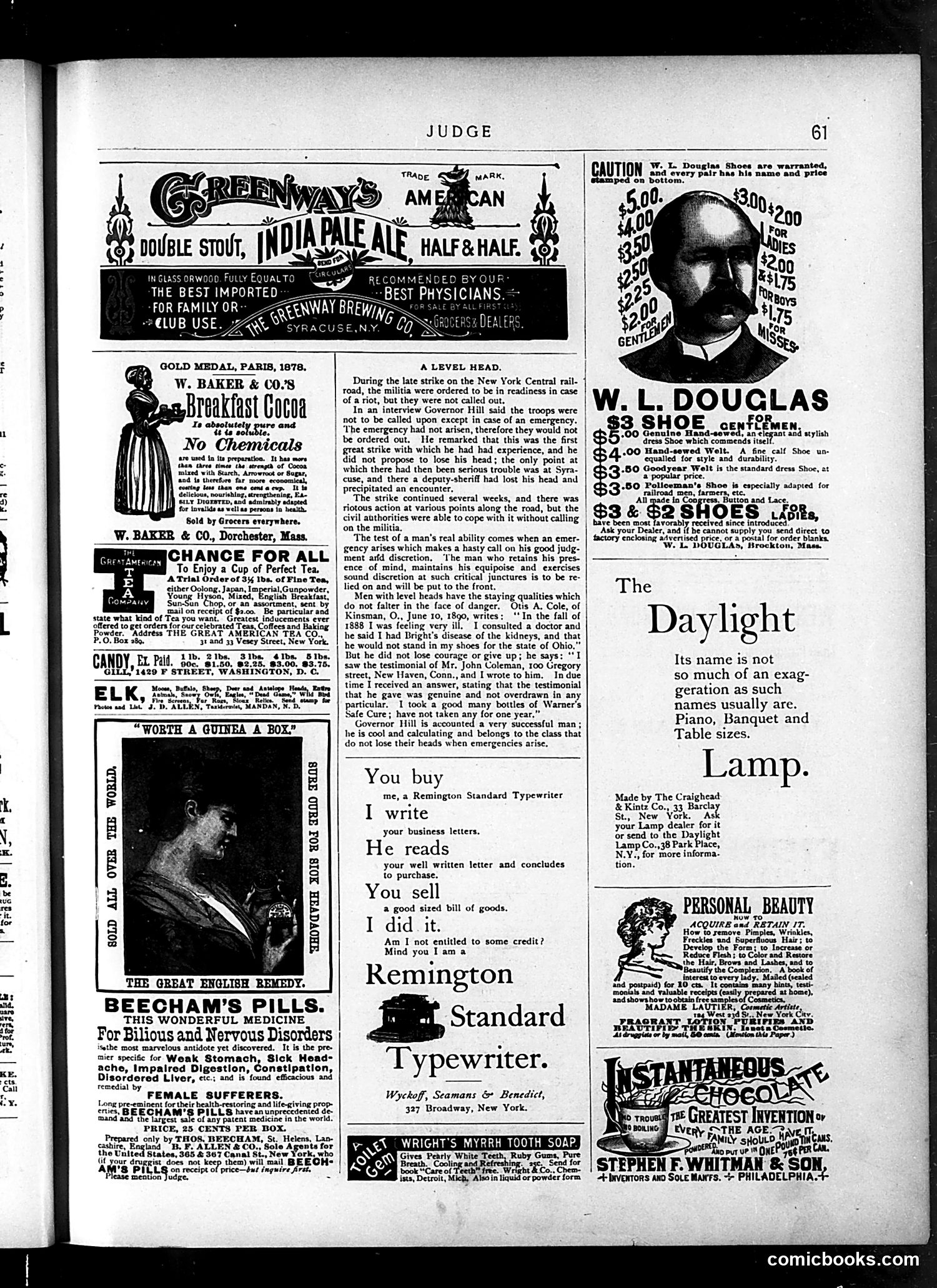
This editorial piece praises Governor **David B. Hill** (referenced as "Governor Hill") for his measured leadership during a recent **New York Central Railroad strike**. The article celebrates his restraint in NOT deploying militia despite labor unrest, arguing this demonstrates superior judgment. The piece then pivots to promoting **Warner's Safe Cure** (a patent medicine) by citing a testimonial from a man who claimed it cured his kidney disease after doctors gave up. The juxtaposition is promotional: Hill's "level head" under pressure is compared favorably to patients who maintain composure during illness. **For modern readers**: This conflates political leadership with patent medicine advertising—both supposedly prove the value of "staying cool" under adversity. The magazine uses an actual political figure to validate commercial products, blending editorial content with advertising in ways modern readers would recognize as ethically dubious.
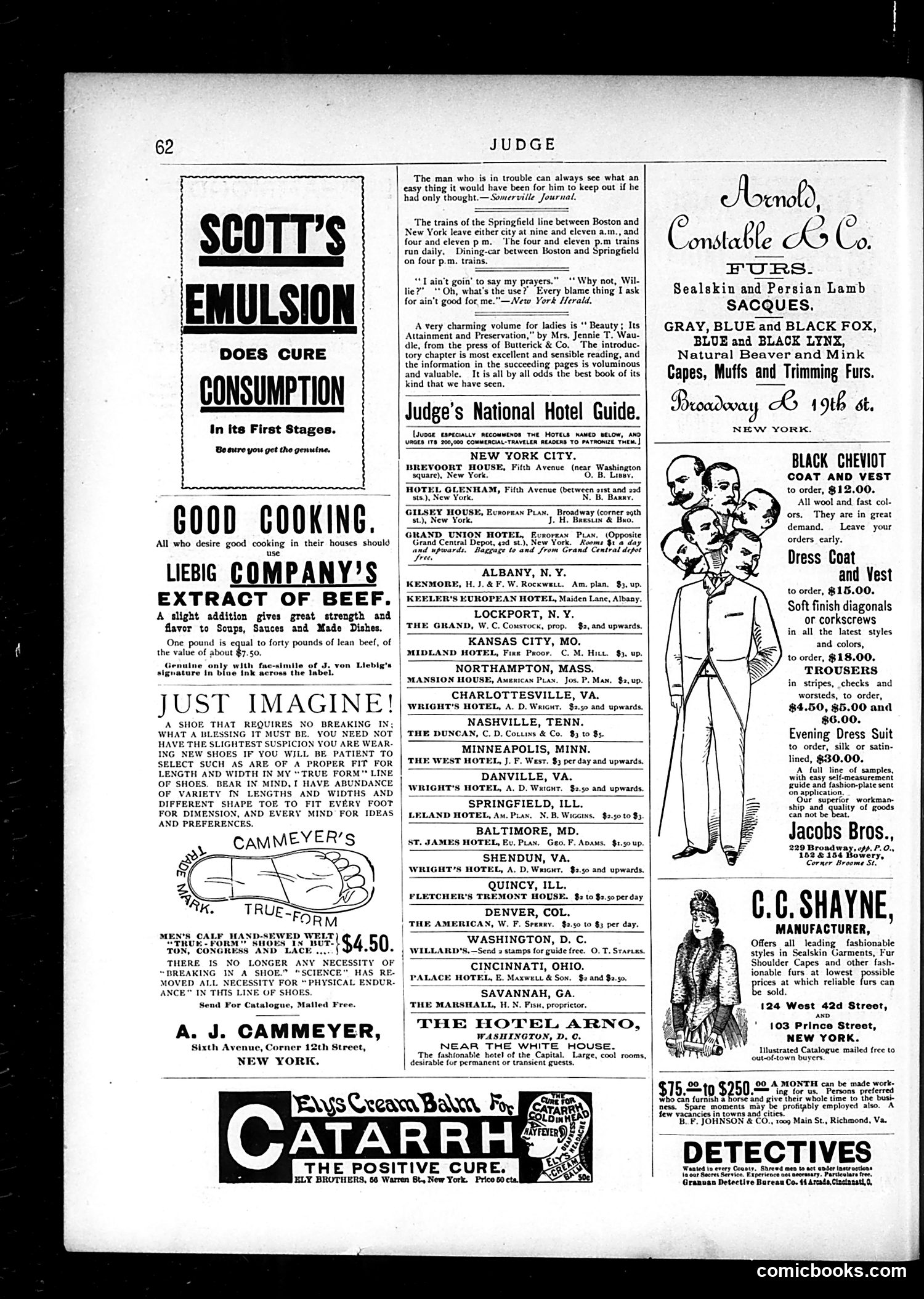
This page is primarily **advertising and hotel guides**, not political satire. The bulk consists of classified ads for patent medicines (Scott's Emulsion for consumption, Liebig's beef extract, Catarrhh cure), clothing tailors, and fur merchants, alongside Judge's "National Hotel Guide"—a directory of recommended hotels across American cities. The only identifiable satirical content is a small joke snippet: a child refusing to say prayers because "every blame thing I ask for ain't good for me"—a mild jab at unanswered prayers or perceived divine indifference, typical of Judge's light domestic humor. The page reflects late-19th-century consumer culture: remedies for tuberculosis and catarrh (common ailments then), custom tailoring services, and travel infrastructure. The shoe advertisement's breathless "JUST IMAGINE!" pitch exemplifies period advertising hyperbole.
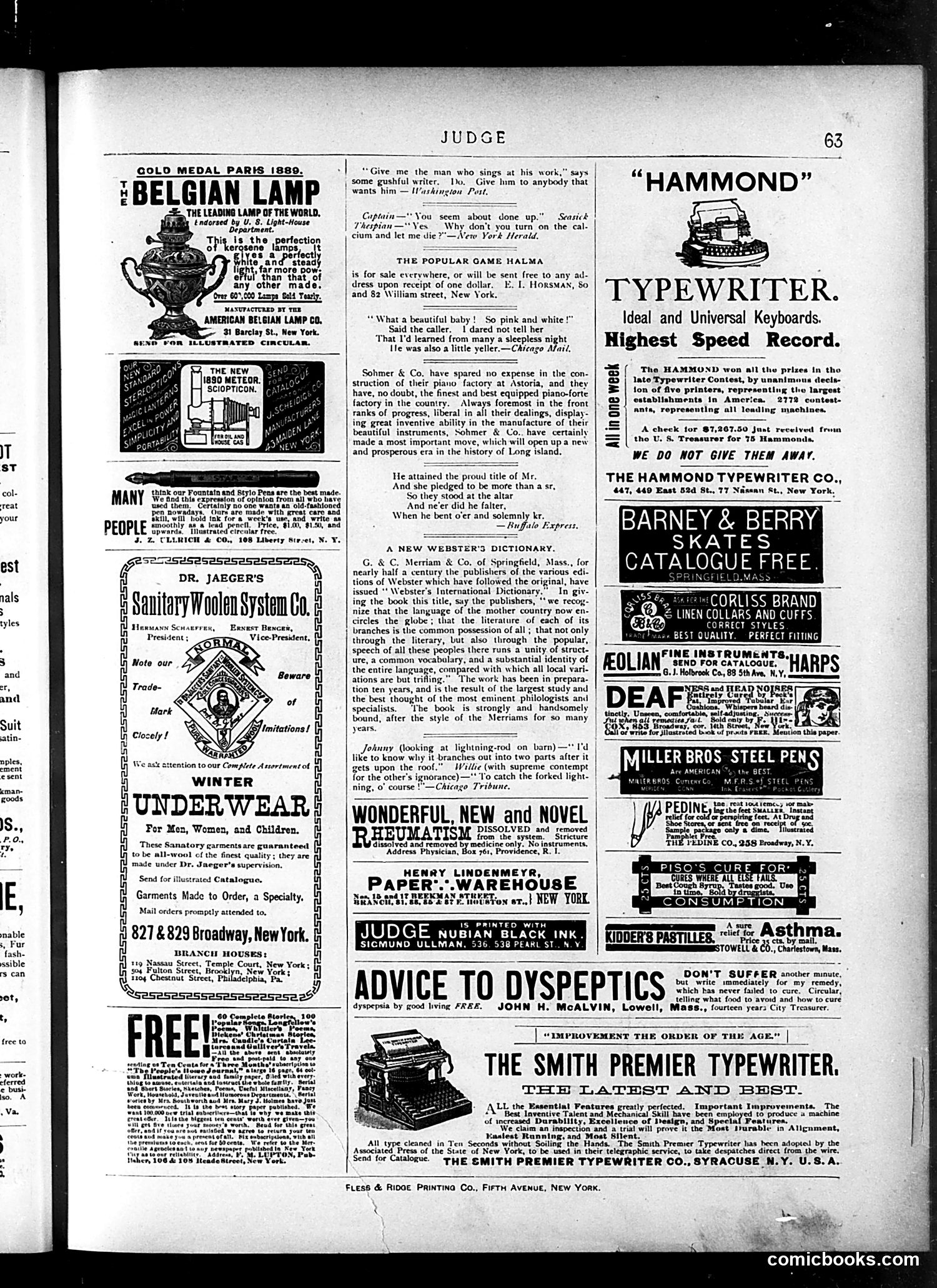
This page is primarily **advertising**, not political satire. It contains product advertisements typical of late 19th-century magazines: Belgian lamps, fountain pens, underwear, pianos, dictionaries, typewriters, and patent medicines. The small humorous items scattered between ads are **brief jokes** rather than political cartoons: - A joke about a man who sings at work (punchline: give him away) - A seasick actor wanting stage lighting to hide his misery - A caller complimenting a baby, unaware it's a "yeller" (crier) - A couple getting married ("Mr." and "Mrs.") - A child asking about lightning rods These are **domestic humor** reflecting everyday life—nothing satirizing politics or current events. The "Judge" branding appears minimal; this reads more as a standard advertising journal with filler content. No identifiable political figures or caricatures are present on this page.
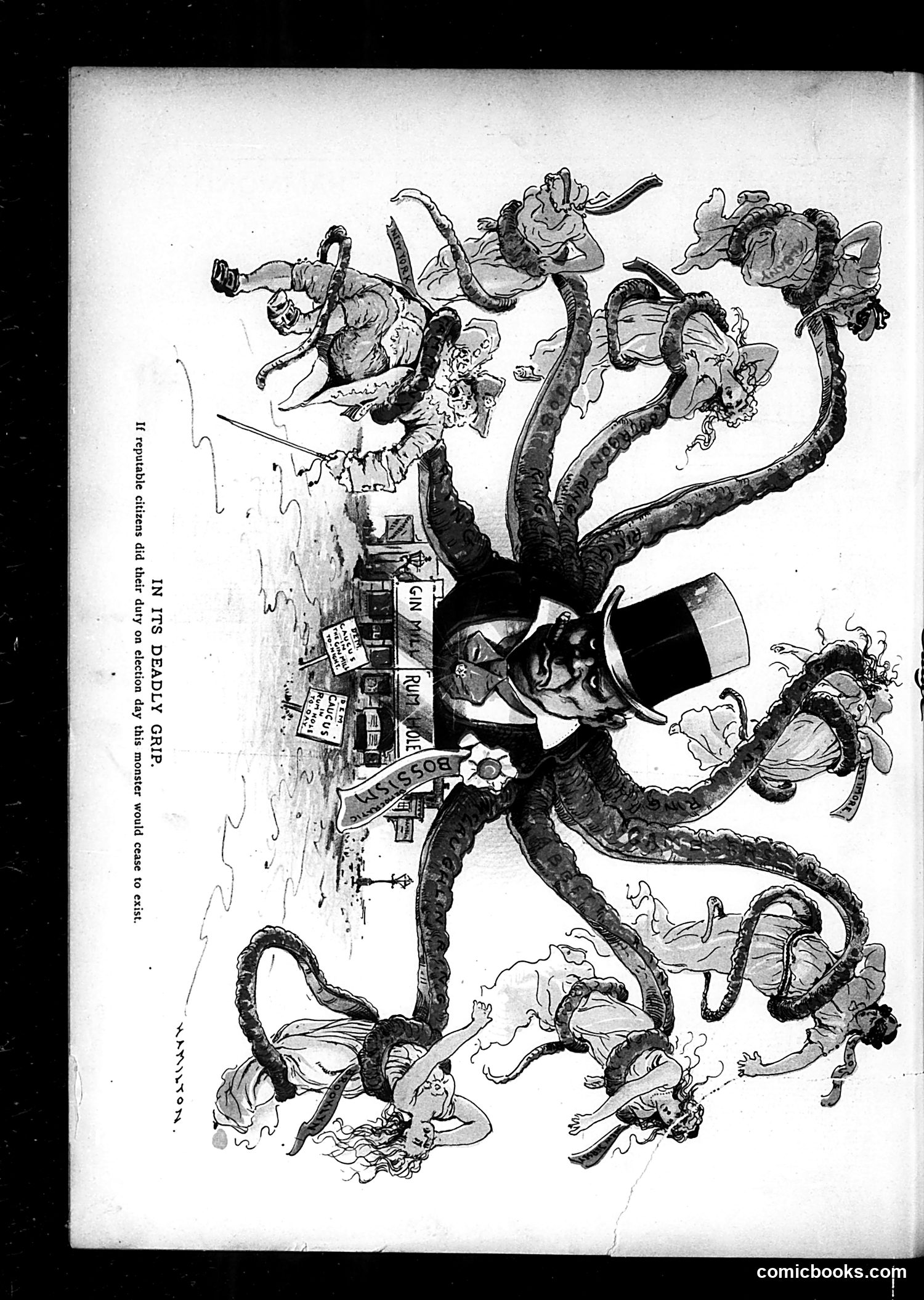
This appears to be a Judge magazine political cartoon depicting a multi-headed octopus-like creature strangling or controlling what looks like a building or institution (possibly representing government or society). The creature is labeled with text that's partially visible but suggests corruption or organized crime ("DEADLY GRIP"). The central message, stated below the image, calls on "reputable citizens" to act on "election day" to destroy this "monster"—clearly advocating voter participation as the remedy against corruption. The cartoon uses the common turn-of-century metaphor of an octopus with multiple grasping tentacles to represent a corrupt organization or political machine. The multiple heads/faces suggest various corrupt interests working in coordination. The text indicates this was meant to mobilize readers toward political action through voting.