
A complete issue · 16 pages · 1890
Judge — August 23, 1890
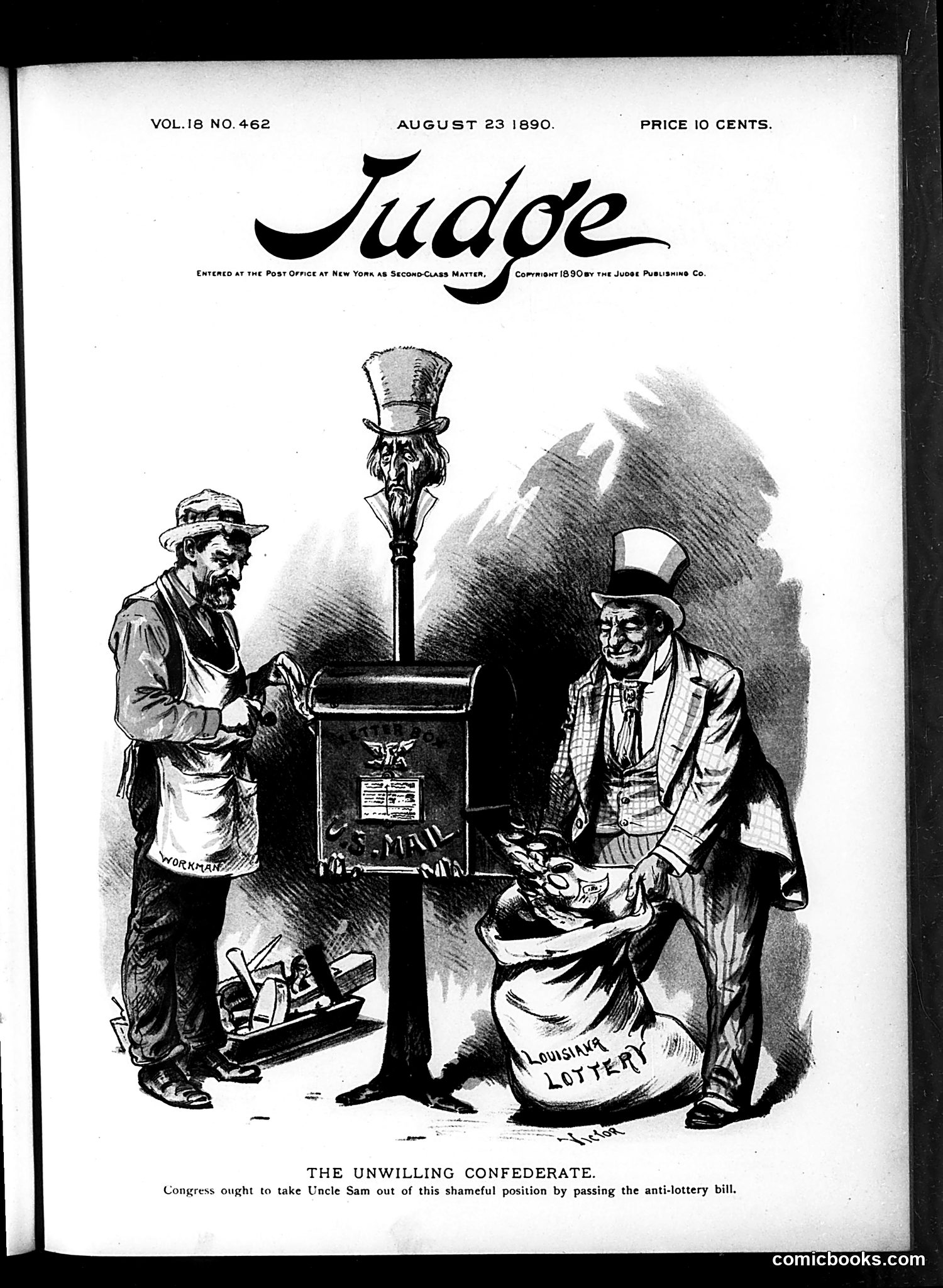
This 1890 *Judge* cartoon satirizes Southern resistance to federal anti-lottery legislation. The image shows Uncle Sam (the bearded figure in top hat on the right) attempting to extract Louisiana from a mail slot—depicted as a bag labeled "LOUISIANA LOTTERY." A workman on the left and Uncle Sam struggle to remove the state, while a caricatured figure representing the lottery or Southern interests resists. The caption states Congress should "take Uncle Sam out of this shameful position by passing the anti-lottery bill." The cartoon criticizes the Louisiana Lottery, a notoriously corrupt gambling operation that operated despite federal opposition. The satire frames Southern political resistance to federal regulation as obstruction of legitimate national reform.
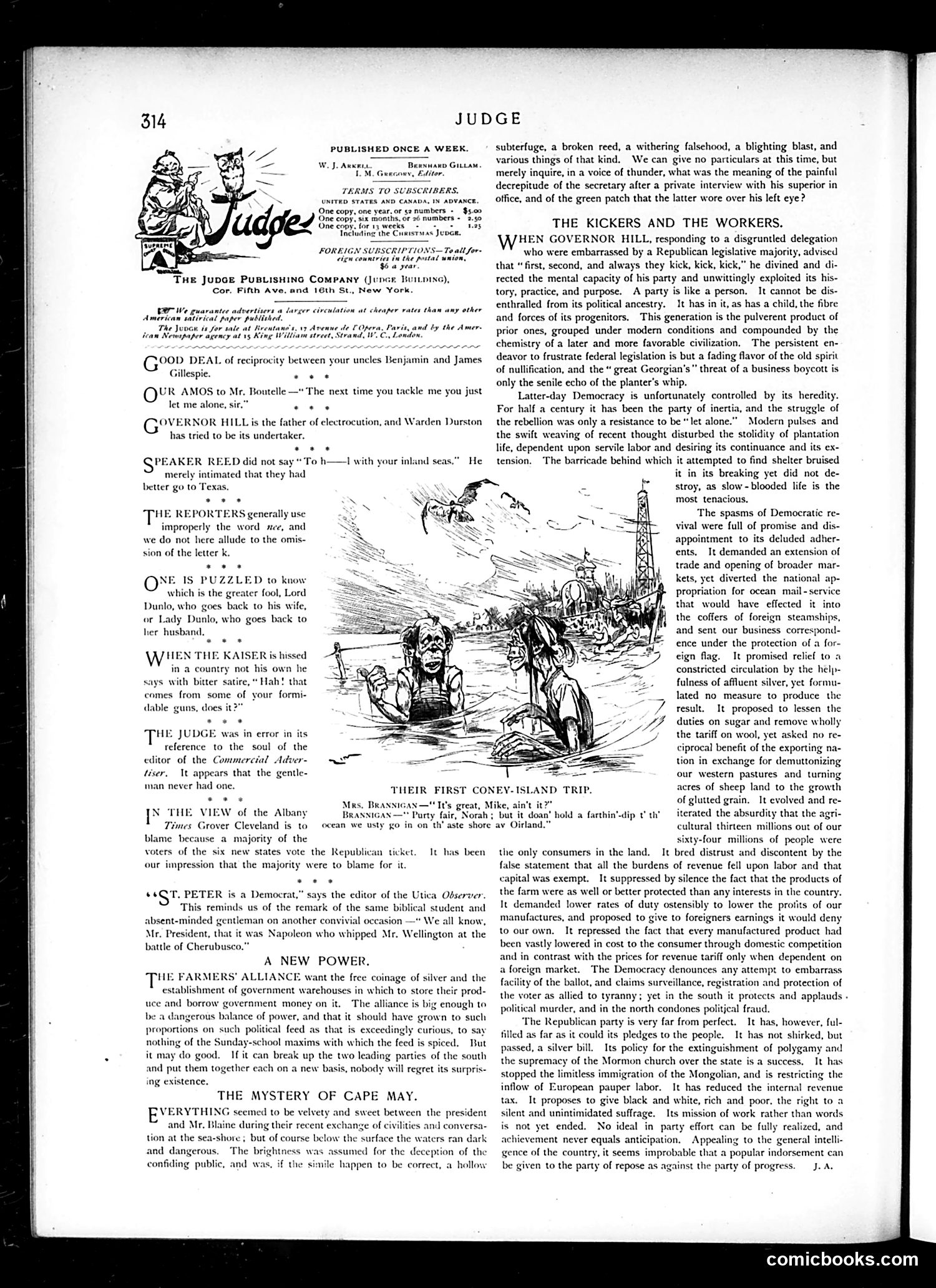
This page contains political commentary rather than traditional cartoons. The main illustration shows three figures in water near an industrial structure, captioned "THEIR FIRST CONVEY-ISLAND TRIP." The text discusses **Governor Hill** and Republican legislative efforts, criticizing Democratic Party tactics. References include complaints about the party's "heredity" control and frustration with blocking federal legislation. A section titled "THE KICKERS AND THE WORKERS" appears to contrast labor groups with Democratic leadership, suggesting the party is out of touch with working people's interests. The piece criticizes Democratic strategy as reactive rather than progressive, and accuses the party of being controlled by established interests rather than genuine reform advocates. Without clearer identification of the water-bound figures, the specific cartoon meaning remains unclear, though it appears related to Democratic political vulnerability or misadventure.
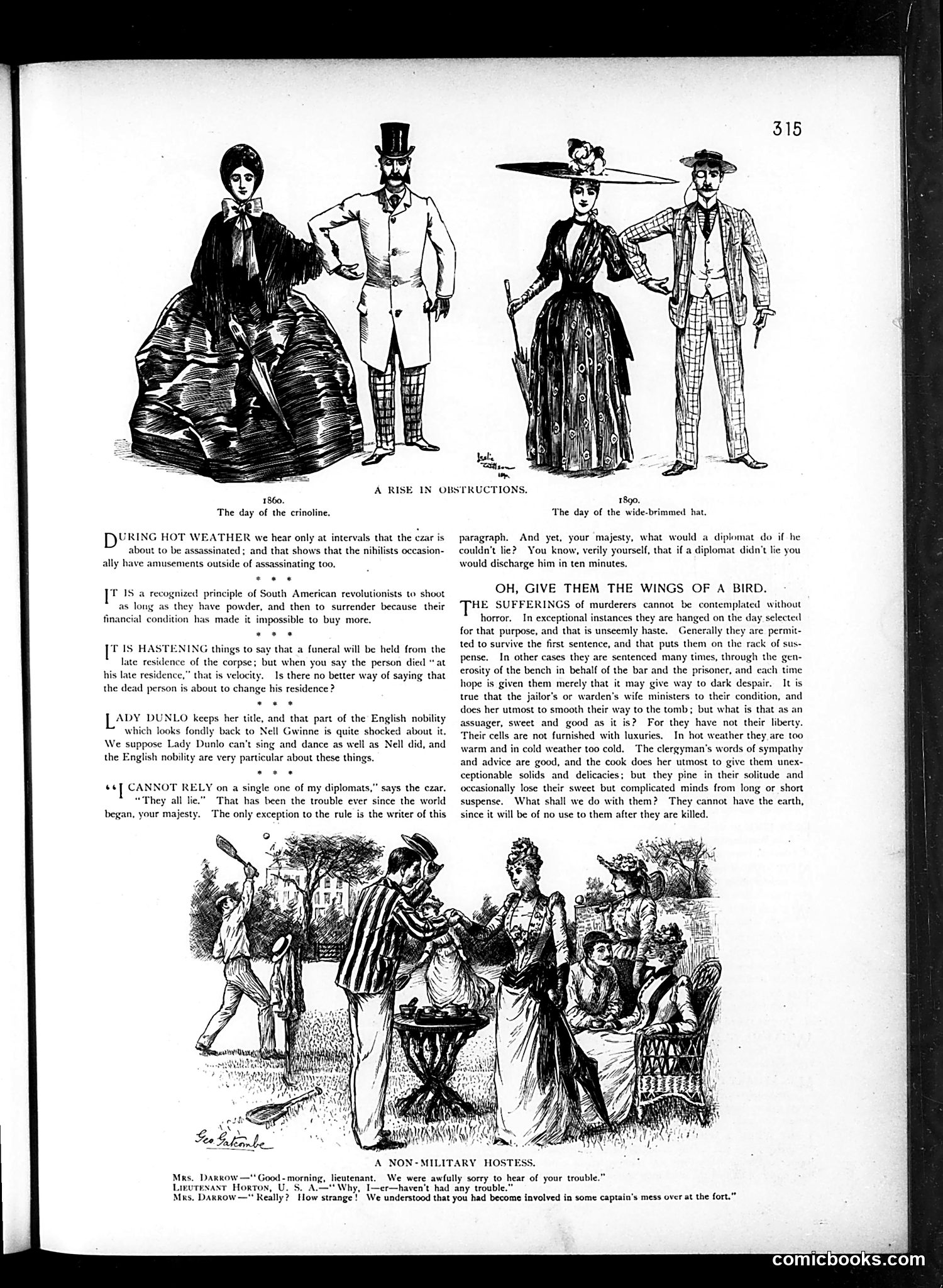
This page satirizes early 1900s fashion extremes through two panels showing women's wear evolution. The left panel (labeled "1860: The day of the crinoline") depicts an enormous hoop-skirted woman dwarfing a uniformed man. The right panel ("1890: The day of the wide-brimmed hat") shows a woman with an absurdly oversized hat extending horizontally, again towering over a male figure. The accompanying text mocks how these fashions obstruct public spaces and domestic life, particularly referencing women's impracticality during social gatherings. The bottom illustration "A Non-Military Hostess" depicts women in a garden party scene, reinforcing the satire about fashion-obsessed society women. The humor targets Victorian/Edwardian fashion excess and women's vanity, a common Judge magazine theme reflecting period anxieties about evolving gender roles and consumption.
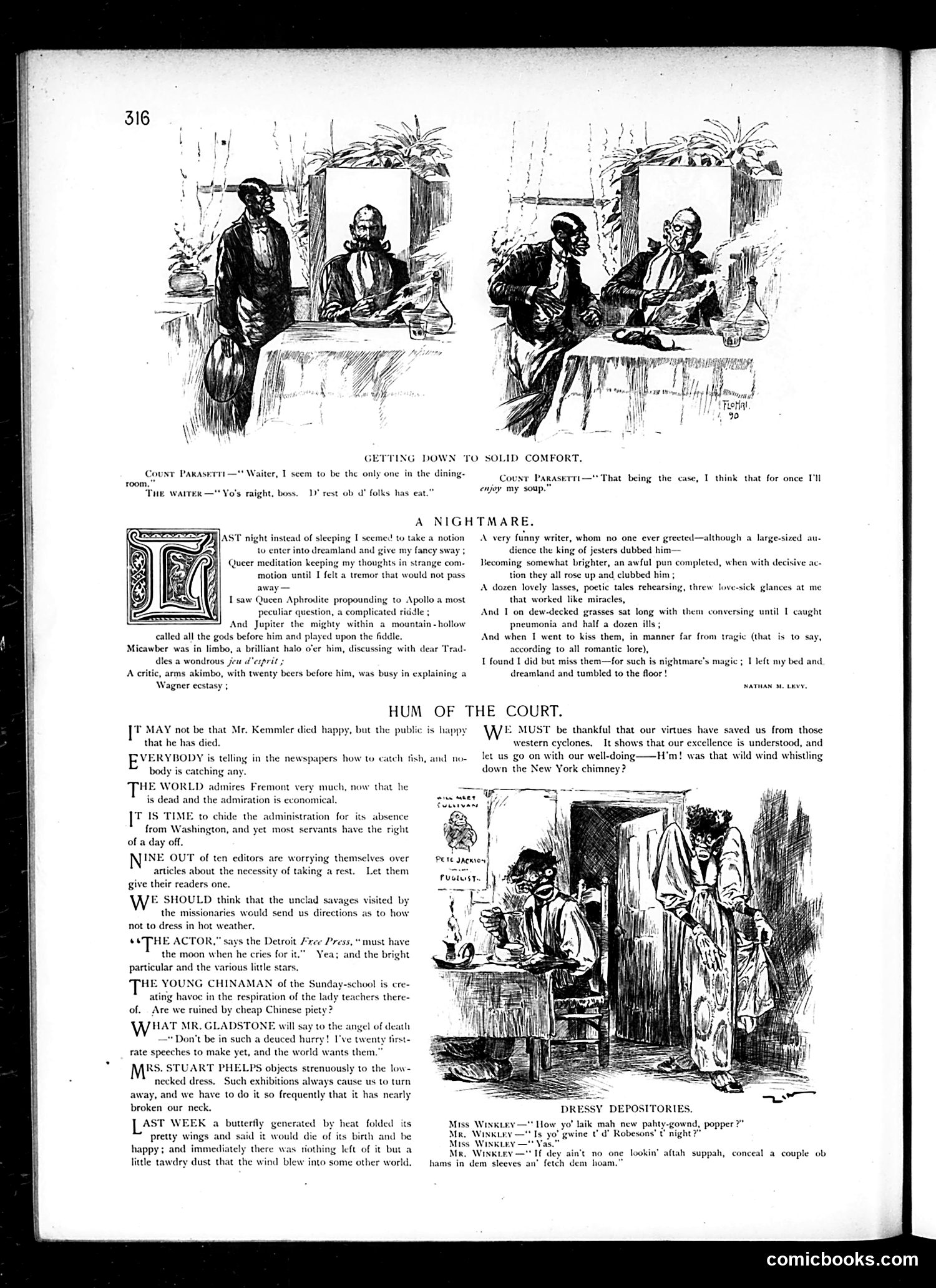
This page contains social satire typical of late-19th-century Judge magazine. The top cartoon mocks aristocratic pretension: a Count dines alone after other guests have fled, then claims he'll "enjoy" his soup—the joke being his solitude forces him to abandon affected manners. "A Nightmare" is a literary piece satirizing overly romantic or artistic sensibilities: the narrator dreams of classical gods, literary characters (Micawber from Dickens), and "a very funny writer" whom audiences beat after hearing his pun. The nightmare ends when he tries to kiss dream-women but falls through—mocking both flowery romanticism and those who take such fantasy seriously. "Hum of the Court" offers brief satirical observations on contemporary figures and issues: Mr. Kemmler (likely referring to a recent execution), fishing advice in newspapers, actor's affectations, and objections to low-necked dresses. "Dressy Depositories" depicts African American dialect humor (common but now offensive), showing lower-class characters discussing clothing and social visits—typical period "humor" based on racial caricature rather than genuine wit.
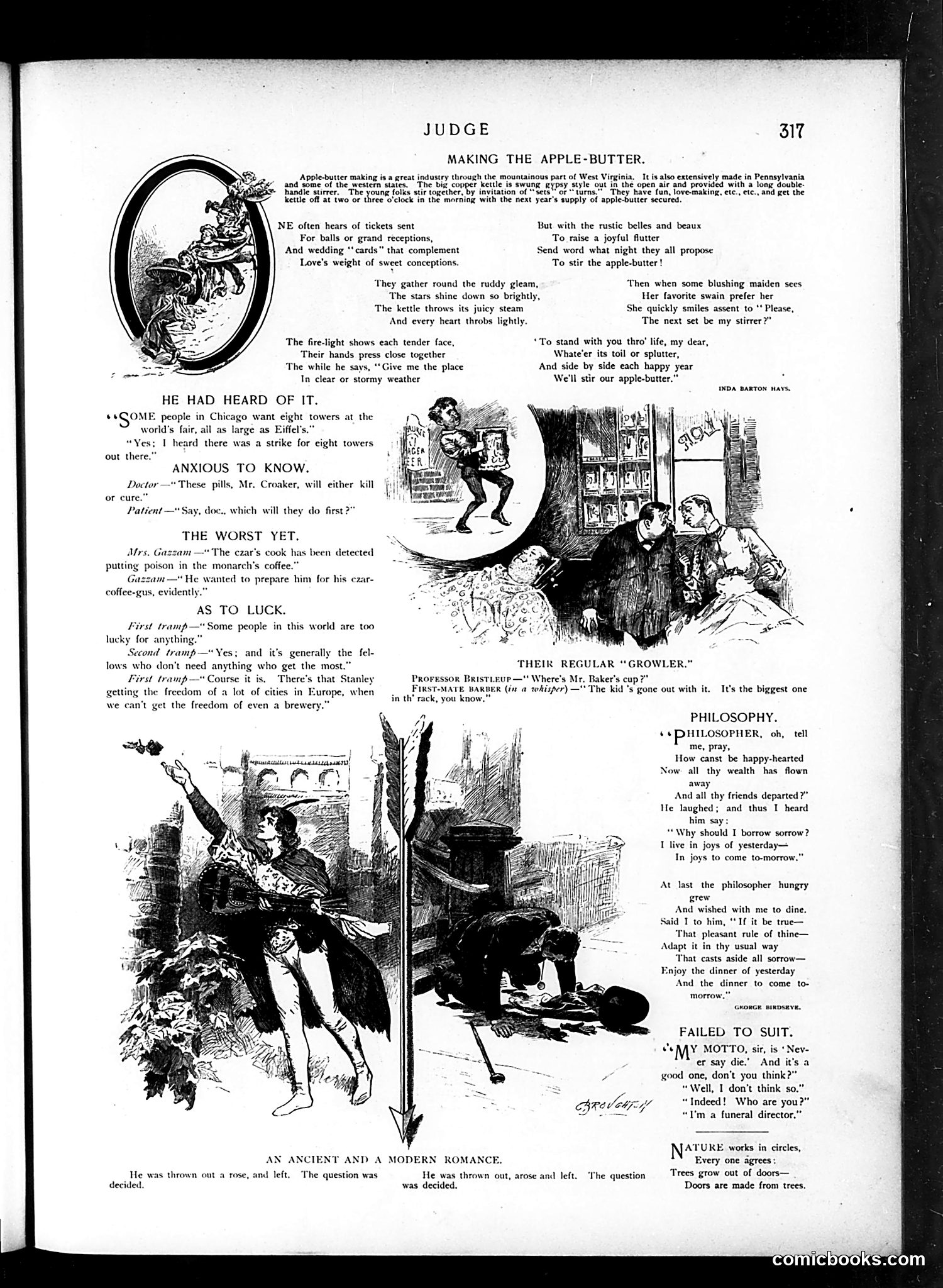
This page from *Judge* (a 19th-century American humor magazine) contains several satirical pieces: **"Making the Apple-Butter"** is a romanticized poem about rural Appalachian courtship customs, where young people gathered to stir apple butter together as a social event—a thinly veiled excuse for supervised romantic encounters. The illustrations show couples using the stirring as courtship cover. The remaining jokes mock various contemporary subjects: Chicago's World's Fair ambitions (the Eiffel Tower reference), medical uncertainty, and the Russian Tsar's vulnerability to poisoning (a timely reference given periodic assassination attempts against Russian rulers). The "Philosophy" poem satirizes empty optimism—a philosopher claims to live without sorrow by dwelling only on past and future joys, then awkwardly contradicts himself when hungry and dependent on others' hospitality. Minor jokes target tramps discussing luck and a funeral director rejecting the "never say die" motto. Overall, the page combines gentle rural Americana with sharper satirical jabs at contemporary politics and social pretension.
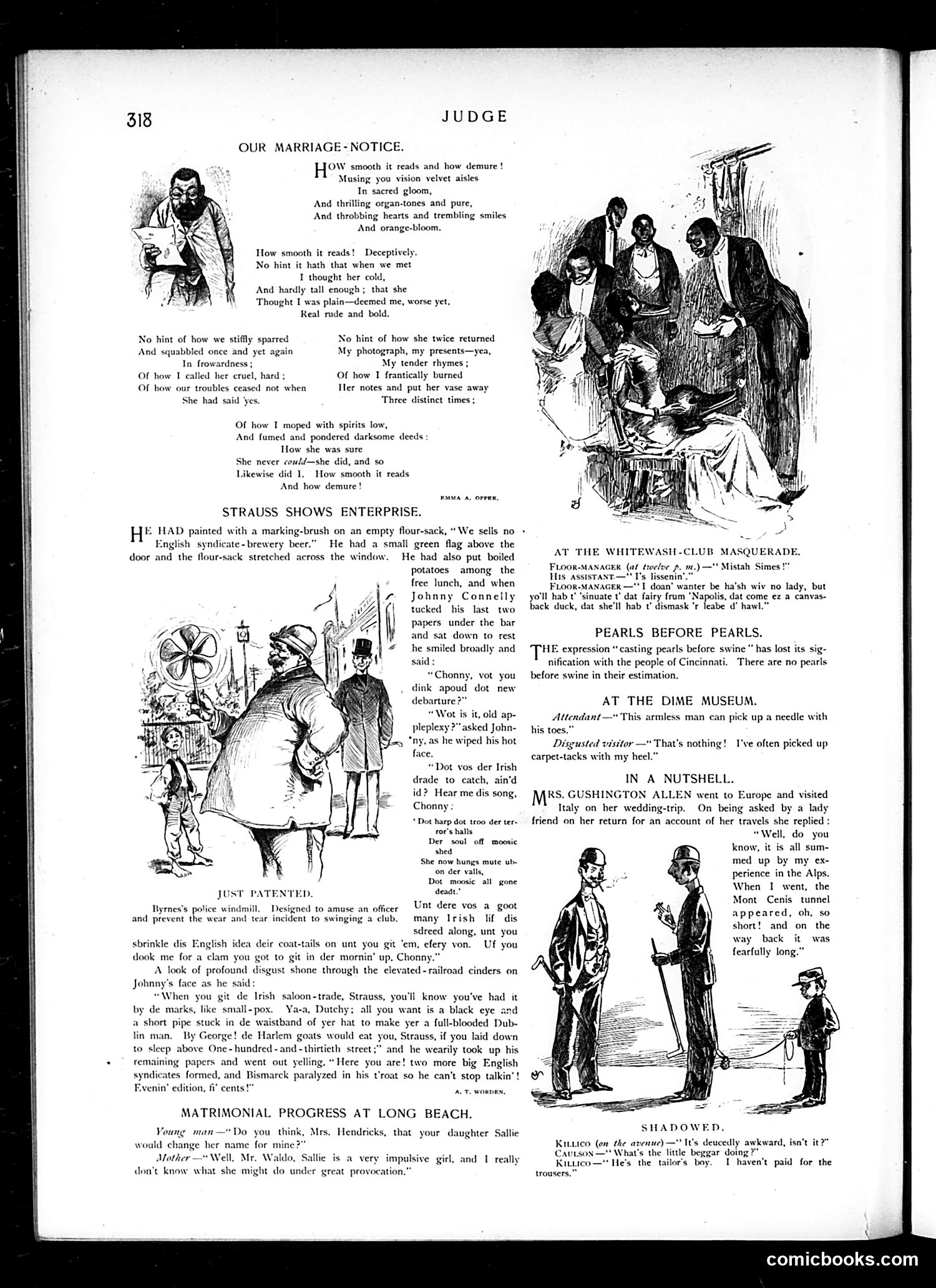
This Judge magazine page contains several satirical sketches mocking American social pretensions and ethnic stereotypes typical of the 1890s. **"Our Marriage Notice"** is a romantic poem exposing the gap between courtship's polished appearance and reality—the couple initially disliked each other, argued constantly, and nearly broke up multiple times before marrying. **"Strauss Shows Enterprise"** ridicules a German-immigrant saloonkeeper attempting to attract Irish clientele by adding patriotic Irish imagery and songs to his bar. The Irish newspaper seller Johnny Connelly mocks the effort as clumsy cultural appropriation. **The remaining sketches** contain period ethnic humor: a German character's fractured English, jokes about Irish immigration, and Cincinnati's supposed indifference to refined expression ("pearls before swine"). The overall tone reflects Judge's satirical approach: exposing hypocrisy in marriage, mocking immigrant entrepreneurship and assimilation attempts, and trafficking in crude ethnic caricatures—attitudes deeply offensive by modern standards but commonplace in 1890s American humor publications.
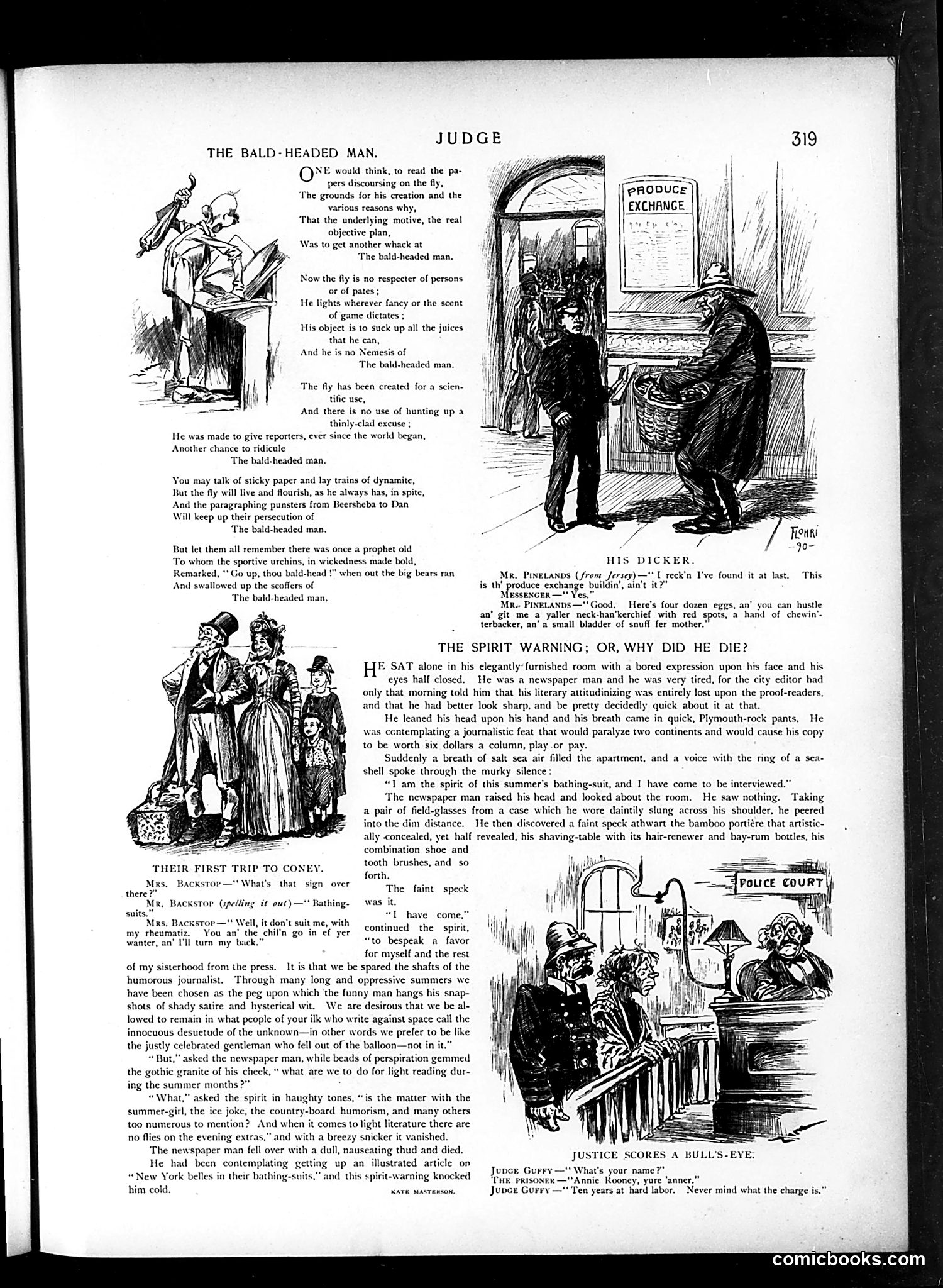
This page contains multiple satirical pieces typical of Judge's late 19th/early 20th-century humor: **"The Bald-Headed Man"** is a running joke mocking how newspapers constantly ridicule bald men. The poem suggests reporters use baldness as easy target material for jokes and puns, comparing this persecution to biblical stories (referencing Elisha and the bears). **"His Dicker"** shows a rural Jersey farmer at a produce exchange, using dialect humor. The joke appears to be about rustic ignorance of urban commerce—he treats the exchange like a general store, requesting eggs and various sundries. **"The Spirit Warning"** satirizes overly dramatic newspaper writing. An exhausted journalist fantasizes that the "spirit of the summer bathing suit" visits to complain about being relentlessly mocked in print. It mocks both pretentious journalistic ambitions and the predictable humor about women's swimwear. The cartoons employ class-based and regional stereotypes common to the era's "humor."
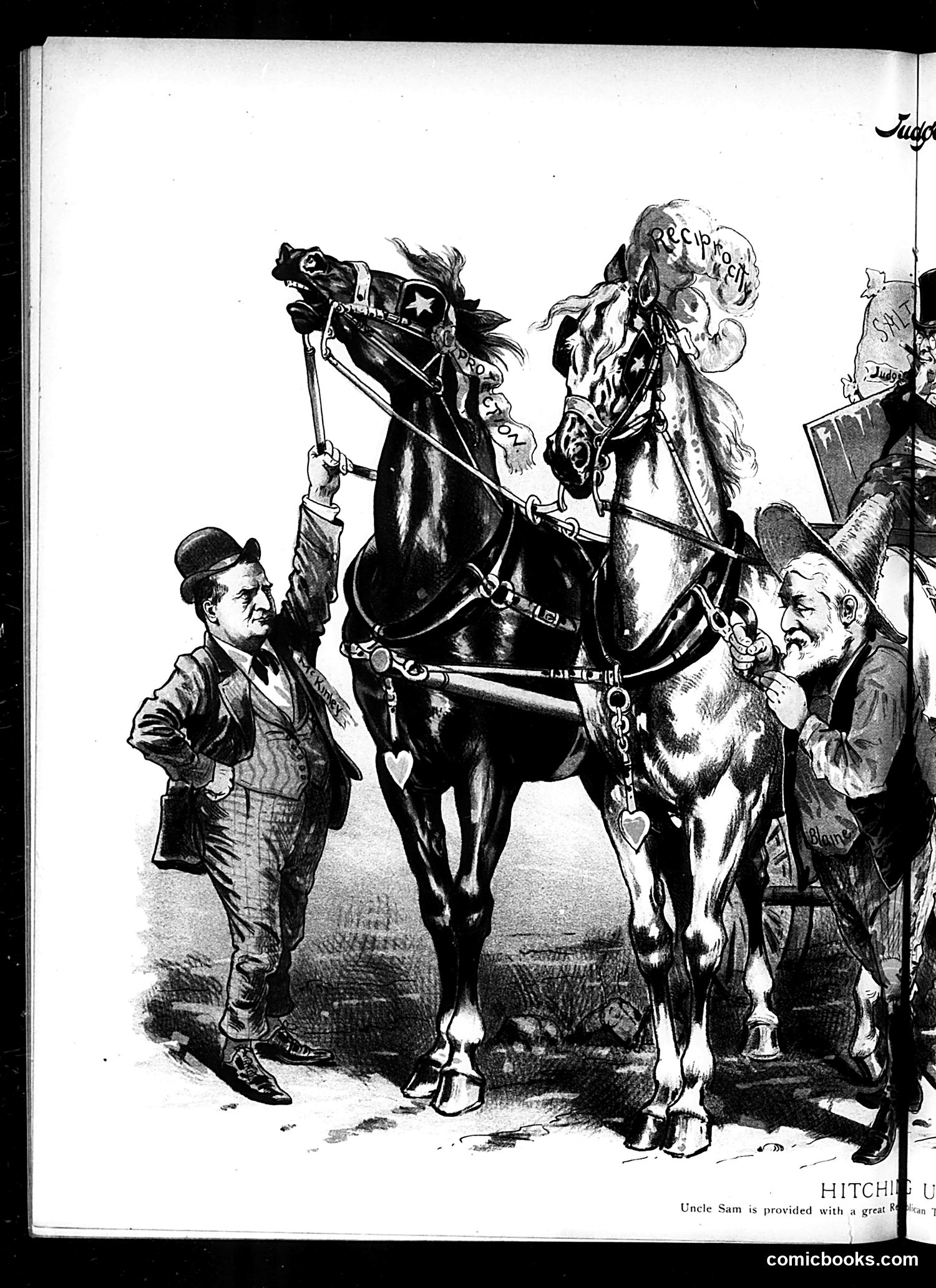
This is a satirical cartoon titled "Hitching U[p]" depicting Uncle Sam being provided with a "great Republican" horse or team. The image shows two men in bowler hats (likely representing Republican political figures or operatives) presenting or "hitching" elaborate, decorated horses to Uncle Sam, who stands on the left in his characteristic outfit. The satire likely criticizes the Republican Party's attempt to align itself with American interests or to harness national support for their political agenda. The ornate horse decorations and the formal presentation suggest either mockery of Republican pretensions or commentary on their use of patriotic imagery for partisan advantage. The cartoon dates from Judge magazine's heyday as a venue for sharp political commentary.
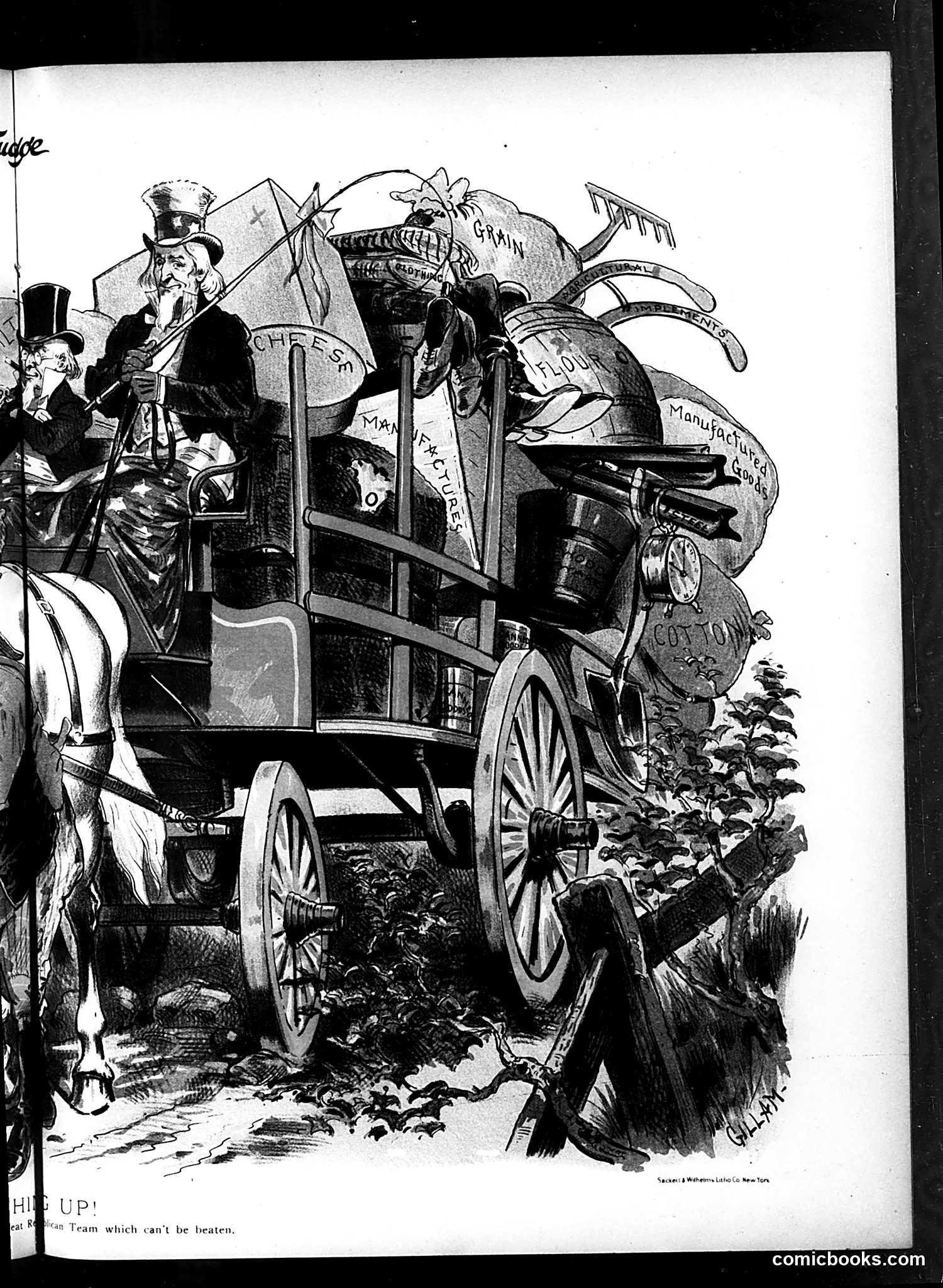
This cartoon depicts an overloaded wagon being pulled by a horse, symbolizing American agricultural and manufacturing industries. The wagon carries barrels and sacks labeled "GRAIN," "FLOUR," and "MANUFACTURED" goods, representing major exports. Two well-dressed figures in top hats ride atop, appearing to be political or business leaders directing the effort. The caption references "a Team which can't be beaten," suggesting confidence in American economic power. The cartoon likely celebrates American industrial and agricultural productivity, possibly from the late 19th or early 20th century. The satire may comment on whether such optimism about exports and economic dominance was justified or overconfident. The visual metaphor of the strained horse suggests potential strain on the system supporting this prosperity.
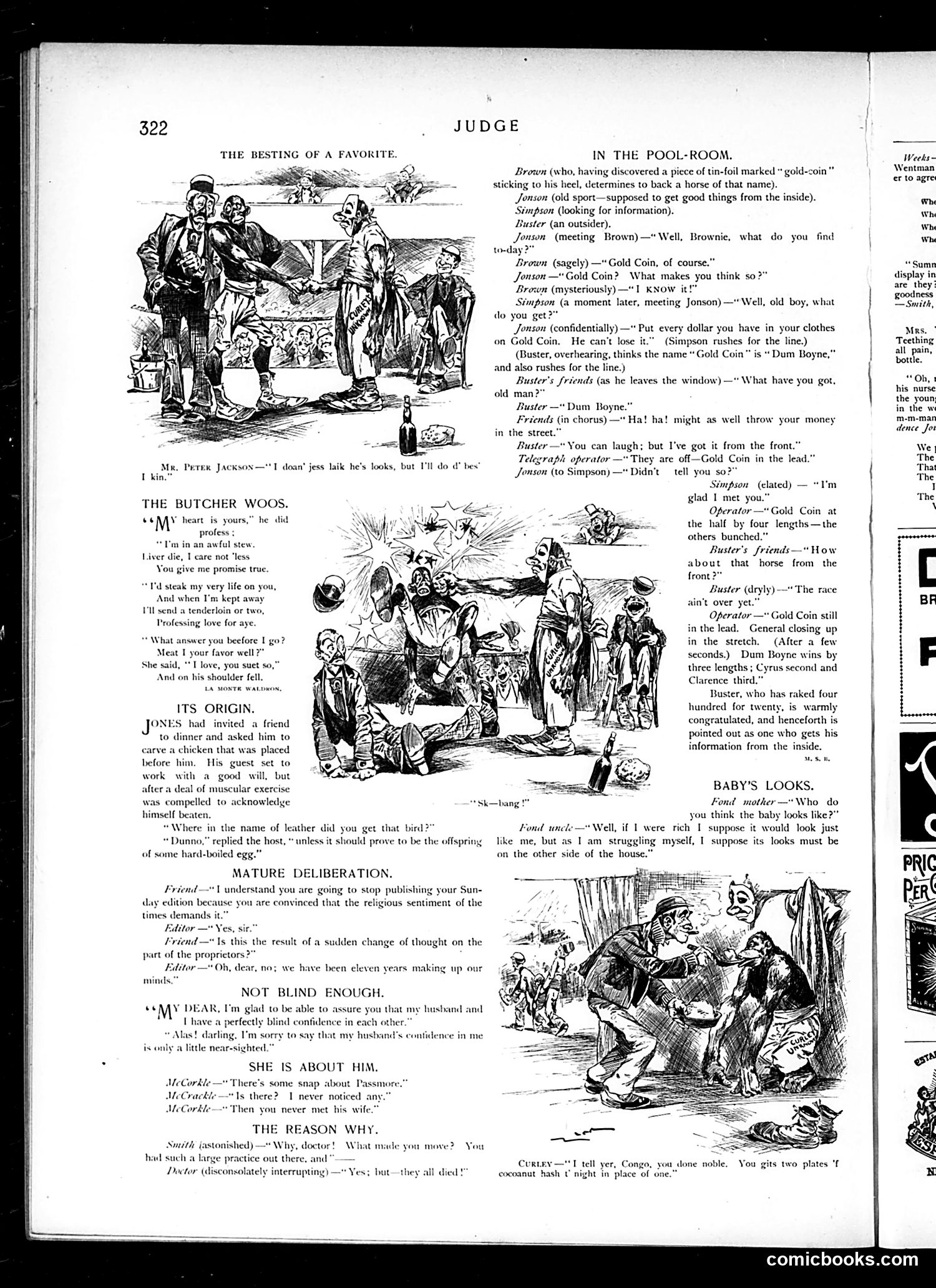
This page contains multiple short comic sketches typical of Judge magazine's satirical humor. **"The Besting of a Favorite"** depicts a horse-racing con. Brown finds tin-foil marked "gold-coin" on his heel and tips off Jonson about a horse named "Gold Coin," which spreads as insider information. Buster mishears it as "Dum Boyne" but also bets on it. The joke: Buster unknowingly bets on the wrong horse yet wins anyway when "Dum Boyne" actually wins—he's credited with getting "information from the inside" despite pure accident, satirizing how people attribute luck to secret knowledge in gambling. **Other sketches** mock domestic life ("The Butcher Woos," "Not Blind Enough"), editorial hypocrisy (an 11-year decision to stop Sunday editions for "religious sentiment"), and social pretension (baby comparisons, marital dynamics). The illustrations are typical Gilded Age caricature work emphasizing class and type. The satire targets gambling culture, gullibility, and the human tendency to mistake coincidence for insider advantage.
This page is primarily **advertising and light humor pieces**, not political cartoons. The content consists of: **"Little Wheels"** — A sentimental allegorical poem about interconnected labor: a sleeping shepherd boy disrupts the entire supply chain (shearers, spinners, weavers) leaving Boston babies without wool clothing. The moral: every person, however humble, is essential to society's functioning. This reflects late-19th-century industrial-era thinking about labor interdependence. **Scattered humor** includes: - A joke about a Boston girl's freckles - A quip about a woman's "negligé costume" winning over a suitor - Wordplay on nautical terms ("spanker") misheard by a child The remaining space is **advertisements** for pianos, cigars, hats, bitters, and other period goods—typical of Judge's revenue model. No significant political satire appears on this page.
This page is primarily **advertising and light humor**, not political satire. The main elements include: **Advertisements dominate**: Kirk's perfume, facial blemish treatments, spectacles, baldness cures, and railroad vacation packages occupy most space—typical late-19th century patent medicine and consumer ads. **Minor humorous content**: A brief joke about a schoolboy named Johnnie unable to get an absence excuse because his mother is away, so he'll ask his father instead. This is genteel domestic humor reflecting period gender roles—mothers typically handled school matters. **Poetry**: "Her Beautiful Eyes" by James Whitcomb Riley, a sentimental romantic poem typical of the era's popular verse. **The cartoon** (top-left) shows "Shandon Bells Perfume" branding but appears decorative rather than satirical. **Overall assessment**: This is a **society/lifestyle page** mixing advertisements with sentimental poetry and mild humor—not political commentary or sharp satire. The magazine's satirical content appears elsewhere in this issue.
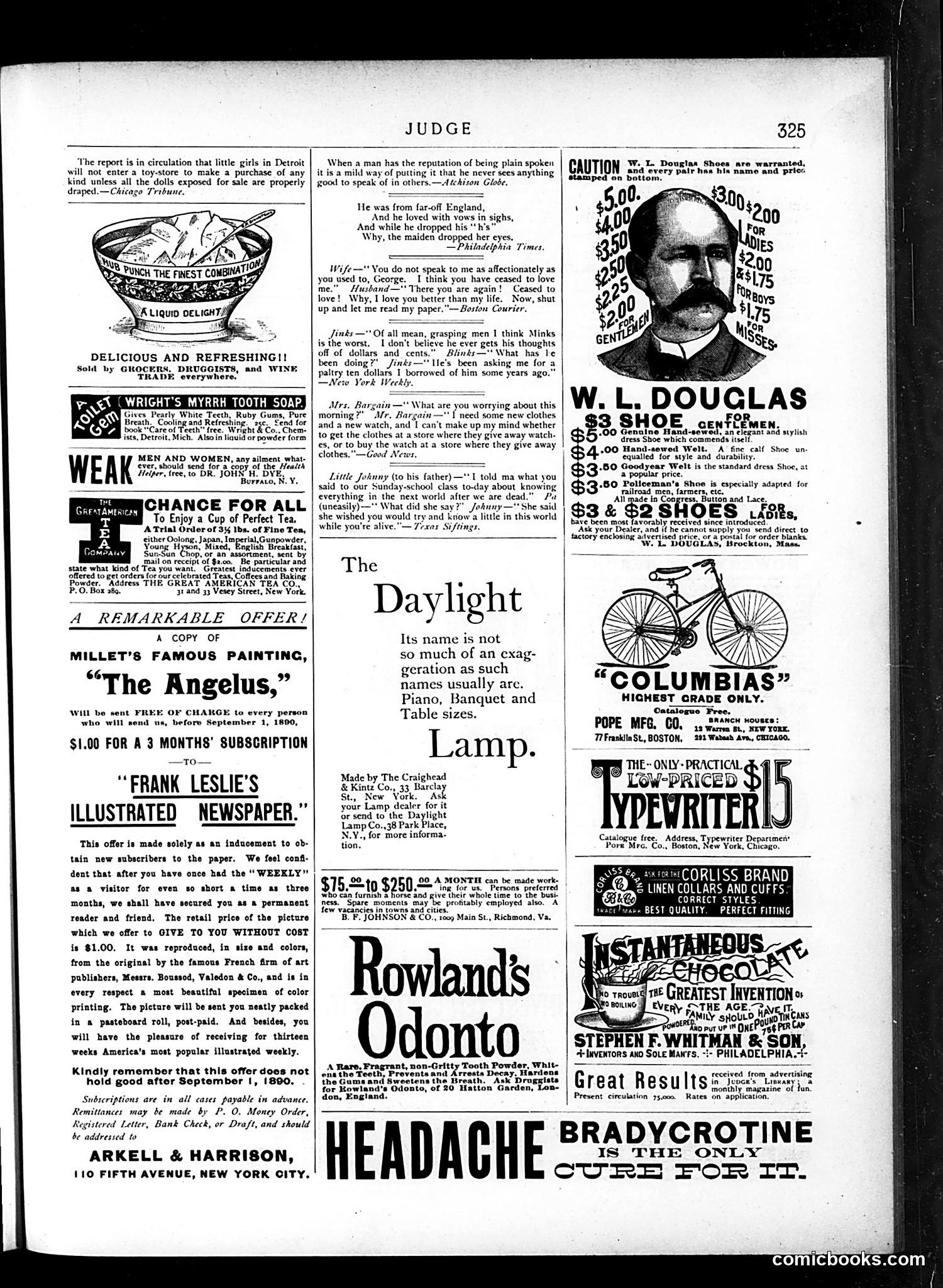
This page is primarily **advertisements and filler content** rather than political satire. The main illustrated item is a brief joke about a Detroit report that young girls refuse to enter toy stores unless dolls are "properly draped"—a humorous comment on Victorian modesty standards being absurdly applied to dolls. The page consists mostly of **period product advertisements**: Wright's Myrrh Tooth Soap, health remedies, tea imports, and Frank Leslie's Illustrated Newspaper (which offers a free reproduction of Millet's painting "The Angelus" as a subscription incentive). Other ads promote the W.L. Douglas shoe brand, Columbia bicycles, a typewriter, tooth powder, and headache medicine. Several short **humorous anecdotes** appear, including jokes about husbands, British accents, and marital disputes—typical light fare for a satirical magazine of the 1890s. There is **no significant political commentary** on this particular page.
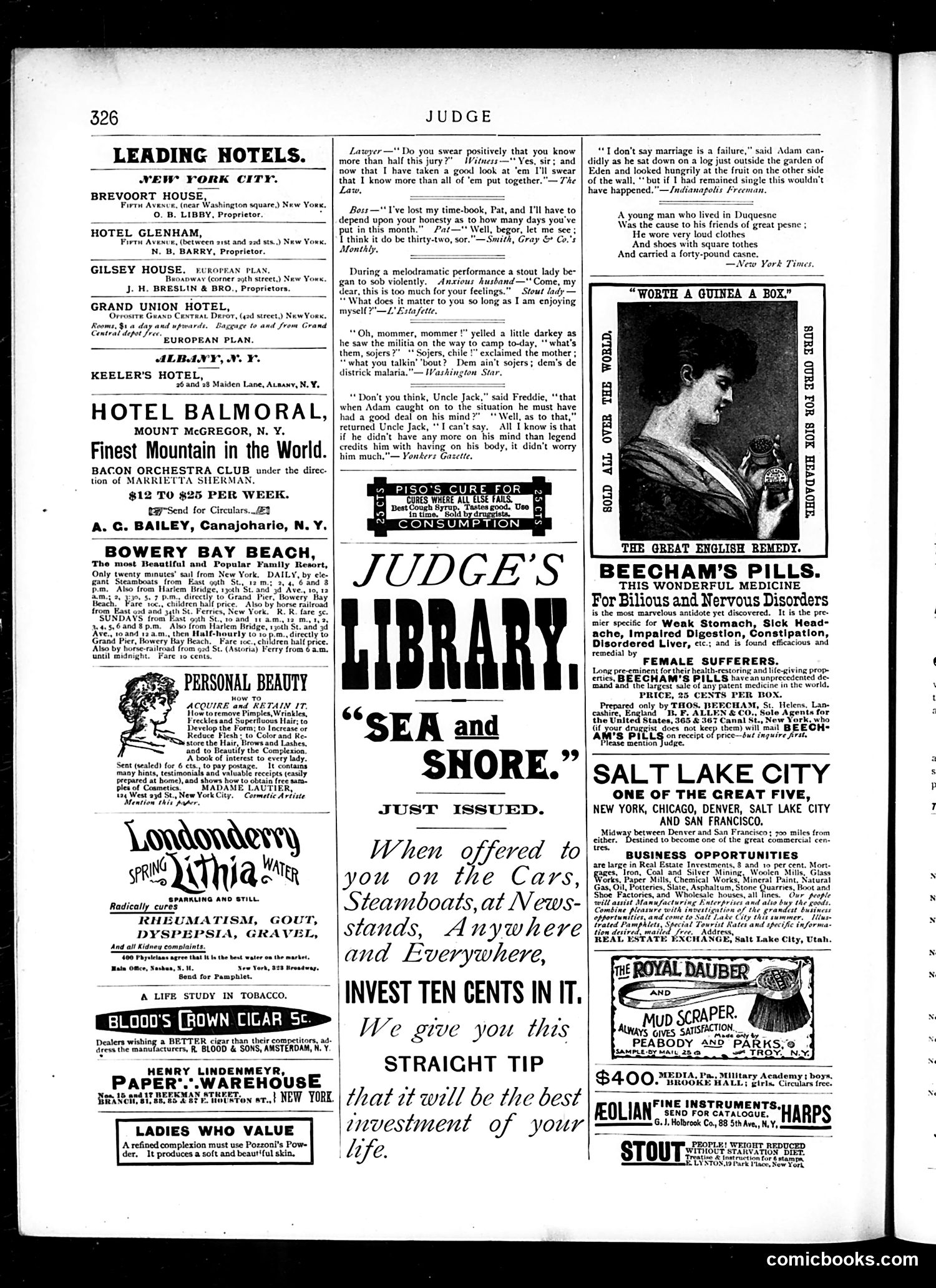
This page is primarily **advertising and filler content** for Judge magazine, circa late 1800s. The main feature is a promotional announcement for Judge's Library publication "Sea and Shore," urging readers to invest ten cents in it as "the best investment of your life." The page also contains several **brief humorous anecdotes** typical of Judge's satirical style: - A lawyer questioning a witness's intelligence - A boss relying on an employee's honesty about work days - A woman crying excessively at melodrama - A child's mispronunciation of "soldiers" - An Uncle Jack joke about Adam and Eve These short jokes mock working-class characters, Irish accents, and human folly—standard Judge magazine fare. The remaining space is filled with advertisements for hotels, patent medicines (Beecham's Pills, Piso's Cure), beauty products, and other commercial goods typical of the period.
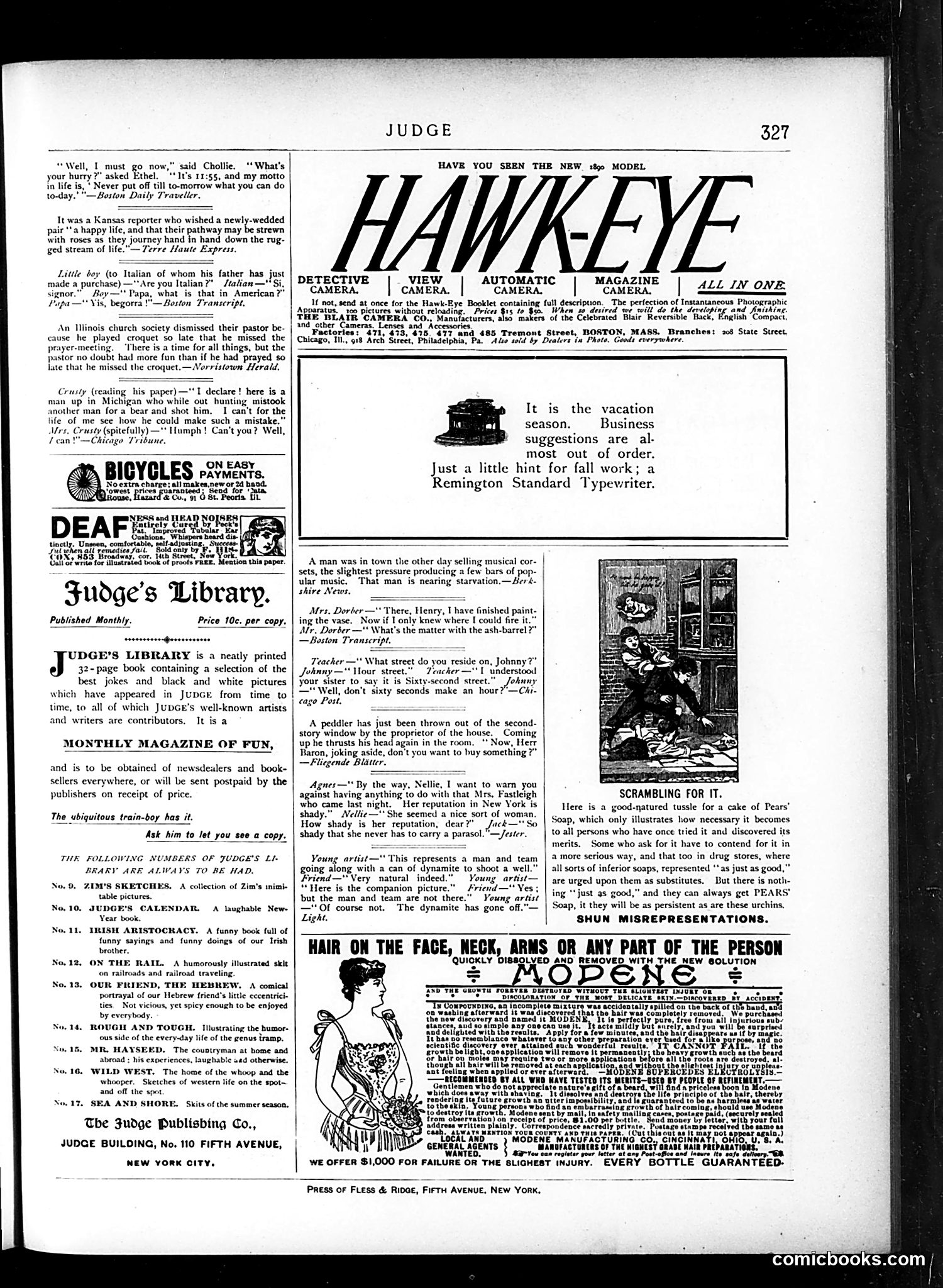
This is primarily an **advertising and filler page** for *Judge*, a satirical weekly. The upper half contains brief humorous anecdotes and quips typical of the era—jokes about marriage, pastoral indiscretion, and ethnic stereotypes (an Italian immigrant labeled "Si" and "No"). The dominant content is **commercial**: ads for cameras (Hawk-Eye, Blair), bicycles, and a "Judge's Library" subscription service (a 32-page monthly humor collection, 10 cents). The sole image is a lower advertisement for hair removal—a vintage patent-medicine style pitch promising to eliminate unwanted facial hair "quickly" with "the new solution," using standard snake-oil marketing hyperbole ("$1,000 for failure"). **Historical context**: These pages reveal early mass-market advertising saturating humor magazines, alongside casual ethnic humor reflecting period attitudes. The camera ads show photography becoming consumer-accessible in the 1890s. There is **no political cartoon** on this page—it's primarily commercial matter interspersed with mild domestic comedy.
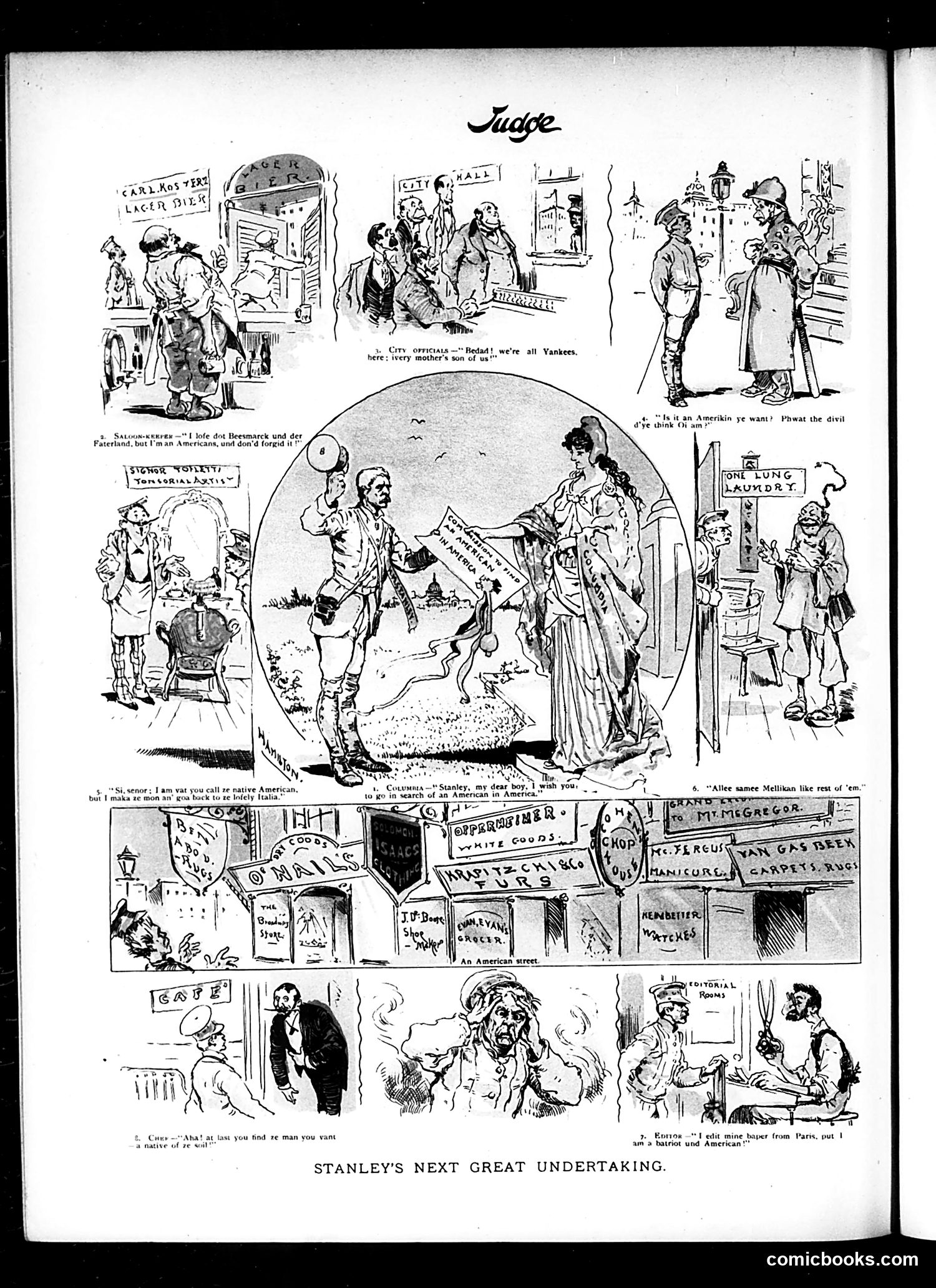
This page satirizes **American identity and immigration** in the early 20th century. The central large cartoon depicts Lady Liberty (allegorical female figure) presenting an American flag to a soldier, representing the assimilation of foreign-born men into American military service. The surrounding vignettes mock various immigrant groups—particularly **Germans and Irish**—showing them adopting American customs while maintaining exaggerated ethnic accents and mannerisms. One caption references "Bismarck," invoking German identity; another uses Irish dialect ("Bedad"). The bottom section depicts "An American street" with storefronts advertising various ethnic businesses (German, Irish, Chinese establishments visible), suggesting how immigrants created distinct neighborhoods rather than fully assimilating. The title "Stanley's Next Great Undertaking" likely references explorer Henry Morton Stanley, implying that assimilating America's diverse immigrant population is as challenging as his famous African expeditions. The overall message: immigrants pose integration challenges to American unity, blending humor with period anxieties about immigration and national identity.