
A complete issue · 16 pages · 1889
Judge — April 13, 1889
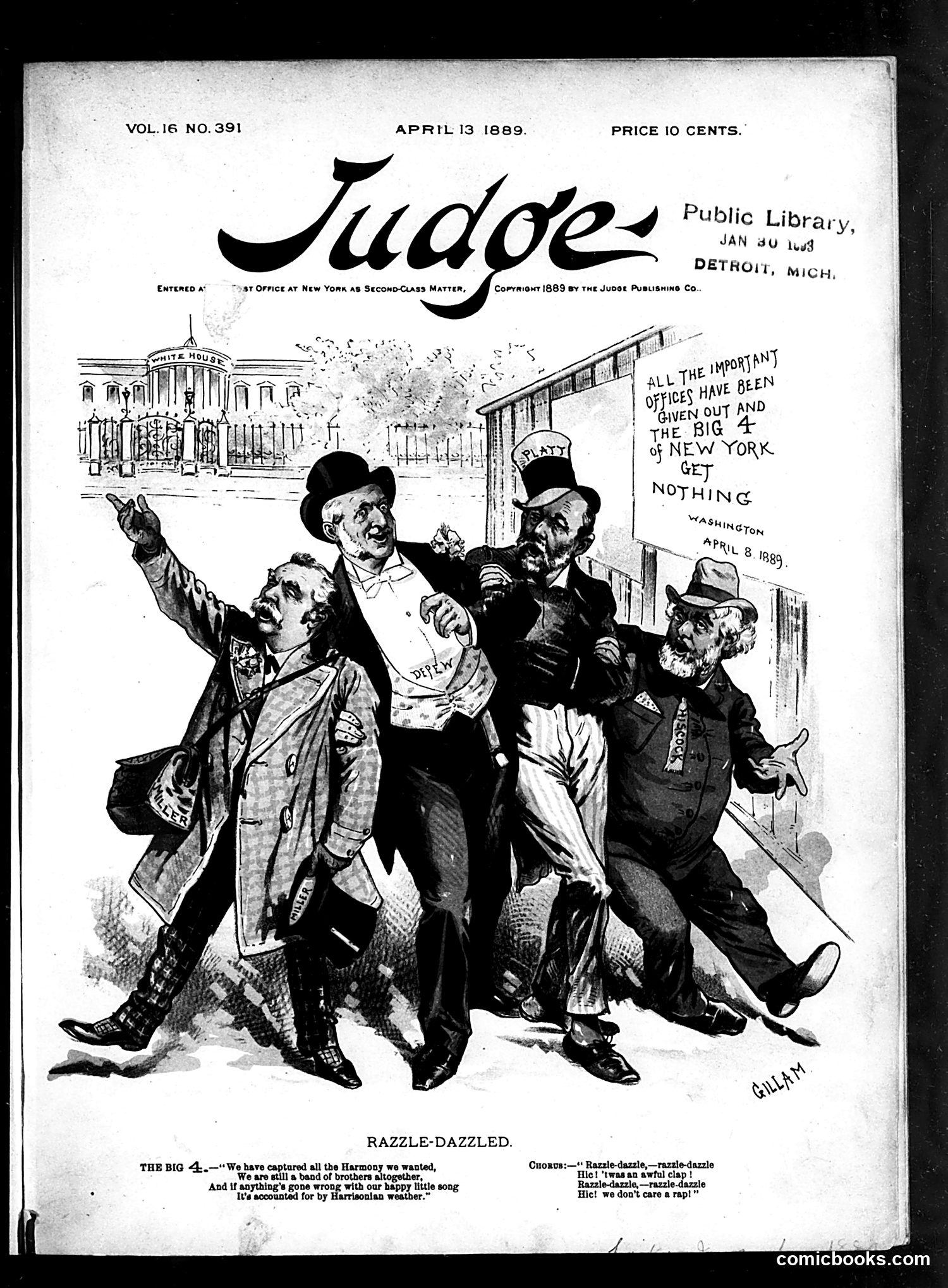
This political cartoon satirizes the "Big 4" of New York—likely referring to prominent political or business figures of 1889. The caption indicates they've "captured all the Harmony we wasted" and are celebrating their supposed victory, singing "razzle-dazzle" nonsense to distract from actual accomplishments. The White House visible in the background suggests federal political involvement. The cartoon's central joke mocks these powerful men for achieving nothing substantive while creating theatrical distractions—"razzle-dazzle" being empty showmanship. The text box noting "all the important offices have been given out and the big 4 of New York get nothing" (dated April 8, 1889) indicates this concerns patronage disputes and political disappointment, where these four figures feel excluded from power distribution.
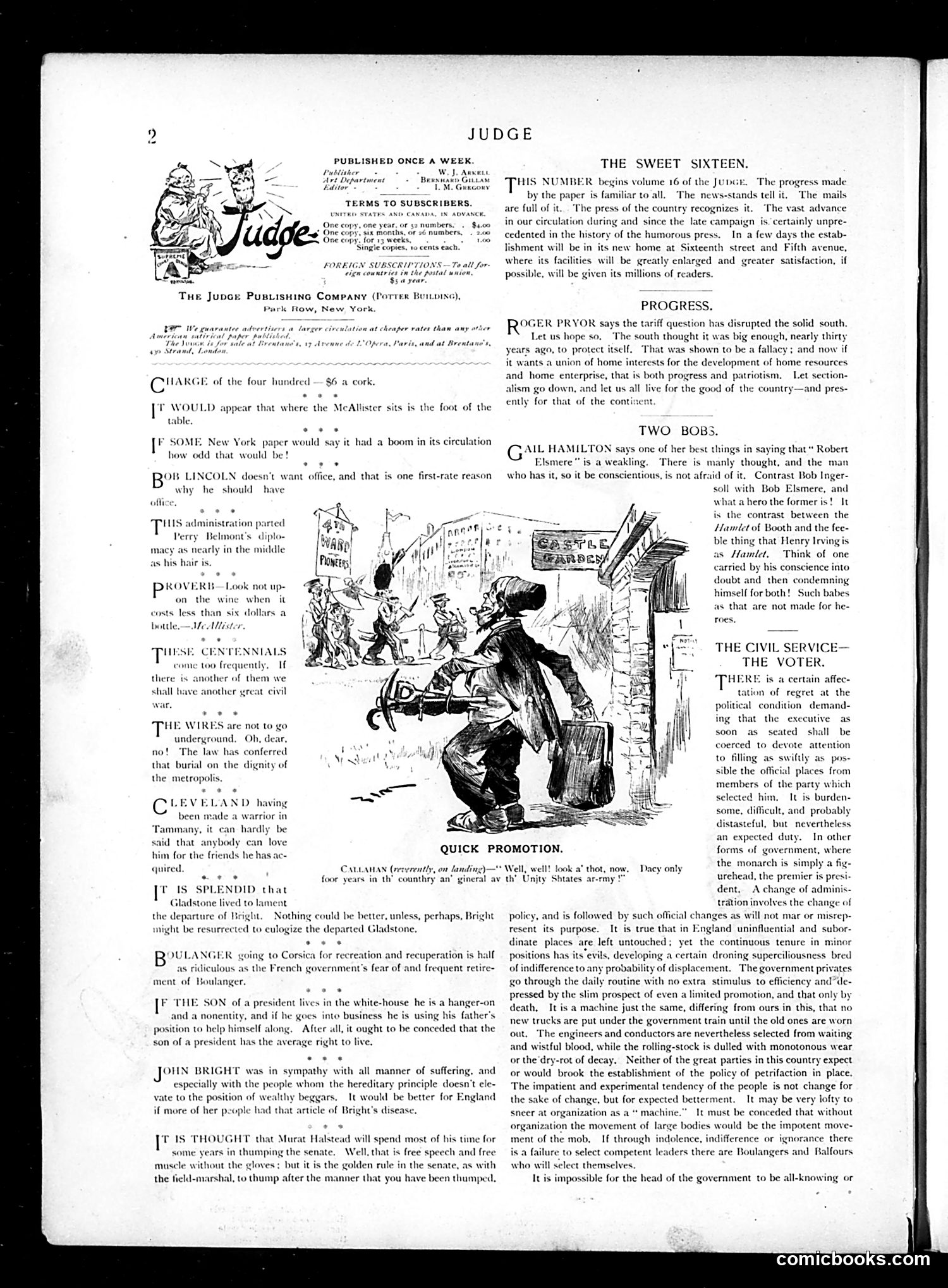
The central cartoon titled "QUICK PROMOTION" depicts a military scene where a large soldier in a long coat appears to be harassing or threatening a smaller figure. The caption reads: "CALLAHAN (nervously, on landing)—'Well, well! look at that, now. They only four years in the country an' already a citizen an' th' Unity States army!'" This satirizes rapid naturalization and military service among recent immigrants in America. The joke targets the perception that foreign-born individuals were advancing quickly through military ranks despite minimal time in the country. The cartoon critiques both immigrant integration and the U.S. Army's promotional practices, suggesting concern about who held positions of authority over native-born soldiers. The humor relies on class and ethnic stereotyping typical of early 20th-century American satire.
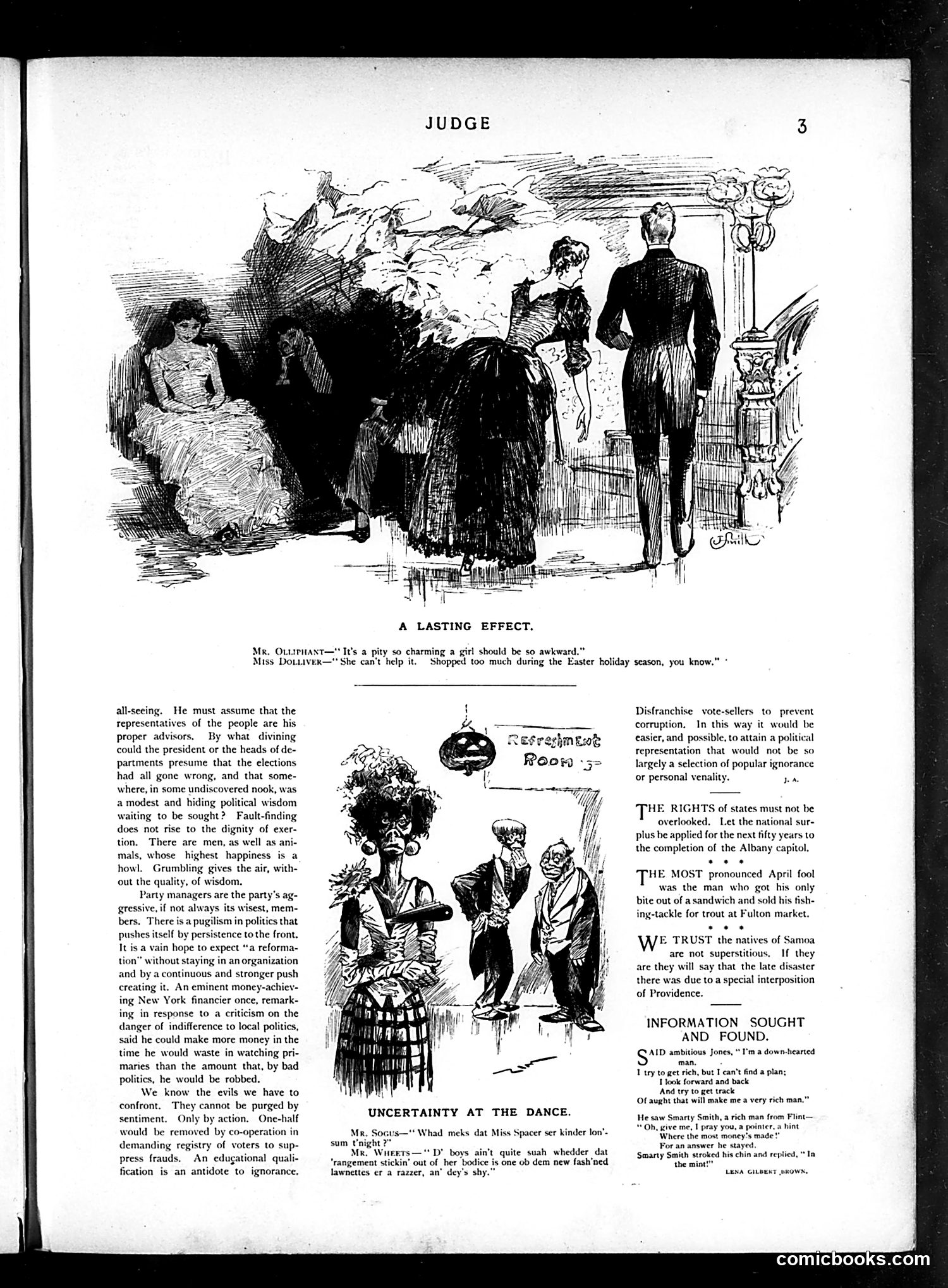
This Judge magazine page contains three satirical items: **"A Lasting Effect"** (top): A social cartoon mocking awkward etiquette. Two women discuss a girl's clumsiness at a social gathering, with the joke implying her shopping spree during Easter holidays explains her ungainly behavior. **"Uncertainty at the Dance"** (middle): A racial caricature using offensive dialect stereotypes. The humor relies on minstrelsy-style Black characters debating whether a woman's corset protrusion is fashionable or a new garment type. **"Information Sought and Found"** (bottom): A joke about ambition and wealth. A poor man named Jones asks successful "Smarty Smith" how to get rich; Smith's punchline—"the mint"—is a double entendre suggesting both currency production and simply having money. The accompanying editorial text discusses political corruption, voter registration, and electoral fraud—issues prominent in Gilded Age American politics. The racial caricature reflects period attitudes; modern readers should recognize it as offensive historical artifact.
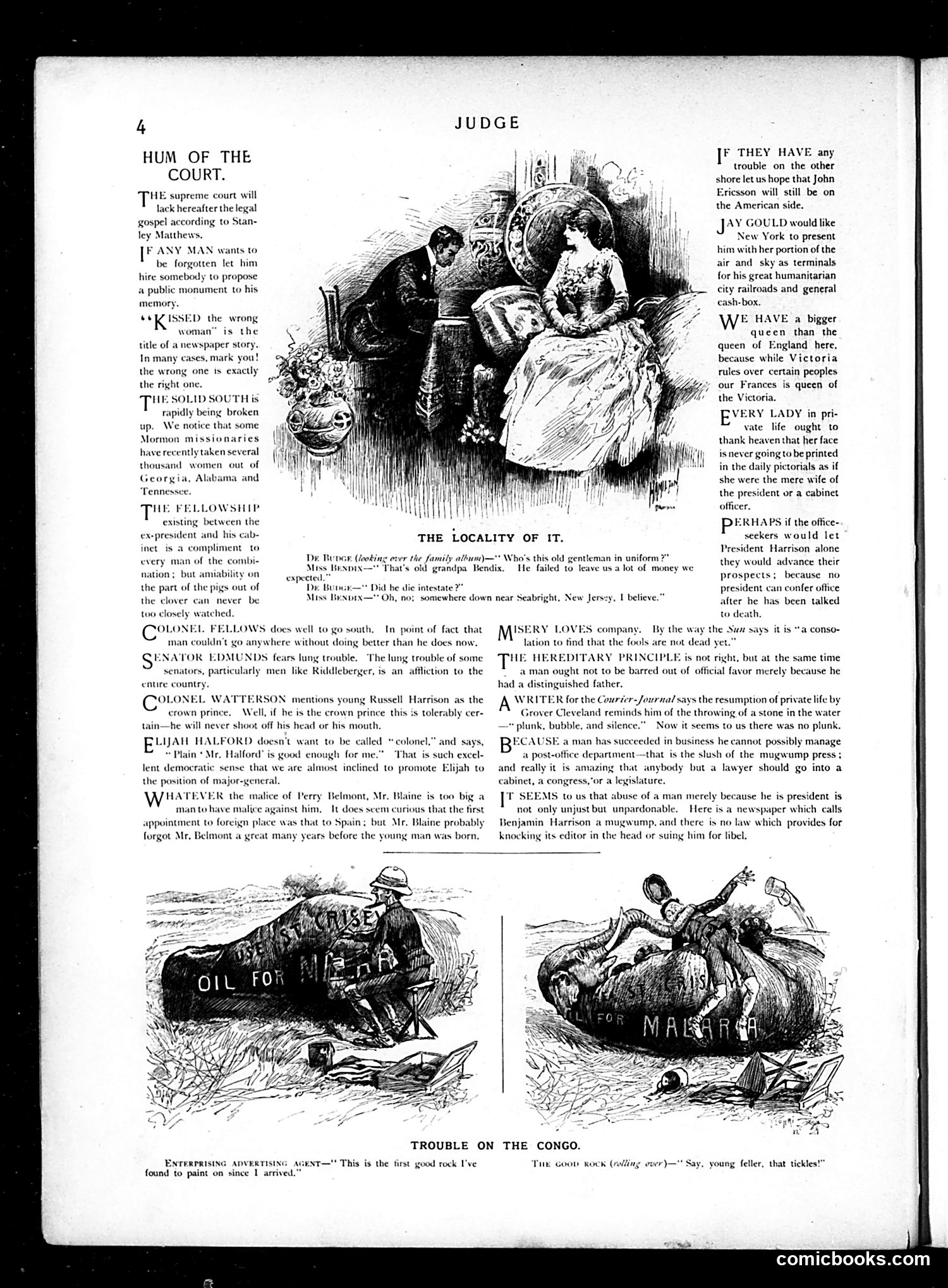
This page from **Judge** magazine (likely 1889-1890s, based on references to President Harrison and Cleveland) contains brief satirical commentary and two editorial cartoons mocking political figures and social issues. **Key references:** - Stanley Matthews: Supreme Court justice whose departure is noted - Russell Harrison: The President's son, mocked as a "crown prince" - Jay Gould: Railroad magnate satirized for self-interest - Perry Belmont vs. James Blaine: A diplomatic appointment controversy - The "Solid South": Reference to Southern Democratic voting bloc being challenged by Mormon recruitment **The cartoons** titled "Trouble on the Congo" show figures labeled "Oil for ___" sitting on barrels—likely satirizing imperialist competition for colonial resources and commercial exploitation in Africa. **Overall tone:** The page attacks nepotism, political corruption, monopolistic business practices, and imperial greed while defending honest governance and criticizing office-seekers. Typical of Judge's Republican-leaning, anti-corruption editorial stance.
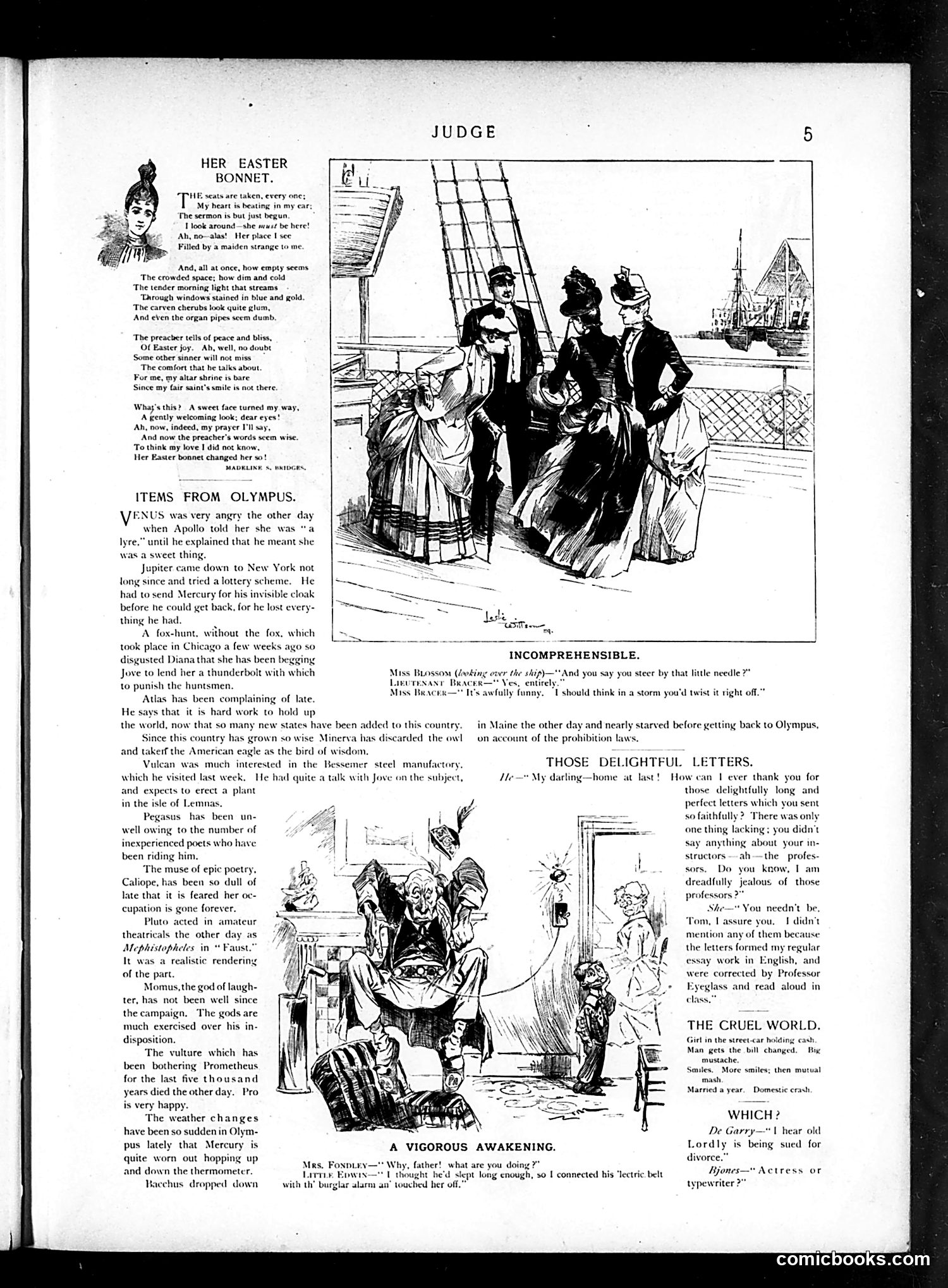
This page contains three distinct satirical pieces: **"Her Easter Bonnet"** (poem with illustration): A sentimental narrative about a churchgoer who fails to recognize his beloved until she wears a new Easter hat—satirizing both romantic sentimentality and the era's obsession with fashionable bonnets as identity markers. **"Items from Olympus"**: Mock gossip about Greek gods navigating modern American life. References include: Jupiter's failed lottery scheme in New York; Minerva abandoning the owl (mascot of wisdom) due to Prohibition; Pluto's amateur theatricals; and complaints about inexperienced poets overusing the winged horse Pegasus. The satire mocks both contemporary social issues (Prohibition, expansion of states) and the gods' struggles with modernity. **"Those Delightful Letters"** and **"The Cruel World"**: Brief humor pieces about romantic correspondence and relationships, standard period-magazine fare. The cartoons employ classical mythology as vehicles for social commentary on American customs, fashions, and laws of the era.
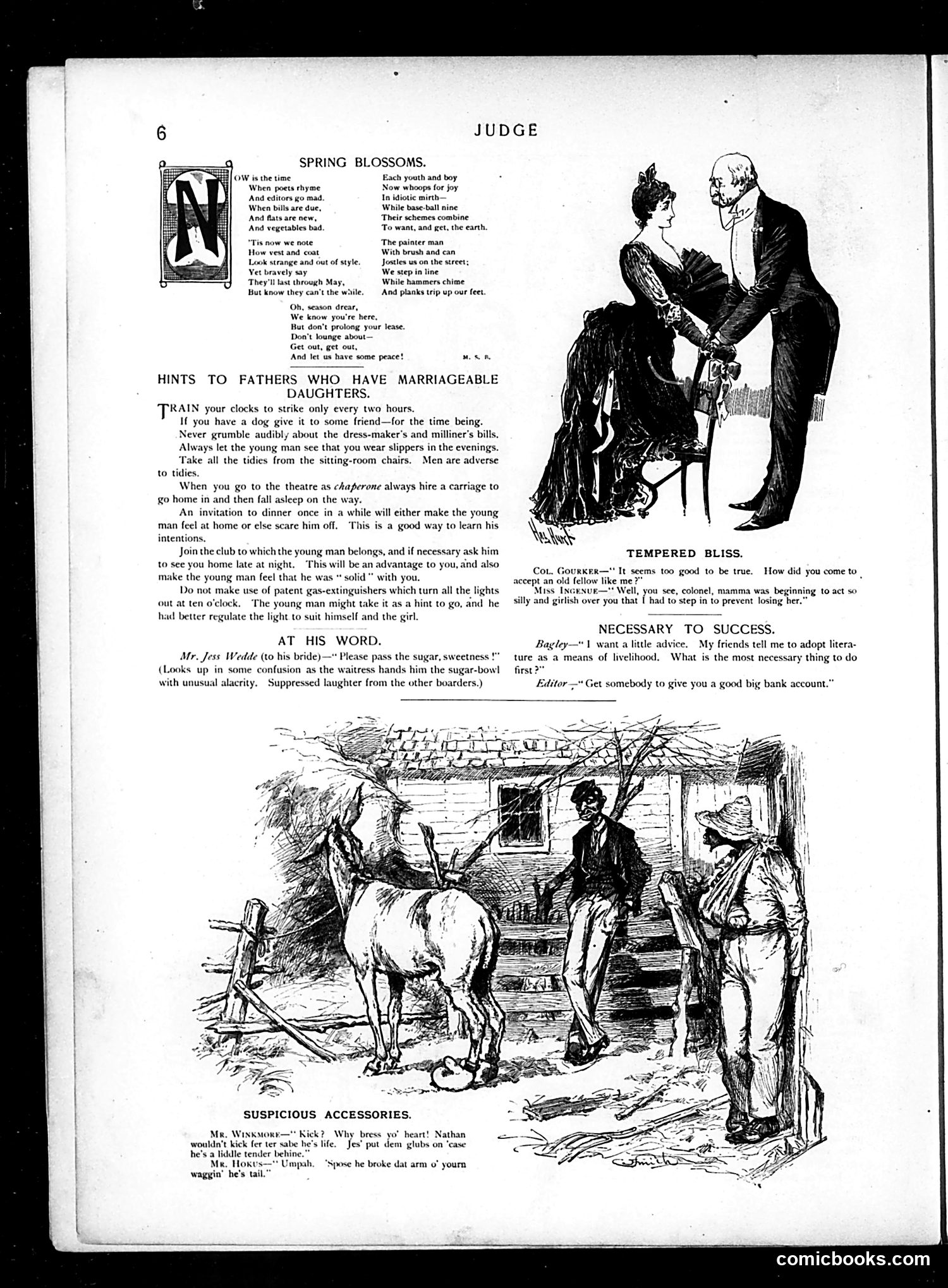
This page from *Judge* contains several humorous pieces satirizing turn-of-the-century American social life: **"Spring Blossoms"** is a poem mocking spring's arrival—poets going mad, careless fashion choices, construction chaos, and unwanted seasonal nuisances. **"Hints to Fathers"** offers tongue-in-cheek advice for fathers with marriageable daughters: manipulate clocks, hide domestic habits, feign domesticity, and deliberately seduce the suitor into commitment through strategic hospitality and social maneuvering. The satire targets both anxious fathers and courtship conventions. **Short humor pieces** include "At His Word" (a newlywed's awkward request), "Tempered Bliss" (a woman marrying an older man to stop her mother's embarrassing behavior), and "Necessary to Success" (mocking that literary success requires inherited wealth). **"Suspicious Accessories"** depicts an apparently working-class conversation about a horse's temperament, likely ethnic humor typical of the era. The overall tone satirizes Victorian courtship rituals, class anxieties, and gender dynamics of the period.
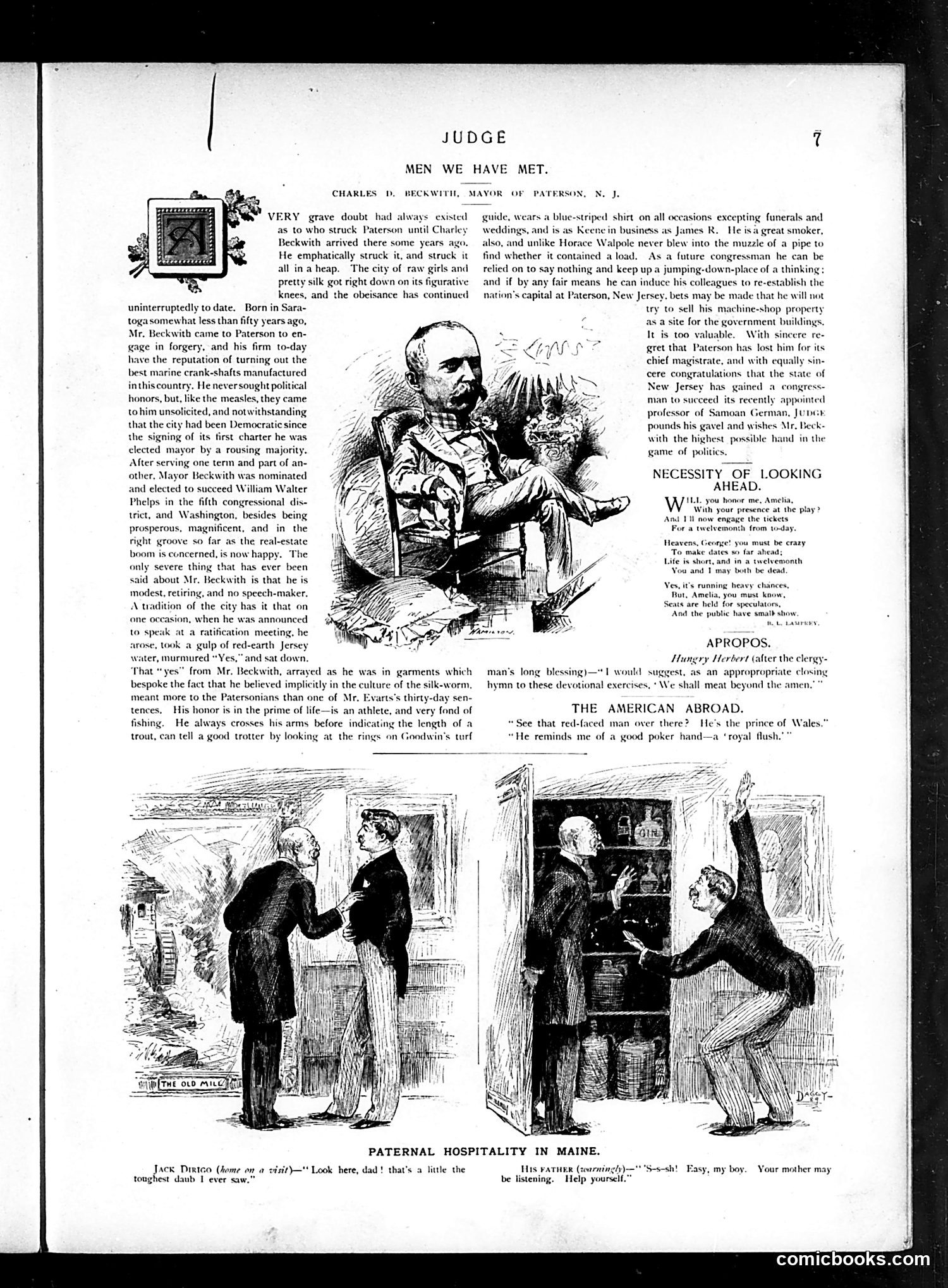
This page from *Judge* contains a biographical profile of **Charles D. Beckwith, Mayor of Paterson, New Jersey**. The text humorously celebrates Beckwith as a self-made businessman who transformed Paterson's industrial reputation through manufacturing marine engine parts, then entered politics despite being famously taciturn. The joke is that his single word "Yes" at a political rally meant more to constituents than elaborate speeches from famous orators. The bottom cartoon, "Paternal Hospitality in Maine," depicts a father covertly offering his visiting son alcohol while warning him to stay quiet—likely satirizing prohibition-era hypocrisy or rural parenting attitudes. The other brief items mock conversational absurdities (a woman refusing theater plans months ahead) and make light observations about American life and clergy. The page is primarily character-driven political humor targeting New Jersey politics and social pretension, typical of *Judge*'s satirical approach to contemporary public figures.
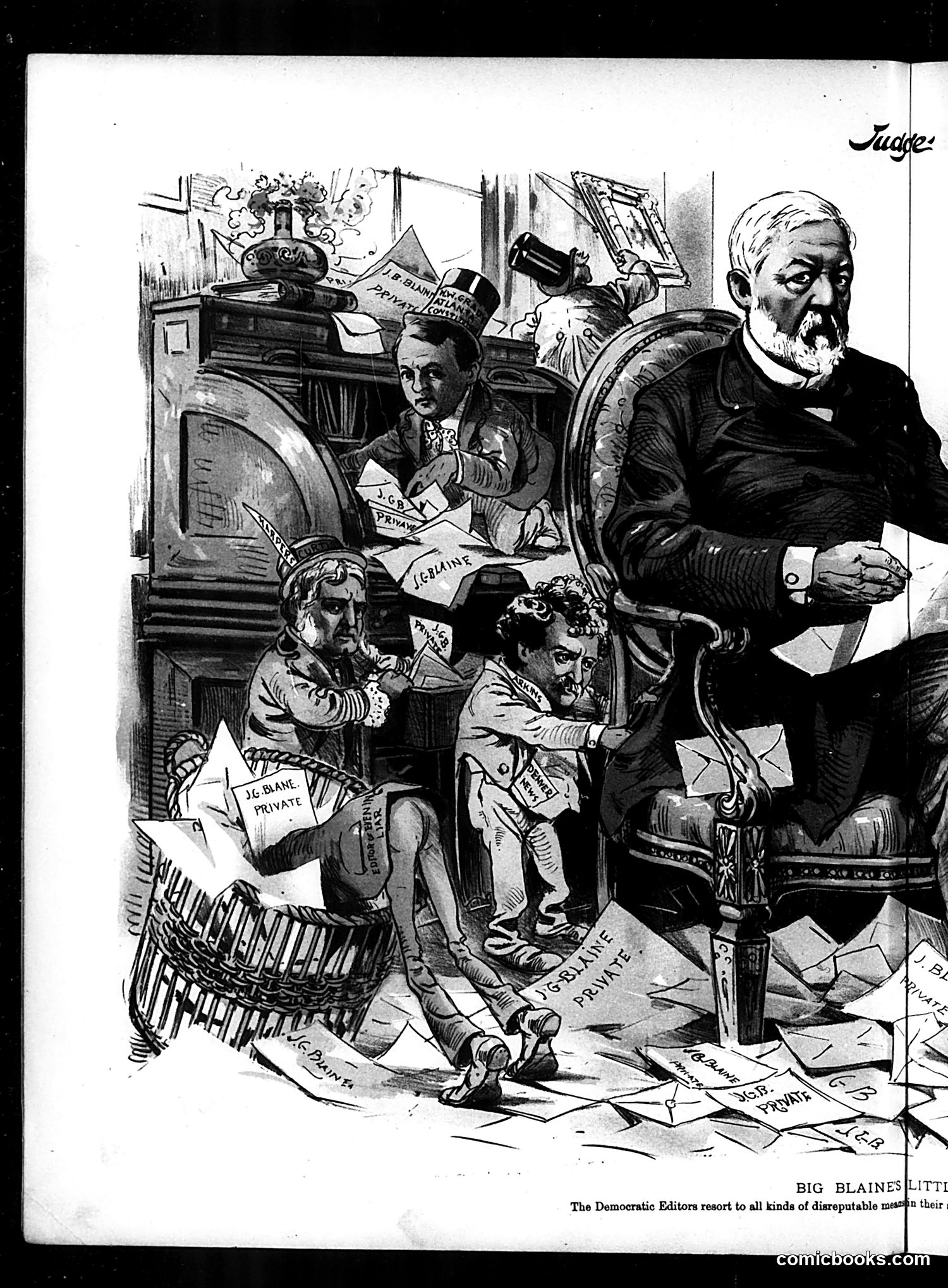
This is a satirical cartoon criticizing Democratic newspaper editors. The image depicts a grotesque scene with caricatured figures—including what appear to be small, deformed characters labeled as representing Democratic editors—engaged in disreputable activities around what looks like a printing press or publishing apparatus. The title "Big Blaines" likely references James G. Blaine, a prominent Republican politician of the 1880s-90s. The cartoon's caption accuses Democratic editors of resorting to "disreputable mess" in their publications, suggesting unethical journalism or propaganda tactics. The grotesque, dehumanizing caricatures reflect the harsh partisan rhetoric typical of Judge magazine's Republican-leaning satire during this era. Without a visible date, the exact political context remains unclear, but this appears to be attacking Democratic press practices as dishonest.
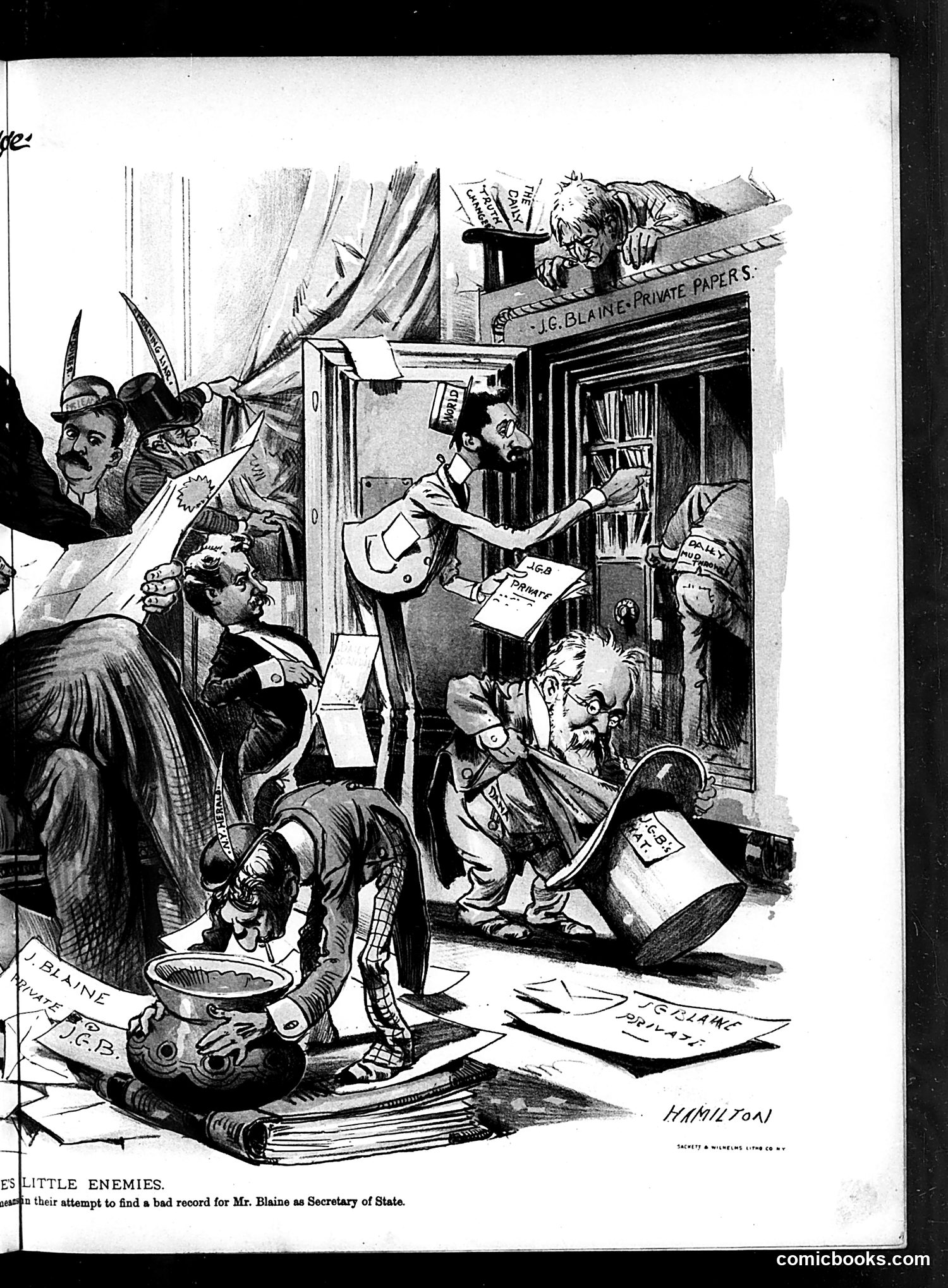
This cartoon, signed by Hamilton, satirizes political opponents' efforts to damage James G. Blaine's reputation as Secretary of State. The image shows caricatured figures (labeled with "J.G. Blaine" and "Private Papers") attempting to break into a filing cabinet or safe containing documents, while Blaine peers down from above. The intruders appear to be portrayed as "little enemies"—depicted with exaggerated, menacing features typical of 19th-century political cartoons. The satire mocks those trying to uncover damaging evidence against Blaine through his official records. The "private papers" reference suggests the cartoon defends Blaine against invasion of his personal documents. The caricatures emphasize the cartoon's dismissive attitude toward these political attacks, framing them as petty or illegitimate attempts at character assassination.
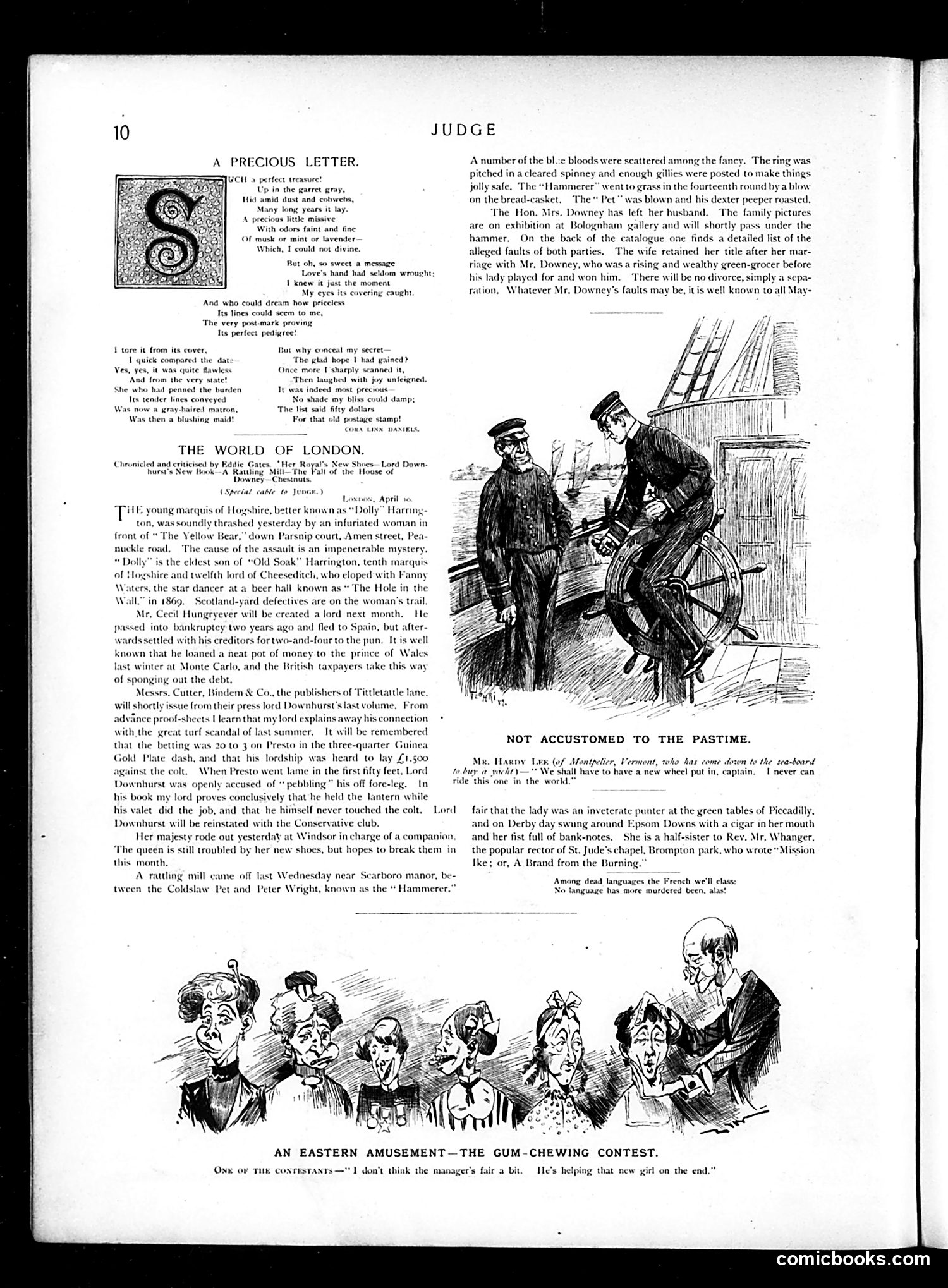
This page contains three distinct satirical pieces: **"A Precious Letter"** (top): A sentimental poem mocking romantic nostalgia. The joke: a man treasures an old love letter for years, only to discover it's merely an old postage stamp—the letter itself was worthless, making his sentimentality absurd. **"The World of London"** (middle): A gossip column satirizing London's upper-class scandals. It mocks aristocratic vices: "Dolly" Harrington (a marquis) is beaten by a woman; Lord Hungryever fled to Spain over bankruptcy yet somehow loans money to the Prince of Wales; Lord Downhurst faced turf-scandal accusations. The satire targets wealthy nobility's moral bankruptcy and financial impropriety. **"Not Accustomed to the Pastime"** (bottom right): A brief anecdote about an American yacht-buyer from Vermont unfamiliar with maritime terminology—gentle mockery of American provincialism. **"An Easter Amusement—The Gum-Chewing Contest"** (bottom): A cartoon showing a gum-chewing competition, satirizing vulgar public behavior at Easter festivities. The page collectively ridicules sentimentality, aristocratic hypocrisy, and lower-class vulgarity.
This page is primarily **advertising and light satirical content**, not political cartoons. The main elements are: **Satirical short pieces** include jokes about newspapers, a humorous anecdote about "earthquake cider" in Marietta, and a quip about a Washington belle deflecting a question to her father. These are gentle social humor rather than pointed satire. **The bulk of the page is advertisements** for consumer products: the Chegue Bank (a traveler's check service), Castoria (a patent medicine for infants), Packer's Tar Soap (for dandruff/skin conditions), Beecham's Pills (a laxative), Sohmer Pianos, and other goods. These ads are typical of Judge magazine's revenue model. **No identifiable political figures or events** appear on this page. The content reflects late 19th-century concerns (travel convenience, patent medicines, personal grooming) but lacks the sharp political edge one might expect from a satirical magazine.
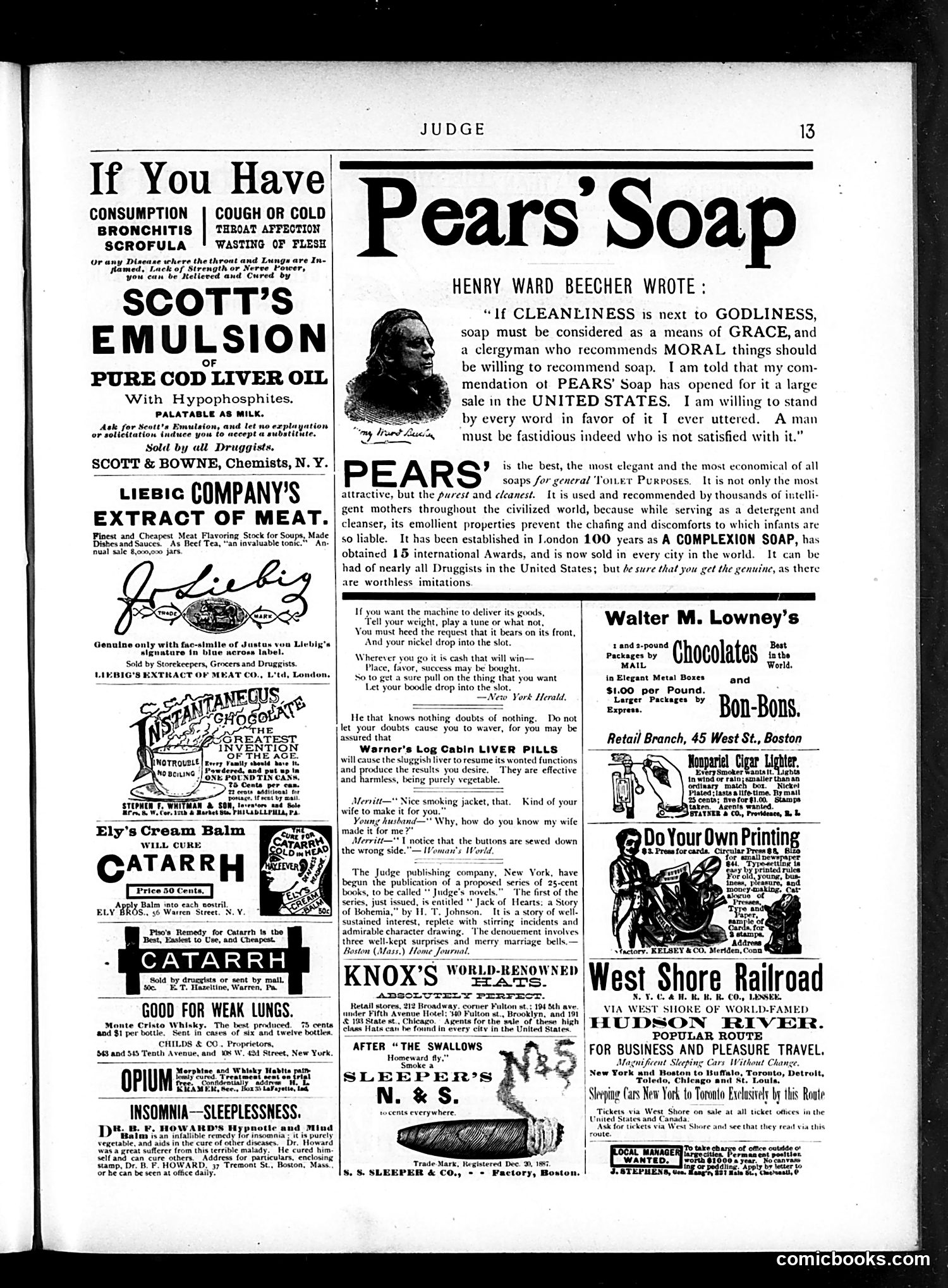
This page is primarily **advertisements** for patent medicines and consumer products typical of late 19th-century America, interspersed with minor satirical content. The dominant advertisement features **Henry Ward Beecher's endorsement of Pears' Soap**—a real historical celebrity testimonial. Beecher, a famous Protestant minister, lent moral authority by equating cleanliness with godliness, a marketing strategy that seems quaint today. The small satirical sections include: - A brief dialogue about a wife's smoking jacket, suggesting domestic humor - A poem about "the slot" (coin-operated machines), mocking American materialism—"cash that will win" for "place, favor, success" The ads themselves reveal period concerns: tuberculosis remedies (Scott's Emulsion), catarrh cures, opium for insomnia, and "liver pills." These "patent medicines" were largely unregulated and often ineffective or harmful—satirizing medical fraud was Judge's implicit purpose by running them alongside editorial content. The page reflects Gilded Age America: commercialism, medical quackery, and celebrity endorsement culture.
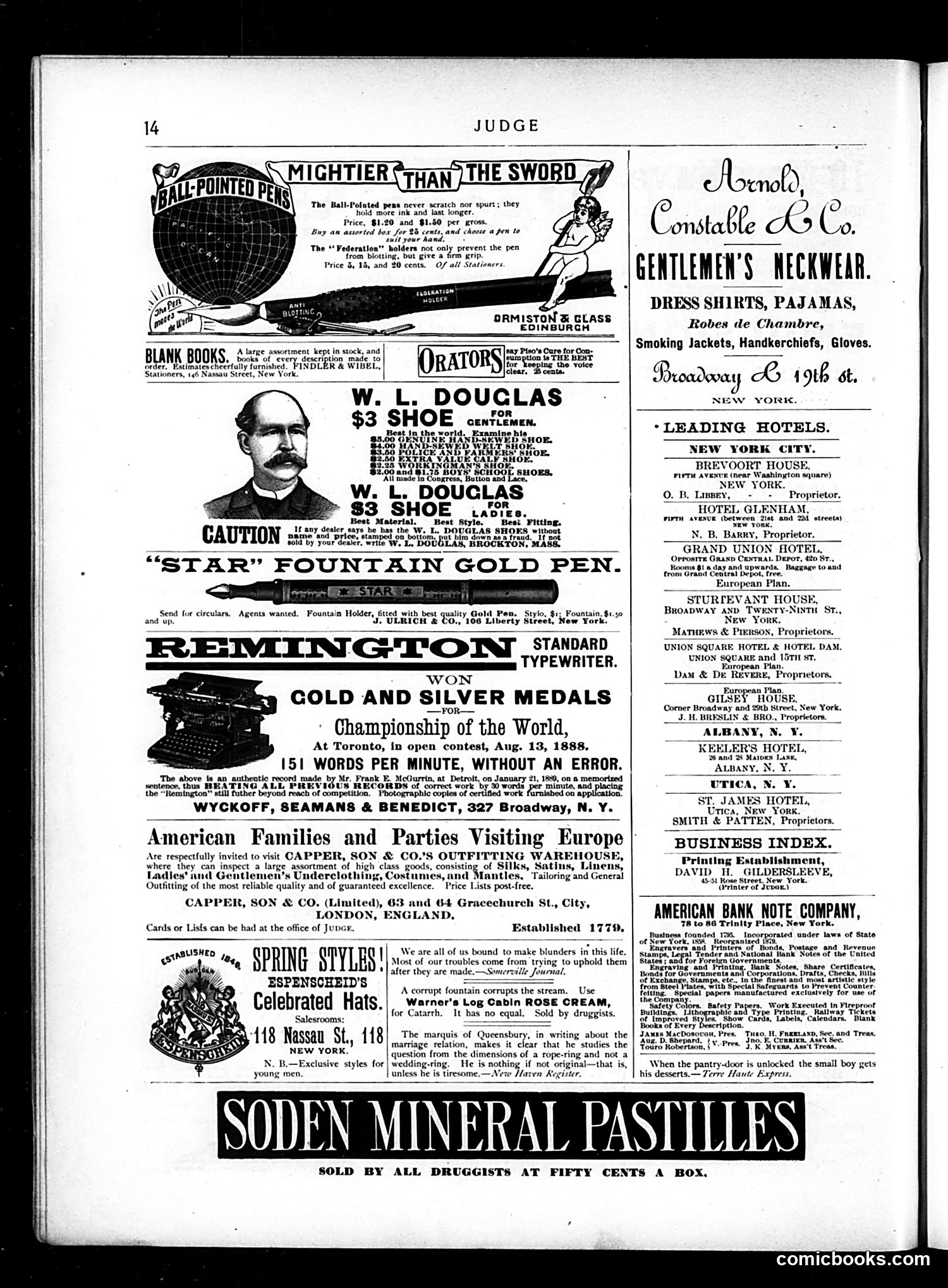
This is primarily an **advertising page** from Judge magazine, not a political cartoon. The page is dominated by late 19th-century commercial advertisements for products like W.L. Douglas shoes, Remington typewriters, fountain pens, and various hotels. The only satirical content appears to be a small item about the Marquis of Queensberry (the British aristocrat famous for his legal persecution of Oscar Wilde, though that specific context isn't mentioned here). The text jokes that he discusses marriage using boxing terminology ("rope-ring" vs. "wedding-ring"), mocking his obsession with combat sports as crude or unromantic. The cartoons at the top advertise ball-pointed pens and other writing implements. The page reflects the magazine's dual purpose: political satire mixed with commercial advertising to support publication.
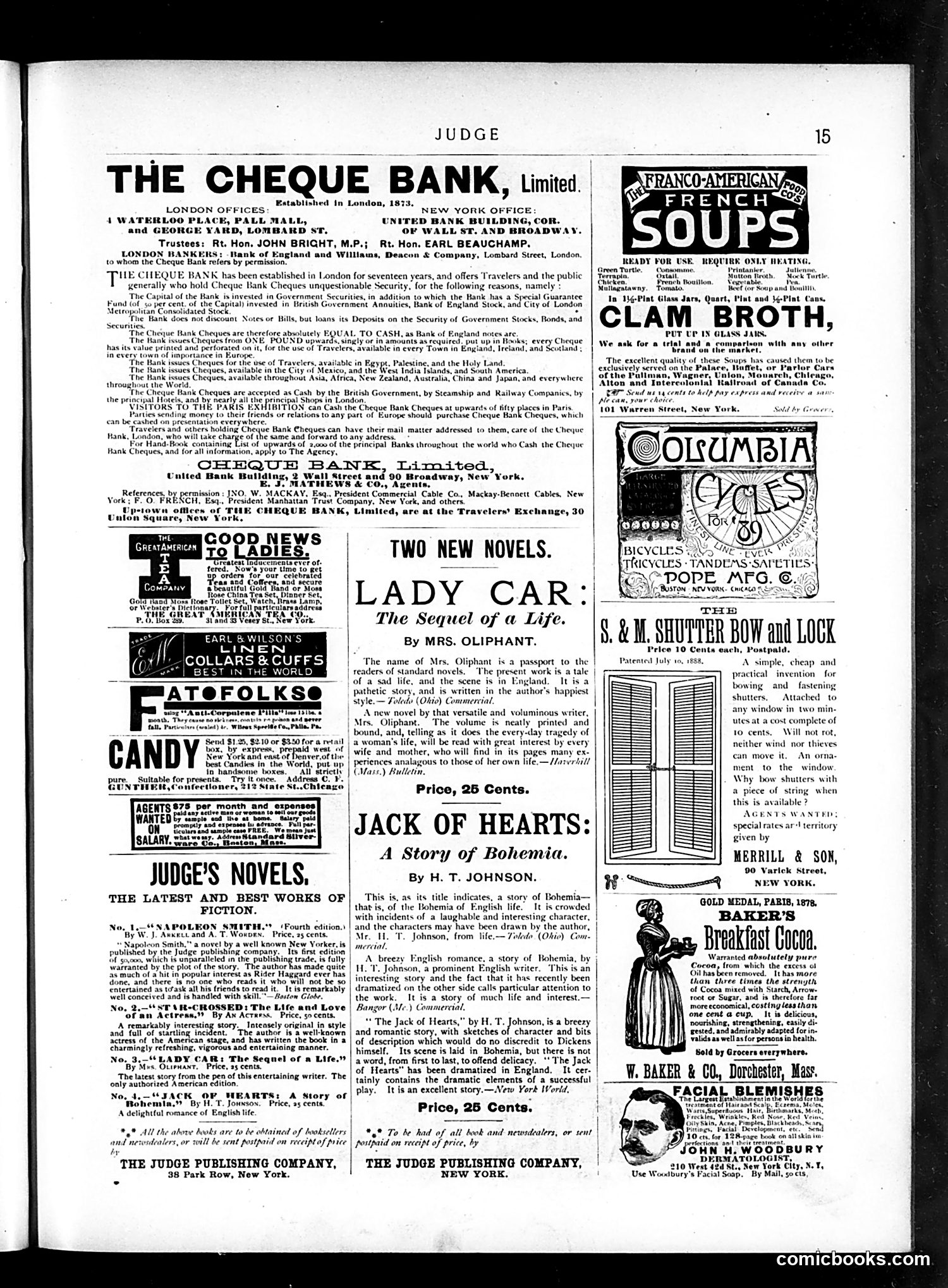
This page is primarily **advertising and business announcements**, not satirical content. The dominant feature is a lengthy advertisement for the Cheque Bank, Limited—a financial institution established in London in 1873 with offices in New York. The bank offered traveler's cheques accepted internationally across Europe, Asia, Africa, and the Americas, positioning itself as secure for tourists and business travelers. The remaining space contains typical period advertisements: tea and coffee promotions offering premiums (china tea sets, dinner sets), Earl & Wilson's linen collars and cuffs, and candy products. On the right side appear advertisements for Franco-American soups, Columbia bicycles, window locks, cocoa, and facial blemish treatments—standard commercial notices of the era. **There is no visible political cartoon or satirical content** on this particular page. It represents Judge magazine's commercial revenue model rather than its editorial satire function.
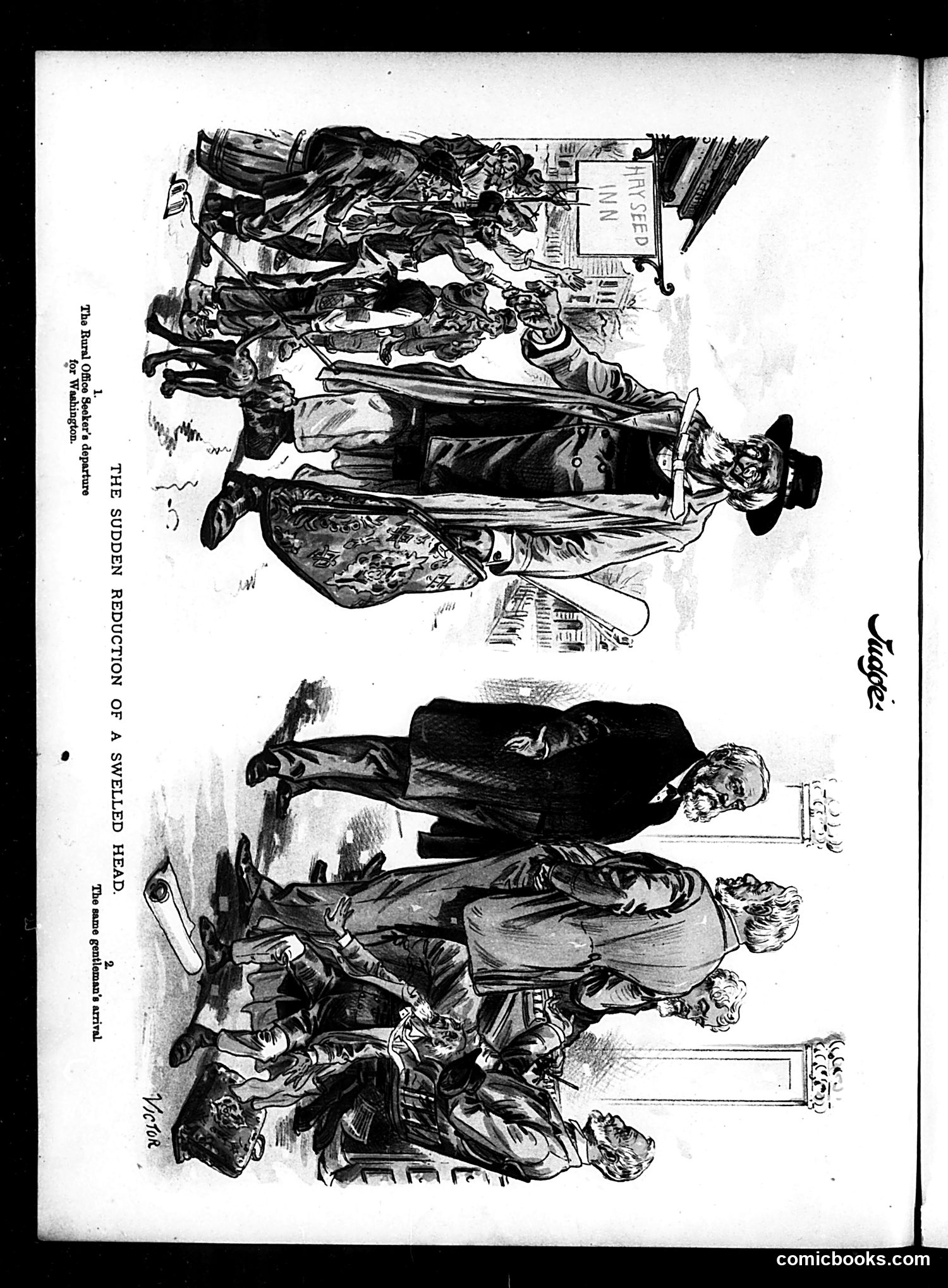
This three-panel satirical sequence depicts a "Rural Office Seeker" whose head literally swells with ego as he travels to Washington seeking political patronage—a common practice in the era of machine politics. The progression shows: (1) his inflated departure with an oversized head; (2) his arrival in Washington, presumably encountering political reality; and (3) his deflated return home with his head returned to normal size. The satire mocks the naive ambitions of small-town politicians seeking federal appointments, suggesting Washington's political establishment humbles such pretensions. The visual metaphor of the literally swelling and shrinking head represents inflated ego meeting harsh reality—a commentary on American patronage politics and the gap between provincial ambition and national political sophistication.