
A complete issue · 16 pages · 1889
Judge — February 2, 1889
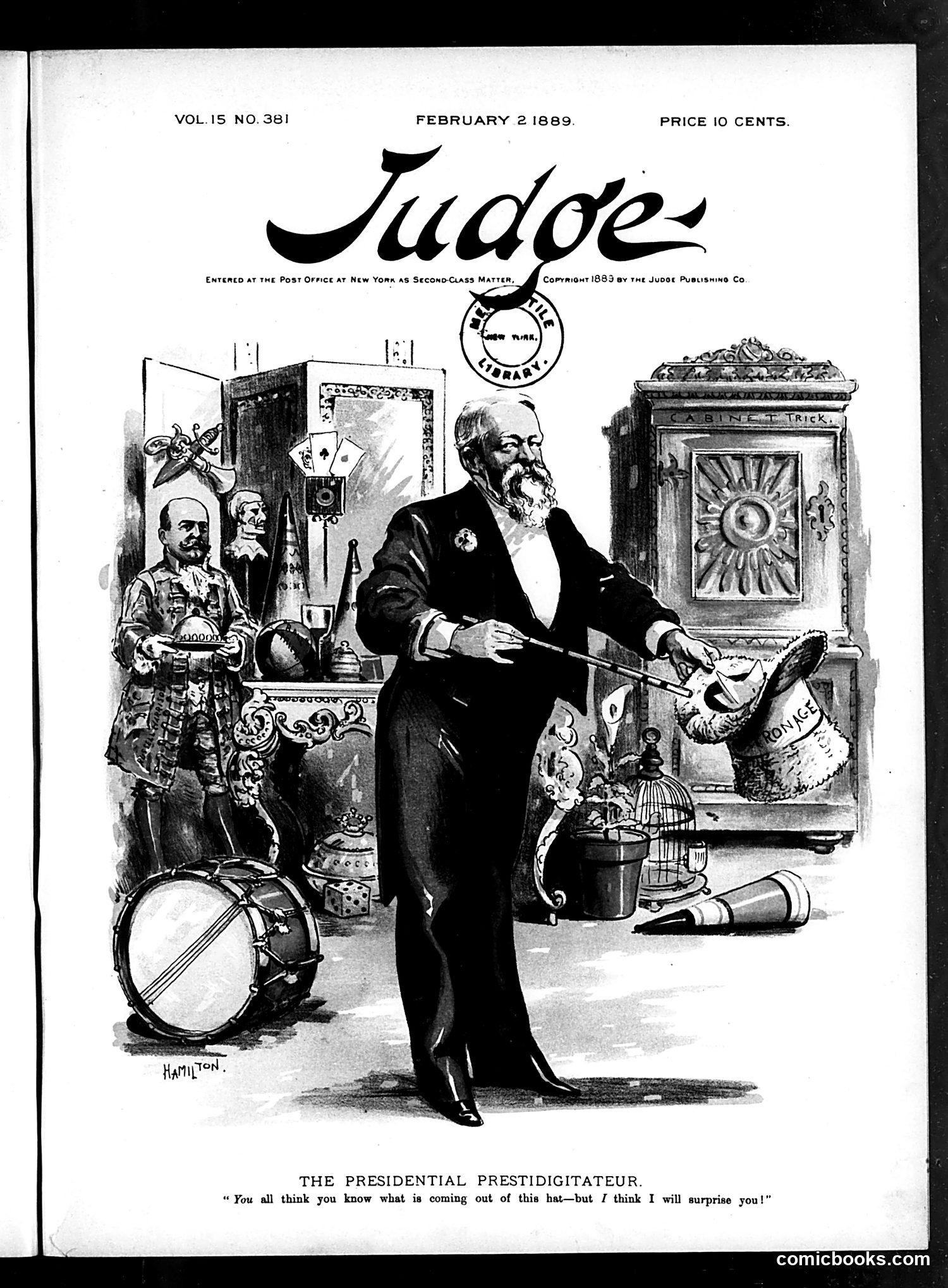
This *Judge* magazine cover from February 2, 1889 satirizes a U.S. President performing magic tricks. The title "prestidigitateur" (magician) suggests the President is deceiving the public through sleight-of-hand politics. The bearded man in the center appears to be demonstrating illusions—pulling items from a hat while various objects (drum, birdcage, furniture) surround him. A military figure stands to the left, implying military or diplomatic involvement. The caption states: "You all think you know what is coming out of this hat—but *I* think I will surprise you!" This likely critiques a President's unpredictable or deceptive policies, though without additional context, identifying the specific President or political crisis requires careful verification. The image suggests public cynicism about executive leadership and hidden agendas.
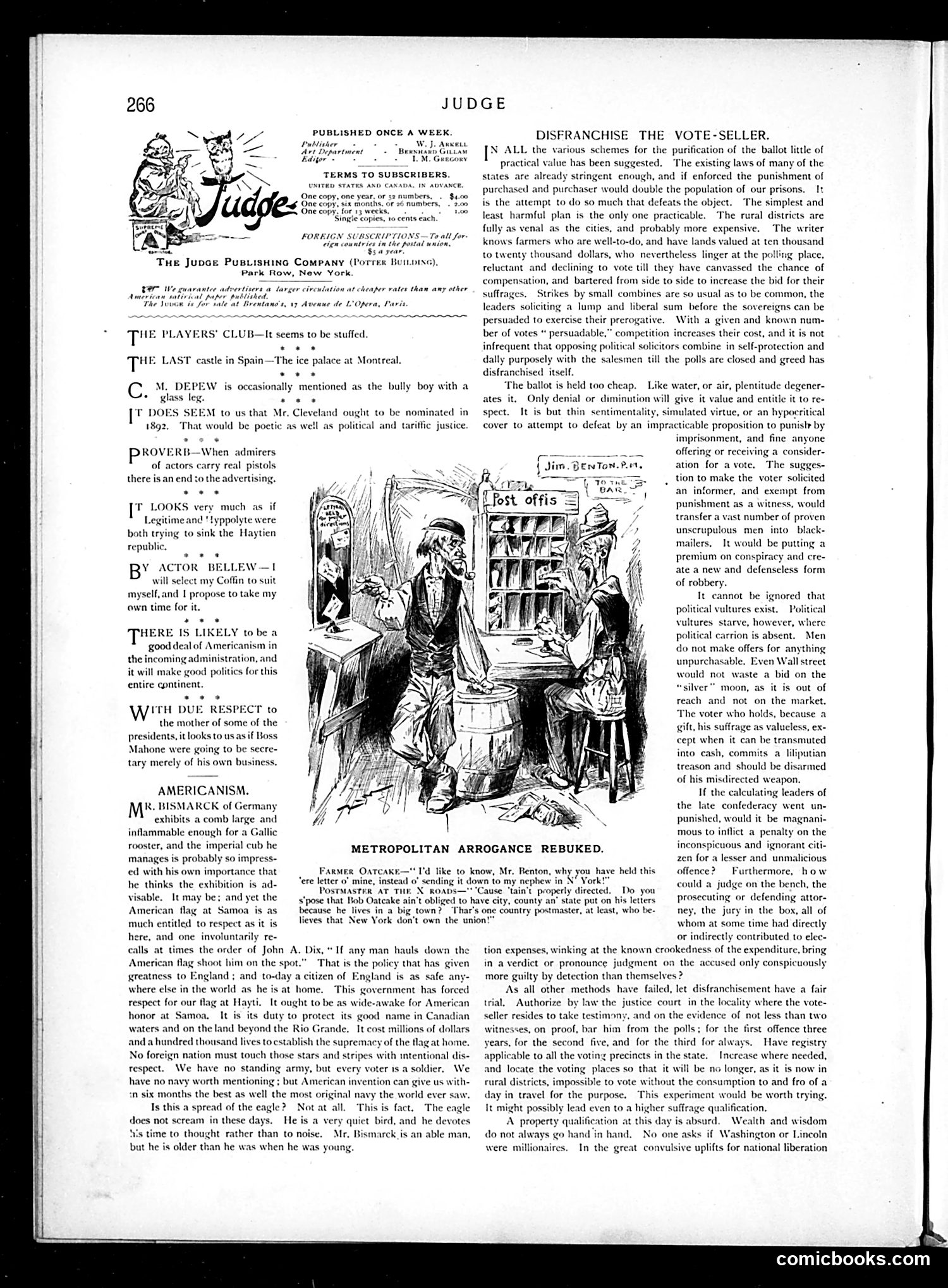
The main cartoon, titled "Metropolitan Arrogance Rebuked," depicts a confrontation between a rural farmer and an urban office worker. The farmer complains that city dwellers look down on rural Americans, claiming the city acts superior while depending on agricultural resources. The accompanying text argues against this perceived metropolitan condescension, defending rural Americans' dignity and contributions. It advocates for greater respect between urban and rural populations. The cartoon satirizes class and regional tensions between agricultural and urban America—a persistent theme in late 19th/early 20th-century American politics. The overall message champions rural values against what the magazine viewed as elitist urban attitudes.
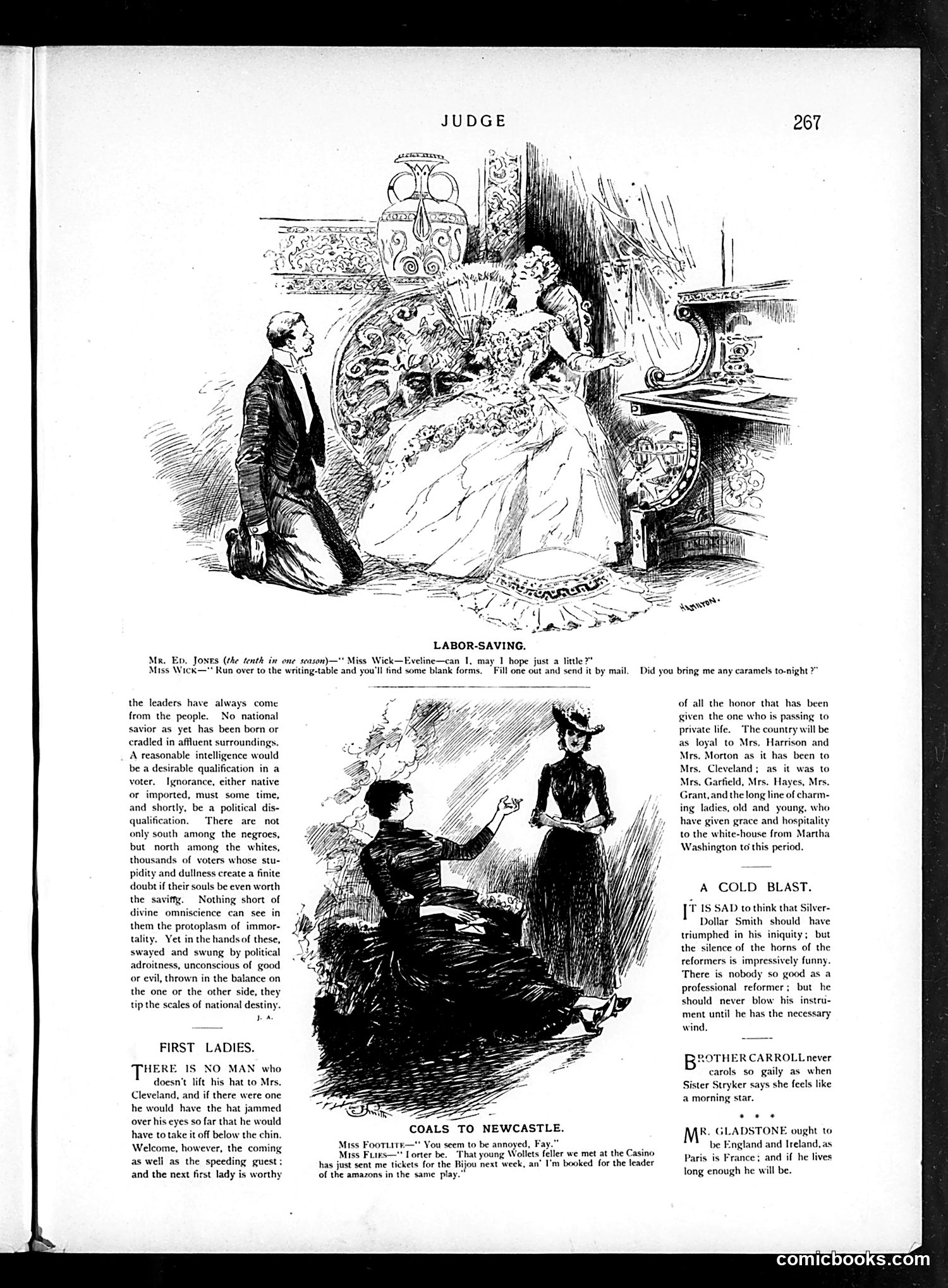
This page contains several satirical items about politics and social life, likely from the 1880s-90s (based on references to Cleveland and Harrison administrations). **"Labor-Saving"** (top cartoon): A man kneels before a wealthy woman, proposing marriage. The joke concerns courtship efficiency—he asks her to fill out blank forms to streamline his tenth proposal of the season, treating marriage proposals as bureaucratic paperwork. **"First Ladies"** section praises Mrs. Cleveland and welcomes the incoming Mrs. Harrison, celebrating First Ladies' grace and dignity across administrations. **"Coals to Newcastle"** depicts a woman annoyed that a suitor sent theater tickets to a play where she's already performing—an ironic, redundant gesture (the phrase means sending something where it's already abundant). **Brief items** below mock Silver Dollar Smith (unclear politician), praise Gladstone, and reference Sister Stryker—all light social commentary typical of Judge's satirical style.
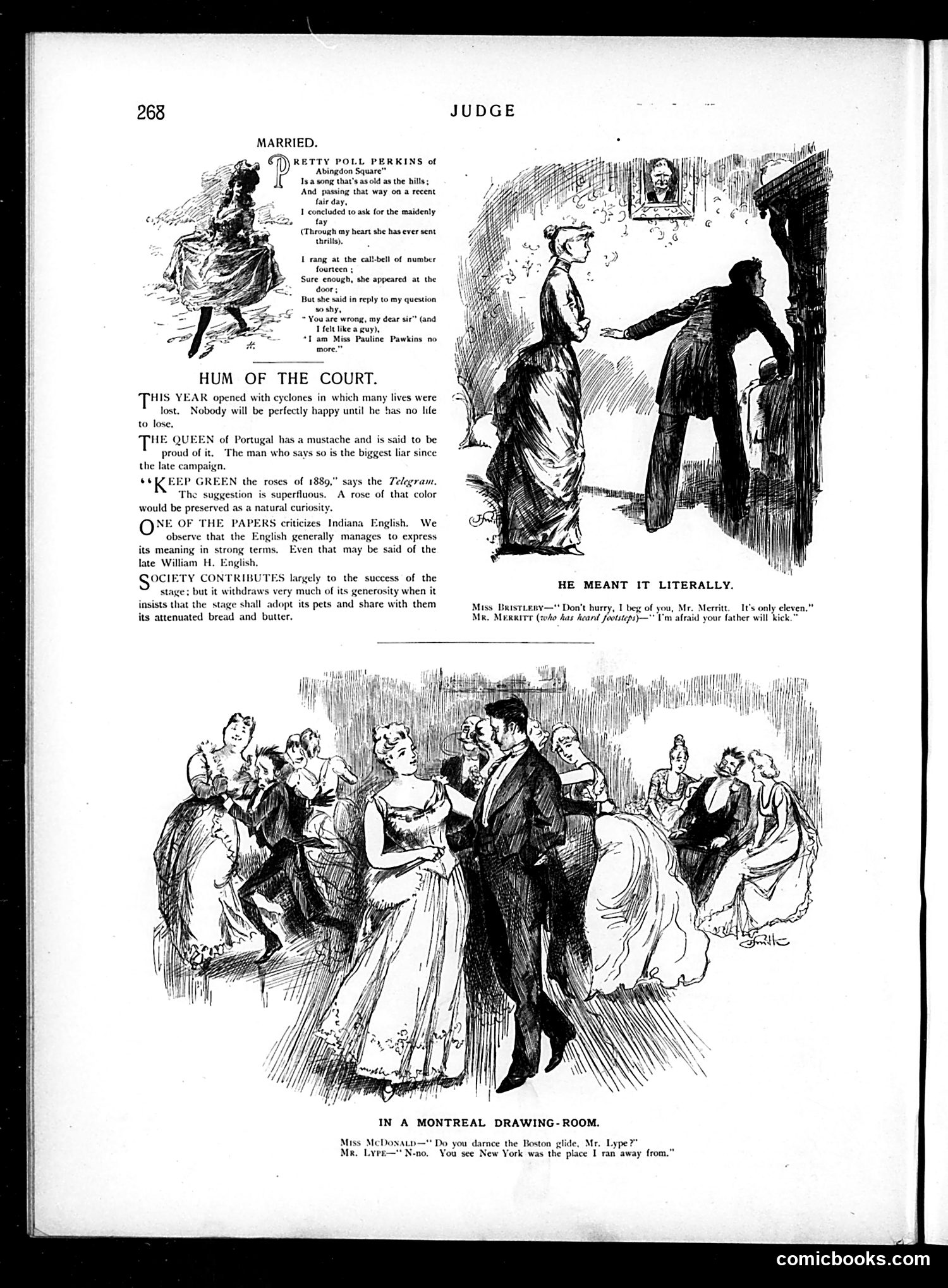
This page contains three unrelated satirical pieces typical of Judge magazine's format: **"Married" (top):** A poem about a suitor visiting "Pretty Poll Perkins" at her Abingdon Square address, only to learn she's married and no longer "Miss Pauline Pawkins." The satire mocks romantic disappointment and changing circumstances. **"Hum of the Court" (middle):** Brief social commentary snippets, including jabs at the Queen of Portugal's mustache (suggesting absurd pride in unfeminine features) and criticism of affected "Indiana English" speech patterns. These are light social observations rather than serious political critique. **"He Meant It Literally" and "Montreal Drawing-Room" (bottom):** Two brief comic scenarios playing on misunderstandings—one involving a father's threat and another where "Mr. Lype" avoids dancing the Boston glide because he "ran away from" New York. The humor relies on double meanings and social awkwardness rather than topical reference. Overall, this represents Judge's typical mix of romantic comedy, social satire, and wordplay humor from the 1880s-90s era.
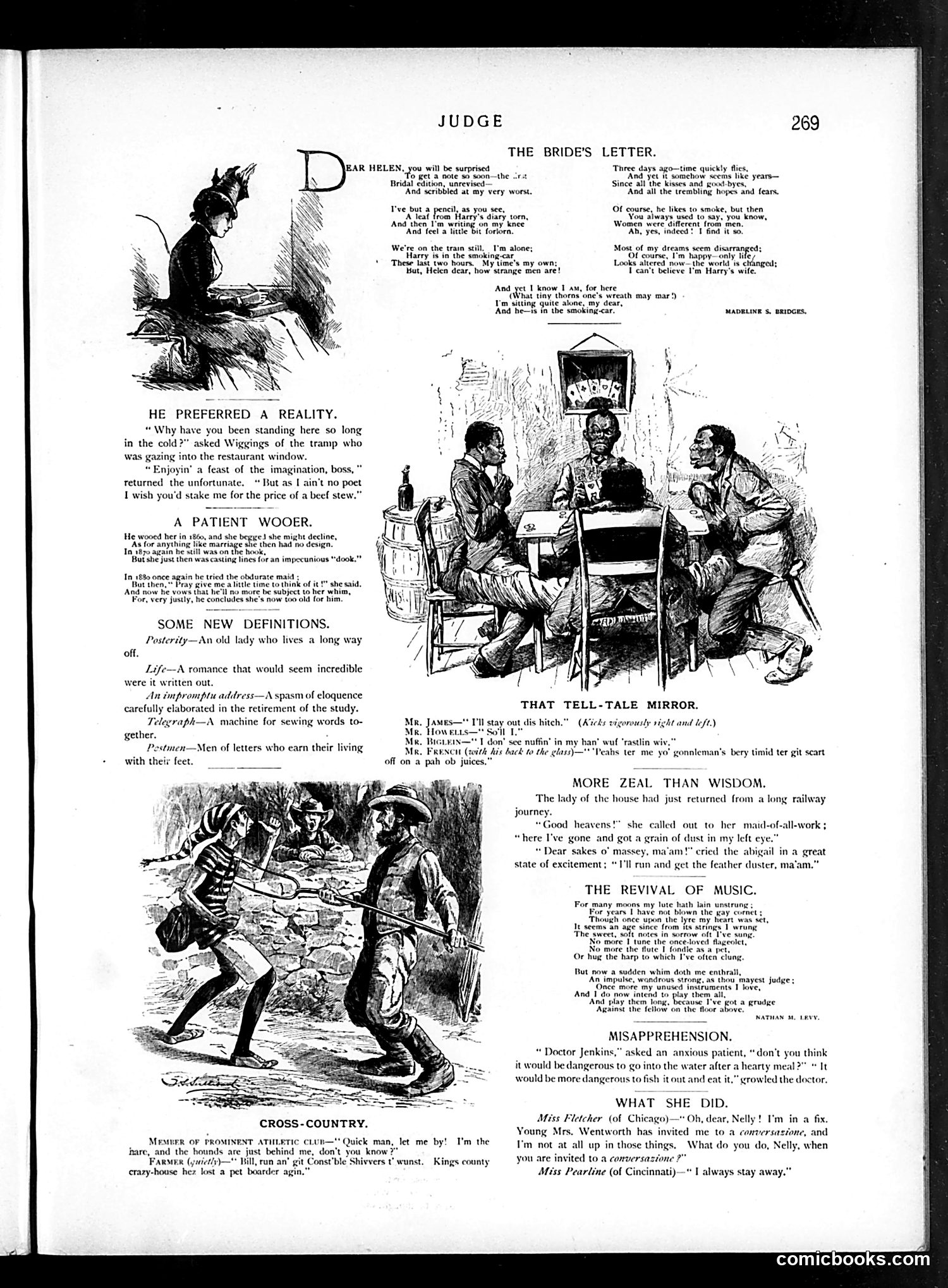
This page contains multiple short humorous pieces typical of late-19th-century American satirical journalism: **"He Preferred a Reality"** mocks a vagrant's romanticizing poverty—he enjoys imagining a feast but needs actual food, undermining the notion that imagination sustains the poor. **"A Patient Wooer"** satirizes prolonged courtship: a man courts an unwilling woman for years; when she finally asks for time to decide, he abandons her as "too old," exposing male fickleness. **"Some New Definitions"** offers witty wordplay on contemporary concepts—Telegraph as "sewing words together" jokes about telegraphy's novelty; "Postmen—Men of letters" puns on the dual meaning. **"That Tell-Tale Mirror"** depicts men avoiding self-reflection in mirrors, suggesting masculine vanity or self-deception. **"The Bride's Letter"** presents a newlywed's complaint that her husband isolates in the smoking car, reflecting period anxieties about modern marriage and male independence. The remaining pieces continue this domestic and social humor typical of Judge's target audience of educated, middle-class readers.
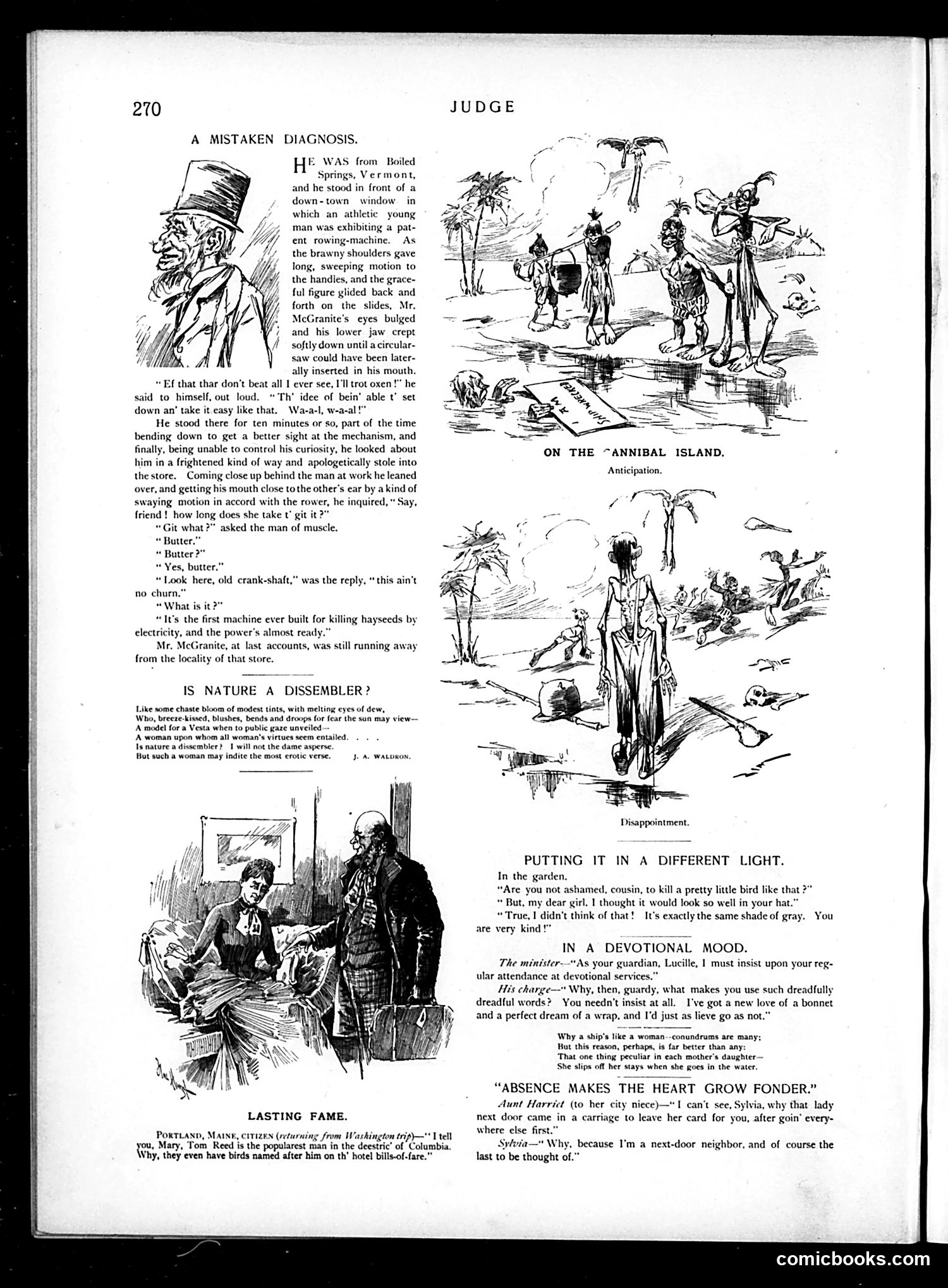
This page contains several brief satirical sketches typical of late 19th-century American humor: **"A Mistaken Diagnosis"** mocks rural ignorance. A Vermont farmer (McGranite) observes a rowing machine in a store window and assumes it's a mechanical butter churn. When told it's an electrical device for "killing hayseeds," he flees—the joke being that "hayseed" is period slang for unsophisticated rural people, making him the butt of his own misunderstanding. **"Lasting Fame"** satirizes Tom Reed (likely Speaker Thomas Brackett Reed), a prominent Maine politician, by joking that birds at Washington hotels are named after him on menus—implying he's so famous even his name appears on food listings. The remaining sketches—"Putting It in a Different Light," "In a Devotional Mood," and "Absence Makes the Heart Grow Fonder"—are gentle domestic humor about women's vanity, materialism, and social pretension, typical of the era's gender-based comedy.
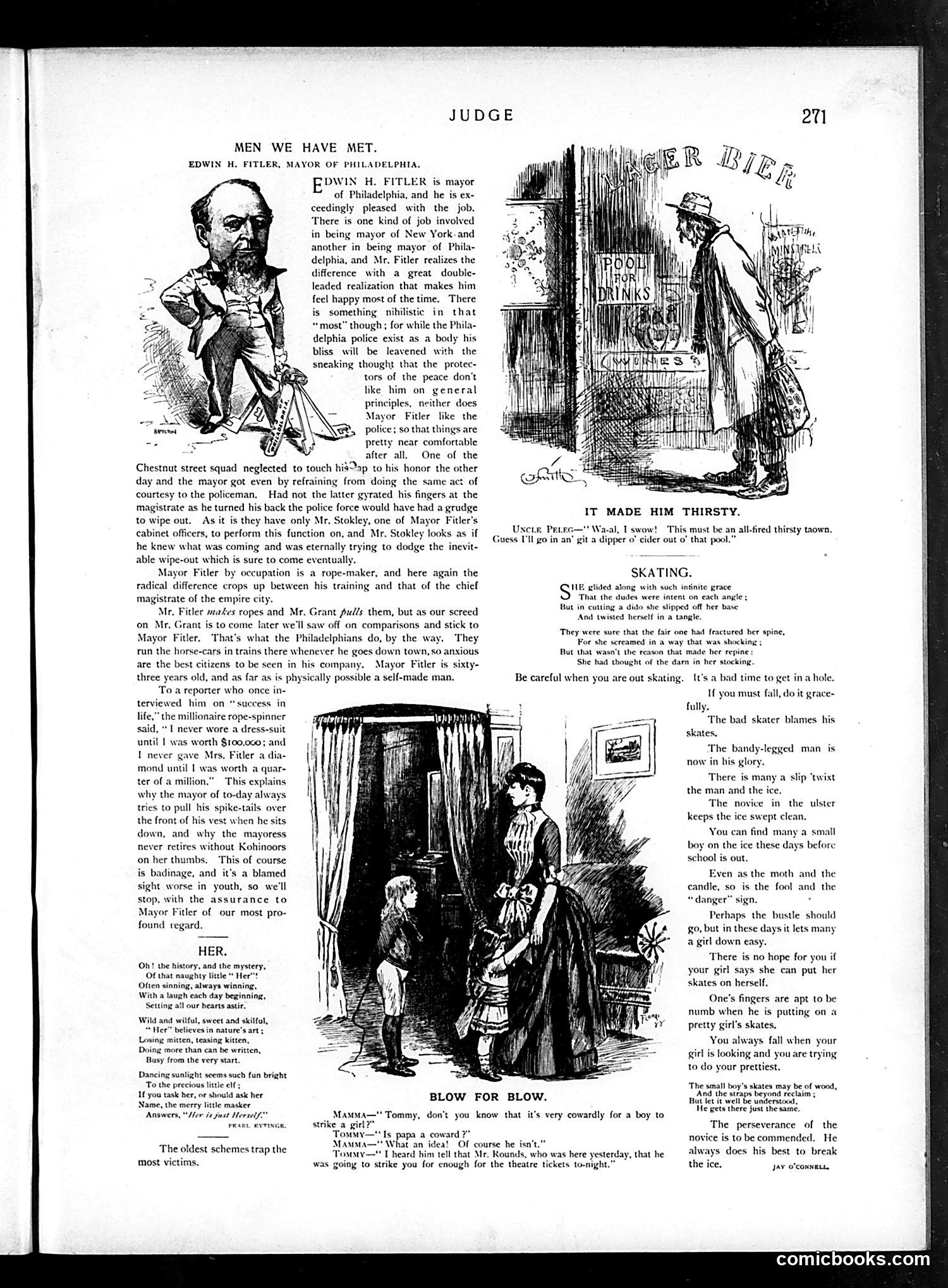
**Main Feature: "Edwin H. Fitler, Mayor of Philadelphia"** This is a biographical sketch mocking Philadelphia's Mayor Fitler. The caricature emphasizes his self-made status—he's a rope manufacturer who withheld luxuries (dress suits, diamonds) until reaching wealth thresholds. The satire targets his provincial pride and class-consciousness: Fitler takes petty satisfaction in his position's dignities while simultaneously disrespecting police (who dislike him equally). The comparison to New York's Mayor Grant implies Philadelphia's mayor operates on a smaller, less consequential stage. The text gently ridicules his vanity about material success and social standing. **Minor Content:** Several short humorous pieces appear: "Her" (sentimental doggerel about a mischievous girl), "Blow for Blow" (joke about cowardly boys), "It Made Him Thirsty" (rural character mistaking a pool for cider), and "Skating" (verse about a young woman's accident). These are typical period filler content—light, society-oriented humor with no apparent political significance. The page represents Judge's mix of social satire and genteel amusement.
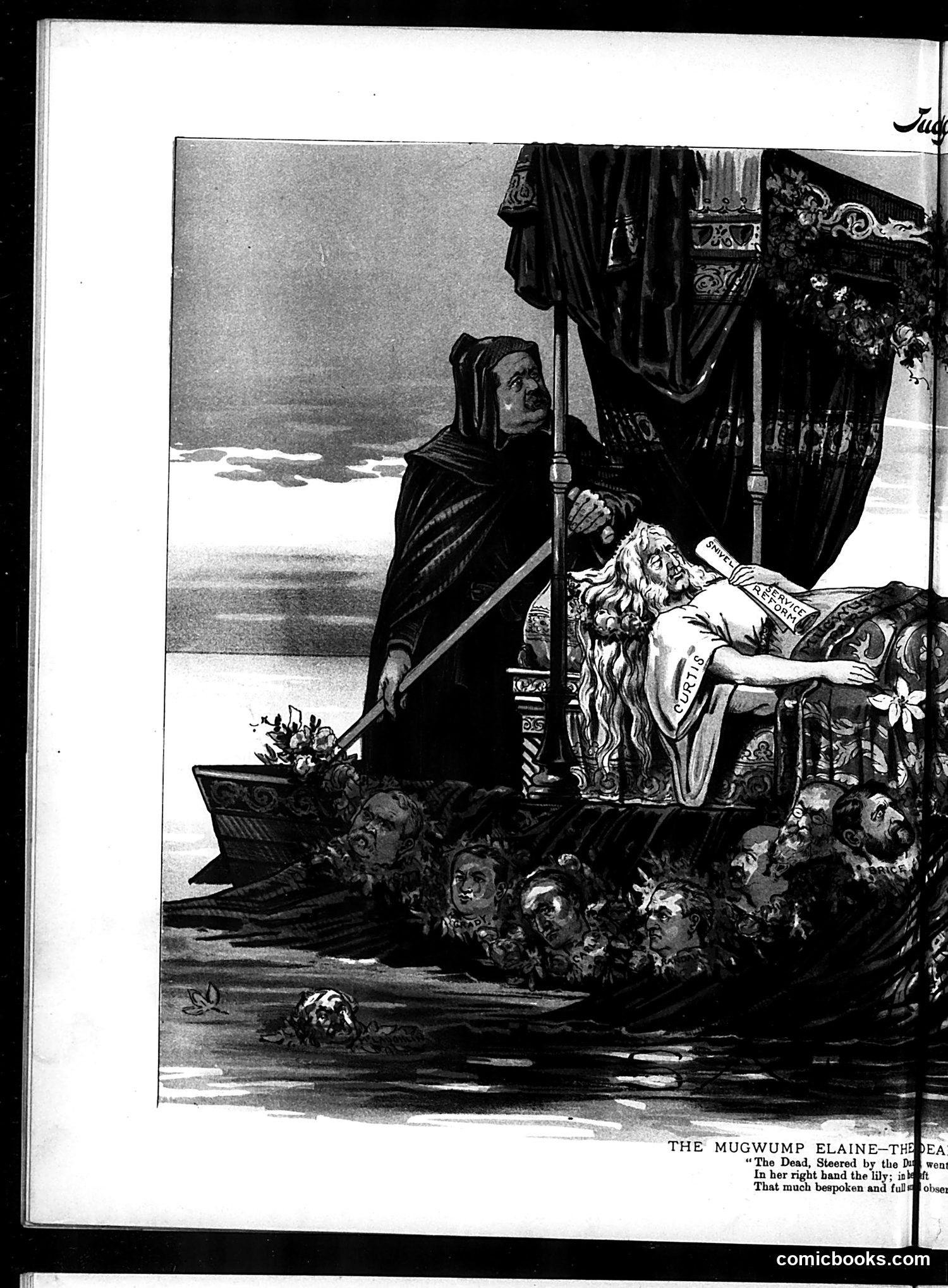
This illustration references "The Dead, Steered by the Dif[ferent]" and depicts a Charon-like figure steering a boat of the dead. The OCR text is too corrupted to fully interpret, but the imagery—a dark ferryman, deceased figures, symbolic lilies—suggests a classical underworld scene, likely used as political satire. "Mugwump" was a derogatory term for Republicans who bolted their party, particularly during the 1884 election. Without clearer text or publication date visible, the specific political target remains unclear, but this appears to satirize a political movement or leader using the classical allegory of death and judgment—a common Judge magazine technique to mock politicians or movements as morally corrupt or doomed.
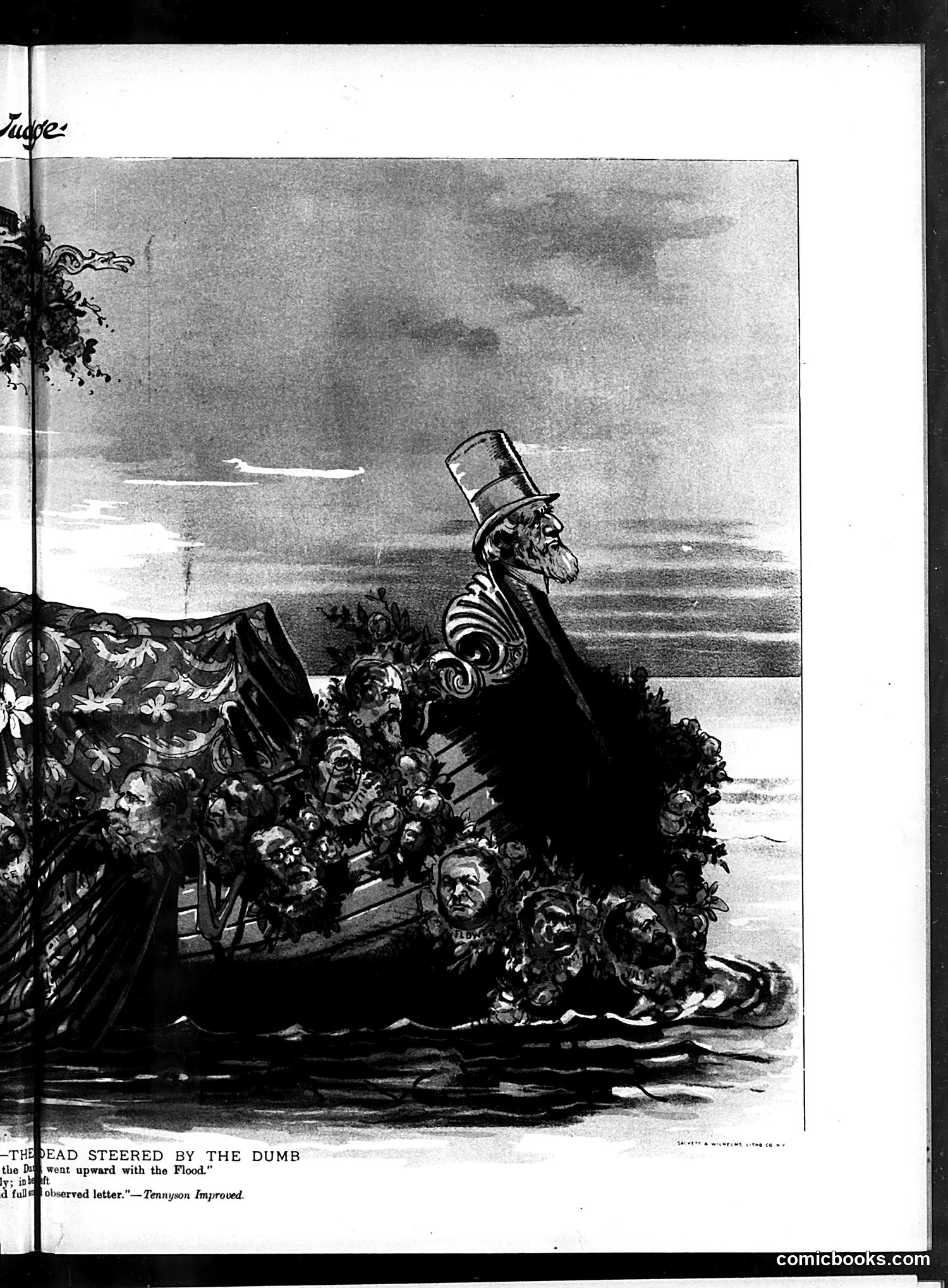
This political cartoon depicts a tall, distinguished gentleman in a top hat standing elevated above a crowd of smaller figures with distorted faces—appearing to steer or command them like a boat. The title references Tennyson, suggesting a critique of leadership and followership. The satire likely critiques how foolish masses allow themselves to be led by a single authority figure, regardless of wisdom. The "dead" may represent the unthinking populace, while the well-dressed figure represents those in power exploiting public ignorance. The water/flood imagery suggests crisis or turbulent times when blind obedience proves especially dangerous. Without a visible date, the specific political event remains unclear, but the cartoon fundamentally mocks the disconnect between elites and the public they manipulate.
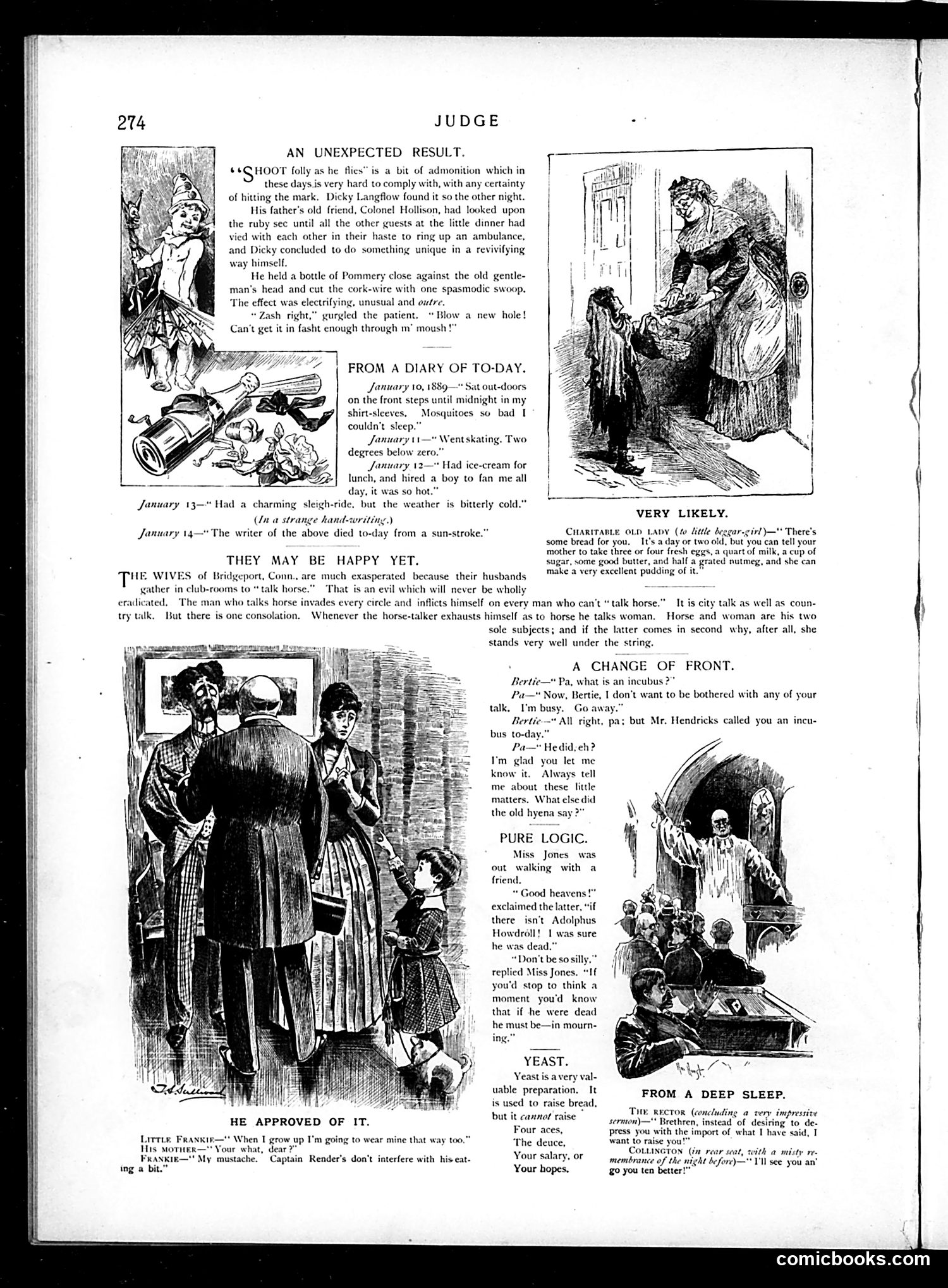
This page contains several satirical items typical of late-19th-century Judge magazine: **"An Unexpected Result"** depicts a dinner guest attempting to revive an elderly colonel with champagne by shooting off the cork near his head—a reckless, absurd "remedy" that produces the colonel's bewildered response. **"From a Diary of To-Day"** mocks contradictory weather accounts (mosquitoes/skating/ice cream/sleigh rides across January days), ending with a note that the diarist died of sunstroke—satirizing either fabricated diaries or extreme weather inconsistency. **"They May Be Happy Yet"** comments on Bridgeport, Connecticut wives complaining that husbands monopolize club conversations about horses. The satire suggests that when horse-talk exhausts itself, men turn to discussing women—implying women are merely another topic of male-dominated discourse. **Other items** include brief jokes about misunderstandings ("incubus"), ironic logic, and a preacher's sermon about "raising" parishioners that's misheard as raising salaries. The humor relies on wordplay, social observation, and incongruity typical of Judge's satirical style.
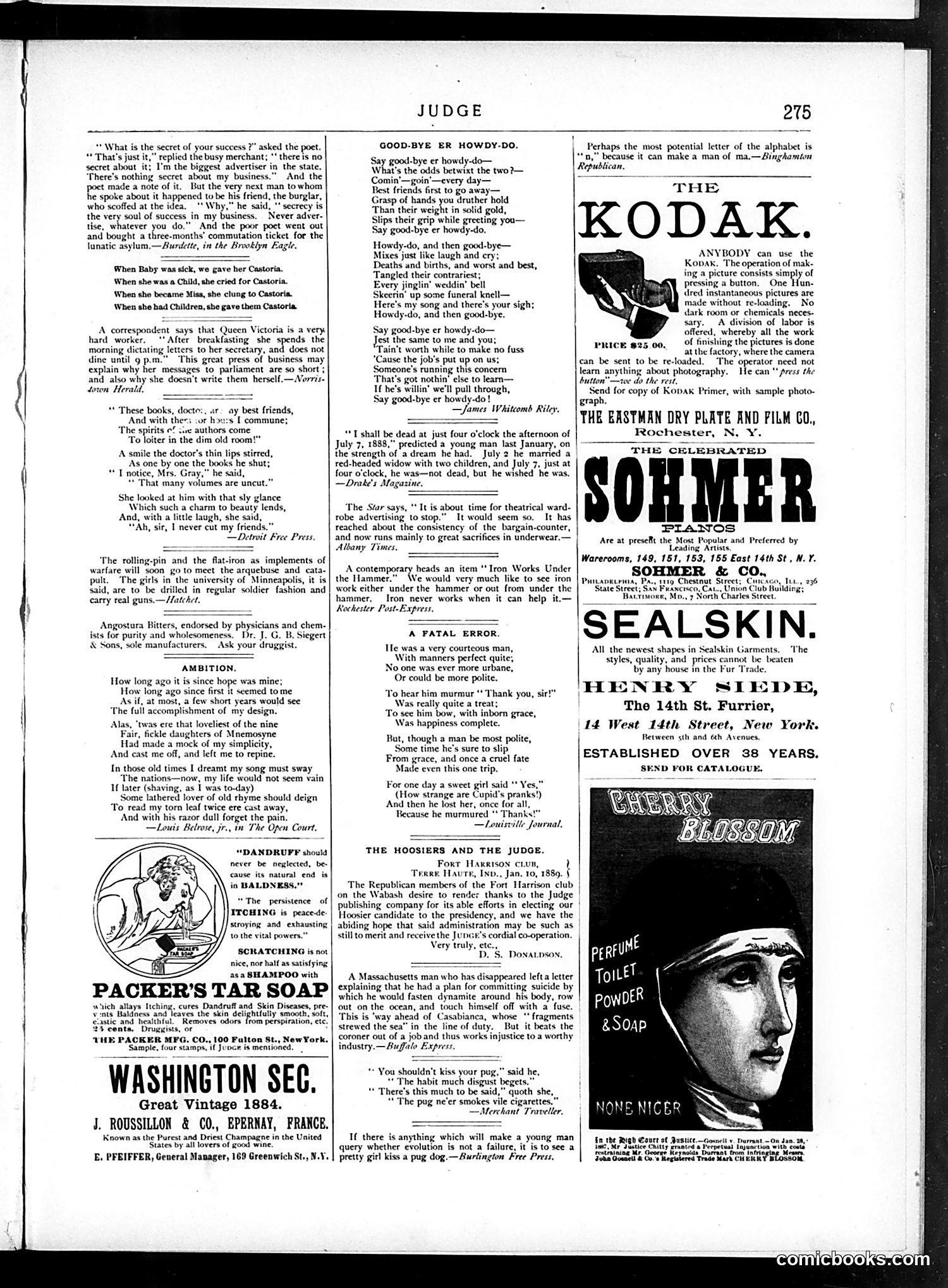
This page is primarily **advertisements and poetry**, not political satire. The main content includes: **Literary pieces**: Humorous anecdotes about a poet consulting a merchant and burglar about success (the merchant advocates advertising; the burglar advocates secrecy), plus poems about ambition, Queen Victoria's work habits, and a doctor noting uncut books in a patient's library. **Social commentary**: A brief note about female students at the University of Minneapolis being drilled in military fashion with real guns—presented as a noteworthy (if bemused) development in women's roles. **Advertisements**: Packer's Tar Soap (addressing dandruff and baldness), Castoria (children's medicine), Angostura Bitters, Washington champagne, and Kodak cameras. The page reflects late-19th-century middle-class concerns: health anxieties, gender-role changes, and commercial products marketed through humor. There's **no clear political cartoon** on this page—it's primarily an advertising and humor compilation typical of Judge magazine's format.
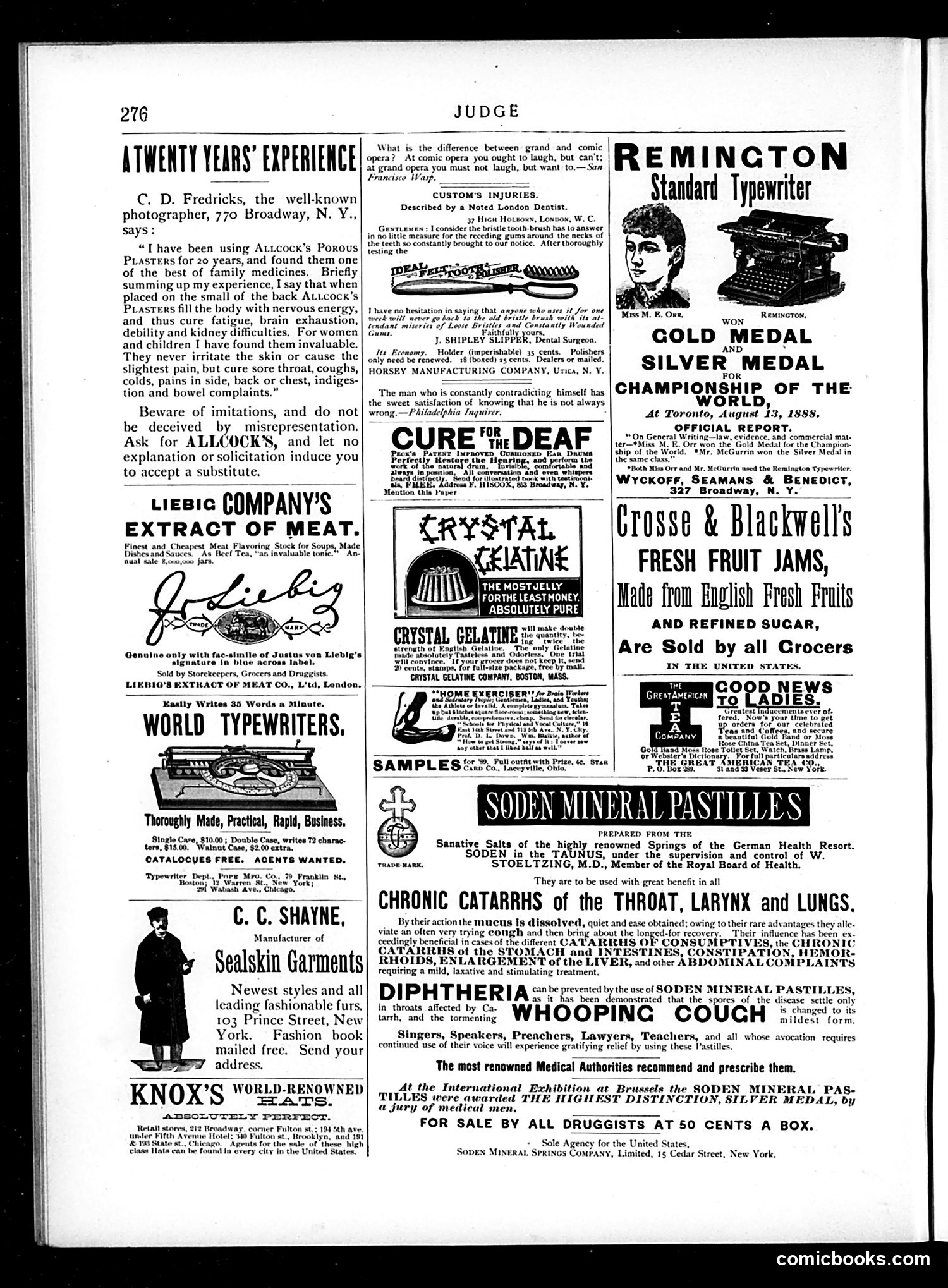
This page is primarily **advertising**, not satirical content or editorial cartoons. It's a collection of late-19th-century advertisements for medical products, typewriters, food items, and clothing. **Key advertisements include:** - **Allcock's Porous Plasters** (medical): Testimonial from photographer claiming the plasters cure fatigue, "brain debility," and various ailments—typical patent medicine marketing of the era - **Remington Typewriter**: Promoting a speed championship won by Miss M.E. Orr in Toronto (1888) - **Soden Mineral Pastilles**: Claiming to cure chronic throat/lung conditions and whooping cough—endorsed by "medical authorities" - **Crystal Gelatine, Liebig's Meat Extract, Crosse & Blackwell Jams**: Food products - **Sealskin Garments and Knox Hats**: Fashion items **Historical context**: These ads reflect turn-of-the-century American consumer culture and the largely unregulated patent medicine industry, before FDA regulations existed. Modern readers should note the extravagant medical claims that would be illegal today.
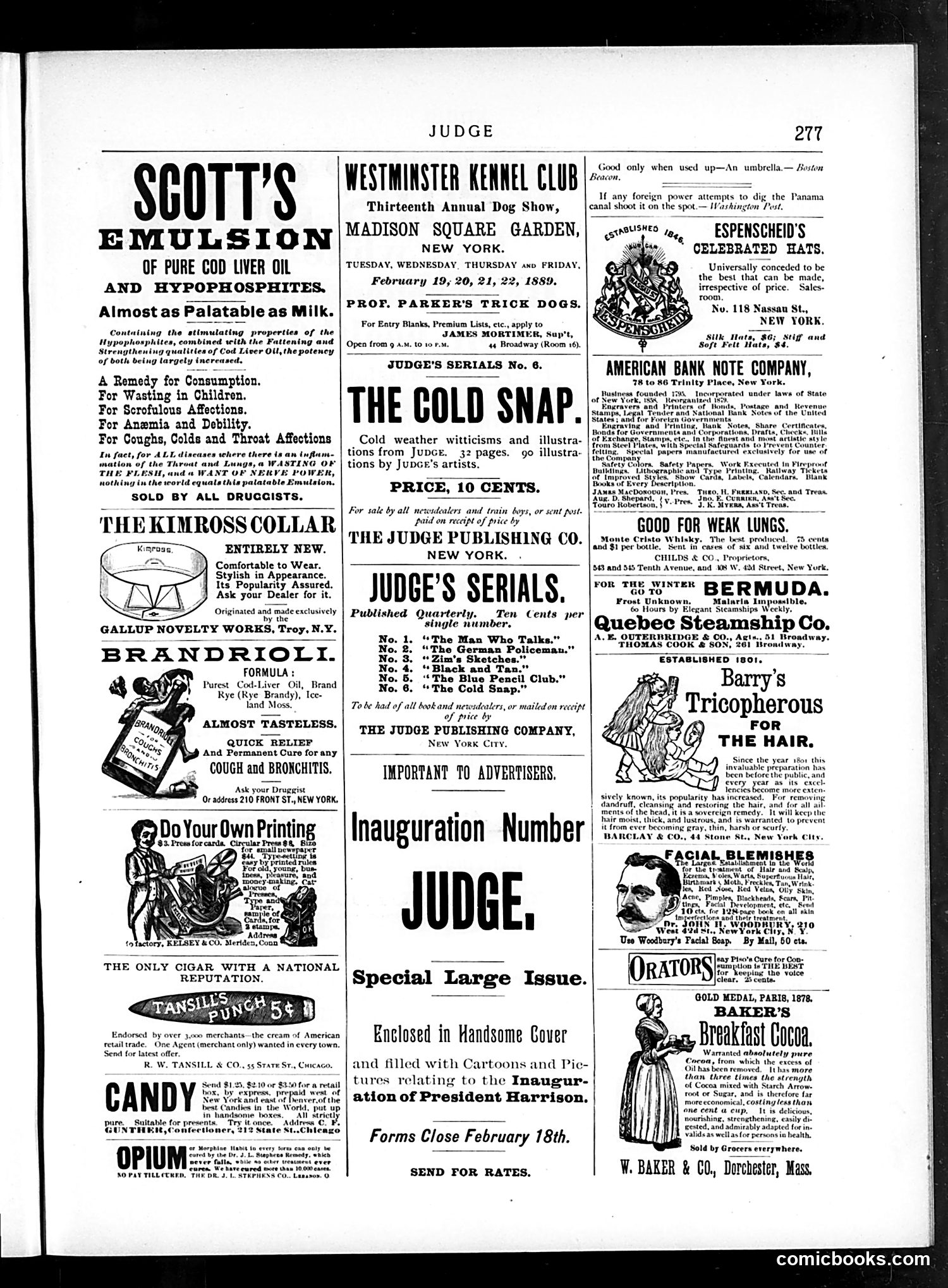
This page is primarily a collection of advertisements and announcements rather than editorial cartoon content. The main advertised event is the **Westminster Kennel Club's Thirteenth Annual Dog Show** (February 19-22, 1889) at Madison Square Garden, notable as an early major American dog show still held today. The page also announces Judge magazine's **"Inauguration Number"** — a special large issue covering President **Harrison's inauguration** (Benjamin Harrison was inaugurated in March 1889). This was topical political content for the era. The remainder consists of period patent medicine ads (Scott's Cod Liver Oil Emulsion for consumption, Brandreth's for coughs), hat and cigar advertisements, and steamship travel notices for Bermuda. The small quoted jokes under some ads are typical satirical filler for Judge. The page represents Judge's dual function as both satirical magazine and advertising vehicle.
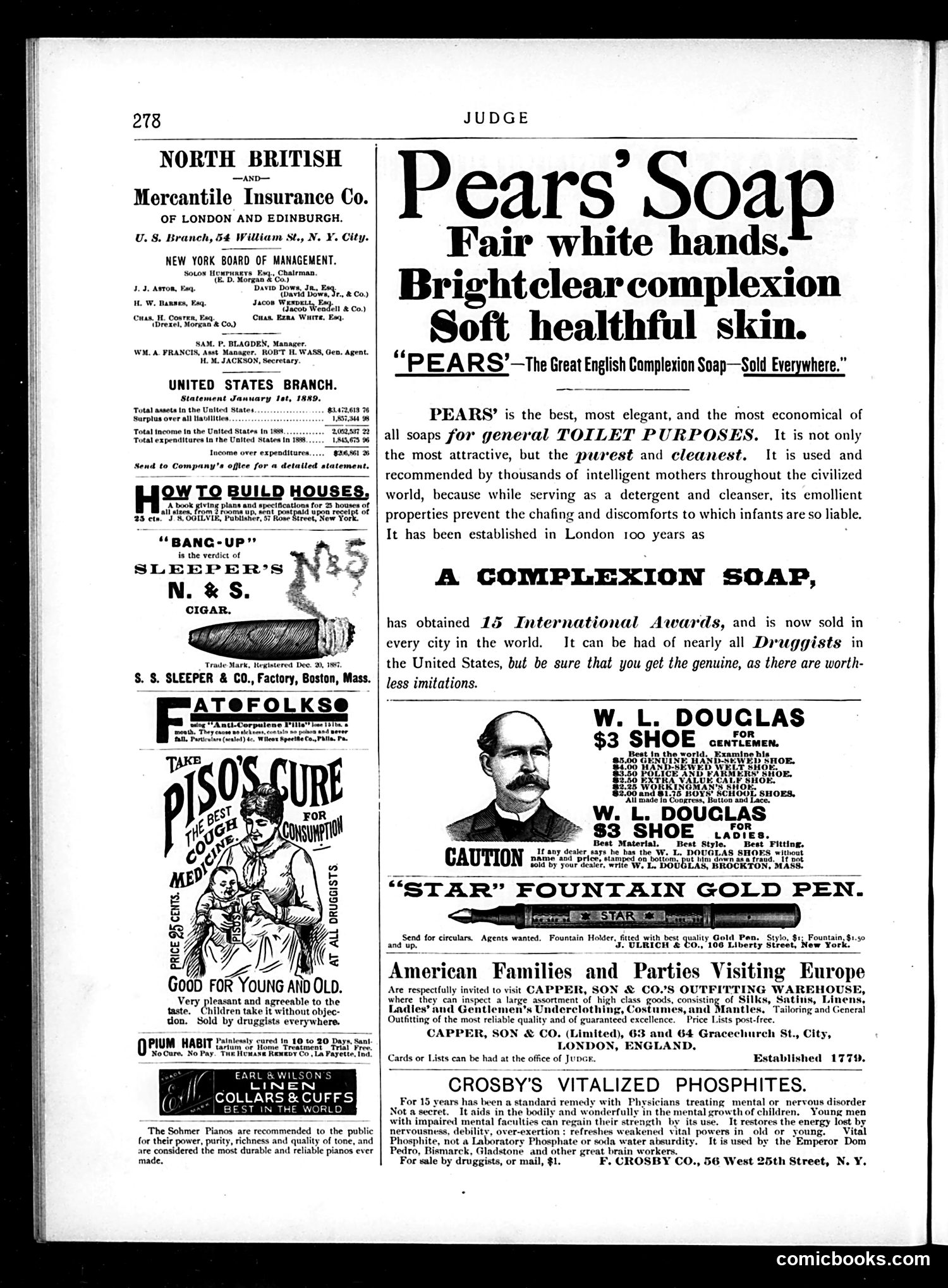
This page is **primarily advertising**, not satirical content. It contains commercial advertisements typical of late-19th-century American magazines, interspersed with a few small notices. The notable ads include: - **Pears' Soap**: A prominent British product marketed with claims about "fair white hands" and "bright clear complexion"—reflecting period beauty standards emphasizing pale skin - **W.L. Douglas $3 Shoes**: A budget shoe brand - **Opium Habit Cure**: A dubious patent medicine claiming to cure addiction in "10-20 days" - **Earl Wilson's Collars & Cuffs** - Various other patent medicines and consumer goods The **Pears' Soap ad is notable historically** for its emphasis on whiteness and complexion—language that carries troubling racial implications in this era, though the ad itself targets general consumers. There is **no visible political cartoon or satire** on this page—it functions as a classified advertising section of the magazine, which was common practice in 19th-century publications.
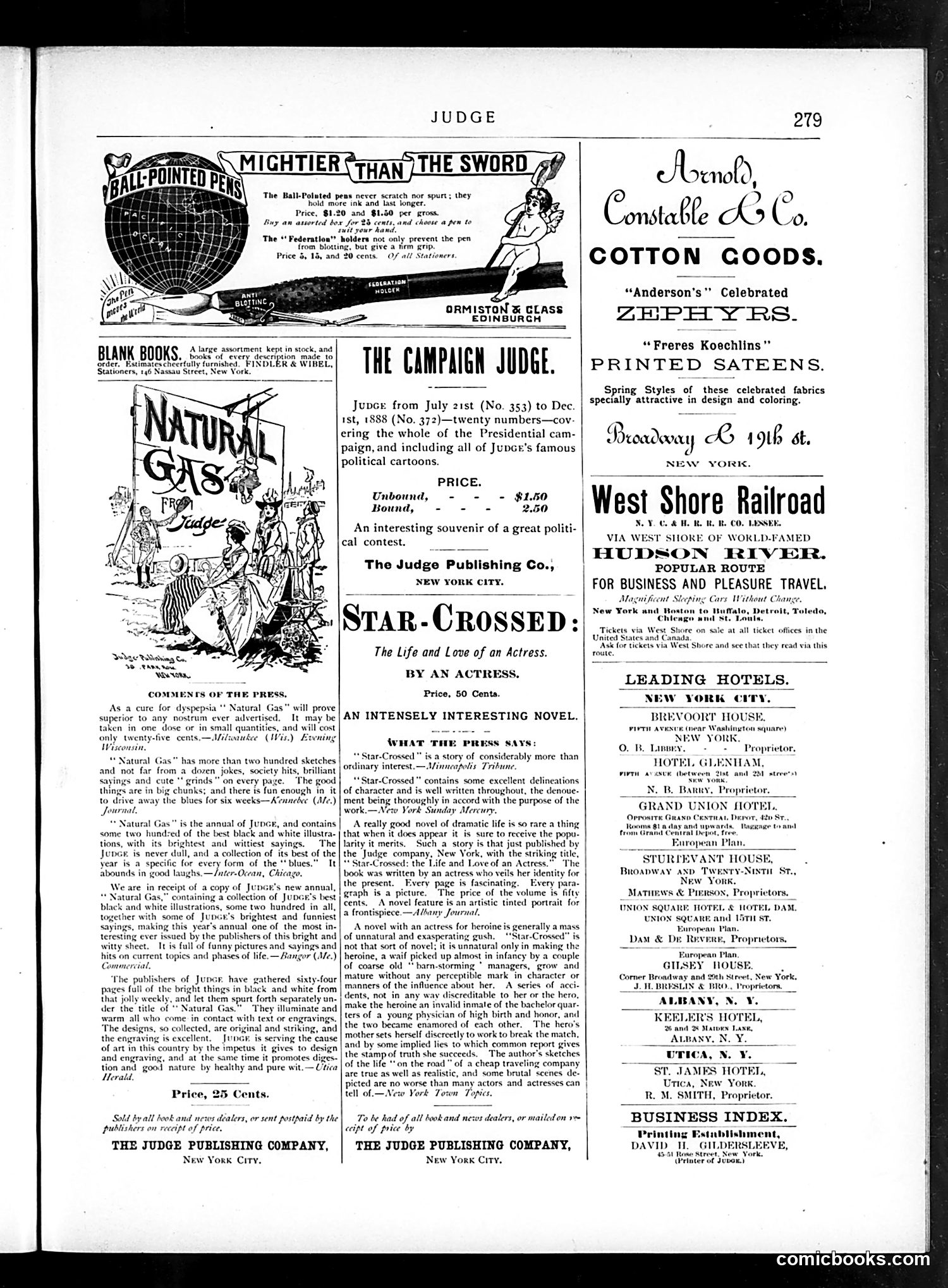
This page is predominantly **advertising and promotional content** rather than political satire. The main elements include: **Upper left**: Advertisement for "Ball-Pointed Pens" and "Federation" pen holders—standard product ads. **Center**: "The Campaign Judge"—a compilation of Judge magazine's political cartoons from the 1888 Presidential campaign (July-December 1888), offered bound or unbound. This references a specific historical election but provides no details visible here. **Lower section**: Promotion for a novel titled *Star-Crossed: The Life and Love of an Actress*, with positive press quotes praising its dramatic merit and "artistic tinted portrait." **Right side**: Advertisements for cotton goods, the West Shore Railroad, and New York hotels. The page functions as a catalog/advertising issue rather than containing satirical content. The 1888 campaign reference suggests this was published around that election period, but the actual political cartoons being advertised aren't visible on this page.
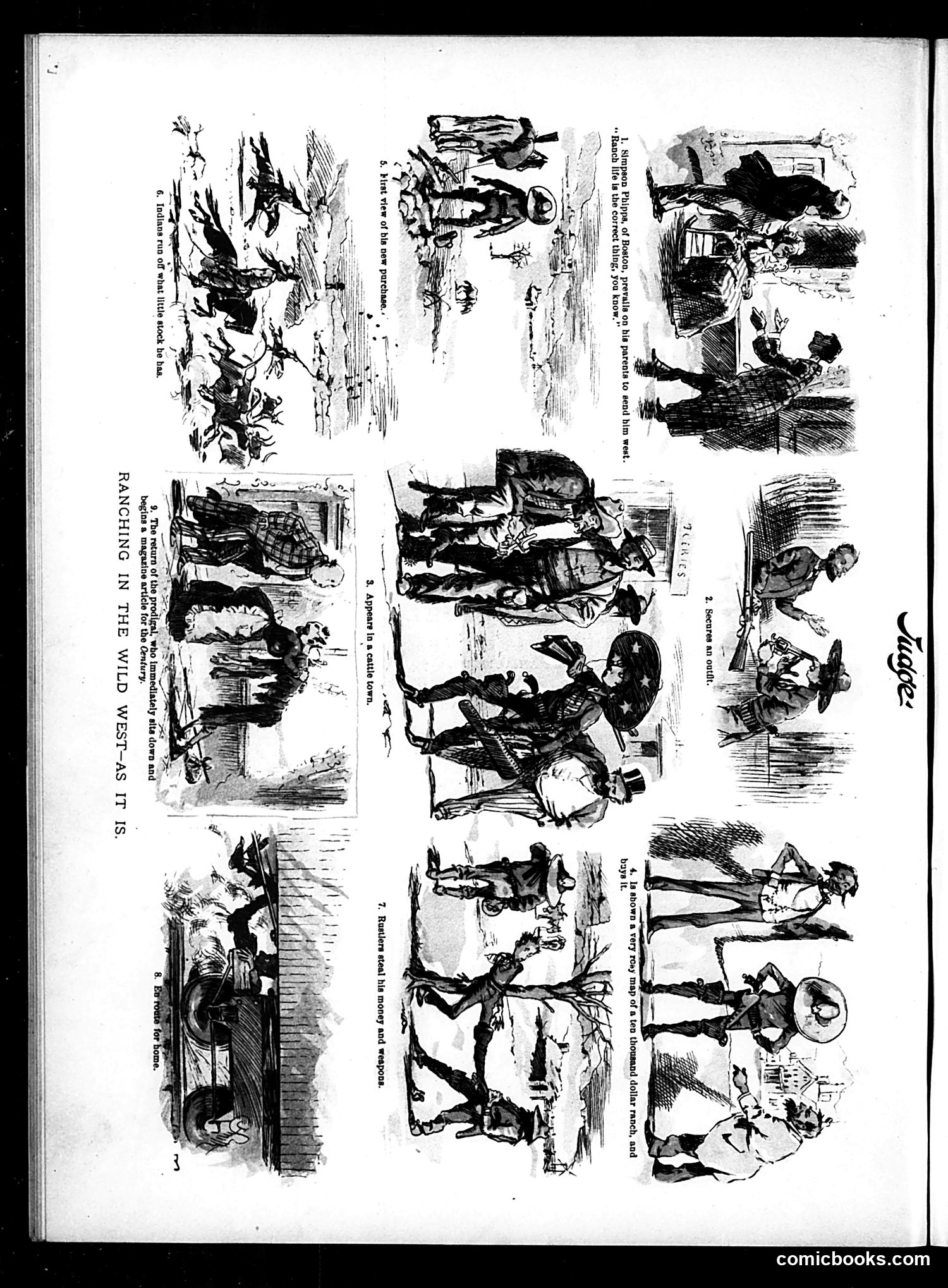
This page from *Judge* satirizes wealthy Eastern elites adopting Western ranch life as a fashionable trend. The narrative follows "Simpson Phipps of Boston," a young man from a prominent family persuaded by romantic imagery of a "$10,000 ranch" to convince his parents to send him west. The cartoon mocks the pretension of Eastern society—where "ranch life is the correct thing, you know"—suggesting that wealthy Bostonians adopted Western living as a status symbol rather than genuine interest. The "prodigal" reference implies wastefulness, as this pampered young man abandons city comfort. This reflects *Judge*'s typical criticism of affectation among the American upper class, ridiculing how fashionable trends (in this case, Western rusticity) were embraced superficially by those with means, regardless of authenticity or practicality.