
A complete issue · 16 pages · 1889
Judge — January 5, 1889
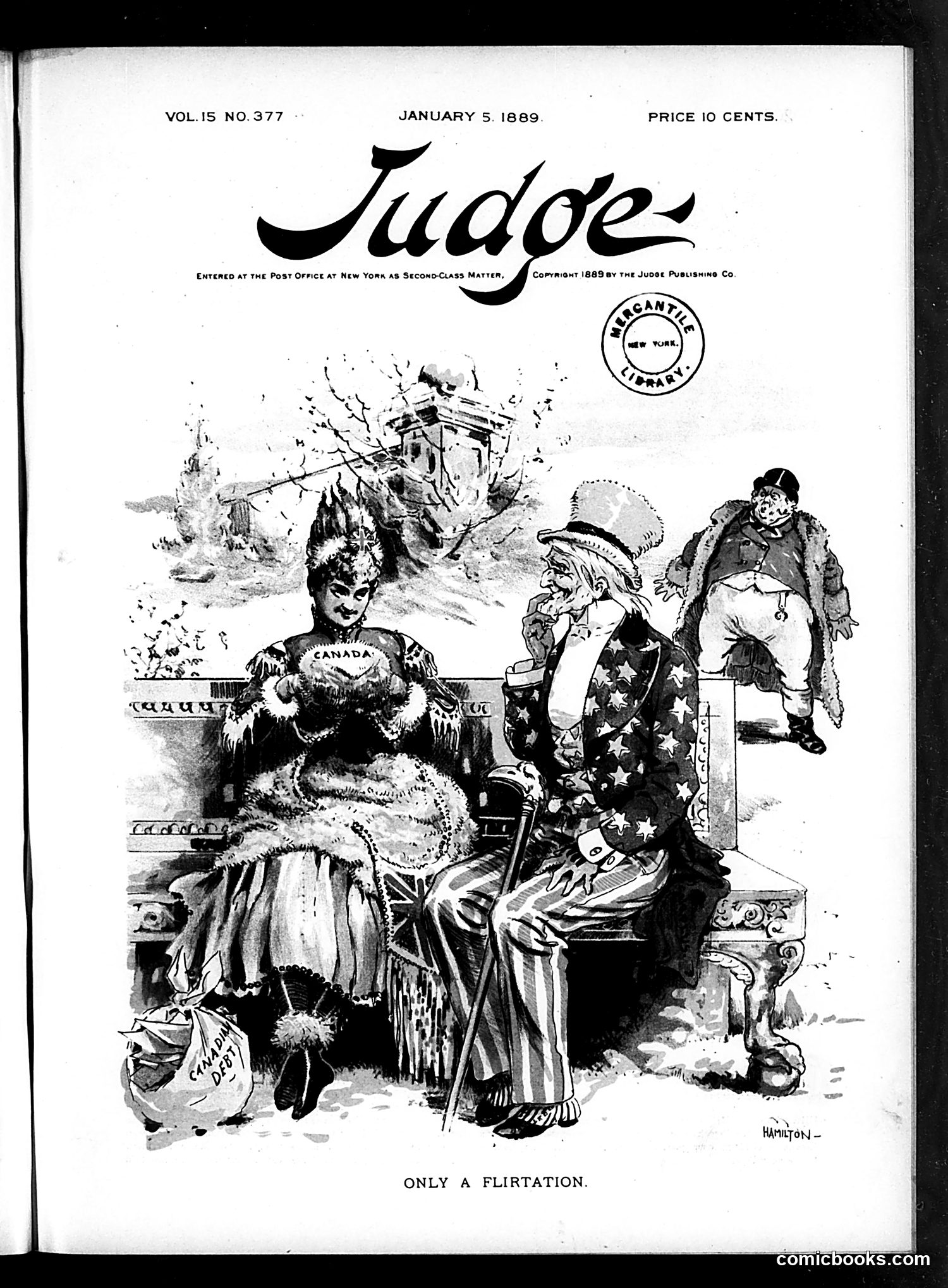
**Title:** "Only a Flirtation" **Visual elements:** The cartoon depicts a woman labeled "CANADA" seated with Uncle Sam (identifiable by his star-spangled outfit and top hat). A second woman representing what appears to be Britain sits nearby, while other figures observe from the background. **Meaning:** This is political satire about Canadian-American trade and diplomatic relations. The "flirtation" metaphor suggests Canada is being courted by the United States through commercial negotiations, while Britain (Canada's colonial parent) watches. The cartoon satirizes anxieties about American influence on Canadian sovereignty during this period of trade negotiations and imperial politics. The piece reflects late-19th-century concerns about North American political realignment and competing imperial interests.
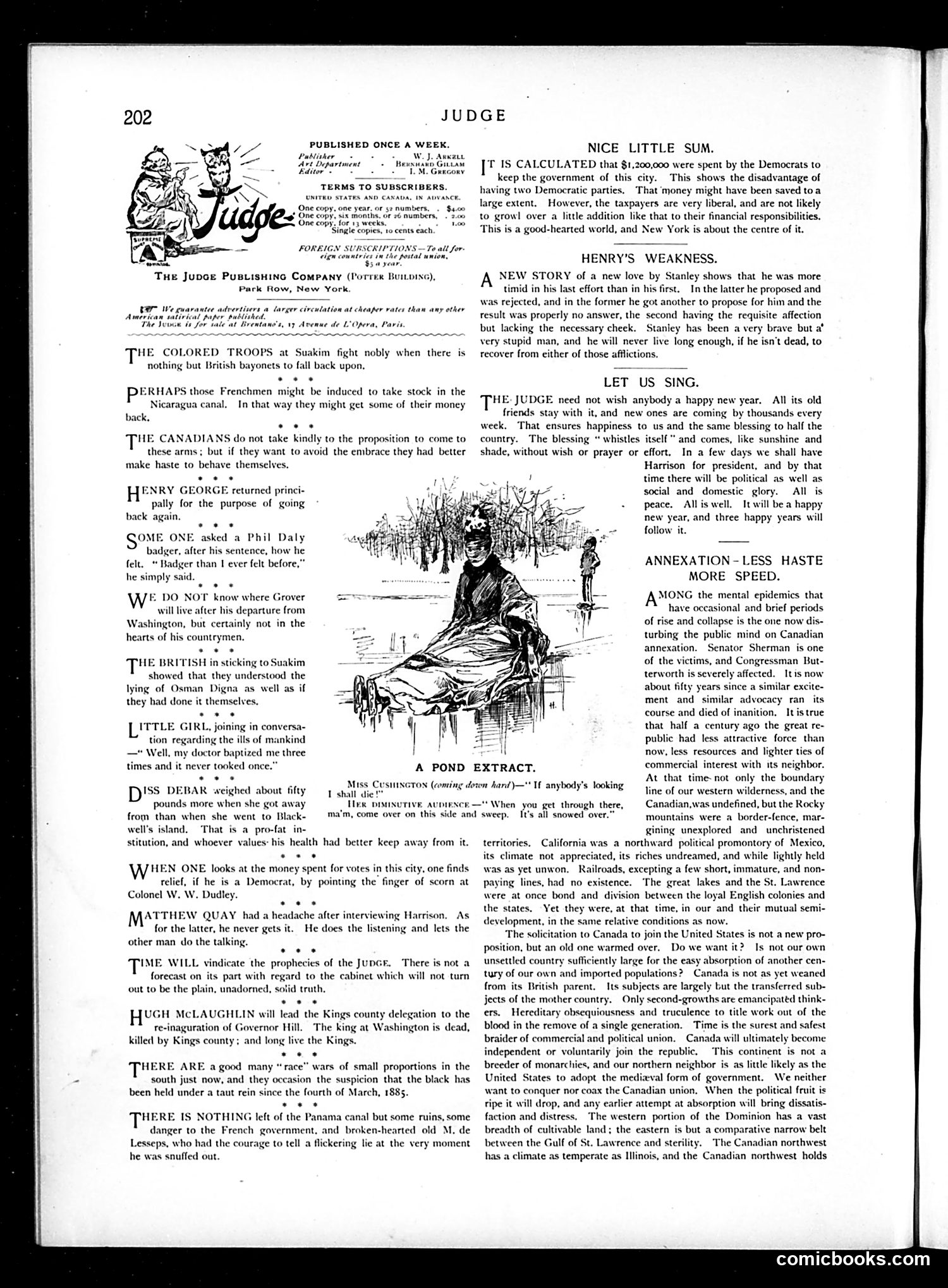
The page contains satirical commentary on early 1900s American politics rather than a single cartoon. The masthead features two caricatured figures (likely representing political stereotypes of the era). Key sections include: **"Nice Little Sum"** - Criticizes Democratic party management of New York City finances, suggesting taxpayers fund inefficient government. **"Henry's Weakness"** - Appears to mock someone named Henry (likely a political figure) for romantic failures and poor judgment. **"Annexation—Less Haste More Speed"** - Debates Canadian annexation to the U.S., discussing territorial ambitions and political implications. The text reflects late 19th/early 20th-century concerns: municipal corruption, partisan politics, and American expansionism. Without publication date confirmation, specific figure identities remain unclear, though the content suggests commentary on contemporary political figures and policy debates.
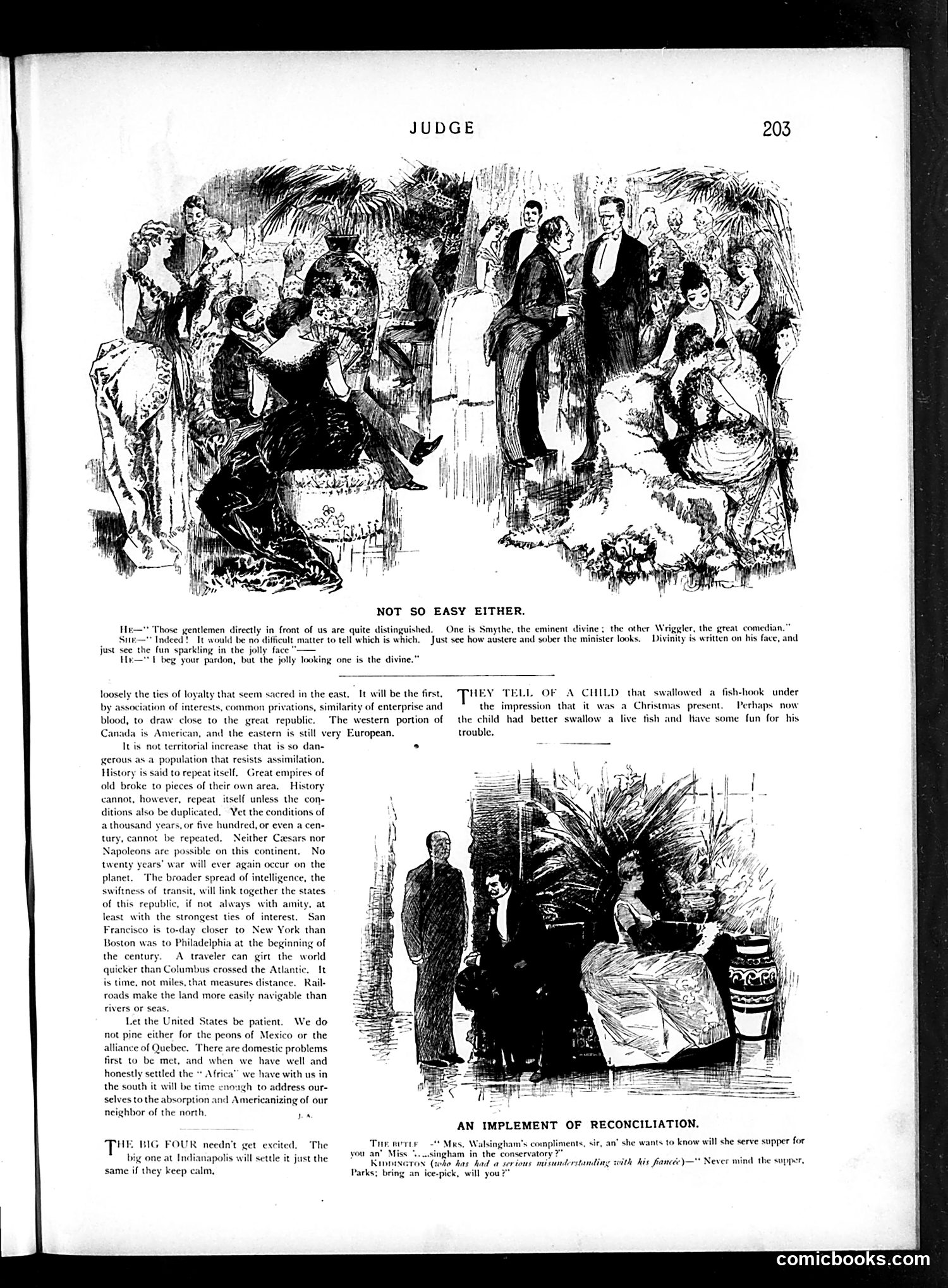
This page contains two satirical pieces mocking American political and social pretensions. **Top cartoon**: Depicts a social gathering where observers struggle to distinguish between "Smythe, the eminent divine" (minister) and "Wriggler, the great comedian." The joke inverts expectations—the austere-looking man is actually the comedian, while the jolly, fun-loving one is the minister. This satirizes the hypocrisy of religious figures who lack genuine piety, or conversely, mocks society's inability to recognize authentic virtue. **Accompanying text**: Discusses westward expansion and territorial absorption, warning against assimilating populations resistant to American values. It expresses confidence that improved transportation and communication will bind the nation together better than force. **Bottom cartoon ("An Implement of Reconciliation")**: Shows a domestic scene where a woman instructs a servant about serving supper, apparently as a peace-making gesture. "The Big Four" reference appears to concern Indianapolis, though the specific political context remains unclear without additional context. Both pieces reflect late 19th-century anxieties about American unity, social cohesion, and expansion.
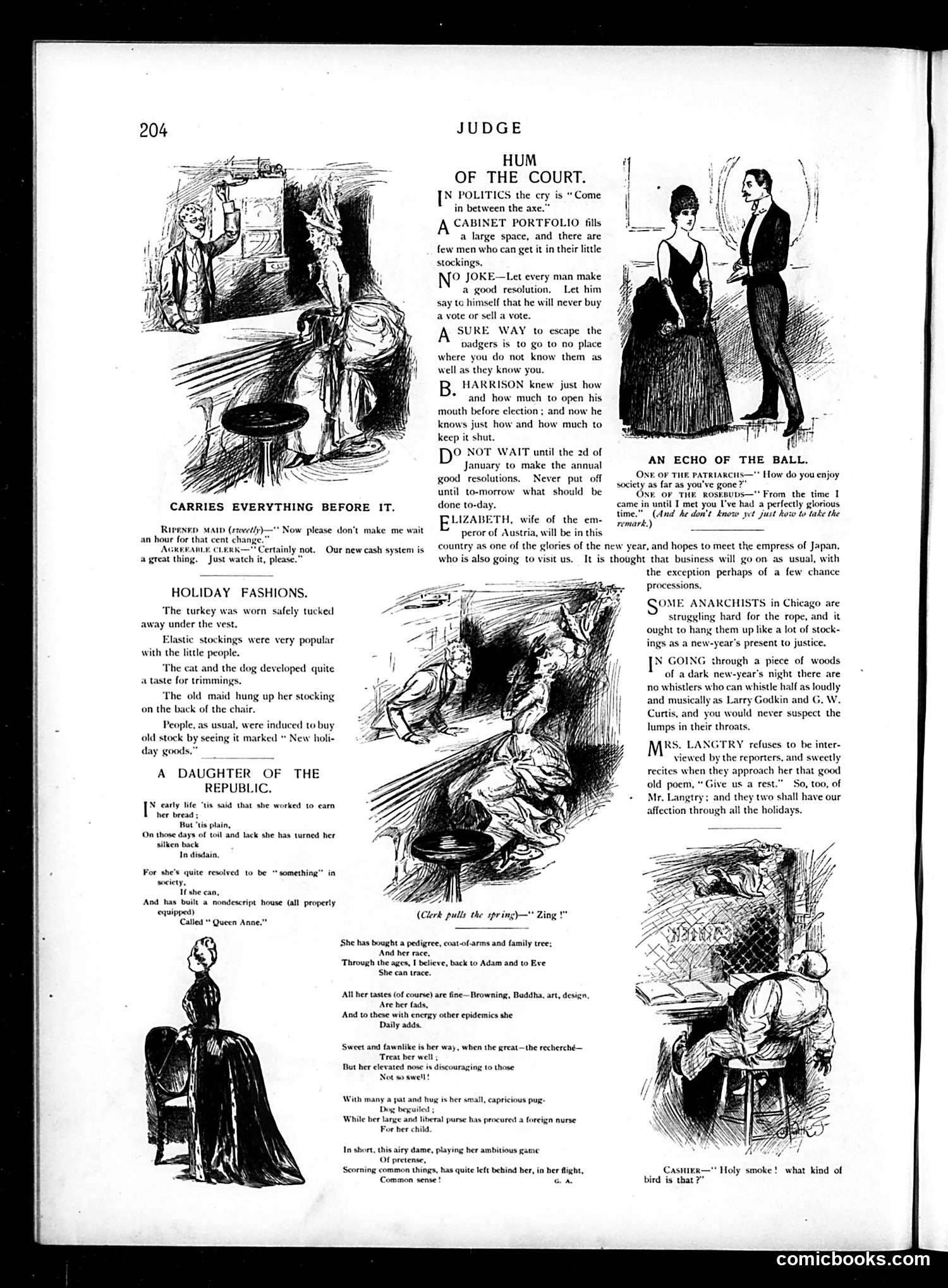
This page mixes editorial commentary with social satire. The "Hum of the Court" section attacks political corruption, specifically referencing President **Harrison** for his selective silence—candid before elections, mute after. The advice about never buying or selling votes reflects contemporary concerns about ballot corruption. "A Daughter of the Republic" satirizes wealthy American women aping European aristocracy. The subject—likely a wealthy industrialist's wife—collects pedigrees and "coat-of-arms," affects refined tastes (Browning, Buddha, art), yet abandons "common sense" through pretension and snobbery toward the less wealthy. Other items mock holiday fashion trends, anarchist violence in Chicago, and reference **Mrs. Langtry** (the famous actress), treating her media attention satirically. The cartoons are crude social commentary typical of 1880s-90s satire: attacking both political corruption and nouveau-riche social climbing with equal disdain.
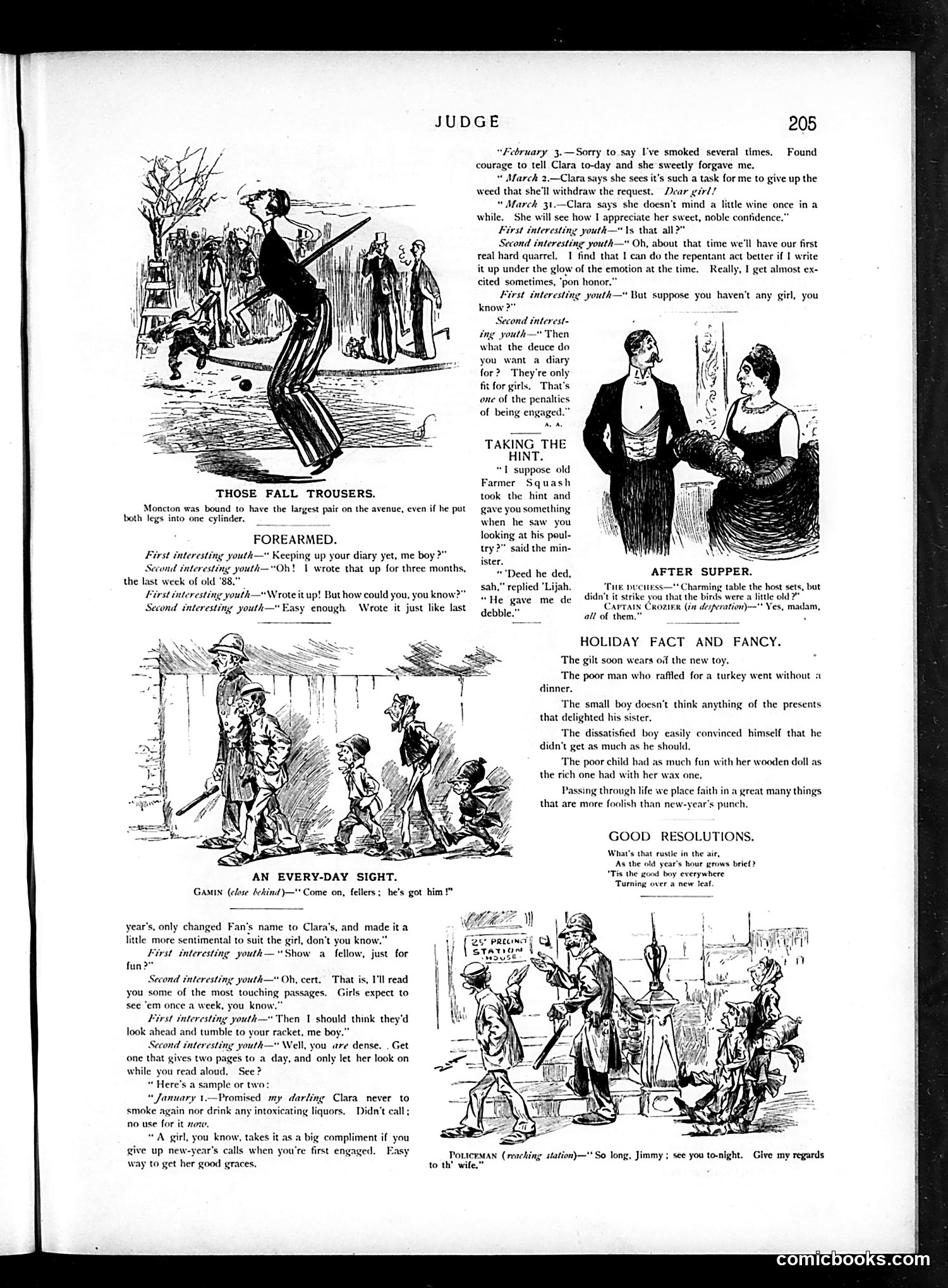
This page satirizes young men's courtship behavior and diary-keeping practices in the late 19th/early 20th century. The main comic premise centers on an engaged man who keeps a diary specifically to document his "repentant acts" after minor quarrels with his fiancée—manufacturing emotional moments for dramatic effect. His friend notes that diaries are "only fit for girls," highlighting the feminization of diary-keeping and the absurdity of a man adopting this practice. The satire extends to New Year's resolutions: the diarist promises his fiancée Clara to quit smoking and drinking, but strategically allows her to release him from these pledges, ensuring future opportunities for "repentance scenes." The scheme relies on women's sentimental expectations. Secondary jokes mock materialism ("Those Fall Trousers," "Taking the Hint") and include brief holiday observations about gift-giving's fleeting satisfaction. The cartoons throughout use Victorian-era stereotypes about gender, courtship rituals, and social pretense—mocking both masculine manipulation and feminine sentimentality as equally foolish.
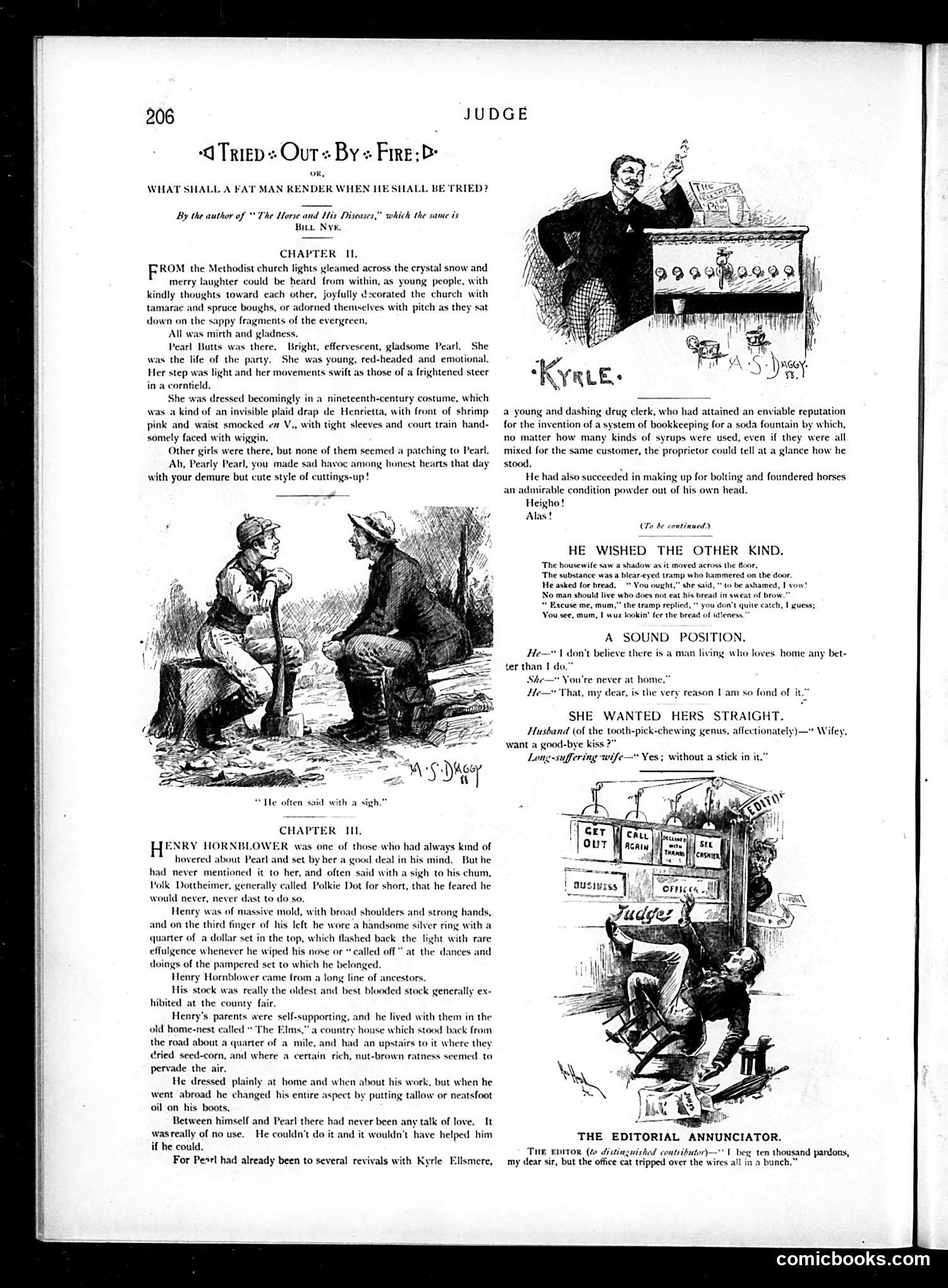
This page from *Judge* contains serialized fiction ("Tried Out By Fire") by Bill Nye, a popular humorist of the era. The main narrative follows Pearl Butts, a vivacious red-headed girl at a Methodist church social, and Henry Hornblower, a lovesick suitor from a rural family with modest means but aristocratic pretensions (their farm is called "The Elms"). The accompanying cartoons are brief social satire: one depicts a tramp seeking bread, rebuked by a moralistic housewife; another shows a wife rejecting her husband's kiss because it contains a toothpick. These are genteel domestic humor typical of the period. The satire targets rural courtship awkwardness, class pretensions, and conventional domesticity. The tone is light rather than political—entertainment for middle-class magazine readers rather than pointed social commentary.
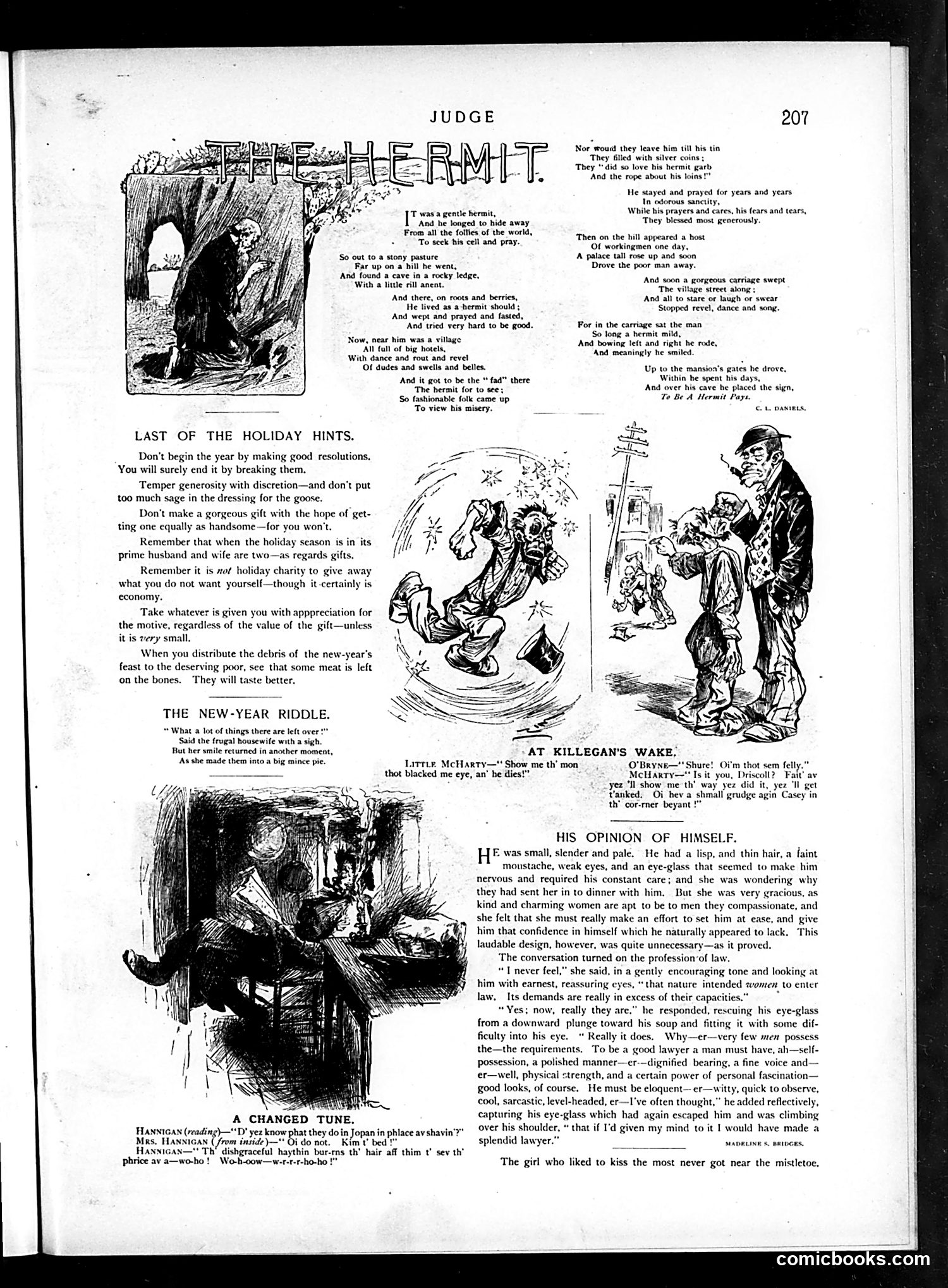
This page contains several satirical pieces typical of Judge's social commentary: **"The Hermit"** (main poem with illustration): A wealthy man abandons society for ascetic hermitage, attracting fashionable visitors who treat his poverty as entertainment. When developers build nearby, he transforms into a wealthy gentleman—revealing the satire: society values the *appearance* of virtue only when packaged attractively. The hermitage becomes a profitable tourist attraction. **"Last of the Holiday Hints"**: Practical post-holiday advice mocking middle-class hypocrisy—don't make resolutions you'll break, don't give expensive gifts expecting returns, and distribute leftover meat (not scraps) to the poor. **"At Killegan's Wake"** and **"His Opinion of Himself"**: Brief comedic sketches. The first depicts Irish-American dialect humor about a tavern brawl. The second satirizes a physically unimpressive man's unwarranted self-confidence in professional matters—society's performative nature masks actual inadequacy. The overall theme: 1900s American society values appearances over substance, particularly regarding wealth, charity, and personal worth.
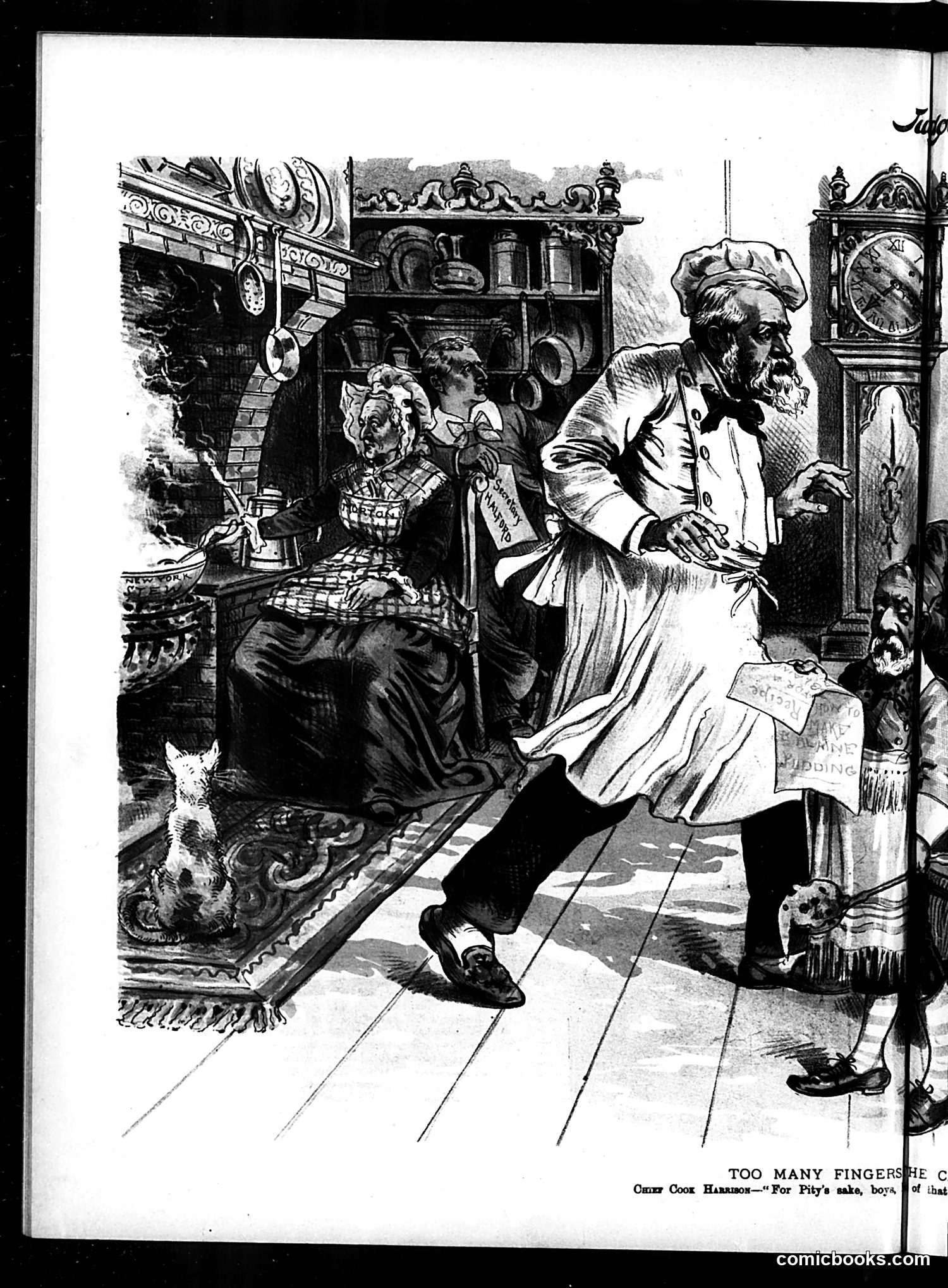
This Judge magazine cartoon satirizes what appears to be political meddling or interference. The caption reads "TOO MANY FINGERS" with a subtitle mentioning "CHIEF COOK HARRISON" and a reference to "Pity's sake, boys, of that..." The image shows a bearded man (likely President William Henry Harrison or a political figure) in a kitchen setting, gesturing in frustration while multiple hands reach in from the background, apparently trying to control or interfere with his cooking/work. The satire criticizes excessive interference in governance—too many people trying to direct policy or decisions simultaneously, represented metaphorically through the kitchen scene. The "too many cooks" idiom (spoil the broth) underlies the visual joke about chaotic leadership when multiple parties attempt control.
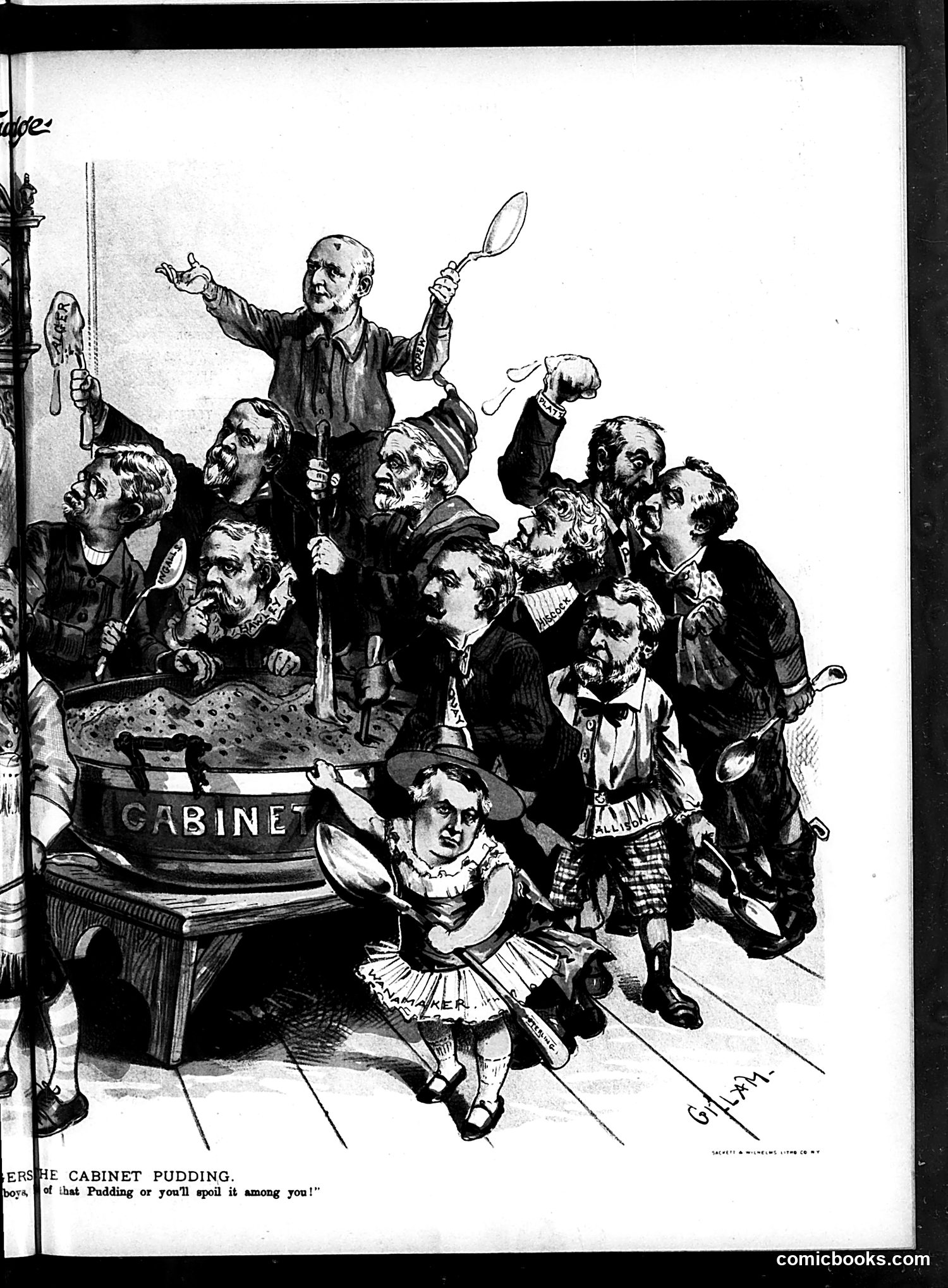
This political cartoon satirizes a government cabinet as a pudding that's being ruined by too many cooks. The central figure (standing elevated with a spoon) appears to be a leader attempting to manage subordinates crowded around a bowl labeled "CABINET." The numerous men in formal dress represent cabinet members or politicians quarreling over the mixture. The joke plays on the phrase "too many cooks spoil the broth"—suggesting that a cabinet with too many competing voices, egos, or factions cannot function effectively. The pudding metaphor implies the government's policy or unity is being destroyed by infighting and disagreement among officials. The reference to "Hershey" in the title is unclear from the image alone—it may reference a contemporary political figure or event, but this cannot be determined from the visible content.
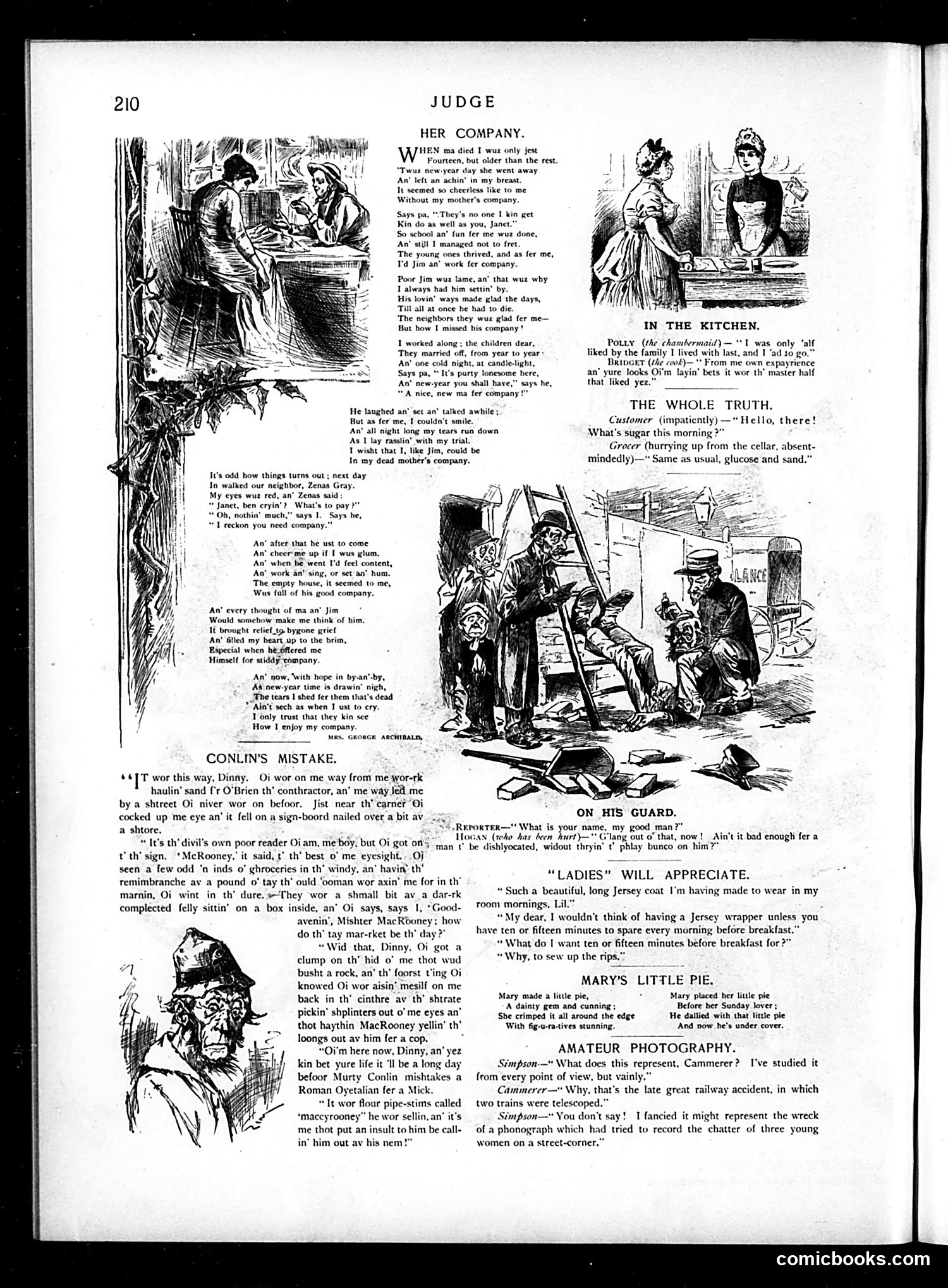
This page contains several humorous vignettes typical of late 19th-century American satirical journalism: **"Her Company"** (main poem): A sentimental narrative about a rural woman finding companionship after loss—first through work and a disabled neighbor (Jim), then through Zenas Gray, a neighbor suitor. It satirizes rural sentimentality and courtship customs. **Kitchen dialogue**: Servants discuss employment, implying masters' inappropriate behavior toward housemaids—a common satirical target of the era regarding class and sexual misconduct. **"The Whole Truth"**: A grocer admits selling adulterated sugar mixed with sand, exposing food fraud—a recurring concern in Gilded Age consumer advocacy. **"Conlin's Mistake"**: An Irish immigrant (heavy dialect) mistakes "McRooney" (grocery store) for "MacRooney" (person's name), playing on immigrant illiteracy and confusion. **Other items** mock fashion absurdities ("Jersey" wrappers), amateur photography, and marital dynamics. The satire targets working-class life, immigrant experience, commercial dishonesty, and gender relations—characteristic Judge content.
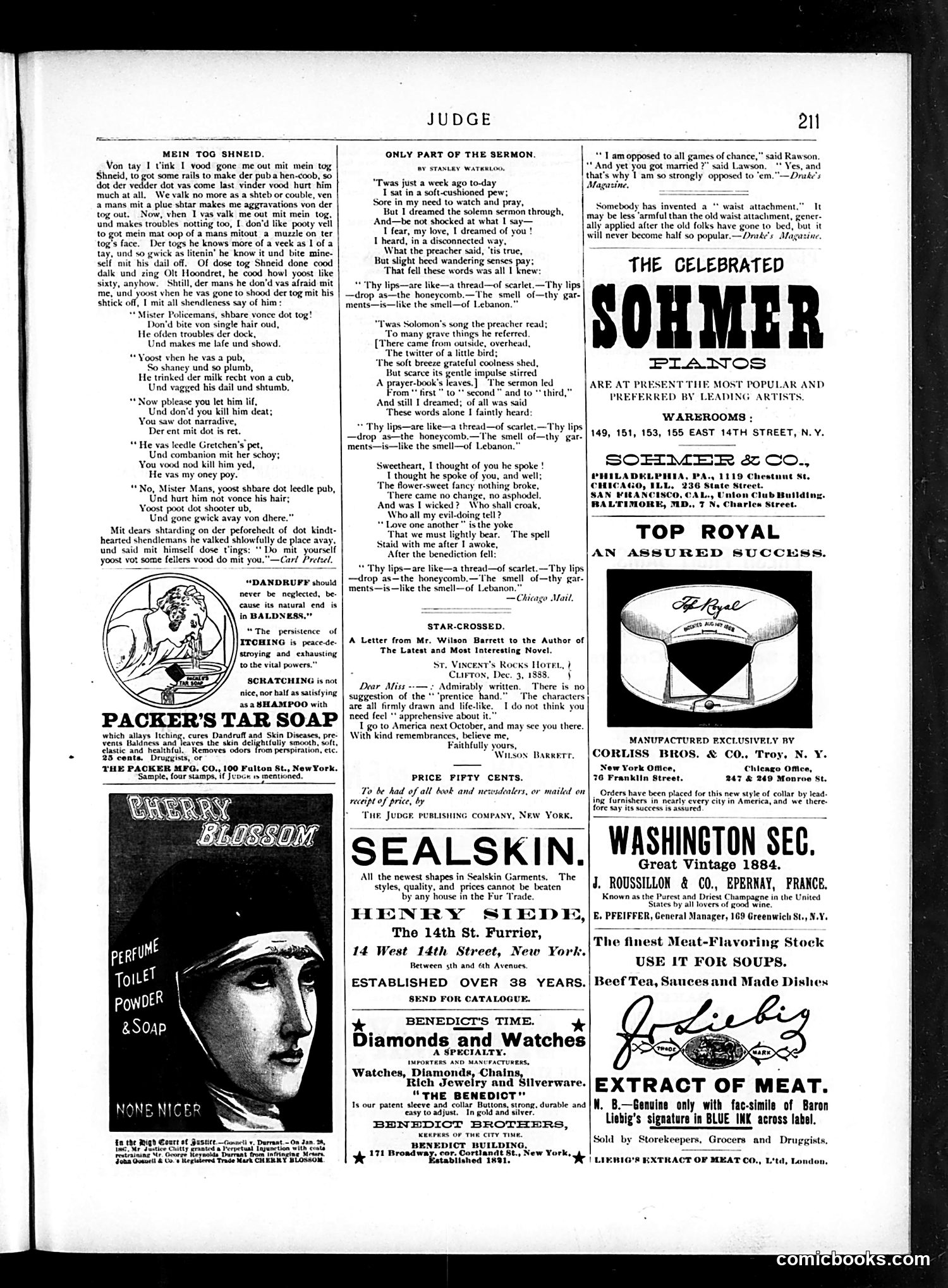
This page contains primarily **advertisements and poetry**, not political cartoons requiring historical context. The main literary content is a poem titled "Only Part of the Sermon"—a romantic piece about a man daydreaming during church about his sweetheart, fixating on sensual biblical verses (from Solomon's Song) the preacher happens to read. It's sentimental Victorian-era humor about distracted worship. The other substantial text piece, "Mein Tog Shneid" (attributed to "Carl Pretzel"), uses heavy German-immigrant dialect humor—common in 1880s American magazines—to tell a folksy story about a man defending his dog to a policeman. The dialect itself is the joke's vehicle. The page is dominated by period **product advertisements**: Packer's Tar Soap (dandruff cure), perfumes, jewelry, meat extract, sealskin garments, and pianos. These ads reflect late 19th-century consumer goods and concerns (baldness anxiety, respectability markers). There are **no identifiable political cartoons or figures** on this visible page section.
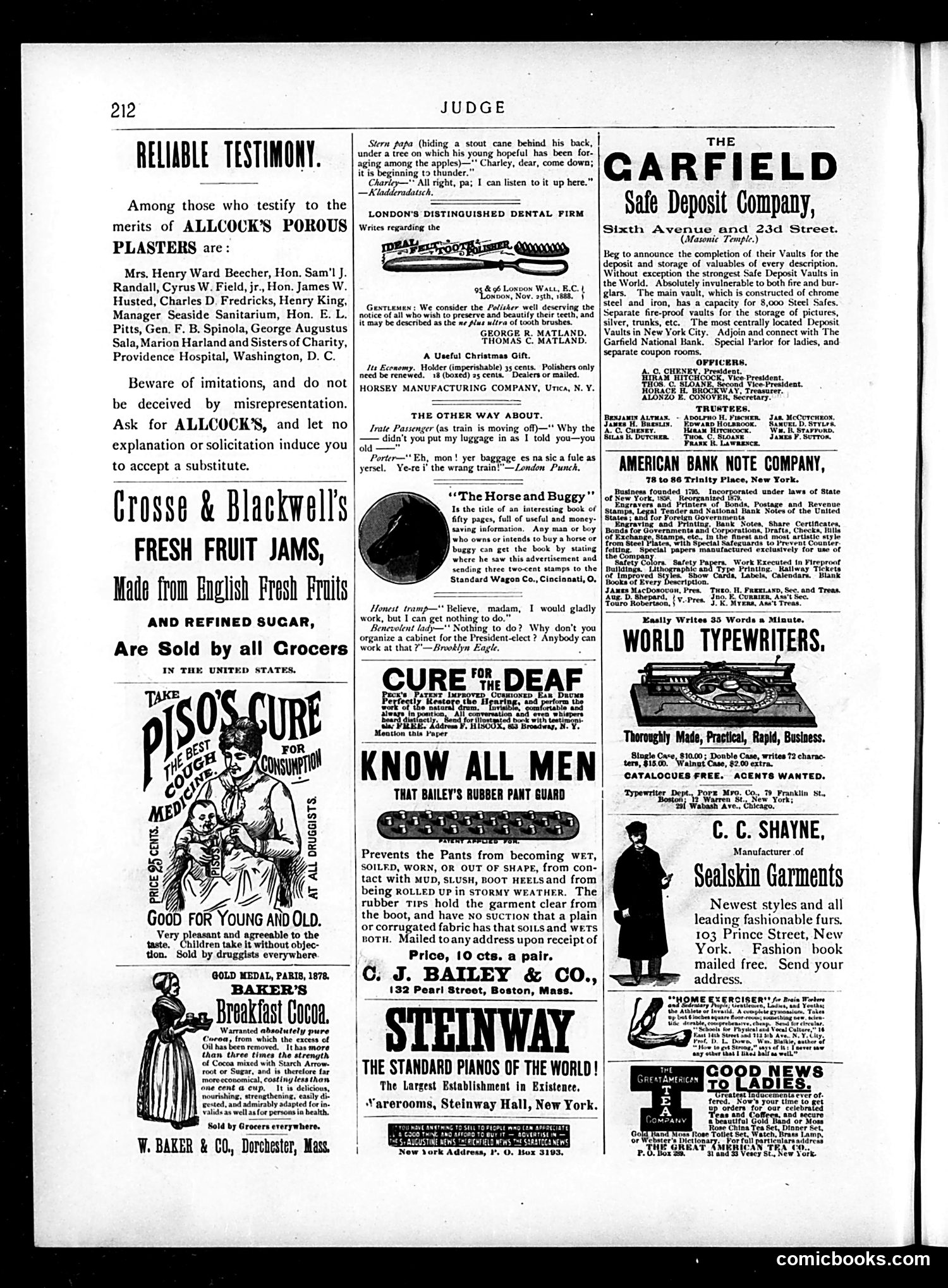
This is primarily an **advertising page** from Judge magazine, with minimal editorial cartoon content. The page features testimonial ads for various consumer products popular in the late 19th century: Allcock's Porous Plasters (pain relief), Baker's Breakfast Cocoa, Crosse & Blackwell's jams, Steinway pianos, and other goods. The few **humorous anecdotes** include: - A father threatening his son with a hidden cane during a thunderstorm (gentle family humor) - An exchange between an angry passenger and a Scottish train porter about luggage (ethnic dialect humor, typical of the era) - A joke about a vagrant refusing honest work, suggesting he "organize a cabinet for the President-elect"—likely mocking a contemporary political figure through absurdist humor The page reflects **turn-of-century consumer culture** and advertising strategies using celebrity endorsements (Henry Ward Beecher, etc.). The humor is mild, domestic, and focused on everyday inconveniences rather than sharp political satire.
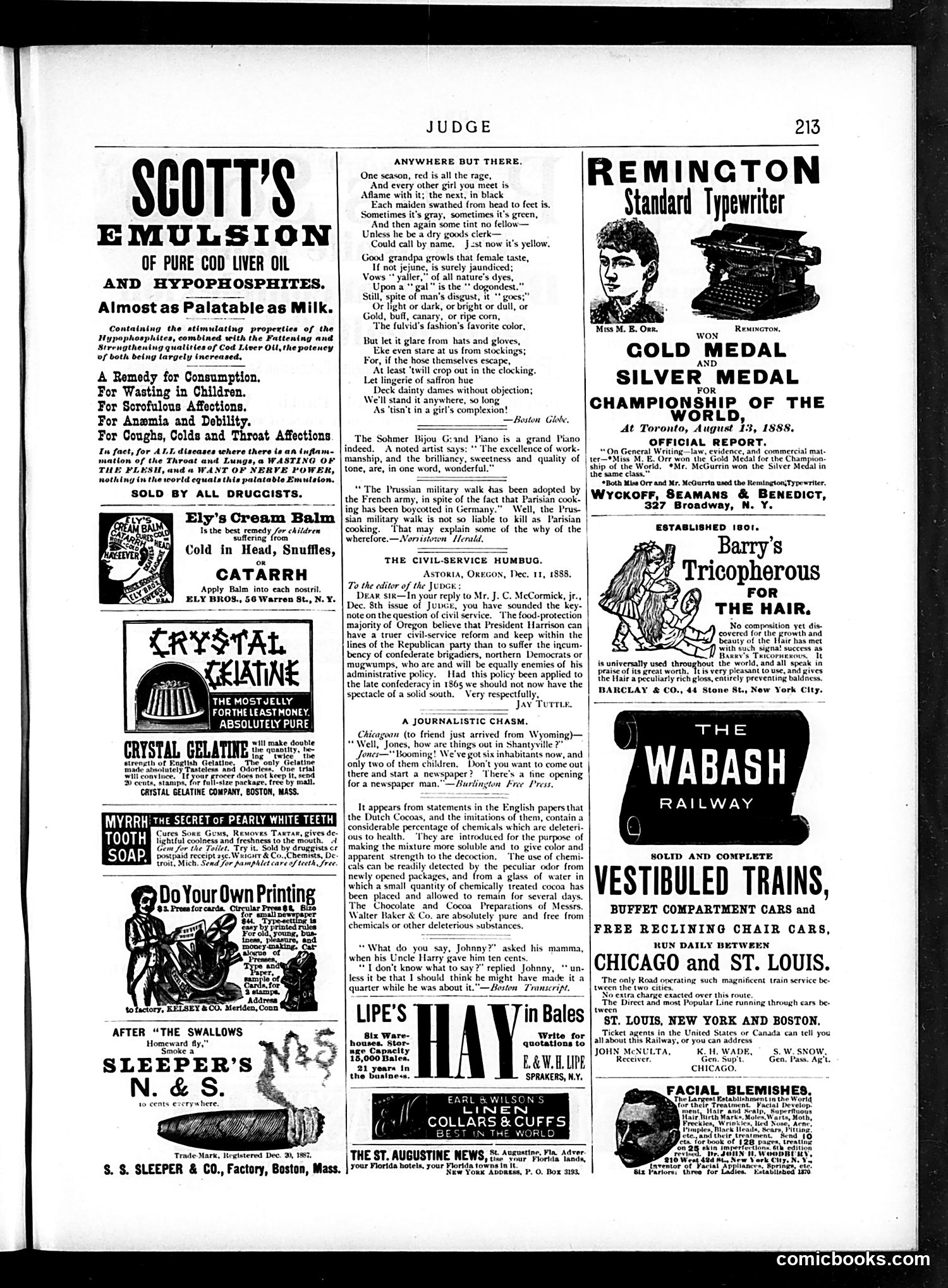
This page is primarily **advertisements and filler content**, typical of late-19th-century magazines. The main editorial content is a poem titled "Anywhere But There" satirizing women's fashion trends—specifically the recurring obsession with yellow clothing. The poem humorously notes that while men tolerate yellow in hats, gloves, and stockings, they draw the line at women wearing yellow face powder or complexion treatments, viewing it as ridiculous. A letter to the editor criticizes civil-service reform under President Harrison, arguing that Republican patronage is preferable to appointing Democrats or "mugwumps" (Republicans who switched parties). The remainder consists of patent medicine advertisements (Scott's Emulsion, Crystal Gelatine, Myrrh Tooth Soap) and commercial ads—typical Judge filler that subsidized the magazine's publication.
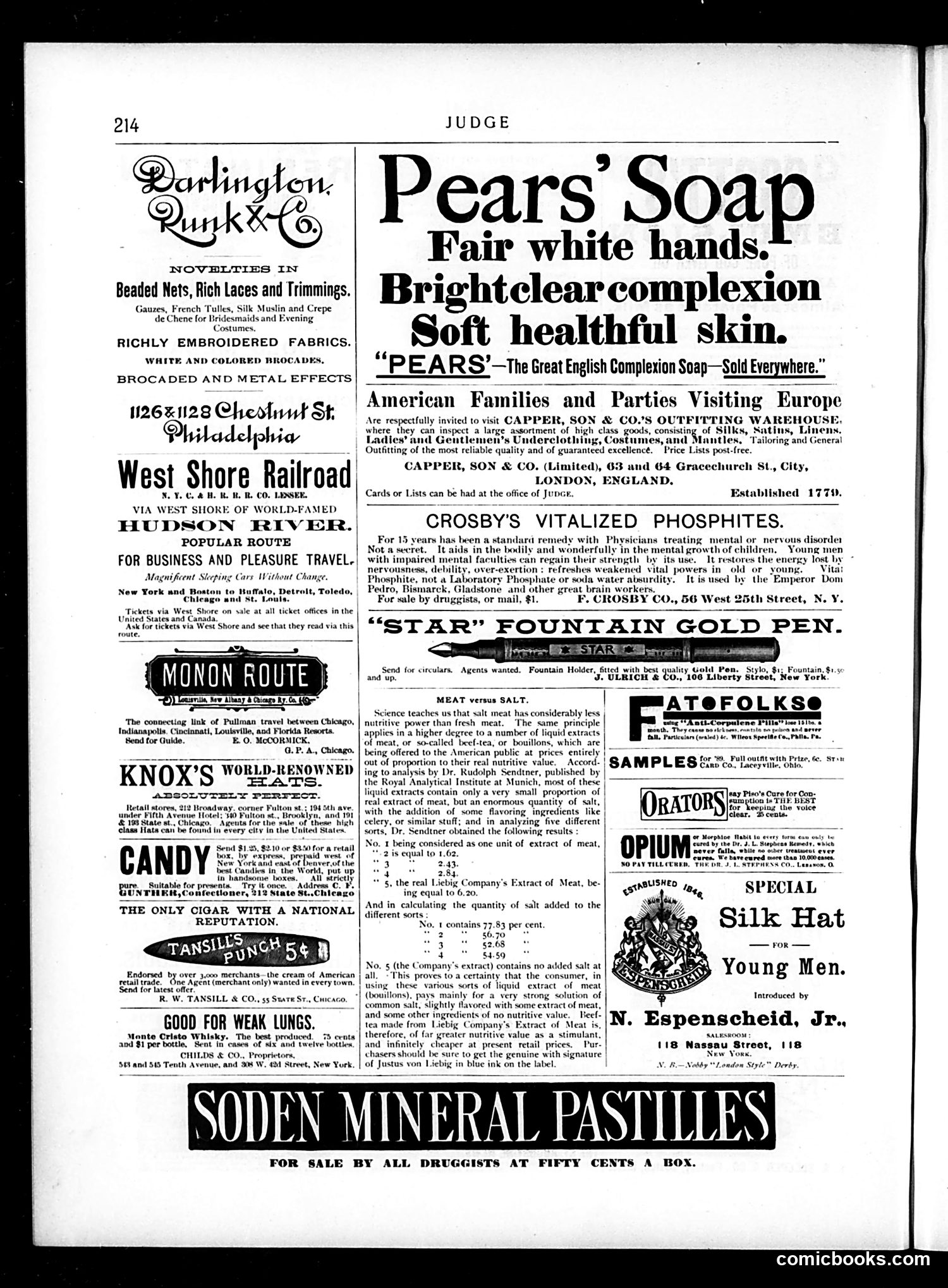
This page is **primarily advertisements**, not satirical cartoons. It's from *Judge* magazine but contains no political satire or editorial content visible. The ads reflect late-19th-century consumer culture and social attitudes worth noting: - **Pears' Soap** prominently advertises "fair white hands" and "bright clear complexion"—language reflecting period beauty standards and racial attitudes - **Knox's Hats**, **Tansill cigars**, and **Monte Cristo Whisky** target affluent male consumers - **West Shore Railroad** and **Capper's outfitting warehouse** cater to wealthy travelers and the upper class - **Crosby's Vitalized Phosphites** (a tonic) mentions endorsements by famous figures (Bismarck, Gladstone, Emperor Pedro), a common marketing tactic The page demonstrates how *Judge*'s audience was primarily wealthy, urban Americans interested in consumer goods, European travel, and patent medicines—typical late-Victorian advertising content mixed with the magazine's satirical mission elsewhere.
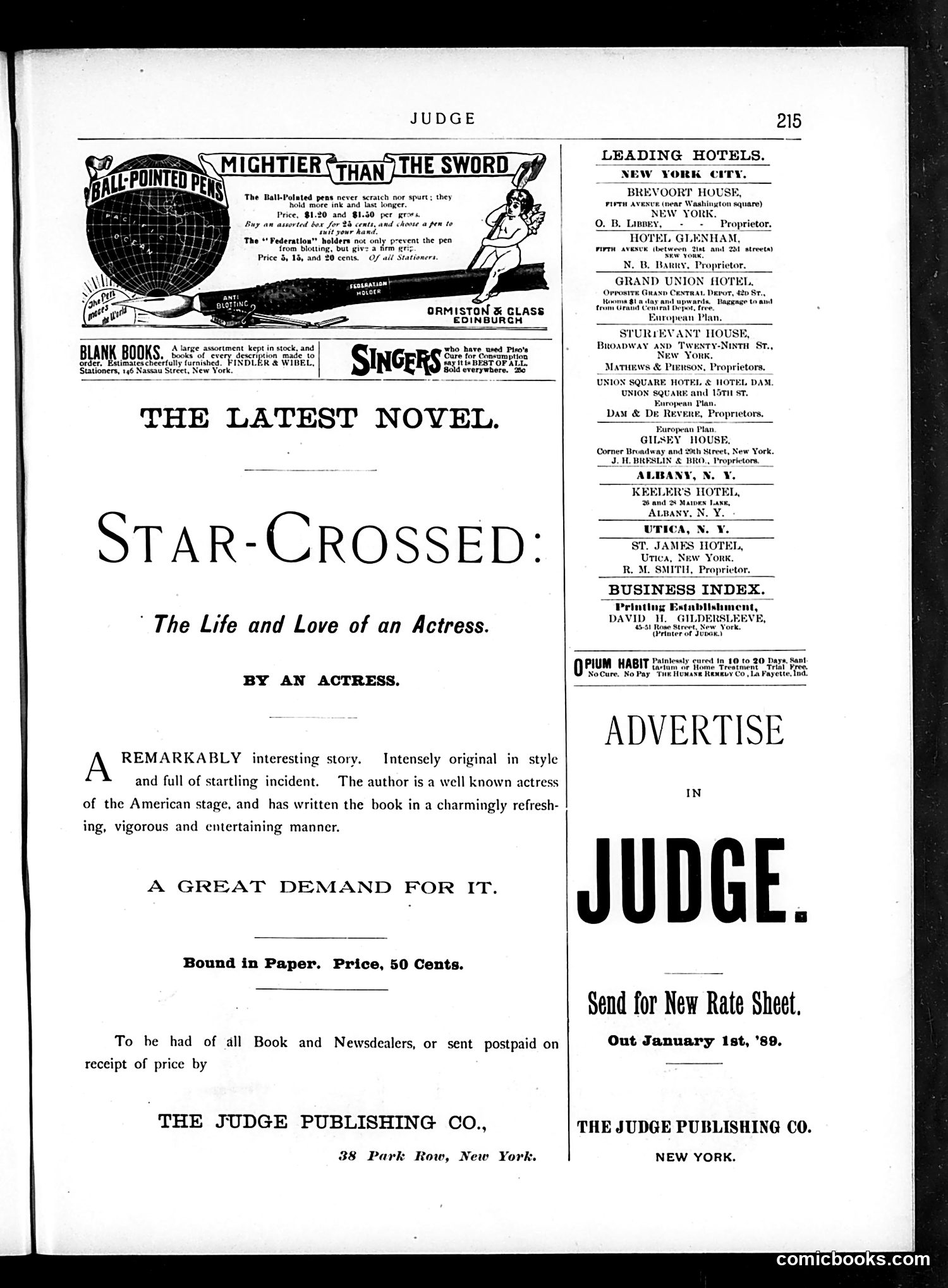
This page is **primarily advertising and announcements** rather than satirical content. It contains: **Main Advertisement:** "Star-Crossed: The Life and Love of an Actress" — a novel by an unnamed actress about theatrical life. The publisher emphasizes it's "remarkably interesting" and in high demand, priced at 50 cents. **Supporting Ads:** Multiple product advertisements typical of late-1880s publications — Ball-Pointed pens, blank books, Singer sewing machines, and a dubious "Opium Habit" cure. **Right Column:** Hotel listings for New York City, a business index, and a call for advertisers to place ads in *Judge* magazine, with a new rate sheet coming January 1st, 1889. **No political satire or recognizable caricatures appear on this page.** It functions as a commercial section of the magazine, mixing editorial promotion with period advertisements.
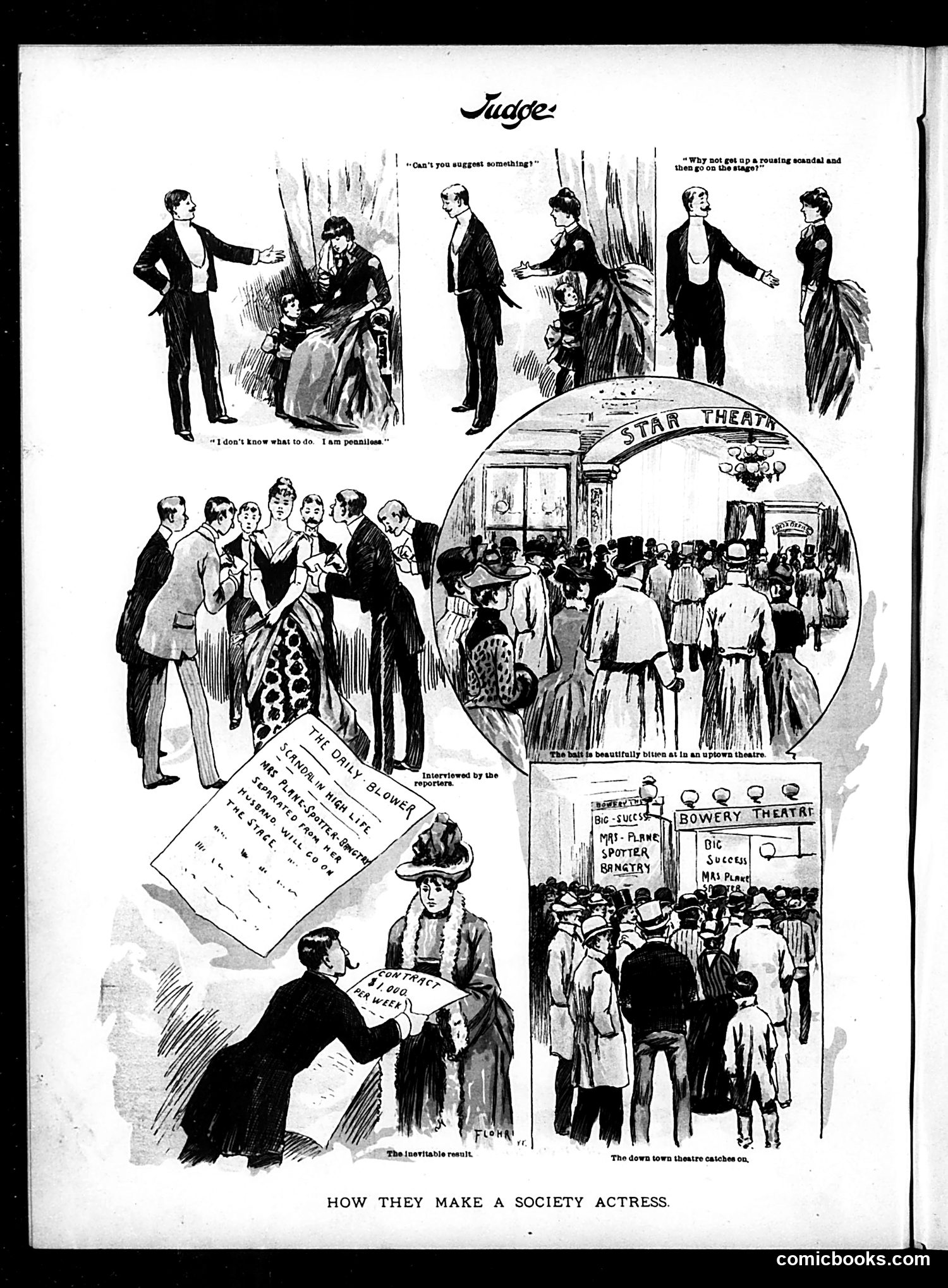
This satirical comic depicts the process of creating a theatrical star from high society. The sequence shows: 1. A wealthy man and woman (likely society patrons) discussing the woman's theatrical ambitions 2. Various scenes of promotion and networking among the elite 3. A ticket or program being distributed 4. Crowds gathering at the Star Theatre and Bowery Theatre The satire suggests that becoming a "society actress" isn't about talent—it's about wealthy patrons' connections and promotional machinery. The final panels show crowds being attracted to theaters through manufactured publicity rather than genuine artistic merit. The inclusion of both upscale and "down town" venues implies that society actresses could draw audiences regardless of venue quality, purely through their social status and the promotion backing them.