
A complete issue · 18 pages · 1888
Judge — December 15, 1888
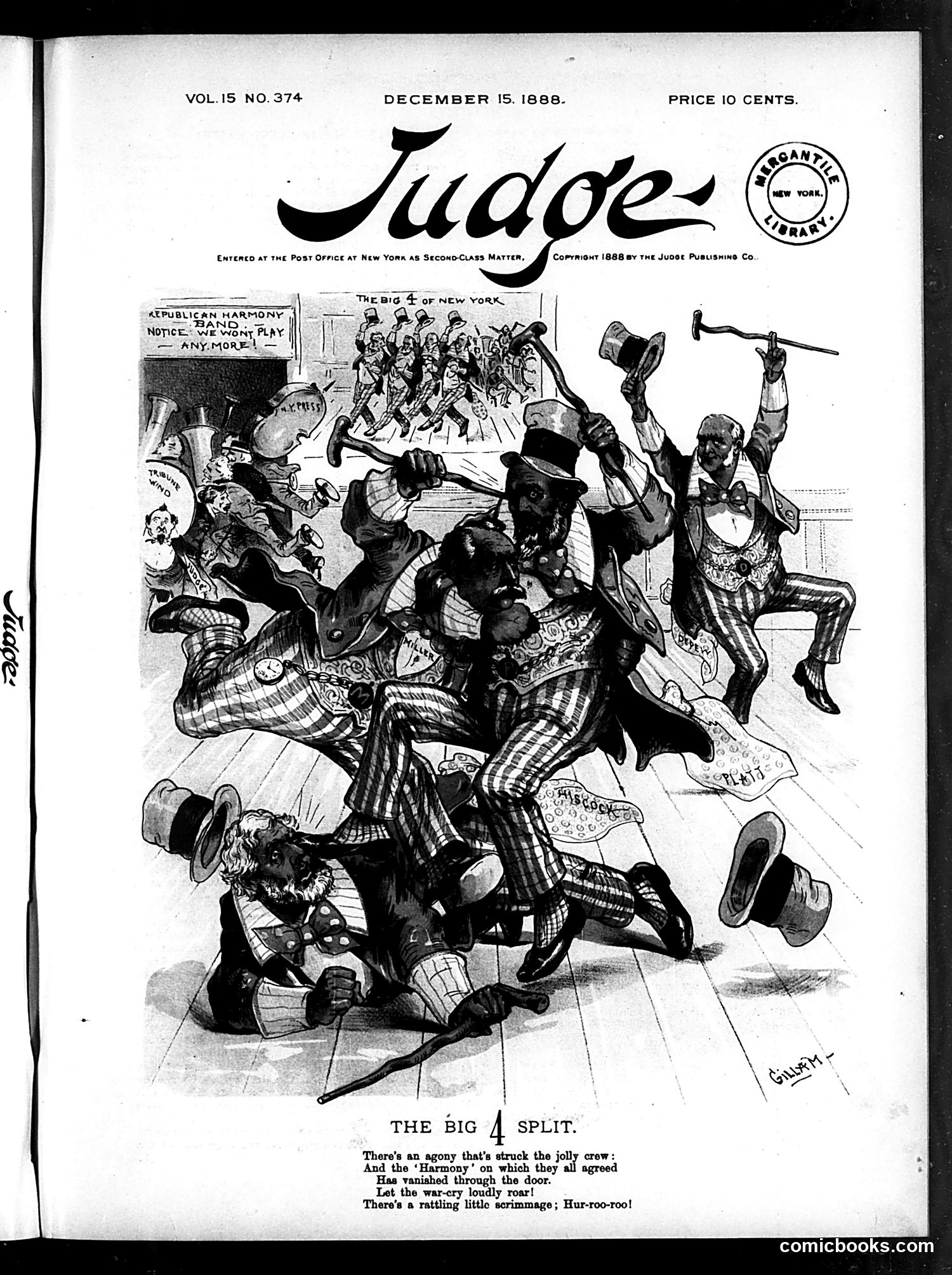
This cartoon satirizes a rupture in Republican leadership, likely referencing the 1888 presidential election aftermath. The "Big 4 of New York" (a sign visible in the background) appears to be four prominent Republican figures engaged in chaotic infighting—depicted as caricatured men in striped pants literally fighting and falling apart. The caption's reference to "Harmony" vanishing "through the door" and the "war-cry" and "rattling little scrimmage" reinforces that party unity has collapsed. The exaggerated violence and slapstick comedy emphasize how the Republican establishment has fractured into competing factions, unable to maintain cohesion. The specific identities of the "Big 4" remain unclear from this image alone, but the cartoon mocks internal party dysfunction during a crucial political moment.
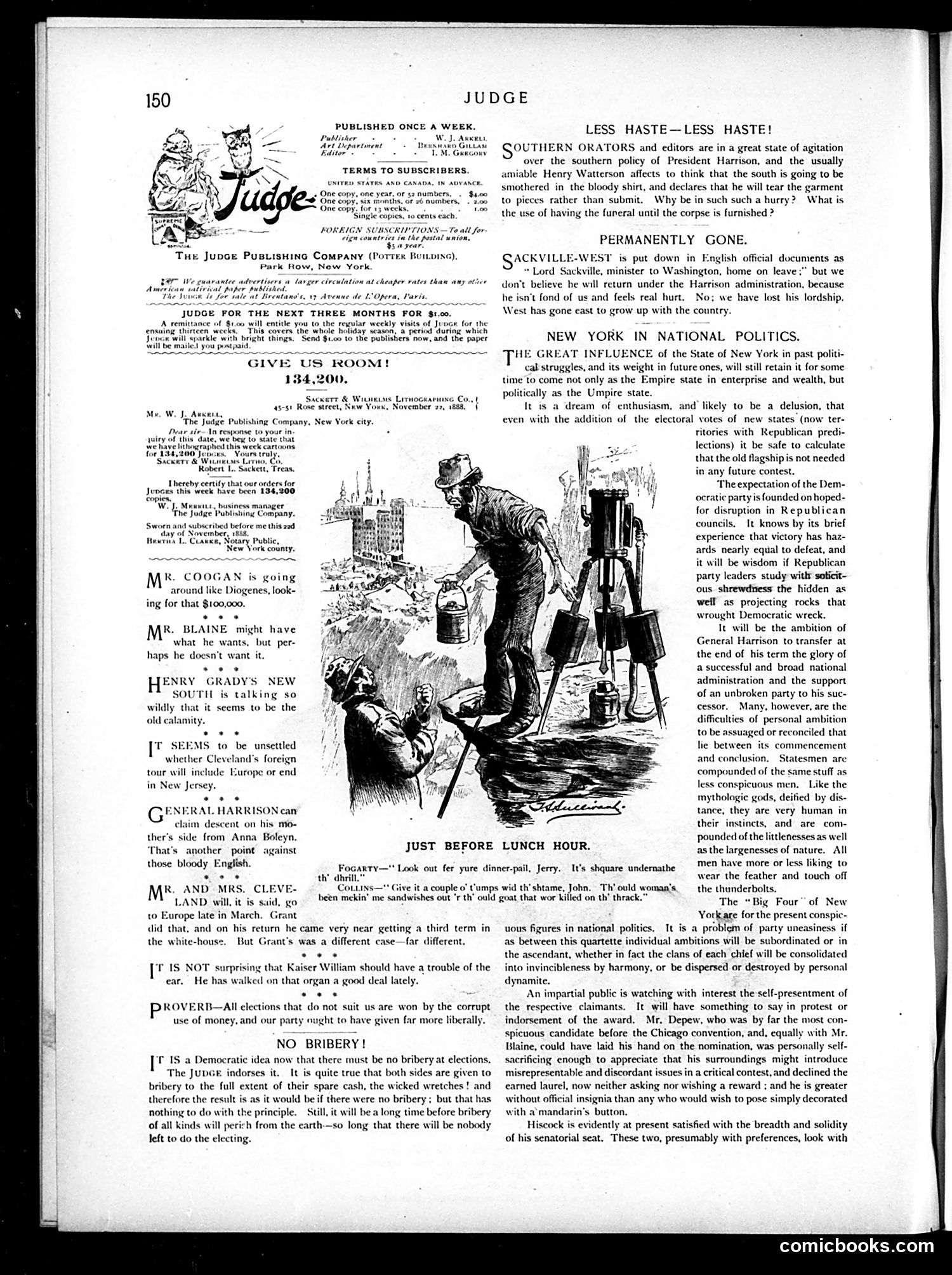
This cartoon depicts a working-class man (labeled "Jerry") attempting to retrieve his dinner pail from what appears to be a construction or industrial site. A well-dressed figure stands above, suggesting class conflict or labor disputes common in the Gilded Age/Progressive Era. The accompanying text references "Coogan" and "Blaine" in brief political jabs, and discusses Cleveland's foreign policy and Democratic/Republican party dynamics. The "No Bribery" section critiques electoral corruption. The cartoon's humor likely satirizes the contrast between wealthy industrialists/politicians and laborers struggling for basic subsistence—a central Progressive Era concern. The title suggests the worker's desperation and time constraints, mocking both labor conditions and possibly political hypocrisy about worker welfare.
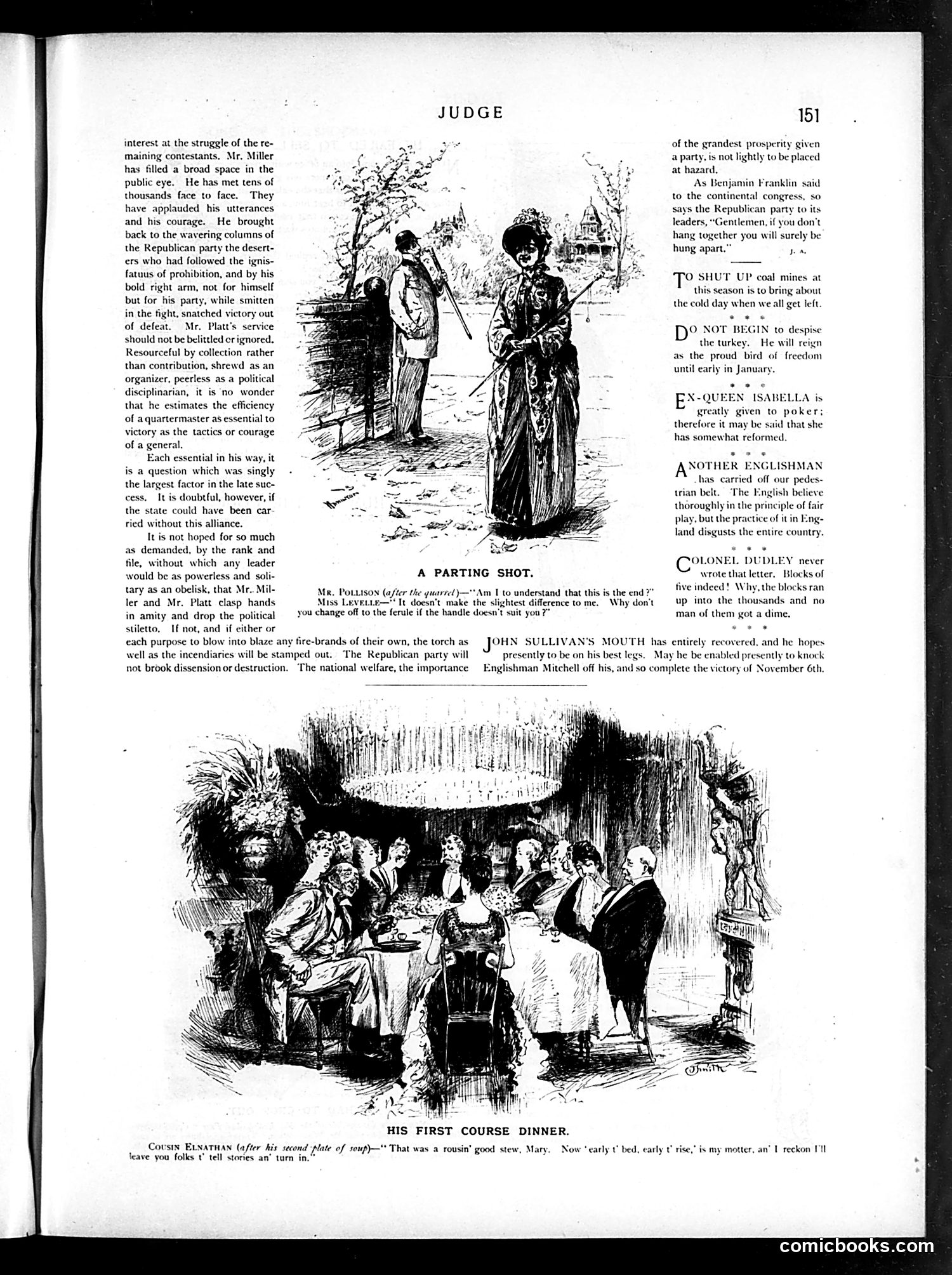
This page from Judge magazine contains political commentary on the 1896 U.S. election. The main text discusses Republican Party unity, praising both "Mr. Miller" (likely William McKinley) and "Mr. Platt" (likely Thomas Platt, Republican political boss), urging them to work together despite tensions ("clasp hands in amity and drop the political stiletto"). The two illustrations satirize contemporary figures and issues: **"A Parting Shot"** depicts a quarrel between Miss Levey and Mr. Pollison, using domestic discord as metaphor for political disagreement—the couple bickering over whether to change course. **"His First Course Dinner"** shows Cousin Elnathan's rustic dinner scene, likely mocking rural/working-class voters and their political awareness. The scattered short items mock figures like Colonel Dudley (apparently involved in vote-buying scandals), boxer John Sullivan, and reference the presidential election completion on "November 6th"—establishing this as from late 1896. The satire emphasizes Republican internal tensions and election mechanics of the Gilded Age.
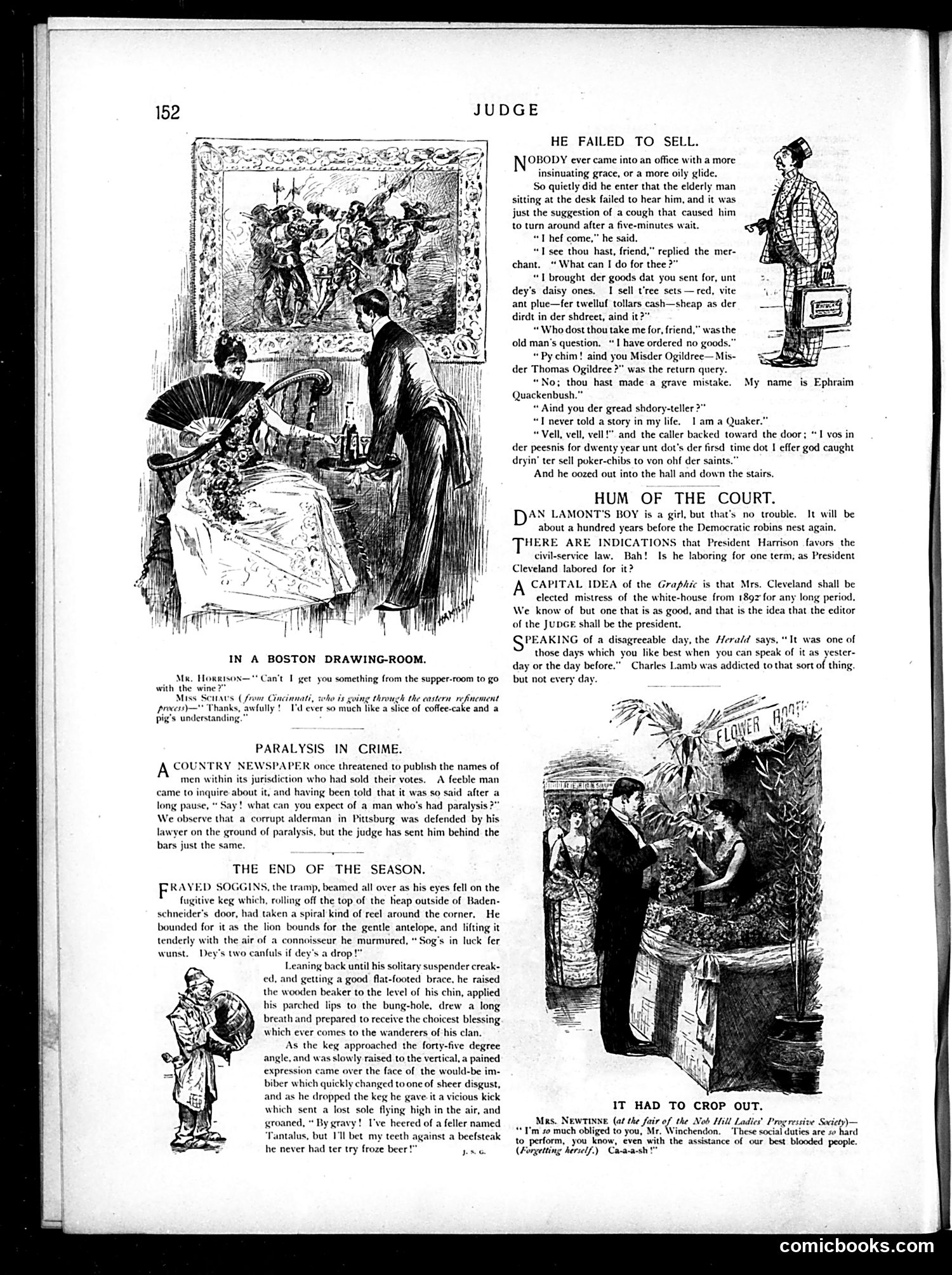
This page contains three satirical pieces typical of Judge's turn-of-the-century humor: **"In a Boston Drawing-Room"**: A brief social joke mocking a Cincinnati woman's pretentious attempt at Eastern refinement—she requests "coffee-cake" with wine, revealing her lack of sophistication. **"Paralysis in Crime"**: Sharp political satire about corruption. It references a Pittsburgh alderman who attempted to use "paralysis" as a legal defense against bribery charges. The piece mocks this excuse, noting the judge rejected it and imprisoned him anyway—suggesting criminals' excuses won't protect them from justice. **"He Failed to Sell"**: A comedic vignette about a pushy German-accented salesman (rendered in heavy dialect) who mistakes a Quaker businessman for someone else, attempting to sell poker chips to a man who explicitly doesn't want goods. The "Hum of the Court" section contains brief political jabs at President Harrison's civil-service reform efforts and jokes about Democratic politics and Mrs. Cleveland. Overall, the page reflects Judge's focus on social pretension, political corruption, and ethnic humor common to 1890s American satire.
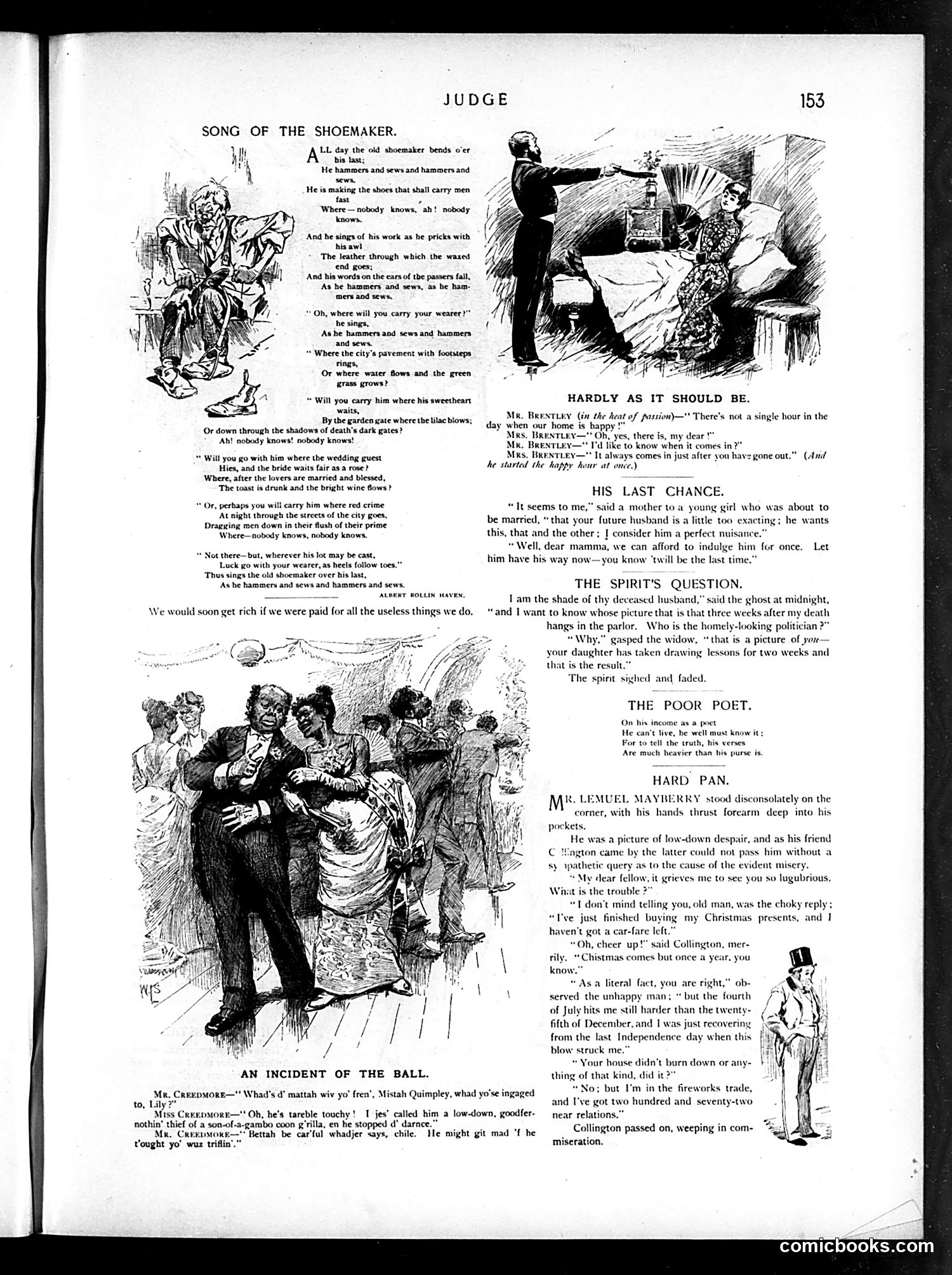
This page contains several satirical pieces typical of late 19th-century American humor: **"Song of the Shoemaker"** is sentimental verse about a humble craftsman contemplating where his shoes will carry their wearers—to love, crime, or death. It's moralistic rather than political satire. **"Hardly as It Should Be"** mocks marital discord through a domestic joke: a husband complains their home is never happy; the wife reveals happiness only occurs after he leaves. **"His Last Chance"** satirizes a bride's naive assumption that indulging her groom's demands now won't persist after marriage—a cynical commentary on matrimonial power dynamics. **"Hard Pan"** depicts a poor poet (Lemuel Mayberry) financially devastated by Christmas shopping, revealing working-class economic anxiety during the holiday season. These pieces use humor to address class struggle, domestic relations, and economic hardship—concerns relevant to Judge's middle-class readership during the Gilded Age.
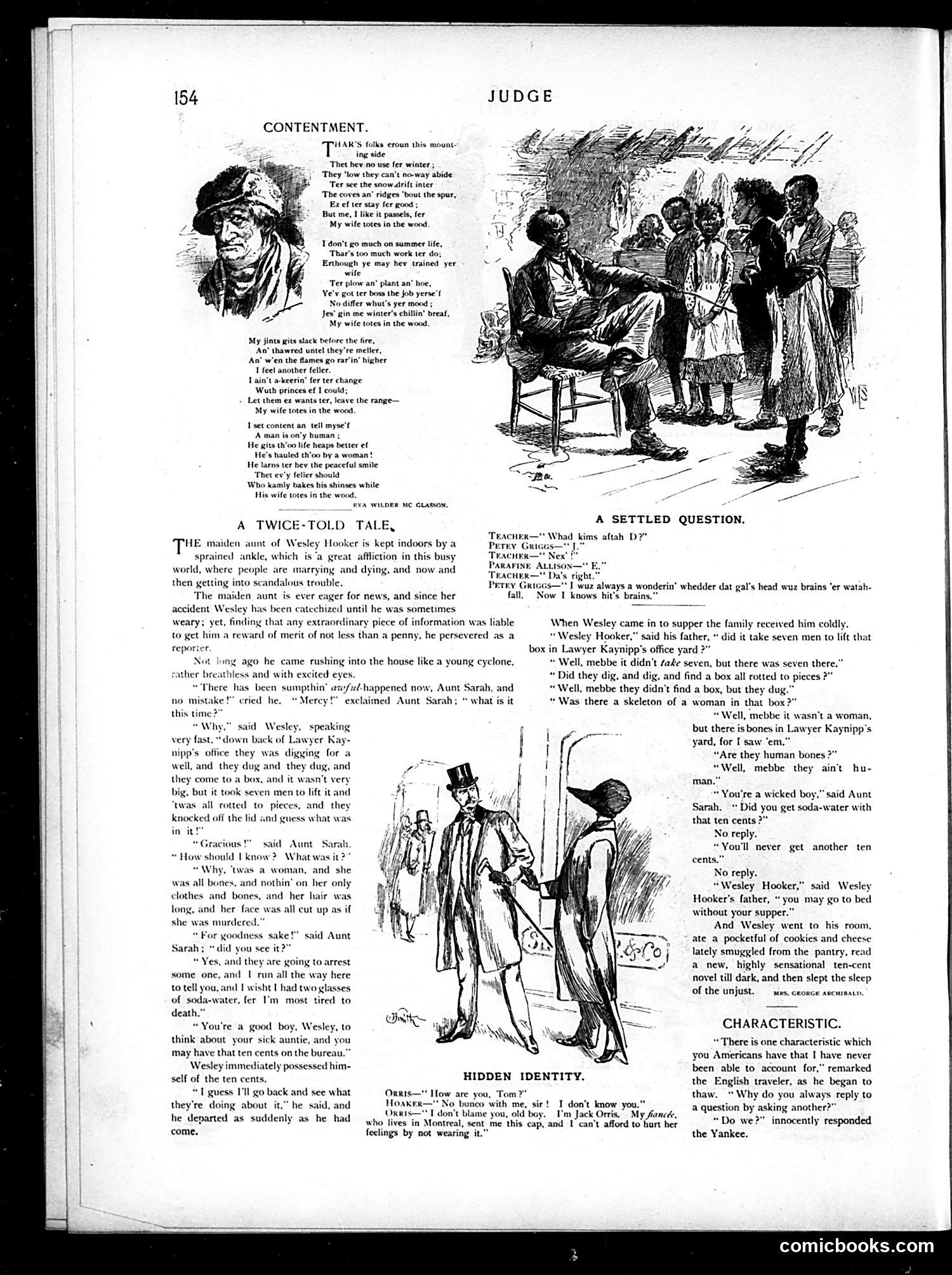
This page from the satirical magazine **Judge** contains three unrelated pieces of humor typical of late 19th/early 20th-century American popular entertainment: **"Contentment"** is a dialect poem celebrating rural life, where a contented man appreciates winter because "my wife totes in the wood"—finding satisfaction in domestic comfort despite labor. **"A Twice-Told Tale"** satirizes a boy's unreliable storytelling. Young Wesley excites his aunt with a sensational story about discovering a murdered woman's skeleton, but when his father questions him, Wesley admits he embellished—they found only a box, no body. The humor mocks children's tendency to exaggerate for attention and reward. **"A Settled Question"** features a racial dialect joke where a Black character resolves whether a girl has "brains or water" in her head through crude logic. **"Hidden Identity"** plays on a man wearing an unfamiliar cap from his fiancée in Montreal, creating comic confusion. The cartoons use period stereotypes and broad humor conventions now considered offensive.
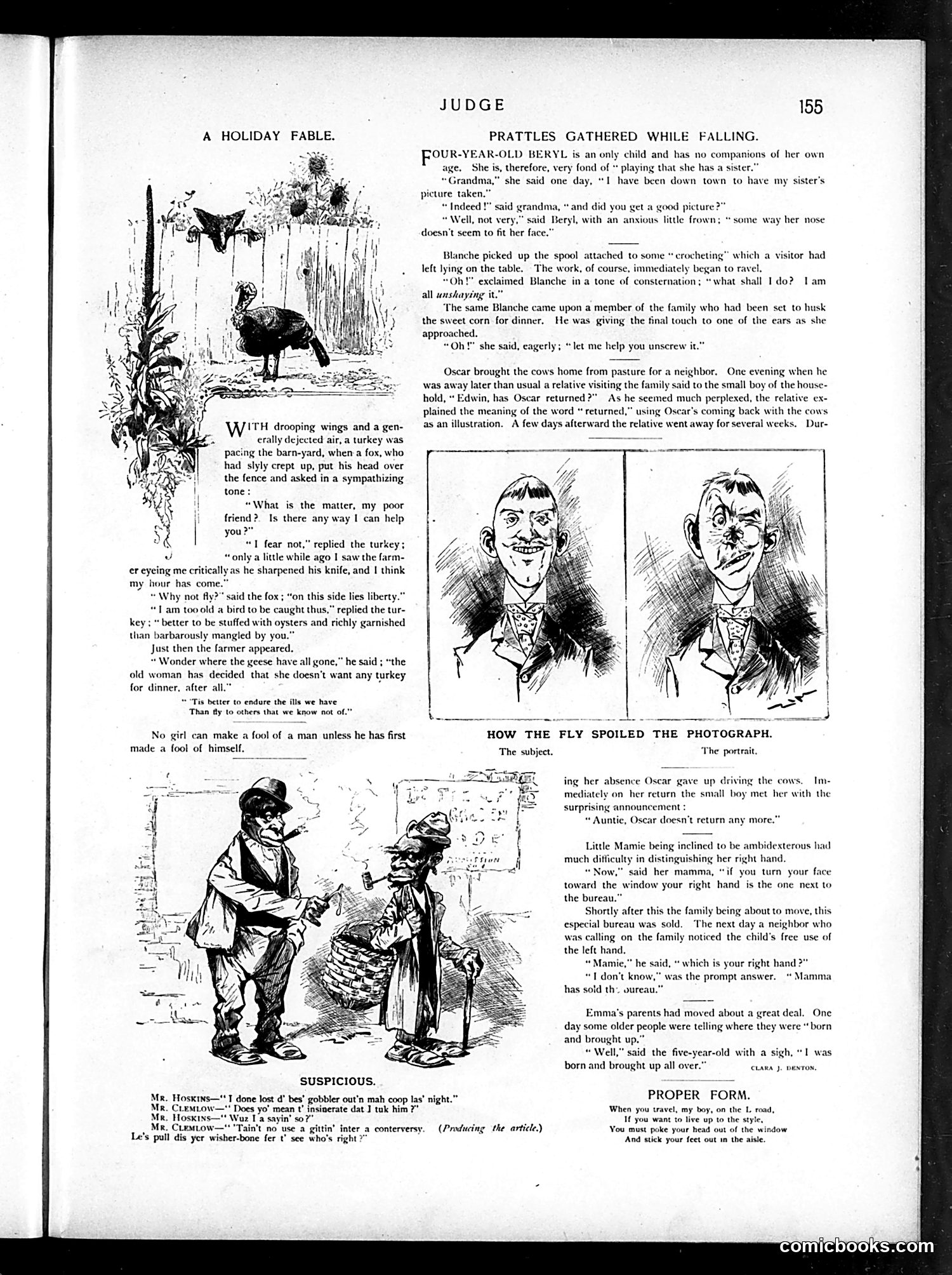
This page contains **fables and humorous anecdotes** rather than political cartoons. The content includes: **"A Holiday Fable"**: A moral tale where a turkey chooses dignified death (stuffed with oysters) over undignified escape, illustrating the proverb "better to endure known ills than unknown." **"Prattles Gathered While Falling"**: A series of children's misunderstandings of adult language—Beryl worries her nose "doesn't fit her face" in a photograph; Blanche tries to "unscrew" corn; a child thinks Oscar the cow won't "return" anymore. These jokes exploit children's literal interpretations of adult idioms. **"Suspicious"**: A dialect-heavy exchange between rural characters (likely representing working-class or ethnic types) disputing a missing turkey, ending with a wishbone-pulling bet to settle the argument. The page reflects **late 19th/early 20th-century humor conventions**: sentimental morality tales, child-centered comedy, and comic ethnic/rural dialect humor. No clear political satire is evident here.
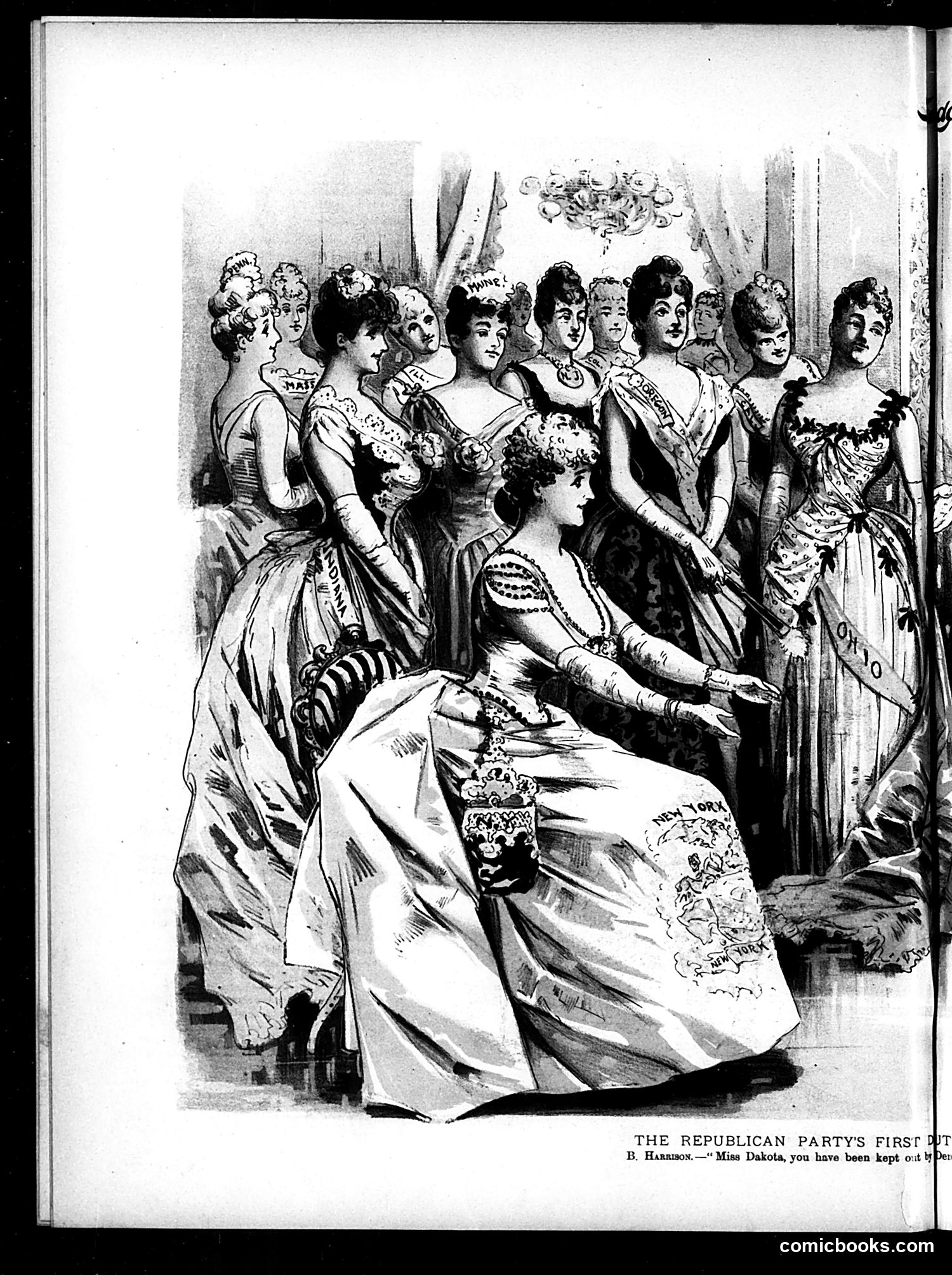
This cartoon, titled "The Republican Party's First [Ball]," depicts a seated woman (labeled "Miss Dakota") being presented to a group of elegant women at what appears to be a formal reception or debutante ball. The caption references B. Harrison (likely President Benjamin Harrison) welcoming "Miss Dakota" into society. The satire likely comments on Dakota's recent admission to the Union (North and South Dakota joined in 1889). The cartoon treats statehood as a social debut, with the new state personified as an awkwardly-dressed newcomer being introduced to the established "society" of existing states. This mockingly suggests Dakota was inexperienced or rough compared to the refined Eastern establishment, reflecting late-19th-century regional tensions and attitudes toward Western expansion.
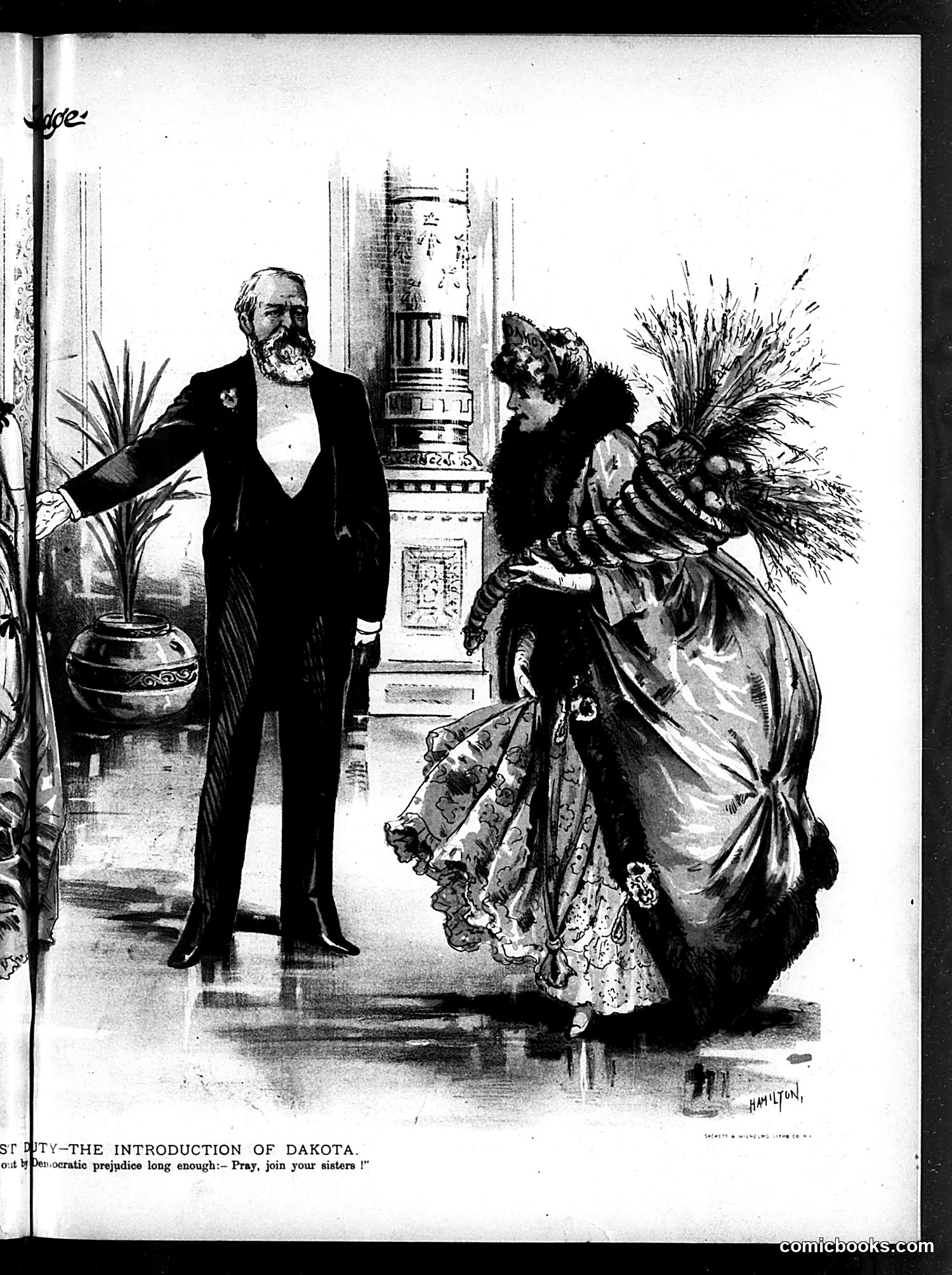
This Judge cartoon satirizes the admission of Dakota Territory to statehood. A bearded gentleman (likely representing a government official or politician) formally "introduces" Dakota—depicted as two elaborately dressed women—to "Democratic prejudice," personified as a stern older woman on the right. The caption reads: "Democratic prejudice long enough!—Pray, join your sisters!" The satire suggests that Dakota's admission represents an unwelcome political development for Democrats, who feared Republican-leaning new states. The "introduction" framing treats statehood as a social presentation, mocking Democratic resistance to westward expansion and new states entering the Union during this period.
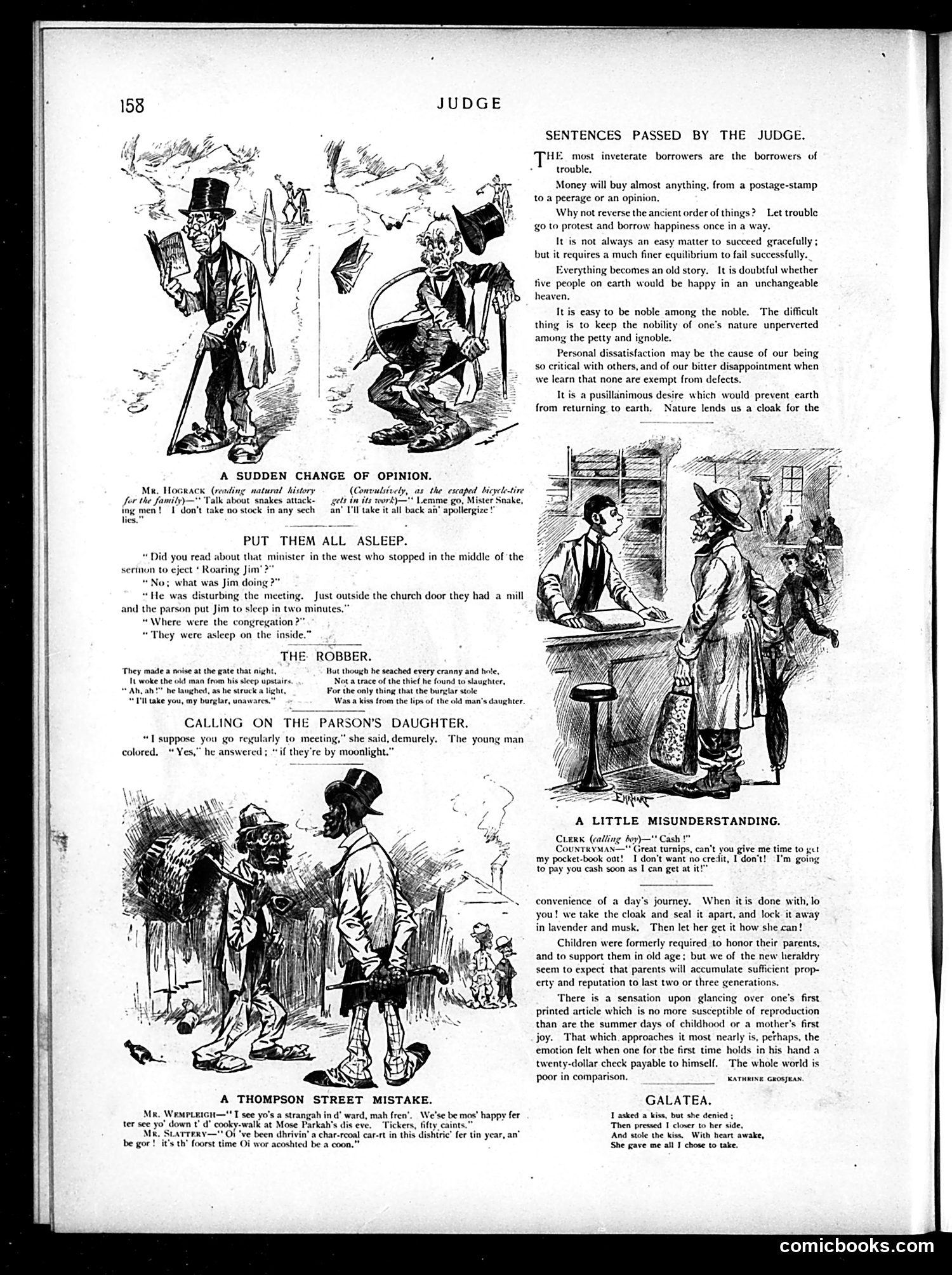
This page from the satirical magazine *Judge* contains multiple humor pieces typical of late 19th-century American comedy: **"A Sudden Change of Opinion"** mocks a man reading natural history who encounters an escaped bicycle tire, which he mistakes for a snake and apologizes to profusely—humor based on mistaken identity and exaggerated fear. **"Put Them All Asleep"** and **"The Robber"** are anecdotal jokes about a minister ejecting a disruptive congregant, and a burglar stealing only a kiss from an old man's daughter—typical sentimental-comedic narratives. **"A Thompson Street Mistake"** appears to contain ethnic dialect humor (Irish and African American characters), common but now-offensive comedy of this era. The page also includes philosophical aphorisms labeled "Sentences Passed by the Judge" on topics like borrowing, failure, and nobility—reflecting *Judge's* role as both satirical and moralistic publication. Overall, this represents genteel Victorian-era humor mixing social observation with ethnic caricature.
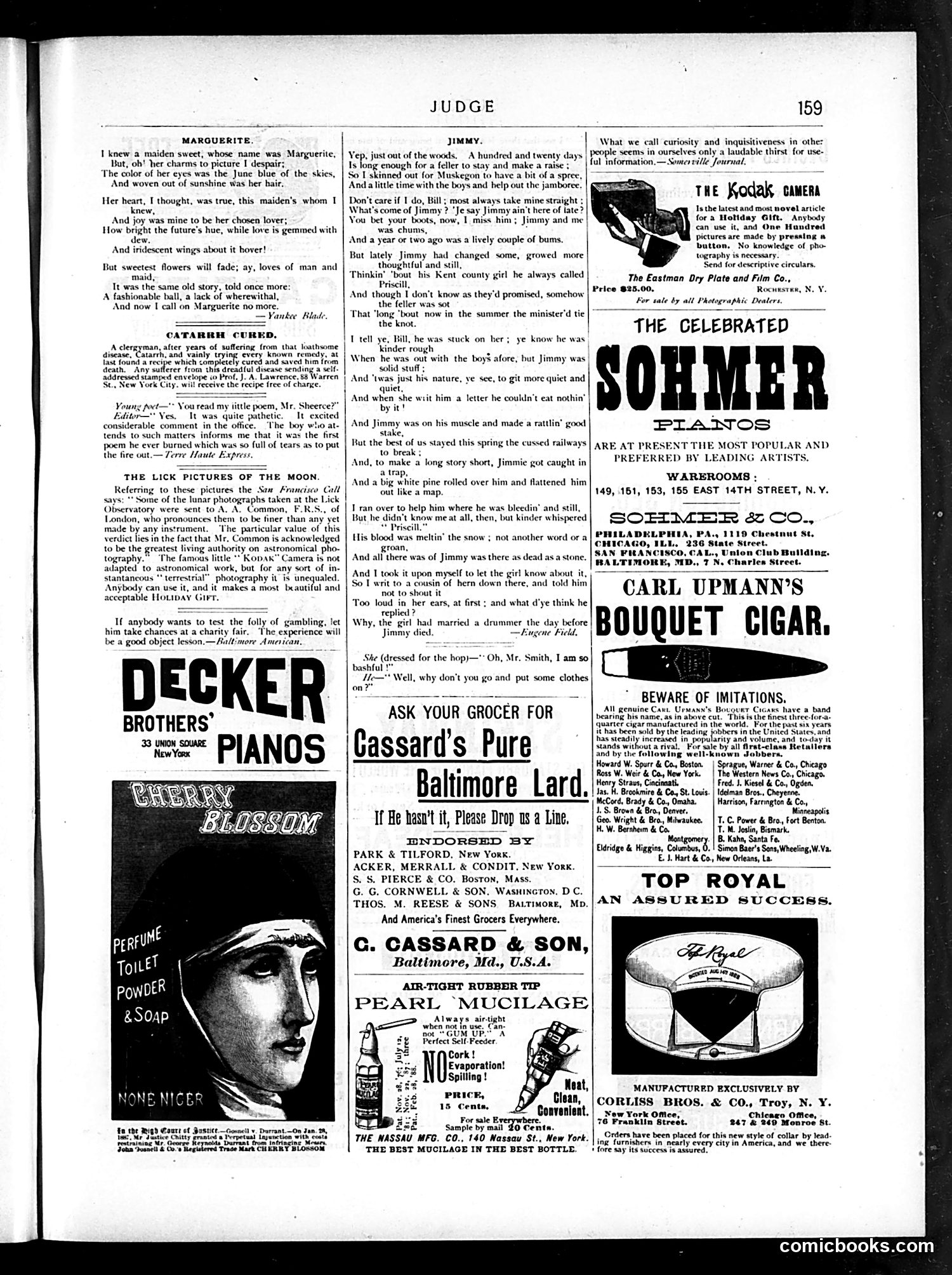
This page is primarily **literary and advertising content** rather than political satire. The main text presents three pieces: 1. **"Marguerite"** — A sentimental poem (credited to *Yankee Blade*) about a man who courts a beautiful woman but stops visiting after she attends a fancy ball, apparently due to class/financial differences. The joke is the cliché nature of this "same old story." 2. **"Jimmy"** — A longer narrative poem about working-class men in Michigan. Jimmy falls in love with a girl named Priscilla, improves his life to marry her, but is killed in a logging accident (a pine tree crushes him). It's a melodramatic tragedy, not satire. 3. **Editorial jokes** mocking submitted poems as poorly written. The rest consists of **period advertisements** for pianos, perfume, lard, cigars, and other products—typical of *Judge* magazine's revenue model. No identifiable political figures or events appear on this page.
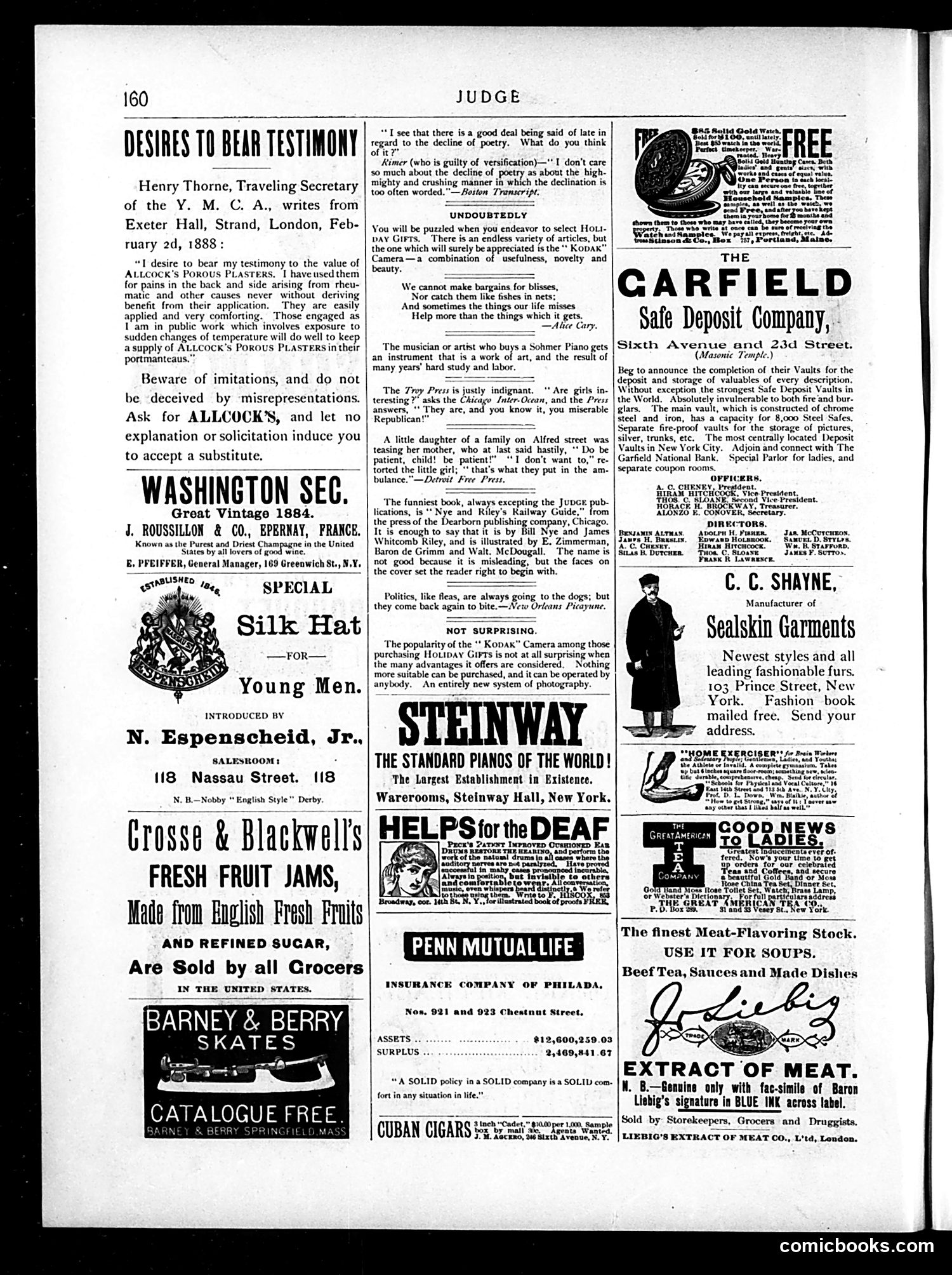
**Content Overview:** This page is primarily **advertising**, not political satire. It contains various commercial endorsements and product advertisements typical of late-19th-century publications. **Notable Elements:** The page opens with a letter from Henry Thorne of the Y.M.C.A. endorsing Allcock's Porous Plasters—a testimonial format common in patent medicine advertising. The text warns against imitations, a significant concern in an era with minimal product regulation. **Satire Present:** The only cartoon content is a brief joke about a "Rimer" complaining that critics are rude about poetry's decline—a gentle literary jab at intellectual pomposity. **Key Advertisements:** - Kodak cameras (promoted as ideal holiday gifts) - Sohmer pianos - Steinway pianos - Silk hats - Jam and skates The page reflects both the magazine's dual nature as satire and advertising vehicle, and period concerns: testimonial-based marketing, patent medicines, and unreliable product authenticity in unregulated markets.
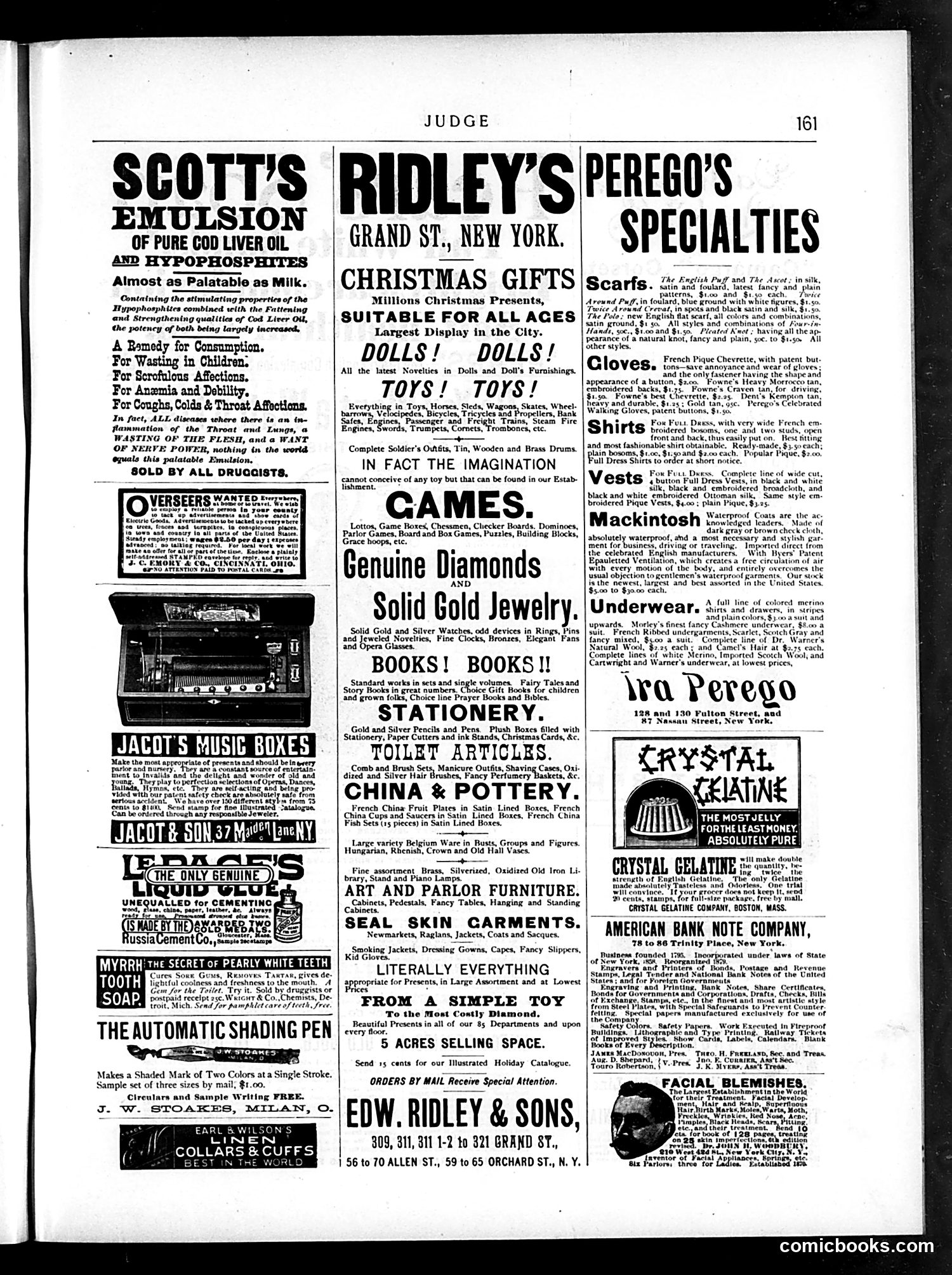
This page is **primarily advertisements**, not political cartoons or editorial satire. It's from Judge magazine's advertising section, featuring typical late-19th-century product pitches: Scott's Emulsion (cod liver oil tonic), Jacot's Music Boxes, Myrrh Tooth Soap, and Ridley's department store Christmas gift catalog. The only substantive content is Ridley's extensive holiday shopping advertisement, listing toys, games, jewelry, books, furniture, and household goods—representing the commercial Christmas culture of the era. There are **no political cartoons, caricatured figures, or satirical commentary** visible on this page. Judge's actual satirical content would appear elsewhere in the magazine. This is purely a commercial page showcasing products marketed to affluent American consumers, demonstrating how magazines monetized advertising space during this period.
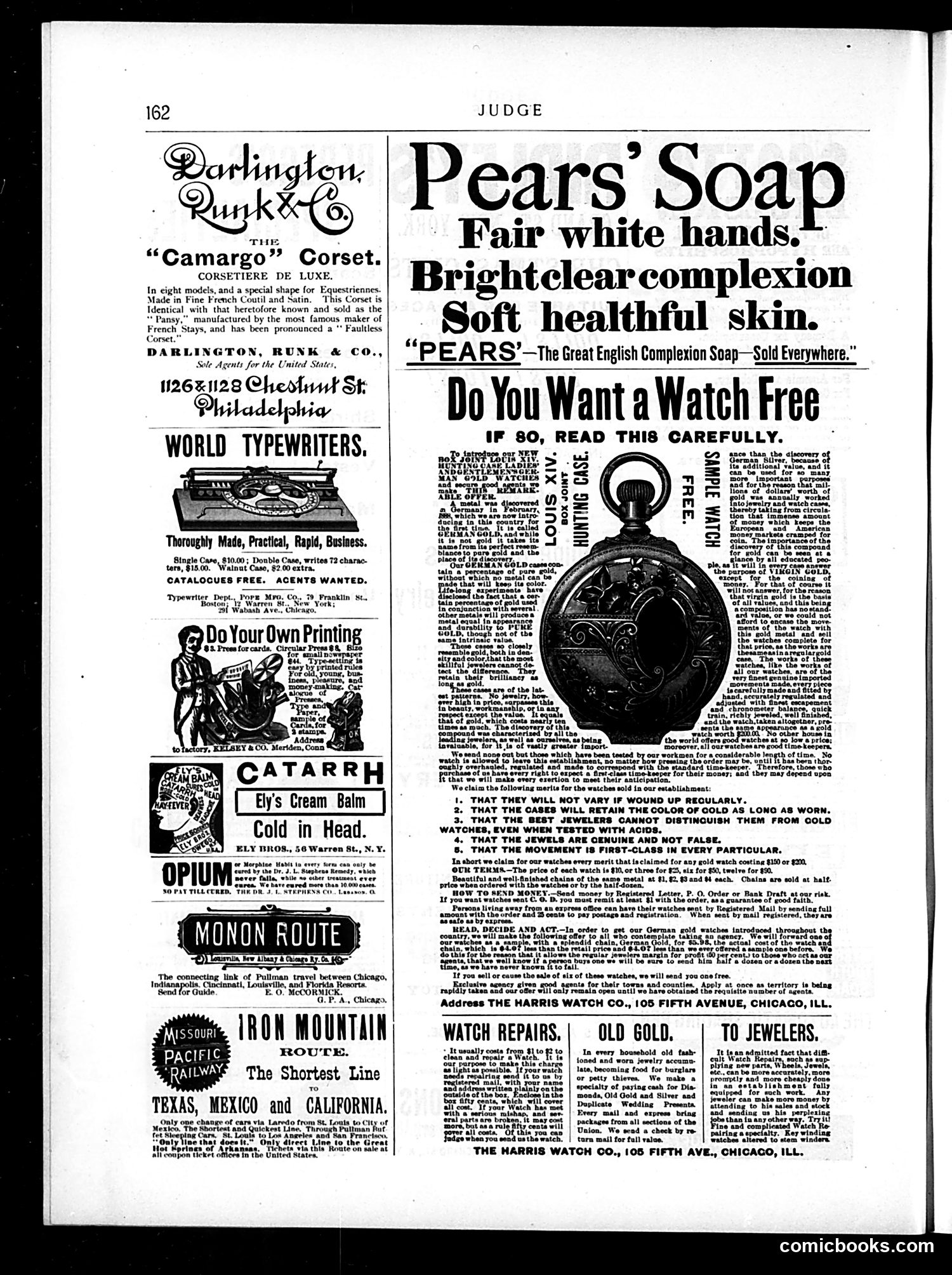
This page is primarily **advertising**, not satire or editorial content. It contains various commercial advertisements typical of late 19th-century publications. The most prominent ad is for **Pears' Soap**, emphasizing beauty standards of the era: "fair white hands," "bright clear complexion," and "soft healthful skin"—reflecting period ideals about genteel appearance. Below that is a lengthy pitch for **free watches** from the Harris Watch Company. The extended text makes exaggerated claims about German gold watches being indistinguishable from solid gold, durable, and reliable—using pseudo-scientific language to overcome customer skepticism about an apparently too-good-to-be-true offer. Other ads include corsets, typewriters, printing presses, patent medicines (catarrh balm, opium treatments), and railroad routes. The page reflects Gilded Age consumer culture: mass-produced goods marketed through hyperbolic claims, targeting middle-class aspirations for refinement and modern conveniences. There is **no visible political satire** on this page.
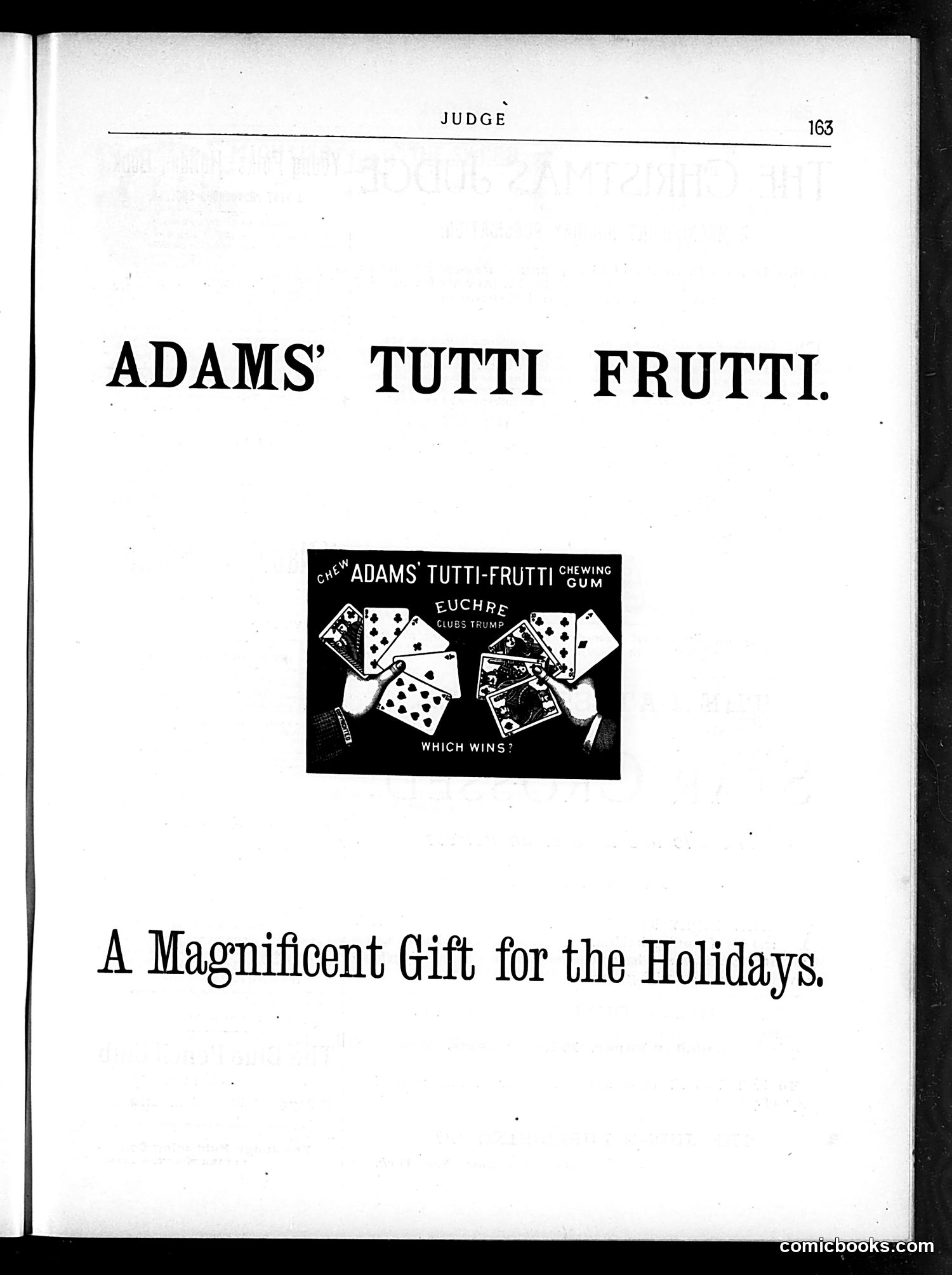
This is a product advertisement rather than political satire. The page promotes **Adams' Tutti Frutti chewing gum**, marketed as "A Magnificent Gift for the Holidays." The advertisement shows a playing card game scenario with the tagline "Which Wins?" The imagery depicts cards and what appears to be a game of chance or competition. The product is specifically labeled as a "Chewing Gum" and mentions "Euchre" (a card game) and "Clubs Trump," suggesting the advertisement uses a gambling/card game theme to create interest. This appears to be vintage advertising using popular recreational activities to market the product as an appealing holiday gift, rather than social or political commentary.
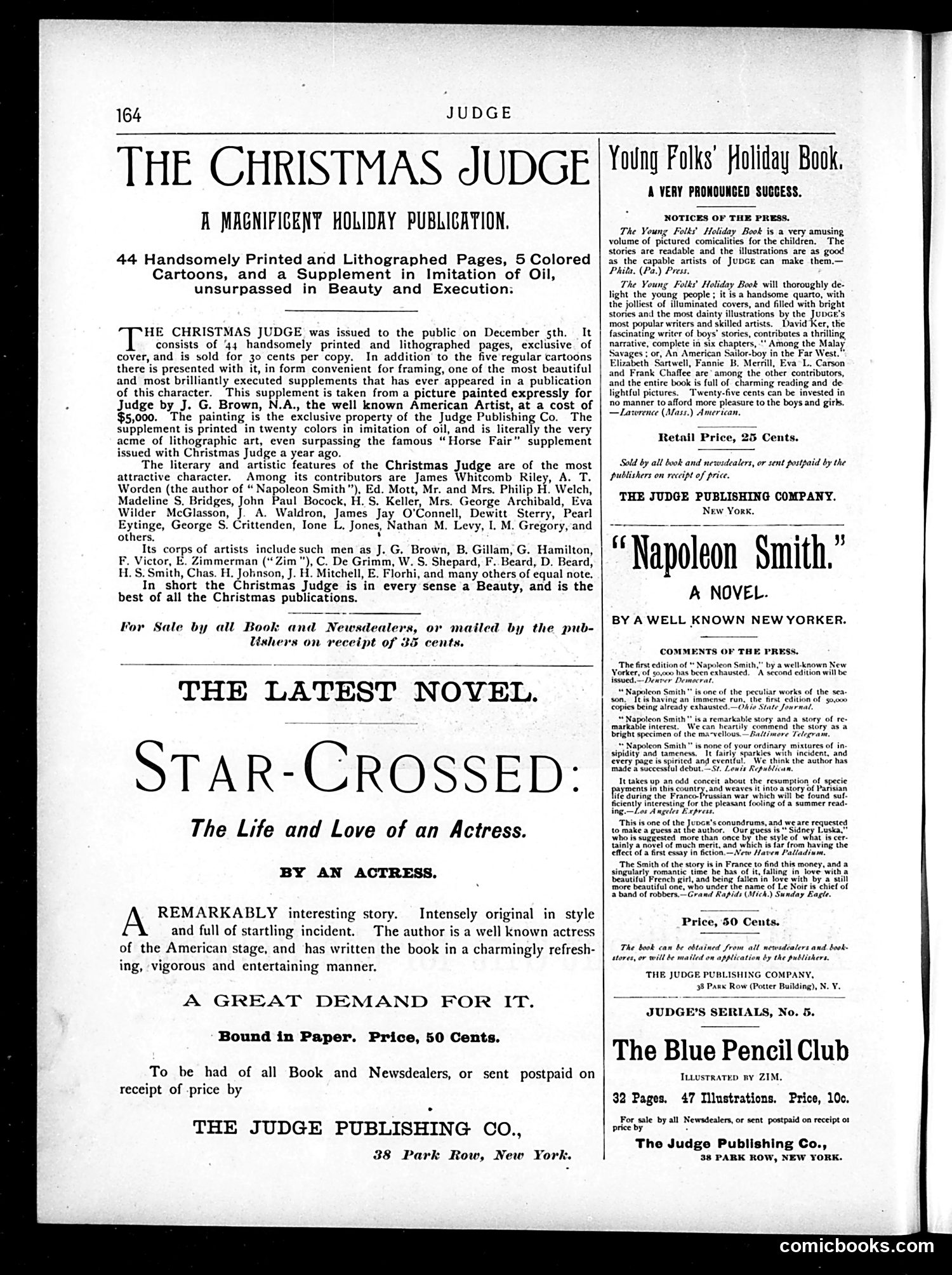
This page is primarily **advertising and promotion** for Judge Publishing Company's holiday and literary offerings, not political satire or comics. The main content advertises: 1. **The Christmas Judge** — a deluxe holiday publication featuring 44 pages, 5 colored cartoons, and an expensive oil-painting supplement by renowned artist J.G. Brown (costing $5,000). Contributors include writer James Whitcomb Riley and numerous prominent illustrators. 2. **"Star-Crossed: The Life and Love of an Actress"** — a novel by an unnamed actress, described as original and entertaining. 3. **"Napoleon Smith"** — another novel by "a well-known New Yorker," receiving positive press notices. 4. **Judge's Serials No. 5: "The Blue Pencil Club"** — illustrated by Zim, 32 pages, 10 cents. 5. **Young Folks' Holiday Book** — children's content with stories and illustrations, priced at 25 cents. The page emphasizes Judge's quality production values and prominent contributors to promote holiday purchasing.
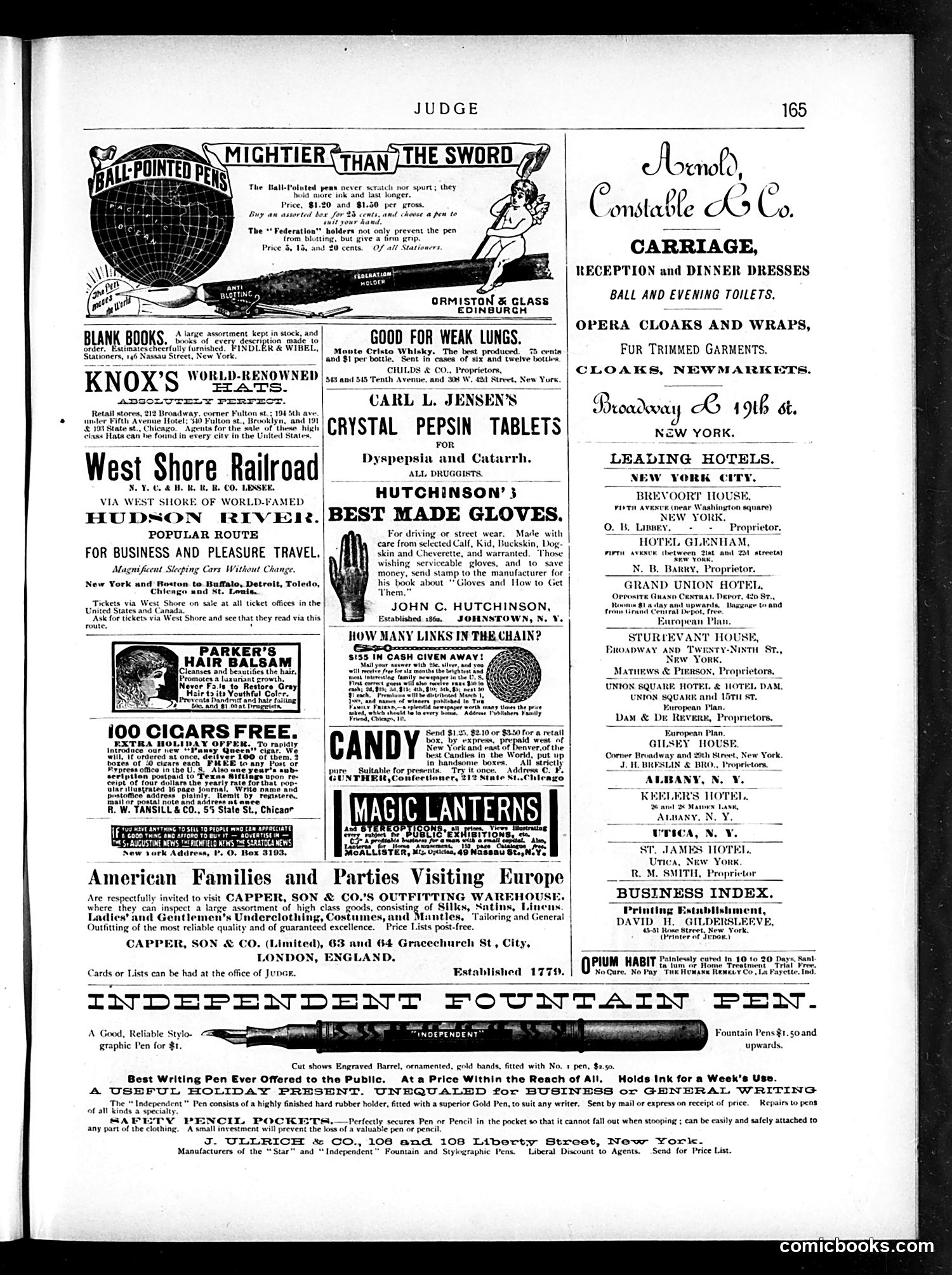
This page is primarily **advertising**, not editorial or satirical content. It features numerous commercial advertisements typical of late 19th-century American magazines, including: - Writing instruments (fountain pens, pencils) - Patent medicines (Crystal Pepsin Tablets for dyspepsia, Monte Cristo Whisky for "weak lungs") - Clothing and accessories (gloves, cloaks, evening wear) - Transportation (West Shore Railroad) - Hotels in New York City - Hair care products The most prominent graphic is the **"Ball-Pointed Pens" advertisement** at top-left, showing a fountain pen and globe. The only satirical element appears to be the small cartoon titled **"How Many Links in the Chain?"** (center-left), though the image quality makes its specific subject unclear—it may reference labor, economic, or social conditions, but without clearer visibility, the exact political point cannot be determined with confidence. This page demonstrates how Judge funded itself through advertising while maintaining its satirical editorial mission elsewhere in the magazine.
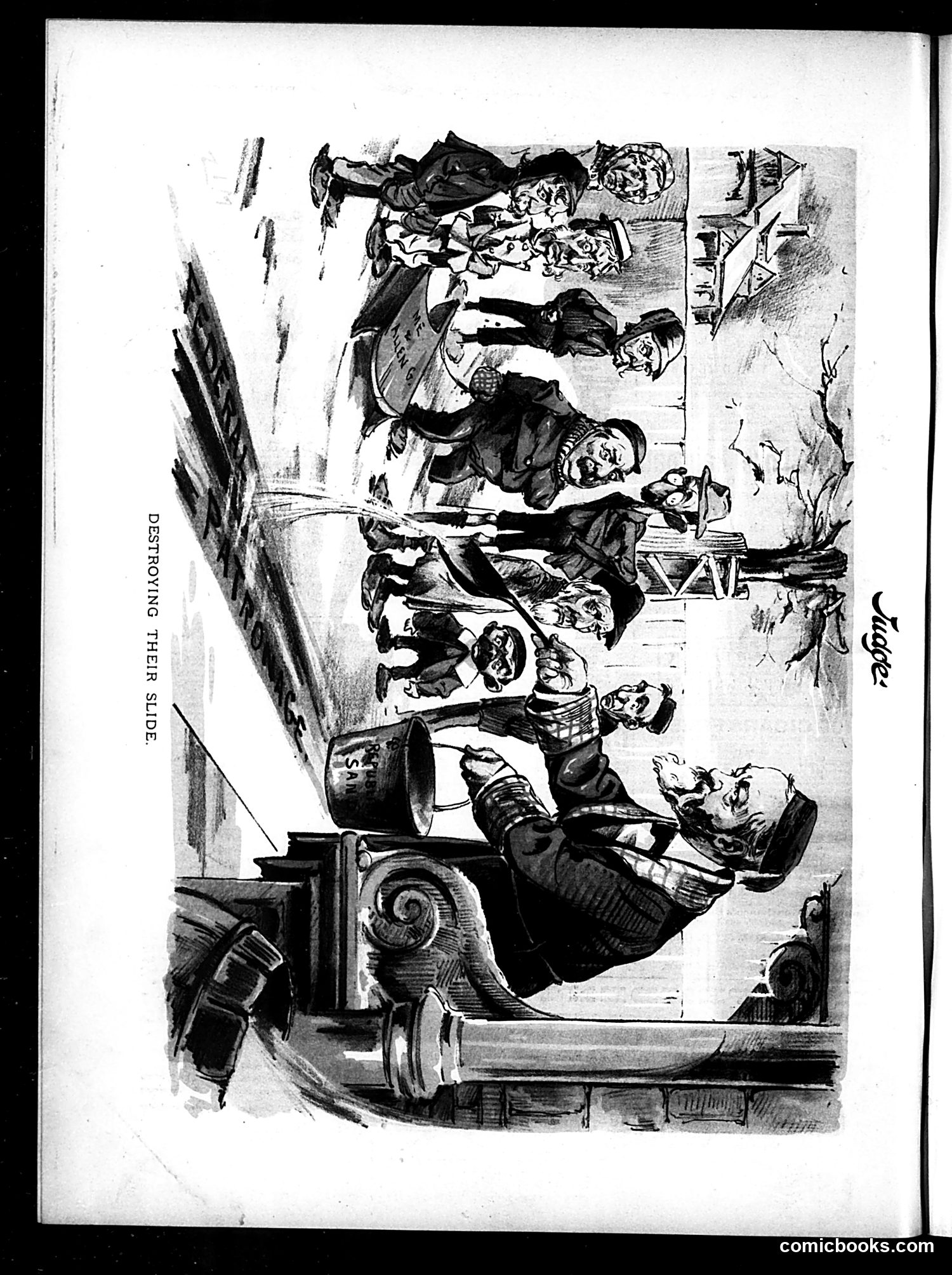
This political cartoon depicts figures destroying or dismantling what appears to be a slide or chute—likely a metaphor for a political "downslide" or decline. The image shows multiple men in formal dress actively breaking apart or toppling a wooden structure on the left side, while other figures observe or participate in the destruction on the right. The satire appears to criticize political opponents or a particular party for deliberately undermining their own position or credibility—"destroying their slide" suggests self-sabotage. The formal attire and architectural setting suggest these are prominent political figures or institutions engaged in this destructive behavior. Without the publication date or additional context visible on this page, the specific historical reference remains unclear, though the style suggests late 19th or early 20th-century American politics.