
A complete issue · 17 pages · 1888
Judge — April 7, 1888
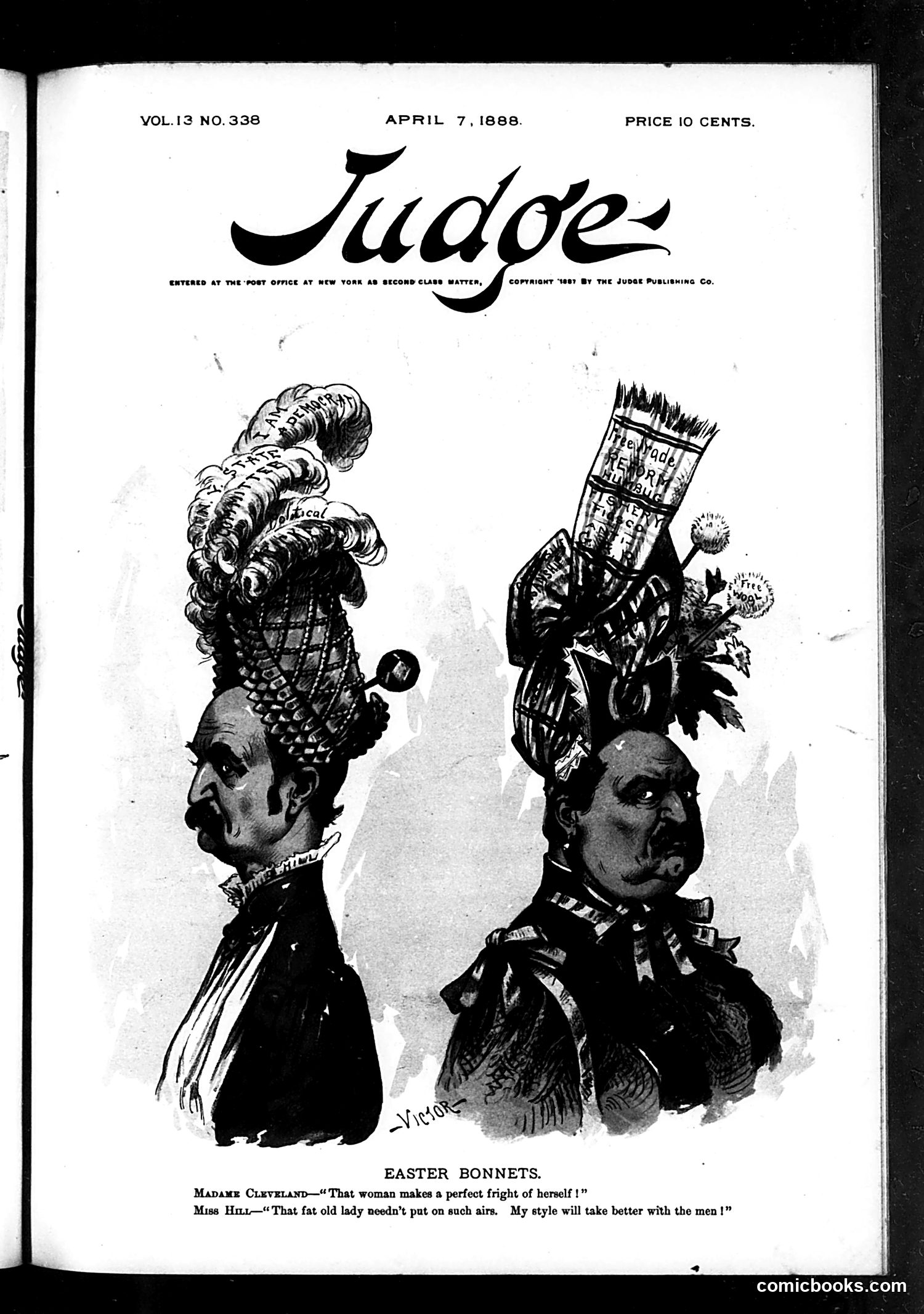
This satirical cartoon mocks excessively elaborate Easter bonnets worn by fashionable women in the 1880s. The two figures shown are identified as "Madame Cleveland" and "Miss Hill"—likely referencing prominent society women of that era. The joke centers on how outrageously oversized and ornate these bonnets had become. Each head sports an impractical tower of fabric, feathers, and decorative elements that dwarf the wearer's actual head. The captions express the women's vanity: one claims the monstrosity makes her "a perfect fright of herself," while the other dismisses concerns about practicality, insisting her style will "take better with the men." The satire targets both the absurdity of fashion trends and women's willingness to embrace uncomfortable, ridiculous styles for social status.
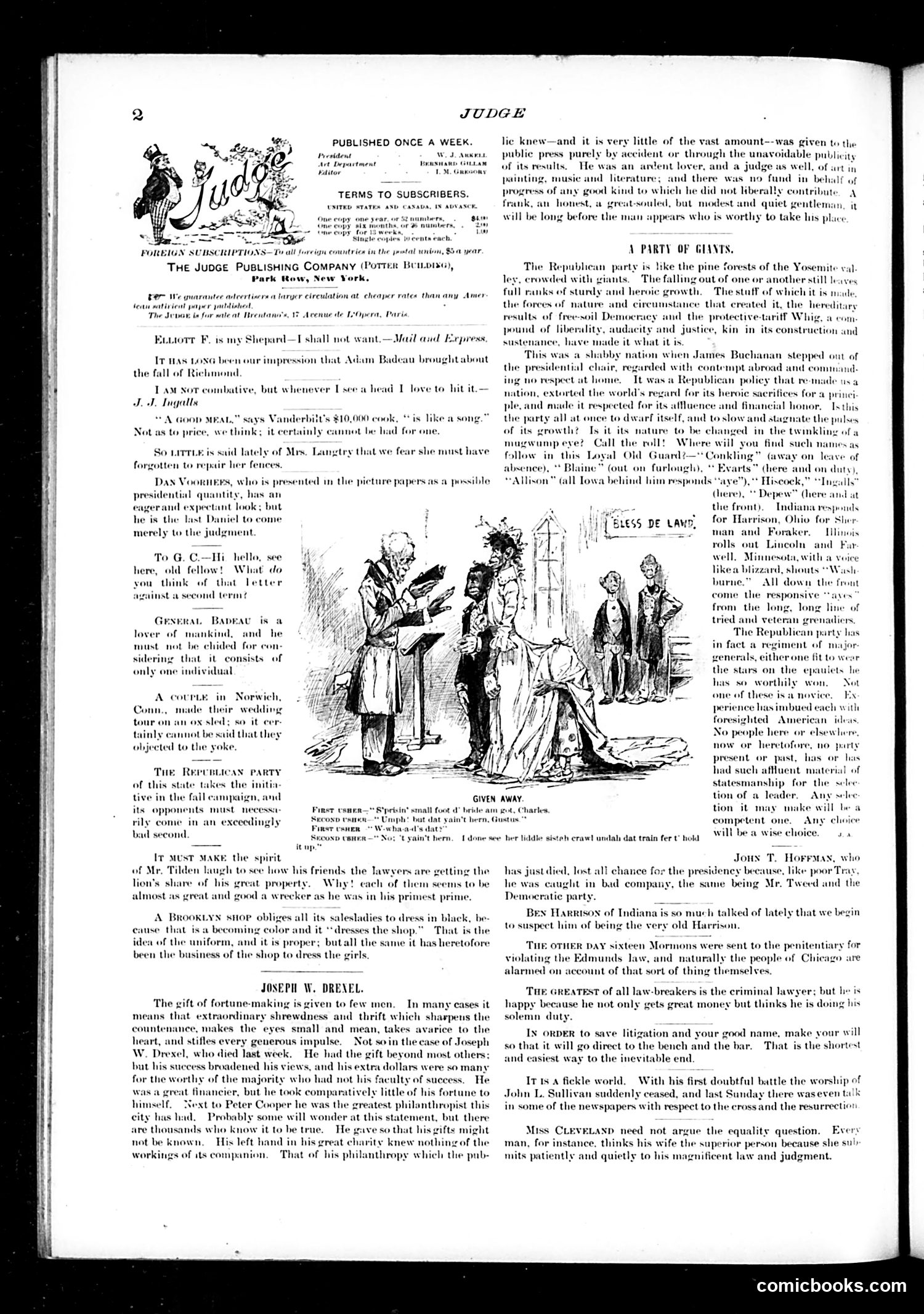
This page contains political commentary and satirical text rather than a primary cartoon focus. The visible illustration shows a crowded scene labeled "GIVEN AWAY" with figures in period dress. The text discusses Republican Party politics, mentioning **James Buchanan** (15th U.S. President), Republican campaign strategy, and criticisms of Democratic leadership. References to "Ben Harrison of Indiana" and mentions of the presidency suggest this dates to the 1880s-1890s era. The satire appears to mock Democratic Party failures and Republican organizational efforts. A section titled "A PARTY OF GIANTS" praises Republican military generals while questioning Democratic leadership. The "GIVEN AWAY" illustration likely satirizes Democratic political giveaways or failed policies, though specific figures remain unclear without additional context.
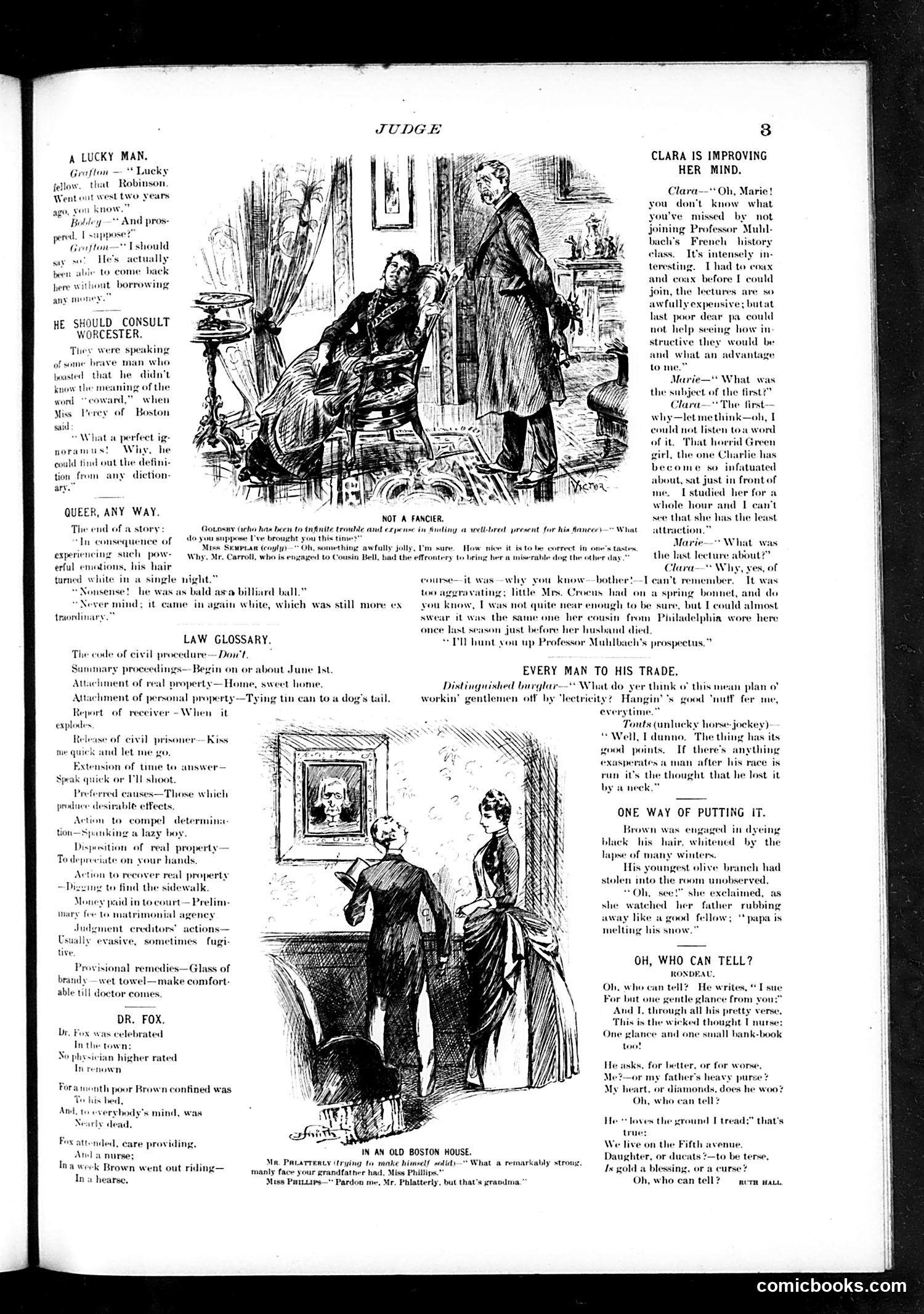
This page from the satirical magazine *Judge* contains several humor pieces typical of late 19th-century American comedy: **"Clara Is Improving Her Mind"** mocks women's education pretensions. Clara claims to study French history but admits she spent the entire lecture distracted by another woman's appearance and fashion—the joke being that despite accessing intellectual opportunities, she's superficially absorbed with vanity rather than learning. **"Every Man to His Trade"** presents a burglar and horse-jockey discussing criminal versus occupational methods, suggesting all classes have their own morally questionable shortcuts. **"Oh, Who Can Tell?"** is a sentimental poem about romantic uncertainty—questioning whether love, money, or social status matter, framed with ironic ambiguity typical of period humor. The **"Law Glossary"** section offers dry legal definitions played for absurdist comedy (e.g., defining attachment as "tying tin cans to a dog's tail"). The illustrations feature typical period sketches depicting domestic scenes and characters. The overall tone reflects *Judge's* satirical focus on American social pretensions, class behavior, and romantic folly.
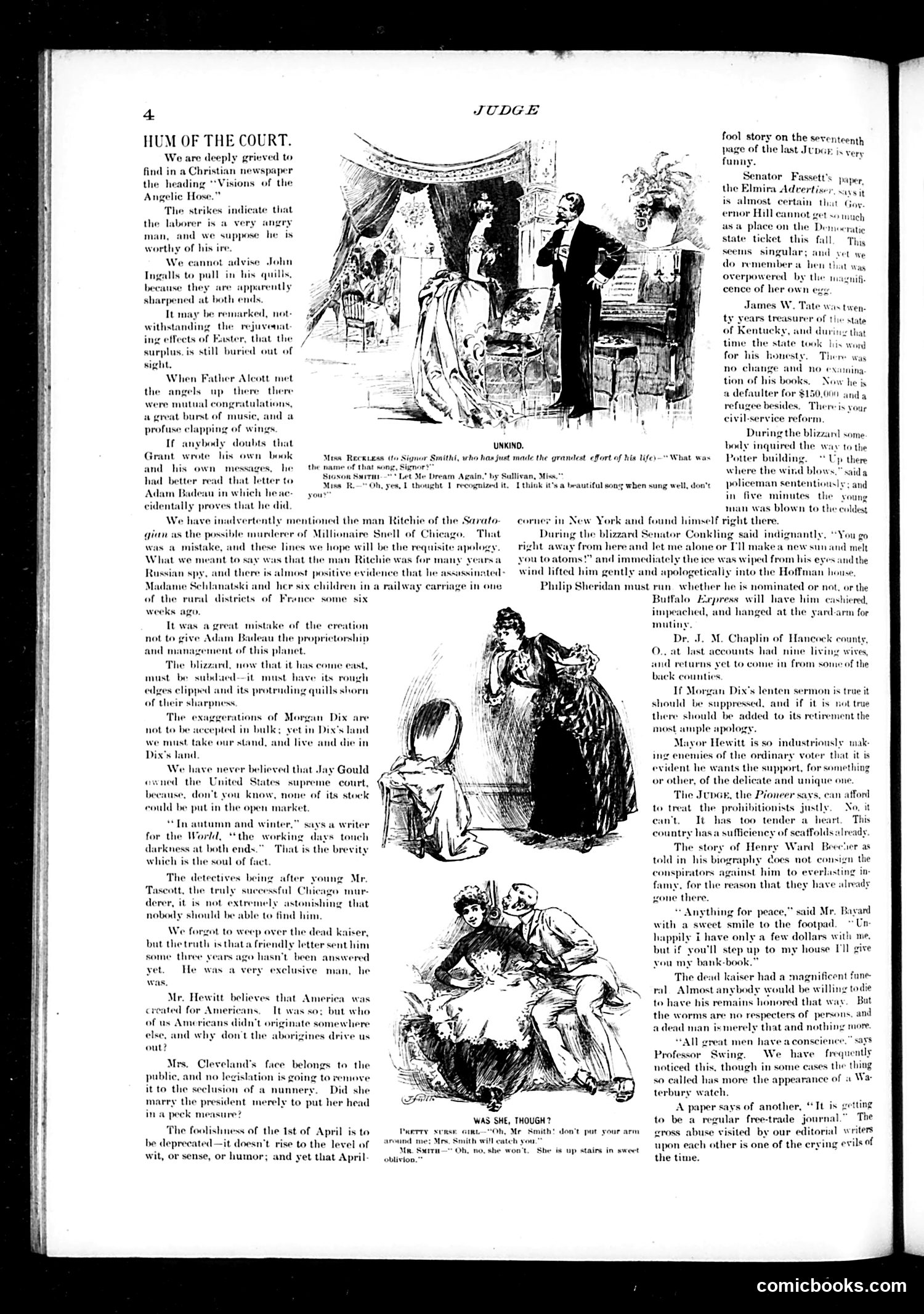
This page from Judge magazine contains multiple brief satirical commentaries on contemporary political and social figures (likely 1880s). The "Hum of the Court" section critiques: **Political figures and events:** - Senator John Ingalls (Kansas) - mocked for his sharp rhetoric - General Ulysses S. Grant - criticized for inconsistencies in his writings and financial management - Senator Morgan Dix - his religious views are attacked - Jay Gould - referenced regarding stock manipulation - President Cleveland and his wife - jokes about their marriage and public life - Senator Roscoe Conkling - satirized for his response during a blizzard **Social commentary:** The cartoons and text mock political hypocrisy, financial corruption, and absurd statements by public figures. References to "civil service reform" suggest debates over government patronage. The tone is irreverent and punchy, typical of Judge's approach to exposing political pretension through humor and caricature.
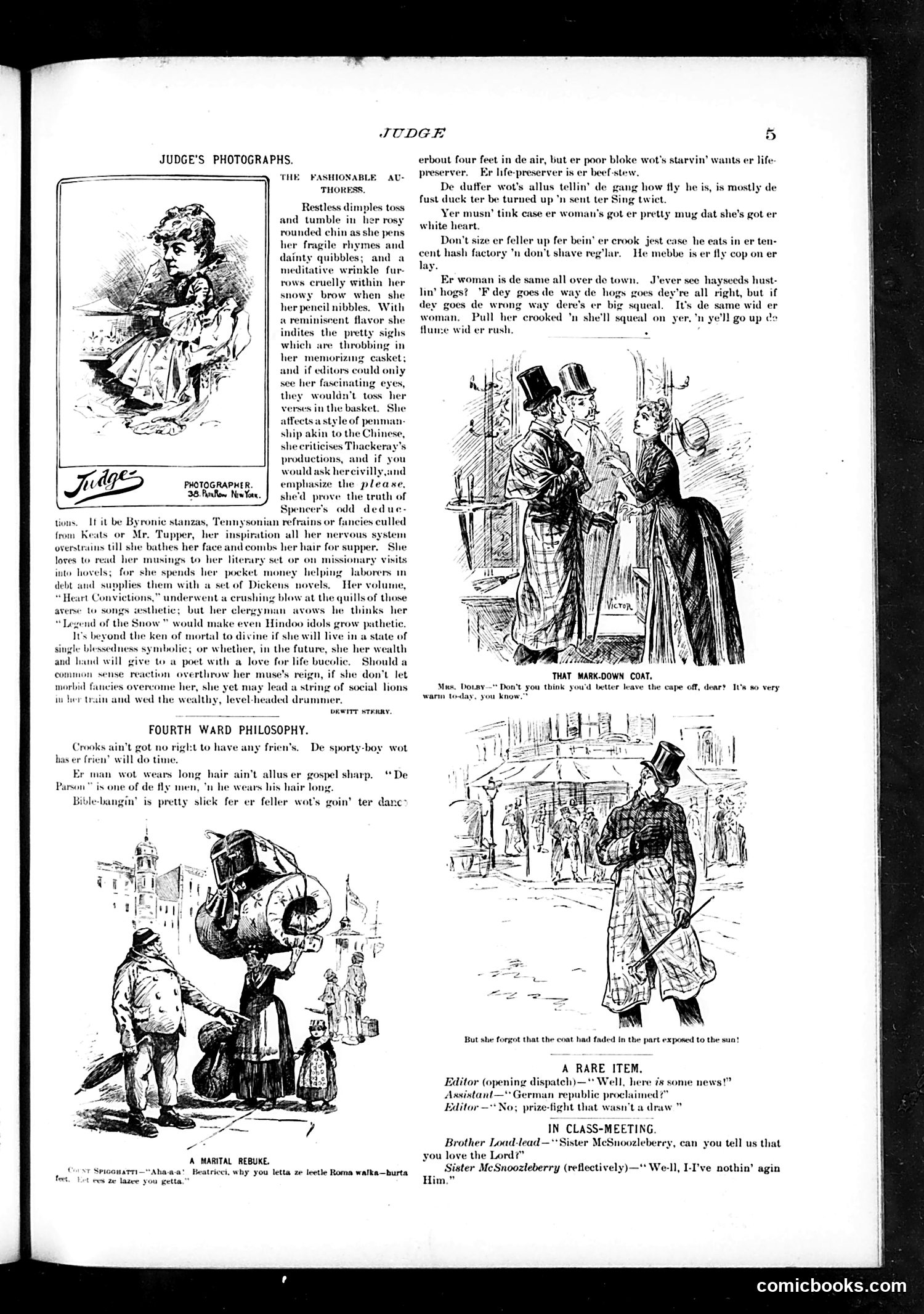
This page contains three satirical pieces typical of Judge's social commentary: **"The Fashionable Authoress"** mocks pretentious female writers who affect artistic airs—adopting Chinese-style handwriting, praising Thackeray and Byron—while lacking genuine talent. The piece suggests editors reject their work, yet they imagine themselves destined for literary immortality or marriage to wealthy men. **"Fourth Ward Philosophy"** presents working-class dialect humor about criminal lowlifes, contrasting those who "ain't got no right to have frien's" with flashy "sporty-boys" wearing long hair, implying superficial style masquerades as substance. **The remaining items** include brief jokes: "A Marital Rebuke" (Italian domestic scene), "That Mark-Down Coat" (wife's vanity about a faded garment), "A Rare Item" (German republic news), and "In Class-Meeting" (lukewarm religious faith expressed as mere tolerance). The humor relies on period stereotypes—affected women, immigrant accents, class divisions—reflecting late-19th-century American attitudes toward gender, immigrant communities, and social pretension.
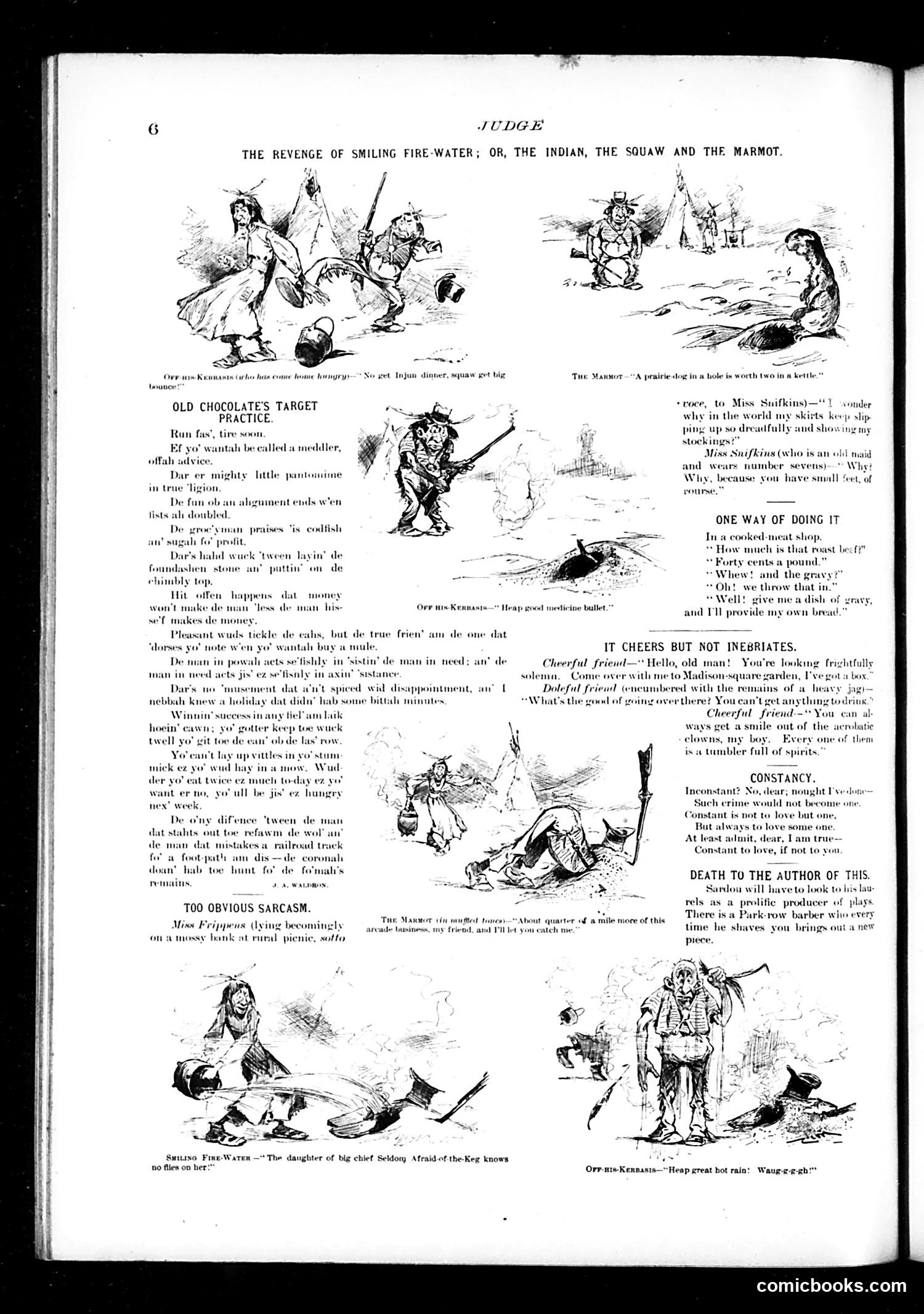
This Judge magazine page satirizes Native Americans through grotesque racial caricatures and stereotypes common to 19th-century American humor. The title story, "The Revenge of Smiling Fire-Water," features characters with exaggerated "Indian" dialect ("Dar er mighty little pantomine in true 'ligion") depicted in crude sketches. The satire targets both Indigenous peoples and upper-class white women. "Old Chocolate's Target Practice" mocks a Black character's speech patterns. Other vignettes ridicule various groups: romantic mismatches, working-class conversations, and social pretension. The humor relies entirely on ethnic and racial caricature—exaggerated features, fractured dialect, and dehumanizing depictions. What Judge presents as witty social commentary reflects deeply racist attitudes normalized in the period. The "marmot" reference and animal comparisons further dehumanize the subjects. Modern readers should recognize this as historical racism masquerading as humor—exactly the prejudicial content such publications actively promoted.
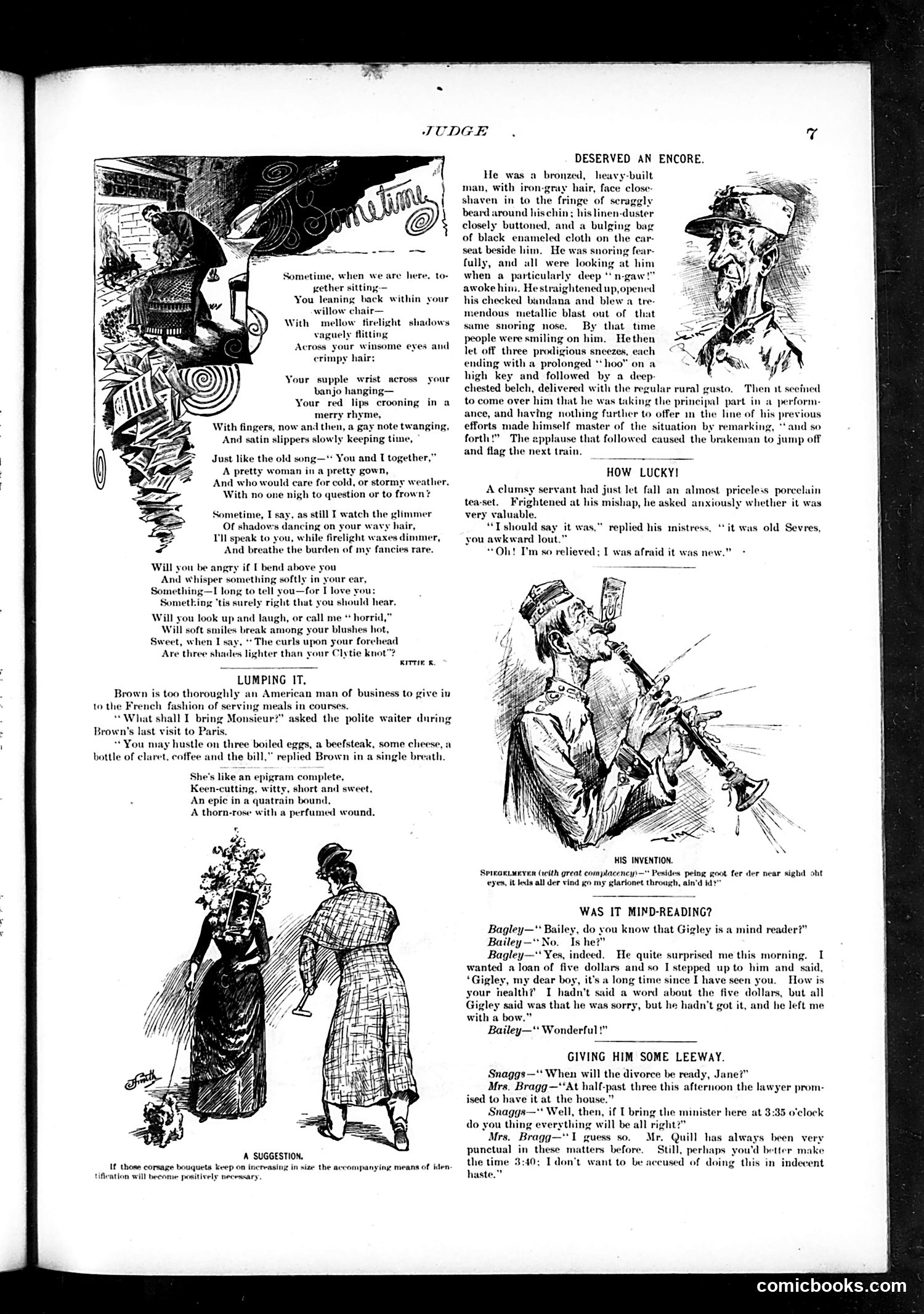
This page contains several unrelated short humor pieces typical of Judge magazine's format: **"Deserved an Encore"** depicts a sleeping train passenger who, upon waking, produces loud snores, sneezes, and belches. Fellow passengers applaud, encouraging him to repeat this "performance"—satirizing audiences who reward vulgar behavior and the performer's shameless response. **"How Lucky!"** jokes about a servant breaking an "old Sevres" (expensive antique porcelain), then expressing relief it wasn't new—inverting expected values to highlight working-class ignorance of quality goods. **"Lumping It"** mocks an American businessman dining in Paris who orders a complete meal simultaneously rather than in French courses—satirizing American impatience and resistance to continental refinement. **"His Invention"** shows a German immigrant proudly describing his eyeglass invention in broken English, apparently a device directing wind toward a clarinet. **"Was It Mind-Reading?" and "Giving Him Some Leeway"** are brief dialogue jokes about mistaken assumptions and marital complications. The cartoons mock various American types: uncouth travelers, working-class servants, provincial businessmen, and immigrants—standard Judge targets of the era.
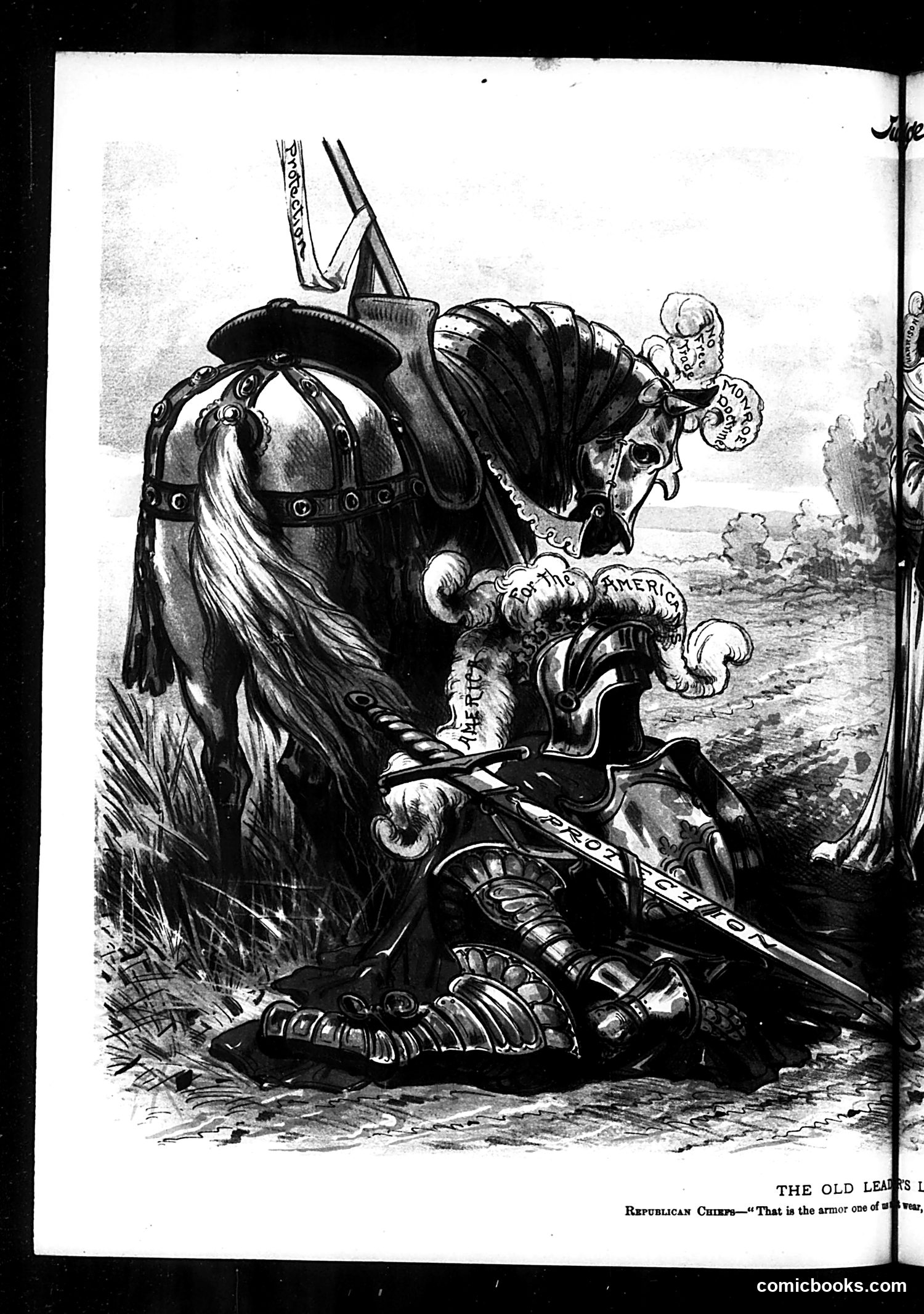
This appears to be a Republican-era political cartoon titled "The Old Leaders," likely from the late 19th or early 20th century. The image depicts a dead or fallen armored knight labeled "AMERICA," being mourned by two figures - one appears to be wearing period costume at the horse's head, while another figure (possibly representing Republican leadership or policy) stands nearby. The satirical point seems to criticize Republican leadership or policies as having caused harm to America itself, represented as a fallen warrior. The caption's reference to "armor one of SF wear" is unclear in the OCR, but the overall message appears to be that outdated Republican approaches or "old leaders" have damaged the nation. Without clearer text or date confirmation, the specific political event referenced remains uncertain.
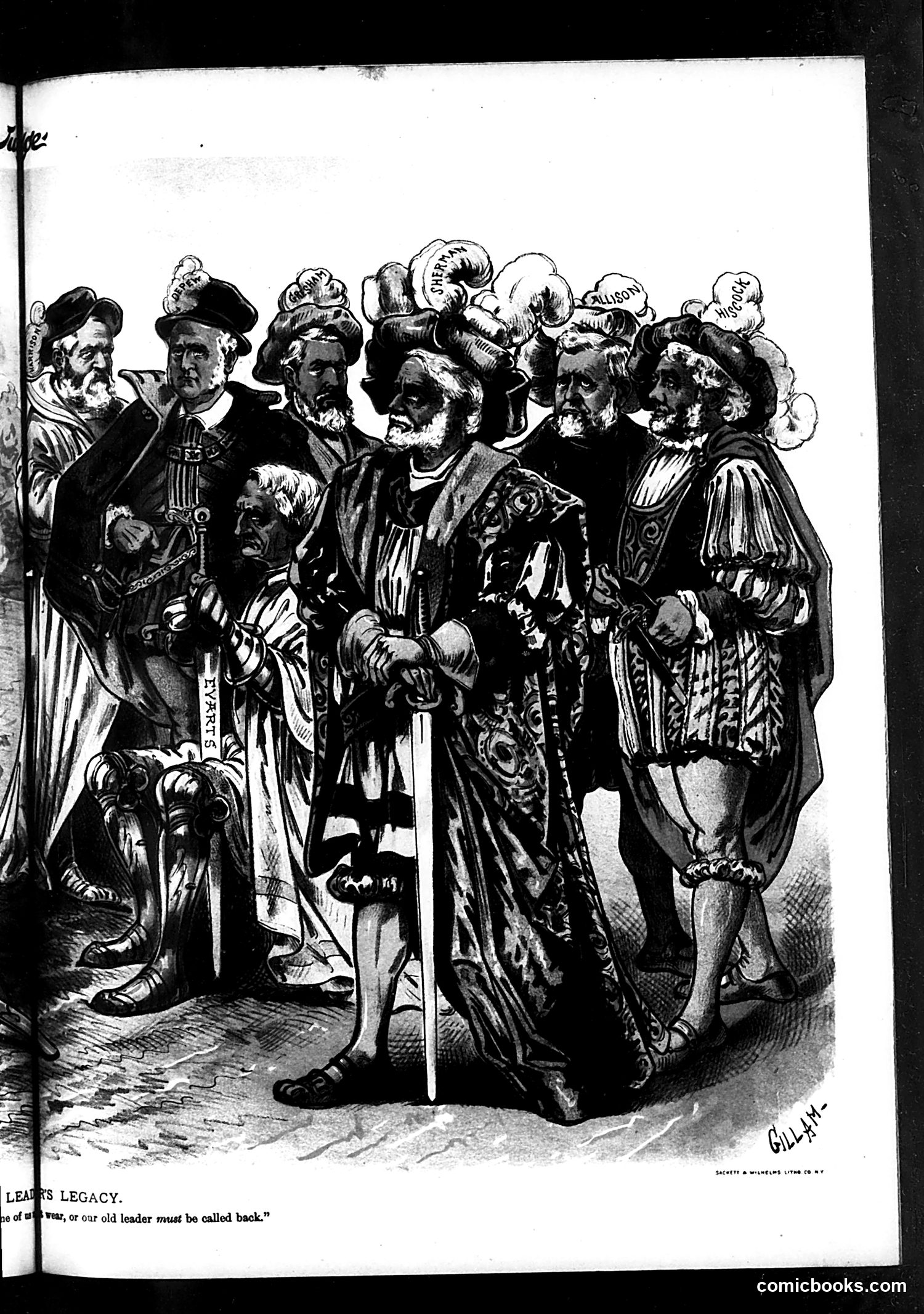
This political cartoon depicts a group of bearded men in Renaissance-style clothing gathered around a central figure holding a sword. The caption references "our old leader must be called back," suggesting a commentary on succession or leadership crisis. The ornate dress and historical styling indicate this likely satirizes political or institutional leadership debates of Judge magazine's era (late 19th/early 20th century). The gathering appears to represent competing factions or advisors uncertain about direction without their original leader. However, without a visible date or clearer identifying marks, I cannot definitively name the specific historical figures, political party, or event referenced. The satire appears to mock nostalgia for past leadership or inability of successors to maintain institutional stability, but the exact context remains unclear from the image alone.
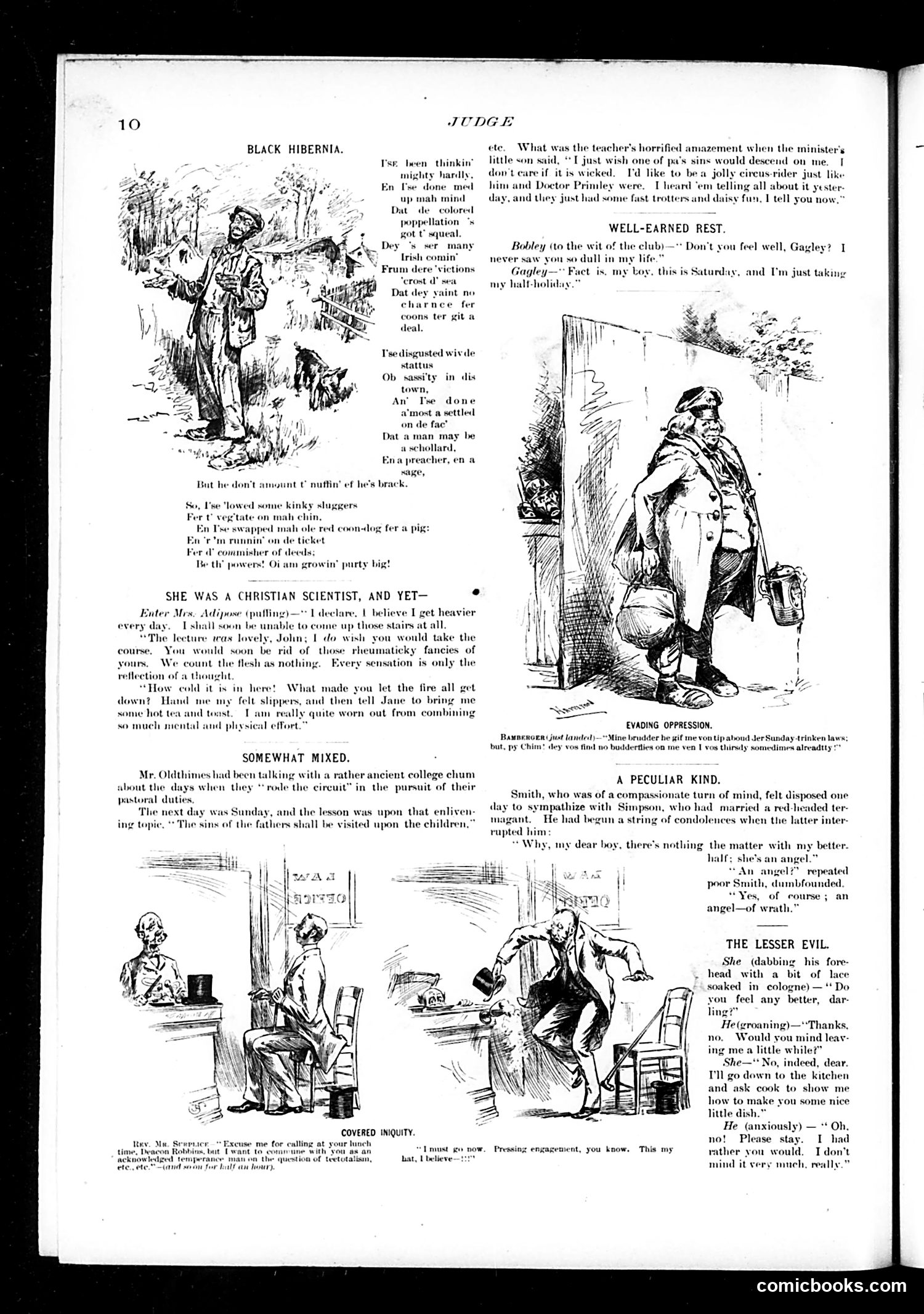
This page contains several satirical sketches typical of late 19th-century American humor: **"Black Hibernia"** presents a racist dialogue where an African American character expresses frustration that Irish immigrants are displacing Black workers and gaining social status. The satire mocks both groups—suggesting neither deserves advancement—while reflecting genuine historical tensions between these communities competing for low-wage labor. **"She Was a Christian Scientist, and Yet"** ridicules Christian Science believers (a contemporary religion emphasizing mind-over-matter healing) by showing a woman denying physical ailments while demanding hot tea, slippers, and comfort—exposing the hypocrisy between stated beliefs and actual behavior. **"Somewhat Mixed"** appears to joke about clerical hypocrisy regarding inherited sin. **Other sketches** humorously depict social awkwardness and marital discord—standard fare for period humor. The page reflects Judge's typical approach: punching down at immigrants, religious minorities, and African Americans while mocking middle-class pretension. The racism is unambiguous and historically significant as period documentation.
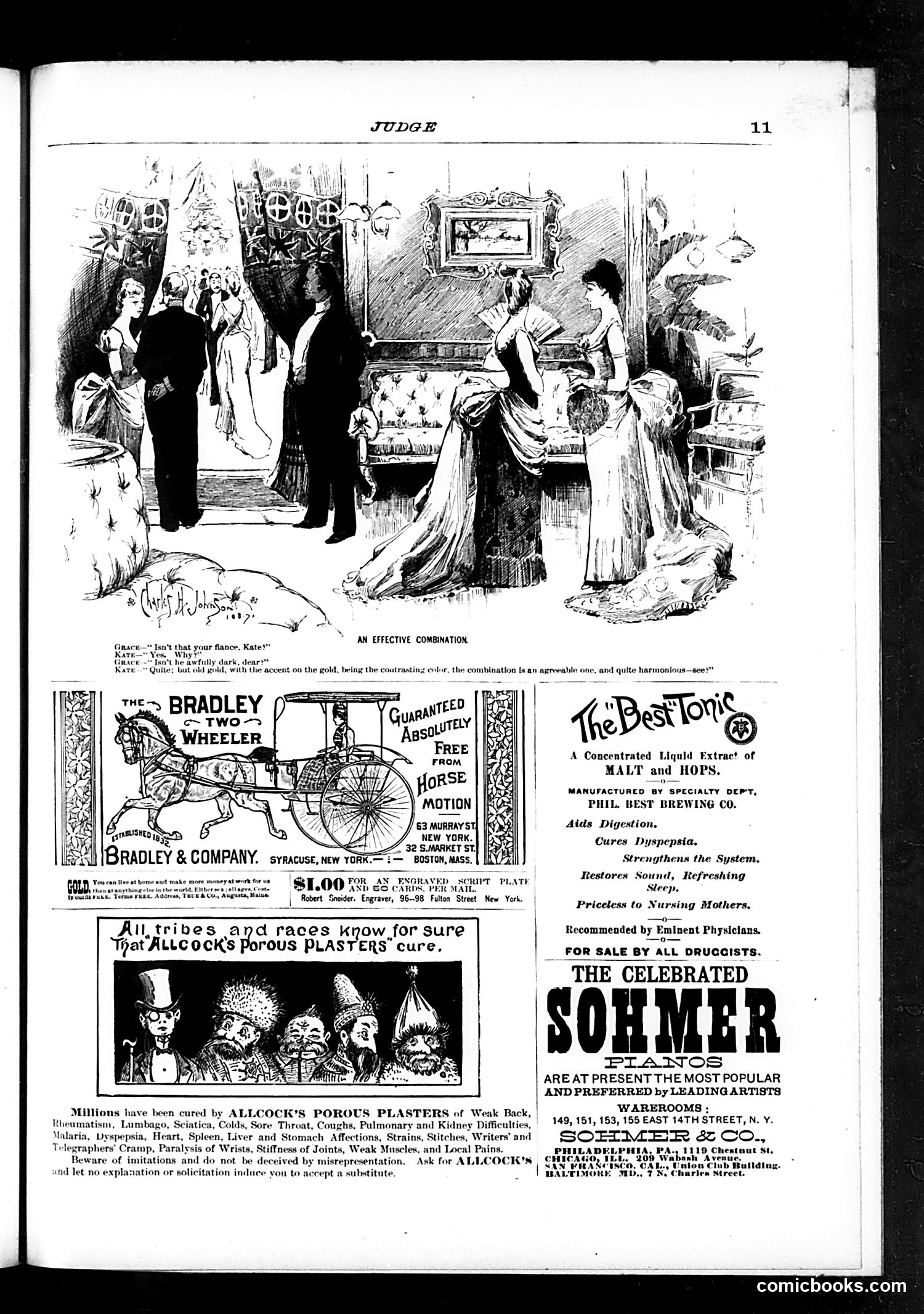
The cartoon satirizes fashion choices among wealthy women. Two elegantly dressed ladies discuss a third woman's outfit: one wears a dark dress with gold trim. The dialogue suggests they're debating whether this color pairing is aesthetically successful—with one character defending it as "an agreeable one, and quite harmonious." The satire likely mocks the pretentiousness of high-society fashion discourse, where women obsess over minute details of color coordination and fabric combinations as markers of taste and status. The cartoon ridicules how seriously the wealthy take such superficial styling decisions. The page is primarily filled with period advertisements (Bradley bicycles, medical plasters, brewing extract, pianos) rather than editorial content, typical of Judge's revenue model. No specific historical figures or political references appear in the cartoon itself.
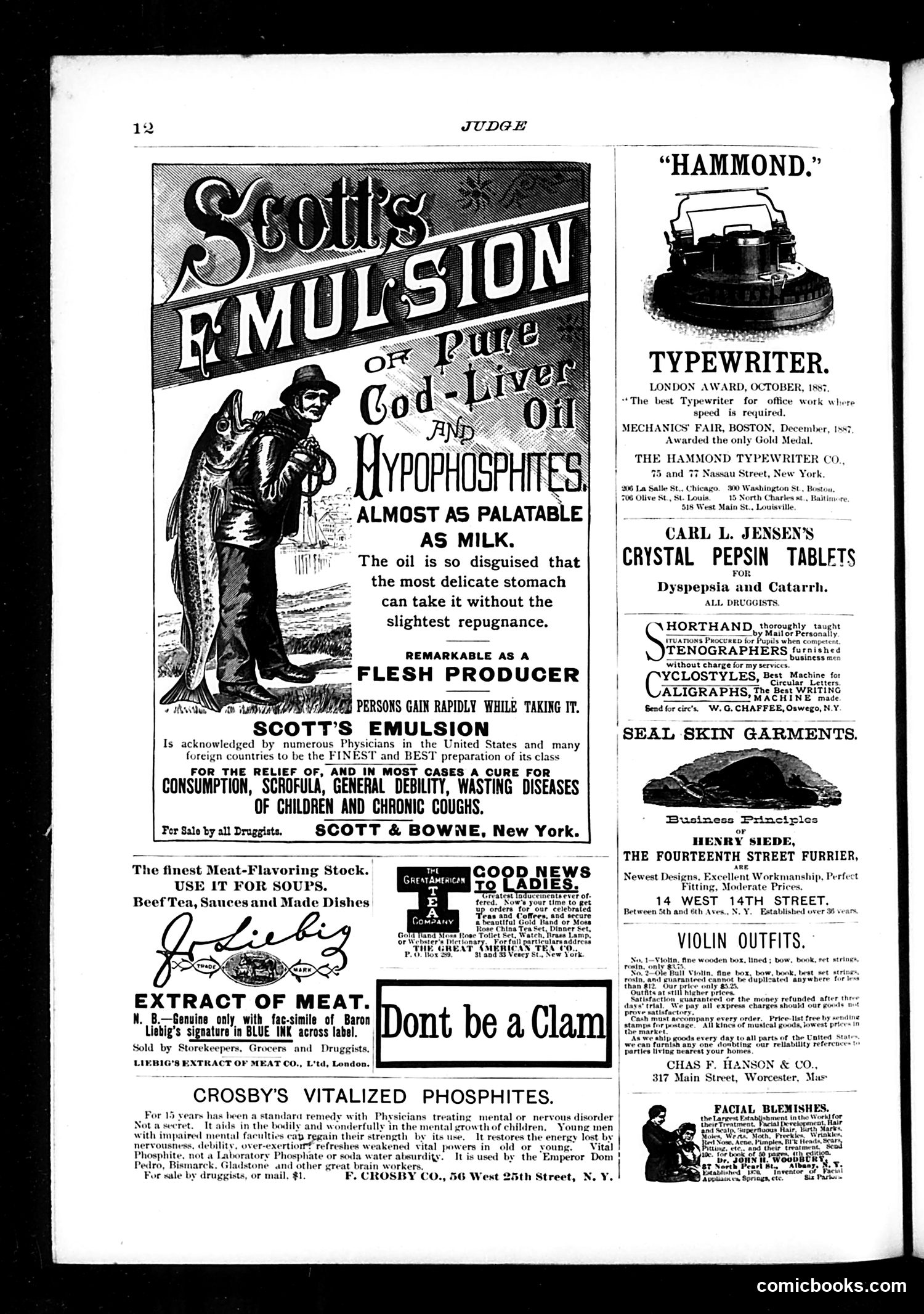
This page is primarily **advertising**, not editorial content or satire. It contains commercial advertisements typical of late-19th-century American magazines. The main ads promote patent medicines and commercial products: - **Scott's Emulsion**: A cod liver oil product marketed as a cure-all for consumption, scrofula, and childhood ailments—claims typical of unregulated pharmaceutical advertising of this era - **Liebig's Extract of Meat**: A meat flavoring product - **Hammond Typewriter**: Office equipment winning awards - **Crystal Pepsin Tablets**: Digestive aid for dyspepsia - Various other products (shorthand services, seal skin garments, violins, facial treatments) The satire is **implicit rather than explicit**: Judge's readers would recognize the irony in these exaggerated medical claims. The phrase "Don't be a Clam" (visible in the image) is the only obvious editorial commentary—likely mocking hesitation to try such dubious remedies. This reflects Judge's typical format: mixing satirical editorial content with contemporary advertising, allowing readers to recognize the absurdity of period patent medicine marketing.
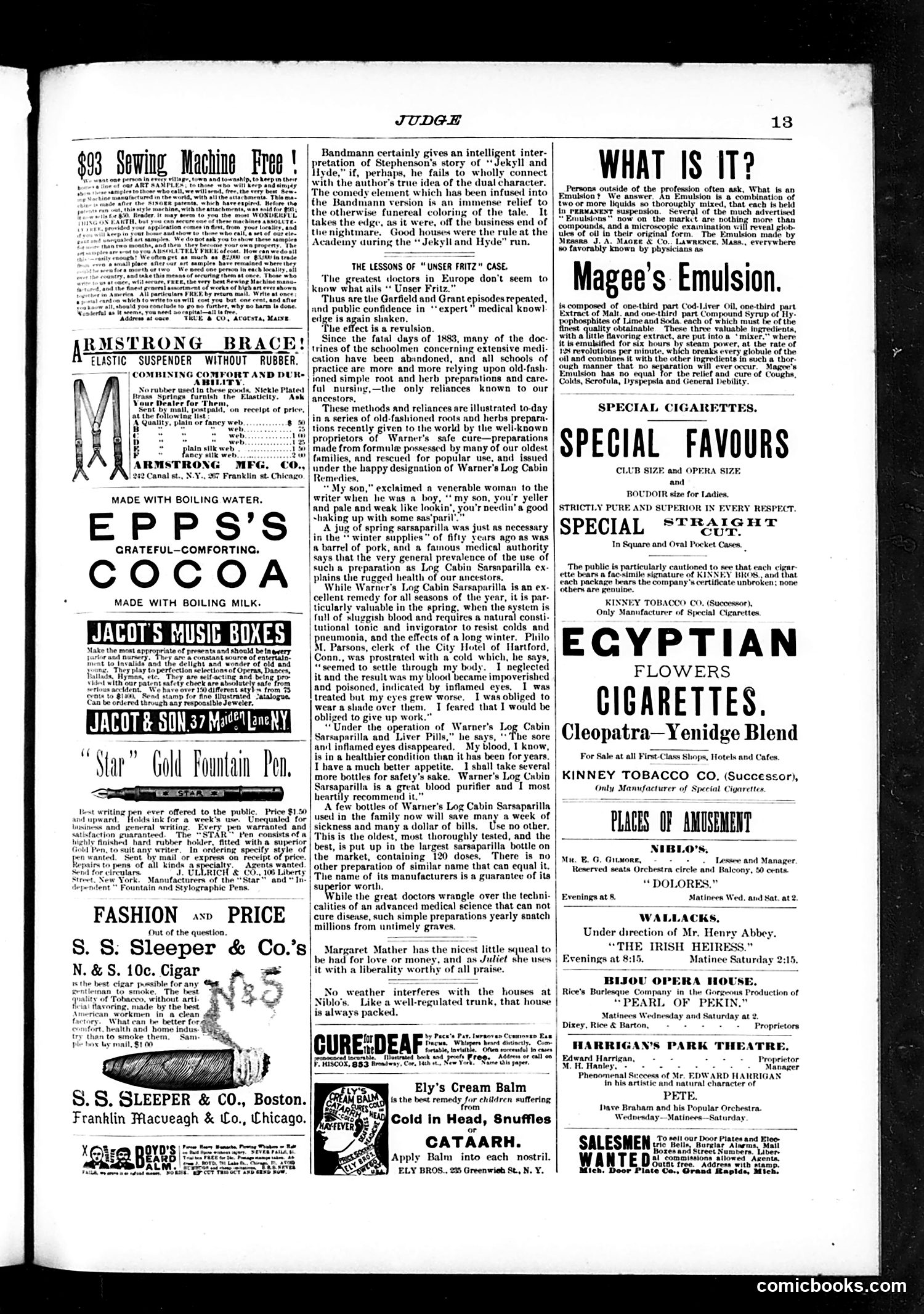
This page is primarily **advertisements and editorial commentary** rather than political cartoons. The main content includes: **Editorial pieces** discussing theatrical productions (Bandmann's "Jekyll and Hyde" adaptation) and medical practice trends, particularly critiquing reliance on "expert" doctors following the "Unser Fritz" case (appears to reference Prince Frederick of Germany's illness, likely 1888). **Extensive product advertisements** for patent medicines, writing implements, cigars, corsets, and food products typical of the 1880s era—including Warner's Log Cabin Remedies, which advertised themselves as returning to "old-fashioned" herbal treatments. The editorial commentary reflects **late-19th-century skepticism** toward modern medical expertise, positioning traditional folk remedies as superior—ironically, while the page itself advertises these "traditional" remedies as commercial products. **No clear political cartoons appear** on this page; it functions primarily as a commercial publication mixing satirical editorial content with advertising.
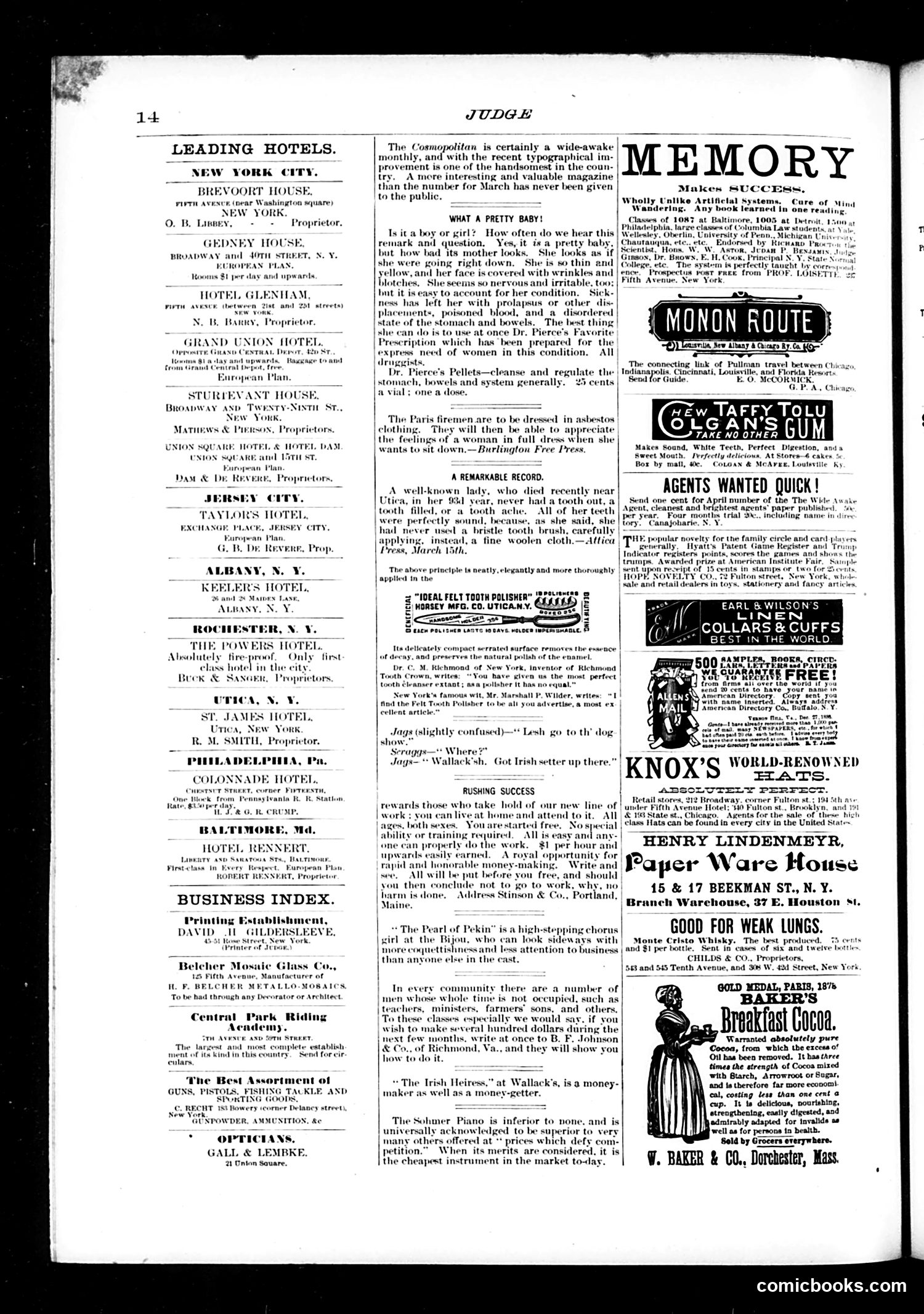
This page is primarily **advertisements and classifieds** for a late 19th-century publication (Judge magazine). The content includes: **Leading Hotels section**: Listings of upscale hotels across major U.S. cities (New York, Albany, Philadelphia, Baltimore), indicating the travel market during this era. **Notable Advertisements**: - **"What a Pretty Baby!"**: A patent medicine ad (Dr. Pierce's Favorite Prescription) exploiting women's vanity and health anxieties—promising to restore appearance by treating "disordered" blood and digestion. This reflects the era's dubious medical advertising directed at women. - **"Rushing Success"**: A work-from-home scheme promising earnings ($100-300/month), typical of exploitative employment ads of the period. - **Other product ads**: Tooth polishers, pianos, cocoa—standard period advertising. **Brief mentions of humor**: Small anecdotes like "Jags," apparently a comic character discussing a dog, suggest the magazine contained satirical content elsewhere. The page reflects Gilded Age consumer culture, patent medicine hucksterism, and targeted marketing toward women's insecurities.
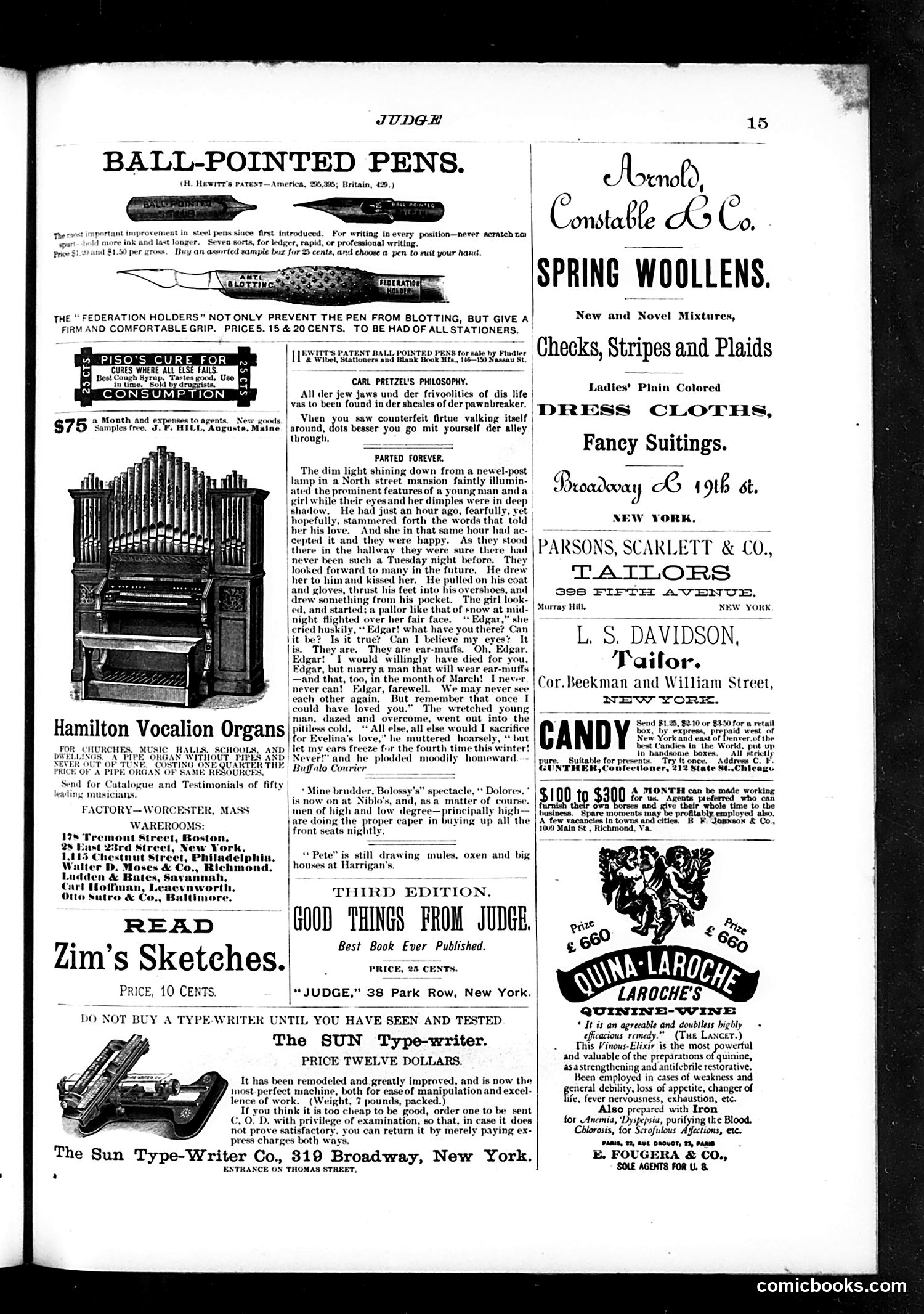
This page is primarily **advertising and filler content**, not political satire. The main items include: **"Parted Forever"** (center): A sentimental melodrama joke. A young couple becomes engaged, but the woman rejects her suitor when she discovers he wears ear-muffs in March—considered undignified or ridiculous. The satire mocks Victorian sentimentality and absurdly rigid social conventions about masculinity and appearance. **"Carl Pretzel's Philosophy"** (right column): A recurring ethnic humor segment featuring a character with a German accent ("der jew jaws," "der frivoolities"). He offers working-class wisdom. This reflects common early-20th-century American magazine use of ethnic stereotypes for humor. The remaining content consists of advertisements for typewriters, tailors, candy, organs, and patent medicines—typical for Judge's revenue model. The page reflects 1880s-1890s commercial and entertainment priorities rather than focused political commentary.
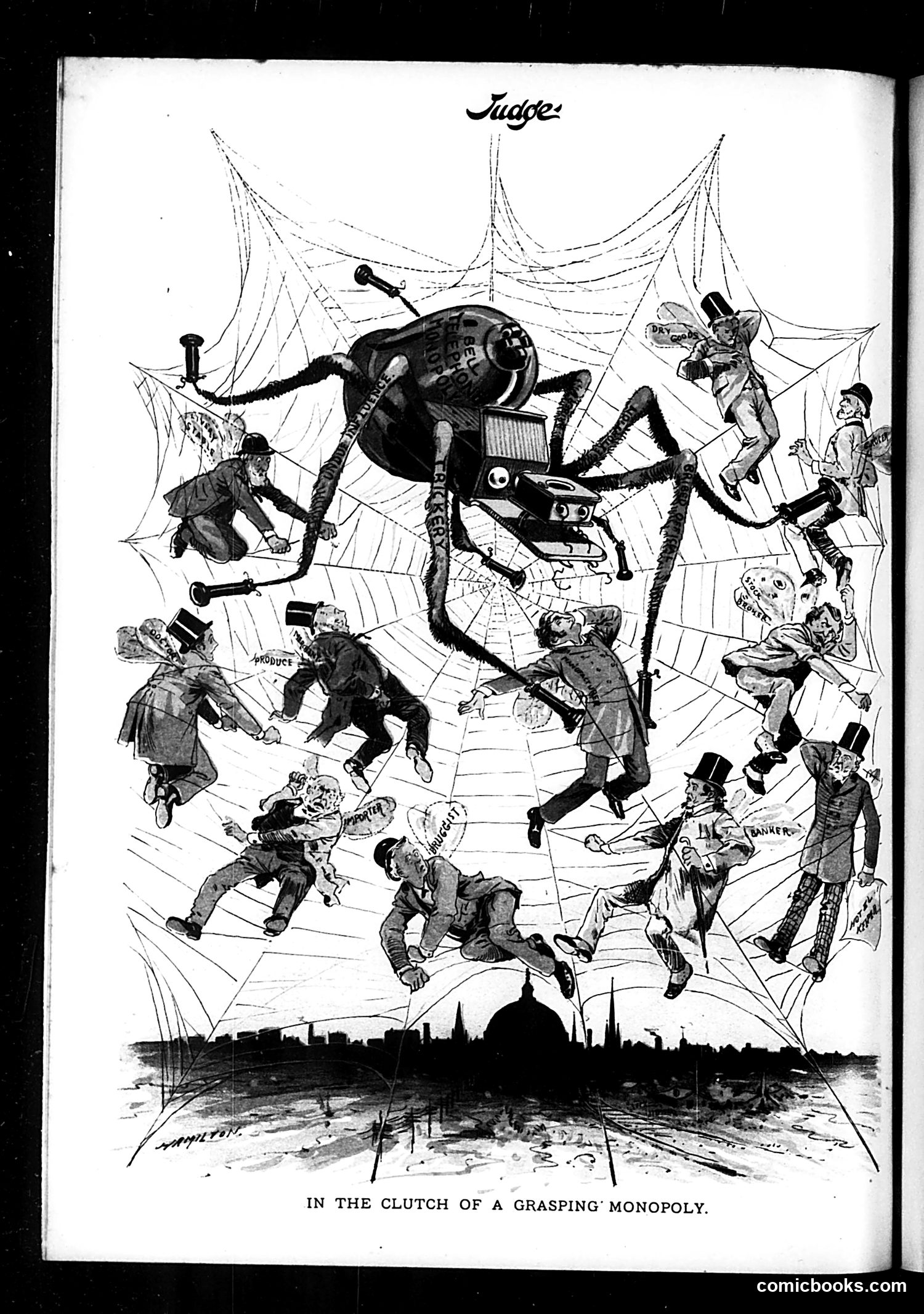
This Judge magazine cartoon titled "In the Clutch of a Grasping Monopoly" depicts a giant mechanical spider—representing monopolistic corporate power—ensnaring various figures in its web. The spider's body contains industrial/commercial imagery, symbolizing concentrated business control. The trapped figures appear to represent different social groups or classes being victimized by monopoly practices: workers, businessmen, and ordinary citizens struggle against the spider's grip. The silhouetted cityscape at the bottom suggests this affects entire urban communities. This reflects late 19th/early 20th-century American anxieties about monopolies and corporate consolidation, likely referencing debates over antitrust legislation and regulation of major industries. The cartoon advocates for public concern about unchecked corporate power threatening democratic society and individual opportunity.

I can see this is a page from *Judge* magazine, but the image is almost entirely black with only a thin white vertical strip visible on the left edge. The OCR text provides only a website credit ("comicbooks.com") with no actual article or caption text to analyze. Without legible content—whether cartoons, caricatures, headlines, or body text—I cannot identify the figures, historical references, or satirical points this page contains. The image quality or scanning appears to have rendered the page content invisible. To provide the analysis you're requesting, I would need a clearer version of this page where the actual cartoon artwork and text are readable.