
A complete issue · 18 pages · 1888
Judge — March 31, 1888
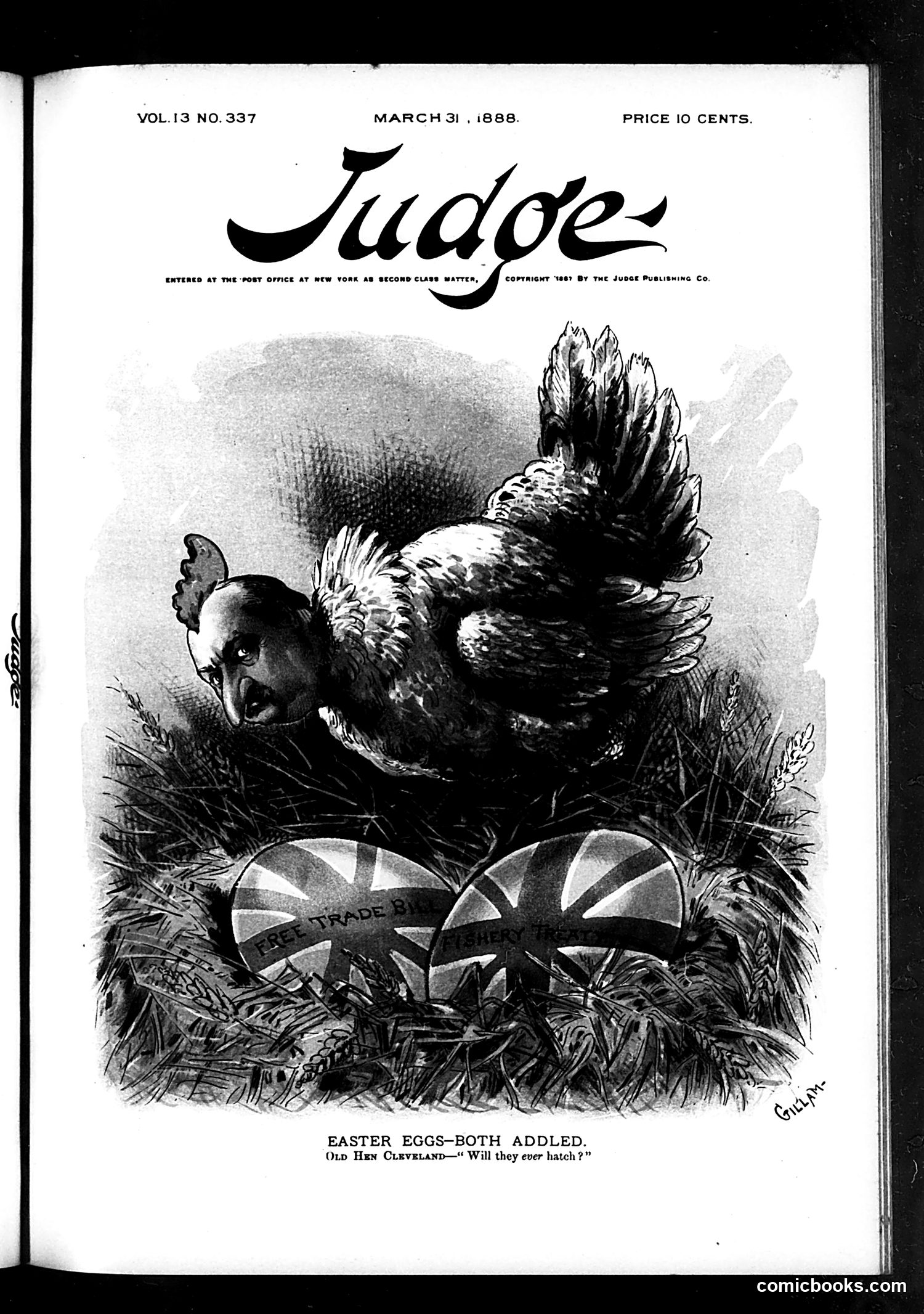
This cartoon depicts a hen sitting on two decorative Easter eggs labeled "FREE TRADE BILL" and "FISHERY BILL." The caption quotes "Old Hen Cleveland," referring to President Grover Cleveland, asking "Will they ever hatch?" The satire mocks Cleveland's legislative agenda during his first term. The "addled eggs" represent bills the administration proposed that appear unlikely to succeed—comparing failed legislative initiatives to rotten eggs that won't produce viable results. The hen metaphor suggests Cleveland's helplessness or ineffectiveness in advancing his political program. This reflects contemporary frustration with Cleveland's handling of trade and fishery policy disputes, likely during the tariff debates of the 1880s.
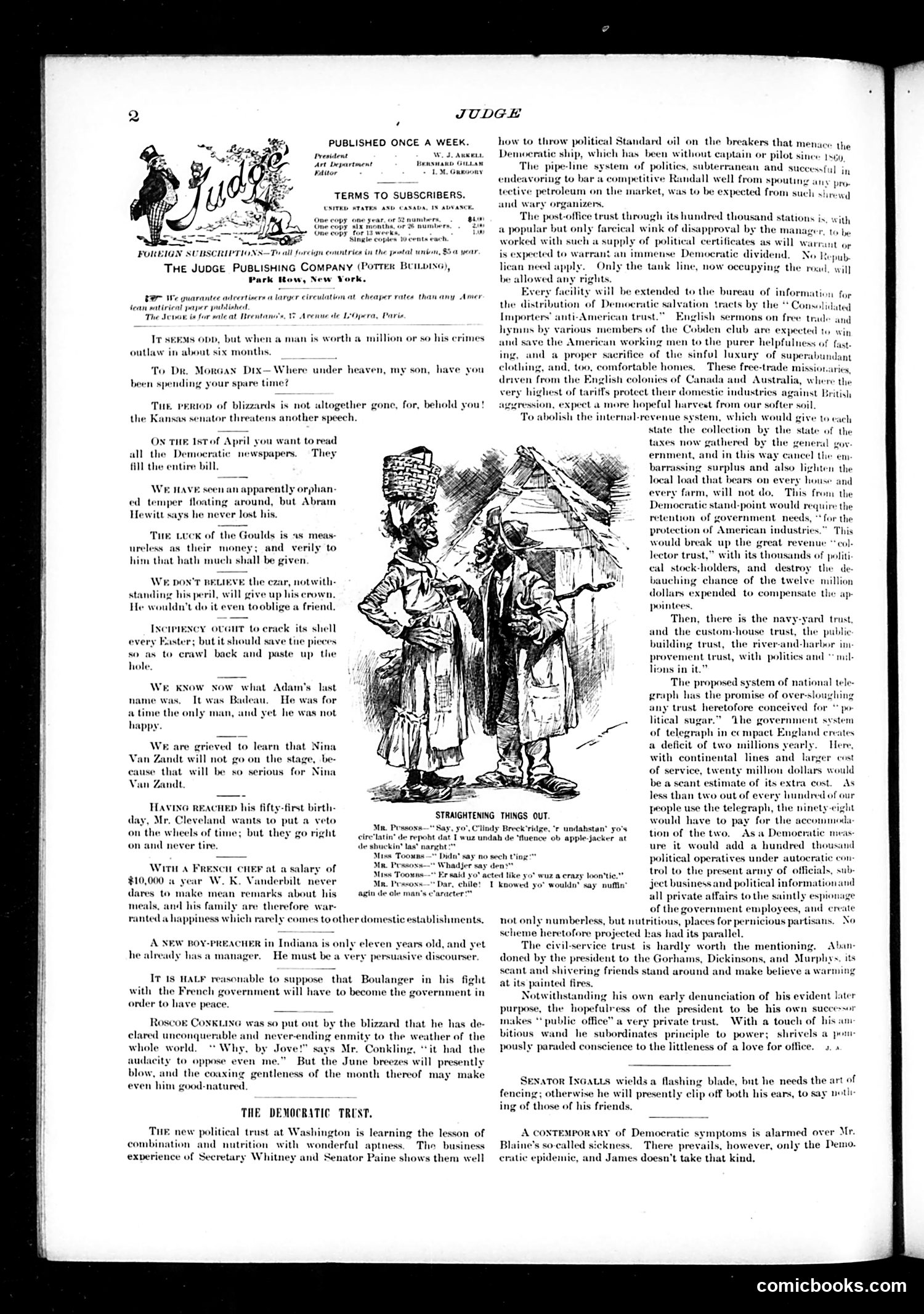
This page contains political commentary rather than a primary cartoon. The main illustrated piece, titled "Straightening Things Out," depicts two figures in period dress appearing to have a confrontation or debate. The text discusses "The Democratic Trust" at Washington, criticizing Democratic handling of political appointments and trusts. References include Secretary Whitney and Senator Paine, suggesting this addresses late 19th-century Democratic administration policies. The surrounding shorter political pieces mock various Democratic figures and positions—including criticism of Kansas senators, veto threats, and Democratic newspaper positions. The overall theme satirizes Democratic Party management of government, particularly regarding trust-busting efforts and political appointments, though without clearer historical dating or more legible illustration details, specific figures and events remain somewhat unclear.
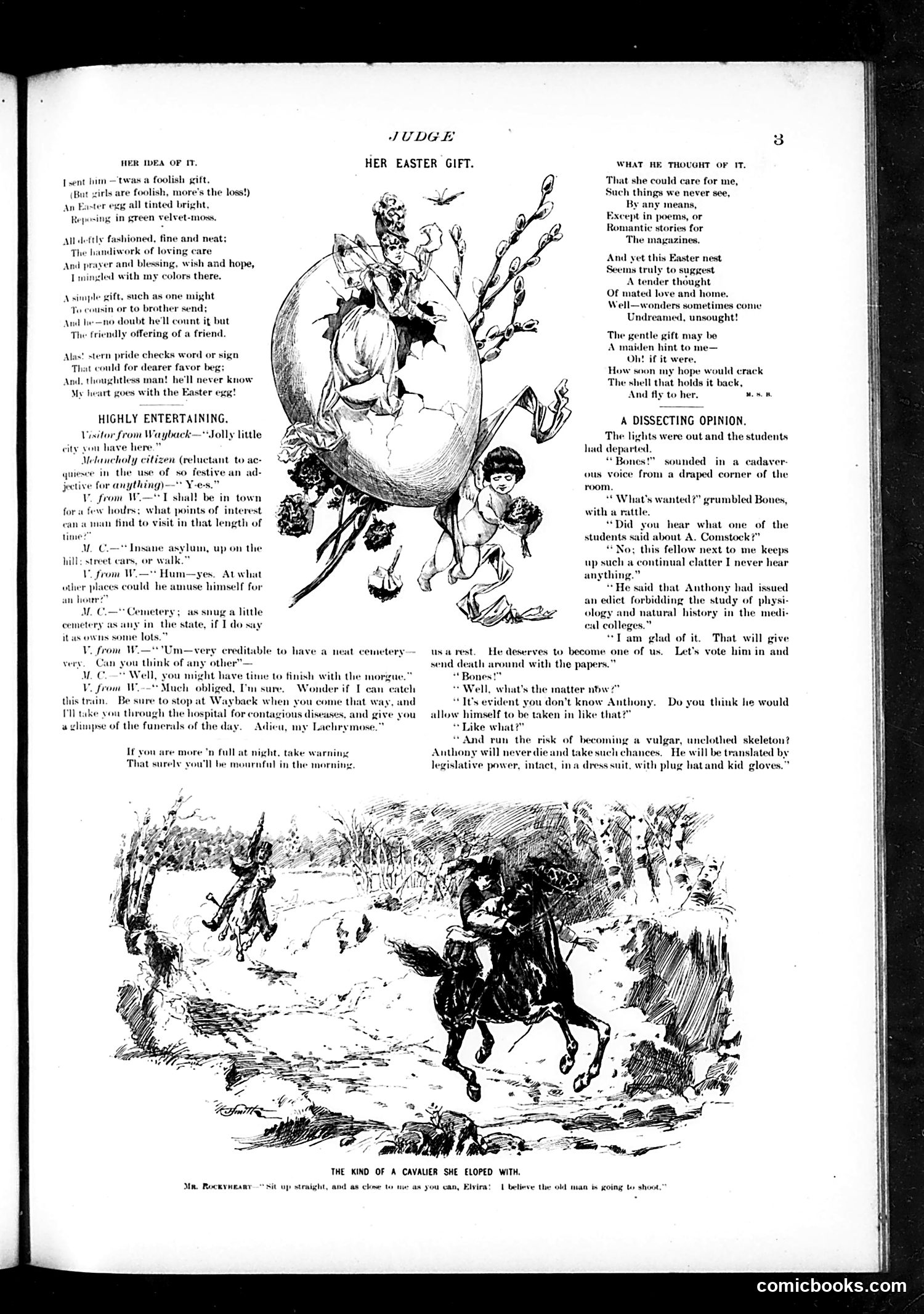
This page contains three separate pieces of social satire typical of late-19th-century *Judge* magazine: **"Her Easter Gift"** presents a sentimental poem paired with an illustration of a woman holding an Easter egg, contrasting her romantic hopes with a man's indifferent reception of her gift—mocking Victorian courtship conventions and gendered emotional labor. **"Highly Entertaining"** satirizes small-town bleakness through a visitor's conversation with a local, who can only suggest touring the cemetery and hospital as attractions—a jab at provincial America's lack of culture and vitality. **"A Dissecting Opinion"** features two skeletons discussing Anthony Comstock, the real historical figure famous for censoring "obscene" materials. The joke mocks Comstock's moral crusades as so extreme he'd censor medical education itself—suggesting his prudishness is corpse-like and ridiculous. The bottom illustration references elopement scandal, a common Victorian melodramatic trope.
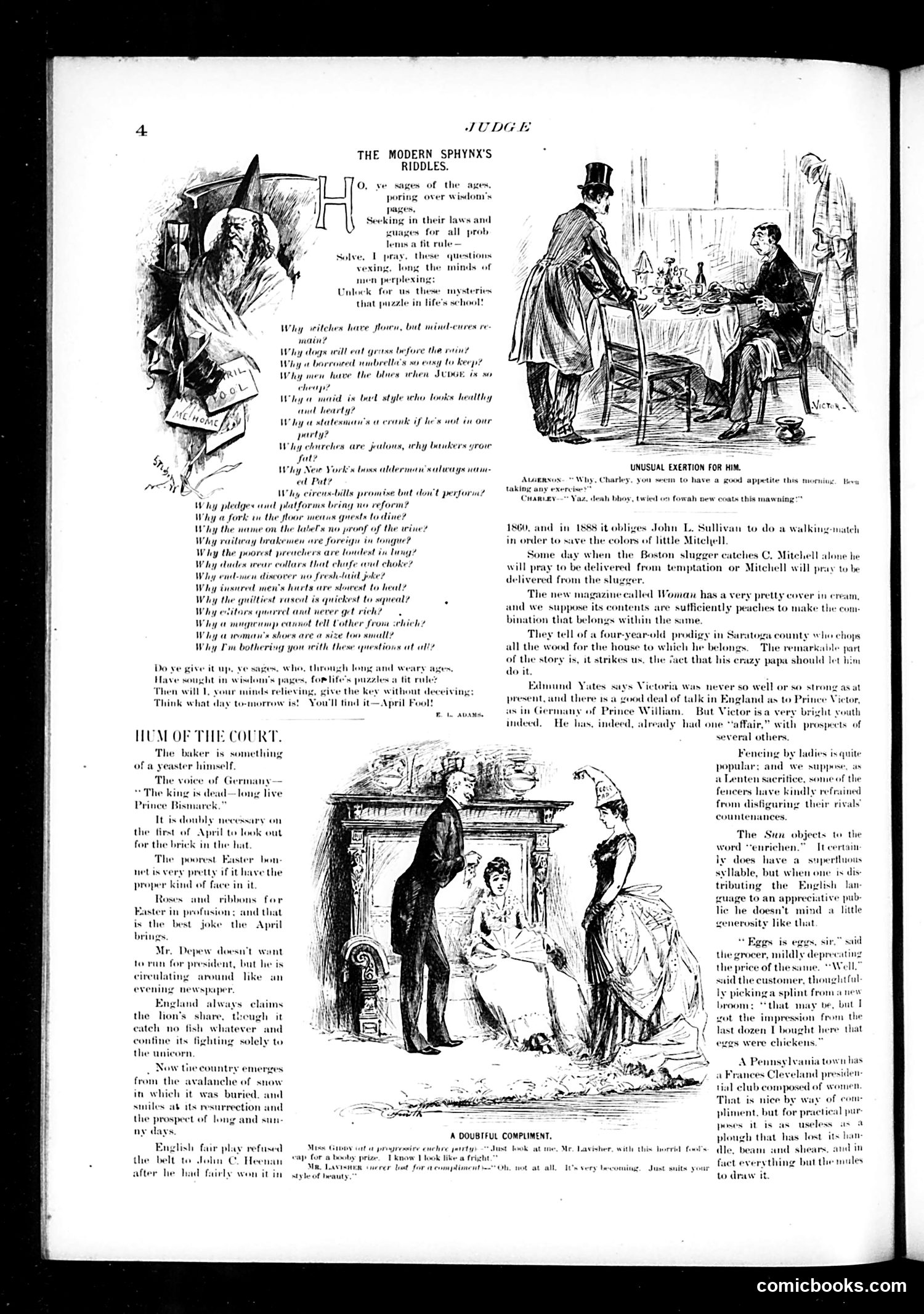
This page from *Judge* (appears to be April 1889, given April Fool's references) contains two main satirical pieces: **"The Modern Sphinx's Riddles"** presents absurdist questions mocking contemporary concerns—Why do men have "the blues when JUDGE is so cheap?" Why do politicians' pledges bring no reform? It's typical April Fool's Day humor, presenting philosophical-sounding riddles with mundane or cynical answers about human nature and society's failures. **"Hum of the Court"** and accompanying cartoons satirize contemporary figures and events. References include boxer John L. Sullivan (known for fighting Mitchell), Victoria's relationship with Prince William, and various social absurdities. The cartoons mock vanity, political corruption, and social pretension through exaggerated situations. The overall tone is lighthearted social commentary—critiquing politicians' dishonesty, fashionable vanities, and the general hypocrisy of Victorian society. The artwork uses caricature to enhance the satire, though specific individuals aren't always clearly identified in surviving reproductions.
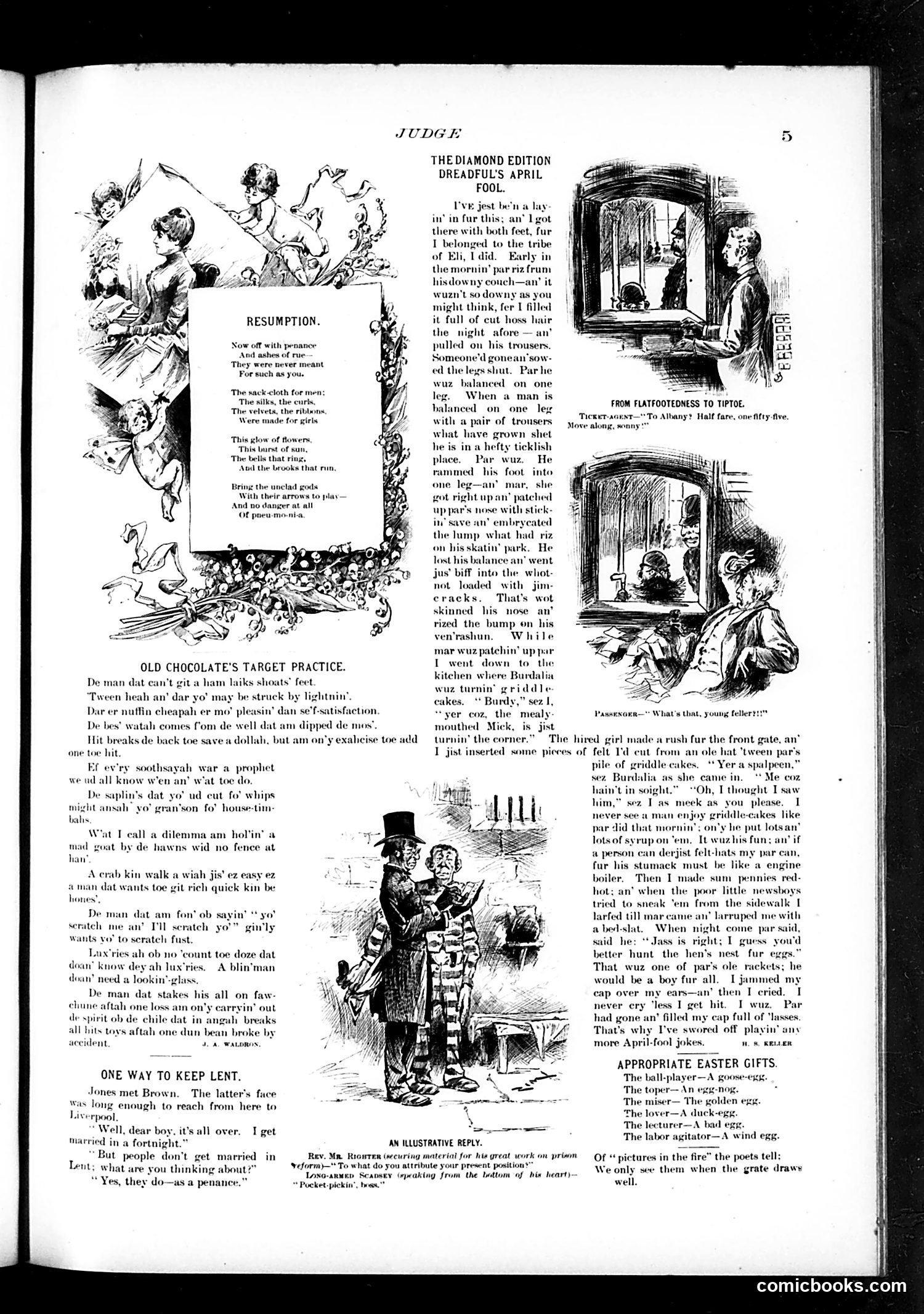
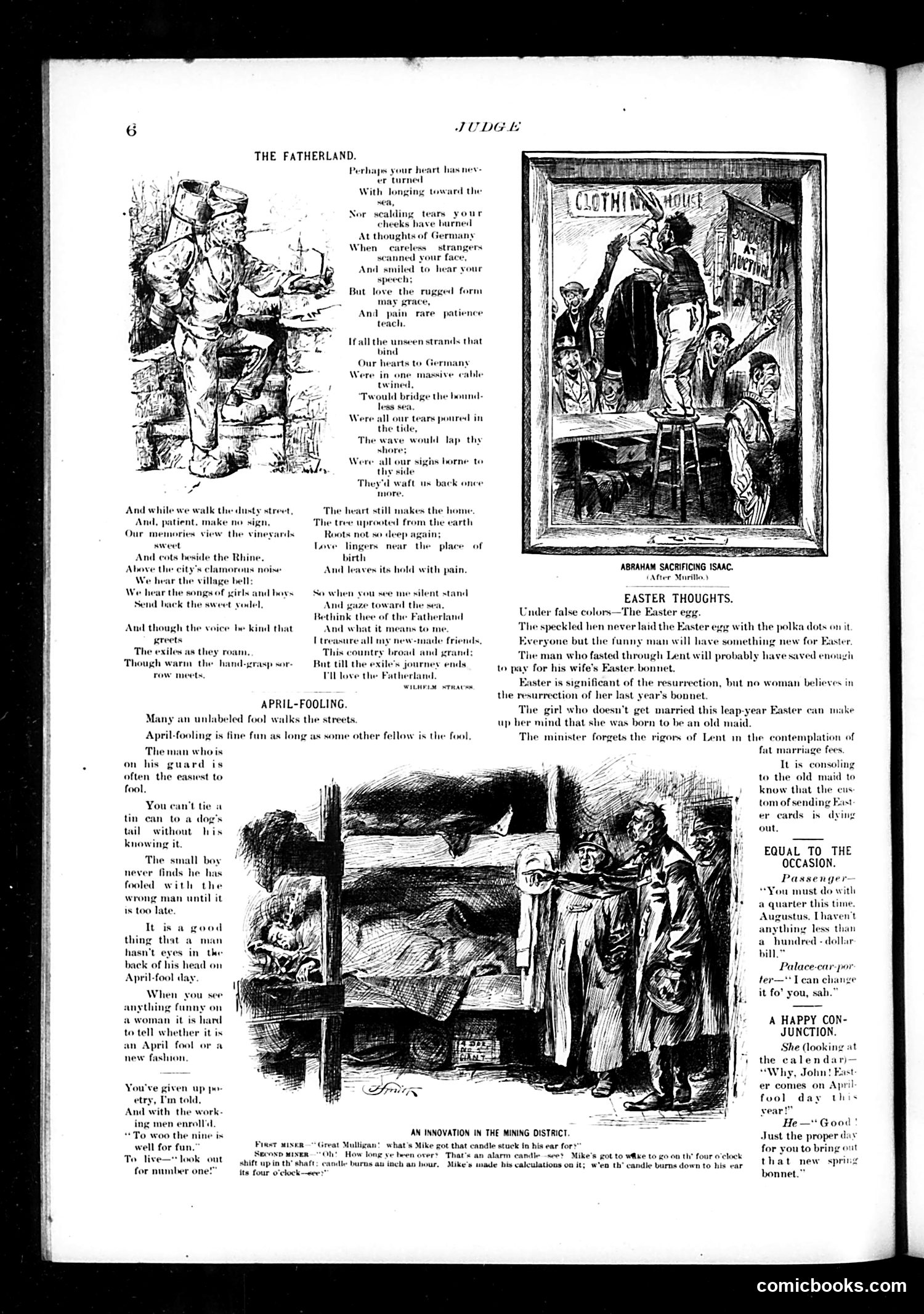
This page contains multiple editorial cartoons and humorous pieces from an American satirical magazine. **"The Fatherland"** is a sentimental poem about German-American immigrants yearning for their homeland across the Atlantic—likely reflecting early-1900s nostalgia for Germany among American communities. **"April-Fooling"** offers cynical observations about foolishness and human nature, suggesting that the truly foolish person is often the one who doesn't realize he's been made a fool. The **Easter-themed jokes** mock commercialism and hypocrisy: women caring more about new bonnets than religious meaning; fasting during Lent forgotten immediately after; Easter cards becoming obsolete. **"Equal to the Occasion"** depicts a passenger negotiating train fare downward—satirizing economic pressures and haggling over small costs. **"An Innovation in the Mining District"** shows miners using an alarm candle in someone's ear—absurdist humor about mining safety methods. The biblical engraving "Abraham Sacrificing Isaac" appears decorative rather than thematically connected to surrounding content.
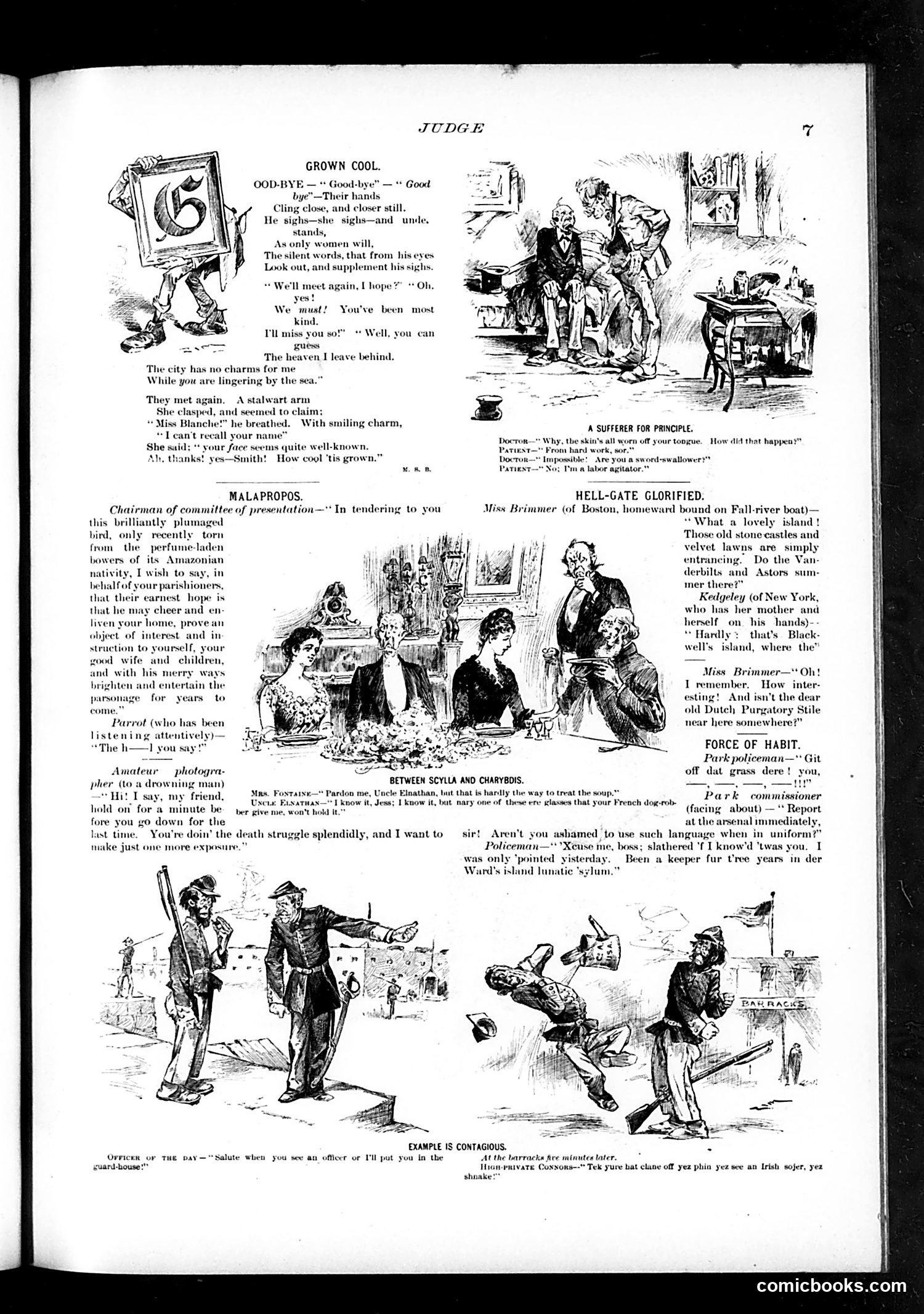
This satirical page contains several unrelated comic sketches typical of 1880s-90s humor: **"Grown Cool"** mocks romantic sentimentality—a couple tearfully parts with flowery declarations, then meets again and the man doesn't recognize the woman, suggesting her emotional investment meant nothing to him. **"Malapropos"** shows a clergyman giving an absurdly verbose presentation speech about a parrot, using malapropisms and overwrought language, while a drowning photographer interrupts with mundane commentary about temperature. **"Hell-Gate Glorified"** satirizes Boston snobbery: a pretentious visitor mistakes Blackwell's Island (a New York prison/asylum location) for an exclusive wealthy estate. **"Force of Habit"** depicts an Irish park policeman reverting to his previous job as a prison guard, reflexively shouting at civilians—showing how occupational conditioning overrides civility. **"Example is Contagious"** shows an officer's salute directive being comically misinterpreted and perpetuated by enlisted men. These sketches rely on period-specific references (Blackwell's Island, Irish stereotypes) and social pretension humor common to Victorian-era American satire.
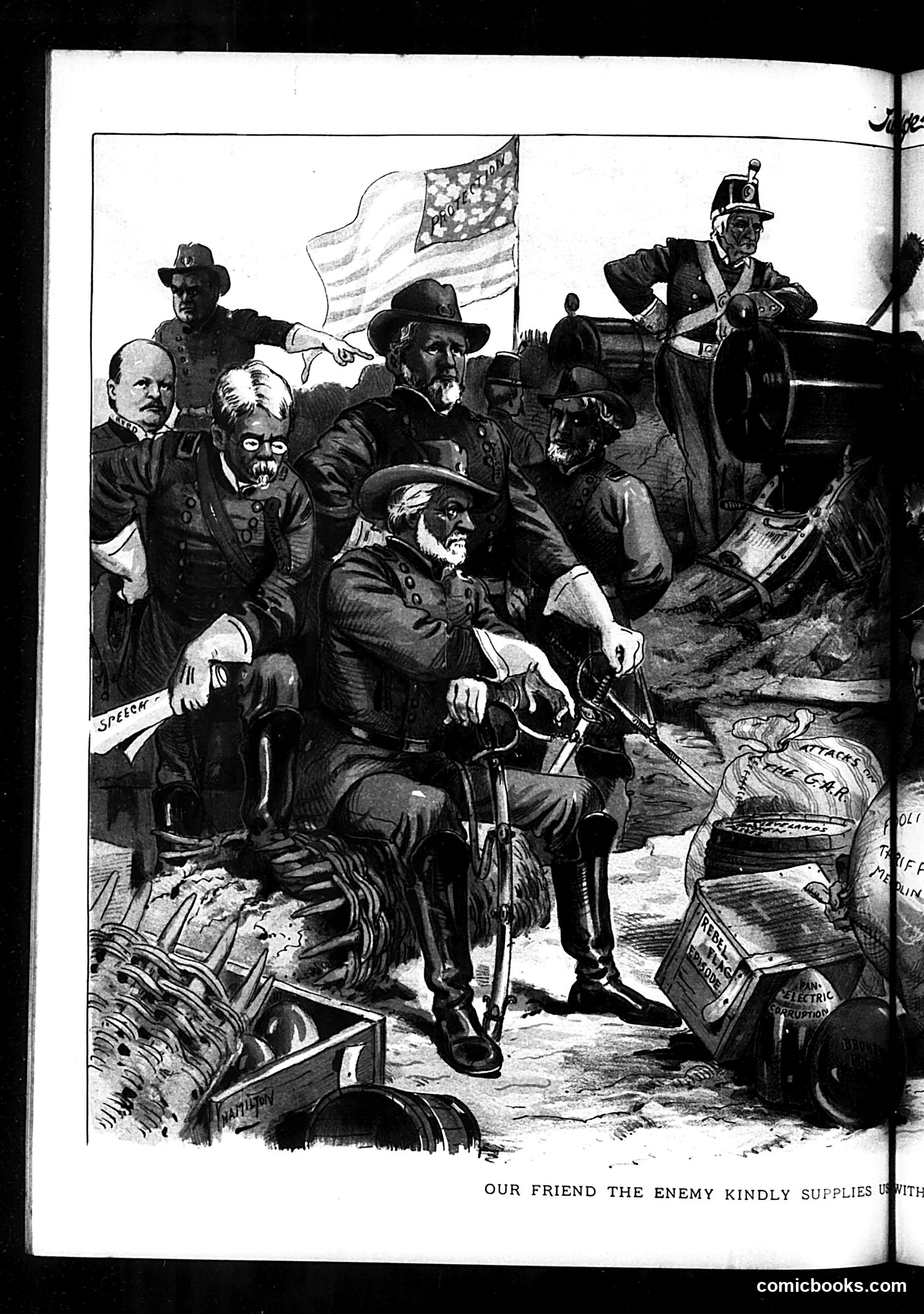
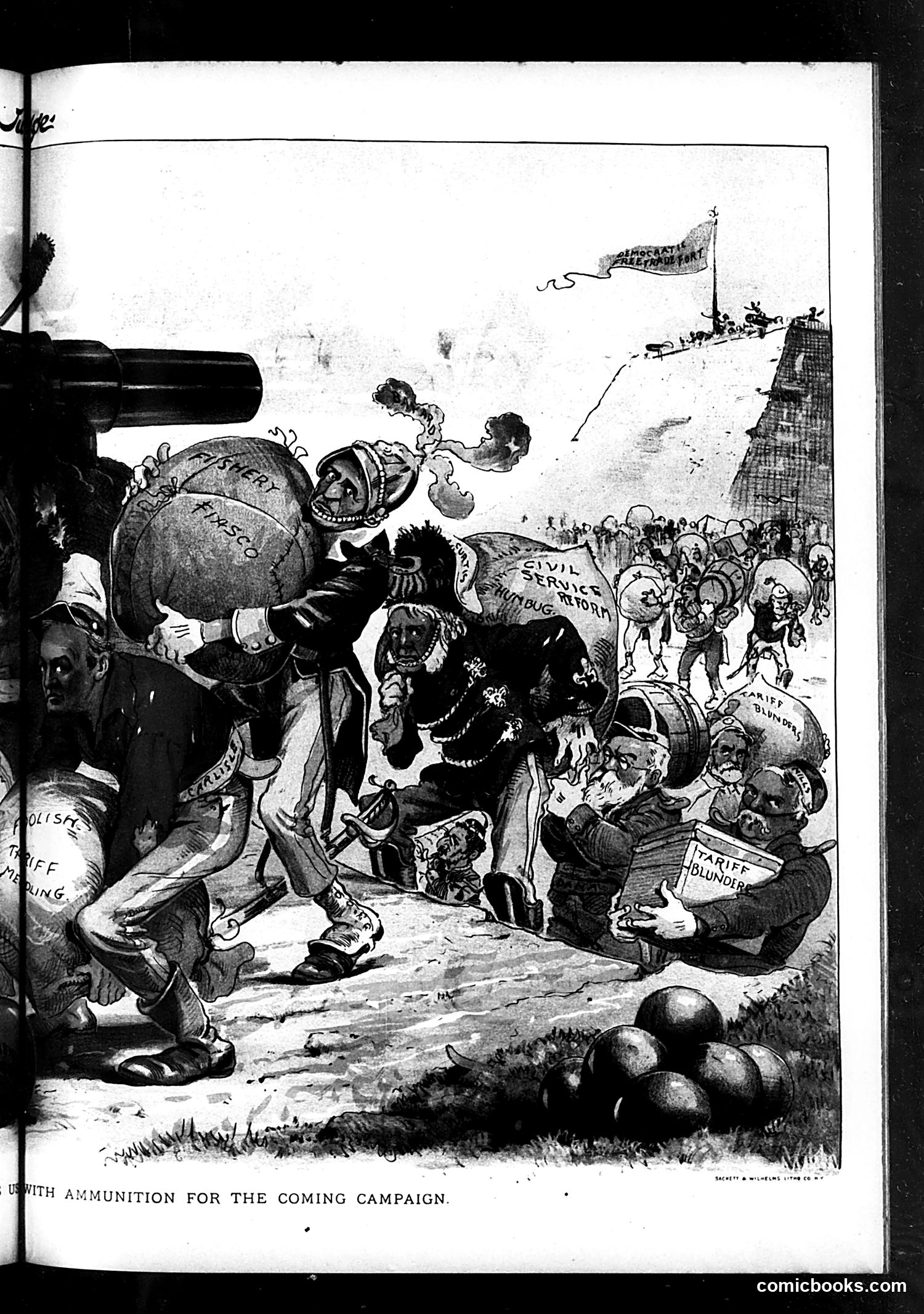
This appears to be a military or wartime satire from *Judge* magazine. The caption reads "OUR FRIEND THE ENEMY KINDLY SUPPLIES US WITH..." (text cut off), suggesting ironic commentary on enemy provision of military supplies or resources. The scene depicts military officers and soldiers around artillery and munitions marked with labels (partially visible). The American flag flies in the background. The figures appear to be high-ranking military or political officials in late 19th or early 20th-century dress, examining supplies. The satire likely critiques either: (1) how an enemy inadvertently provides resources useful to American forces, or (2) domestic corruption/profiteering where enemy supplies reach American hands through improper channels. Without the complete caption and clearer label readings, the specific historical event referenced remains unclear, though the context suggests a period of military conflict or tension.
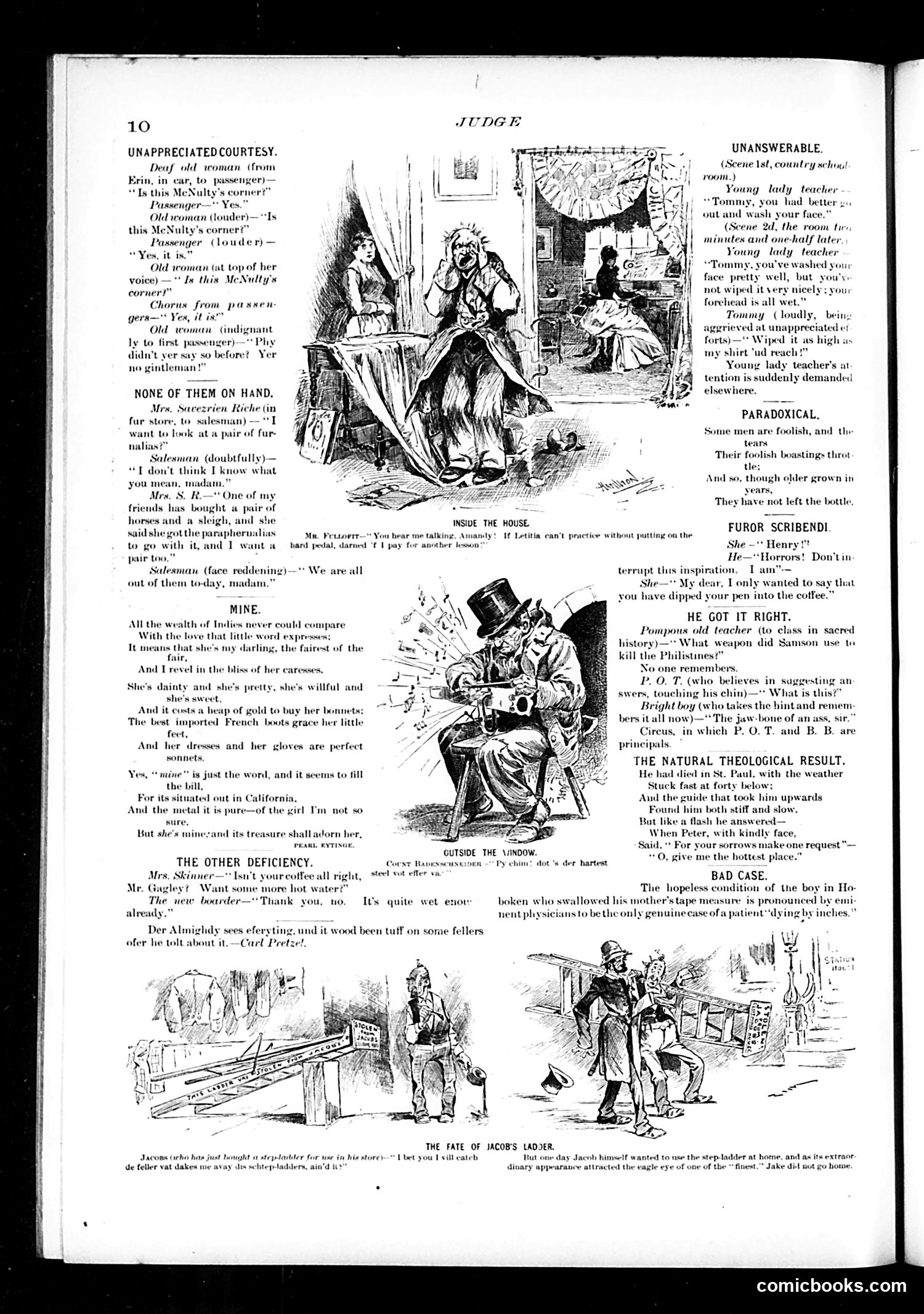
This page contains multiple brief humorous sketches typical of Judge's satirical format: **"Unappreciated Courtesy"** mocks Irish immigrants (the deaf woman from "Erin") through dialect humor, suggesting cultural rudeness—she demands a man repeat himself loudly, then insults him for not doing so initially. **"None of Them on Hand"** ridicules wealthy women's pretension; a rich customer asks for "furs" using a made-up word ("emalias"), embarrassing a salesman who must admit ignorance of her invented terminology. **Other sketches** include domestic comedy ("Mine"—about an expensive wife), workplace absurdity (a coffee-dipped pen), and classroom humor involving a condescending teacher and clever student. The illustrations depict working-class and immigrant characters in exaggerated style. The overall tone reflects period attitudes: gentle mockery of ethnic groups, class-based humor favoring the educated/wealthy, and domestic gender dynamics treating women as expensive luxuries. These represent typical Judge magazine content—accessible humor for middle-class readers about social "types" and everyday mishaps.
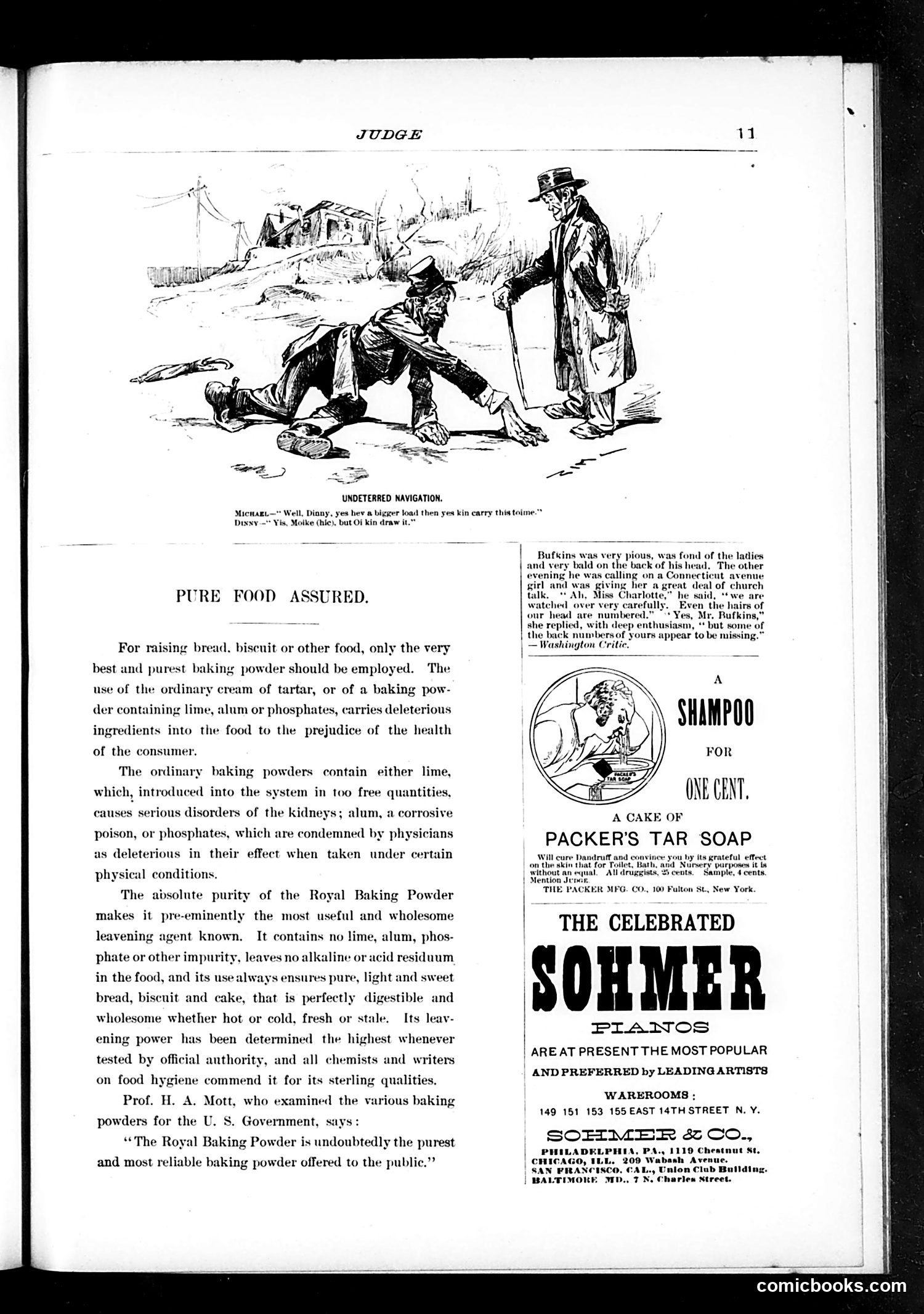
**The Cartoon "Undeterred Navigation":** A drunk Irishman (identified as "Dinny" and "Moike") staggers while carrying an impossibly large load. His companion remarks he has a bigger burden than he can carry; the drunk replies he can "draw it"—meaning he'll drag it despite his intoxication. This is a ethnic stereotype joke about Irish drunkenness and foolish overconfidence, playing on period prejudices against Irish immigrants. **The Advertisements:** The page is dominated by endorsements for Royal Baking Powder (the main text argues for pure food standards), along with ads for Packer's Tar Soap and Sohmer Pianos. These reflect late 19th-century consumer culture and emerging food-safety concerns following muckraking journalism about adulterated products. The baking powder article explicitly attacks competitors' use of harmful additives (lime, alum, phosphates), positioning Royal as the pure alternative—typical patent-medicine-era marketing claims.
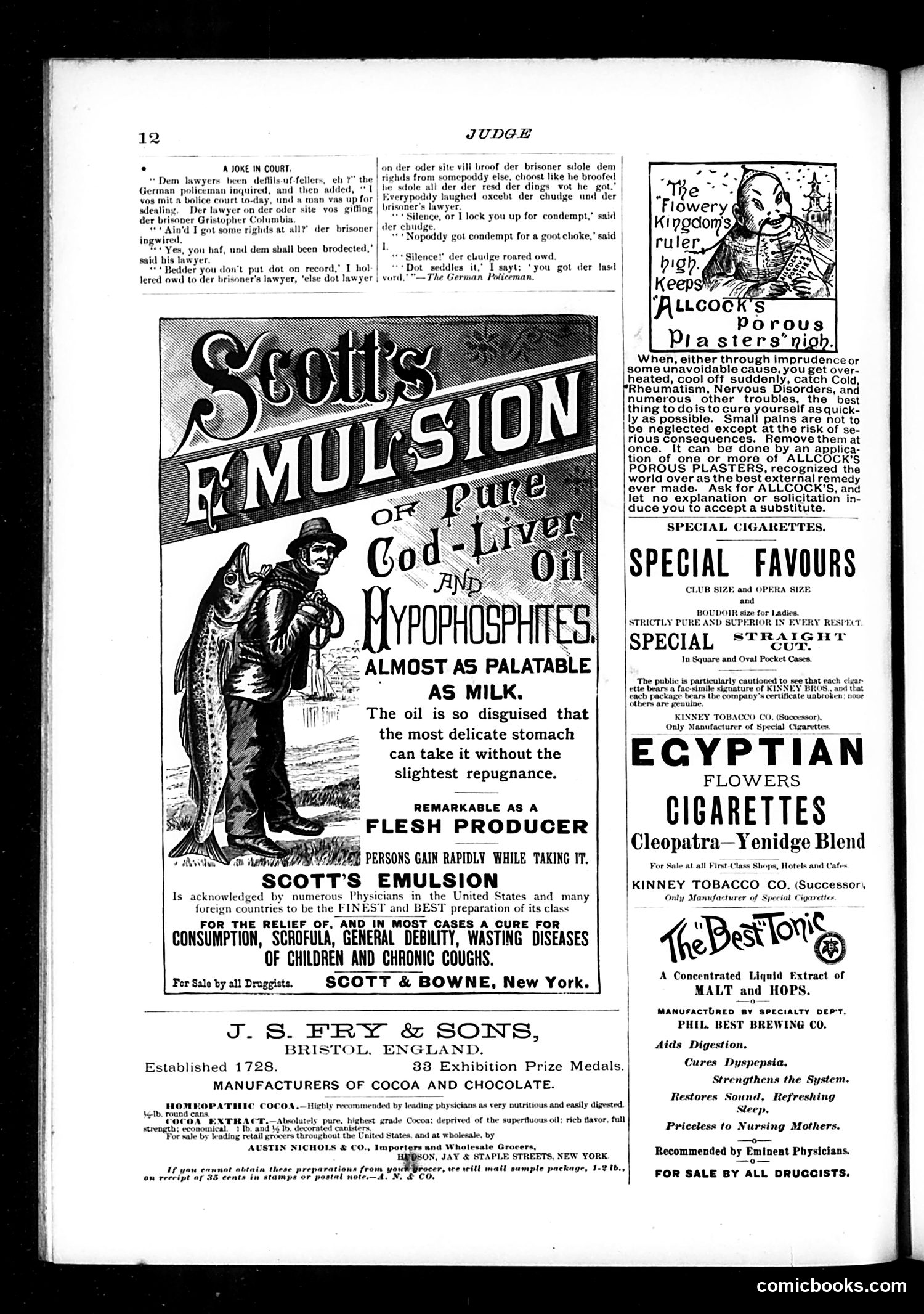
This page is primarily **advertising**, not political satire. The dominant content consists of patent medicines and consumer goods typical of late 19th-century American marketing. The small "A Joke in Court" at the top features a German-accented immigrant character (marked by dialect spelling like "dem," "vos," "der") as the butt of a joke about legal rights. The humor relies on ethnic caricature—a common Judge magazine trope—where the German-speaking defendant misunderstands court proceedings, creating wordplay around "contempt of court" versus a "good choke" (joke). The remainder of the page advertises **dubious medicinal products**: Scott's Emulsion (cod-liver oil marketed as a "flesh producer"), Allcock's Porous Plasters, Egyptian Flowers cigarettes, and various cocoa and malt extract tonics. These ads represent the era's largely unregulated patent medicine industry, before FDA oversight, making exaggerated health claims that would be illegal today.
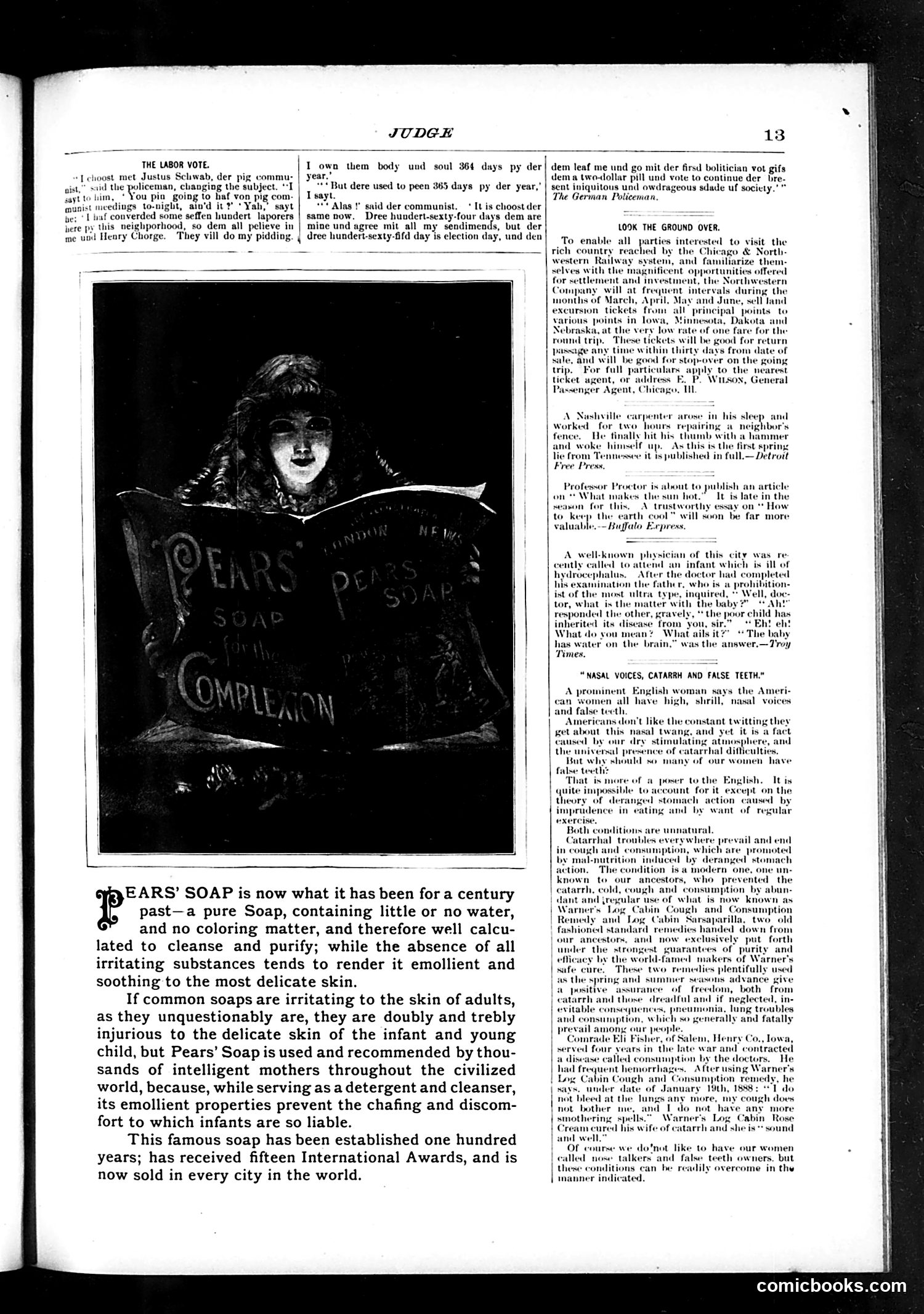
This page contains a satirical **labor political joke** rather than a cartoon image. The "Labor Vote" section ridicules immigrant German-American workers and their political vulnerability. **The Satire:** A German communist claims to control 700 immigrant workers' votes in his neighborhood. He boasts they'll follow him and "Henry George" (the 1880s single-tax advocate). However, the punchline reveals his actual leverage: he only truly owns them for 364 days—on election day (day 365), they abandon his radical politics for any candidate offering a "two-dollar pill" (bribe), continuing "the present iniquitous and outrageous state of society." **The Point:** Judge mocks both immigrant laborers as easily corruptible and communists as deluded about their influence. The thick German dialect emphasizes xenophobic stereotypes common to 1880s American satire. The rest of the page is **Pears' Soap advertising**—a full-page commercial touting the product's century-old pedigree and suitability for infants' delicate skin, alongside minor news briefs about travel excursions and medical gossip.
This page is primarily **advertising**, not political satire. It's from Judge magazine's advertising section featuring late 19th-century products and services. The one cartoon element appears near the top: a sketch of a character (possibly representing an earthquake or natural disaster, based on the OCR text referencing "earthquake symptoms") used humorously in what seems to be a Remington typewriter ad. The page otherwise showcases period advertisements for: - **Remington Standard Typewriter** (office equipment) - **Plymouth Rock pants** (affordable clothing) - **Piper Heidsieck champagne** (luxury goods) - **Various remedies and consumer goods** (Epps's Cocoa, Ely's Cream Balm for catarrh) - **Musical boxes and luxury items** The "Carl Pretzel's Philosophy" section appears to be ethnic humor, using dialect writing—a common but now-offensive comedic device of the era. Overall, this reflects Judge's dual function as both satirical magazine and advertising vehicle, with minimal actual political or social commentary visible on this particular page.
This is primarily an **advertising page** from Judge magazine (circa 1887, based on dates visible). The page contains three repeated advertisements for **Macee's Emulsion** (a cod liver oil product), interspersed with other commercial ads and brief entertainment listings. The Macee's ads feature **testimonial letters** from satisfied customers—a clergyman and a factory worker—claiming the emulsion cured respiratory ailments, night sweats, and general debility. This was standard medical marketing of the era, before FDA regulations. The only apparent **satirical content** is a brief joke about a woman's vanity: an old gentleman observes that women scrutinize men's finances while hiding their own spending, then notes a woman who damaged her skin with cosmetics but recovered using "common sense" and Dr. Pierce's products—poking fun at women's cosmetic use. The page mostly consists of **period advertisements** for patent medicines, theater listings, and business opportunities—reflecting Judge's role as both satirical magazine and advertising vehicle for contemporary products and entertainments.
This page is primarily **advertising and business listings**, not political satire. It showcases late 19th-century commercial establishments and consumer products. The notable content includes: **Hotel Advertisements**: Listings for prominent New York, Jersey City, Albany, Baltimore, Philadelphia, and Rochester hotels catering to travelers. **Product Advertisements**: Several products appear, including: - "Ideal Felt Tooth Polisher" (dental hygiene product) - Sohmer pianos (endorsed by bandmaster Patrick Sarfield Gilmore) - S.S. Sleeper & Co. cigars - Earl Wilson collars and cuffs - Various patent medicines and consumer goods **The satirical content** is minimal—mostly brief humorous anecdotes like the story of a boy saving $500 from his allowance, only to ask his father for $400 to pay debts. This appears to be a typical Judge magazine page blending advertising revenue with light humor, reflecting consumer culture and commercial interests of the era rather than political commentary.
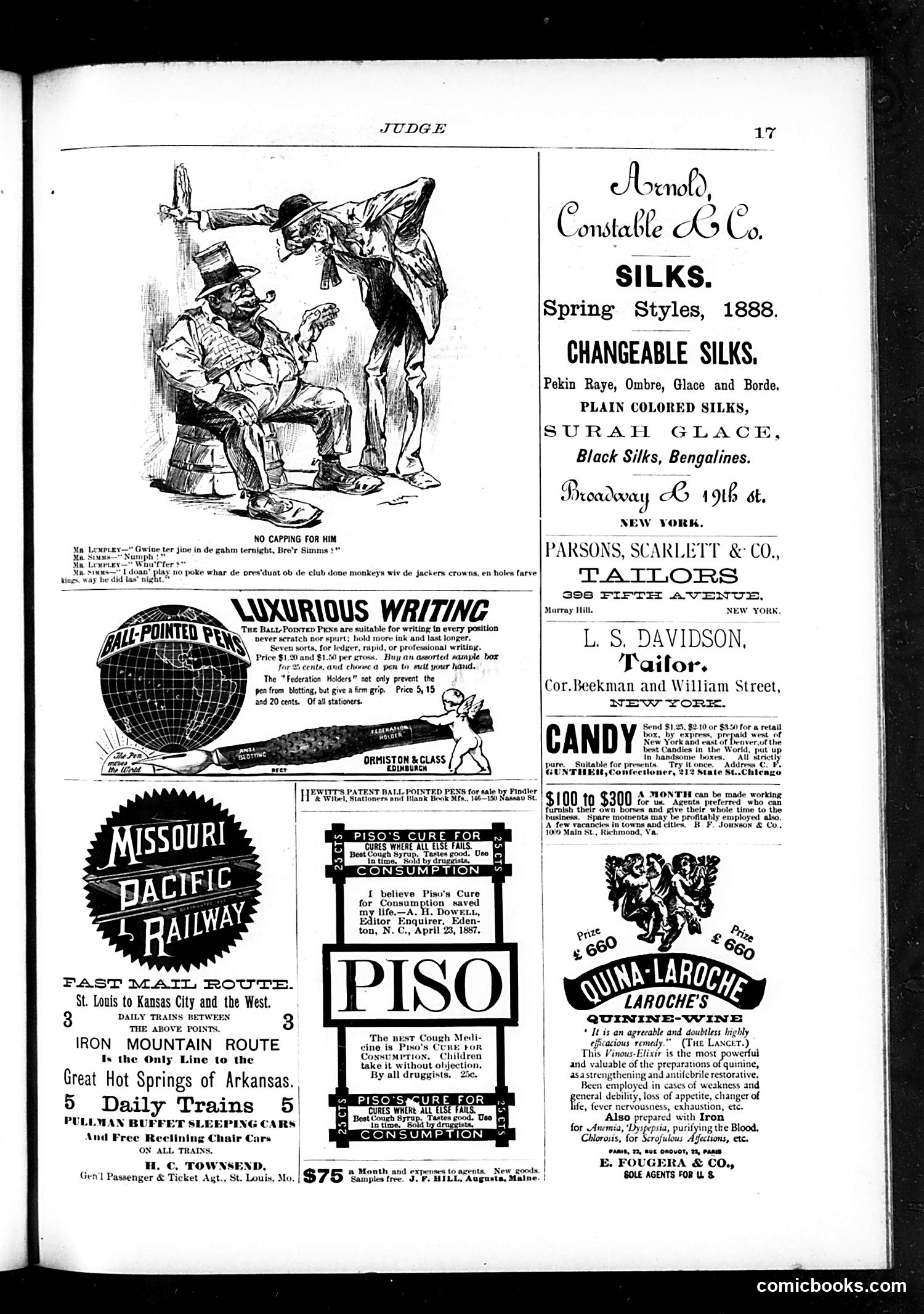
This single-panel cartoon depicts two Black men in dialect-heavy conversation, with one warning the other against joining a dice game because the club's president "holds fav" (cheats) and manipulates the betting. The title "No Capping for Him" refers to capping—adding money to a bet. The cartoon relies on racist stereotypes common to 1880s American humor: exaggerated dialect, depiction of African Americans as gamblers, and minstrel-show imagery. The joke plays on supposed Black predisposition toward gambling and gullibility. This represents *Judge* magazine's casual racism typical of the era—the cartoon treats racial caricature as entertainment without satirizing any actual social issue or public figure. The "humor" is purely based on ethnic stereotype rather than political or social commentary. The page is otherwise filled with period advertisements (silks, railroads, patent pens, patent medicines).
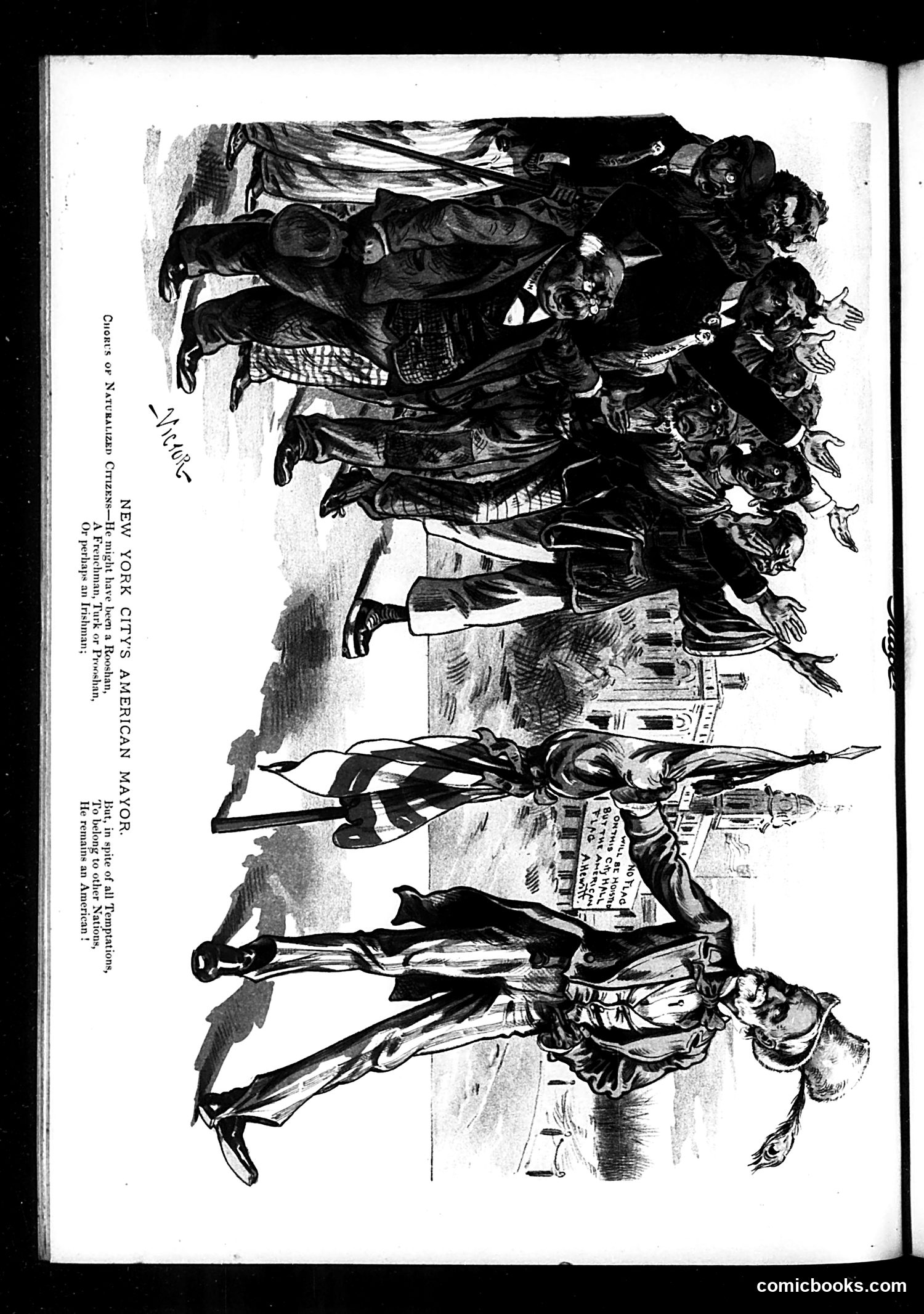
This page appears to be upside-down or rotated, making definitive analysis difficult. The OCR text has produced only random letters and symbols, suggesting the scanner captured a largely non-textual area of the page. What is visible in the image shows what appears to be a satirical illustration in Judge magazine's style, featuring multiple figures in period dress (likely late 19th or early 20th century). The composition suggests political or social commentary, but without legible text or clear identifying captions, I cannot reliably determine: - Which specific figures are caricatured - What political event or social issue is being satirized - The intended meaning or "joke" To properly analyze this cartoon, the page would need to be correctly oriented and the accompanying text legible.