
A complete issue · 16 pages · 1888
Judge — February 25, 1888
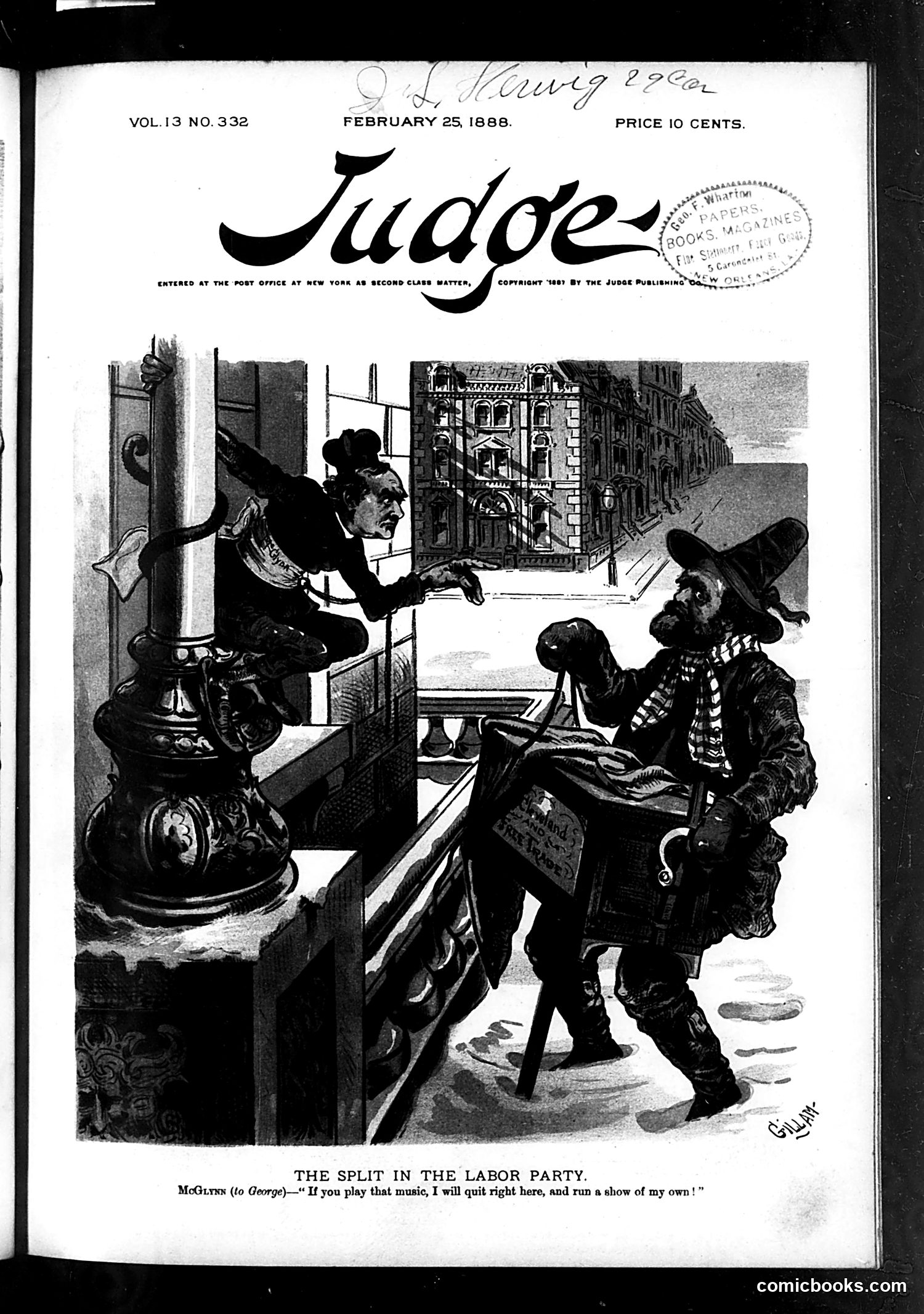
This political cartoon satirizes a conflict within the labor movement. McGlure (identified in the caption as "to George") threatens musicians with violence—"If you play that music, I will quit right here, and run a show of my own!"—suggesting labor leadership disputes over strategy and control. The caricatured figures appear to represent different factions within organized labor, with the aggressive McGlure character embodying the threat of schism. The ornate building visible through the window suggests this occurs in a theater or public venue, implying the dispute concerns entertainment workers. The cartoon mocks labor's internal divisions, portraying leadership conflicts as petty and self-destructive rather than principled disagreements. This reflects late-1880s tensions between competing labor organizations and philosophies.
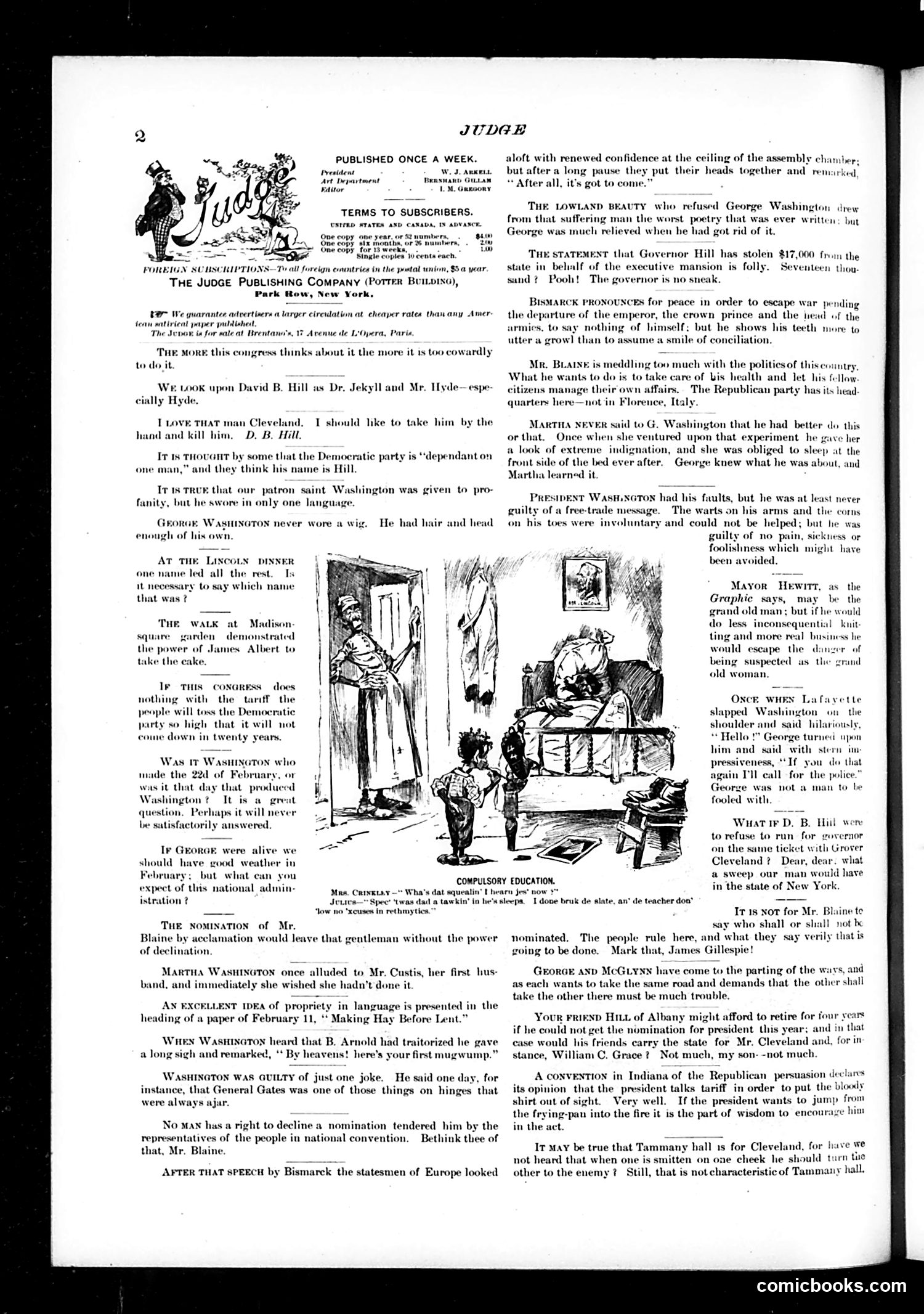
This single cartoon depicts a classroom scene where a teacher confronts a student about poor attendance. The dialogue reads: "Mrs. Crowley—'What's dat sperrit? I been yer now?'" and "Jimmey—'See! Yous said a taxicab in yer school. I done brung de slate, an' de teacher don't like yer homes in dirtitches.'" The satire targets **compulsory education laws**, likely from the early 1900s. The broken dialect and immigrant setting suggest this mocks working-class families' struggles with mandatory schooling requirements. The joke appears to be that the student invented an absurd excuse ("taxicab in school") to explain absence, poking fun at both truancy enforcement and the comedic language barriers of urban immigrant communities.
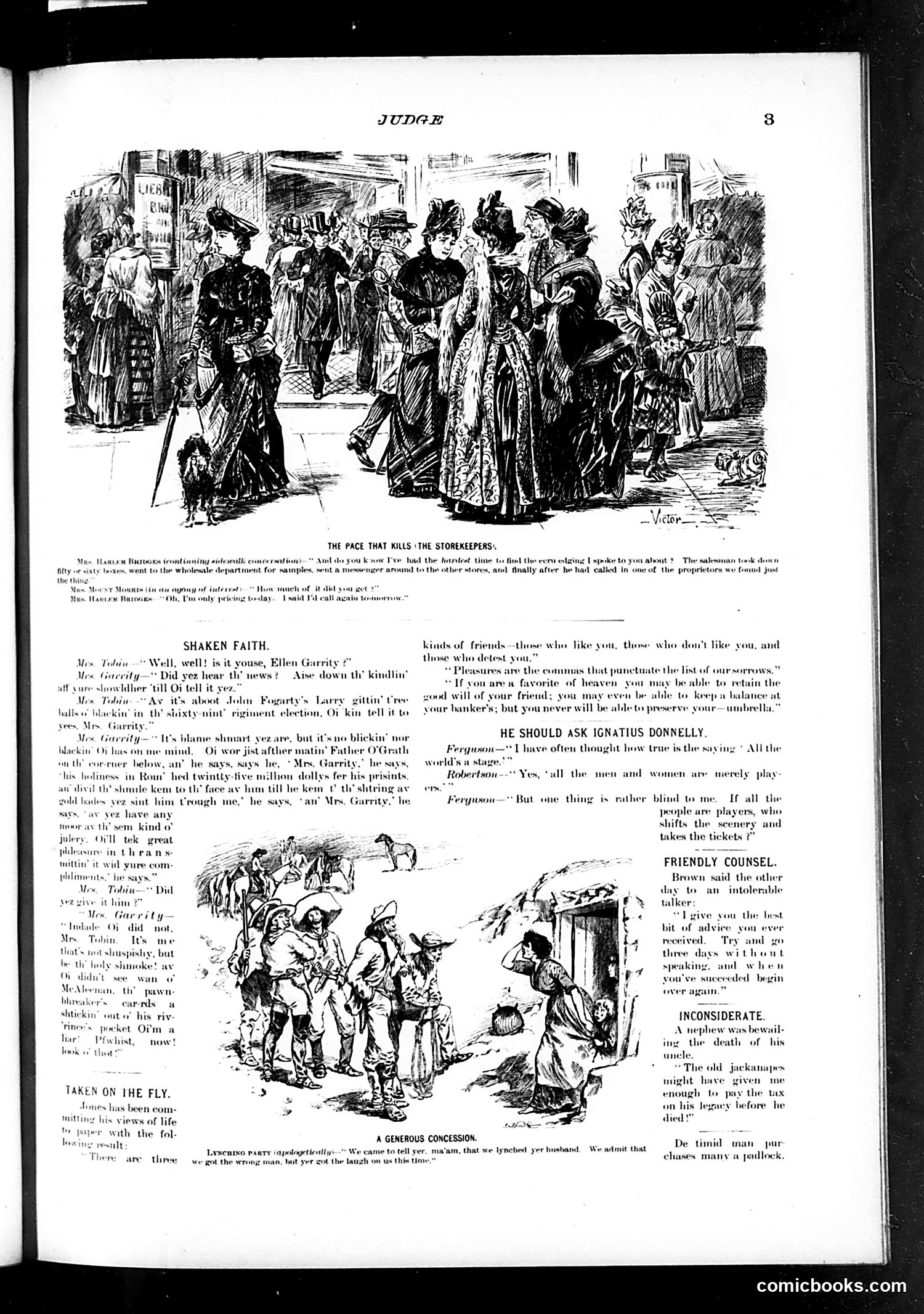
This page contains several satirical sketches typical of Judge's late 19th-century Irish-American humor and social commentary. **"The Pace That Kills"** (top): A street scene satirizing urban society's shallow concerns—appears to mock fashionable women's obsession with social status and superficial appearances. **"Shaken Faith"**: A dialogue between Irish working-class women (identifiable by dialect and names like Mrs. Garrity, Mrs. Tobin) discussing a man's infidelity and hypocrisy—satirizing both male moral failings and women's gossipy response to scandal. **"A Generous Concession"** (bottom): The darkest piece—depicts a lynching party apologizing for killing the "wrong man" but finding humor in the mistake. This reflects Judge's occasional willingness to satirize racial violence, though the tone treats murder as darkly comedic rather than condemning. The page mixes domestic Irish-immigrant humor with broader social critique, using heavy dialect and working-class characters typical of Judge's appeal to urban readership.
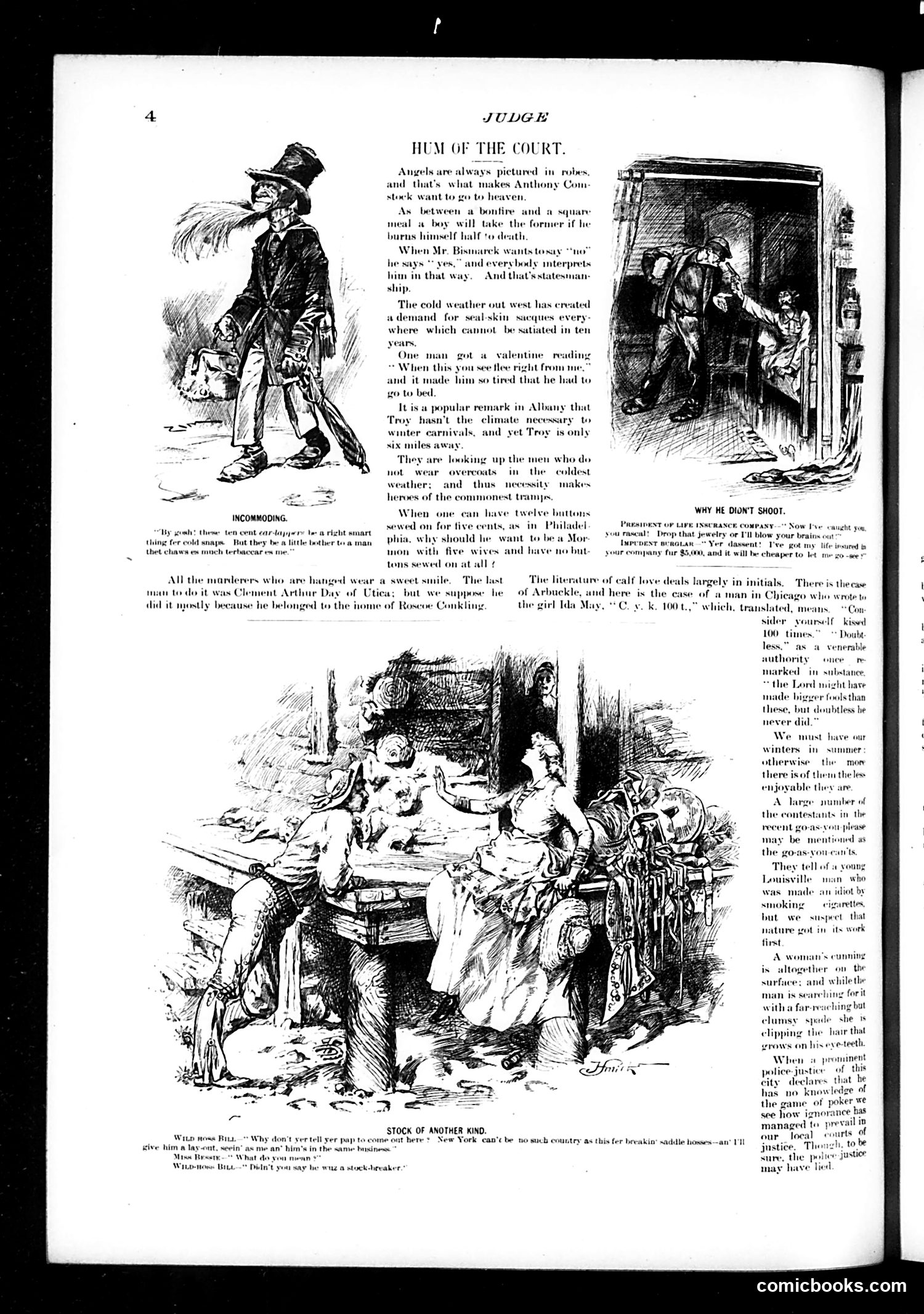
This page contains miscellaneous satirical commentary and two cartoons mocking American social customs and public figures of the Gilded Age. **Top cartoon ("Incomoding"):** Depicts a shabby man—likely representing urban poverty or vagrancy—illustrating a joke about Anthony Comstock, the famous censorship crusader, who wanted angels depicted clothed in heaven (satirizing his prudishness). **Bottom cartoon ("Stock of Another Kind"):** Shows Wild Bill and Miss Havers in frontier dress, with dialogue about broken saddle horses and "stock-breaker." This appears to play on livestock terminology while referencing frontier types or possibly contemporary figures. **Text commentary** includes brief satirical observations: jokes about boys preferring bonfires to meals, remarks on seal-skin jackets, references to Clement Arthur Day (a hanged murderer), and Roscoe Conkling (a prominent politician). The satire targets Victorian morality, fashion excess, and criminal justice. The overall tone is cynical about American society, class conditions, and public figures of the 1880s era.
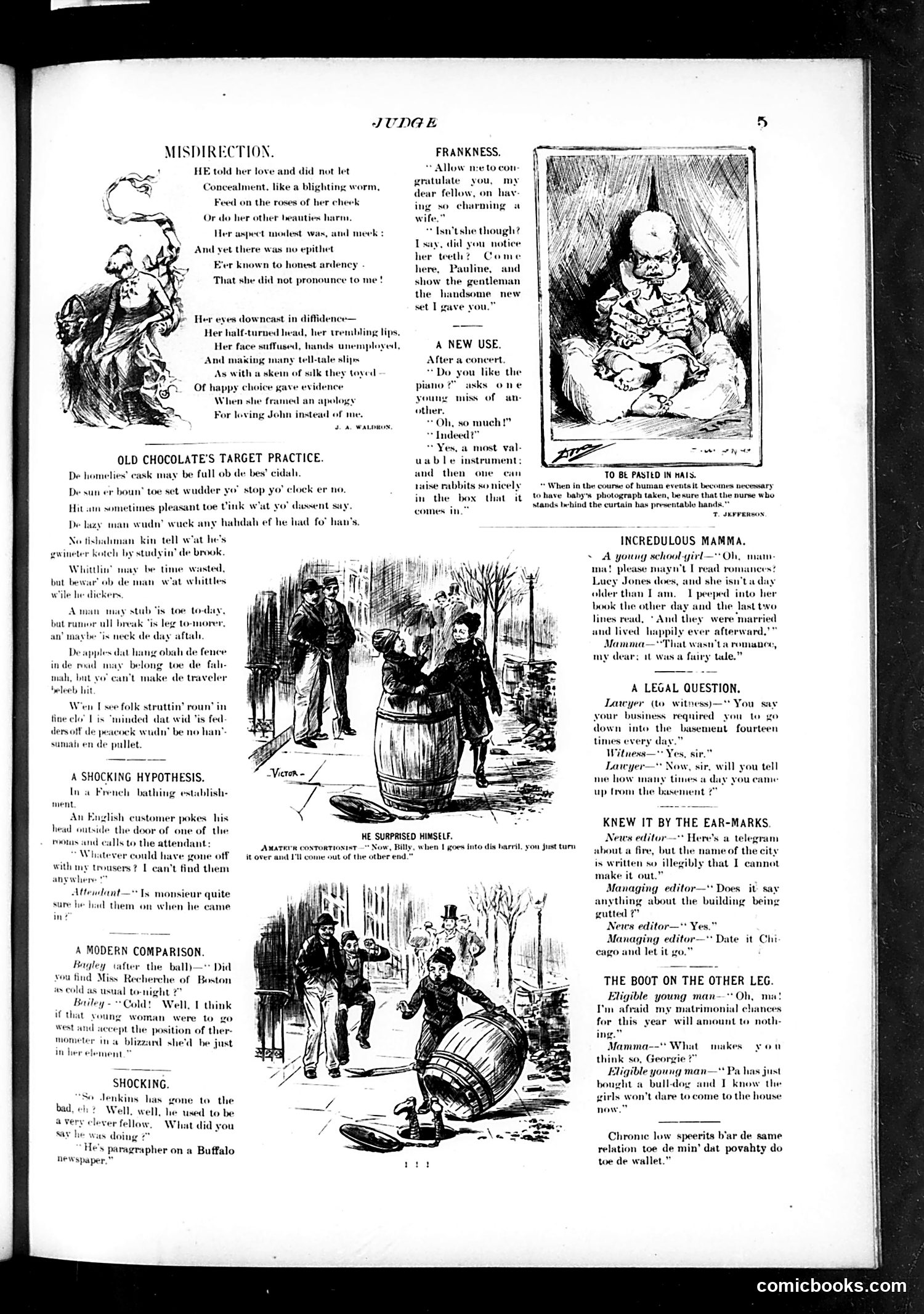
This page contains multiple brief satirical sketches typical of late 19th-century American humor magazines: **"Misdirection"** mocks romantic dishonesty—a man professes love while his actions betray indifference, using flowery language to mask infidelity. **"Old Chocolate's Target Practice"** uses dialect humor (characteristic of the era's problematic racial comedy) about a man shooting at targets. **"A Shocking Hypothesis"** jokes about a bathhouse misunderstanding where an English customer loses his clothes. **"A Modern Comparison"** satirizes social pretense among the wealthy regarding courtship coldness. **"Frankness"** ironically depicts a man proudly displaying his wife's false teeth to a visitor—humor based on dental prosthetics and marital embarrassment. **"A New Use"** makes an off-color joke about using a piano as furniture for raising rabbits. The remaining sketches address legal testimony, journalism mishaps, and courtship anxieties through brief comedic exchanges. Overall, this reflects Judge's focus on wordplay, social awkwardness, and domestic situations rather than political commentary.
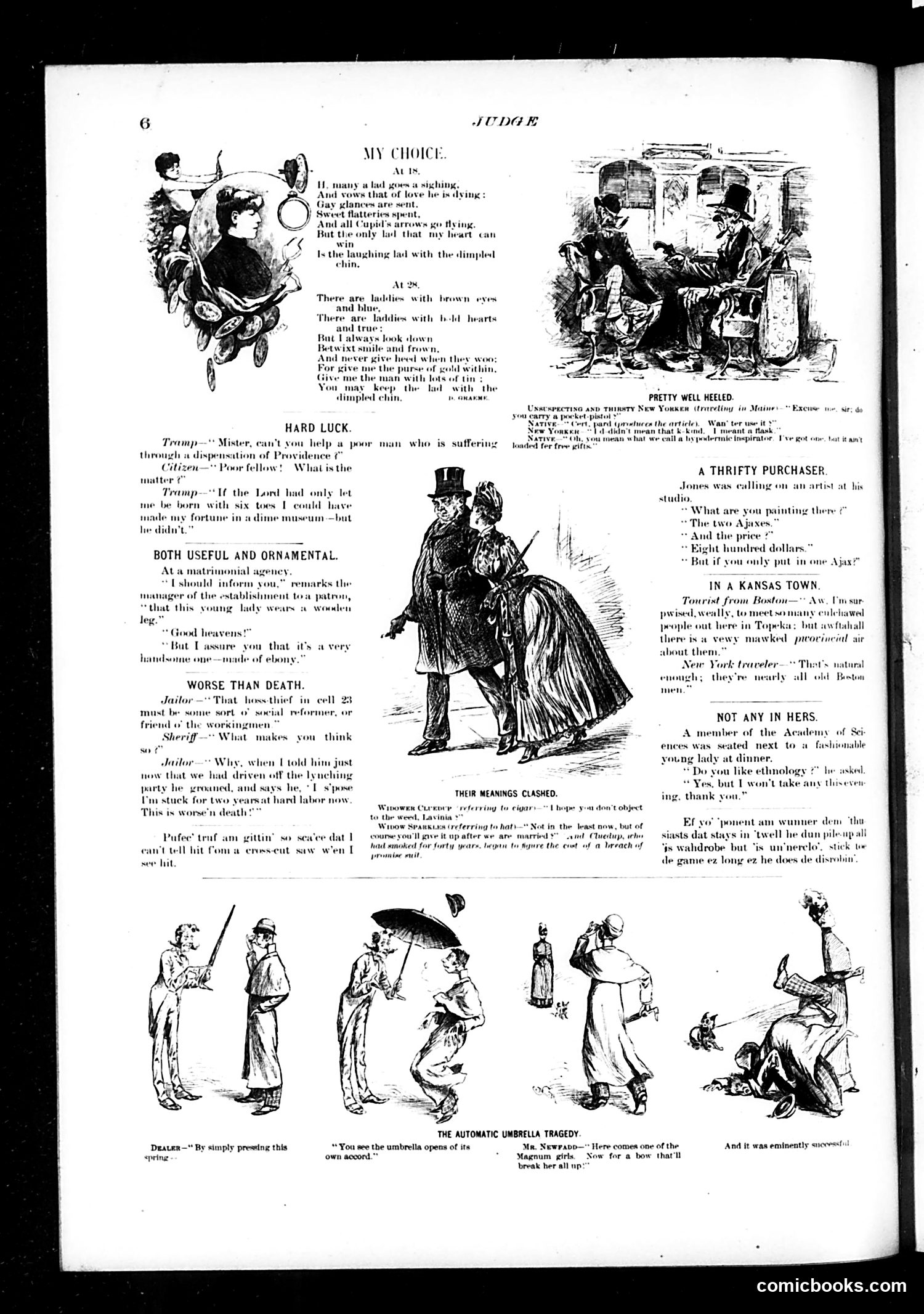
This page collects brief satirical vignettes typical of 1890s American humor magazines. Key pieces include: **"Hard Luck"**: A tramp complains to a farmer that he'd be rich if born with six toes—he could have displayed himself in a dime museum. The satire mocks both poverty and the era's exploitative "freak shows." **"Both Useful and Ornamental"**: A jeweler assures a customer that a young woman's wooden leg is made of fine ebony. This satirizes Victorian attitudes toward disabled people and absurd aesthetic justifications. **"Worse Than Death"**: A sheriff notes that a horse-thief—supposedly a friend of workingmen—groans upon hearing the lynching party disbanded, preferring death to two years' hard labor. This darkly satirizes labor conditions and mob violence. **"The Automatic Umbrella Tragedy"**: Sequential panels show an umbrella that springs open violently, injuring a young woman. The humor derives from the era's proliferation of unreliable mechanical gadgets. Other brief jokes address matrimonial agencies, cigars, painting prices, and provincial fashion—standard fodder for Judge's genteel readership.
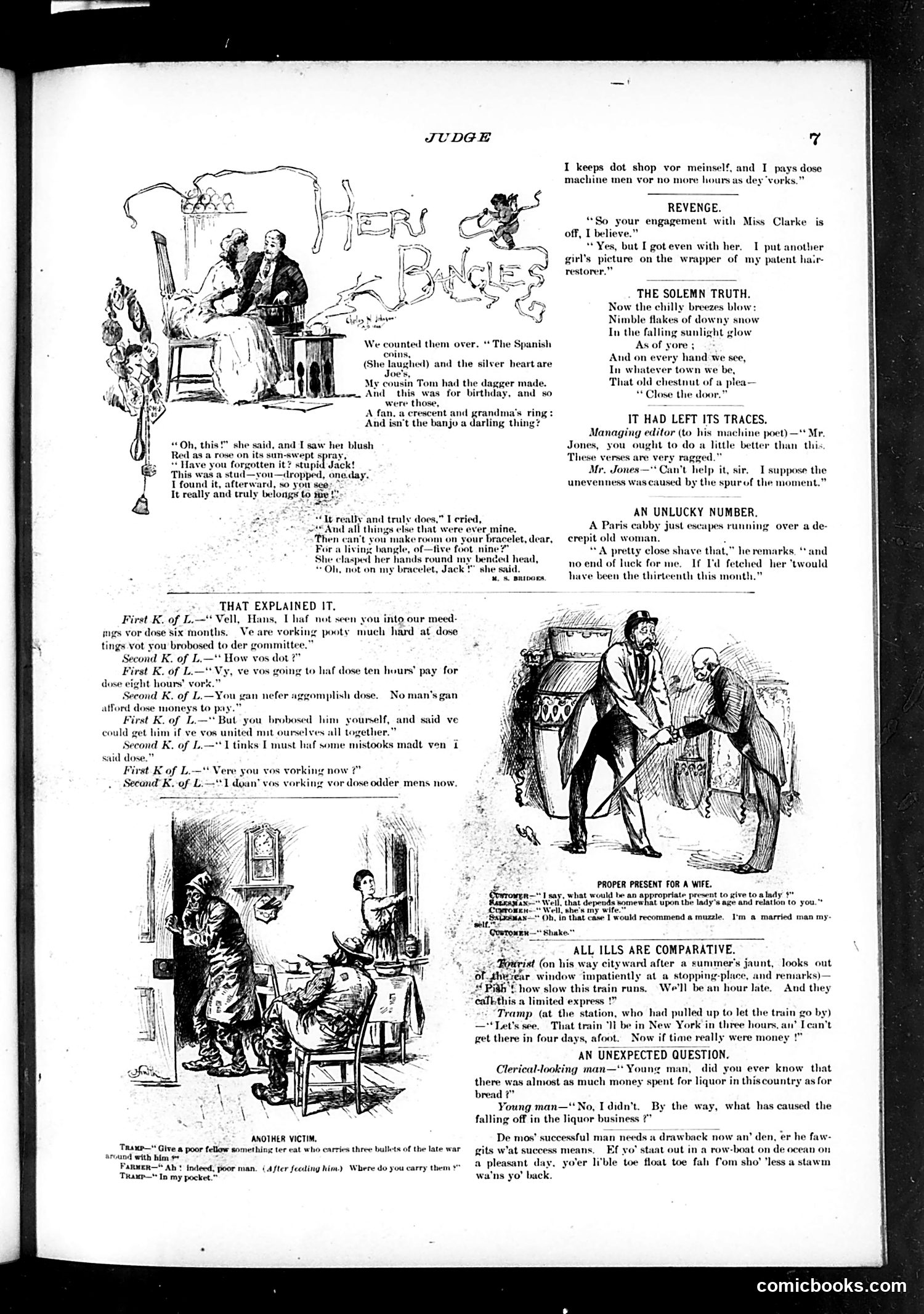
This page from *Judge* magazine contains several satirical pieces mocking working-class immigrants and contemporary social issues: **"That Explained It"** features two Knights of Labor (KOL) members speaking in exaggerated German-immigrant dialect. They discuss labor organizing—specifically a failed proposal for ten hours' pay for eight hours' work. The satire mocks both immigrant workers and labor activism as impractical and contradictory. **"An Unlucky Number"** jokes about a man nearly hitting an elderly woman with a cab, calling it fortunate because it would have been his "thirteenth" victim that month—dark humor about urban danger. **Other pieces** include romantic mishaps, train travel complaints, and working-class humor. The dialect humor and caricatured immigrant voices were typical of *Judge's* era, reflecting late-19th-century American attitudes toward working-class and immigrant communities. The overall tone ridicules labor organizing, immigrants, and working-class concerns through stereotyped portrayals.
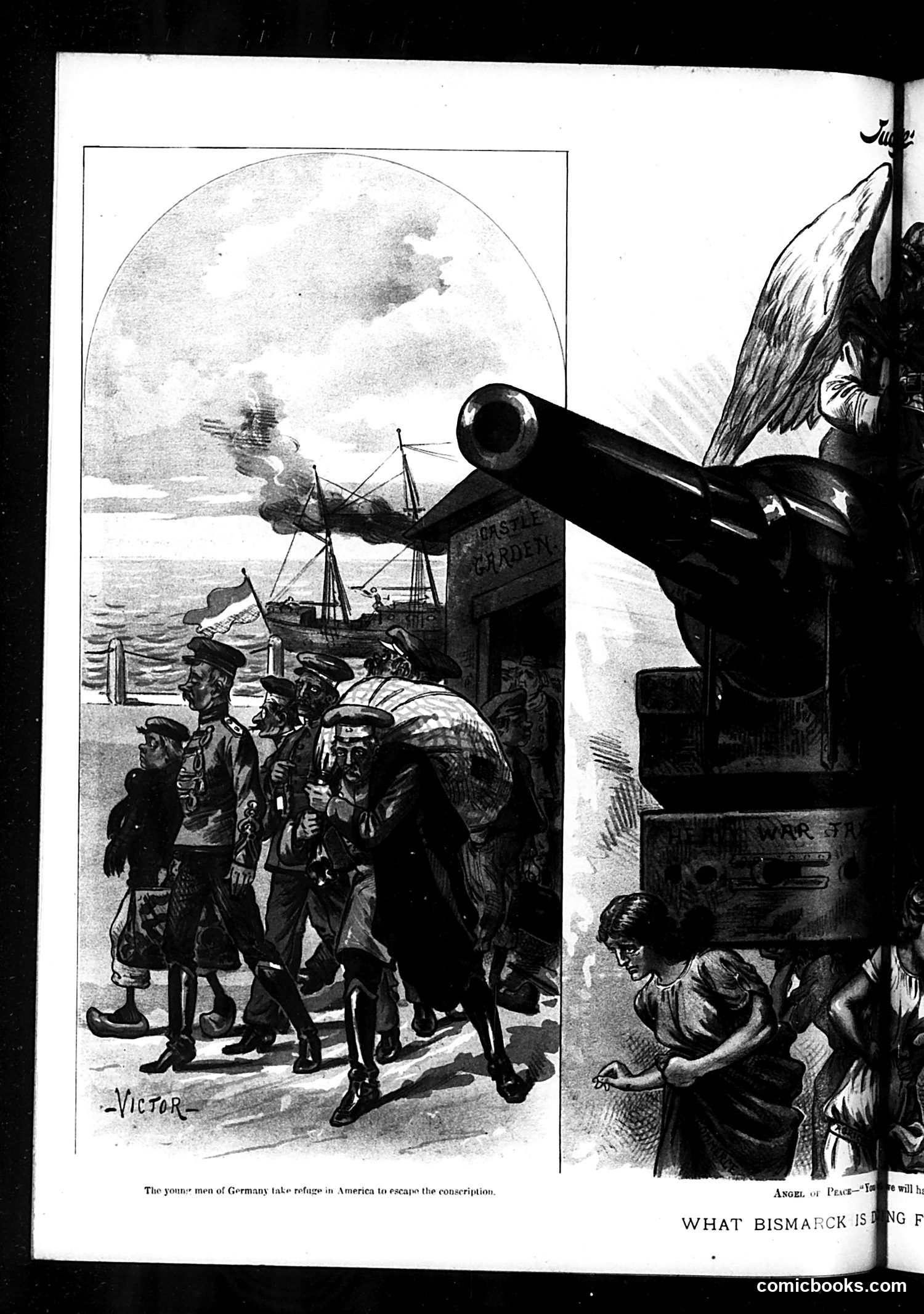
This page contains a political cartoon signed "VICTOR" depicting German military figures at a harbor, with ships visible in the background. The caption reads: "The young men of Germany take refuge in America to escape the conscription." The cartoon satirizes German military conscription policy by showing soldiers or officials apparently facilitating the escape of German youth to America. The incomplete OCR text references Bismarck (German Chancellor Otto von Bismarck) and mentions "Angel of Peace," suggesting the cartoon critiques the contradiction between peaceful rhetoric and militaristic conscription practices. The illustration appears to mock Germany's military policies while suggesting America served as a refuge from compulsory military service—a significant issue in late 19th-century European politics when Judge magazine was prominent.
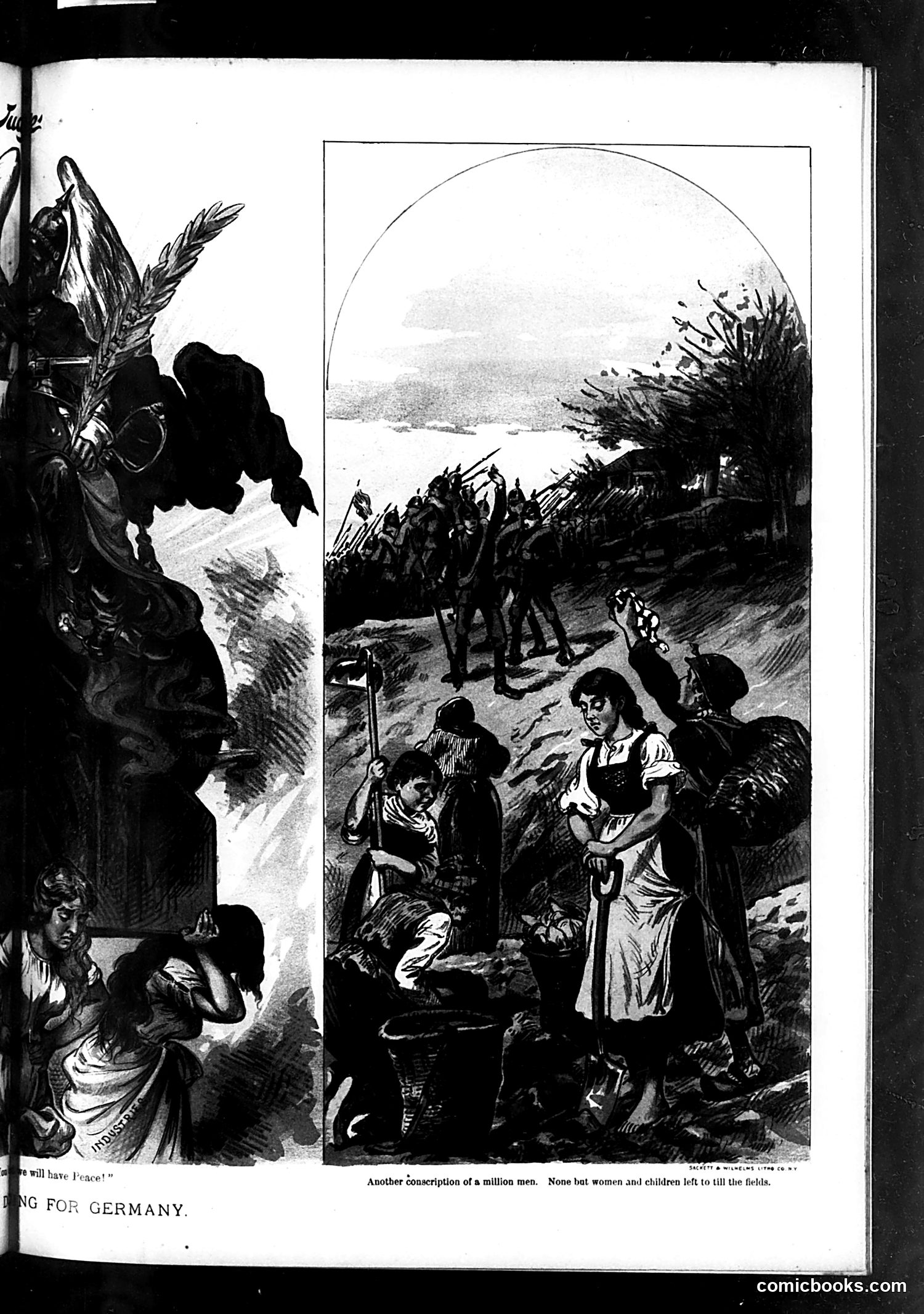
This appears to be a WWI-era satirical cartoon from *Judge* magazine criticizing German military conscription. The right panel depicts women and children laboring in fields while soldiers march away in the background, illustrating the caption's grim point: "Another Conscription of a million men. None but women and children left to till the fields." The left panel shows allegorical figures, likely representing Peace or Mercy observing this scene with concern. The satire critiques Germany's massive military mobilization, suggesting it has depleted the civilian population so thoroughly that only non-combatants remain to sustain agriculture and society. The cartoon implicitly questions the sustainability and human cost of such conscription policies, presenting it as socially destructive rather than strategically sound.
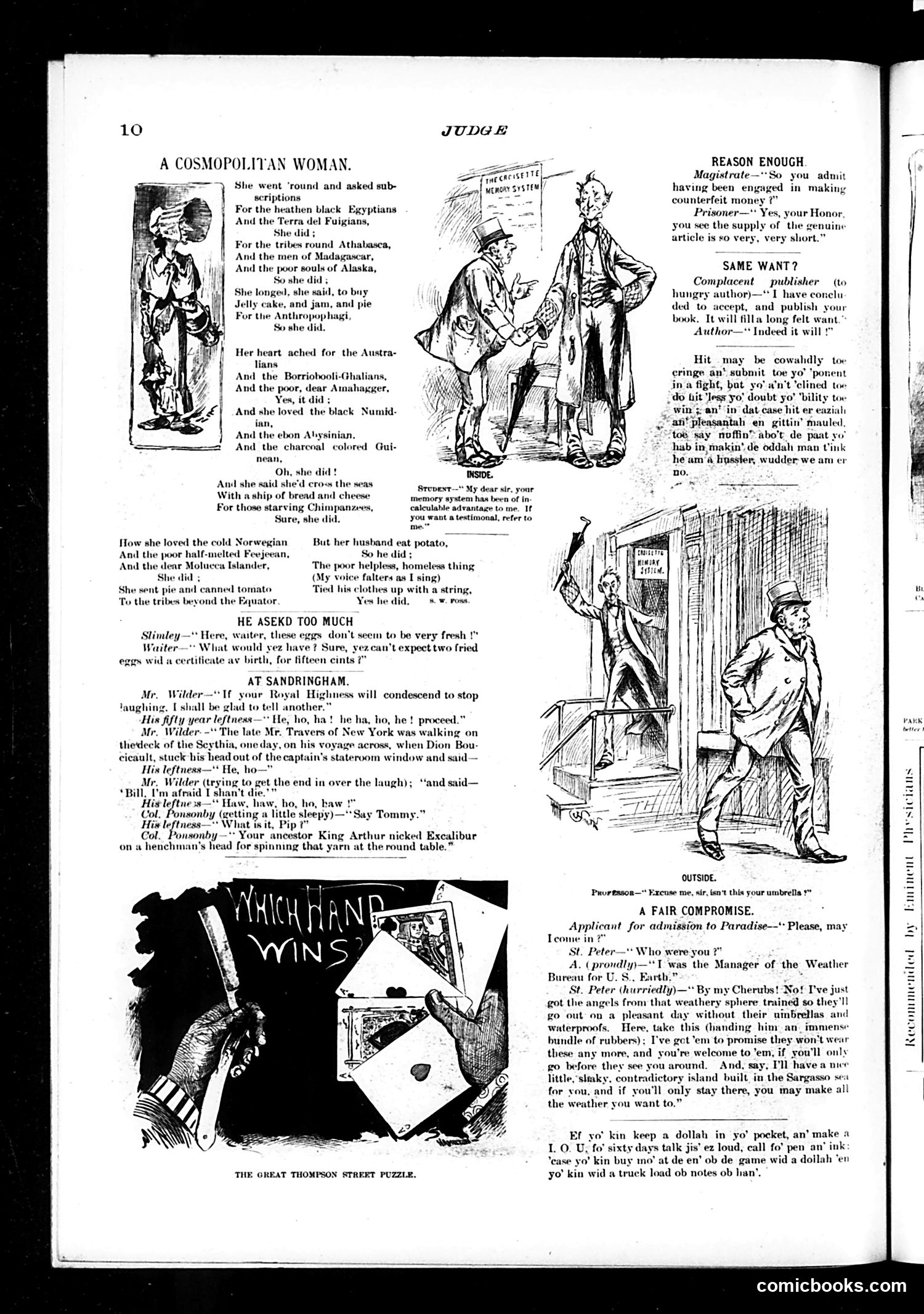
This page satirizes **Victorian-era charitable pretension** and various social absurdities. **"A Cosmopolitan Woman"** mocks wealthy women who fundraise passionately for exotic foreign missions (Egyptians, Fuegians, "Anthropophagi") while their own husbands suffer domestic neglect—eating plain potatoes and wearing clothes tied with string. The joke: performative global charity masks indifference to family hardship. **Other sketches** target: - Restaurant pretension ("fresh eggs") - British royal humor at Sandringham - Counterfeiting prosecutions - Publishing industry dynamics **"A Fair Compromise"** jokes that a Weather Bureau manager admitted to Paradise becomes immediately useful—the angels had been properly trained but needed someone to manage their umbrella discipline. He's essentially conscripted into divine labor, exiled to the Sargasso Sea. The cartoons employ **class satire**, mocking both the pompous charitable classes and working-class dialect humor common to period magazines.
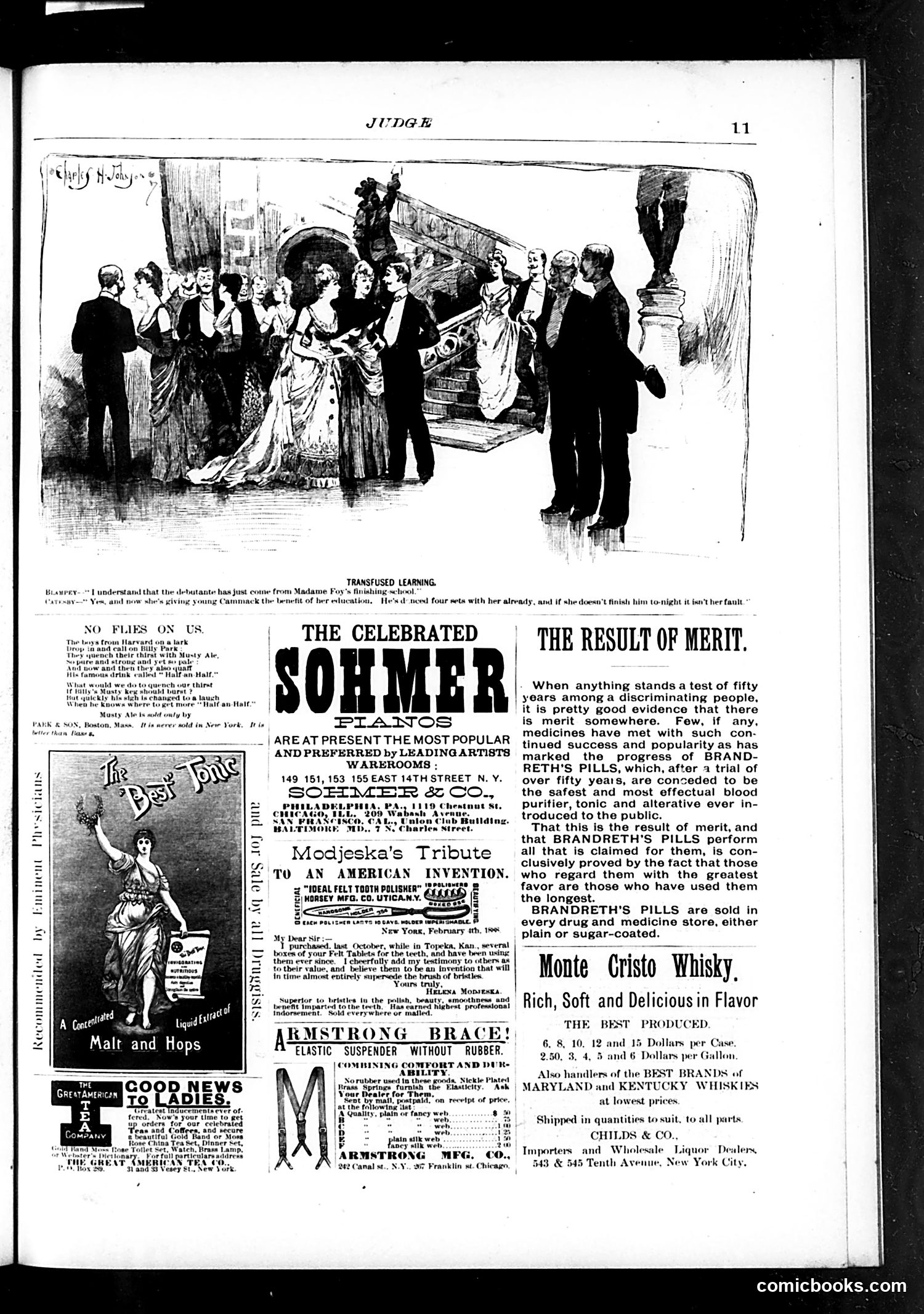
The top cartoon, titled "TRANSFUSED LEARNING," depicts a social scene where a debutante has just returned from Madame Foy's finishing school. The joke centers on her newfound education: the caption suggests she's acquired four romantic suitors during her schooling, and her mother quips that if the young woman "doesn't finish him to-night it isn't her fault"—a double entendre implying the finishing school taught her social/romantic skills rather than substantive education. The page is otherwise dominated by **period advertisements** for pianos, tooth polish, suspenders, patent medicines (Brandreth's Pills as a blood purifier), and whiskey. These ads reflect 1890s consumer culture and marketing claims typical of the era—note Madame Modjeska's endorsement of the "Ideal Felt Tooth Polisher" and Brandreth's Pills' boast of 50 years of popularity as proof of merit. The satire gently mocks both the pretensions of finishing schools and the era's credulous consumer culture.
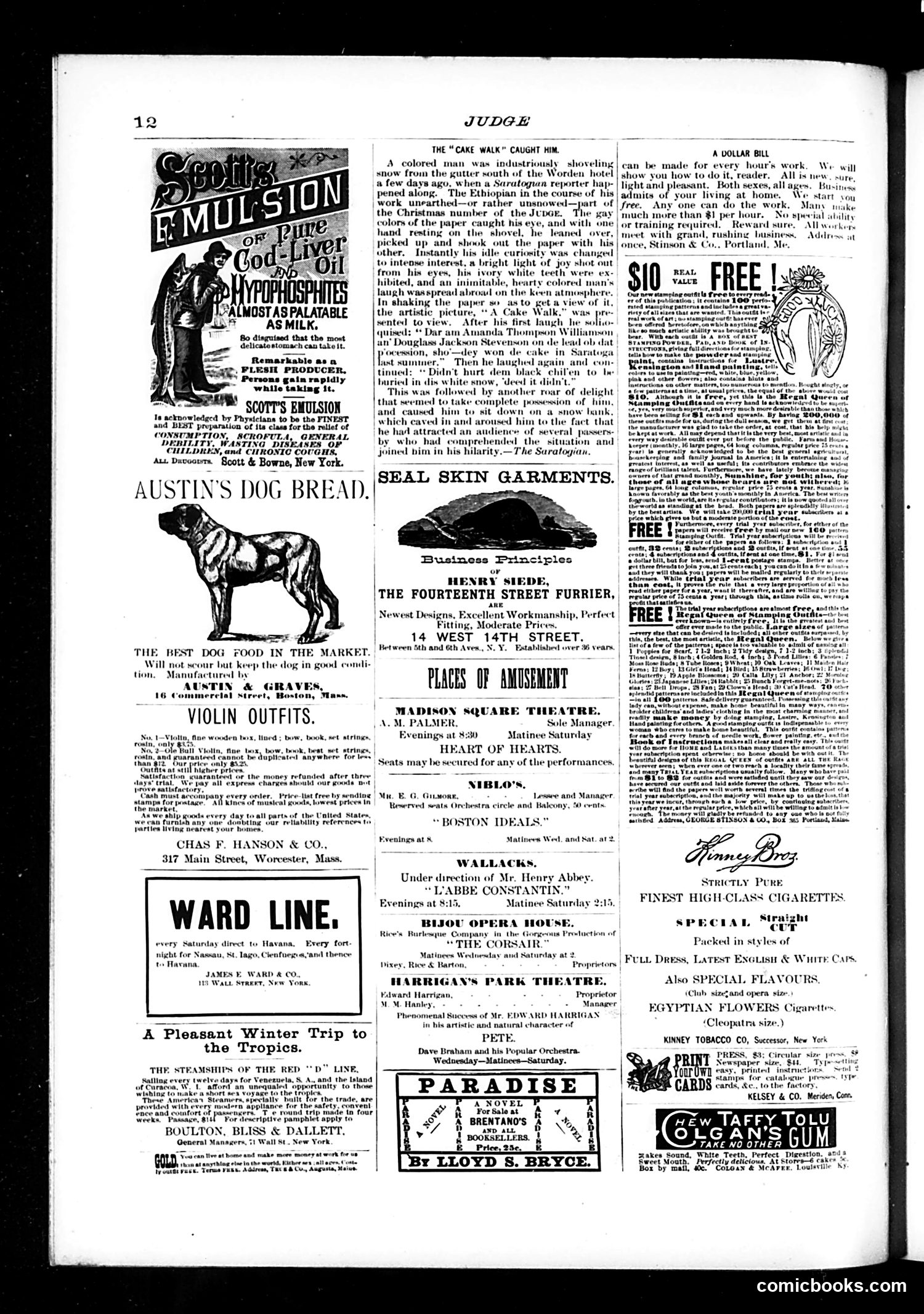
This page is primarily **advertising**, not political satire. However, it contains one notable sketch with social commentary: ## "The Cake Walk" Story The text describes an African American laborer shoveling snow who discovers a *Judge* magazine featuring an illustration of the "Cake Walk"—a popular (and racially fraught) dance. The man becomes so excited recognizing the famous dance that he stops work, sits in the snow, and loses himself in nostalgic joy. **The satire**: Judge presents this as a humorous anecdote about an African American's simple pleasure being distracted from labor. By modern standards, the piece trades in racial stereotypes—the "happy Negro" stereotype—mocking his speech patterns ("Dar am a cake walk") and suggesting his childlike susceptibility to entertainment over responsibility. **Historical context**: The Cake Walk was a popular 1880s-90s phenomenon, originally a plantation dance mocking white behavior, later appropriated into mainstream entertainment. Judge's treatment reflects the magazine's frequent use of racial caricature for comedic effect. The rest of the page is conventional late-19th-century advertising for goods, services, and theatrical performances.
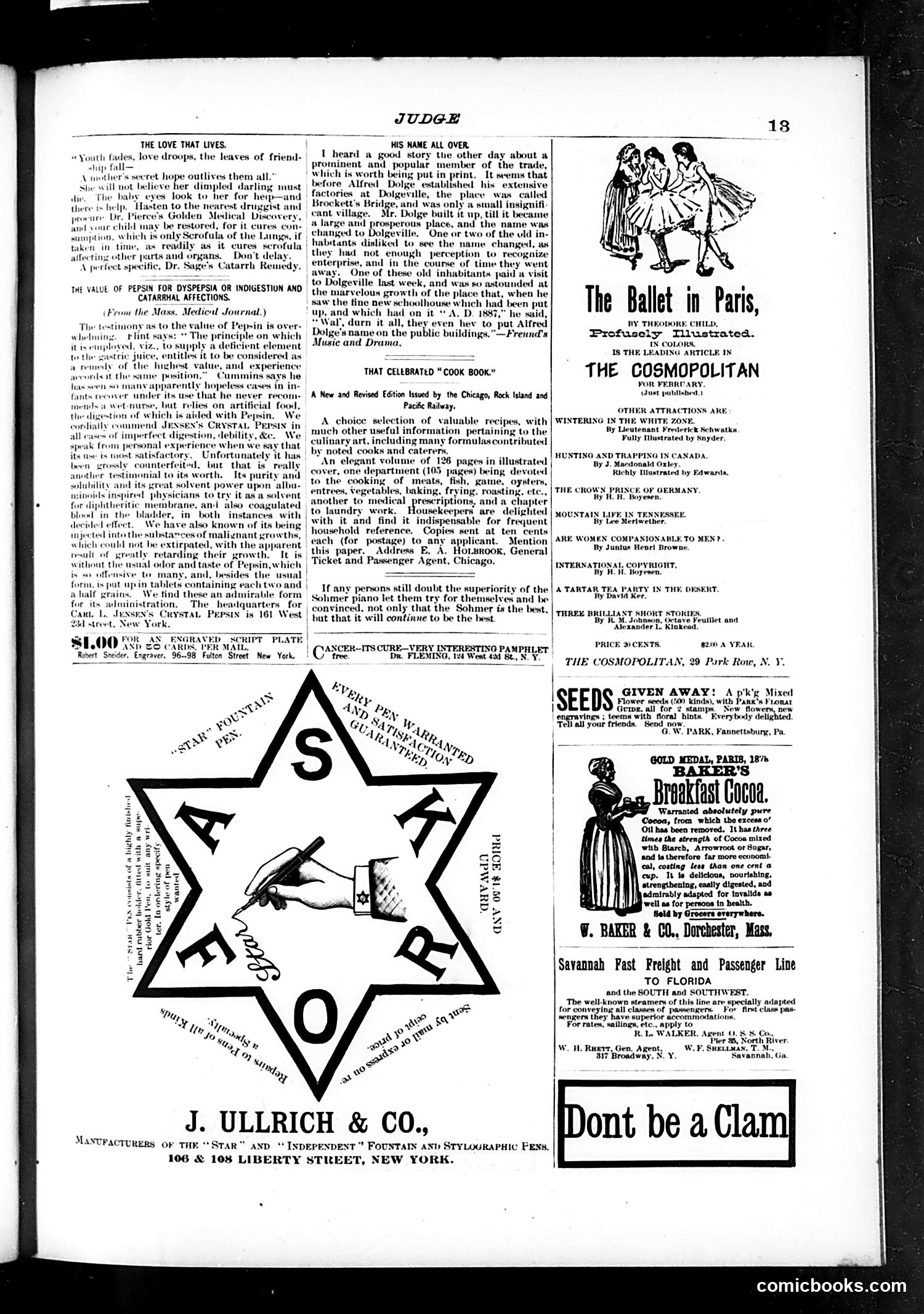
This page is primarily **advertisements and filler content** rather than political satire. The notable elements: **Main Content:** - A sentimental poem, "The Love That Lives," about a mother's devotion - A story about **Alfred Dolge**, an industrialist who established factories in what became "Dolgeville" (New York), transforming a small village. The anecdote jokes that old residents resented the town being renamed after him—one visiting former resident sarcastically quips that even the new schoolhouse bears "Alfred Dolge's name" **Advertisements:** - Medical products (Dr. Pierce's remedies for consumption/scrofula) - The Sohmer piano - A Chicago railroad cookbook - Baker's Breakfast Cocoa - Ullrich fountain pens (with star logo) - Various other products The Dolge story is mildly satirical—gently mocking small-minded resistance to progress and a benefactor's outsized presence in "his" town—but it's local-interest humor rather than national political commentary. The page is overwhelmingly commercial in nature.
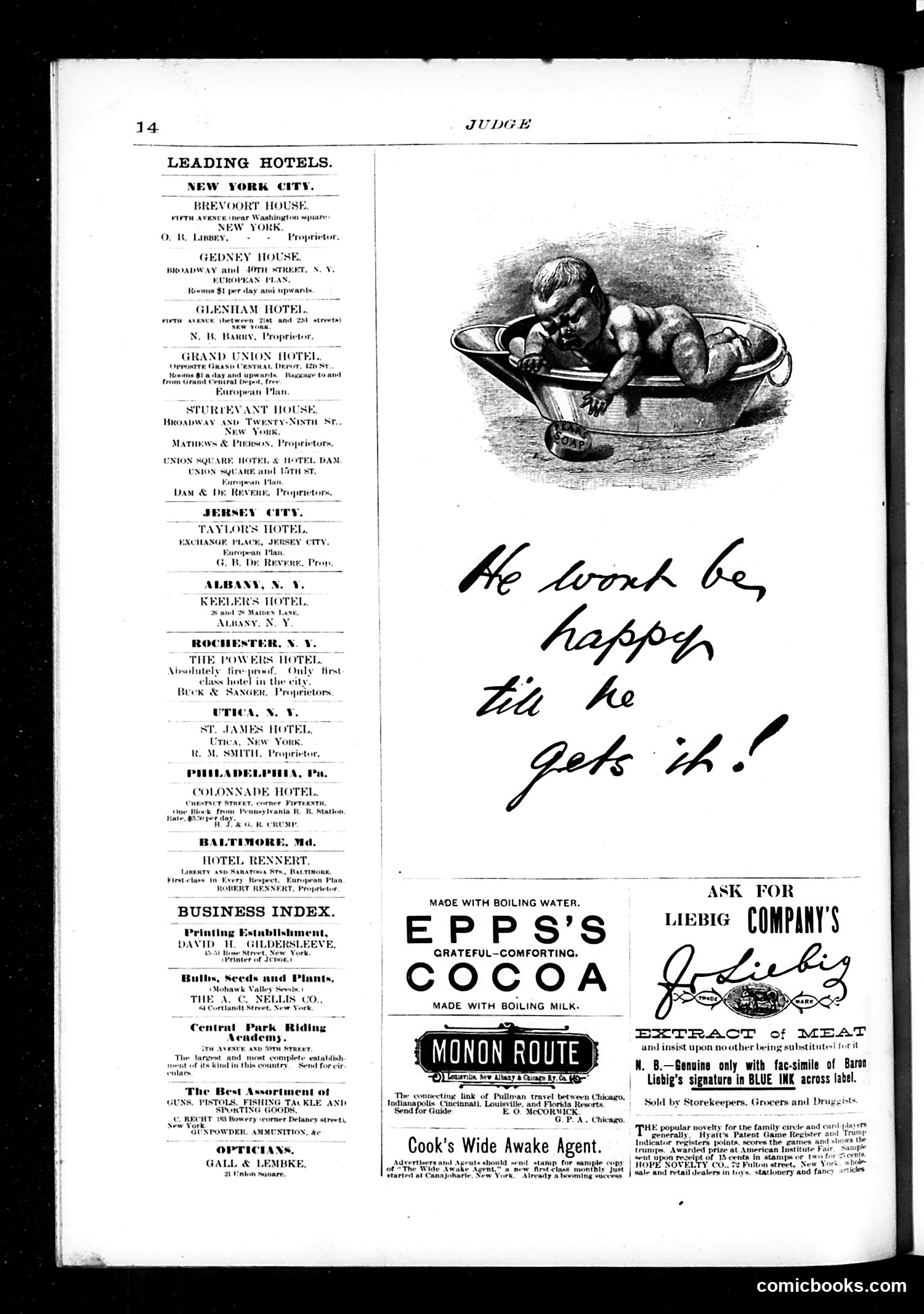
This page is primarily **advertising and business directory** content from Judge magazine, not a political cartoon. The central image shows a **cherubic infant or cupid figure in a bathtub** — a common decorative motif of the era. Handwritten text above reads "He should be happy till he gets it!" — likely advertising copy for a product (possibly soap or bathing goods, given the bathtub context). Below are advertisements for **Epps's Cocoa**, **Liebig Company's Extract of Meat** (a beef extract product), the **Monon Route** railroad, and **Cook's Wide Awake Agent** (a travel booking service). These represent typical late-19th century consumer goods and services. The left column lists prominent American hotels in major cities — standard advertising for the hospitality industry during this period. **No significant political satire is evident** on this page. It functions as a commercial index rather than editorial commentary, reflecting Judge's reliance on paid advertisements to support publication.
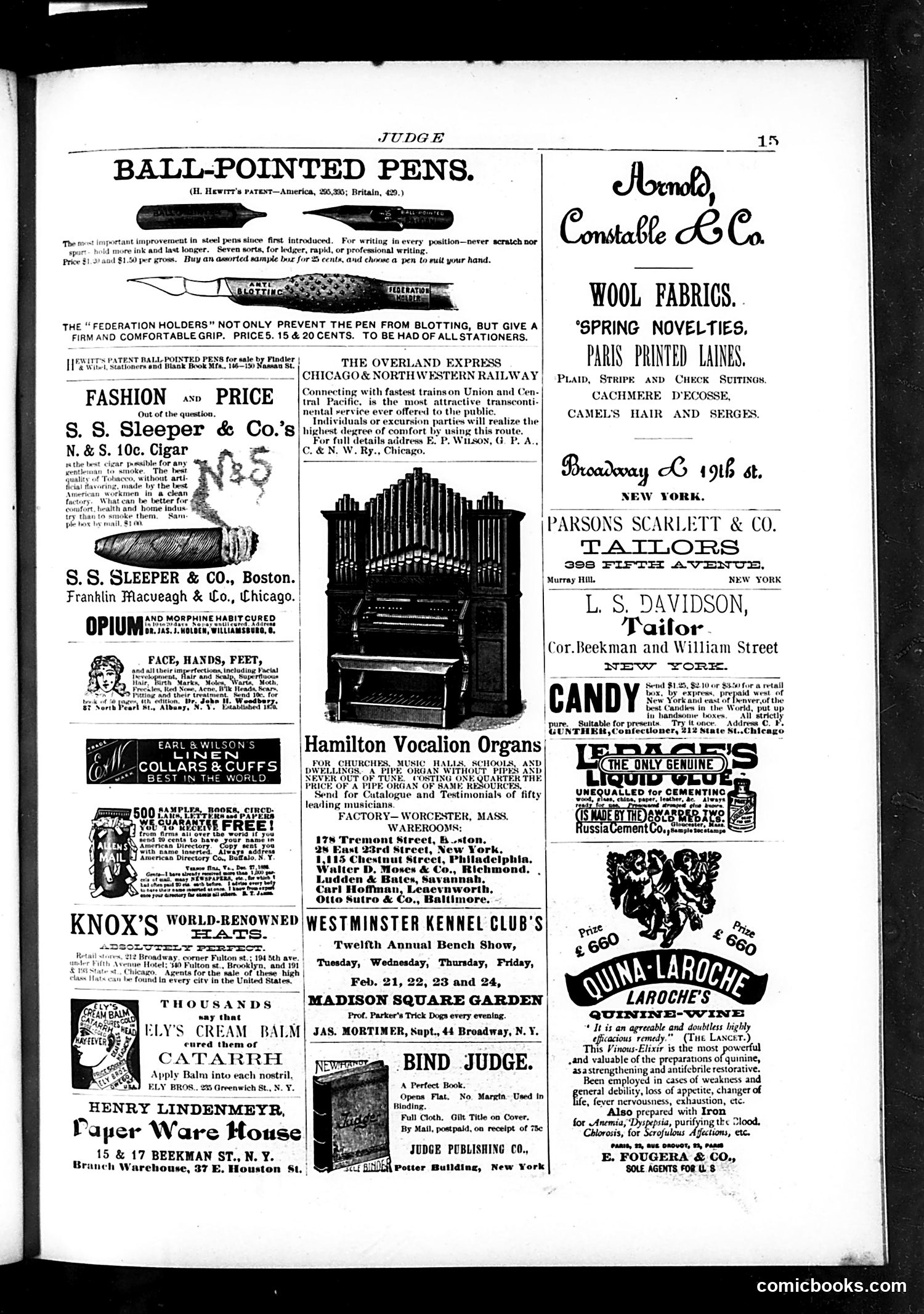
This is primarily an **advertising page** from Judge magazine, not a satirical cartoon spread. The page showcases commercial advertisements typical of the late 19th or early 20th century. The main content includes ads for: - **Ball-pointed pens** (marketed as a recent innovation) - **S.S. Sleeper & Co. cigars** and other tobacco products - **Fashion and clothing** (tailors, wool fabrics, etc.) - **Hamilton Vocalion Organs** - **Knox Hats** - **Various patent medicines** (opium-based treatments, quinine tonics) - **Miscellaneous goods** (paper products, dog shows, railroad services) The **only visual satirical element** appears to be a small caricature accompanying the S.S. Sleeper cigar ad—though its specific subject or commentary is unclear from this reproduction. The page reflects period advertising practices, including claims about "improvements" in manufacturing and the prevalence of medicinal products (many containing now-prohibited substances like opium and quinine).
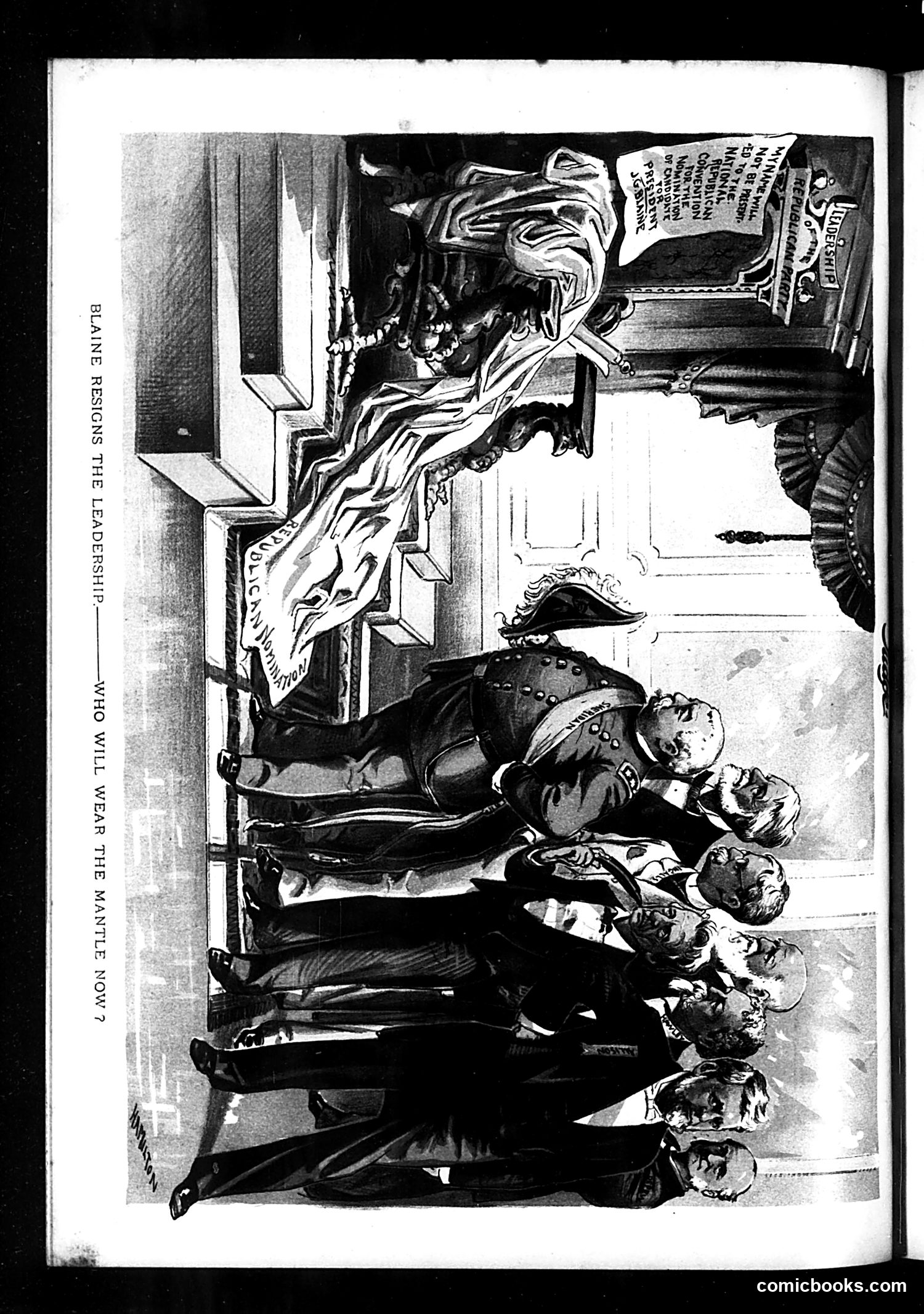
This cartoon depicts **James G. Blaine resigning Republican Party leadership**. The image shows several men in formal 19th-century dress standing before a large, menacing caricatured figure—likely representing the Republican Party or its ideological burden. The "mantle" referenced in the title is both literal (the draped fabric the figure holds) and figurative—asking who will assume Blaine's role as party leader. The satire suggests that leadership of the party is an unenviable, possibly corrupting position, symbolized by the grotesque figure looming over the candidates. **Context needed**: This likely references a specific moment when Blaine—a controversial Republican figure—stepped down from party leadership, leaving uncertainty about succession. Without the publication date visible, the exact historical moment cannot be determined from the image alone.