
A complete issue · 16 pages · 1888
Judge — February 11, 1888
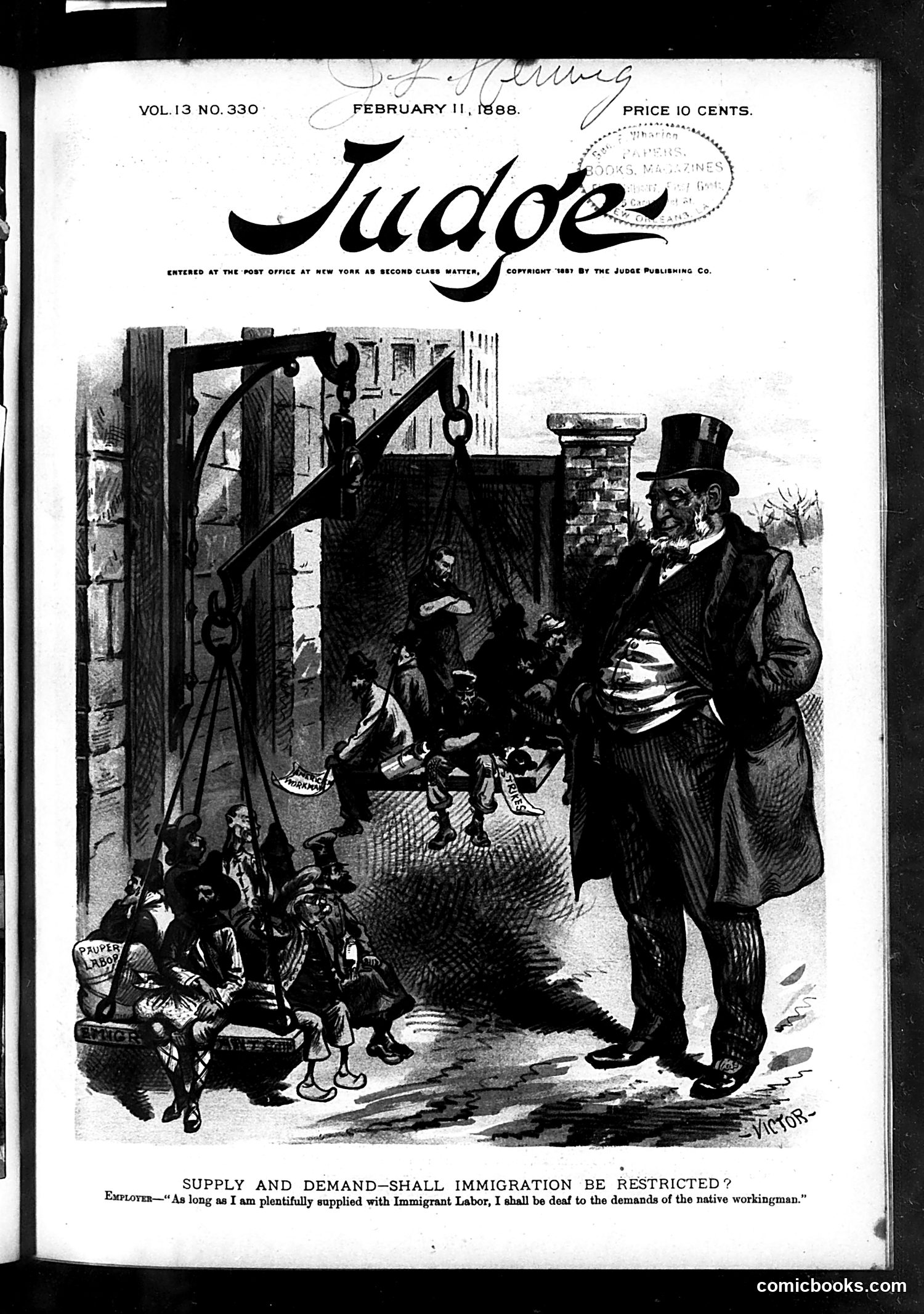
This political cartoon satirizes immigration policy debates of the 1880s. The image shows a wealthy employer (top hat, formal dress) addressing workers labeled "Supply and Demand" about restricting immigration. He declares he'll accept "immigrant labor" only as long as it supplies cheap workers—but opposes immigration when it might empower native workers to demand fair wages. The cartoon critiques employer hypocrisy: they welcomed immigrant workers when it benefited them economically, but suddenly advocated restriction when labor became scarce enough to strengthen workers' bargaining power. The caption's quote captures this: employers want immigrants only when controllable and cheap, not when workers gain leverage. This reflects real 1880s tension between business interests and labor advocates over immigration policy.
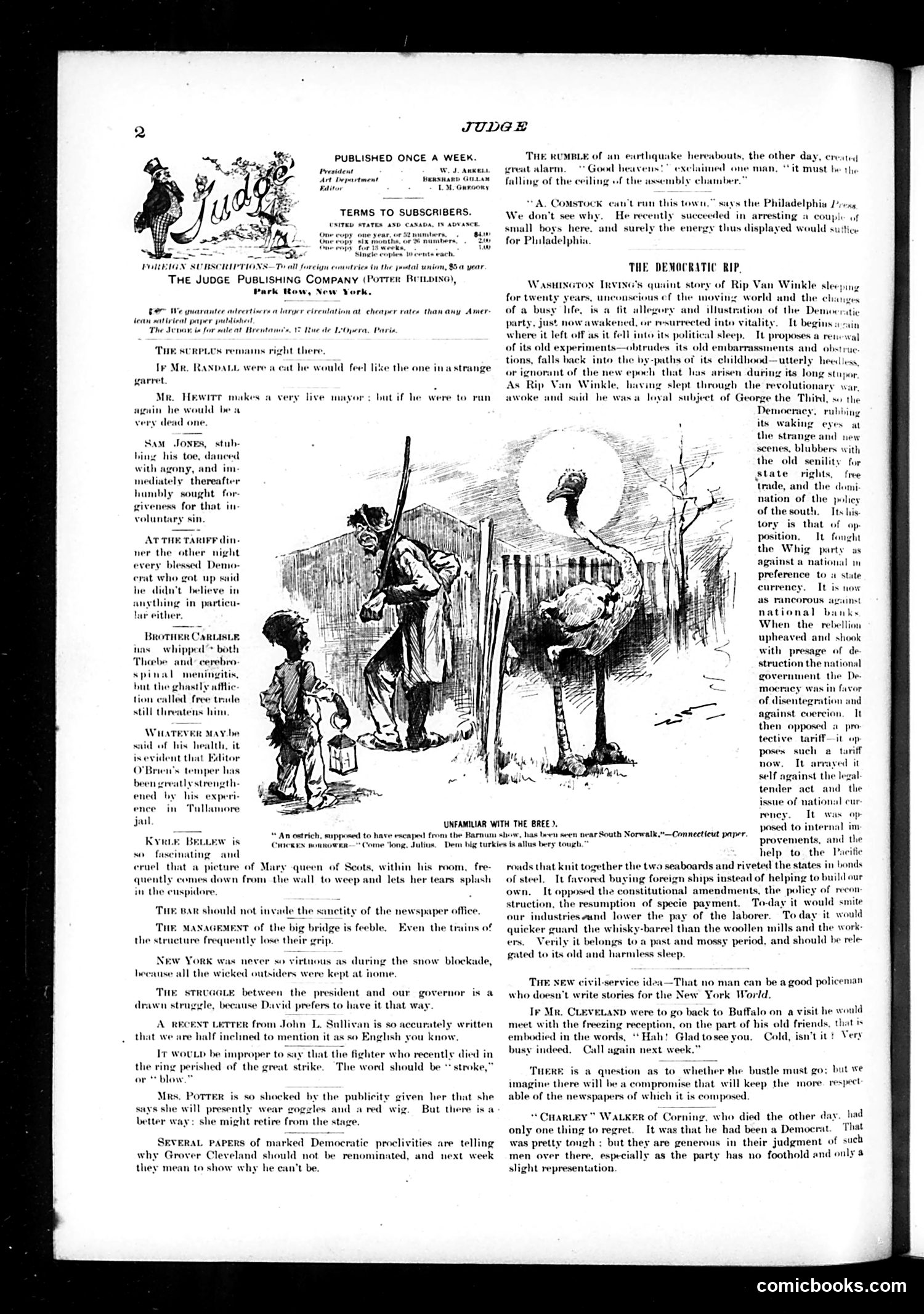
This page contains two main elements: political commentary and a cartoon illustration. The cartoon depicts a figure near a fence, apparently illustrating the caption "UNFAMILIAR WITH THE BREED" which references someone who "escaped from the Bayou show, has been seen near South Norwalk"—likely a humorous anecdote about an escaped animal. The text discusses Democratic Party politics, mentioning figures like Rip Van Winkle (used metaphorically) and references to Cleveland. The commentary criticizes Democratic Party positions on tariffs, currency, and constitutional government. The satire targets what the author sees as the party's inconsistent or backwards positions—comparing them to someone awakening from a long sleep to find the world changed. The overall thrust appears to be anti-Democratic Party political satire typical of Judge's editorial stance during this period.
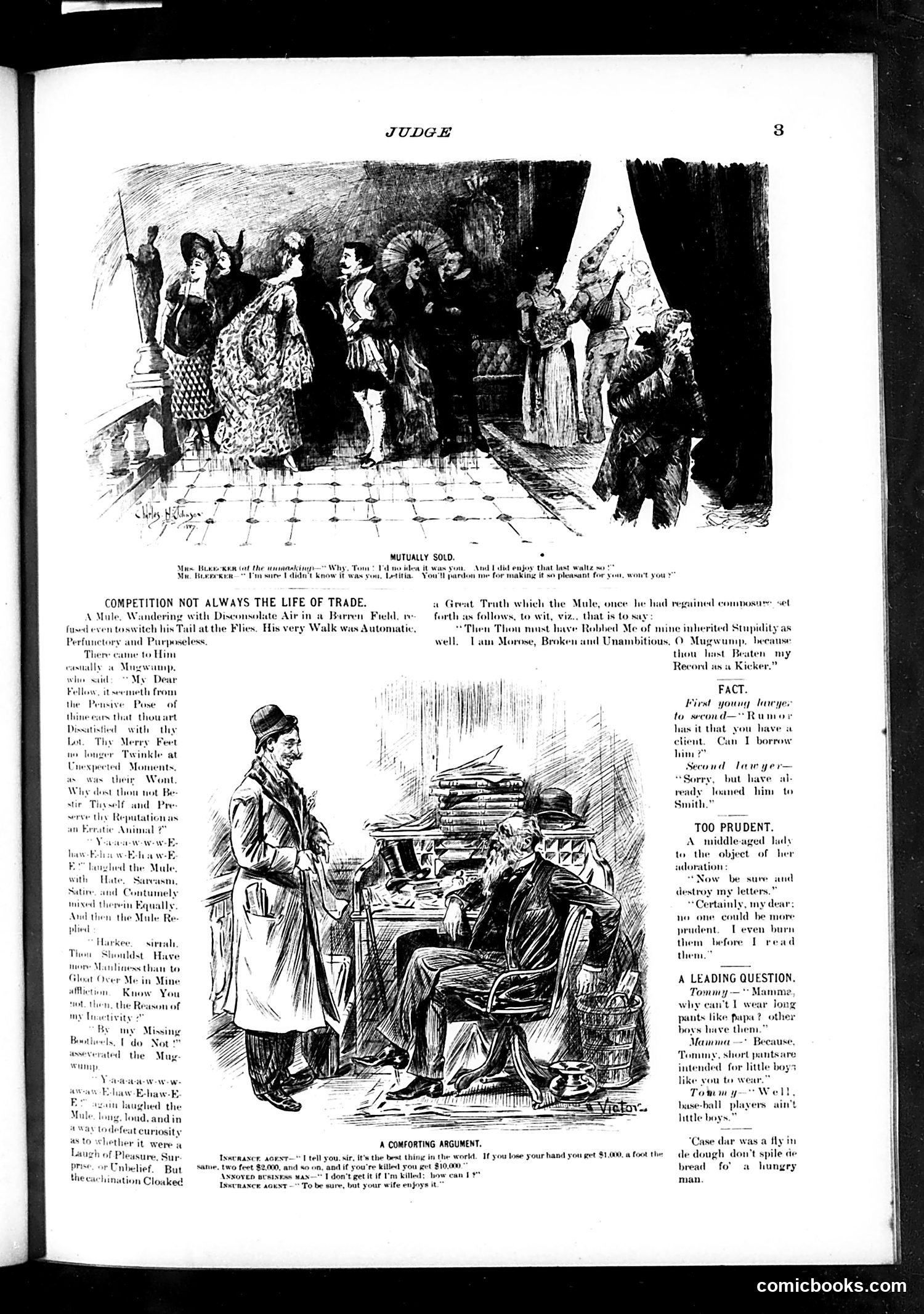
This page contains multiple satirical cartoons and humorous dialogue typical of late 19th-century Judge magazine. **"Mutually Sold"** (top): A social commentary on business deception—two parties (Mrs. Hardscrape and "Tons") each claim ignorance of the other's identity while conducting what appears to be a dishonest transaction, satirizing how people knowingly participate in fraud while maintaining plausible deniability. **"Competition Not Always the Life of Trade"** (center): A philosophical Aesop's fable about a depressed mule. When questioned why he's lost his vigor, the mule explains he's been "robbed" of his inherited stupidity and lack of ambition—a darkly ironic critique suggesting that competition and striving actually diminish happiness compared to accepting one's station. **"A Comforting Argument"** (bottom left): An insurance agent cynically justifies high premiums by calculating death benefits, reducing human life to profitable actuarial tables. **Scattered jokes** (right side): Brief, unrelated humor about lawyers, parental authority, and domestic matters—typical filler content for the period. The overall tone is cynical about business ethics and human nature.
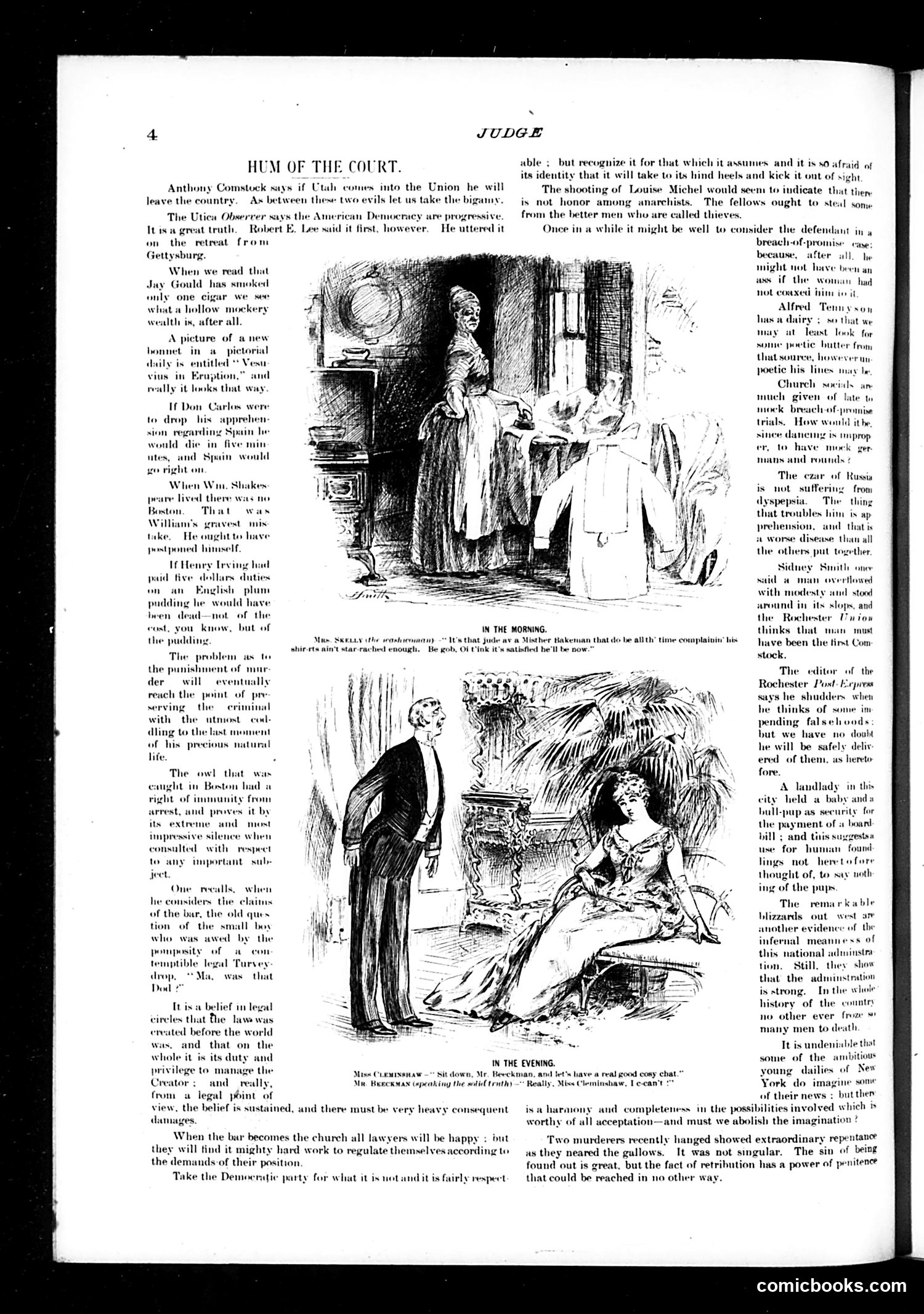
This page contains brief satirical commentary on American politics and society circa the 1880s-90s, with two accompanying illustrations. **Key References:** - **Anthony Comstock** (anti-vice crusader): Threatened to leave the U.S. if Utah gained statehood, likely referencing Utah's polygamy. The joke: choosing between Comstock leaving or Utah's "bigamy" presents a false dilemma. - **Jay Gould** (wealthy railroad magnate): Mocked for smoking only one cigar—satirizing that even the ultra-rich can't truly enjoy wealth's supposed pleasures. - **Louise Michel** (French anarchist): Her shooting is presented as ironic—anarchists supposedly lack honor, yet "steal from better men called thieves." The illustrations show courtroom scenes with captions mocking legal proceedings and human nature. **Overall Tone:** Sharp criticism of prominent figures, legal hypocrisy, religious pretense, and social absurdities through brief quips rather than sustained argument—typical Judge magazine style combining visual and textual satire.
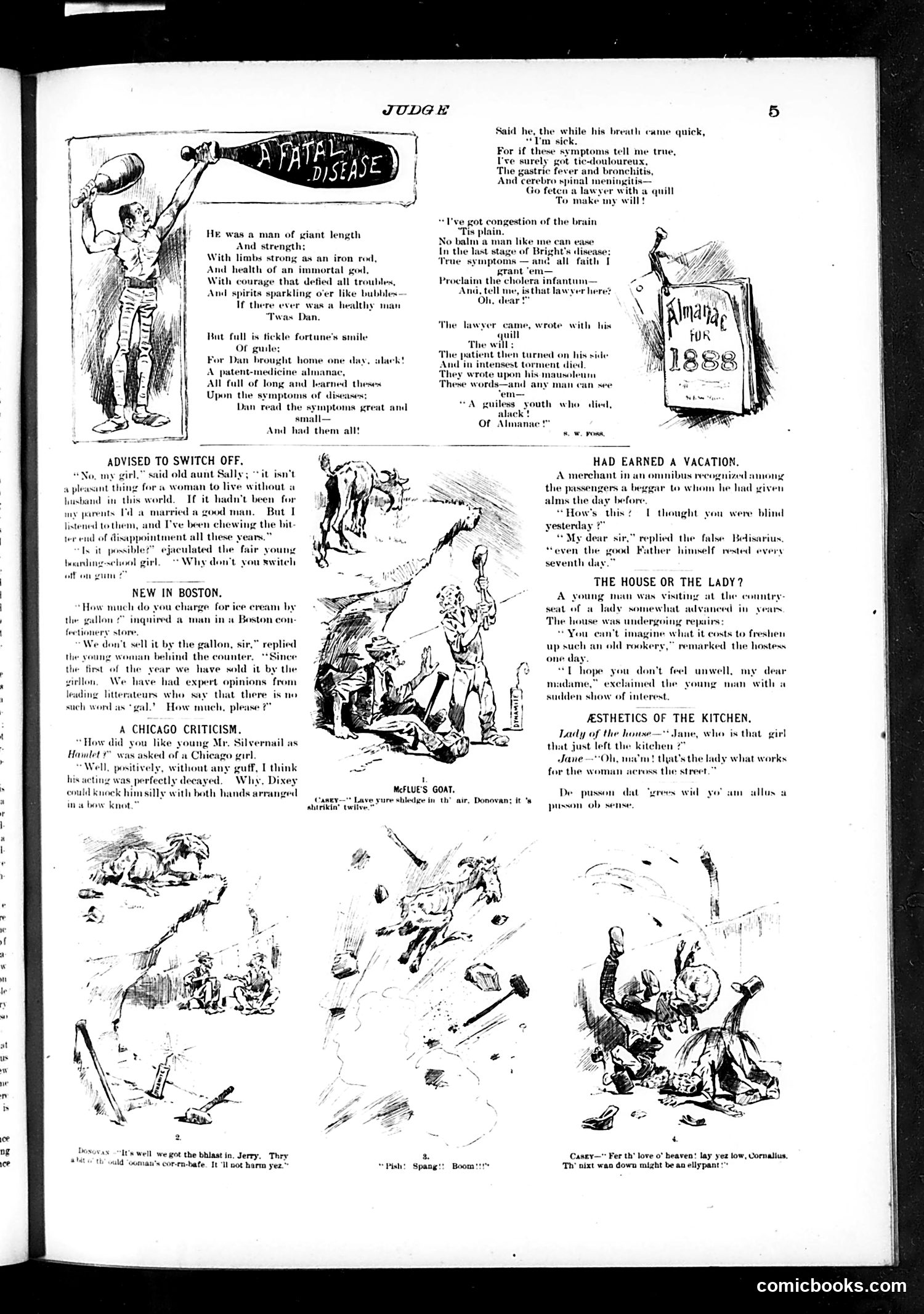
This page from Judge magazine (circa 1880s based on the Almanac reference) contains several brief humorous sketches satirizing American life: **"The Patent Medicine Man"** mocks the era's snake-oil salesmen. A perfectly healthy man named Dan purchases a patent medicine containing dubious ingredients, then develops every symptom listed on the bottle—a sharp critique of fraudulent medical products that actually caused harm. **The short anecdotes** target regional pretension: a Boston ice cream vendor rejects "gallon" as improper English (satirizing affected Northern sophistication), and a Chicago theater critic's overly verbose praise of an actor. **"The House or the Lady?"** jokes about a woman's home renovation costs being compared to a person's value—typical Victorian domestic humor. **"Mule's Goat"** and the kitchen exchange are mild observational comedy about servants and working-class life. The cartoons use exaggerated illustrations and vernacular dialect to ridicule patent medicines, social climbing, and class pretensions of the Gilded Age.
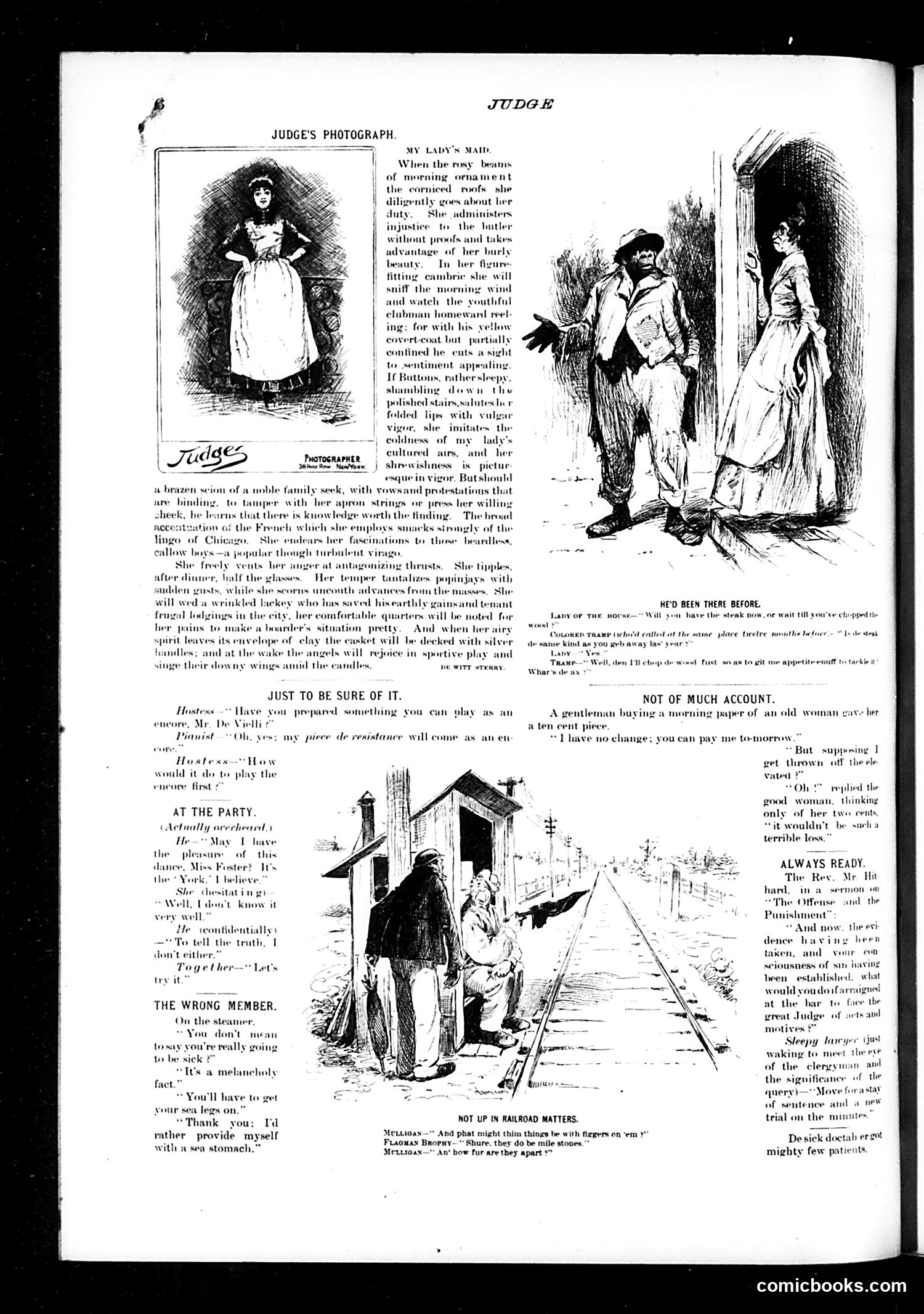
This page from *Judge* contains several brief satirical sketches mocking Victorian society conventions and human nature. **"My Lady's Maid"** satirizes servants who ape their employers' affectations—the maid imitates her mistress's mannerisms and pretensions while maintaining working-class vulgarity. **"Just to Be Sure of It"** jokes about a pianist's inflated confidence in performing an "encore"—she'll play her signature piece first to guarantee applause, revealing vanity and insecurity. **"The Wrong Member"** depicts a seasick club member seeking sympathy; another man misunderstands, offering nautical advice about "sea legs" instead of listening. **"Not Up in Railroad Matters"** shows confusion over railroad distances—an exchange where figures or measurements cause bewilderment. **"Not of Much Account"** mocks penny-pinching: an old woman cannot change a dime, viewing the loss as negligible. **"Always Ready"** depicts a sleeping clergyman during his own sermon, representing clerical hypocrisy or inattentiveness. The page emphasizes class pretension, social awkwardness, and human foibles through everyday situations.
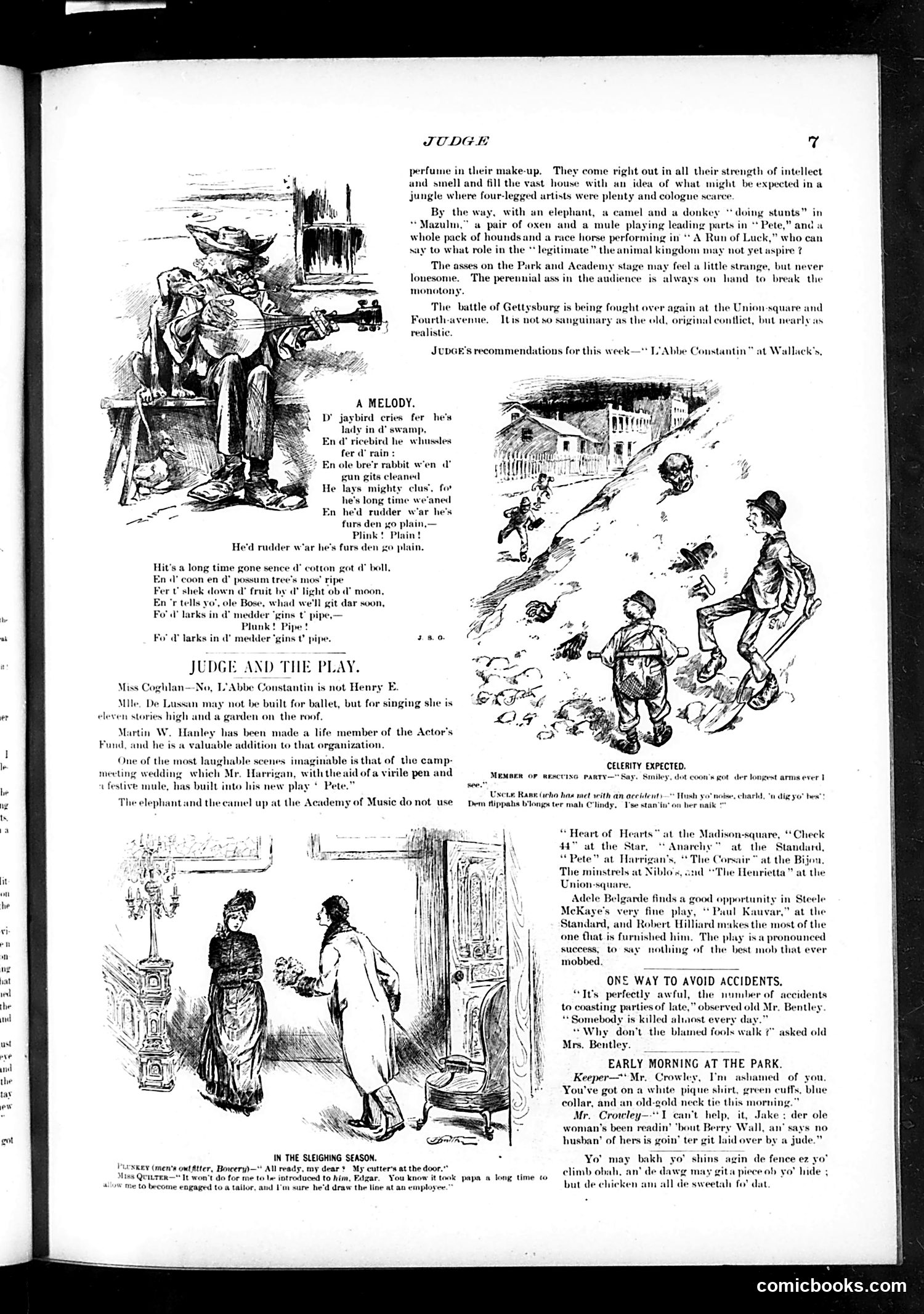
This page from Judge contains theatrical reviews and social satire typical of 1880s-90s American humor. **Main Content:** The "Judge and the Play" section reviews contemporary Broadway productions, critiquing actors and shows. References include "L'Abbé Constantin," "Pete" (a Harrigan play featuring performing animals), and other current theatrical productions. **The Satire:** The cartoons mock American social pretensions and class anxieties: 1. **"Early Morning at the Park"** jokes about a working-class man (Crowley) whose wife reads about "Berry Wall" (a famous dandy) and demands fashionable clothing—satirizing how lower classes ape upper-class fashion trends. 2. **"In the Sleighing Season"** depicts a tailor being refused introduction to a woman's father, who fears his daughter might marry "beneath" her station—mocking rigid class prejudices. 3. **"One Way to Avoid Accidents"** presents elderly characters dismissing sledding dangers, suggesting stupidity among all social classes. The dialect humor ("'bout Berry Wall") reflects period attitudes toward immigrant and working-class speech.
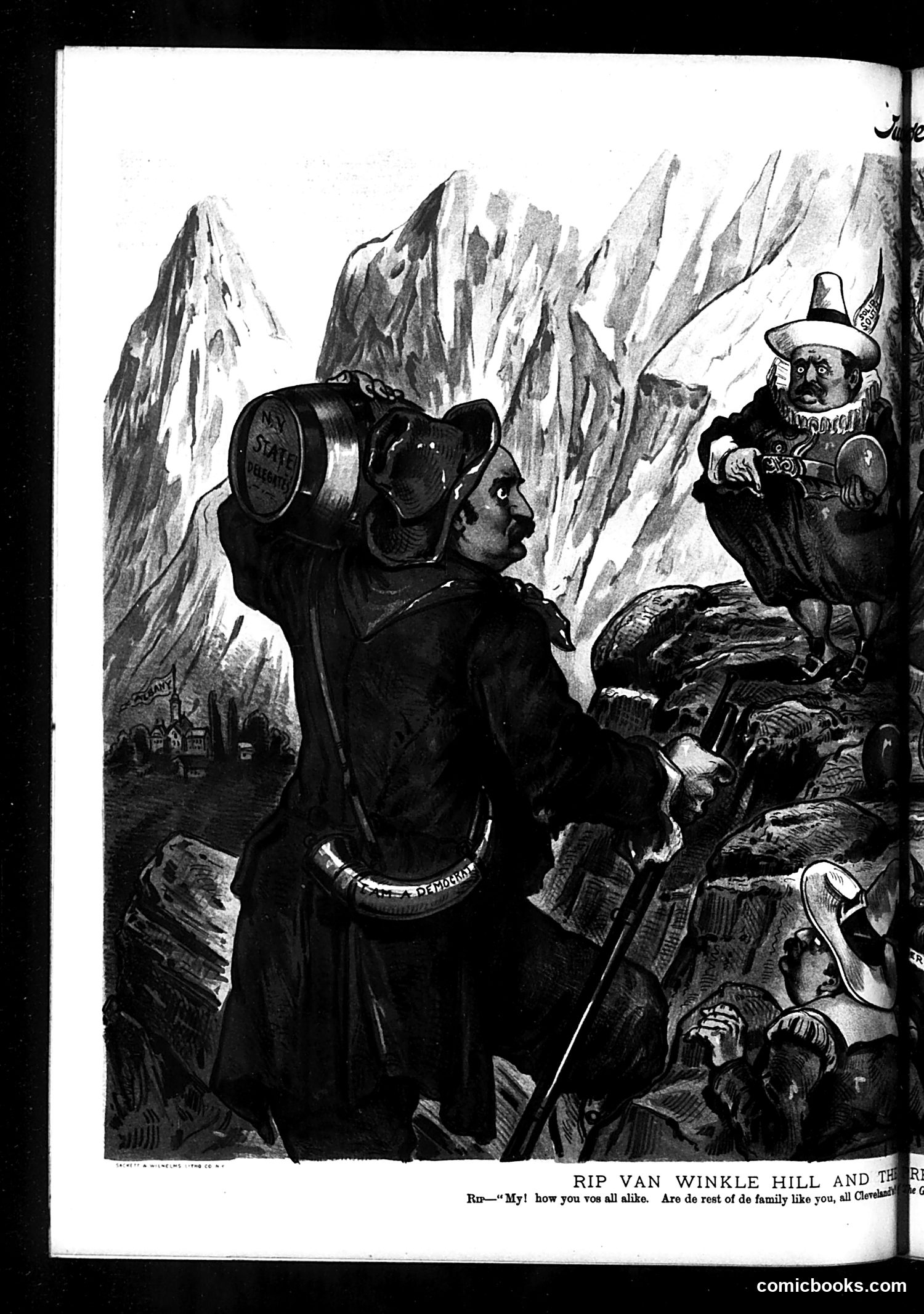
This cartoon references the classic American folk tale of Rip Van Winkle, who slept for years and awoke to find the world transformed. The figure labeled "Hill" (likely a politician) carries a barrel and appears bewildered among icy cliffs—suggesting he's been isolated or "asleep" to current events. The dialogue suggests someone with a foreign accent (indicated by phonetic spelling: "vos," "de") questioning whether Hill and his family are all alike, implying criticism of his outdated views or disconnection from modern America. The satirical point appears to be mocking a political figure named Hill for being out-of-touch or anachronistic—a "Rip Van Winkle" who's slept through important changes and no longer understands contemporary society.
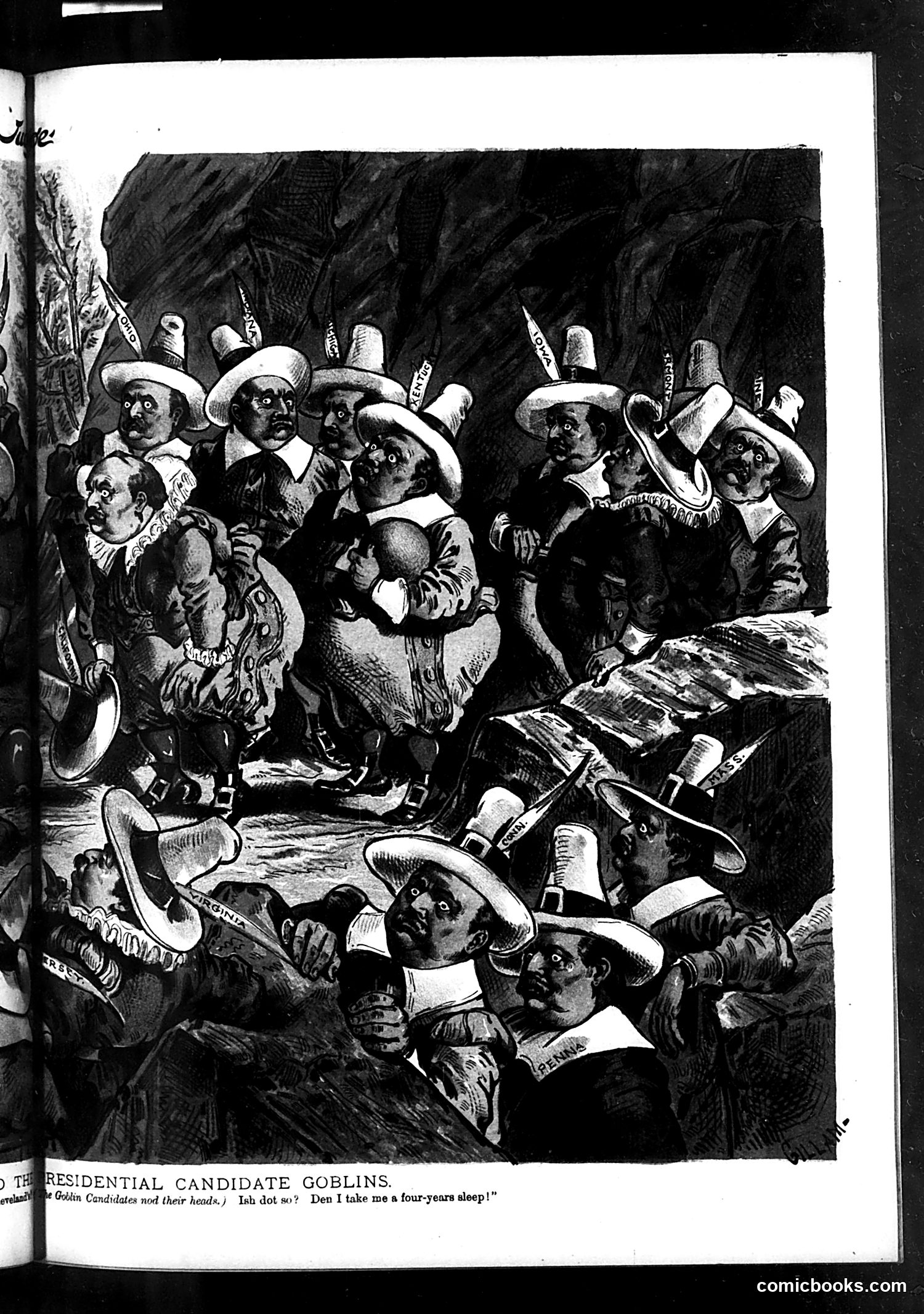
This satirical cartoon depicts grotesque goblin-like creatures wearing wide-brimmed hats and period clothing, appearing to be presidential candidates in conversation. The caption's broken-English dialogue—"Ish dot so? Den I take me a four-years sleep!"—mocks immigrant speech patterns while suggesting that presidential candidates are essentially supernatural creatures or frauds. The satire likely targets the 1880s-1890s presidential race, using goblin imagery to dehumanize or delegitimize the candidates. The "four-years sleep" reference jokes that the presidency is worthless or that candidates are merely waiting out their term. The exaggerated racial caricature and immigrant mockery reflect *Judge* magazine's period attitudes, combining political criticism with ethnic stereotyping common to 19th-century American satire.
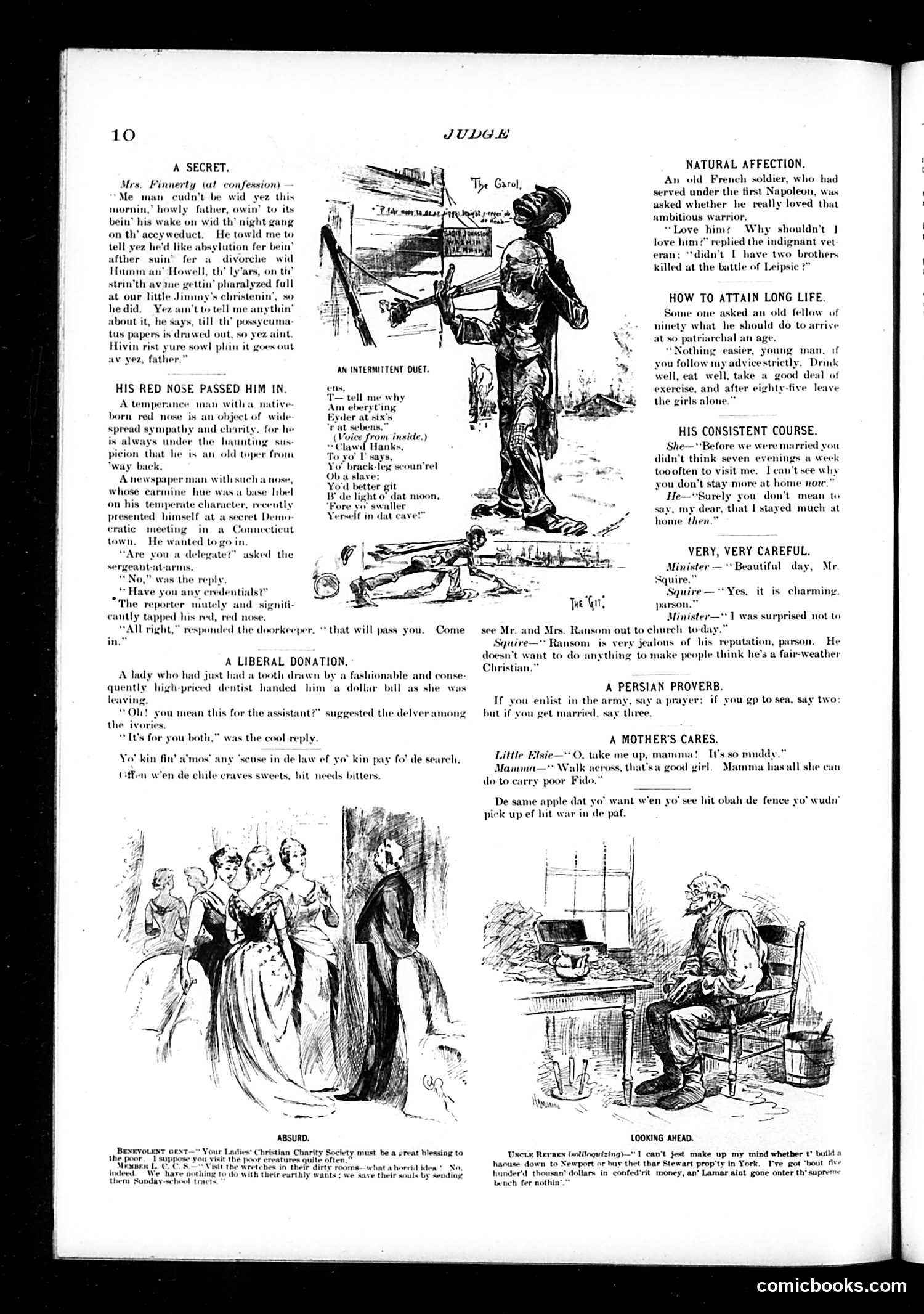
This page from *Judge* contains multiple brief satirical pieces typical of the magazine's format: **"A Secret"** presents an Irish-American working-class woman's confession, using heavy dialect humor common to the era. The satire targets both her husband's drinking and her casual attitude toward infidelity and divorce—controversial topics in the late 19th/early 20th century. **"Natural Affection"** jokes darkly about a French veteran's pride in serving Napoleon, despite the wars costing him brothers' lives—satirizing blind nationalism and military glorification. The remaining pieces are brief one-liners or short comedic vignettes on common topics: longevity, marital discord, professional credentials, Christian hypocrisy, dentists' greed, and Southern Reconstruction-era poverty. **"Looking Ahead"** appears to mock a formerly wealthy Southerner ("confed'rit money") now reduced to modest means, using dialect humor to underscore post-Civil War economic decline. The overall tone reflects *Judge's* satirical focus on contemporary urban life, immigrant communities, and social hypocrisy among the middle and upper classes.
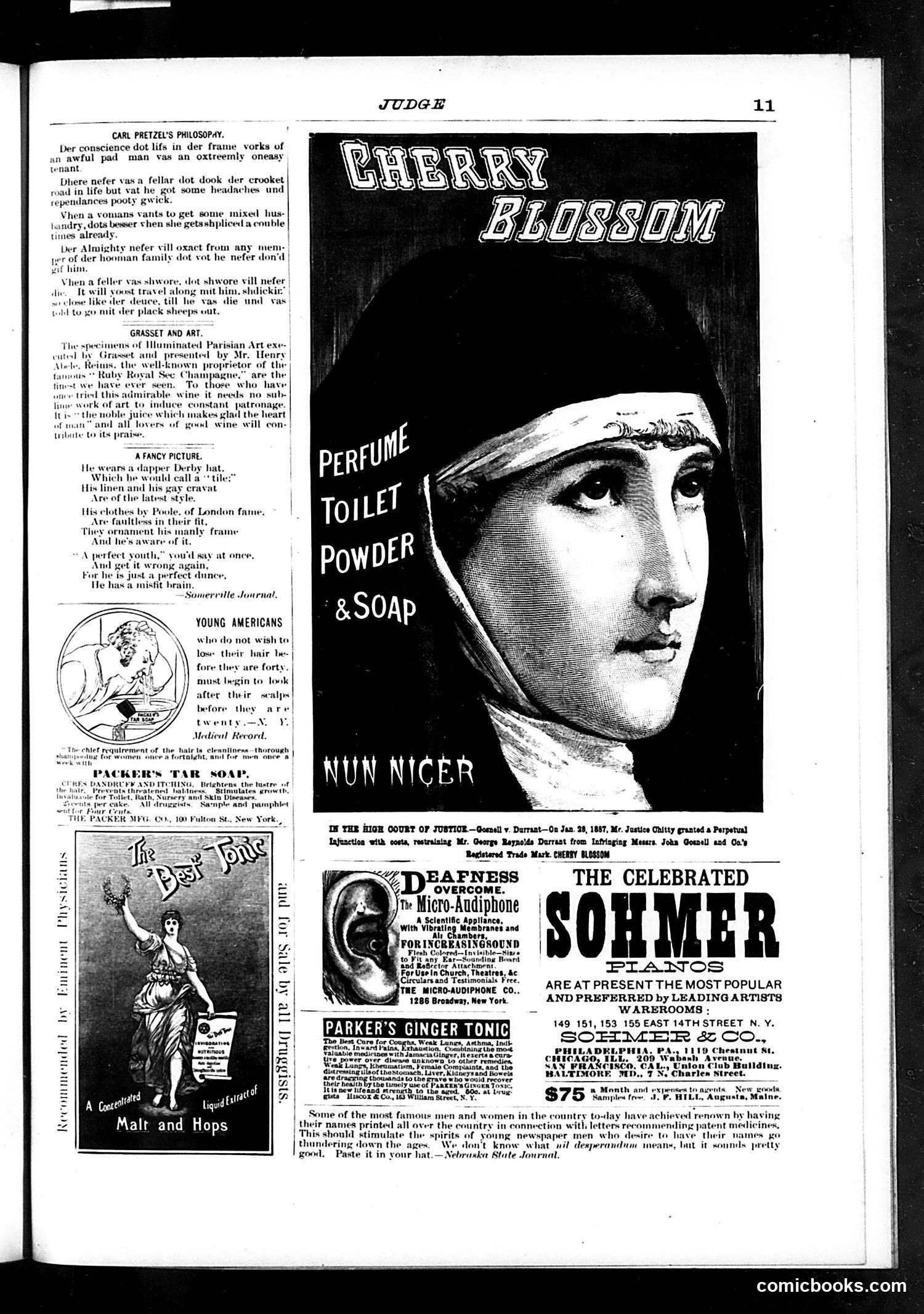
This page is primarily **advertising**, typical of Judge's revenue model. The main content includes: **"Carl Pretzel's Philosophy"** (left column): A dialect humor feature using exaggerated German-immigrant speech ("der," "vhen," "vot"). Pretzel offers homespun moral aphorisms—conscience troubles wrongdoers, swearing travels, etc. This was popular turn-of-century American humor, though the heavy accent caricature would be considered offensive today. **Legal Notice** (center): References a real 1887 British court case protecting the "Cherry Blossom" trademark—likely a cleaning product—against infringement. **Advertisements**: The page features ads for Sohmer Pianos, the Micro-Audiphone (a hearing device), Parker's Ginger Tonic, Nun Nicer soap/perfume, and other products typical of late-1800s magazines. **"Young Americans" item**: Brief advice about hair care for men. The page demonstrates how Judge mixed satirical columns with substantial advertising to fund operations, rather than focusing on political cartoons as the question assumes.
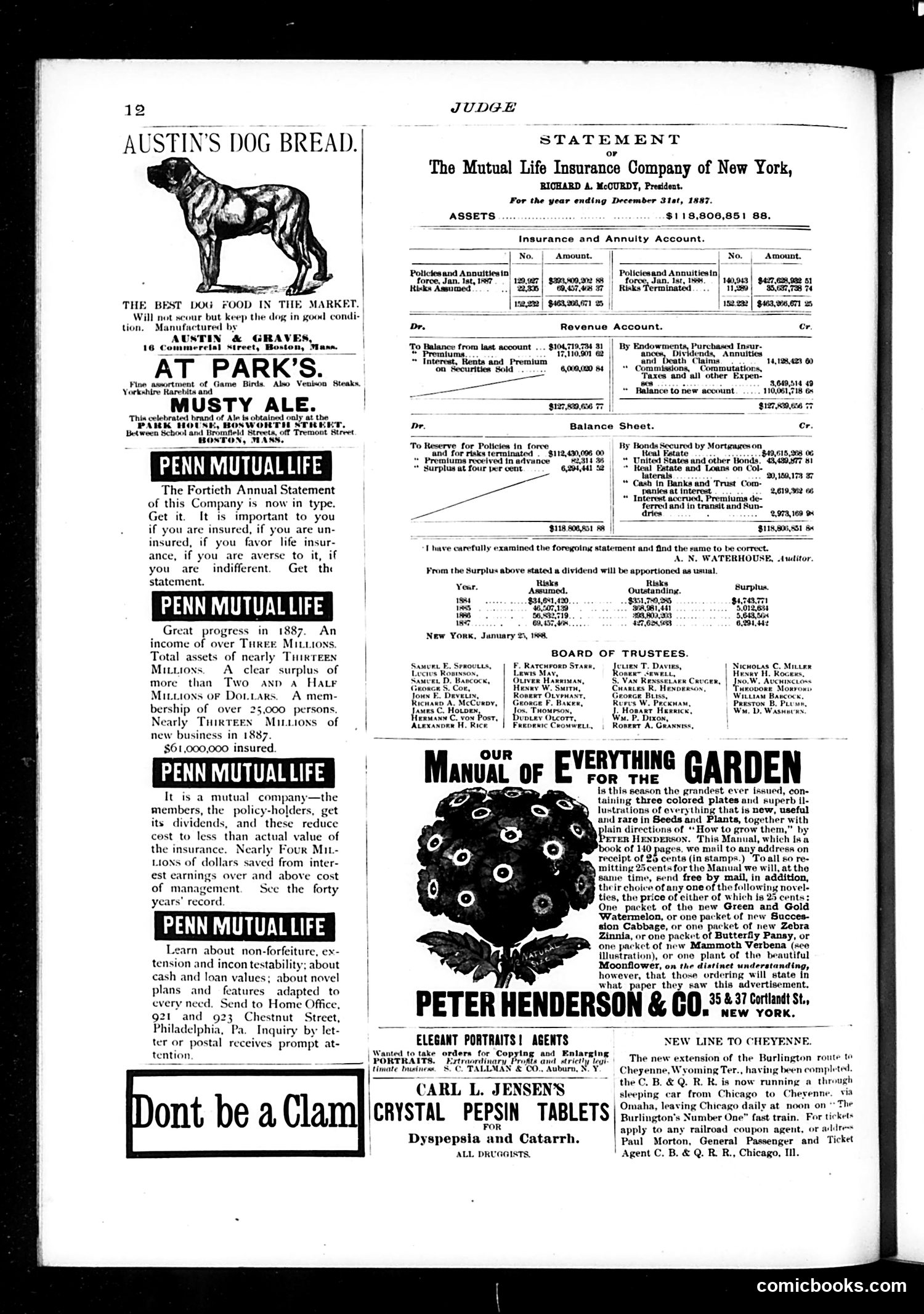
This page is primarily **advertising and financial statements**, not satirical content. The left side features commercial advertisements for dog food, ale, and—prominently—multiple ads for Penn Mutual Life Insurance, emphasizing the company's financial strength (nearly $13 million in assets, 25,000 members). The center-right contains a formal **financial statement from the Mutual Life Insurance Company of New York**, showing assets of $118 million, revenue accounts, balance sheets, and a board of trustees—standard corporate disclosure. The lower right advertises **Peter Henderson & Co.'s seed catalog** and other commercial services. At bottom appear ads for **Carl L. Jensen's Crystal Pepsin Tablets** (for dyspepsia and catarrh) and a Cheyenne railway line. The page reflects the magazine's dual purpose: satirical humor elsewhere, but also serving as a publication venue for serious corporate and commercial announcements aimed at affluent readers interested in investments and consumer goods.
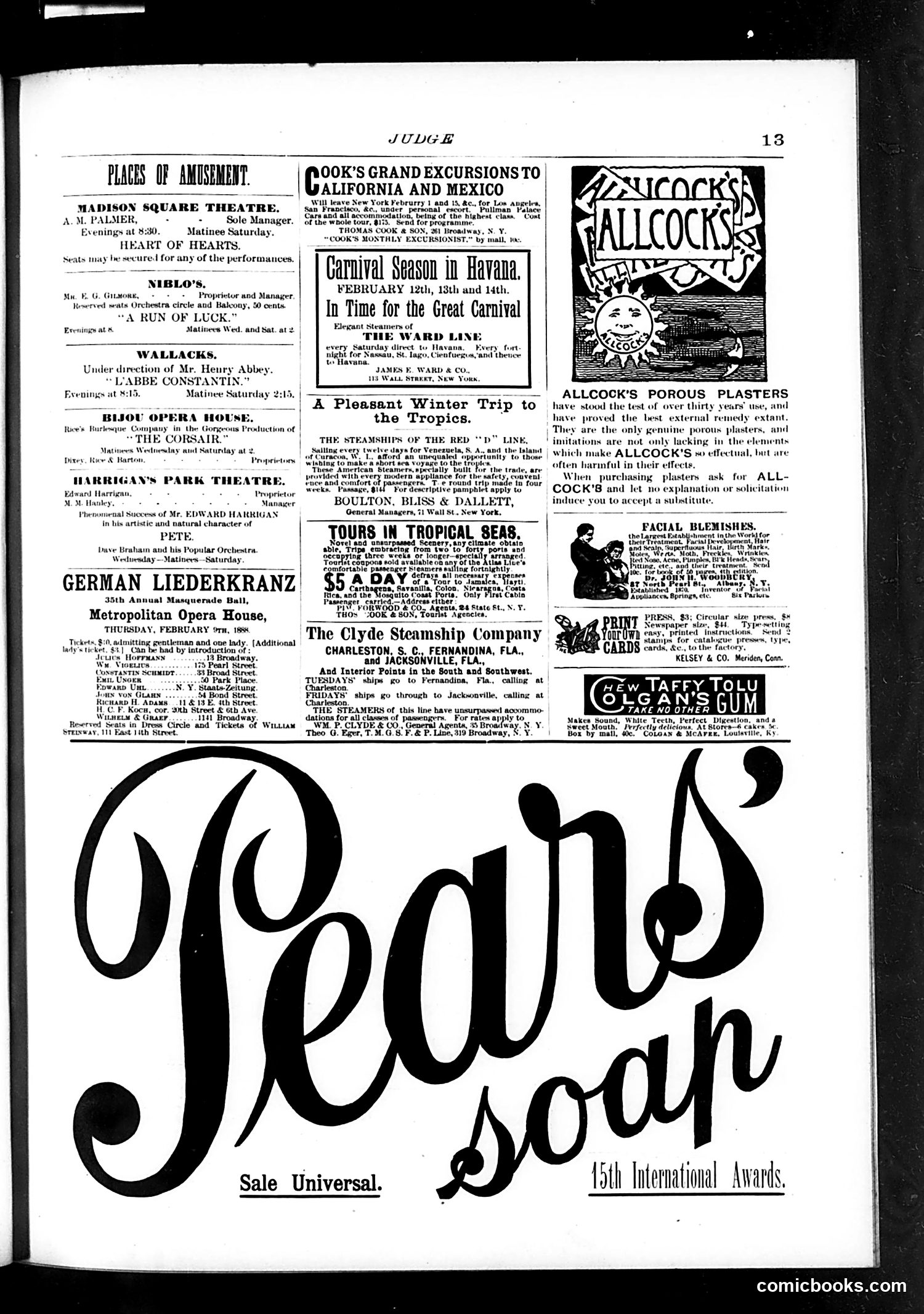
This is primarily an **advertising page** from Judge magazine, not a political cartoon. The page showcases entertainment venues (theaters, opera) and consumer products popular in 1880s New York. The dominant visual element is a large decorative advertisement for **"Pear's Soap"** (Sale Universal, 15th International Awards)—a prominent Victorian-era product claiming superior quality through international recognition. Other notable ads include: - **Theatrical productions** at major venues (Madison Square Theatre, Wallacks, Harrigan's Park Theatre) - **Travel excursions** to California, Mexico, Cuba, and the Tropics via steamship companies - **Allcock's Porous Plasters** (medical remedy claiming 30+ years of proven effectiveness) - **Various consumer goods** (Tolu gum, facial treatments) The page reflects Gilded Age consumer culture: leisure travel, theatrical entertainment, and patent medicines were major commercial categories. The emphasis on "international awards" and "proven effectiveness" typifies how manufacturers marketed products before modern advertising standards. No political satire is evident on this page.
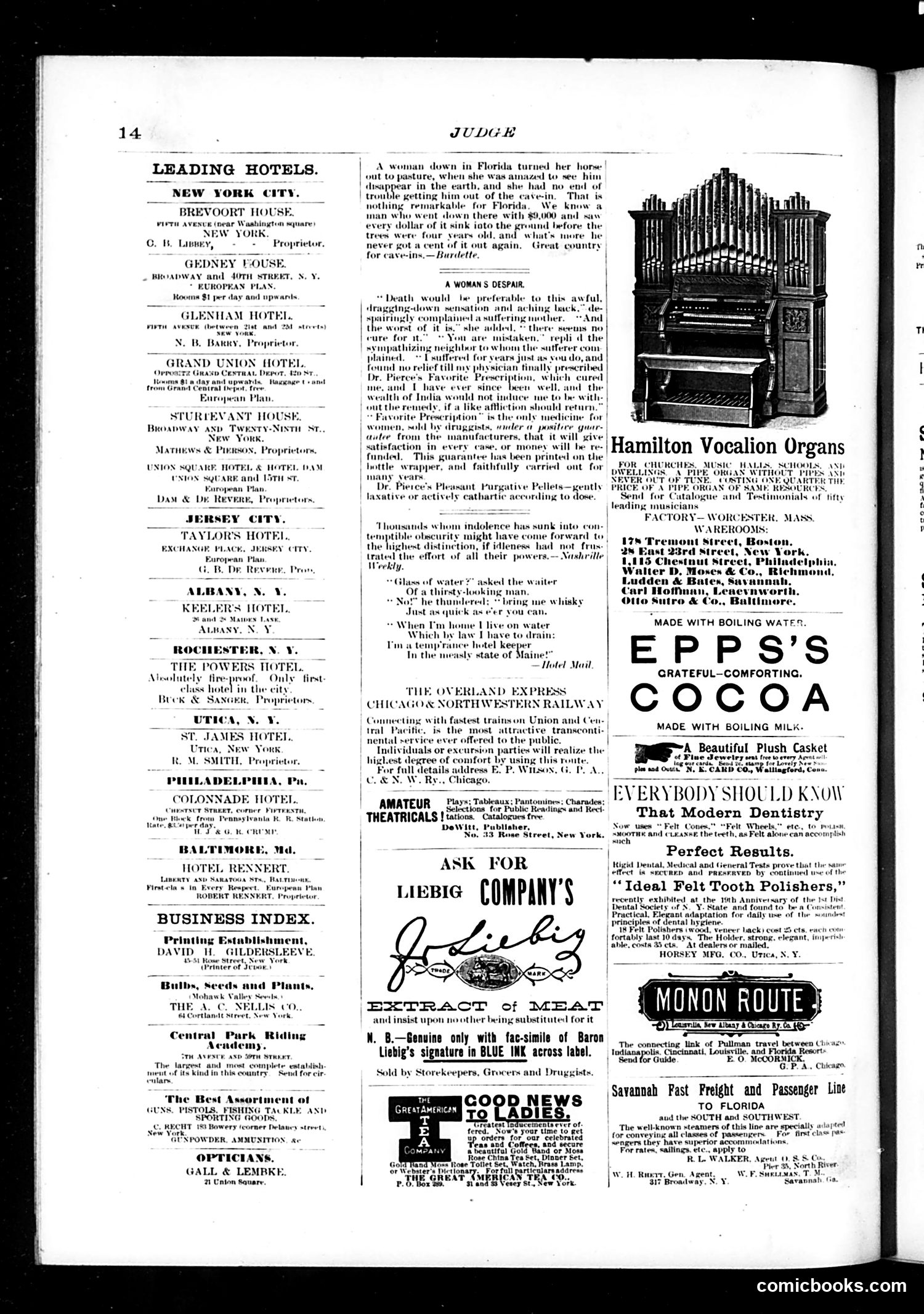
This page is primarily a **directory of advertisements** rather than editorial content. It lists leading hotels across major American cities (New York, Jersey City, Albany, Rochester, Philadelphia, Baltimore) and various consumer products (cocoa, dental polishers, organs, railroads). The only substantive editorial content visible is a brief humorously-titled section **"A Woman's Despair"** — apparently a medical advertisement for Dr. Pierce's remedies, using the common late-19th-century advertising format of presenting patient testimonials as quasi-editorial content. The page reflects the magazine's business model: prestigious hotel and product advertisements targeting middle and upper-class readers. The content itself contains no political satire or social commentary — it's purely commercial. This was typical for magazines of this era, where advertising revenue subsidized satirical content elsewhere in the publication. The page demonstrates how Judge financed itself through high-end advertising rather than relying solely on subscription revenue.
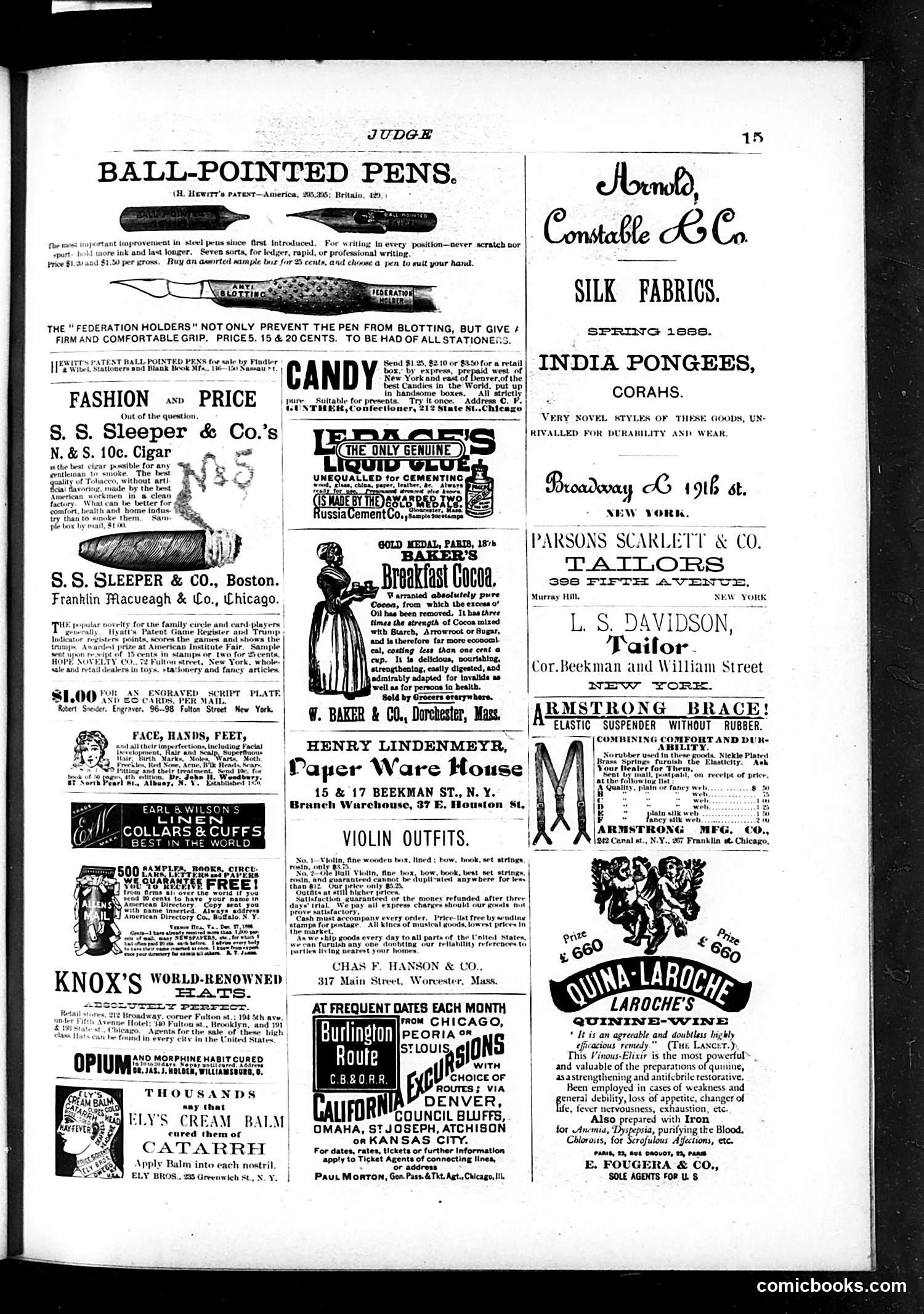
This page is primarily **advertising**, not satirical content. It showcases commercial products typical of the 1880s, reflecting consumer culture and industrial innovation of the era. Key advertisements include: - **Ball-pointed pens** (top): A genuine technological innovation—the page celebrates this as "the most important improvement in steel pens since first introduced," emphasizing durability and comfort. The "Federation Holders" prevent blotting. - **Consumer goods**: Cigars, cocoa, breakfast items, violin outfits, paper goods, tailoring services, and patent medicines (notably "Quinine-Wine" for weakness and fever). - **Travel**: Burlington Route railroad excursions to western cities. The page reveals what middle-class Americans purchased and valued in the 1880s: personal grooming products, manufactured goods, and the new technology of reliable writing instruments. There is **no identifiable political satire** visible here—this appears to be a standard advertising section of *Judge* magazine.
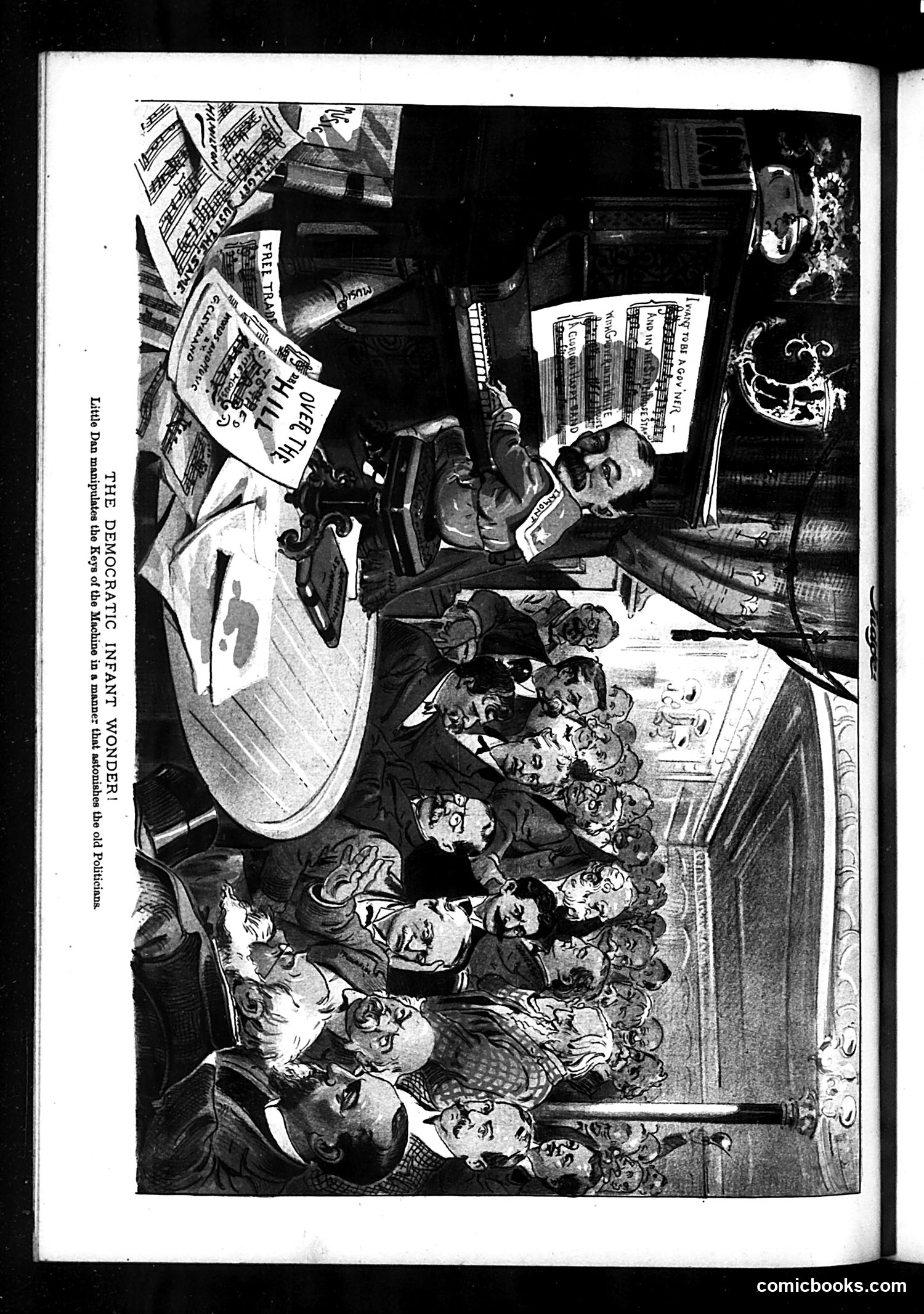
This political cartoon satirizes Democratic Party leadership, depicting "Little Dan" (likely Daniel, a diminutive reference to a Democratic leader) as a child manipulating the party machine's controls. The image shows him operating levers or "keys" while senior politicians watch in astonishment. The satire suggests that the Democratic Party is being run by someone inexperienced or inappropriately young/incompetent, yet somehow managing to control the established political machinery in ways that surprise veteran politicians. The "infant wonder" framing is mocking—presenting incompetence as somehow impressive or shocking rather than concerning. Without a visible date, the specific reference remains unclear, though this reflects 19th-century American anxieties about Democratic Party leadership and competence.