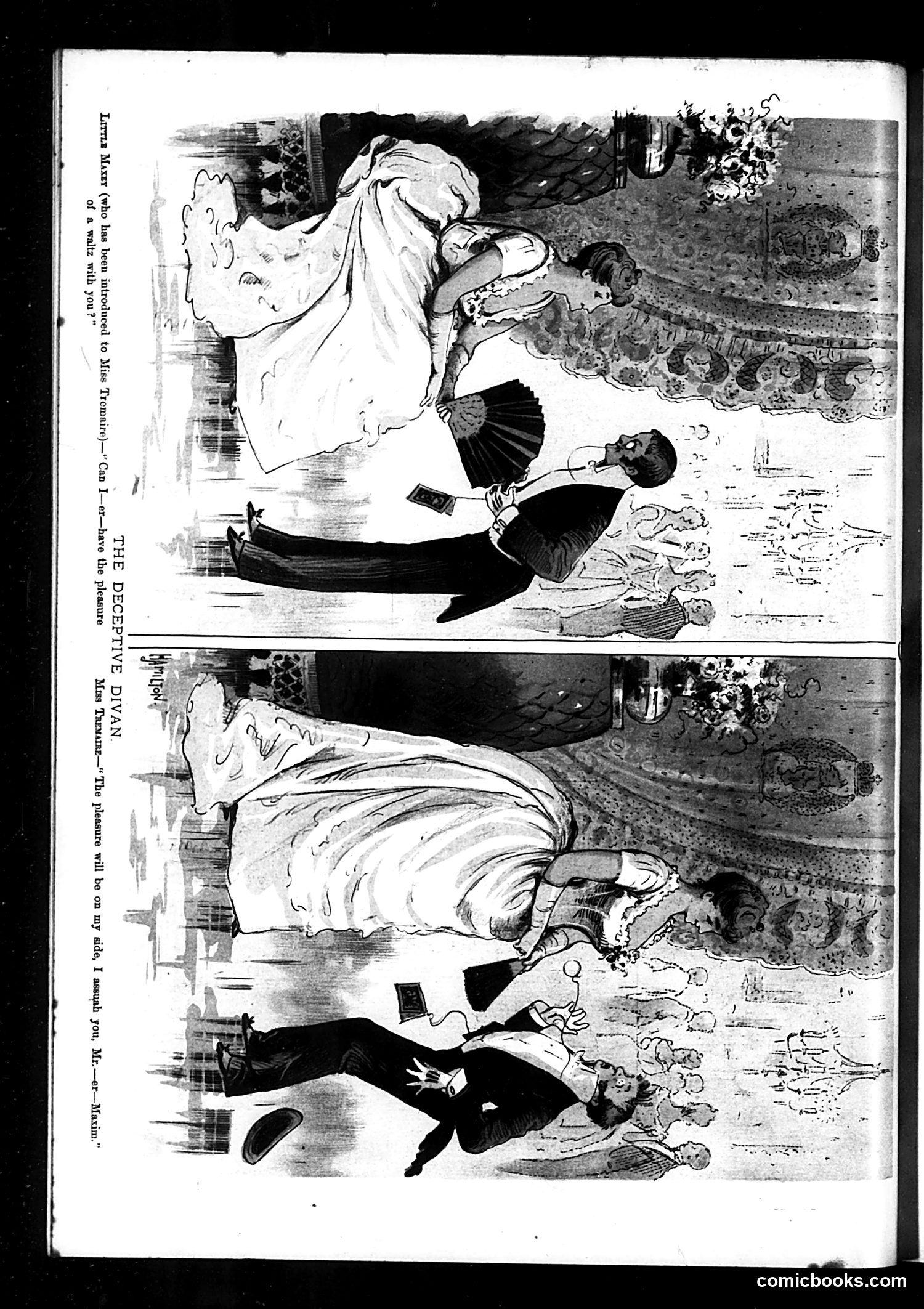
A complete issue · 16 pages · 1887
Judge — November 26, 1887
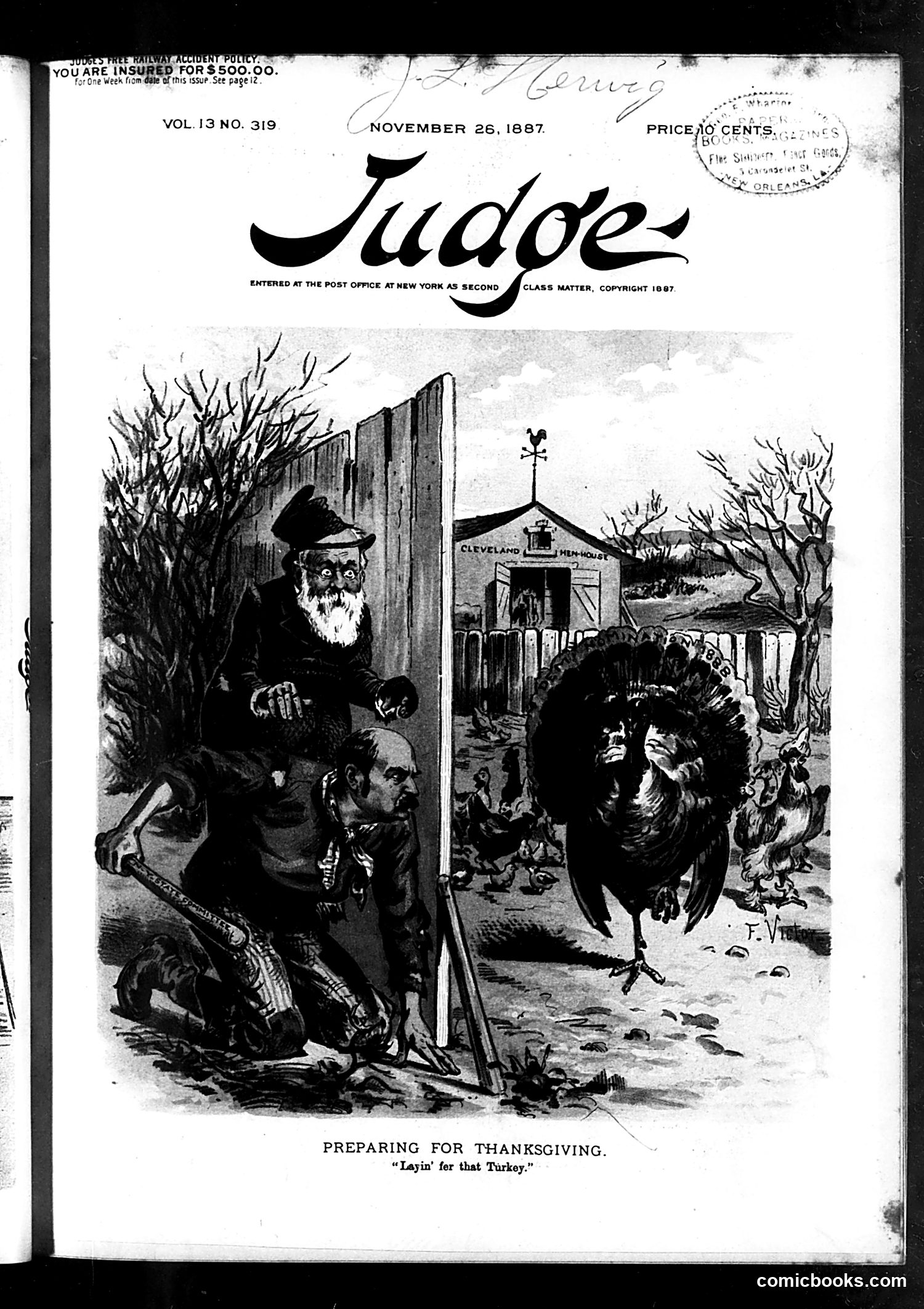
This Thanksgiving-themed cartoon depicts a humorous domestic scene titled "Preparing for Thanksgiving—'Layin' for that Turkey.'" The illustration shows what appears to be a rural or working-class household with a bearded man and woman plotting to catch a turkey for their holiday meal. The turkey is depicted prominently in the yard near a "Cleveland Hen House" structure. The scene humorously captures the practical, often undignified preparations ordinary families undertook to procure holiday poultry. The "Cleveland" reference on the hen house likely alludes to President Grover Cleveland (in office 1885-1889), suggesting contemporary political satire typical of Judge magazine's style—layering topical references into everyday humorous situations for added comedic resonance among readers familiar with current events.
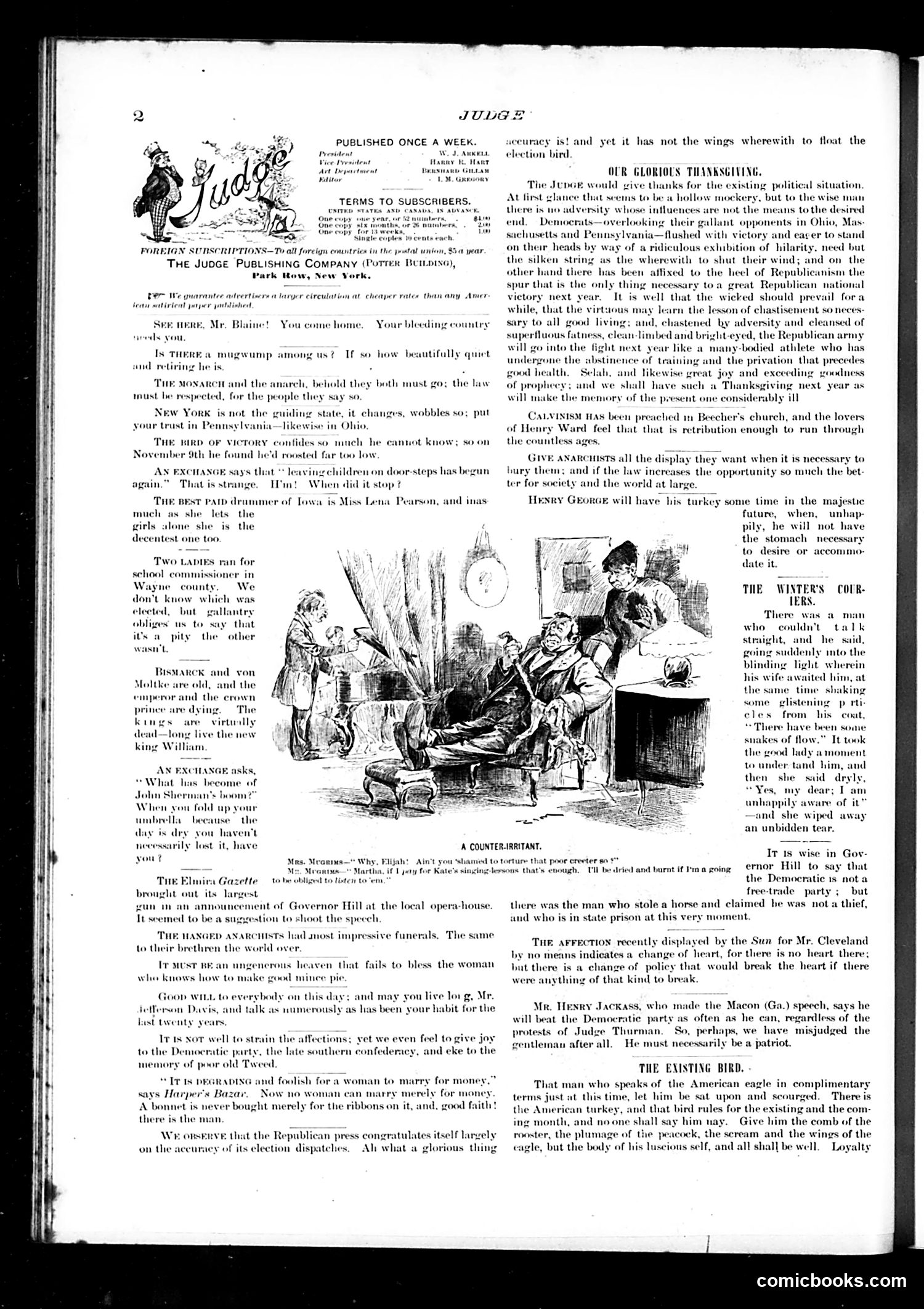
This page contains editorial commentary and satirical pieces rather than a single cartoon. The main illustrated article, "A Counterirritant," depicts what appears to be a domestic dispute or political disagreement between a man and woman, with the woman asking "Why, Elijah? Ain't you shamed to insure that pest forever so?" The surrounding text references Republican electoral strategy, Henry Ward Beecher (a prominent minister), Governor Hill, and Democratic politics. The satire critiques political maneuvering and hypocrisy—particularly regarding the use of inflammatory rhetoric and personal attacks in campaigns. Without clearer identification of specific figures or dated context, the precise political targets remain unclear, though the piece appears to mock both parties' campaign tactics and their appeal to voters' emotions rather than principles.
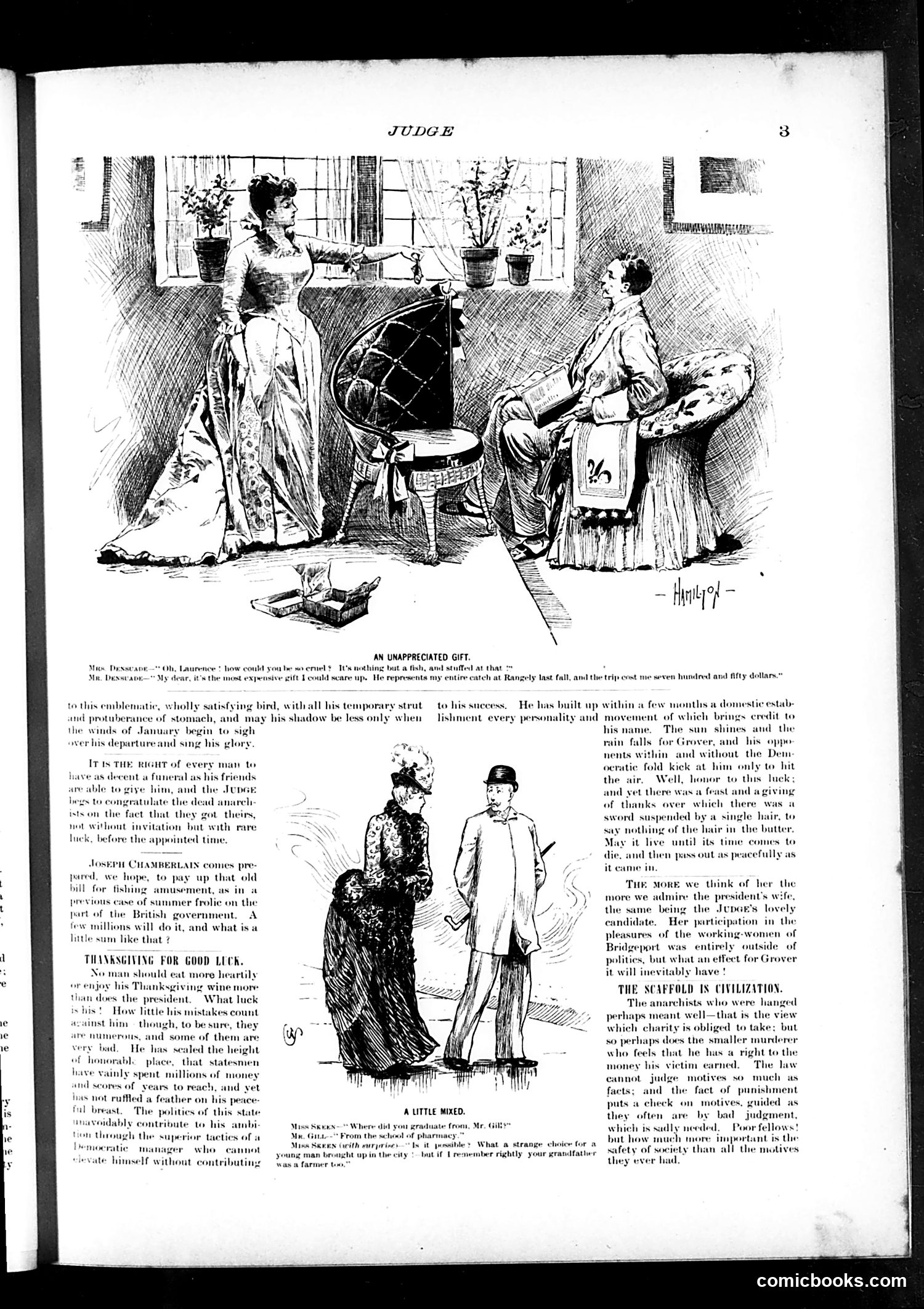
This page contains two separate satirical cartoons mocking prominent figures of the era (likely 1880s-90s based on style). **Top cartoon ("An Unappreciated Gift"):** A woman presents her husband with a stuffed fish, claiming it cost $750—representing his fishing trip to Rangely. The satire mocks wealthy men's expensive leisure pursuits and their wives' sarcastic reactions to such wasteful expenditures. **Bottom cartoon ("A Little Mixed"):** Two figures discuss a young man's choice of pharmacy as a career, with one noting he resembles "your grandfather"—appears to be social satire about career choices and family resemblance. The accompanying text includes sections titled "Thanksgiving for Good Luck" (praising President Grover Cleveland's fortunate political position despite mistakes) and "Scaffold is Civilization" (arguing capital punishment deters crime better than addressing criminal motives). The page primarily satirizes wealth, politics, and social attitudes rather than targeting specific newsworthy events.
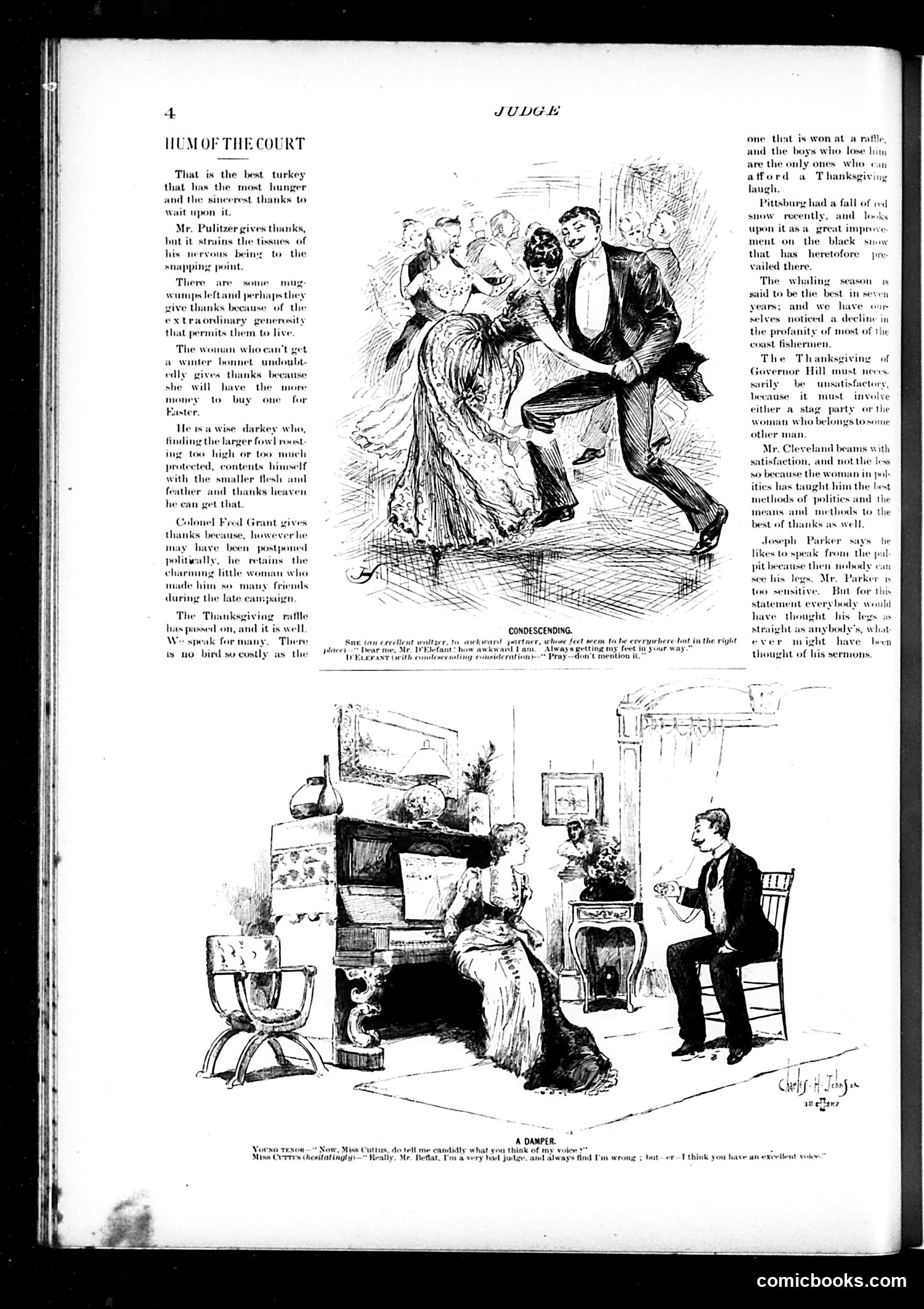
This page contains **humor columns and cartoon vignettes** about Thanksgiving gratitude, likely from the 1880s-90s. **"Humor of the Court"** offers satirical observations on who gives thanks: Joseph Pulitzer (newspaper publisher), women seeking bonnets for Easter, enslaved people grateful for scraps, and Colonel Fred Grant (son of President Ulysses S. Grant, apparently politically sidelined but retaining influence). A pointed jab targets **Governor Hill** (likely David B. Hill of New York), whose Thanksgiving is "unsatisfactory" because it must involve either adultery or a "stag party"—satirizing perceived moral hypocrisy among politicians. **"Condescending"** and **"A Damper"** are brief comic exchanges mocking social pretension: a man boasting about his feet, and a woman feigning praise while insulting a suitor's voice. The satire targets late-19th-century hypocrisy among the wealthy and powerful, contrasting their selective gratitude with working people's genuine thanks for modest circumstances.
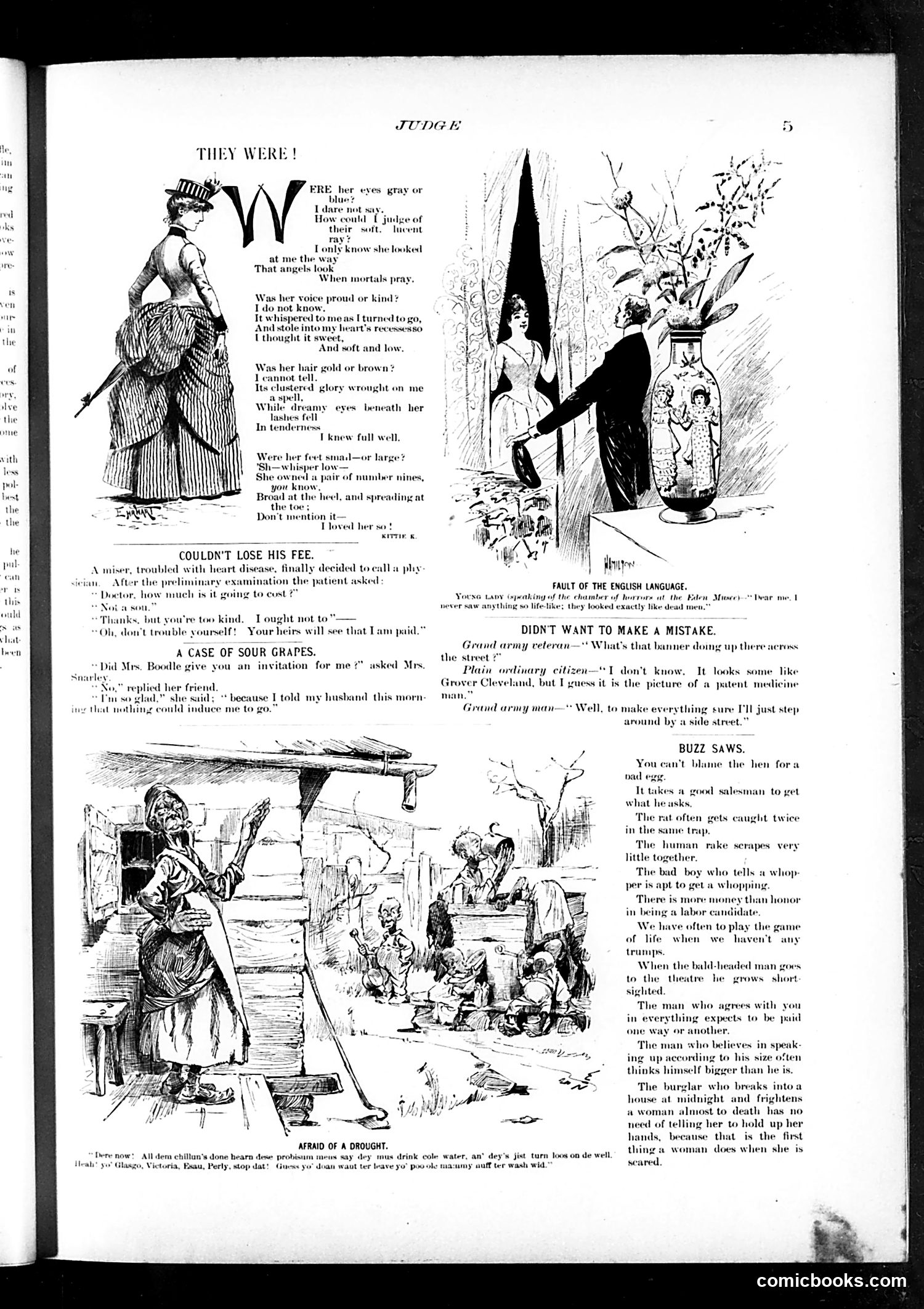
This page contains several unrelated satirical pieces typical of Judge's format: **"They Were!"** (top left): A romantic poem with accompanying illustration of a woman, likely poking fun at sentimental Victorian poetry and male nostalgia. **"Couldn't Lose His Fee"** (center): A joke about a miserly, dying patient consulting a physician. The punchline implies the doctor won't waive fees even for a patient's heirs—satirizing medical greed and the mercenary nature of the profession. **"Case of Sour Grapes"** (lower left): Social satire about Mrs. Snarley using a transparent excuse (claiming her husband forbade her attendance) to avoid an unwanted social invitation. **"Didn't Want to Make a Mistake"** (right): A Grand Army veteran (Civil War vet) questions a patriotic banner, suspecting it's actually an advertisement for patent medicine—satirizing commercialism's exploitation of patriotic imagery. **"Buzz Saws"** (right column): A collection of cynical one-liners about human nature, greed, and hypocrisy. These reflect Judge's focus on social observation and mild cynicism about American life.
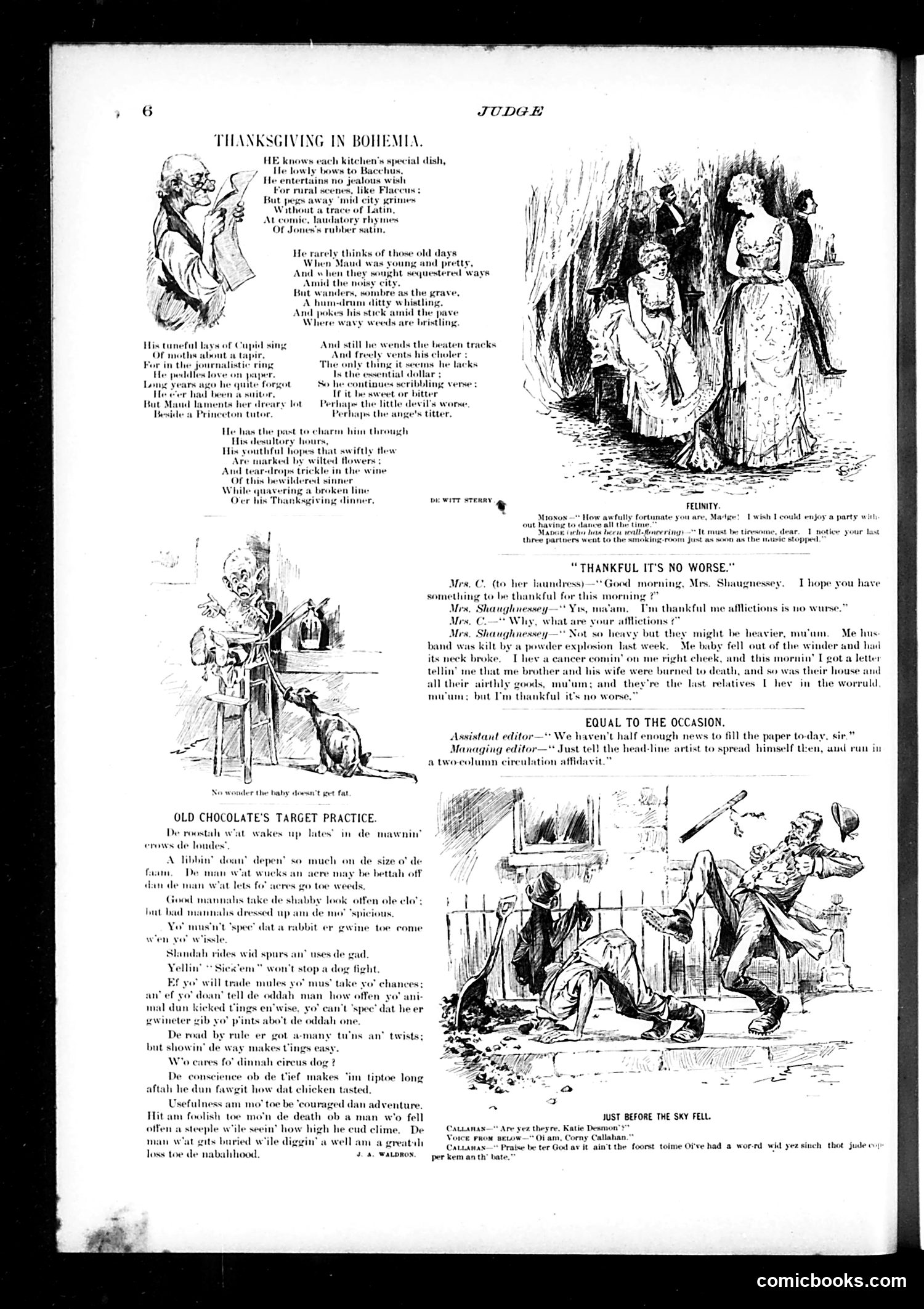
This page contains several satirical pieces typical of late 19th/early 20th-century American humor: **"Thanksgiving in Bohemia"**: A poem mocking artistic pretension—the subject is a bohemian artist who romanticizes poverty and city life while claiming artistic superiority, despite his actual circumstances. **"Thankful It's No Worse"**: A dialogue satirizing Irish immigrant working-class resilience. Mrs. Shaughnessey endures horrific tragedies (husband killed, child injured, relatives burned to death) yet maintains stoic gratitude that things aren't worse—the humor targets both the character's acceptance of misery and stereotypical Irish dialect representation. **"Equal to the Occasion"**: Editorial humor about filling newspaper space with sensationalism when lacking real news. **"Old Chocolate's Target Practice"** and **"Just Before the Sky Fell"**: Dialect humor pieces using exaggerated African American and Irish immigrant speech patterns (common in period publications), depicting rustic or working-class scenarios. The page exemplifies Judge's satirical approach: punching down at working-class and immigrant groups through caricature and dialect.
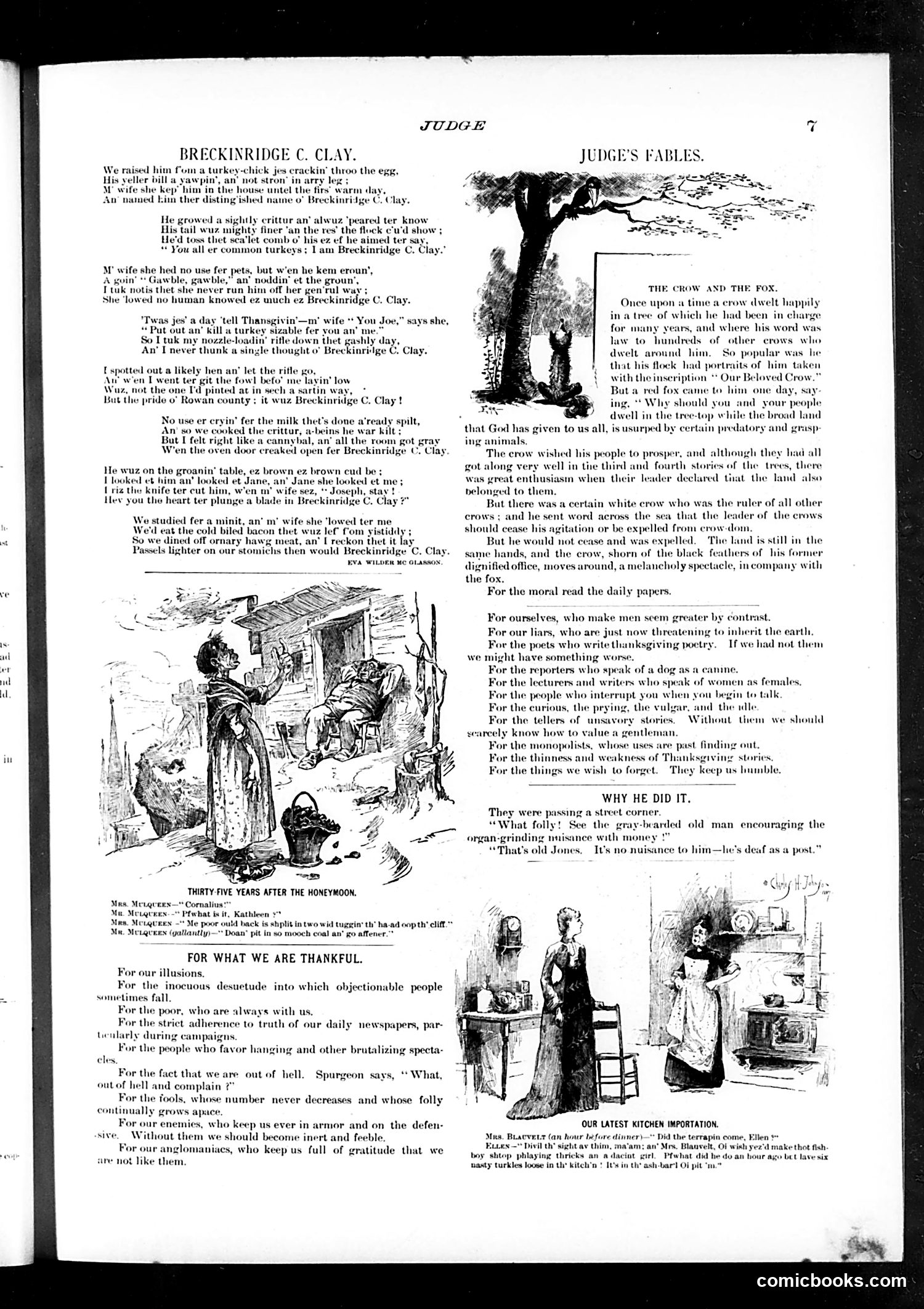
This page contains **political satire and fables** typical of late-19th-century Judge magazine: **"Breckinridge C. Clay"** (top left) appears to be a satirical poem mocking a rural, seemingly simple-minded figure whose name suggests the Kentucky politician Henry Clay. The narrator repeatedly confuses this Clay with other things—a turkey, a hen—suggesting either the character's insignificance or the narrator's foolishness. The joke likely targets Clay's political legacy or contemporary political figure. **"The Crow and the Fox"** (center/right) is a political fable where a white crow expels the black crow leader after the fox agitates them to abandon their tree. This appears to reference racial or political divisions—possibly Reconstruction-era politics or contemporary labor/social conflicts. The moral instructs readers to "read the daily papers," suggesting contemporary news parallels the allegory. **"For What We Are Thankful"** (bottom) is satirical gratitude listing things society should *not* be proud of: illusions, poor people, newspapers' dishonesty, and monopolists. It's cynical social commentary on American institutions. The page combines political allegory, rural dialect humor, and institutional satire typical of Judge's approach.
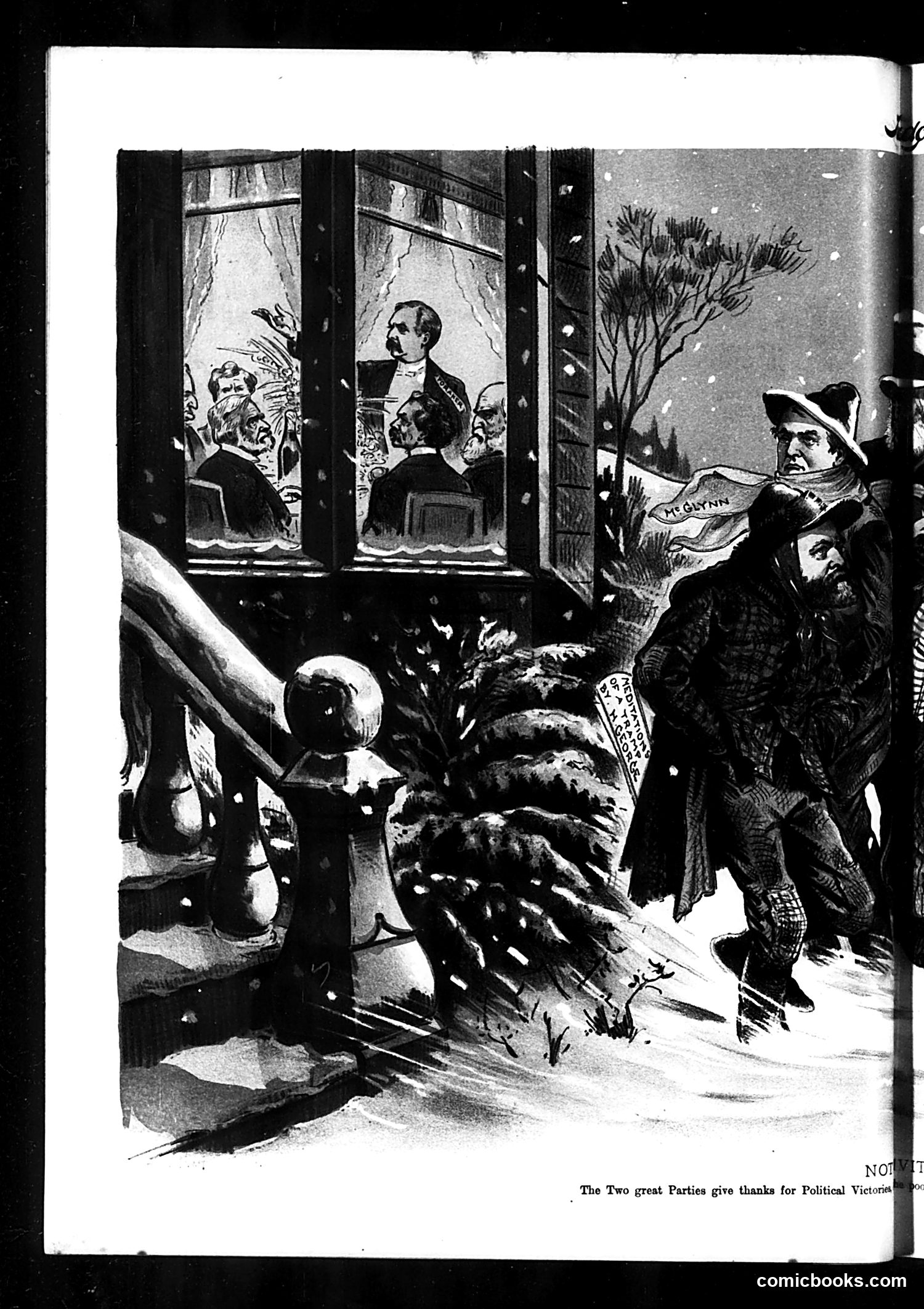
This political cartoon depicts two well-dressed men inside a building, apparently giving thanks for electoral victories. Outside in the snow, poor and working-class figures huddle in the cold, appearing to be excluded from the celebration. The satire critiques the major American political parties (the "Two great Parties") for celebrating their own political wins while ignoring the suffering of ordinary citizens, particularly the poor and homeless visible outside the warm interior. The contrast between the comfortable, well-fed politicians indoors and the struggling masses outdoors emphasizes economic inequality and the disconnect between party leadership and constituents' real hardships. Without a visible date, the specific election referenced remains unclear, but Judge magazine typically targeted Gilded Age political hypocrisy.
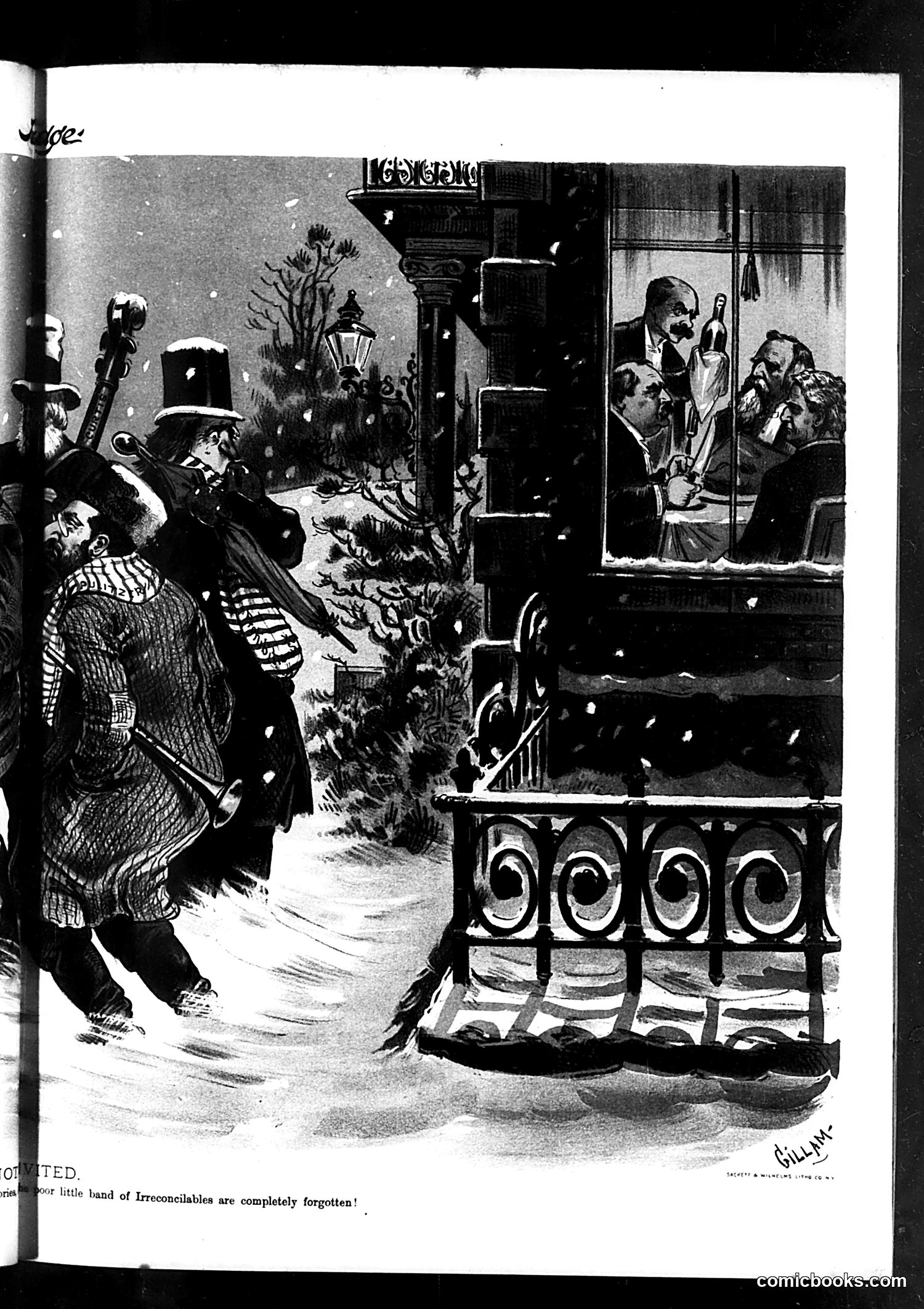
This cartoon depicts a street scene where elegantly dressed figures peer through a window at what appears to be a festive gathering inside. The caption reads: "Poor little band of Irreconcilables are completely forgotten!" The "Irreconcilables" refers to a group of U.S. senators who opposed the League of Nations after World War I, viewing it as a threat to American sovereignty. This cartoon satirizes their political irrelevance—suggesting they've become forgotten outsiders watching life move on without them, excluded from the important social and political events of the day. The contrast between the observers outside (appearing somewhat shabby or dejected) and the celebration within emphasizes their marginalization and loss of influence.
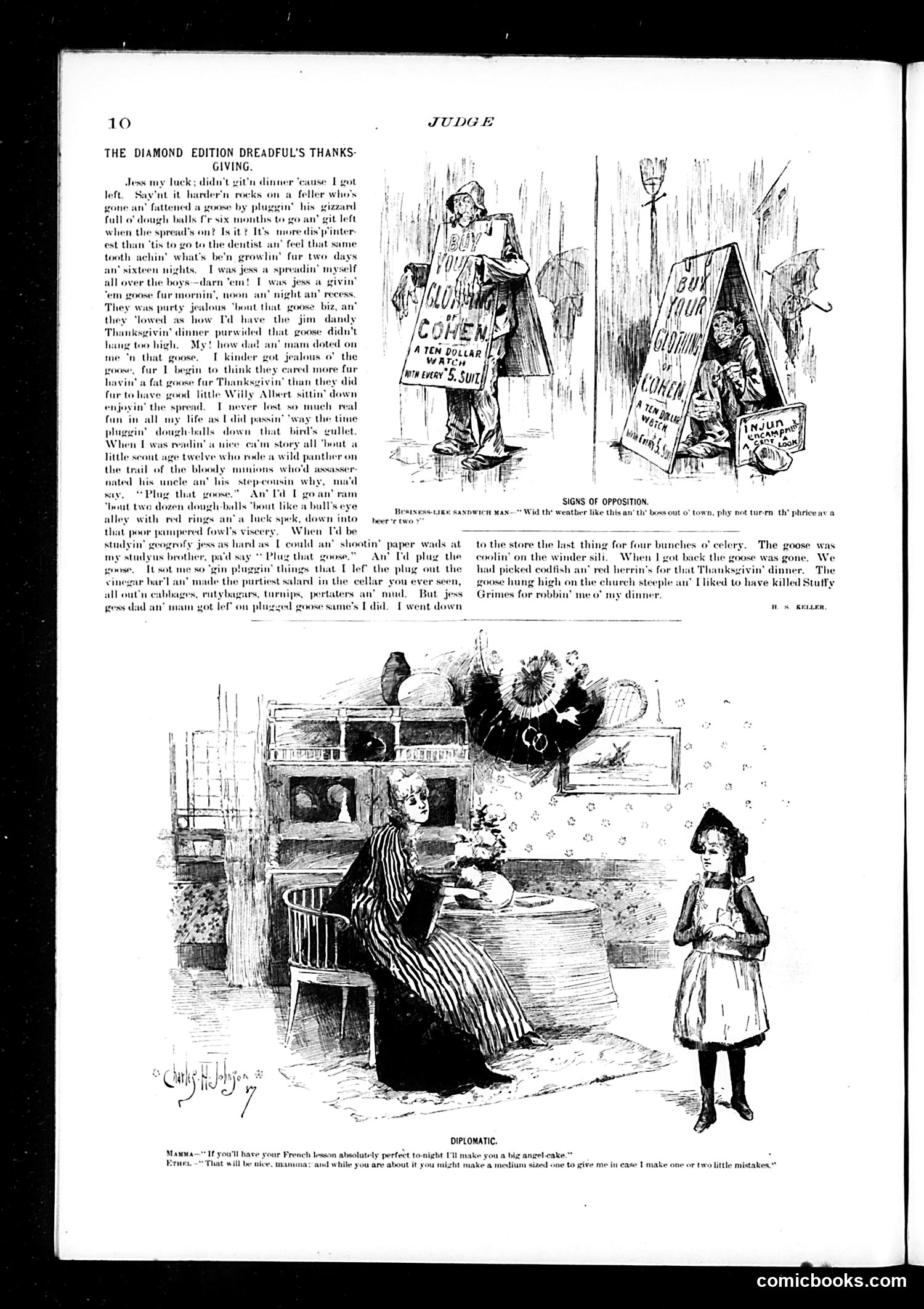
This page contains two cartoons satirizing American domestic life around Thanksgiving. **Top cartoon ("Signs of Opposition"):** A poor boy advertises a ten-dollar goose he's trying to sell, apparently during hard economic times. The satire mocks working-class families' struggles to afford holiday meals and their desperation to sell what little they have. **Bottom cartoon ("Diplomatic"):** A mother negotiates with her daughter, offering to make her a "big angel-cake" if the girl's French lessons are "absolutely perfect." The daughter cautiously agrees while hedging against potential mistakes. This satirizes the pretentious middle-class pursuit of French refinement and education—and the transactional nature of parental incentives. Both cartoons use humor to critique social anxieties: economic hardship for the poor, and aspirational class-climbing among the middle classes. The publication date and specific references are unclear from the visible text.
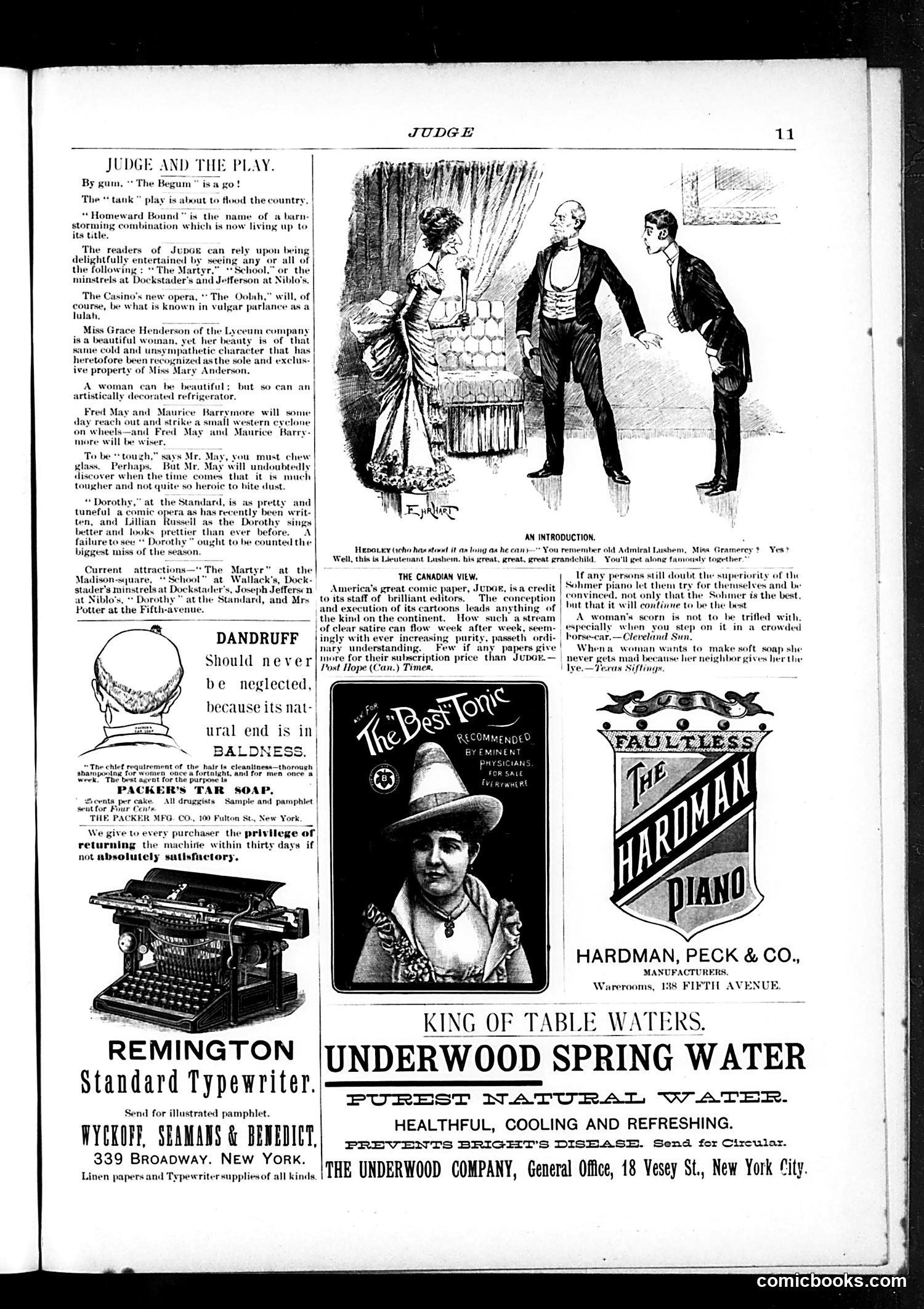
This page combines theatrical commentary with period advertisements. The main cartoon (top) shows a social scene with three figures at what appears to be a formal gathering—likely satirizing contemporary theater or high society interactions, though the specific joke is unclear without additional context. The text discusses current Broadway productions ("The Martyr," "Homeward Bound," "The Oolah") and actresses like Miss Grace Henderson, employing Judge's typical sardonic humor. One notable jab compares a beautiful woman to "an artistically decorated refrigerator"—mocking the era's tendency to value women primarily for decorative beauty. The page is dominated by **advertisements** (Remington typewriter, Packer's Tar Soap for dandruff, "The Best Tonic," Hardman piano, and Underwood Spring Water), reflecting Judge's revenue model. A Canadian testimonial praises Judge's superiority to other comic papers. The content reflects early 20th-century concerns: theatrical entertainment, grooming products addressing male baldness anxiety, and health tonics—typical consumer anxieties of the period.
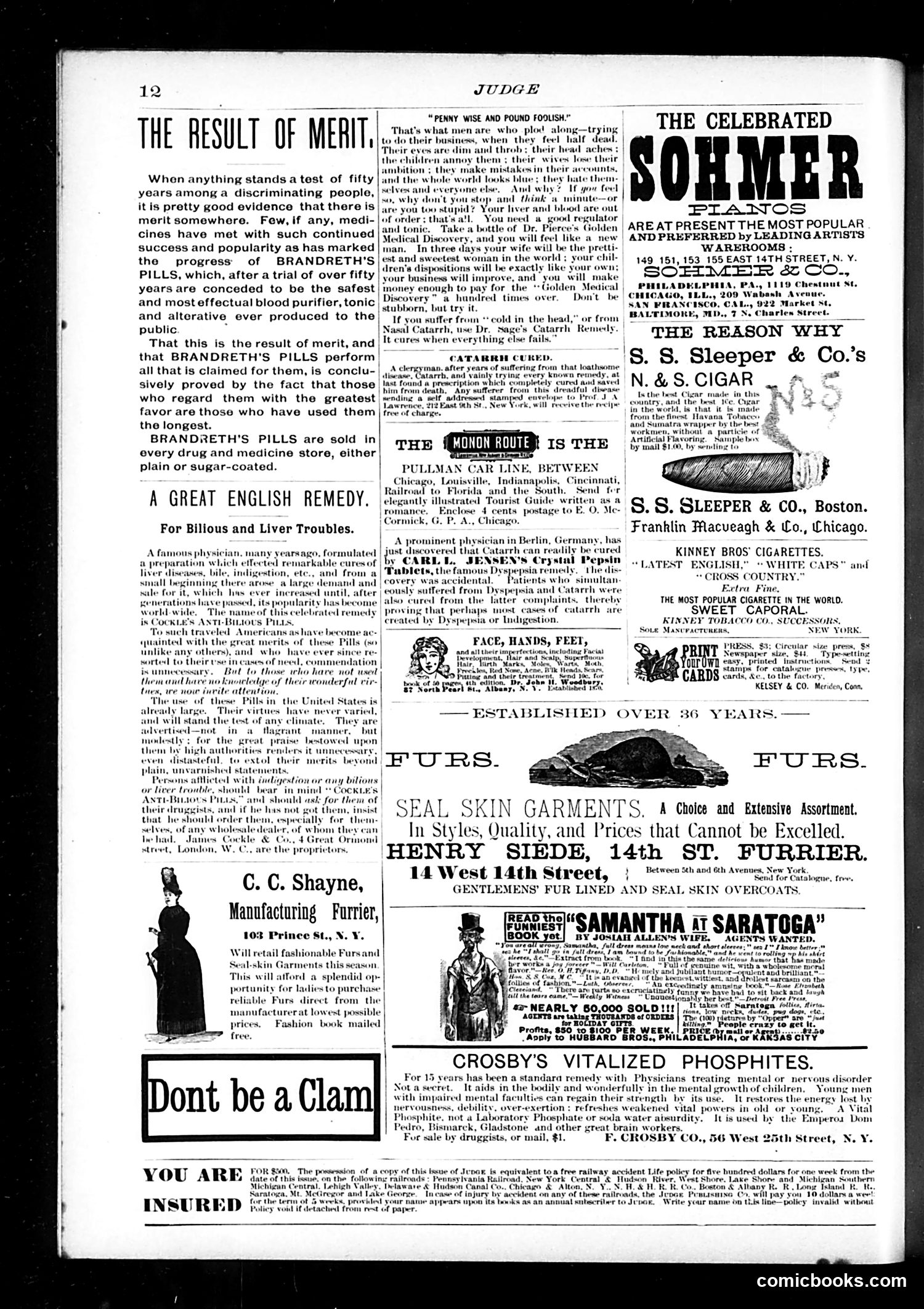
This page is primarily **advertising**, not editorial satire or political cartooning. It contains mainly patent medicine and commercial advertisements typical of Judge magazine's revenue model in this era. The main article, "The Result of Merit," is an advertisement for **Brandreth's Pills**—a patent medicine that claims 50+ years of market success as proof of efficacy. The lengthy testimonial emphasizes the product's longevity and trustworthiness among "discriminating people." Other ads include remedies for catarrh, liver troubles, and "vitalized phosphites," along with ads for furs, pianos, and cigars. One notable section includes the phrase **"Penny Wise and Pound Foolish,"** apparently promoting patent medicines as wise health investments. The tiny cartoon labeled **"Don't be a Clam"** (bottom left) is unclear without additional context—likely a brief satirical joke, but its specific target is not legible. This page reflects Judge's dual nature: while known for political satire, it relied heavily on patent medicine advertising for funding, even as such products were often fraudulent or ineffective.
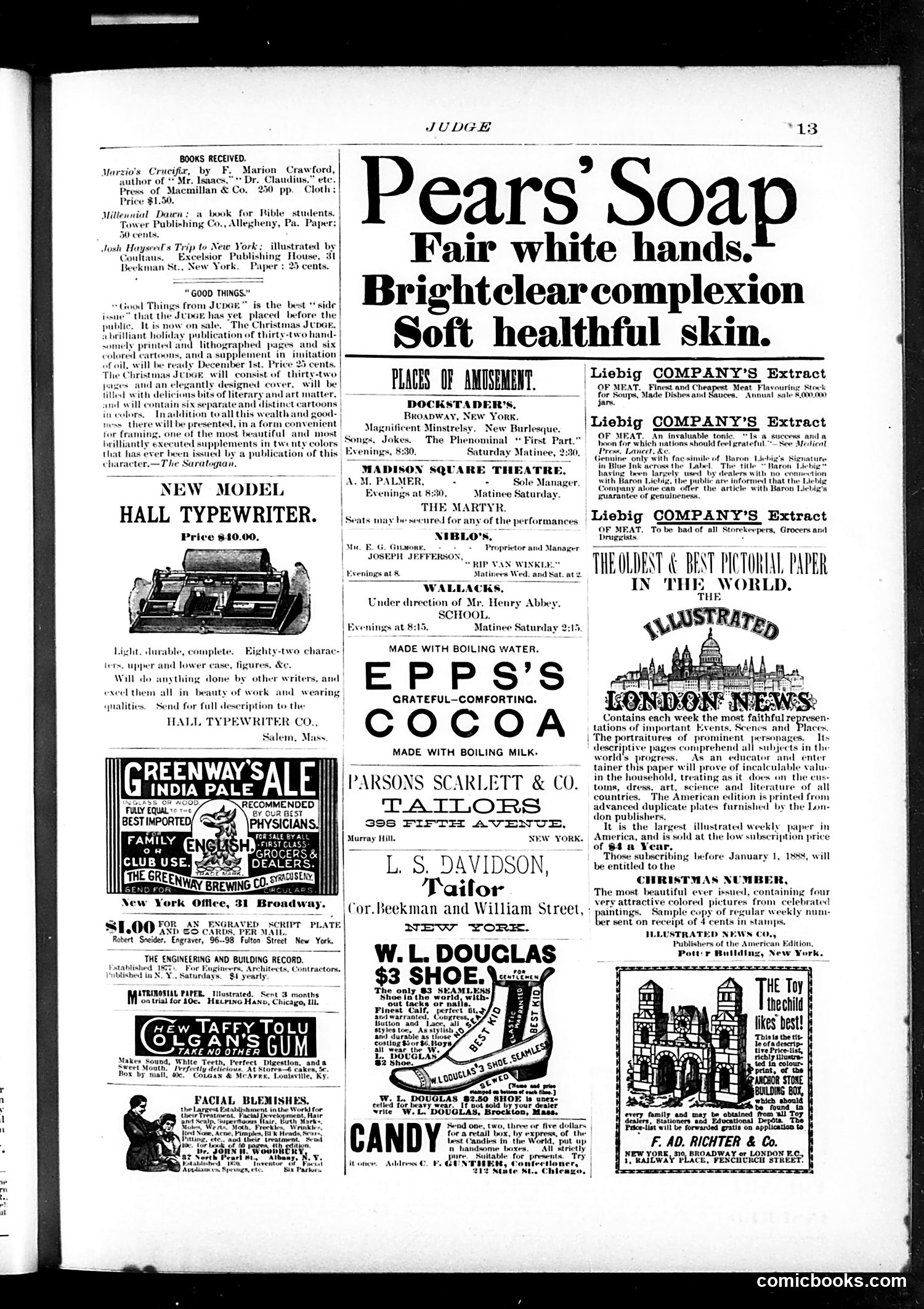
This appears to be primarily an **advertising and announcements page** rather than featuring satirical cartoons or political commentary. The page contains: - **Book reviews** for religious and literary works - **Theater advertisements** (Dockstader's Minstrelsy, The Martyr, Niblo's) - **Product advertisements** for typewriters, cocoa, tailoring services, candy, and soap - **Liebig Company meat extract ads** (repeated multiple times) - **Illustrated London News promotion** The only visual element is a **typewriter illustration** and shoe advertisements with minimal imagery. **For modern readers:** This demonstrates how 19th-century magazines blended editorial content with revenue-generating ads. There is **no apparent political satire or social commentary** on this particular page—it's a straightforward commercial/informational publication page. The content reflects contemporary consumer products and entertainment venues of the era, but contains no identifiable cartoons or satirical figures to analyze.
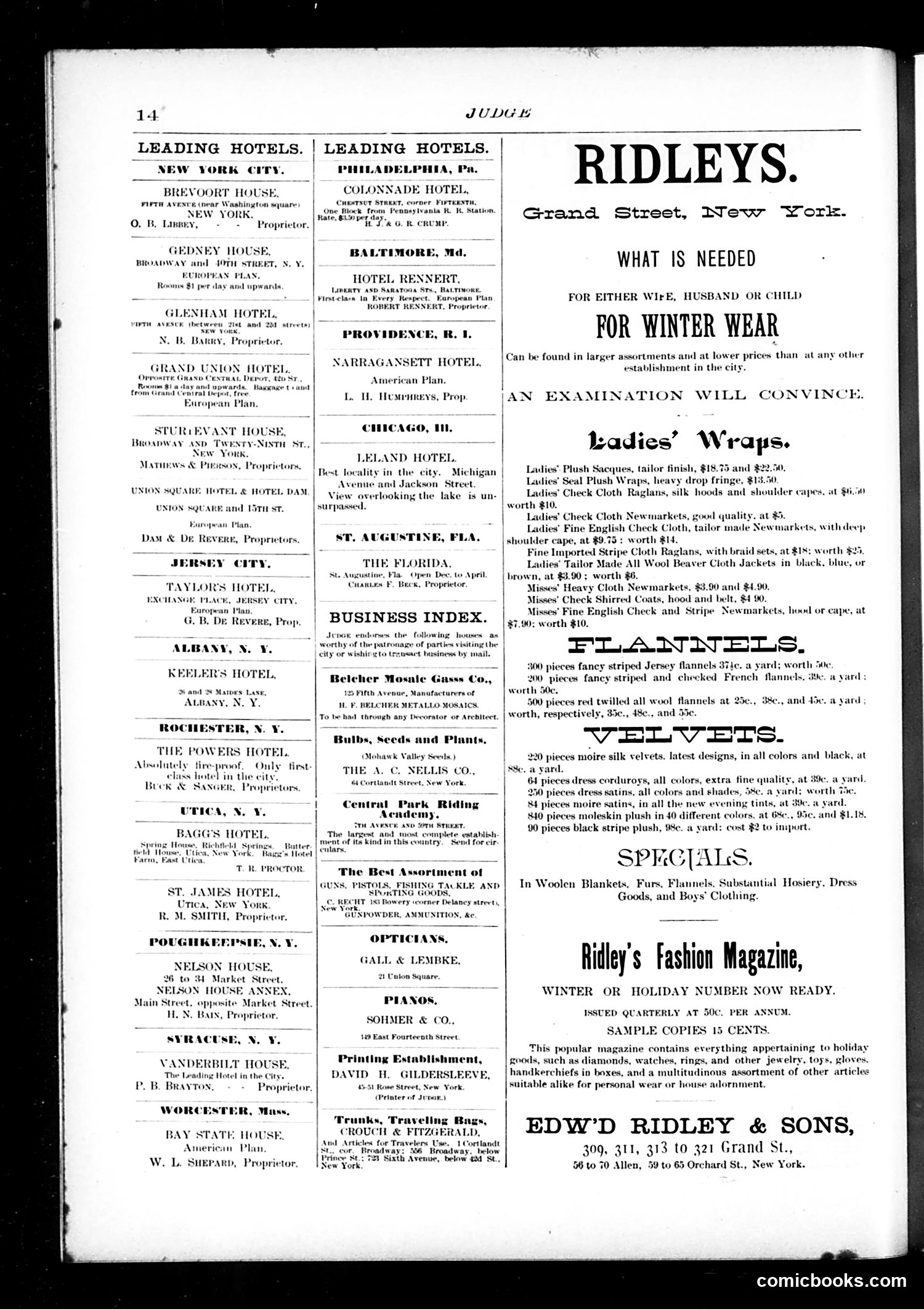
This page is primarily **advertising**, not political satire. It contains listings for leading hotels across multiple American cities (New York, Philadelphia, Baltimore, Providence, Chicago, etc.), followed by a large advertisement for **Ridley's department store** on Grand Street, New York. The Ridley's ad dominates the right side, promoting winter clothing for women and children—plush wraps, jackets, flannels, velvets, and other garments with specific prices and materials listed. It concludes with an announcement for **Ridley's Fashion Magazine**, a quarterly publication at 50 cents per issue. There are no political cartoons, caricatures, or satirical commentary visible on this page. The "BUSINESS INDEX" section lists various commercial enterprises (mosaics manufacturers, seed companies, printing establishments, opticians, piano makers). This is a typical page from a late 19th-century magazine mixing hotel advertisements with retail promotions—common publishing practice of that era.
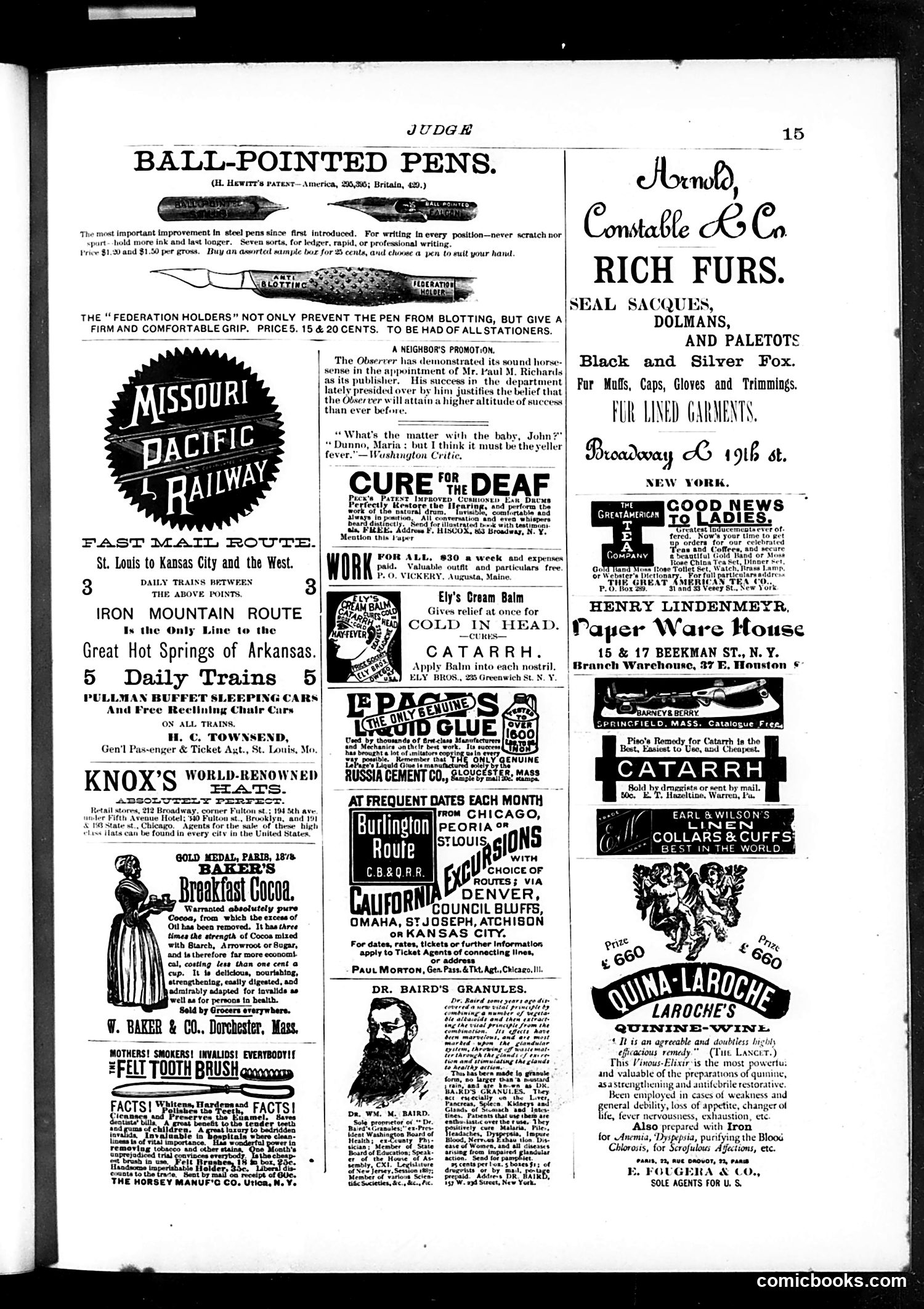
This page is primarily **advertisements and notices** rather than satirical cartoons. The only identifiable satirical content is a brief joke labeled "A NEIGHBOR'S PROMOTION," which appears to be wordplay involving a baby and a man named "John"—the humor is unclear from the fragmentary OCR text. The bulk of the page consists of **commercial advertisements** typical of early 20th-century magazines: ball-pointed pens, railroad routes (Missouri Pacific Railway, Burlington Route), patent medicines (catarrh remedies, Dr. Baird's Granules, Quinine-Wine), breakfast cocoa, and dental products. There's also an advertisement for fur-lined garments and a paper warehouse. These ads reflect the commercial culture and medical practices of the era, when patent medicines made extravagant claims about treating various ailments, and railroads aggressively marketed passenger service. For a modern reader, the page demonstrates how magazines sustained themselves through advertising revenue and how differently health and commerce were marketed a century ago.