
Judge, 1887-11-26 · page 7 of 16
Judge — November 26, 1887 — page 7: what you’re looking at
What you’re looking at
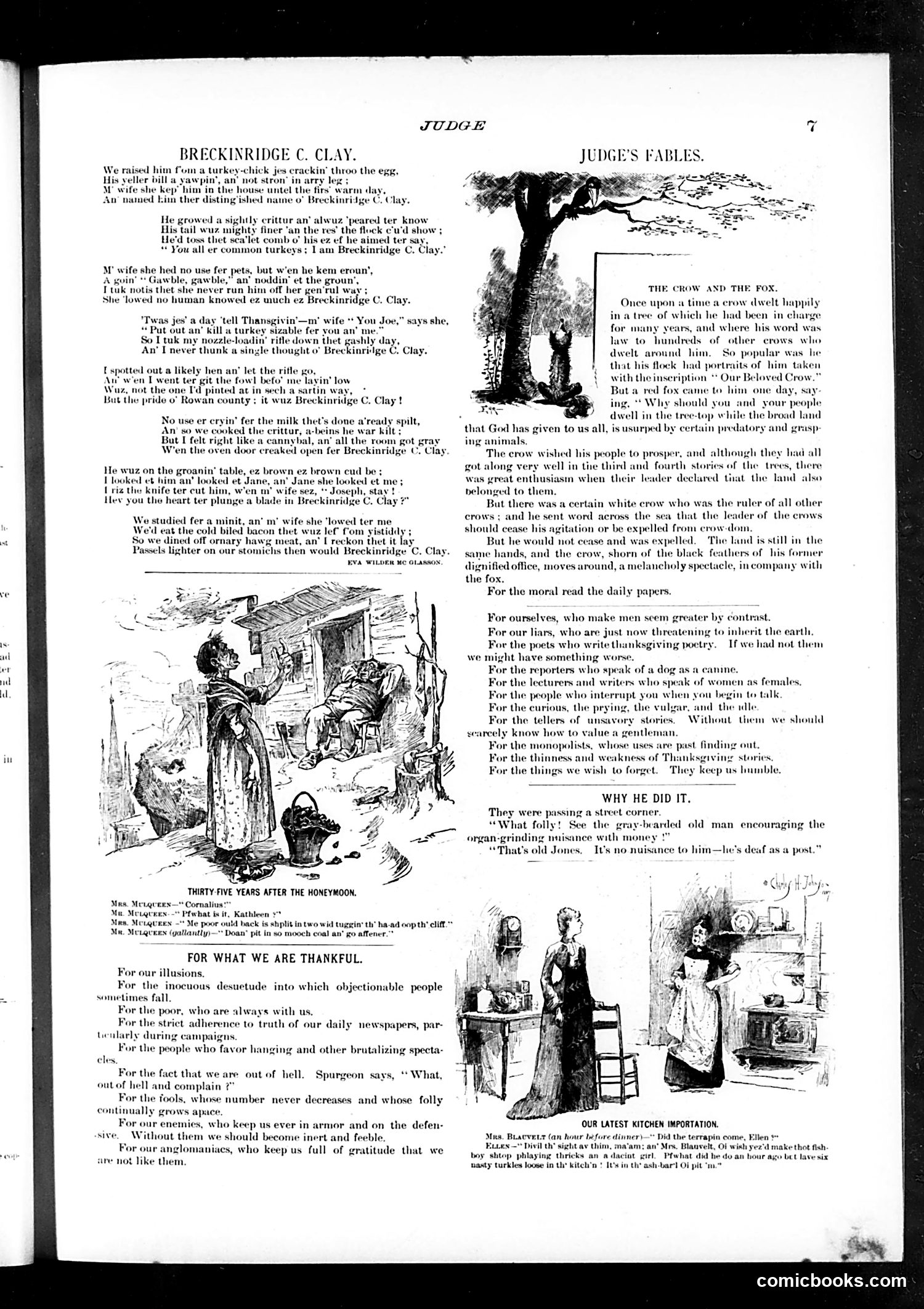
This page contains **political satire and fables** typical of late-19th-century Judge magazine: **"Breckinridge C. Clay"** (top left) appears to be a satirical poem mocking a rural, seemingly simple-minded figure whose name suggests the Kentucky politician Henry Clay. The narrator repeatedly confuses this Clay with other things—a turkey, a hen—suggesting either the character's insignificance or the narrator's foolishness. The joke likely targets Clay's political legacy or contemporary political figure. **"The Crow and the Fox"** (center/right) is a political fable where a white crow expels the black crow leader after the fox agitates them to abandon their tree. This appears to reference racial or political divisions—possibly Reconstruction-era politics or contemporary labor/social conflicts. The moral instructs readers to "read the daily papers," suggesting contemporary news parallels the allegory. **"For What We Are Thankful"** (bottom) is satirical gratitude listing things society should *not* be proud of: illusions, poor people, newspapers' dishonesty, and monopolists. It's cynical social commentary on American institutions. The page combines political allegory, rural dialect humor, and institutional satire typical of Judge's approach.
📄 Transcribed text from this page (OCR, searchable)
Machine-transcribed from the original scan — historical spelling and the odd misread are preserved.
C. CLAY. JUDGE'S FABLES We raised him fom a tur ick jes crackin’ throo the egg, S His yeller bill ays ai y leg; M wife she ke # M' wife she hed no use fer pets, but w'en he kem eroun’, A guin’ * Gawble, gawble,” an” noddin’ et the groun’, i: F — T tuk notis thet shen h ff her gen’ Cal way “a sie, THE CROW AND THE FOX. She ‘lowed no human knowed ez much ez Breckinridge C. Clay. = Sai Once upon a time a crow dwelt happily "Twas jes’ a da ivin'—m' wife “You Joo,” says she, a ina tree of which he had been in cl “Put out an’ kill a izable fer you an’ me. ‘ y years, and where his word was So I tuk my ‘lin’ rifle down thet gashly day, ; , law to Tnnidreds of other crows who An’ I never thunk a single thought o' Breckinrilge C: Clay. dwelt E spotted out a likely hen an’ let the rifle x 3 that his Hock An’ wen T went ter git the fowl befo" me layin’ with the inser Wuz, not the one I'd pinted at in sech asa g A But a red fox » him one ds But the pride o' Rowan county ; it wuz Breckin . Clay! : ing, “' Why should you and your people No use er eryin’ fer the milk thet's done a’ready spilt, . . dwell in the tree top while the broad land An’ so we cooked the 1 at ns he ts in od has given to us all, is usurped by ain predatory and grasp: I . nimals. The crow wished his people to prospe though they had all He wuz on the groanin’ table, ez brown ez brown cud be : long very wall inthe Giind abd tourll s of the trees, there I looked et him an’ looked et J * Jane she looked et me; was great enthusiasin when tl er declares p Tand alse Knife ter cut him, wen an" wife sez, Joseph belonged to them. Hew you the heart ter plunge a blade in Breckinridge C. " But there was a certain white crow who was the of all other We studied fer a minit, an’ m' wife she crows ; and he sent word across the sea that the leader of the crows the cold biled bacon thet wuz let f Way's should cease his agitation or be expelled from erow-do: vedined off ornary hawg meat, an’ Lreckon thet it lay But he would not cease and was expelled. The land is still in the Pascls lighter on oar tomichs then would Breckinridge C. ‘lay. same hands, and the crow, shorn of the black feathers of his former dignified office, moves around, a melancholy spectacle, in company with the fox. For the moral read the daily papers. For ourselves, who make men seem greater by contrast. For our lis y v ei i it the earth, For the poets who w sgi pry. ve had not th we might have something worse For the reporters who speak of a dog as ac For the lecturers and writers who speak of wom For the people who interrupt you when For the curious, the prying, the vuly ‘or the tellers of unsave stories, Without them we should seareely know how to value a gentleman, For the monopolists, whose uses are past finding out, For the thinness and weakness of Thanksgiving stories, For the things we wish to forget. They keep us lumble. WHY HE DID IT. They were passing a street corner. See the gray-bearded old man encouraging the wisance with money !” That's old Jones. It's no nuisance to him—he's deaf as a post.” Mrs. Mevgrers— Mu. Mevgtxes.~ Mus. Mcuguzes —* Me poor ould back is shplit in two wid tuggin’ th’ ha.ad oop th’ cliff." Mu. Metgeres (yallantly)—* Doan’ pit in so mooch coal an’ go affener.* FOR WHAT WE ARE THANKFUL. For our illusions. For the inocuous desuetude into which objectionable people sometimes fall. For the poor, who are always with us. For the strict adherence to truth of our daily newspapers, par- teularly duri us, For the people who favor hanging and other brutalizing specta- or the fact that we are out of hell. Spurgeon says, ‘ What, outof hell and complain ?” For the fools, whose number never decreases and whose folly continually grows apace For our enemies, who keep us ever in armor and on the defen- OUR LATEST KITCHEN IMPORTATION. Without them we should become inert and feeble. x (an hour befure dinner)— Did the terrapin come, For our anglomaniacs, who keep us arati » the - m ‘sight av thim, ma’am; an’ Mrs, Blanvelt, Of wish une not like tl ucs, who keep us full of gratitude that we ricky an adacint girl. Pfwhat did he do an t bet lave six Benak Nike chem. hasty turkles loose in tht kiteh'n It's in th’ ash-bart Of pit comicbooks.com