
A complete issue · 16 pages · 1887
Judge — November 12, 1887
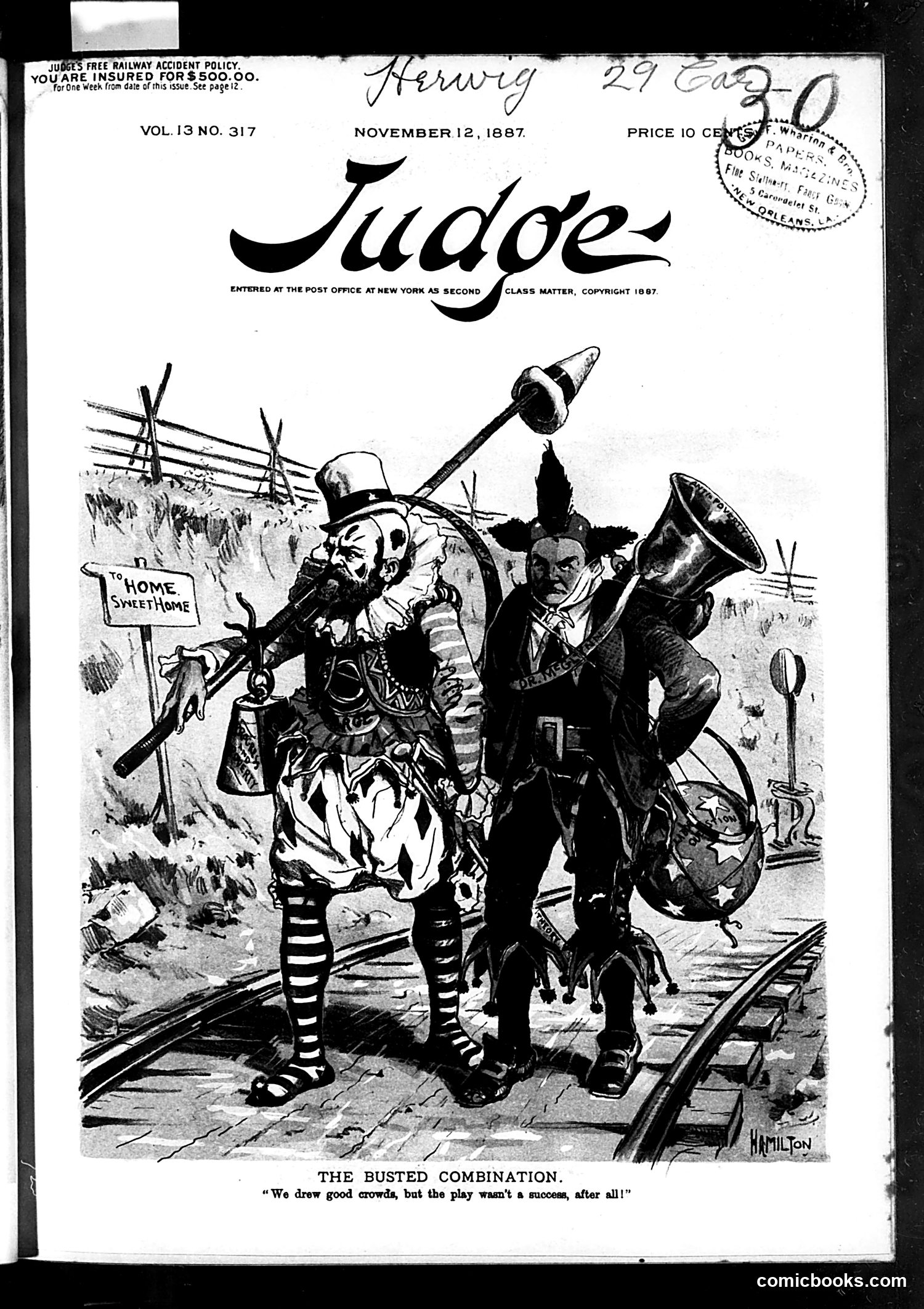
This November 1887 Judge cartoon satirizes a failed theatrical partnership. The caption reads: "We draw good crowds, but the play wasn't a success, after all!" Two performers stand on railroad tracks near a "Home Stretch" sign, accompanied by what appears to be a Devil or demon figure. They're depicted as clowns or vaudeville entertainers with exaggerated costume elements. The "busted combination" likely refers to a real theatrical act or partnership that collapsed despite drawing audiences—suggesting the performers were popular individually but failed when working together. The railroad setting and "home stretch" sign suggest the act is returning home in defeat. The cartoon mocks the entertainment industry's instability and the gap between crowd appeal and actual commercial success—a recurring theme in Gilded Age humor about show business.
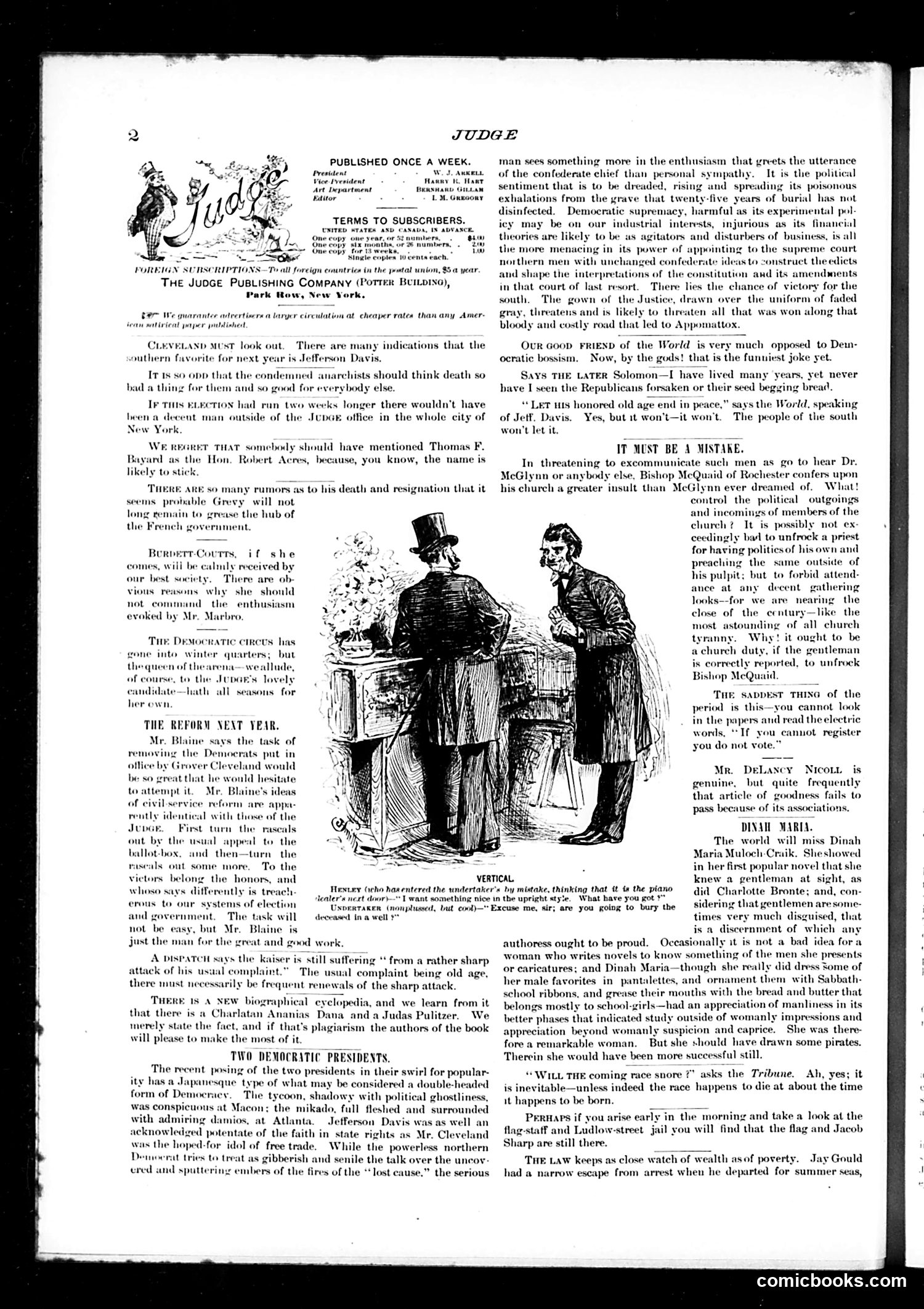
The central cartoon depicts three figures in formal dress examining what appears to be a coffin or undertaker's equipment. The caption reads "VERTICAL" with dialogue about an "upright style" and positioning. The surrounding text discusses political figures and social commentary, including references to Cleveland and Democratic/Republican election dynamics. One section titled "IT MUST BE A MISTAKE" discusses Bishop McQuaid and church political involvement—criticizing a priest for political preaching and suggesting this represents "church tyranny." Other commentary addresses civil service reform, the upcoming presidential election, and various public figures' scandals. Without clear date markers or identifying labels in the cartoon itself, the specific identities of the three figures remain **unclear from the image alone**, though the formal setting and undertaker's context suggest commentary on a political or social figure's demise or decline.
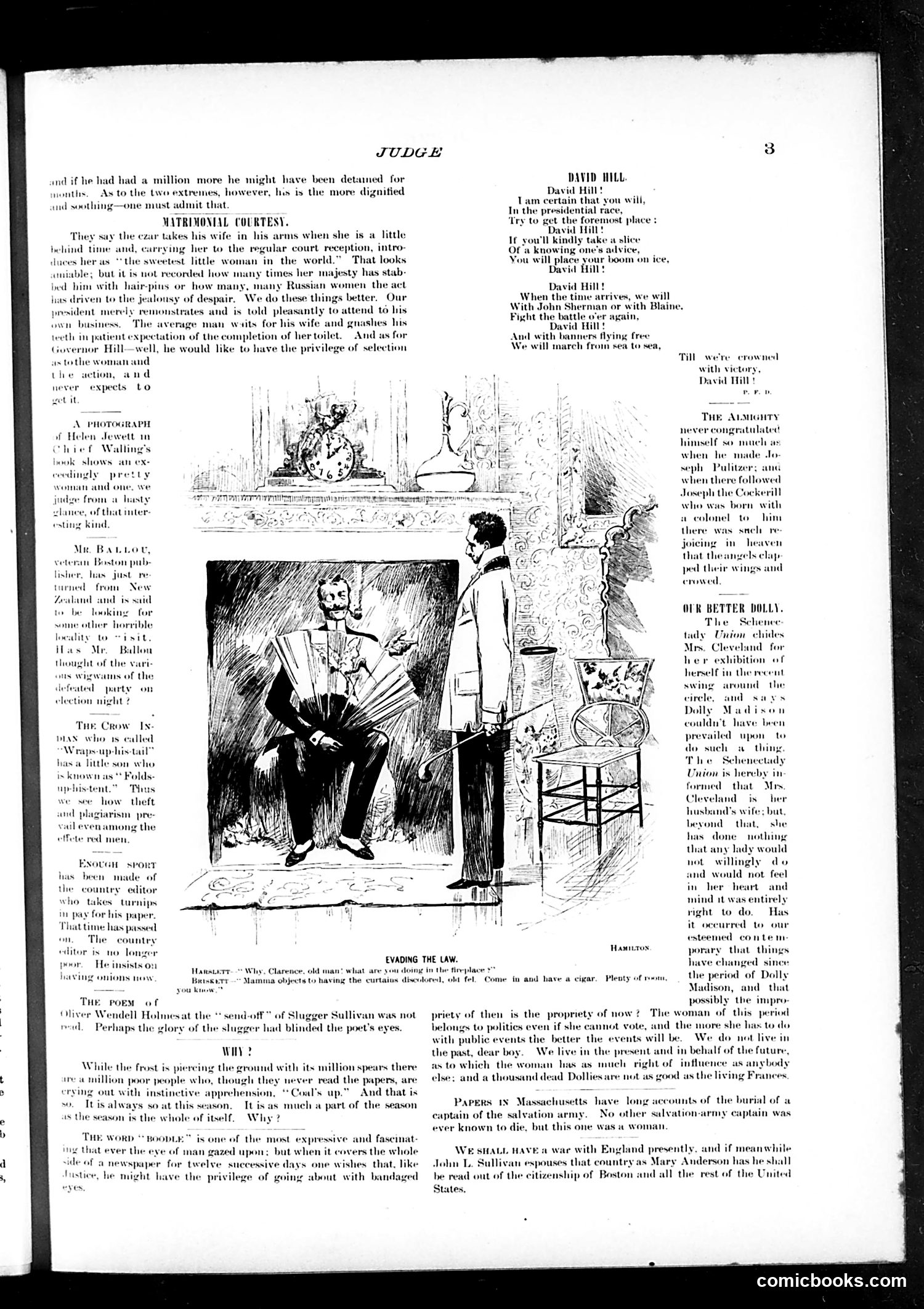
This page contains several satirical pieces mocking contemporary American politics and society circa the 1880s-90s: **"Matrimonial Courtesies"** contrasts the Russian Czar's public affection for his wife with American presidential indifference, sarcastically praising American men for ignoring their spouses during social obligations. **"David Hill"** references a political figure (likely Governor/Senator David B. Hill of New York) being advised to avoid political ambitions, with veiled mockery of his presidential aspirations. **The cartoon "Evading the Law"** (center) depicts what appears to be a legal or political confrontation, though the specific reference is unclear from the text. **"Our Better Dolly"** sarcastically defends a woman's (Dolly Madison reference) right to involve herself in public affairs, arguing modern women should have political influence unlike their historical counterparts. The page demonstrates Judge's characteristic approach: mocking political figures, critiquing gender roles, and offering commentary on contemporary American life through exaggeration and irony.
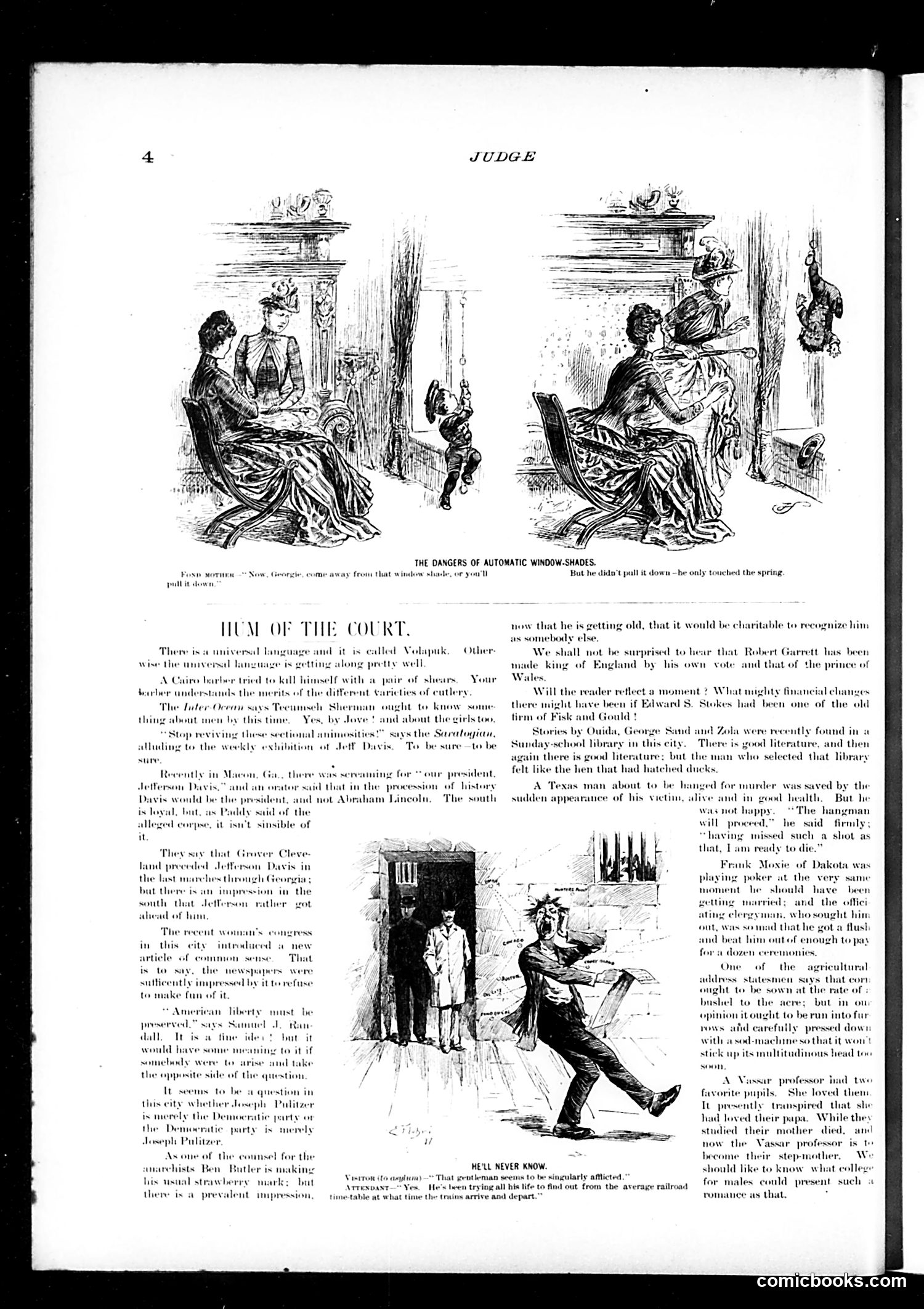
The top cartoon shows two nearly identical domestic scenes satirizing the new mechanical window-shade technology. A woman warns her companion "come away from that window shade, or you'll pull it down," but the danger isn't pulling—it's that touching the spring mechanism causes the shade to snap up violently, potentially injuring the user. This is visual satire about modern "improvements" that create new hazards. The humor lies in the irony: the automatic shade meant to be convenient instead poses physical danger through its forceful spring action. The page's lower "Hum of the Court" section contains various political and social commentary pieces, including references to Grover Cleveland, Jefferson Davis, and satirical observations about lawyers, journalism, and contemporary absurdities—typical Judge magazine fare mocking public figures and societal pretensions.
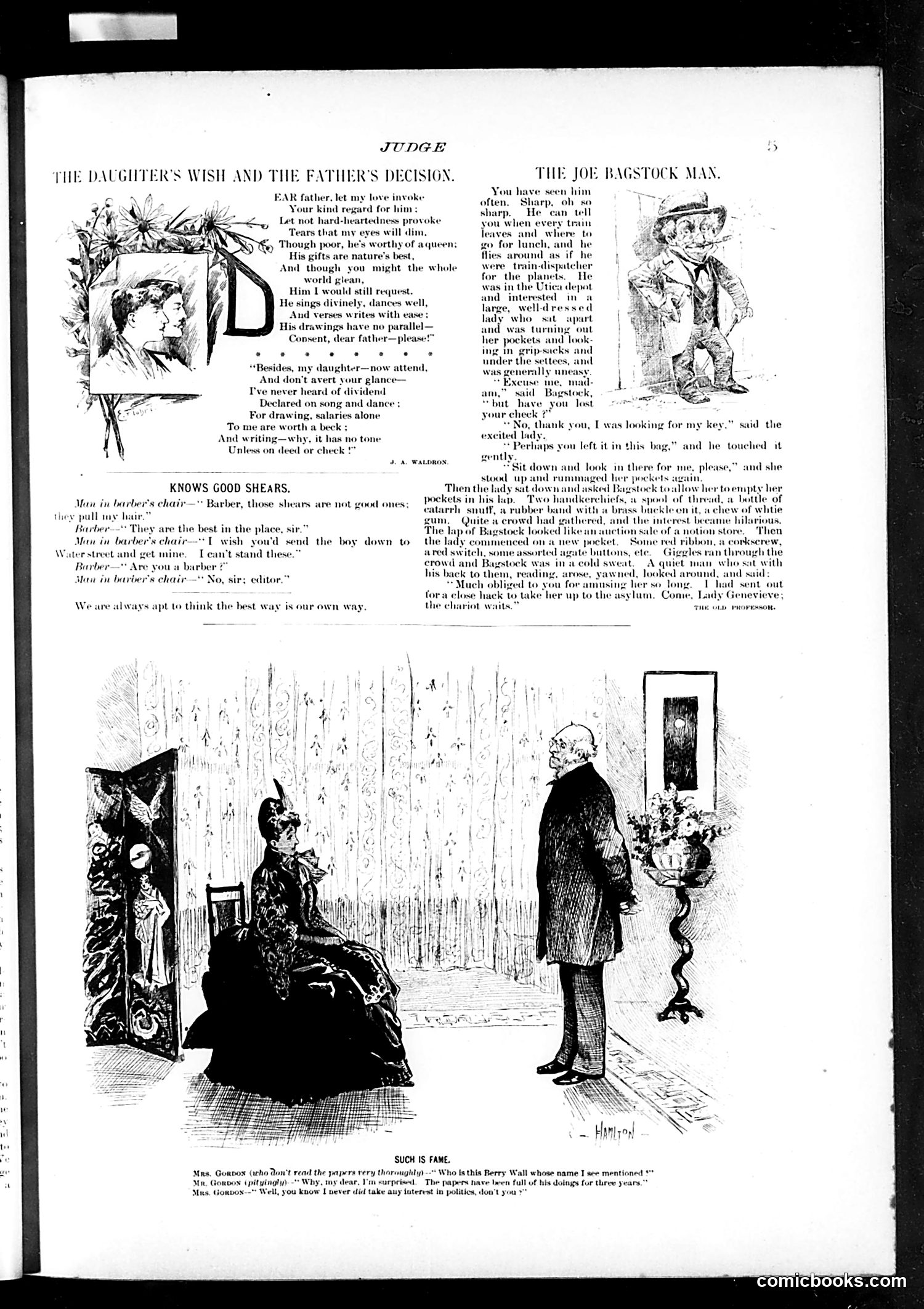
This Judge magazine page contains three distinct satirical pieces: **"The Daughter's Wish and the Father's Decision"** mocks a father who refuses to support his talented but financially unsuccessful suitor—a singer, dancer, and artist. The satire: fathers claim to value artistic merit while actually demanding financial security. The poem's final lines ("Unless on deed or check") expose this hypocrisy. **"Knows Good Shears"** is a brief morality tale about a barber and customer debating shear quality. The punchline reveals the customer is an "editor"—suggesting editors are notoriously difficult, opinionated clients. The moral warns against assuming one's own preferences are universally correct. **"Such is Fame"** features Mrs. Goodbox admitting she doesn't recognize the frequently-mentioned "Berry Wall" because she ignores politics. The joke satirizes selective attention and celebrity—Wall apparently dominated newspapers for years, yet educated people remained oblivious to him. All three pieces use humor to critique human nature: hypocrisy, stubbornness, and indifference to public affairs.
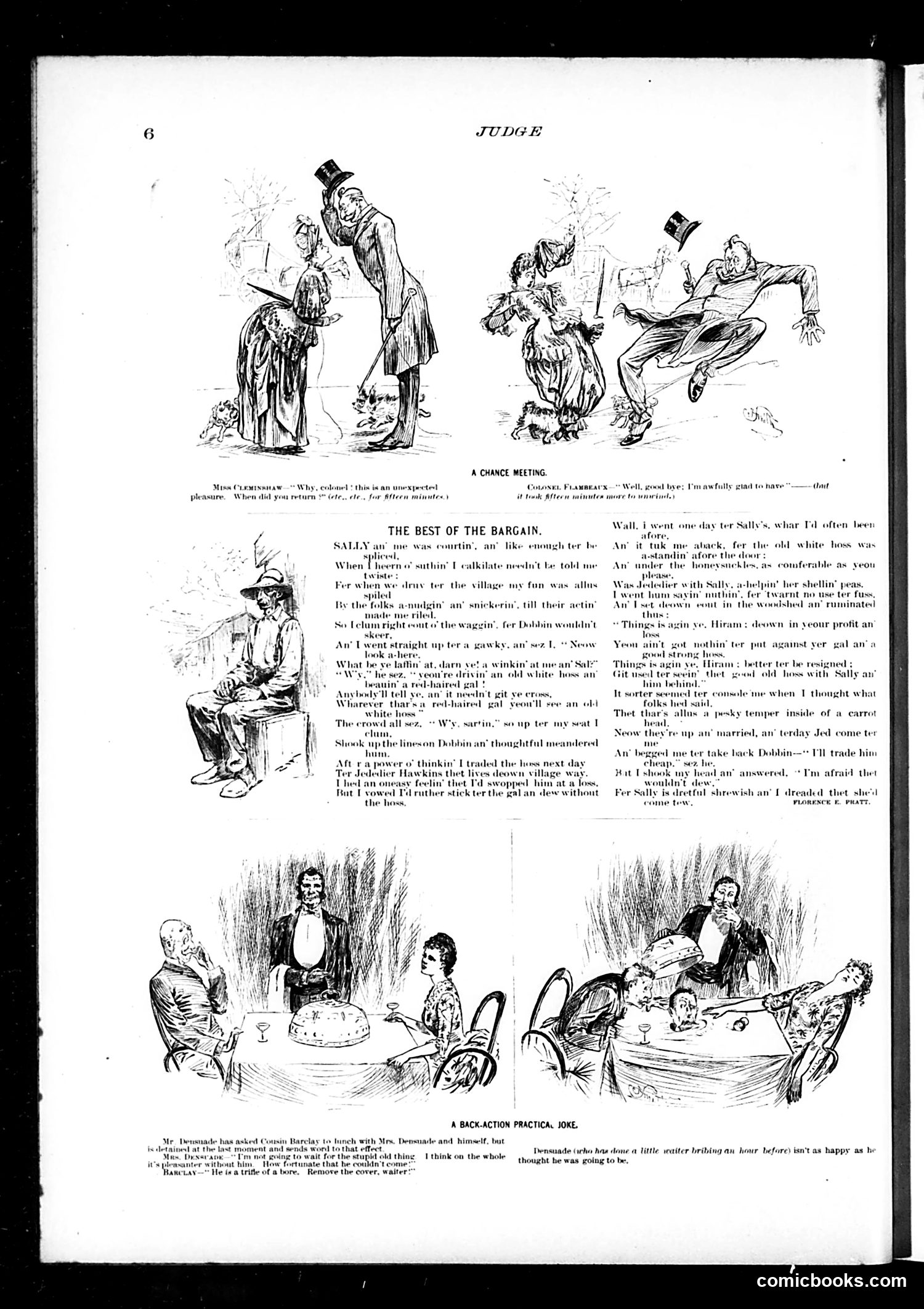
This page contains three distinct satirical pieces from Judge magazine: **"A Chance Meeting"** (top): Two brief comic vignettes mocking upper-class affectation. The first shows a society woman complaining about domestic service; the second depicts Colonel Flambeau boasting about his social connections. The satire targets pretentious behavior and status-consciousness among the wealthy. **"The Best of the Bargain"** (center/bottom): A rural dialect story in verse about a farmer named Sally who traded his white horse to avoid village gossip about courting. The humor relies on rustic vernacular and the ironic "bargain"—he lost the horse but gained a shrewish wife. This mocks rural courtship customs and the theme that marriage involves compromises. **"A Back-Action Practical Joke"** (bottom right): Depicts gentlemen at dinner, with caption suggesting someone has bribed a waiter. The satire targets wealthy men's behavior and suggests their happiness is illusory. Overall, the page satirizes both upper-class pretension and rural simplicity, using dialect humor and ironic outcomes typical of Judge's late 19th-century style.
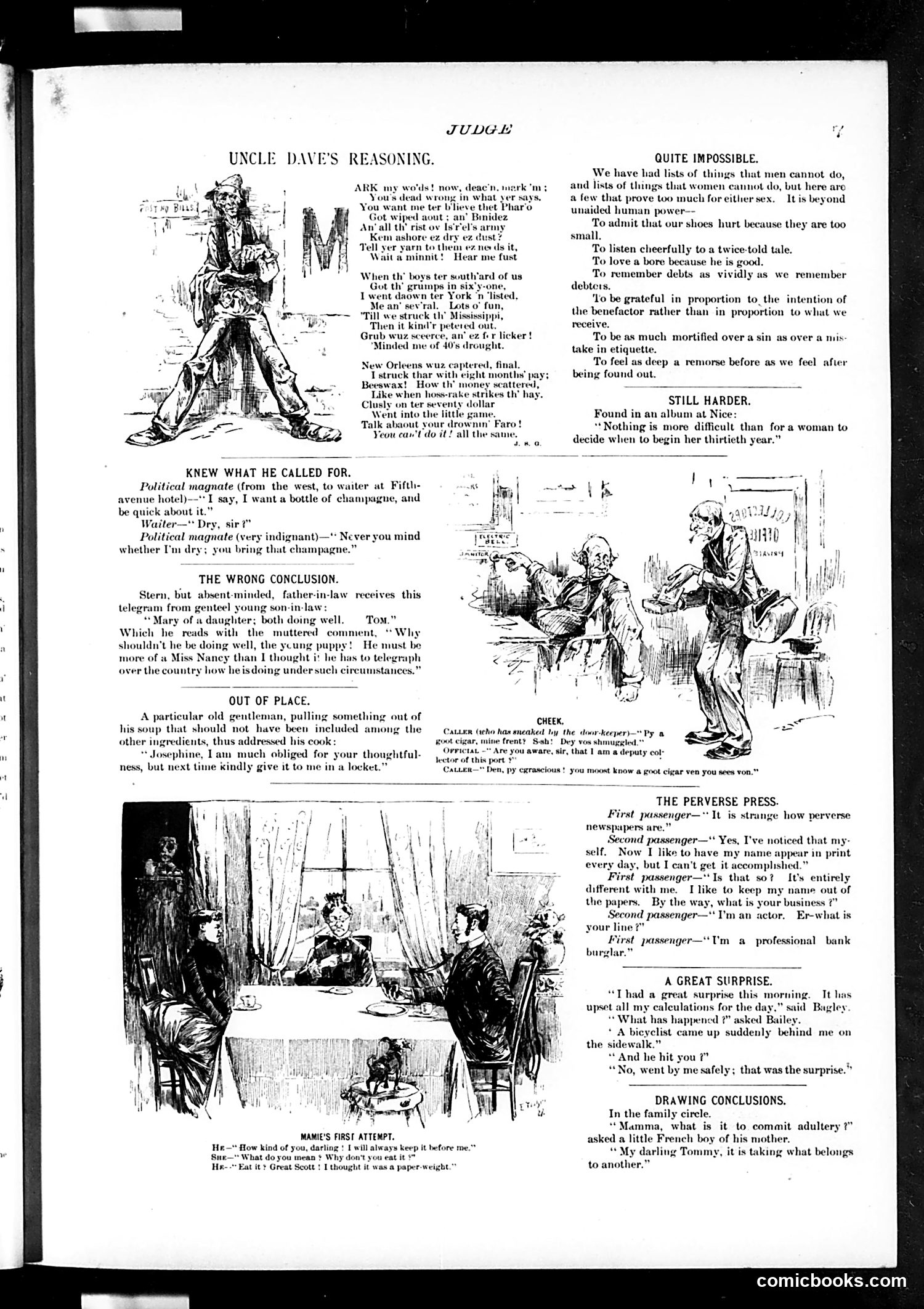
This page from Judge (a 19th-century American satirical weekly) contains multiple unrelated humor pieces: **"Uncle Dave's Reasoning"** features a cartoon of an elderly man recounting Civil War memories in dialect, rambling about enlisting, Mississippi campaigns, and New Orleans—apparently using worn-out anecdotes to justify his current circumstances. **"Quite Impossible"** humorously lists human contradictions both sexes find impossible: admitting shoe discomfort, forgiving oneself before (rather than after) being caught doing wrong, and women deciding when to "begin" their thirtieth year—satirizing vanity and self-deception. Other brief sketches mock: - A Western politician demanding champagne without caring about quality - An absent-minded father misinterpreting his son's telegram - A cook finding inappropriate items in soup - Perverse newspaper readers and a bank burglar - A mother explaining adultery to her French son The humor relies on dialect, misunderstandings, and observations about human nature rather than specific political events, making most jokes universal rather than topical.
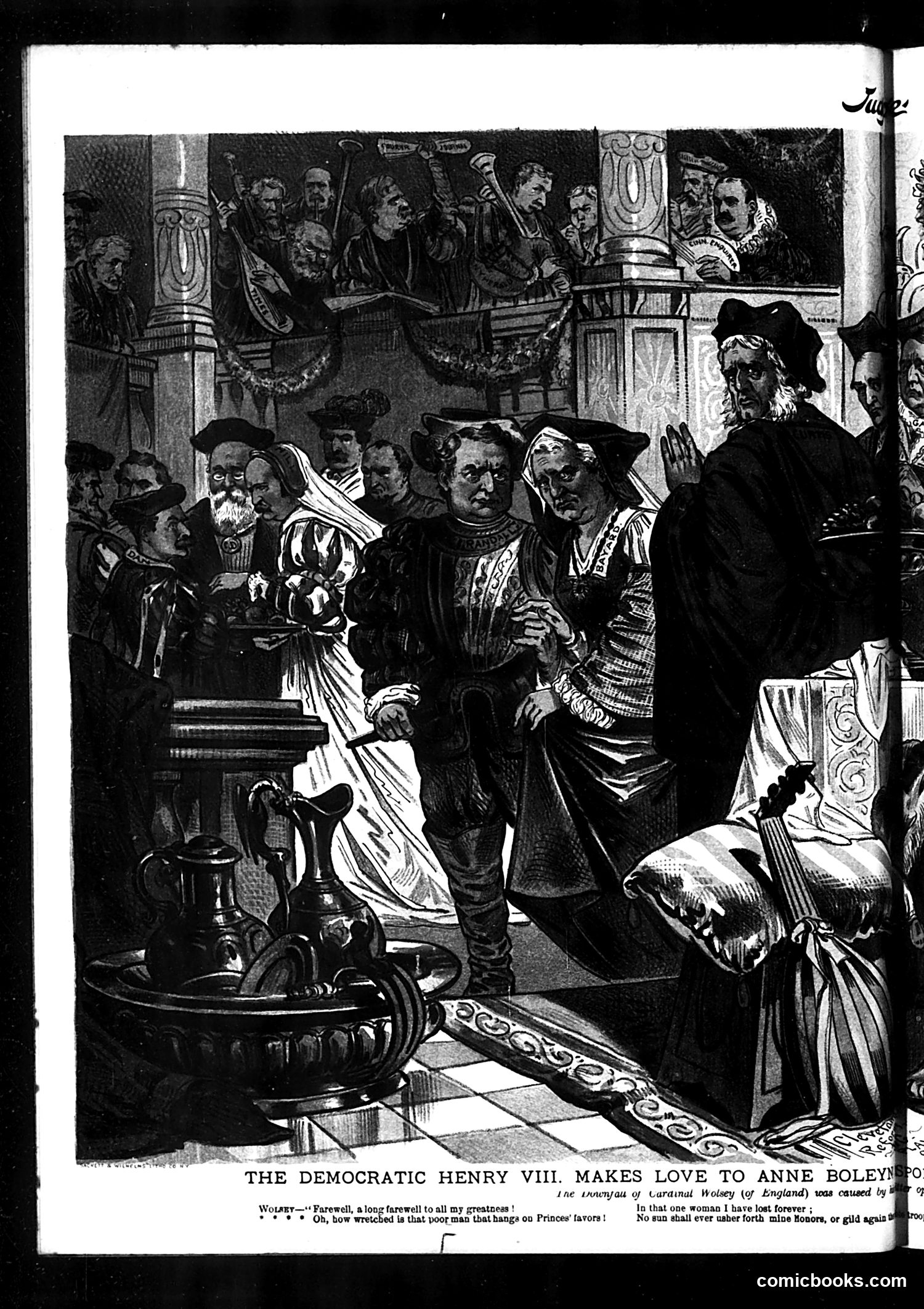
This *Judge* cartoon satirizes Democratic politics by comparing a contemporary political figure to Henry VIII pursuing Anne Boleyn. The title suggests a Democratic leader is abandoning principle for romantic/personal interest, paralleling Henry VIII's break with Rome over Anne Boleyn. The elaborate court scene depicts figures in Tudor-era dress. The quotations reference Cardinal Wolsey's fall from Henry VIII's favor—a cautionary tale about losing power when a ruler becomes infatuated. The satire appears to criticize a Democratic politician for allowing personal interests to override political judgment or cardinal principles, much as Henry VIII sacrificed his alliance with the Catholic Church. Without additional context, the specific figure targeted remains unclear, though the comparison suggests the cartoon mocks Democratic leadership as dangerously swayed by personal favor rather than principle—a common *Judge* theme attacking Democratic politicians as morally compromised.
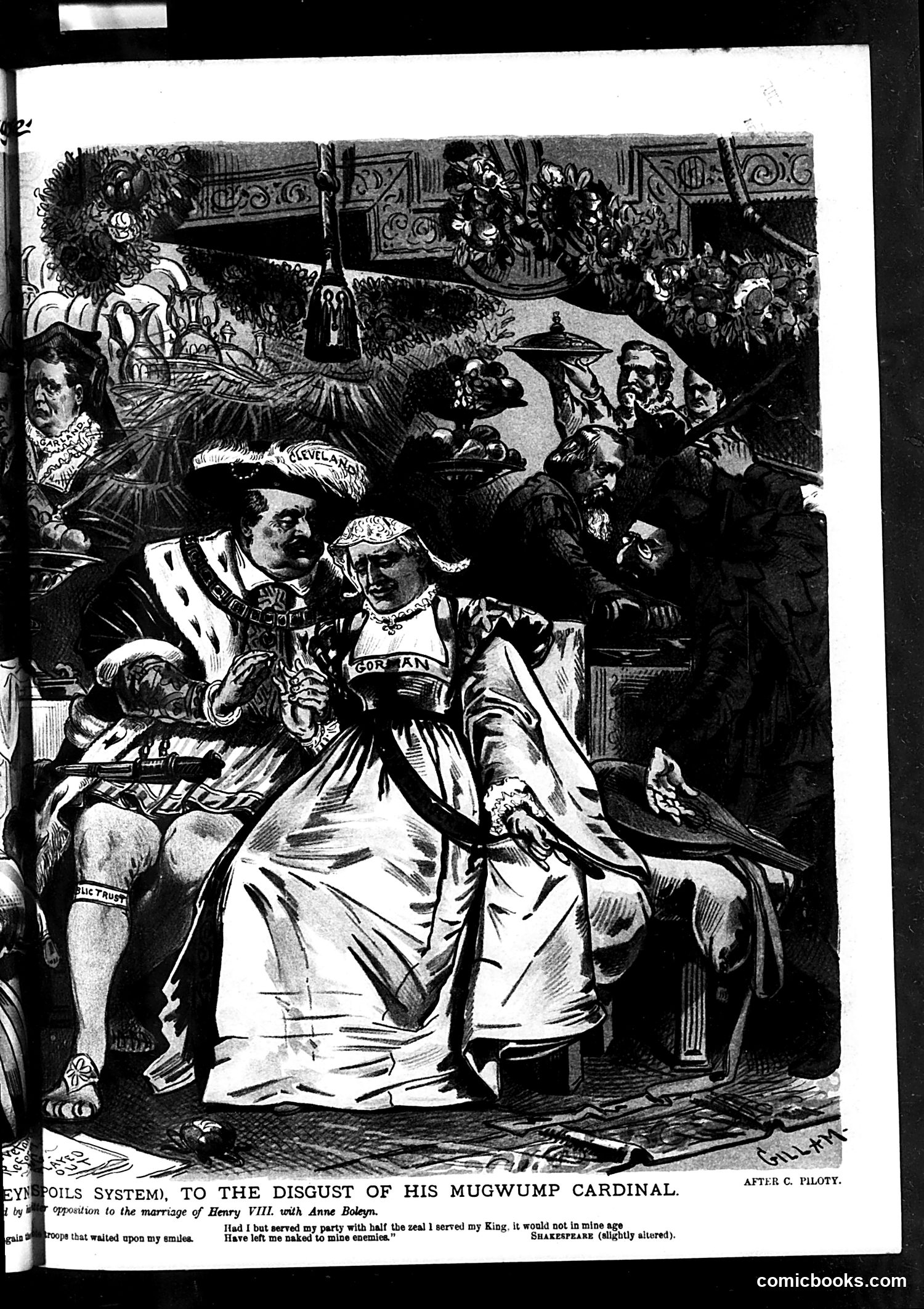
This satirical cartoon references Henry VIII's marriage to Anne Boleyn, using it as historical allegory for a contemporary political dispute. The engraving shows a Cardinal (identifiable by his regalia) expressing dismay at the union, with courtiers and attendants surrounding him in an ornate Tudor-era setting. The caption attributes a Shakespeare quote to the Cardinal, suggesting betrayal—he served his "King" but lost standing among his "enemies." The satire likely critiques a specific 19th-century political figure or faction whose loyalty to a leader resulted in public disgrace or loss of power. The historical parallel to Cardinal Wolsey's fall from favor under Henry VIII strengthens the analogy. Without the publication date and additional context, the exact contemporary reference remains unclear, but the cartoon uses Tudor history to mock present-day political miscalculation.
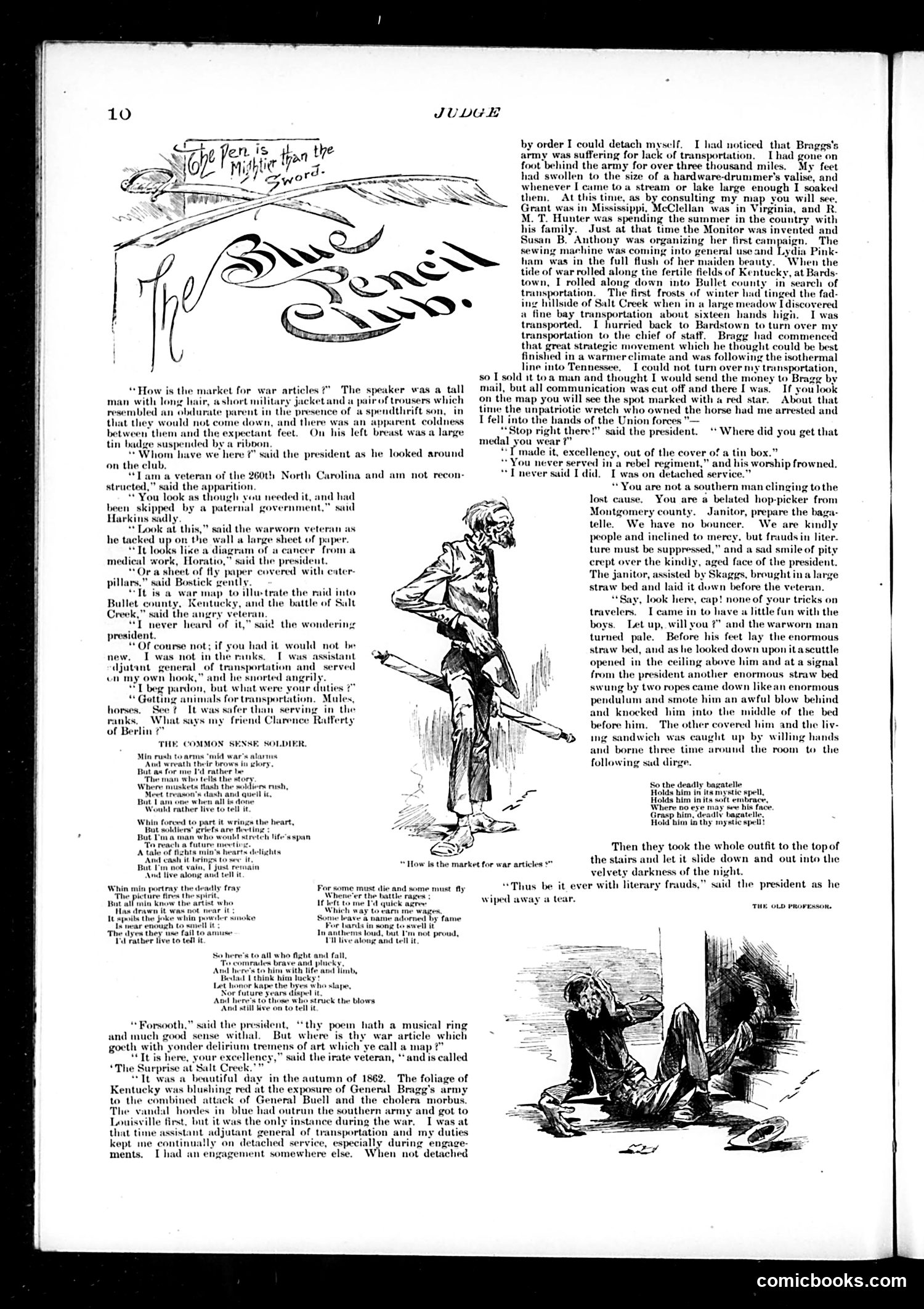
This page from *Judge* magazine presents a satirical Civil War narrative featuring a dialogue between a U.S. President (likely Lincoln) and a ragged, long-haired Union veteran seeking recognition for his wartime service. **The Satire's Point:** The veteran claims credit for discovering a strategic location ("Salt Creek") and organizing transportation logistics during the 1862 Kentucky campaign. He presents an incomprehensible map that the president compares to "a diagram of a cancer" or "fly paper covered with caterpillars"—suggesting the veteran's actual contributions were worthless or nonsensical. **The Joke:** The piece mocks Civil War memoir-writers and veterans who exaggerated their importance, as well as the chaos of Union military organization. The president's dismissive responses and the absurdist humor of the unintelligible "war article" satirize both grandiose veteran narratives and military bureaucratic confusion. **Historical Context:** The references to Grant, McClellan, Susan B. Anthony, and specific 1862 events ground this in authentic Civil War-era politics and culture.
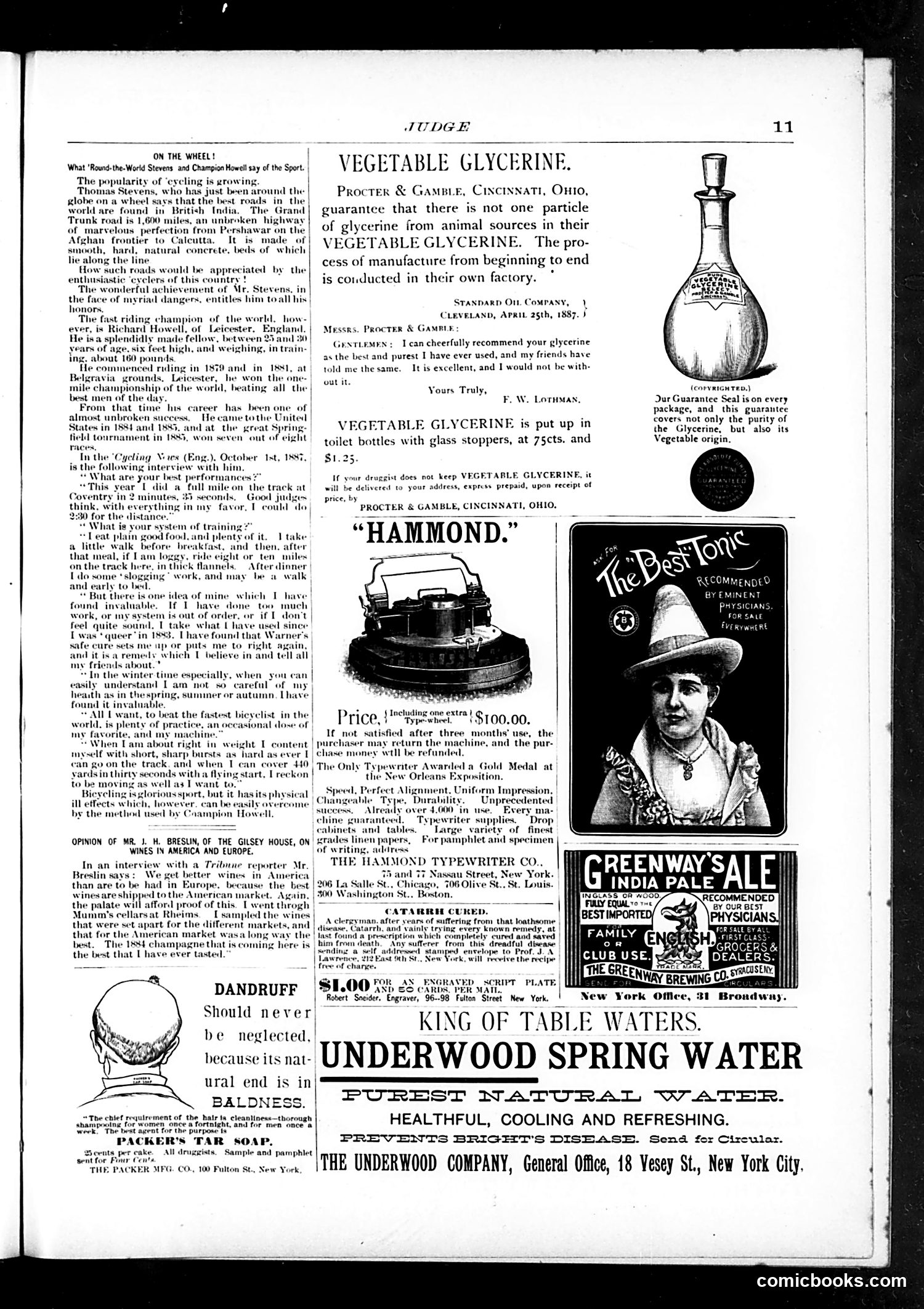
This is primarily an **advertising page** with minimal editorial content. The articles at top discuss cycling champions Richard Howell and "Round-the-World Stevens," establishing cycling as a fashionable sport. The main advertisements are for consumer products: - **Vegetable Glycerine** (Procter & Gamble): A toiletry product emphasized as purely plant-based, not animal-derived—significant to Victorian consumers concerned about product purity. - **Hammond Typewriter**: Marketed at $100 with a money-back guarantee, positioned as the superior writing machine. - **Underwood Spring Water**: Branded as "King of Table Waters," promoting health benefits. - **Packer's Tar Soap**: A dandruff remedy, reflecting Victorian anxieties about appearance and hygiene. There are no political cartoons visible. The page reflects **late-19th-century consumer culture**: advertisements emphasize product purity, technological innovation (typewriters), and health/grooming products. The cycling articles suggest the sport's growing popularity among upper-class leisure activities.
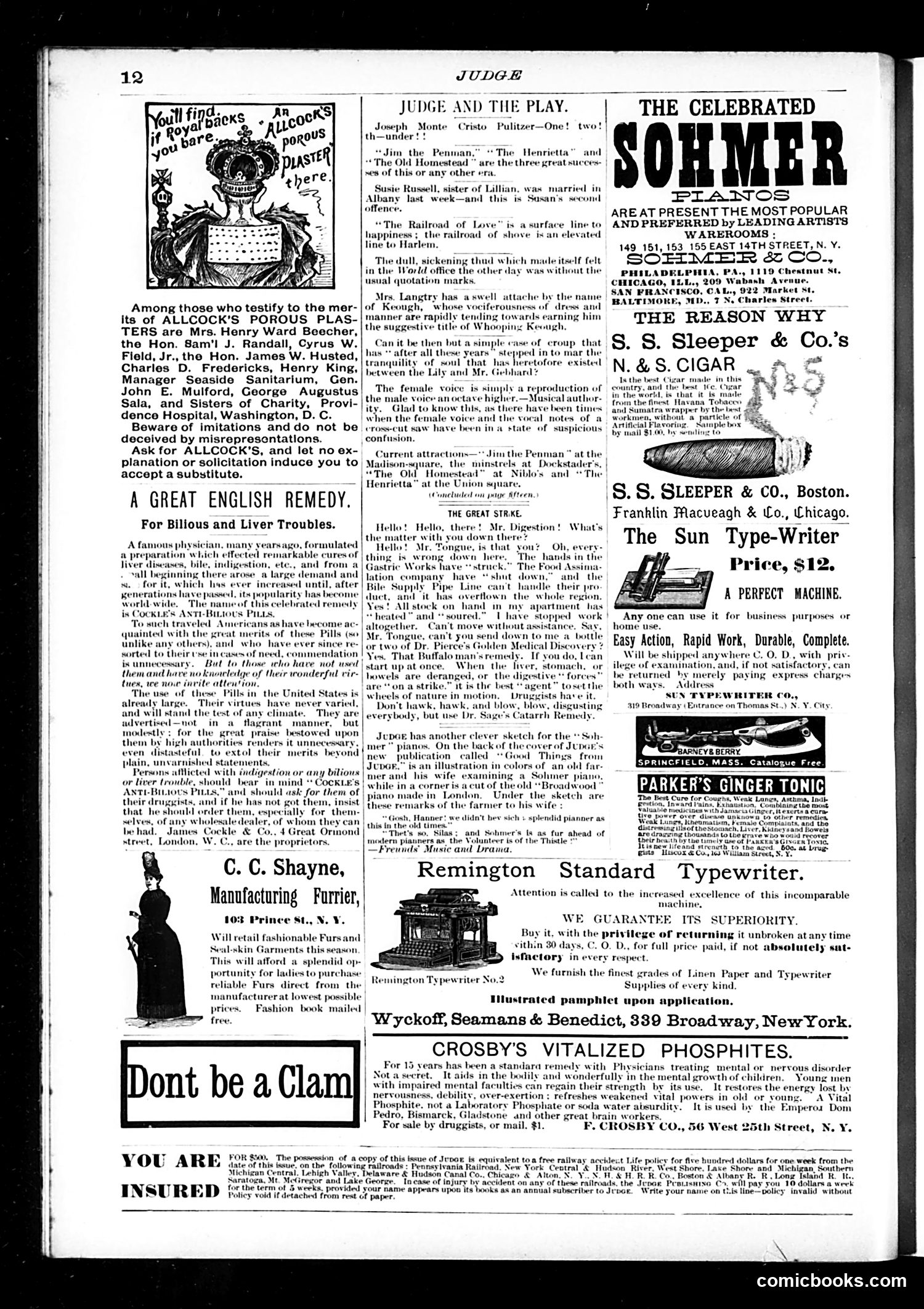
This page is predominantly **advertisements and notices** rather than satirical cartoons. The substantive editorial content appears to be a brief theater column titled "JUDGE AND THE PLAY." ## The Editorial Content: The theater column references contemporary 1880s stage productions and performers. It includes gossipy observations about "Susie Russell" and mentions plays like "*The Railroad of Love*" and "*Jim the Penman.*" There are oblique references to actress Lillie Langtry and Mr. Gebhard, though the exact scandal referenced is unclear from the fragmentary OCR text. The column also includes a medical joke about "Mr. Digestion" and digestive complaints, playing on contemporary patent medicine advertisements. ## The Advertisements: The bulk of the page comprises ads for products typical to the era: Allcock's Porous Plasters (medical), patent medicines, furs, typewriters, pianos, and cigars. These ads feature celebrity endorsements and exaggerated health claims standard to the period. The editorial-advertising mix suggests this was a common publication format for Judge magazine in this era.
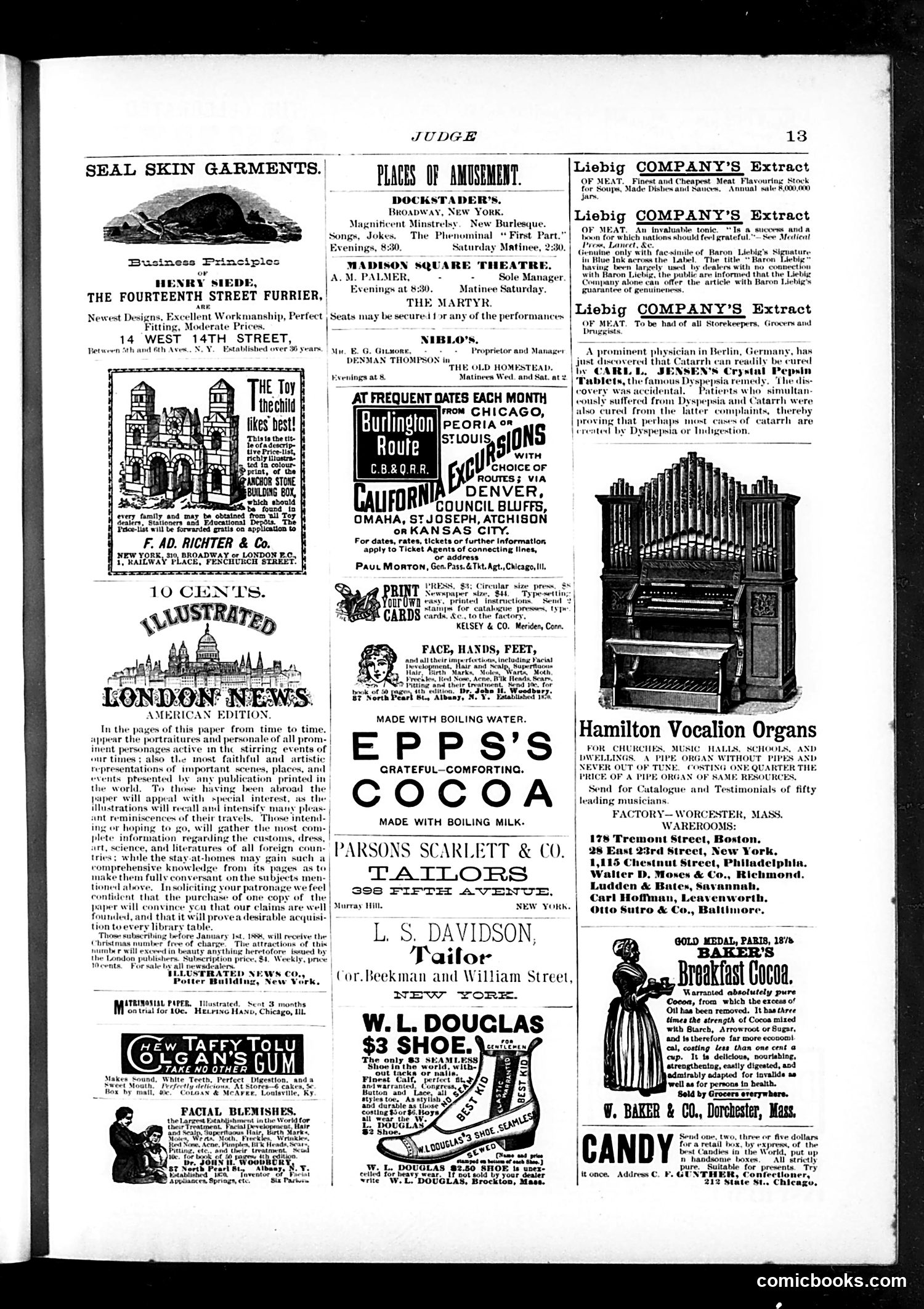
This is primarily an **advertising page** from Judge magazine, with minimal editorial content. The page displays numerous commercial advertisements typical of the 1880s-90s era, including: - Theater listings (Dockstader's, Madison Square Theatre, Niblo's) - A railway excursion ad (Burlington Route to Colorado) - Consumer products: shoes (W.L. Douglas), cocoa (Epps's, Baker's), gum, tailoring services - Liebig Company's meat extract (a popular Victorian-era food product) - Hamilton Vocalion organs The **small cartoon/illustration** appears to be a generic domestic scene, not a political satire. The page's real content is commercial rather than satirical—it reflects what advertisers wanted to reach Judge's middle and upper-class readership. The inclusion of products like cocoa, organs, and fashionable tailoring indicates the magazine's affluent audience. There is no discernible political commentary or cartoon satire visible on this particular page.
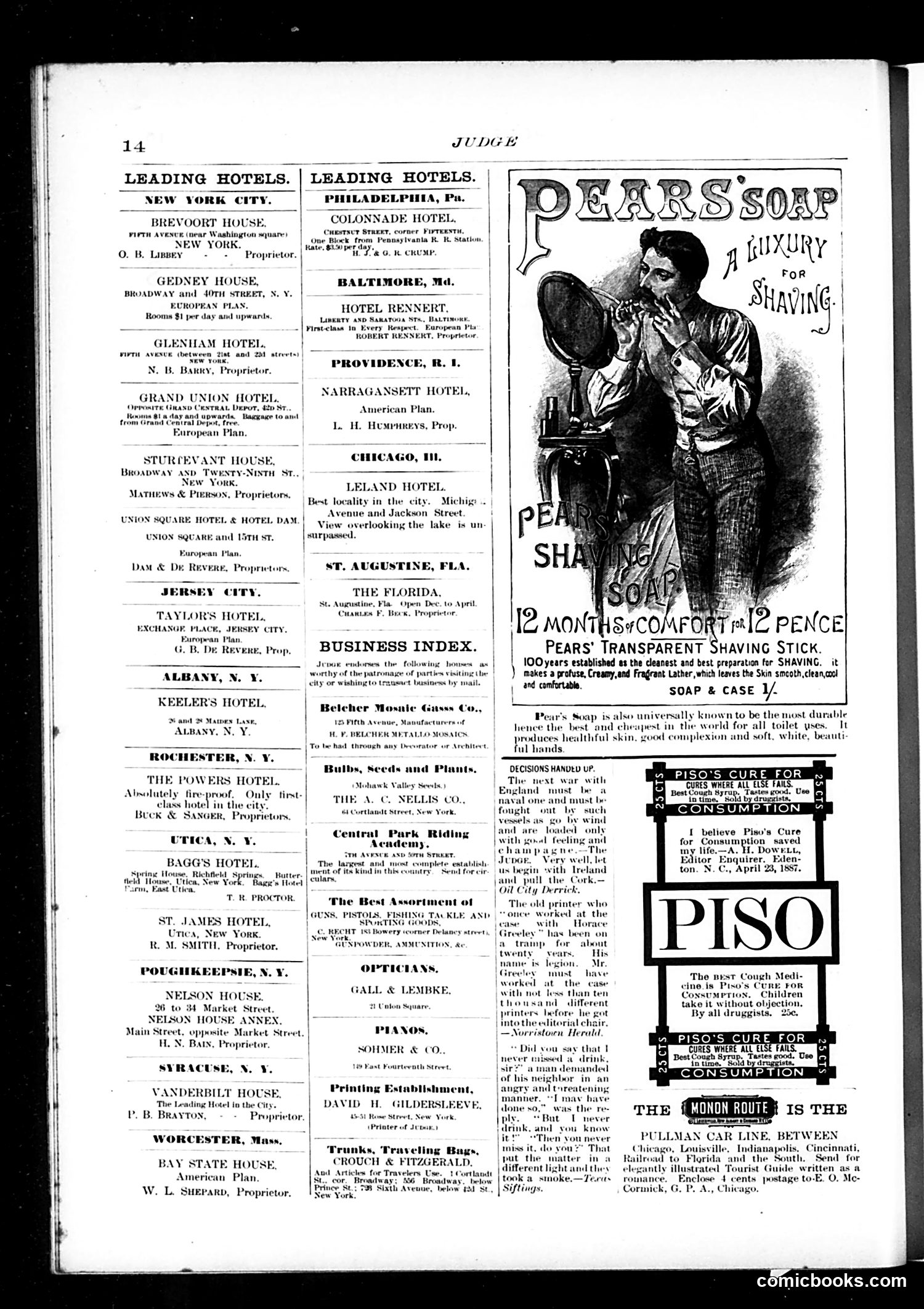
This page is primarily **advertising and business listings**, not satirical editorial content. It features: **Hotel Advertisements**: Listings for prominent hotels across major American cities (New York, Philadelphia, Baltimore, Chicago, etc.), a common Judge feature targeting wealthy travelers. **Patent Medicine Ads**: The most visually prominent content shows **Pear's Soap** advertisements and multiple testimonials for **Piso's Cure for Consumption** (a patent medicine marketed for coughs and tuberculosis). These ads feature woodcut illustrations of satisfied users and emotional testimonials claiming miraculous cures—typical of the era's largely unregulated patent medicine industry. **Business Directory**: Listings for opticians, piano makers, printing establishments, and luggage manufacturers. **The Satire (if any)**: The page itself isn't satirizing these products. Rather, Judge's publication of such ads reflects the magazine's era, when patent medicines made outrageous health claims without FDA oversight. Modern readers might find the ads themselves satirical-seeming—the testimonials are suspiciously glowing and the cures implausibly broad. This page demonstrates Judge's dual nature: satirical journalism mixed with commercial advertising revenue.
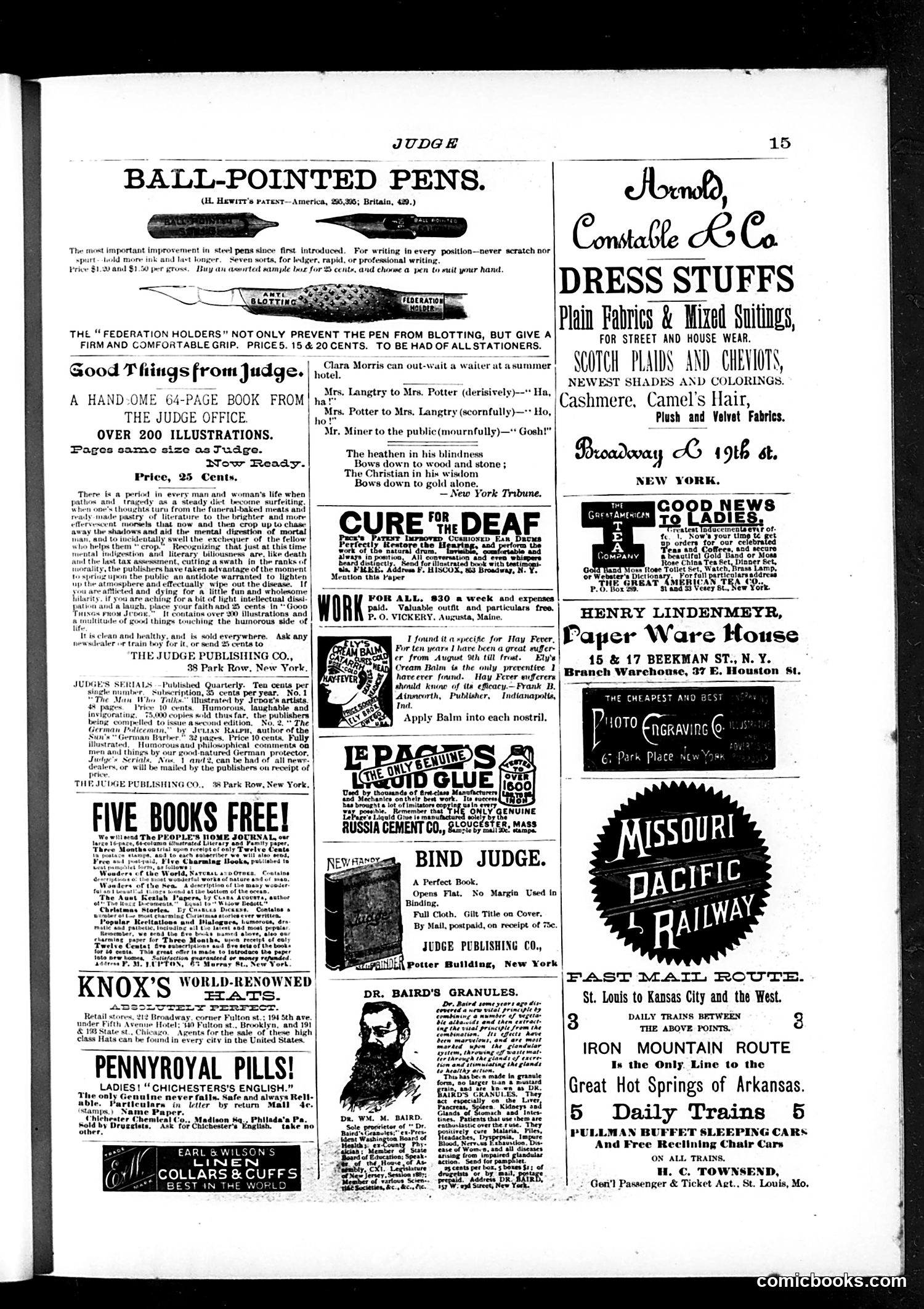
This page is primarily **advertising**, not satire or political commentary. It showcases various commercial products and services typical of the late 19th century Judge magazine. The small editorial content includes brief jokes: - A witty exchange between actresses Clara Morris, Mrs. Potter, and Mrs. Langtry, creating humorous tension through competitive theatrical personalities - A quip about religious hypocrisy (attributed to *New York Tribune*): contrasting heathen worship of physical idols with Christians' worship of gold—criticizing materialist society The page demonstrates how Judge balanced satirical commentary with commercial content. The "Good Things from Judge" section promotes a 64-page book of humor and illustrations. Advertisements include the Missouri Pacific Railway, office supplies, dress fabrics, and patent medicines—standard merchan dising reflecting consumer culture of the era.
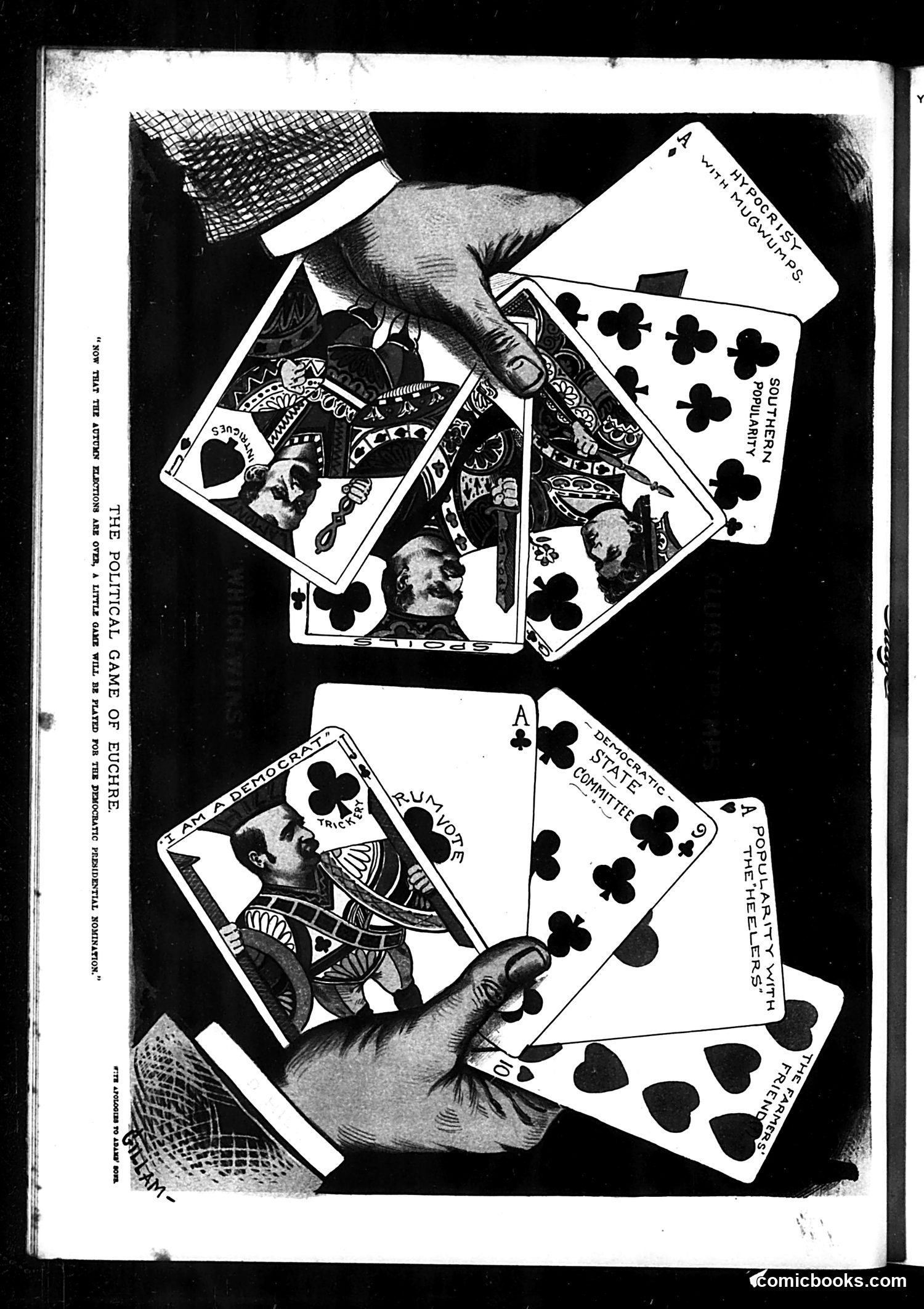
This satirical cartoon depicts American political competition as a card game. Two pairs of hands play euchre (a card game popular in 19th-century America), with playing cards showing political figures and text referencing election strategy. The caption indicates this represents Democrats competing for the presidential nomination following autumn elections. The visible card labels mention "Southern" support and "popularity with the people," suggesting the cartoon critiques how Democratic factions courted regional blocs and public opinion to advance candidacies. By equating politics to card-playing, Judge magazine satirizes the calculating, strategic nature of nomination contests—implying politicians treated voter support like game pieces to be manipulated. The specific candidates or year remain unclear from the visible text, but the metaphor mocks the transactional aspects of electoral politics.