
A complete issue · 16 pages · 1887
Judge — June 4, 1887
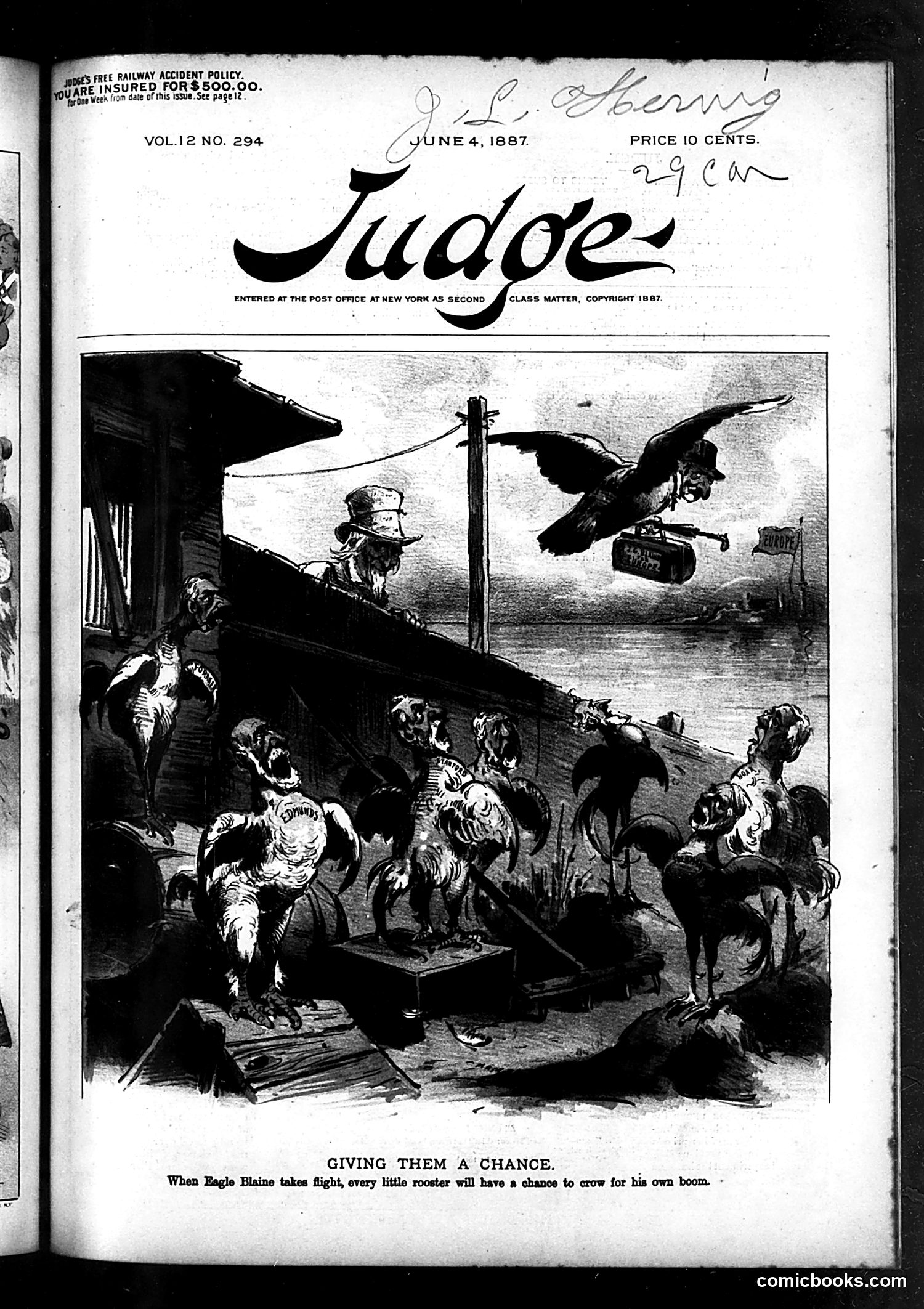
This satirical cartoon titled "Giving Them a Chance" depicts an eagle (representing America or American power) taking flight while roosters below scramble on a dock. The caption states: "When Eagle Blaine takes flight, every little rooster will have a chance to crow for his own boom." This references **James G. Blaine**, likely Secretary of State under President Chester Arthur. The "eagle" represents Blaine's political prominence or ambitions. The "roosters" symbolize lesser political figures or rivals who hope to advance their own careers ("crow for his own boom") once Blaine leaves office or loses influence. The satire mocks both Blaine's dominance in politics and the scrambling ambition of minor politicians eager to fill any power vacuum he creates.
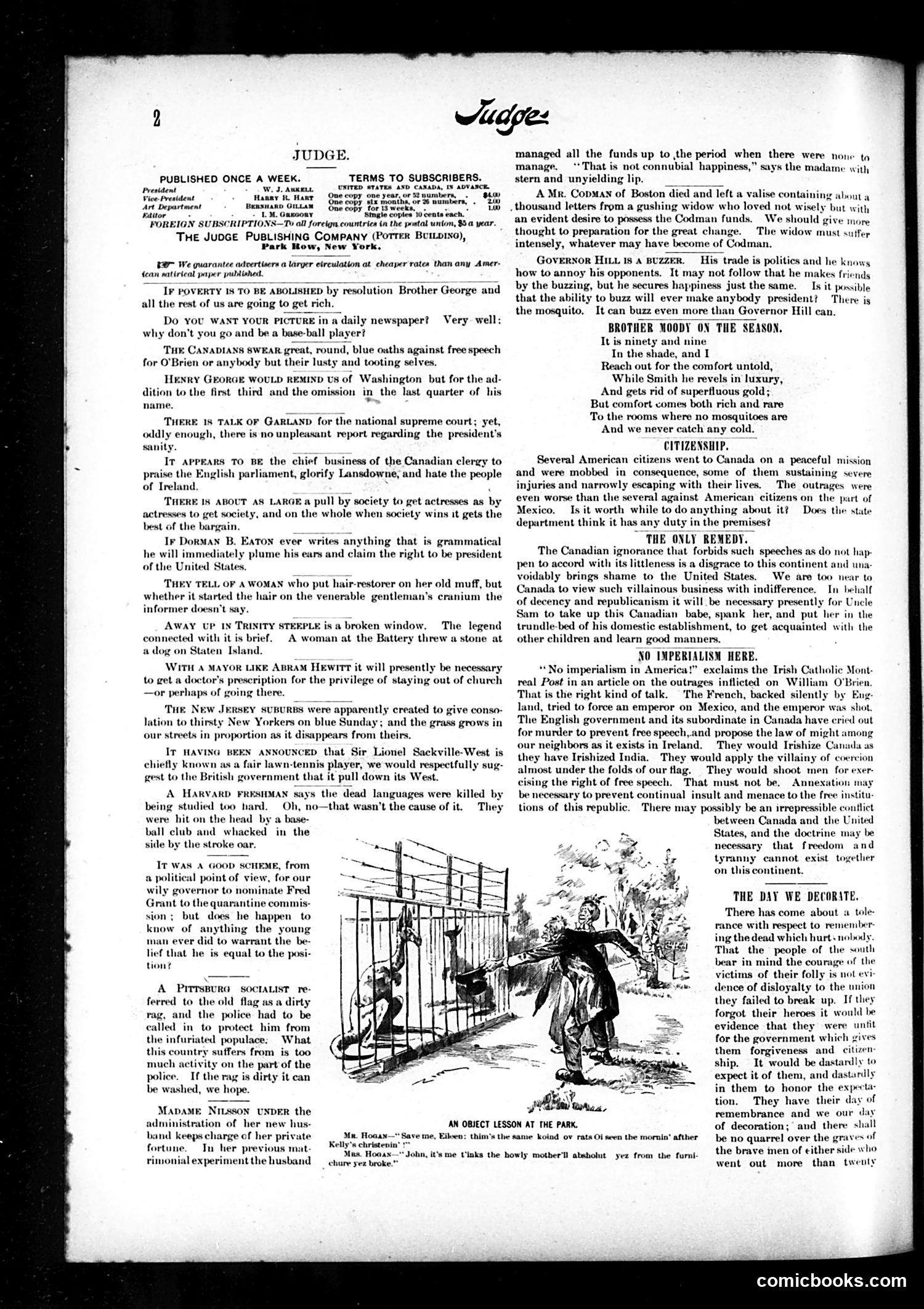
This cartoon depicts a woman instructing a young boy at a fence, likely in a public park. The caption reads: "Save me, Edwin; that's the same kind of rat O'Brien saw the mornin' after Kelly's christenin'!" and "Well, it's not unlike the howly mother'n alebout yez broke." The humor relies on ethnic Irish stereotyping common to Gilded Age satire. The misspelled dialect ("howly mother," "alebout yez") and references to "O'Brien" and "Kelly" mark the characters as Irish-American. The joke appears to reference drunken behavior at a christening party, with the implication that someone saw rats while intoxicated—a crude ethnic caricature equating Irish immigrants with both poverty and excessive drinking.
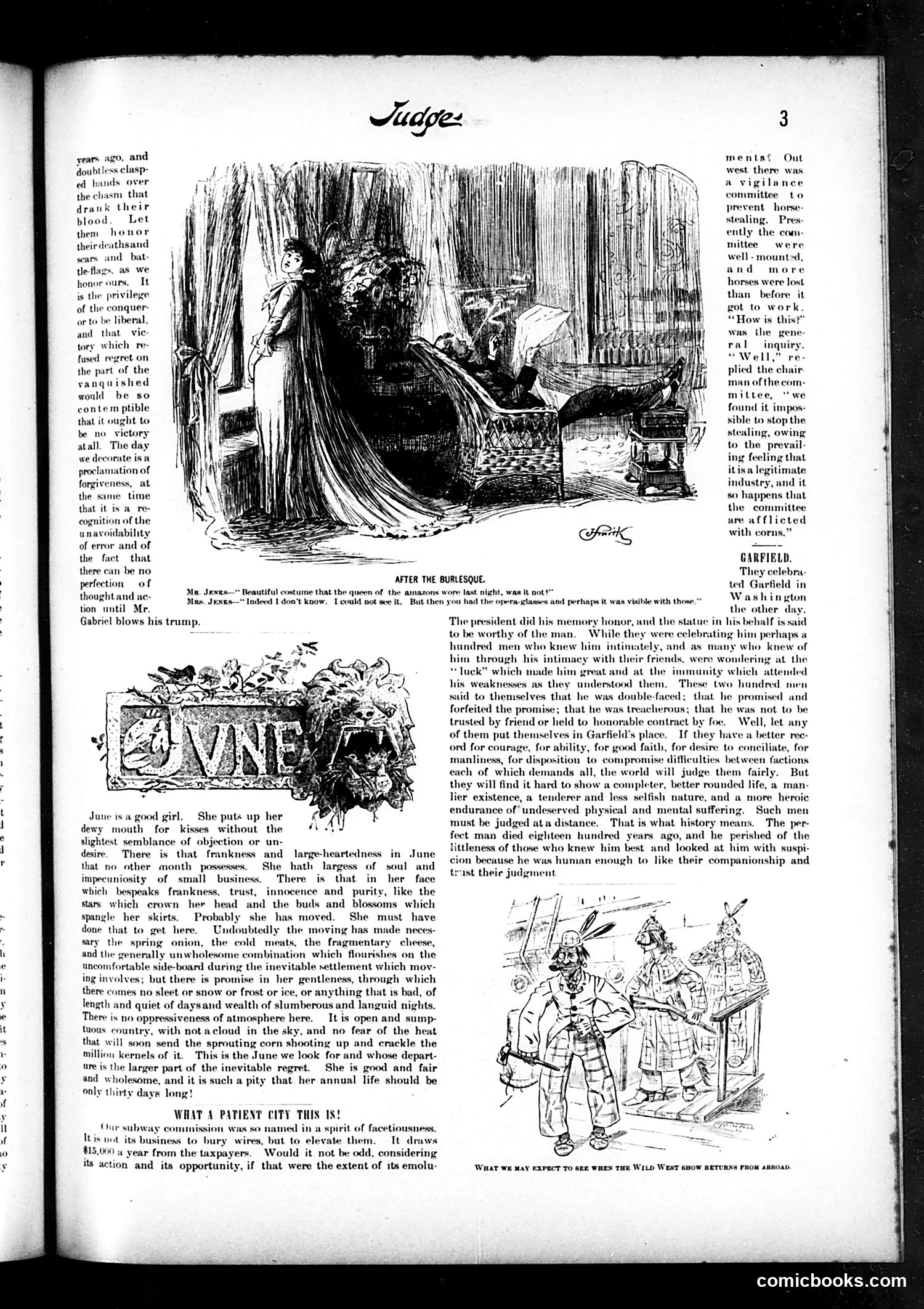
This page contains multiple satirical pieces: **"After the Burlesque"** (top): A married couple discusses opera costumes. The husband claims he couldn't see details without opera glasses, implying his wife wore an inappropriately revealing costume—likely satirizing theatrical excess or women's fashion standards of the era. **Garfield Memorial Commentary** (center): The text praises President James Garfield (assassinated 1881) while acknowledging his flaws—broken promises, treachery, and untrustworthiness among those who knew him. The satire critiques how historical figures gain heroic status through distance and time, even when contemporaries knew them as deeply flawed. It's a pointed commentary on selective memory and posthumous reputation-building. **"What a Patient Fit This Is!"** (bottom): A short satirical piece about a subway commission drawing $15,000 annually, questioning whether this expense is justified given its purpose of burying wires. **June Character Sketch**: A sentimental description of June as an innocent girl, possibly mocking Victorian sentimentality about seasons or youth. The overall tone is acerbic social and political criticism.
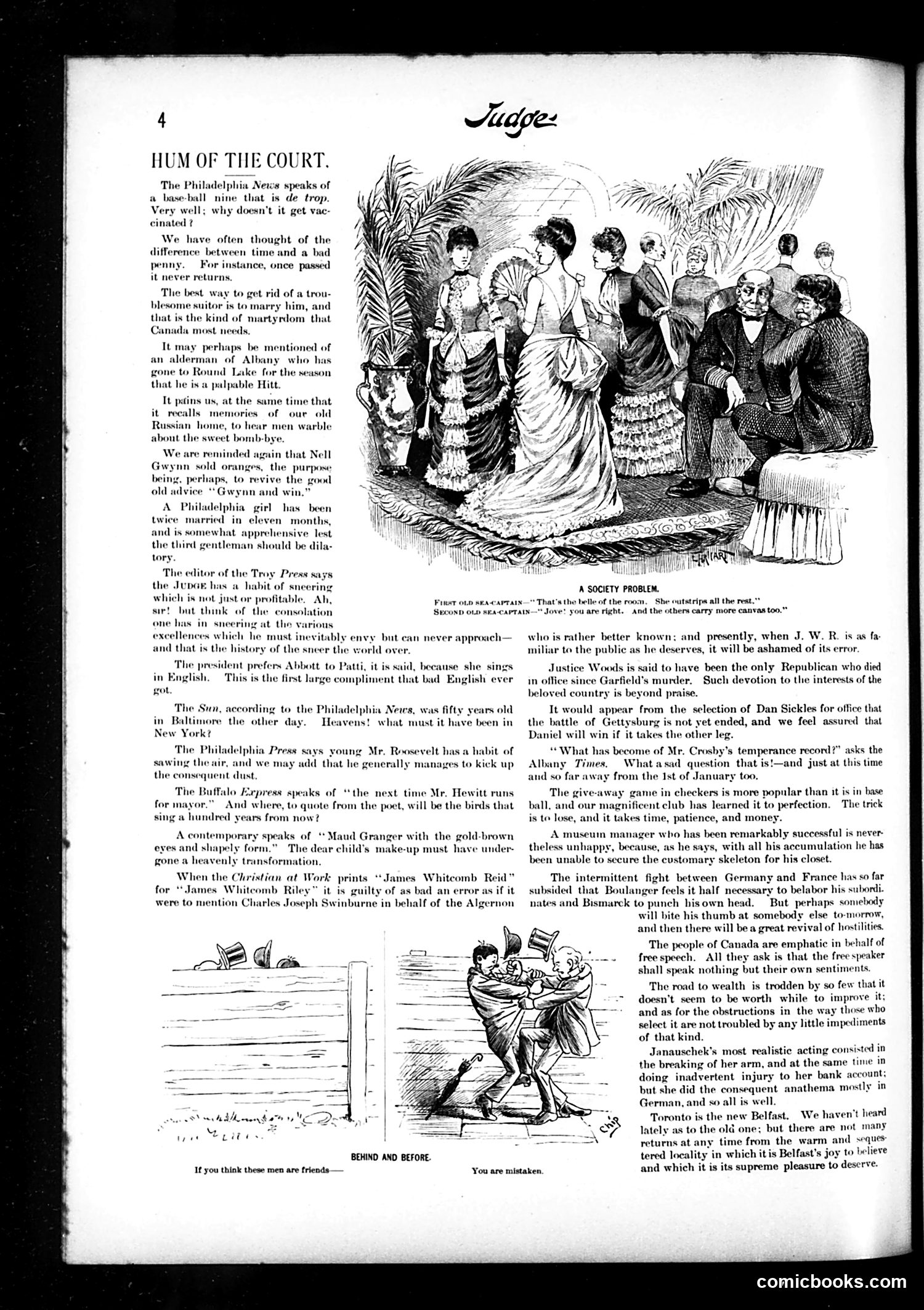
This page from Judge combines short satirical commentary with illustrations mocking contemporary figures and social issues. **"Hum of the Court"** section contains brief jabs at various public figures: references to a Philadelphia baseball player, an Albany alderman, and commentary on romantic scandals (a Philadelphia girl marrying quickly, Nell Gwyn's historical notoriety). The cartoons illustrate two main satirical points: 1. **Top illustration**: A "Society Problem" showing well-dressed women at what appears to be a social gathering—likely satirizing fashionable society's shallow concerns or gossip. 2. **Bottom cartoons titled "Behind and Before"**: Two nautical scenes showing old sea captains. The caption reads "If you think these men are friends—You are mistaken," using maritime competition (sailboat racing imagery) as metaphor for false friendship or rivalry among public figures. The page generally lampoons American society's pretensions, political corruption, and social hypocrisy through brief witticisms and visual humor typical of Judge's approach—sharp, topical, and often darkly comedic about contemporary scandals.
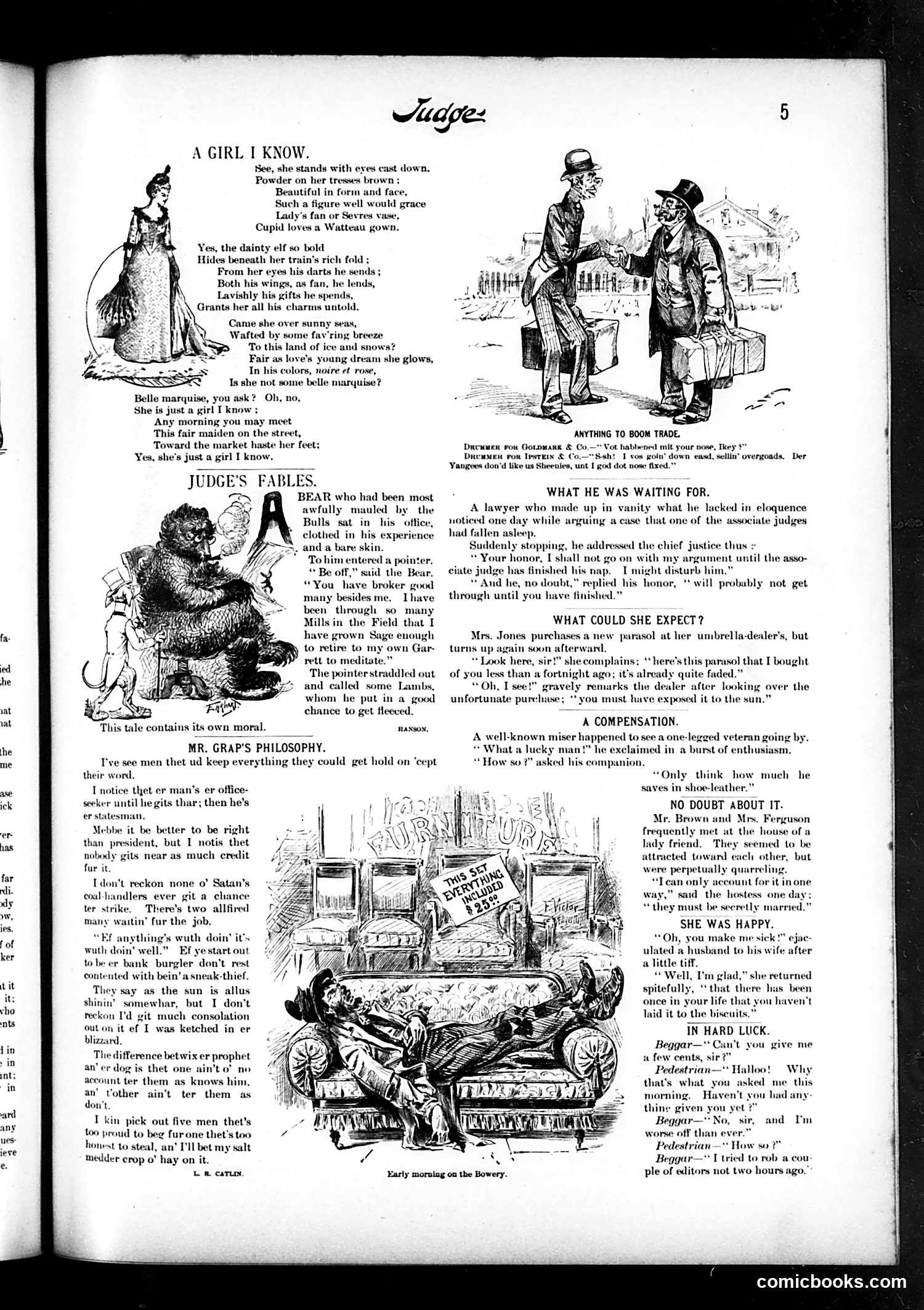
This page contains satirical content typical of late 19th-century American humor: **"A Girl I Know"** — A sentimental poem mocking romantic idealization of women, contrasting elaborate flattery ("Cupid loves a Watteau gown") with the mundane reality that she's just an ordinary girl heading to market. **"Judge's Fables"** — A Bear wounded by Bulls (likely Wall Street speculation) refuses help from a Pointer (broker), cynically observing the Pointer will fleece Lambs instead. The moral criticizes financial exploitation and predatory trading practices. **"Mr. Grap's Philosophy"** — Folksy aphorisms mocking hypocrisy: politicians become "statesmen" upon election; bank burglars should fully commit to crime; the difference between prophets and dogs is reputation-dependent. **The Yiddish dialogue** and lawyer anecdote mock ethnic stereotypes and professional pretension respectively. **The miser joke** satirizes miserliness by finding dark humor in disabled veterans' poverty. Overall, the page targets financial corruption, social pretense, and human vice through humor.
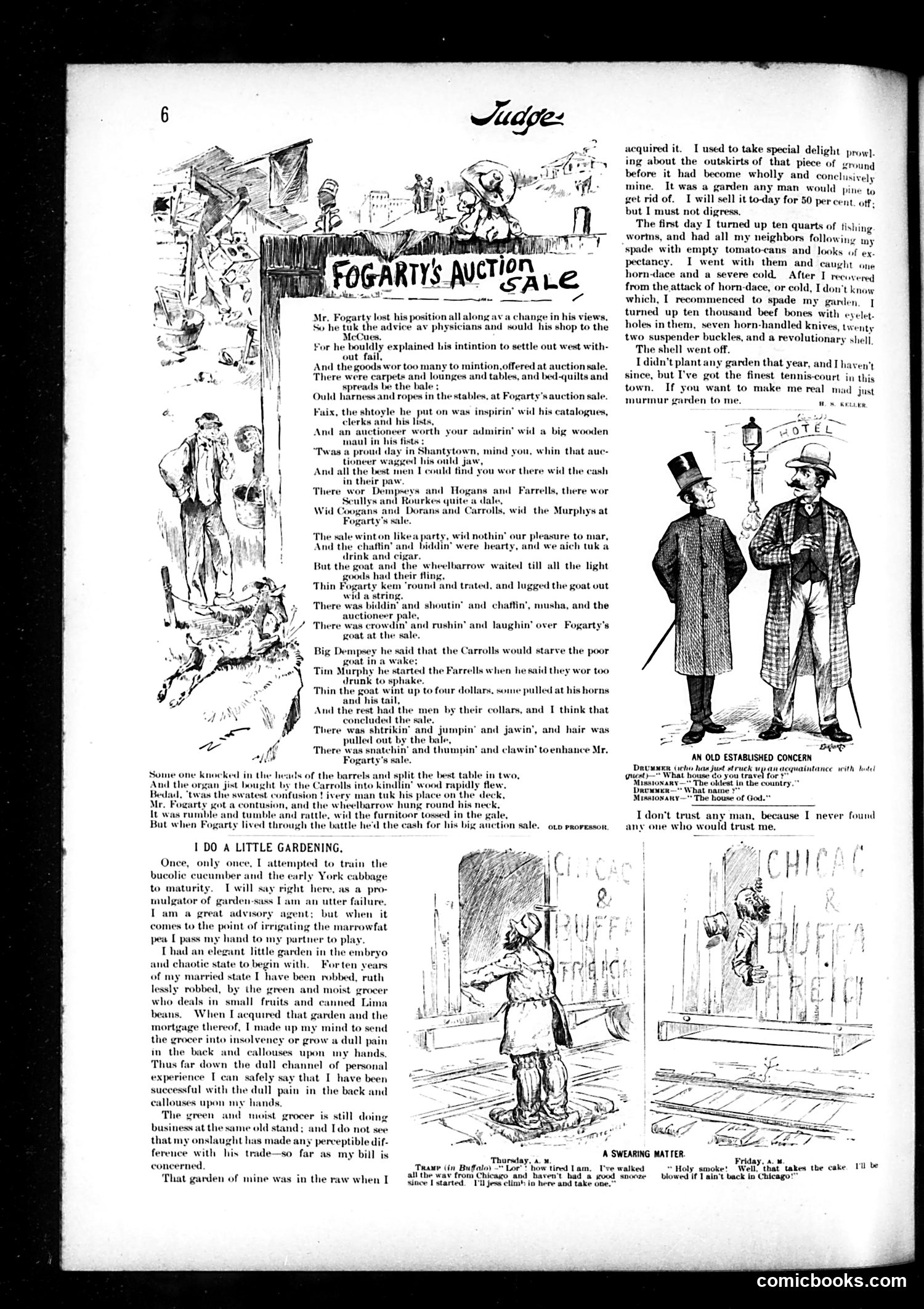
**"Fogarty's Auction Sale"** is a humorous Irish-American narrative poem about a chaotic auction in Shantytown. Mr. Fogarty, having lost his job and sold his shop, auctions off his belongings. The poem celebrates working-class Irish immigrant culture—named characters like Dempseys, Hogans, Carrolls, and Murphys attend. The humor centers on a wild goat that escapes, causing mayhem: men get pulled by its tail, furniture breaks, and a fight erupts. Despite the destruction, Fogarty successfully completes the sale. The satire gently mocks Irish immigrant community life, particularly the boisterous, rough-and-tumble socializing and the absurdity of frontier auctions. **"I Do a Little Gardening"** is a first-person account of an urban gardener's humbling failures. The narrator attempts to grow vegetables to avoid paying the grocer's inflated prices, but digs up animal bones, lost silverware, and even explosive shells instead. His efforts at self-sufficiency prove futile. The satire mocks bourgeois aspirations toward pastoral self-reliance and the gap between genteel ambitions and messy reality.
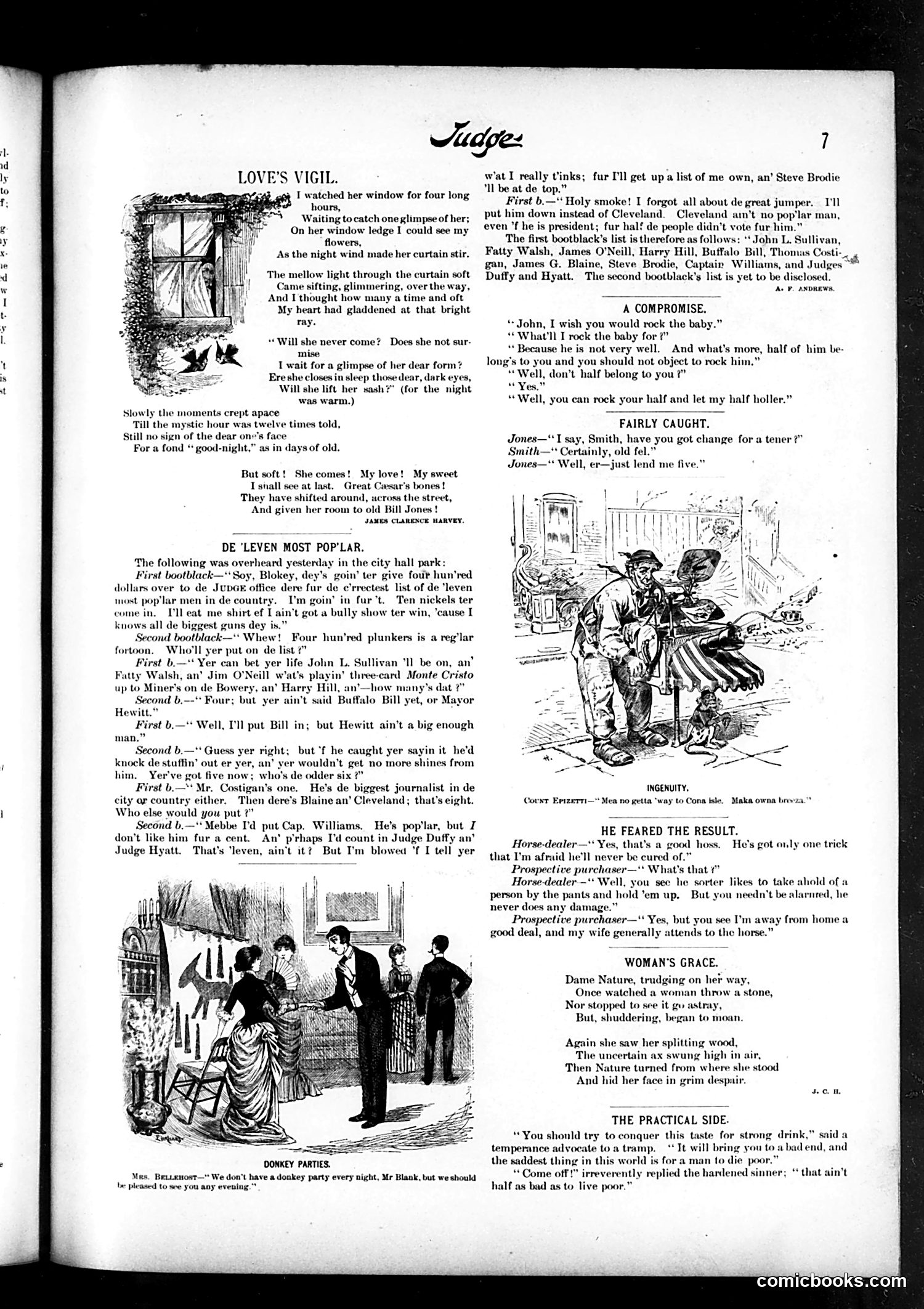
This page contains humorous sketches satirizing working-class New York life circa the 1880s-90s. **"De 'Leven Most Pop'lar"** depicts two bootblacks competing for a prize by listing the "eleven most popular" figures. Their list includes John L. Sullivan (the famous boxer), Steve Brodie (known for jumping off the Brooklyn Bridge), Buffalo Bill, and politicians like James G. Blaine and Cleveland—reflecting contemporary celebrity and political obsessions among working people. **Other sketches** include domestic humor ("A Compromise" about sharing baby-rocking duties) and social observation ("Woman's Grace" about female dignity). The artwork captures period working-class dialect and concerns—boxing, daredevil stunts, political figures, and street life. The satire gently mocks both the bootblacks' aspirations and the public figures they idolize, while the poems and vignettes offer sentimental or moralistic commentary typical of the era's magazine humor. The overall tone is affectionate rather than biting, capturing Gilded Age popular culture.
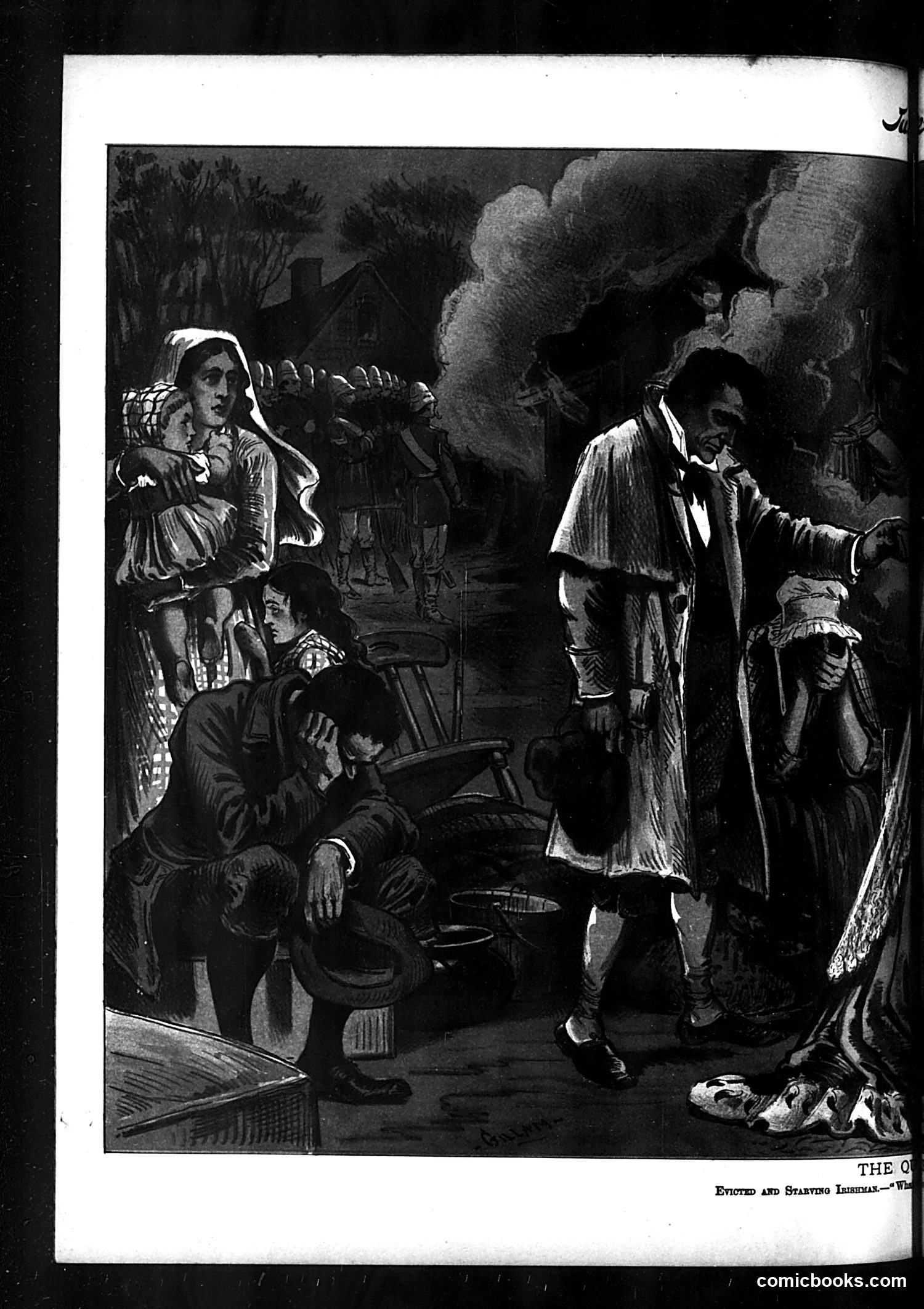
The visible text at bottom reads "EVICTED AND STARVING IRISHMEN—'Wh[cut off]" and "THE O[cut off]," indicating this depicts Irish eviction scenes, likely referencing 19th-century Irish landlord crises. The engraving shows multiple figures in tattered clothing in a nighttime street scene. A seated man appears distressed, while standing figures in cloaks gesture dramatically. The composition suggests desperation and displacement. Judge magazine frequently satirized social conditions and political issues. This appears to be social commentary on Irish suffering during eviction periods—when landlords forcibly removed tenants, often depicted as inhumane. The dramatic, darkened setting emphasizes the tragedy. Without the complete caption, the specific satirical angle remains unclear, but the image likely critiques either the evictions themselves or responses to Irish suffering by authorities or wealthy classes.
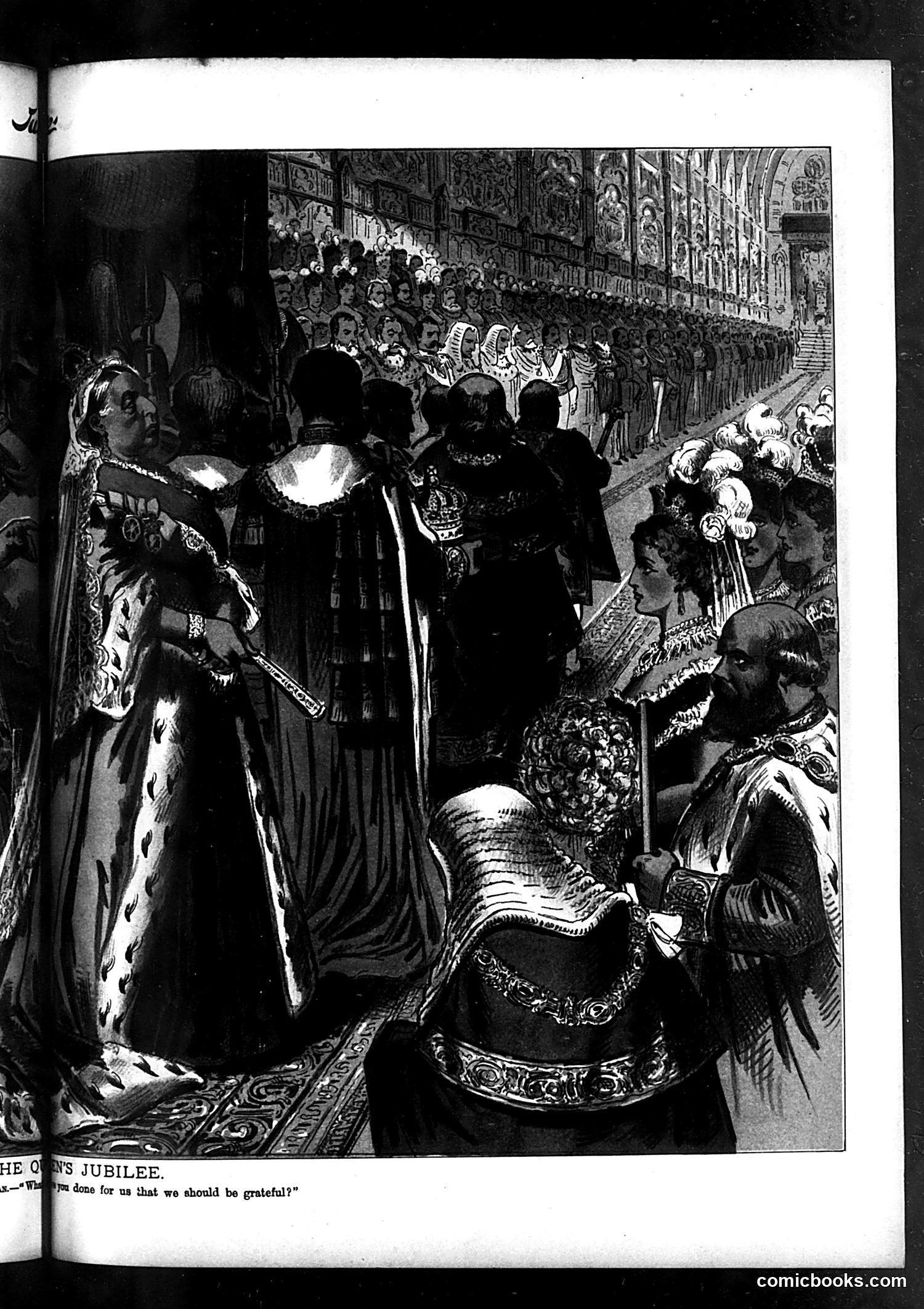
This page from *Judge* magazine depicts a formal royal or state ceremony, likely from the late 19th or early 20th century based on the elaborate Victorian dress and architectural style. The caption reads "THE QUEEN'S JUBILEE" with dialogue: "'Tis done for us that we should be grateful?" The satire appears to mock a royal jubilee celebration—a major state occasion commemorating a monarch's reign. The figures in ornate robes and regalia process through an elaborate cathedral or palace setting before assembled crowds. The cynical caption suggests the cartoon questions what ordinary citizens should actually be grateful for regarding such expensive pageantry. Without clearer identification of which specific queen or jubilee is referenced, the exact political target remains unclear, though the satire critiques the disparity between royal spectacle and public benefit.
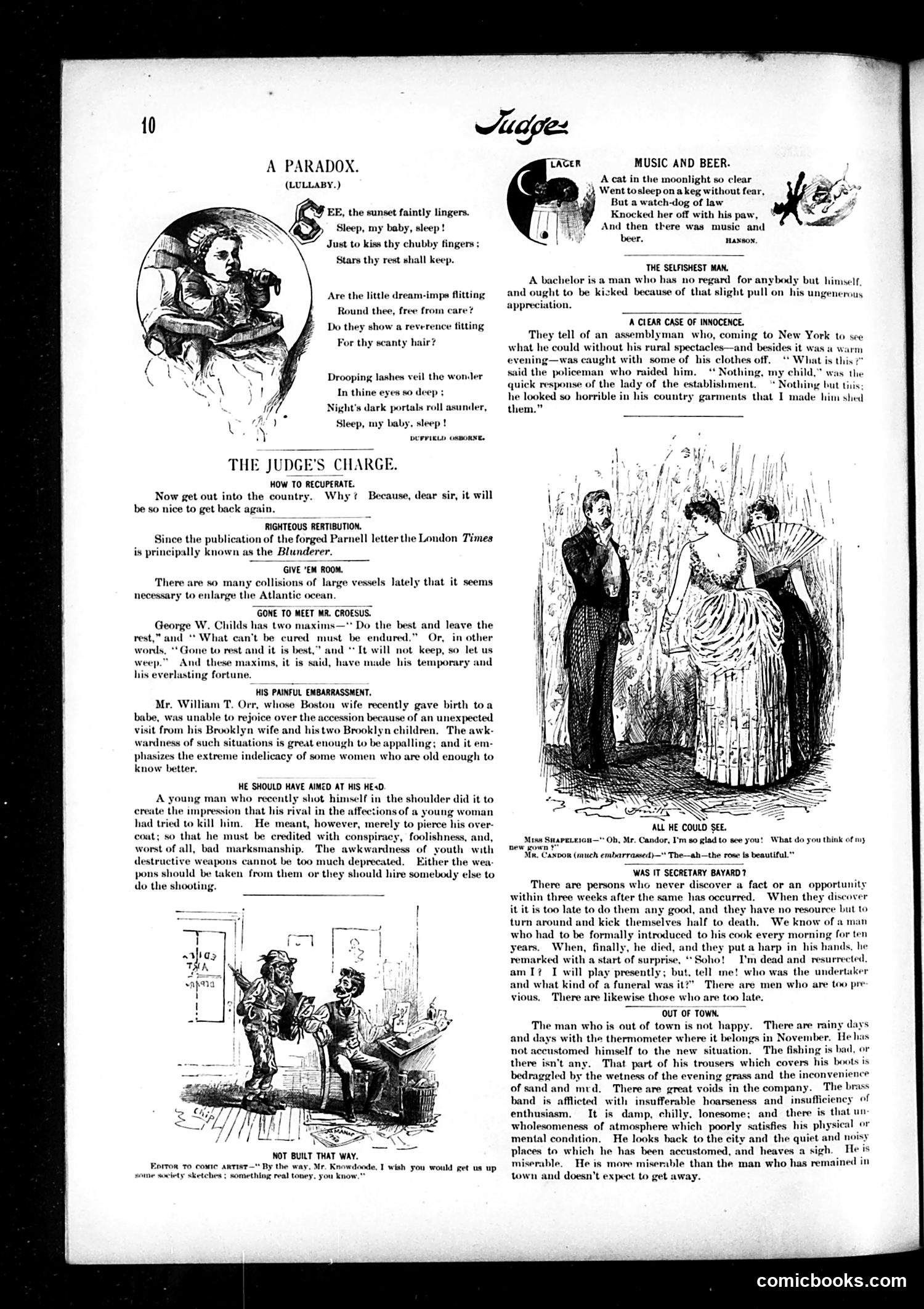
This page contains several satirical short items typical of Judge magazine's format: **"A Paradox"** is a sentimental lullaby poem with an ironic title, accompanied by an illustration of a sleeping child. **"The Judge's Charge"** collects brief satirical quips on contemporary topics: - A jab at the *London Times* for publishing the forged Parnell letter (a major 1880s scandal involving Irish political figures) - Criticism of George W. Childs for his self-serving maxims about work and rest - Social mockery of a Boston man embarrassed by the simultaneous presence of his wife and his Brooklyn family (implying bigamy) - A young man who shot himself to frame a rival but demonstrated poor marksmanship - Humorous observations about selfish bachelors, rural assemblymen caught undressed in the city, and a man so oblivious he required reintroduction to his cook yearly The cartoons and text target hypocrisy, incompetence, moral failings, and social pretension through satirical exaggeration—typical Judge fare aimed at educated urban readers.
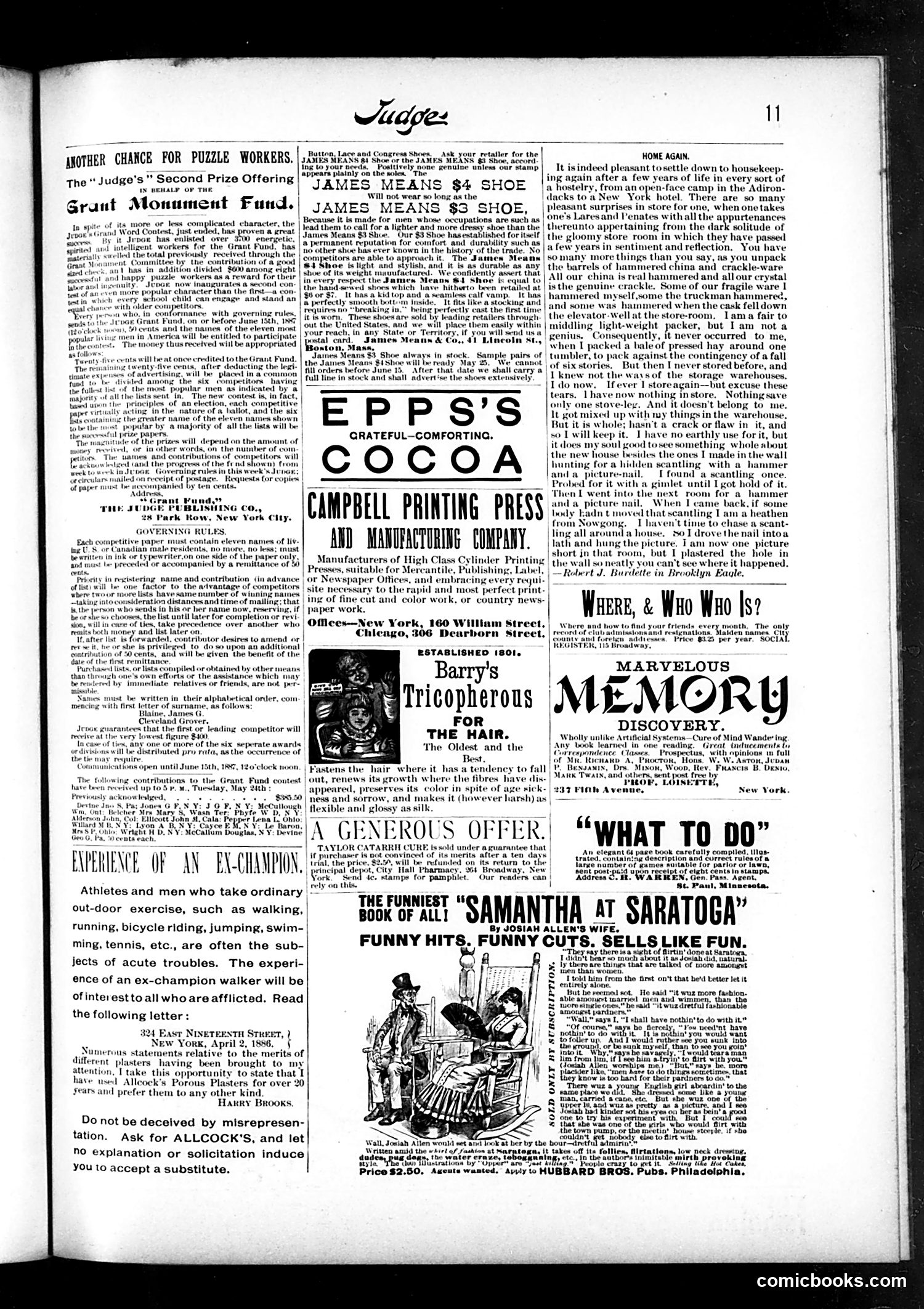
This page is primarily **advertising and contest announcements** rather than political satire. The main content includes: 1. **Grant Monument Fund Contest**: Judge magazine is running a word-puzzle competition to raise money for the Grant Monument Fund, offering $600 in prize money distributed among winners. 2. **Product Advertisements**: The page features multiple ads for consumer goods (James Means shoes, Epps's Cocoa, Campbell Printing Press, Barry's hair tonic, and Allcock's Porous Plasters). 3. **Minor Entertainment Content**: Small sections advertise books and theatrical productions like "Samantha at Saratoga." 4. **Testimonial Letter**: An endorsement from an "ex-champion walker" praising Allcock's Porous Plasters for treating athletic injuries. The page reflects **late 19th-century magazine culture**—mixing editorial contests, consumer advertising, and entertainment promotions to engage readers and generate revenue. There is no identifiable political cartoon or satirical commentary visible on this particular page.
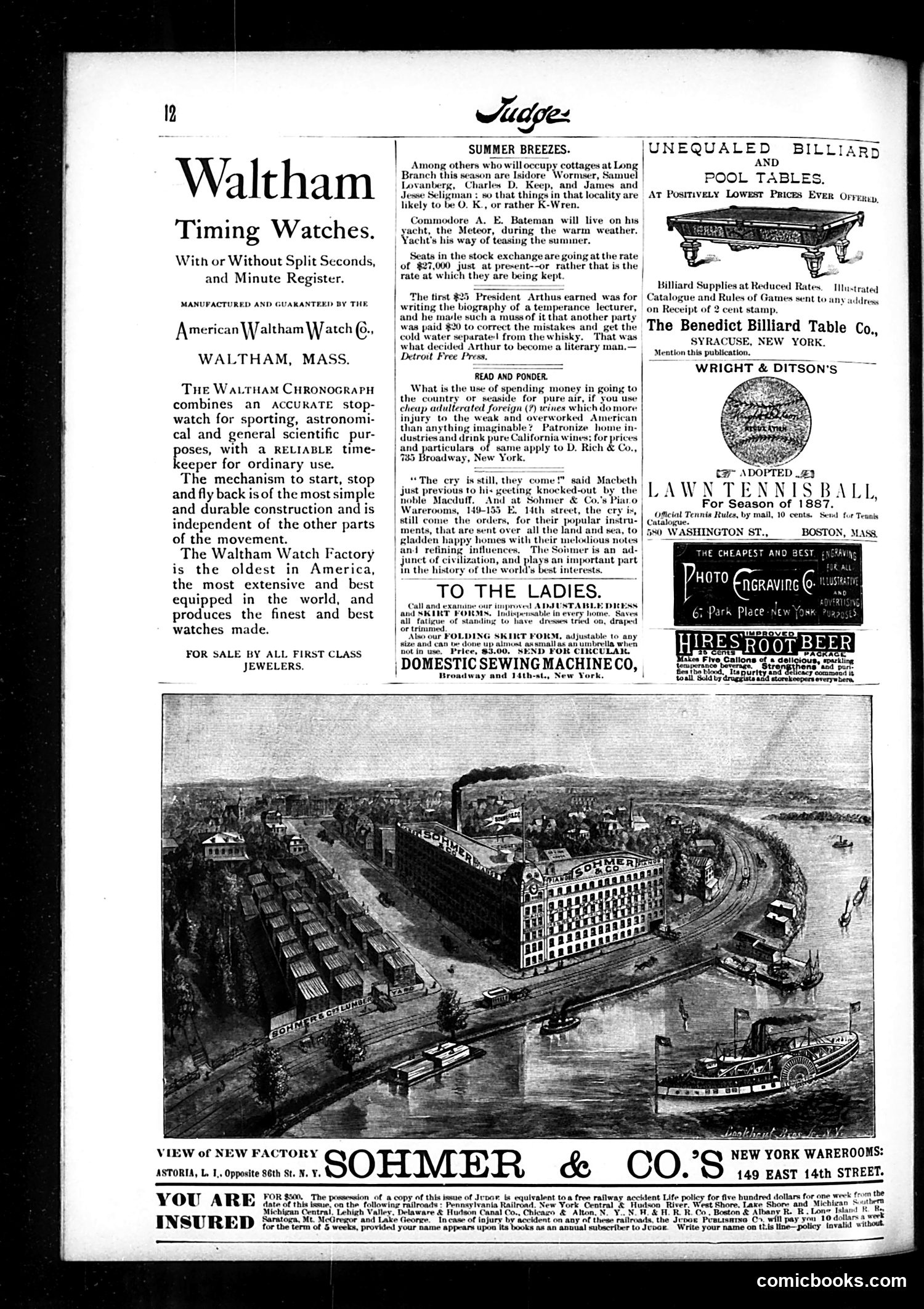
This is primarily an **advertising page** with minimal satirical content. The page features various commercial advertisements for products like Waltham watches, billiard tables, lawn tennis balls, and sewing machines—typical of Judge magazine's revenue model. The only notable satirical section is "SUMMER BREEZES," a brief humor column containing light social jabs. One item jokes about President Arthur's literary abilities, claiming his early writing was so poor that he abandoned authorship. Another pokes fun at wealthy New Yorkers' pretensions, including a commodore who lives on his yacht as a form of summer boasting. There's also a consumer-advocacy piece encouraging readers to buy American California wines rather than cheap foreign imports to support domestic industry. The large illustration shows the Sohmer & Co. piano factory in Astoria, promoting their manufacturing prowess and insurance coverage. Overall, this page reflects late 19th-century magazine economics and light-touch social humor rather than pointed political satire.
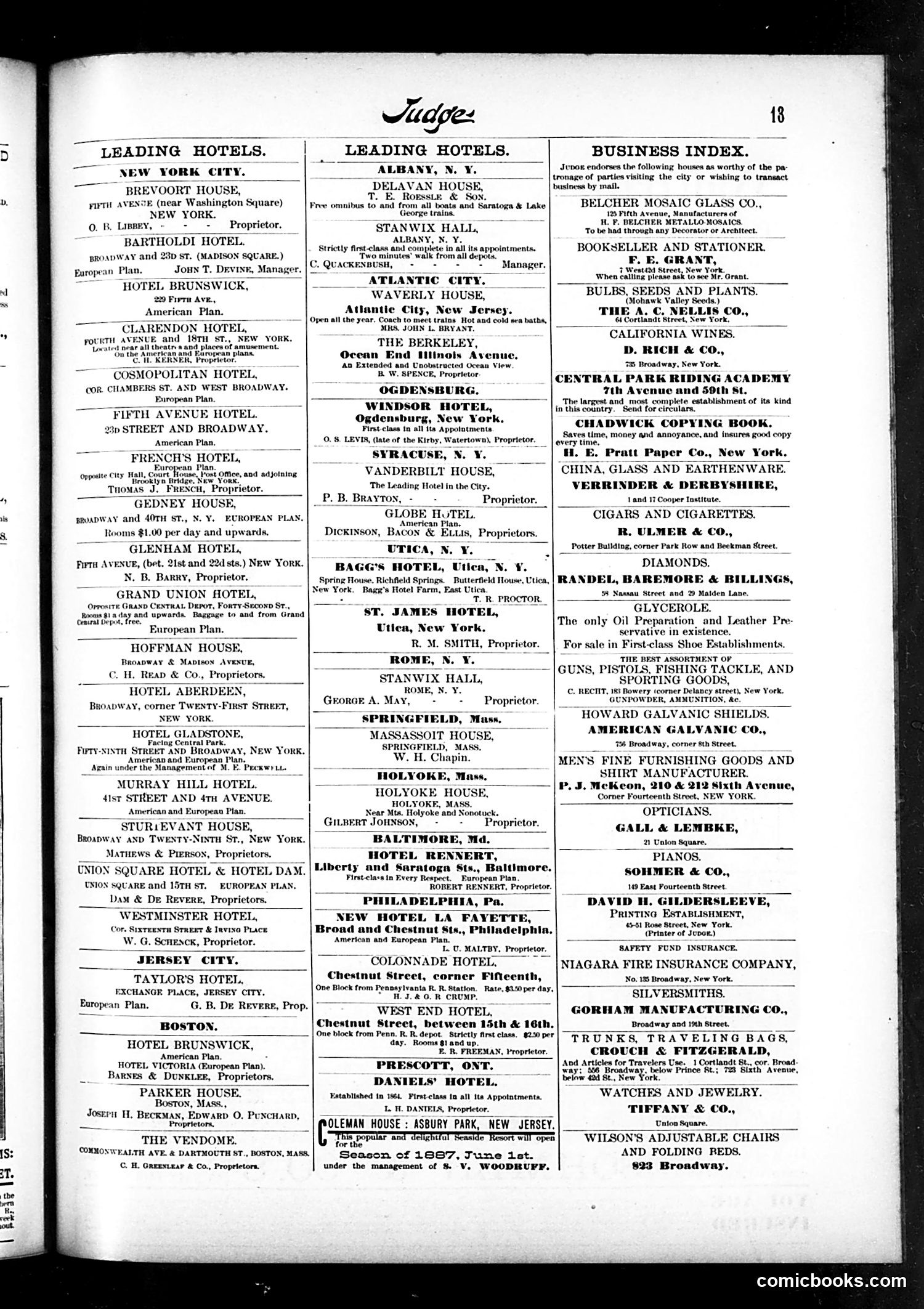
This is primarily a **business directory page** rather than a satirical cartoon page. It consists almost entirely of hotel and business advertisements organized in three columns: - **Left column**: Leading hotels in New York City - **Middle column**: Leading hotels in other cities (Albany, Atlantic City, Syracuse, etc.) - **Right column**: A "Business Index" listing various merchants and services in New York The advertisements follow a standard format listing the hotel/business name, address, proprietor, and brief description of amenities or specialties. Notable businesses advertised include the Central Park Riding Academy, various wine merchants, booksellers, and jewelers. **No satirical content is visible on this page.** This appears to be a standard commercial directory section, typical of magazine back matter from the 1880s, designed to generate advertising revenue rather than provide editorial satire or commentary.
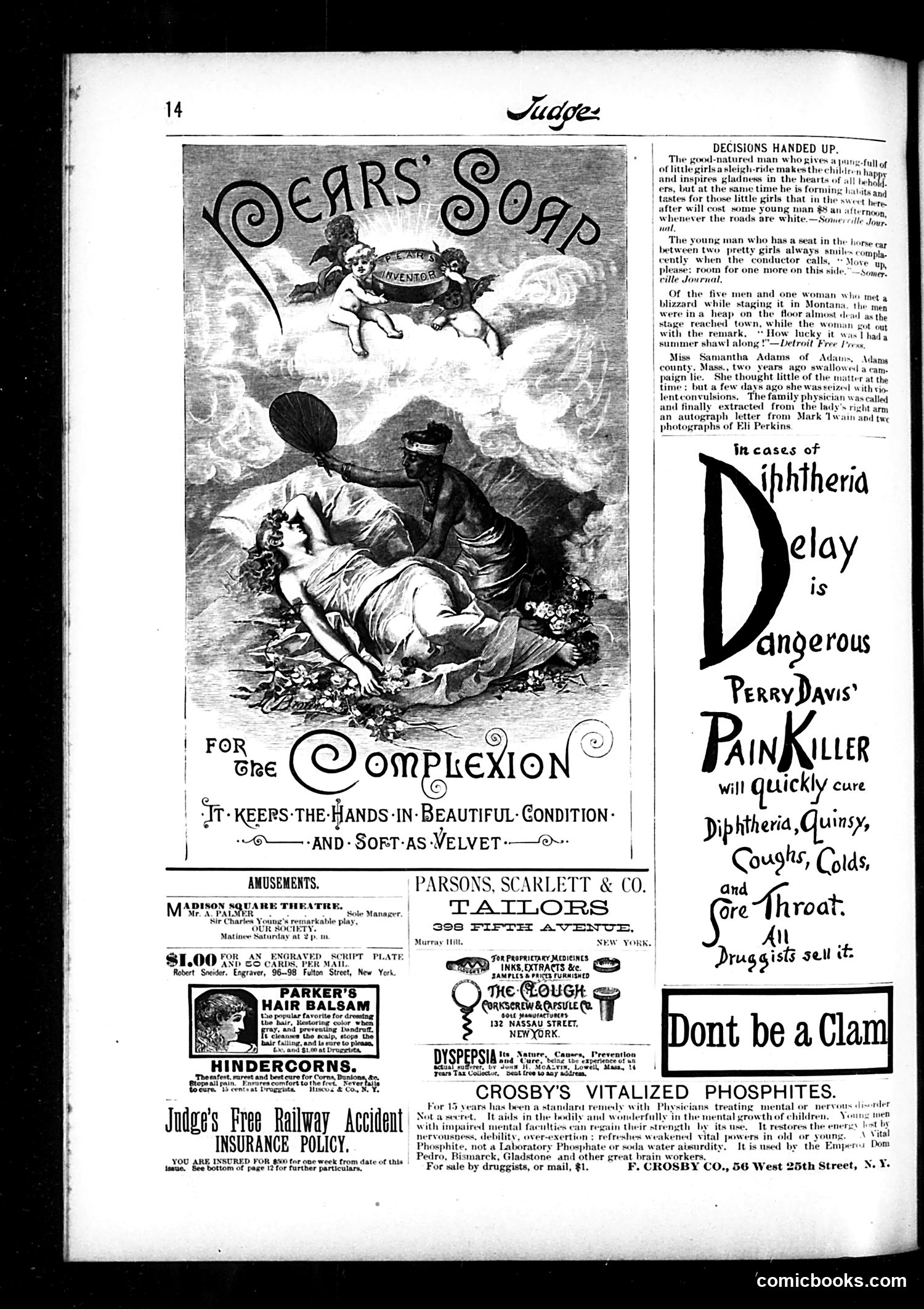
This page is primarily **advertising**, featuring vintage patent medicines and commercial services typical of early-20th-century American magazines. The main illustration is a **Sears Soap advertisement** showing classical allegorical figures (cherubs and a reclining woman) promoting the product's benefits for complexion and skin softness. The surrounding ads include: - **Parker's Hair Balsam** and **Hindercorns** (corn remover) - **Perry Davis' Pain Killer** for diphtheria and sore throat - **Crosby's Vitalized Phosphites** (a patent medicine claiming to restore strength and mental faculties) - Theater announcements and tailoring services The phrase **"Don't be a Clam"** (visible in large text) appears to be an advertisement slogan, though its specific product isn't entirely clear from this excerpt. The page reflects the era's aggressive marketing of unregulated patent medicines—many making dubious health claims—before modern FDA oversight. The "Decisions Handed Up" column contains brief humorous anecdotes typical of Judge's satirical content, separate from the advertisements.
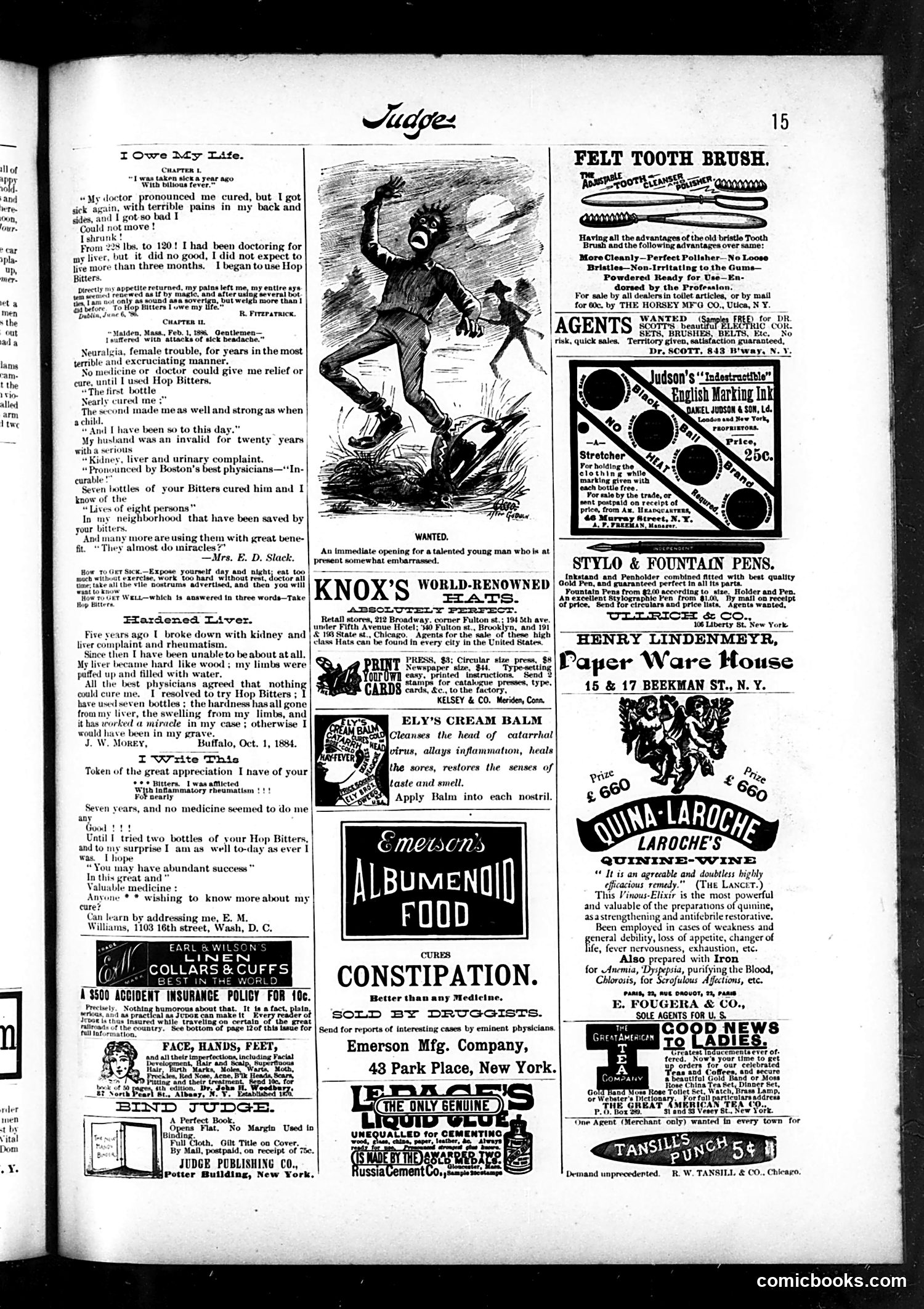
This page from Judge magazine is primarily **advertising**, containing testimonial ads for "Hop Bitters"—a patent medicine marketed as a cure-all remedy. The testimonials describe miraculous recoveries from serious ailments: kidney disease, rheumatism, liver problems, and female complaints. Modern readers should recognize this as typical 19th-century medical fraud. The **central cartoon** depicts a man being violently ejected or knocked about, likely satirizing the exaggerated "cures" claimed by such medicines—the ironic visual punchline being that these "remedies" cause more damage than relief. The page also contains legitimate product advertisements (Knox hats, Judson inks, dental brushes) mixed with the patent medicine promotions. This reflects how Judge's business model depended on advertising revenue from all manufacturers, regardless of product legitimacy. For modern readers, the page documents both 19th-century consumer gullibility and the era's lack of FDA regulation over medical claims.
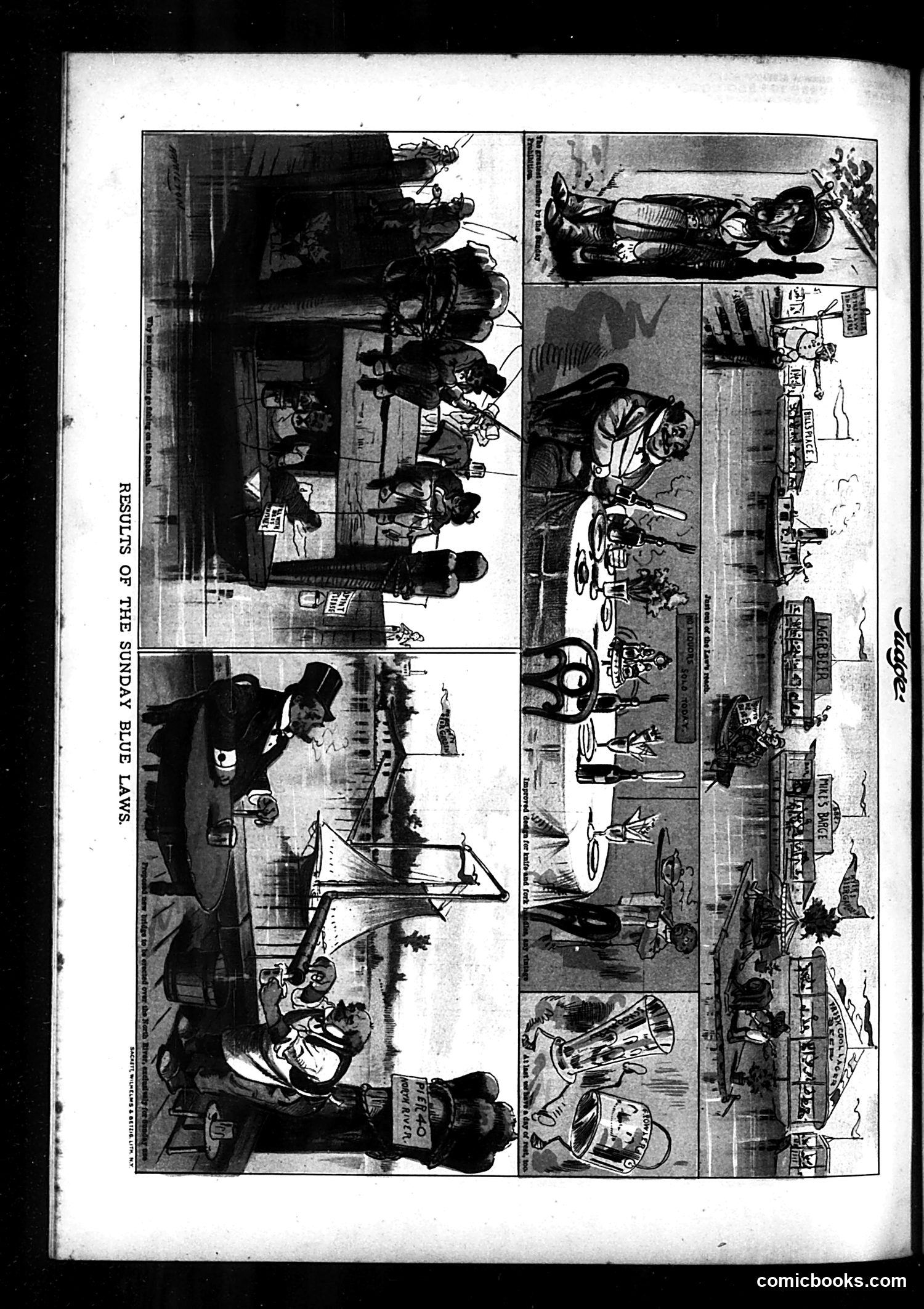
This appears to be a page titled "Results of the Sunday Bicycle Laws," though the OCR text is incomplete. The page contains multiple cartoon panels arranged vertically and horizontally, appearing to depict various scenes related to bicycle usage and regulation. The cartoons seem to satirize the consequences or enforcement of Sunday bicycle ordinances—laws that restricted bicycle riding on Sundays, which were common in late 19th/early 20th-century America due to religious observance concerns. The specific figures and detailed narrative of each panel are difficult to discern clearly in this image quality, but the overall satirical point appears to mock how these restrictive laws affected cyclists and city life on Sundays.