
A complete issue · 16 pages · 1887
Judge — May 21, 1887
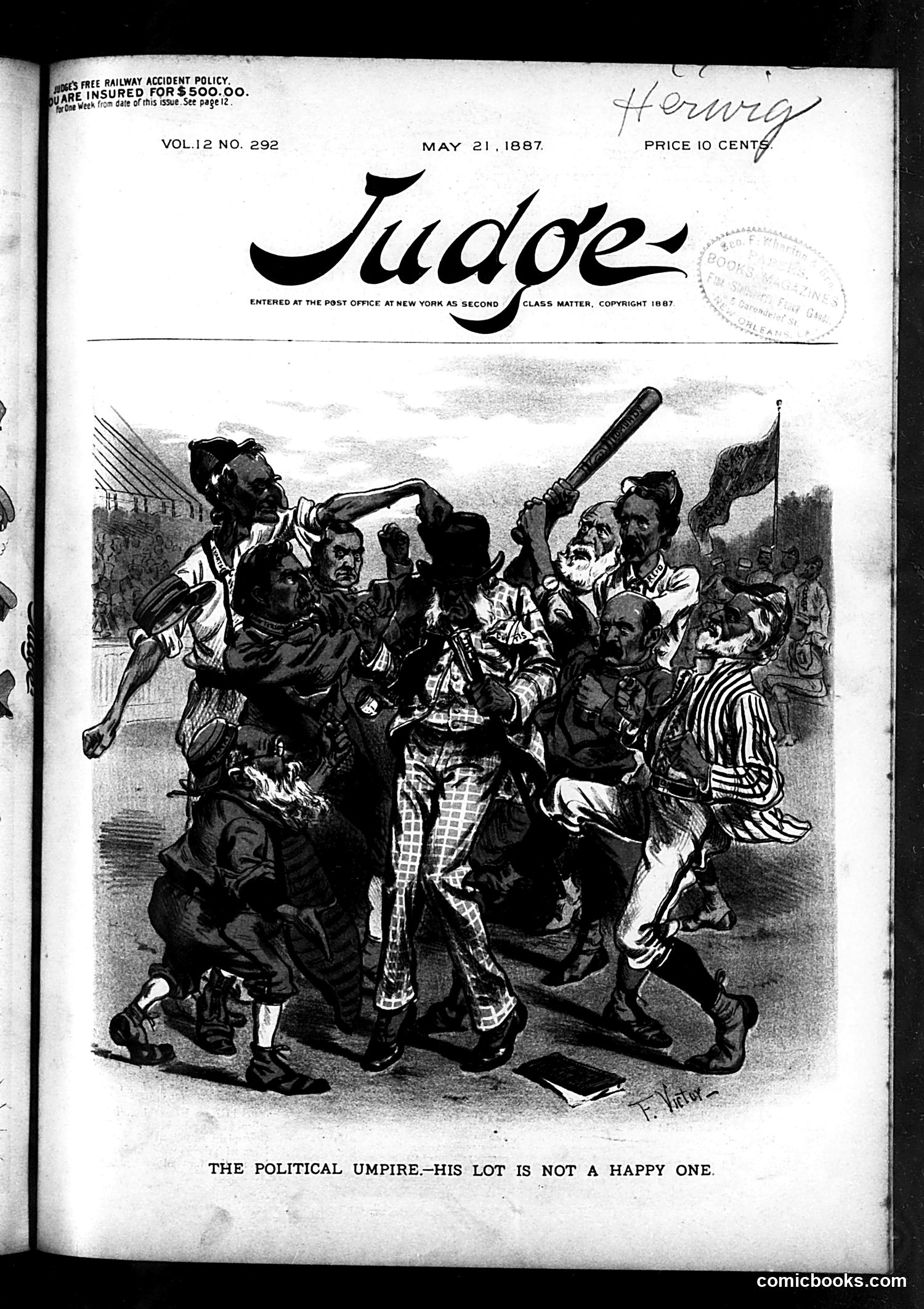
This 1887 *Judge* cartoon satirizes the role of a political mediator or referee during America's contentious post-Reconstruction era. The central figure—dressed as a baseball umpire with bat raised—is literally besieged by angry politicians and citizens from multiple factions, all attacking or pressuring him simultaneously. The satire suggests that attempting to maintain neutral authority in politics is an impossible, thankless task. The umpire metaphor reflects baseball's growing popularity as an American symbol of fair play, but here it's overwhelmed by the chaos of competing political interests. The cartoon critiques the futility of impartial political judgment when partisan forces refuse to accept any neutral authority.
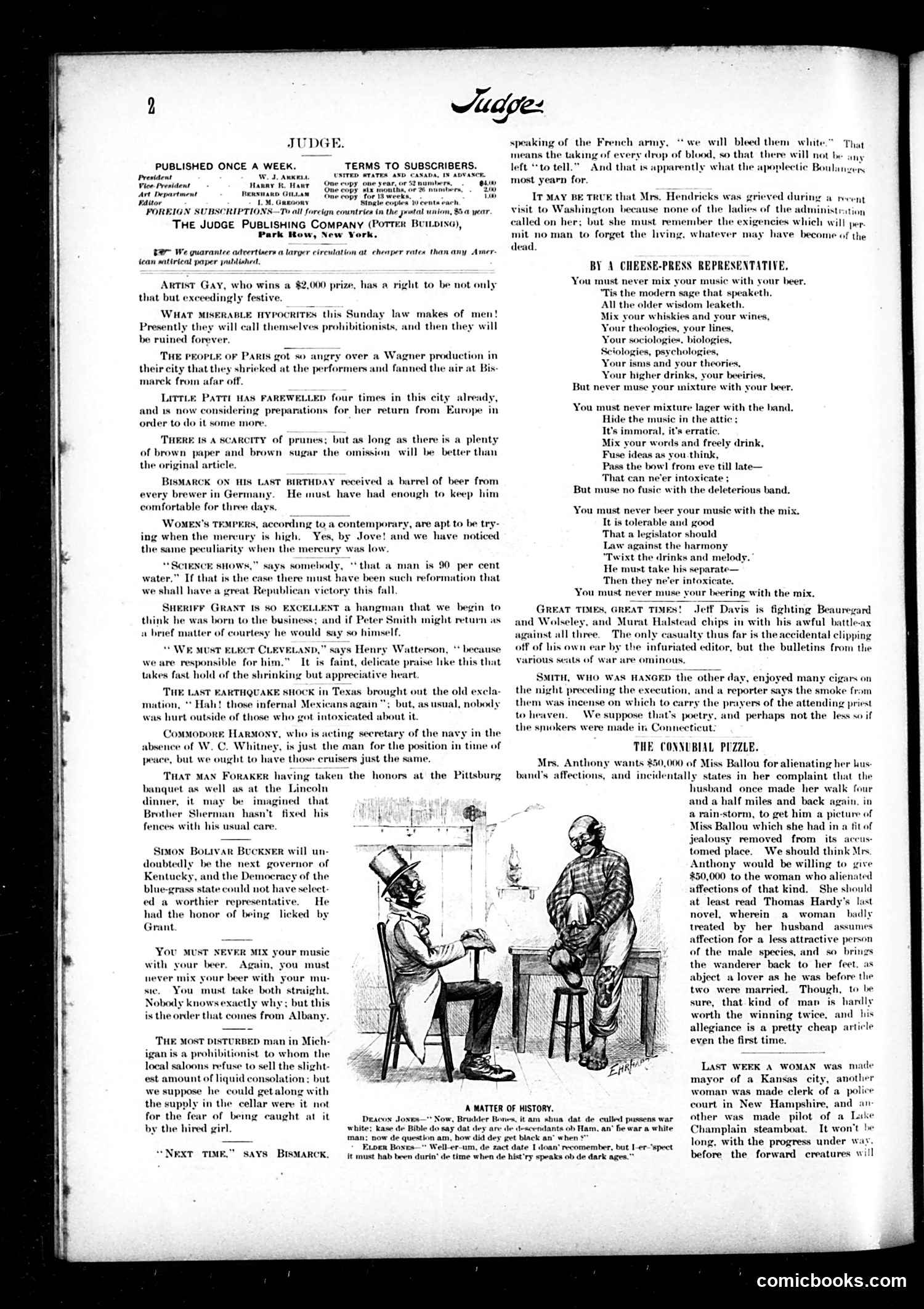
This cartoon depicts two men in conversation—one appears to be explaining something to the other while gesturing. The caption reads: "A MATTER OF HISTORY" with dialogue about biblical genealogy and race. The text references debates about Ham's descendants being "white" versus other races, quoting: "Well or um, he ain't done remember, but I er 'spect it must hav been some time when he had 'er speak of dar ages." This satirizes 19th-century pseudoscientific attempts to use biblical ancestry to justify racial hierarchies and slavery. The cartoon mocks the absurdity of such "historical" arguments by presenting the explanation as confused and unconvincing—the speaker clearly cannot coherently defend the racist pseudoscience being questioned.
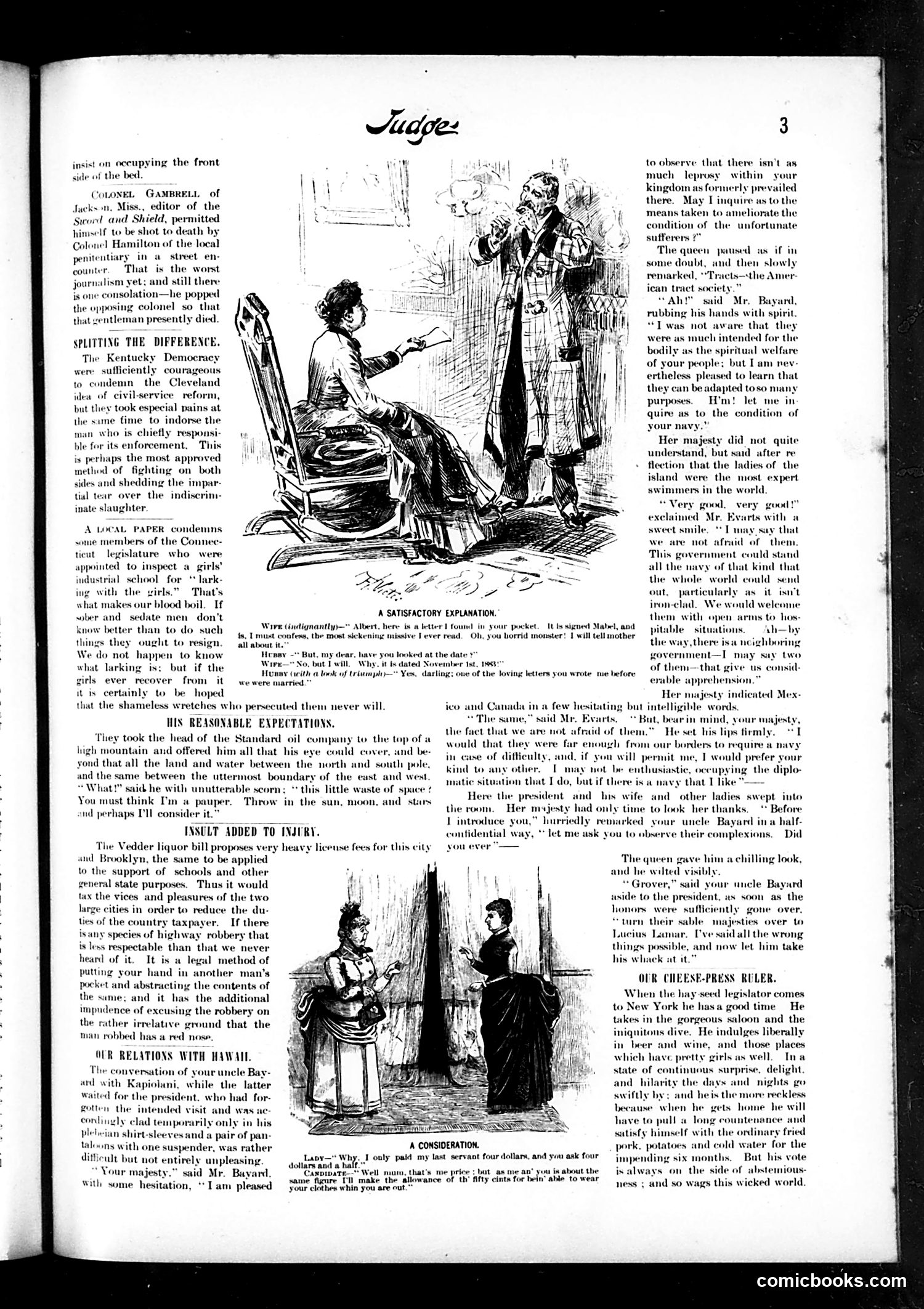
This page contains several distinct satirical pieces mocking contemporary American politics and social issues: **"Splitting the Difference"** ridicules Connecticut legislators who appointed themselves to inspect a girls' industrial school, implying misconduct ("larking") while pretending reform efforts. **"His Reasonable Expectations"** parodies the Devil's temptation of Christ, reimagined with a Standard Oil executive being offered worldly wealth—satirizing corporate greed and the oil monopoly's insatiable appetite. **"Insult Added to Injury"** attacks the proposed Vedder liquor tax, which would fund rural schools through city vice taxes. Judge condemns this as unjust "highway robbery"—taxing urban citizens to subsidize rural taxpayers. **"Our Relations with Hawaii"** mocks Secretary of State Bayard's diplomatic visit to Hawaii's queen, lampooning his awkward attempts at flattery and Hawaii's actual conditions (leprosy crisis, limited navy). The satire critiques American imperialism and condescending diplomacy toward indigenous sovereigns. The cartoons use exaggerated caricature and dialogue to expose hypocrisy and injustice in governance.
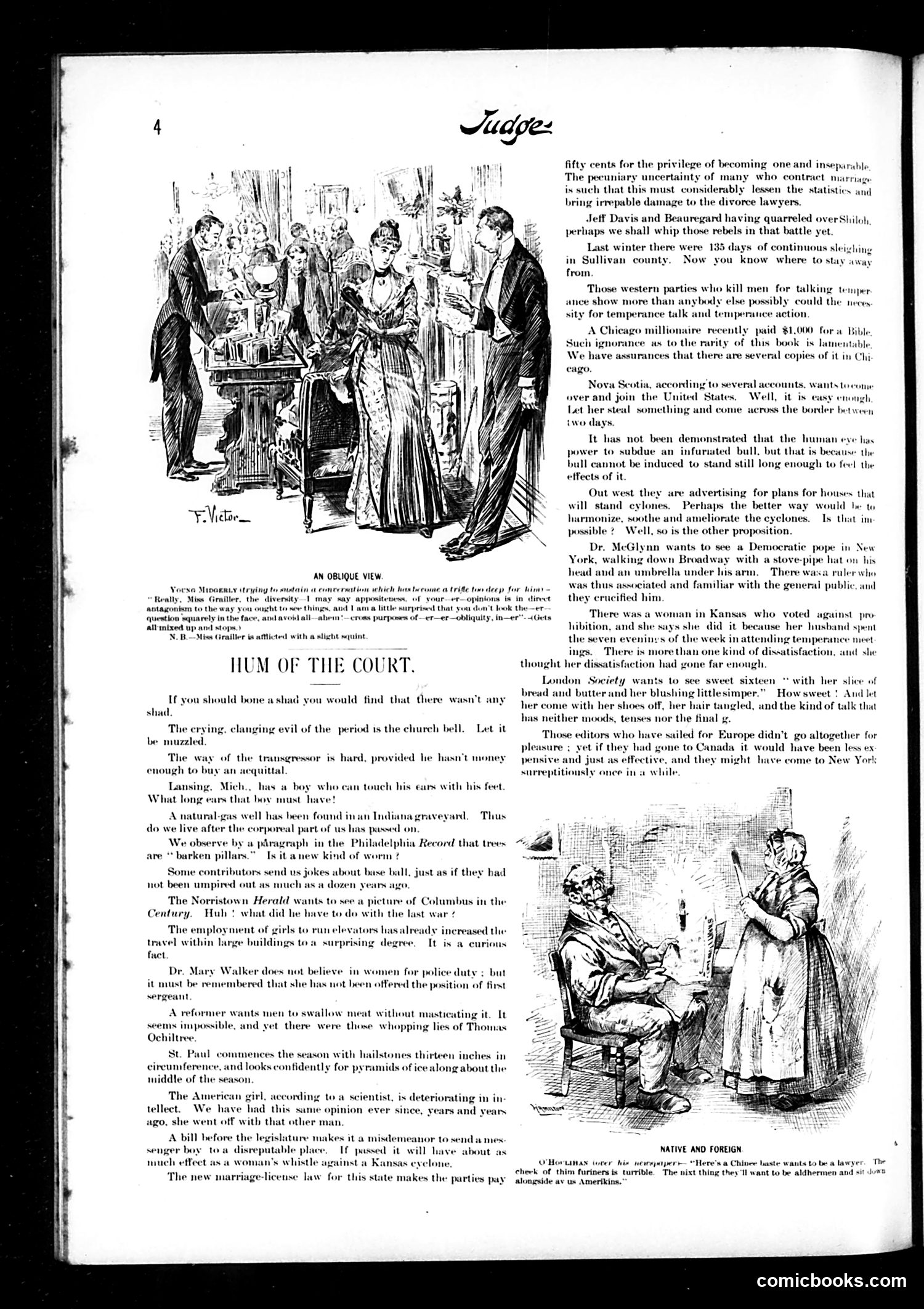
This page contains a collection of brief satirical commentary pieces typical of Judge's "Hum of the Court" section—short, caustic observations on contemporary American life and politics. **Key references include:** - **Jeff Davis and Beauregard quarreling over Shiloh**: A Civil War–era jab at Confederate leaders feuding over military strategy, suggesting their infighting helps Union victory. - **Nova Scotia wanting to join the US**: Satirizing Canada's potential annexation by joking it would be as simple as stealing something and crossing the border. - **Various social critiques**: Complaints about church bells, temperance reformers, women in police work, and Victorian marriage laws—all targets of Judge's satirical pen. The text mocks contemporary absurdities: a Chicago millionaire overpaying for a Bible (implying ignorance of books' actual rarity), architects designing cyclone-proof houses, and the observation that a "Democratic pope in New York" would be equally unlikely. **The cartoons** (an "oblique view" sketch and "Native and Foreign" illustration) appear to be character studies supporting these satirical observations, though specific identities are unclear from the image quality.
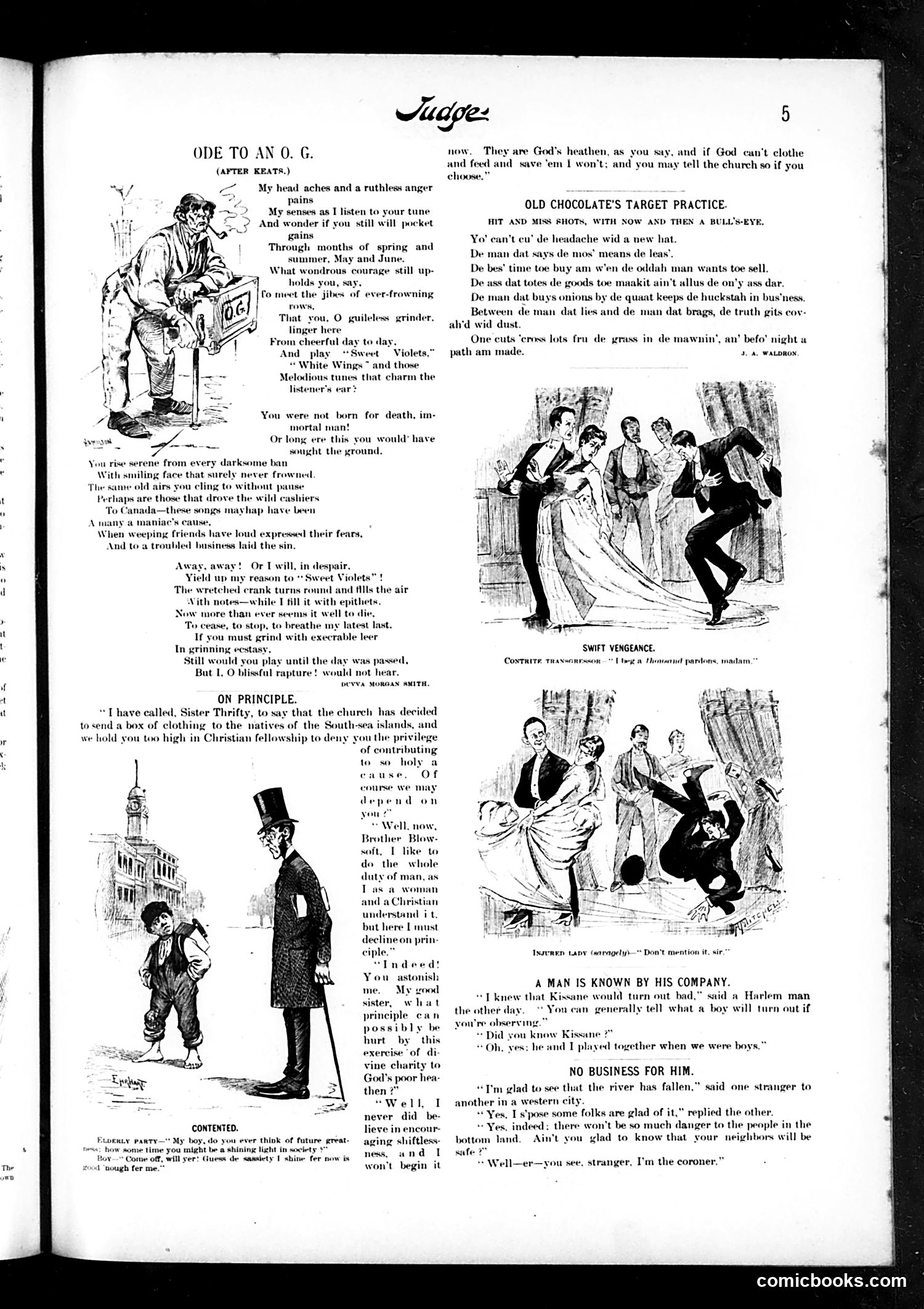
This page from Judge contains several satirical pieces reflecting late 19th/early 20th-century social attitudes: **"Ode to an O.G."** mocks a street organ grinder—a common urban nuisance of the era. The poem, styled after Keats, sarcastically praises this "guileless grinder" while complaining about his repetitive, maddening music played throughout seasons. **"On Principle"** satirizes selective Christian charity. Sister Thrifty solicits donations for South Sea Island missionaries, but Brother Blowsoft refuses on "principle"—likely implying hypocrisy: he'll contribute to foreign missions but not local poor relief, or he opposes the evangelical work itself. The joke exposes inconsistent moral reasoning. **"Old Chocolate's Target Practice"** presents folk wisdom in dialect, presumably from an African American character, offering practical observations about commerce and human nature. The remaining cartoons address social dynamics: company's influence on character, and a coroner's darkly ironic lack of enthusiasm about fewer river deaths (fewer bodies to process). The page reflects period attitudes including casual racism and class-based humor typical of Gilded Age publications.
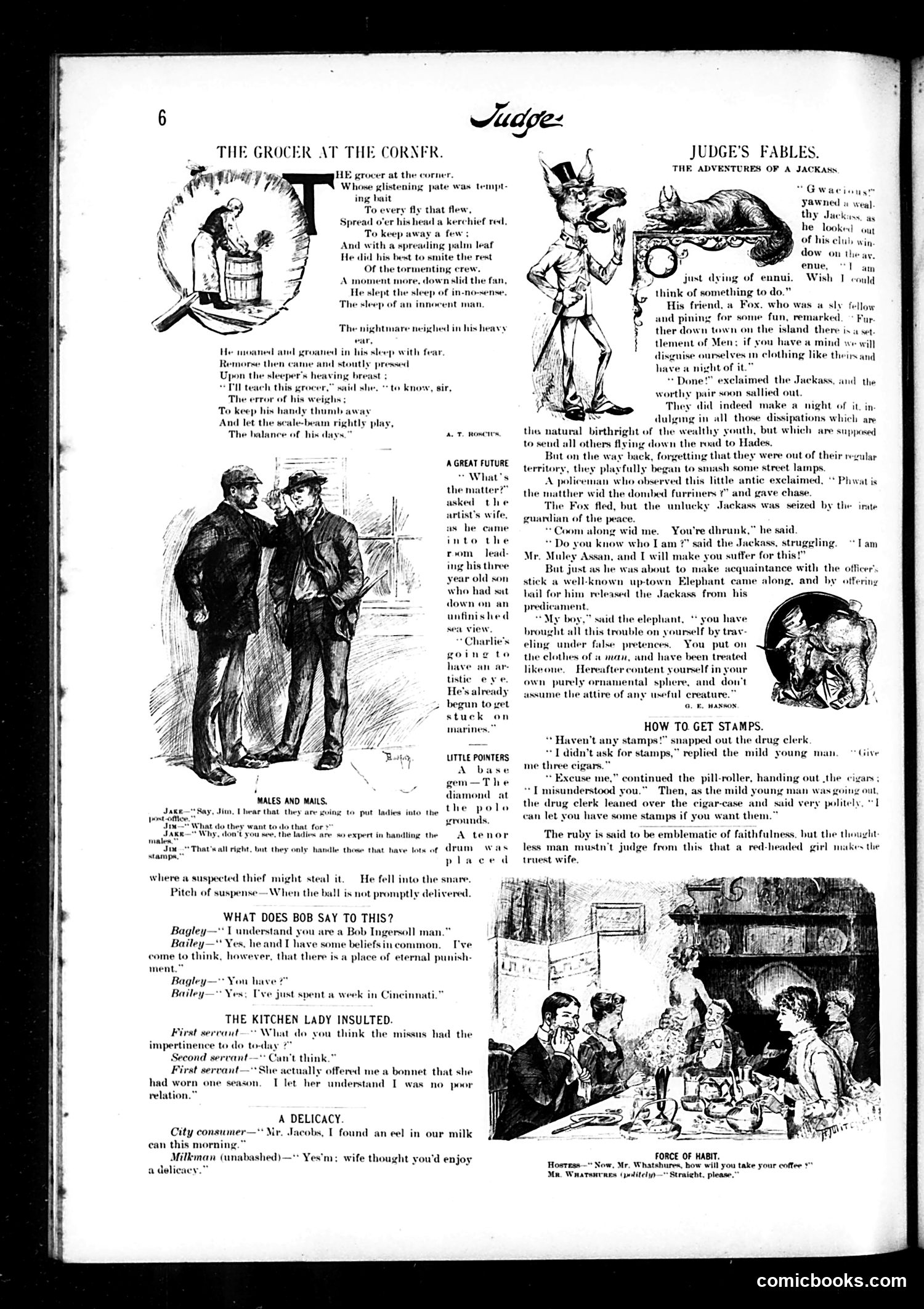
This page contains several satirical short pieces typical of Judge magazine's humor: **"The Grocer at the Corner"** mocks a bald grocer who places a red kerchief on his head to ward off flies—absurd logic that the satirist ridicules. **"A Great Future"** jokes about an artist whose three-year-old son sits on an unfinished seascape painting, creating accidental marks. The artist optimistically interprets this as evidence the child has "an artistic eye." **"Judge's Fables: The Adventures of a Jackass"** is the main piece: a wealthy, foolish "Jackass" and a Fox disguise themselves as working-class men to slum in a settlement downtown. They cause mischief (breaking street lamps). When caught, an Elephant lectures the Jackass that wearing false clothing/pretending to be something you're not leads to trouble—a morality tale about class pretense and authenticity. The remaining pieces are brief workplace humor: servants insulted by hand-me-downs, a drug clerk's misunderstanding, and a drunken man's "force of habit." The satire targets vanity, foolishness, class hypocrisy, and social pretension.
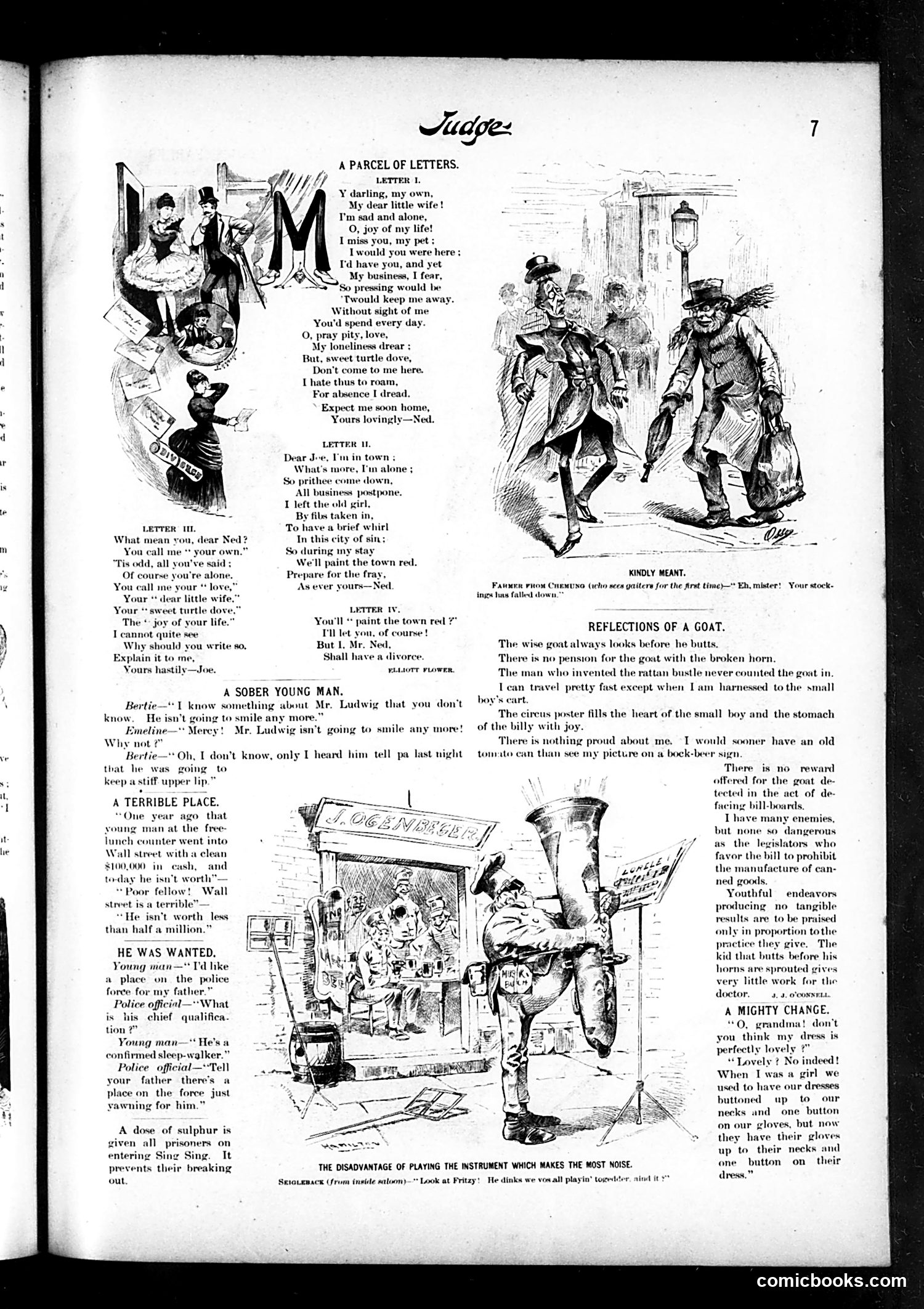
This page contains humorous short pieces typical of Judge's satirical style. The main content includes: **"A Parcel of Letters"**: A multi-part joke exposing hypocrisy. A man named Ned writes contradictory letters to his wife—one claiming loneliness and devotion, another revealing he's abandoned her to enjoy "painting the town red" in the city. The satire targets husbands who deceive their wives about business trips, actually using them as cover for dissolute behavior. **Other pieces** include brief comedic sketches: "A Sober Young Man" about someone who won't smile, "A Terrible Place" (likely about Wall Street financial ruin), "He Was Wanted" (a police force joke), and "Reflections of a Goat" (humorous animal observations). The cartoons depict street scenes and domestic situations rendered in period illustration style. "Kindly Meant" shows someone commenting on another's appearance; "The Disadvantage of Playing the Instrument Which Makes the Most Noise" appears to mock loud musicians. The satire primarily targets marital infidelity and male duplicity—common Judge themes—alongside general absurdist humor.
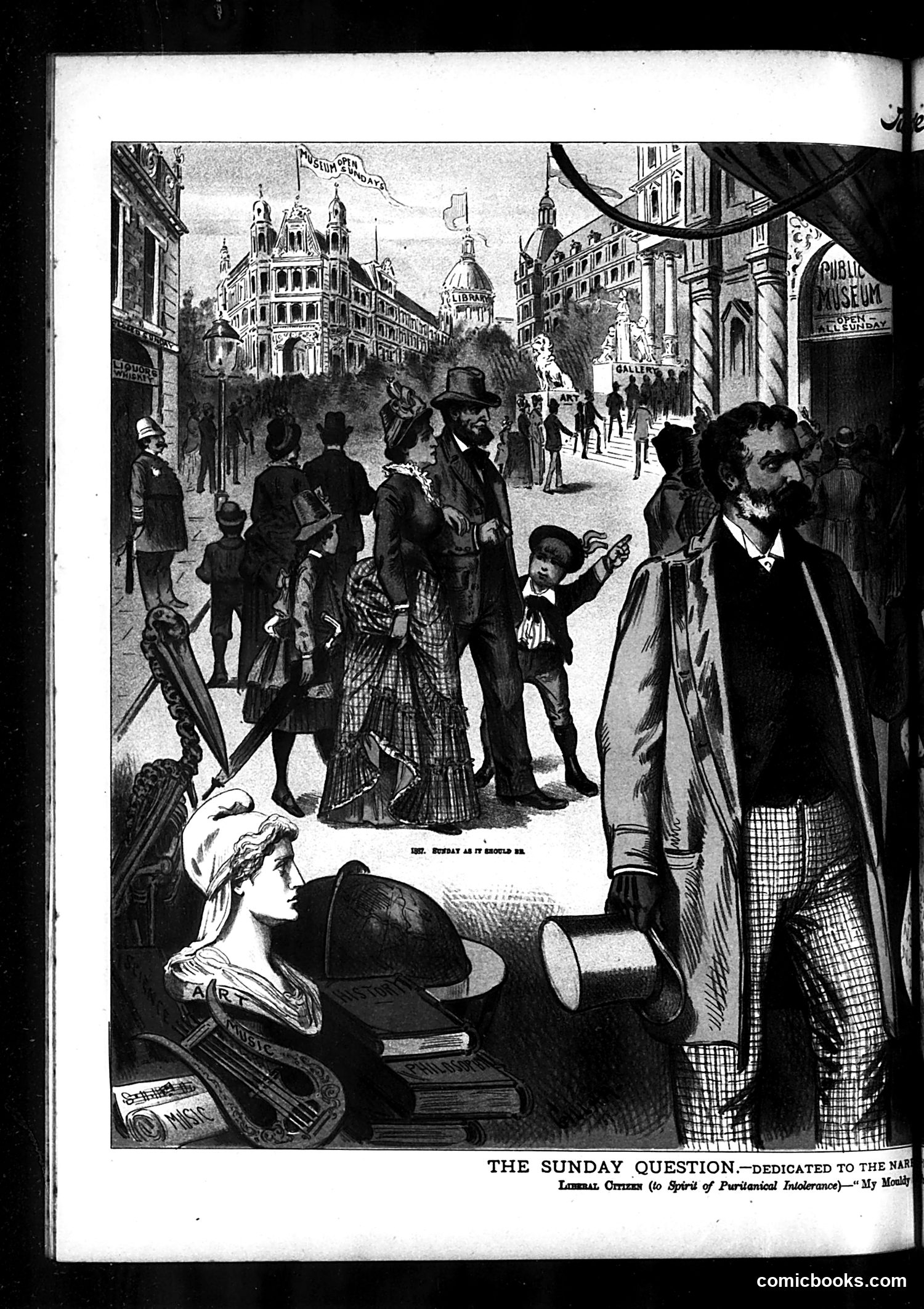
This satirical cartoon critiques debates over Sunday observance laws—restrictions on commercial activity and entertainment on Sundays, championed by religious conservatives. The allegorical female figure (labeled "Liberty" or representing free commerce) sits dejected amid books and implements, while well-dressed citizens stroll freely through a prosperous urban street in the background. The cartoon's subtitle mocks "Puritanical Intolerance," suggesting that strict Sunday laws represent an oppressive, outdated moralism constraining modern society. The contrast between Liberty's suppressed state and the thriving public life behind her implies the cartoon argues *against* such restrictions—advocating for secular freedom and commercial liberty over religious regulation. This reflects late-19th/early-20th century American tensions between religious traditionalists and those favoring secular modernization.
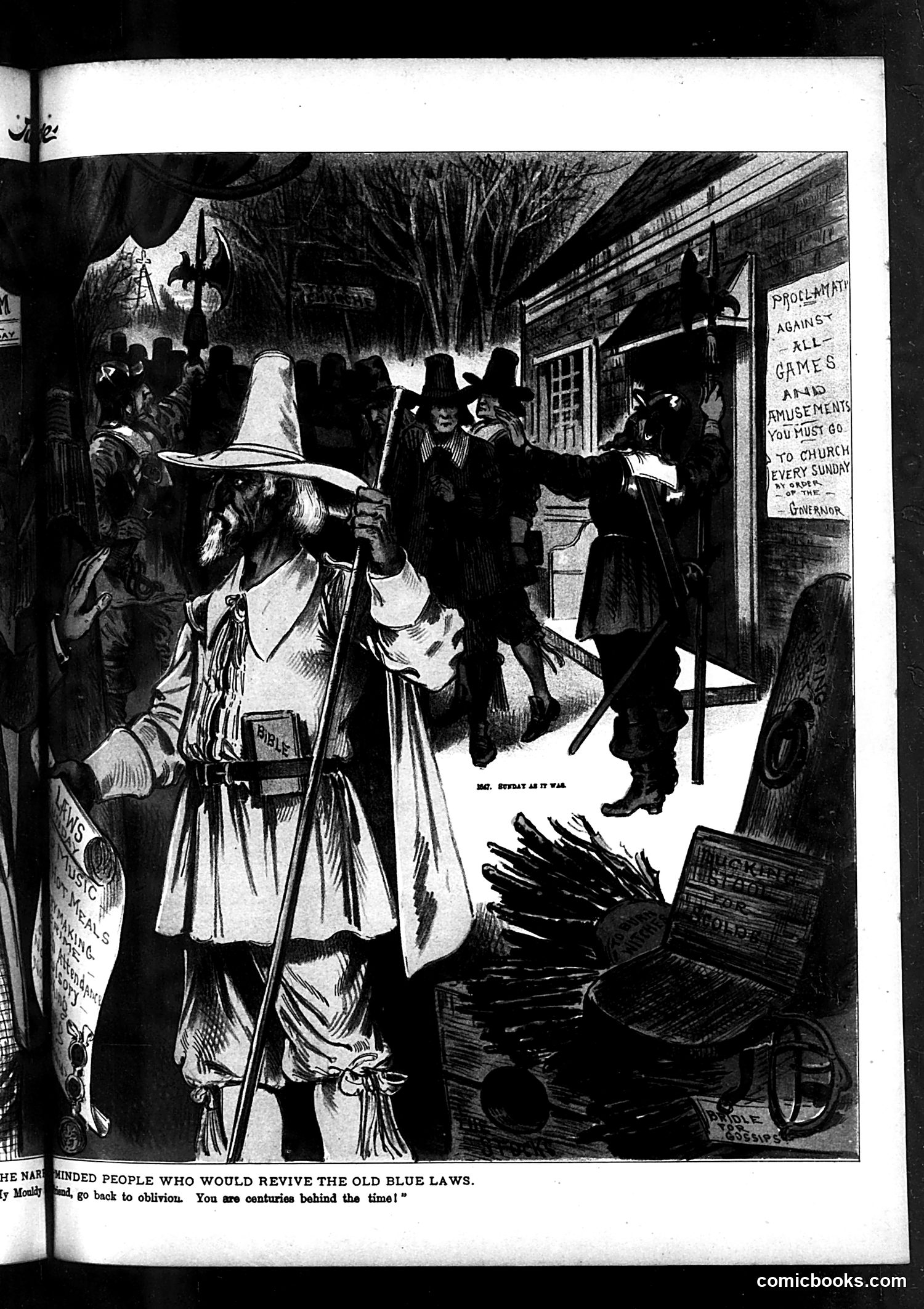
This engraving depicts figures in KKK robes and regalia alongside what appears to be a religious procession or gathering. The caption references "minded people who would revive the old blue laws" and mentions being "centuries behind the times." The satire conflates the KKK with efforts to enforce "Blue Laws"—archaic religious statutes restricting activities like games and amusements on Sundays. A visible proclamation on the right warns against "all games and amusements" and mandates church attendance. The cartoon argues that those seeking to revive restrictive religious legislation are morally equivalent to the KKK—representing backward, extremist ideology. The juxtaposition suggests both represent dangerous attempts to impose outdated social control, positioning such efforts as un-American and regressive.
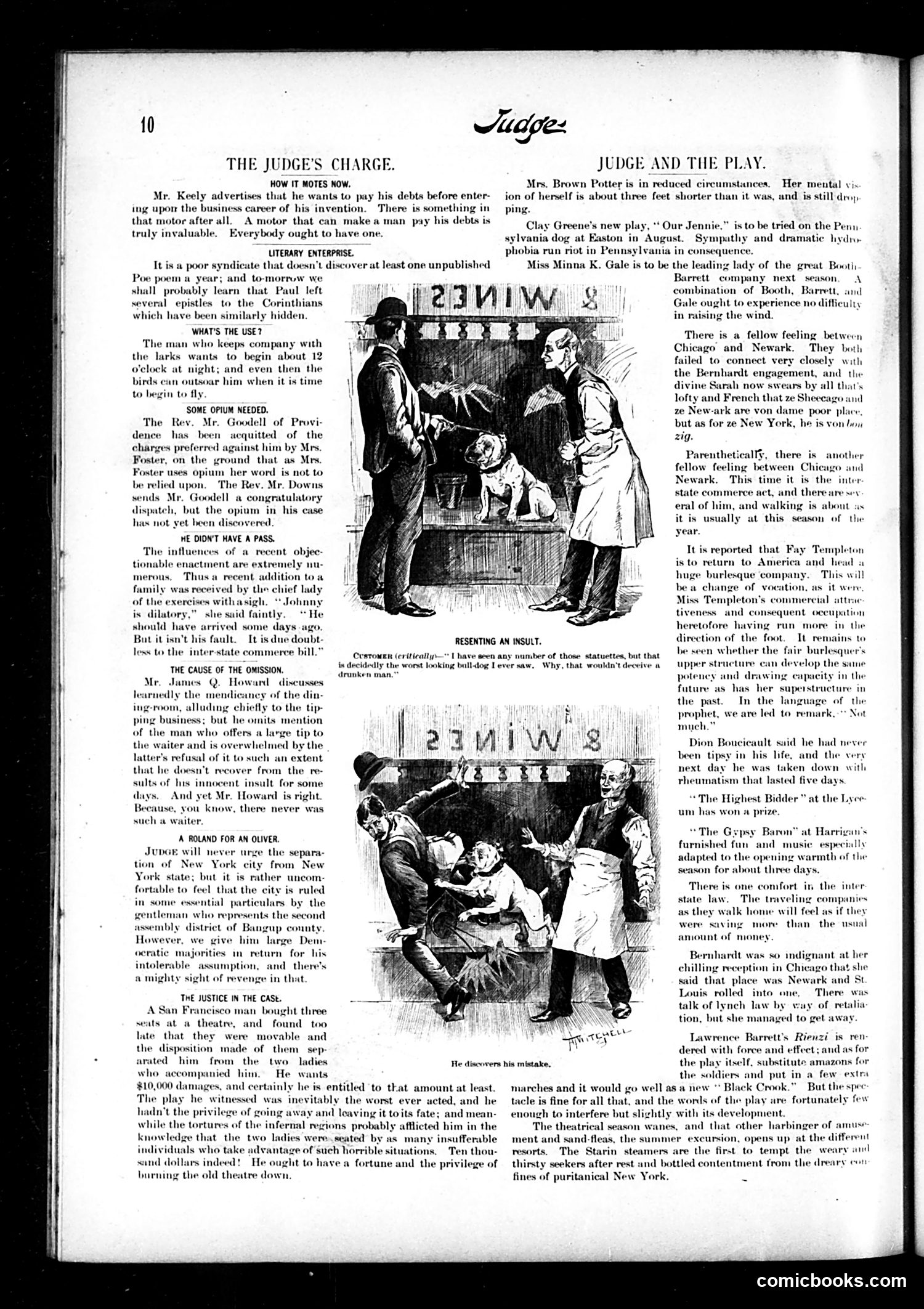
This page from *Judge* magazine contains satirical commentary on various contemporary topics (circa 1880s-90s based on references): **Main Cartoons:** Two illustrated panels titled "RESENTING AN INSULT" and "He discovers his mistake" depict what appears to be a street confrontation, likely satirizing social etiquette or honor disputes of the era. **Key Satirical Pieces:** - **Keely Motor**: Mocks inventor John Keely's famous "perpetual motion" machine by joking it's remarkable only because it makes people pay debts - **Literary Enterprise**: Ridicules publishers' habit of "discovering" unpublished Poe poems annually - **Rev. Goodell Case**: References a real scandal where opium use allegedly disqualified a woman's testimony against a clergyman - **Theater Complaint**: Sarcastically supports a man's $10,000 lawsuit for moveable theater seats that separated him from companions—suggesting the play was so awful, he deserved compensation for enduring it **Tone**: Dry, cynical humor targeting credulous public figures, dubious inventions, literary fraud, and social absurdities. The magazine assumes readers recognize these contemporary scandals and figures.
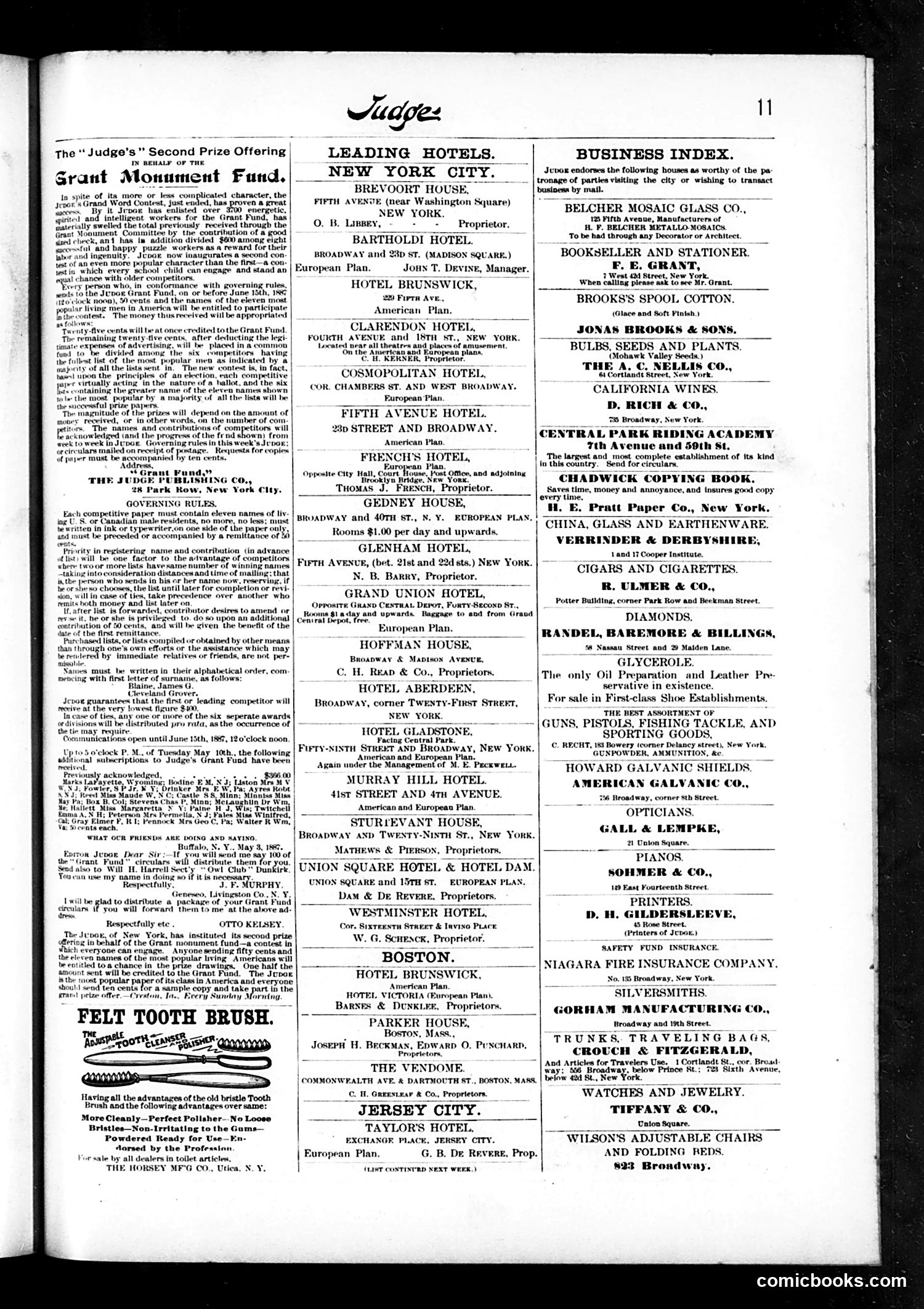
This page is primarily an **advertisement and business directory** rather than a political cartoon. The main content describes Judge magazine's fundraising effort for the Grant Monument (Ulysses S. Grant's tomb). The "Second Prize Offering" is a contest where readers submit lists of eleven names of popular living Americans for 50 cents; half proceeds support the Grant Monument Fund. Winners receive cash prizes based on how many "popular" names they correctly predict. The bottom portion contains a **felt tooth brush advertisement** promoting its advantages over traditional bristle brushes, and an extensive **hotel and business directory** for New York City, Boston, and Jersey City establishments. There is **no apparent political cartoon or satirical commentary** on this page—it's functional commercial content demonstrating how 19th-century magazines mixed editorial contests with advertising to generate revenue while supporting charitable causes.
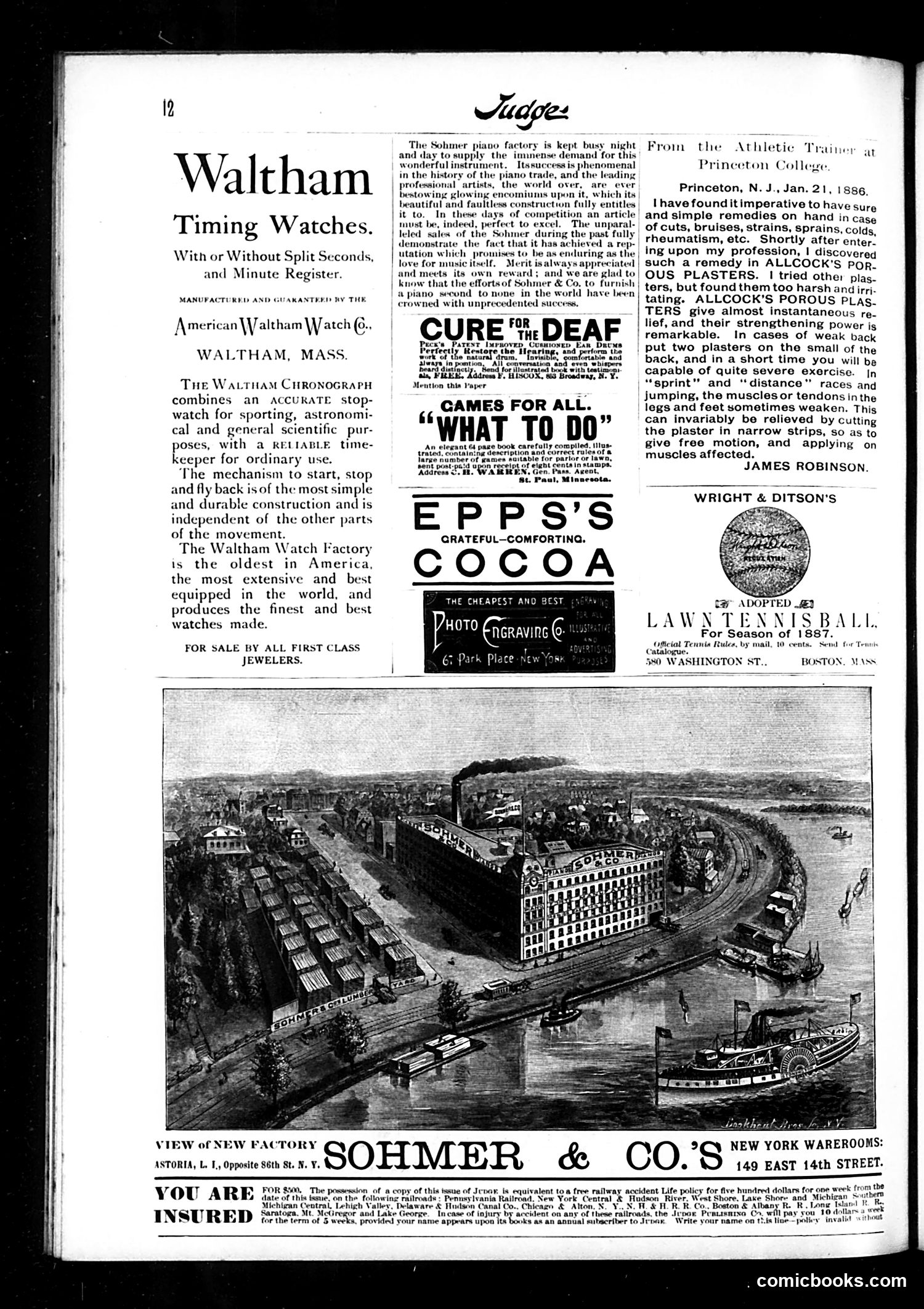
This is primarily an **advertising page** rather than a satirical cartoon page. The dominant content consists of commercial advertisements for products and services popular in the 1880s. **Key Advertised Products:** - Waltham timing watches (American manufacture, positioned as superior) - Sohmer pianos (large factory view illustration dominates the page) - Allcock's Porous Plasters (medical remedy endorsed by Princeton's athletic trainer) - Epps's Cocoa - Wright & Ditson's lawn tennis balls - Photo engraving services **Notable Feature:** At bottom, Judge includes a novel insurance gimmick: possession of that issue of Judge functions as a free railway accident life insurance policy ($20 value) for subscribers traveling on major railroads. This reflects both the era's dangerous rail travel and Judge's creative marketing approach. **Historical Context:** The advertisements reveal 1880s consumer culture—pianos as status symbols, medicinal plasters as standard athletic supplies, cocoa as comfort drink, and tennis as emerging leisure activity for the prosperous classes. No political satire or caricature appears on this particular page.
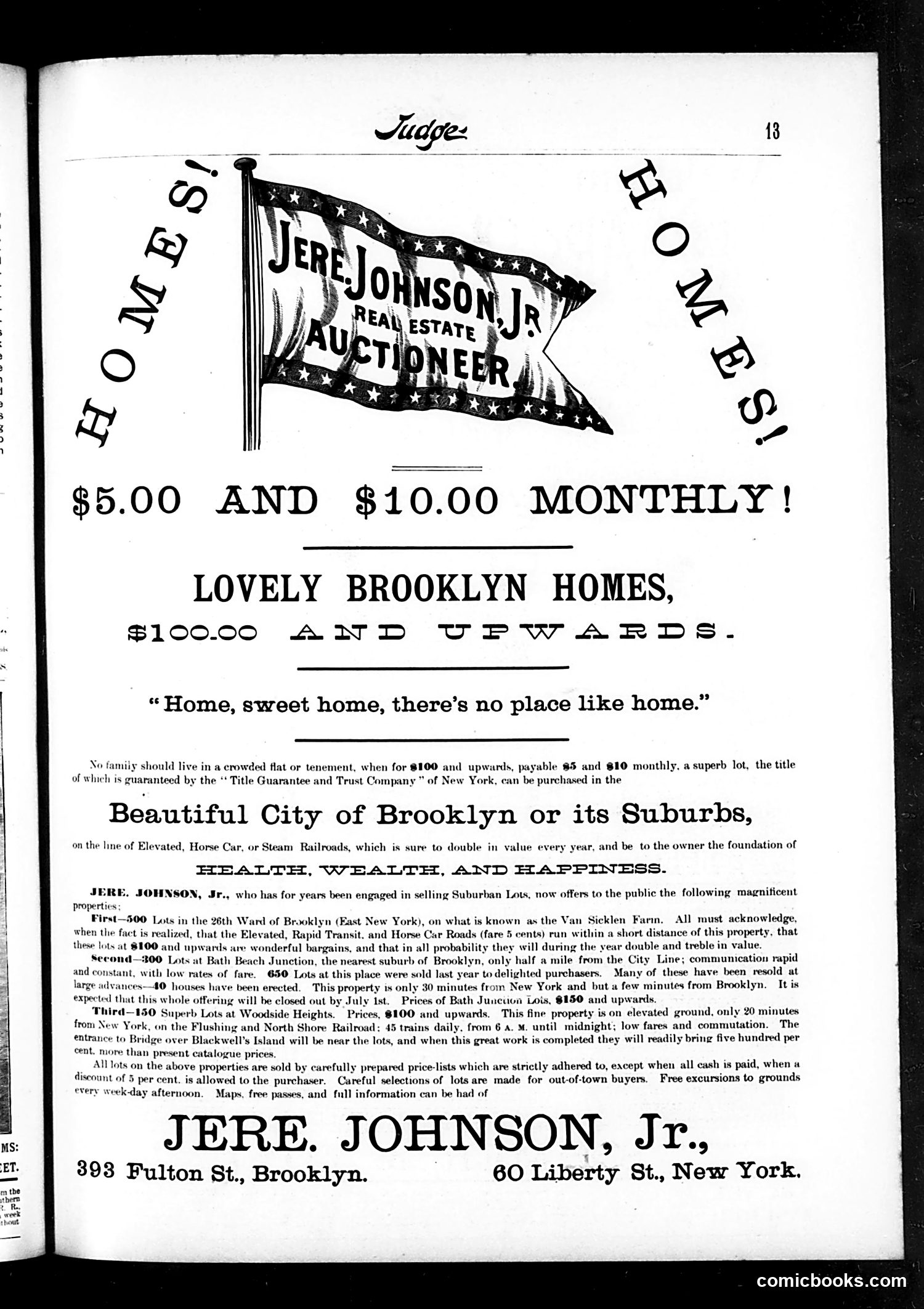
This page is primarily **real estate advertising**, not political satire. It promotes Brooklyn suburban properties by real estate agent Jere Johnson Jr., appearing in *Judge* magazine around the late 19th century. The ad uses patriotic imagery (American flag banner) and the idealistic phrase "Home, sweet home, there's no place like home" to market affordable lots ($100+ with $5-$10 monthly payments) in Brooklyn developments. It emphasizes that new transportation infrastructure—elevated railways, horse cars, steam railroads—will double property values and bring "health, wealth, and happiness." The appeal targets working and middle-class families seeking to escape crowded urban tenements. Three specific developments are pitched: Van Sicklen Farm in East New York, Bath Beach Junction, and Woodside Heights, each promising rapid transit access and appreciating value. While not explicitly satirical, the ad's breathless optimism about suburban investment and guaranteed prosperity reflects the speculative real estate boom of the Gilded Age—a phenomenon *Judge* might have satirized elsewhere.
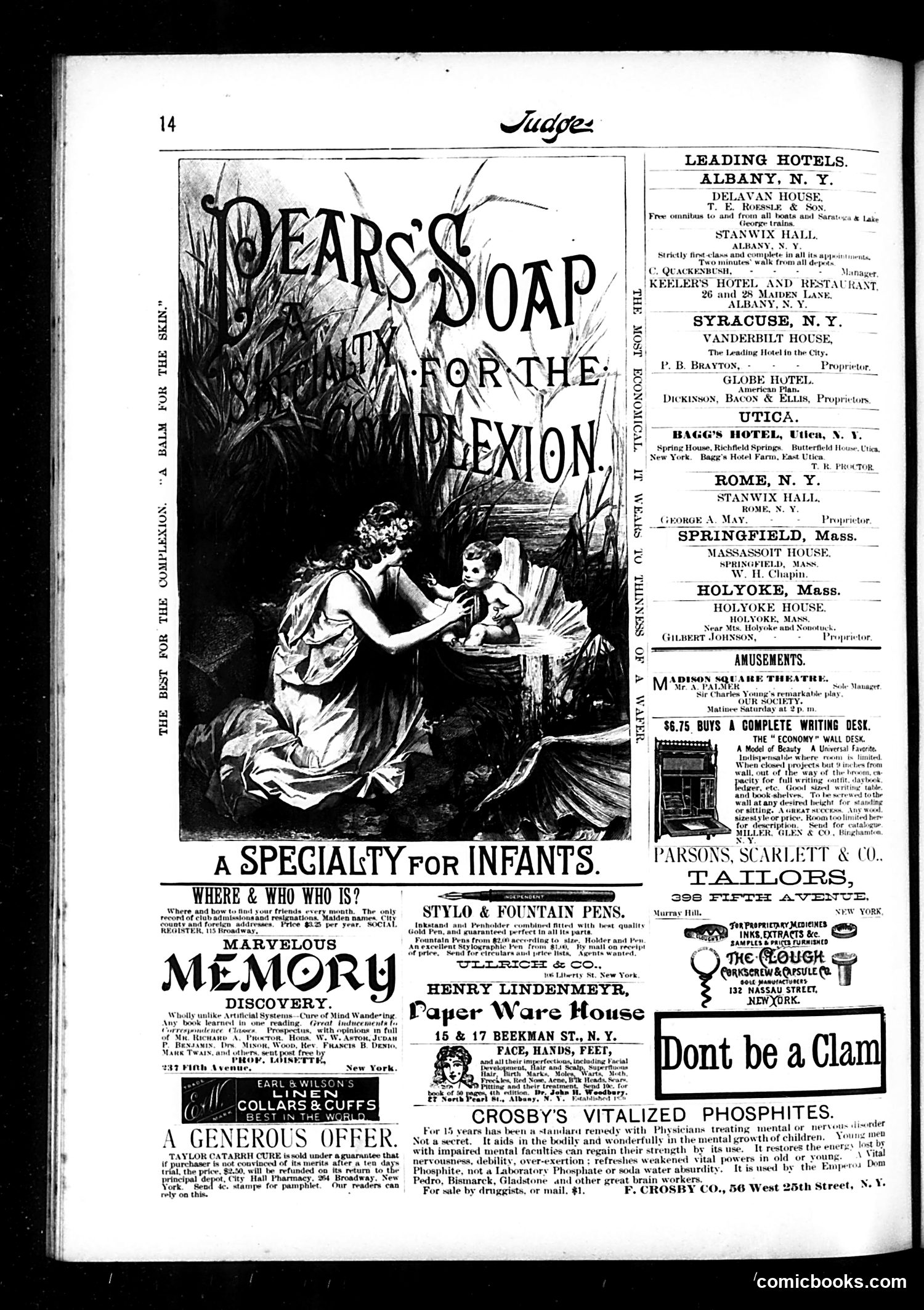
This page is primarily **advertising**, not editorial content or satire. The dominant image is a large product advertisement for "Dear's Soap for the Complexion"—a Victorian-era beauty product marketed as a "specialty for infants." The illustration depicts a classical allegorical scene: a woman (possibly representing beauty or motherhood) with a cherub, rendered in a romantic engraving style typical of 19th-century product marketing. The remainder of the page consists of hotel listings (Albany, Syracuse, Utica, Rome, Springfield, Holyoke) and various commercial advertisements for goods including fountain pens, paper warehouse supplies, tailoring services, and patent medicines like "Crosby's Vitalized Phosphites" (marketed for mental development in children). **The satirical content, if any, is minimal.** The page reflects the commercial character of *Judge* magazine, which relied heavily on advertising revenue. The patent medicine ads are typical of the era, though modern readers would recognize many such products as medically dubious or harmful by today's standards.
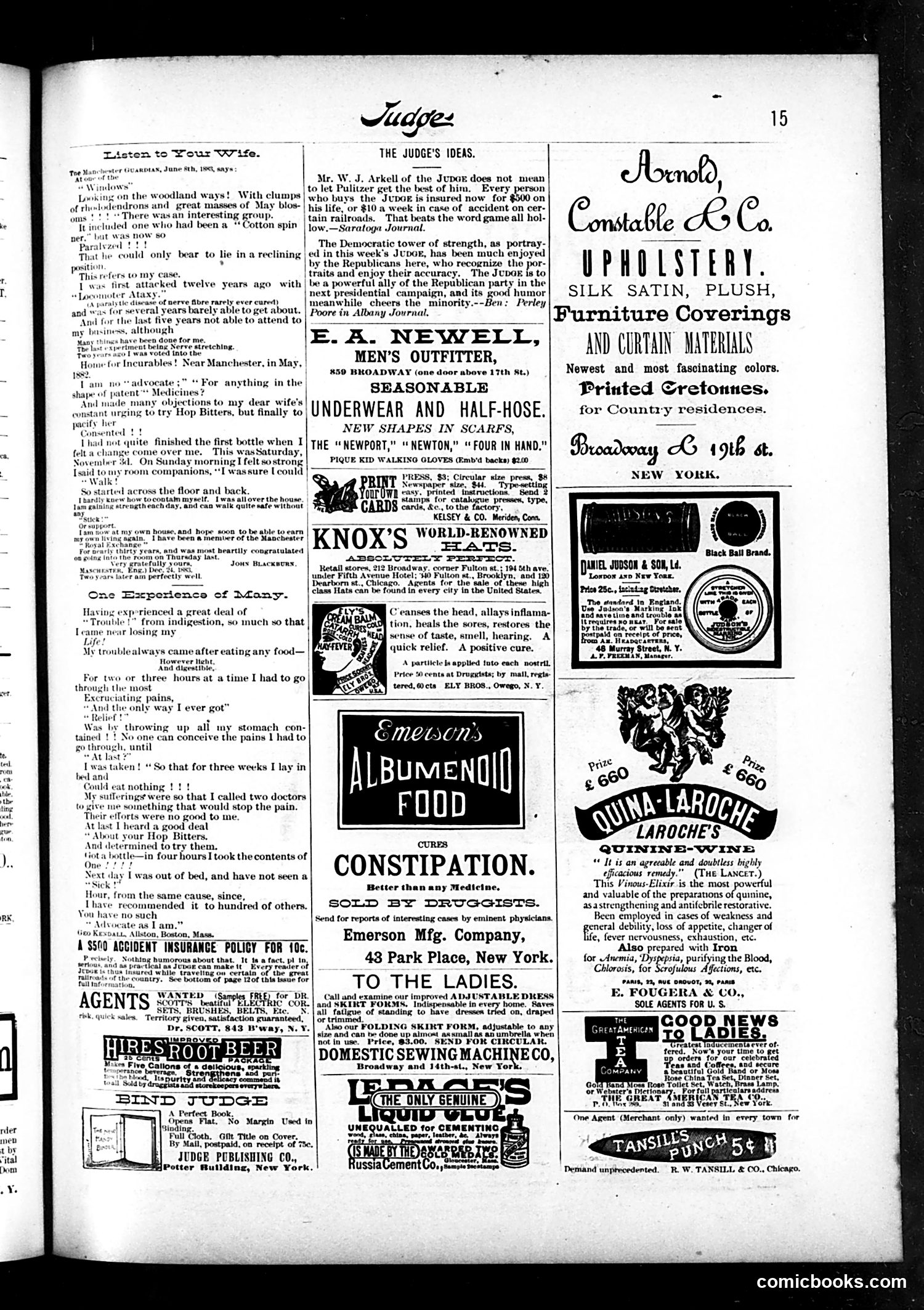
This is primarily a **advertisements and editorial page**, not a satirical cartoon page. The substantive content relates to the magazine's competition with *The World*, Pulitzer's newspaper. In "The Judge's Ideas," editor W.J. Arkell announces that *Judge* now offers readers $500 life insurance or $10 weekly accident coverage—framed as beating Pulitzer's "word game." The accompanying editorial quotes (attributed to contemporary sources like Saratoga Journal) praise the magazine's "Democratic tower of strength" political cartoons as effective Republican campaign tools. Otherwise, the page consists of period advertising: men's clothing (E.A. Newell), hats (Knox), medical products (Emerson's Albumenoid Food for constipation), and dress forms. The testimonials for Hop Bitters describe digestive remedies—typical 19th-century patent medicine marketing. The page documents *Judge's* early corporate strategy: using insurance as a reader incentive while establishing itself as a Republican political voice.
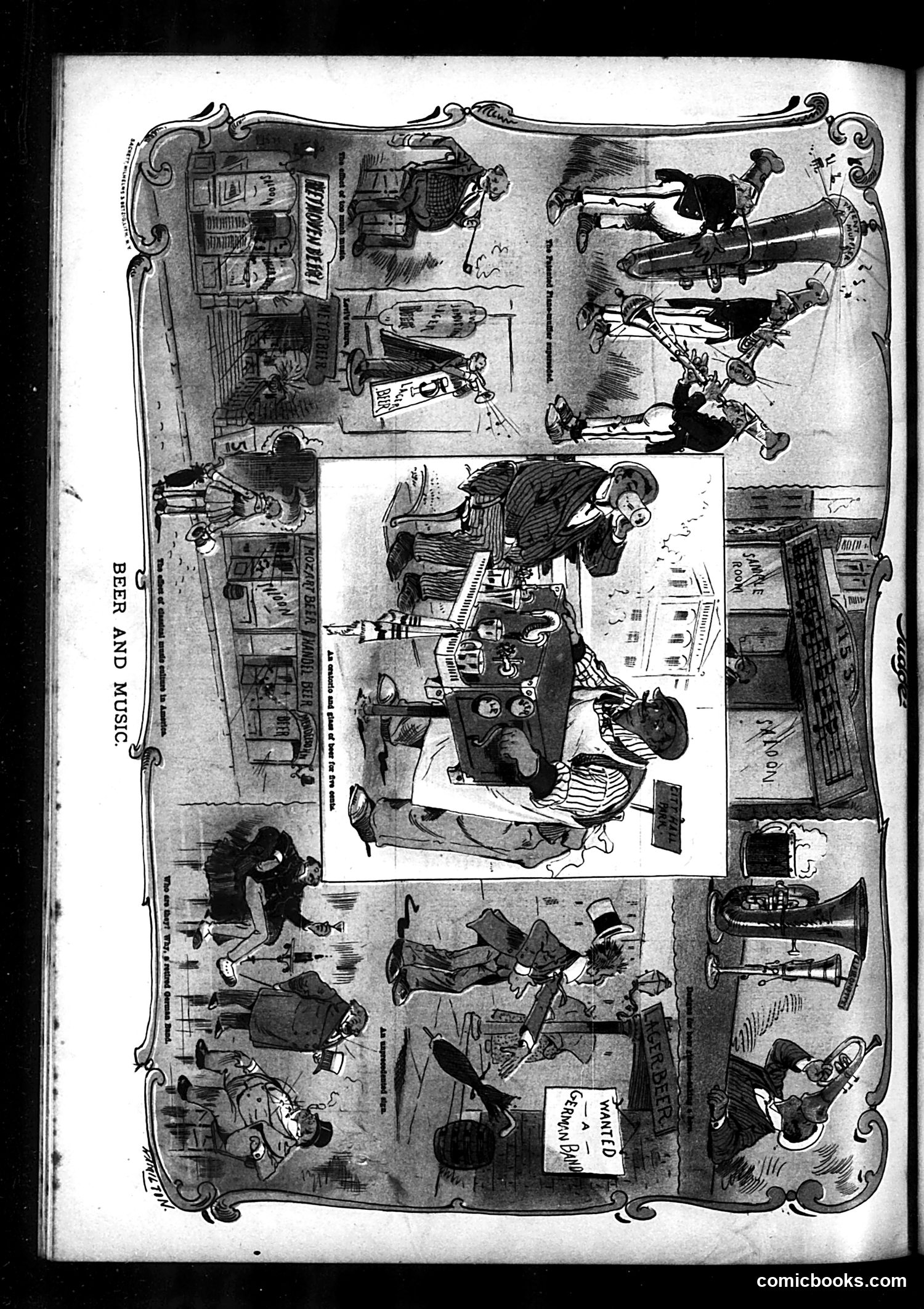
This appears to be a satirical cartoon page titled "Beer and Music" depicting scenes of German-American cultural life, likely from the late 19th or early 20th century. The page shows various vignettes of beer halls, musical performances, and social gatherings featuring German immigrants or German-Americans. The satire likely mocks German cultural stereotypes popular in America at that time—excessive beer consumption, loud music, boisterous behavior, and distinctive German fashions and customs. The ornate decorative border and multiple comic panels suggest Judge magazine's typical format of social commentary through exaggerated caricature. Without clearer OCR text or visible caption details, the specific individuals or events referenced remain unclear, but the overall message appears to be gentle ethnic humor about German-American community life and traditions.