
Judge, 1887-05-21 · page 5 of 16
Judge — May 21, 1887 — page 5: what you’re looking at
What you’re looking at
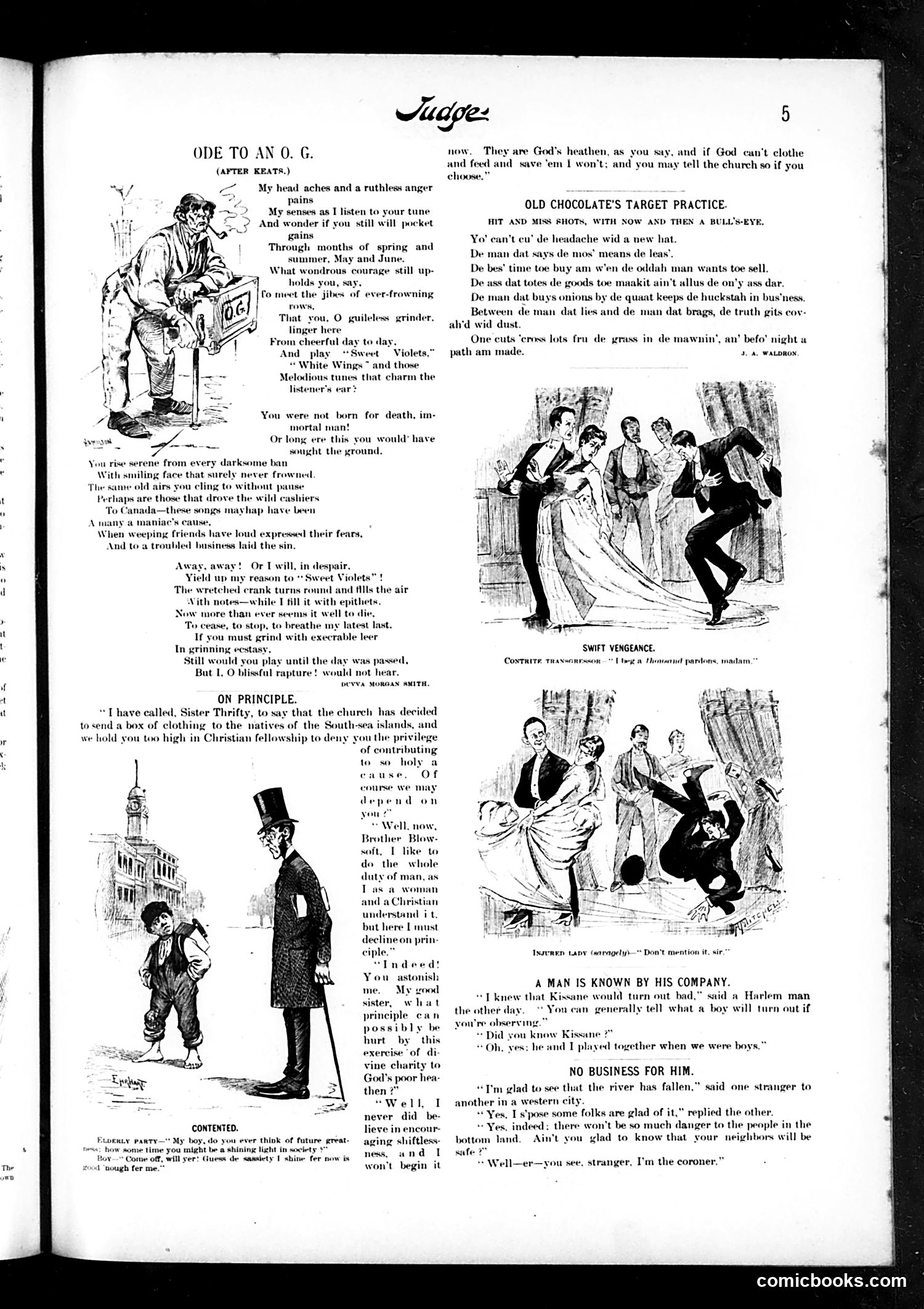
This page from Judge contains several satirical pieces reflecting late 19th/early 20th-century social attitudes: **"Ode to an O.G."** mocks a street organ grinder—a common urban nuisance of the era. The poem, styled after Keats, sarcastically praises this "guileless grinder" while complaining about his repetitive, maddening music played throughout seasons. **"On Principle"** satirizes selective Christian charity. Sister Thrifty solicits donations for South Sea Island missionaries, but Brother Blowsoft refuses on "principle"—likely implying hypocrisy: he'll contribute to foreign missions but not local poor relief, or he opposes the evangelical work itself. The joke exposes inconsistent moral reasoning. **"Old Chocolate's Target Practice"** presents folk wisdom in dialect, presumably from an African American character, offering practical observations about commerce and human nature. The remaining cartoons address social dynamics: company's influence on character, and a coroner's darkly ironic lack of enthusiasm about fewer river deaths (fewer bodies to process). The page reflects period attitudes including casual racism and class-based humor typical of Gilded Age publications.
📄 Transcribed text from this page (OCR, searchable)
Machine-transcribed from the original scan — historical spelling and the odd misread are preserved.
wliape- 5 ODE TO AN 0. G. (AFTER KEATS.) 7 My head aches and a ruthless anger pains My senses as I listen to your tune 2 And wonder if you still will pocket gains Through months of spring and summer, May and June. What wondrous courage still up- ds you, say, er-frowning That you, O guileless grin linger here From cheerful day to day, And_ play weet Violets,” “ White Wings * and those Melodious tunes that charm the listener's ear You were not born for death, im- a Or long ere this you would’ have = night the ground. You rise serene from every darksome ban With ing face that surely never frowned The same old airs you cling to withont pause haps are those that drove the wild cashiers hap have been expressed their fears, id the sin, Or Twill, in despair, § lets” ! rank turns round and fills the air le T fill it with epithets. yw more than ever seems it well to die, To cease, to stop, to breathe my latest last. If you must grind with execrable leer In grinning ecstasy, Still would you play until the day was passed, But 1, O blissful rapture! would not hear. DEVVA MOROAN AMITHL, ON PRINCIPLE. “Thave called, rr Thrifty, to say that the church has decided tosend a box of clothing to the natives of the South-sea islands, and we hold you too high in Christian fellowship to deny you the privilege of contributing to so holy a cause, Of course we may depend on yeu? © Well, now, Brother Blow- soft, [like to do the whole duty of man, as T as a wom and a Christian understand it but here L must decline on prin ciple. ‘Indeed! sister, principle can possibly be hurt by | this exercise of di vine charity to God's poor hea then 7” “Well, I never did be- CONTENTED. lieve in encour- Etoenty ranty—" My boy, do you ever think of future ereat- aging shiftless- Vs: how some time you might be a shining light in society a ‘Come off, will yer! Guess de samicty | bine fer now in NESS, UE 1 uough fer me.” won't begin it now. They are God's heathen, as you say, and if God can't clothe and feed and save ‘em I won't; and you may tell the chureh so if you choose OLD CHOCOLATE’S TARGET PRACTICE. HIT AND MISS SHOTS, WITH NOW AND TH! Yo" can't cu’ de headache wid a new hat. dat says d * means de leas’. -s' time toe buy am wien de oddah man wants toe sell. s dat totes de goods toe maakit ain't allus de on’y ass dar, De man dat buys onions by de quaat keeps de huckstah in bus’ness. Between de man dat lies and de man dat brags, de truth gits cov- ah’d wid dust. One cuts ‘ers lots fru de grass in de mawnin’, an’ befo’ night a path am made. SWIFT VENGEANCE. ContRrite TRaNeanrsson °F beg a th Ixseren tapy (aaragely)—" Don't mention it, sir.” A MAN IS KNOWN BY HIS COMPANY. “TL knew that Kissane would turn out bad,” said the other day ly tell what a boy will turn out if you're observing.” “= Did vou know Kissane 2” Oh, yes: he and T played together when we were boy NO BUSINESS FOR HIM. “T'm glad to see that the river has fallen,” another in a western city. ** Yes, I s'pose some folks are glad of it,” replied the other. “Yes, indeed: there won't be so much danger to the people in the bottom land. Ain't you glad to know that your neighbors will be said one stranger to ++ Well—er—you see, stranger, I'm the corone: comicbooks.com