
A complete issue · 16 pages · 1887
Judge — February 12, 1887
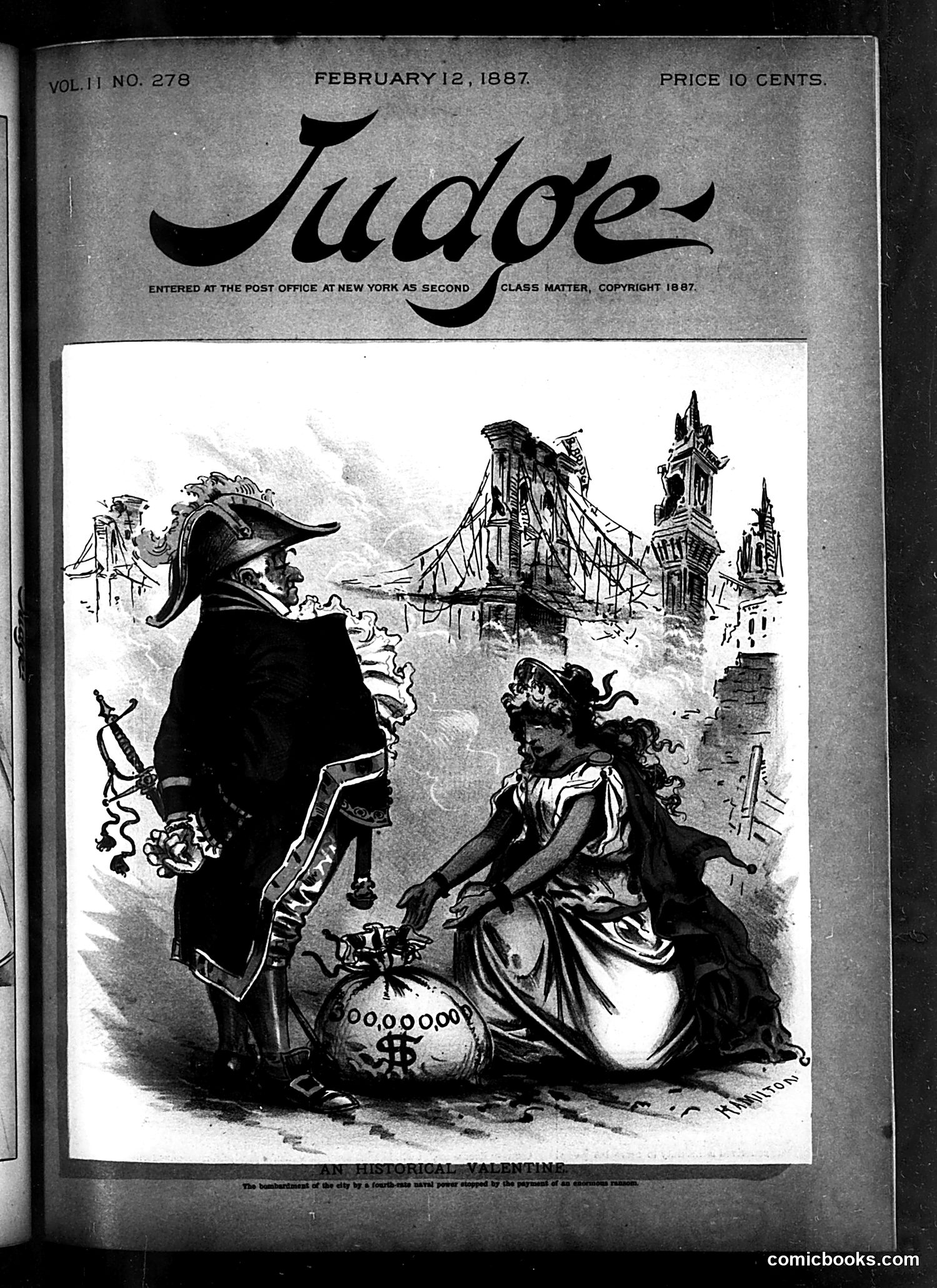
This satirical cartoon depicts a military or political figure (wearing a bicorne hat and formal dress) presenting an offering to a female personification of a city. The woman sits atop a large money bag marked with dollar signs, suggesting wealth or municipal funds. The title "Historical Valentine" and the cityscape background (featuring a prominent bridge and church spires, likely New York) indicate this comments on municipal corruption or fiscal mismanagement. The military figure appears to be offering tribute or attempting to gain favor through financial means—a commentary on how city funds were being extracted or misappropriated, possibly through military contracts or corrupt dealings between political/military leadership and city treasuries during the Gilded Age.
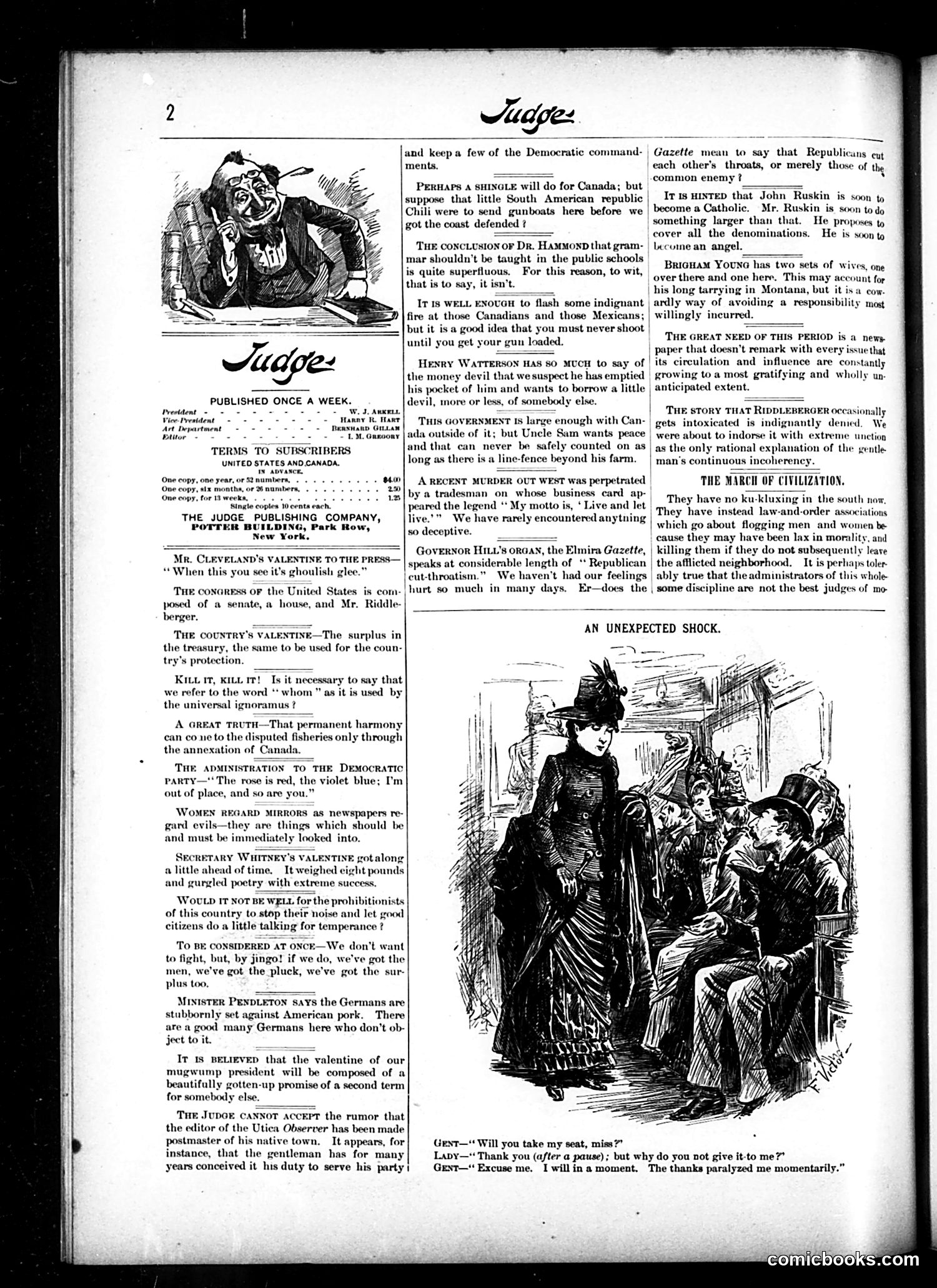
This page contains political commentary and satirical text rather than a single coherent cartoon. The top illustration appears to be a caricatured figure, though its specific target is unclear from the image alone. The text column discusses various political topics including: criticism of Democratic commandments, concerns about Canada and South American republics, grammar instruction in schools, and references to "Henry Watterson" regarding the "money devil." There's mention of treasury surplus and fisheries disputes. The lower illustration, titled "AN UNEXPECTED SHOCK," depicts a gentleman offering his seat to a lady on what appears to be public transportation. The caption jokes about social courtesy—he offers his seat but then refuses to give it up, claiming he'll "in a moment" while thanking her sarcastically for "paralyz[ing]" him. The page appears primarily focused on political opinion pieces rather than cohesive satirical cartooning.
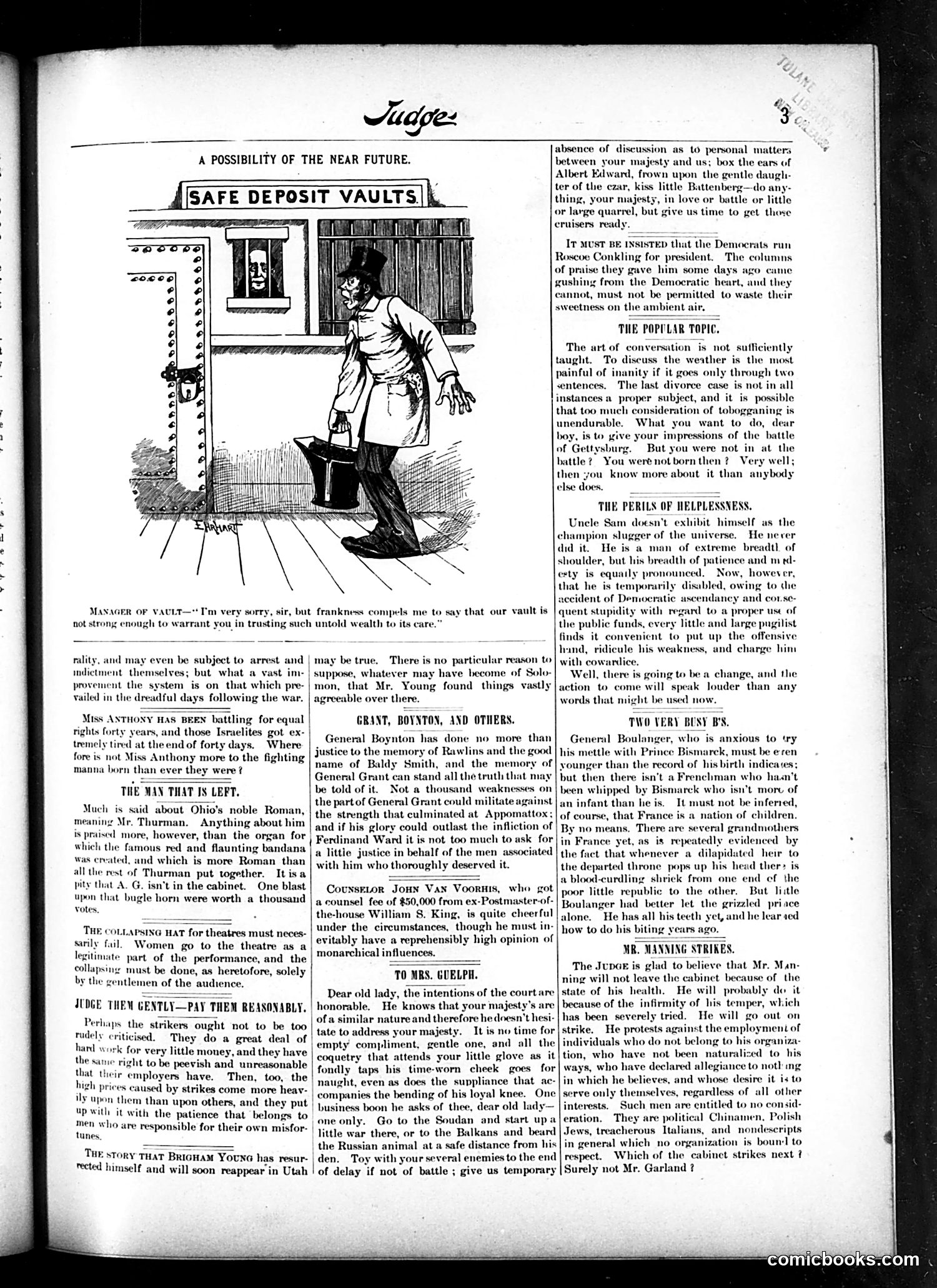
The main cartoon depicts a vault manager apologizing to a customer, explaining their safe deposit vault cannot secure "untold wealth" because the vault itself might be arrested or indicted—a satirical jab at post-Civil War financial instability and government corruption. The surrounding commentary includes topical jabs: criticism of Ohio politician Thurman; commentary on labor strikes and workers' wages; references to Brigham Young and Mormon Utah; General Grant's reputation amid the Ferdinand Ward financial scandal; and a mocking "letter" to Queen Victoria (addressed as "Mrs. Guelph"), suggesting she distract herself and the British public with minor foreign conflicts rather than meddle in British domestic politics. The satire targets 1880s-era political figures, financial scandals, and international tensions. Without specific dates visible, the references to Grant and recent labor unrest suggest this is from the early 1880s.
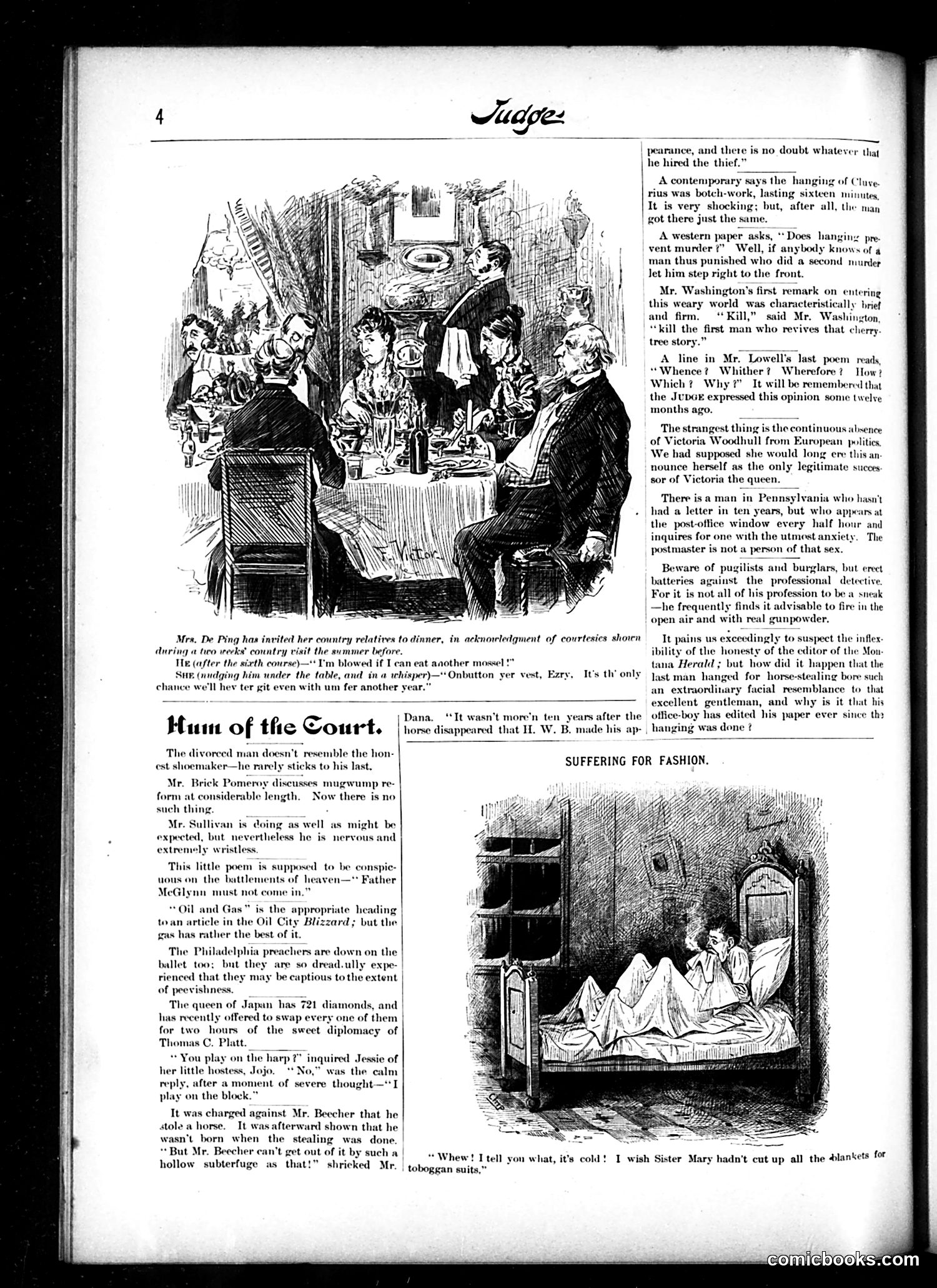
This page from the satirical magazine *Judge* contains two main elements: **Upper cartoon ("Hum of the Court"):** Depicts rural country relatives invited to dinner by their wealthy city cousin. The humor plays on class contrast—the unsophisticated guest (Ezry) is overwhelmed by multiple courses and whispers to loosen his vest, while his wife suggests they'll need to "get even" by reciprocating hospitality. This satirizes the awkward social dynamics between rural and urban Americans during the Gilded Age. **Lower cartoon ("Suffering for Fashion"):** Shows a woman in bed shivering, regretting that her sister cut up blankets for fashionable toboggan suits (winter clothing). The satire mocks the era's obsession with fashion at the expense of practical comfort and household necessities. The scattered commentary between sections contains typical *Judge* humor—brief satirical jabs at public figures, social pretensions, and contemporary events. The overall tone reflects late-19th-century American class consciousness and gender-based humor.
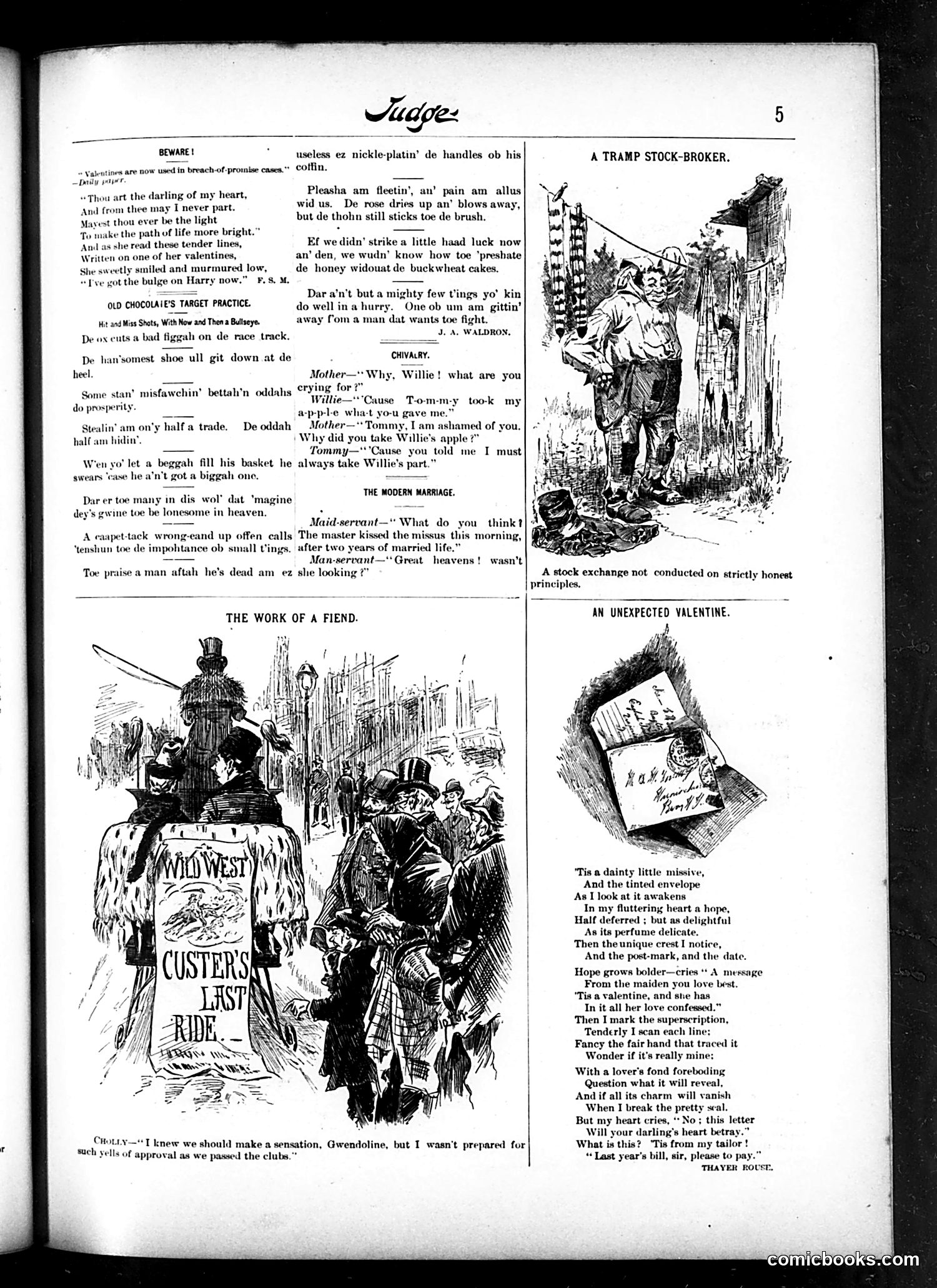
This page contains several satirical pieces typical of late 19th-century American humor: **"Old Chocolate's Target Practice"** presents racial dialect humor (common but offensive by modern standards), offering folk wisdom in exaggerated African American vernacular—a format Judge frequently used for philosophical observations. **"Chivalry"** jokes about children misinterpreting parental instruction: Tommy takes Willie's apple because his mother told him to always support Willie. **"The Modern Marriage"** satirizes marital disillusionment—a servant expresses shock that a master kissed his wife after two years, suggesting affection typically dies quickly in marriage. **"The Work of a Fiend"** (cartoon) depicts Custer's Last Ride as a Wild West show spectacle, satirizing commercialized entertainment of frontier violence. **"An Unexpected Valentine"** presents ironic romance—a man anticipates a love letter but discovers it's his tailor's overdue bill notice, a common comedic trope about disappointed expectations. The overall theme emphasizes disillusionment: lost romance, betrayed hopes, and harsh realities beneath surface pleasantries.
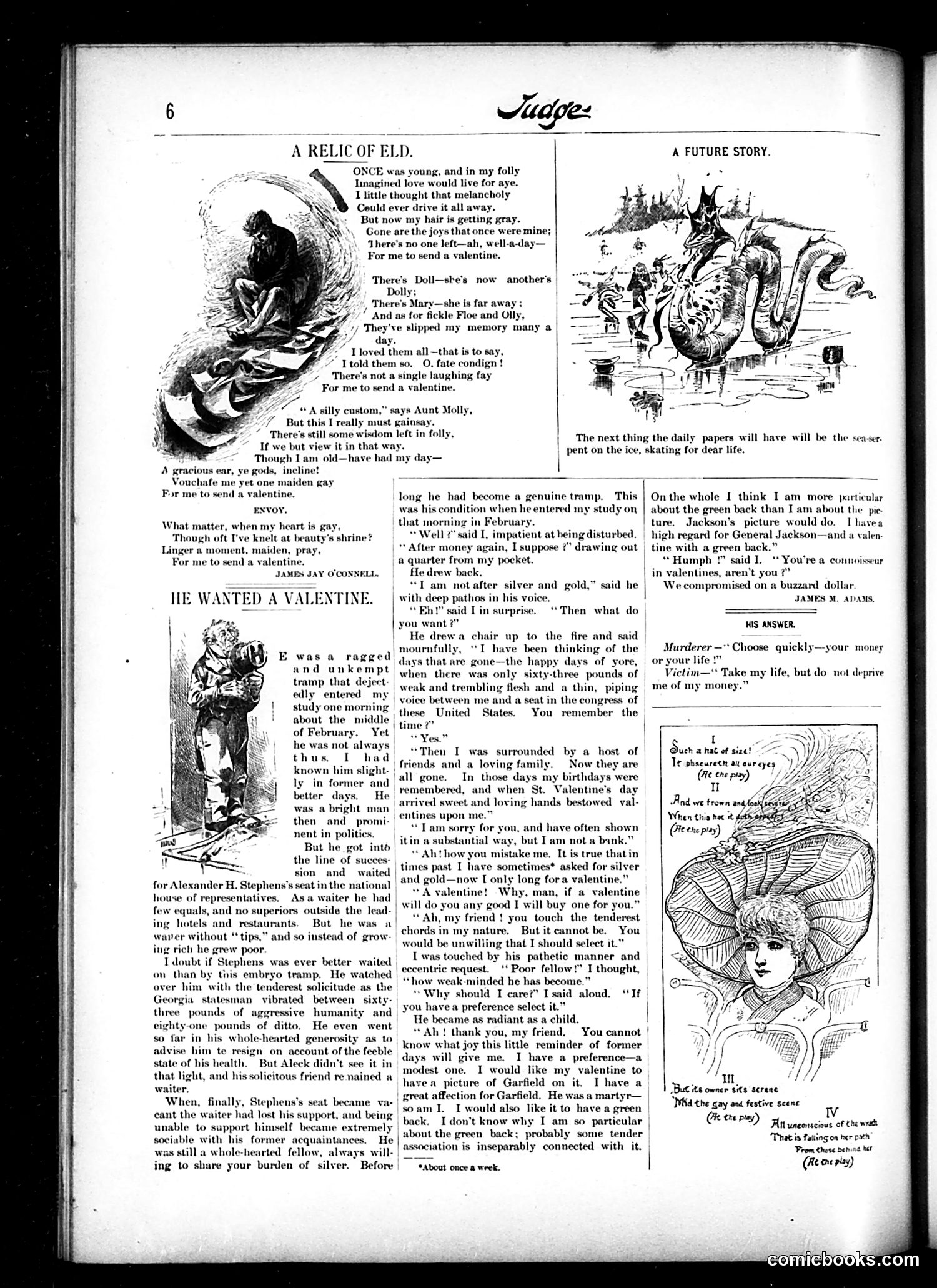
This page contains satirical verse and a story satirizing post-Civil War American politics, specifically Georgia Reconstruction politics. **"A Relic of Eld"** is a sentimental poem about aging and lost love—nostalgic satire on romantic decline. **"He Wanted a Valentine"** is the main satire. It tells of a ragged tramp who was formerly a waiter to **Alexander H. Stephens**, a prominent Georgia politician and former Confederate Vice President. The story lampoons how Stephens's political career—he sought succession to his House seat—depended on this devoted supporter. When Stephens lost his position, the waiter lost his livelihood and became destitute, despite his loyal service. The tramp's final request for a "valentine" rather than money is the bitter joke: the once-dignified man has been reduced to seeking emotional scraps instead of material aid. The satire criticizes how politicians abandoned loyal followers and the precarious fate of those dependent on political patronage during Reconstruction.
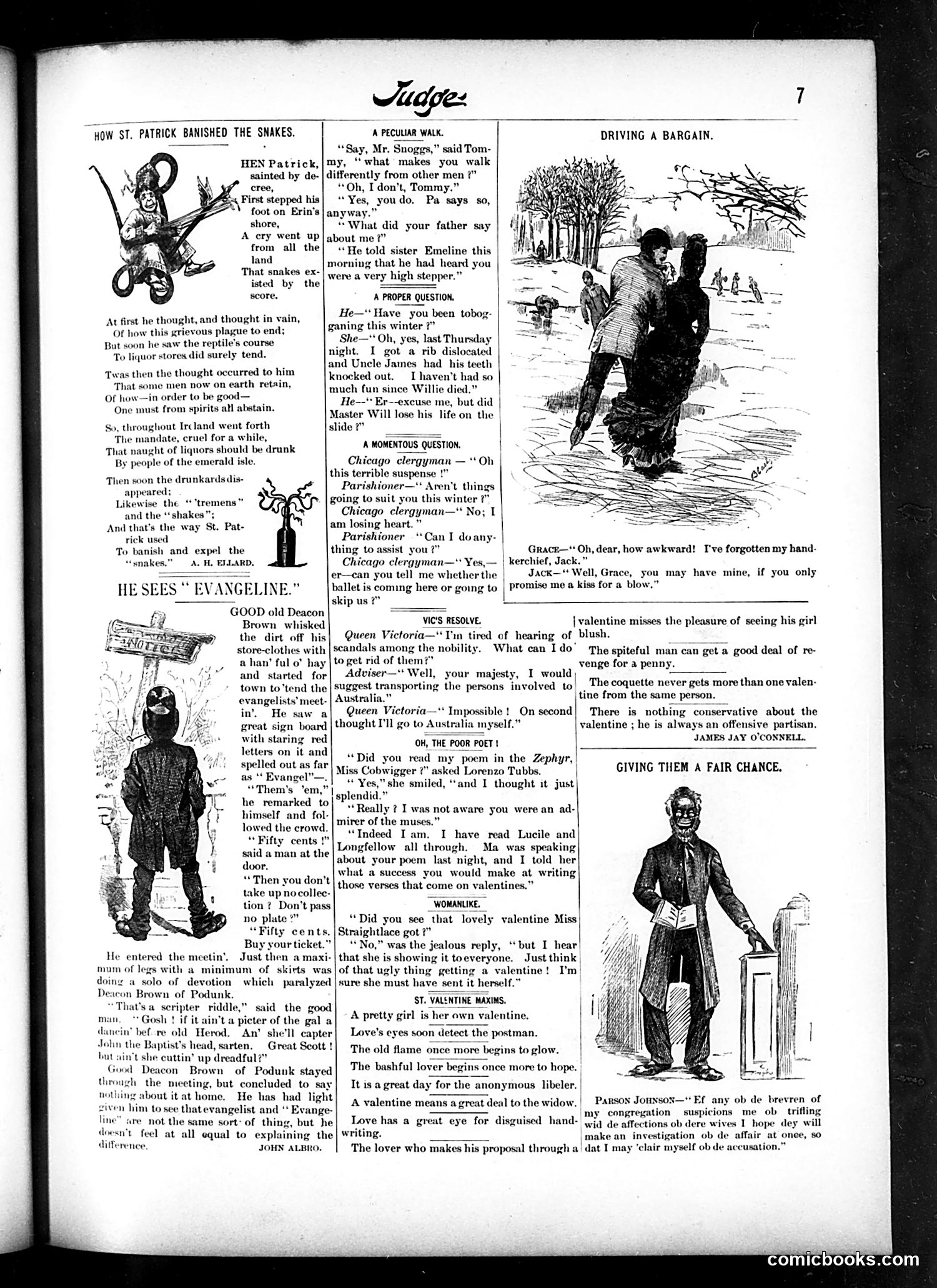
This page contains several brief satirical pieces typical of late-19th-century American humor: **"How St. Patrick Banished the Snakes"** presents a temperance allegory: St. Patrick's expulsion of Ireland's snakes is reframed as prohibiting alcohol to cure drunkenness and its associated ailments ("tremens" and "shakes"). The joke conflates literal snakes with the slang term for delirium tremens symptoms. **"He Sees 'Evangeline'"** mocks rural naivety—a country deacon attends what he believes is a religious revival but discovers it's actually a theatrical performance featuring a dancing woman. The humor lies in his confused conflation of "evangelist" and "Evangeline" (the famous poem/play). The remaining items are brief one-liner jokes about social awkwardness, flirtation, and marital situations—standard period humor. The cartoons use exaggerated illustration to emphasize the comedic misunderstandings and social pretensions being ridiculed.
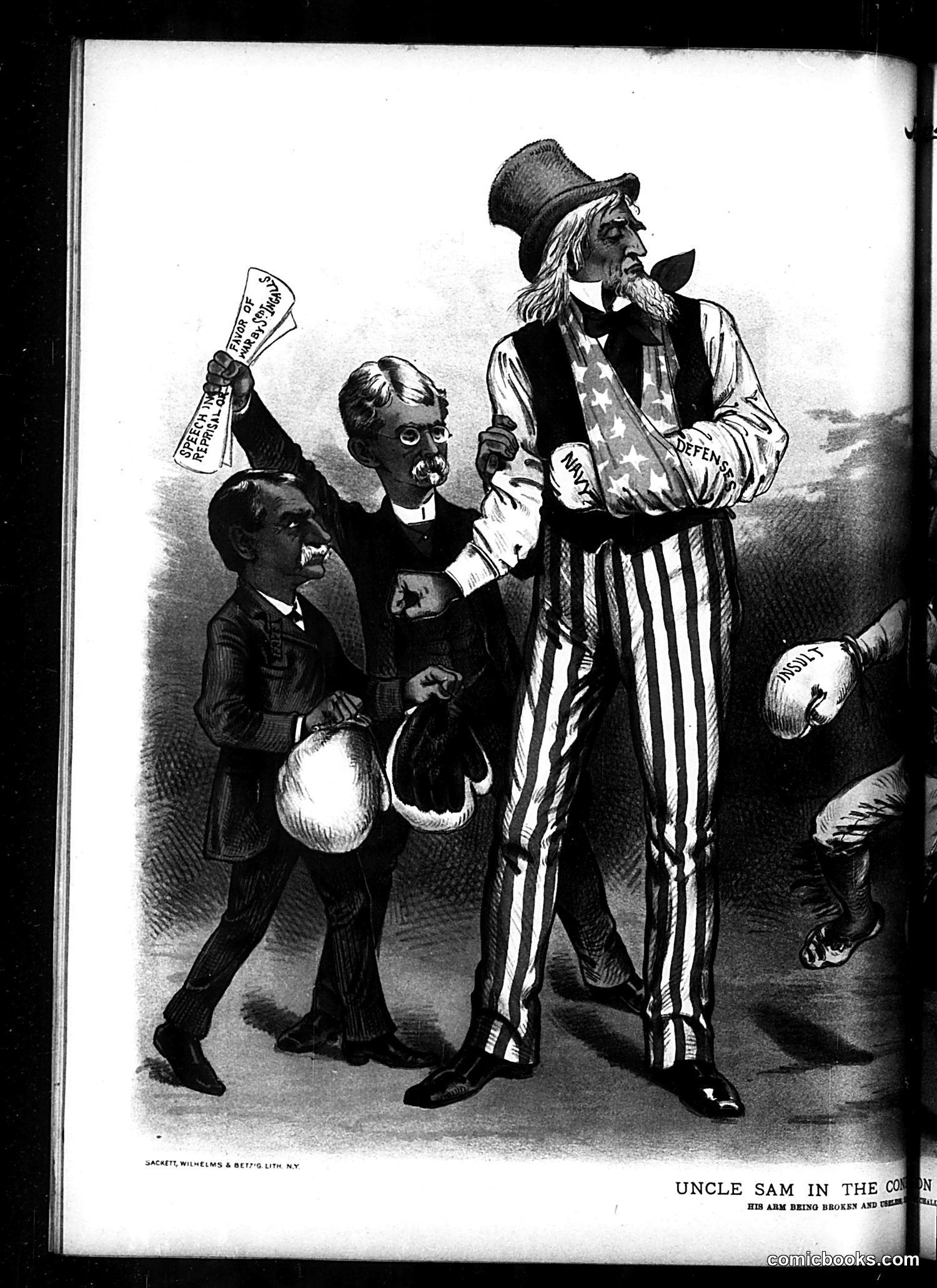
This political cartoon depicts **Uncle Sam** (tall figure in striped pants and top hat, personifying the United States) with his arm in a sling, labeled "BROKEN." He's surrounded by three smaller caricatured figures in formal dress who appear to be political opponents or adversaries. The cartoon's message is that America's power or authority has been compromised or weakened—Uncle Sam's broken arm suggests inability to act decisively. The surrounding figures seem to represent political rivals or foreign interests taking advantage of this diminished state. Without the complete caption visible, the exact historical event isn't entirely clear, but the satirical point is evident: the cartoon criticizes a perceived weakness in American leadership or military capability during a specific political moment, likely from the late 19th or early 20th century based on Judge magazine's era.
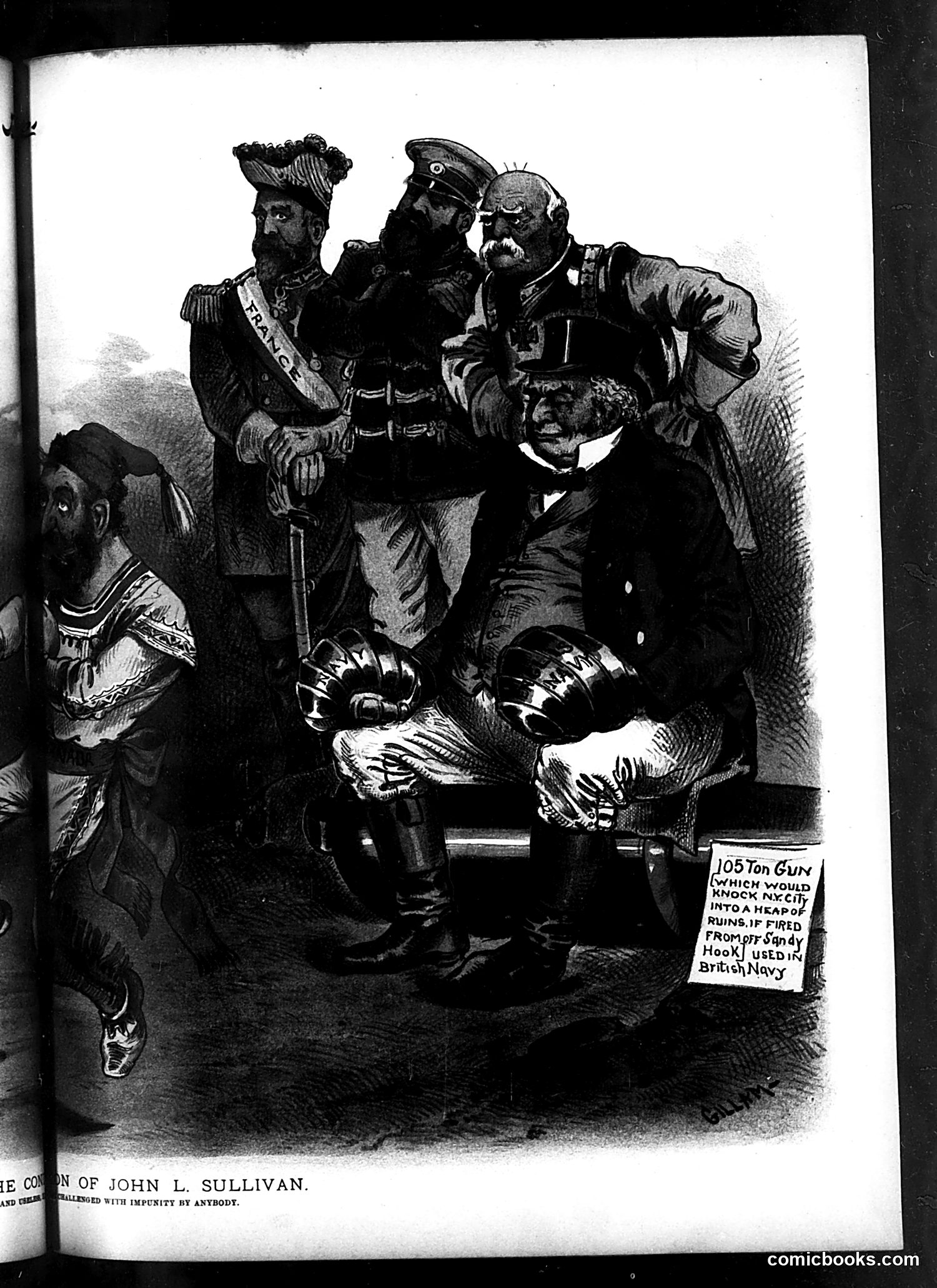
This Judge cartoon satirizes John L. Sullivan, the famous heavyweight boxing champion. The image shows military officers and officials examining or demonstrating a massive 105-ton gun capable of devastating New York City. The caption's wordplay equates Sullivan's fighting power to this destructive weapon—suggesting he's as dangerous and uncontrollable as military ordnance. The partial text mentioning the gun was "used in British Navy" indicates this references actual weapons technology of the era. The satire appears to mock Sullivan's celebrity status and fearsome reputation, treating his boxing prowess as a genuine threat to public safety. The "impunity" reference suggests criticism of his ability to escape consequences, likely referencing legal or social controversies surrounding the boxer during his career.
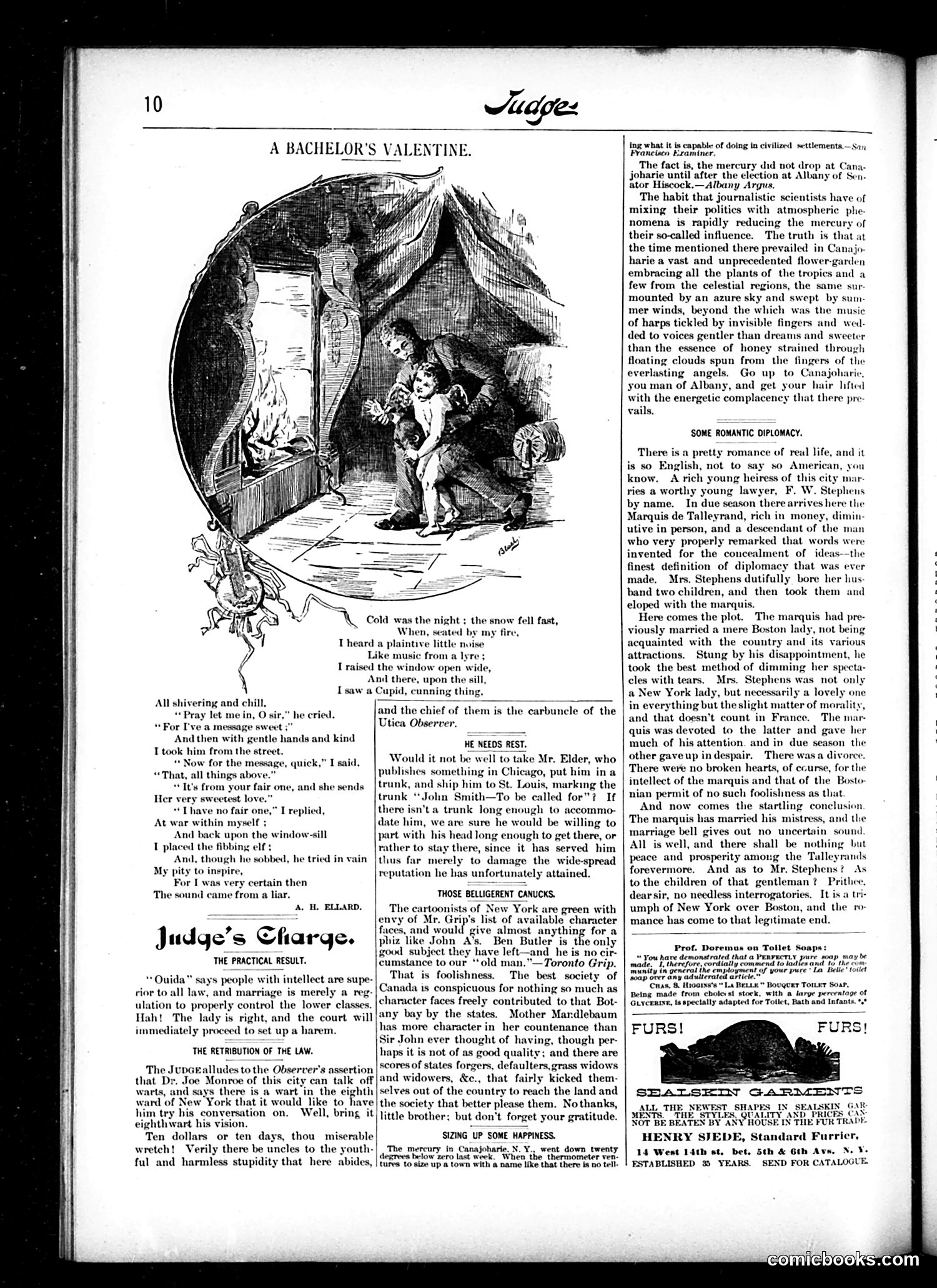
This page features a sentimental poem illustrated with a Victorian-era engraving showing a young man admitting a cupid (winged cherub) through his window on a cold night. The cupid delivers a love message from "your fair one." The accompanying satire is that the young man immediately recognizes the cupid as a liar—suggesting that romantic declarations delivered by such means are inherently false or that love messages themselves are deceptive. Below the main cartoon, **Judge's Charge** contains editorial commentary mocking various contemporary figures and publications: - Criticism of "Ouida" (a female writer) for suggesting intellect exempts people from marriage laws - Mockery of a Chicago editor named Elder for his foolish statements - A joking exchange with Toronto's *Grip* magazine about which country produces more distinctive character faces for caricature - A jab at the *San Francisco Examiner* for mixing political reporting with weather commentary regarding temperature drops in upstate New York The tone throughout is characteristic 1880s satirical journalism—witty, pointed, and topical to contemporary figures now largely forgotten.
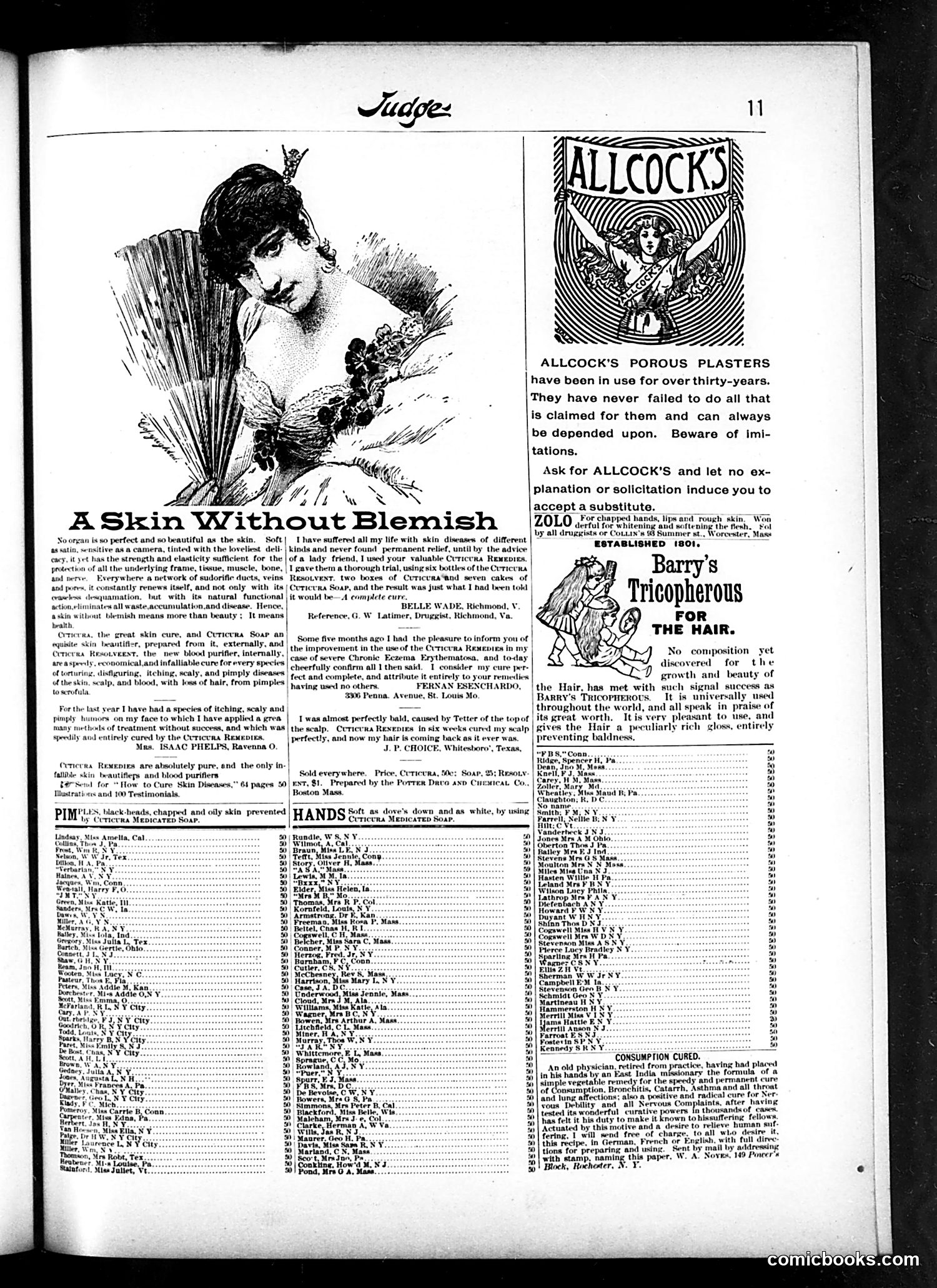
This page is primarily **advertising**, not satire or political commentary. The main content consists of testimonial ads for two patent medicines: 1. **Cuticura Remedies** (top left): Promotes a skin treatment claiming to cure various ailments—eczema, itching, pimples, baldness. It includes customer testimonials praising the product's effectiveness, a common advertising tactic of the era. 2. **Allcock's Porous Plasters** (top right): Advertises a medical plaster product, warning consumers to avoid imitations—suggesting competitor products were already common. 3. **Barry's Tricopherous** (right): Promotes a hair growth product. The page reflects late 19th/early 20th-century American consumer culture when unregulated patent medicines made extravagant health claims. These ads would appear quaint today—the vague, miraculous cures and extensive testimonial lists are hallmarks of products later restricted by the FDA (established 1906). The extensive lists of customers by location served as quasi-endorsements before modern advertising standards existed.
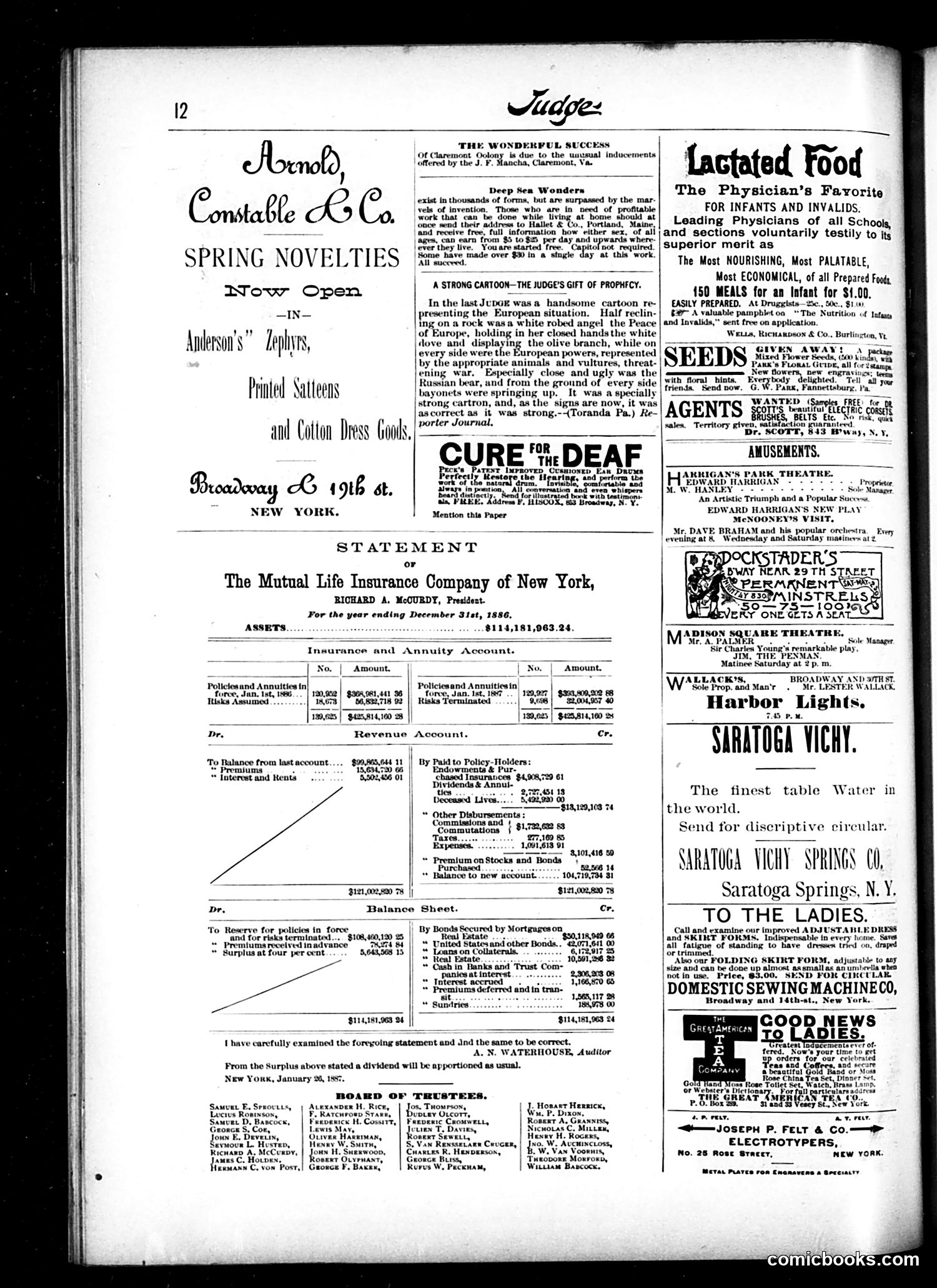
This page is primarily a **financial statement and advertisements** rather than satirical content, though it opens with a reference to Judge's editorial cartoon work. The one substantive editorial reference mentions a **previous Judge cartoon depicting the "Peace of Europe"** as a white-robed angel surrounded by threatening European powers represented as animals (notably a "Russian bear"). The cartoon warned of impending war in Europe. The text notes this prediction has proven accurate—a comment likely referencing ongoing tensions in the 1880s, possibly related to the Eastern Question or Franco-Russian relations. The bulk of the page shows the **Mutual Life Insurance Company's annual financial statement** and various period advertisements (seeds, dress goods, a "cure for deafness," lactated food for infants, theatrical performances). For modern readers: The cartoon reference suggests Judge positioned itself as prophetic political commentary on international affairs, while this largely administrative page demonstrates the magazine's role as both satirical publication and vehicle for financial notices and commercial advertising.
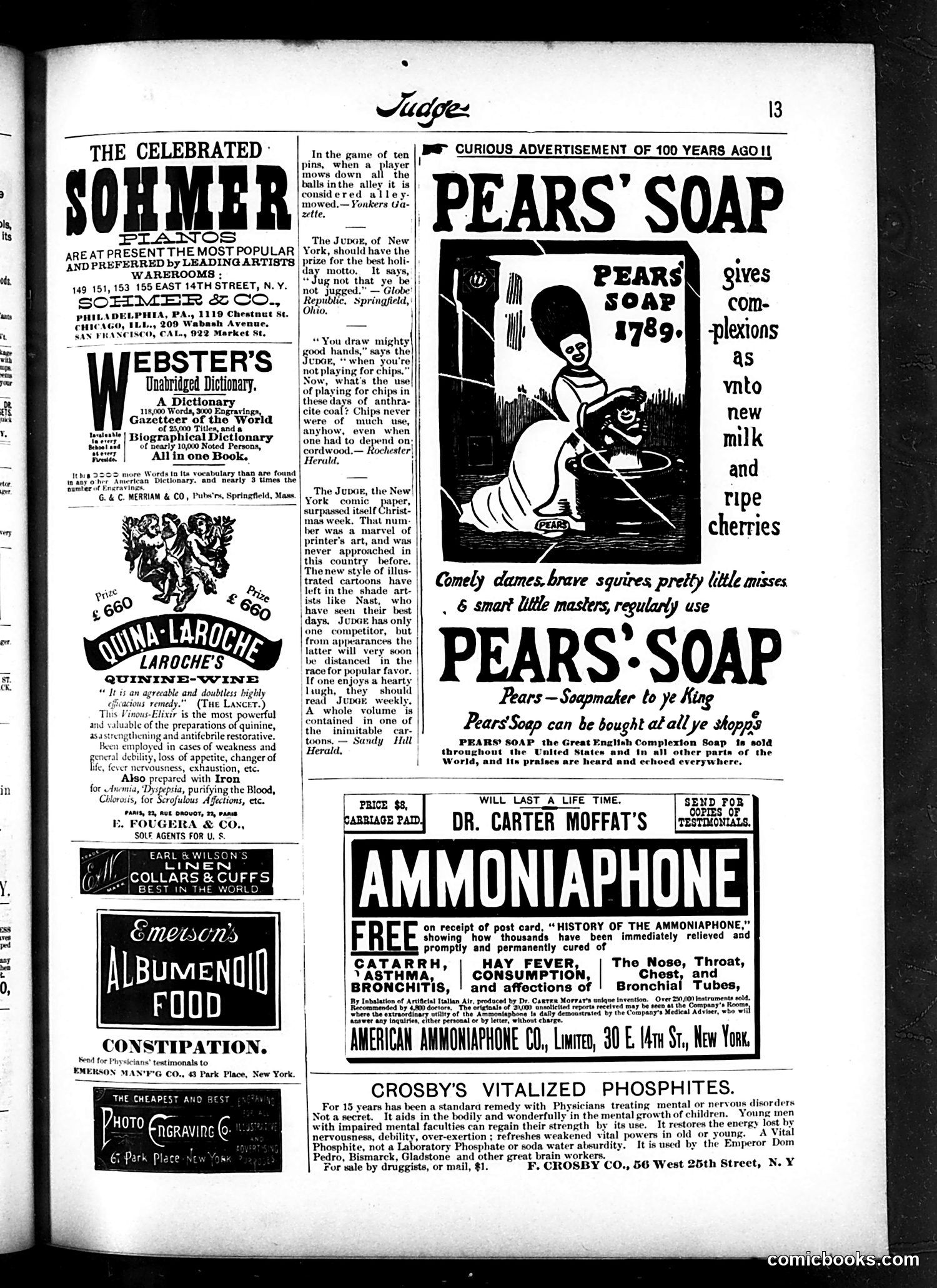
This is primarily an **advertising page** from Judge magazine, with minimal editorial content. The page is dominated by late 19th-century product advertisements. The notable elements include: **"Curious Advertisement of 100 Years Ago"** — A Pears' Soap ad from 1789, presented as a historical curiosity. The Victorian-era soap company markets their product with period language ("Pears — Soapmaker to ye King"), advertising it as a complexion soap sold worldwide. **Other prominent ads** include patent medicines (Dr. Carter Moffat's Ammoniophone for catarrh, asthma, consumption), Webster's Dictionary, Sohmer pianos, and Crosby's Vitalized Phosphites for mental disorders—typical of the era's largely unregulated and often dubious medical claims. **Small editorial jokes** scattered throughout mock contemporary topics like tenpin bowling and The Judge comic paper's artistic superiority. The page reflects Judge's business model: satirical content paired with paid advertisements from manufacturers and patent medicine companies.
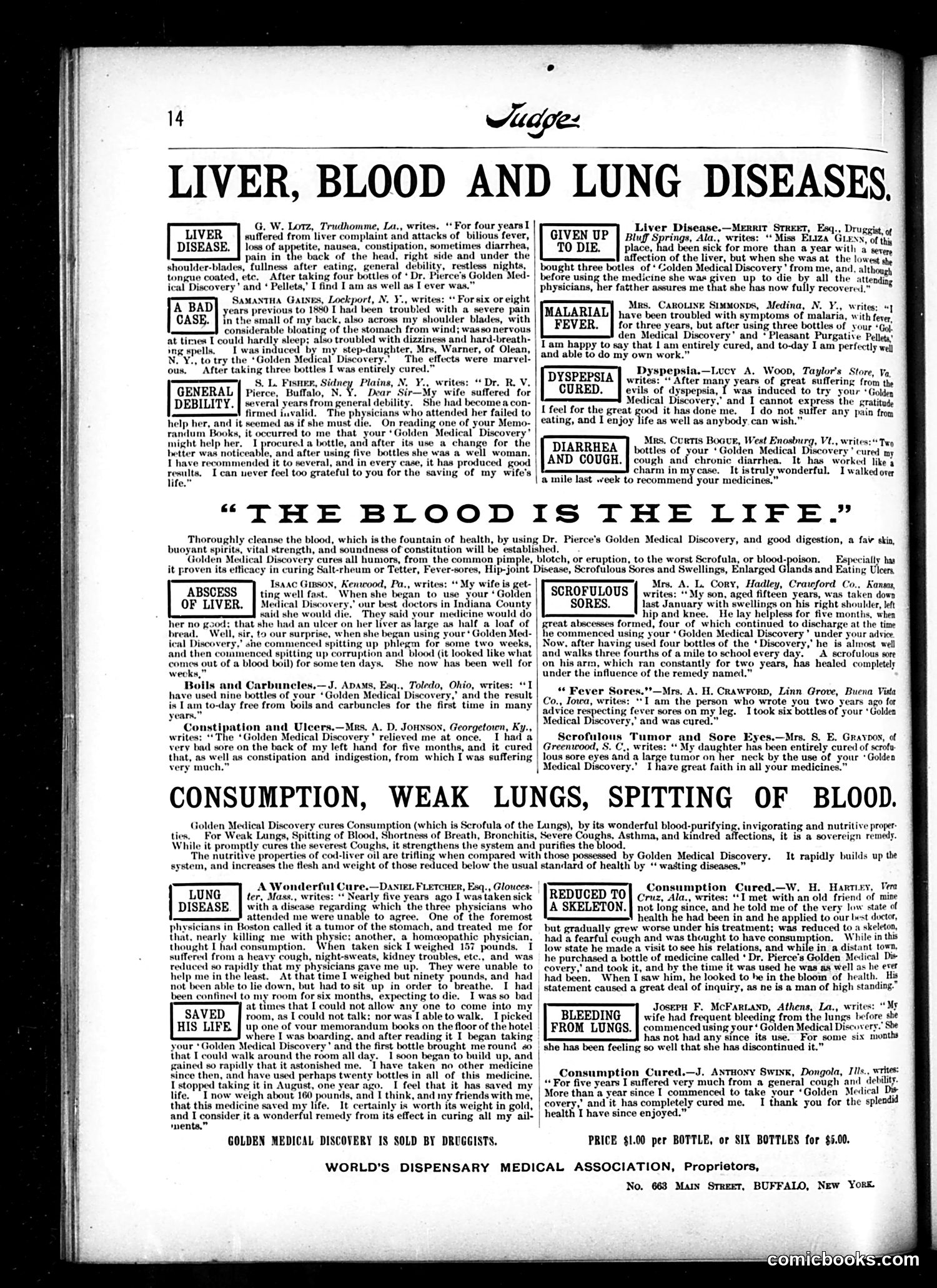
This is **not a cartoon or satirical content** — it's a full-page **patent medicine advertisement** for Dr. Pierce's "Golden Medical Discovery," published in *Judge* magazine. ## Content The page consists entirely of testimonial letters from supposed patients claiming the medicine cured various ailments: liver disease, malaria fever, dyspepsia, diarrhea, consumption, and general debility. Each testimonial includes the writer's name and location (e.g., "G. W. Lotz, Trudhomme, La."). ## Historical Context for Modern Readers This represents **turn-of-the-century patent medicine marketing** — a largely unregulated industry making extraordinary health claims. The repeated phrase "The Blood is the Life" suggests the product supposedly purified the blood as a cure-all. Such advertisements were common in magazines and often featured fabricated testimonials. The Federal Food and Drug Administration wouldn't regulate such claims until after 1906. The advertisement's presence in *Judge* — a satirical magazine — is notable but unremarkable; publications accepted such ads regardless of editorial content.
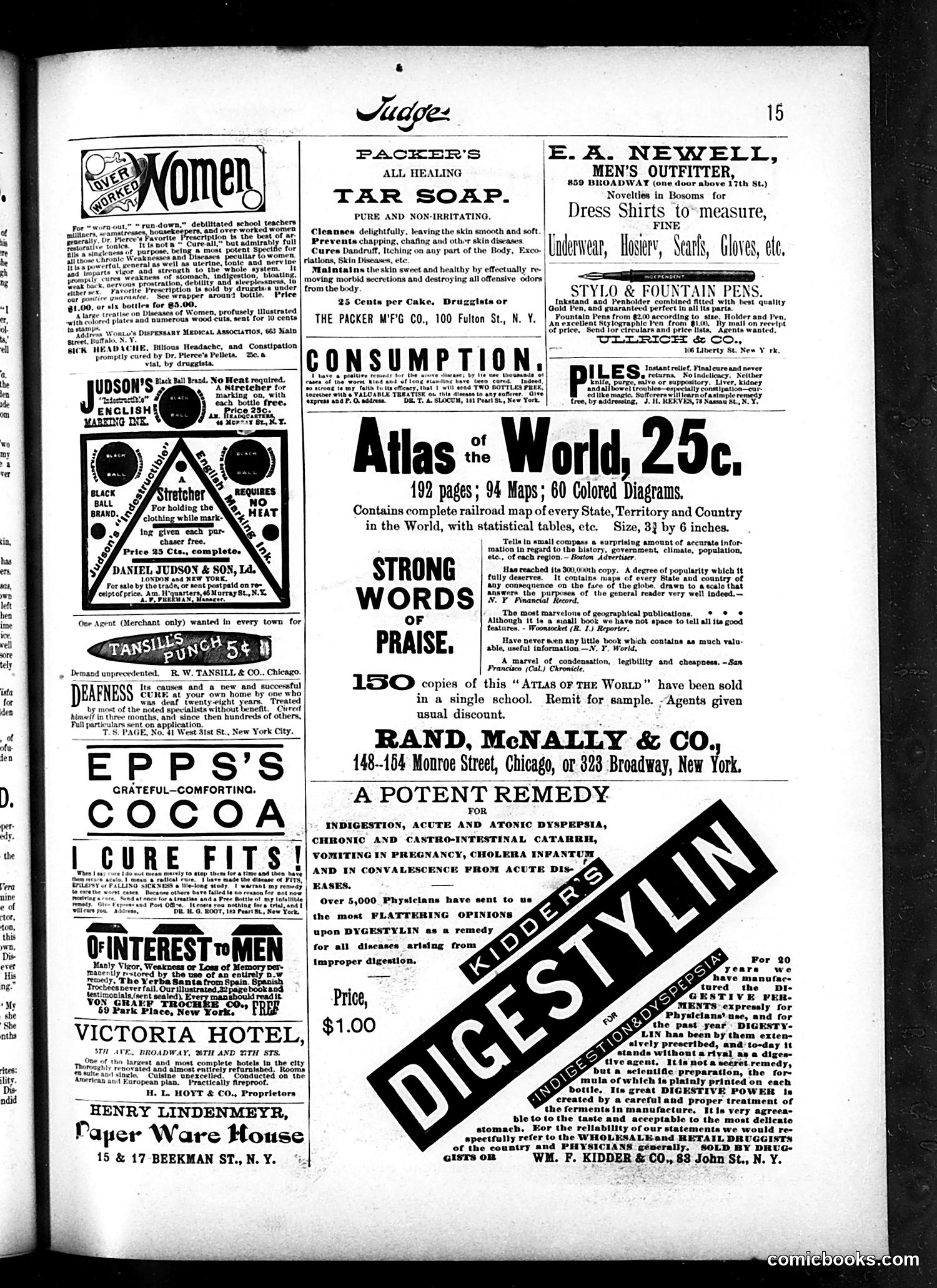
This page is **primarily advertising**, not political satire. It's page 15 from *Judge* magazine and consists almost entirely of patent medicine advertisements and commercial promotions typical of the era. The major elements include ads for: - **Packer's Tar Soap** (claiming to cure various ailments) - **Dygestylin** (a digestive remedy with prominent diagonal text, claiming endorsement from "over 5,000 Physicians") - **Epps's Cocoa**, various patent medicines, and men's clothing/accessories The satirical content of *Judge* itself isn't visible on this page. What *is* evident is the **context of turn-of-century American medicine**: extravagant, unregulated health claims, vague testimonials, and products marketed to cure everything from indigestion to "weakness." This reflects an era before FDA regulation when such advertisements were completely legal and commonplace in magazines. The page demonstrates how *Judge* sustained itself financially through advertising, not satire alone.
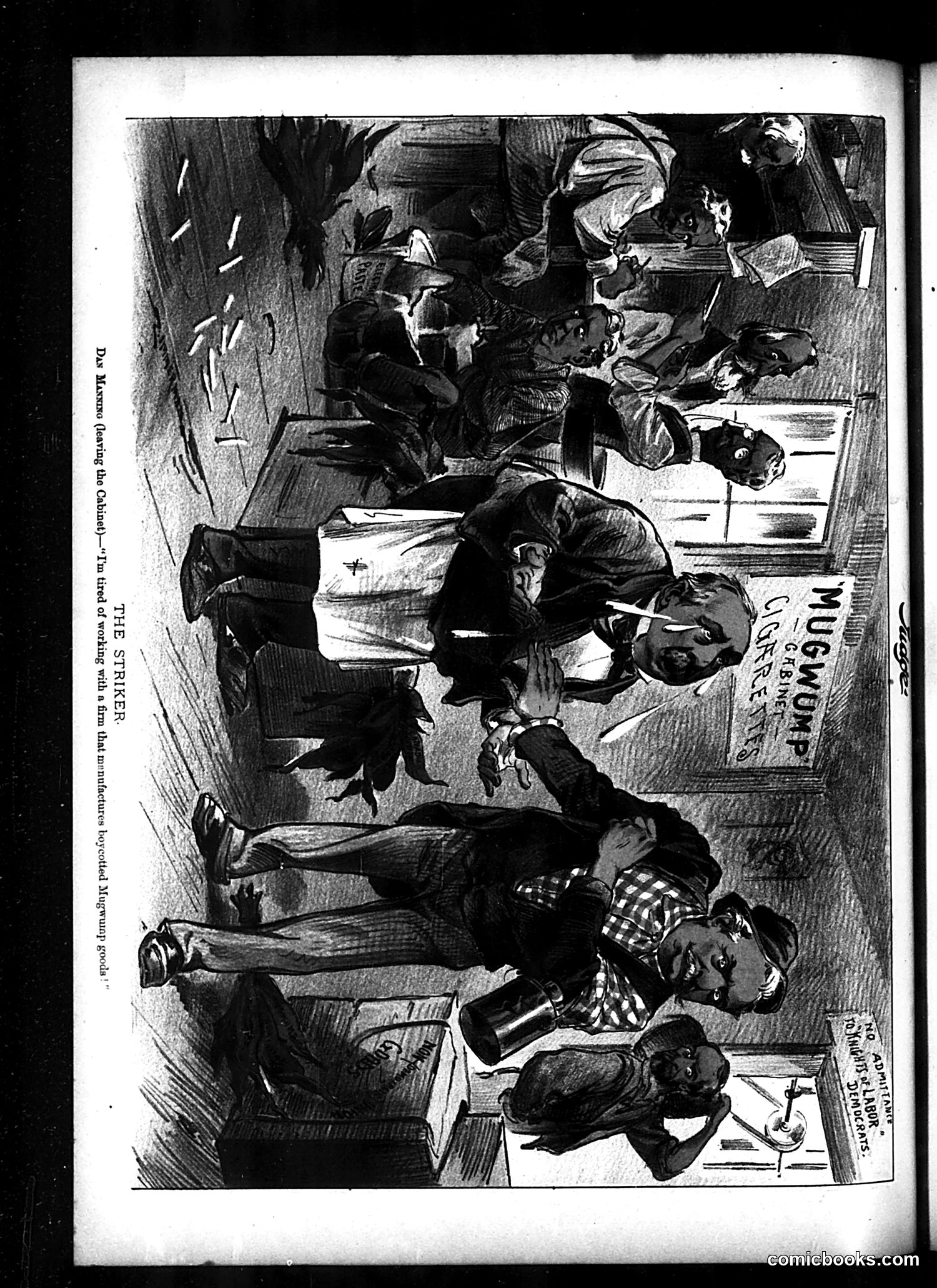
This appears to be a political cartoon from *Judge* magazine satirizing a Cabinet member's resignation. The figure labeled "Day Manning" (likely a misspelling in OCR) is depicted leaving office, complaining about working with a firm that manufactures "boycotted Mugwump goods." "Mugwump" was a derogatory term for Republican reformers and political independents in the late 19th century. The cartoon mocks someone resigning over principle—specifically objecting to association with goods linked to boycotts or reformist politics. The satire suggests the resignation is performative or hypocritical: the figure claims to oppose the "Mugwump" position while actually being willing to work within corrupt systems. The scene depicts various officials and workers in what appears to be a government or commercial setting, emphasizing the institutional nature of the complaint.