
A complete issue · 16 pages · 1886
Judge — December 18, 1886
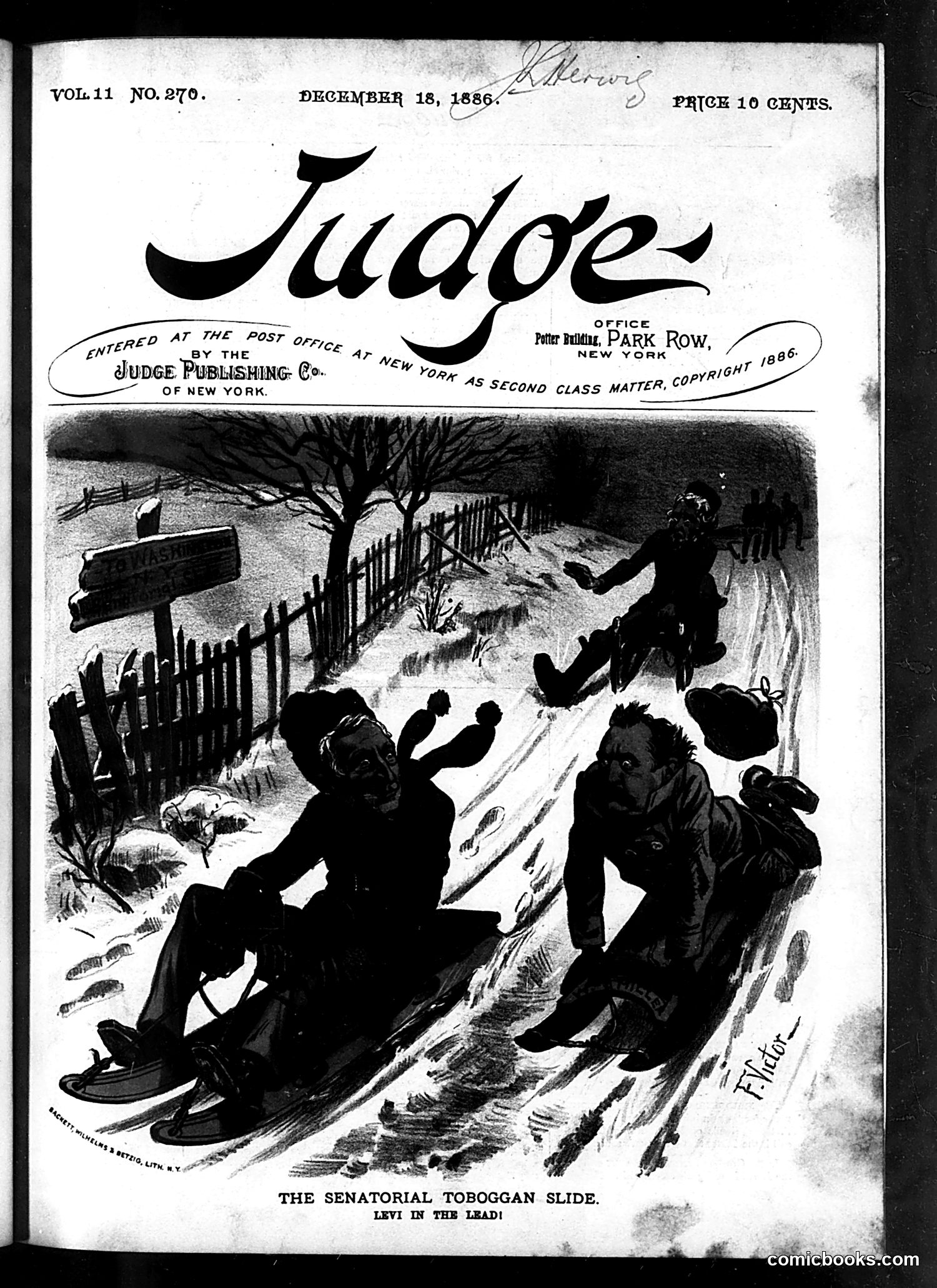
This political cartoon from December 18, 1886, satirizes corrupt or chaotic behavior within the U.S. Senate. The caption "The Senatorial Toboggan Slide, Levi in the Lead!" suggests Senator Levi (likely a contemporary political figure) is leading senators down a metaphorical slope—implying reckless descent into impropriety or scandal. The toboggan imagery conveys loss of control and momentum toward disaster. Multiple silhouetted figures sliding together suggests collective legislative misbehavior or a chain reaction of corruption. The snowy winter setting reinforces the sense of dangerous, uncontrolled motion. Without identifying all figures specifically, the cartoon mocks senatorial misconduct through physical comedy, a common Judge magazine technique for political criticism in the Gilded Age.
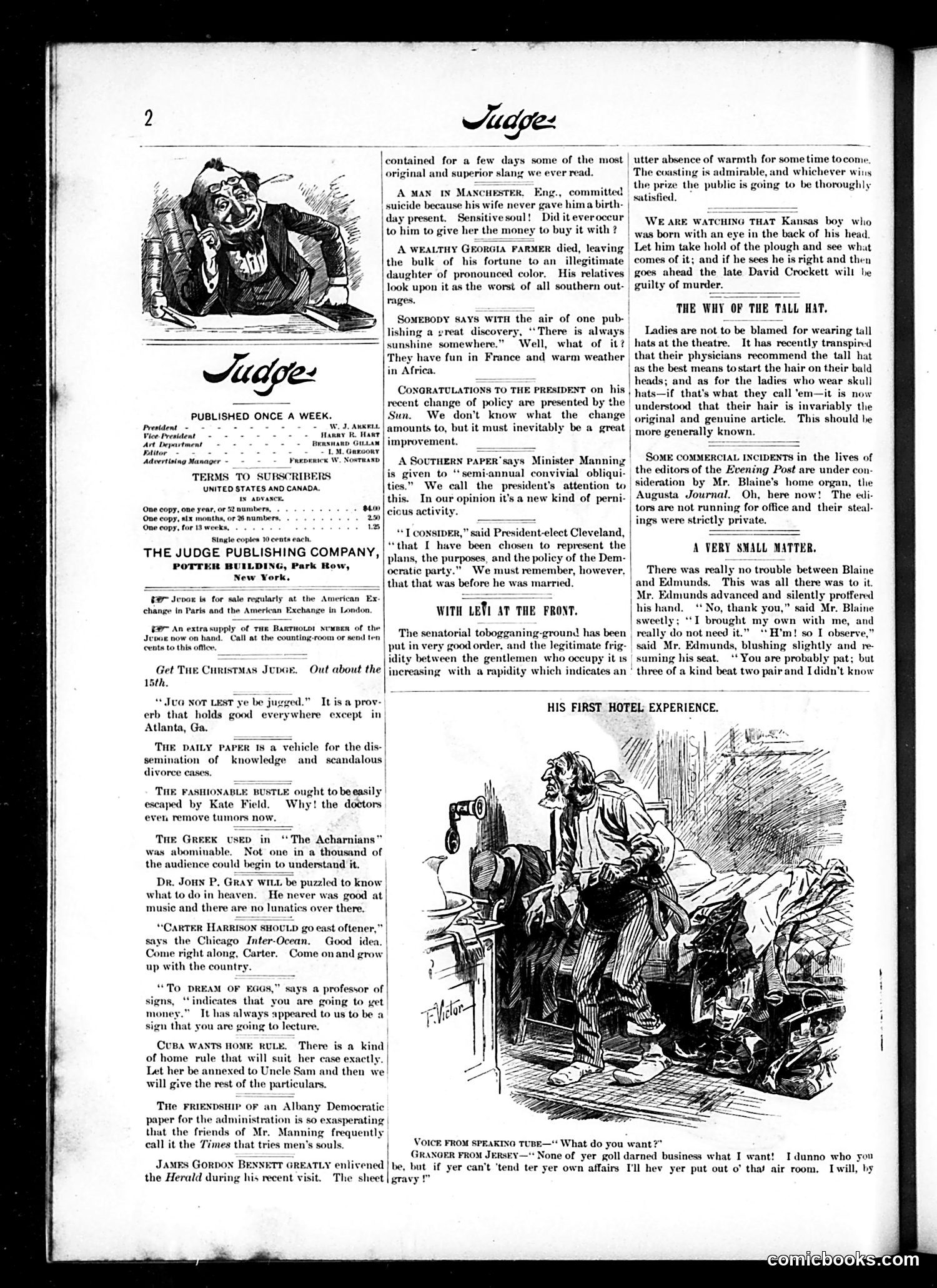
The page contains several brief satirical items typical of Judge's format. The top cartoon depicts a disheveled figure, likely satirizing a political or social stereotype, though the specific target is unclear without additional context. The items mock various subjects: a Kansas man's eye injury being blamed on his wife's hat-wearing at theaters; President-elect Cleveland's upcoming administrative changes; Senator Manning's policy shifts; and workplace dynamics between Blaine and Edmunds. The lower illustration titled "His First Hotel Experience" shows a confused man at a hotel desk with a bellhop, apparently satirizing rural or unsophisticated guests unfamiliar with urban hotel customs—a common Judge theme mocking social pretension and class differences. The page functions primarily as miscellaneous social and political commentary rather than sustained satirical narrative.
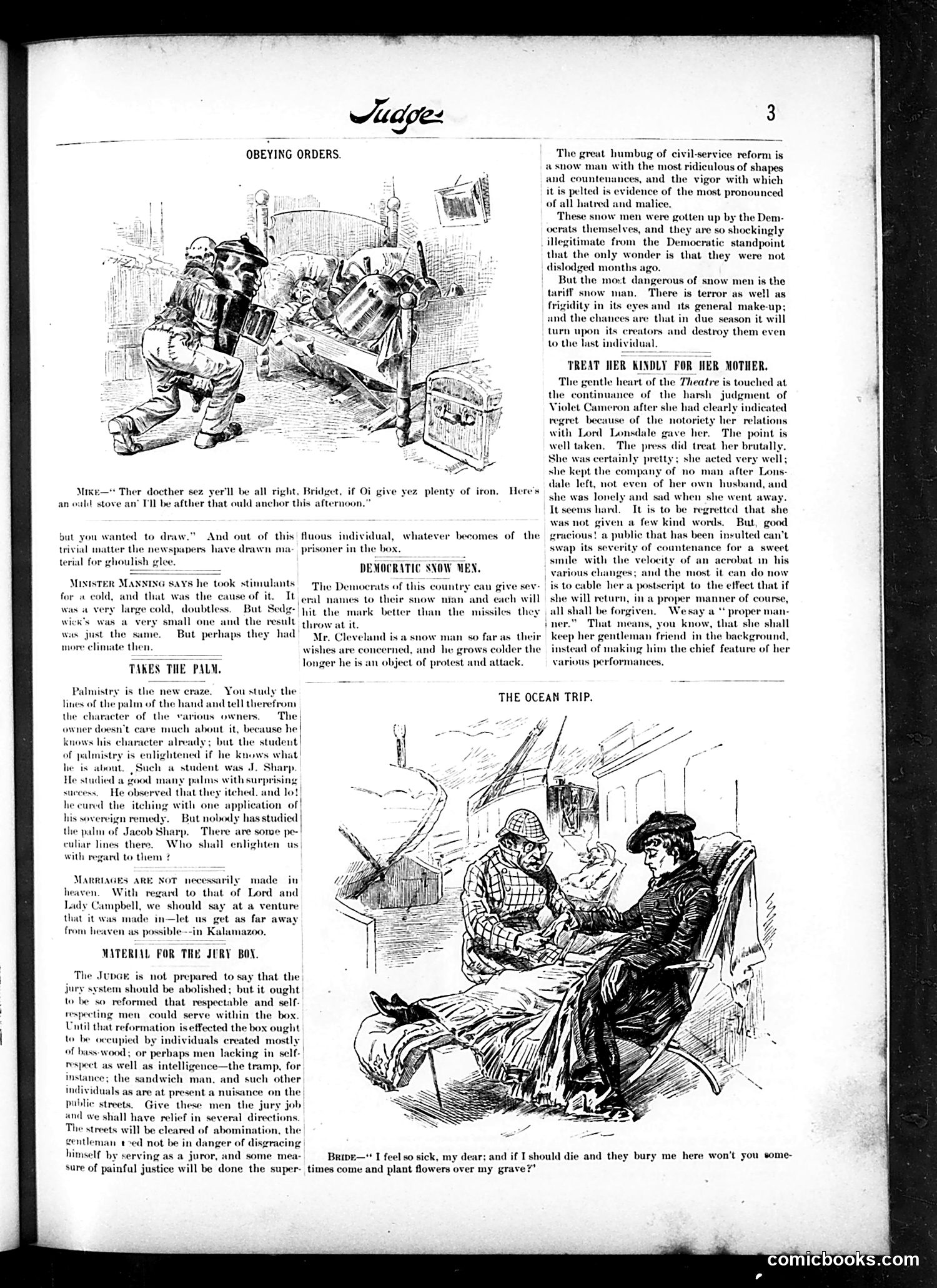
This page contains three distinct satirical pieces targeting Democratic politics and social issues of the era. **"Democratic Snow Men"** uses winter snowmen as metaphor for failed Democratic policies. Cleveland is depicted as a "snow man" growing colder—losing support. The tariff is another "dangerous snow man" that will ultimately destroy its creators. The satire mocks Democrats for creating these unpopular positions themselves. **"Takes the Palm"** sarcastically discusses palmistry trends while obliquely referencing Jacob Sharp, likely a corrupt political figure, suggesting his palm lines would reveal his character flaws. **"Material for the Jury Box"** advocates replacing respectable jurors with social undesirables—tramps and street performers—to clear cities of "abominations" while getting honest verdicts. This is darkly ironic social commentary. The cartoons depict working-class figures in period dress. The magazine's consistent target is Democratic incompetence and corruption, using humor to attack the party's policy failures and moral character.
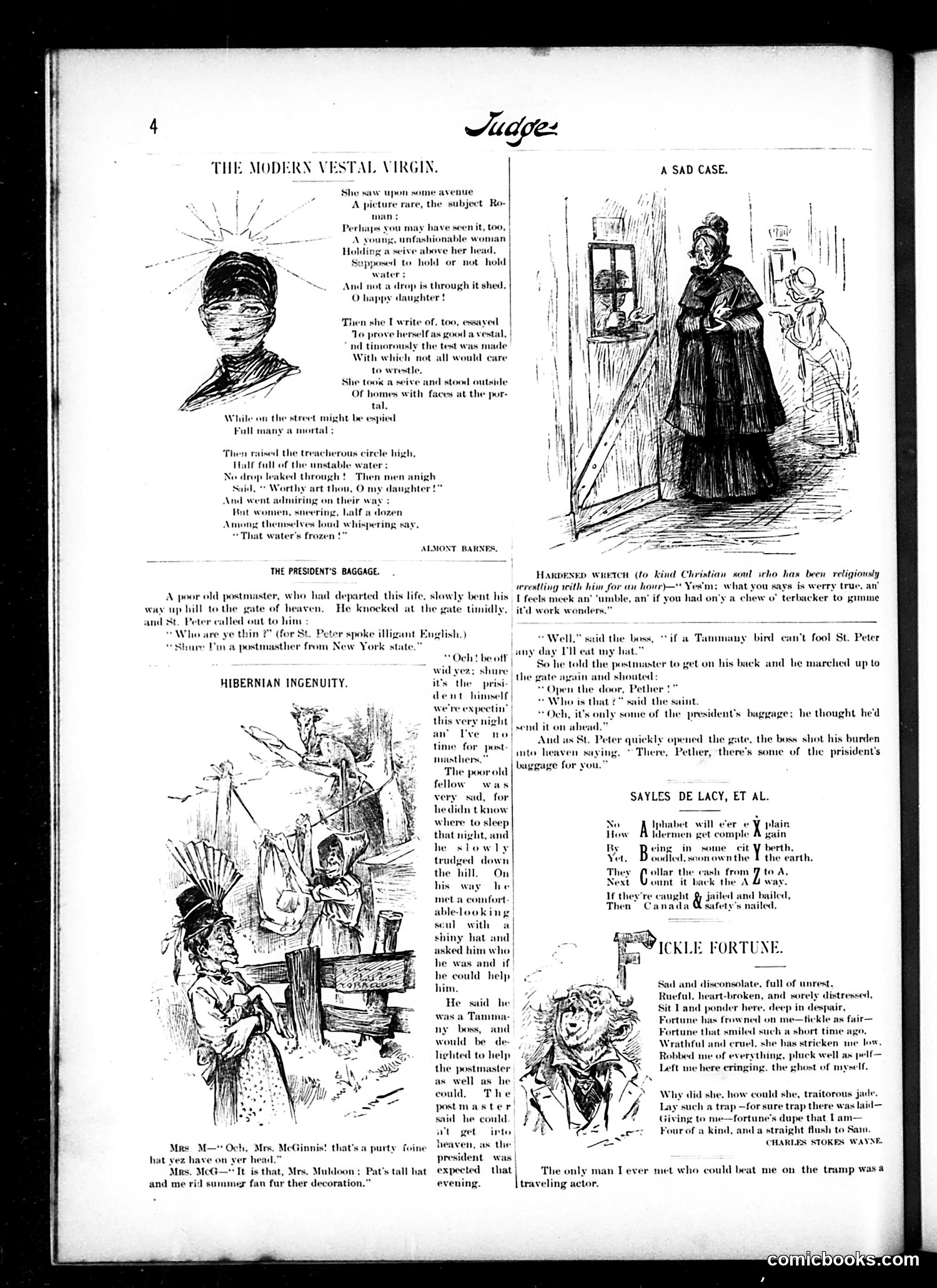
This page contains several satirical pieces targeting late-19th-century American corruption and Irish-American stereotypes: **"The Modern Vestal Virgin"** mocks women attempting to prove their virtue through a water-freezing "test"—likely referencing pseudoscientific claims or fraudulent spiritualism popular at the time. **"The President's Baggage"** is a direct political jab: an Irish-American Tammany Hall boss uses St. Peter's gate as a metaphor for heaven, attempting to bribe entry by claiming the postmaster is merely "the president's baggage." This attacks both Tammany Hall corruption (the Democratic machine controlling New York politics) and suggests the presidency itself is compromised by such bosses. **"Hibernian Ingenuity"** reinforces ethnic stereotypes of Irish immigrants as crafty schemers. The remaining pieces ("Pickle Fortune," "Sayles de Lacy") appear to be unrelated satirical poems or stories. The overall tone reflects *Judge*'s editorial stance criticizing political machines, spiritualist fraud, and ethnic caricature—common targets of 1880s-1890s American satire.
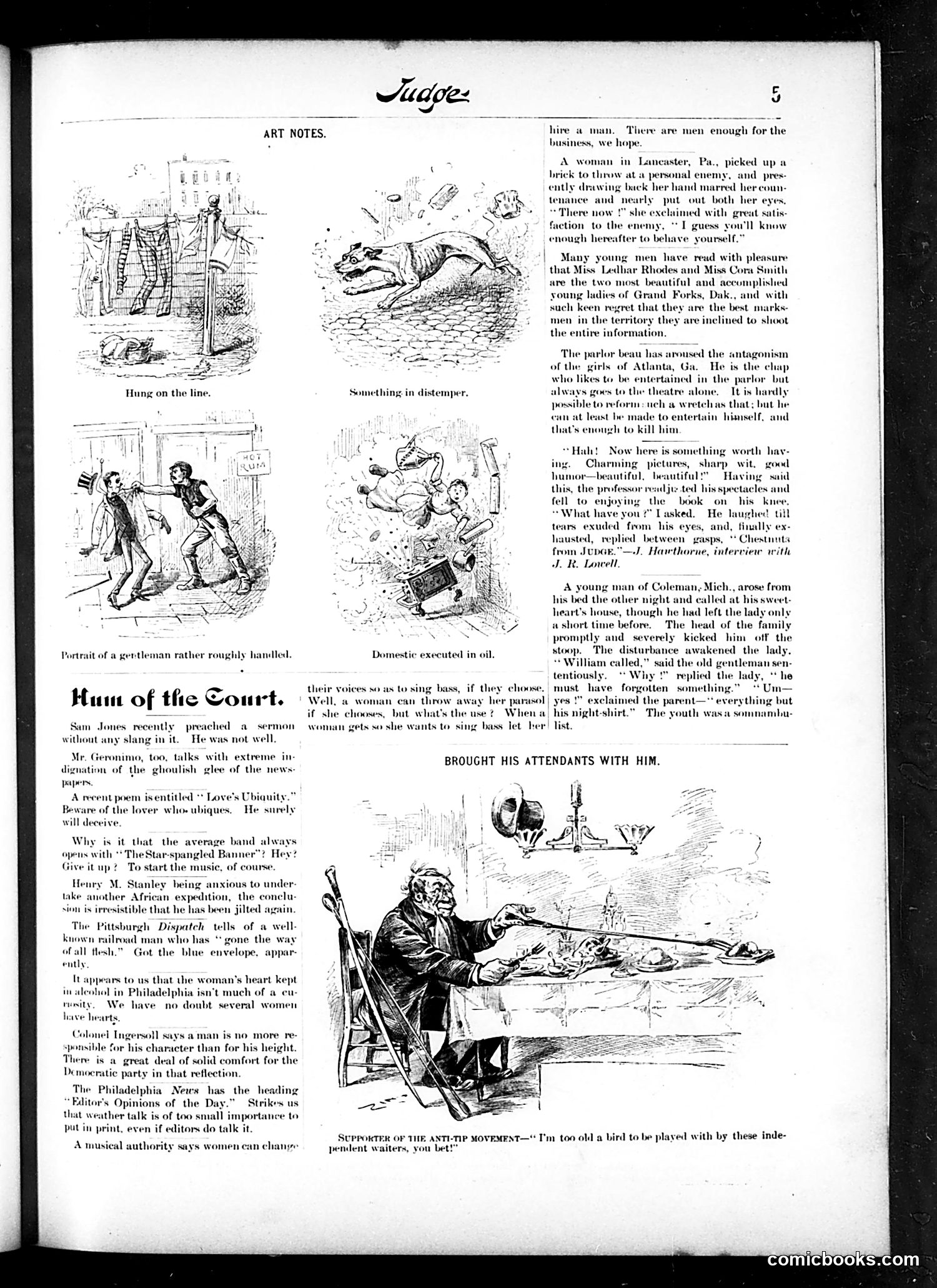
This page combines art criticism, social commentary, and humorous anecdotes typical of 1890s-era satirical journalism. The **"Art Notes"** section critiques illustrations and includes gossipy observations about Southern belles and courtship. It mocks a "parlor beau" in Atlanta who avoids entertaining himself—social satire about idle, dependent men. The **"Hum of the Court"** section collects brief, comedic observations: a woman throwing her parasol (critiquing female impulsiveness), complaints about newspaper sensationalism, and absurdist humor about bands and African expeditions. The **bottom cartoon** depicts an elderly man dining alone, complaining about "independent waiters"—commentary on the emerging **anti-tipping movement**. He protests being pressured to tip, framing it as manipulation by service workers seeking unearned money. The overall thrust satirizes modern social changes: women's assertiveness, newspaper excess, and labor disputes over tipping customs. The tone is conservative, mocking new social demands while maintaining light, irreverent humor typical of Judge's target audience.
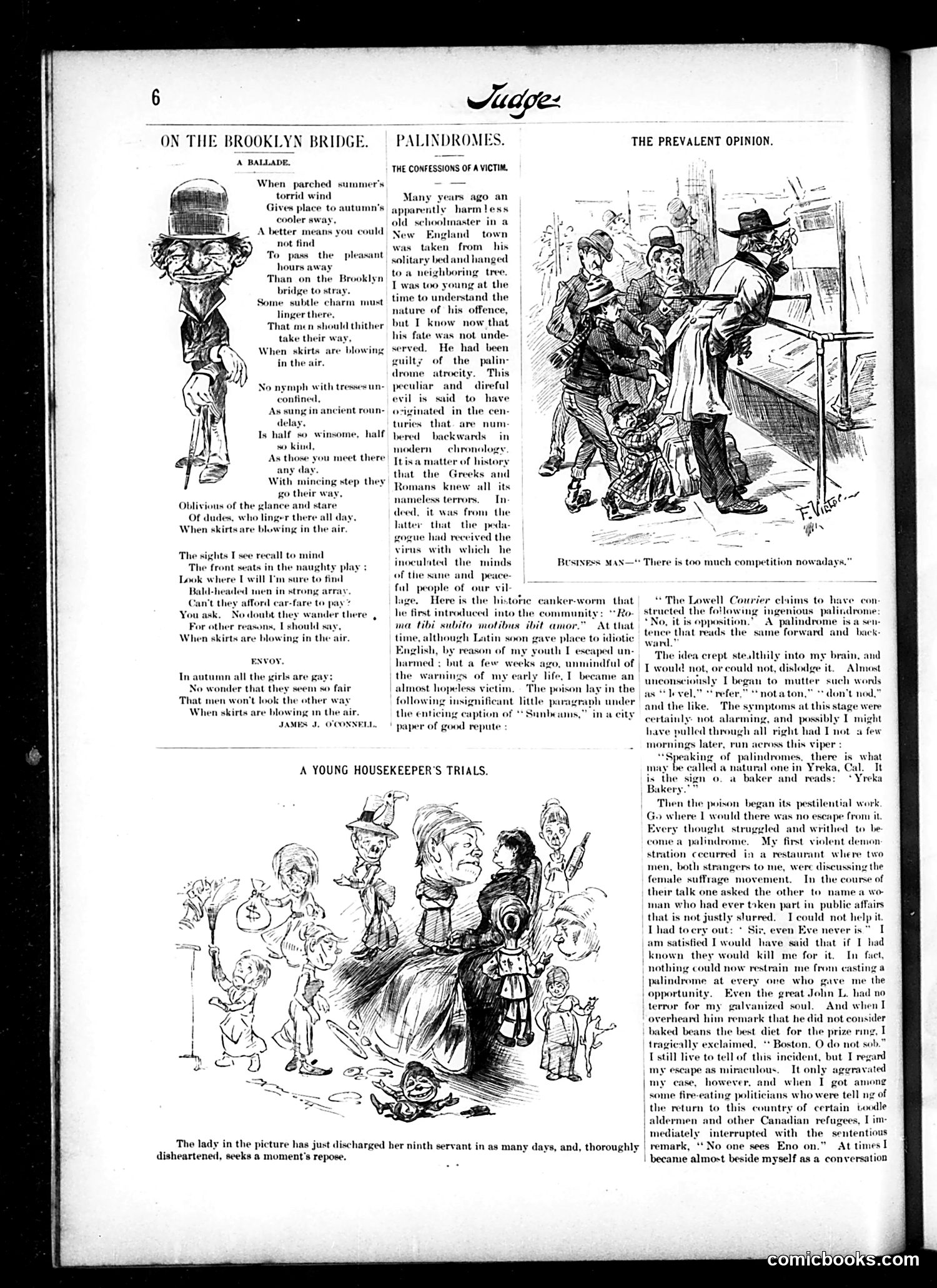
This page contains three separate pieces of social satire: 1. **"On the Brooklyn Bridge"** (top left): A skeletal figure represents urban decay or poverty, depicted as a persistent presence among the city's pedestrians—likely criticizing indifference to social problems. 2. **"A Young Housekeeper's Trials"** (center): Shows a harried woman surrounded by demanding figures with money bags, illustrating the financial pressures and chaos of domestic management. The caption notes her "disheartenment" after discharging servants repeatedly—satirizing the difficulty of household labor and servant relations in the era. 3. **"The Prevalent Opinion"** (right): Depicts what appears to be a street debate about a palindrome (mentioned in the OCR text), with figures discussing wordplay or linguistic matters—likely mocking trivial public discourse. The overall theme addresses urban poverty, domestic labor struggles, and public conversation priorities.
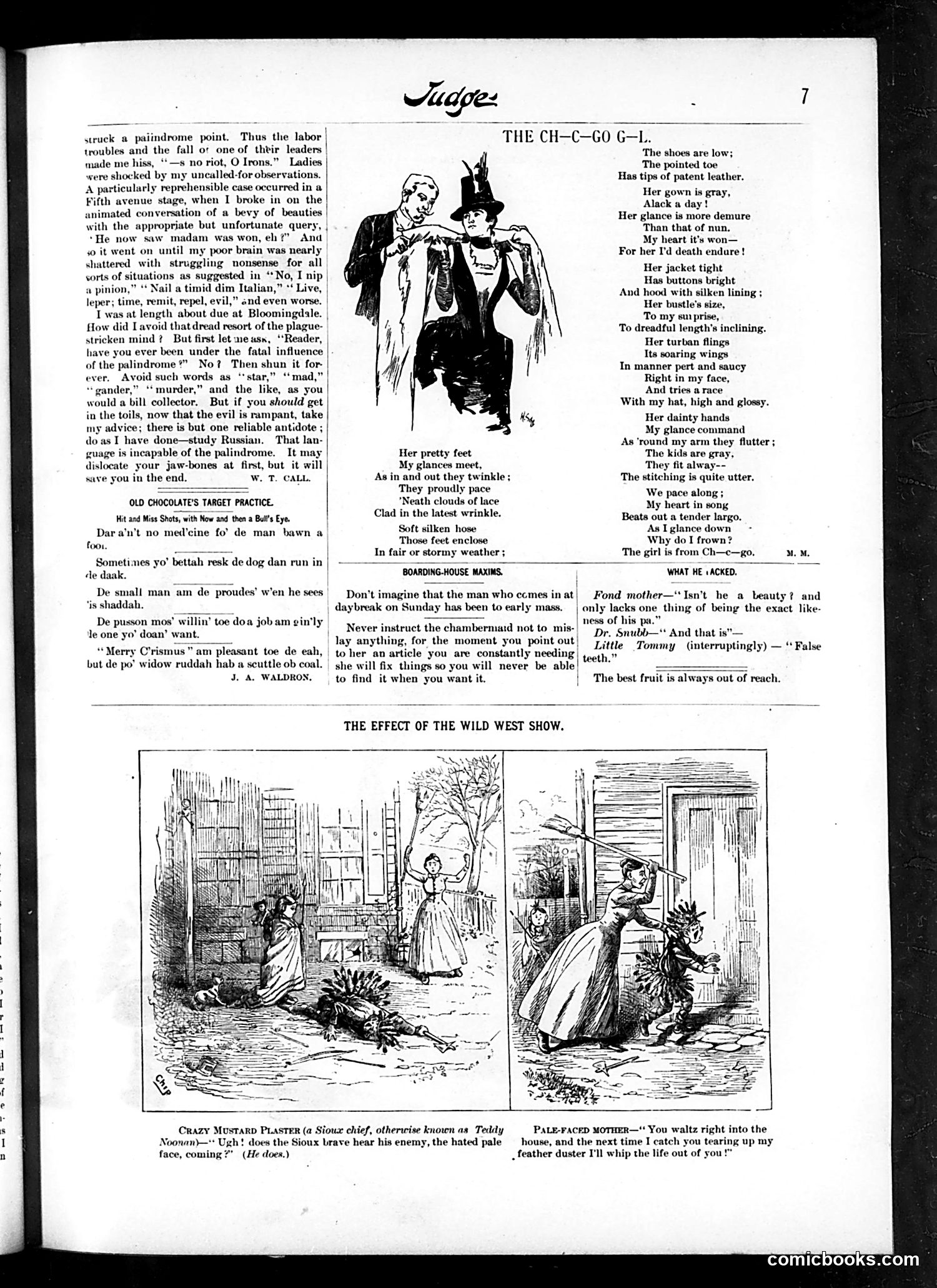
This page satirizes the cultural impact of Buffalo Bill's Wild West Show, which toured America in the 1880s-90s, creating a national fascination with frontier mythology. The bottom cartoon pair mocks how this show influenced urban behavior: the left panel shows a "Sioux chief" (labeled "Crazy Mustard Plaster"/"Teddy Noonan") menacing city dwellers amid skyscrapers—Wild West imagery invading civilized space. The right panel shows a pale-faced mother dealing with her son playing "savage," having adopted Wild West show mannerisms. The satire's point: the show's popularity was so pervasive that even city children and adults were adopting exaggerated frontier personas and violence as entertainment-influenced behavior. The joke critiques how mass entertainment (the Wild West Show) was corrupting proper urban manners and creating cultural chaos—a common anxiety about popular entertainment in this era. The other content on the page is unrelated verse and humorous sketches.
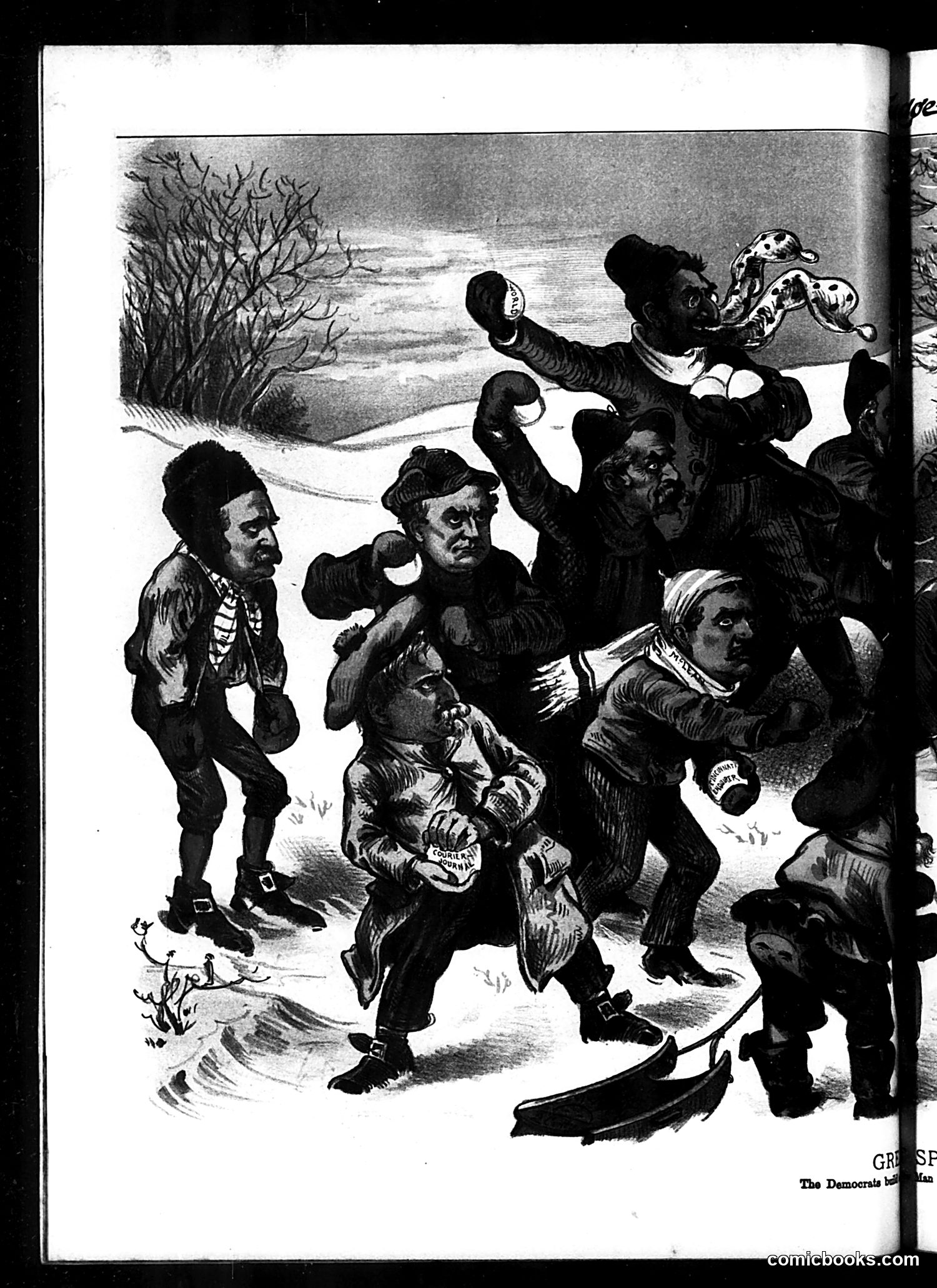
This appears to be a satirical cartoon from *Judge* magazine depicting Democratic Party figures in a snowy winter setting. The exaggerated caricatures and dramatic gestures suggest political mockery—likely commenting on Democratic leadership or strategy during a particular election cycle or political crisis. The figures display caricatured facial features typical of late 19th/early 20th-century political satire. One figure holds what appears to be a snake or serpent, possibly symbolizing deception or internal party conflict. The partial text visible ("The Democrats is...") suggests critique of Democratic Party actions or policies. Without the complete caption or date, the specific political event being satirized remains unclear, but the cartoon clearly mocks Democratic Party leadership through visual exaggeration and symbolic imagery.
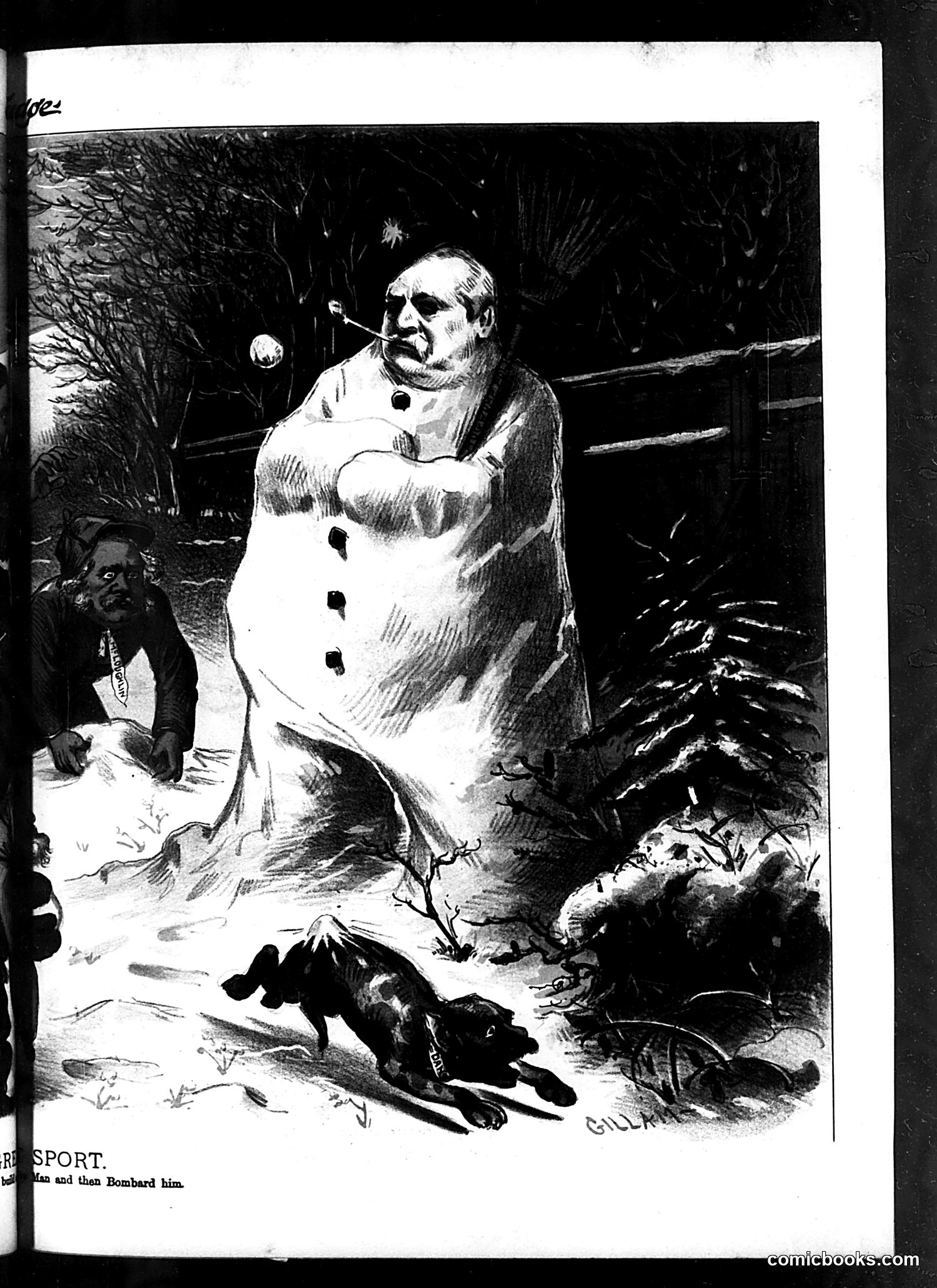
This appears to be a satirical cartoon from *Judge* magazine titled "Sport," with partial caption text reading "...and then bombard him." The central figure is a heavyset man dressed as a snowman, complete with coal buttons and a pipe. He's surrounded by dogs in a snowy setting. The snowman-man caricature likely represents a political figure being subjected to harsh criticism or "bombardment" — the cartoon's title suggests mockery of some public figure through the unflattering snowman disguise. The dogs circling him may represent critics or opposition attacking this figure. Without the complete caption or publication date visible, the specific political target remains unclear, but the overall satire ridicules someone through the dehumanizing snowman imagery while under attack.
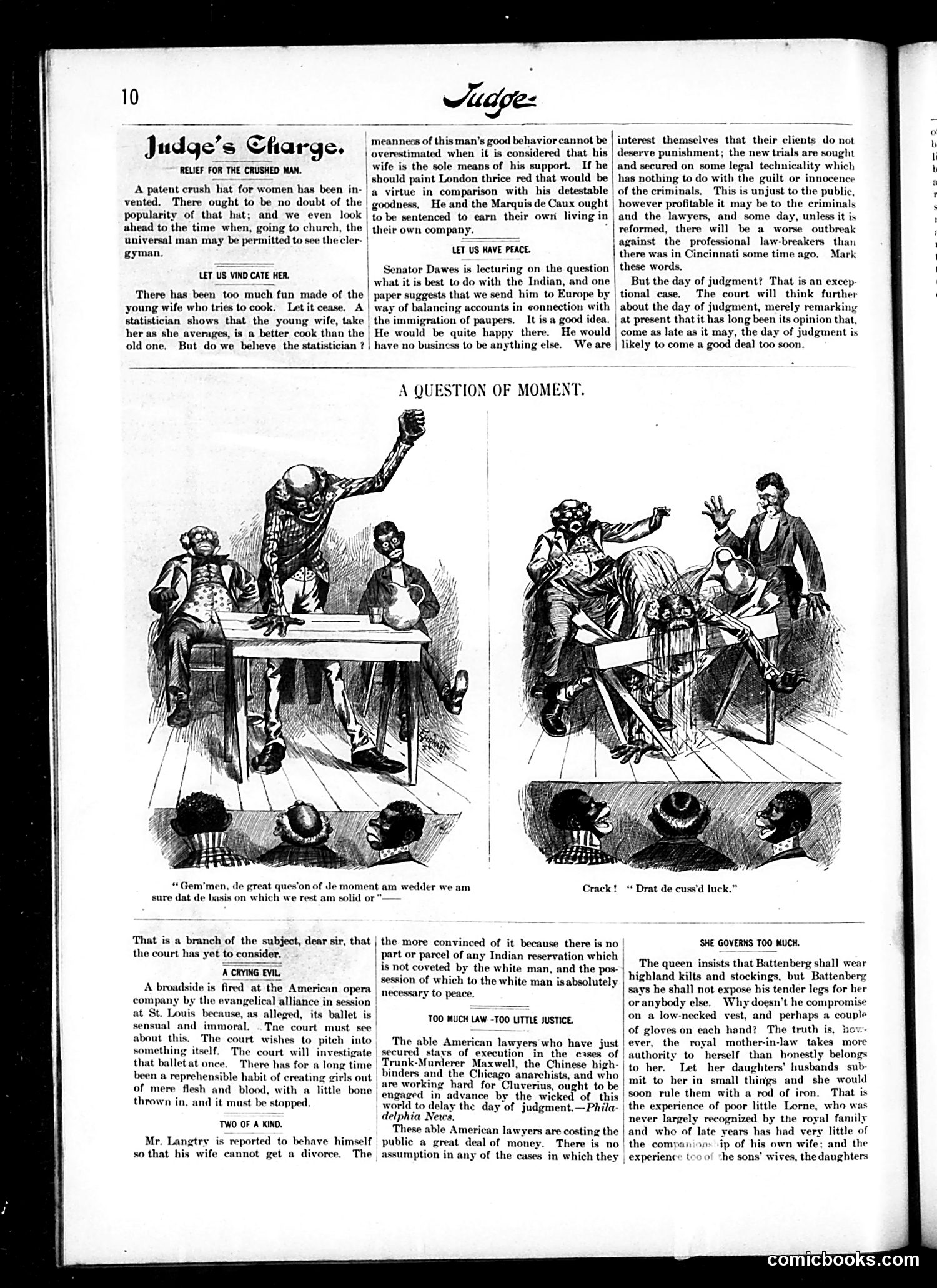
This page satirizes American legal corruption and judicial incompetence. The main cartoon depicts three figures at a table debating whether their foundation is "solid"—a visual metaphor for questioning whether the justice system has legitimate grounding. The accompanying text attacks American lawyers who exploit legal technicalities to free guilty criminals (references "Trunk-Murderer Maxwell" and "Chicago anarchists"), prioritizing profits over justice. It warns that unchecked professional law-breaking will provoke public violence like the Cincinnati riots. A secondary item mocks Queen Victoria's excessive authority over her son-in-law Prince Battenberg's clothing choices, satirizing royal interference in private matters. The cartoons use exaggerated facial features typical of 19th-century satirical illustration to ridicule both the justice system's compromised ethics and aristocratic overreach.
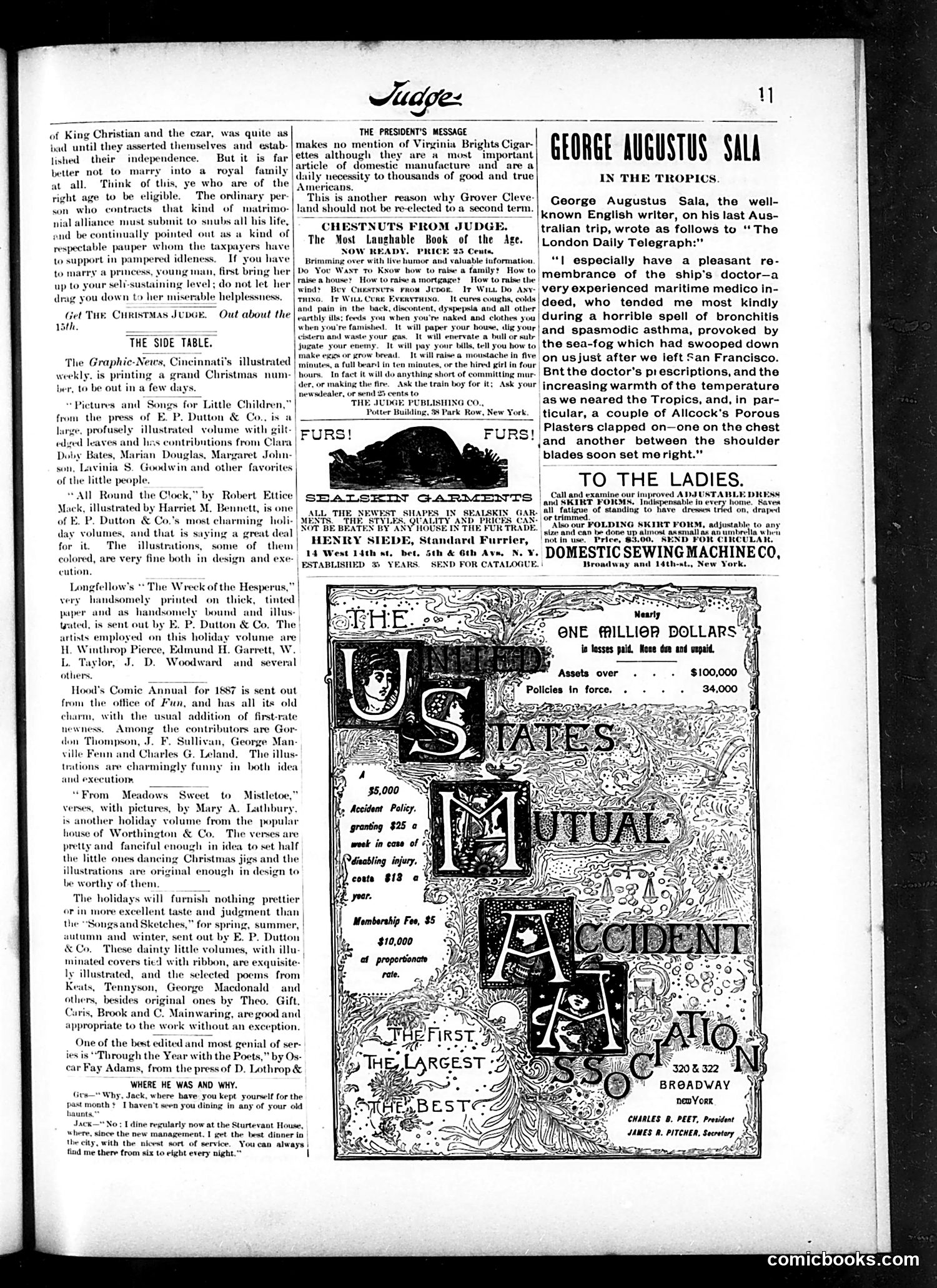
This is primarily an advertising and notices page from Judge magazine, rather than a satirical cartoon page. **Notable Content:** The main article is "George Augustus Sala in the Tropics," featuring a letter from British travel writer George Augustus Sala about his Australian voyage. He describes maritime medicine, bronchitis complications during sea-fog near San Francisco, and remedies involving plasters on his chest—typical health observations from 19th-century travel writing. **Advertisements include:** - Sealskin garments from Henry Siede (furrier) - The States Mutual Accident Insurance Company (prominently featured with ornate lettering) - Domesticsewing Machine Co. - Various book announcements for holiday publications **Social Context:** References to King Christian and the Czar indicate European monarchical marriage politics, and Grover Cleveland's potential second term as U.S. president appears briefly mentioned. The page is predominantly commercial rather than satirical, typical of Judge's mixed-content format that balanced editorial cartoons with substantial advertising revenue.
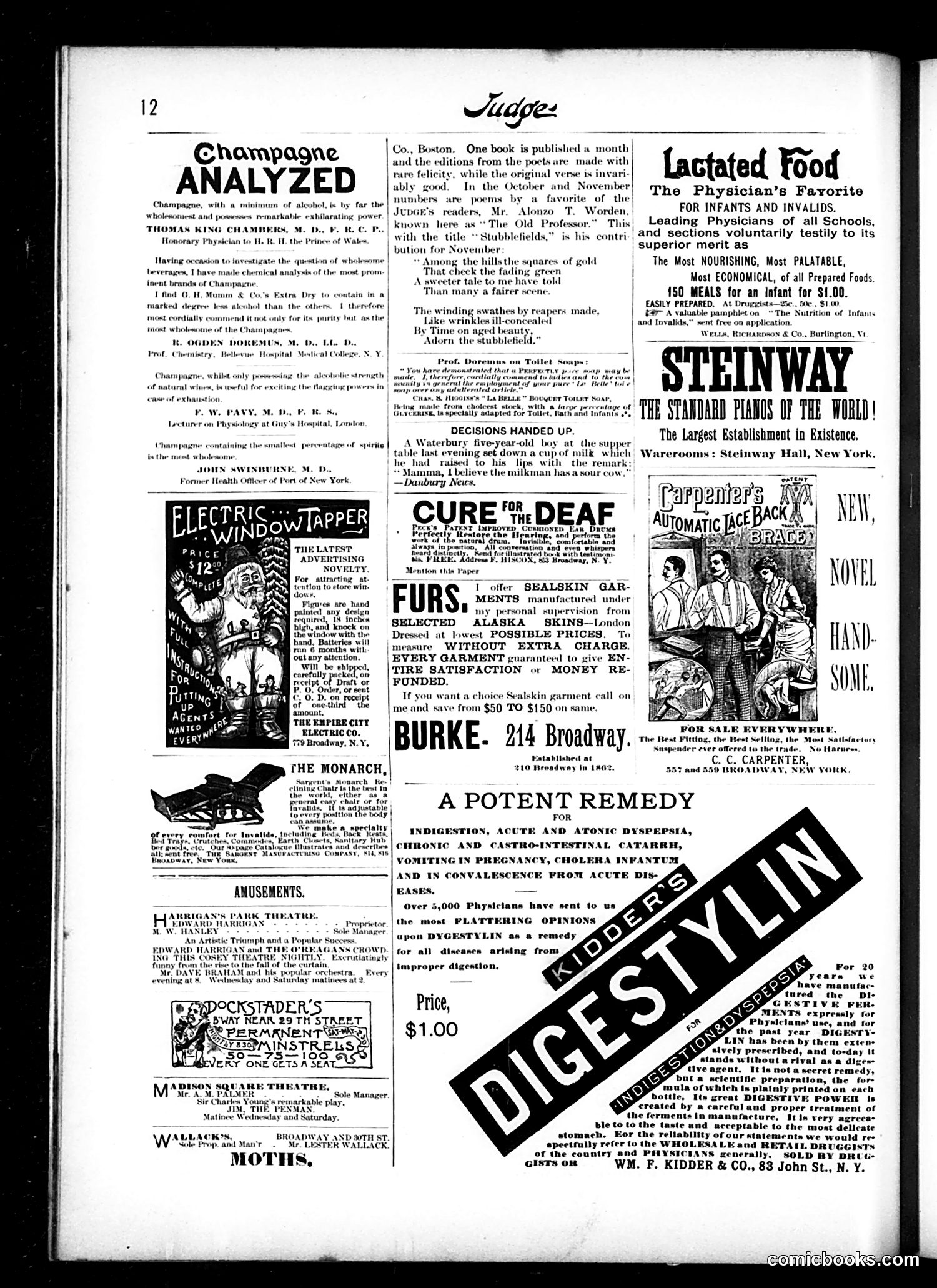
This page is primarily advertising, with minimal satirical content. The main illustrated advertisements are: 1. **"Electric Tapper" wind-up toy** — a novelty device marketed as an amusing mechanical novelty. 2. **"The Monarch" — a medical device** claiming to cure various ailments by "applying light in the best in the world" through positioning the body; typical pseudo-scientific medical marketing of the era. The page also contains advertisements for Steinway pianos, fur garments, theatrical productions, and various patent medicines (notably "Digestylin" for indigestion, heavily promoted with physicians' endorsements). The brief satirical text at top discusses champagne analysis by physicians. The "Decisions Handed Up" section contains a mild joke about a child's observation about milk. Overall, this reflects the magazine's business model: satirical editorial content subsidized by extensive patent medicine and quack remedy advertising—common in early 20th-century American publications, before FDA regulation of medical claims.
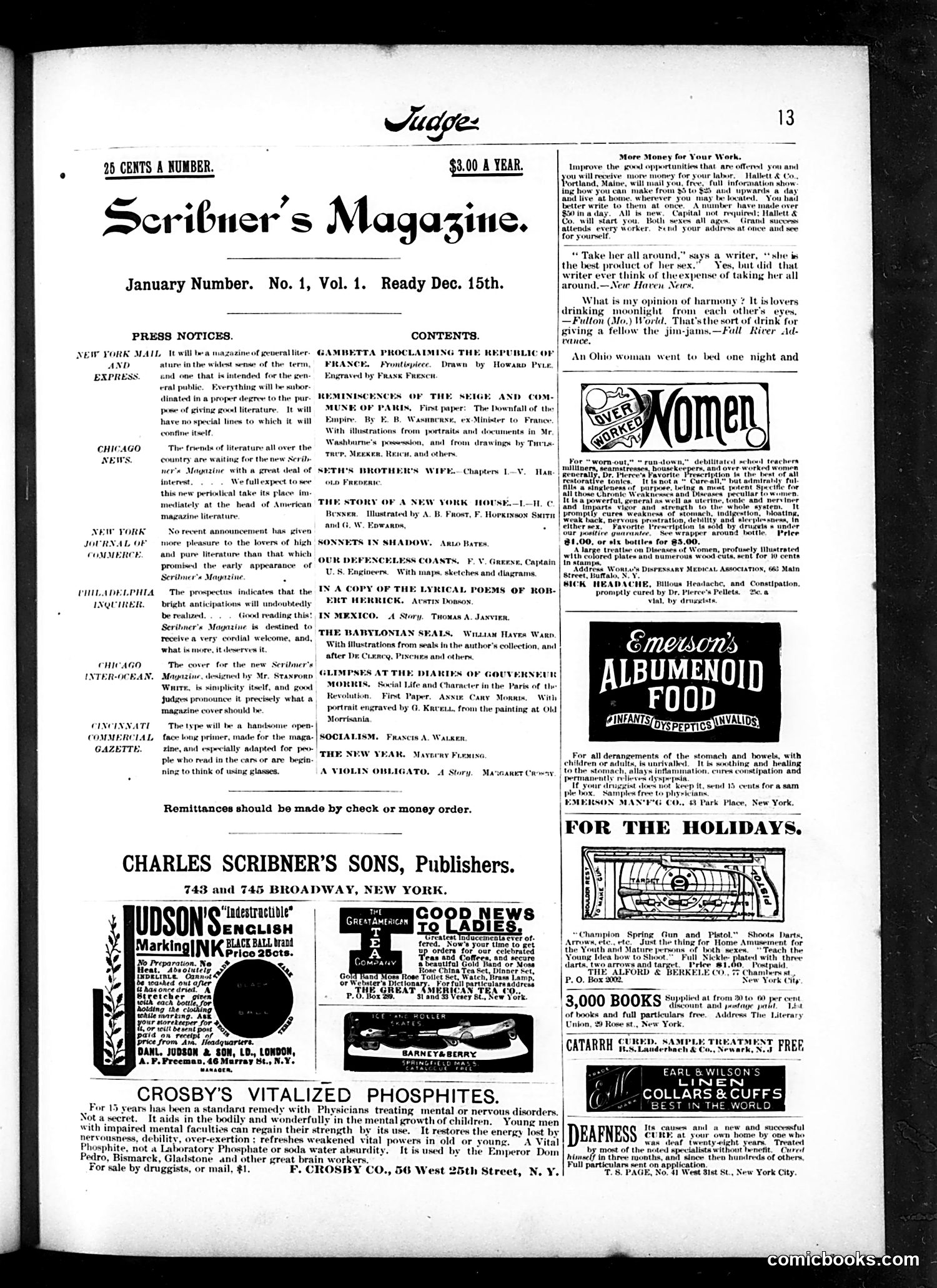
This page is primarily the **title/contents page for Scribner's Magazine's inaugural January issue** (Vol. 1, No. 1), featuring press notices and table of contents rather than editorial cartoons. The page advertises articles including "Gambetta Proclaiming the Republic of France" (a frontispiece illustration) and pieces on the Siege and Commune of Paris—timely political content referencing 1870s French history. There are also serialized fiction pieces and travel writing. The scattered humorous quotes at top (about women being "the best product," the cost of romance) appear to be magazine filler jokes, not cartoons. The visual content consists mainly of period advertisements for products like "Emerson's Albumenoid Food" and "Hudson's Sanatone" cleaning product. **Context for modern readers**: This represents an ambitious new literary magazine positioned as serious, nationally-distributed journalism. The French political references would have been current events interest for 1870s American readers.
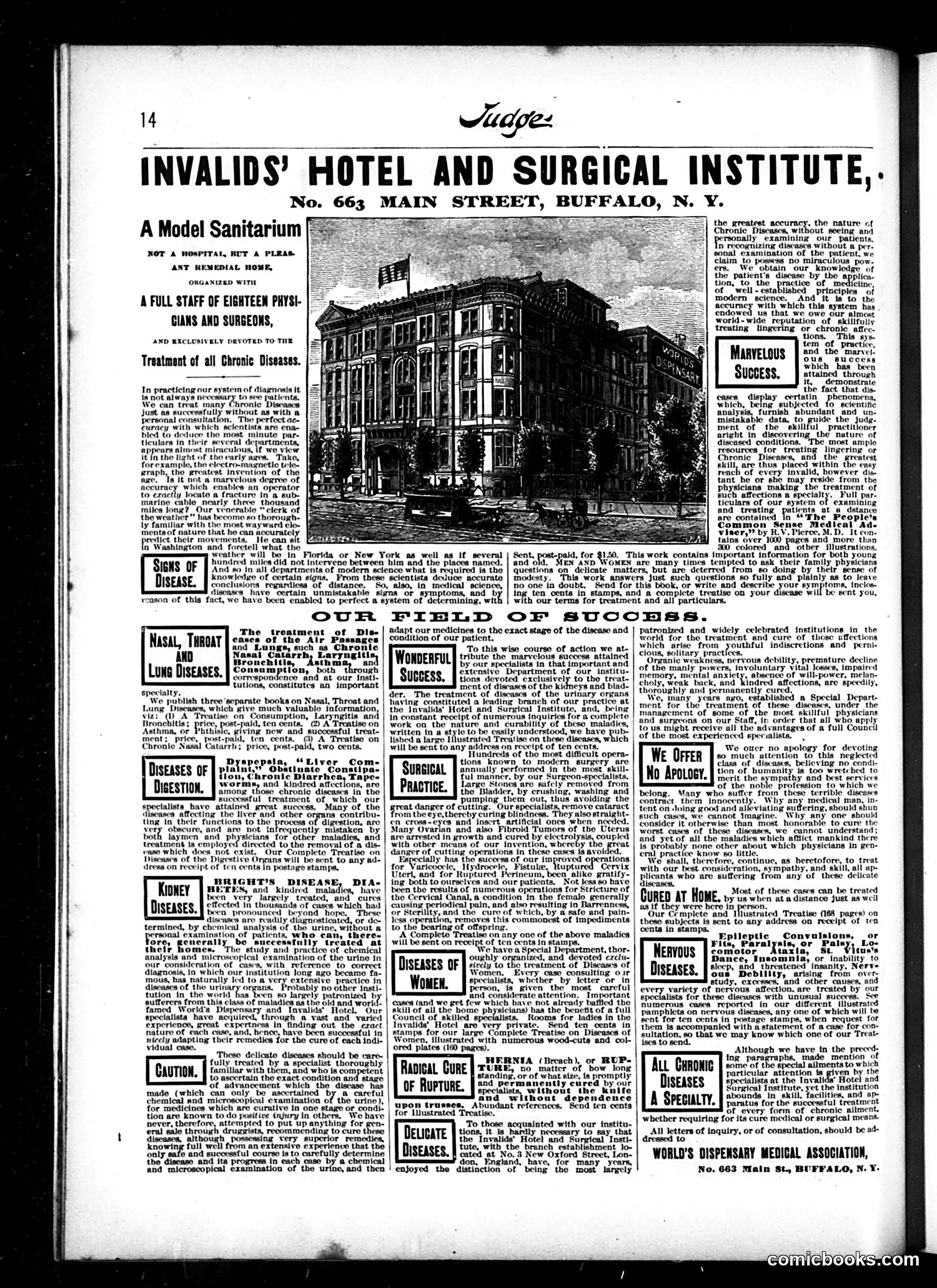
This is a full-page advertisement for a medical facility, not a political cartoon. The Invalids' Hotel and Surgical Institute in Buffalo, New York promotes itself as a "Model Sanitarium" that treats chronic diseases. The main appeal targets distant patients by claiming physicians can accurately diagnose illnesses without in-person examination—comparing medical diagnosis to long-distance telegraph technology and weather forecasting to argue that modern science enables remote detection of disease symptoms. The ad emphasizes having eighteen physicians and surgeons, offers a free medical book ("The People's Common Sense Medical Adviser"), and invites patients to describe symptoms by mail in exchange for treatment plans. This appears to be late 19th-century mail-order medicine advertising, exploiting contemporary scientific advances to market dubious long-distance diagnostics to chronically ill Americans—a common practice of the era.
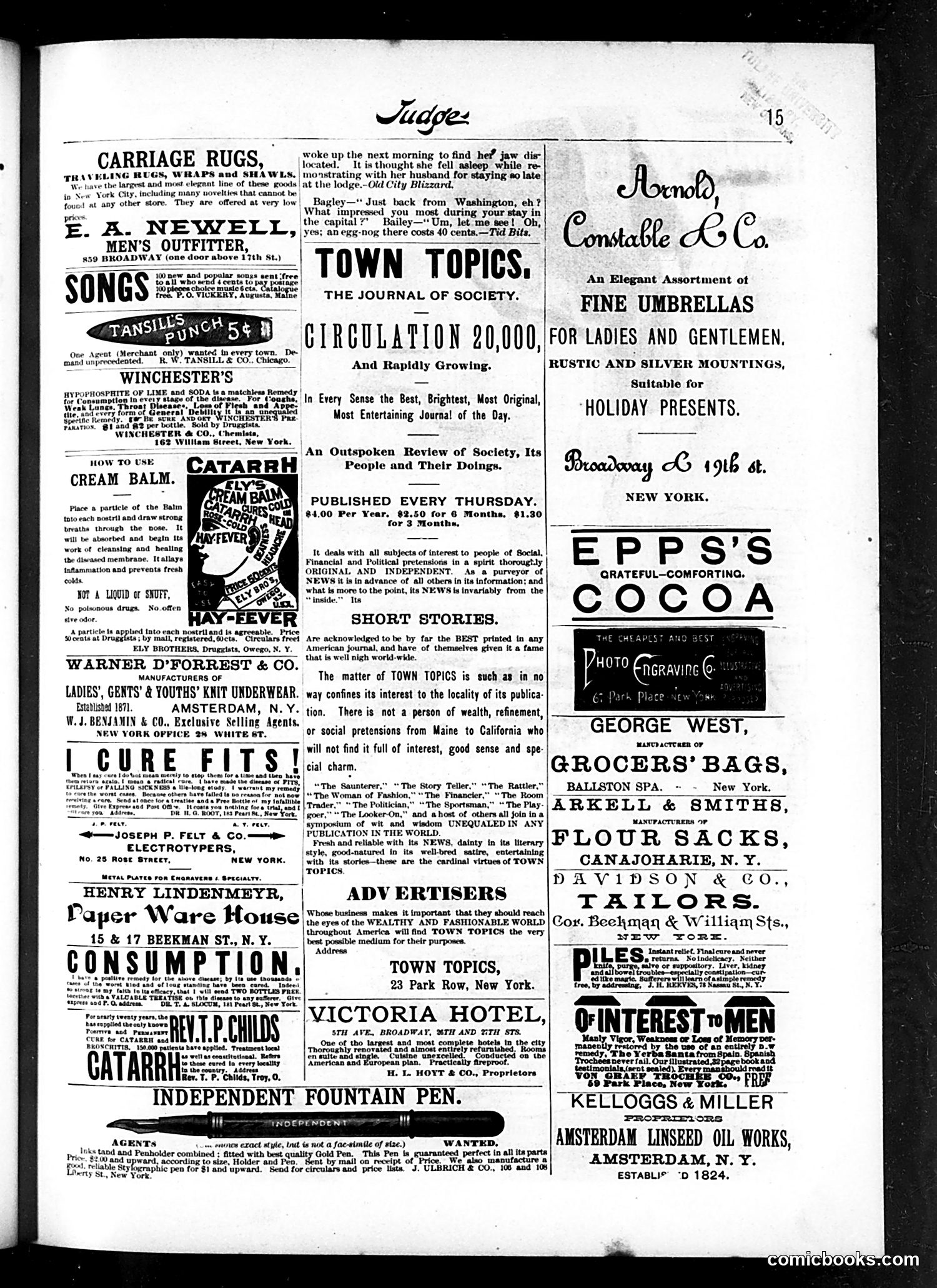
This page is predominantly **advertising and promotional material** rather than satirical cartoons. It features commercial ads for products like carriage rugs, men's clothing, patent medicines (catarrh cream, consumption cure), and undergarments—typical of 19th-century publications. The small **"Town Topics"** section contains brief society humor: - A woman dislocates her jaw arguing with her husband about his late lodge hours - A joke about Washington, D.C. egg-nog prices There is one small illustrated **catarrh remedy advertisement** with a simplified face graphic, but it serves commercial rather than satirical purposes. The page lacks substantive political or social satire. "Judge" was known for cutting editorial cartoons, but this particular page appears to be a filler issue dominated by revenue-generating advertisements aimed at wealthy urban readers—reflecting how 19th-century magazines sustained themselves financially.
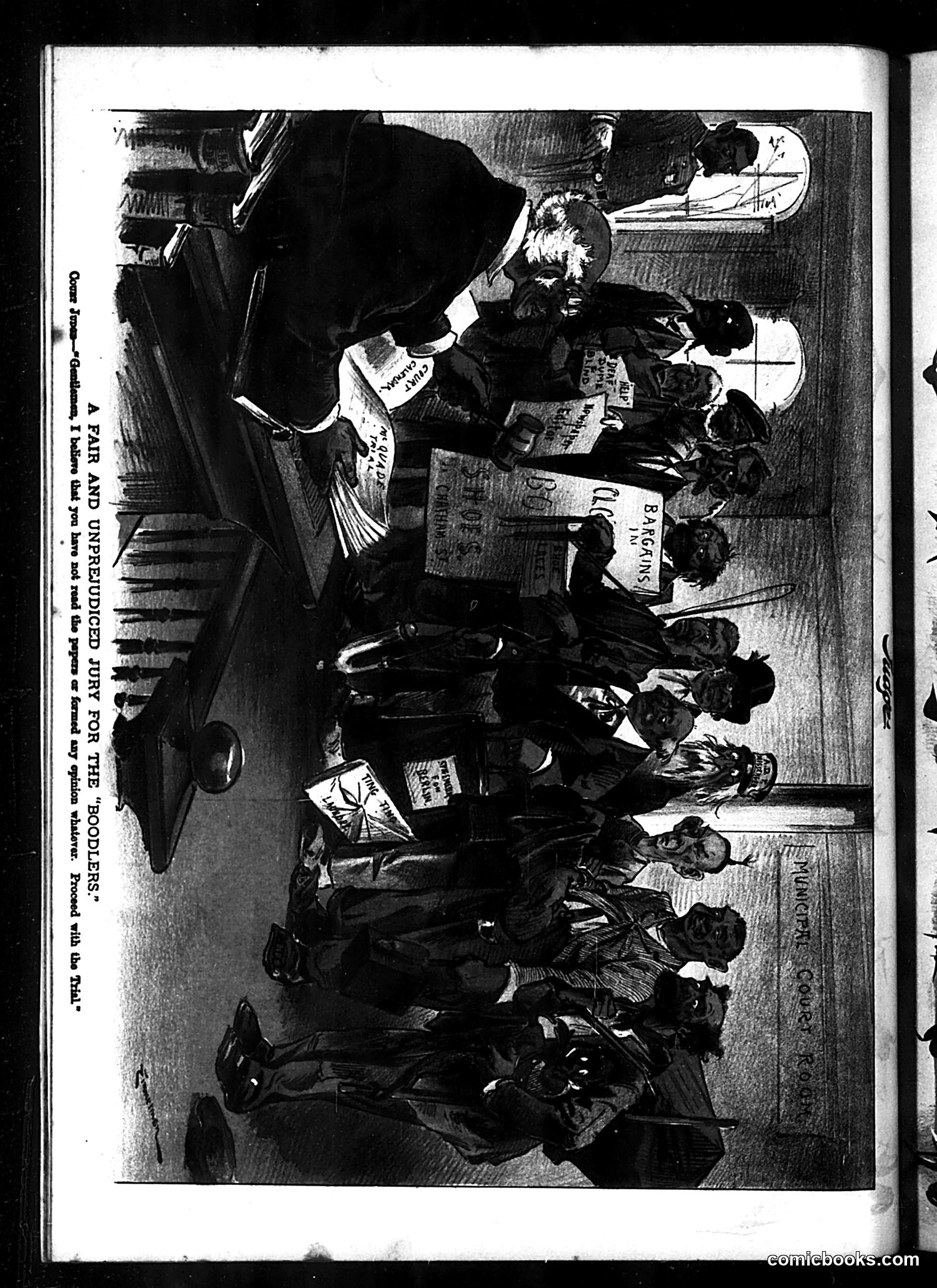
This cartoon satirizes corruption trials by depicting a deliberately incompetent jury. The judge addresses jurors who are illiterate or willfully ignorant—they haven't read newspapers or formed opinions about the case, making them "unprejudiced" in the worst possible way. "Boodlers" refers to corrupt politicians or officials who engage in bribery and graft. The satire suggests that finding jurors ignorant enough to be truly impartial actually makes a fair trial impossible, since they lack the information needed to judge guilt or innocence. This critiques both judicial incompetence and the broader problem of political corruption in the Gilded Age, implying that corrupt officials could escape justice through technicalities or by exploiting the jury system's flaws.