
A complete issue · 19 pages · 1886
Judge — October 23, 1886
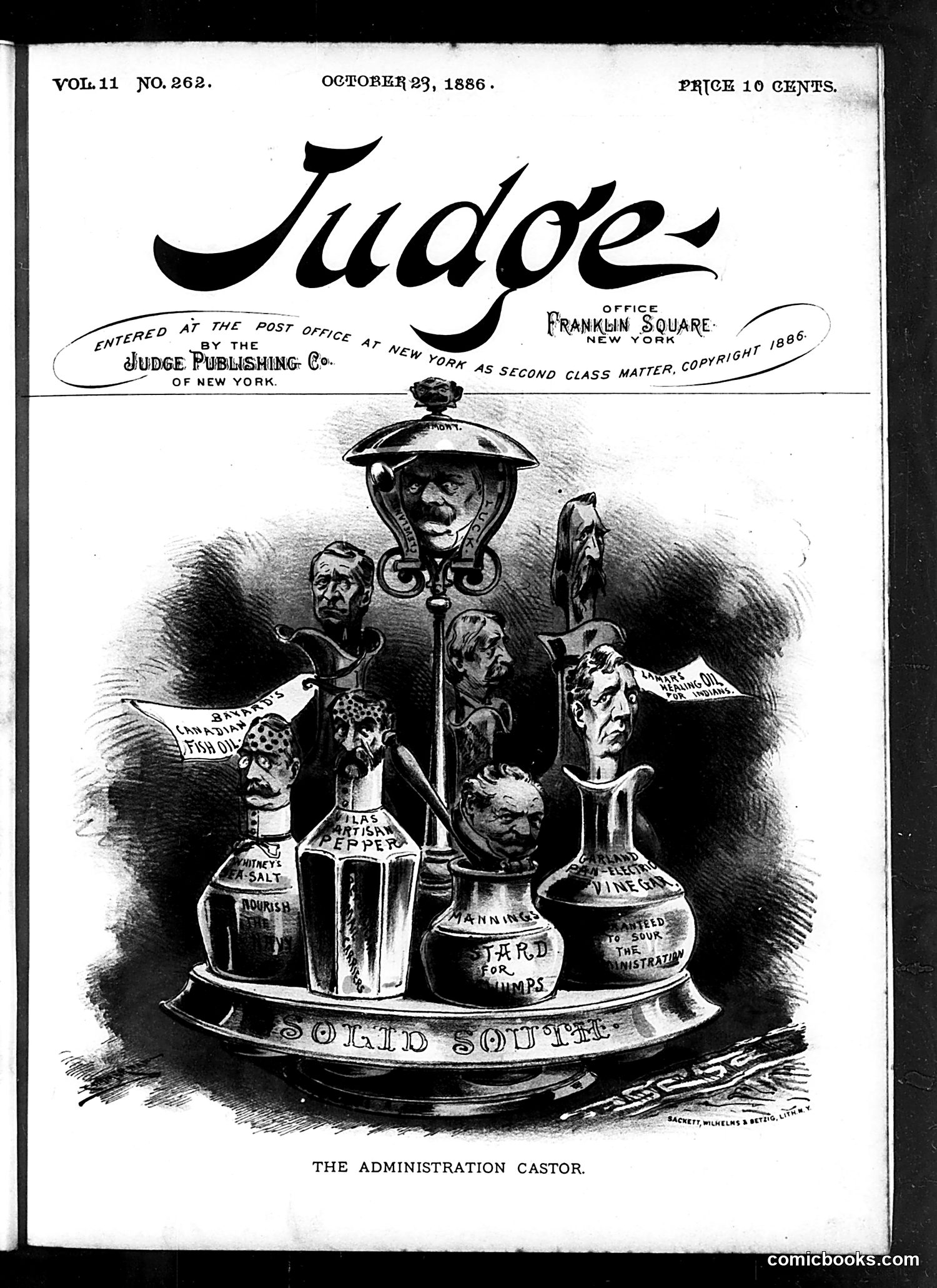
This October 1886 *Judge* cartoon satirizes President Cleveland's administration as a medicinal castor oil bottle—a common purgative of the era. The central figure at top appears to be Cleveland himself, with smaller caricatured heads of his cabinet members arranged as bottles of various remedies below, each labeled with policy positions or scandals (labels are partially legible but include references to "salt," "pepper," and other condiments/medicines). The "Solid South" base suggests the cartoon critiques how Southern Democratic support props up Cleveland's administration. The overall message appears to be that the administration functions like patent medicine—offering dubious remedies with little real benefit. This reflects broader 1880s skepticism toward Cleveland's policies and effectiveness.
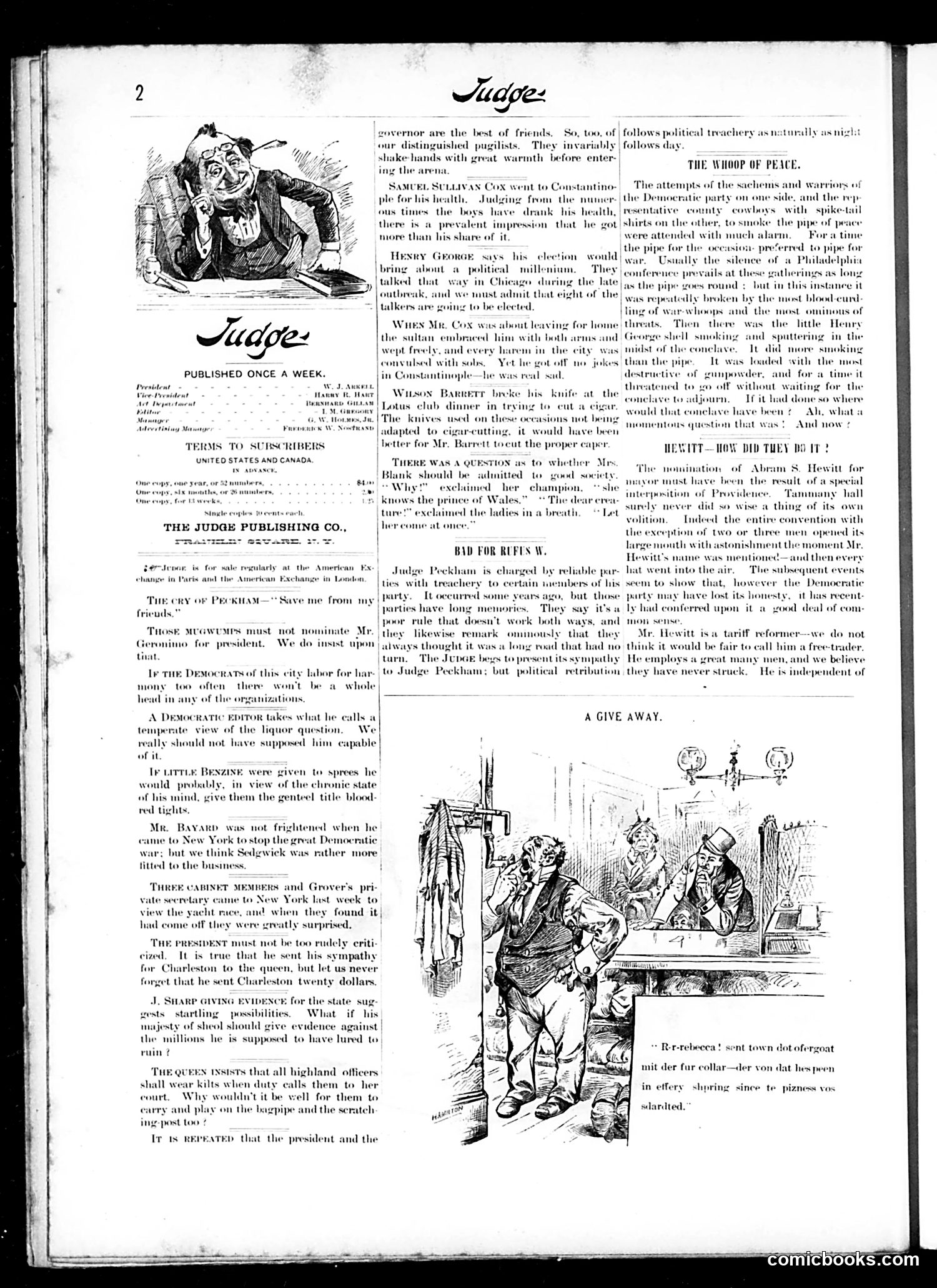
This page contains several political commentary pieces from an American satirical magazine. The main cartoon titled "A Give Away" depicts what appears to be a clothing donation or charity situation, with figures exchanging garments in a humorous manner. The text discusses various political figures and controversies, including references to Judge Peckham, Wilson-Barrett, and commentary on Democratic party politics. One section titled "The Whoop of Peace" discusses Democratic party attempts and military matters, suggesting tensions around war and peace policy. However, without clearer dates or additional context visible on this page, I cannot definitively identify the specific historical moment, political figures being caricatured, or the exact events being satirized. The exact publication date would be necessary to properly contextualize these references for a modern reader.
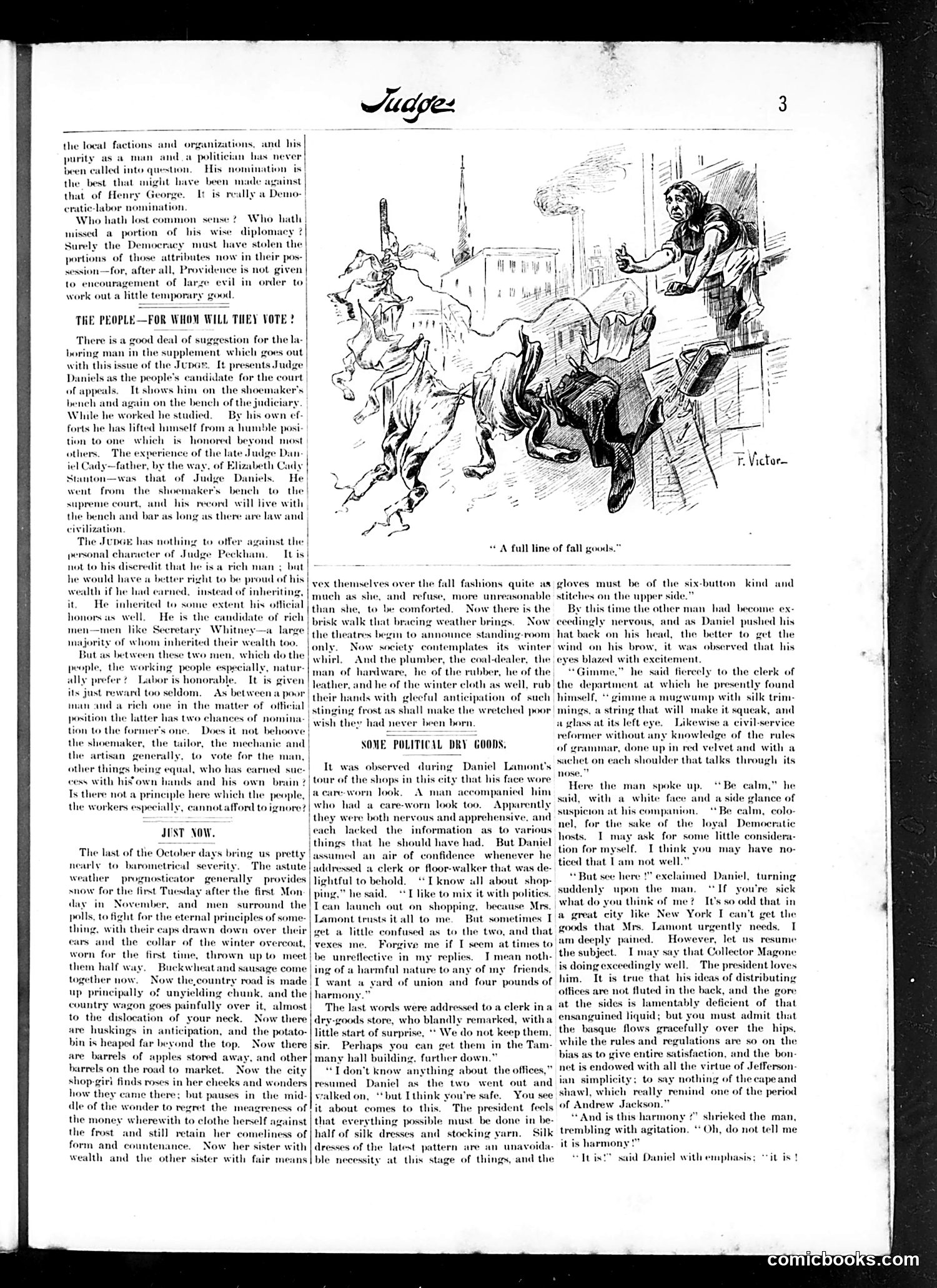
This page contains two interconnected political pieces from Judge magazine advocating for Judge Daniel Lamont as a presidential candidate. **The Main Cartoon** (top): Depicts Lamont shopping in a city store, accompanied by another man. The satire plays on Lamont's humble origins—he rose from a shoemaker to the supreme court through self-made effort, embodying the American meritocratic ideal the article champions. **The Political Message**: The text argues Lamont deserves working-class votes because he "lifted himself from a humble position" through honest labor, unlike wealthy politicians born to privilege. He represents "the people's candidate." **"Some Political Dry Goods"** (bottom section): A humorous anecdote where Lamont confuses shopping terminology with political rhetoric, joking that he sometimes mixes the two up. This gentle mockery humanizes him while reinforcing his everyman credentials. **The satire's point**: Judge endorses Lamont by emphasizing his working-class authenticity against competitors of inherited wealth, positioning him as the candidate who understands ordinary Americans' struggles.
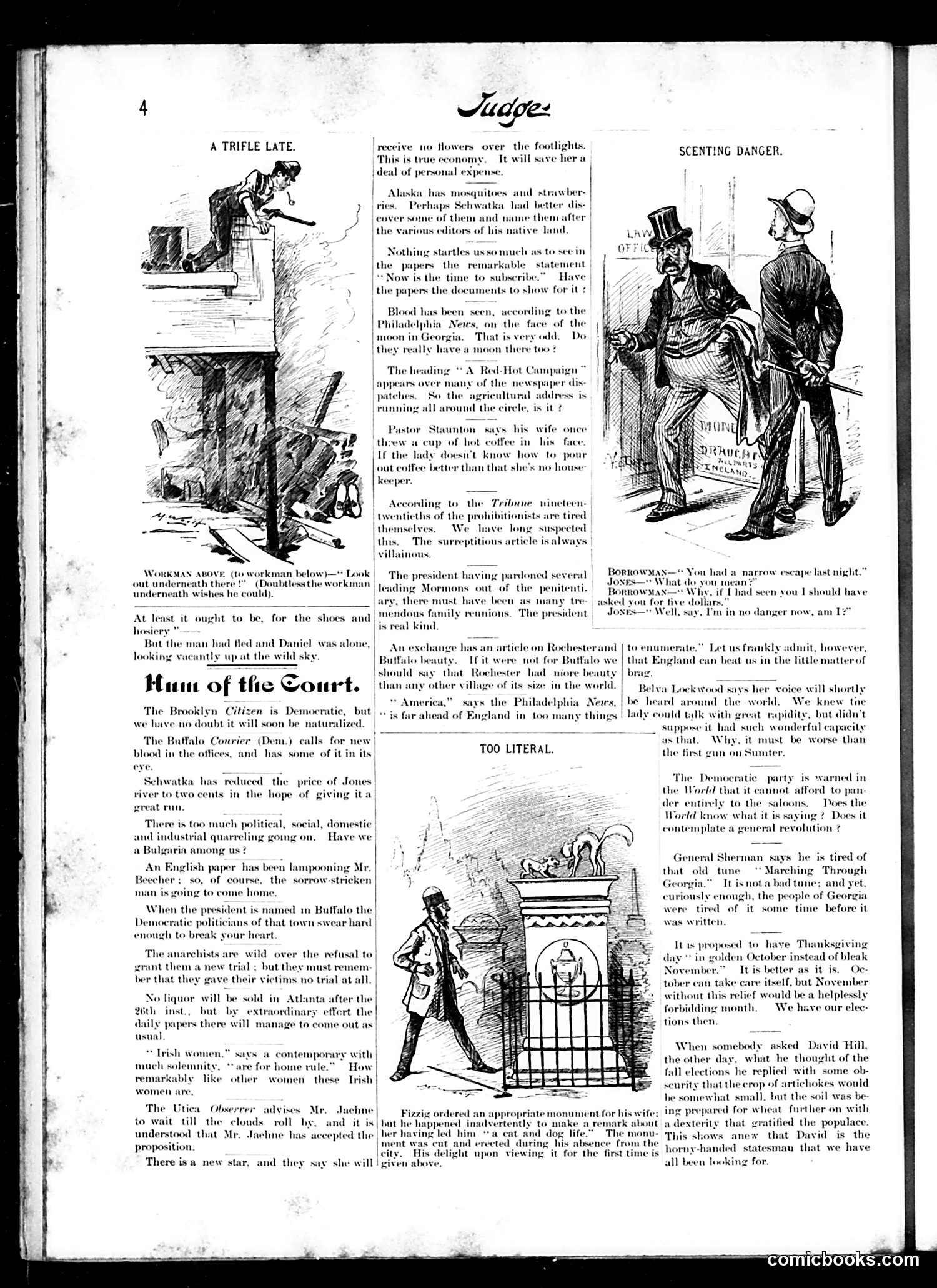
This page from *Judge* magazine contains three distinct satirical pieces: **"A Trifle Late"** (top left): Shows a workman perched precariously on a building, wishing he could fall—dark humor about dangerous working conditions and worker desperation. **"Hum of the Court"** (center): Gossip column commentary mocking political and social absurdities of the era, including references to Democratic politicians in Buffalo, anarchists, and disputes between clergy (likely referencing Henry Ward Beecher). **"Scenting Danger"** (right): A cartoon where a man discovers his wife narrowly missed seeing him, implying infidelity—playing on the phrase "narrow escape." **"Too Literal"** (bottom center): A man ordered a monument to his wife claiming she gave him a "cat and dog life" (meaning constant conflict); the monument was literally sculpted with fighting animals, creating an unintentionally hilarious public embarrassment. The humor relies on wordplay, exaggeration, and satirizing contemporary political figures and social foibles recognizable to 1880s readers.
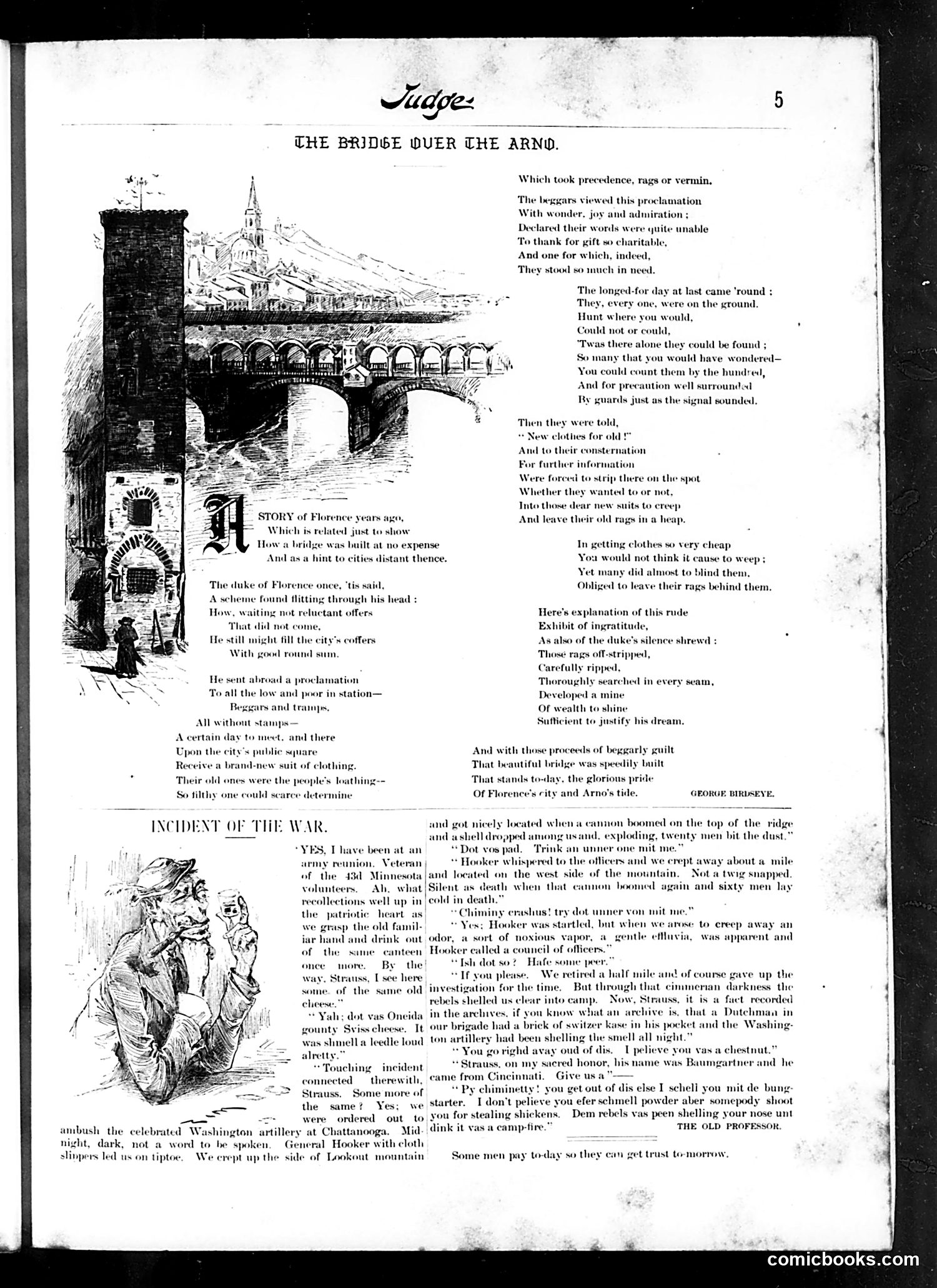
**"The Bridge Over the Arno"** is a humorous poem about a Duke of Florence who cleverly solves his financial problems. He offers free new clothes to the city's beggars and poor—but secretly has his men rip apart their old rags and search every seam for hidden valuables. The proceeds fund construction of a bridge, enriching the city while the poor unknowingly contribute their accumulated wealth. **"Incident of the War"** is a comedic dialogue between Civil War veterans. Two soldiers recount a battle where cannon fire killed comrades, then reveal the real problem: one soldier carried Swiss cheese in his pocket, and the smell proved so overpowering it forced a strategic retreat. The humor lies in deflating military heroism with absurd domestic practicality—the cheese, not enemy fire, determined the battle's outcome. Both pieces use satirical exaggeration to mock human nature: greed and deception in the first, vanity in military storytelling in the second.
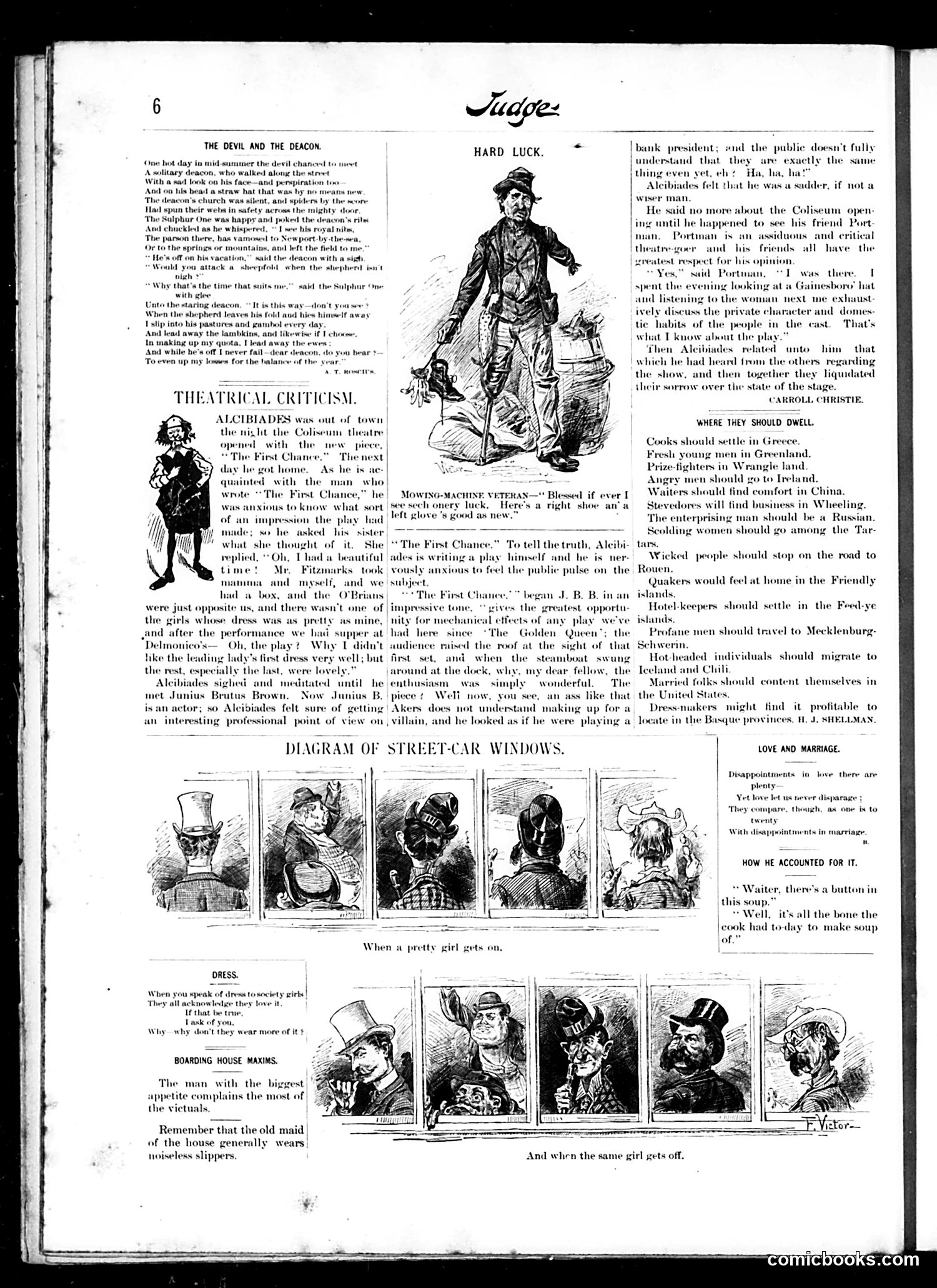
This page contains several satirical pieces typical of late 19th-century American humor: **"The Devil and the Deacon"** (top poem): A moral tale mocking religious hypocrisy—a deacon confesses to a devil that he regularly steals sheep from his pastor's flock to meet his quota, then returns them. The satire targets the gap between pious public behavior and private vice. **"Theatrical Criticism"** (middle): Satirizes shallow theater audiences, particularly society women who attend plays for fashion display rather than artistic merit. A character discusses Alcides' sister, who cares only about her dress and dinner afterward, not the actual performance—mocking the superficiality of gilded-age theater-going. **"Diagram of Street-Car Windows"** (bottom): Visual gags showing passengers' expressions "when a pretty girl gets on" versus "when the same girl gets off"—crude humor about male behavior in public transit. **Side columns**: Various quips about marriage disappointments, boarding house complaints, and travel advice—typical magazine filler humor. The satire targets: pretentious theater society, religious hypocrisy, and working-class vulgarity—standard Judge magazine targets of the era.
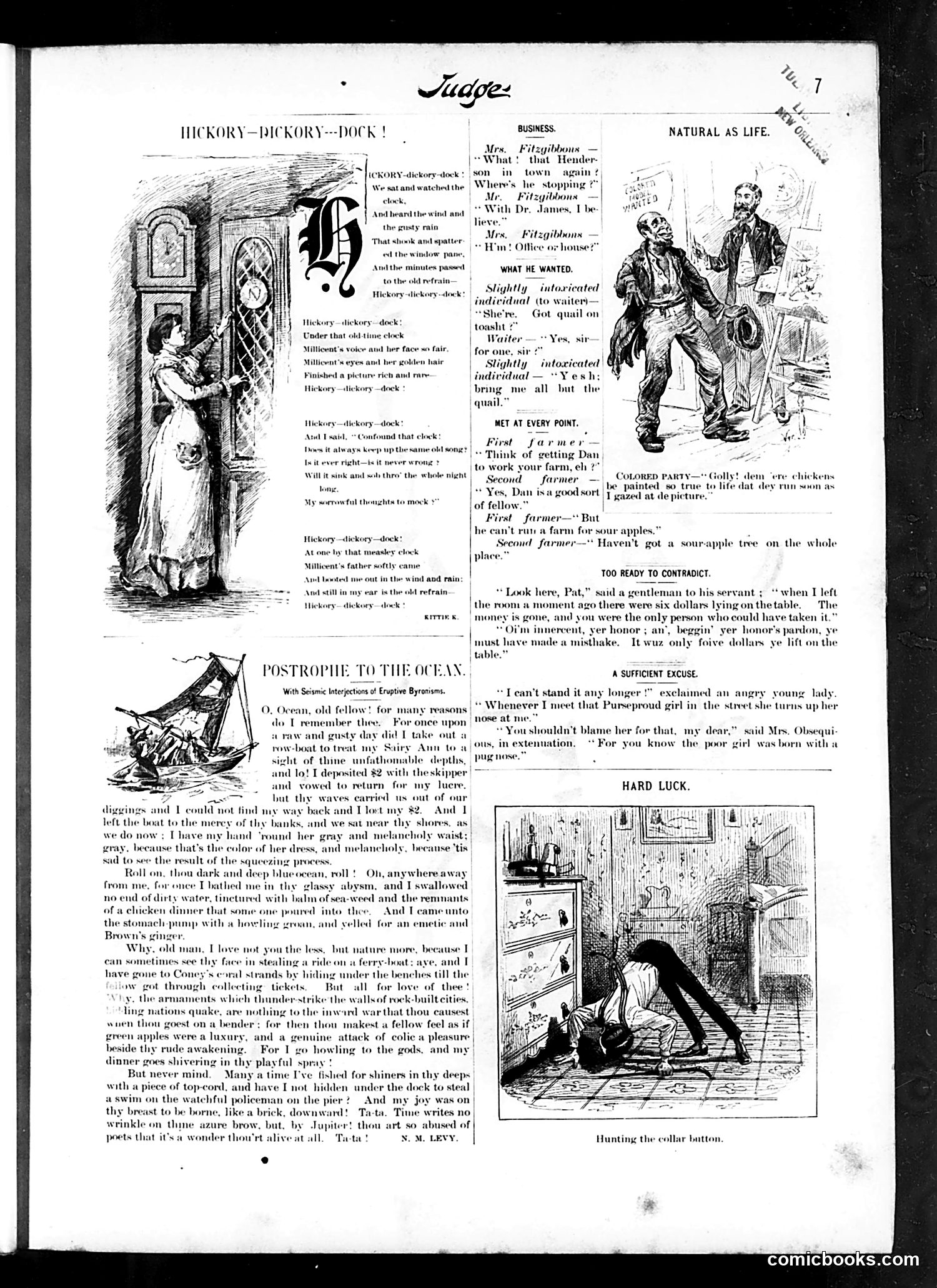
This page contains three distinct satirical pieces typical of late-19th century Judge magazine: **"Hickory-Dickory-Dock"** (left): A sentimental poem about a man listening to a clock while thinking of a woman named Millicent—satirizing the era's overwrought romantic poetry by coupling it with mundane domestic observation. **"Postrophe to the Ocean"** (center): A humorous first-person account mocking Byronic literary conventions. The narrator complains to the ocean about losing money and suffering indignities (swallowing dirty water, needing stomach-pumping), deflating the grandiose "man-versus-nature" trope popular in Romantic literature. The signature "S. M. Levy" suggests Jewish immigrant authorship, itself notable for the era. **"Hard Luck"** (right): A multi-panel comic strip showing someone hunting for a lost collar button—everyday frustration treated as dramatic narrative, likely satirizing both detective stories and working-class struggles. The page mixes social observation with literary parody, typical of Judge's satirical approach to American life and culture.
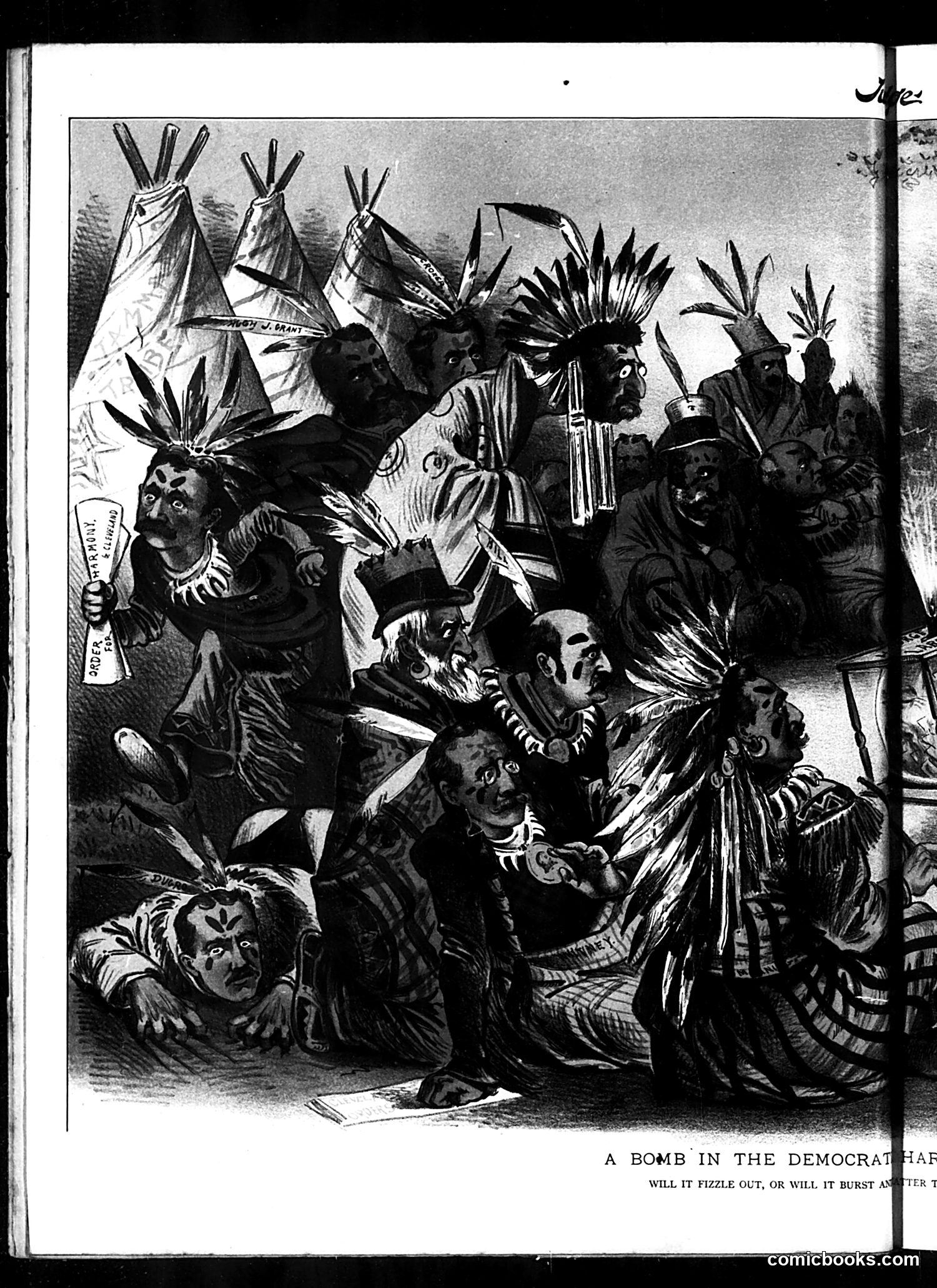
This political cartoon satirizes internal conflict within the Democratic Party. The image depicts Native American figures (identifiable by headdresses and tepees in the background) gathered around what appears to be a volatile situation—the "bomb" referenced in the title. The cartoon uses the bomb as a metaphor for a destructive dispute threatening to tear the party apart. The Native American imagery and caricatures suggest the cartoon is commenting on a specific Democratic controversy, possibly related to westward expansion policies or factional disagreements of the era. The caption's question—"Will it fizzle out, or will it burst?"—frames the conflict as either something that will dissipate harmlessly or explode into full party rupture. This appears to be commentary on whether internal Democratic tensions would resolve or cause serious damage to the party's unity.
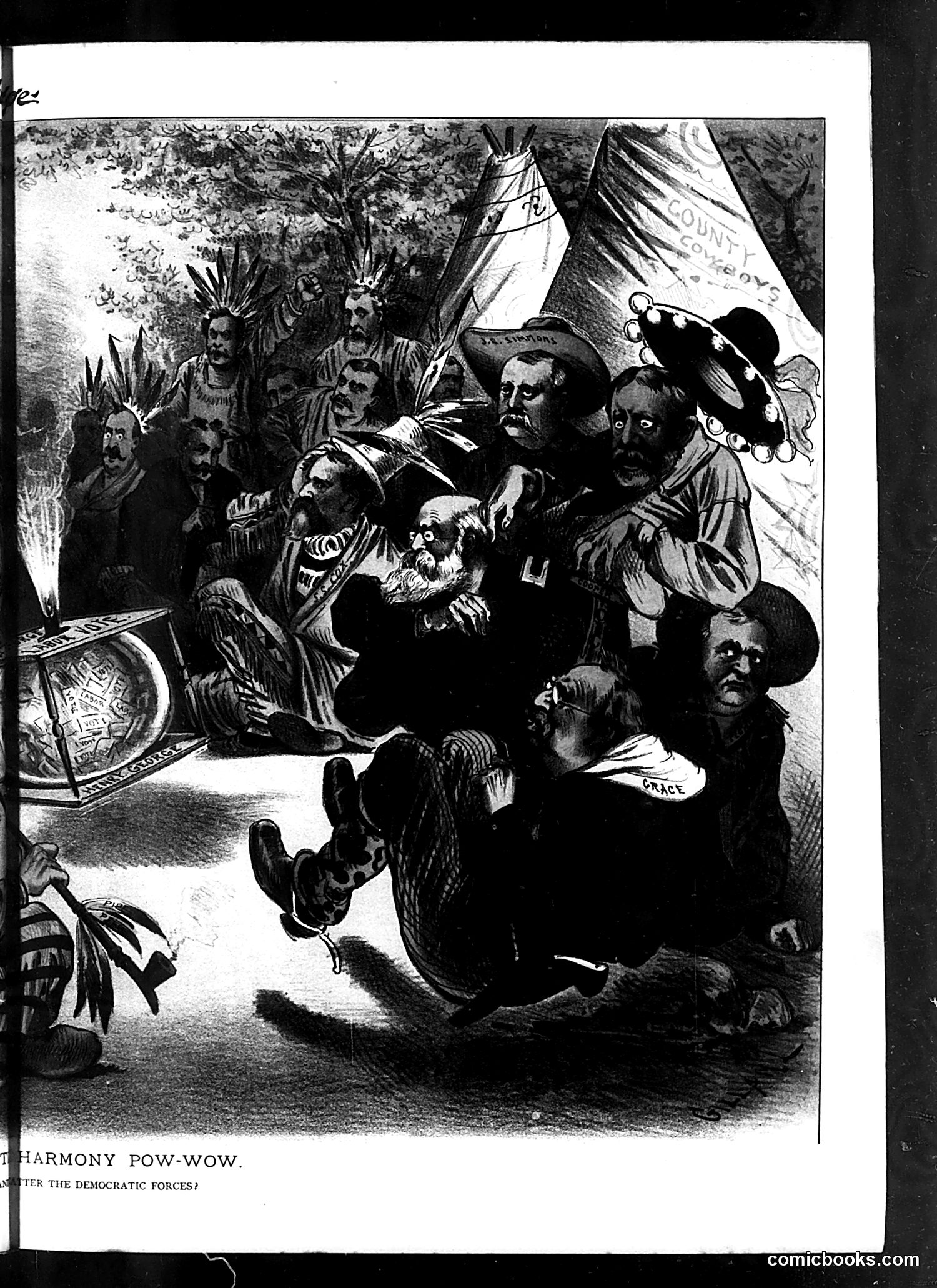
This cartoon satirizes Democratic Party unity efforts, likely from the late 19th century based on Judge magazine's style. The title "Harmony Pow-Wow" mockingly compares Democratic leadership to a Native American gathering, suggesting their attempts at party cohesion are theatrical and artificial. The scene depicts multiple bearded men in military uniforms and formal dress huddled together, with flags and regalia visible. The subtitle asks "After the Democratic Forces?" — implying the cartoon questions whether these Democratic leaders can actually achieve genuine harmony or cooperation. The caricatures and exaggerated expressions suggest the cartoonist viewed Democratic unity negotiations as absurd political theater rather than serious governance. The "pow-wow" reference uses period-typical Native American imagery disparagingly to mock what the artist considered performative party politics.
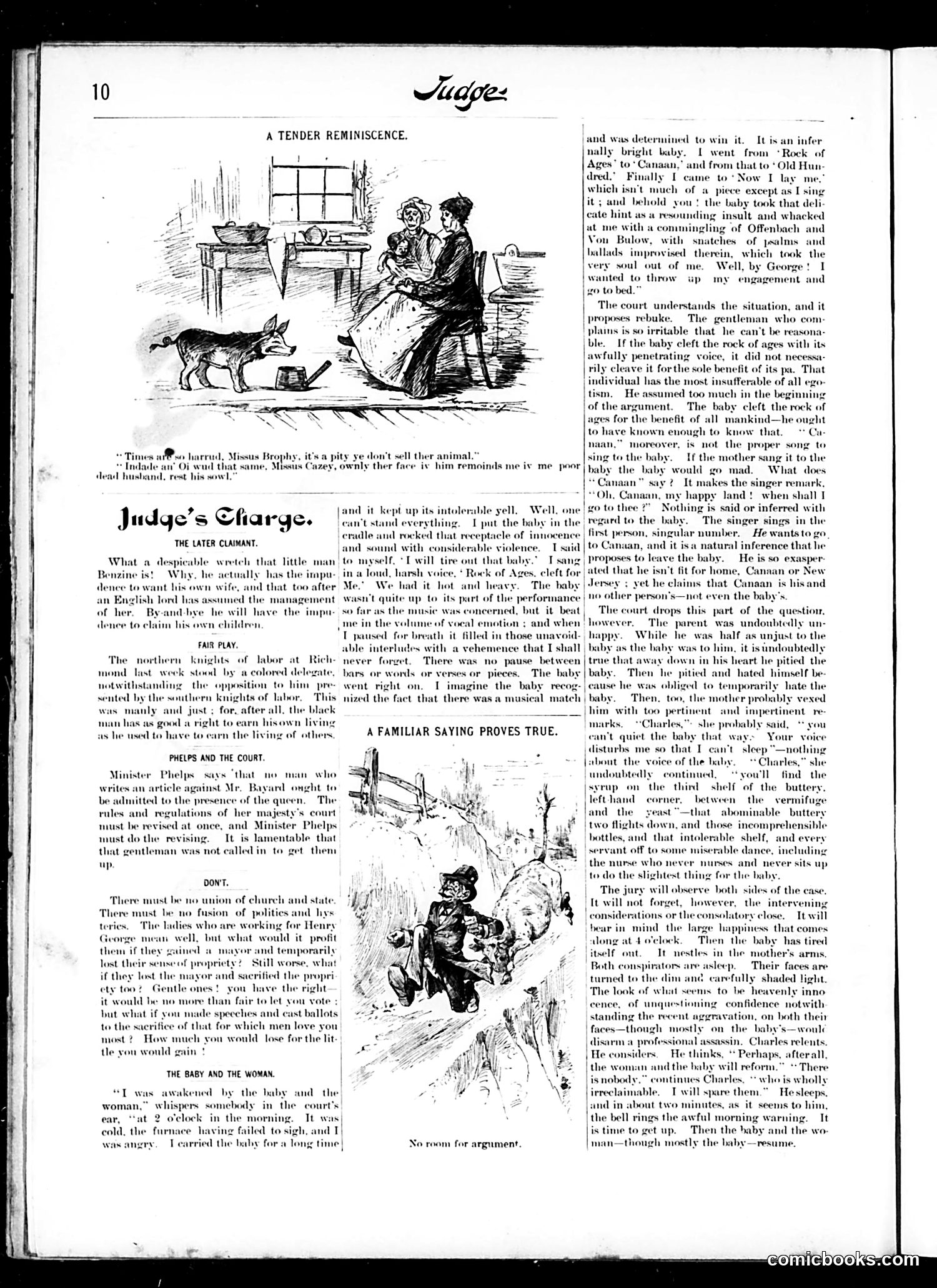
This page contains multiple brief satirical pieces mocking legal proceedings and social pretension. The main content appears to be "Judge's Charge," satirizing a court case involving a man ("Benzine") disputing paternity or custody claims—the judge sarcastically notes his "impudence" in wanting "his own wife" and eventually "his own children." The accompanying illustrations and vignettes mock various social issues: a dispute over a baby (suggesting custody/legitimacy conflicts common in period legal cases), arguments about church-state separation, and labor disputes in Richmond. The satire targets litigious men of dubious character who make unreasonable legal claims, self-righteous judges, and the absurdity of formal court proceedings applied to domestic disputes. The humor relies on readers' familiarity with specific court cases and legal scandals of the era—context now largely lost—though the general mockery of pretentious legal arguments remains clear.
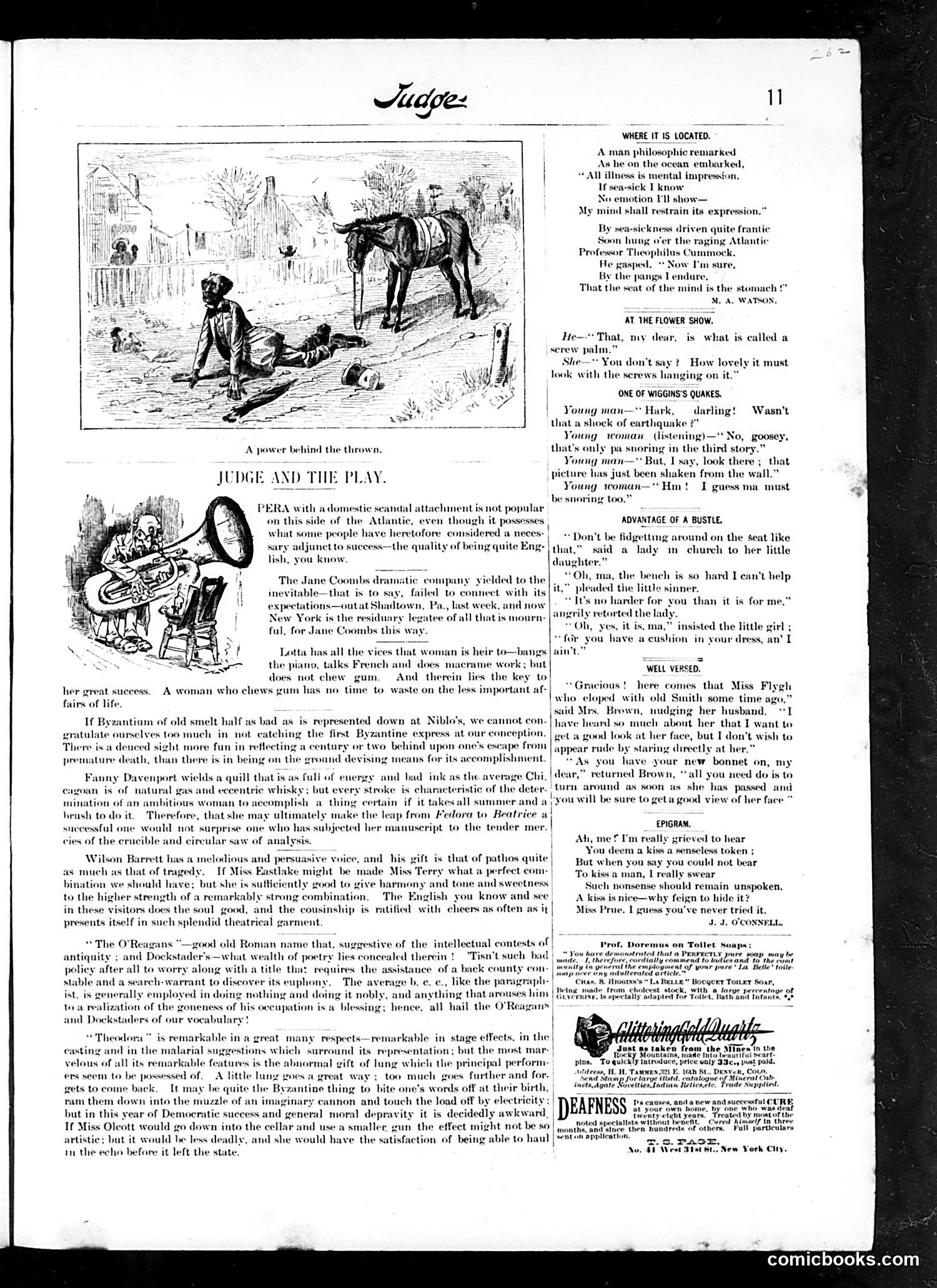
This page from Judge magazine contains theatrical criticism and light satirical verses rather than political cartoons. The main article, "Judge and the Play," reviews contemporary theater productions. It criticizes a company's staging of "Pera" (likely *La Péra*, a French play) as unsuccessful in America, and discusses other theatrical works including "The O'Reagans," "Dockstaders," and "Theodora." The critic mocks the lead actress's excessive vocal projection—describing how she forces words down "into the muzzle of an imaginary cannon," suggesting her delivery is unnaturally theatrical and destructive to the art form. The scattered verses mock common pretensions: a philosopher claiming illness is "mental impression" while seasick, and a couple discussing decorative plants at a flower show. The page's illustration shows a destitute man, captioned "A power behind the throne"—a sardonic reference to influencing authority from poverty. The advertisements below include remedies for deafness, typical of period medical marketing.
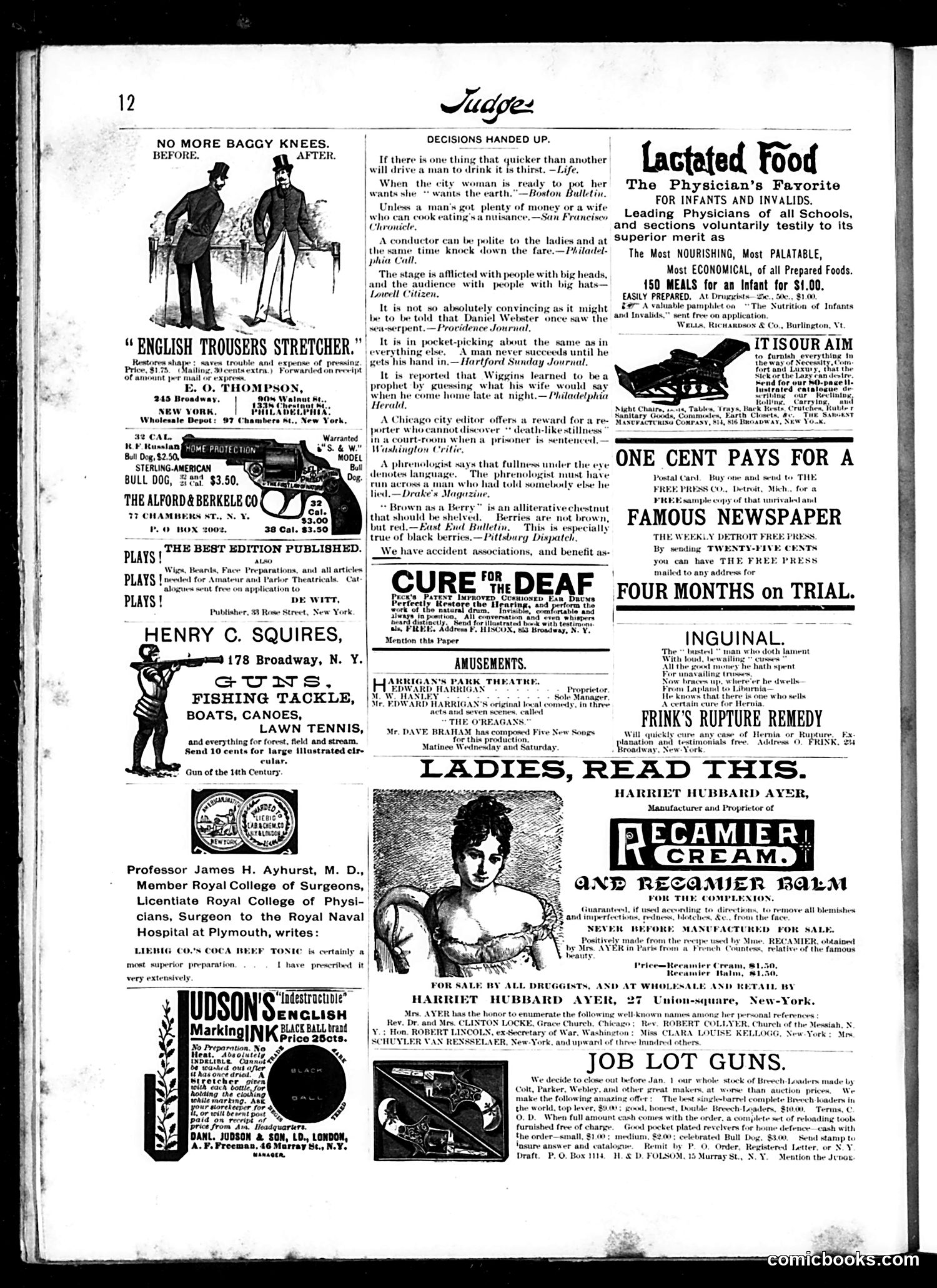
This is primarily an **advertising page** from Judge magazine, with one small cartoon at top-left titled "No More Baggy Knees." ## The Cartoon The cartoon depicts a man before and after wearing an "English Trousers Stretcher"—a device marketed to prevent the sagging knees that plagued Victorian men's trousers. The humor is straightforward: it mocks the common wardrobe problem and the inventors' solution. The before/after format was a standard advertising trope. ## The Advertisements The page is dominated by patent medicines (Liebig's Coca Beef Tonic, cure-for-deafness tonics), baby formula (Lactafed Food), beauty creams (Recamier Cream by Harriet Hubbard Ayer—a famous cosmetics entrepreneur), firearms, and theatrical supplies. These ads reveal period consumer concerns: infant nutrition, deafness "cures," women's complexion products, and personal grooming challenges. The magazine's readership was urban, middle-to-upper class, and concerned with modern conveniences and self-improvement products typical of the **Gilded Age**.
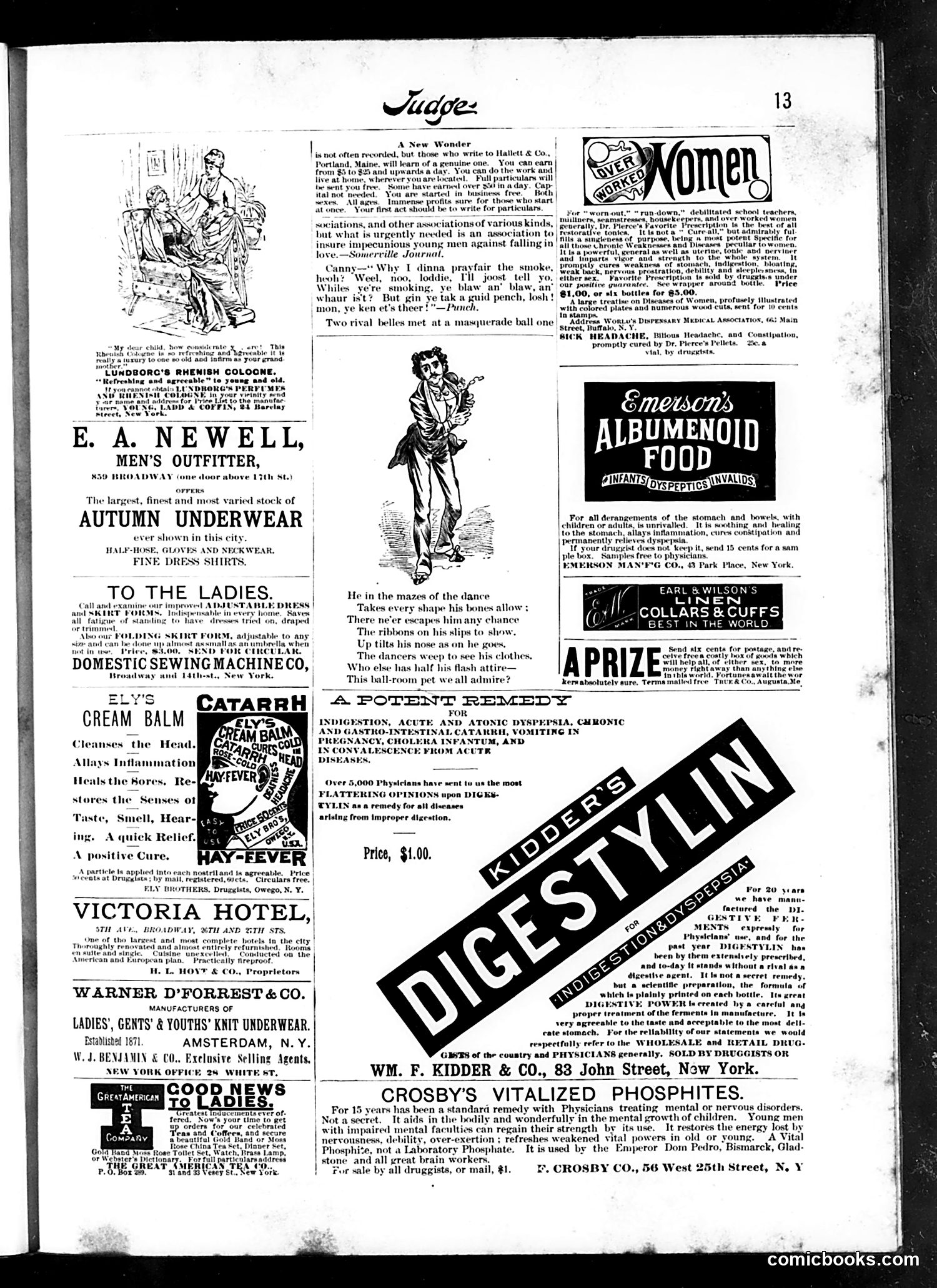
This page is primarily **advertisements**, not political cartoons. The page contains commercial ads for patent medicines, clothing, and household products typical of late 19th-century magazines. The visible satirical content appears minimal. There are brief humorous verses—including a Scottish dialect joke about smoking and dancing—but these are marginal to the advertising content. The ads themselves reflect period attitudes: they promote dubious "remedies" (Kidder's Digestylin, Crosby's Phosphites, Emerson's Albumenoid Food) claiming to cure everything from dyspepsia to nervous disorders. The ads targeting women (domestic sewing machines, dress forms) and men's fashion reflect Victorian gender roles. **Notable**: One ad references an association against "impecunious young men against falling in love," suggesting middle-class anxiety about courtship and financial stability—a genuine social concern of the era masked by commercial opportunism. The page documents how Judge mixed satire with aggressive patent-medicine marketing, which was later regulated.
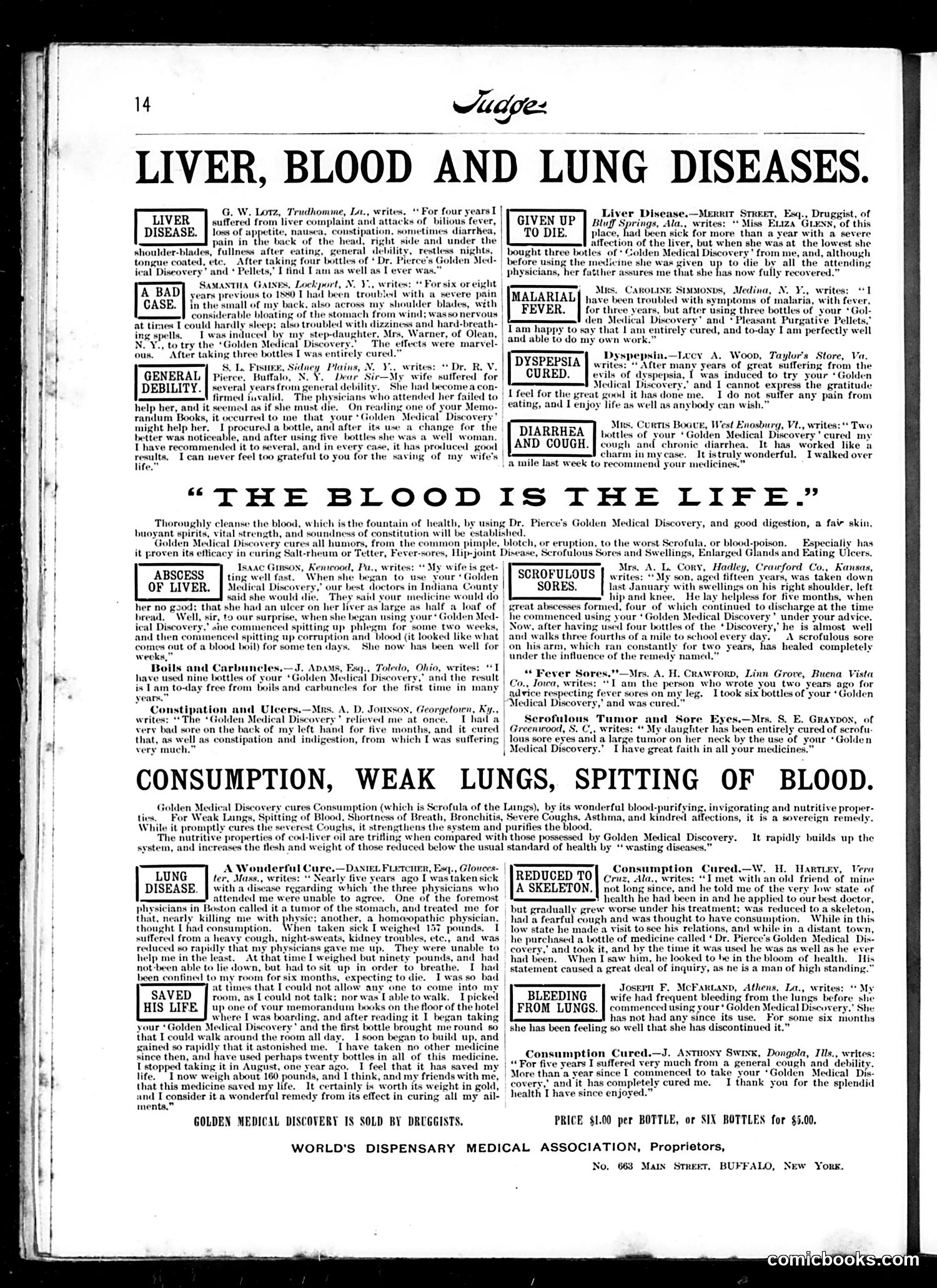
This page is **entirely an advertisement** for Dr. Pierce's "Golden Medical Discovery," a patent medicine, disguised as editorial content. There are no cartoons or satire present. **What this represents:** The page is a standard example of late-19th-century medical advertising common in American magazines. It features testimonial letters from supposed patients claiming cures for liver disease, malaria, consumption (tuberculosis), dyspepsia, diarrhea, and blood disorders. **Historical context:** These "patent medicines" were largely unregulated and often contained questionable ingredients. The testimonials use specific place names and names (though generic enough to be unverifiable) to create credibility. Judge magazine accepted such advertising alongside satirical content. **For modern readers:** This illustrates pre-FDA medicine marketing practices and demonstrates how publications legitimized dubious health claims through customer testimonials—a marketing technique that persists today.
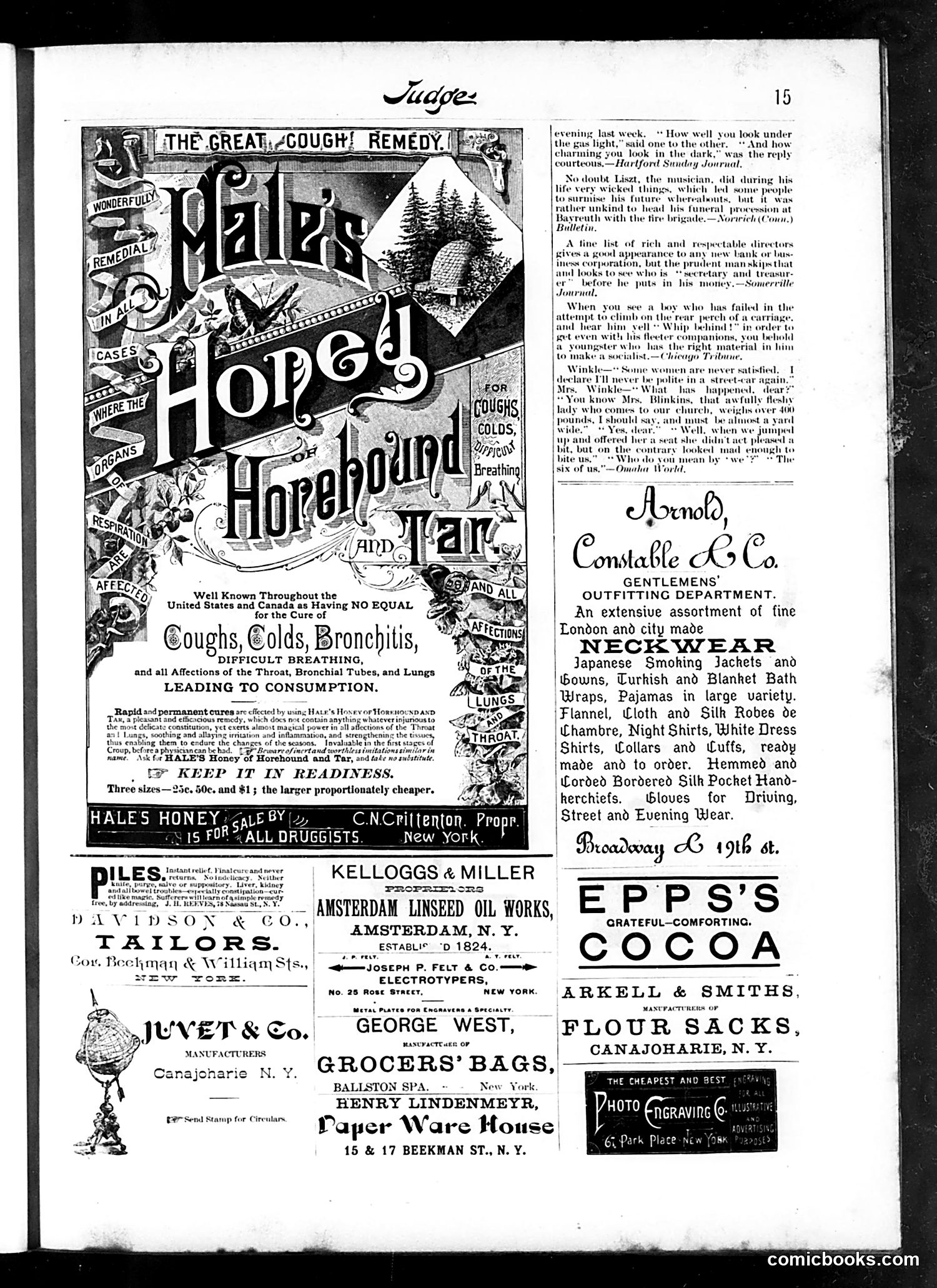
This page is primarily **advertising** with one large patent medicine advertisement dominating the left side. The main content is **Hale's Honey of Horehound and Tar**, a cough remedy advertised as a cure for coughs, colds, bronchitis, and throat afflictions "leading to consumption" (tuberculosis). The ornate Victorian advertisement claims it produces "rapid and permanent cures" and warns against "worthless imitations." This reflects the **patent medicine era** (pre-FDA regulation) when dubious tonics and remedies were heavily marketed with expansive health claims. The warning about imitations was common—these products were so profitable that counterfeits abounded. The remainder of the page contains **miscellaneous business advertisements** for tailors, linseed oil works, paper warehouses, grocers' bags, and gentlemen's clothing—typical of Judge's advertising sections. No political cartoons or satire appear on this particular page.
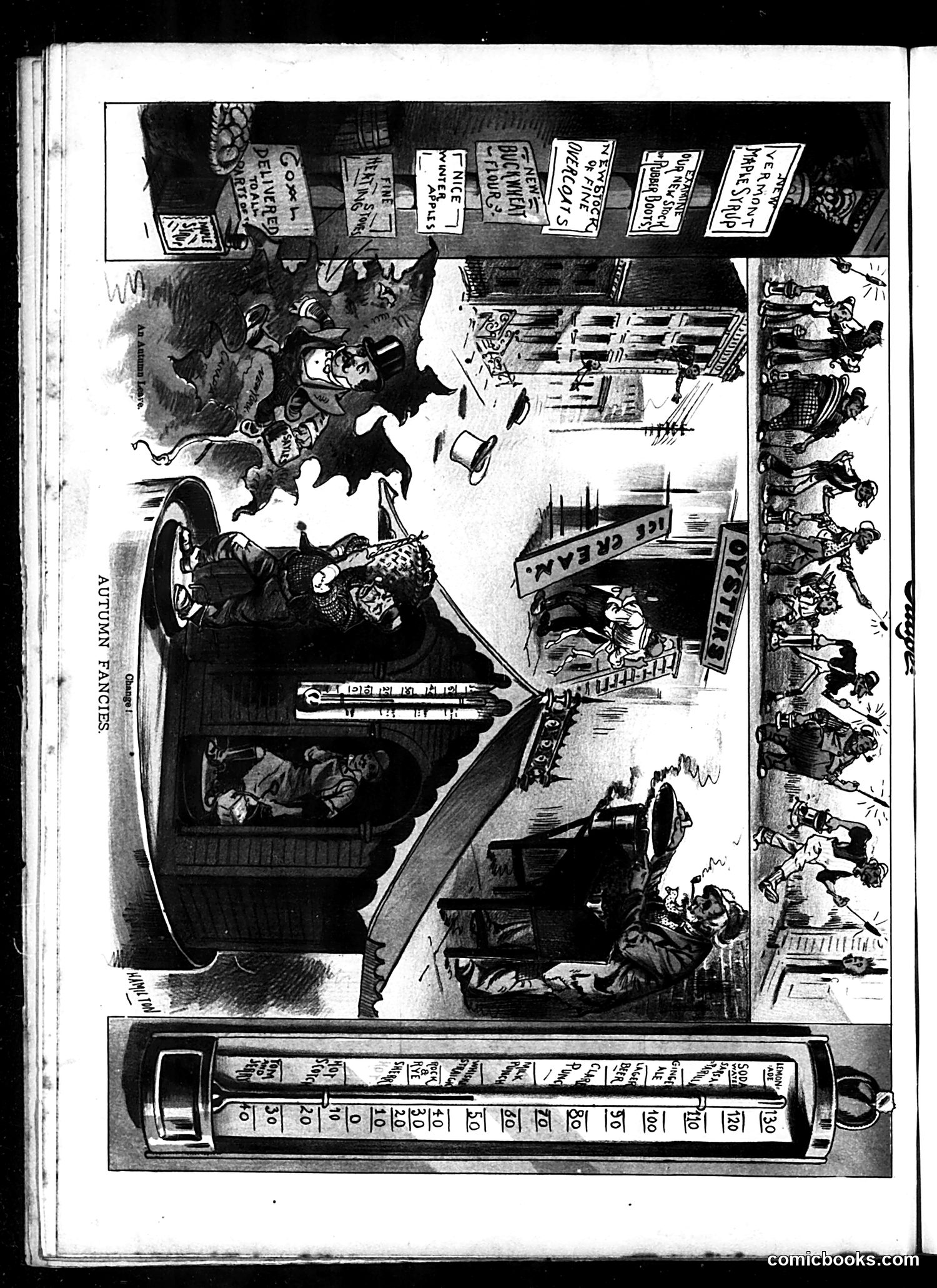
I can see this is a page from *Judge* magazine, but the OCR text provided is too corrupted to read reliably, consisting mainly of random characters and numbers rather than legible content. From the **image alone**, I can observe this appears to be a multi-panel political cartoon drawn in a satirical style typical of early 20th-century American comics. The artwork shows various figures in different scenes, with what looks like storefronts or public spaces. There are banners or signs visible at the top, though their text isn't clearly legible in this reproduction. However, **without readable text**, I cannot accurately identify the specific figures, political figures being caricatured, or the precise satirical point being made. To properly explain this cartoon's meaning to a modern reader, I would need either clearer OCR text or the ability to read the signs and dialogue clearly in the image.
I can see this is a blank or nearly blank page from Judge magazine, with only minimal markings visible on the left margin. There is no discernible cartoon, illustration, or readable text content on this page itself. The page appears to be either a blank section between articles, a title page, or possibly a scanning/preservation artifact where the content did not reproduce clearly. Without visible cartoon imagery or substantive text to analyze, I cannot identify figures, references, or satirical intent. To provide meaningful analysis of Judge's political or social satire, a page with actual cartoon or text content would be needed.
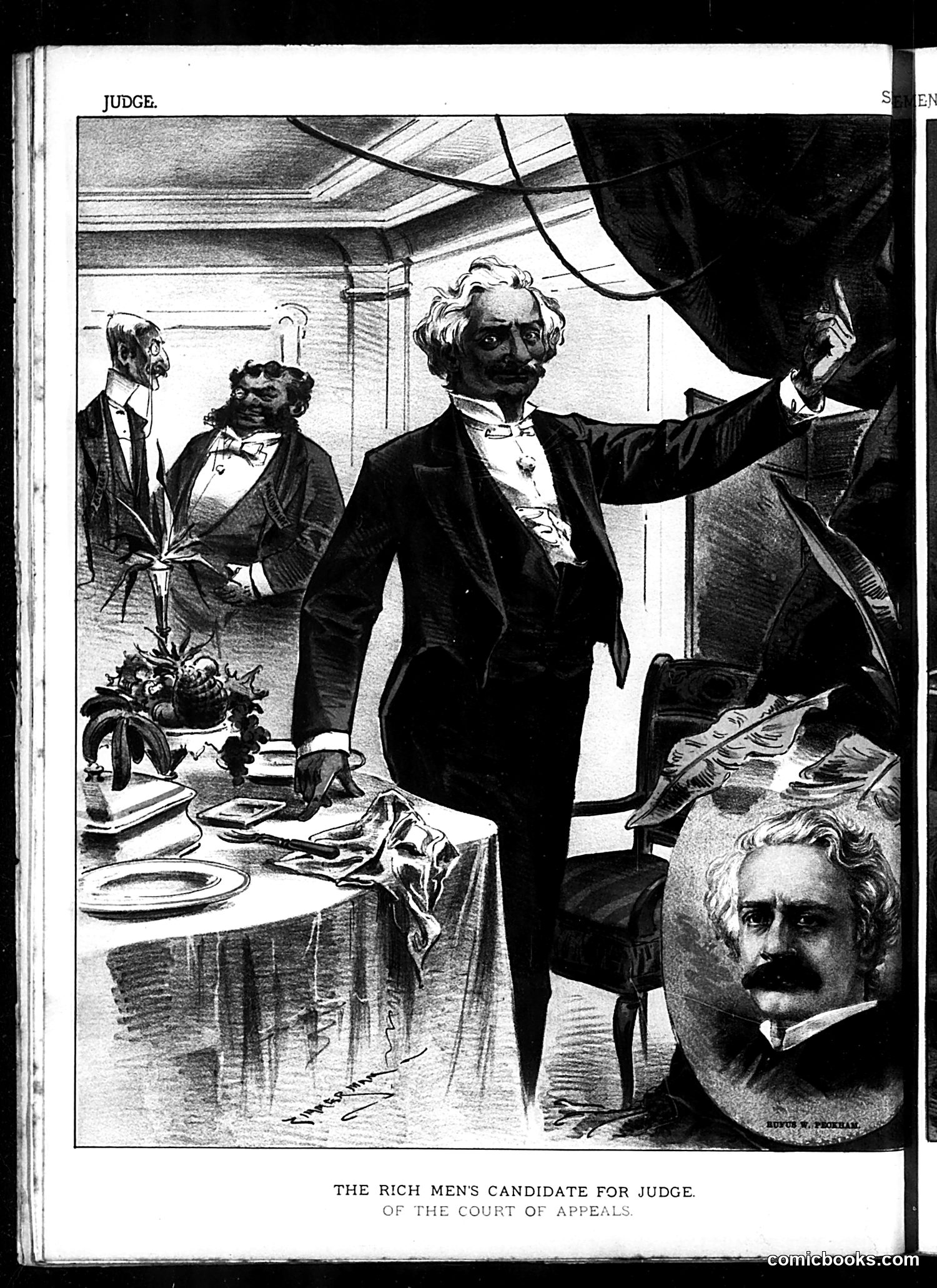
This satirical cartoon critiques judicial corruption and class bias. The central figure—a wealthy man in formal attire—stands amid luxurious dining settings (flowers, fine plates, draped fabric), suggesting opulence and excess. Surrounding gentlemen in tuxedos appear to be endorsing or presenting him as a judicial candidate. The satire's point: the cartoon mocks the idea that wealthy elites could secure judicial appointments through their social and financial connections rather than merit. The lavish setting emphasizes that this candidate represents rich interests, not impartial justice. By labeling him explicitly as "the rich man's candidate," Judge magazine condemns the perceived corruption of the appeals court selection process, suggesting judges were chosen to serve wealthy patrons rather than uphold the law fairly for all citizens.
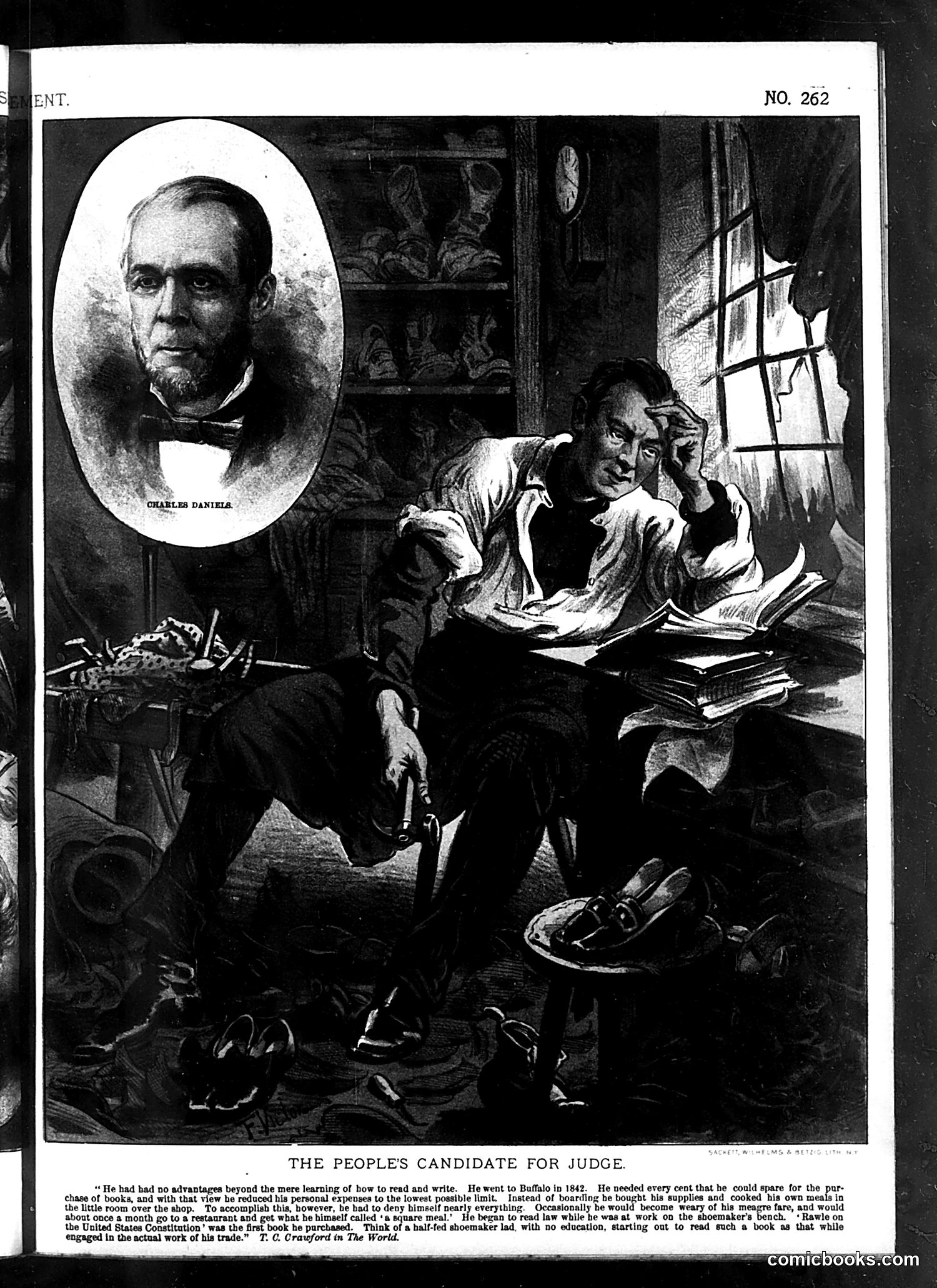
This Judge magazine satire mocks a political candidate for judicial office—identified as Charles Daniels in the portrait—by highlighting his humble origins as a poor, self-taught shoemaker. The cartoon contrasts Daniels' meager background (depicted in the main illustration showing him studying law in a cramped room while working as a cobbler) with his aspirations to become a judge. The accompanying text emphasizes his poverty: he ate sparingly, taught himself to read law books on a shoemaker's bench, and lacked formal education. The satire's point appears to be ridicule of someone from the working class presuming to hold judicial office—suggesting that his lack of traditional education and genteel background make him unsuitable for the bench. This reflects the class prejudices of Judge's audience, implying that judges should come from educated, privileged backgrounds rather than from labor.