
Judge, 1886-10-23 · page 19 of 19
Judge — October 23, 1886 — page 19: what you’re looking at
What you’re looking at
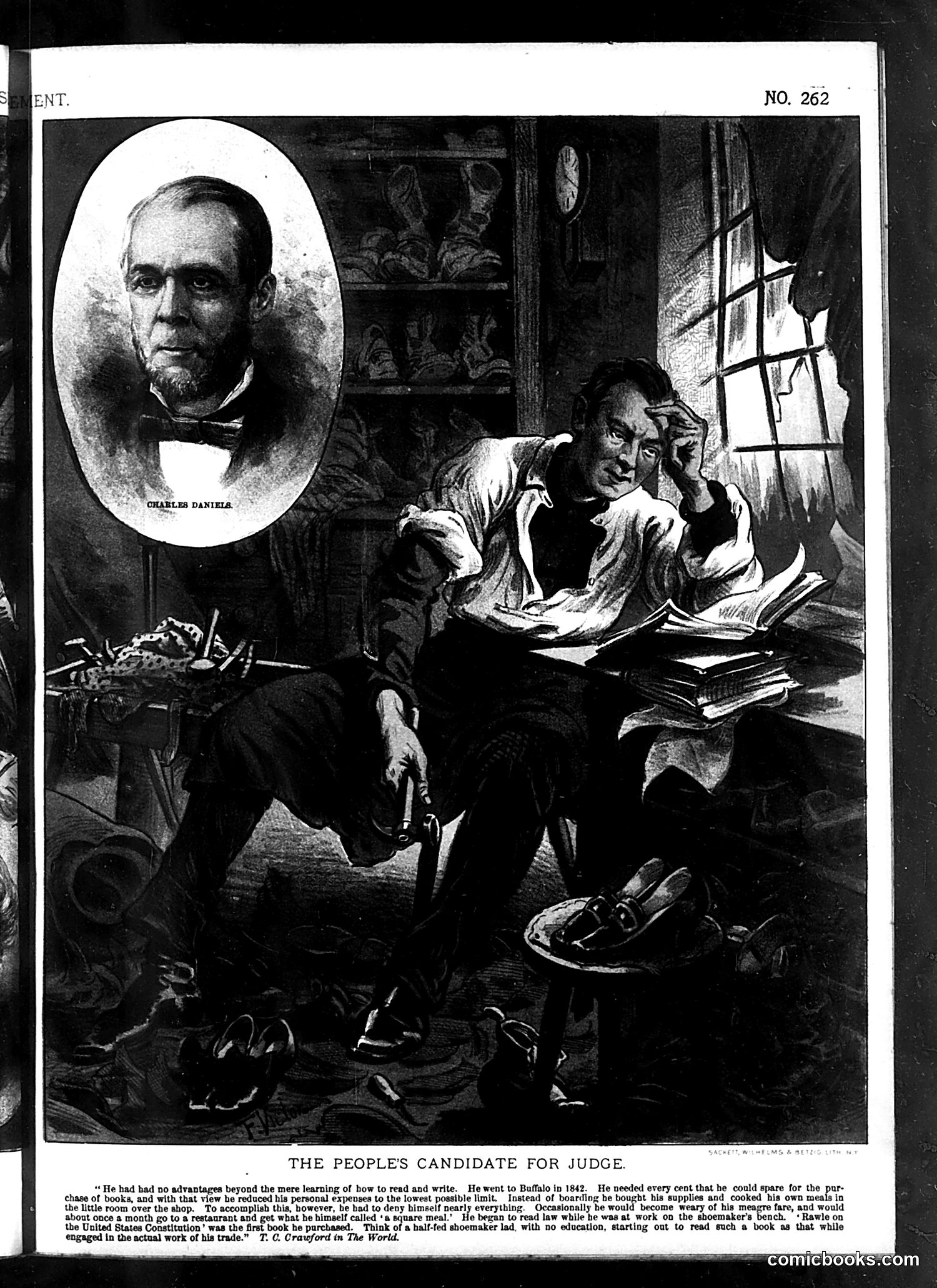
This Judge magazine satire mocks a political candidate for judicial office—identified as Charles Daniels in the portrait—by highlighting his humble origins as a poor, self-taught shoemaker. The cartoon contrasts Daniels' meager background (depicted in the main illustration showing him studying law in a cramped room while working as a cobbler) with his aspirations to become a judge. The accompanying text emphasizes his poverty: he ate sparingly, taught himself to read law books on a shoemaker's bench, and lacked formal education. The satire's point appears to be ridicule of someone from the working class presuming to hold judicial office—suggesting that his lack of traditional education and genteel background make him unsuitable for the bench. This reflects the class prejudices of Judge's audience, implying that judges should come from educated, privileged backgrounds rather than from labor.
📄 Transcribed text from this page (OCR, searchable)
Machine-transcribed from the original scan — historical spelling and the odd misread are preserved.
P; j THE PEOPLE'S CANDIDATE FOR JUDGE. “He had had no advantages beyond the mere learning of how to read and write. He went to Buffalo in 1842. He needed every cent that he could spare for the pur- chase of books, and with that view be reduced his personal expenses to the loweat possible limit. Instead of boarding be bought his supplies and cooked his own meals in the little room over the shop. To accomplish this, however, he bad to deny bimself nearly everything. Occasionally he would become weary of his meagre fare, and would about once a month go to a restaurant and get what he himself called ‘a square meal.’ He began to read law while he was at work on the shoemaker'’s bench. '+ Rawle on the United States Constitution’ was the first book he purchased. Think of a balf-fed shoemaker lad, with no education, starting out to read such @ book as that while engaged in the actual work of his trade.” T. C. Crawford in The World. -com