
A complete issue · 17 pages · 1886
Judge — April 10, 1886
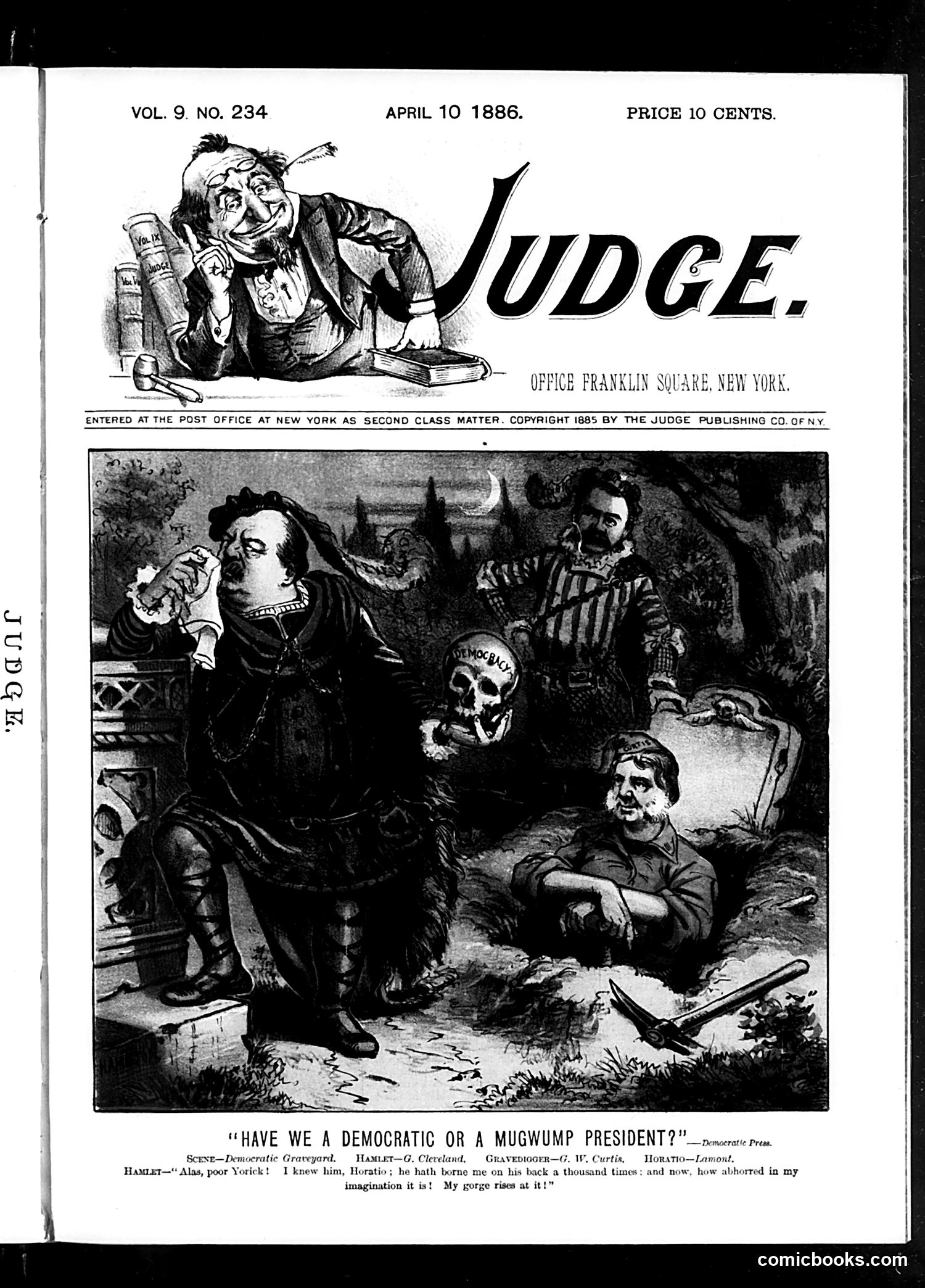
This satirical cartoon criticizes President Grover Cleveland by invoking the "Mugwump" label—referring to Republicans who abandoned their party to support Cleveland's 1884 election. The graveyard scene depicts Democratic spirits troubled by Cleveland's governance, suggesting he governs like a Republican turncoat rather than a true Democrat. The caption quotes Hamlet's "Alas, poor Yorick," reinforcing the theatrical satire. Democratic figures (identified as Cleveland, Curtis, Lamont, and others) appear distressed in this cemetery setting, implying Democratic principles are "dead" under Cleveland's presidency. The cartoon attacks Cleveland for supposedly betraying Democratic ideology, a common 1886 critique from his party's progressive wing regarding his conservative fiscal and labor policies.
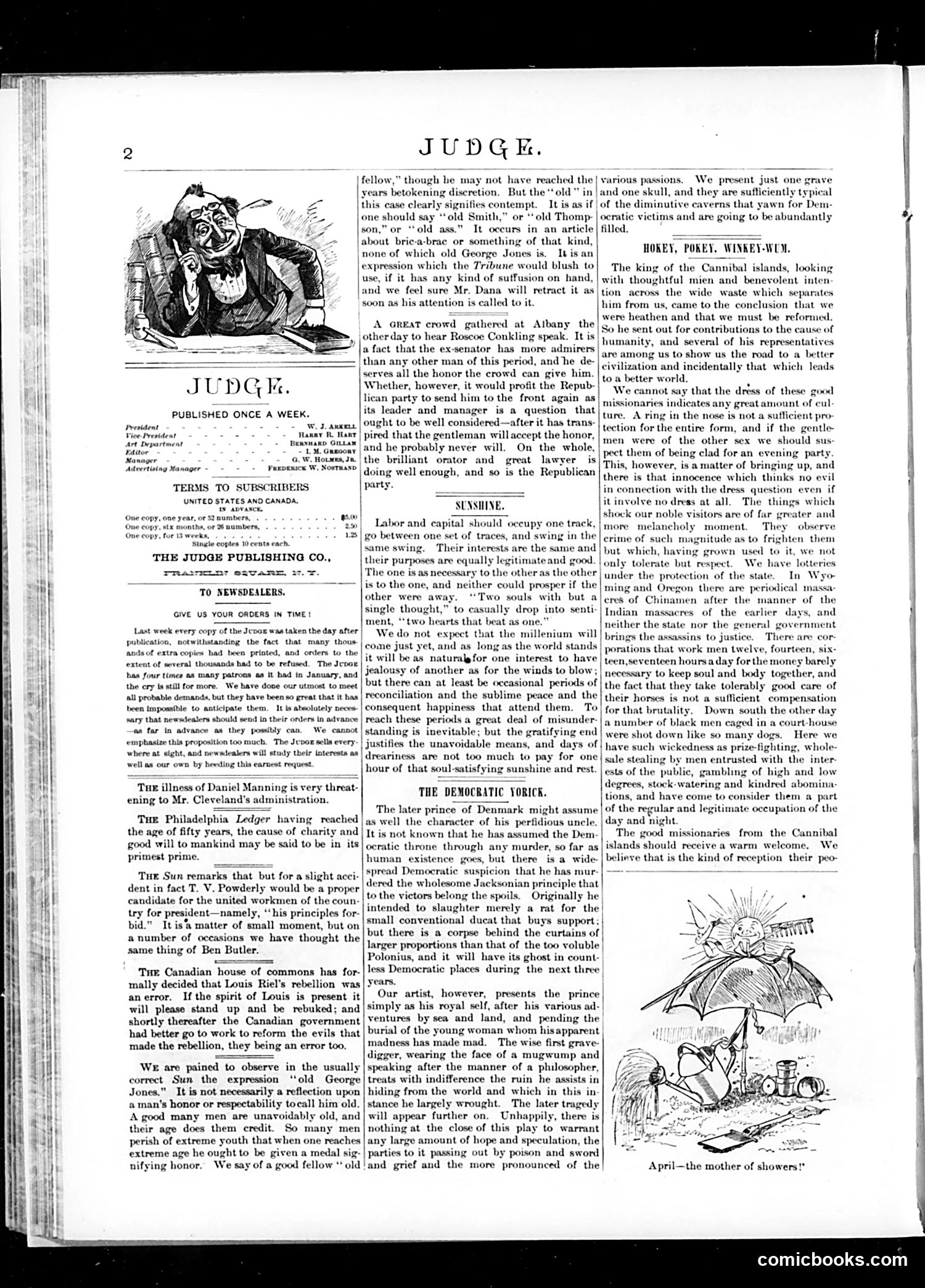
This page contains editorial commentary rather than political cartoons. The main article "Judge" discusses Senator Roscoe Conkling's speech at Albany, praising his oratory while debating Republican party strategy. Another section, "The Democratic Voice," appears to mock Democratic suspicions about their candidate, suggesting they suspect him of murdering his uncle—a reference to unclear historical context that would require additional research to verify. The illustrations show a disheveled figure (top left, likely representing some political target) and two landscape scenes (bottom), though their specific satirical meaning isn't clearly labeled. The page primarily features political opinion pieces rather than visual satire, making it difficult to determine exact targets without additional historical context about 1870s politics.
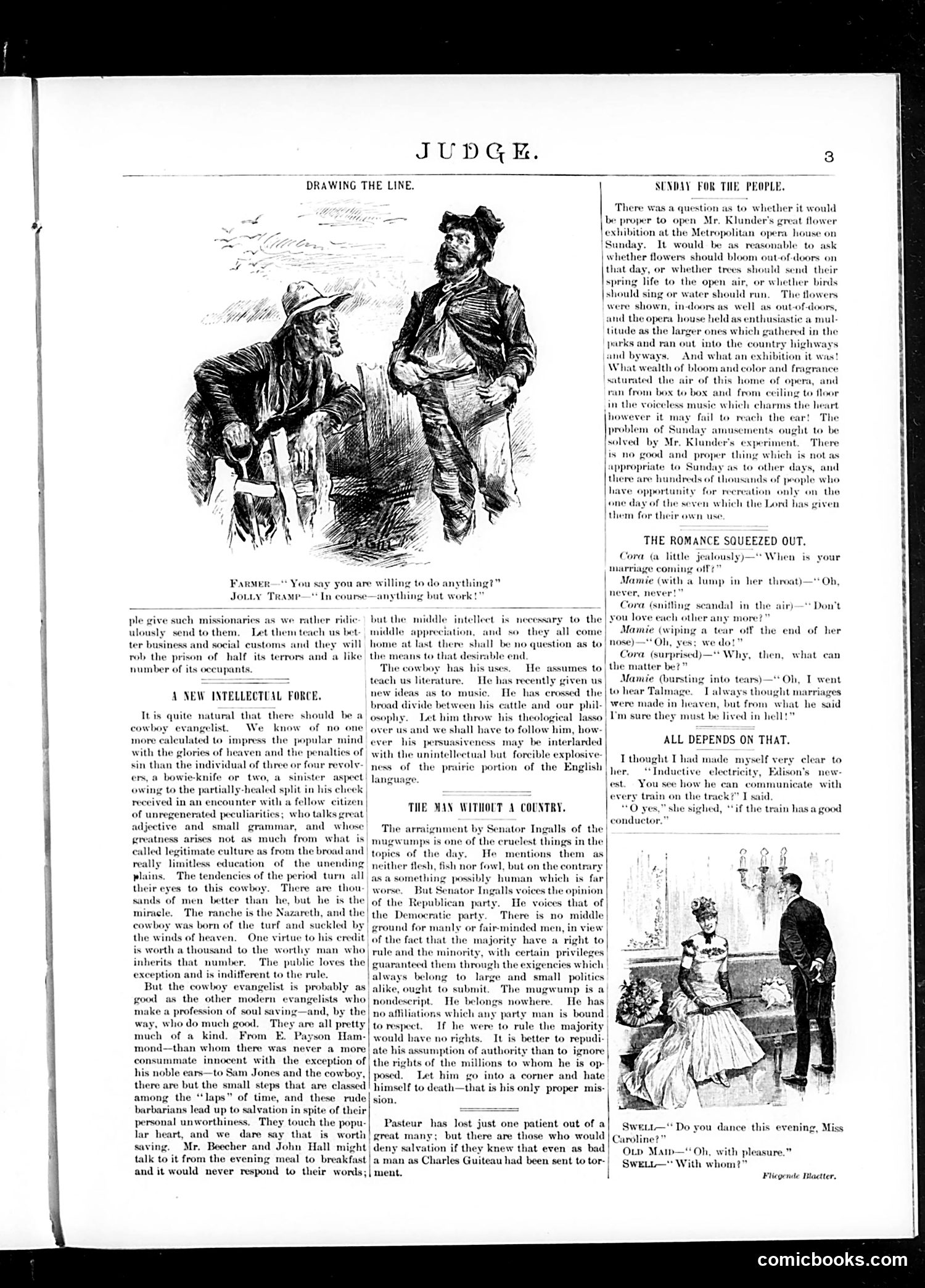
**"Drawing the Line"** (left cartoon): A farmer and "Jolly Tramp" negotiate. The farmer offers work; the tramp refuses, saying he'll do "anything but work." This satirizes vagrants and the tension between labor and idleness in the Gilded Age—a common Judge theme mocking both poverty and reluctance to work. **"A New Intellectual Force"** (center text): Sarcastically praises a "cowboy evangelist," suggesting cowboys lack education yet presume to teach. This mocks the perceived contradiction of rough frontiersmen positioned as moral/intellectual authorities—likely referencing actual evangelical movements of the era. **"The Man Without a Country"** (center): Attacks "mugwumps"—independent voters/reformers who rejected party loyalty. Judge's conservative stance condemns their refusal to align with either Republican or Democratic machines, calling them rootless and dangerous to majority rule. **Right column**: Includes lighter social satire about Sunday amusements and a brief comedic dialogue about dancing. The page reflects 1880s anxieties: labor unrest, distrust of "educated" pretenders, and contempt for political independents.
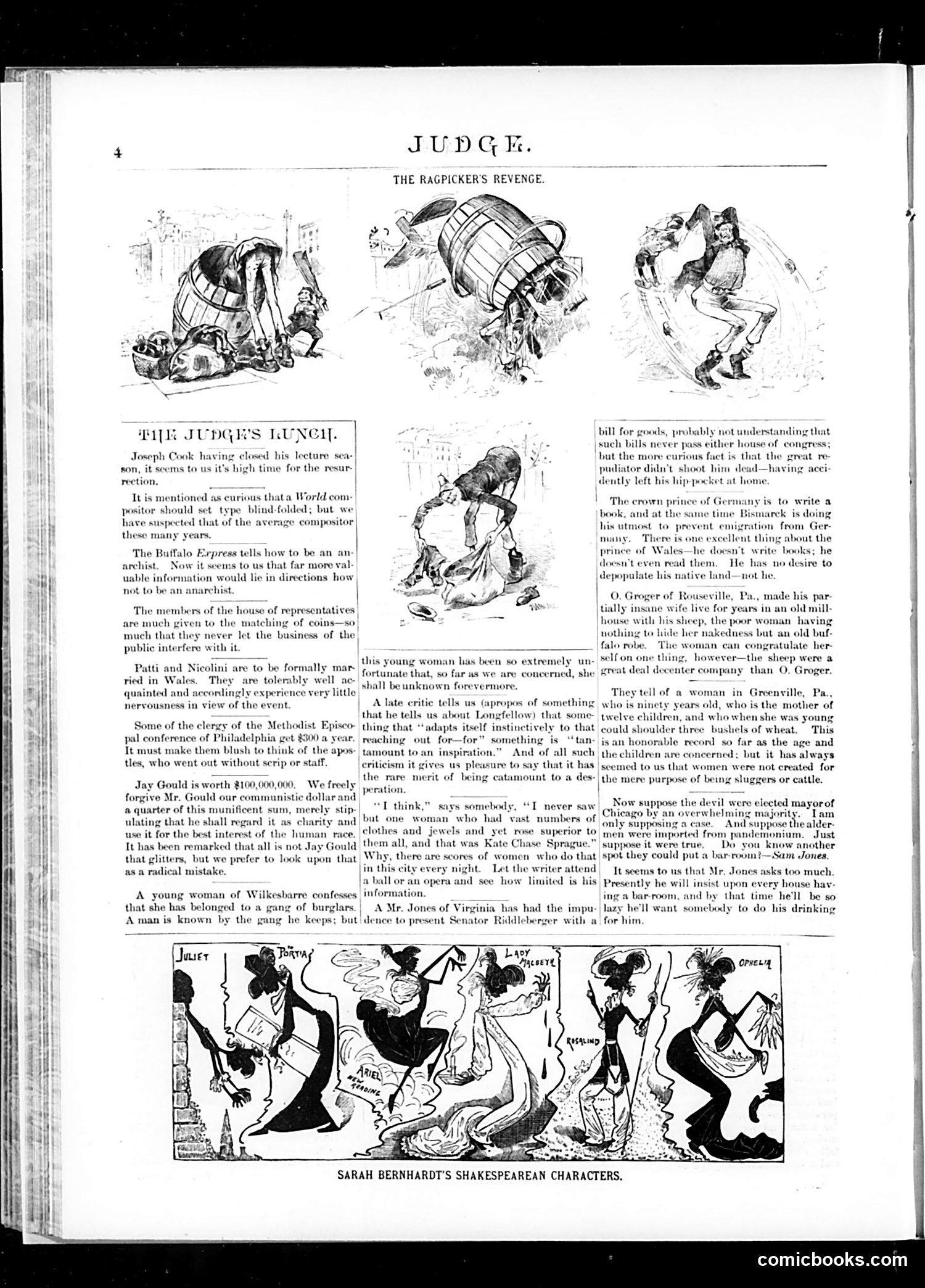
This page from **Judge** (a satirical American weekly) contains multiple short political and social commentary items with illustrations, typical of the magazine's format. **"The Ragpicker's Revenge"** section mocks various public figures and social issues: - **Joseph Cook** (mentioned closing his lecture season) likely refers to a contemporary preacher/public speaker - References to **Jay Gould** ($100 million wealth) satirize the robber baron's fortune - **Kate Chase Sprague** (daughter of Chief Justice Salmon Chase) appears in a joke about wealthy women with superior taste - **Sam Jones** (appears to be a temperance crusader) is mocked for his anti-drinking stance - The piece ridicules politicians, clergy salaries, and social hypocrisies **"The Judge's Lunch"** and **"The Ragpicker's Revenge"** cartoons above illustrate comic scenarios with exaggerated characters. **"Sarah Bernhardt's Shakespearean Characters"** (bottom strip) is a theatrical caricature series depicting the famous French actress in various Shakespeare roles through silhouettes—likely satirizing contemporary theater or her dramatic interpretations. The overall tone: satirical commentary on wealth inequality, clergy, politicians, and social pretension.
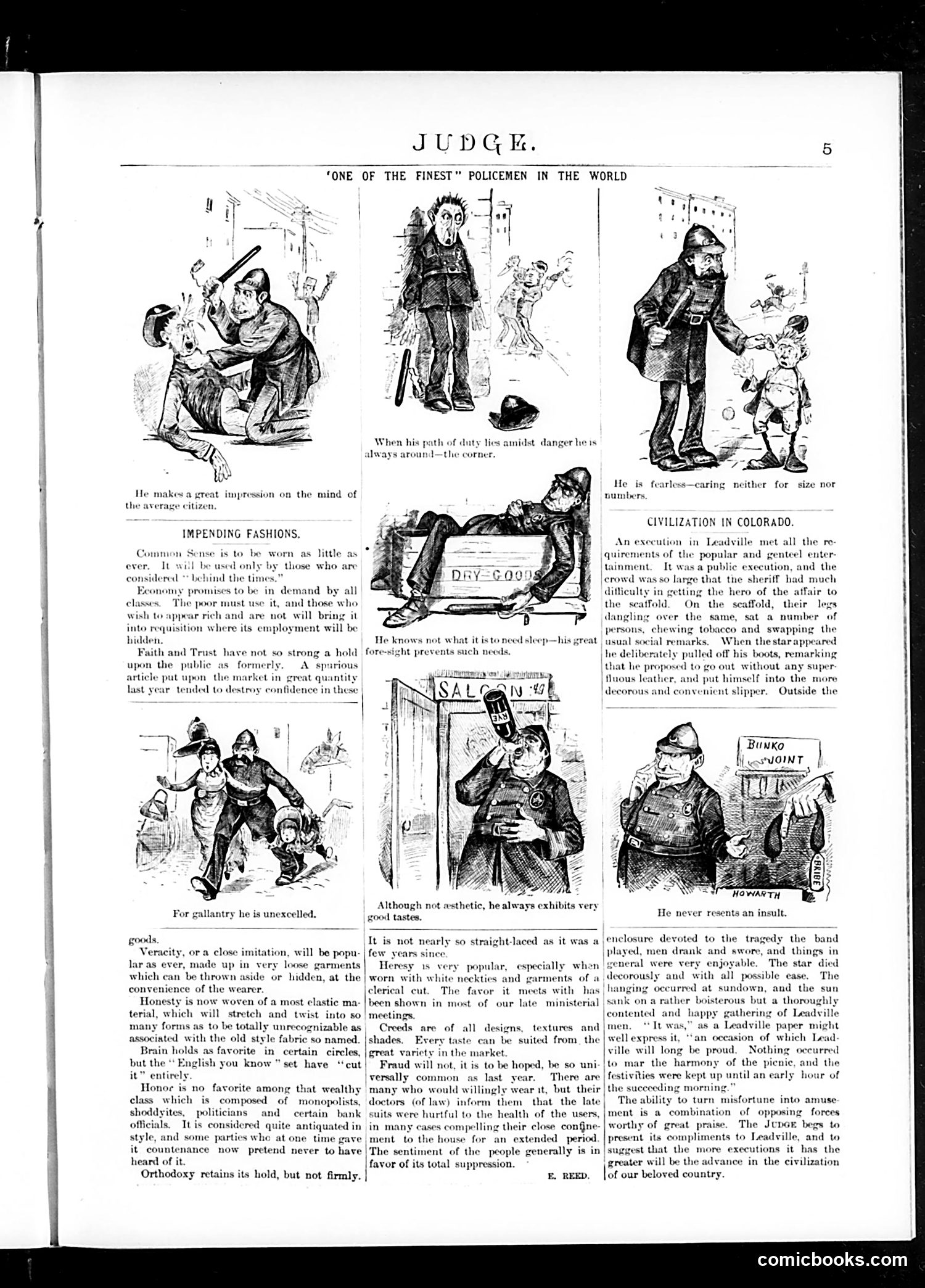
This page contains two distinct satirical pieces: **"One of the Finest Policemen in the World"** mocks a police officer through caricature, suggesting he's ineffectual and cowardly despite claiming fearlessness. The images show him in undignified positions (cowering, sleeping), satirizing corrupt or incompetent law enforcement. **"Impending Fashions"** is an allegory on moral decline. The text playfully describes virtues ("Common Sense," "Faith and Trust," "Honesty," "Heresy") as if they were clothing fashions going in and out of style. This bitterly critiques 1890s American society for abandoning moral principles in favor of expediency and fraud, particularly among the wealthy and politically connected. **"Civilization in Colorado"** sarcastically describes a public execution in Leadville where the condemned man died with dignity while the attending crowd behaved with shocking indifference and enjoyment—treating the execution as casual entertainment. This mocks frontier "civilization" and American callousness. The overall thrust: institutional corruption, moral hypocrisy, and frontier brutality masquerading as progress.
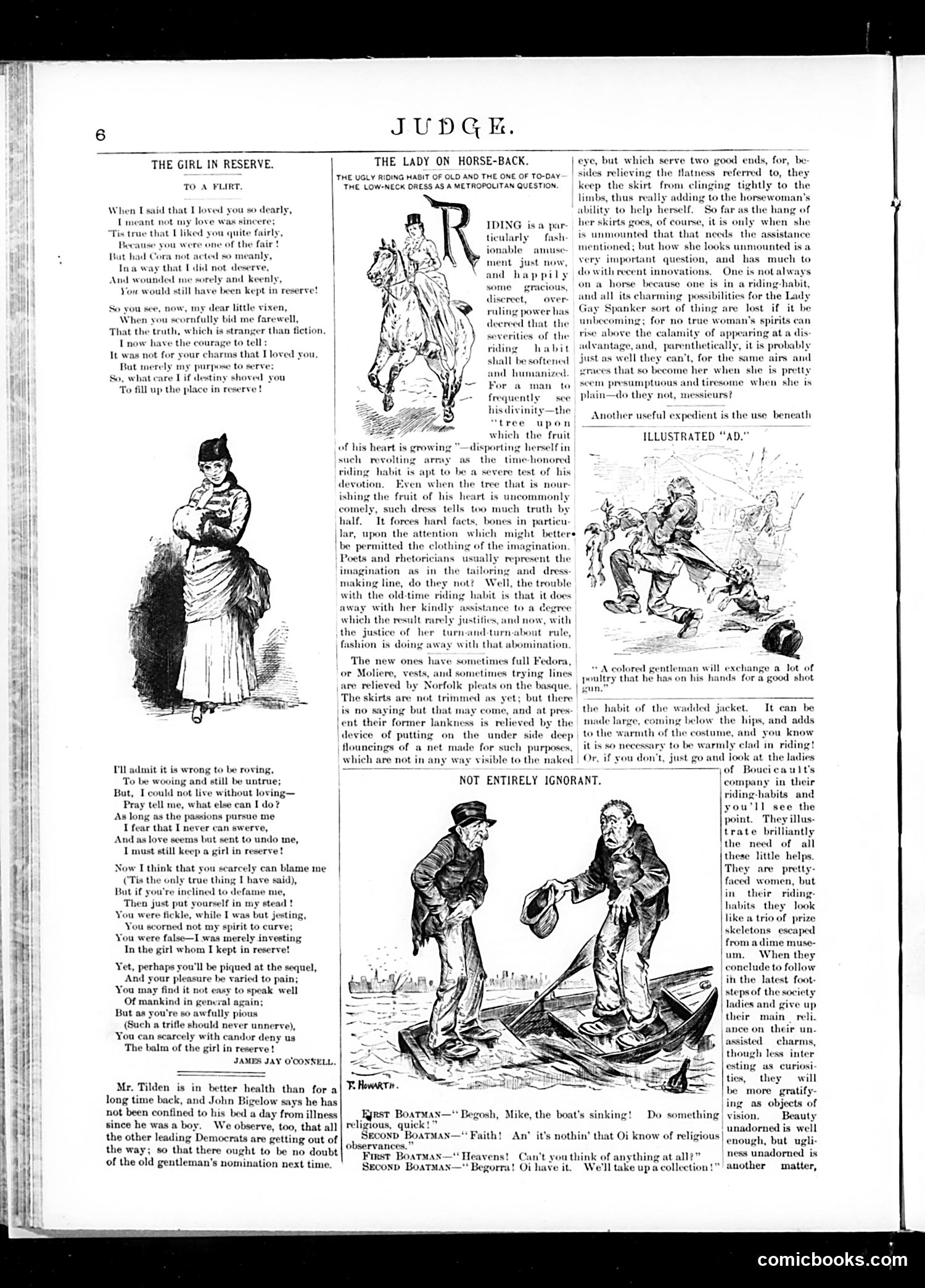
This page contains two distinct pieces: **"The Girl in Reserve"** (poem, left): A satirical verse by James Jay O'Connell mocking a male flirt who keeps a woman as a backup romantic option while courting others. The speaker admits his infidelity without shame, treating romance as a cynical game where women are interchangeable. It's social commentary on shallow male courtship behavior and emotional dishonesty. **"The Lady on Horse-Back"** (article with illustrations, right): Satirizes women's changing riding fashions. The piece critiques how modern low-necked riding dresses reveal too much of women's bodies, forcing attention to "hard facts, bones in particular" rather than the clothing itself. It advocates for practical modifications (deep flouncings, nets) that preserve modesty while horseback riding. This reflects late-19th-century anxieties about women's fashion increasingly exposing the female form. Both pieces target social hypocrisy: male duplicity in romance and female immodesty in public dress.
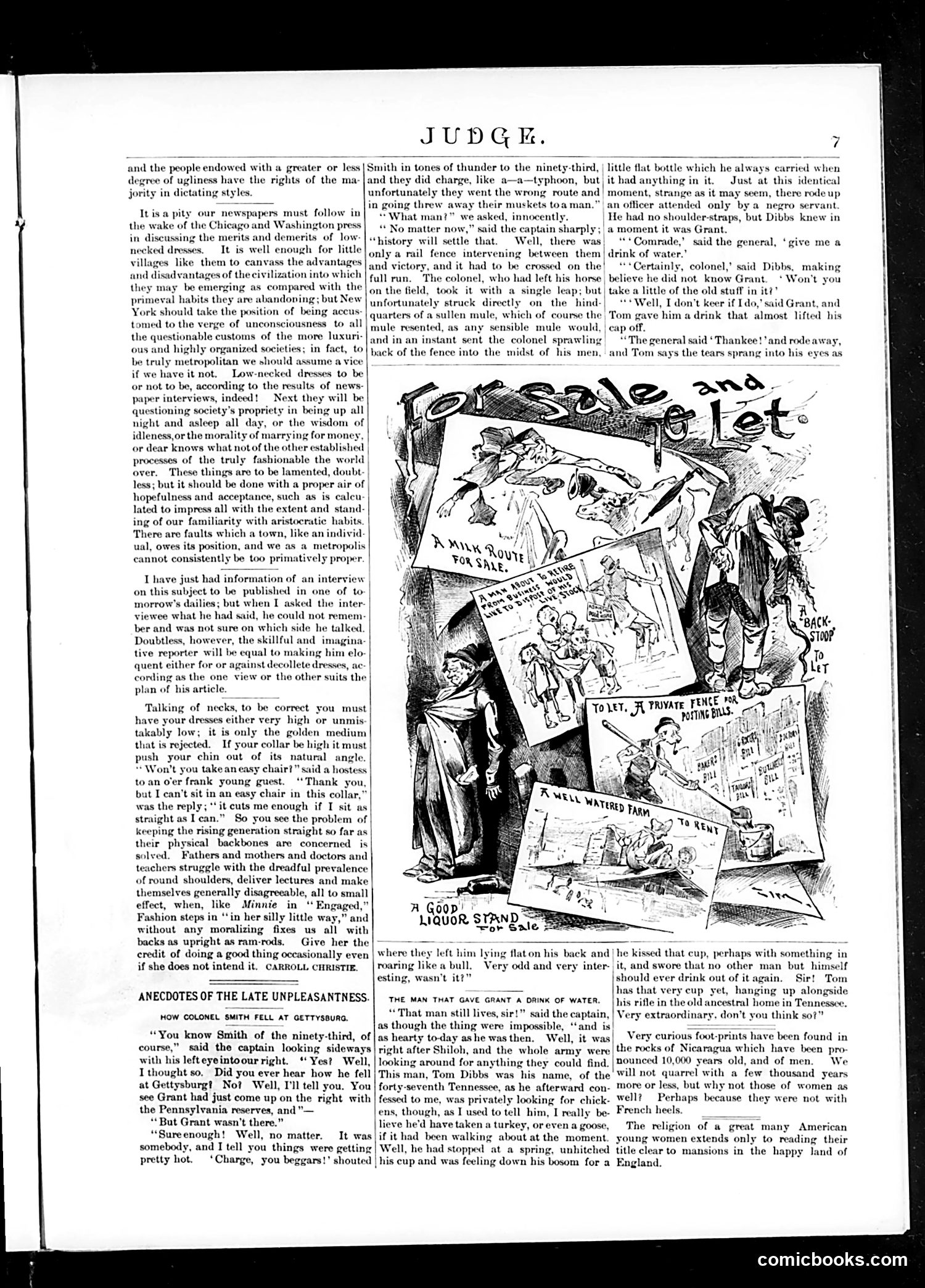
This page contains two distinct pieces of satirical content: **The Main Cartoon** (center illustration): Depicts a cluttered pile of discarded newspapers and printed materials labeled with various sensational headlines ("A Milk Route for Sale," "A Good Liquor Stand for Sale," "A Well Watered Tank to Rent"). A figure examines this refuse, satirizing the proliferation of cheap, tabloid-style journalism and classified advertising that cluttered American newspapers of the era. **"Anecdotes of the Late Unpleasantness"** (text section): A humorous post-Civil War anecdote mocking unreliable war stories. The narrator describes Colonel Smith's fall at Gettysburg, but the account is riddled with factual errors and contradictions (Grant wasn't even present), satirizing how Civil War stories had become embellished folklore rather than accurate history. The absurd, rambling account emphasizes how these narratives had devolved into comedy by the time of publication. Both pieces critique American culture's embrace of sensationalism and fabrication over truth.
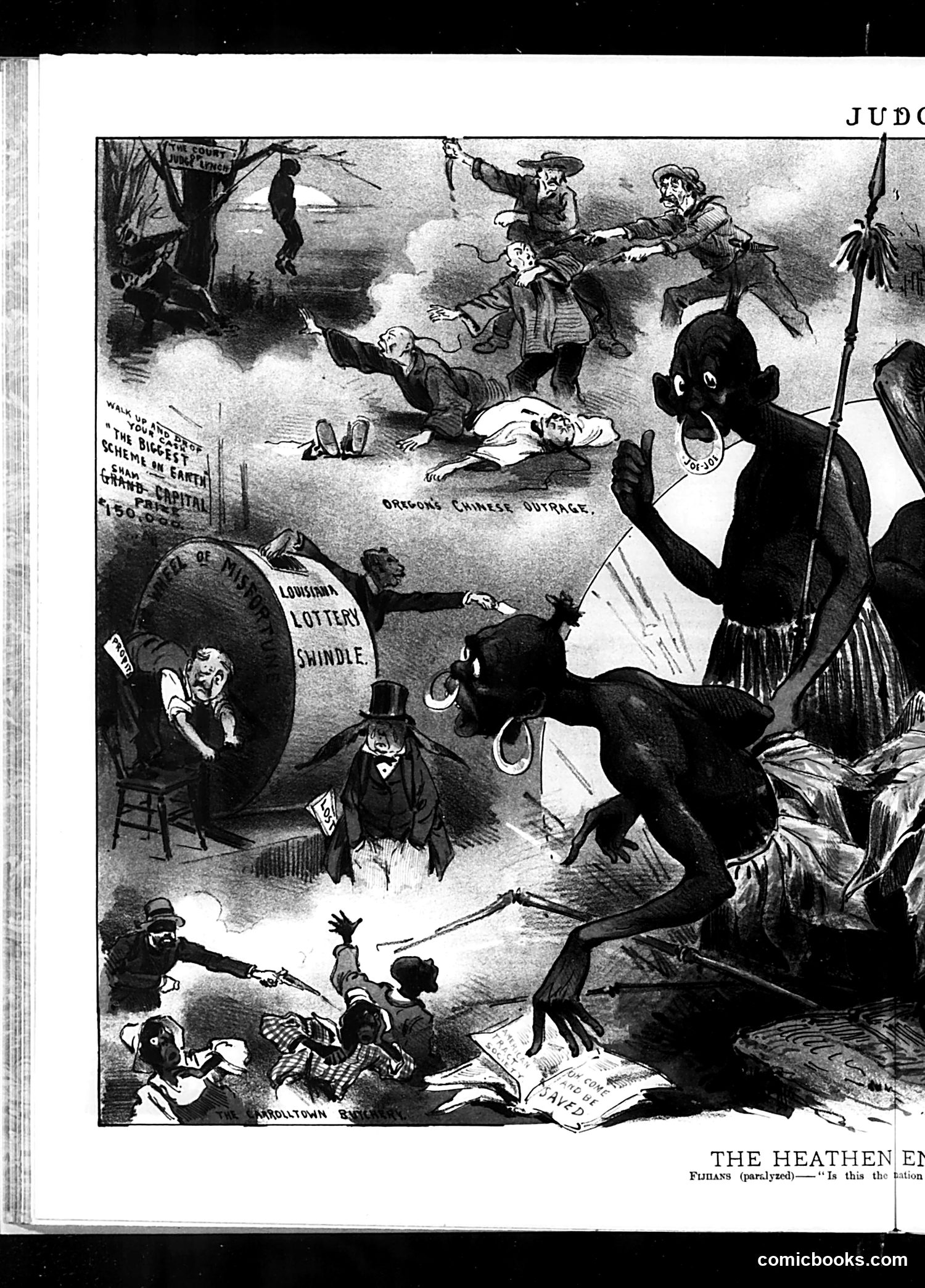
This appears to be a political cartoon titled "THE HEATHEN E[N]" from *Judge* magazine, though the complete title is cut off. The caption references "Funans (paralyzed)" and includes partial text about "bation" (likely "damnation"). The image depicts a chaotic scene with caricatured figures with exaggerated features representing Chinese people ("Heathen"), being attacked or threatened by white American figures. References visible include "OREGON CHINESE OUTRAGE," "LOUISIANA LOTTERY," and "SWINDLE." This satirizes late-19th-century anti-Chinese sentiment and violence in America, likely commenting on the Oregon anti-Chinese riots or broader exclusionary policies. The cartoon appears critical of American exploitation and violence against Chinese immigrants, though the racist caricatures reflect the period's widespread prejudices. Without the complete title and caption, the precise satirical target remains partially unclear.
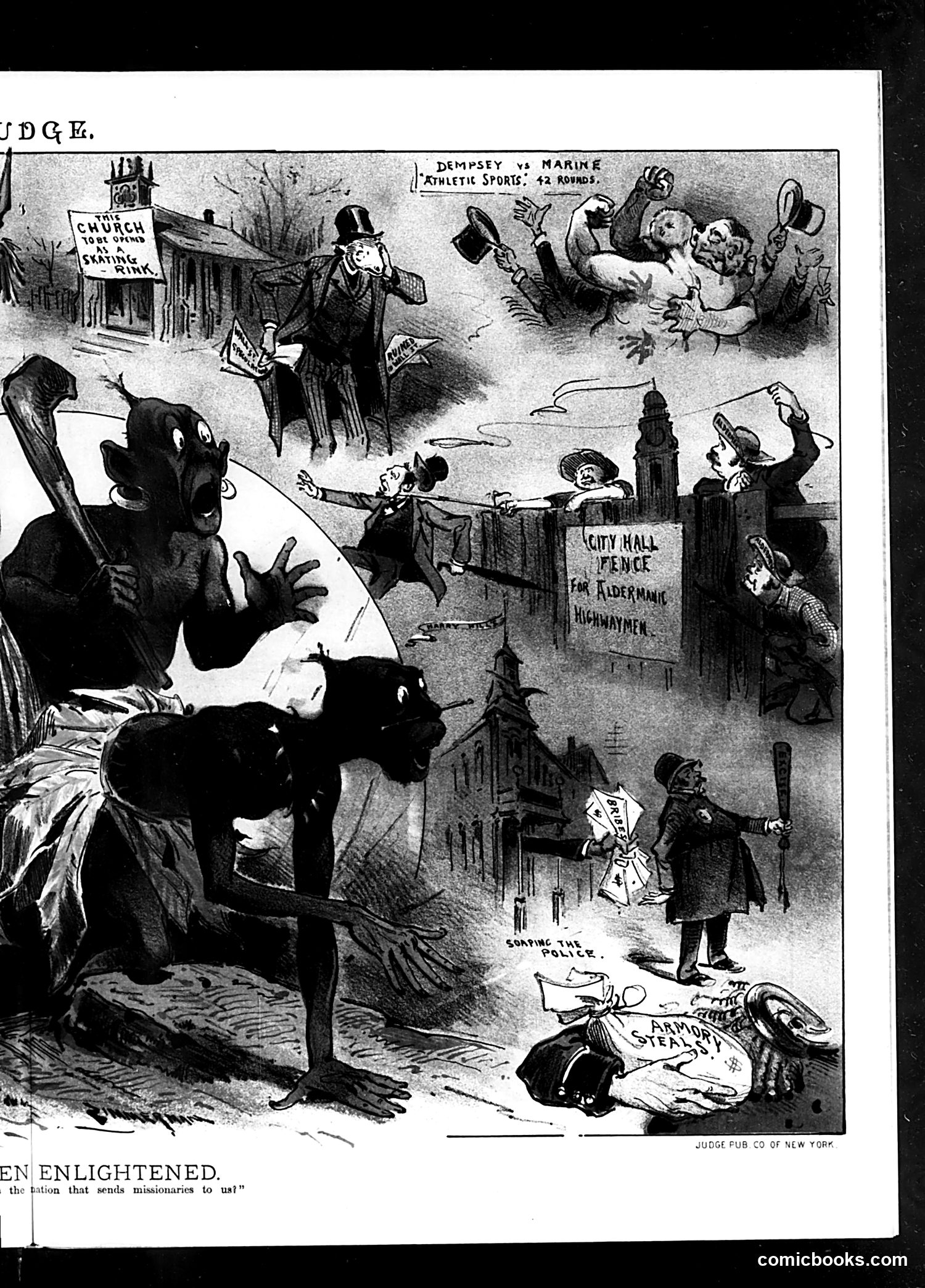
This satirical cartoon critiques American hypocrisy regarding missionary work and social order. The central image shows chaos in an American city—featuring a "City Hall Fence for Aldermanic Highwaymen," a church "for Skating Rink," and police being "sworn" (mocked). A demonic figure observes from the left. The title "Dempsey vs Marine" (likely referencing a boxing match) and the caption "When Enlightened" suggest irony: America sends Christian missionaries abroad while its own cities suffer corruption, religious institutions decay into entertainment venues, and urban crime flourishes unchecked. The demon watching represents evil thriving in American cities—contradicting claims of Christian enlightenment. The satire argues America should address its own moral failings before claiming moral authority to evangelize globally.
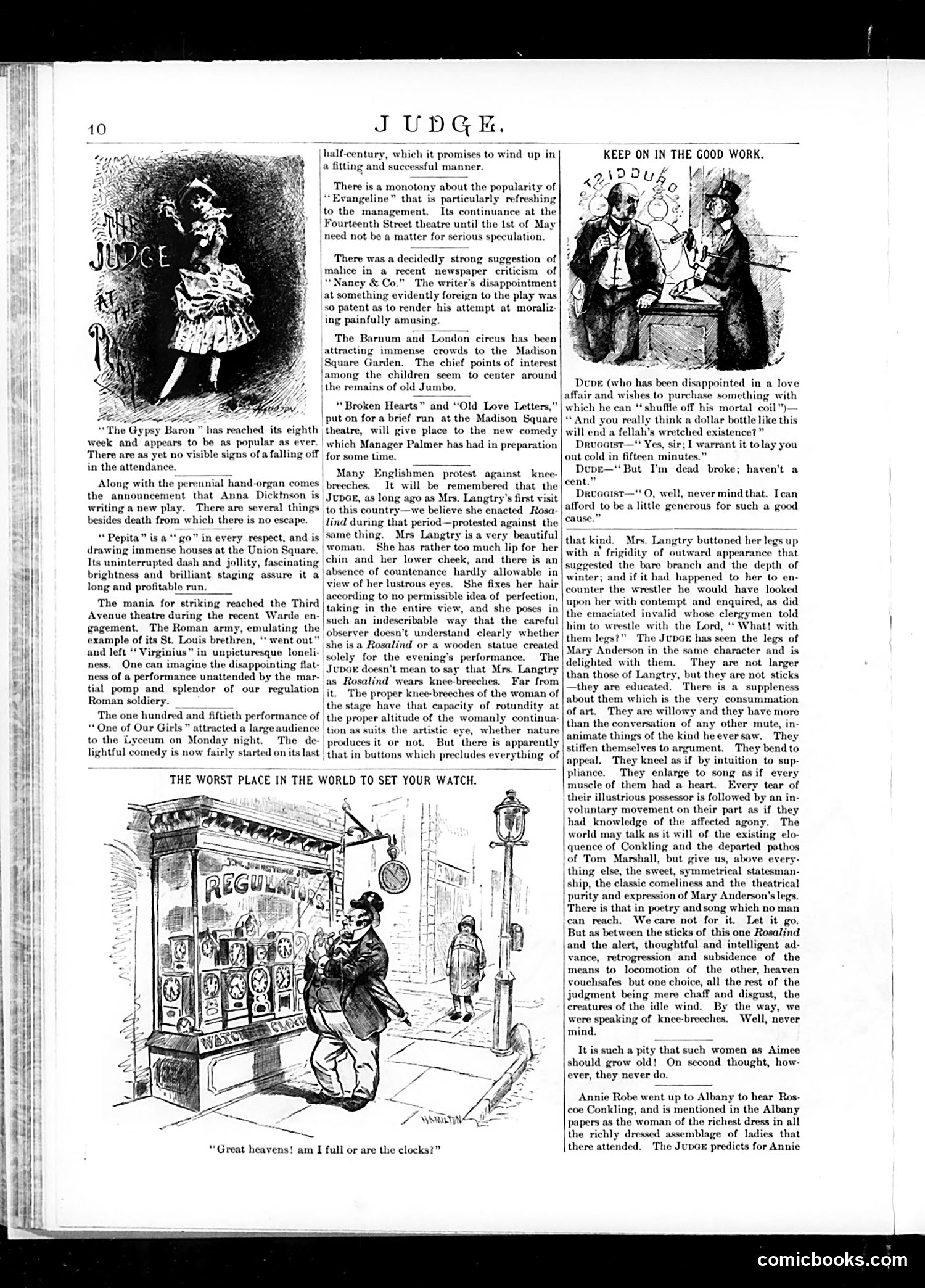
This page from Judge magazine contains theater reviews and satirical commentary on 1880s New York entertainment. **Main Cartoon:** "The Worst Place in the World to Set Your Watch" depicts a man consulting a large street clock outside what appears to be a jewelry or watch shop. The joke is visual irony—the supposedly reliable timepiece is actually unreliable, making it the worst location to verify time. **Theater Reviews:** The text discusses various Broadway productions ("Evangeline," "Pepita," "Virginius," "One of Our Girls") and theatrical trends of the era, including strikes by stagehands that affected performances. **Social Commentary:** A notable passage criticizes actress Lily Langtry's appearance and dress, reflecting the magazine's satirical approach to public figures. The review dismissively describes her physical features and costuming choices. **"Keep On in the Good Work" Section:** A separate satirical dialogue mocks suicide, with a character considering purchasing poison, presented as dark humor typical of Judge's irreverent style. The page represents Judge's blend of theater criticism, social satire, and crude humor characteristic of late-19th-century American periodicals.
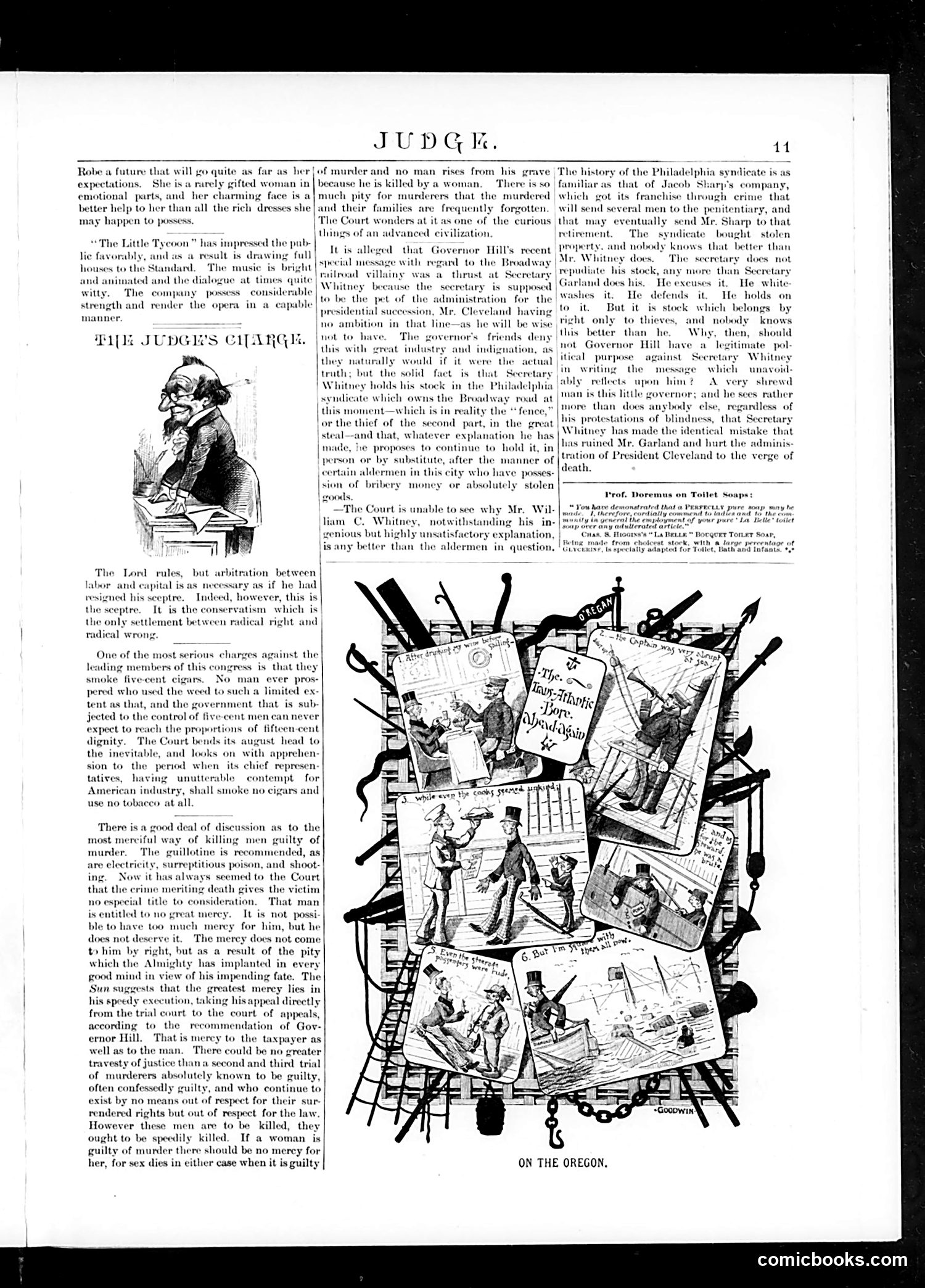
The large central illustration depicts a chaotic pile of newspapers and publications stacked haphazardly with ladders, showing people climbing through them. The caption reads "ON THE OREGON." This appears to satirize media coverage of the USS Oregon, likely referencing the ship's famous 1898 voyage around Cape Horn during the Spanish-American War, which generated intense newspaper attention. The cartoon mocks the sensationalism and competitive frenzy of American journalism—depicted as a confusing, disorganized heap where reporters scramble to gather stories. The accompanying text discusses political corruption involving Secretary Whitney and a Philadelphia transit syndicate, contrasting judicial proceedings with broader critiques of American governance and ethics. The cartoon's point: American newspapers were chaotically sensationalizing major events while serious political corruption went inadequately addressed by the courts and government.
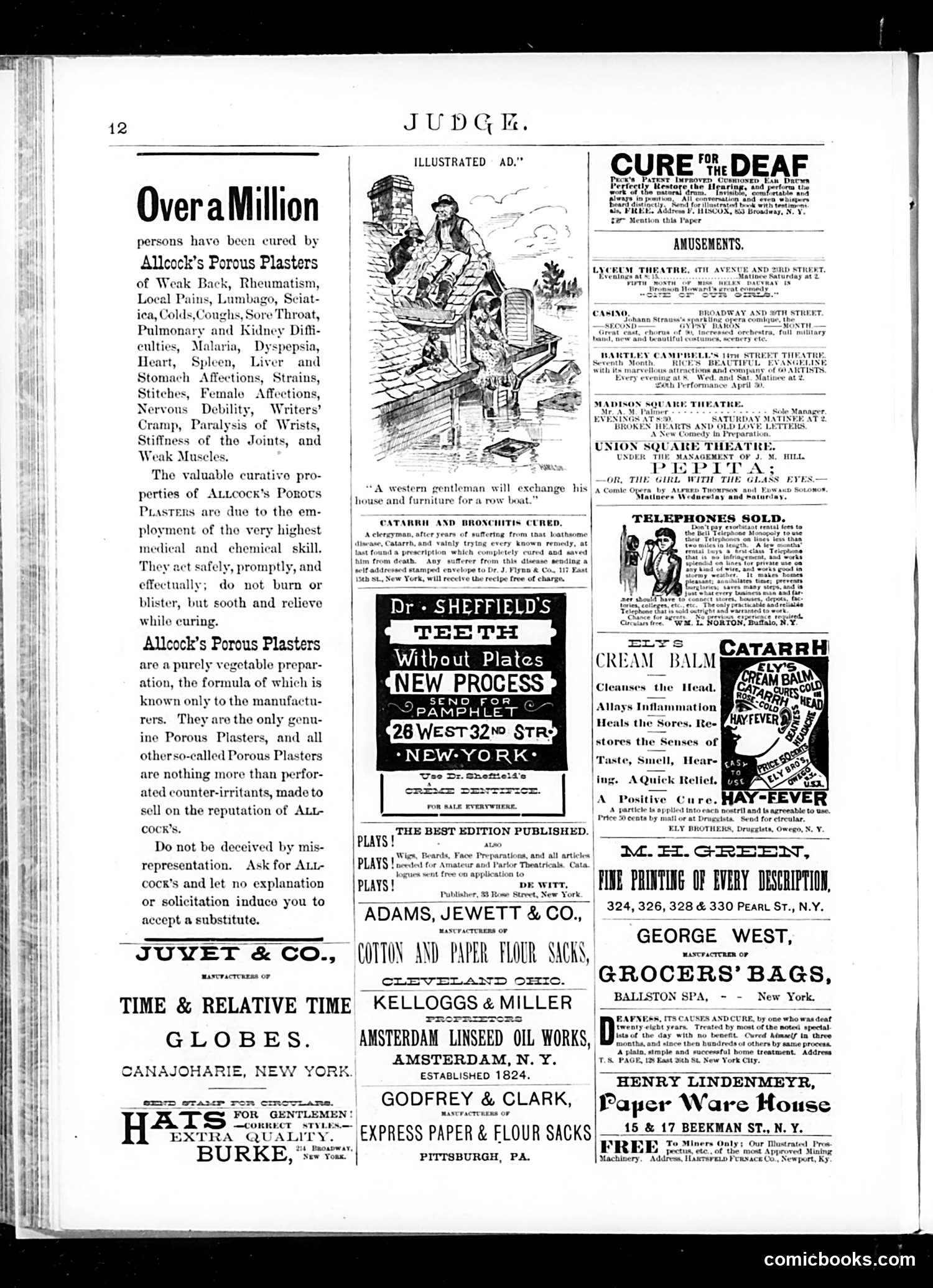
This page is primarily **advertising**, not political satire. It's a typical late-19th-century magazine page mixing patent medicine ads with commercial notices. The main illustrated cartoon shows a western gentleman offering to "exchange his house and furniture for a row boat"—a humorous comment on frontier life or perhaps economic desperation, though the joke's specific context is unclear without more historical detail. The rest of the page consists almost entirely of product advertisements: Allcock's Porous Plasters (a popular medical treatment), Dr. Sheffield's artificial teeth, cream balms for catarrh, telephones, hats, flour sacks, and printing services. These ads reflect the era's faith in patent medicines and new technologies like telephones. The sole satirical element appears minimal here. Judge's typical political humor is largely absent; instead, we see the commercial landscape of Gilded Age America, where dubious medical remedies and industrial products dominated magazine pages.
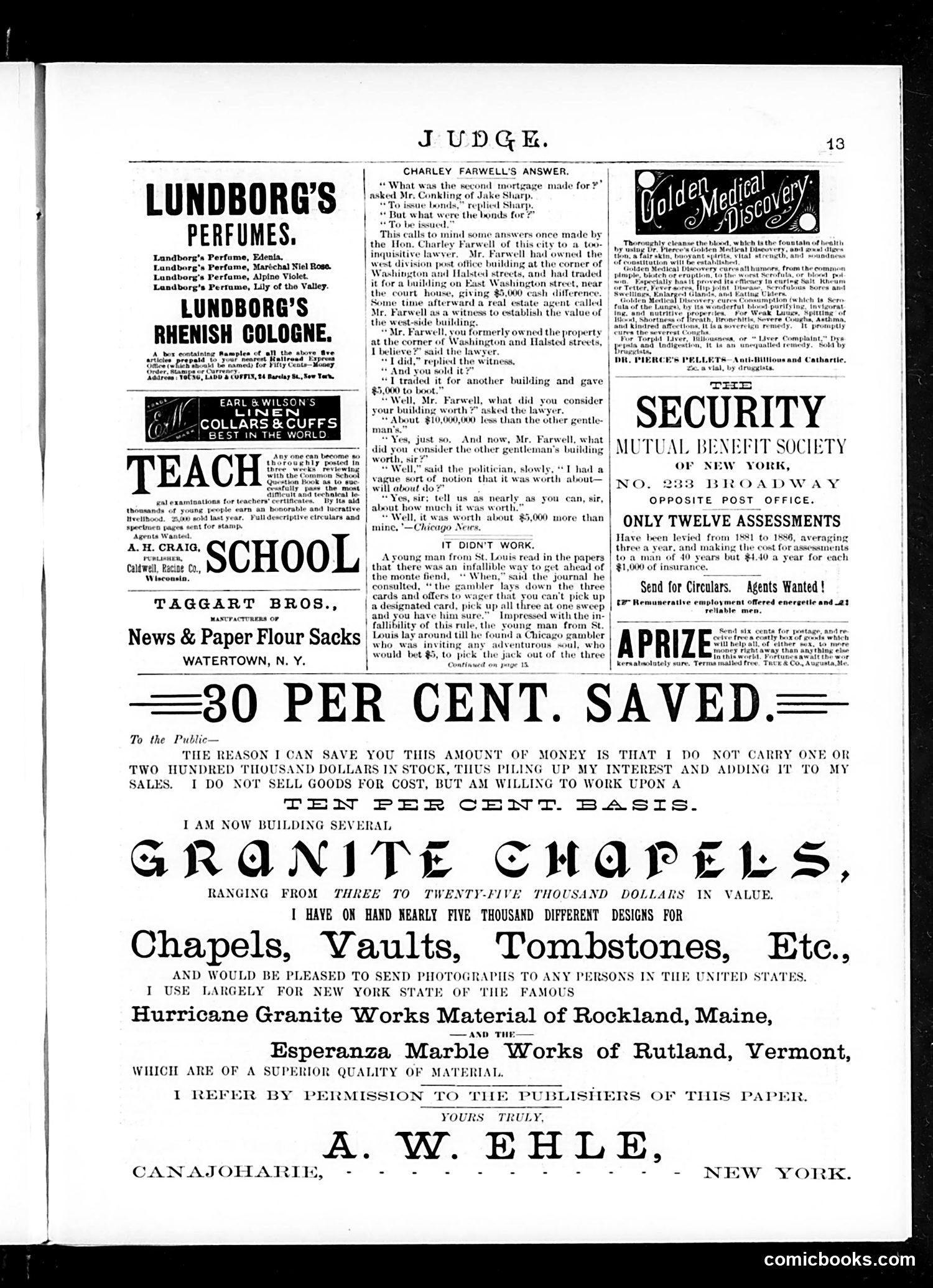
This page is primarily **advertisements** rather than editorial cartoons. The visible satirical content is minimal. At the top, "Charley Farwell's Answer" appears to be a brief political joke involving **Roscoe Conkling** (a prominent Republican senator), referencing a real estate transaction and mortgage dispute in what seems to be a Chicago legal matter. The humor depends on readers' familiarity with this specific local controversy—likely a scandal or embarrassing property deal involving Farwell and Conkling. The joke's point is unclear without additional context, but it appears to mock either Farwell's evasiveness about property values or Conkling's involvement in questionable real estate dealings. The remainder of the page consists of period advertisements for perfumes, collars, schools, and notably a large advertisement from granite chapel/tombstone builder A.W. Ehle claiming "30 per cent saved" through his low-overhead business model. Without knowing the specific Farwell-Conkling incident referenced, the full satirical intent cannot be determined.
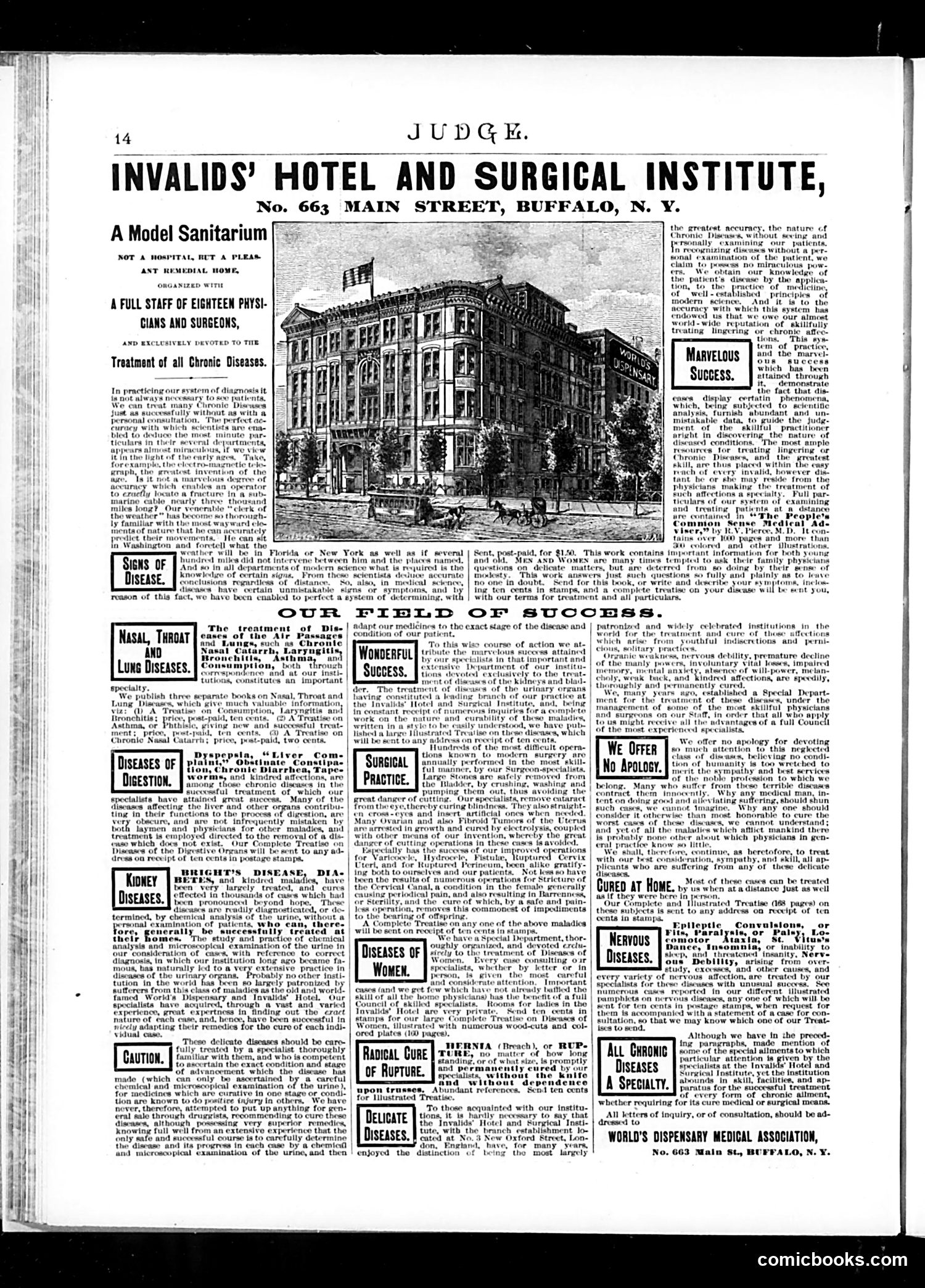
This page is **entirely advertising** — not a cartoon or satirical content. It's a full-page promotional advertisement for the "Invalids' Hotel and Surgical Institute" in Buffalo, New York. The ad presents itself as a medical facility claiming expertise in treating chronic diseases through mail-based diagnosis. Key claims include: - Physicians can diagnose patients without seeing them, using only described symptoms - Special expertise in "diseases of men" (a euphemism for sexually transmitted infections and sexual dysfunction) - Published treatises available for modest fees - Emphasis on privacy and discretion for embarrassed patients **The satirical context** (likely why Judge published it): This reflects late-19th-century medical quackery. Mail-order diagnosis and treatment were common scams, particularly targeting men with sexual health concerns who wouldn't consult doctors in person. The exaggerated claims about diagnosing from a distance ("as well as if several miles did not intervene") would strike contemporary readers as absurdly fraudulent—making the ad itself the joke Judge is running on readers.
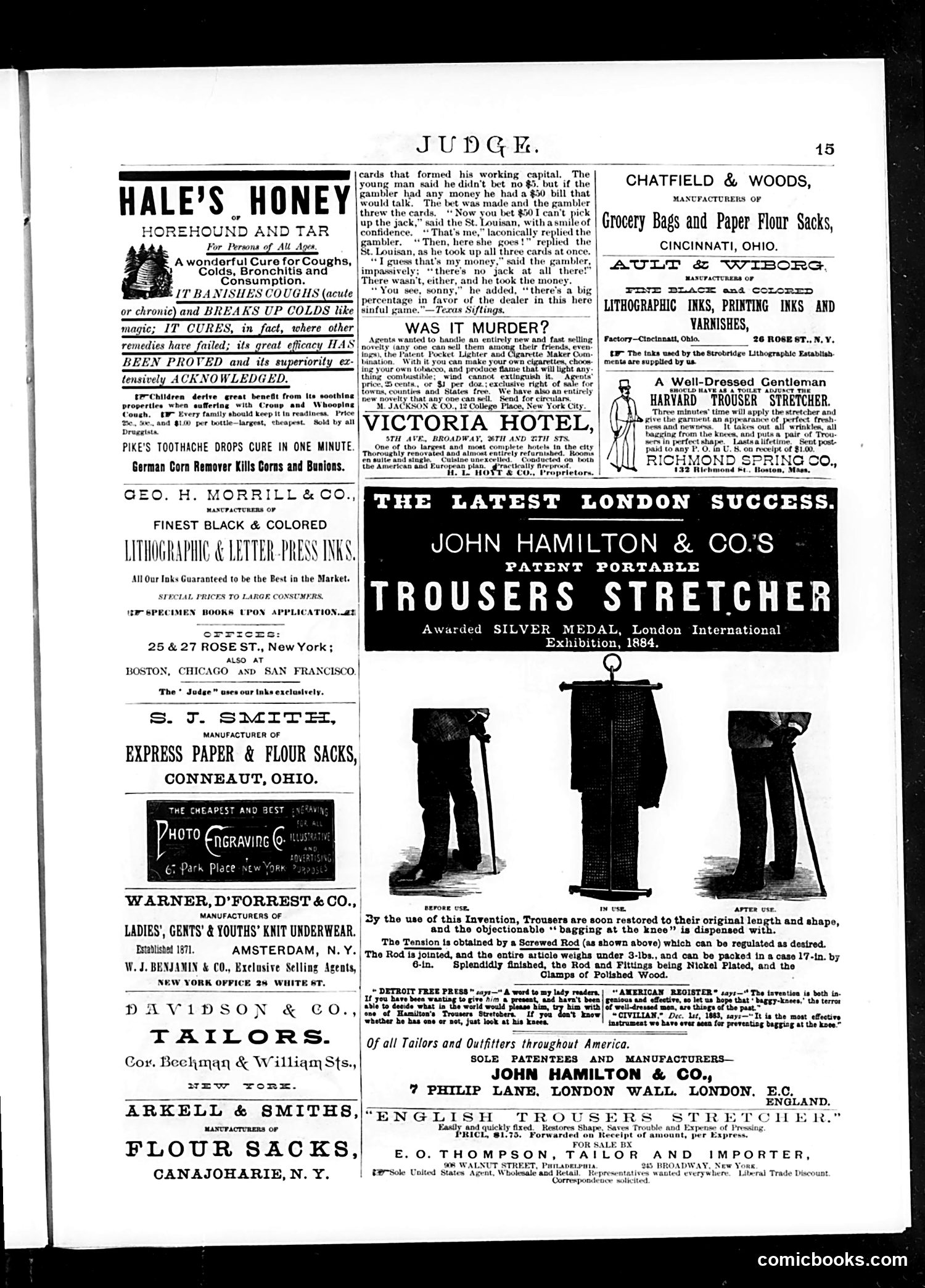
This page is primarily **advertising**, not a political cartoon. It showcases various consumer products and services from the 1880s, arranged as paid advertisements. The dominant content is the **John Hamilton & Co.'s Patent Portable Trousers Stretcher**—a device designed to restore baggy knees in trousers. The illustrated advertisement shows three silhouettes demonstrating the stretcher's use, with testimonials praising how it restores trouser shape and eliminates objectionable "bagging at the knee." Surrounding this are ads for mundane goods: patent medicines (Hale's Honey for coughs, Pike's Toothache Drops), paper and flour sacks, printing inks, knit underwear, and tailoring services. The satirical *Judge* magazine apparently monetized its pages by selling advertising space to manufacturers and service providers. There is **no evident political satire or social commentary** on this particular page—it's a straightforward commercial directory dressed in period typography and design.
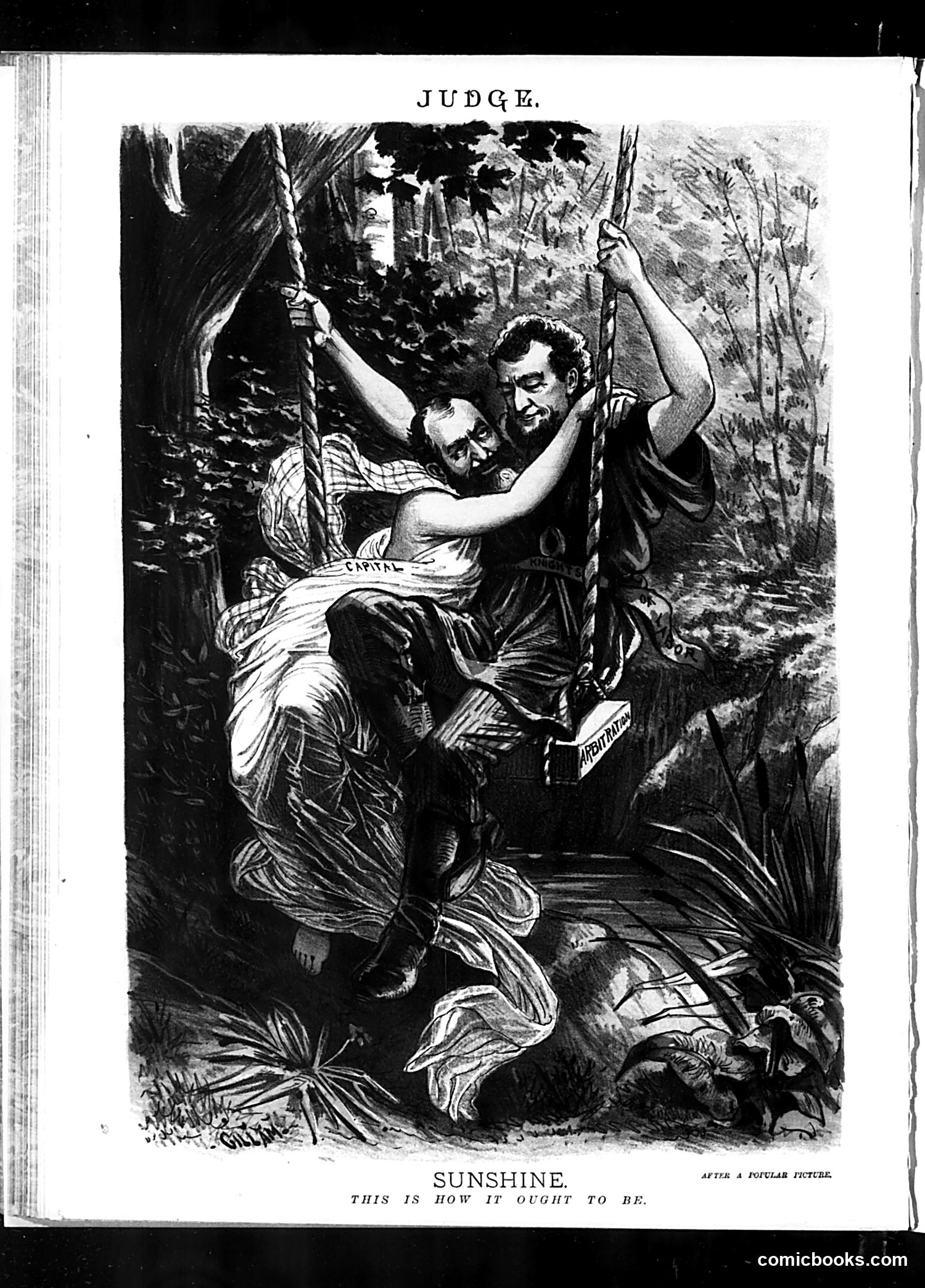
This is a political cartoon titled "Judge" featuring an allegorical scene. A woman labeled "CAPITAL" sits in a woodland setting with a male figure, both reaching upward together toward sunlight filtering through trees. The composition suggests harmony and cooperation between capital and labor (or capital and the worker). The subtitle "This Is How It Ought to Be" indicates the cartoon advocates for peaceful coexistence between these economic forces. The natural, pastoral setting and collaborative gesture imply an idealized vision of industrial relations—likely responding to contemporary labor disputes or class conflict of the era. Without the magazine's date visible, the specific historical moment remains unclear, but this represents a pro-capitalist perspective promoting social cooperation rather than confrontation during America's industrial period.

I can see this is a page from *Judge* magazine, but the image shows essentially a blank white page with only binding marks visible on the left edge and a few small dots scattered across it. There is no discernible cartoon, illustration, text, or readable content to analyze. This appears to be either a blank page, a title page, or a page where the content has not reproduced clearly in this scan. Without visible imagery or legible text, I cannot identify any figures, political references, or satirical points that would explain the page's meaning to a modern reader. If you have a different page from this issue with more visible content, that would be more helpful for analysis.