
Judge, 1886-04-10 · page 7 of 17
Judge — April 10, 1886 — page 7: what you’re looking at
What you’re looking at
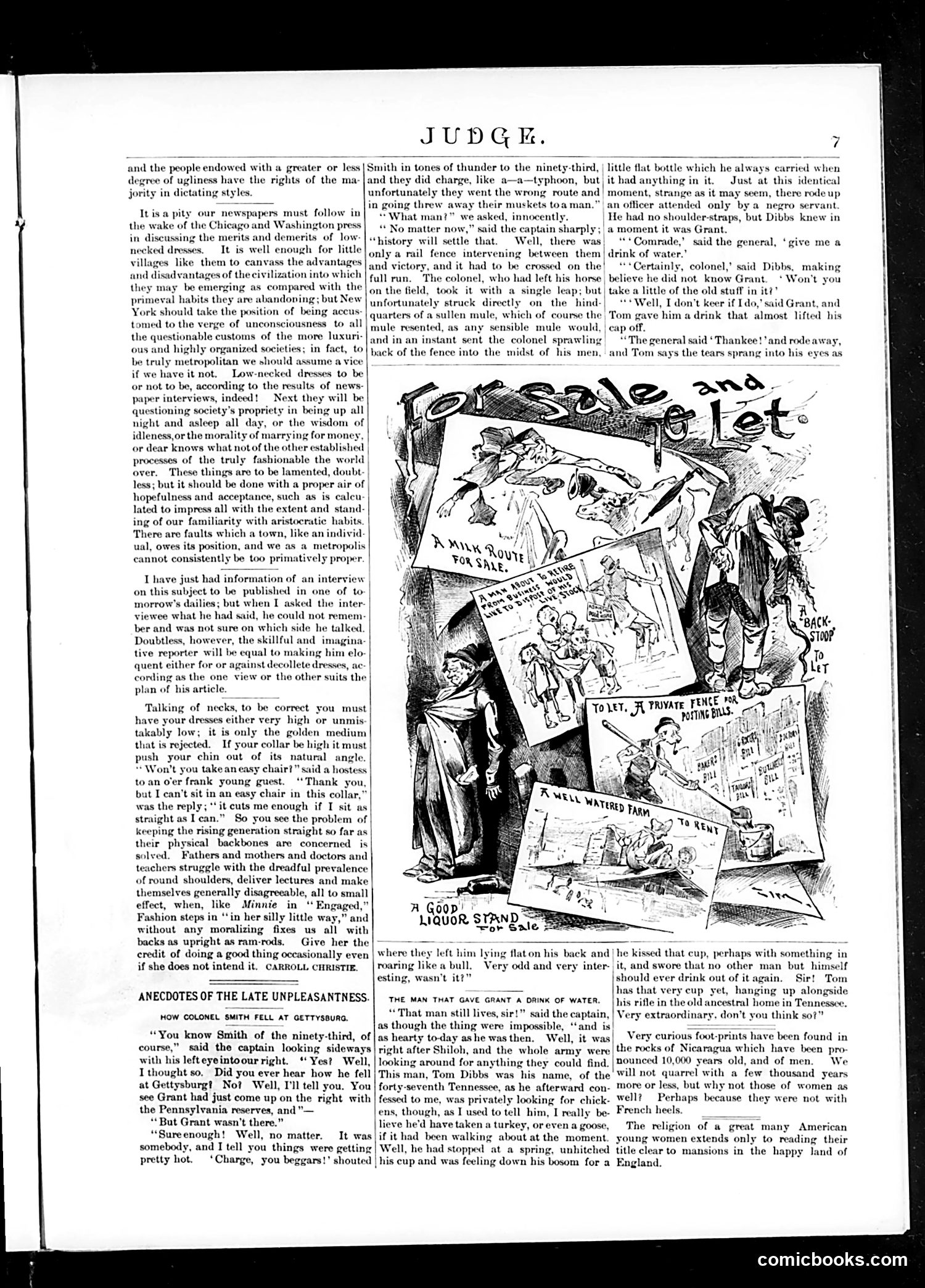
This page contains two distinct pieces of satirical content: **The Main Cartoon** (center illustration): Depicts a cluttered pile of discarded newspapers and printed materials labeled with various sensational headlines ("A Milk Route for Sale," "A Good Liquor Stand for Sale," "A Well Watered Tank to Rent"). A figure examines this refuse, satirizing the proliferation of cheap, tabloid-style journalism and classified advertising that cluttered American newspapers of the era. **"Anecdotes of the Late Unpleasantness"** (text section): A humorous post-Civil War anecdote mocking unreliable war stories. The narrator describes Colonel Smith's fall at Gettysburg, but the account is riddled with factual errors and contradictions (Grant wasn't even present), satirizing how Civil War stories had become embellished folklore rather than accurate history. The absurd, rambling account emphasizes how these narratives had devolved into comedy by the time of publication. Both pieces critique American culture's embrace of sensationalism and fabrication over truth.
📄 Transcribed text from this page (OCR, searchable)
Machine-transcribed from the original scan — historical spelling and the odd misread are preserved.
and the people endowed with a greater or less degree of ugliness have the rights of the ma jority in dictating styles. Itisa pity our ne the wake of the Chic: in discussing the merits necked dresses. It is well enough for little villages like them to canvass the advantages and disadvantages of the tion into which they m g as compared with the primeval habits they are abandoning; but New York should take the position of being tomed to the verge of un Spapers must follow in on press nd demerits of low: cus: msciousness to al the questionable customs of the more luxuri: to ous and highly organized soci in fact, be truly metropolitan we should assume a if we have it not. Low-necked dresses to be or not to be, according to the results of news- paper interviews, indeed! Next they will be questioning society’s propriety in being up all night and asleep all ¢ r the wisdom of idleness,or the morality of marrying for money, or dear knows what notof the other established | processes of the truly fashionable the world over. These things are to be lamented, doubt less; but it should be done with a proper air of hopefulness and acceptance, such as is caleu lated to impress all with the ing of our s ‘There are faults which a town, like an individ- ual, owes its position, and wi 4 metropolis cannot consistently be too primatively proper. on th subject | to be published in one of to prrow’s dailies; but when I asked the inter: wee what he had said, he could not remem- ber and was not sure on which side he talked Doubtless, however, the skillful and imagina- tive reporter will be equal to making him elo- quent either for 01 cording as t plan of hi Talking of necks have your dresse takably low; that is rejected. If your collar be high it must | push your chin out of its natural angle. “Won't you take an easy chair?” said a hostess toan o'er frank young guest. “Thank you, but I can’t sit in an easy chair in this collar,” was the reply; ‘it cuts me enough if T sit as straight as can.” So you see the problem of | keeping the rising generation straight so far as | their physical backbones are concerned is solved. Fathers and mothers and doctors and teachers struggle with the dreadful prevalence of round shoulders, deliver lectures and make themselves generally disagreeable, all to small effect, when, like Minnie in‘ Engaged,” Fashion steps in ‘in her silly little way,” and without any moralizing fixes us all’ with backs as upright as ram-rods. Give her the credit of doing a good thing occasionally even | if she does not intend it. CARROLL CHRISTIE. to ‘be correct you must ither very high or unmis it is only the golden medium ANECDOTES OF THE LATE UNPLEASANTNESS. HOW COLONEL SMITH FELL AT GETTYSBURG. “You know Smith of the ninety-third, of course,” said the captain looking sideways with his lefteyeintoour right. ‘ Yes? Well, I thought so. Did you ever hear how he fell at Gettysburg? No? Well, I'll tell you. You see Grant had just come up on the right with the Pennsylvania reserves, and "— “But Grant wasn't there.” | “Sureenough! Well, no matter. It was somebody, and I tell you things were getting pretty hot. ‘Charge, you beggars!’ shouted | his cup and was feeling down his bosom for a JUDGE. Smith in tones of hander to the ninety-third, | little flat bottle which he always carried when and they did charge, like a—a—typhoon, but) it had anything in it. Just at this identical unfortunately they went the wrong route and| moment, strange as it may seem, there rode up in going threw away their muskets toa man.” an officer attended only by a negro servant “What man?” we asked, innocently. He had no shoulder-straps, but Dibbs knew in “No matter now,” said the captain sharply; a moment it was Grant. “history will settle that. Well, there was “** Comrade,” said the general, ‘ only a rail fence intervening between the em| drink of w and victot nd it had to be crossed on the! “Certainly, colonel,’ said Dibbs, full run. ‘The colonel, who had left his horse | believe he did not know Grant on the field, took it with a single leap; but) take a little of the old stuff in it?” unfortund struck directly on the hind- ‘Well, I don't keer if Ido,’ said Grant, and quarters of a sullen mule, which of course the, Tom gave him a drink that almost lifted his mule resented, as any sensible mule would, | cap off. and in an instant sent the colonel sprawling) — ‘‘The general said ‘ Thankee!' and rode aw. back of the fence into the and Tom says the tears sprang into his eyes as give me a making “Won't you midst of his men, where they left him lying roaring like a bull. esting, wasn't it?” E ack and {he kissed that cup, perhaps with something in Very odd and very inter- it, and swore that no other man but himself |should ever drink out of itagain. Sir! ‘Tom has that very cup yet, hanging up alongside THE MAN THAT GAVE GRANT A ORINK OF WATER. | hig rifle in the old ancestral home in Tennessee. “That man still lives, sir!” said the captain, | Very extraordinary, don’t you think so?” as though the thing were impossible, ‘and is as hearty today ashe was then, Well, it was| _ Very curious footprints have been found in right after Shiloh, and the whole army were|the rocks of Nicaragua which have been pro- looking around for anything they could find, Bounced 10,000 years old, and of men. We This man, Tom Dibbs was his name, of the Will not quarrel with a few thousand years forty-seventh Tennessee, as he afterward con- ™ore or less, but why not those of women as fessed to me, was privately looking for chick. Well? Perhaps because they were not with ens, though, as I used to tell him, I really be- French heels. lieve he'd have taken a turkey, or even a goose, if it had been walking about at the moment. Well, he had stopped at a spring, unhitched The religion of a great many American young women extends only to reading their title clear to mansions in the happy land of England. comicbooks.com