
A complete issue · 16 pages · 1886
Judge — March 27, 1886
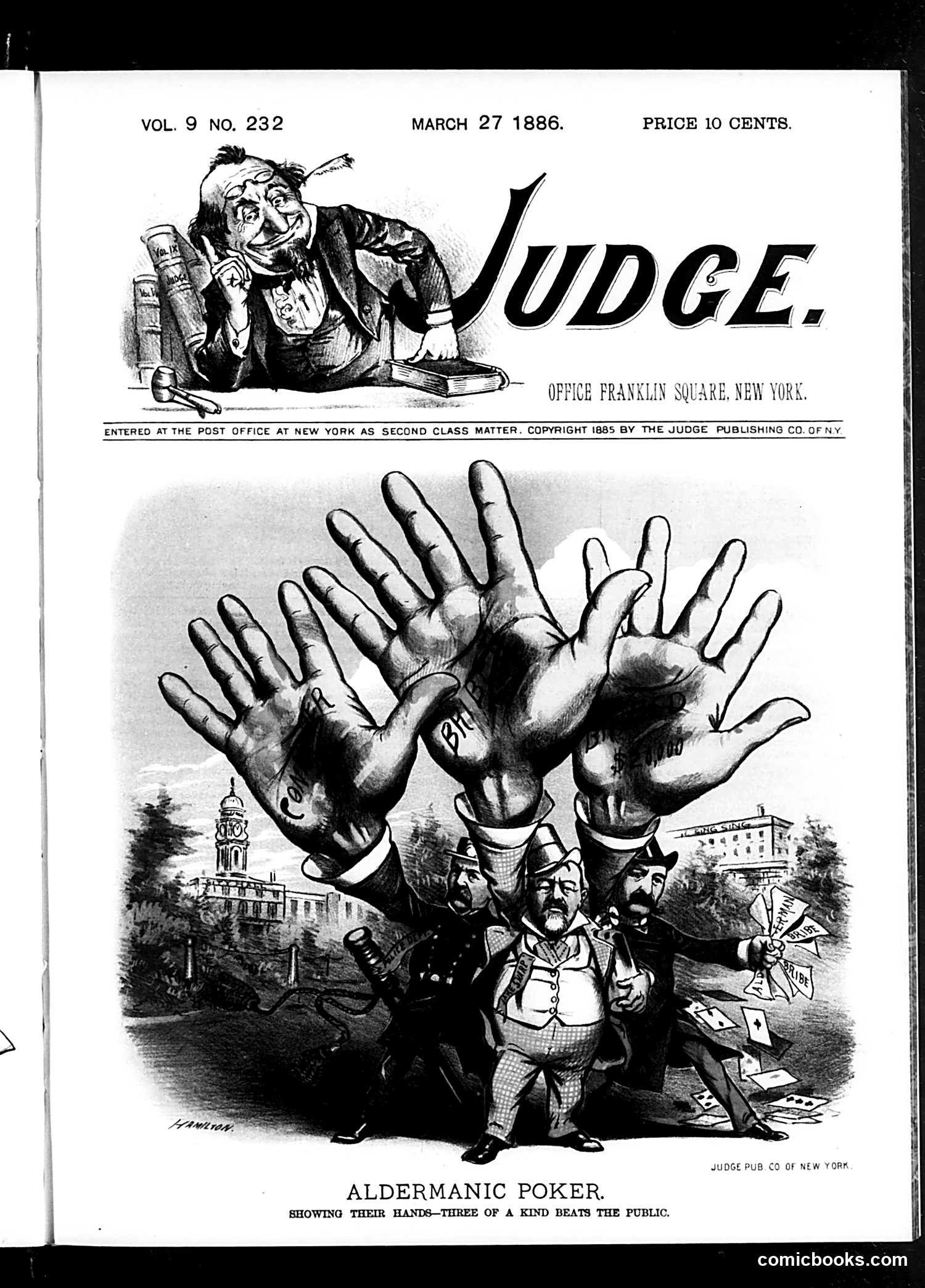
This political cartoon satirizes New York City aldermen as corrupt gamblers. Three figures with exaggerated facial features (likely representing specific aldermen, though not individually labeled) are shown playing poker with oversized hands reaching upward, symbolizing their grasping corruption. The subtitle states they're "showing their hands—three of a kind beats the public," a poker pun suggesting these aldermen are colluding together ("three of a kind") against ordinary citizens. The playing cards and money scattered around reinforce the gambling metaphor for political corruption. The urban setting (with city hall visible) emphasizes this is about New York municipal government. Judge uses the card game as a familiar vice to mock aldermanic dishonesty and collusion during the Gilded Age.
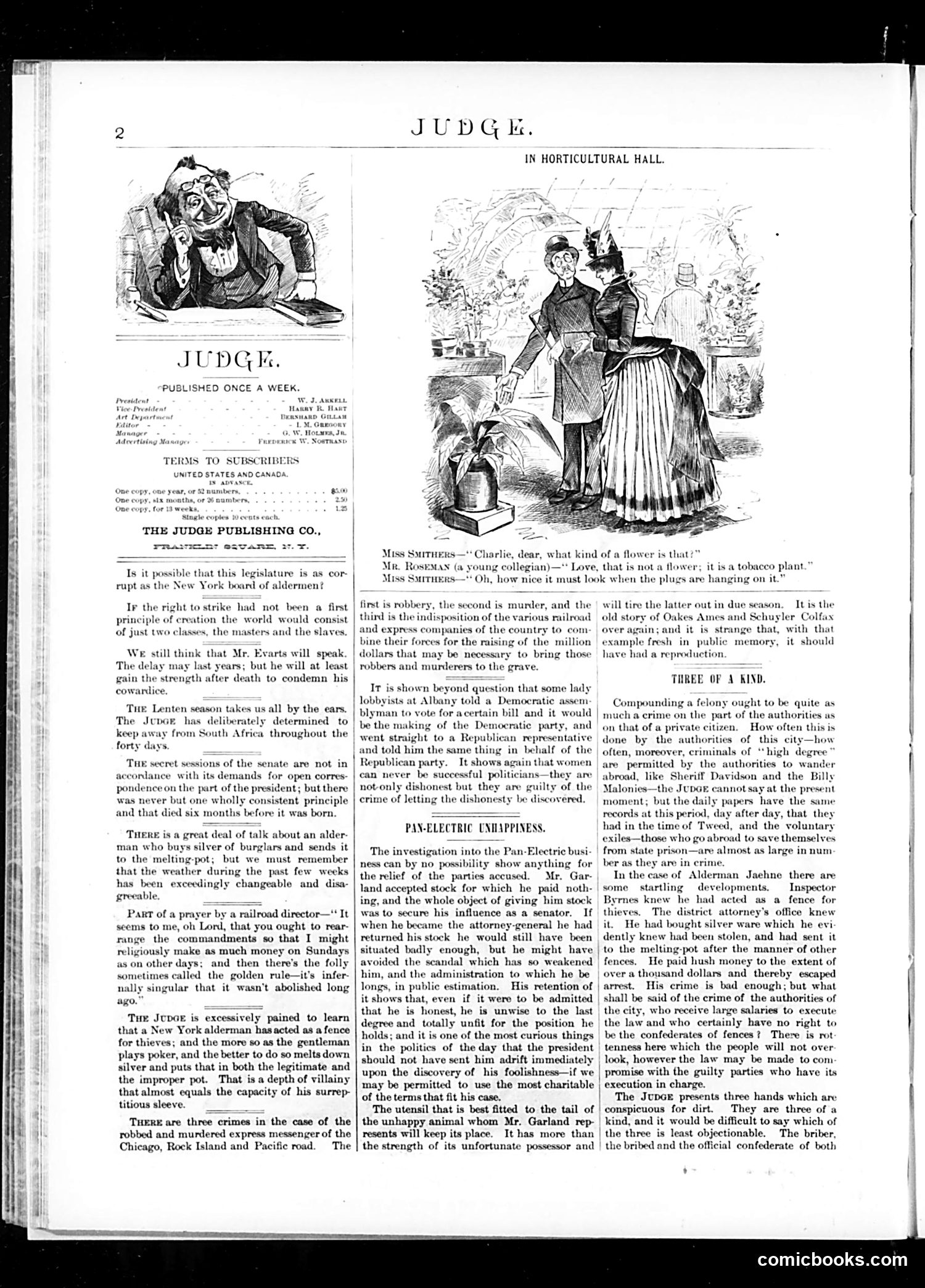
This page contains two editorial cartoons and accompanying text commentary from Judge magazine. **Top Left Cartoon ("Judge"):** Depicts a disheveled, distressed figure—likely representing a corrupt politician or official—clutching his head in anguish or despair. **Top Right Cartoon ("In Horticultural Hall"):** Shows a well-dressed woman (Miss Smithers) speaking with two men, one identified as a "young collegian" named Roseman. The exchange jokes about a "flower" being a "tobacco plant"—a pun playing on the woman's naiveté or the men's deceptive wordplay about plants. The surrounding text discusses political corruption, railway scandals, senate misconduct, and criminal investigations—suggesting Judge is critiquing Gilded Age institutional corruption and dishonesty among elites, using humor to expose hypocrisy in politics and society.
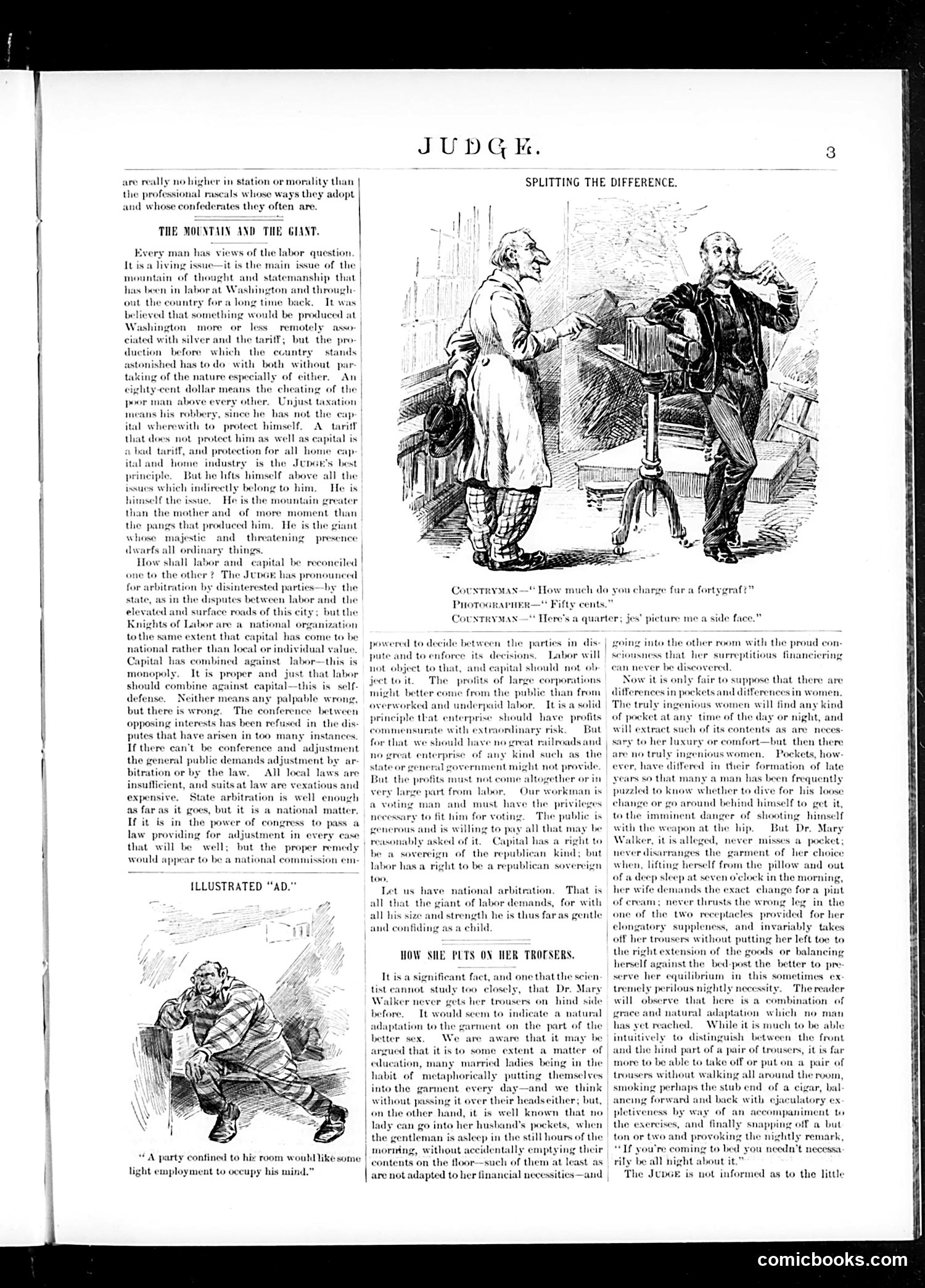
This page from *Judge* contains three distinct satirical pieces: **"The Mountain and the Giant"** (main article): A lengthy political commentary on labor-capital relations. The text advocates for national arbitration to resolve disputes between workers and corporations, arguing both sides have rights but must be regulated fairly. It critiques monopolistic capital while defending workers' right to organize. **"Splitting the Difference"** (top cartoon): Shows a countryman negotiating with a photographer over portrait costs. The countryman offers a quarter instead of fifty cents for a side-view photo—a visual pun suggesting "splitting the difference" by literally cutting the face in half. This satirizes cheap negotiating tactics. **"How She Puts On Her Trousers"** (bottom section): A humorous piece about women's dress reform, joking that Dr. Mary Walker (a real 19th-century women's rights activist) dons trousers backwards. It playfully suggests women are naturally adapted to stealing from their husbands' pockets—a period sexist joke about female shopping habits. The page blends serious labor politics with lighter social satire typical of *Judge's* mixed content.
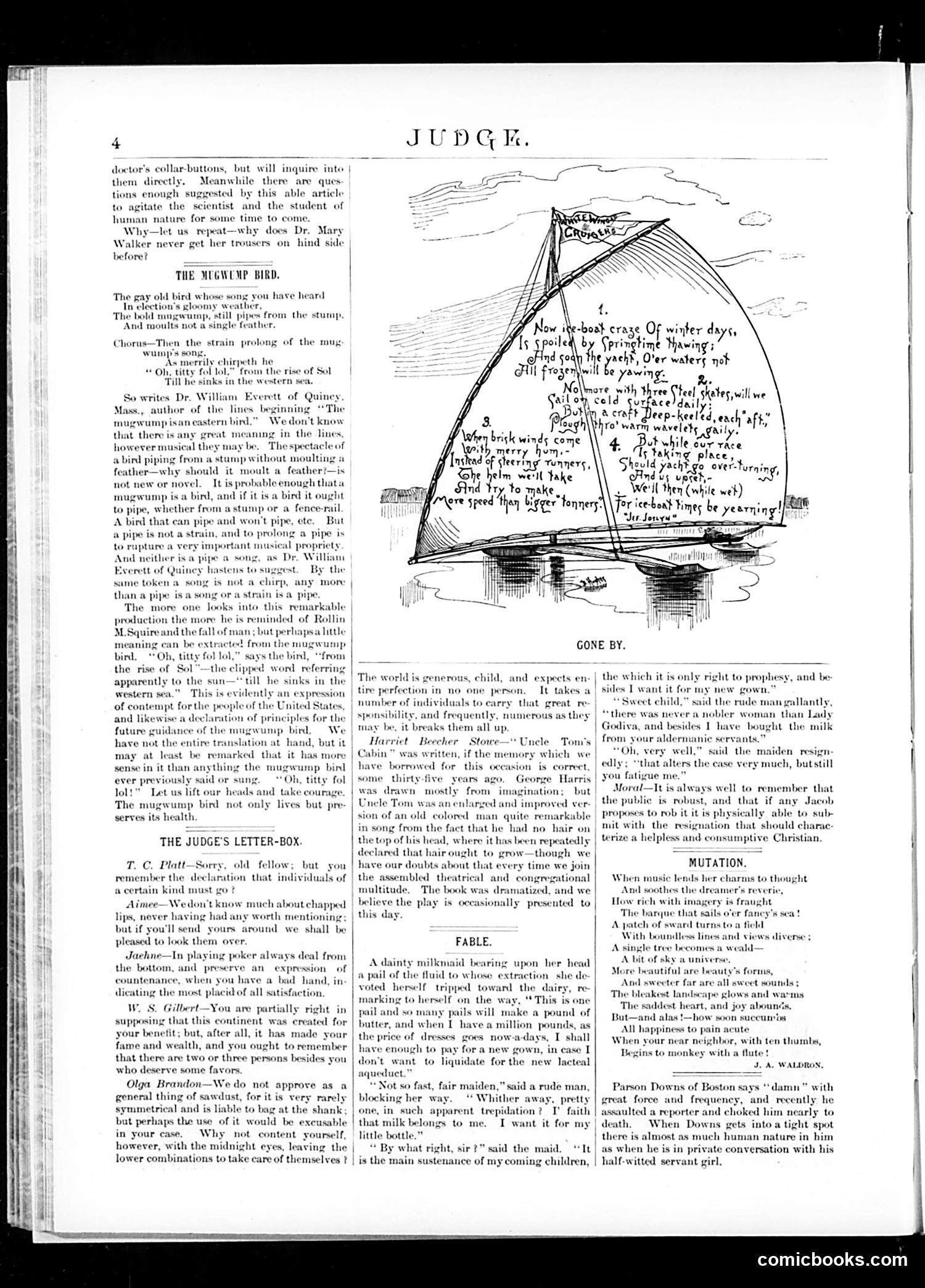
This page from the satirical magazine **Judge** primarily contains literary and humorous content rather than political cartoons. ## Main Content: **"The Nugwemp Bird"** is a mock-serious piece mocking the term "mugwump"—referring to Independent Republicans who refused to support party orthodoxy during the Gilded Age. The satire ridicules the pretentiousness of this political faction by presenting them as an absurd bird that "pipes" (speaks) without meaningful content. The repeated wordplay on "pipe," "strain," and "song" satirizes mugwumps as all noise and no substance. **"The Judge's Letter-Box"** contains humorous reader responses, including a jab at W.S. Gilbert (the famous playwright), reminding him that America deserves credit for his fame and wealth. ## Political Context: The mugwump satire reflects late-19th-century American political polarization—ridiculing independent voters and politicians who broke party lines as self-righteous but ineffectual. The tone suggests Judge magazine's conservative Republican stance viewing mugwumps as pretentious outsiders.
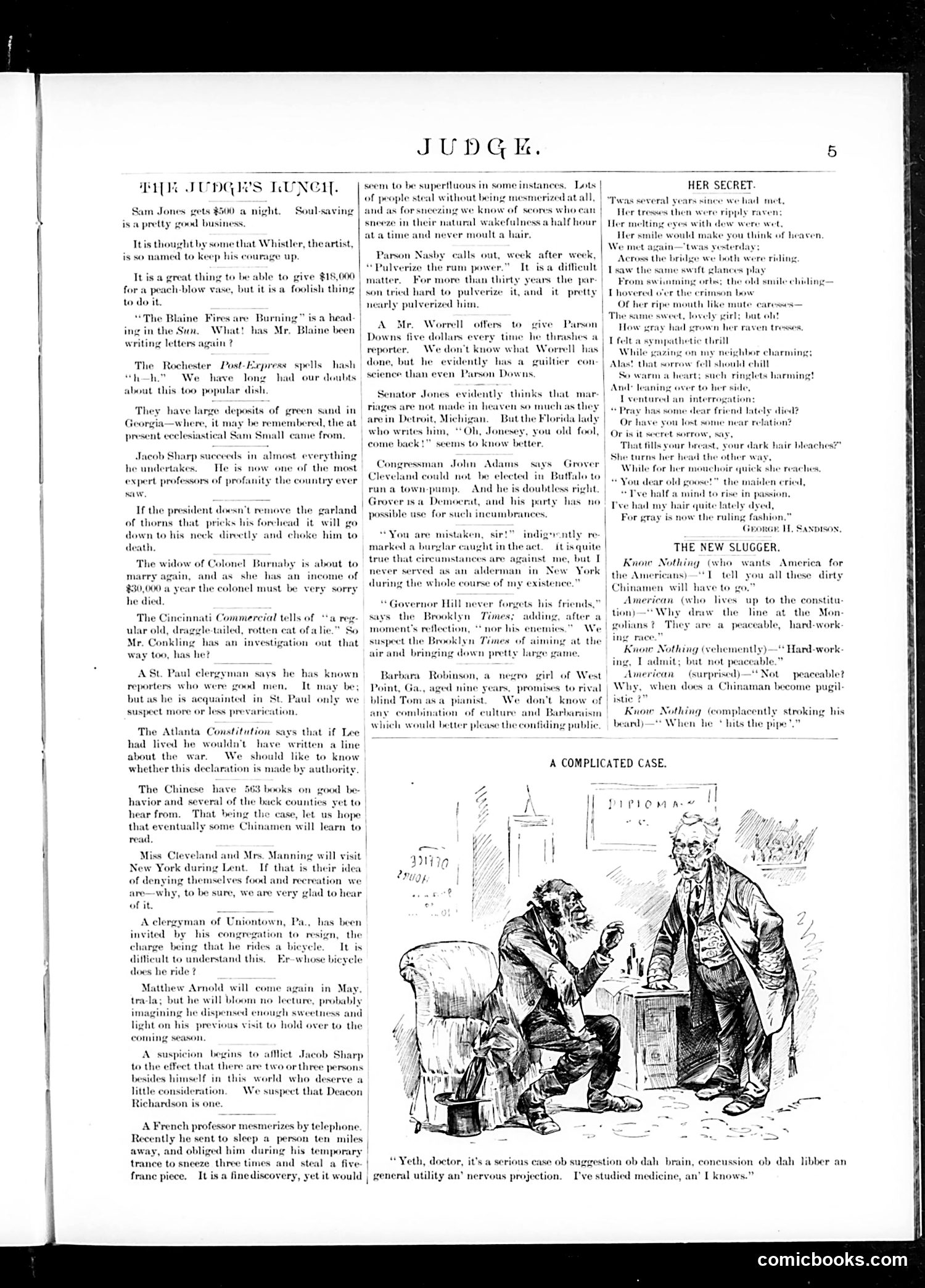
This page from the satirical magazine *Judge* contains brief humorous commentary and social criticism typical of the era. The main cartoon, titled "A Complicated Case," depicts a doctor examining a poor, disheveled patient. The caption references "suggestion oh dah brain, concussion oh dah libber an' general utility an' nervous projection," mocking both medical pseudoscience and the patient's impoverished condition through dialect humor. The surrounding text consists of short satirical observations on contemporary figures and issues: Sam Jones (a revival preacher) earning high fees for "soul-saving," criticism of wealthy collectors spending excessive amounts on vases, references to political figures like James G. Blaine, and commentary on journalists and clergy. The poetry section "Her Secret" offers sentimental romantic verse—likely included for tonal contrast to the satirical content. Overall, the page reflects *Judge's* mission to ridicule contemporary social pretension, religious hypocrisy, and public figures through brief quips and illustrations.
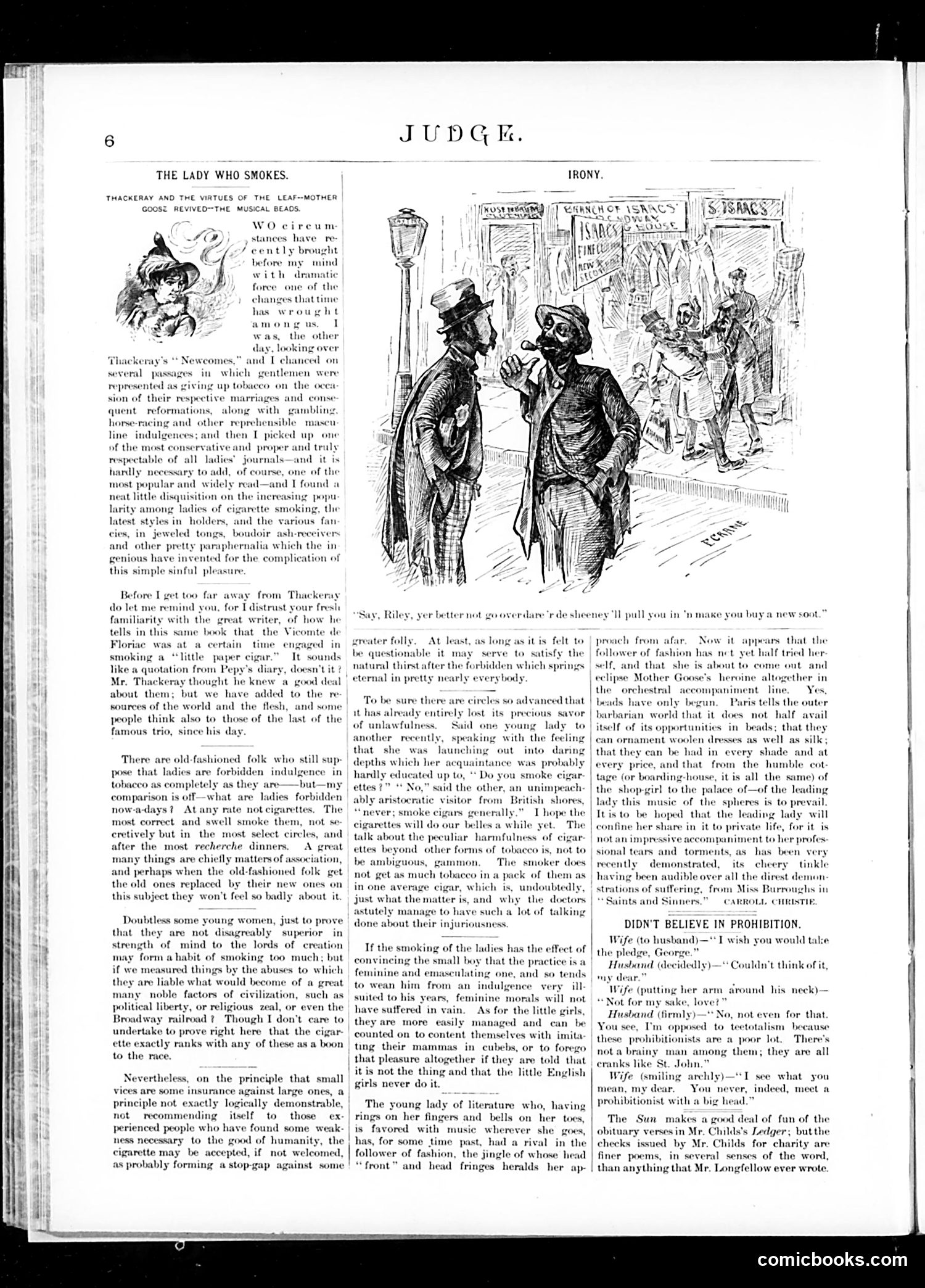
This page contains two distinct items: **"The Lady Who Smokes"** (left): A lengthy essay defending women smoking cigarettes. The author invokes Thackeray's *The Newcomes* to argue that tobacco use among respectable ladies is now socially acceptable, comparing historical anxieties about women smoking to outdated prudishness. The piece dismisses concerns about health or propriety as old-fashioned. **"Irony"** (right): A cartoon depicting two men on a city street observing fashionable women. One says to the other: "Say, Riley, yer better'd go overslide 'ide sheepey'll pull you in 'n make you buy a new coat." The joke appears to mock fashionable women's clothing as so elaborate or expensive that men must avoid them—satirizing contemporary fashion excess or women's consumer habits. The page reflects late-19th-century social debates about women's independence, consumer culture, and changing gender roles.
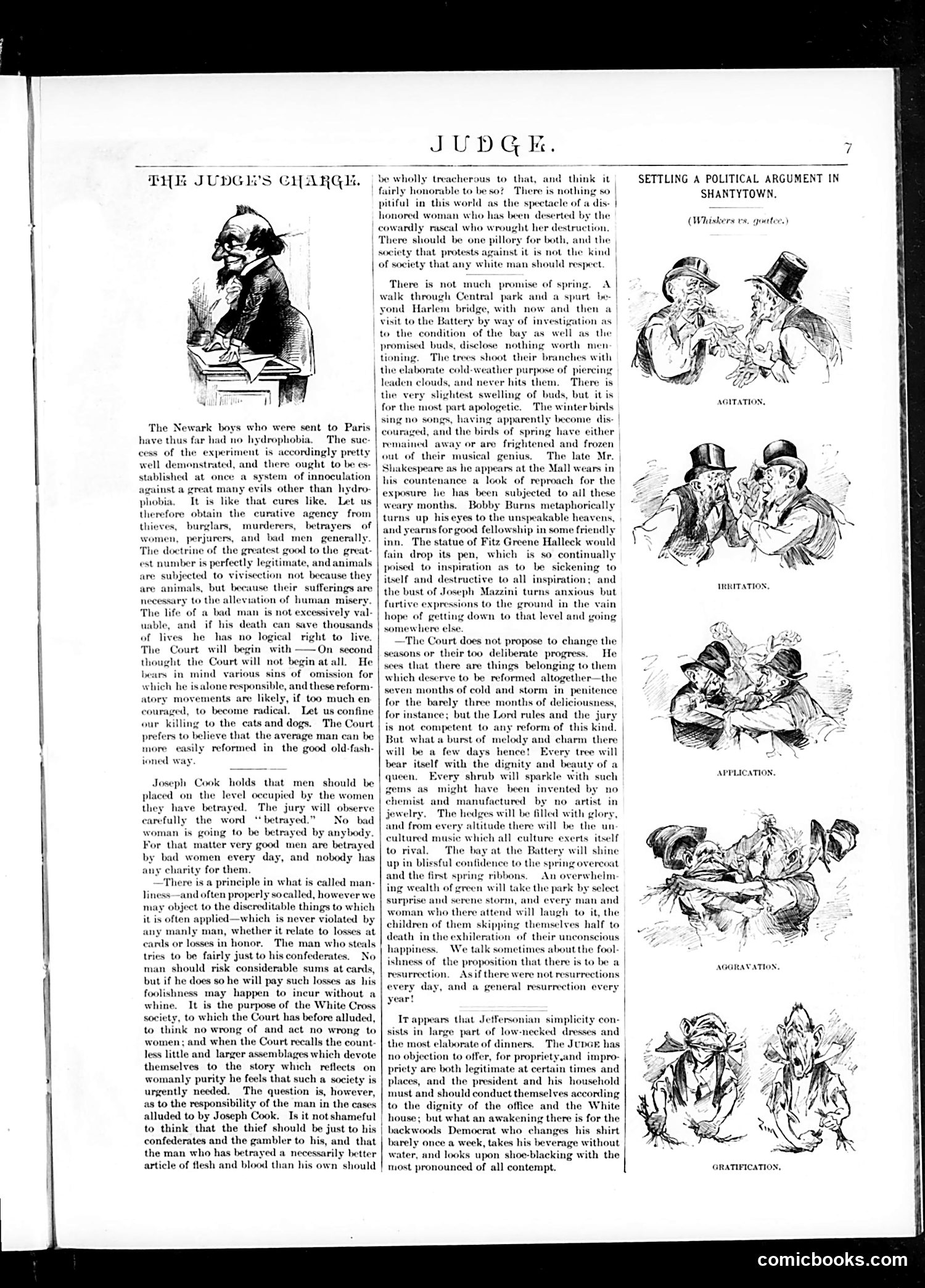
This page contains "The Judge's Charge," a lengthy editorial (left column) paired with satirical illustrations labeled "Settling a Political Argument in Shantytown" (right side). **The Editorial's Main Points:** The text addresses moral hypocrisy, particularly regarding seduction and abandonment of women. It critiques wealthy men who betray women while maintaining social respectability—arguing they deserve public shaming alongside their victims. The piece also discusses the "Newark boys sent to Paris" (an inoculation experiment) and references statues of Shakespeare, Bobby Burns, and Fitz Greene Halleck, using them to critique artistic and moral decline. **The Cartoon Series:** The right side shows six small illustrations depicting working-class men ("shantytown" residents) in heated political debate, with captions: "Agitation," "Irritation," "Explication," "Aggravation," and "Gratification." These humorously depict escalating argument stages among ordinary citizens. **The Satire:** The contrast juxtaposes elite hypocrisy (editorial) with common people's straightforward quarreling, suggesting working-class honesty contrasts with upper-class moral corruption.
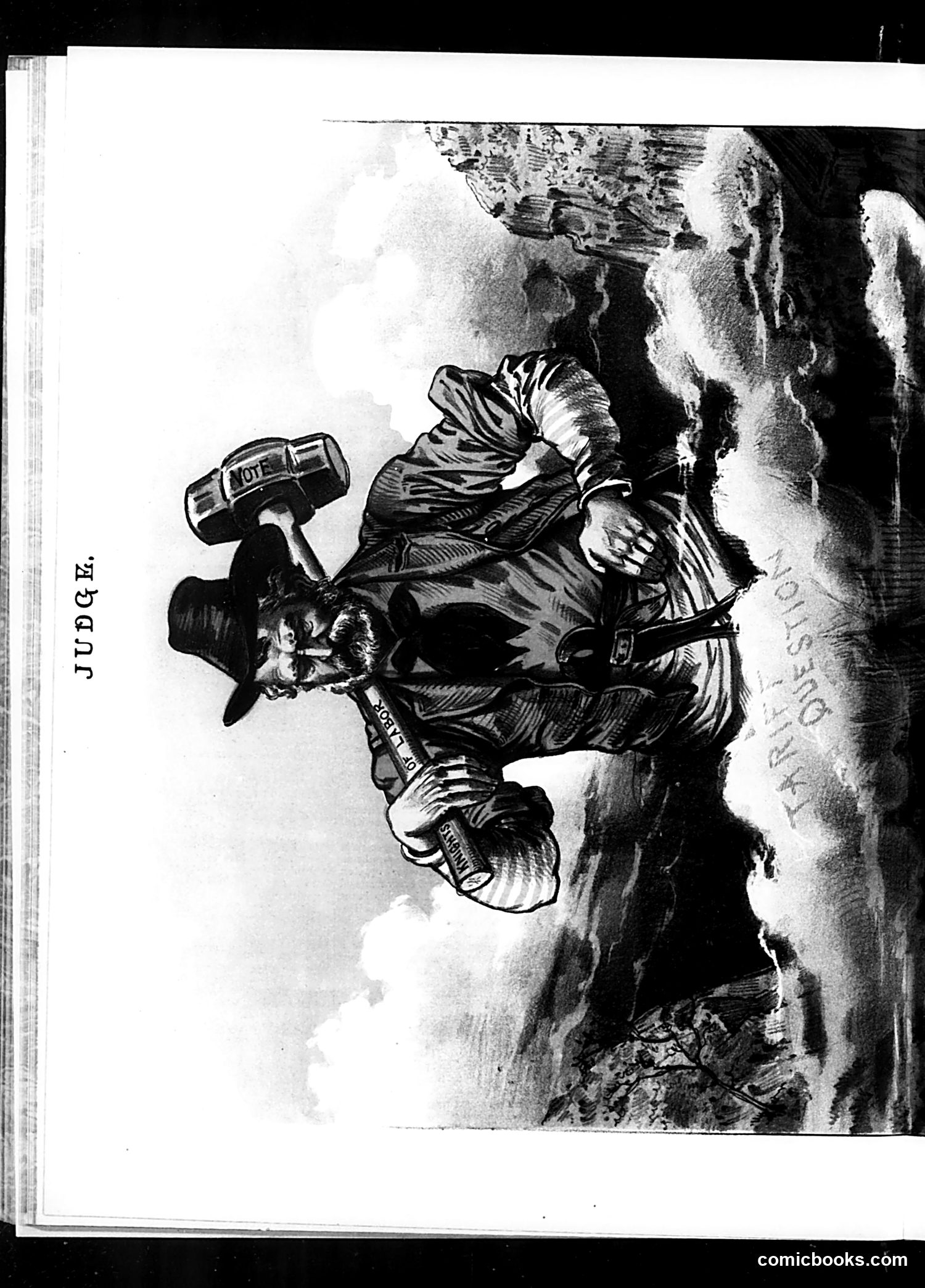
This page appears to be from *Judge* magazine and contains a single political cartoon labeled "JUDGE" on the left margin. The illustration shows a figure in period clothing (appearing to be 19th century dress) wielding a large mallet or hammer labeled "VOTE," striking at what appears to be rocky terrain or obstacles. The figure seems to be depicted as engaged in breaking through resistance or removing barriers. However, the OCR text is largely illegible and contains only character fragments, making it impossible to identify the specific political context, the figure being caricatured, or the precise satirical point. Without readable text or additional context about the publication date, I cannot accurately explain what political or social issue this cartoon addresses. **I cannot provide a reliable interpretation without clearer source material.**
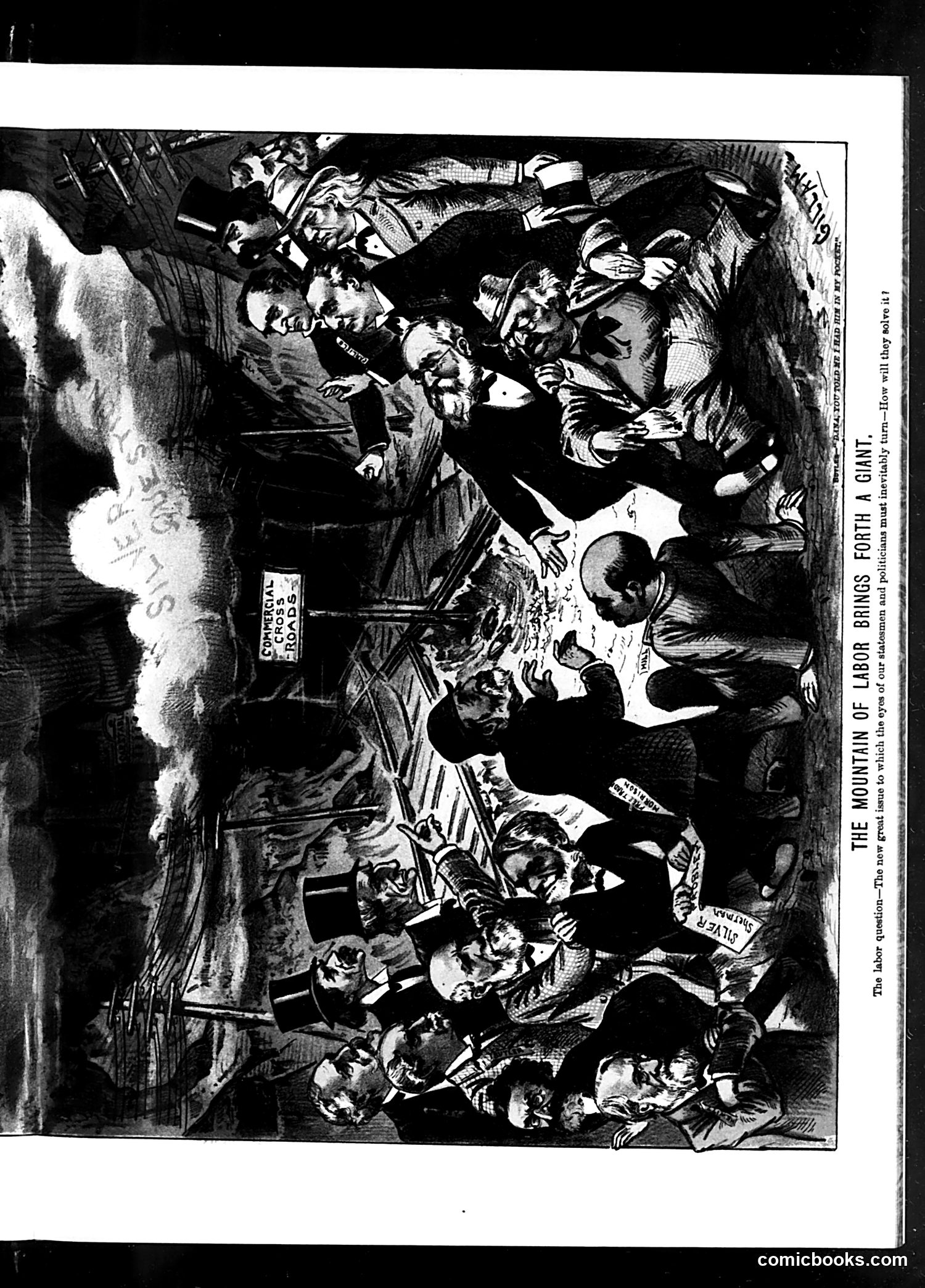
This political cartoon depicts a chaotic scene where numerous politicians and statesmen scramble around a mountainous pile labeled "LABOR" (visible on the left). The caption suggests labor issues are producing unexpected consequences—"a giant"—that leaders must address. The satire mocks political ineffectiveness: despite many officials supposedly tackling the labor problem, their confused activity produces nothing of substance. The "giant" appears to represent either the growing power of labor movements or the massive, uncontrollable consequences of ignoring worker demands. This reflects late-19th/early-20th century anxieties about labor unrest, strikes, and socialist movements. The cartoon satirizes how politicians debate endlessly without solving fundamental labor disputes, allowing the problem to grow into something monstrous they can no longer control. The exact identities of individual figures remain unclear from the image alone.
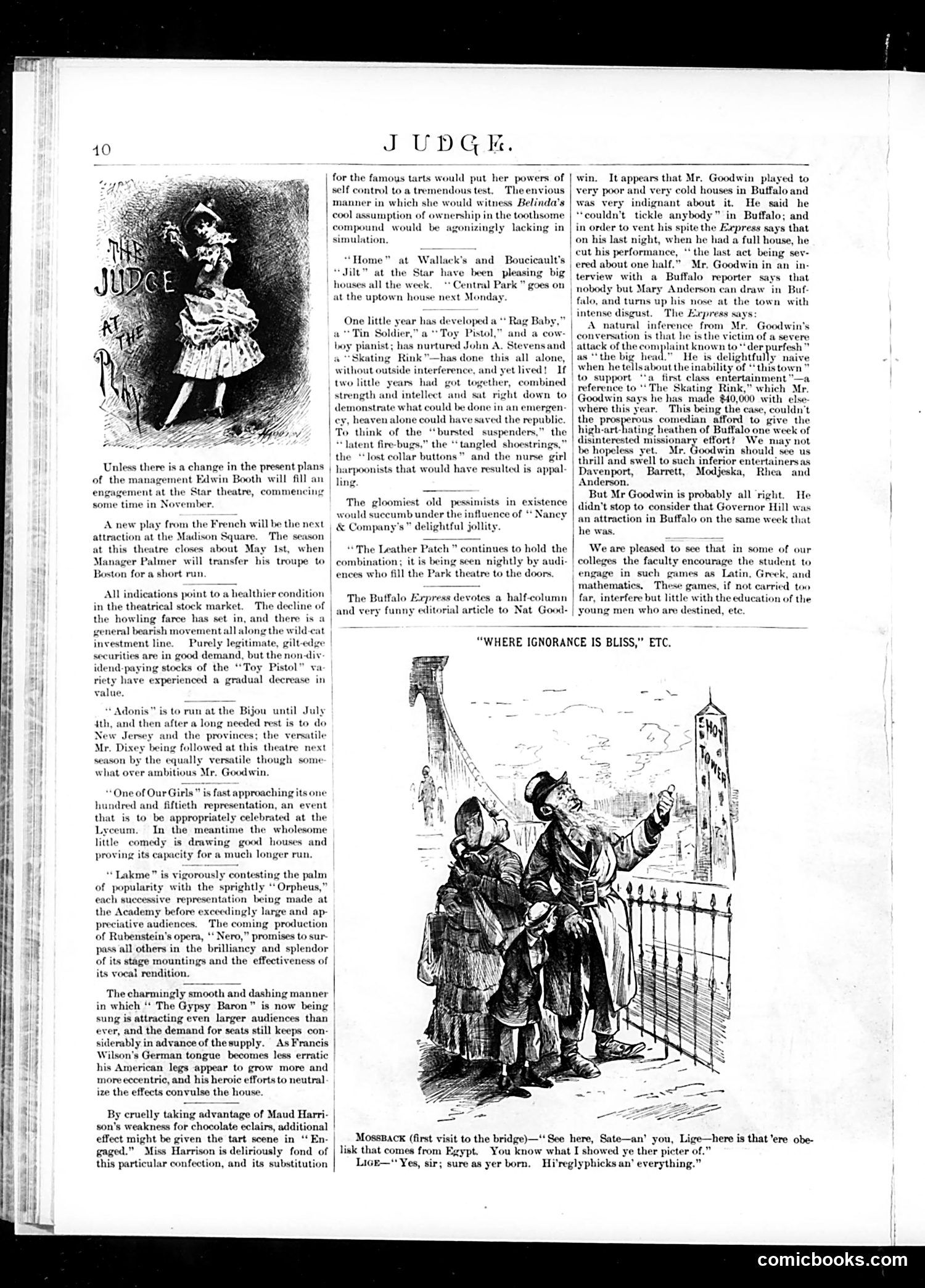
This page contains theatrical reviews and a single cartoon captioned "Where Ignorance is Bliss, Etc." **The Cartoon:** The illustration depicts two figures on a bridge—a well-dressed man (labeled "Mossback," apparently a rural or unsophisticated visitor) and a city guide or con artist ("Sate"). Mossback points excitedly at what he believes is an Egyptian obelisk, while the guide deceives him with a tall tale about its origin from Egypt. **The Satire:** The joke targets rural gullibility and urban deception. The "Mossback" stereotype represented an unsophisticated country person easily fooled by city slickers. The bridge setting suggests this occurs near a famous landmark (likely Brooklyn Bridge, completed 1883). The guide deliberately lies to the credulous visitor, who accepts the nonsense because of his ignorance—hence the title "Where Ignorance is Bliss." **Social Context:** This reflects period anxieties about rural-urban division and the vulnerability of country folk to metropolitan con artists—a common satirical theme in Gilded Age humor magazines.
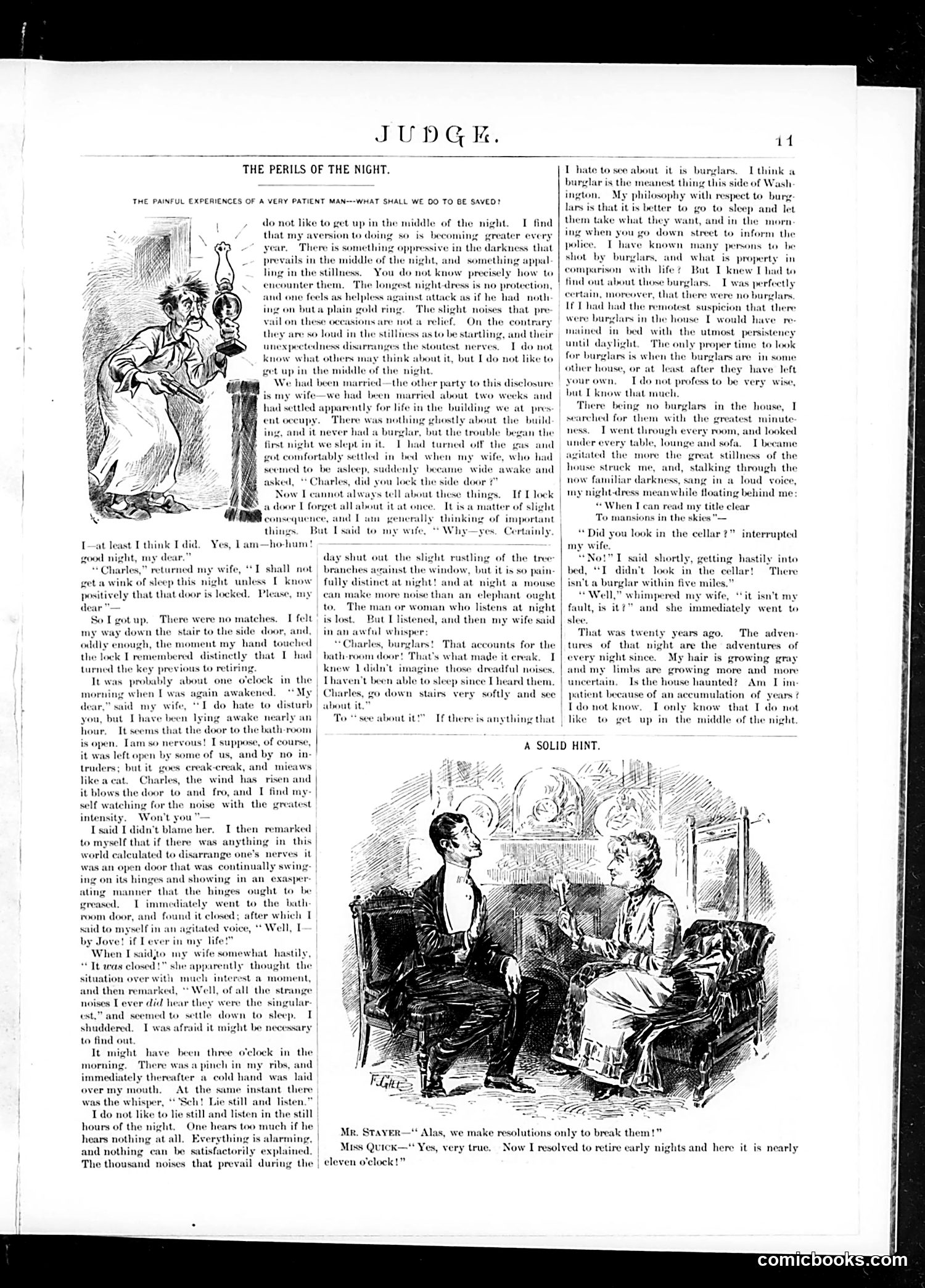
This page presents a humorous domestic narrative about a nervous husband repeatedly awakened by his wife's fears of burglars during the night. The satire targets anxious middle-class domesticity and the husband's patient, long-suffering tolerance of his wife's escalating concerns. The story mocks both characters: the wife's irrational nighttime anxieties (locked doors mysteriously opening, suspicious noises) and the husband's philosophical resignation to sleepless nights. The accompanying illustration "A Solid Hint" shows Mr. Stayer and Miss Quick discussing resolutions to retire early, suggesting the broader theme of urban residents' nightly security paranoia. The satire reflects late-19th-century concerns about urban crime and burglary, while poking fun at the gap between rational daytime behavior and irrational nighttime fears. The humor lies in the mundane domestic conflict—not actual danger, but the couple's mutual inability to sleep soundly.
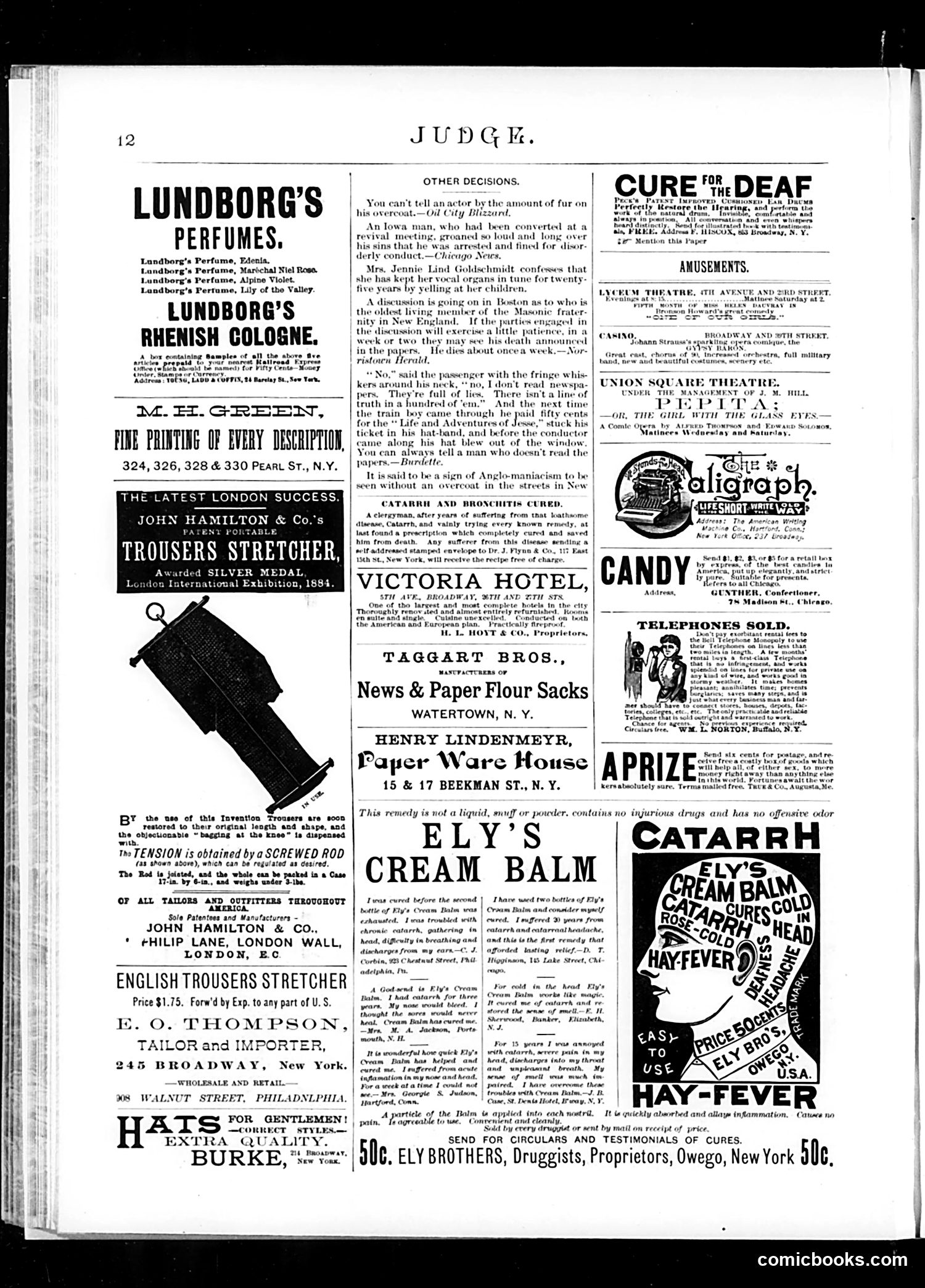
This page is primarily **advertising**, typical of late 19th-century magazines. The main content consists of product advertisements for clothing, pharmaceuticals, and household items. The most prominent advertising feature is a **portable trouser stretcher** (a Victorian clothing device) awarded a silver medal at the 1884 International Exhibition—reflecting the era's obsession with maintaining proper garment shape. The page also includes **"Other Decisions,"** brief satirical anecdotes mocking human behavior: a clergyman who "groans so loud" about sins he's arrested, a man who can't be identified as an actor without visible fur, and a passenger whose hat blows out a train window because he doesn't read newspapers (implying newspaper readers are more careful/aware). **Ely's Cream Balm** dominates the lower half—a catarrh/hay fever remedy with testimonials. This reflects the period's heavy reliance on patent medicines, many of dubious efficacy. The satire is mild and domestic rather than political. The humor targets everyday foolishness and social pretension rather than specific figures or events.
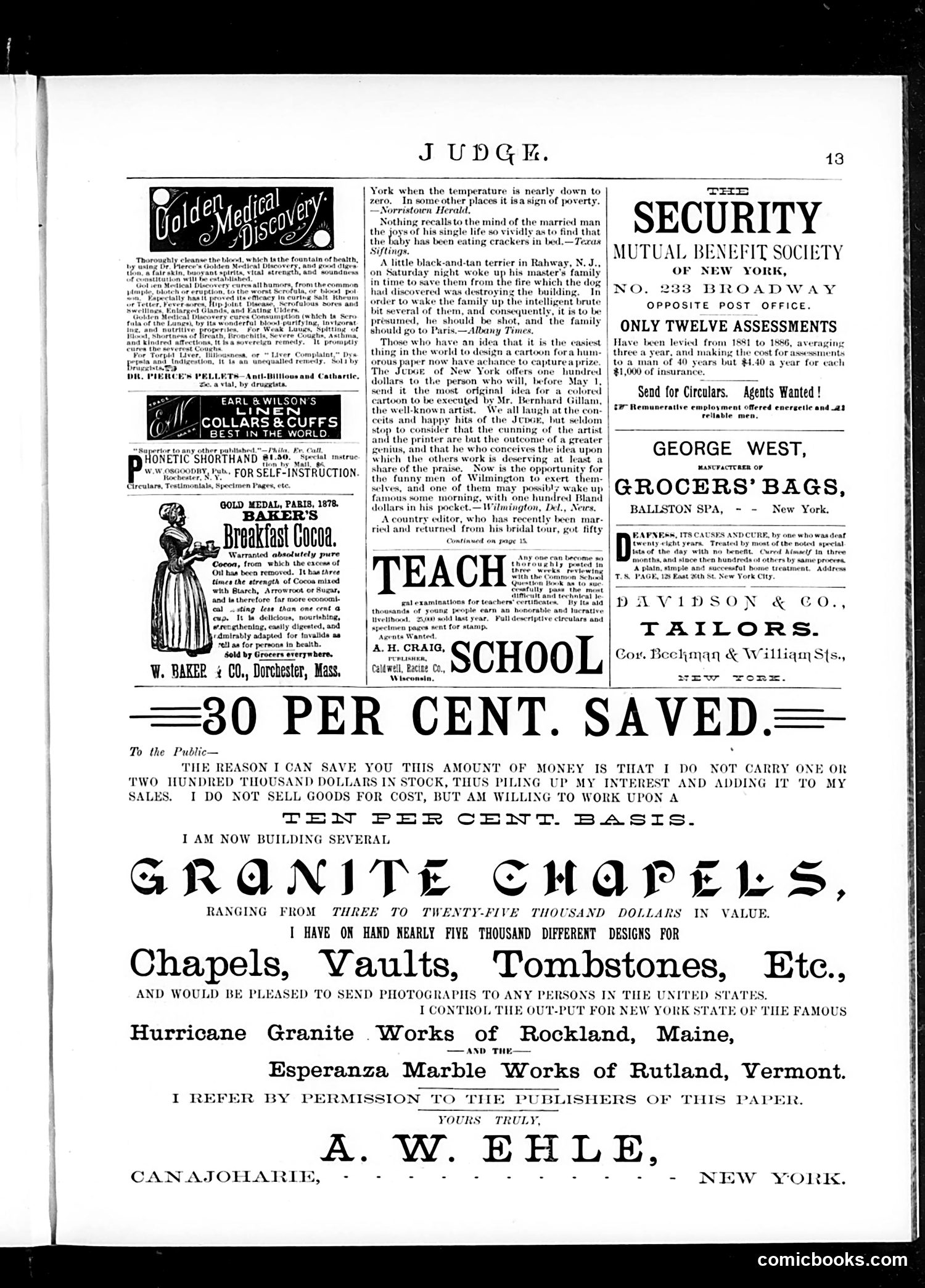
This is primarily an **advertising page** rather than a satirical cartoon page. The dominant content is a large advertisement from A. W. Ehle, a monument and granite chapel manufacturer based in Canajoharie, New York. **Main Advertisement Content:** Ehle promotes his business by claiming to save customers "80 per cent" on granite chapels, vaults, and tombstones. He explains his low prices by stating he doesn't carry large inventory, avoiding interest costs—he operates on a "ten per cent basis" instead. He advertises nearly 5,000 different designs and controls the output for New York State from two major granite works (Rockland, Maine and Rutland, Vermont). **Surrounding Advertisements:** The page includes typical period ads: Earl & Wilson collars and cuffs, Baker's Cocoa, a stenography school, tailors, and a mutual benefit insurance society. **Historical Context for Modern Readers:** This reflects late 19th-century business practices: monuments were major purchases, direct-mail advertising was standard, and manufacturers competed on cost efficiency. The insurance advertisement shows early mutual-aid societies offered affordable coverage.
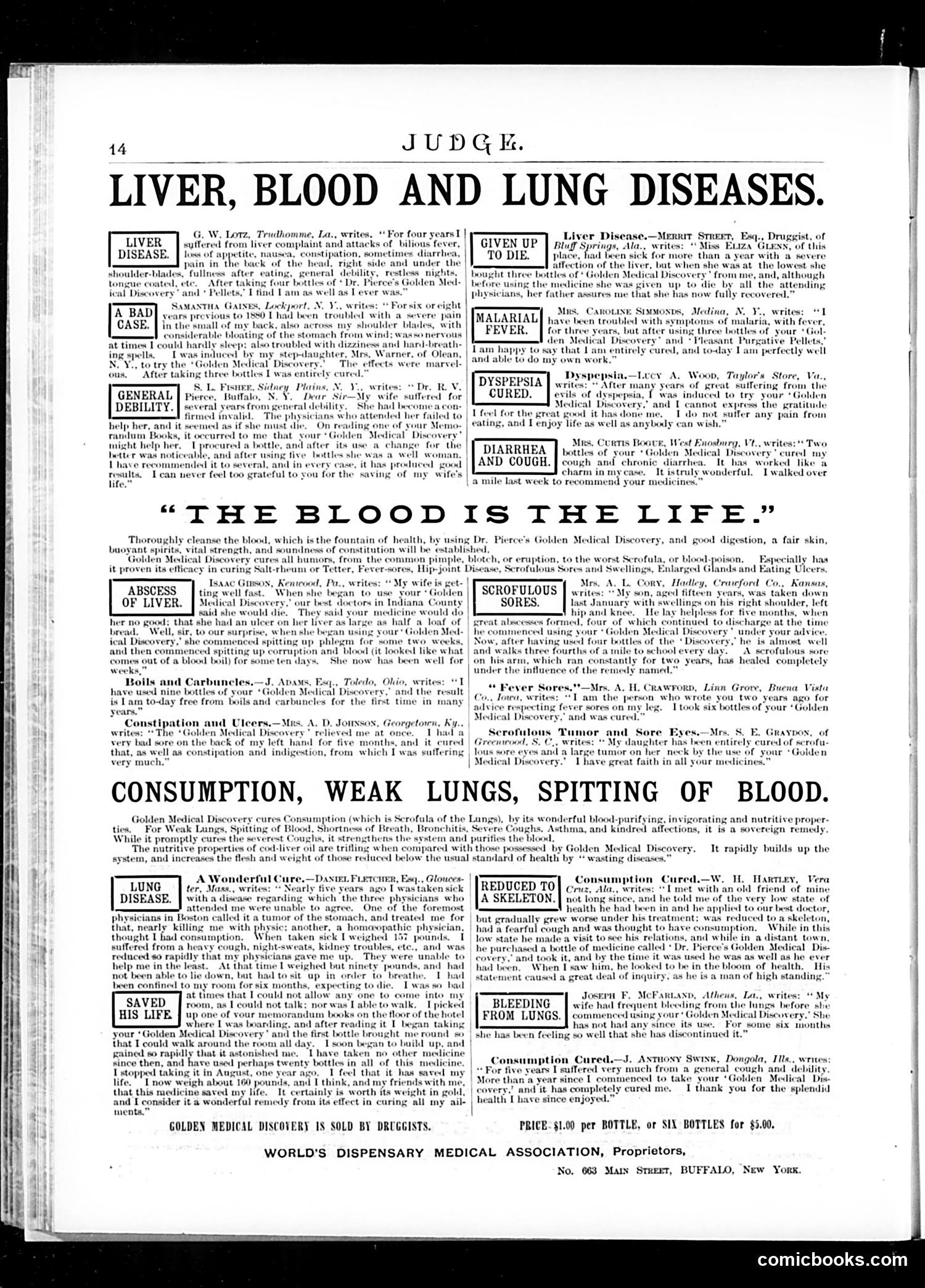
This is not a cartoon or satirical content—it's a full-page **medical advertisement** for "Golden Medical Discovery," a patent medicine sold by the World's Dispensary Medical Association in Buffalo, New York. ## The Content The page presents testimonials from supposedly real patients claiming cures for liver disease, malaria, dyspepsia, diarrhea, consumption (tuberculosis), scrofulous sores, and other ailments. Each testimonial includes a patient's name, location, and detailed description of symptoms followed by miraculous recovery after using the product. ## Historical Context This represents **19th-century patent medicine marketing**—before FDA regulation. Such advertisements were common in magazines like *Judge*. The testimonials are likely fabricated or exaggerated. The repeated phrase "The Blood is the Life" served as the product's central marketing claim: that purifying blood through this tonic would cure numerous unrelated diseases. By modern standards, these claims would constitute fraud, but such advertisements were standard practice in the era and appeared alongside legitimate editorial content in respected publications.
This page is **primarily advertising**, not editorial or satirical content. It's dominated by commercial advertisements for patent medicines (Hale's Honey for coughs), safes, paper products, and printing supplies typical of late 19th-century periodicals. The only narrative content is a brief anecdote titled "Sewing Satchels," describing a man who took a sewing machine agent's demonstration too literally—he sewed up cloth, then kicked his wives out of his tent one by one. The joke appears to be a crude, misogynistic play on the phrase "sewing machine agent" and domestic absurdism. The page reflects Judge's reliance on advertising revenue and contains no identifiable political cartoons or satirical commentary on contemporary figures or events. It's a typical interior page designed primarily to generate revenue rather than editorial content.
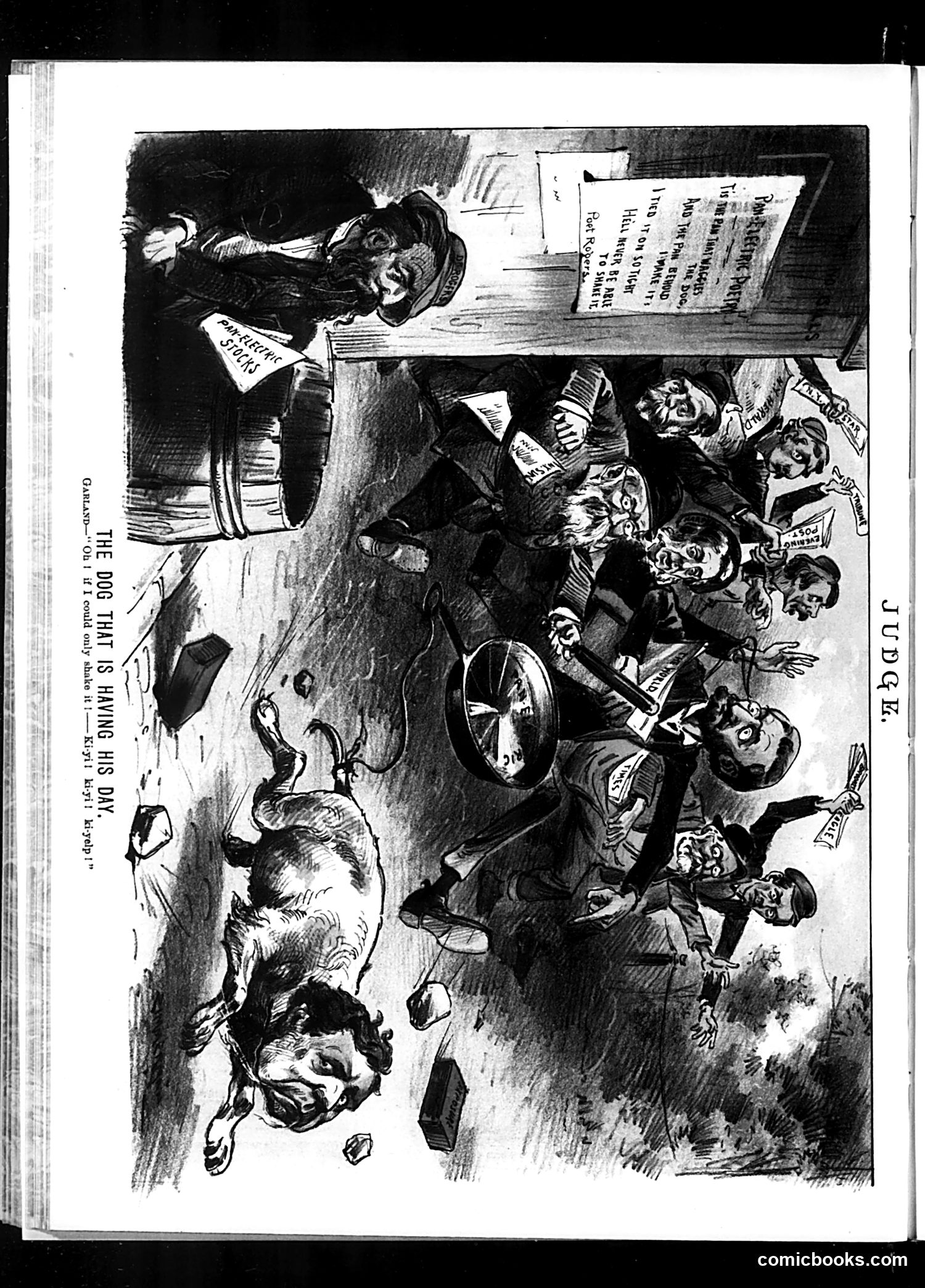
This is a satirical cartoon titled "The Dog That Is Having His Day," showing a large dog labeled "Sheriff" standing on a platform above a group of men wearing what appear to be prisoner or convict uniforms. The dog appears triumphant while the men below look distressed or submissive. The satire likely references a sheriff exercising authority over prisoners or detainees, with the "dog having his day" suggesting someone in power enjoying their moment of dominance. The exaggerated cartoon style emphasizes the absurdity of the power dynamic. However, without the publication date visible and given the OCR text's incomplete nature, the specific historical or political context—which sheriff, which situation, which era—remains unclear. The joke appears to mock abuse of authority or excessive displays of power.