
Judge, 1886-03-27 · page 2 of 16
Judge — March 27, 1886 — page 2: what you’re looking at
What you’re looking at
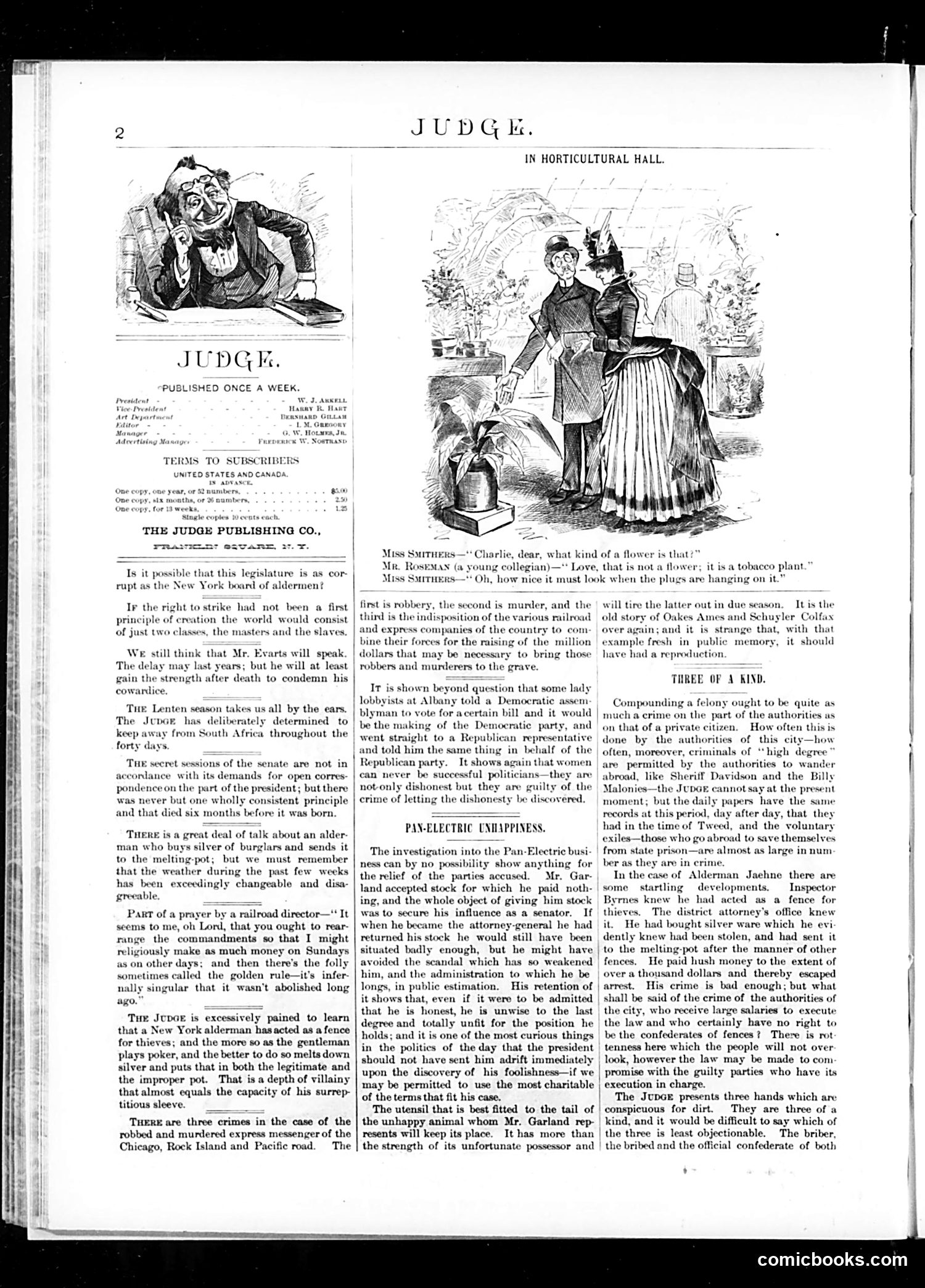
This page contains two editorial cartoons and accompanying text commentary from Judge magazine. **Top Left Cartoon ("Judge"):** Depicts a disheveled, distressed figure—likely representing a corrupt politician or official—clutching his head in anguish or despair. **Top Right Cartoon ("In Horticultural Hall"):** Shows a well-dressed woman (Miss Smithers) speaking with two men, one identified as a "young collegian" named Roseman. The exchange jokes about a "flower" being a "tobacco plant"—a pun playing on the woman's naiveté or the men's deceptive wordplay about plants. The surrounding text discusses political corruption, railway scandals, senate misconduct, and criminal investigations—suggesting Judge is critiquing Gilded Age institutional corruption and dishonesty among elites, using humor to expose hypocrisy in politics and society.
📄 Transcribed text from this page (OCR, searchable)
Machine-transcribed from the original scan — historical spelling and the odd misread are preserved.
OS Pe er ee SS ee EE JUDGK. PUBLISHED ONCE A WEEK. Manager @. 18, Hotanes, “Advertising Manag Frrpenice W, Nowrwast TERMS TO SUBSCRIBERS UNITED STATES AND CANADA. THE JUDGE PUBLISHING CO., rraonmcinr esvaRs, 27. ¥. cor. Is it possible that this legislature is rupt as the New York board of aldermen Ir the right to strike had not been a first principle of creation the world would consist of just two classes, the masters and the slaves. We still think that Mr. Evarts will sp The delay may last years; but he will at les gain the strength after death to condemn his cowardice. Tue Lenten season ti The Jupae has deliberately determined to keep away from South Africa throughout the forty days. us all by the ears. THE secret sessions of the senate are not in acconlance with its demands for open corres- pondence on the part of the president; but there was never but one wholly consistent principle and that died six months before it was born. Tuere is a great deal of talk about an alder man who buys silver of burglars and sends it to the melting-pot; but we must remember that the weather during the past few weeks has been exceedingly changeable and disa- greeable, Pant of a prayer by a railroad director—'* It seems to me, oh Lord, that you ought to rear- the commandments so that I might sly make as much money on Sundays as on other days; and then there's the folly sometimes called the golden rule—it’s infer- nally singular that it wasn't abolished long pm Tue Jevoe is excessively pained to learn that a New York alderman has acted as afence for thieves; and the more so as the gentleman plays poker, and the better to do so melts down silver and puts that in both the legitimate and the improper pot. That is a depth of villainy that almost equals the capacity of his surrep- titious sleeve. Turner are three crimes in the case of the robbed and murdered express messenger of the Chicago, Rock Island and Pacific road. The JUDGE. Miss Suituers—** C IN HORTICULTURAL HALL. e, dear, what kind of a flower is that!” Mr. Rosema (a young collegian)—" Love, that is not a flower; it is a tobacco plant.” Miss Sarruers—* Oh, how ni first is robbery, the second is munde | third is the indisposition of the various railroad | and express companies of the country to | bine their forces for the raising of the million dollars that may be necessary to bring those robbers and murder to the grave. and the Ir is shown be: lobbyists ond question that some lady told a Democratic assem | blyman to acertain bill and it would be the making of the Democratic part went straight to a Republican represen: and told him the same thing in behalf of the Republican party. It shows again that women | can never be successful politicians—they arv | not only dishonest but they are guilty of the crime of letting the dishonesty be discovered. PAN-ELECTRIC UNHAPPINESS. The investigation into the Pan-Electric busi ness can by no possibility show anything f the relief of the parties accused. Mr. land accepted stock for which he paid noth- ing, and the whole object of giving him stock was to secure his influence as a senator. If when he became the attorney-general he had returned his stock he would still have been avoided the scandal which has so weakened him, and the administration to which he be longs, in public estimation. His retention of it shows that, even if it were to be admitted that he is honest, he is unwise to the last degree and totally unfit for the position he holds; and it is one of the most curious things in the politics of the day that the president should not have sent him adrift immediately upon the discovery of his foolishness—if we may be permitted to use the most charitable of the terms that fit his case. The utensil that is best fitted to the tail of the unhappy animal whom Mr. Garland rep- resents will keep its place. It has more than the strength of its unfortunate possessor and situated badly enough, but he might have | ¢ it must look when the plugs are hanging on it.” will tire the latter out in due season, It is the old story of Oakes Ames and Schuyler Colfi yin; and it is strange that, with that example fresh in public memory, it should have had a reproduction over 4 TUREE OP A KIND. Compounding a felony ought to be quite as much a crime on the part of the authorities as on that of a tizen. How often this is done by the authorities of this city—how ‘ten, moreove minals of “high degree” are permitted by the authorities to wander abroad, like Sheriff Davidson and the Billy Malonies—the JUDGE c the present moment; but the d e the same records at thi that they had in the time of Tweed, and the voluntar: exiles—those who go abroad to save themselves from state prison—are almost as large in num ber as t i In the case of Alderman Jaehne there are some startling development Inspector Byrnes knew he had acted as a fence for thieves. The district attorney's office knew it. He had bought silver ware which he e dently kn had been stolen, and had sent it to the melting-pot after the manner of other fences. He paid hush money to the extent of over a thousand dollars and thereby escaped arrest. His crime is bad enough; but what shall be said of the crime of the authorities of the city, who receive large salaries to execute the law and who certainly have no right to be the confederates of fences? There is rot tenness here which the people will not over look, however the law may be made to com promise with the guilty parties who have its execution in charge. The JvpGE presents three hands which are conspicuous for dirt. They are three of kind, and it would be difficult to say which o' the three is least objectionable. The briber, the bribed and the official confederate of both comicbooks.com