
A complete issue · 16 pages · 1886
Judge — February 20, 1886
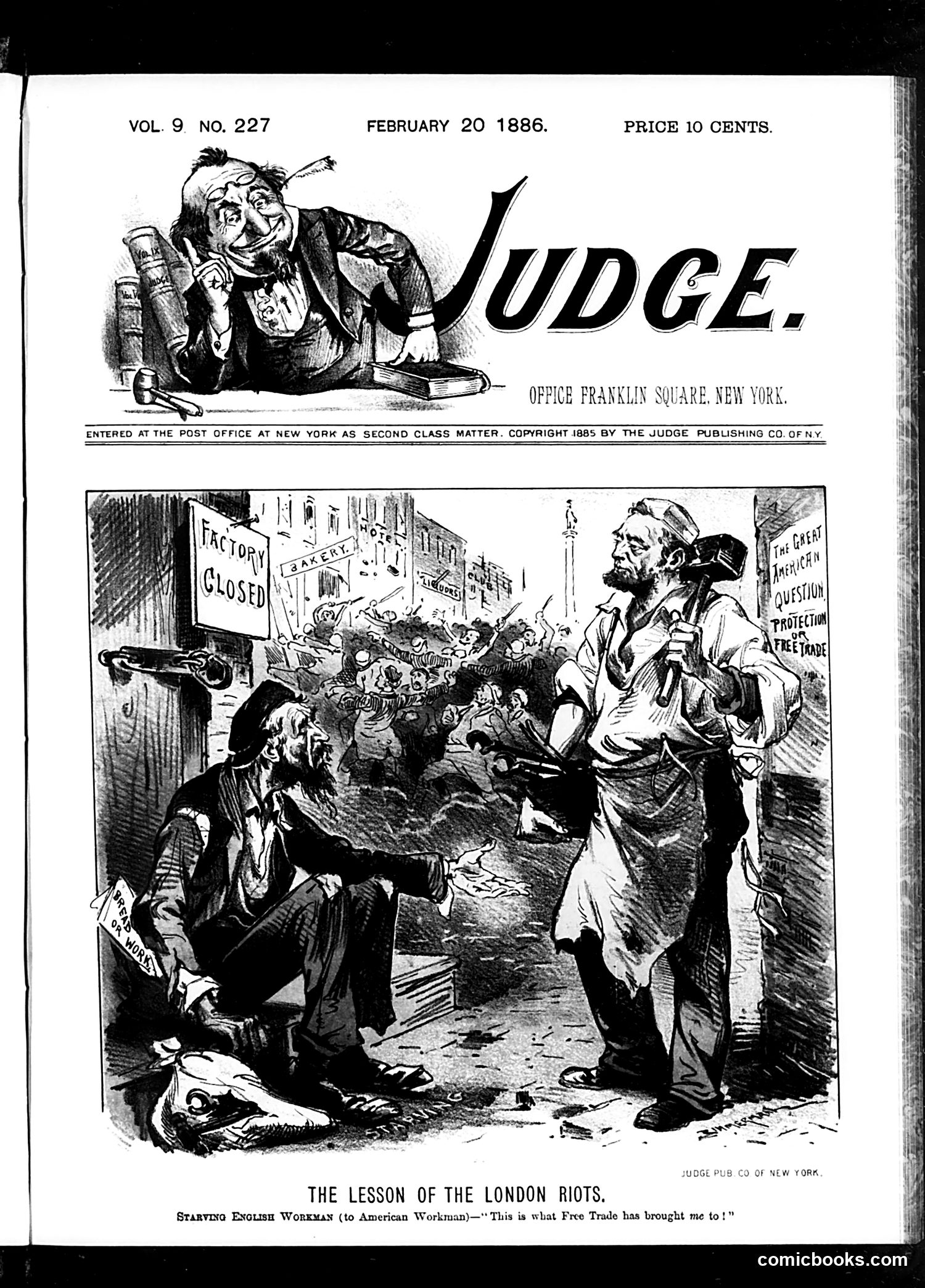
This 1886 *Judge* cartoon satirizes the economic consequences of free trade policy. The main image depicts a starving English workman confronting an American worker, with a closed factory and rioting crowds in the background. The caption—"This is what Free Trade has brought me to!"—uses the London riots (a real event) as evidence of free trade's destructive effects. The cartoon argues protectionist positions: free trade, rather than benefiting workers, has caused factory closures and social unrest in Britain. The figure on the right appears to represent American interests or prosperity. The satire suggests Americans should learn this "lesson" and reject free trade policies to avoid similar domestic turmoil and worker suffering.
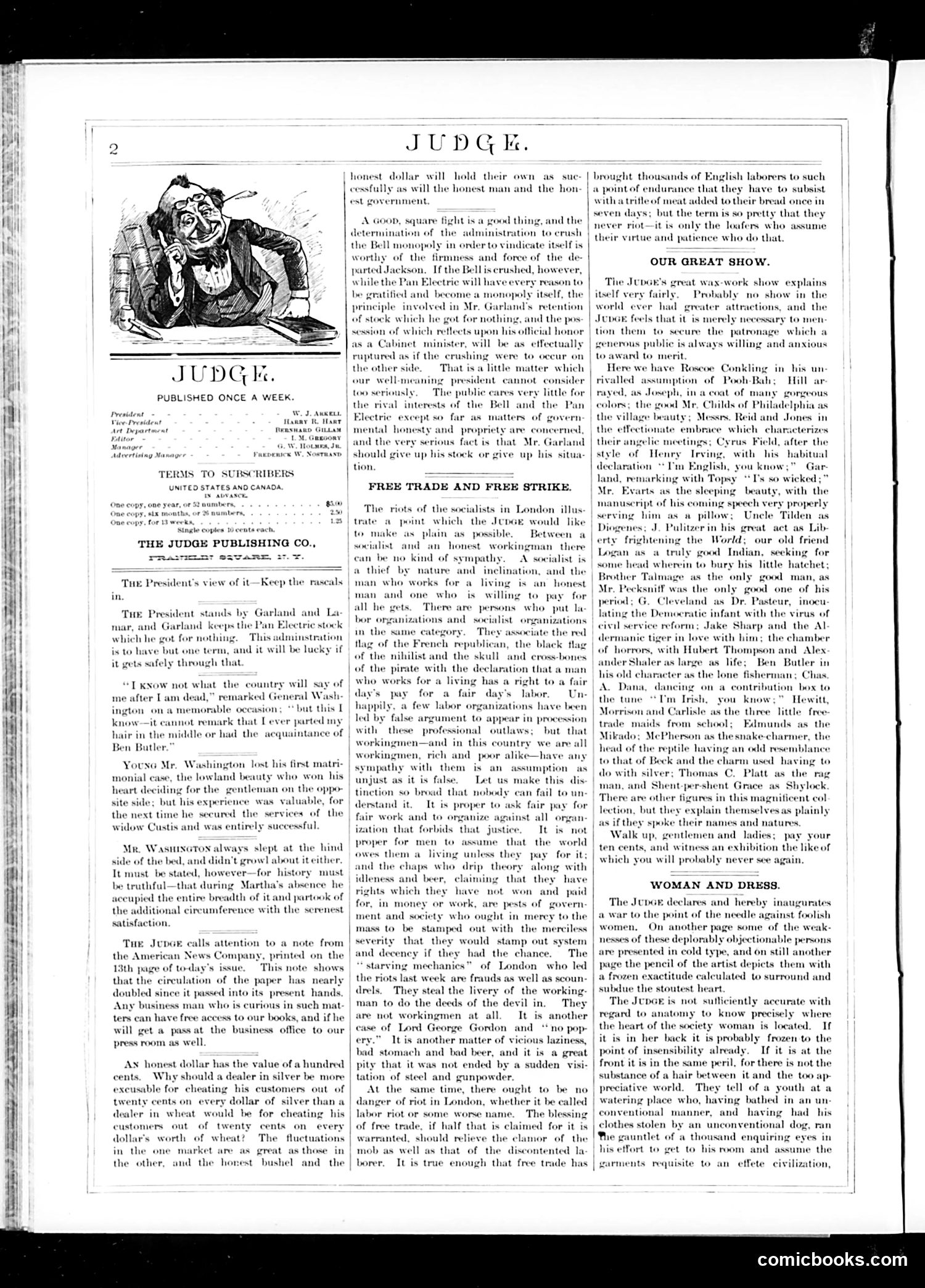
The main cartoon depicts a grotesque figure labeled "JUDGE" - a personified representation of the magazine itself as moral arbiter. The illustration shows Judge as a disheveled, heavy-set character, establishing the satirical tone. The text addresses contemporary political issues: criticism of the Pan-Electric stock scheme, discussion of free trade versus protectionism, and commentary on socialist labor organizing in London. The article "FREE TRADE AND FIRE STRIKE" critiques both wealthy capitalists and socialist organizers, suggesting they're equally problematic. "WOMAN AND DRESS" appears to be social satire about women's fashion and comportment. Overall, this page represents Judge's role as political satirist commenting on labor disputes, economic policy, and social morality during the Gilded Age.
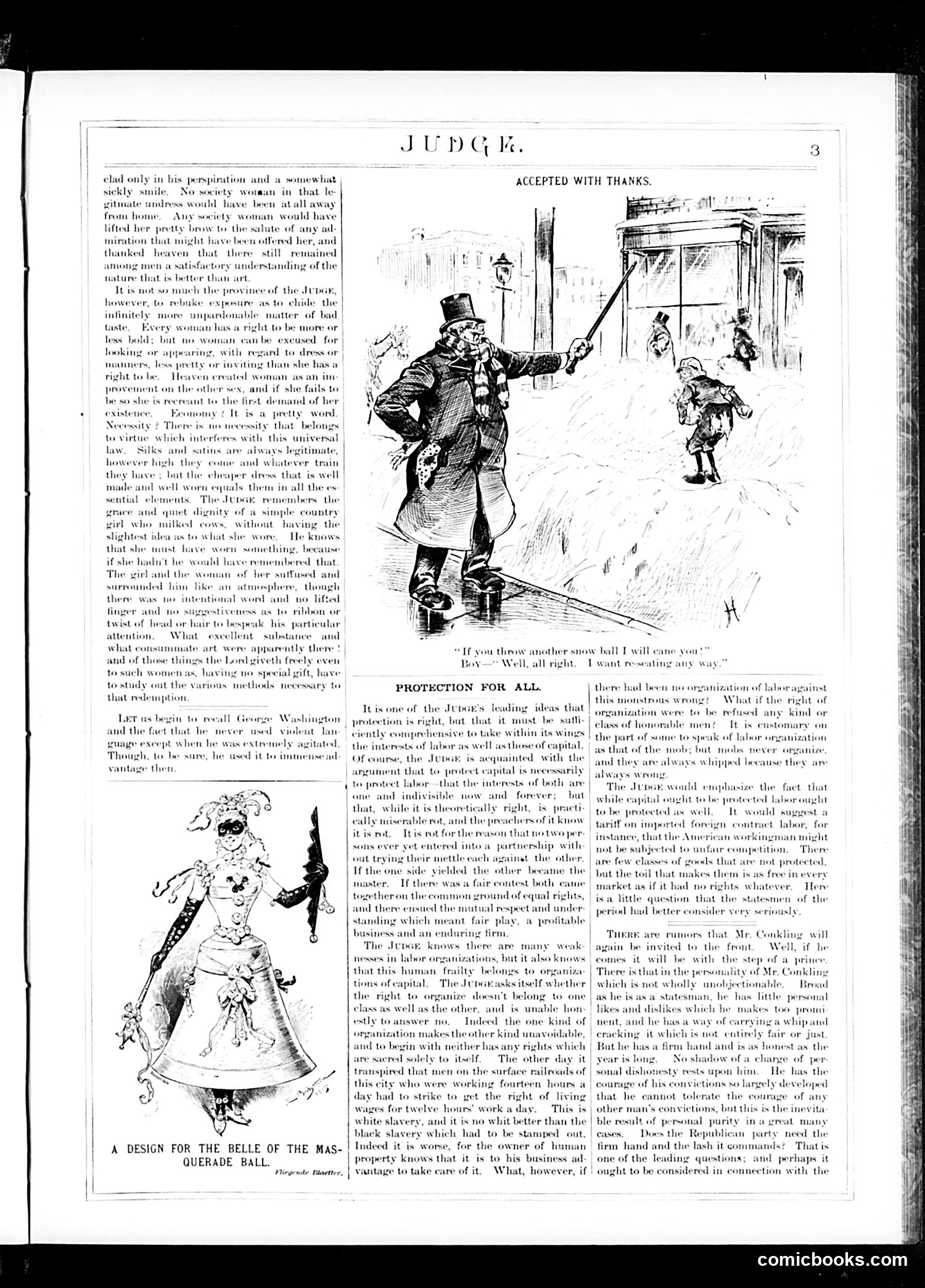
## Main Cartoons: **Top cartoon ("Accepted with Thanks"):** A well-dressed man with a cane appears to threaten children with snow, saying "If you throw another snow ball I will cane you!" The satire likely mocks upper-class authority figures abusing power over children, or critiques harsh adult responses to innocent play. **Bottom cartoon ("A Design for the Belle of the Masquerade Ball"):** Shows an elaborately dressed woman in a ball gown. The accompanying text criticizes women's revealing fashion at society events—satirizing both the immodesty of the dress and society's hypocritical standards for women's appearance and behavior. ## Main Article: "Protection for All" This editorial argues that *Judge* magazine supports protective tariffs, but only if they protect *both* labor and capital equally. It critiques: - Weak labor organizations - Unfair working conditions (14-hour workdays) - The contradiction that capital gets protection while workers face unfair competition - Hypocrisy: owners protect property but workers' labor remains unprotected The piece references Mr. Conkling (likely Roscoe Conkling, prominent Republican politician), suggesting political debate over tariff policy.
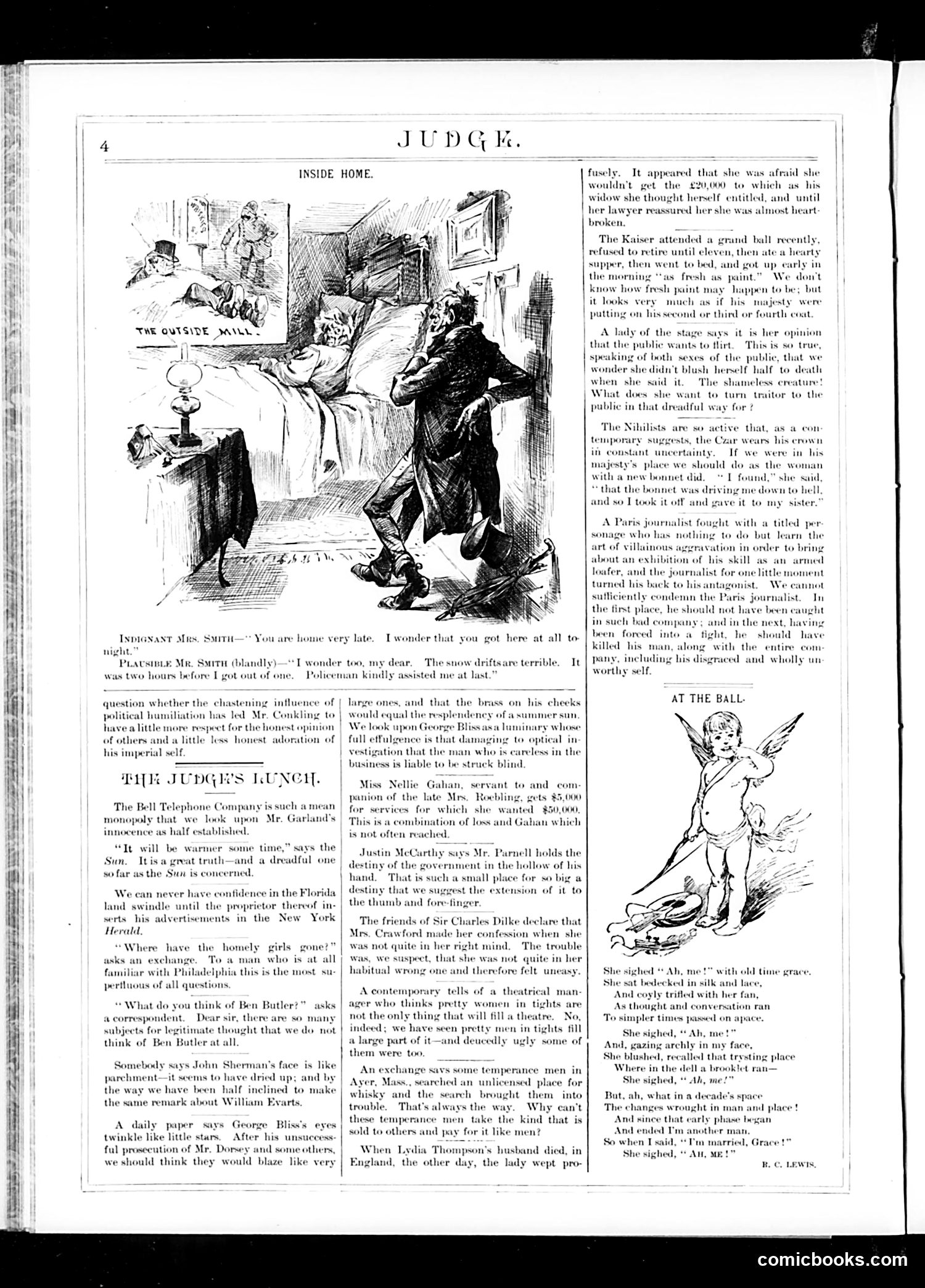
This page from *Judge* magazine contains satirical commentary on contemporary public figures and social issues, likely from the 1880s based on references. **Main cartoons/content:** The "Inside Home" section features a sketch mocking **Mrs. Robling** (widow of bridge engineer Washington Robling), who reportedly worried about losing her £20,000 widow's entitlement until reassured by her lawyer—satirizing mercenary widow stereotypes. **Political/social satire includes:** - Mockery of **Ben Butler** (controversial Union general/politician) - Criticism of the **Bell Telephone Company** monopoly and Mr. Garland's involvement - Comments on **Charles Dilke** (British politician involved in scandal) - Jibes at **John Sherman** and **William Evarts** (appearance-based insults) - Attacks on **the Kaiser** for imperial pretension - Criticism of **Paris journalists** as agitators The tone is irreverent, personal, and focuses on mocking public figures' appearances, moral character, and perceived hypocrisy. "At the Ball" poem appears unrelated to main satirical content.
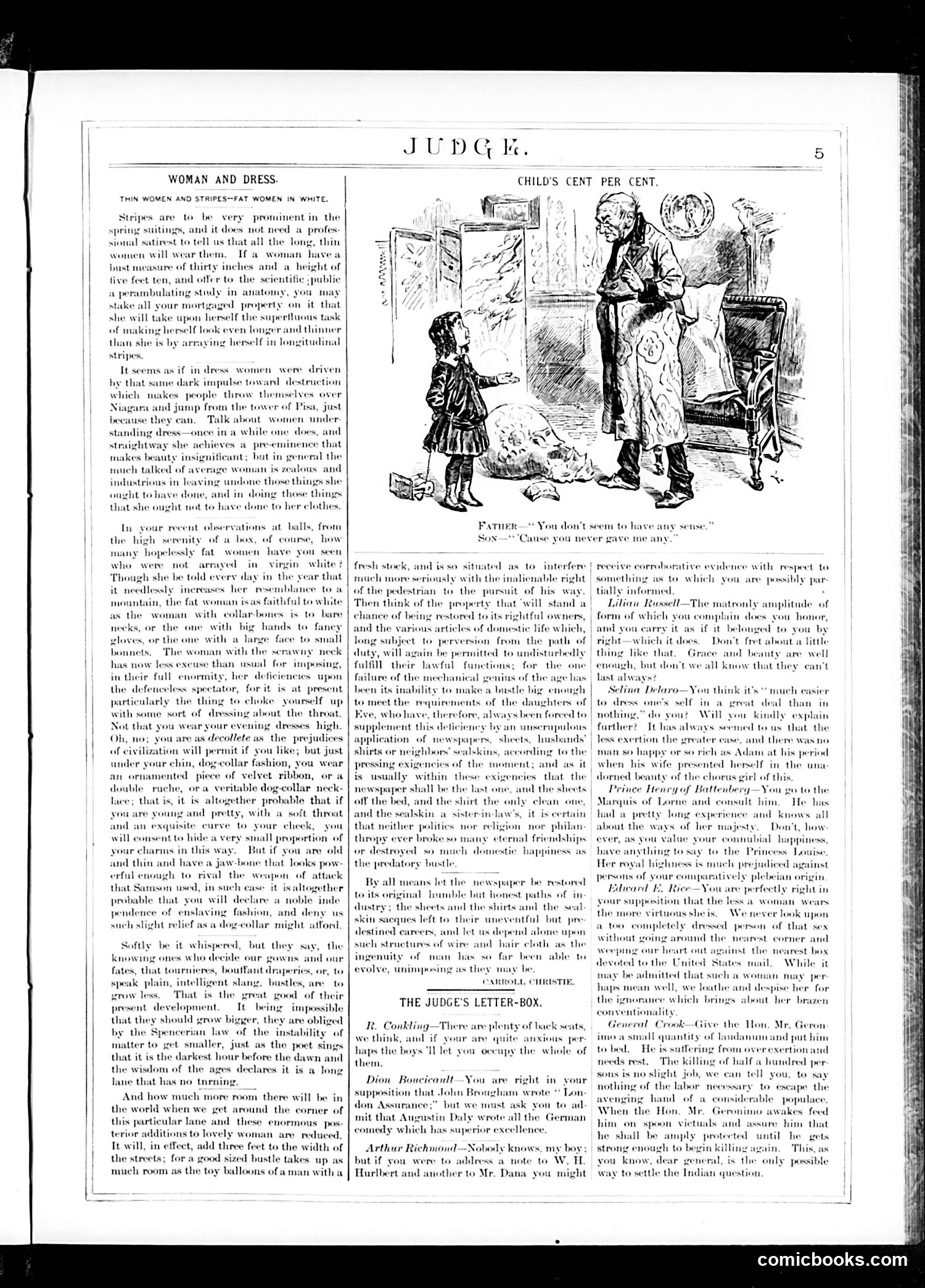
This page contains two distinct elements: **"Woman and Dress"** (left column): A satirical essay mocking fashion conventions and women's body consciousness. The author criticizes how thin women will wear vertical stripes (which elongate the figure) while fat women wear white (which broadens appearance), suggesting women are slaves to fashion's impossible standards. The piece argues this vanity is absurd—comparing it to people jumping from the Tower of Pisa—yet women remain obsessed with dress despite the futility. **"Child's Cent Per Cent"** (right): A cartoon and accompanying advice column where a father scolds his son for lacking "sense," and the son replies he was never given any. The accompanying letters appear to be humorous advice from public figures (Lillian Russell, Prince Henry of Battenberg) on matters of dress and marriage. The overall satire targets **Victorian-era women's fashion obsession** and **rigid gender expectations** around appearance, ridiculing both the impracticality of fashion trends and women's internalized pressure to conform to them.
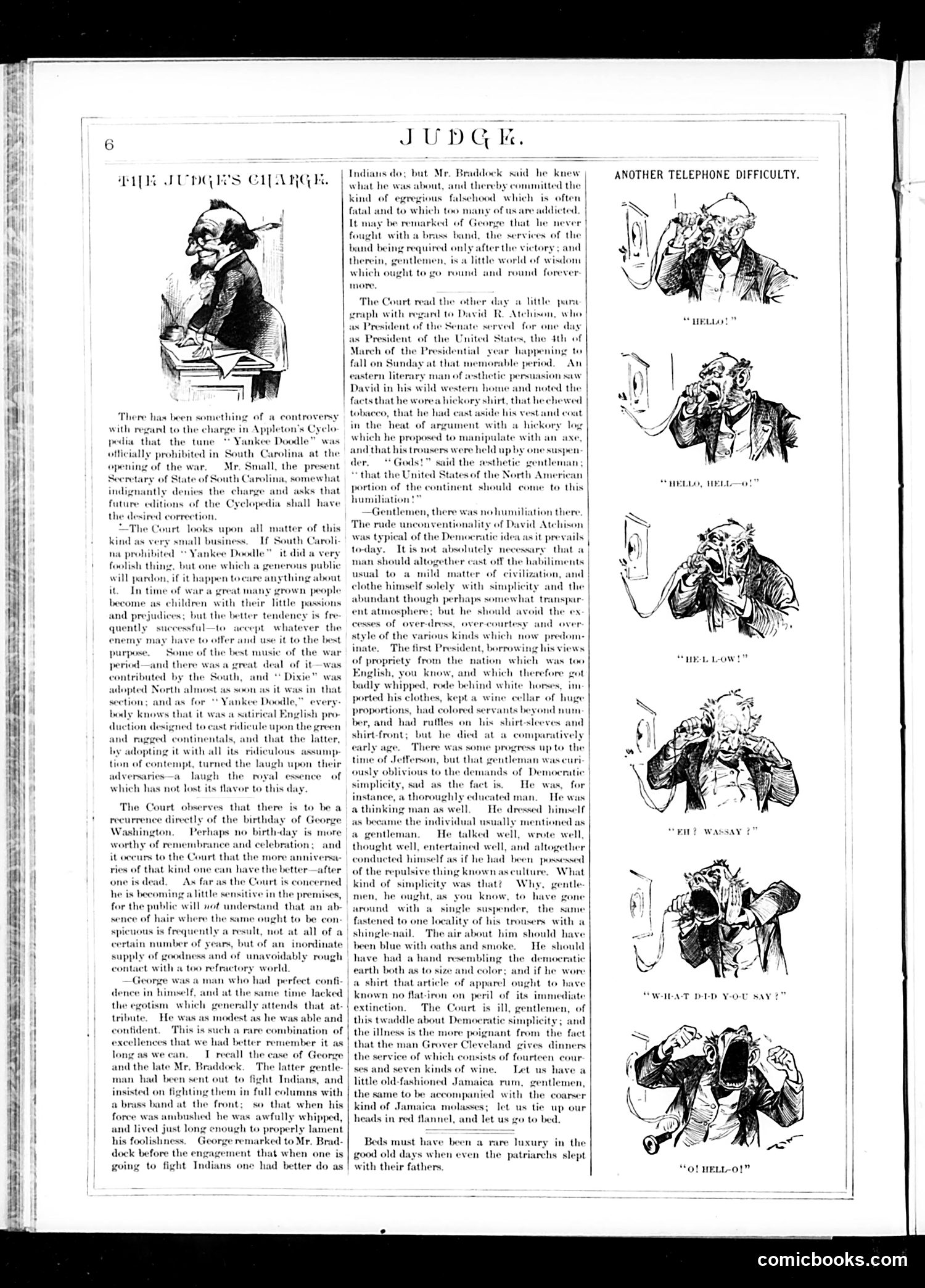
**Content:** This page contains two sections: a lengthy editorial essay titled "The Judge's Charge" and a comic strip titled "Another Telephone Difficulty." **"The Judge's Charge"** discusses a controversy over whether South Carolina banned "Yankee Doodle" during the Revolutionary War. The author defends Confederate figures—particularly David Atchison—against charges of impropriety, arguing that their simple dress (hickory shirts, suspenders) reflects democratic virtue rather than disrespect. The piece contrasts this favorably with the elaborate formal dress of earlier presidents like George Washington and Jefferson, sarcastically praising Democratic simplicity. **The satire targets:** Northern accusations against Southern leaders; Democratic claims of republican virtue; and the idealization of frontier informality as moral superiority. **"Another Telephone Difficulty"** shows six comic panels of a frustrated caller repeatedly hearing "HELLO!" responses while unable to connect with the intended party—satirizing contemporary telephone technology's unreliability. The page reflects post-Reconstruction-era Republican skepticism toward Democratic mythologizing of the South.
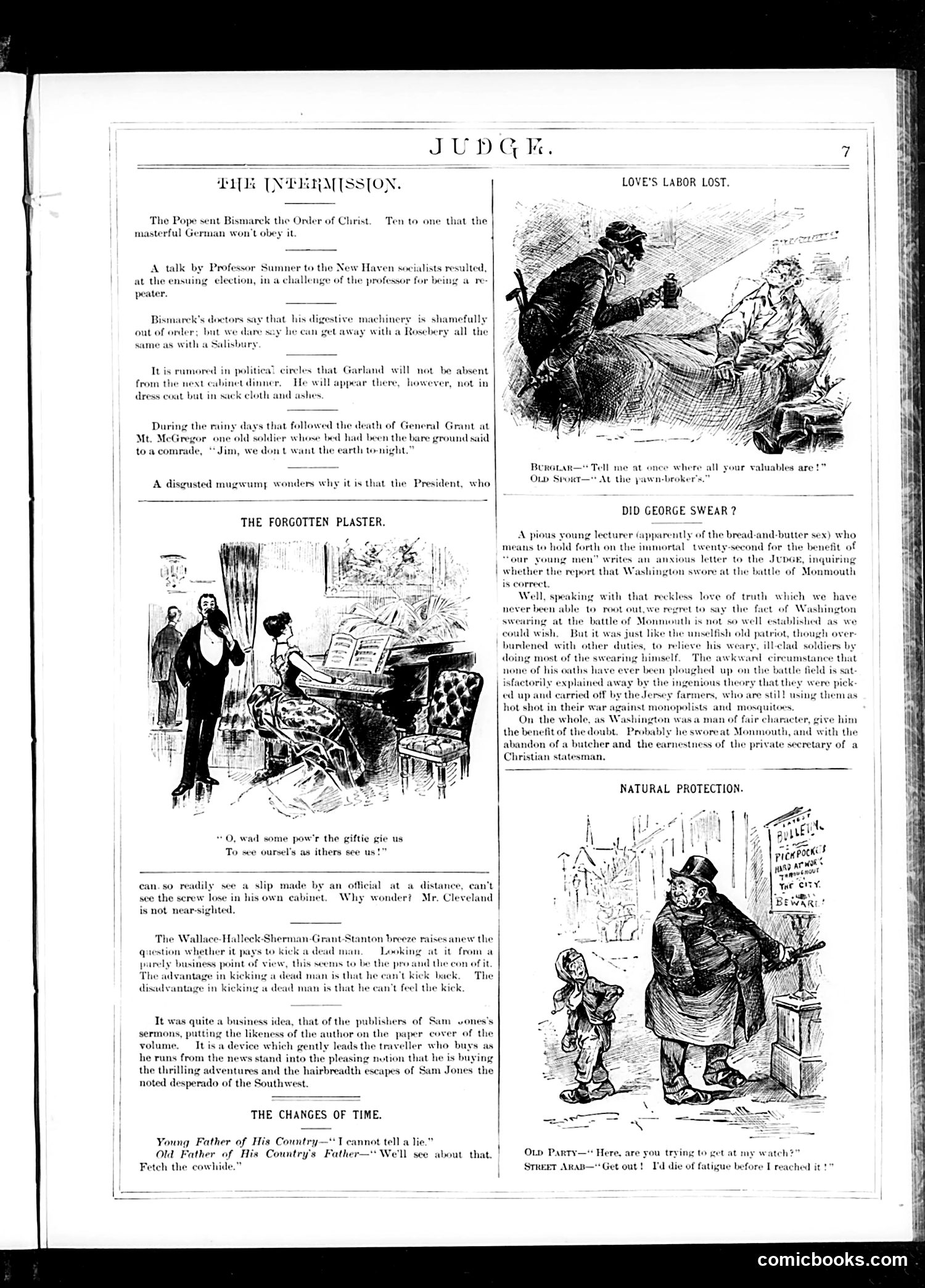
This page from *Judge* satirizes several 1880s political and social topics: **"The Intermission"** mocks prominent figures: the Pope's ineffectual authority over Bismarck; Professor Sumner's socialist views; and Garland's expected cabinet absence due to scandal. **"Love's Labor Lost"** depicts a burglar and fence discussing stolen goods—the "yawn-broker's" (pawnbroker's) slang humor. **"Did George Swear?"** questions whether George Washington swore at the Battle of Monmouth. The article sardonically suggests Washington probably did curse while managing incompetent soldiers and worn equipment, though historians haven't definitively proven it—a humorous deflation of patriotic mythology. **"Natural Protection"** shows a street urchin so malnourished and filthy that even a pickpocket cannot steal from him—dark social commentary on urban poverty's "protective" effect. The page blends political commentary with working-class humor typical of *Judge*'s satirical approach.
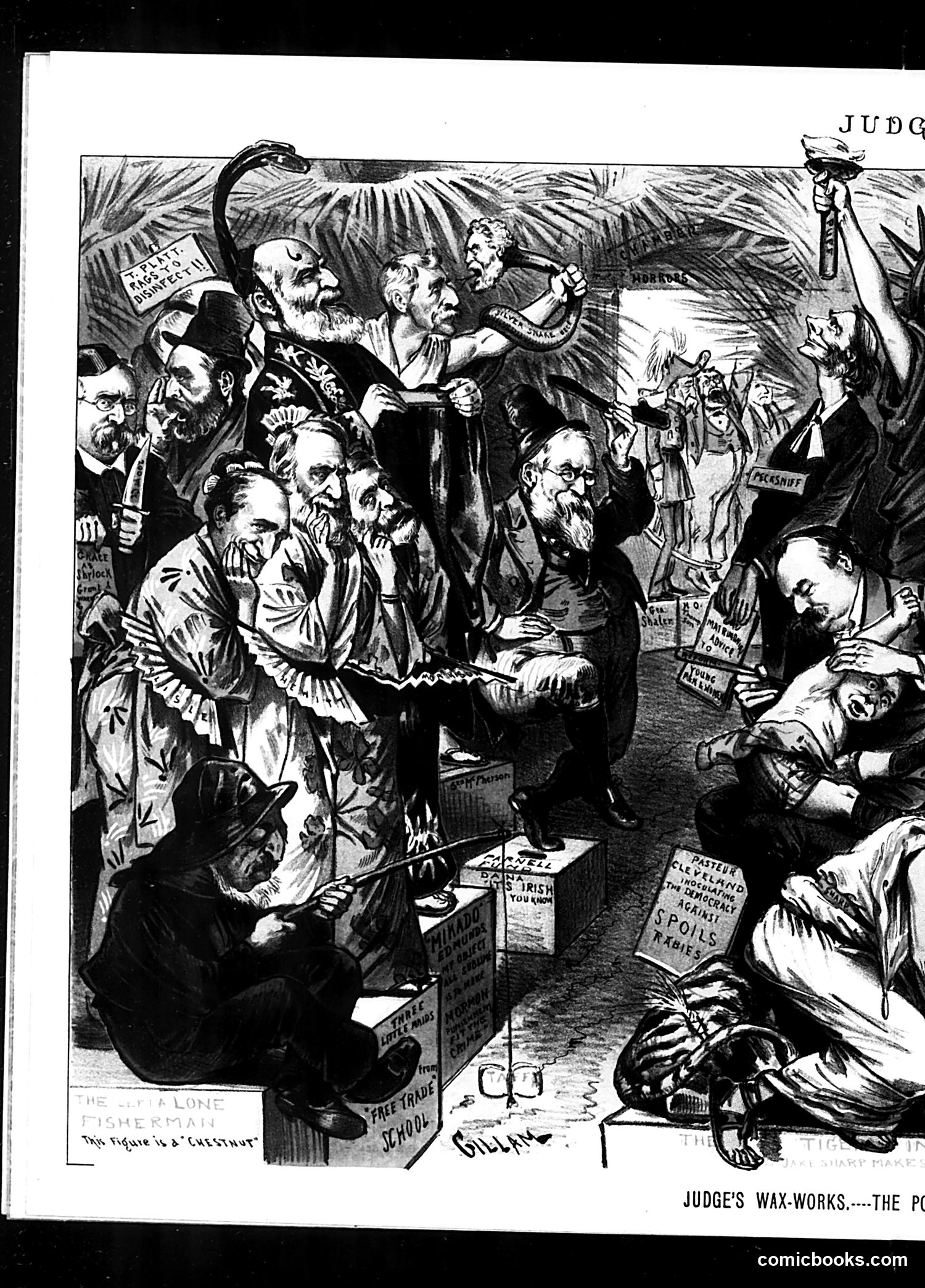
This is a satirical cartoon depicting political figures as wax museum displays. The title "Judge's Wax-Works" suggests these are caricatured likenesses of prominent politicians or public figures, presented as artificial recreations—implying they lack authenticity or genuineness. The composition shows multiple bearded men in formal dress, some appearing distressed or exaggerated in expression. Various labels visible on boxes reference trade and tariff issues, suggesting this cartoon addresses economic policy debates of its era. The snake imagery at top and the theatrical staging underscore the satirical intent—presenting politicians as manufactured spectacles rather than serious statesmen. Without clearer labels or date information visible, the specific individuals and exact political controversy remain uncertain, though the cartoon clearly mocks political leadership through caricature and theatrical presentation.
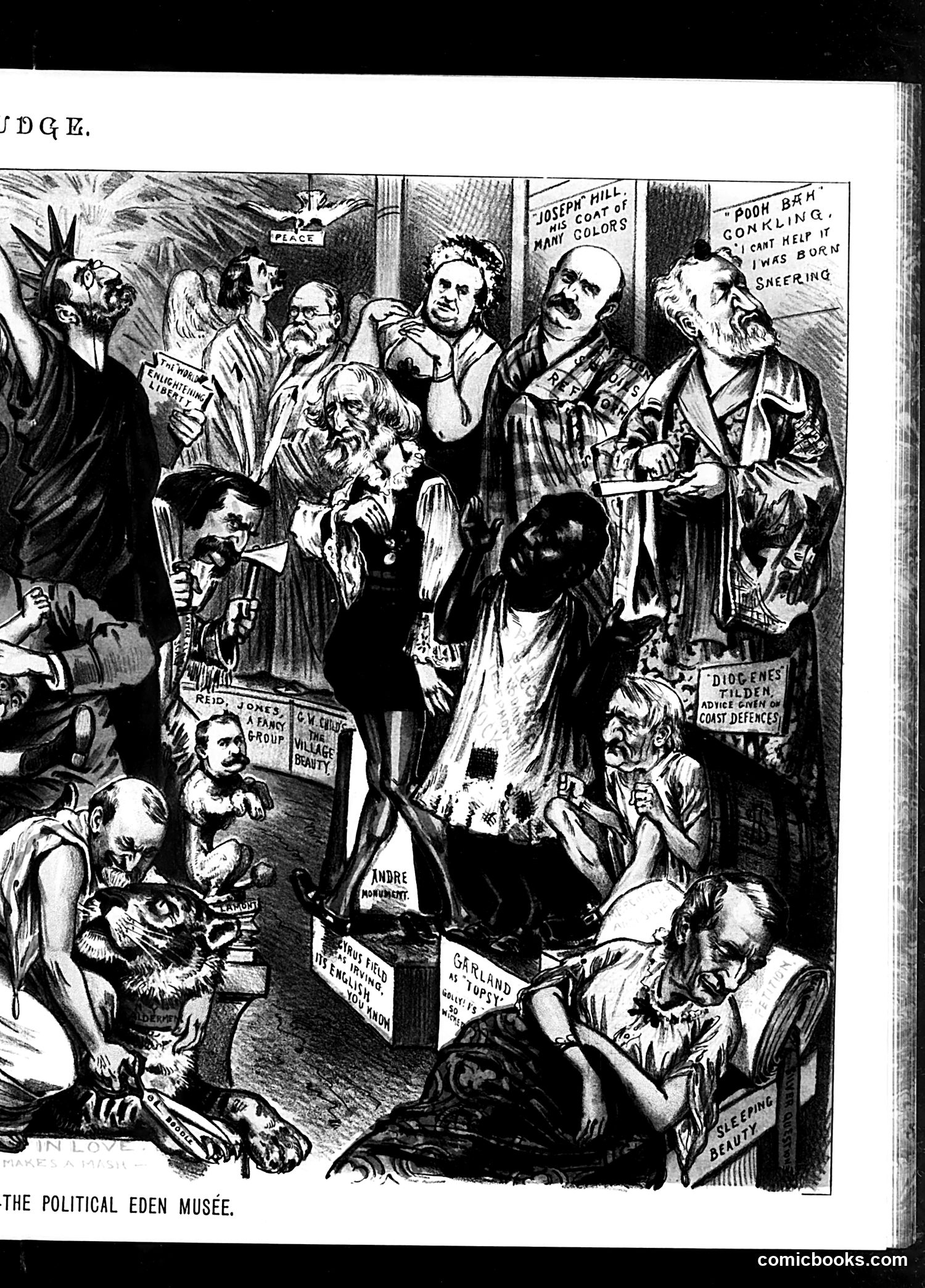
This cartoon satirizes prominent political figures of its era as specimens in a museum of curiosities. The title puns on the "Eden Musee," a popular wax museum attraction. Various labeled figures stand displayed like exhibits, with speech bubbles containing their characteristic statements or scandals. The visible labels reference politicians and their notorious associations—one mentions "Joseph Hill" and "many colors," another references "Poor Bath" and sheering, while others allude to political corruption or behavioral controversies of the day. The cartoon mocks these public figures by treating them as oddities worthy of museum display, suggesting they're freakish specimens rather than serious statesmen. Without clearer date information or all labels, specific identifications remain uncertain, but the satire's intent is clear: ridicule political figures through caricature and institutional framing.
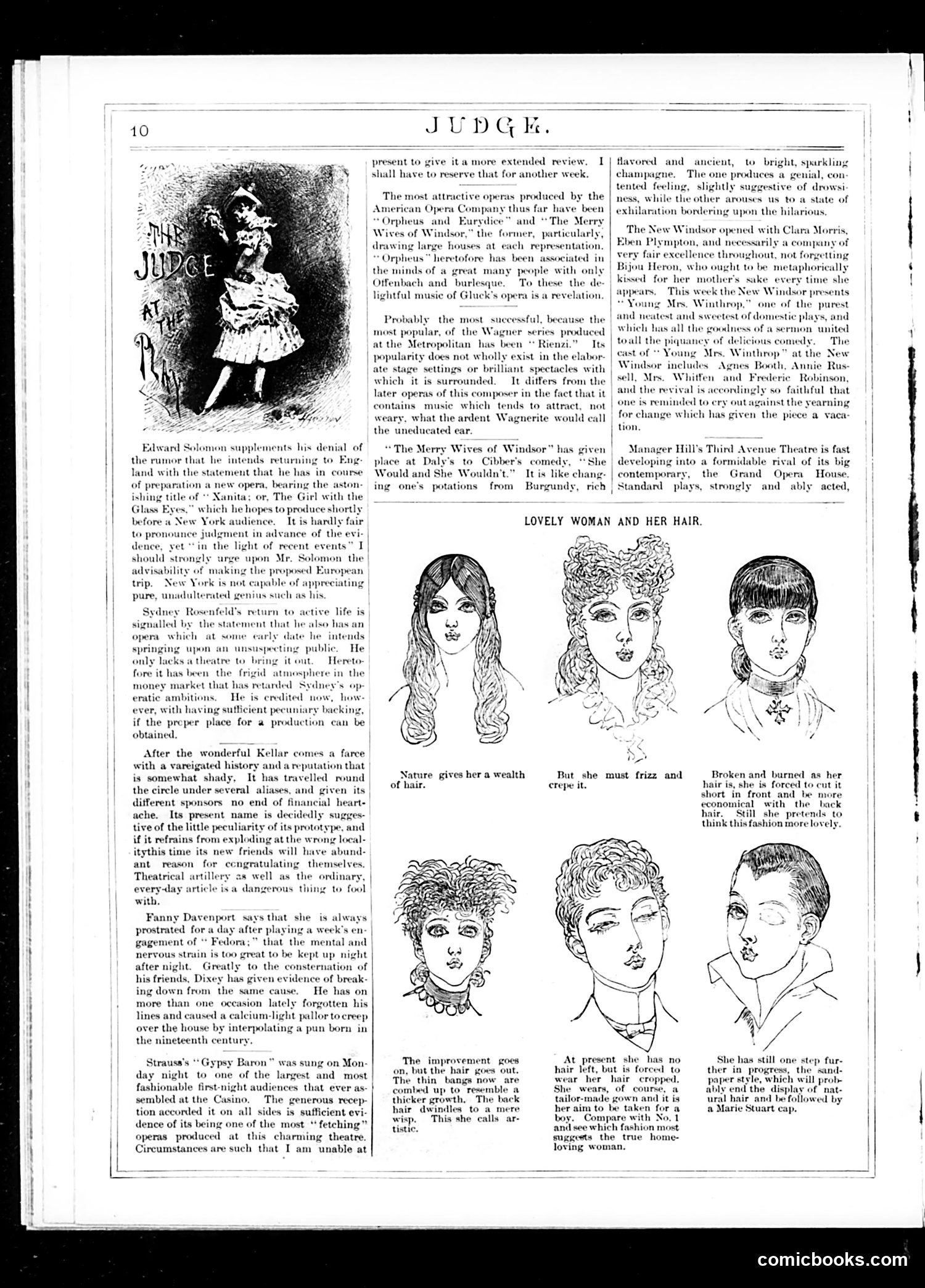
This page from **Judge** magazine features theater criticism and reviews mixed with a humorous section on women's hairstyles. **Main Content:** The left column discusses contemporary opera and theater productions, including works by Wagner ("Rienzi" at the Metropolitan Opera), Gluck's "Orpheus and Eurydice," and various Broadway comedies. The critic evaluates which productions are most successful with audiences. **The Cartoon/Illustration:** The right side shows six sketched female faces under the heading "LOVELY WOMAN AND HER HAIR." These appear to be satirical commentary on women's hair fashions of the era, with captions describing different styles and their results—frizzing, baldness from excessive styling, and the contradictions women face trying to maintain fashionable hair. The satire mocks the impractical and damaging beauty standards women were expected to follow. **Historical Context:** This reflects late 19th-century anxieties about women's beauty standards and the physical toll of fashionable hairstyling practices.
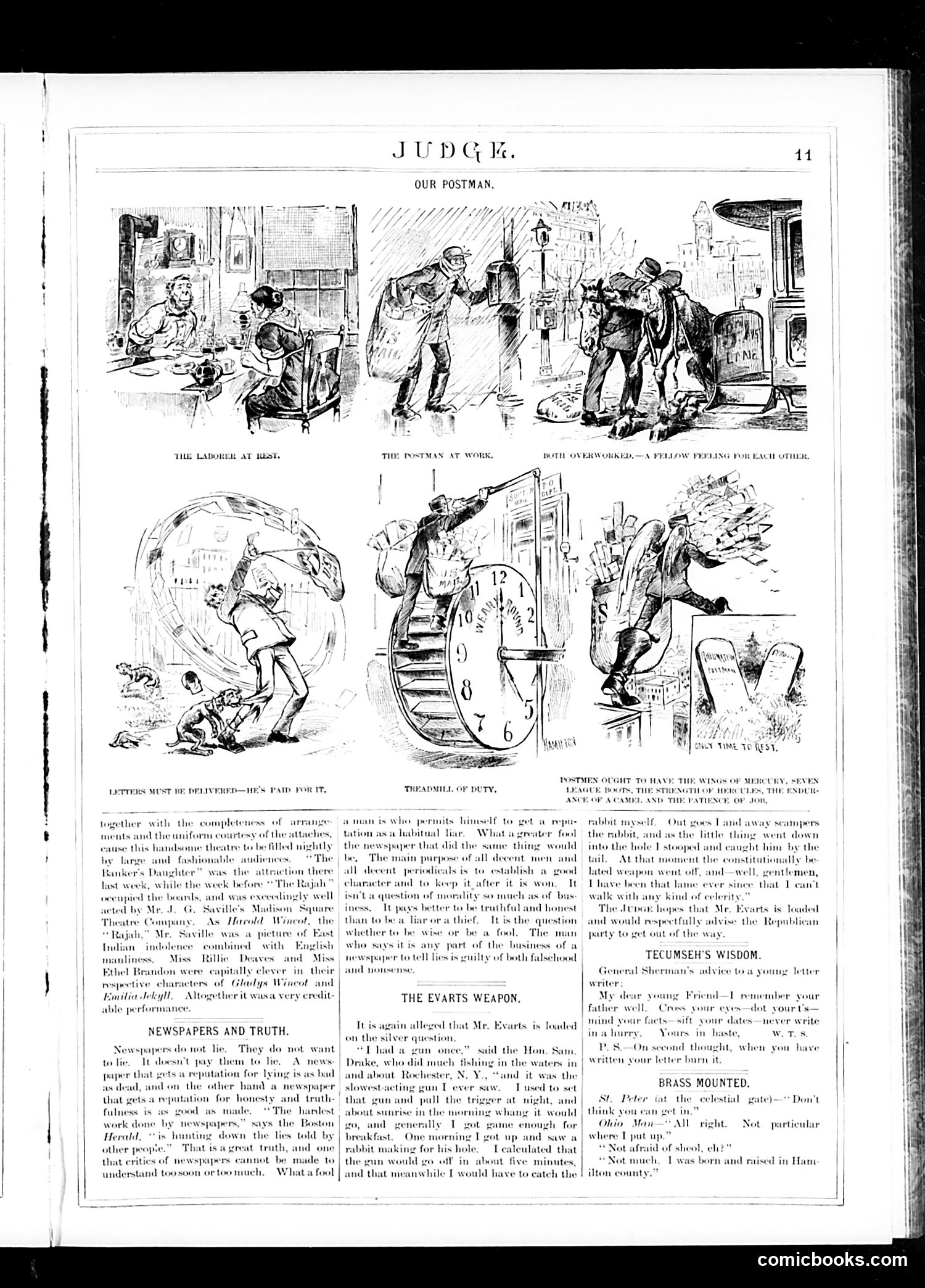
This page satirizes the grueling life of postal carriers through six cartoon vignettes showing a postman enduring absurd trials—spinning in circles, climbing a massive clock, juggling mail amid chaos, and navigating other impossible scenarios. The accompanying text argues that newspapers should tell the truth because dishonesty damages their reputation. It uses the postman as a metaphor: just as this carrier must possess "the treadmill of duty, league boots, the strength of Hercules, the endurance of a camel and the patience of Job," newspapers must maintain integrity through honest reporting. The satire critiques both the postal system's demands on workers AND the broader principle that institutions (like newspapers) depend on trustworthiness. The exaggerated illustrations of the postman's suffering humorously underscore how impossible the job seems—yet it must be done faithfully, much like journalism's obligation to truth. The page also includes unrelated brief comedic pieces ("Tecumseh's Wisdom," "The Evarts Weapon," "Brass Mounted") typical of Judge's miscellaneous humor format.
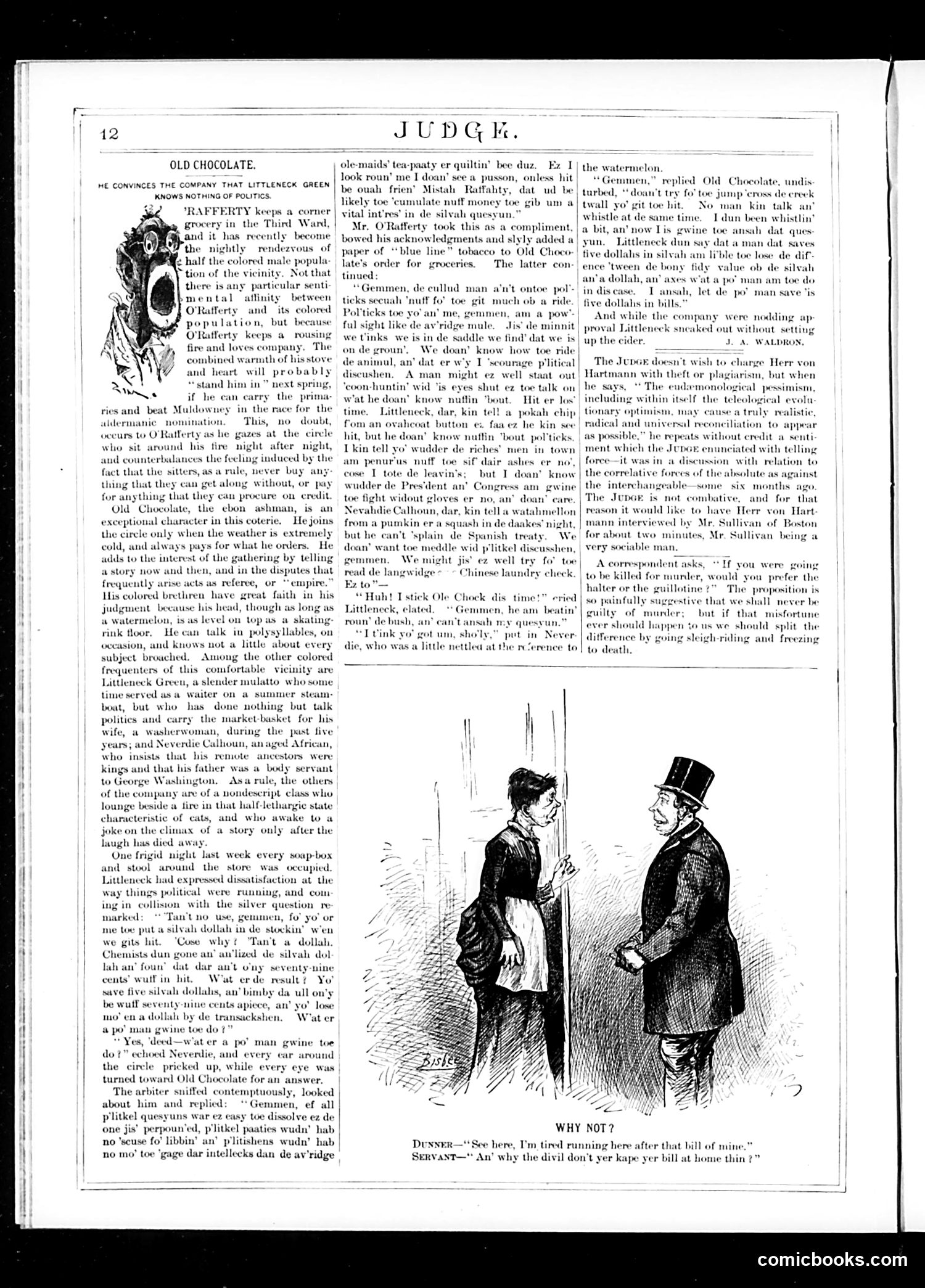
This *Judge* page satirizes late-19th-century American politics through a dialogue among Black patrons at an Irish grocer's fire. The setup: **Littleneck Green**, a talkative loafer, complains about the silver question (currency debate dividing the era), claiming silver dollars contain only 79 cents' worth of silver—so saving them is pointless. **Old Chocolate**, the respected ashman referee, dismisses this as easily-solved nonsense compared to real political problems. He sarcastically suggests politicians wouldn't need to engage intellects if all questions dissolved as simply as tea-party gossip. The grocer **O'Rafferty** rewards this wisdom by adding free tobacco, recognizing Old Chocolate as sensible—unlike the politically-obsessed but economically-clueless Littleneck. The satire targets: working-class men debating incomprehensible currency policy while achieving nothing; politicians exploiting such confusion; and the assumption that political talk substitutes for actual understanding or economic progress. The humor relies partly on dialect caricature typical of the era's racial stereotyping.
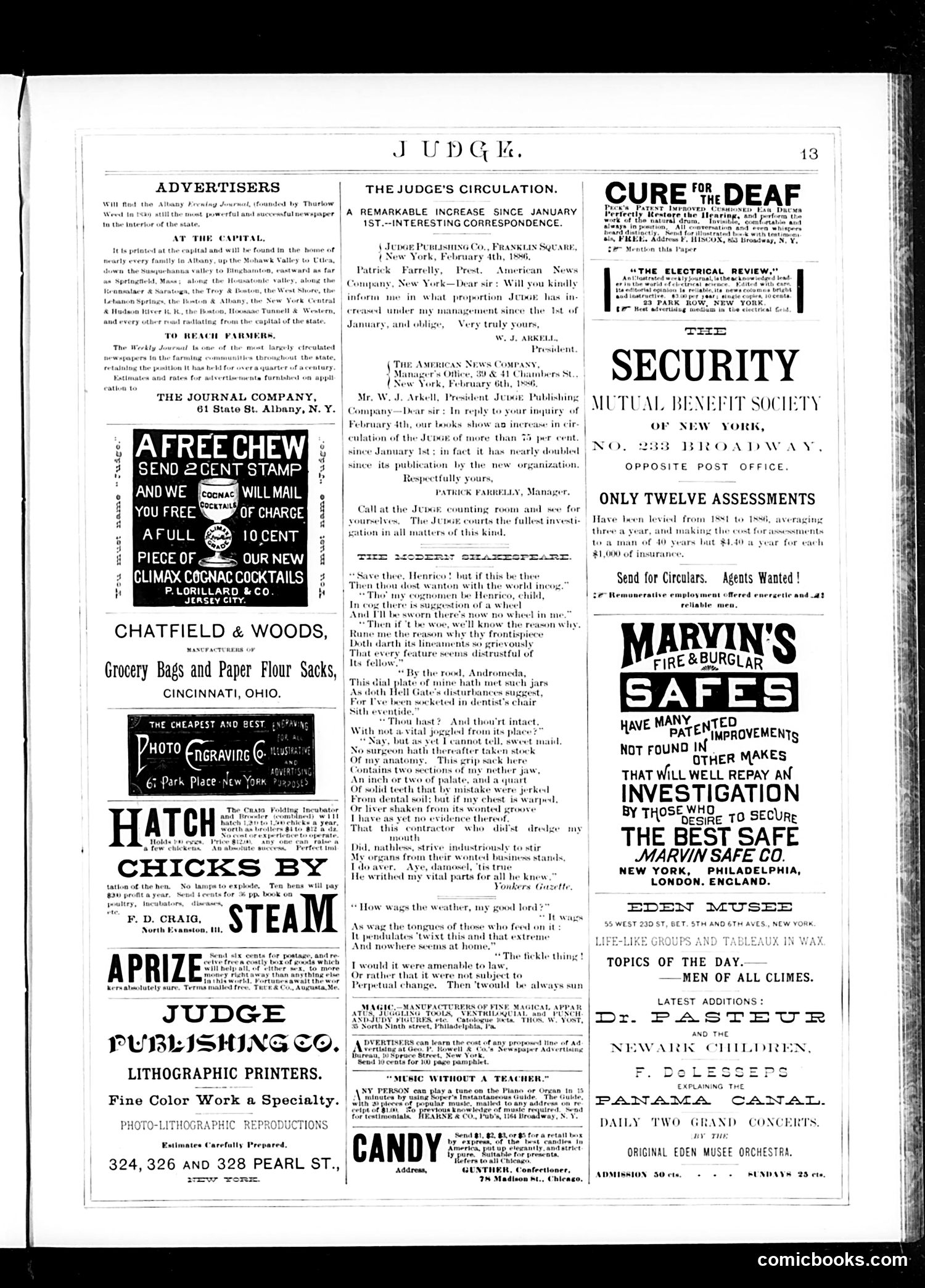
This is primarily an **advertising and business correspondence page** from Judge magazine (February 1886), not a satirical cartoon page. The content includes: **Main Editorial Feature**: A letter from Patrick Farrelly (President, American News Company) to W.J. Arkell (President, Judge Publishing Company) discussing the magazine's circulation growth since January 1st—up more than 75 percent. This appears to be genuine business correspondence used to promote the magazine's success. **Advertisements**: The page is dominated by period product ads—chewing gum, flour sacks, engraving services, safes, cognac cocktails, insurance, and cultural attractions (Eden Musee concerts, Panama Canal exhibitions). **No identifiable political cartoons or satire** are visible on this particular page. The "Judge" branding and layout suggest this is from the magazine's interior/back section, likely used for business promotion rather than the satirical content the magazine was known for. The page essentially functions as a business testimonial wrapped in commercial advertising.
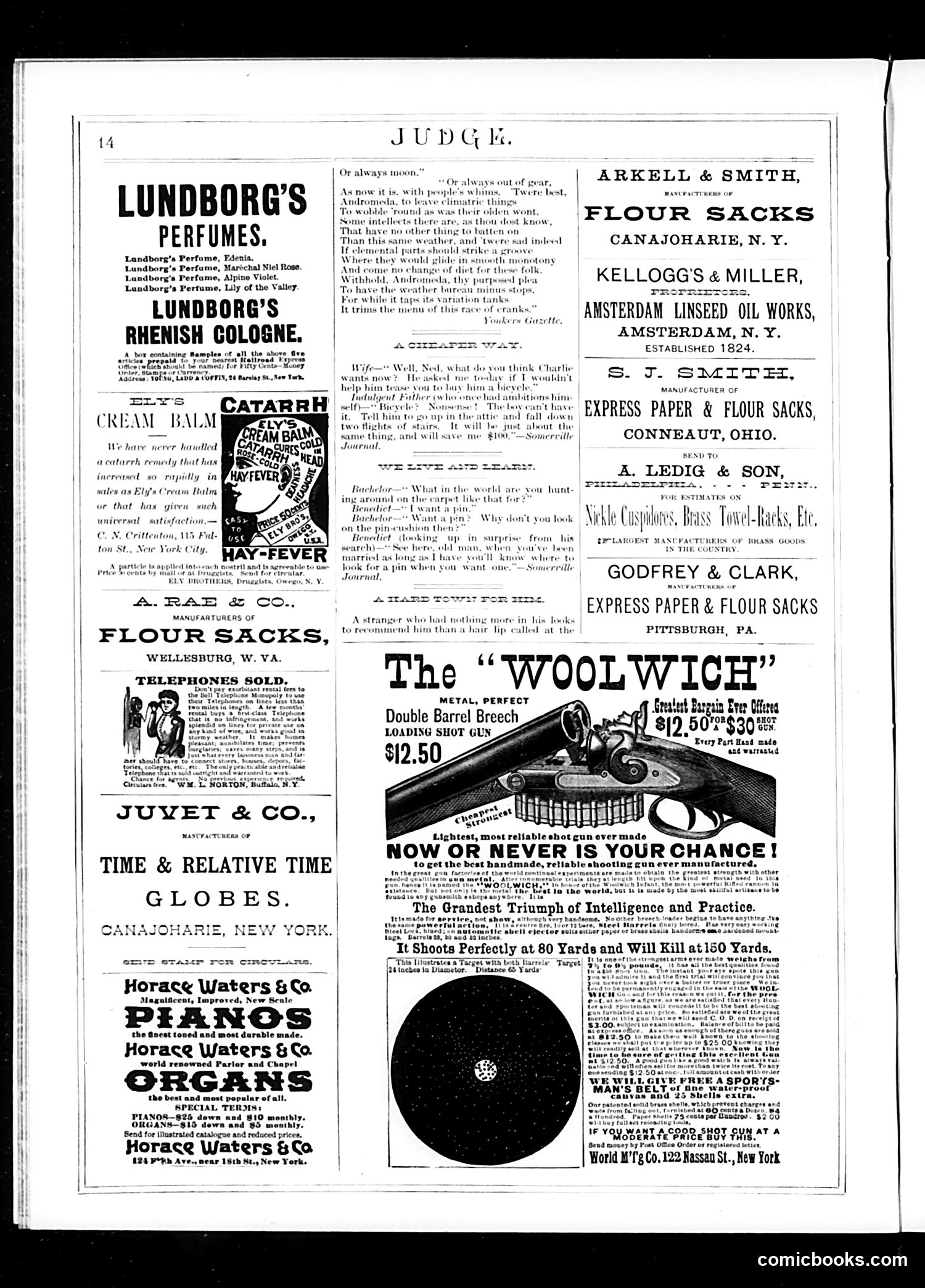
This page is primarily **advertising** with minimal editorial cartoon content. The dominant feature is a large advertisement for the "Woolwich" double-barrel breech-loading shotgun ($12.50), marketed as "the greatest bargain ever offered" with emphasis on "NOW OR NEVER IS YOUR CHANCE." The page includes scattered brief humorous anecdotes rather than political satire: - A dialogue about a bachelor searching the carpet for a pin (rather than looking where pins are typically kept) - A brief joke about someone with a "hair lip" These appear to be filler humor typical of *Judge*'s format—light social comedy rather than political commentary. The remaining space comprises advertisements for various industrial and consumer products: flour sacks, perfumes, pianos, organs, and linseed oil works—characteristic of late 19th-century trade publications. **No identifiable political figures, caricatures, or satirical commentary is evident on this page.**
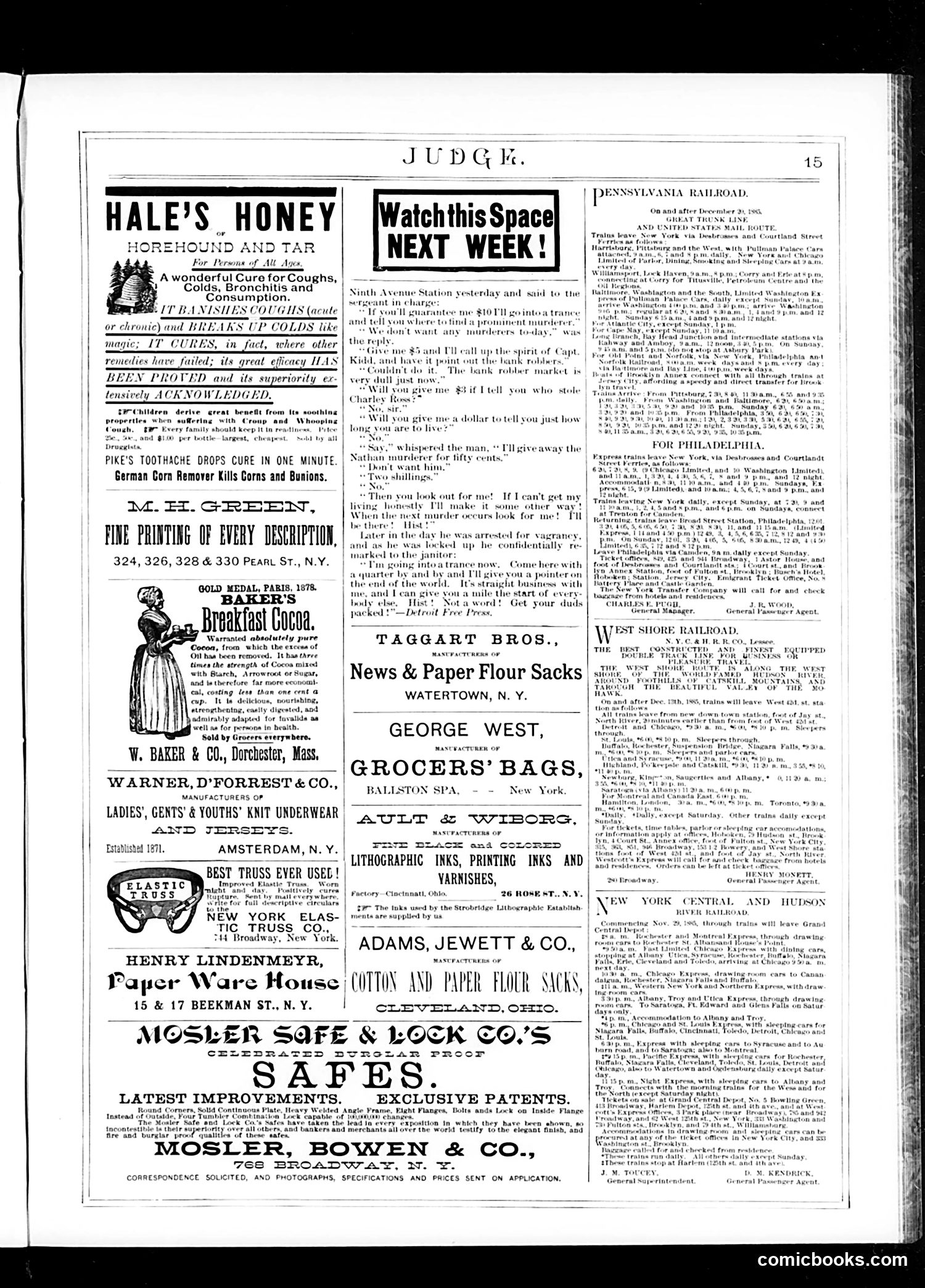
This is primarily an **advertising page** from Judge magazine, with minimal editorial content. The page consists almost entirely of commercial advertisements for late 19th-century products and services: patent medicines (Hale's Honey, Pike's Toothache Drops), industrial goods (safes, printing inks, flour sacks), clothing, and railroad schedules. The only apparent editorial cartoon or satirical content is a small dialogue labeled "Watch this Space! Next Week!" at the top, which appears to be a teaser for upcoming content rather than a complete cartoon on this page. **What's historically notable for modern readers:** This demonstrates how Judge magazine funded itself through advertising while maintaining its satirical editorial mission. The products advertised—especially the patent medicines making health claims—reflect the largely unregulated pharmaceutical market of the era before FDA oversight. The railroad advertisements show the dominance of rail travel in American commerce and daily life during this period.
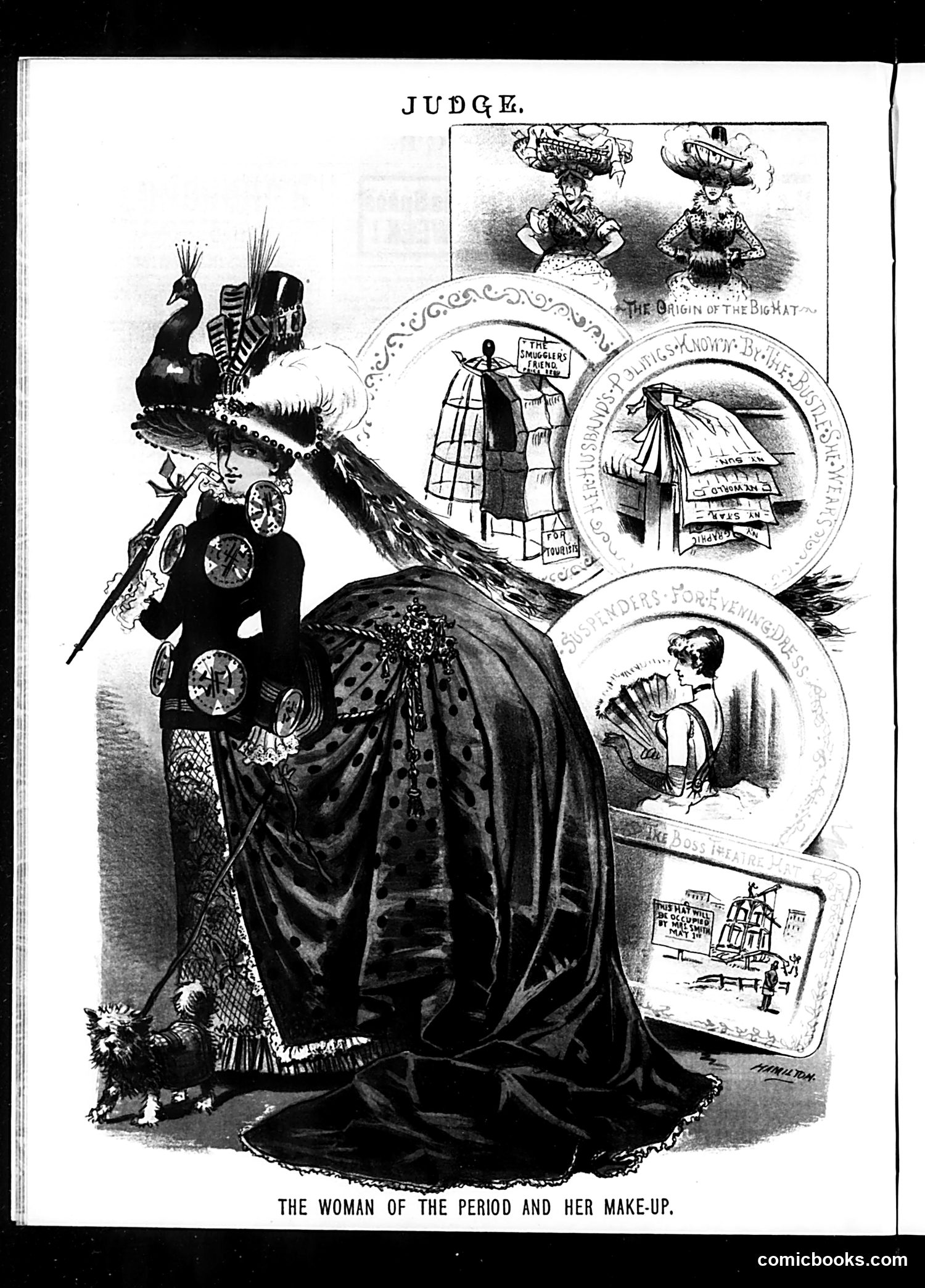
This Judge cartoon satirizes fashionable women of the era through exaggerated visual contrasts. The central figure shows an elaborately dressed woman with an enormous peacock-topped hat and ornate clothing, accompanied by smaller circular diagrams and sketches detailing her "make-up"—literally the constructed nature of her appearance. The surrounding vignettes appear to deconstruct feminine fashion and artifice, showing elements like "The Origin of the Big Hat" and various undergarments or structural supports. A small dog at the bottom adds comedic scale. The satire targets the period's extreme fashion excess and the labor involved in achieving fashionable appearance—suggesting that women of society were artificial constructions rather than natural beings. The cartoon critiques both the absurdity of contemporary women's fashion and the effort required to maintain such elaborate presentation.