
Judge, 1886-02-20 · page 10 of 16
Judge — February 20, 1886 — page 10: what you’re looking at
What you’re looking at
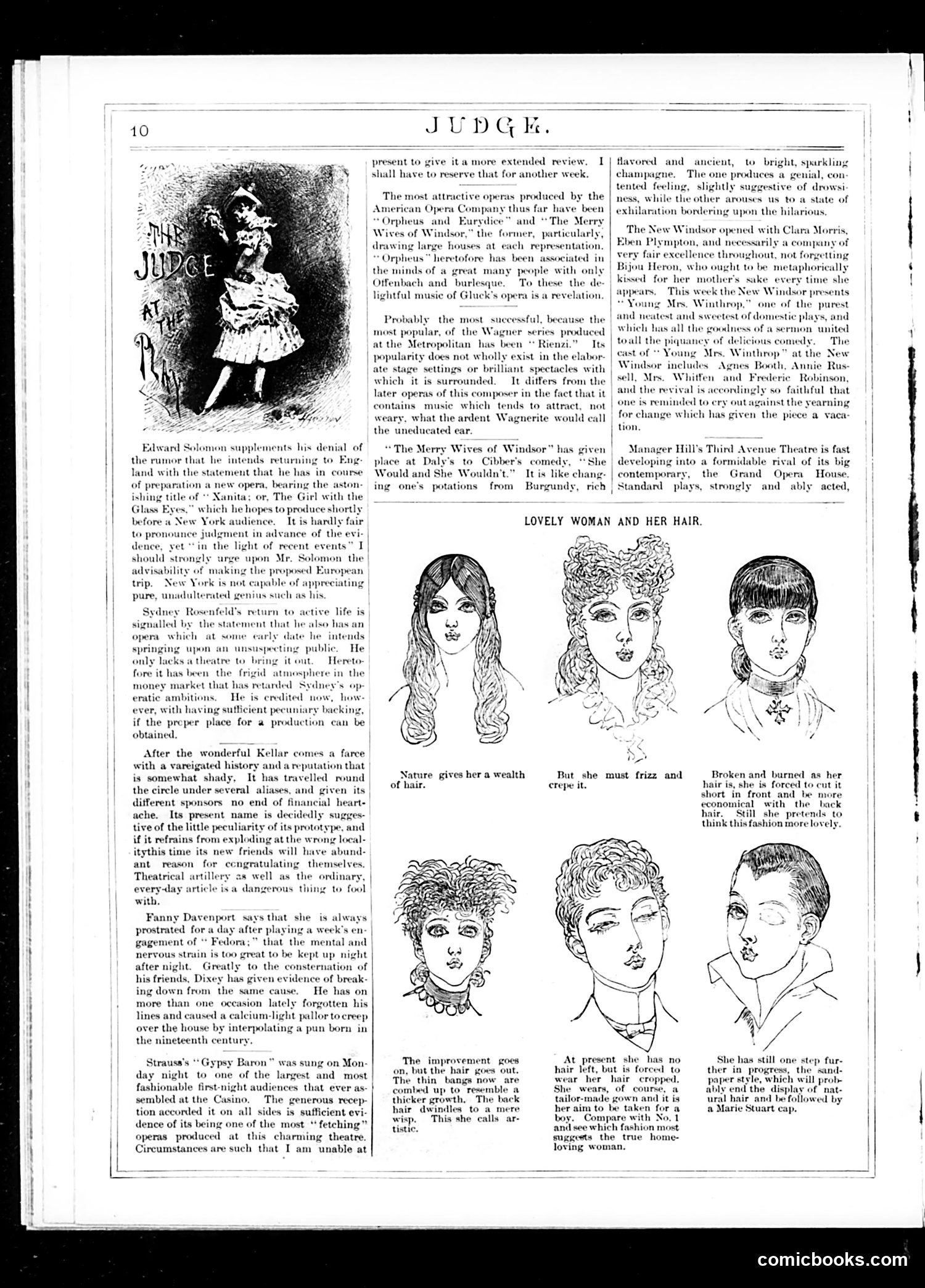
This page from **Judge** magazine features theater criticism and reviews mixed with a humorous section on women's hairstyles. **Main Content:** The left column discusses contemporary opera and theater productions, including works by Wagner ("Rienzi" at the Metropolitan Opera), Gluck's "Orpheus and Eurydice," and various Broadway comedies. The critic evaluates which productions are most successful with audiences. **The Cartoon/Illustration:** The right side shows six sketched female faces under the heading "LOVELY WOMAN AND HER HAIR." These appear to be satirical commentary on women's hair fashions of the era, with captions describing different styles and their results—frizzing, baldness from excessive styling, and the contradictions women face trying to maintain fashionable hair. The satire mocks the impractical and damaging beauty standards women were expected to follow. **Historical Context:** This reflects late 19th-century anxieties about women's beauty standards and the physical toll of fashionable hairstyling practices.
📄 Transcribed text from this page (OCR, searchable)
Machine-transcribed from the original scan — historical spelling and the odd misread are preserved.
Edward Solomon supplements his denial of the rumor that he intends returning to Eng land with the statement that he has in course of preparation a new opera bearing the aston. anita; or, The Girl with the “Which he hopes to produce shortly York audience, It is hardly fair of the evi- dence, yet should str proposed if f appreciating as stich as his th uropean trip. pure, uni Iney Rosenfeld’s return to active life is Hed by the statement that he ch at upon > has an he intends ing public. He itout. Hereto tmosphere in the mnie early ¢ springing only lacks a theatre to br fore it has been the frigid money market that has retarded Sydney's op: mbitions Hh unsuspe He is credited now, how. ever, with having sufficient pec if the proper place for a produ obtained. eratic After the wonderful Kellar comes a farce with a vareigated history and a reputation that is somewhat shady, It has travelled round the circle under several aliases. and given its different sponsors no end of financial heart- ache. Its present name is decidedly sug tive of the little peculiarity of its protot if it refrains from exploding at the wro1 itythis time its new friends will have a ant reason Theatrical art pgratulating themselves, well as th Fanny Davenport says that she is always prostrated for a day after playing a week's pment of ** that the mental and nervous strain is too great to be kept up night after night. G to the consternation of his friends, Dixey has given evidence of break- | ing down from the same cause. He has on more than one occasion lately forgotten his lines and caused a calcium-light pallor to creep over the house by interpolating a pun born in the nineteenth century, Strauss's “Gypsy Baron” was sung on Mon- day night to one of the largest and most fashionable first-night audiences that ever as- } sembled at the Casino. The generous recep- tion accorded it on all sides is sufficient evi- dence of its being one of the most “fetching” operas produced at this charming theatre. JUDGE. Circumstances are such that I am unable at shall have to reserve that for another week. The most attractive operas produced by the American Opera Company thus far have been “Orpheus and Euryd nd “The Merry Wives of Windsor,” the former, particularly, drawing houses at each repre * Orpheus the minds of a ¢ e with only Offenbach and burlesque. To these the ¢ lightful musie of Gluck’s opera is a revelatic tation, ted in heretofore has been ass Probably the most successful, because the most popular, of the Wagner series produced “Rienzi.” Its at the Metropolitan has been popularity does not whol ate stage settings or b which it is surrounded. later operas of this composer in the fact that it contains music which tends to attract, not weary, what the ardent Wagnerite would call the uneducated ear. “The Merry Wives of Windsor” has giv place at Daly’s to Cibber’s comedy, * Would and She Wouldn't.” ing one’s potations from It differs from the crepe it. The improvement goes on, but the hair goes out. But she must frizz and At present she has no hair left, but is forced to champagne, The one produces a genial, con tented feeling, slightly suggestive of drowsi ness, while the other arouses us to a state of exhilaration bordering upon the hilarious. The New Windsor opened with Clara Morris, Eben Plympton, and necessarily a cot x excellence throughout, not fors who ought to be 1 many of ting mother's sake every pears, This week the New Windsor presents “Young Mrs. Winthrop,” one of the purest and neatest and sweetest of domestic plays, a all th rood ness ¢ v of de ng Mrs. Winthrop Windsor includes Agnes Booth, Ann Whitfen C and the revival is a Rus- Robinson, » faithful that st th ning sell, Mrs. one is reminded to for change which has given th tion st formidable rival of its big ntemporary, the Grand House. andani plays, strongly and ably acted, Opera Broken and burned as her hair is, she is forced to cut it short in front and be more ith the t » pretends to n more lovely. She has still one step fur- ther in pr the sand The thin bangs now wear her hair cropped, paper style, which will prob- combed up to resemble a She wears, of course, a ably end the display of nat- thicker growth, The ba or-made gown and it is w ir and be followed hair dwindles’ to a mere her aim to be a Marie Stuart cap, w This she calls boy. Comp: tistic. and see which suggests the true home- loving woman. comicbooks.com