
Judge, 1886-02-20 · page 3 of 16
Judge — February 20, 1886 — page 3: what you’re looking at
What you’re looking at
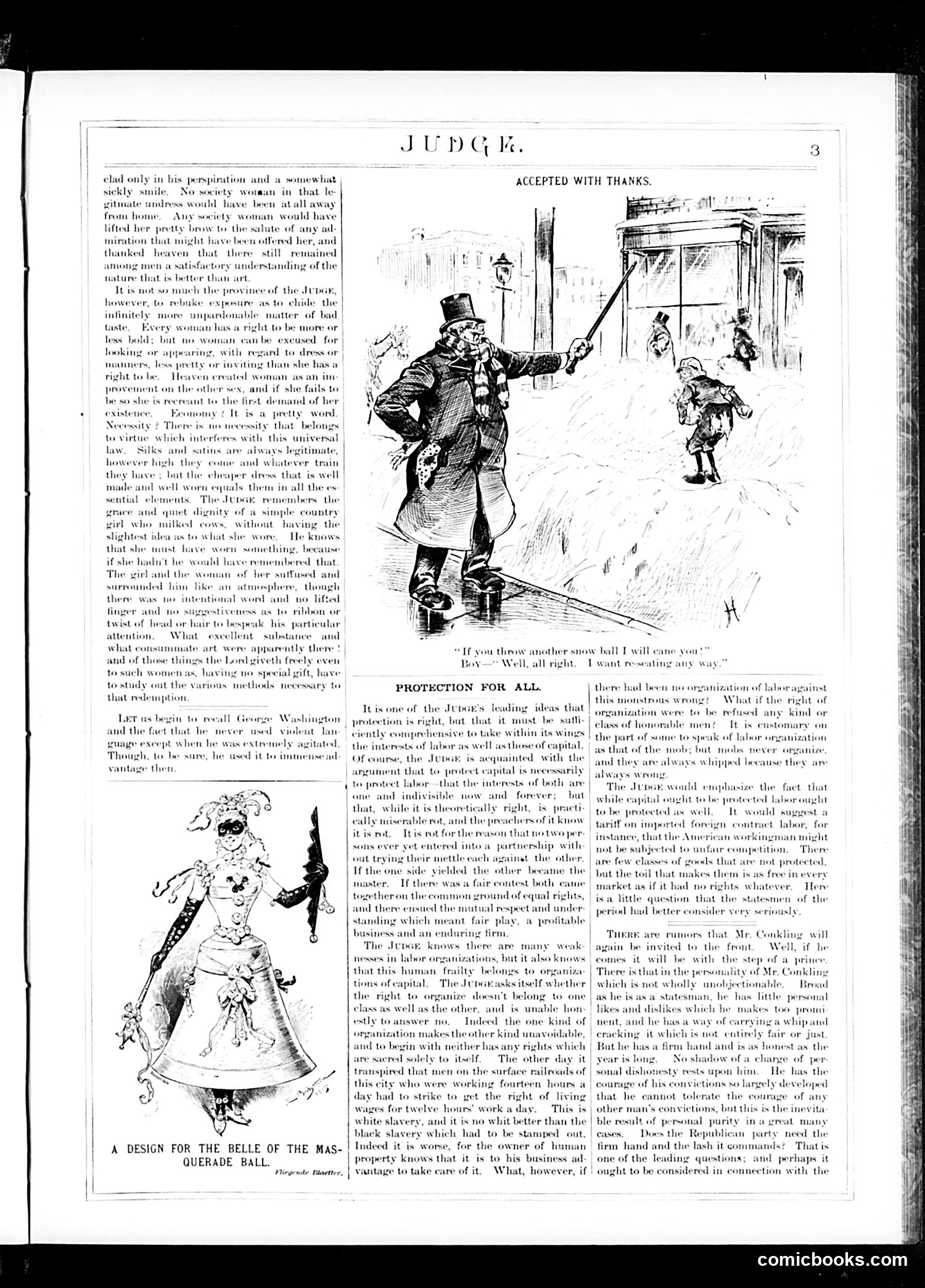
## Main Cartoons: **Top cartoon ("Accepted with Thanks"):** A well-dressed man with a cane appears to threaten children with snow, saying "If you throw another snow ball I will cane you!" The satire likely mocks upper-class authority figures abusing power over children, or critiques harsh adult responses to innocent play. **Bottom cartoon ("A Design for the Belle of the Masquerade Ball"):** Shows an elaborately dressed woman in a ball gown. The accompanying text criticizes women's revealing fashion at society events—satirizing both the immodesty of the dress and society's hypocritical standards for women's appearance and behavior. ## Main Article: "Protection for All" This editorial argues that *Judge* magazine supports protective tariffs, but only if they protect *both* labor and capital equally. It critiques: - Weak labor organizations - Unfair working conditions (14-hour workdays) - The contradiction that capital gets protection while workers face unfair competition - Hypocrisy: owners protect property but workers' labor remains unprotected The piece references Mr. Conkling (likely Roscoe Conkling, prominent Republican politician), suggesting political debate over tariff policy.
📄 Transcribed text from this page (OCR, searchable)
Machine-transcribed from the original scan — historical spelling and the odd misread are preserved.
clad only in his perspiration and a somewhat smile. No society woran in that le ate undress would have been at all away Any society woman would have r pretty brow to the salute of an, Limight have been offered her, aven that there still among men a sitisfactory understandir nature that is better than art Ibis not so much th however, to rebuke exposure i infinitely more unpardonable matt > right to be mone be excused than she has en created Wonuin as an ine nton the other sex, and if she fails to: nt to the first demand of her ny f It ix a pretty word hv necessity that” bel to virtue whieh interferes with this universal but the cheaper dress th and well worn equals th elements. The Jubak re ad quiet dignity of a simp! Ws, without ws to whut she wore have worn somethin would have remembe girland the woman of her suffused and surrounded him like an atmosphere, though nd no lifted t Yr Hess as to ribbon or twist of head or I there was ne int peak his particular attention, What nt substance and what consummate and of those things th to such women > apparently there ! sth freely even to study out the v that redemption vus methods 1 Let us begin to recall George Wi ton nd the fact that he never age except when he was extry Though, to be sure, he used it to immense ad vantasy A DESIGN FOR THE BELLE OF THE MAS- QUERADE BALL. Piegenite Riaetter. JUDQGK. ACCEPTED WITH THANKS. “Tf you throw another snow ball [will eane you!” Well, all right PROTECTION FOR ALL. It isone of the Jupce’s leading ideas that protection is right, but that it must be sufli ciently comprehensive to take within its wins the interests of labor as well as those of capit Of course, the JUDGE is acquainted with the argument that to protect capital is necessarily to protect labor that the interests of both an 1 indivisib and forever; but wetically right, is: practi of it know It is rot for the reason that no two per cally miserable rot, and t it is rot | sons ever yet entered into } out try If the one side y master, If there was together on the common ground of equal and there ensued the mutual respect and ur standing which meant fair play, a profit busi sand an endur firm The JepGe knows there are many weak nesses in labor zations, but it also knows that this hur “tilts to organiza: itself whether the right to organize doesn’t belong to one class as well as the other, and is unable hon Indeed the one kind of makes the other kind unavoidab! und to begin with neither has any rights whieh are sicred solely to itself. The other day it transpired that men on the suri this city who were working fourteen hours a v had to ste to get tl ve hours’ work a day. and it is no whit better than the ‘y which had to be stamped out | Indeed it is worse pwner of human | property knows that it is to his business ad vantage to take care of it. What, however, if tions of eapital nswer no, roads of it of living This is T want reseating any way.” there had been ne orsiniza this monstrous wr wi organization were te class of honorable men? 4 of seme to sp f the mob: Jepor would emp pital ought te be to be protec well tariff on impos that the American workin not be subjected to unfair ¢ instane are few classes of goods th but the toil that makes them is as free in every market as if it h ts whatever. Herv isa little question that the statesmen of the period had better consider very ser : are rumors that Mr. Conkl : s invited to the front 1 comes it will be with the step of a prince There is that in th y of Mr. Conkling which is not wholly unobjectionable. — Broad as he is asa statesman, he 1 likes and dislikes which he 1 nent, and he has a way of ¢ cracking. it whieh is But he has a firs year is long. little personal too promi c whip and t entirely fair or just sonal dishonesty tests upon him. He ivietions so largely developed that he cannot tolerate the of any other man’s convictions, but this is the ine ble result of personal purity: ina great m cases. Does the Republican party need the firm hand and the lash it commands? Thatis one of the | z questions; and perhaps it ought to be considered in connection with the eee comicbooks.com