
A complete issue · 16 pages · 1886
Judge — January 23, 1886
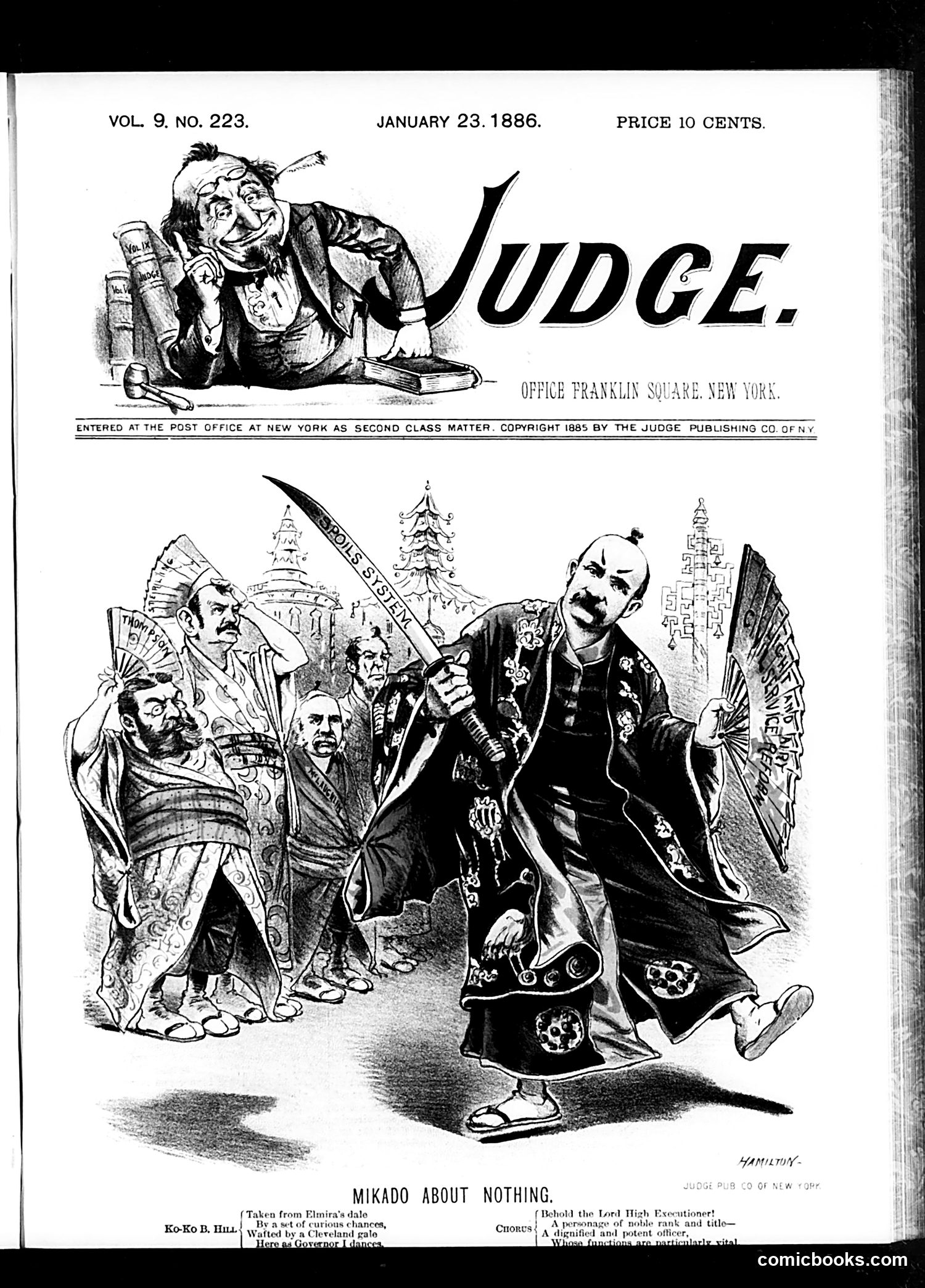
This cartoon satirizes American attitudes toward Japanese culture during the 1880s. The title references Shakespeare's "Much Ado About Nothing," suggesting Americans made excessive fuss over Japanese aesthetics. The main figure (right) appears to be a caricatured Japanese dignitary or official in traditional dress, surrounded by admirers holding Japanese fans and wearing Asian-inspired clothing. The caption identifies references to "Ko-Ko," "Chorus," and mentions a "Governor-General," likely alluding to Gilbert and Sullivan's operetta "The Mikado" (premiered 1885), which was hugely popular in America. The satire mocks the fashionable "Japonisme" craze among American elites—their uncritical enthusiasm for Japanese aesthetics treated as exotic spectacle rather than serious cultural engagement. The caricatured faces and exaggerated features reflect period racial stereotyping.
The main cartoon titled "JUDGE" depicts a disheveled, rotund figure—likely representing political corruption or mismanagement. The accompanying articles critique several political figures and issues of the era. "The Silver Radicals" discusses Farmer Cleveland's struggles with anti-silver advocates and railroad interests, suggesting political conflict over monetary policy. "The Presidential Yum-Yum" appears to mock a young politician (likely Ko Ko) whose success stems from chorus-girl connections rather than merit, satirizing how political advancement can depend on personal relationships and Democratic Party patronage rather than genuine accomplishment. "The First Lady" addresses Miss Cleveland's social position and marriage prospects, reflecting contemporary interest in the President's personal life as political commentary. The satire targets Gilded Age political corruption, monetary policy debates, and nepotism in government.
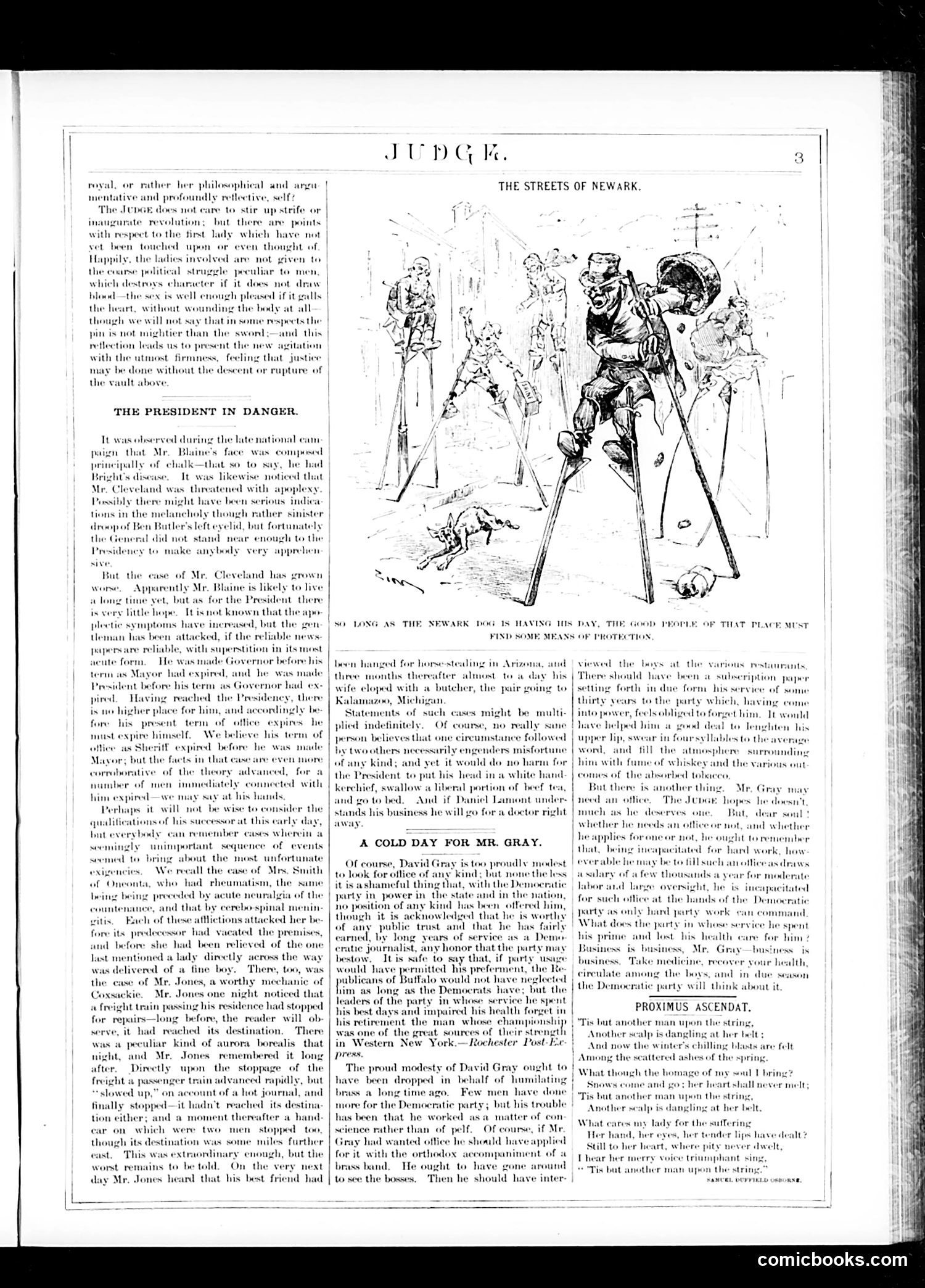
This page contains three satirical pieces mocking Democratic political figures of the Gilded Age era. **"The Streets of Newark"** (top illustration): Shows well-dressed men on stilts towering over ordinary citizens and dogs. This appears to satirize prominent Newark or New Jersey politicians as absurdly inflated and out of touch with common people. **"The President in Danger"**: Mockingly suggests President Cleveland's health is deteriorating (chalk-colored face, threatened apoplexy), comparing unfavorably to rival James Blaine. The satire implies Cleveland is unfit for office. **"A Cold Day for Mr. Gray"** and **"Froimus Ascendant"**: These sections discuss David Gray and Daniel Lamont, Democratic party figures. The text sarcastically portrays Gray as too proud to accept political positions while criticizing the party's patronage practices—suggesting hypocrisy in Democratic claims about merit-based governance versus actual cronyism. The overall thrust mocks Democratic leadership as either physically/mentally unfit, absurdly pretentious, or corrupt in their political dealings. This reflects typical 1880s partisan attack journalism.
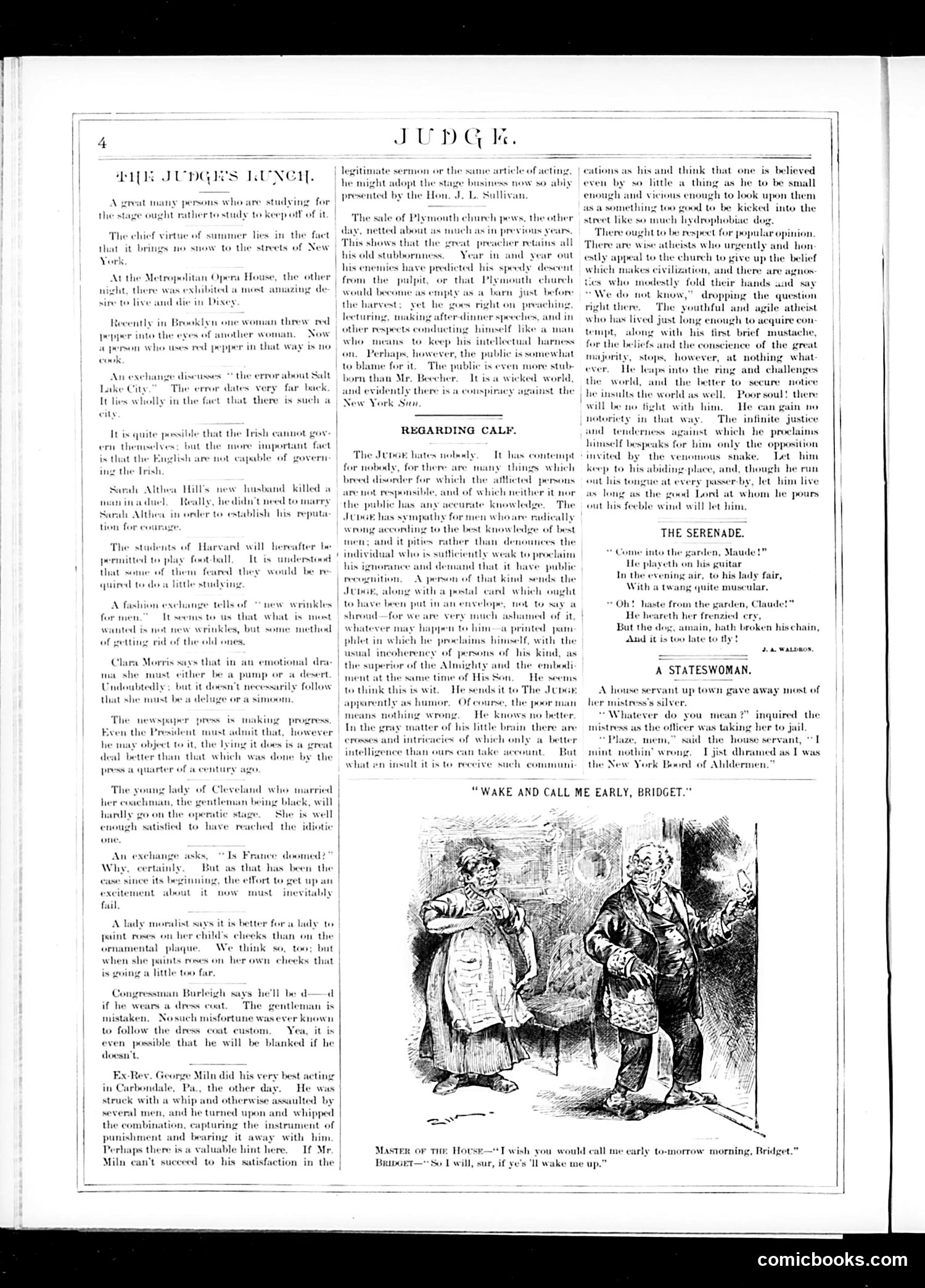
This page from *Judge* contains multiple brief satirical commentaries on contemporary American social issues, typical of the magazine's format. The main cartoon depicts "Wake and Call Me Early, Bridget," showing what appears to be a domestic servant (Bridget, a stereotypical Irish maid name) being asked by her employer to wake him early. The satire likely mocks class relationships and servant culture. The surrounding text contains sharp jabs at various targets: Irish governance capability, Harvard students' laziness, the newspaper press's dishonesty, and emotional actresses' melodrama. One item references Plymouth Church (likely Henry Ward Beecher's congregation) and its financial troubles, while another criticizes a young atheist's arrogance. The overall tone is characteristic of *Judge's* elite, dismissive humor targeting immigrants, working classes, and cultural pretension. Without specific dates visible, precise historical context remains unclear, but the sensibility reflects late-19th-century American satirical magazine conventions.
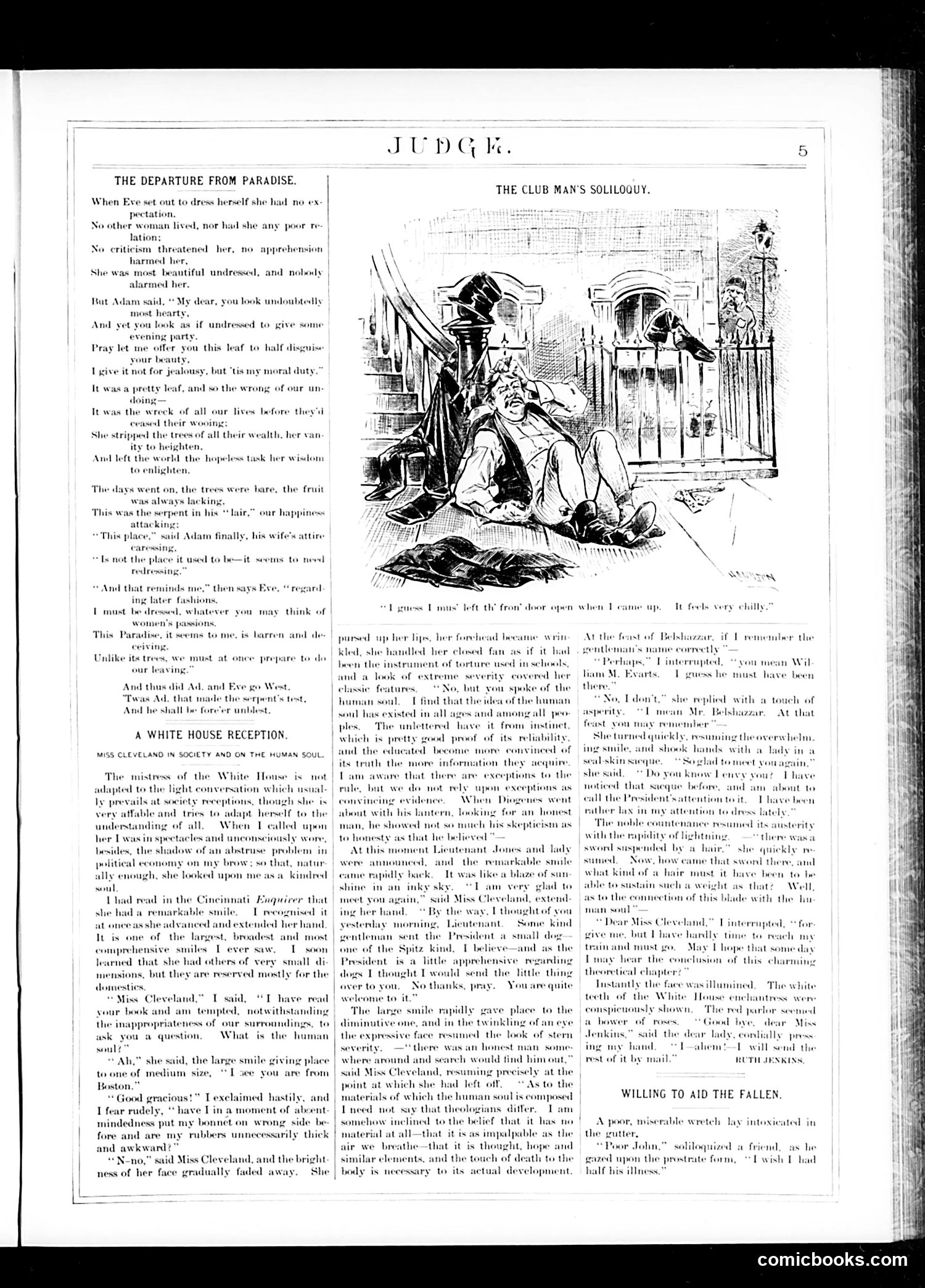
This page contains two satirical pieces mocking contemporary social conventions, particularly regarding women's fashion and behavior. "The Departure from Paradise" presents a mock-biblical narrative where Adam urges Eve to cover herself with a leaf for "moral duty" rather than jealousy. Eve's vanity leads her to strip trees bare for adornment, and the couple leaves Paradise destitute. The satire targets women's fashion excess and vanity, suggesting female consumerism destroys domestic happiness. "The Club Man's Soliloquy" depicts a man complaining that his wife's fashionable dress and social ambitions have ruined their home—"This place...seems to need redressing." He blames women's "later fashions" for their domestic troubles. Both pieces reflect Victorian anxieties about women's independence, consumption, and public social participation. The humor relies on blaming women's appearance and behavior for broader social problems, a common Judge magazine trope criticizing the "New Woman" of the 1880s-90s.
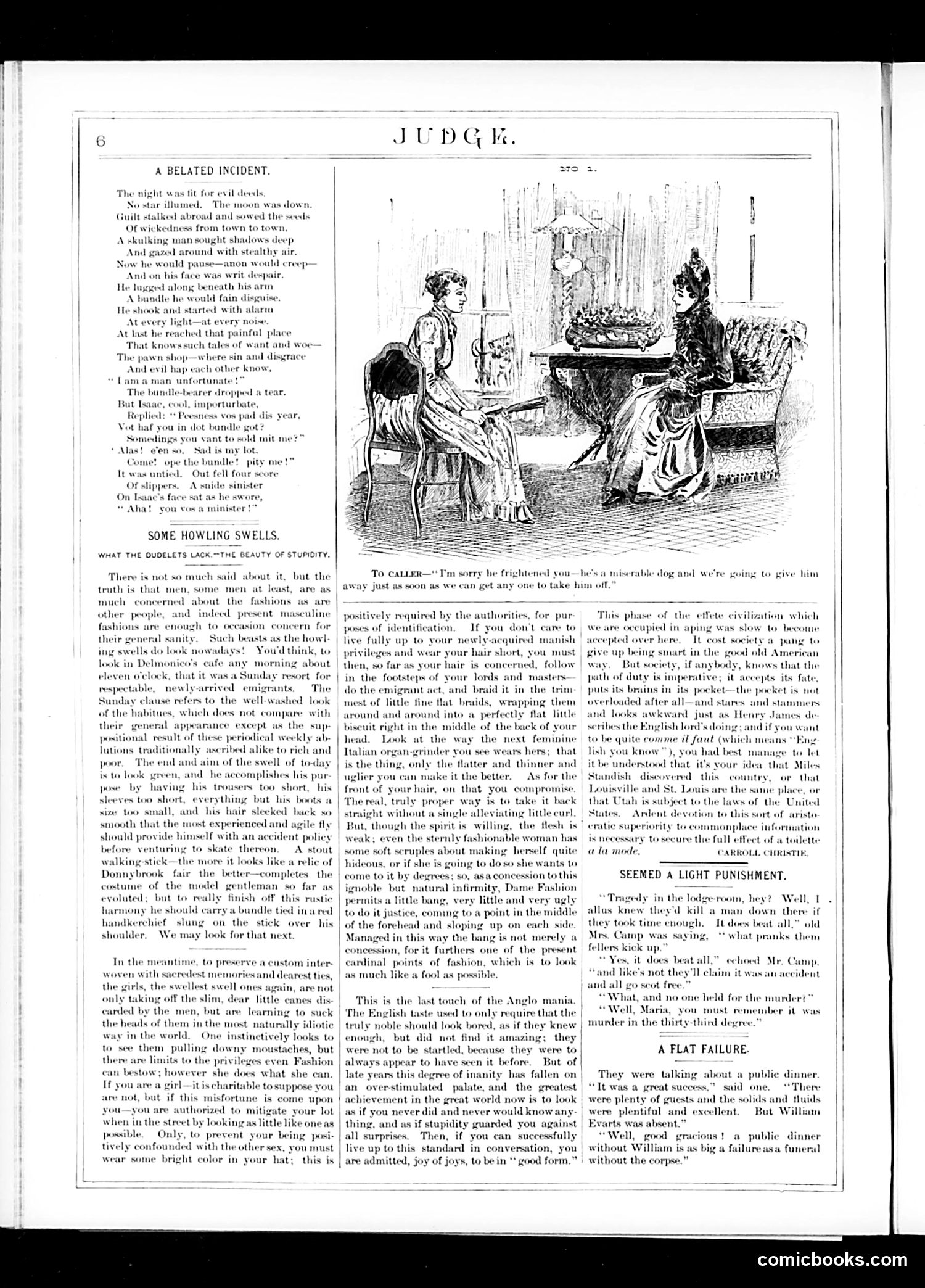
This page satirizes two distinct targets: **"A Belated Incident"** (left): A sentimental poem paired with an illustration mocking a pawnbroker scene. The narrative depicts a desperate man pawning possessions, but the humor lies in ethnic caricature—the pawnbroker speaks in exaggerated immigrant dialect ("you vos a minister?"), portraying Jewish immigrants as crude stereotypes. Judge uses pathos undercut by mockery, a common formula of the era. **"Some Howling Swells" and "What the Dudelets Lack"** (right): Satirizes wealthy young men ("swells," "dudelets") who affect exaggerated fashions—short trousers, slicked-back hair, affected mannerisms—while adopting an air of studied boredom copied from English aristocracy. The satire suggests these American dandies foolishly ape European pretension without understanding true sophistication, ultimately achieving only "the beauty of stupidity." The critique targets class affectation and masculine vanity. Both pieces use ethnic/class stereotyping typical of 1880s-90s Judge humor.
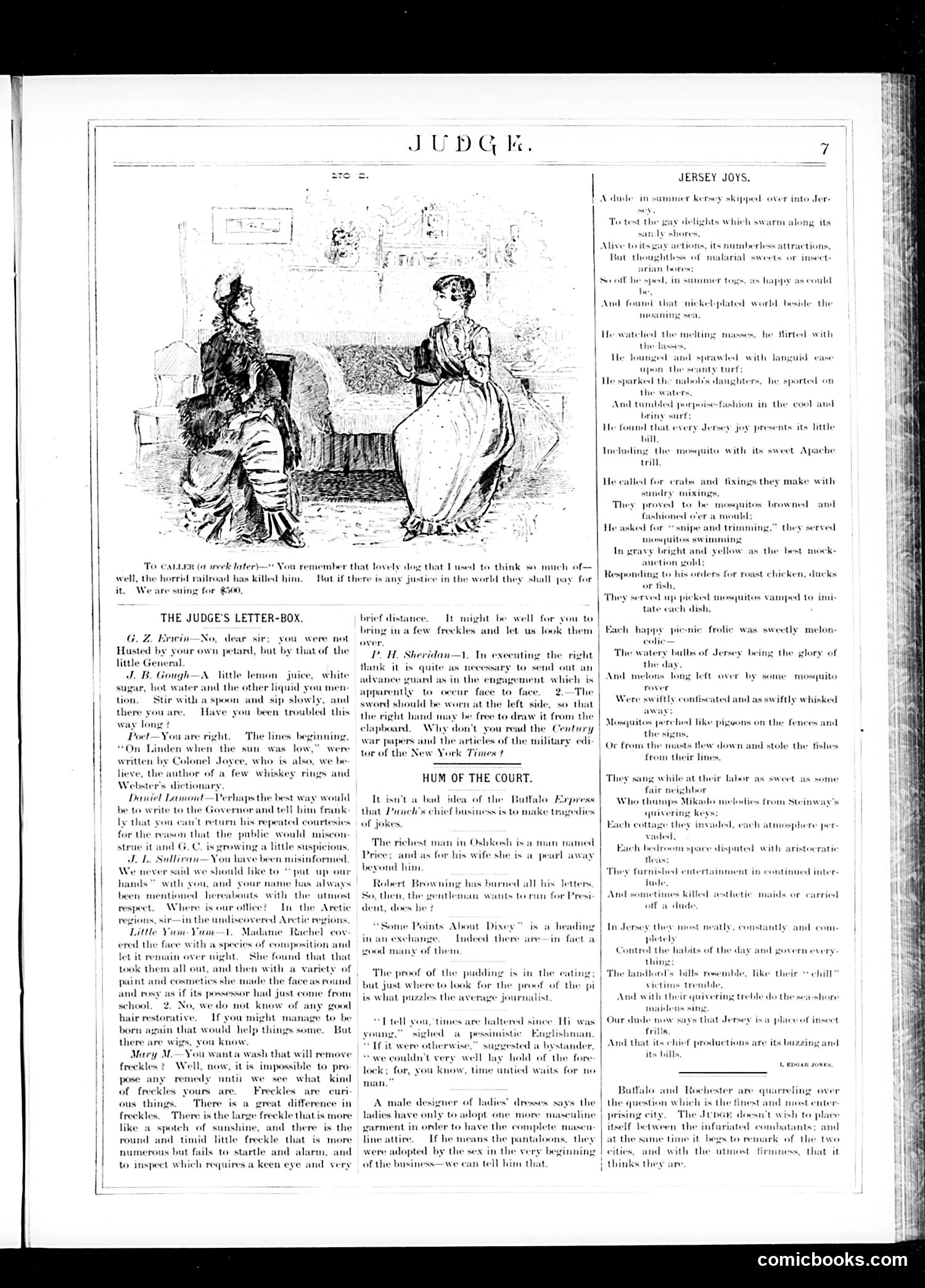
This page satirizes the overhyped romance of a New Jersey summer vacation. The cartoon depicts a well-dressed man who escapes to Jersey seeking leisure and pleasure—flirting with "the masses," lounging by the shore, and enjoying water sports. However, the accompanying poem reveals the reality: every activity comes with a hidden bill. He's swarmed by mosquitoes (described with mock-heroic language as having an "Apache trill"), overcharged for seafood, and ultimately killed by a train, prompting a caller's bitter complaint about railroad liability. The satire targets both the commercialization of leisure—transforming what should be free natural pleasures into expensive commodities—and Jersey's notorious mosquito problem. It's a classic Gilded Age critique: the fantasy of affordable summer escape collides with actual costs and discomfort, deflating bourgeois aspirations. The tragic railway death adds dark humor, suggesting even vacations carry literal danger.
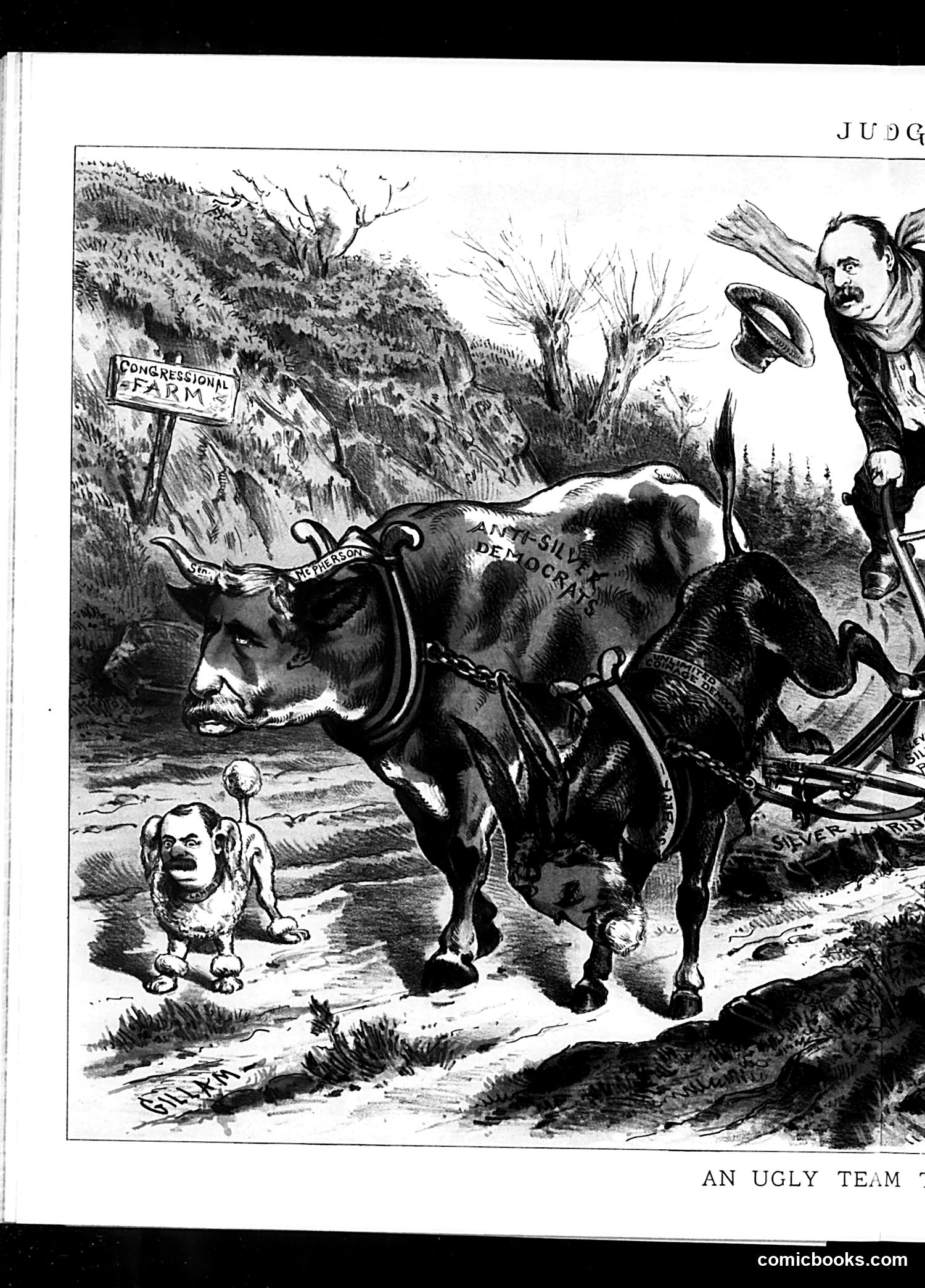
This political cartoon depicts a man driving an ox-drawn cart past a "Congressional Farm" sign. The ox is labeled "Anti-Silver Democracy," and a small dog follows alongside. A man in the background tips his hat. The satire criticizes Democratic Party divisions over the silver currency issue, a major political controversy of the 1890s. The "ugly team" refers to the awkward alliance between different Democratic factions—represented by the ungainly ox and dog—that were pulling the party in conflicting directions on monetary policy. The Congressional Farm label suggests Congress's involvement in this divisive debate. The overall message mocks how Democrats appeared disunited and poorly coordinated on this central economic issue that split the party during this era.
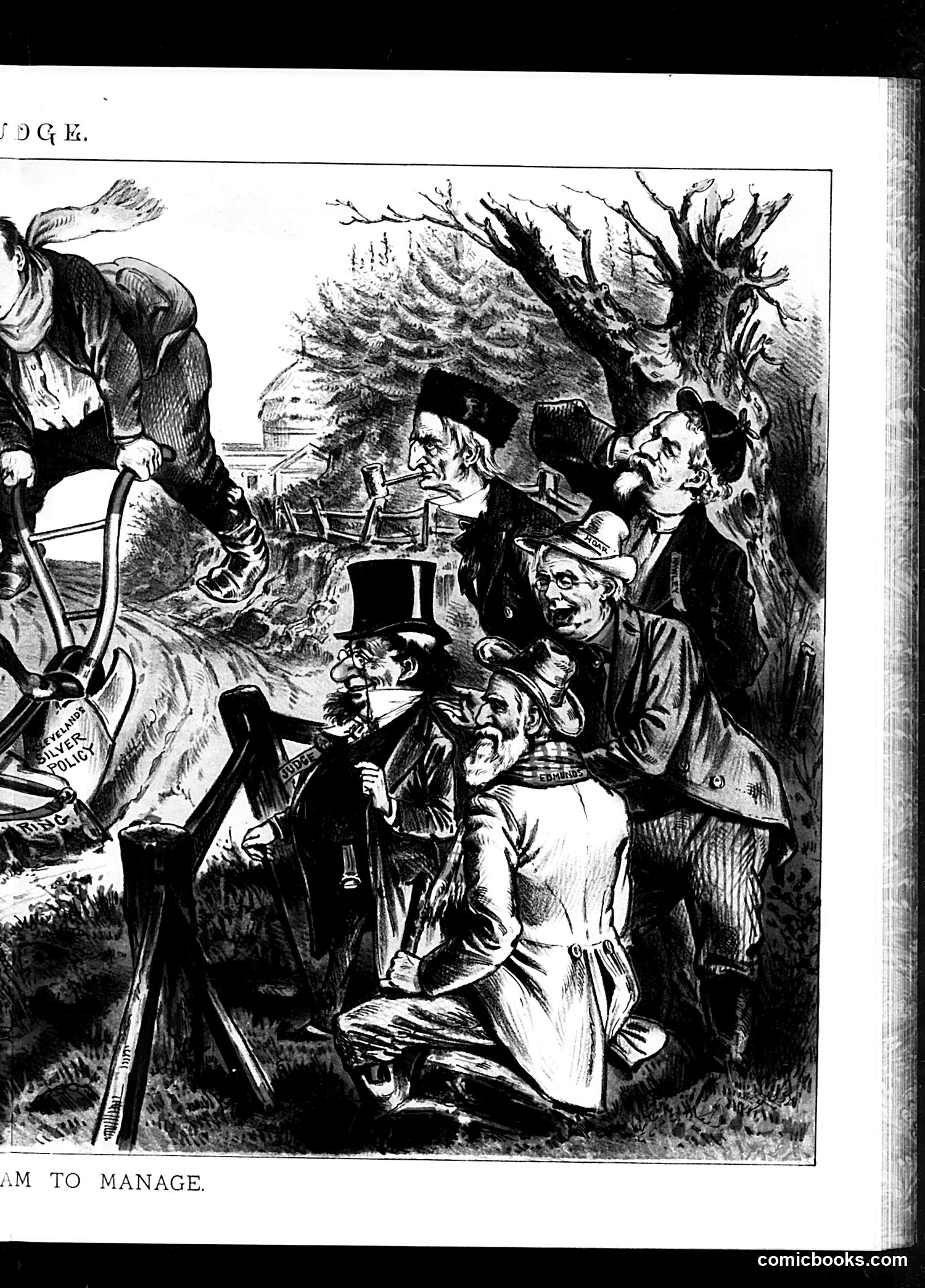
This appears to be a satirical cartoon from *Judge* magazine depicting a scene of political management or manipulation. The central figure—a man in a top hat smoking a cigar—appears to be orchestrating or controlling several other men around him, some wearing hats and appearing distressed or agitated. The title fragment "AM TO MANAGE" suggests this concerns someone's attempt to control or manipulate a situation or group of people. The exaggerated facial features and caricatured style typical of 19th-century political satire indicates this likely critiques a political figure's management tactics or backroom dealings. However, without the full caption or date, the specific individuals and political context remain unclear. The composition suggests themes of political control or corruption common to *Judge's* satirical commentary.
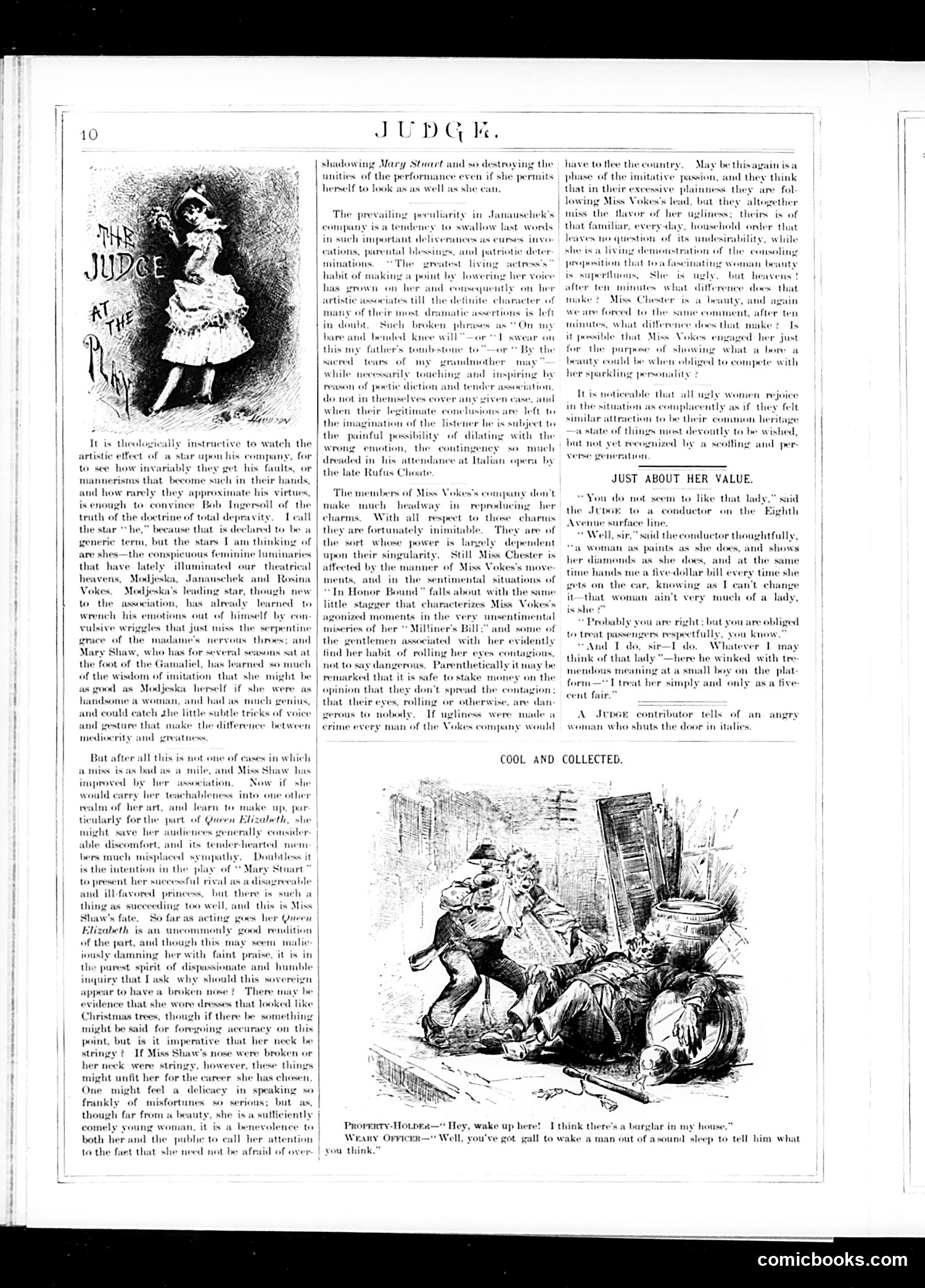
This page critiques **theatrical performance styles** of prominent 19th-century actresses, particularly those in Miss Vokes's company. The text discusses how stars like **Modjeska and Janauschek** influence their fellow performers—sometimes negatively—through mannerisms and vocal habits. The main satirical targets are: 1. **Actresses who mumble or swallow final words** during dramatic moments (cursing scenes, emotional deliveries) 2. **Imitative performers** who copy star mannerisms rather than develop genuine artistry 3. **Overwrought acting conventions**—affected posturing presented as theatrical profundity The bottom cartoon, titled "Cool and Collected," depicts a **property-holder** (landlord) roughly awakening a sleeping tenant to demand rent payment. A weary officer responds dryly that waking someone for bills is hardly remarkable. **The page's dual satire**: The theatrical criticism mocks artificial acting styles, while the cartoon mocks landlords' aggressive debt-collection tactics—both presented as pompous and excessive.
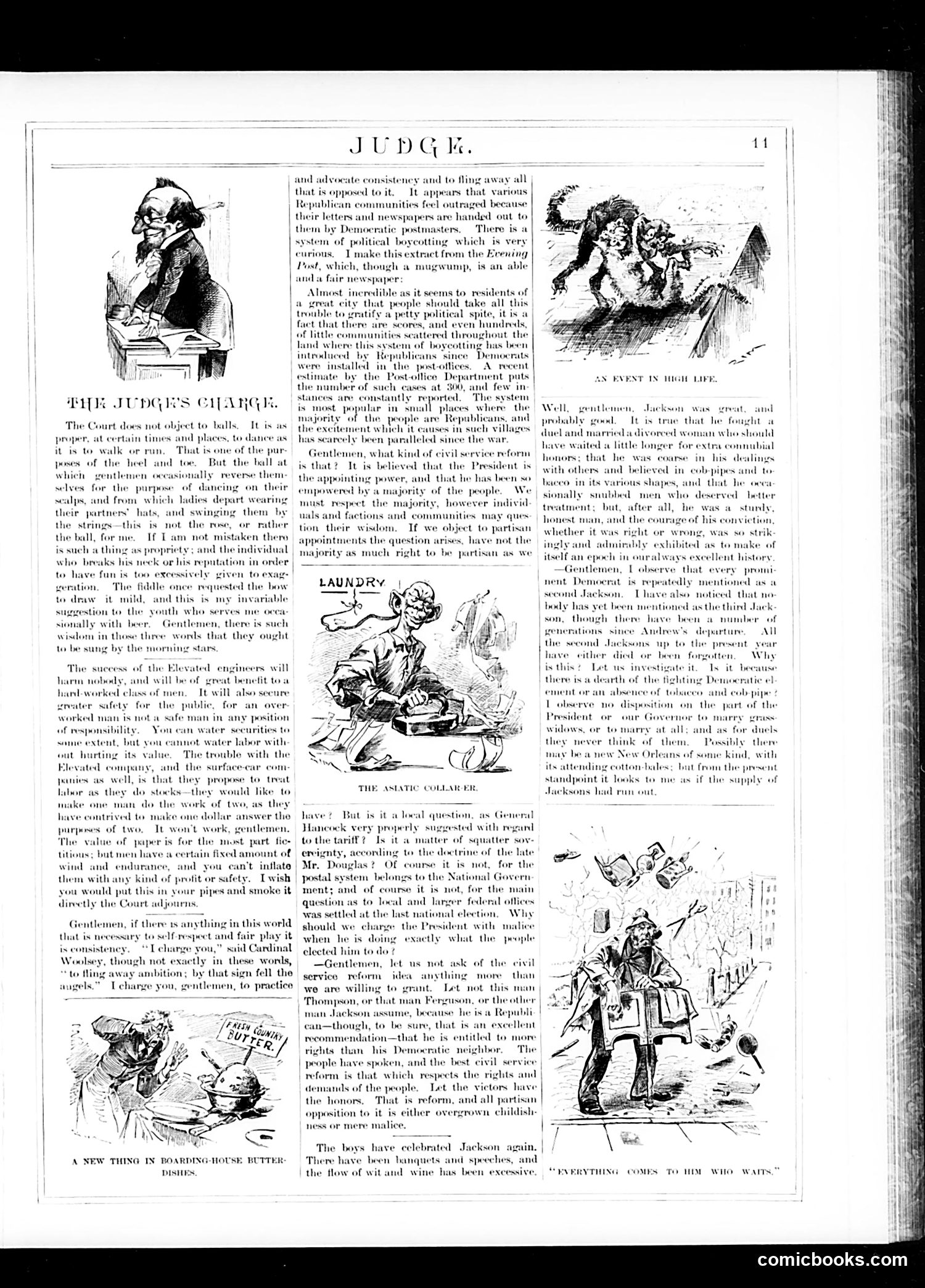
This page satirizes civil service reform and patronage politics under President Andrew Jackson. **"The Judge's Charge"** (left column) criticizes the spoils system—where winning political parties reward supporters with government jobs, including postmaster positions. The text notes Republicans have adopted Democratic boycotting tactics in villages where the system operates. **The cartoons** mock various aspects of Gilded Age politics: "The Asiatic Collarer" appears to reference Chinese labor/immigration debates; "A New Thing in Boarding-House Butter-Dishes" uses a domestic metaphor (unclear exact reference); other sketches show social disorder from political corruption. **The satire's point**: The author argues Jackson deserves credit for fighting—his Democratic successor shouldn't be attacked for merely implementing what Jackson's party established. Reform requires respecting electoral results and winners' prerogatives, not partisan obstructionism. The piece defends Jackson-era political appointments as legitimate, not corrupt. The tone suggests this appeared during post-Reconstruction political debates about federal patronage power.
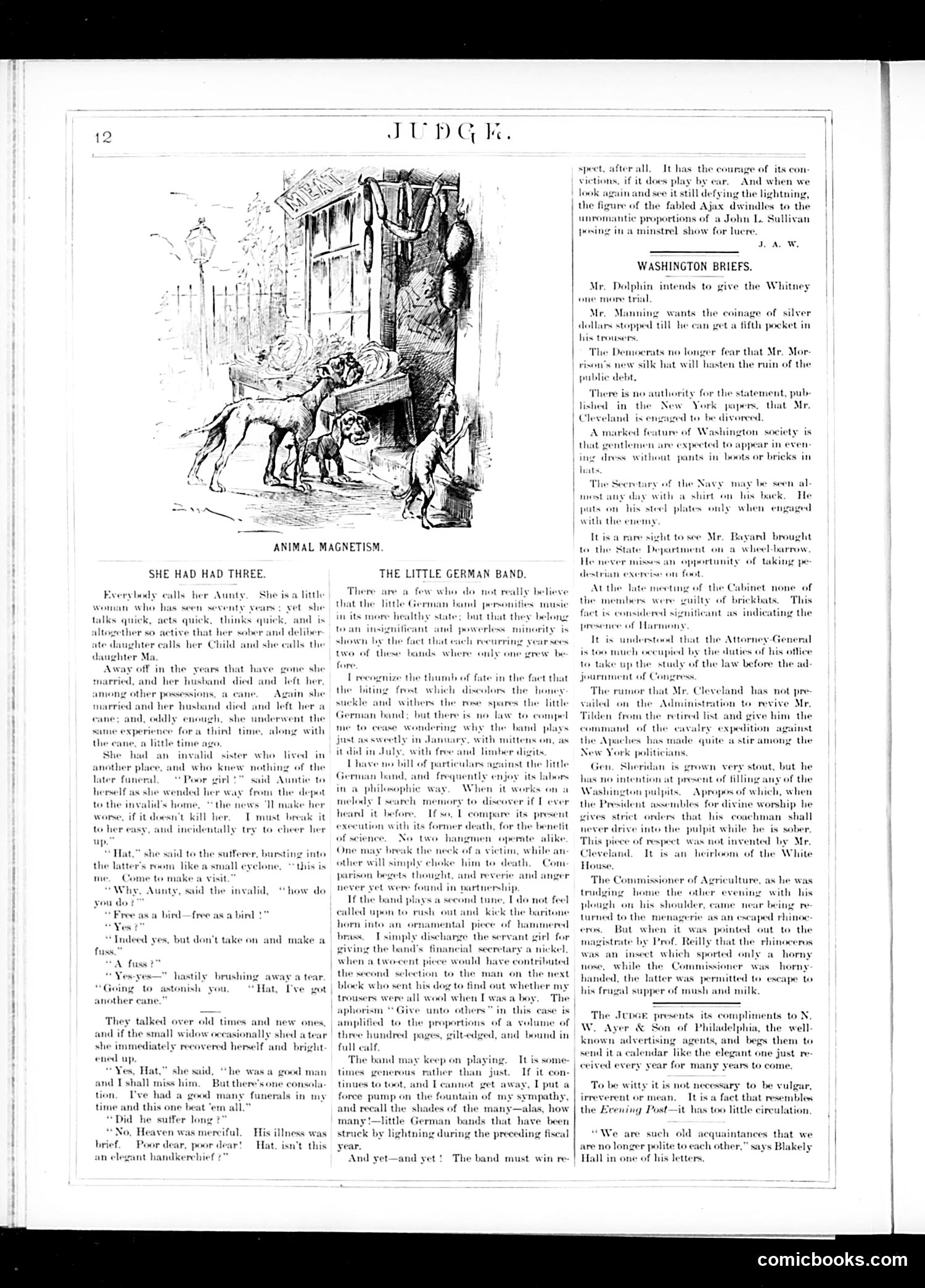
This page contains two satirical pieces typical of 1880s-90s American humor: **"Animal Magnetism" / "She Had Had Three"**: A sentimental anecdote about an elderly widow ("Aunty") visiting an invalid relative to deliver bad news about her fourth husband's death. The humor lies in the widow's repeated marriages and deaths—she's accumulated three dead husbands and now a fourth. The "animal magnetism" title suggests her inexplicable ability to attract husbands despite repeatedly becoming widowed. It's gentle domestic humor mocking either her romantic persistence or the macabre pattern of spousal mortality. **"Washington Briefs"**: Short political jokes mocking current politicians and policies. References include criticism of the Democratic Party's handling of public debt, Secretary of the Navy's appearance, and a satirical piece about "The Little German Band"—likely immigrant street musicians receiving mixed treatment in society. These brief items poke fun at contemporary political figures and social hypocrisies. The overall tone reflects Judge's satirical approach to American politics and social life of the period.
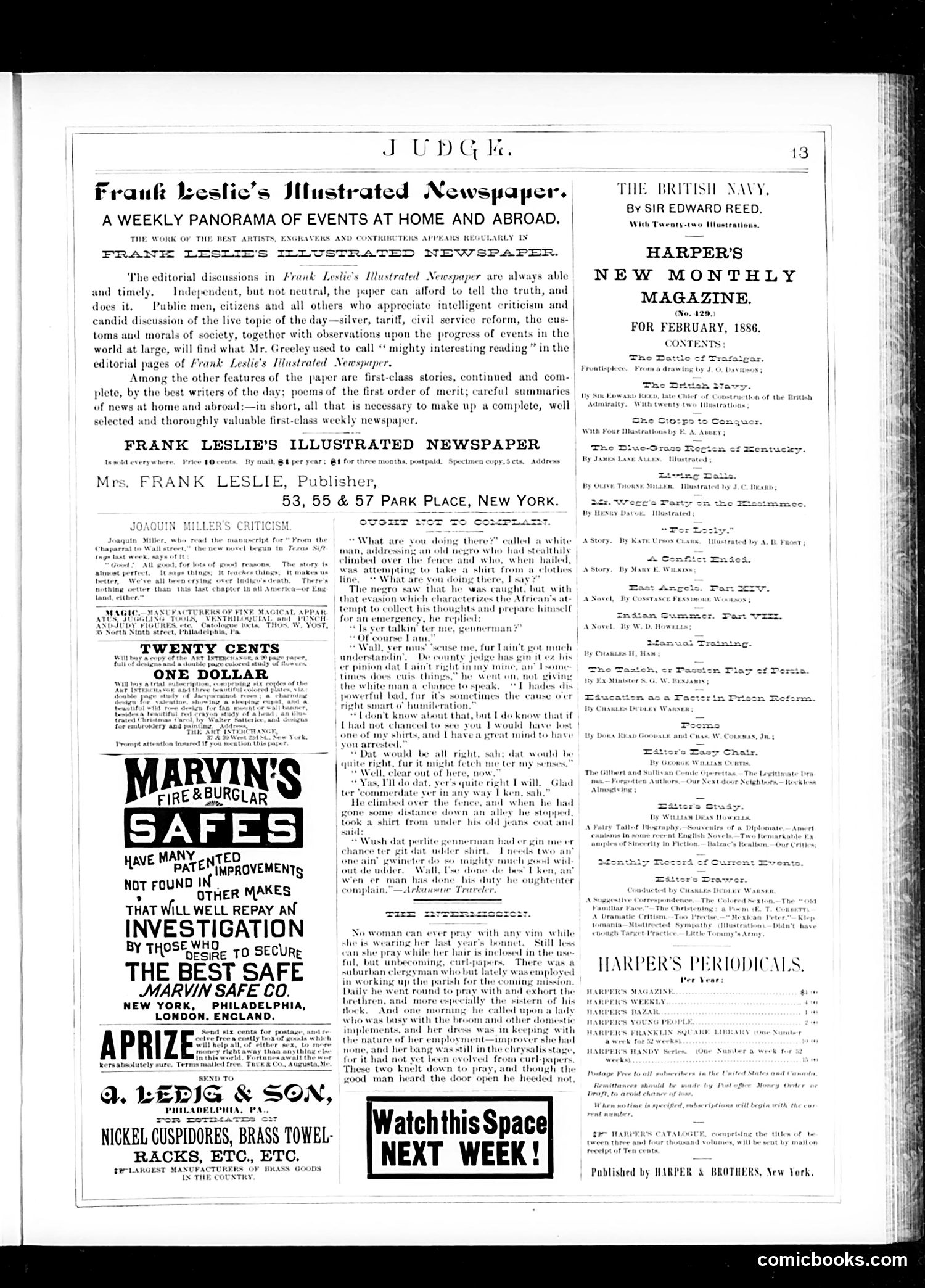
This is primarily a **title page and advertisement section** rather than a satirical cartoon page. It features: **Main Content:** - Masthead for "Frank Leslie's Illustrated Newspaper," a competing publication to Judge, emphasizing its editorial independence and timely coverage of current events - Advertisement for "Harper's New Monthly Magazine" (February 1886 issue) - Multiple commercial advertisements for safes (Marvin Safe Co.), brass goods (A. Ledig & Son), and other products **Historical Context:** This page reflects the **late 19th-century magazine competition**—Frank Leslie's was a major rival to Judge in the satirical/illustrated press market. The emphasis on "independent" editorial stance and "first-class stories" shows publishers competing for readers' attention and credibility. The advertising layout was typical for the era, mixing editorial promotion with commercial notices. There are **no visible political cartoons** on this particular page; it's essentially a business/promotional section of the publication.
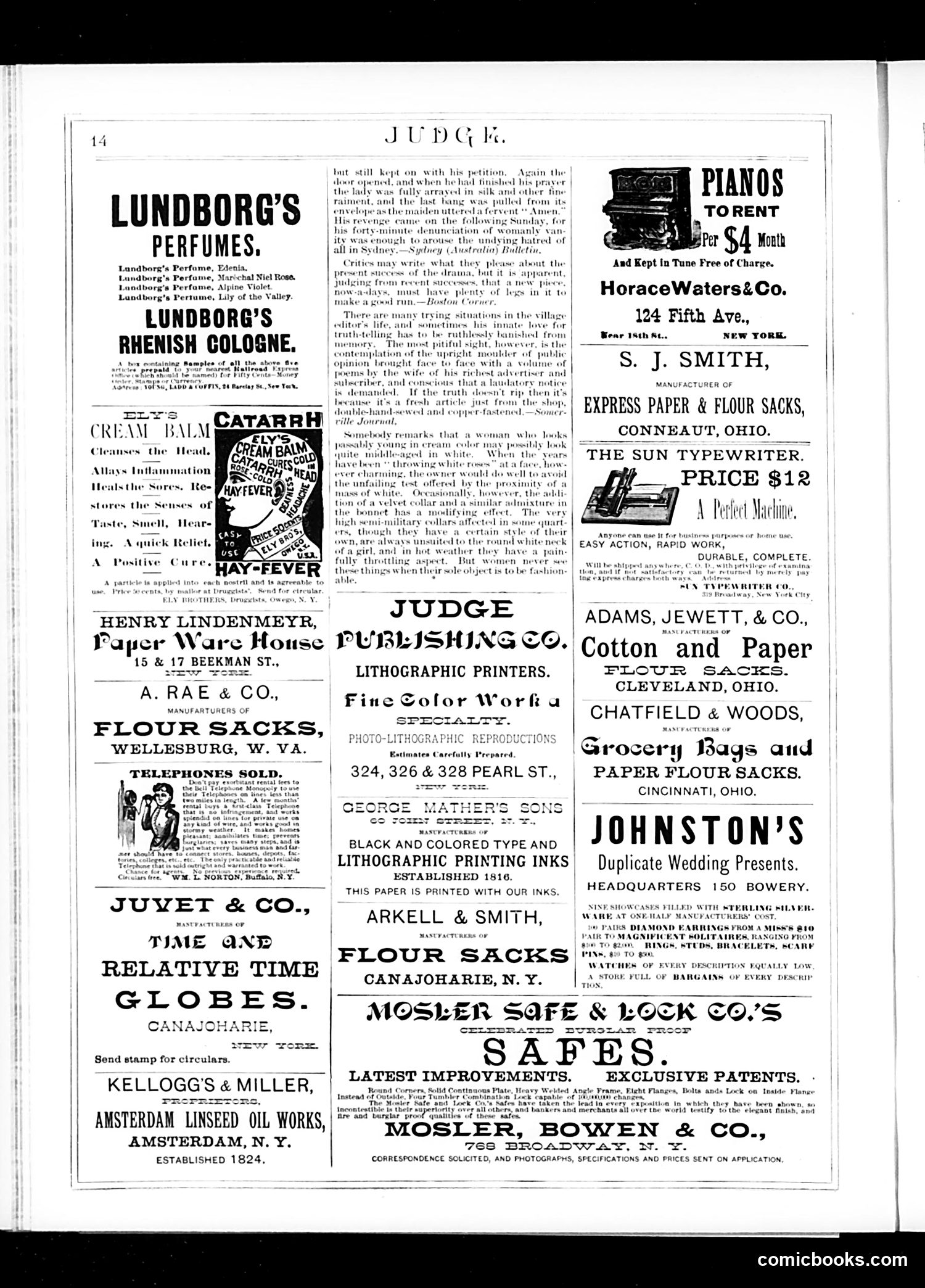
This page is **primarily advertising** with minimal editorial content. The visible text discusses theatrical criticism—specifically reviewing a drama's portrayal of village life and female characters, noting how actresses' appearances (particularly aging and fashion) affect audience perception. The reviewer remarks that women's fashion choices influence how they're judged on stage. The bulk of the page consists of **classified advertisements** typical of late 19th/early 20th-century magazines: perfumes (Lundborg's products), flour sacks, safes, printing services, paper goods, pianos for rent, typewriters, wedding gifts, oil works, and other industrial/commercial products. **No significant political cartoon or satirical content is visible**—this appears to be a standard Judge advertising page from the publication's history, reflecting the era's business culture and consumer goods market.
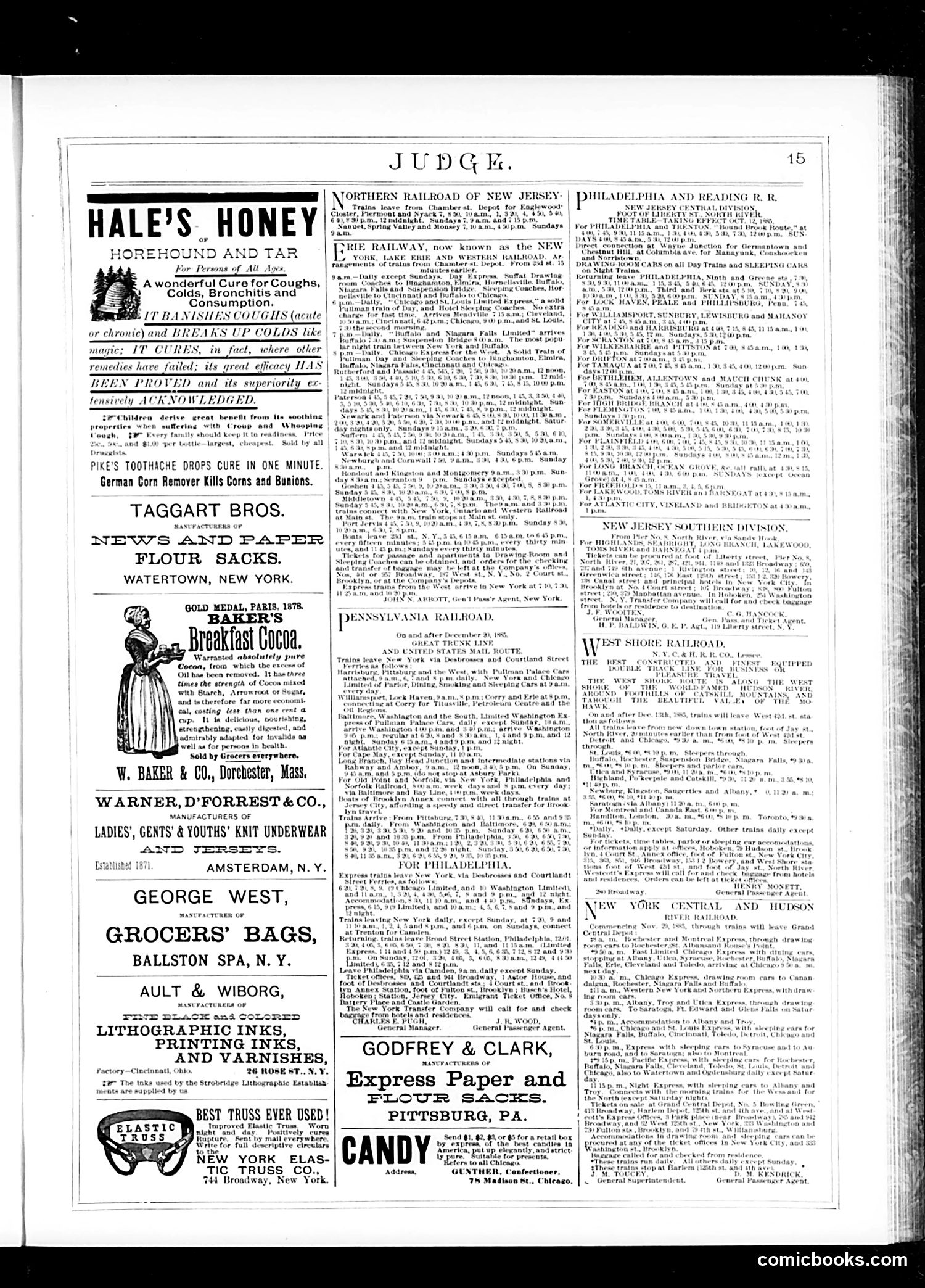
This page is **primarily advertising**, not political satire. It consists of commercial advertisements typical of an 1870s-era American magazine, including: - **Patent medicines**: Hale's Honey (cough remedy), Pike's Toothache Drops, German Corn Remover - **Food products**: Baker's Breakfast Cocoa, candy - **Clothing/medical devices**: Warner corsets, elastic trusses, knit underwear - **Industrial supplies**: flour sacks, printing inks, lithography materials - **Railroad schedules**: Northern Railroad of New Jersey, Pennsylvania Railroad, Philadelphia & Reading RR, and others There are no visible political cartoons or satirical illustrations on this page. The railroad timetables may reflect the era's transportation infrastructure, but they serve as practical information rather than commentary. This represents typical Judge magazine filler content between editorial pages.
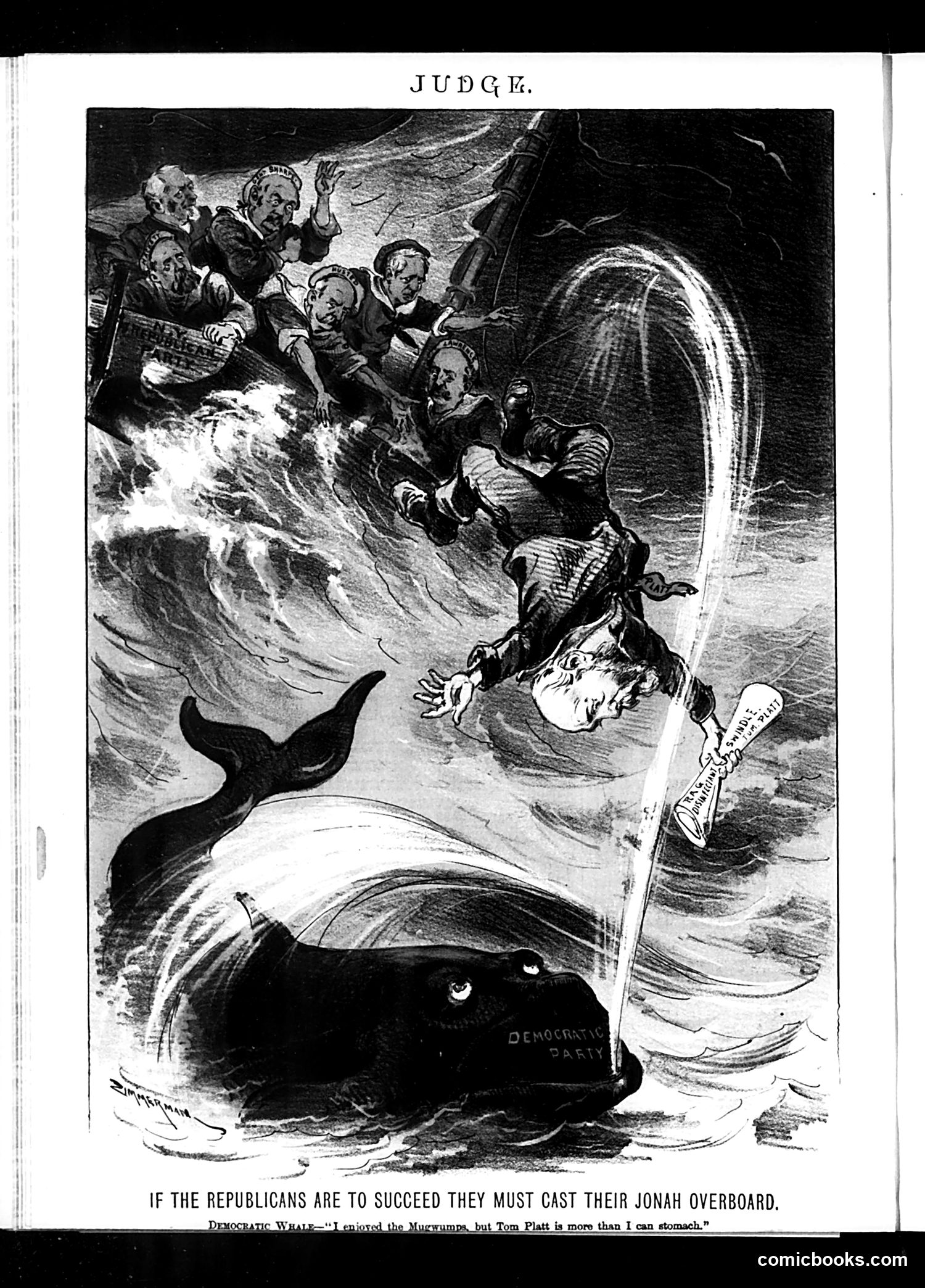
This is a political cartoon titled "If the Republicans are to Succeed They Must Cast Their Jonah Overboard." The image depicts a large whale labeled "Democratic Party" threatening a boat of Republican figures. One figure stands apart, appearing to be cast overboard or in danger. The caption references a "Democratic Whale" and quotes someone saying they can stomach the "Mugwumps, but Tom Platt is more than I can stomach"—suggesting internal Republican party conflict. **Context**: The cartoon uses the Biblical "Jonah" metaphor (a person whose presence brings bad luck). It appears to criticize Tom Platt, a Republican political figure, as a liability to the party's success. The satire suggests Republicans must remove problematic figures (Platt) to survive political challenges from Democrats, represented as the threatening whale. The exact date and specific historical moment remain unclear without additional context.