
A complete issue · 16 pages · 1883
Judge — December 29, 1883
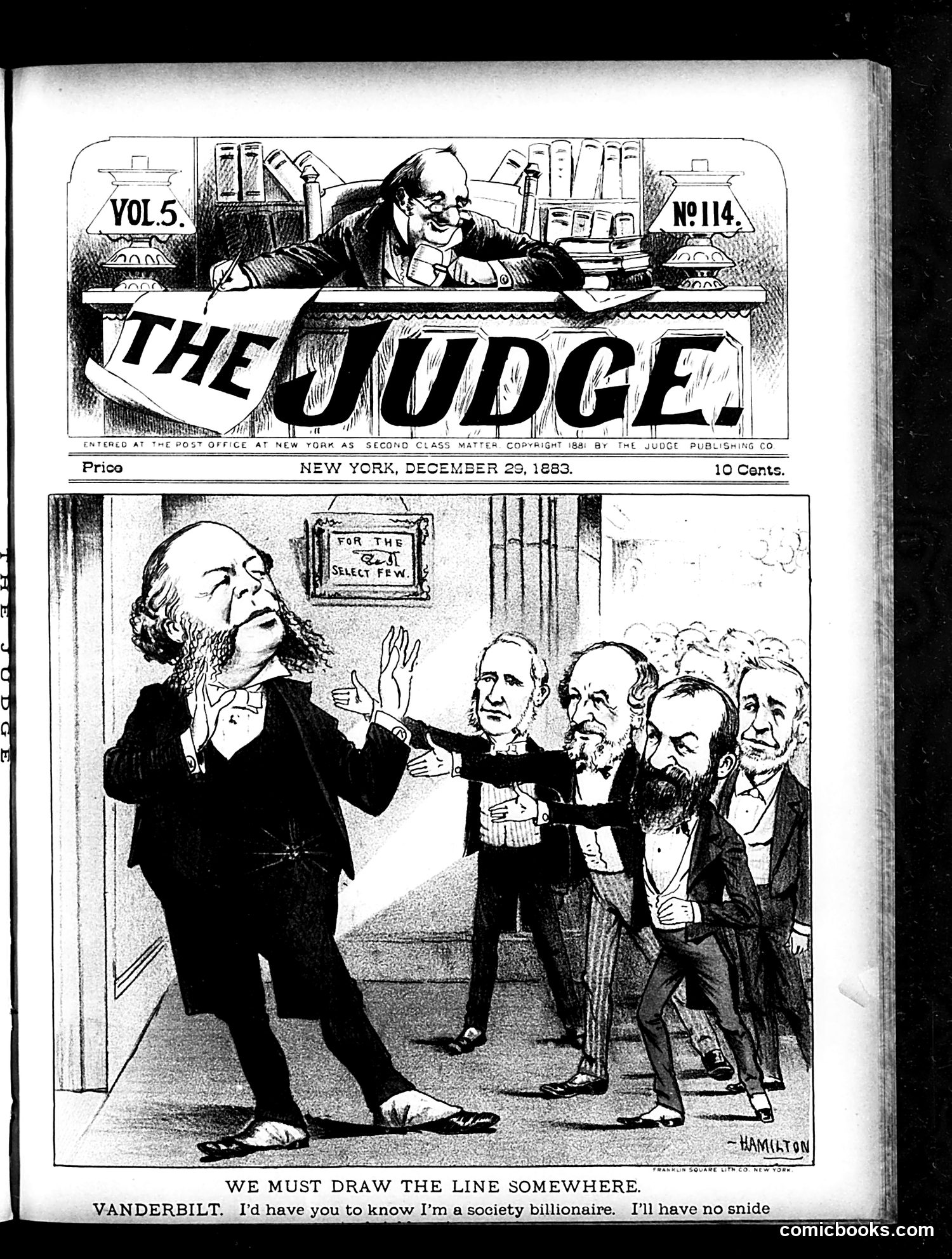
This December 29, 1883 *Judge* cartoon satirizes **Cornelius Vanderbilt**, the railroad magnate shown on the left with exaggerated features. The caption references his claim to be "a society billionaire" with "no snide [behavior]." The cartoon depicts Vanderbilt addressing five distinguished gentlemen (likely politicians or social elites), suggesting he's attempting to assert respectability and social standing despite his immense wealth and ruthless business practices. The title "We Must Draw the Line Somewhere" implies irony—society must set ethical boundaries, yet the ultra-wealthy like Vanderbilt presume they can purchase social acceptance and legitimacy. The satire mocks the Gilded Age tension between new industrial fortunes and old-money establishment values.
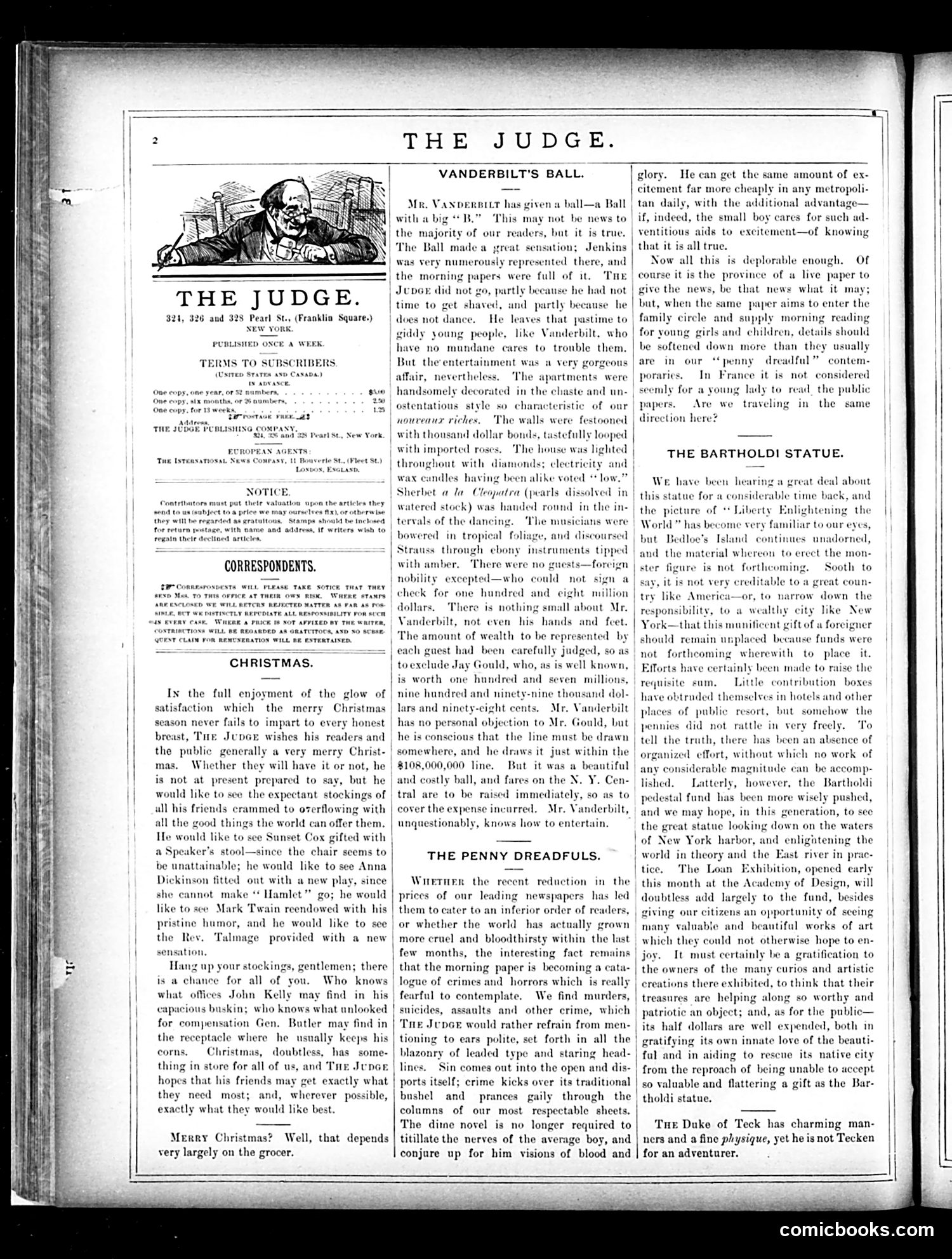
This satirical magazine page from the 1870s-80s contains three distinct pieces: **The Cartoon** (top left): A caricatured figure, likely a political opponent of Judge's editorial stance, appears to be depicted in a mocking manner—though the specific identity isn't entirely clear from the image alone. **"Vanderbilt's Ball"**: Savage satire on the extreme wealth disparity of the Gilded Age. Judge mocks railroad magnate Cornelius Vanderbilt's lavish ball, sarcastically describing obscene luxury—walls decorated with thousand-dollar bonds, diamonds, imported roses. The joke cuts deepest when noting Vanderbilt deliberately excluded Jay Gould as not *wealthy enough*, and that railroad fares will be raised to cover the ball's costs. The satire critiques both ostentatious nouveau-riche display and how the wealthy extract money from ordinary people. **"The Penny Dreadfuls"**: Discusses sensationalist newspaper content—murders, crime, scandal—suggesting lowbrow papers are becoming "a catalogue of crimes." Overall, Judge positions itself as moralistic social commentary on wealth inequality and media degradation.
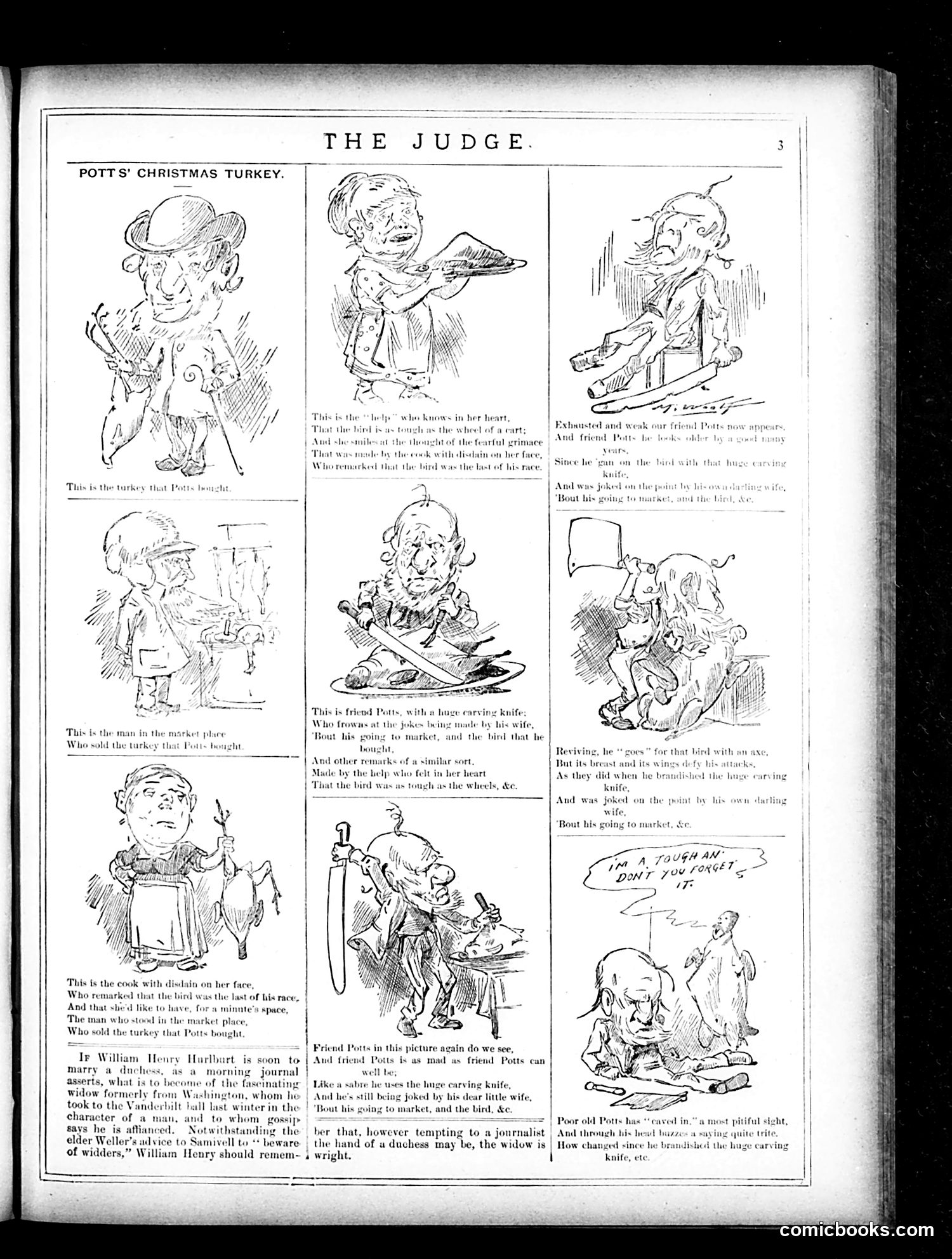
This page satirizes **William Henry Hurlburt**, a journalist about to marry a duchess. The main narrative follows a Christmas turkey that Hurlburt supposedly bought, using it as an extended metaphor for his situation. The cartoon traces the turkey through various hands—a market vendor, a cook, a carving knife wielder—each character remarking that the bird becomes progressively worn down and exhausted, much like the once-vigorous Hurlburt. The final image shows "Poor old Potts" (likely Hurlburt's nickname or alias) exhausted after brandishing his "huge carving knife." **The satire's point**: Marrying wealthy nobility will wear down and domesticate this otherwise independent-minded journalist. The repeated refrain "Bout his going to market, and the bird, &c." suggests inevitable fate. The humor relies on readers knowing Hurlburt's reputation and the scandal surrounding his engagement to a widow of higher social standing.
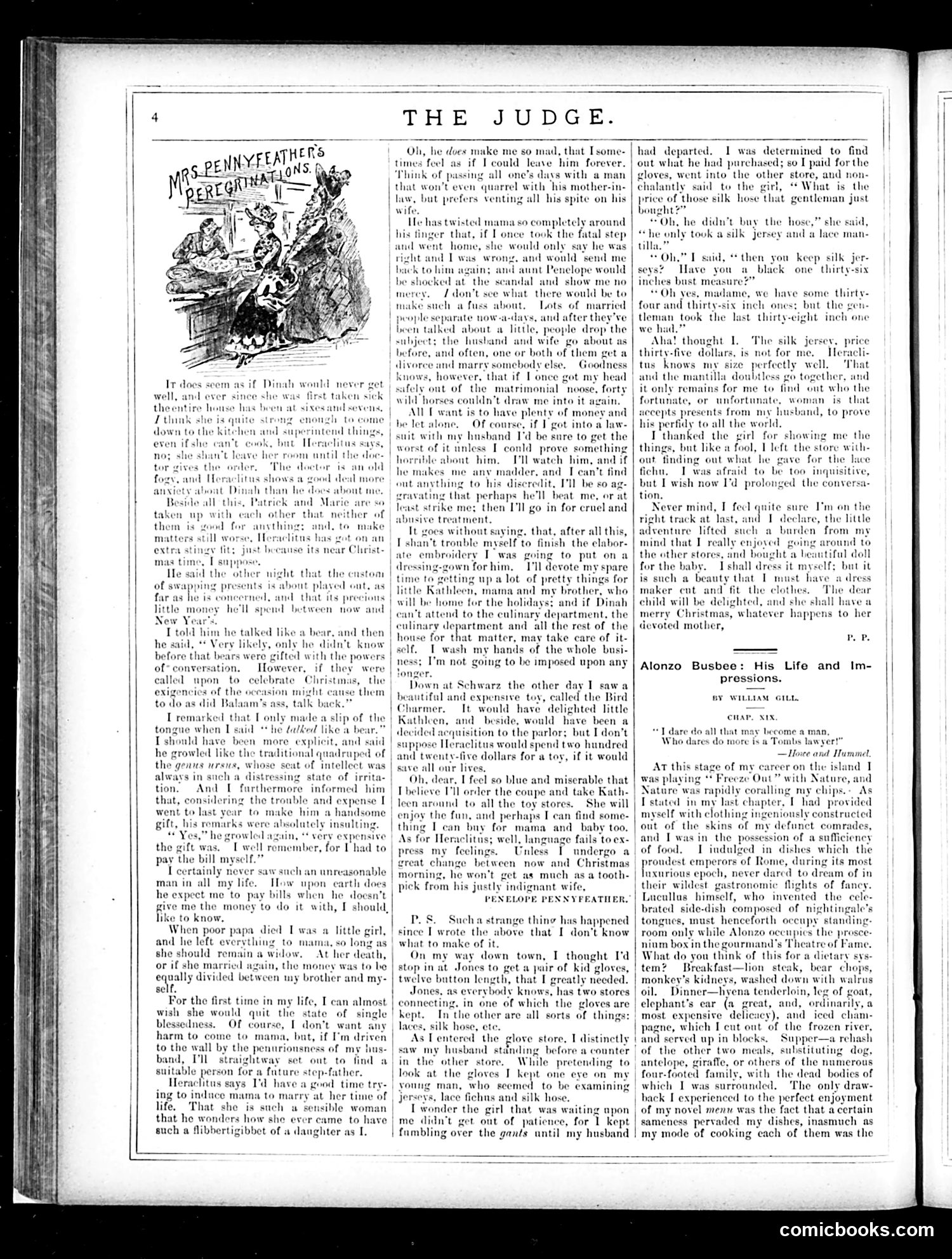
This page features a lengthy domestic complaint column, likely a recurring feature. The unnamed female narrator vents about her stingy husband who refuses to give her money for bills or Christmas gifts, while lavishing attention on her mother-in-law ("Dinah"). The satire targets both the husband's miserliness and the wife's entitled, gold-digging attitude. She fantasizes about divorcing him to access her inheritance, threatens to fabricate abuse charges ("I'll go in for cruel and abusive treatment"), and jokes about finding her widowed mother a wealthy second husband so she can access that money too. The cartoon at top-left (titled "Mrs. Pennyfather's Perfections") appears to be a separate domestic humor piece. The satire mocks upper-middle-class marriage dynamics—the wife's materialism and manipulative scheming, the husband's tight-fistedness—reflecting Victorian anxieties about women's legal and financial dependence.
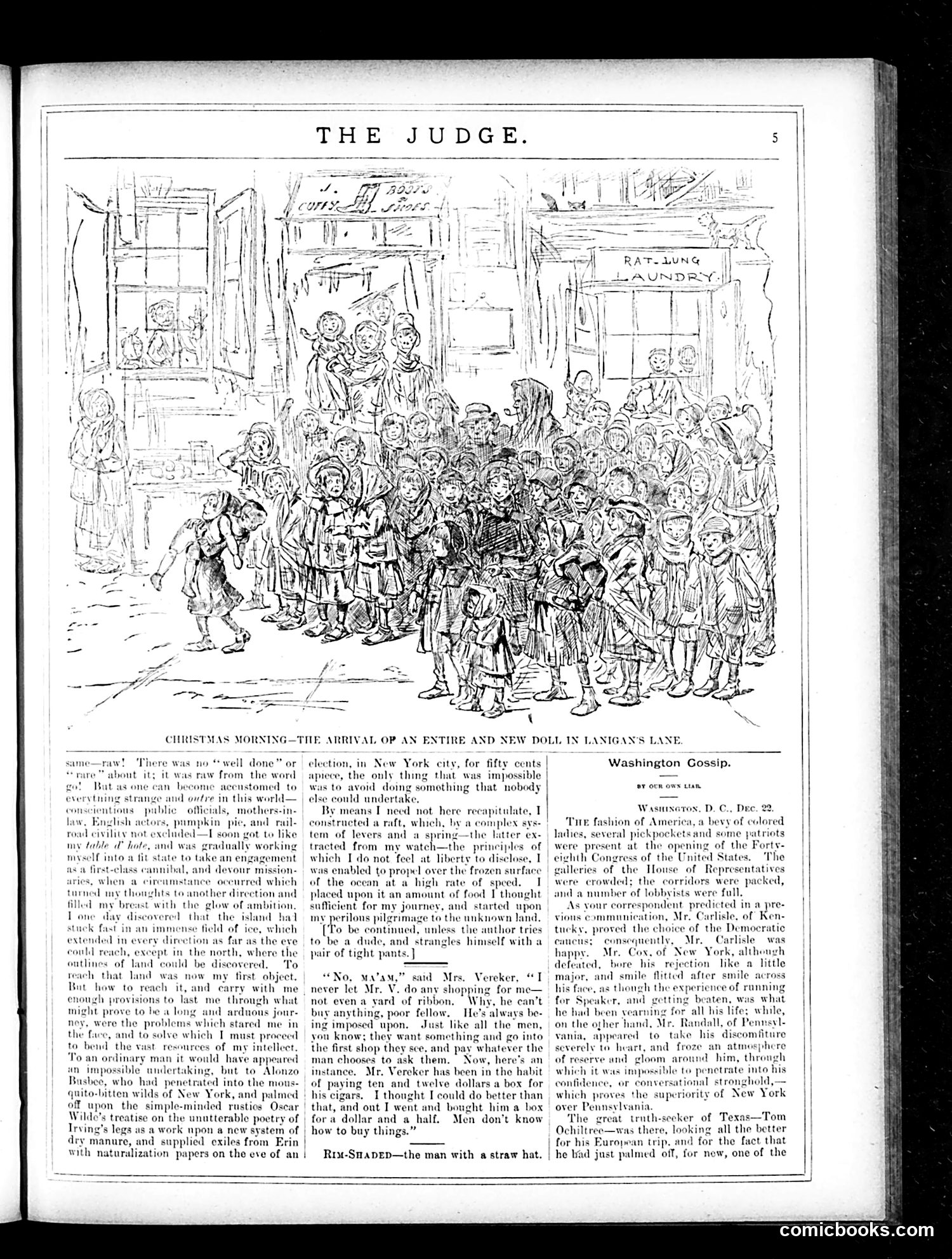
This page contains three distinct pieces of satirical content: **Main Cartoon** ("Christmas Morning—The Arrival of an Entire and New Doll in Lanigan's Lane"): The sketch depicts a crowded street scene of poor children, apparently in a tenement district, receiving charity dolls. The satire likely critiques either inadequate charitable efforts toward impoverished urban children or mocks sentimental Christmas charity as performative. **"Washington Gossip"**: This brief political column references the opening of Congress and discusses Democratic leadership selection, mentioning Mr. Carlisle of Kentucky and Mr. Randall of Pennsylvania as contenders for Speaker. The gossipy tone suggests internal Democratic Party tensions over leadership. **"Rau-Shaded" anecdote**: A humorous dialogue mocking men's incompetence at shopping and negotiation, with the wife smugly contrasting her superior purchasing skills. The page reflects Judge's typical mix of urban social commentary, political gossip, and domestic humor aimed at middle-class readers. Without date context, the specific congressional reference is unclear, though the content suggests 1880s-1890s America.
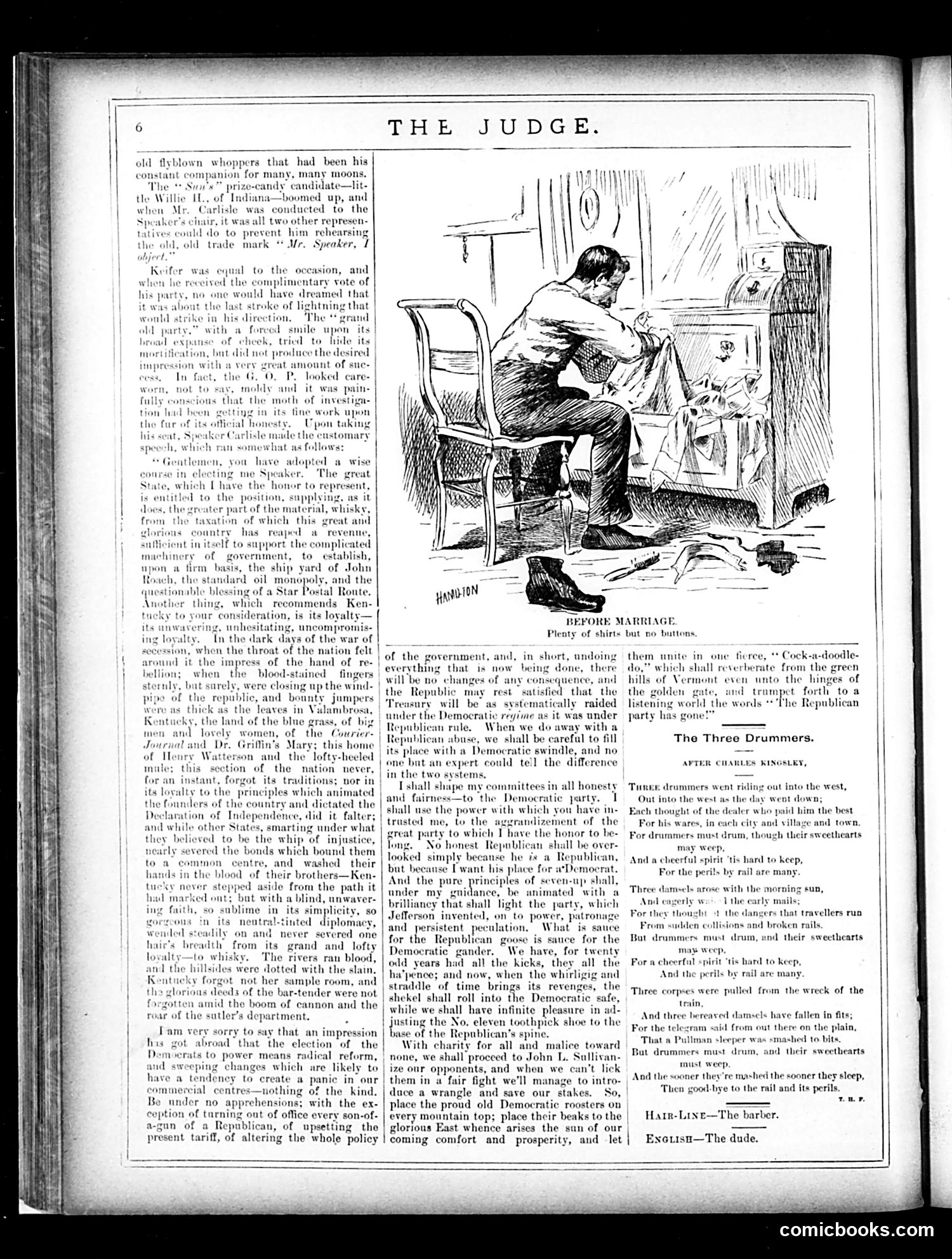
This Judge page satirizes Democratic political hypocrisy through a speech attributed to what appears to be a Democratic Party leader (likely Secretary of Treasury Thomas Carlisle, based on OCR references). The cartoon "Before Marriage" depicts a man at a desk writing—possibly representing a politician drafting campaign promises or policy statements. The accompanying text mocks Democratic claims of reform. The speaker promises to use power "in all honesty and fairness to the Democratic party" while cynically admitting that replacing Republican corruption with Democratic corruption is indistinguishable: "When we do away with a Republican abuse, its place with a Democratic swindle, and no one but an expert could tell the difference." The satire targets Democratic hypocrisy—they criticize Republican mismanagement of the Treasury and tariffs while planning identical abuses under their own rule. The phrase "What is sauce for the Republican goose is sauce for the Democratic gander" crystallizes the joke: both parties are equally corrupt, merely taking turns at the public trough.
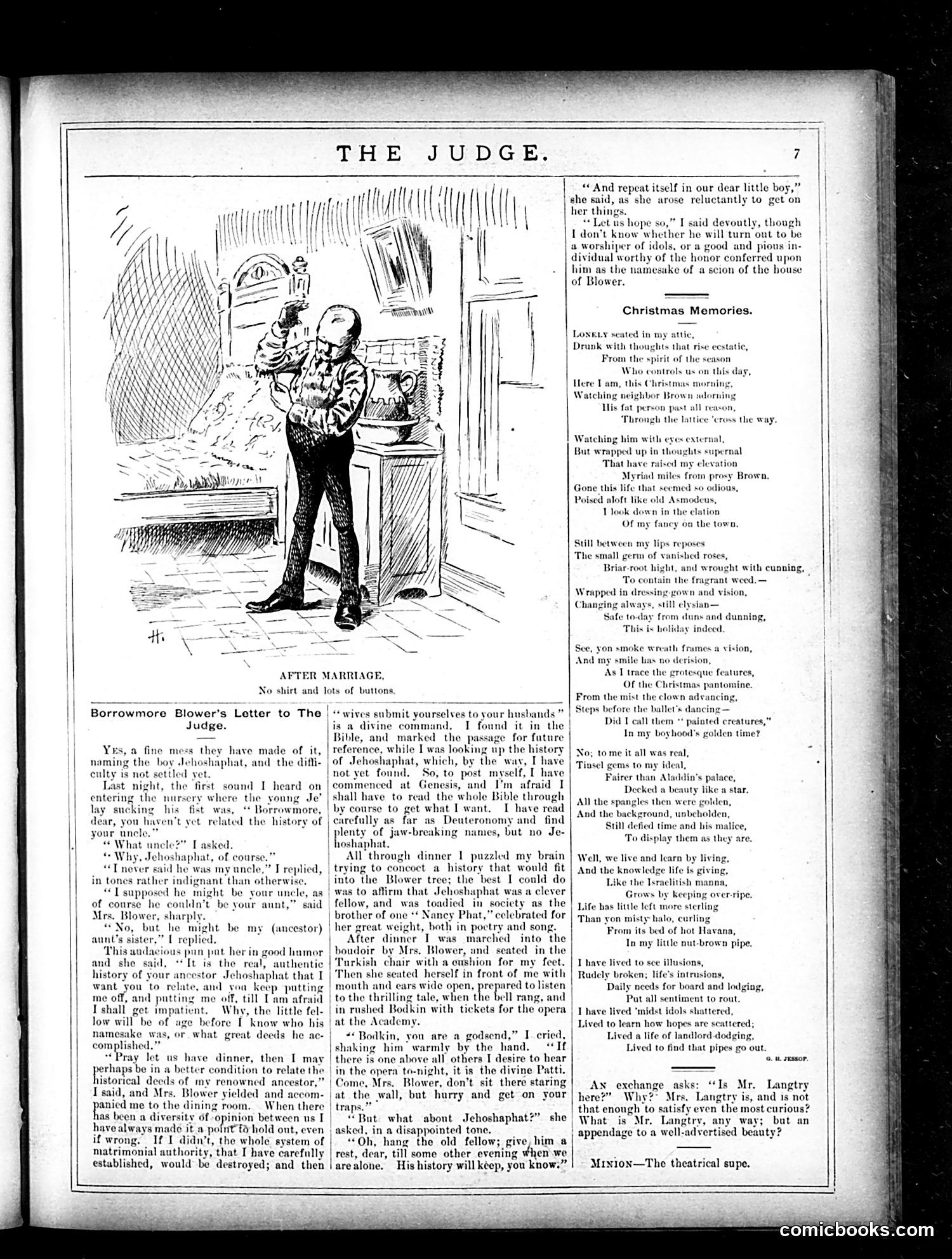
This page satirizes marital dynamics and male anxiety about domestic authority. The cartoon captioned "After Marriage: No shirt and lots of buttons" appears to show a man struggling with clothing—likely depicting the loss of independence and dignity husbands experienced upon marriage. The accompanying letter is a comedic monologue by Borrowmore Blower, who relates his predicament: his wife insists he explain the biblical history of Jehoshaphat, their son's namesake. Blower repeatedly postpones and evades the task—claiming he must read the entire Bible first, inventing false genealogies, and ultimately using opera tickets as escape. The satire targets masculine pride and domestic power struggles. Blower attempts to assert "matrimonial authority" by resisting his wife's requests, yet continuously capitulates. His invented excuse about Jehoshaphat being related to "Nancy Phat" reveals his dishonesty. The humor lies in depicting marriage as a battle of wills where husbands must maintain authority through obstinacy while wives manipulate through persistence.
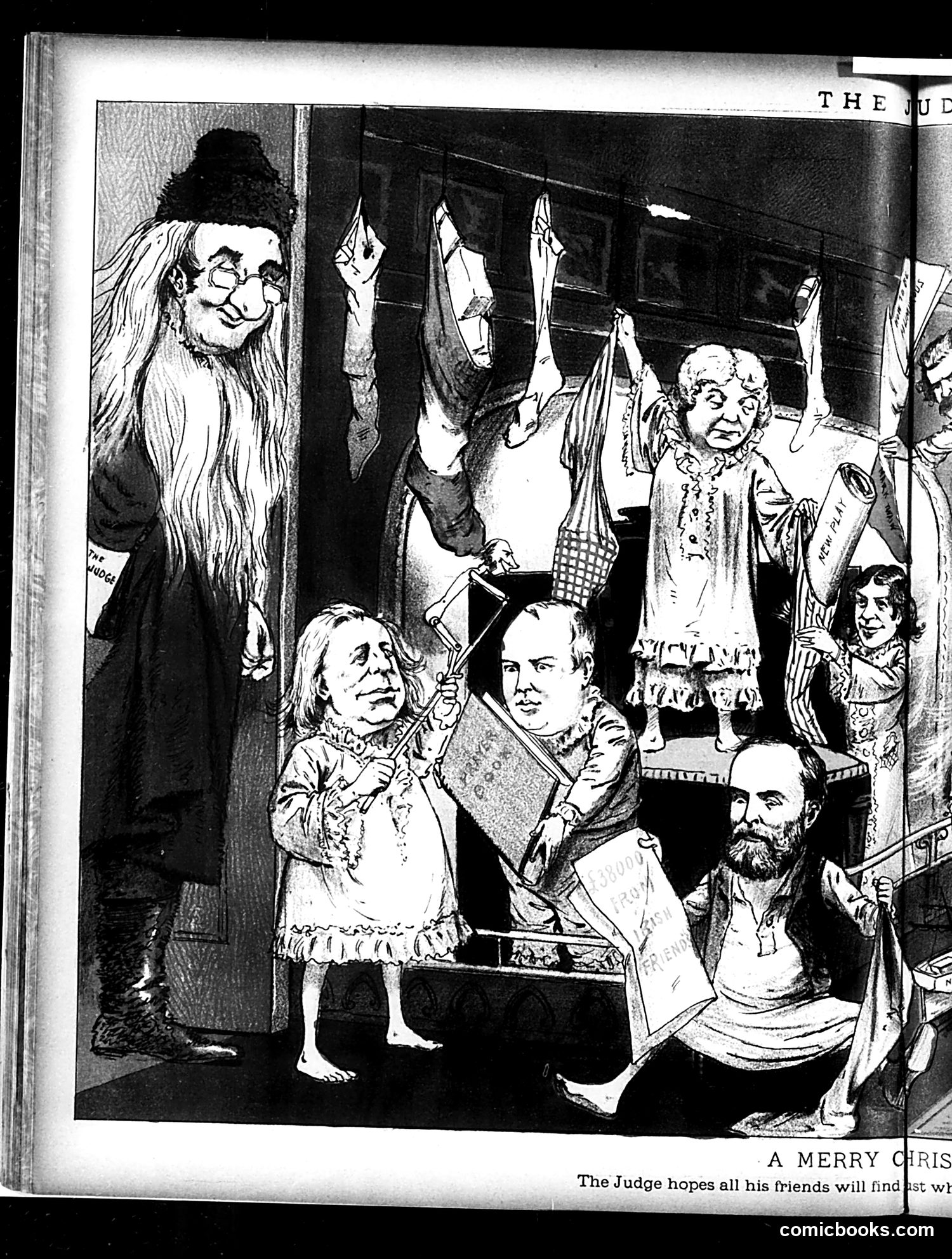
This satirical cartoon depicts what appears to be a Christmas gift-giving scene with caricatured figures. The central image shows adults and children exchanging wrapped presents, with exaggerated facial features typical of Judge magazine's style. The caption reads "A MERRY CHRISTMAS" with text beginning "The Judge hopes all his friends will find..." (text cut off). The satire likely comments on materialism, class disparity, or hypocrisy around holiday celebration among wealthy or political figures—common Judge targets. The distorted physiognomies suggest mockery of specific public figures, though without clearer identification or the complete caption text, specific references remain unclear. The style and quality suggest this is from Judge's late 19th or early 20th-century run, but exact dating and subject identification cannot be confirmed from the visible image alone.
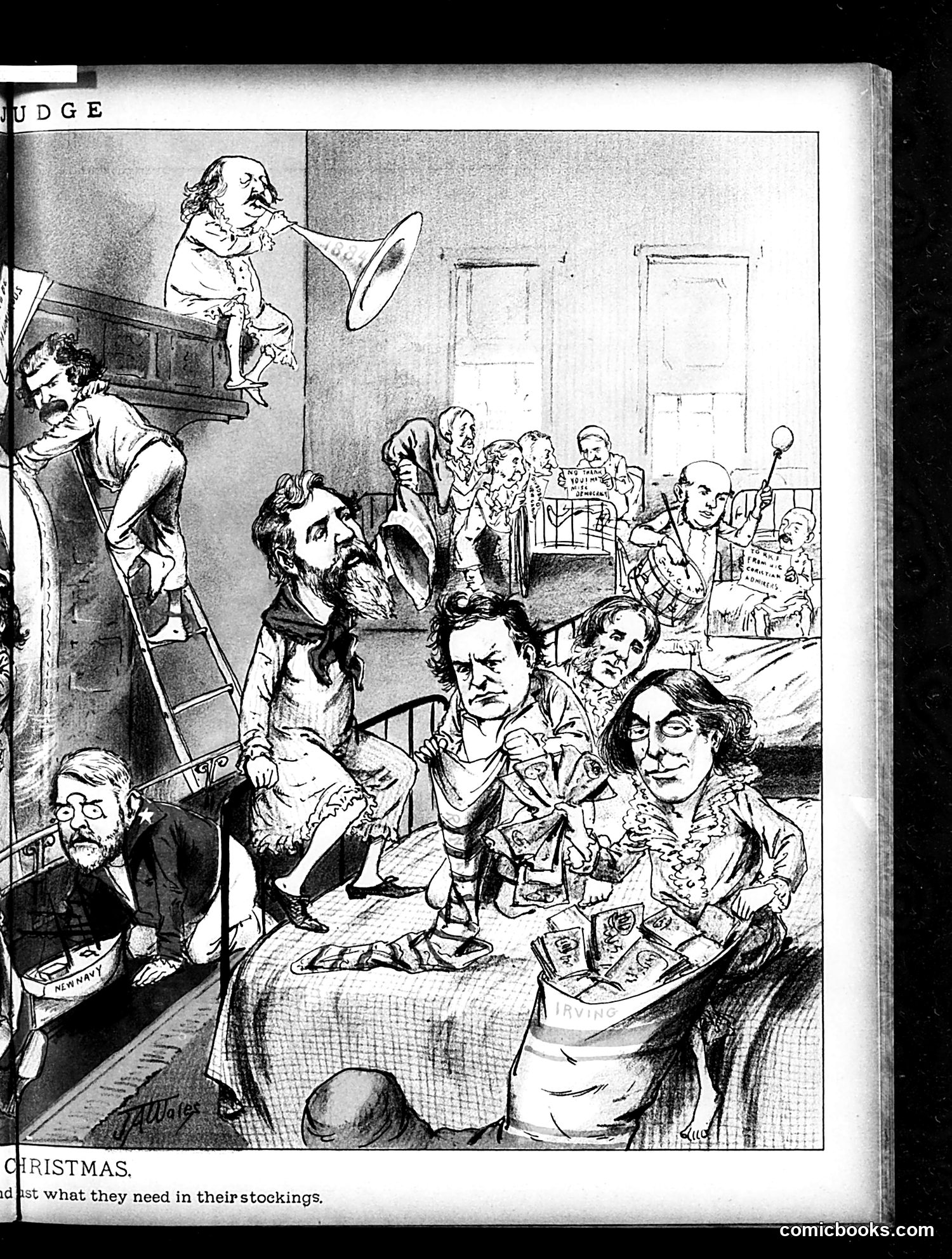
This satirical cartoon depicts a courtroom or judicial scene titled "Christmas," with the caption referencing what figures "need in their stockings." The image shows exaggerated caricatured figures—some appearing to be judges or legal officials—alongside what appears to be a child or young person on an elevated platform or stand (possibly representing testimony or judgment). The cartoon likely satirizes legal corruption, judicial misconduct, or Christmas-related social commentary popular in late 19th/early 20th-century Judge magazine. The caricatures suggest specific public figures of the era, though their precise identities are unclear from the image alone. The "stockings" reference suggests the satirist is commenting on what these officials deserve as punishment or criticism during the Christmas season—implying they're corrupt or deserving of coal rather than gifts. The exact political/social references remain uncertain without additional context.
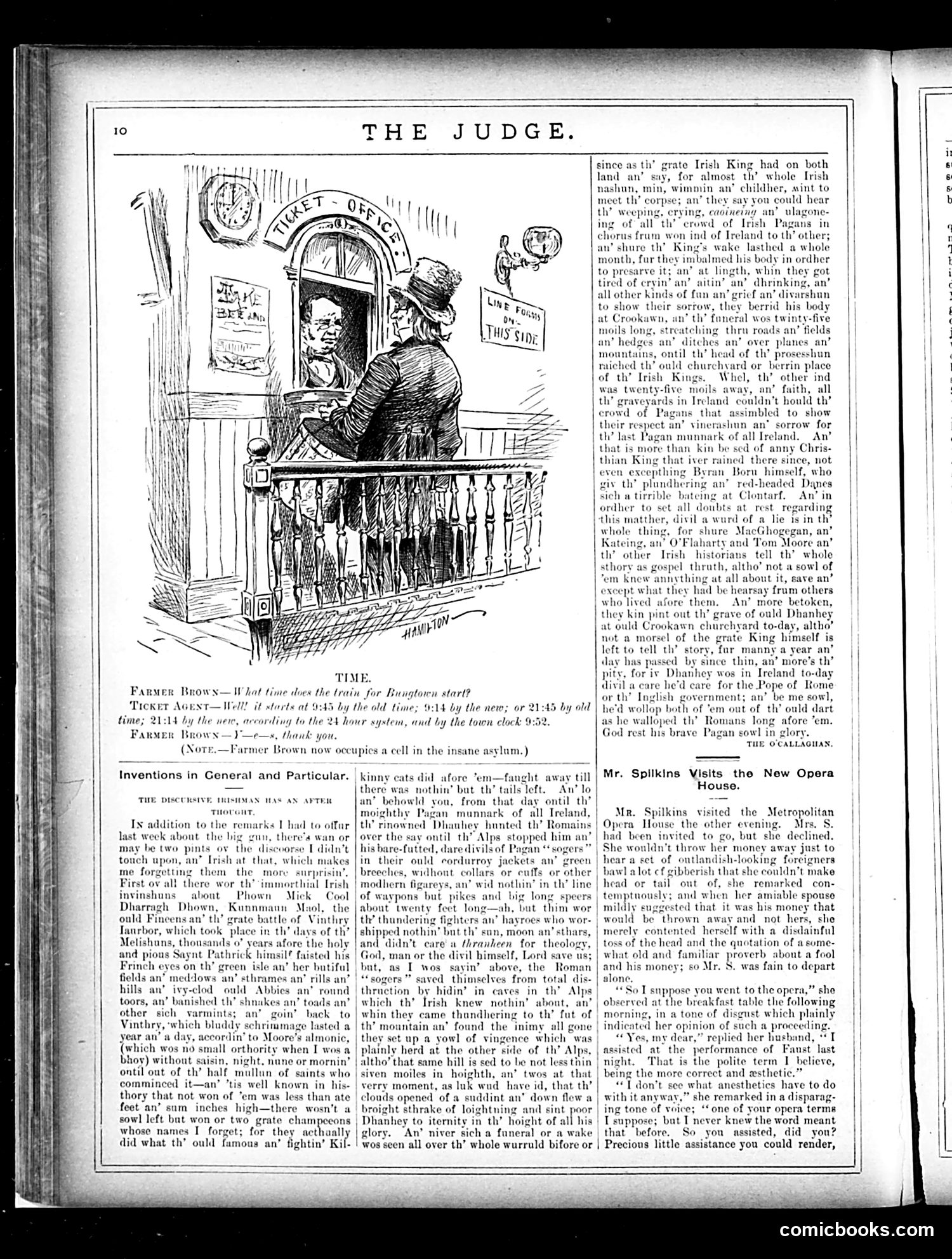
This page contains two distinct pieces of satire: **The Ticket Office Cartoon ("TIME"):** A farmer asks a railway ticket agent what time a train leaves. The agent provides conflicting answers using both old and new time-keeping systems (9:45 old time vs. 9:14 new time, etc.). The joke's punchline reveals the farmer is now insane from the confusion—satirizing the real-world chaos caused by the adoption of standardized time zones in America, which replaced local "town time." This was a genuine source of public confusion in the late 19th century. **"The Discursive Irishman":** A lengthy comic monologue in thick Irish dialect recounting exaggerated historical claims about Irish military prowess and ancient heroes. The satire mocks both the Irish tendency toward boastful storytelling and contemporary stereotypes portraying Irish immigrants as verbose and prone to tall tales. The character appears to be responding to earlier remarks about a "big gun," turning the conversation toward Irish martial glory. Both pieces target confusion and communication breakdowns—one literal, one cultural.
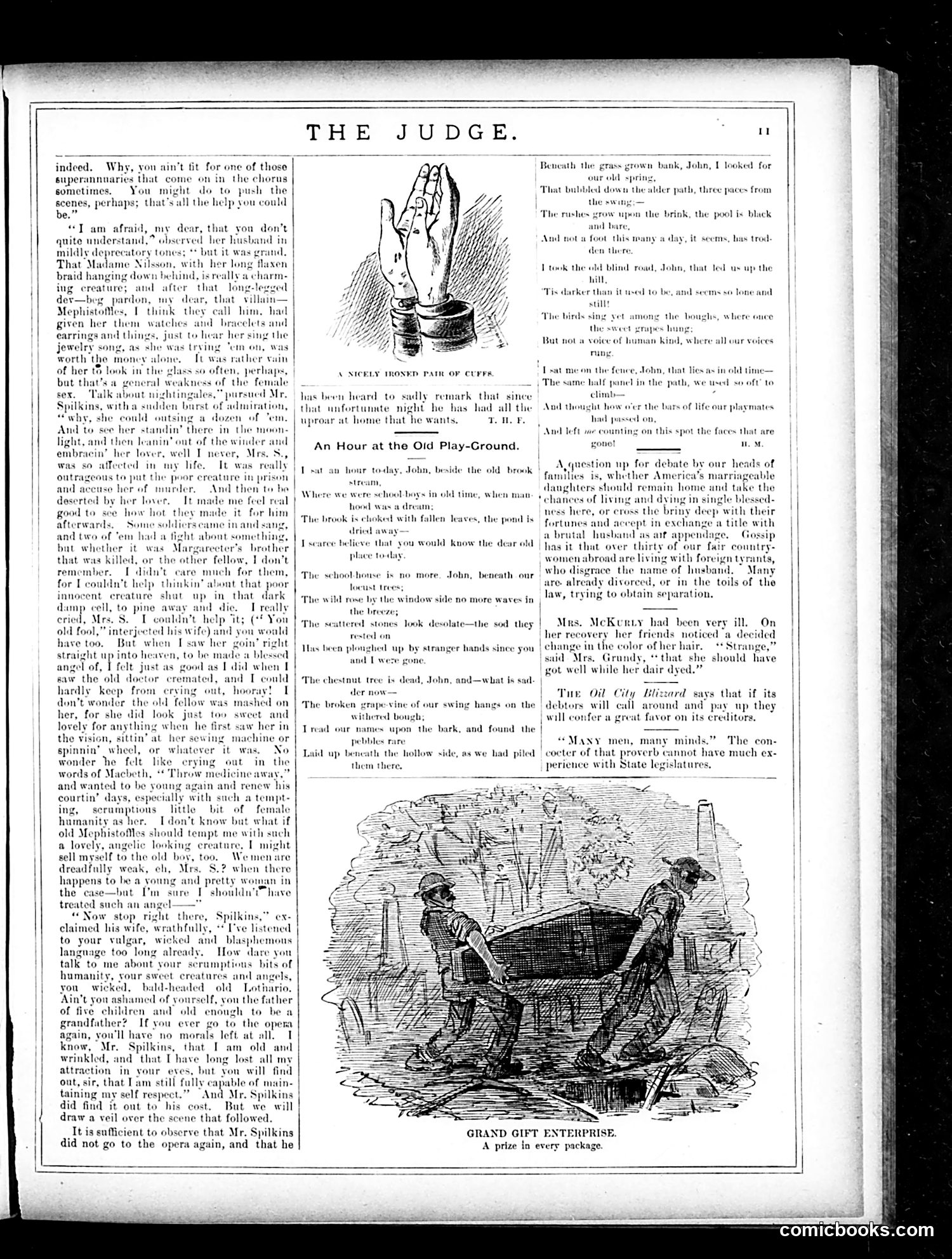
This page contains three distinct pieces of satirical content: **"A Nicely Ironed Pair of Cuffs"** (top illustration): A visual joke depicting a man's praying hands emerging from shirt cuffs, labeled as "nicely ironed." The satire appears to mock either hypocrisy (pretending piety) or perhaps the obsessive attention to sartorial detail among the upper classes. **"An Hour at the Old Play-Ground"** (center text): A conversational piece where one character criticizes another's wife-hunting behavior, specifically mocking a man's infatuation with an opera singer (likely referencing a famous performance, possibly Adelina Nilsson). The satire targets male foolishness and the theatrical affectations of high society. **"The Judge"** (right column, poetry): A nostalgic poem contrasting a childhood brook's vitality with its present decay, seemingly used as filler content. The page's dominant theme is satirizing Victorian society's pretension, gender relations, and the folly of middle-class men enchanted by operatic performers. The humor relies on recognizing contemporary cultural references now obscure to modern readers.
This page from *Judge* magazine contains theatrical criticism mocking New York's Madison Square Theatre and its productions. The main article criticizes Henry De Mille's plays for lacking coherent plots—the author argues that moral lessons don't substitute for actual dramatic structure. The piece references several contemporary actors (Richard Mansfield, Agnes Booth, William J. Scanlan) who abandoned the respectable Madison Square Theatre to perform in melodramas and lowbrow productions elsewhere, undermining the theatre's pretensions to moral instruction. The accompanying poem, "A Tale of Lush," appears to be wordplay satire, repeatedly using "lush" (both legitimate and forced) in poetic verse—likely mocking overwrought theatrical writing or sentimental drama. The satire's point: prestigious institutions claiming moral authority lose credibility when their own performers defect to popular entertainment, exposing the gap between theatrical pretension and practice.
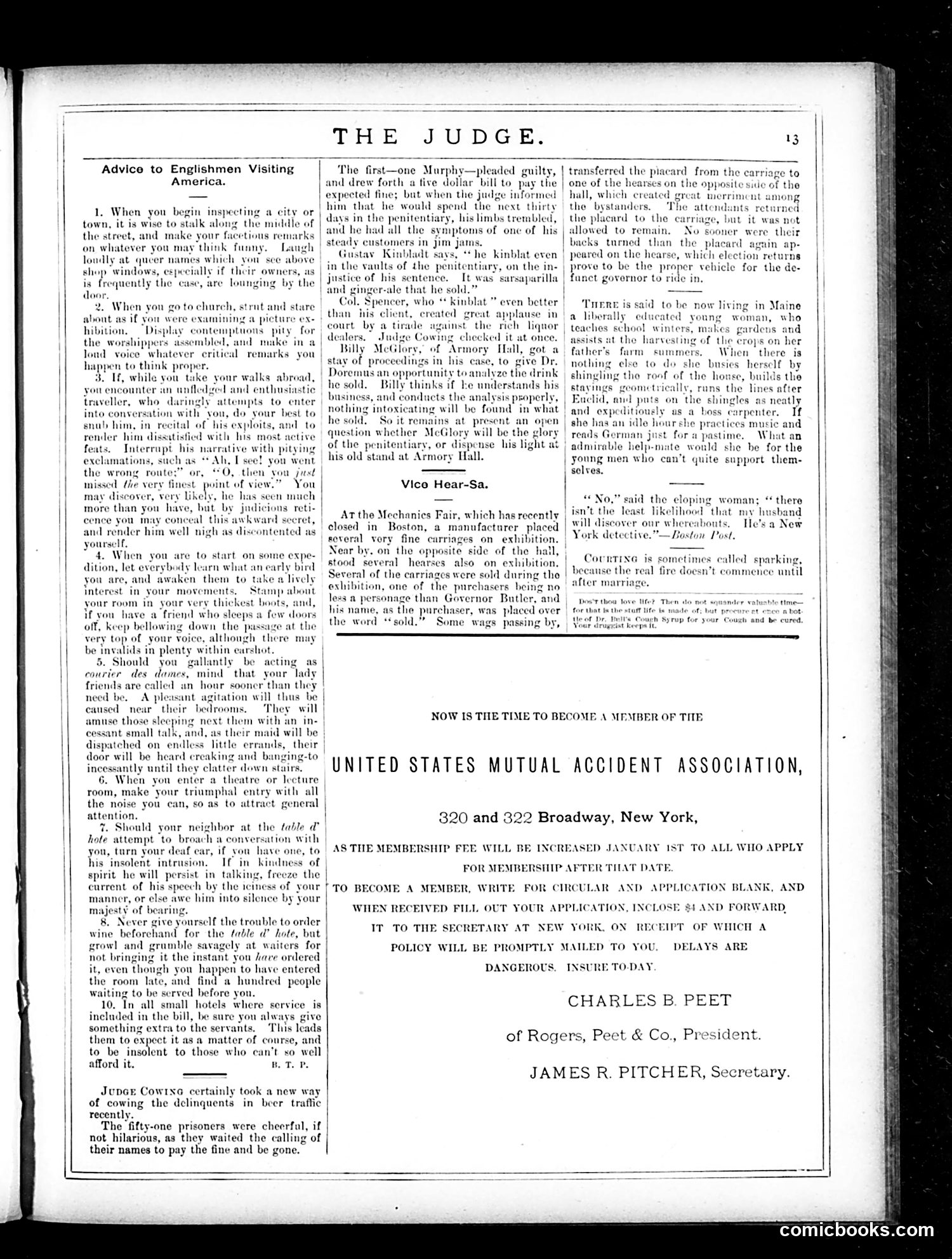
This satirical piece mocks British visitors to America by presenting deliberately terrible etiquette as "advice." The humor inverts proper behavior: laugh loudly at American names, stare disrespectfully in churches, interrupt travelers' stories, make noise before departing, be rude to neighbors, and mistreat servants. The satire targets British snobbery and presumed superiority. Rather than educating Americans, it suggests British tourists are themselves obnoxious—loud, rude, and contemptuous of American customs. The piece (credited to "B.T.P.") exposes how visiting foreigners often behave badly while judging their hosts. The accompanying brief anecdotes about Judge Cowrey sentencing beer-traffic violators and a carriage exhibition further illustrate American legal and commercial life, providing context for the satirical critique of foreign attitudes toward American society.
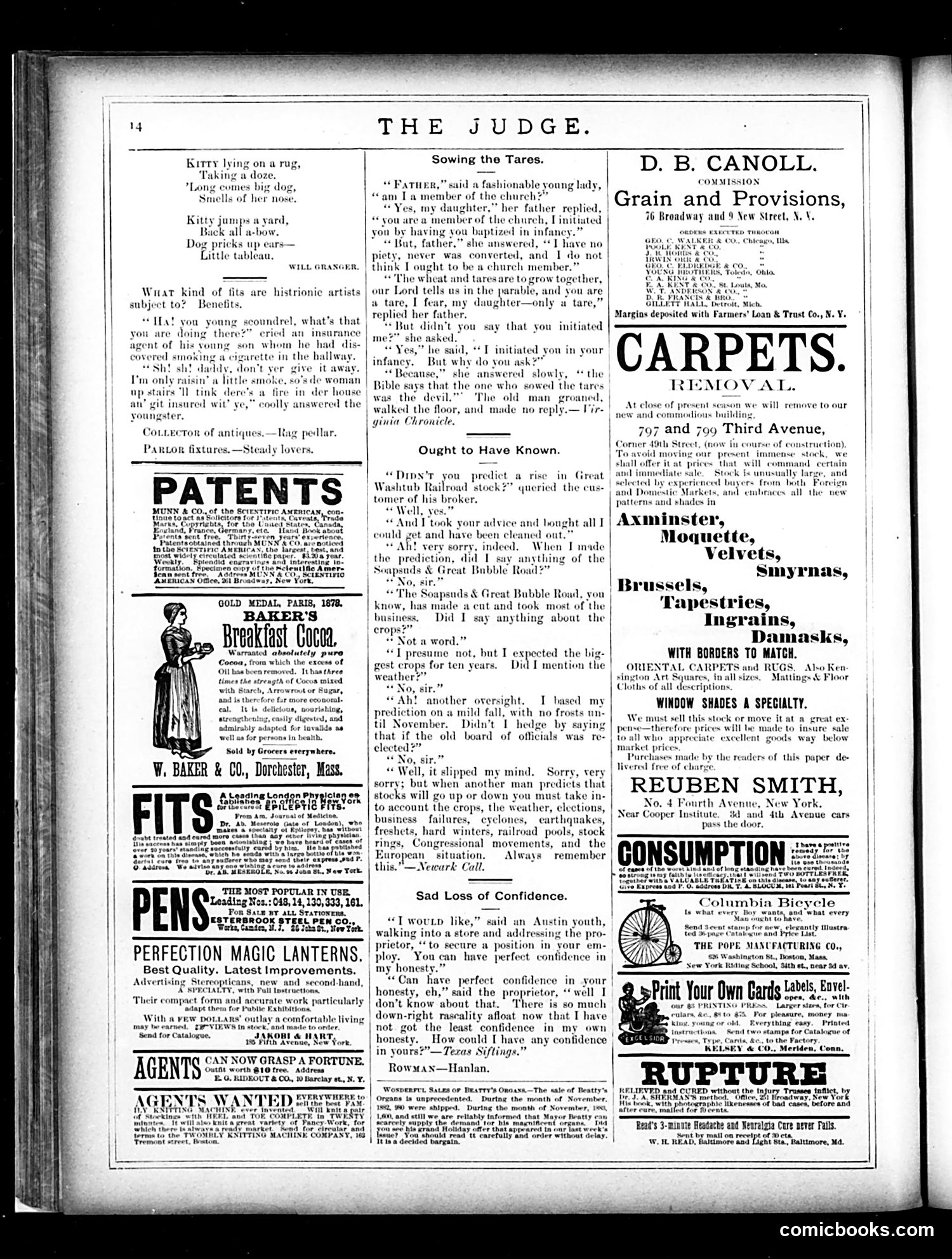
This page is primarily **advertisements and miscellaneous content** rather than political satire. However, it contains several short humorous pieces: **"Sowing the Tares"** depicts a clash between a fashionable young woman and her father about church membership. She claims baptism in infancy doesn't make her a "true" member—referencing the Biblical parable of wheat and tares (good and bad plants). Her father, scandalized, essentially calls her spiritually corrupt ("a tare"), suggesting the satire targets either shallow religious pretension among the wealthy or generational religious doubt. **"Ought to Have Known"** mocks a stock broker's failed predictions about railroad stock. The joke: he based his forecast on weather, crops, and elections but failed to account for actual business fundamentals—satirizing the dubious expertise of financial advisors. **"Sad Loss of Confidence"** presents a youth seeking employment; the proprietor refuses because widespread dishonesty has eroded his faith in anyone's honesty. The page primarily features period advertisements for carpets, cocoa, pens, and patent services.
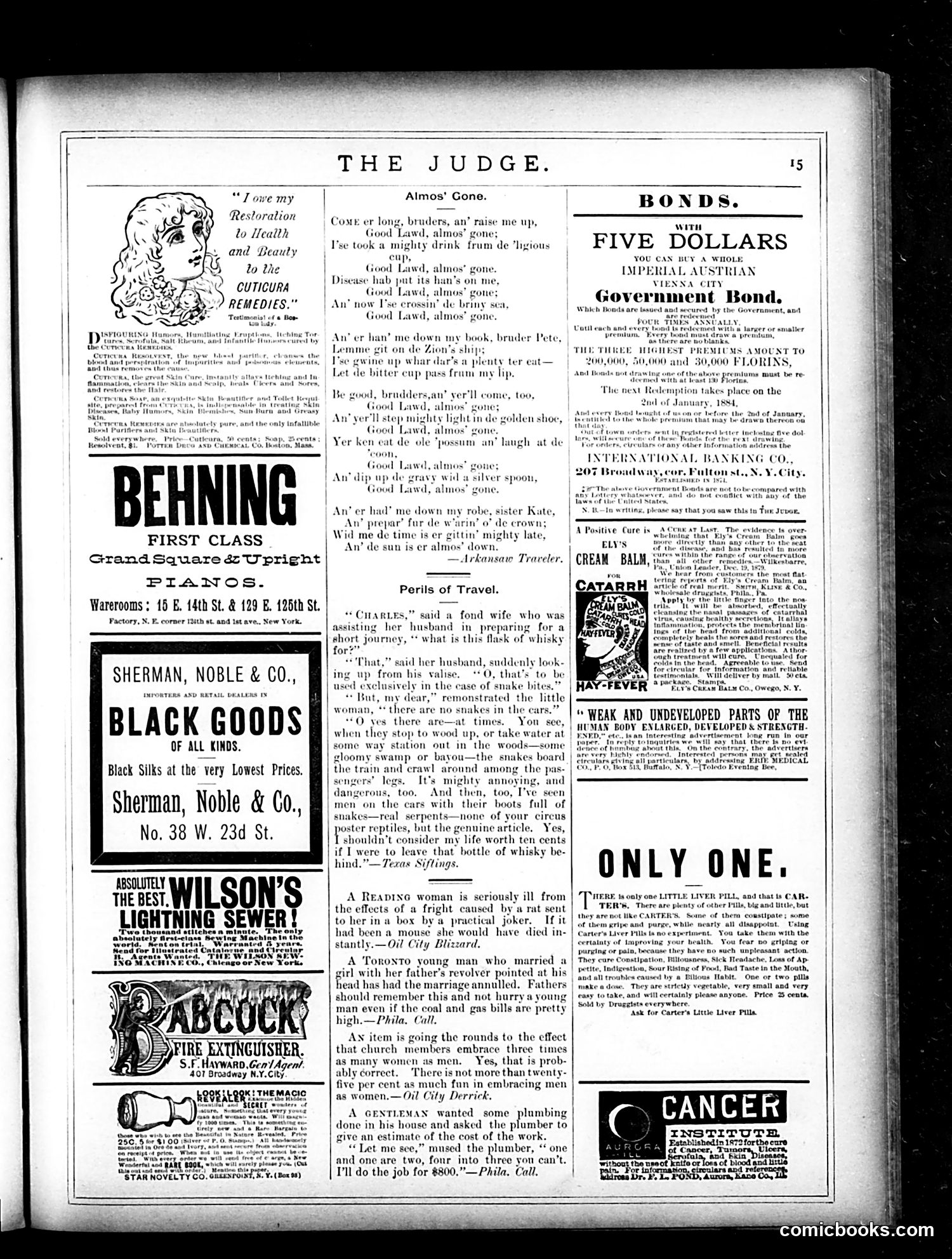
This page is primarily **advertisements and filler content** rather than satirical cartoons. The main notable element is the dialect poem "Almos' Gone," presented as a spiritual or folk song in African American vernacular. **The poem's context:** Published in the 1880s, this represents *period-typical* representation of Black Americans in white publications—using heavy dialect and religious themes. Modern readers should understand this reflects the racial attitudes and stereotyping common to the era, not authentic cultural documentation. The remainder of the page consists of commercial ads (pianos, fabric, sewing machines, medical products) and brief humorous anecdotes in the "Perils of Travel" section—one about a husband bringing whisky to prevent snake bites on a train, another mocking a plumber's mathematical incompetence. These jokes target common anxieties and working-class incompetence rather than political figures. **Overall:** This is a standard commercial page from Judge magazine, mixing light humor with advertising rather than substantive satire.
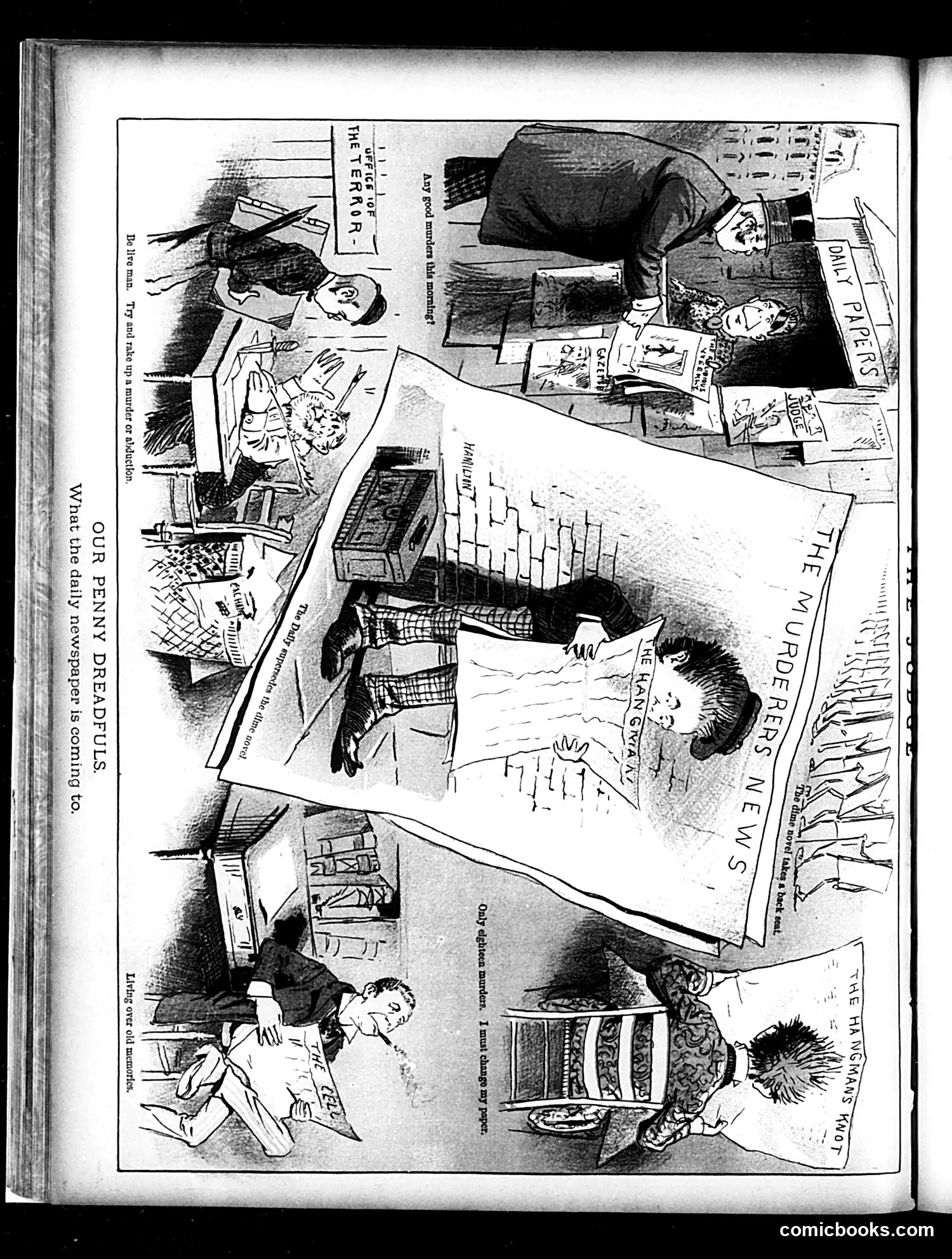
This Judge magazine cartoon satirizes sensationalist American newspapers of the era (appears to be late 19th or early 20th century). The cartoon depicts newspaper vendors/readers complaining that their publication lacks sufficient lurid crime content. One figure says "Only eighteen murders—I must change my paper," while another urges finding "a murder or abduction" to boost circulation. The satire targets the "penny dreadfuls" (cheap newspapers featuring sensational crime stories) and critiques how newspapers competed for readers by emphasizing violent, scandalous content rather than substantive reporting. The title "What the daily newspaper is coming to" suggests concern about journalism's degradation through commercialism and readers' appetite for sensationalism. This reflects genuine Progressive-era anxieties about yellow journalism and media ethics.