
A complete issue · 16 pages · 1883
Judge — December 1, 1883
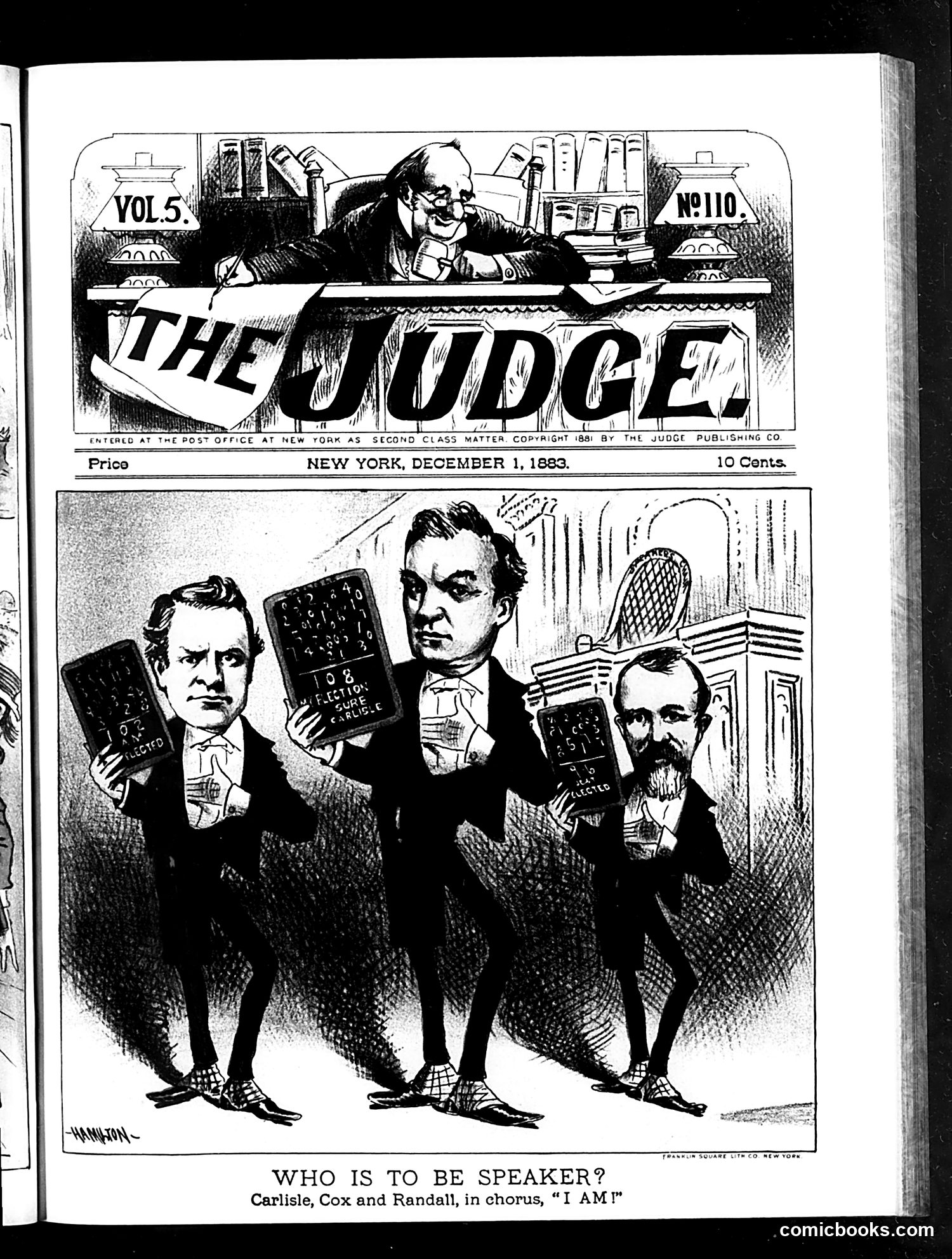
This cartoon satirizes the competitive struggle to become Speaker of the House of Representatives. Three men, identified in the caption as **Carlisle, Cox, and Randall**, hold law books labeled with what appear to be vote counts or procedural rules—their "weapons" in the political contest. The satire mocks how these ambitious politicians are invoking legal technicalities and parliamentary procedure to advance their candidacies rather than relying on genuine qualifications or merit. Each figure clutches his rulebook defensively, suggesting they're using arcane legislative knowledge as their competitive advantage. The judge figure overlooking from above likely represents the House itself or public observation of this procedural maneuvering.
This page from Judge contains two main pieces: **"Thanksgiving"** (left column): A tongue-in-cheek editorial celebrating Thanksgiving while sardonically noting America's genuine problems—murders, bank fraud, "shorn lambs from Wall Street," and dirty streets. The piece mocks the irony of being thankful despite social ills, while acknowledging Thanksgiving as a legitimate "pretty custom" for family reunion. **"A Triangular Fight"** (right column): References Captain Marryatt's novel about a mathematical duel involving three parties arranged as an equilateral triangle. The author draws a contemporary political parallel: the dispute between **Carlisle, Cox, and Randall** over the Speaker's chair. The satire suggests these three political rivals should resolve their conflict as elegantly as Marryatt's mathematical duelists, rather than fighting chaotically. This appears to reference late-19th-century House leadership disputes, mocking the messiness of actual politics versus orderly literary solutions.
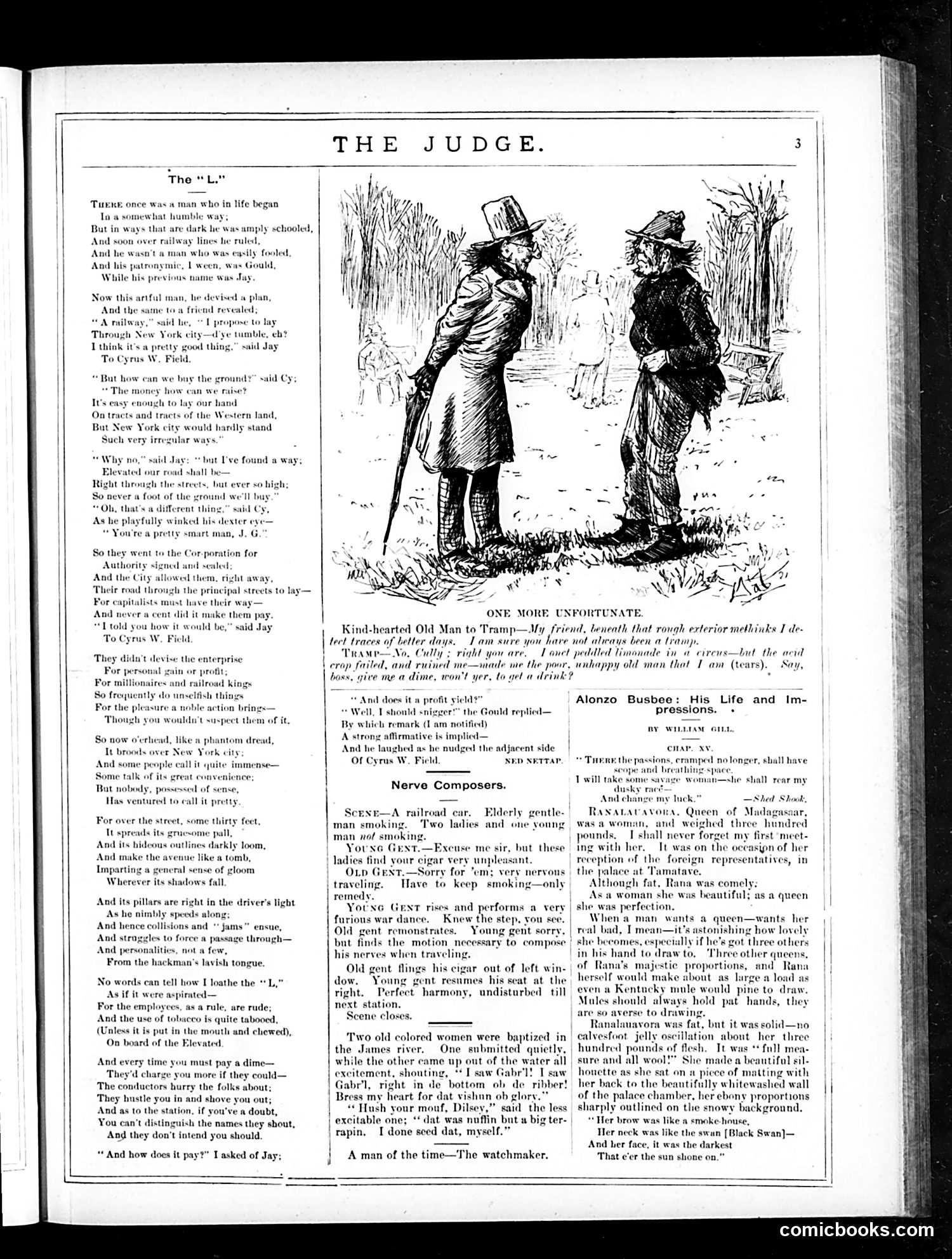
This page from *Judge* contains three distinct pieces of satire: **"The 'L'" (Main Cartoon):** A lengthy poem attacking the elevated railway in New York City, apparently built through an arrangement between railroad magnate Jay Gould and financier Cyrus W. Field with city authorities. The satire mocks how they obtained land rights through corrupt "Corporation" dealings, then profited from an eyesore structure that darkened streets, caused accidents, charged excessive fares (a dime), and employed rude conductors. The joke: Gould and Field claimed it benefited the public, but obviously enriched themselves. **"One More Unfortunate":** A brief comic dialogue where a sympathetic old man recognizes a tramp's "better days," but the tramp admits his farm failed—he's genuinely poor, not romantically fallen. Dark humor about real economic hardship. **"Nerve Composers":** A slapstick vignette where a young man's involuntary nervous dancing (caused by an old man's cigar smoke) paradoxically restores peace when the old man removes the cigar. The page reflects *Judge's* focus on urban corruption, class commentary, and absurdist humor.
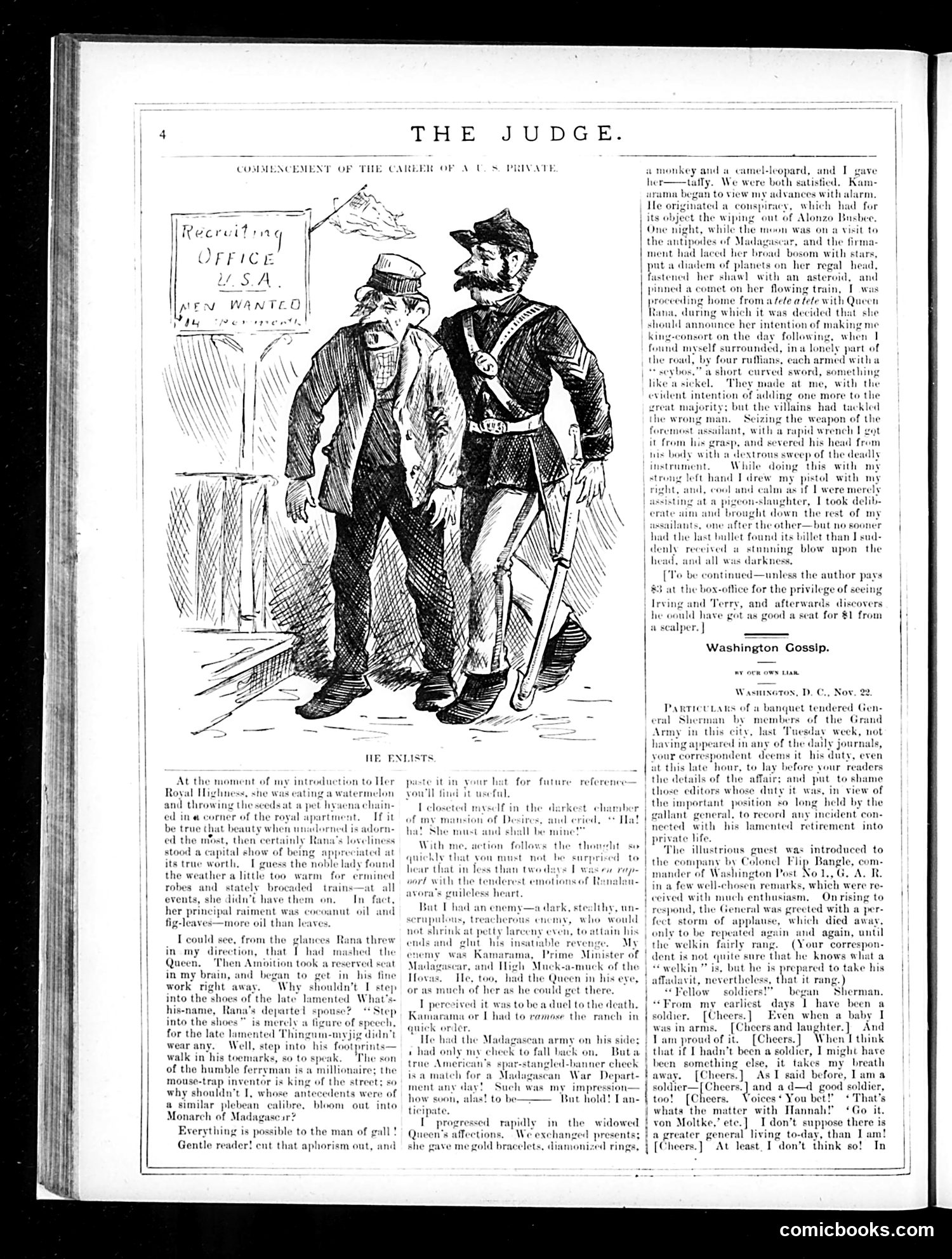
This page satirizes American military recruiting and features two main elements: **The Cartoon ("He Enlists"):** A recruiting officer at a U.S. Army office approaches a disheveled civilian, likely mocking the desperation of military recruitment. The contrast between the smartly uniformed officer and the slovenly recruit suggests humor about the quality of enlisted men. **"Washington Gossip" Column:** A rambling, absurdist narrative about a banquet for General Sherman's retirement. The piece mocks Washington society and journalistic pretension—the author complains other editors didn't cover the event, then provides a deliberately overwrought account mixing domestic melodrama (defending a queen named Rana) with military grandiosity. The humor lies in the ornate, self-important tone of society journalism and the mockery of Sherman's celebrated status. Together, these pieces satirize both military recruitment struggles and Washington's self-congratulatory elite culture during the post-Civil War period.
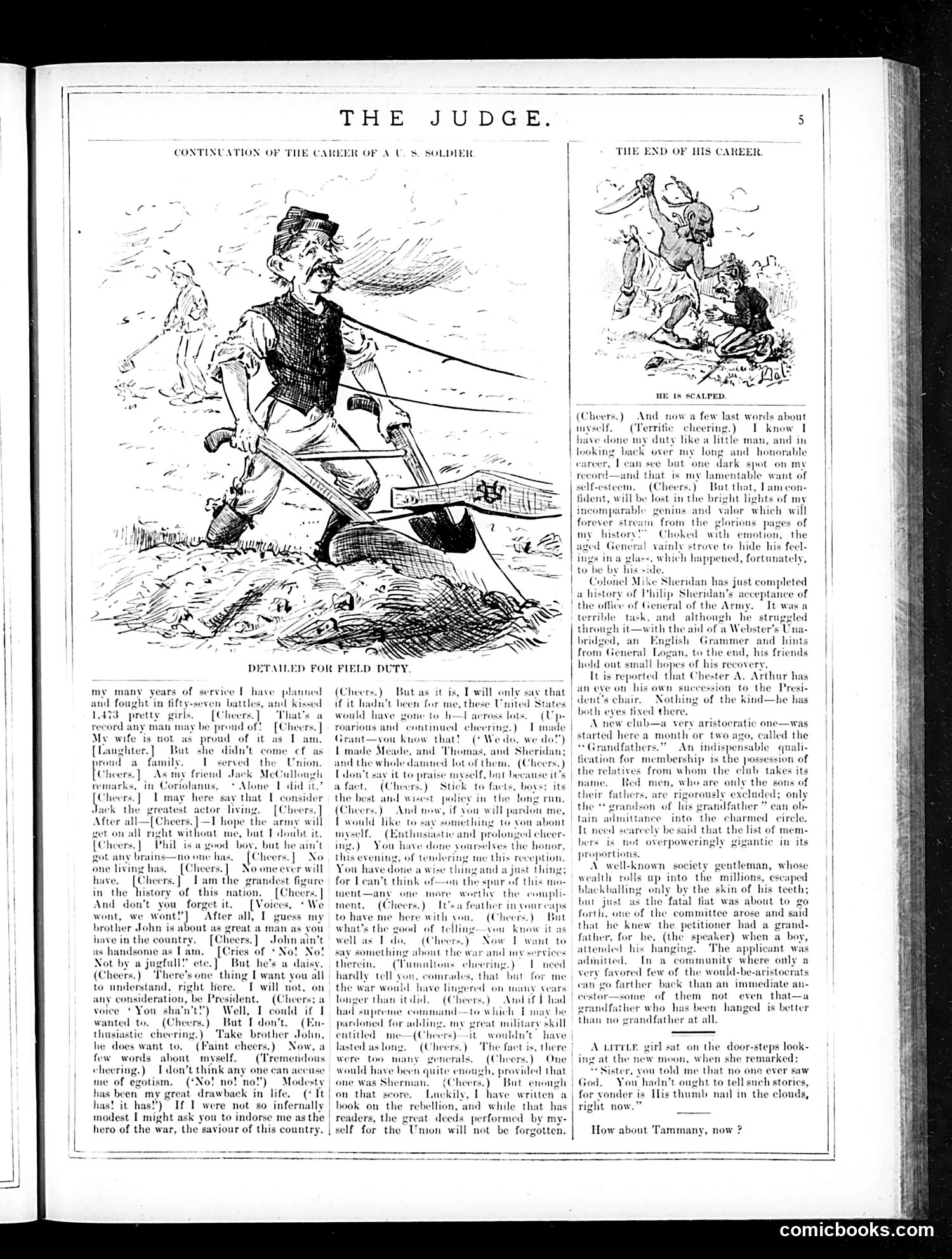
This page satirizes a pompous Civil War general's self-aggrandizing speech. The left cartoon shows a bloviating soldier claiming credit for Union victory, boasting he "made Meade" and the other generals, and repeatedly interrupting himself with false modesty ("I'm not as proud of it as I am"). He's depicted as an egomaniacal blowhard. The right cartoon, titled "The End of His Career," shows him being scalped by Native Americans, suggesting comeuppance for his arrogance. The accompanying text references General Philip Sheridan's acceptance as "General of the Army," and hints at political ambitions—someone (likely Sheridan) has his eye on the presidency. The satire targets military self-promotion and the gap between actual wartime service and inflated self-assessment. The scalping image, while grotesque by modern standards, was a common period trope for humiliation or downfall.
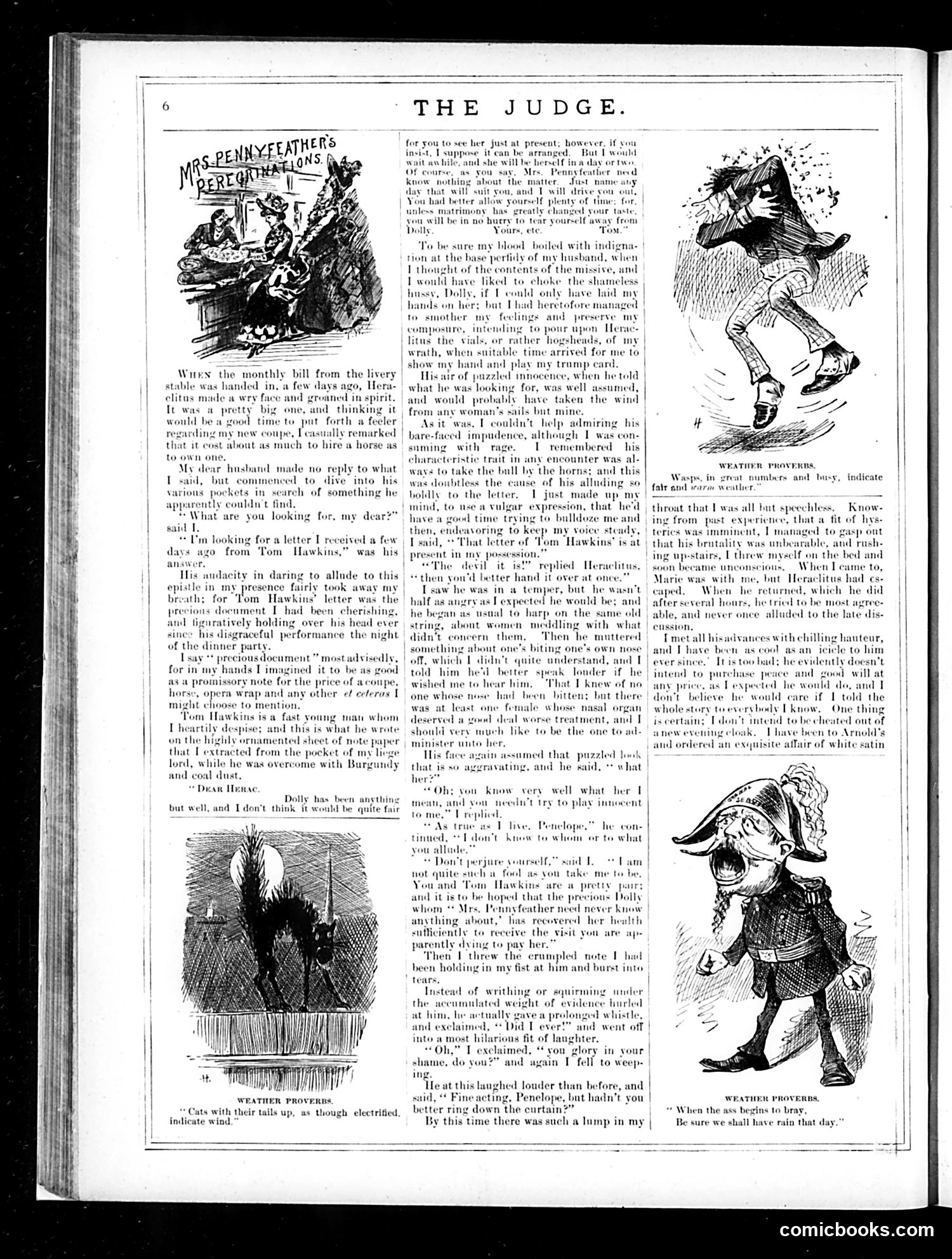
This page contains a serialized domestic fiction story titled "The Judge," likely a popular serial from Judge magazine (a 19th-century American satirical weekly). The narrative concerns a wife discovering her husband's infidelity through a letter from "Tom Hawkins" involving a woman named "Dolly." The central satire targets **marital discord and the performative nature of domestic disputes**—the husband tries to manipulate his wife through feigned innocence and aggressive confrontation ("taking the bull by the horns"), while she responds with theatrical emotion and dramatic accusations. The accompanying illustrations show weather proverbs (cats' tails predicting wind, etc.), which provide comedic sidebar commentary rather than connecting to the main plot. **The broader satire**: Judge mocks both spouses' theatrical behavior during quarrels—the husband's crude bluffing and the wife's hysterical tearfulness—suggesting that Victorian domestic conflicts were performative rituals rather than genuine emotional exchanges. The tone is cynical about marriage itself.
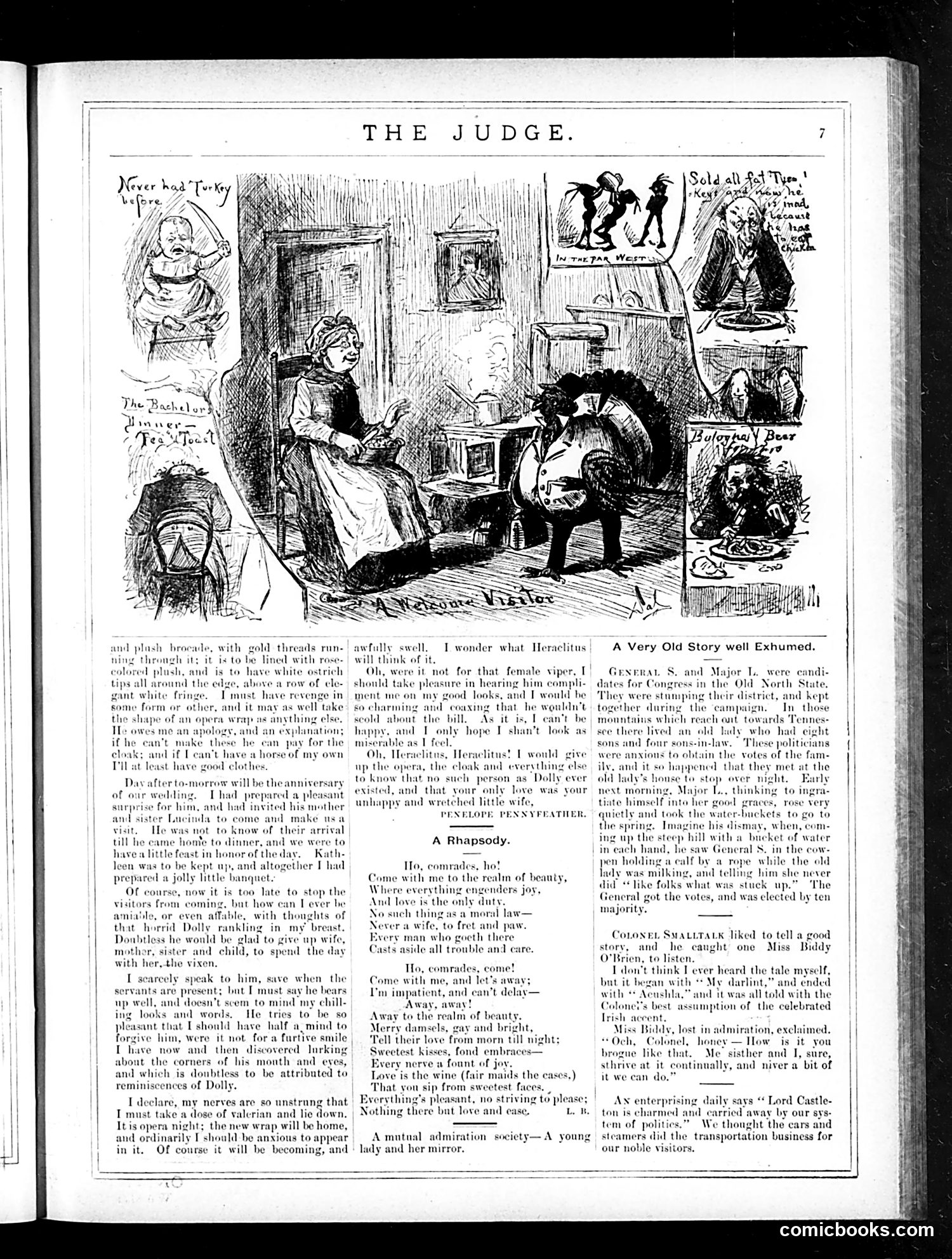
This page contains multiple satirical pieces typical of Judge's social commentary: **Main Cartoon**: "A Recusant Visitor" depicts a domestic scene where a jealous wife (Penelope Pennyfeather) resents her husband's attention to a woman named Dolly. The surrounding vignettes mock various character types—the bachelor, the woman of fashion, a bulwark of society—using exaggerated Victorian archetypes to satirize social pretension and marital discord. **"A Rhapsody"**: A poem mocking sentimental romantic idealism, suggesting love requires no effort or struggle—satire of flowery Victorian sentiment. **Political Anecdote**: A story about political candidates (Senators S. and Major L.) campaigning in North Carolina, where an old woman's vote proves decisive. The humor lies in her rejecting politicians who are "stuck up," preferring common folk—satire of democratic politics and rural voter preferences. **"Mutual Admiration Society"**: A brief joke about a young woman admiring herself in a mirror, mocking narcissism and vanity. The page overall satirizes Victorian domesticity, romantic excess, political ambition, and social pretension.
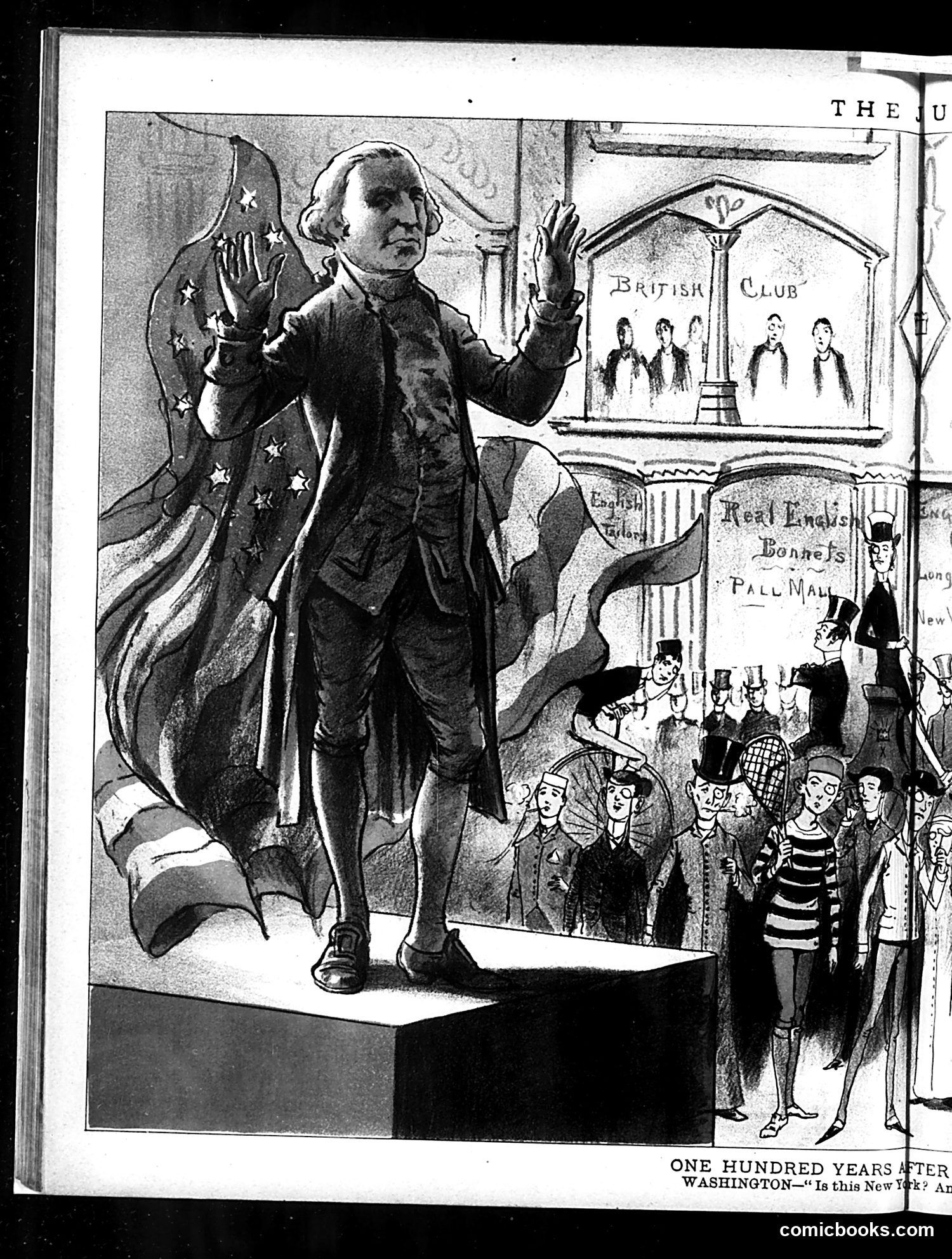
This satirical cartoon depicts a colossal statue of George Washington (identifiable by period dress and pose) dominating a scene labeled "ONE HUNDRED YEARS AFTER WASHINGTON." Below him stands a crowd of well-dressed men outside establishments labeled "British Club," "Real English Bonnets," and "Pall Mall"—references to British fashions and products. The satire critiques American cultural subservience to British styles and preferences a century after the nation's founding. Despite achieving independence from Britain, Americans appear to have surrendered to British aesthetic dominance, surrounding themselves with British goods and institutions. Washington's commanding, questioning gesture seems to express disappointment at this ironic outcome—the new nation he founded has culturally re-colonized itself through consumerism and fashion imitation rather than maintaining independence.
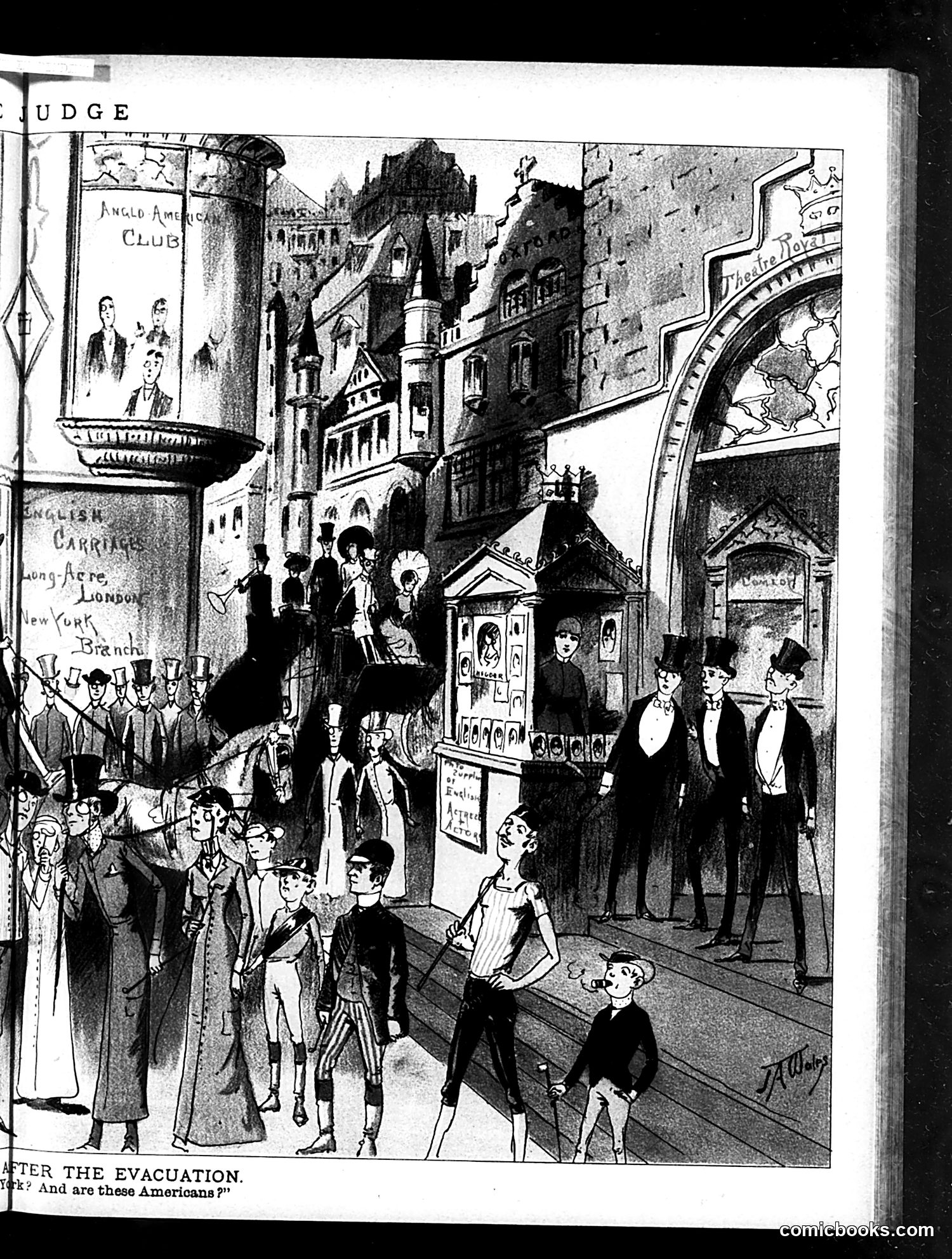
This Judge cartoon satirizes American attitudes toward British institutions during a period of evacuation (likely WWI or WWII). The scene depicts a London street with iconic British architecture and various social establishments (Anglo-American Club, Theatre Royal visible). The caption's question—"And are these Americans?"—appears to mock the American presence or influence in Britain during evacuation. The cartoon contrasts well-dressed British gentlemen and institutions with crowds of presumably American visitors or evacuees, suggesting satirical commentary on Americans abroad and their integration (or lack thereof) into British society. The humor likely targets either American tourists' behavior or military personnel stationed in Britain, questioning their cultural compatibility or propriety.
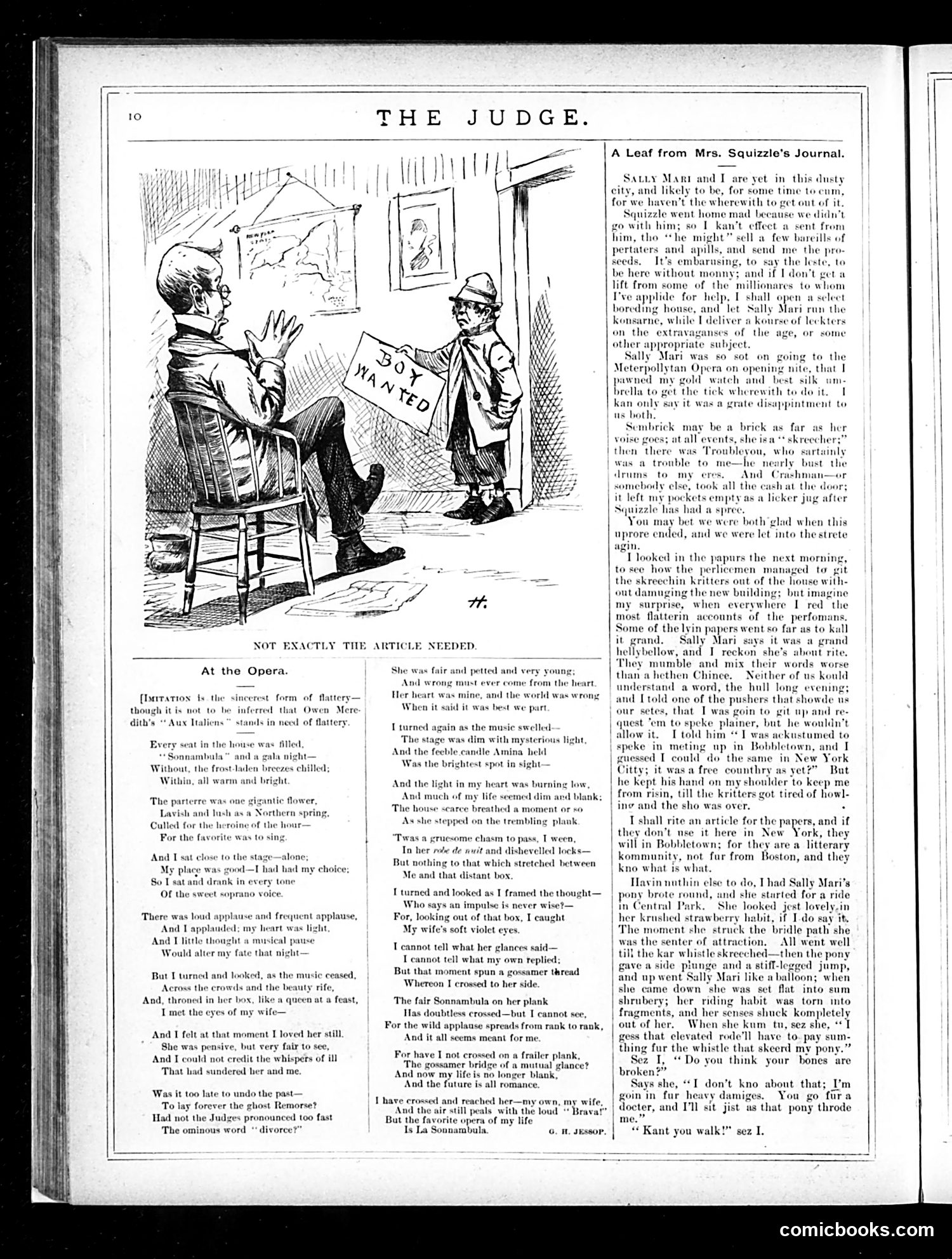
This page contains two distinct pieces from *Judge* magazine: **"NOT EXACTLY THE ARTICLE NEEDED" (Main Cartoon):** The cartoon depicts a man posting a "BOY WANTED" notice while a young boy stands nearby. The title's joke suggests this is satirizing mismatched expectations—likely commenting on employment or social situations where what's advertised doesn't match what's actually needed or desired. The specific context is unclear without additional historical information. **"At the Opera" (Poem/Story):** This sentimental narrative describes a divorced man who, while alone at the opera, glimpses his estranged wife in a box across the theater. During a dramatic moment in the performance (the opera *La Sonnambula*), they make eye contact, creating an emotional reconciliation. The piece romanticizes the possibility of rekindling their relationship through this chance encounter. **"A Leaf from Mrs. Squizzle's Journal" (Satirical Diary Entry):** Written in exaggerated dialect, this mocks a woman of limited means who pawned her watch to attend the Metropolitan Opera's opening night, only to have the performance disrupted by audience members shrieking. It satirizes social pretension and the gap between aspirations and reality among the working classes.
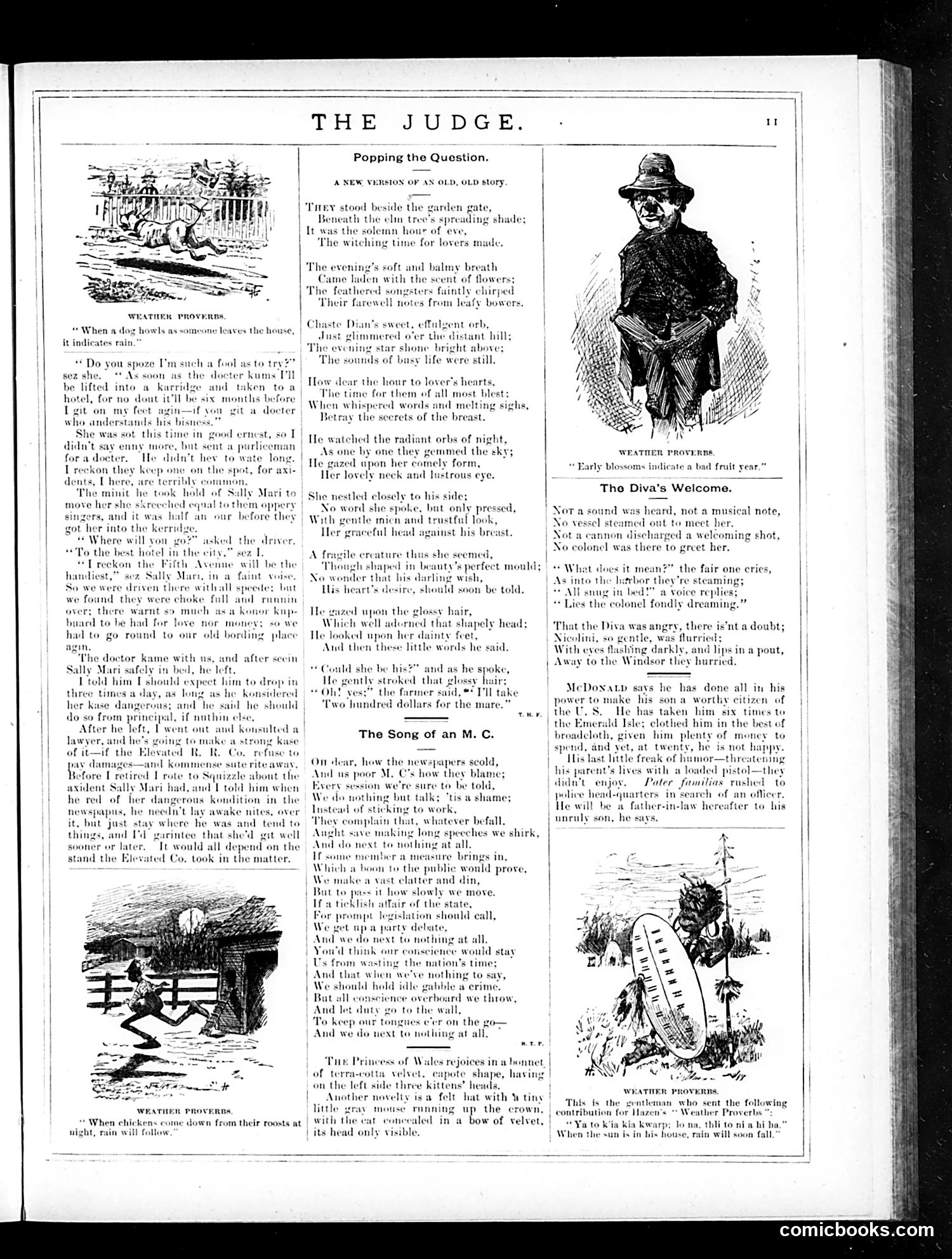
This page from Judge contains several satirical pieces typical of American humor circa late 19th century. The main narrative poem "Popping the Question" subverts romantic convention: a man and woman share an intimate moment beneath an elm tree, building romantic tension through flowery language about her beauty and his desire to propose. The punchline reveals he's actually a farmer proposing to *buy her horse* for two hundred dollars—a crude joke deflating sentimental courtship rhetoric. "The Song of an M.C." (Member of Congress) is political satire mocking legislative ineffectiveness: Congress accomplishes nothing, talks endlessly, stalls beneficial measures, and prioritizes partisan bickering over public service. This reflects contemporary frustration with congressional gridlock. The page also includes "Weather Proverbs" (folk sayings) and "The Diva's Welcome," satirizing operatic pretension through an overwrought reception scene. The illustrations are period woodcuts depicting these domestic and political scenarios in exaggerated style characteristic of Judge's visual humor.
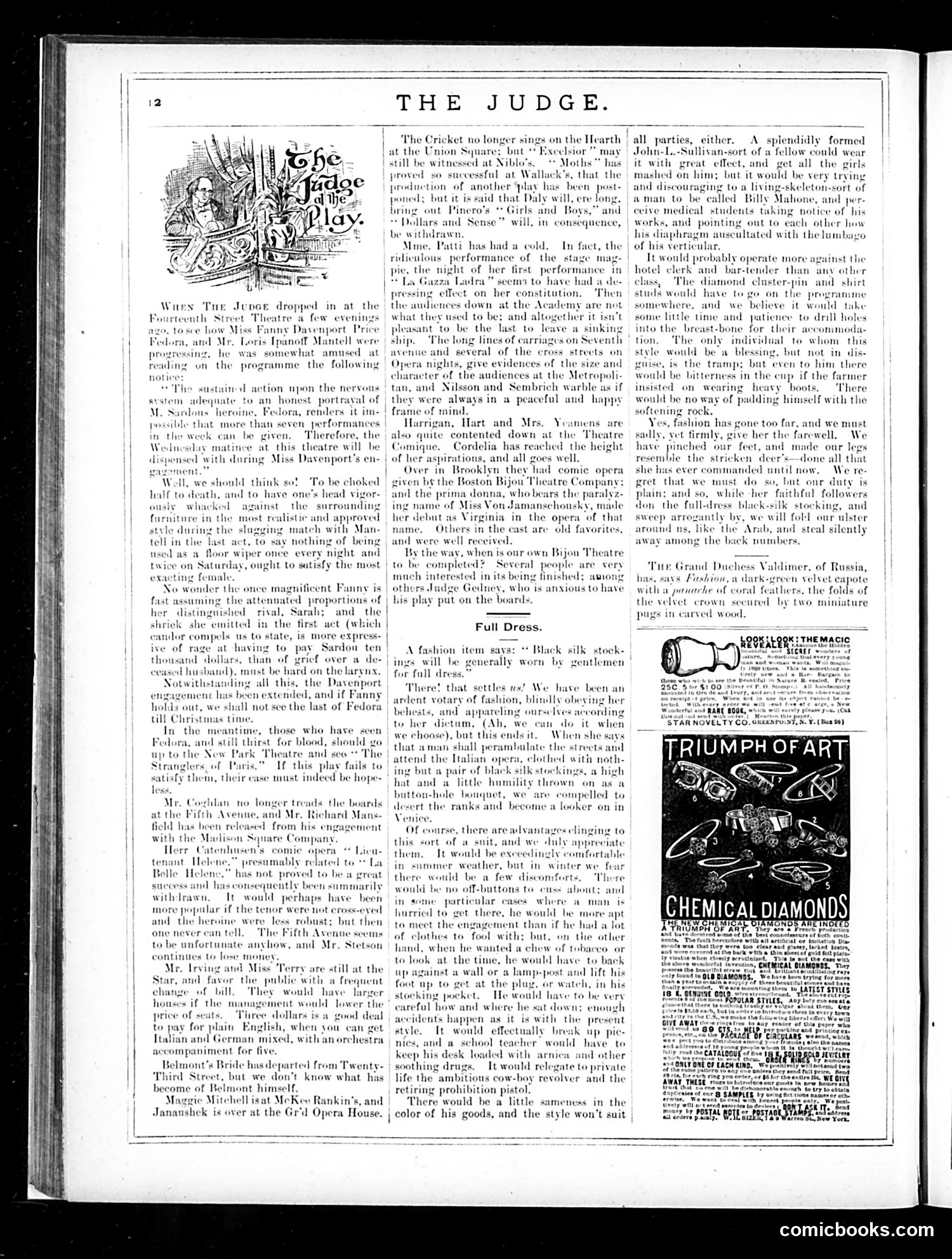
This page from *Judge* magazine consists primarily of theater criticism rather than political cartoons. The illustrated header shows "The Judge at the Play," indicating a regular column reviewing New York theatrical productions. The critic discusses several contemporary stage performances, including Fanny Davenport in *Fedora*, productions at the Fifth Avenue Theatre, and various other venues. The tone is gossipy and sometimes snide—the writer mocks Davenport's exhaustion from performing eight times weekly, jokes about actress Nilsson's cold affecting her performance, and comments on various actors' careers. The second section, "Full Dress," addresses fashion etiquette, specifically debating whether black silk stockings are appropriate formal wear for men attending the opera. The critic takes a somewhat humorous stance on rigid fashion conventions. The advertisements on the right (for "Triumph of Art" and "Chemical Diamonds") are typical period product placements, unrelated to the editorial content.
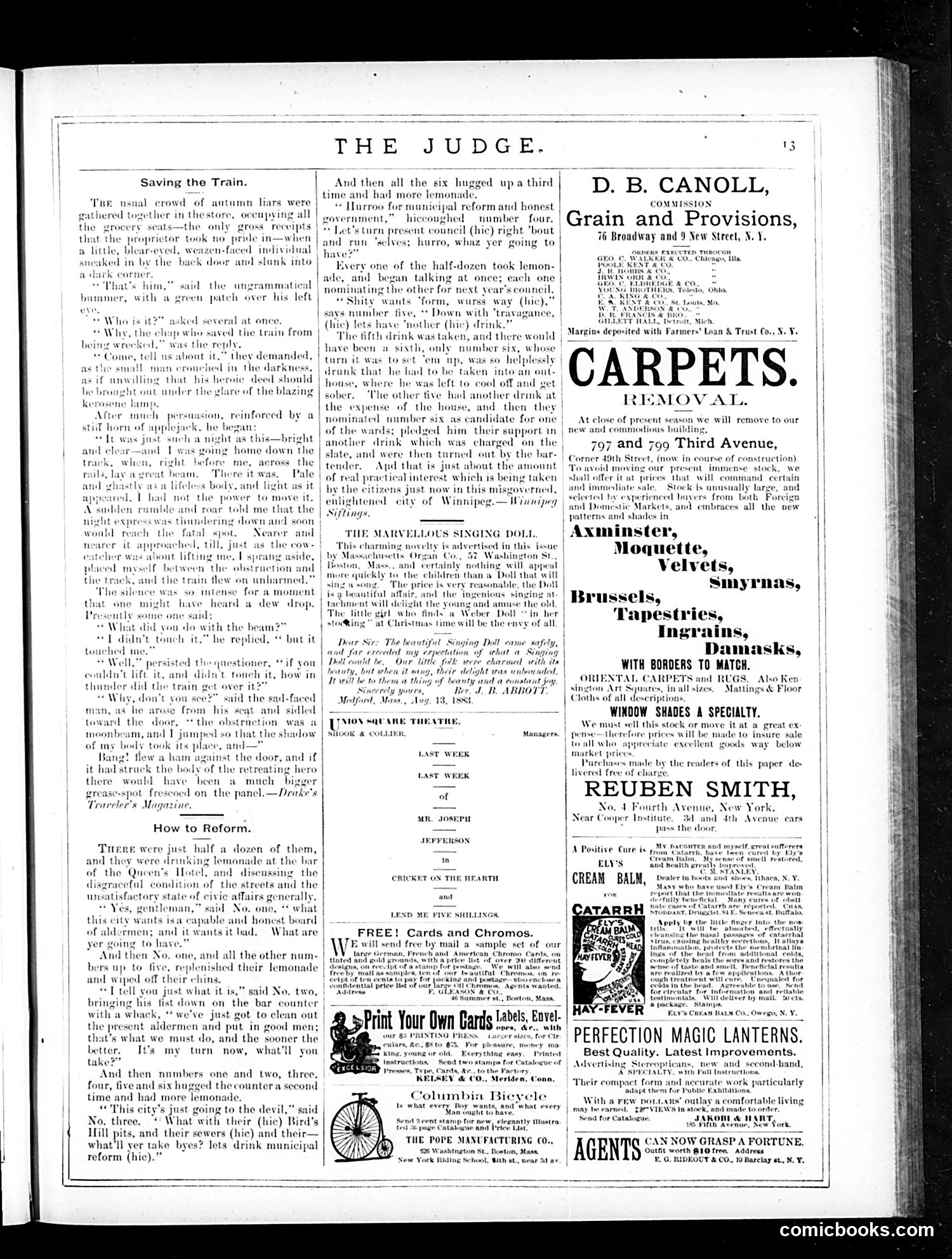
This satirical story mocks the hypocrisy of urban reformers in the 1880s. Six men gather at a bar, loudly proclaiming the need for an "honest board of aldermen" and condemning the city's corrupt government. However, each speech is interrupted by drinking more lemonade (likely a euphemism for alcohol). As they drink, they become progressively intoxicated, and their reform rhetoric devolves into slurred hiccups. Eventually, the drunkest among them—so inebriated he must be carried to an outhouse—becomes their nominee for city council ward representative. They pledge support and charge the celebration drink to the bar tab. The satire's point: those demanding governmental honesty are themselves corrupt hypocrites who conduct actual political business (nominations, pledges) while drunk and self-serving, charging expenses rather than paying honestly. Their rhetoric about reform masks cynical, alcohol-fueled patronage politics—the very corruption they denounce.
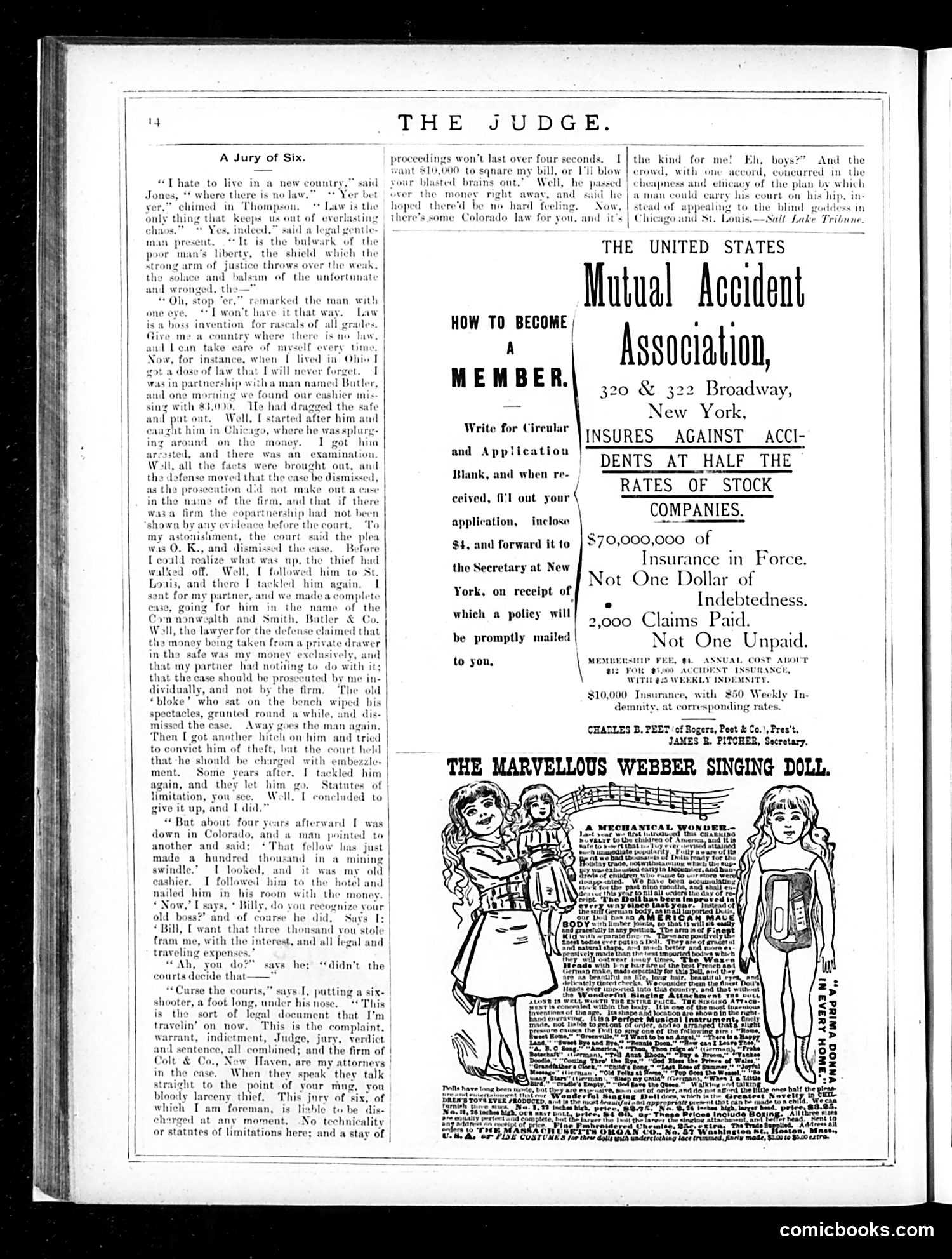
This satirical story mocks the absence of formal legal systems in frontier Colorado. Jones and Thompson discuss how Colorado law is inadequate ("no law"), prompting Jones to recount a personal anecdote about pursuing a cashier who embezzled money. The narrative illustrates frontier "justice": Jones chases the thief to Chicago for examination, but the formal legal system fails—the cashier is released on bail. Years later, Jones encounters the same man now wealthy from mining swindles in Colorado. Rather than trust courts, judges, juries, or statutes, Jones simply threatens him into repaying the stolen money with interest, retrieving his own justice with a gun. **The satirical point**: The story ridicules both the inadequacy of Colorado's legal infrastructure AND suggests that frontier violence and personal coercion are sometimes more effective than formal law. The "jury of six" (presumably armed men) represents frontier vigilantism replacing proper courts—a commentary on the lawlessness of Colorado during the mining era. The page also contains period advertisements, including one for a Mutual Accident Association insurance company.
This page is primarily **advertising with minimal editorial content**. The few articles present are short anecdotes rather than political commentary. The main text pieces are humorous guest testimonials: 1. **"Looking Up Testimony"**: A traveler complains bitterly about terrible hotel food—poor coffee, bad butter, cold soup reheated as "hash," raw biscuits, and saucy waiters. Another man suggests the traveler should testify about these conditions to help the hotel's "reconstruction" under new management. 2. **"He Saw It"**: A railroad promoter seeking subscriptions refuses a poor man's loan request. The man explains he's "a bear in the stock market"—meaning he profits from falling stock prices—making him financially unreliable to the promoter's eyes. Both are light social satire about hospitality failures and financial speculation, typical of *Judge*'s period humor. The remainder of the page is dominated by product advertisements (pianos, cocoa, pens, patent medicines, fire extinguishers) characteristic of 19th-century magazine publishing.
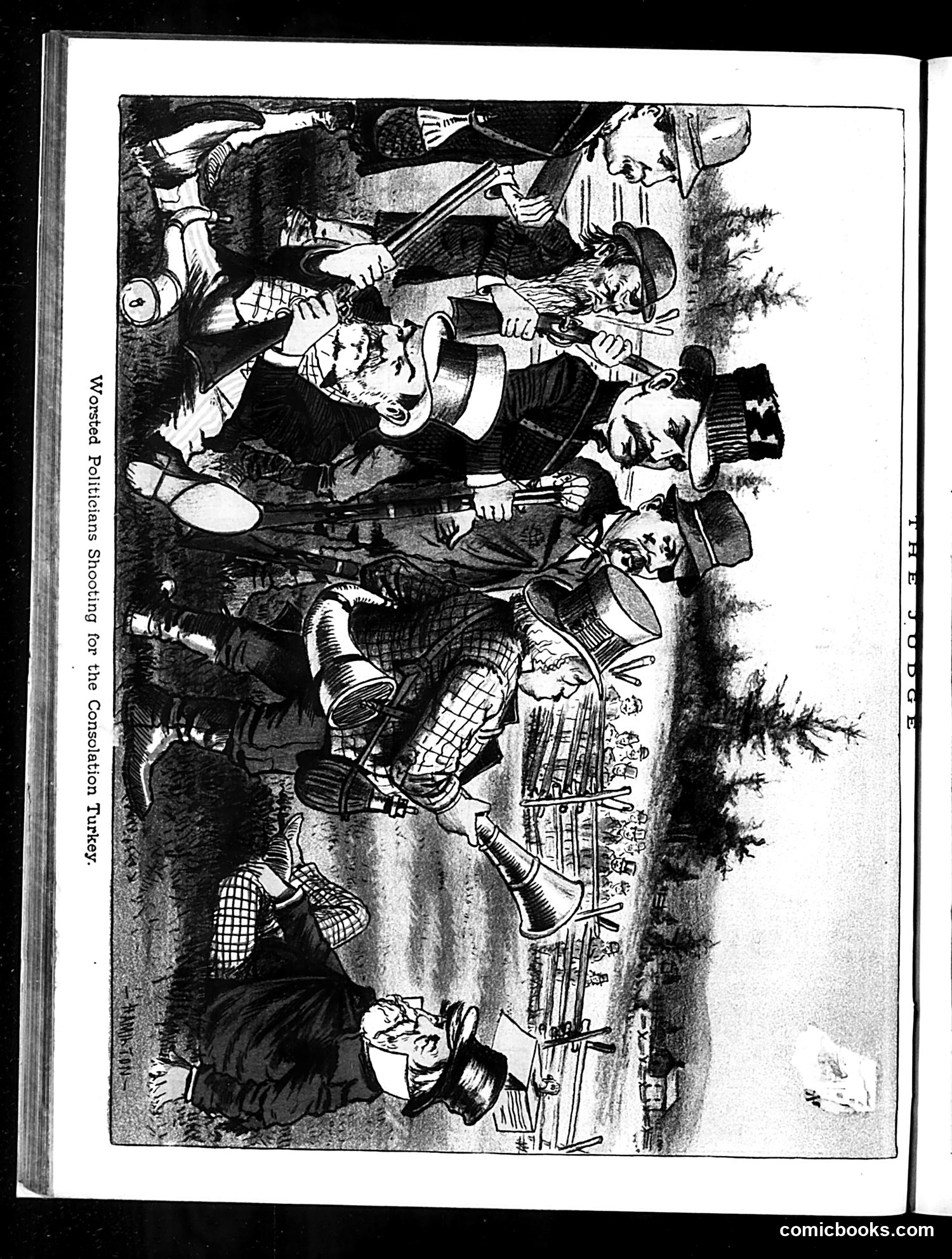
This page appears to be a rotated illustration (meant to be viewed sideways) from *Judge* magazine showing a satirical scene titled "Wrecked Politicians Stocking for the Constitution Turkey." The cartoon depicts multiple figures in formal attire engaged in what appears to be a chaotic, violent struggle or brawl. The title suggests this is political satire about politicians fighting or competing over constitutional matters, metaphorically described as "stocking" (preparing/stuffing) a turkey meant to represent the Constitution itself. The figures are caricatured, likely representing specific politicians of the era, though their identities are unclear from the image alone. The violent, undignified composition emphasizes satirical criticism of political conflict and politicians' behavior. Without dating information visible, the specific historical context cannot be determined with certainty.