
A complete issue · 16 pages · 1883
Judge — November 24, 1883
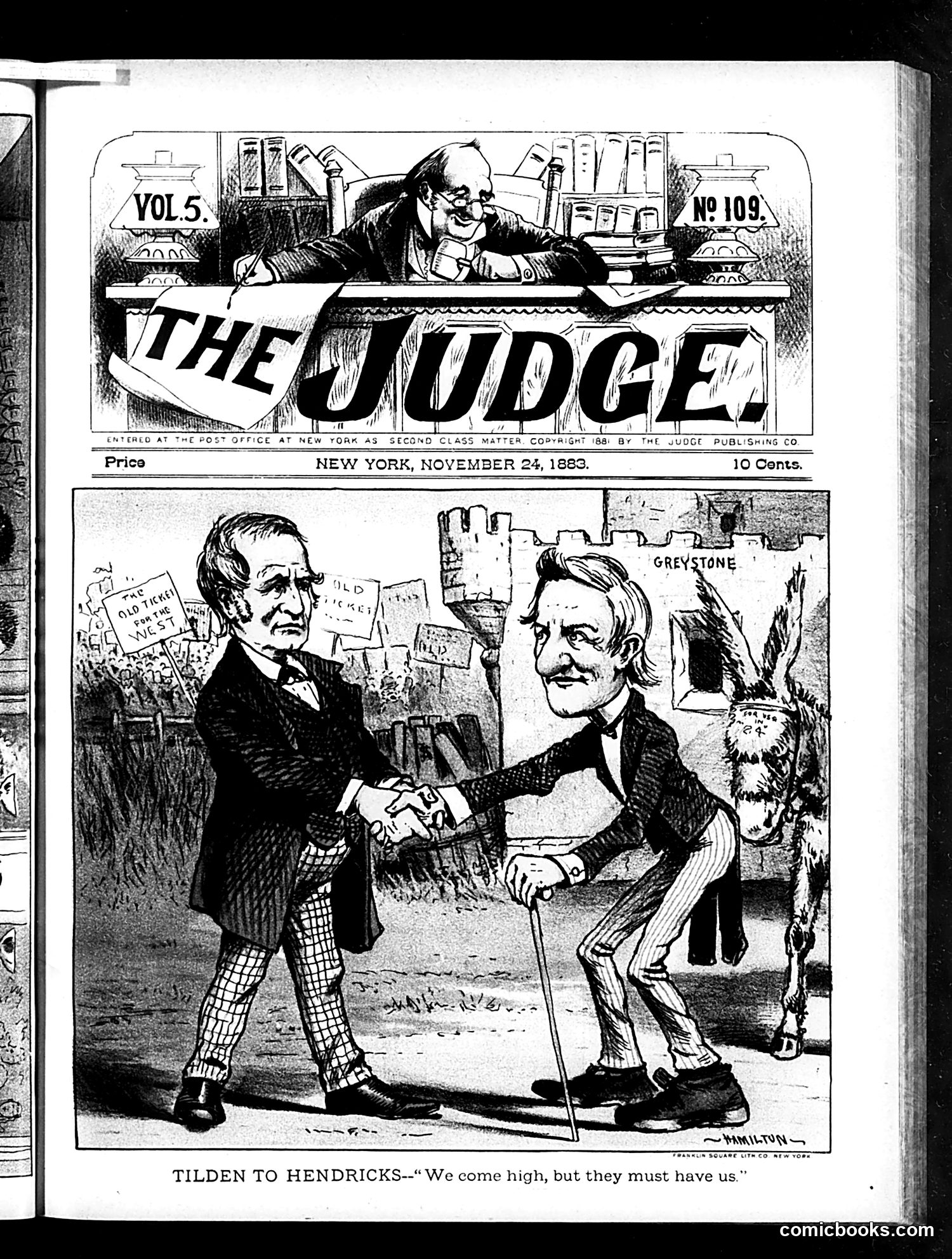
This political cartoon titled "Tilden to Hendricks" shows two men shaking hands beneath Greystone castle. The caption reads: "We come high, but they must have us." The figures appear to be Samuel Tilden and Thomas Hendricks, Democratic politicians of the era. The satirical point seems to concern their political ambitions and demands—suggesting they're positioning themselves as valuable commodities that the party cannot refuse, despite their high asking price (literally or figuratively). The Greystone setting and formal handshake suggest negotiation or deal-making. Without additional context about the specific 1883 political situation, the exact circumstances remain unclear, but the cartoon clearly mocks their presumption of indispensability to Democratic leadership.
This page satirizes the 1876 Presidential campaign featuring Democrat Samuel J. Tilden and his running mate William H. Hendricks. The top cartoon mocks mutual congratulations between these candidates—their exaggerated handshake and "shake, brother!" dialogue suggest false camaraderie masking personal ambition. The text implies both men secretly believe they're indispensable to the party and inflated in importance. The "Purely Political" section discusses New York election results, particularly noting that Democrat Maynard underperformed his ticket, suggesting temperance positions hurt him. It also references John Kelly and Tammany Hall's complex dealings with Republicans for control of city wards—indicating factional corruption within Democratic ranks. The "Rural Congressman" section discusses a rural legislator, likely contrasting rural vs. urban political concerns. The satire suggests deep Democratic Party dysfunction: internal factionalism (Tammany vs. Irving Hall), candidates prioritizing self-interest, and deals with Republicans undermining party loyalty. Judge attacks both the candidates' vanity and the party's organizational corruption.
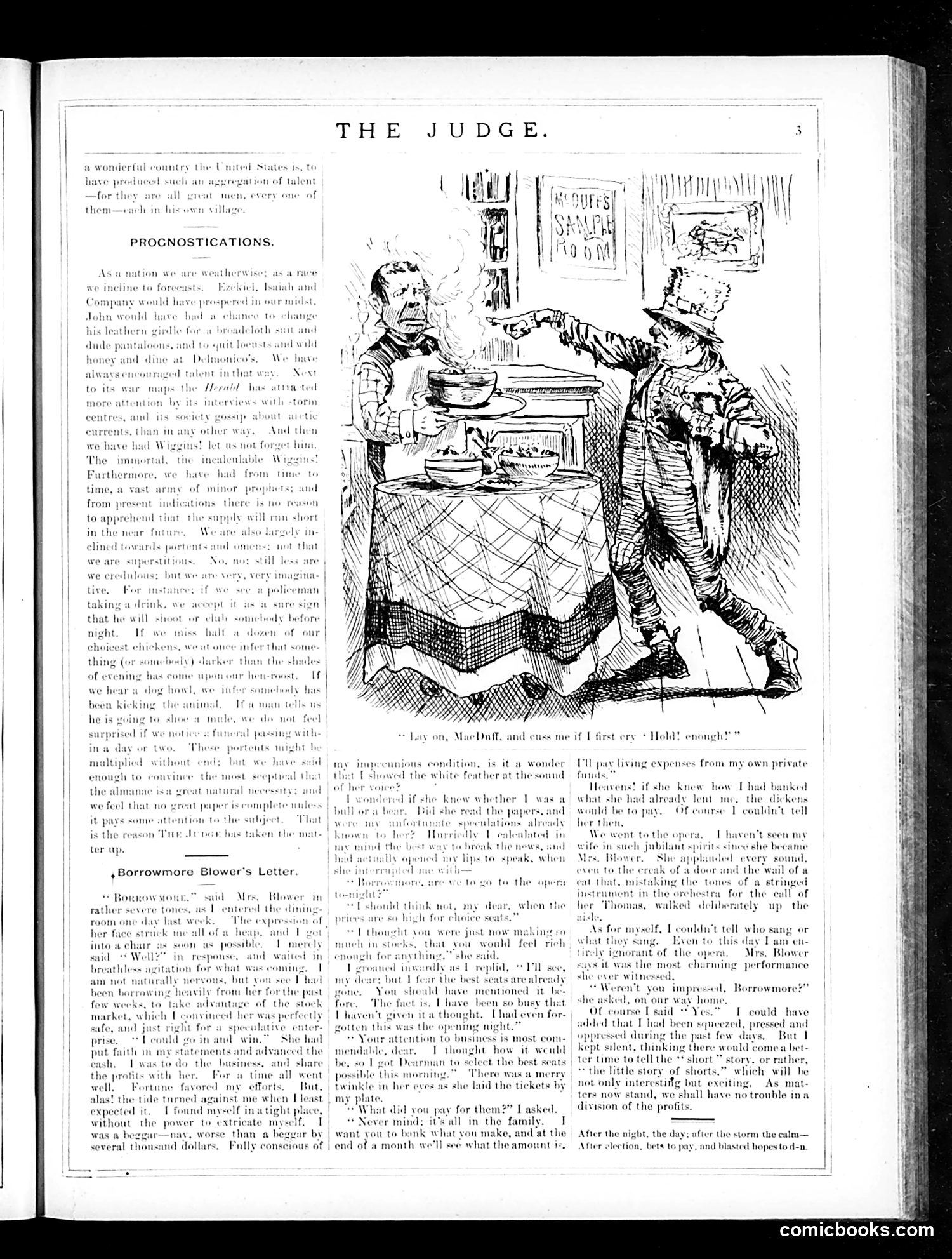
This page contains two distinct pieces: a "Prognostications" column offering satirical social commentary, and "Borrowmore Blower's Letter," a humorous narrative. **"Prognostications"** mocks Americans' tendency toward superstition and fortune-telling. It satirizes how people interpret everyday occurrences as omens—a pedestrian drinking predicts violence, a chicken's death suggests darker events. The piece criticizes this gullible "imaginative" thinking as characteristic of the nation. **"Borrowmore Blower's Letter"** describes a financial misadventure. A man lends money to an acquaintance (likely "Mrs. Blower"), who uses it for opera tickets and other expenses. When the borrower asks repayment, the lender avoids direct answers, claiming funds are "tied up" in family matters. The satirical humor targets both the borrower's financial irresponsibility and the lender's complicity in enabling it—a common social problem of the era regarding informal lending and broken promises. Both pieces reflect *Judge* magazine's focus on middle-class social folly and financial mishaps.
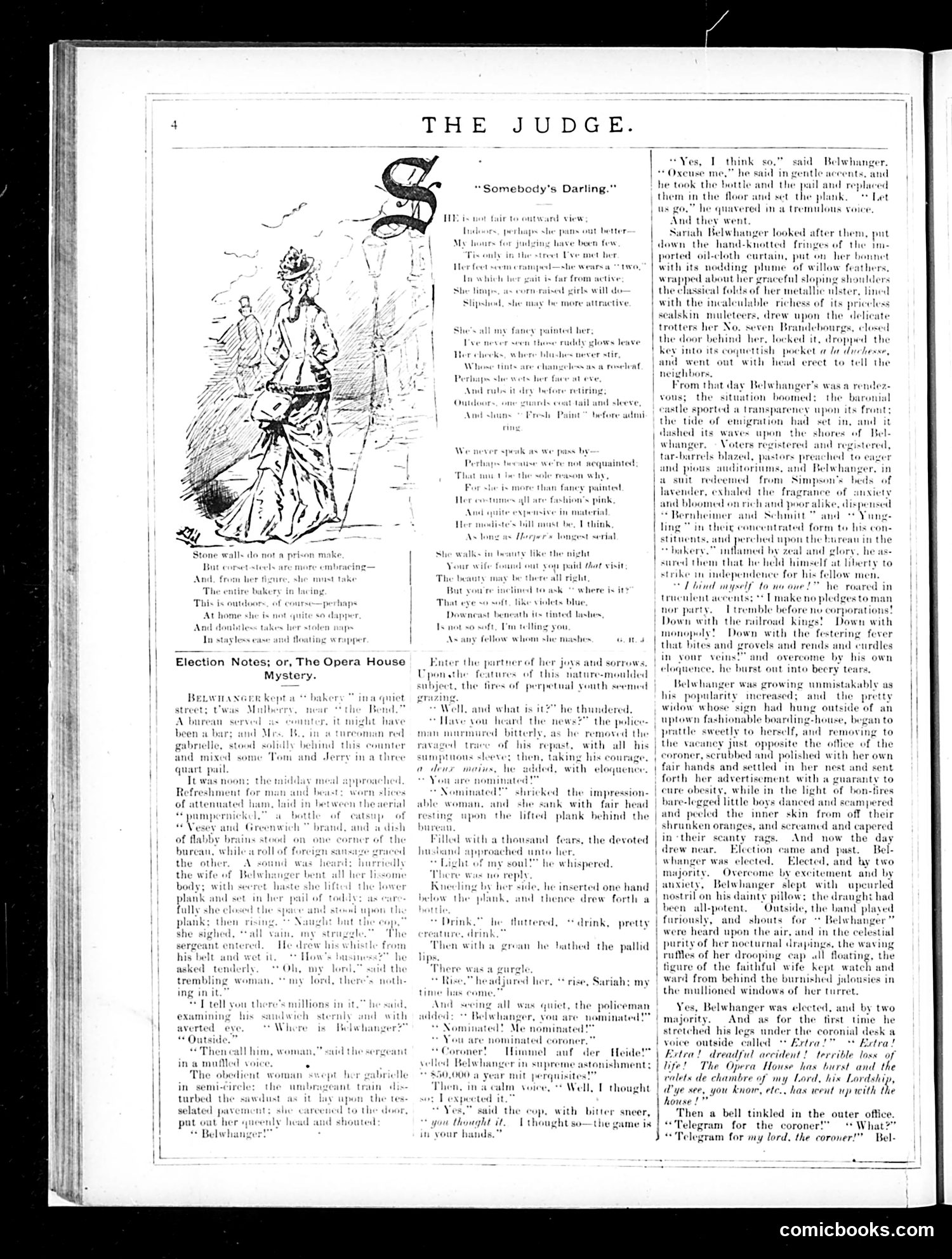
This page satirizes a mundane domestic incident inflated into political theater. The narrative concerns Mr. Belwhanger, apparently nominated for coroner, whose wife Sarah becomes indignant when he seems more interested in eating than acknowledging his nomination. She dramatically leaves, locking herself in a room. The satire targets how election campaigns manufacture excitement around trivial matters. Belwhanger's subsequent campaign—featuring transparency displays, passionate speeches about "railroad kings" and corrupting forces, and theatrical emotional appeals—transforms an ordinary marital squabble into a political victory. He wins "by two majority," suggesting the entire campaign apparatus produces negligible actual support. The cartoon mocks the gap between political rhetoric's grandiosity and the petty realities underlying elections. The "opera house mystery" ironically frames a domestic tiff as momentous political theater, exposing how campaigns exploit dramatic presentation to create artificial significance around unremarkable candidates and issues.
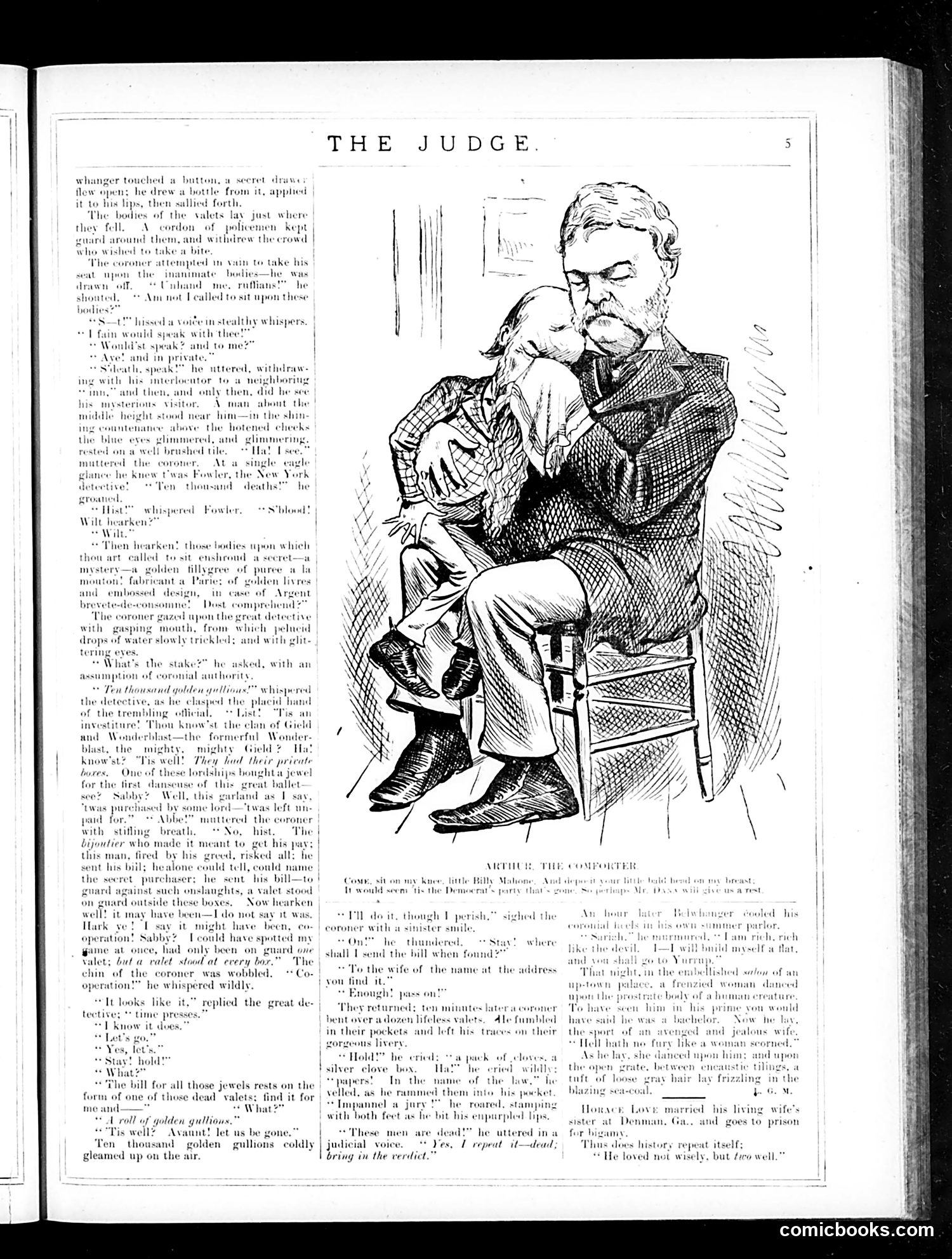
This page presents a serialized detective story ("The Comforter") rather than political satire. The narrative follows a coroner investigating a murdered woman, with a mysterious visitor revealing details about a jeweled artifact—a golden snuffbox—that implicates a valet in the crime. The illustration shows the coroner confronting this visitor (likely the detective or informant) while discussing the case. The OCR text captures dialogue about the murder investigation, a hidden jewel, and the valet's involvement. The closing lines reference a woman who danced upon learning of her husband's guilt and death—suggesting domestic betrayal as the crime's motive. The final quoted line, "He loved not wisely, but [too] well," echoes Othello, indicating themes of passion and murder. This appears to be **serialized fiction**, not political commentary, typical of Judge's mixed content combining satire with entertainment narratives.
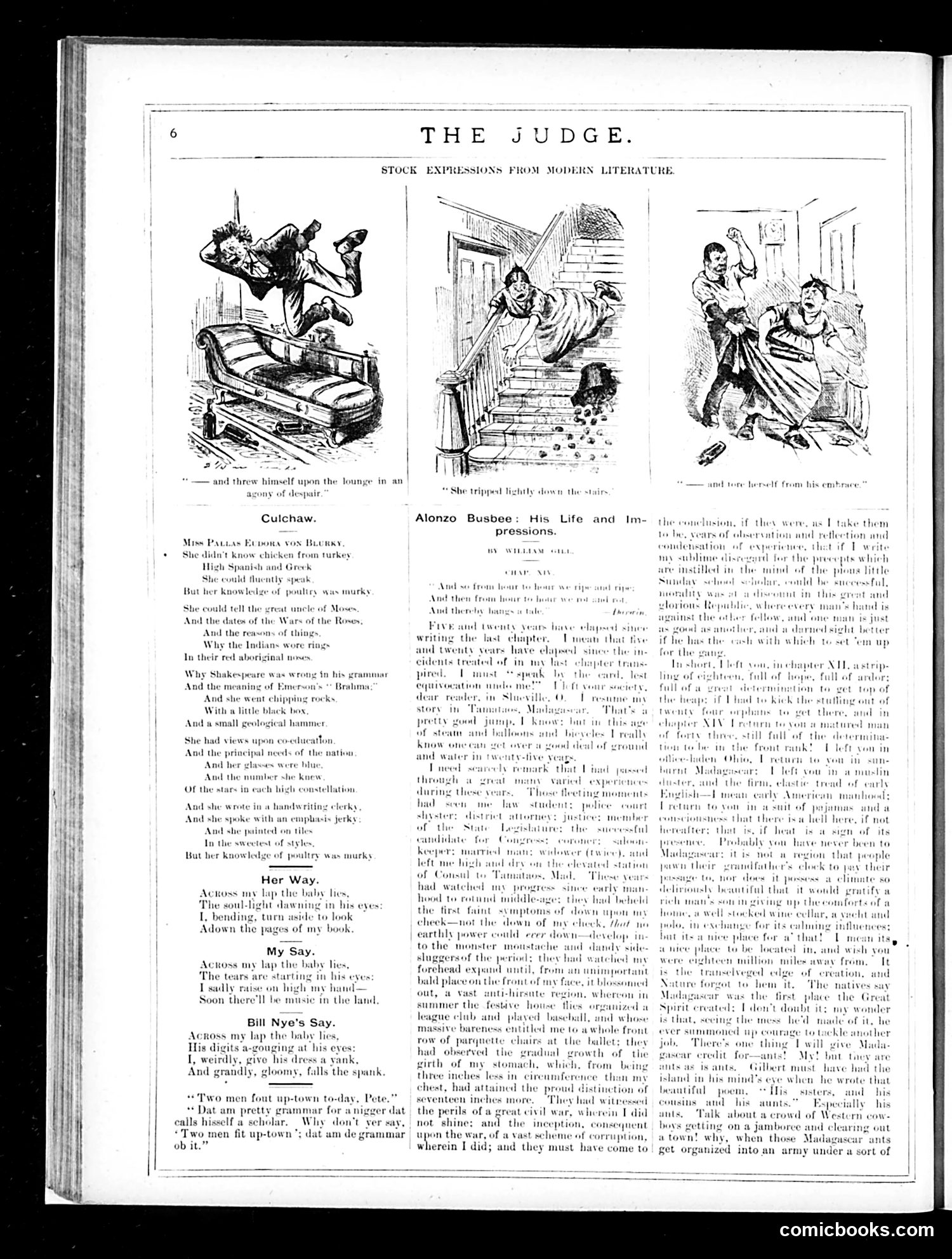
This page contains three separate satirical pieces rather than a unified cartoon: **"Culchaw"** mocks an educated woman (Miss Patias Elbows von Blurky) who knows literature, history, and science but is ignorant about practical matters like cooking poultry. The satire targets pretentious intellectualism divorced from domestic competence—a common Victorian-era jab at educated women. **"Her Way," "My Say," and "Bill Nye's Say"** are three parallel comic poems about a baby on a man's lap, each presenting different emotional perspectives (romantic, sentimental, and humorous) on the same domestic scene. This appears to be mild satire on sentimental Victorian literature. **"Alonzo Busbee: His Life and Impressions"** (the right column) is a longer narrative piece where Busbee reflects on his life changes over 25 years—his physical decline, changing facial hair, and observations about progress. The tone is reflective rather than sharply satirical. The three illustrations depict domestic/comedic situations matching these texts. Without clearer OCR, specific political references remain unclear, but the overall page exemplifies Judge's focus on domestic life and character satire rather than hard political commentary.
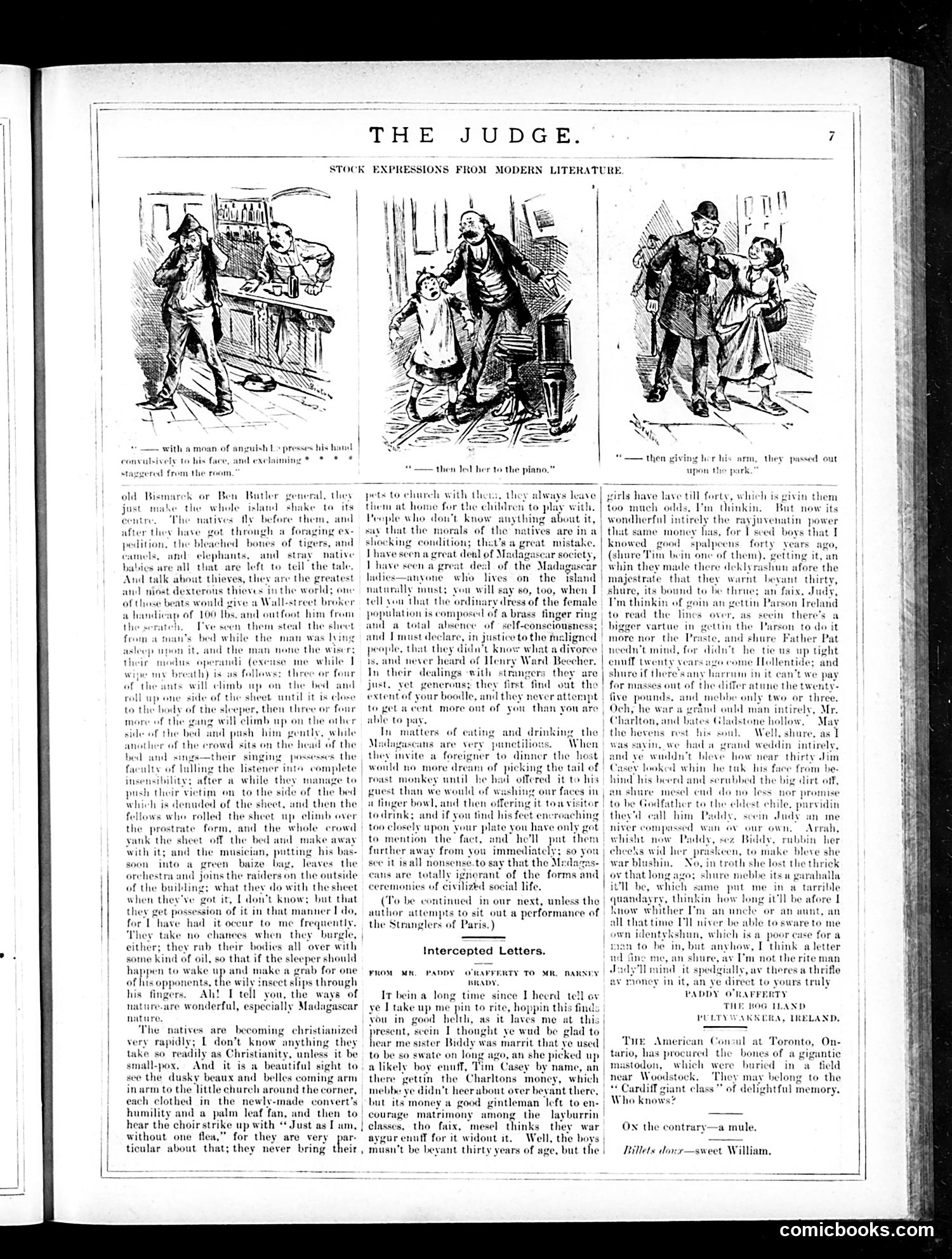
This page from *Judge* presents three satirical sketches mocking Victorian literary clichés about exotic (colonial) settings and characters. **The cartoons** feature stock character types—presumably from popular novels—engaging in stereotypical behaviors. The sketches ridicule overwrought descriptive writing about foreign lands, particularly Madagascar and Irish settings. **The satire targets**: Authors (likely including Henry Ward Beecher, explicitly mentioned in the text) who populated their works with melodramatic "native" characters and exaggerated exotic details. The lengthy text passages parody purple prose—breathlessly describing ant thieves, native "morals," and romantic complications with laughable solemnity. **The point**: *Judge* mocks contemporary literature's reliance on tired tropes: the "noble savage," sexual misconduct in colonies, and overwrought moralizing about "civilizing" non-European peoples. By juxtaposing absurd scenarios (elaborately coordinated ant burglary) with sanctimonious commentary, the magazine skewers both literary pretension and the racist assumptions embedded in popular fiction. The humor depends on recognizing these conventions as ridiculous padding inflating mediocre stories.
This appears to be a satirical cartoon titled "THE JUDGE" depicting several figures in a courtroom or judicial setting. The image shows what appears to be officials or judges being presented as the subjects of judgment themselves—a common Judge magazine technique of turning tables on authority figures. The cartoon likely satirizes judicial corruption, incompetence, or bias during the Gilded Age or Progressive Era, when such criticism was prevalent. The figures wear period clothing consistent with late 19th-century America. Without clearer labeling visible in the image, I cannot definitively identify specific individuals or the exact historical event being referenced. The satire's point appears to criticize those in power being held accountable by public scrutiny.
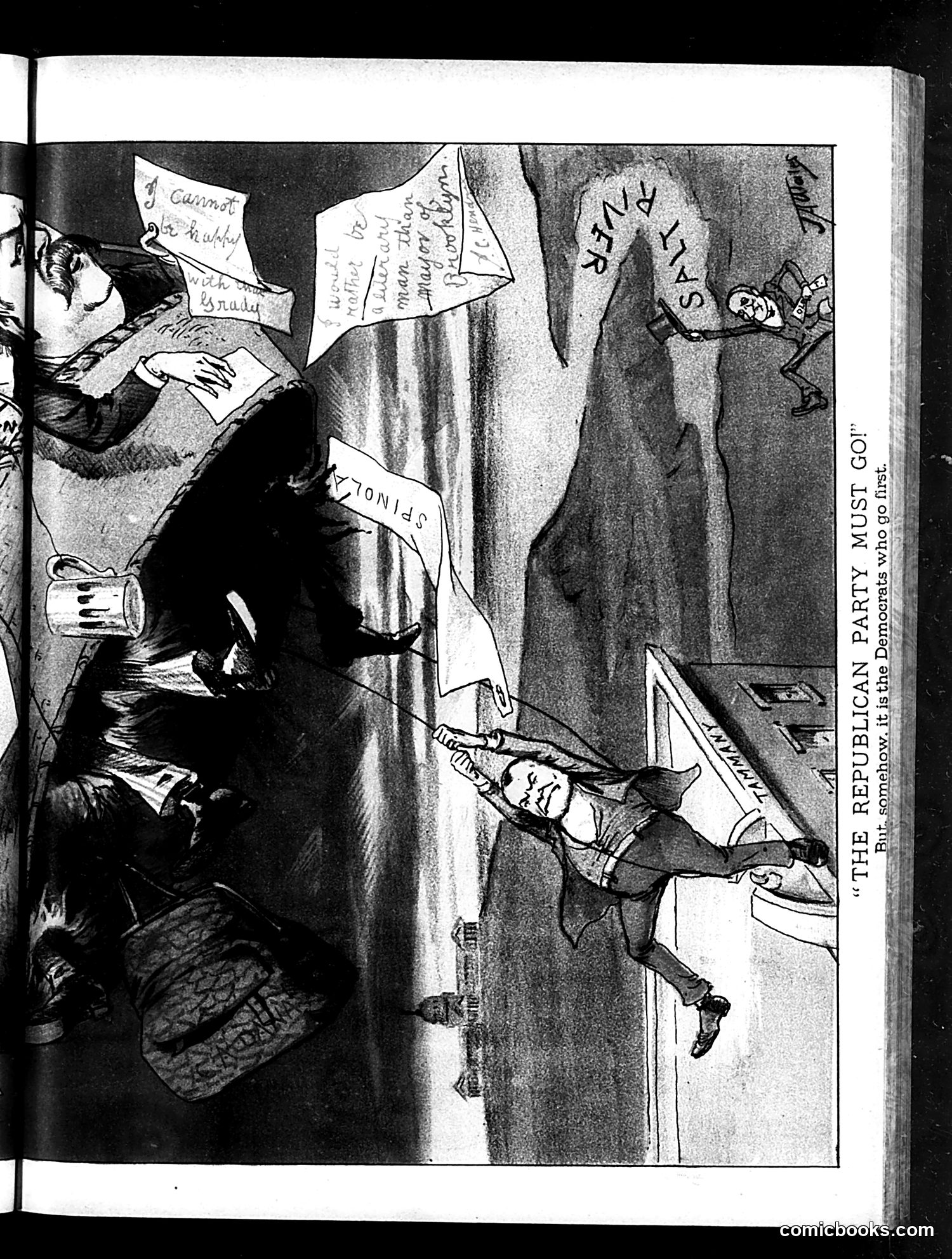
This political cartoon satirizes the Republican Party, depicted as a elephant (the GOP's traditional symbol) lying drunk or incapacitated on the floor. The title reads "THE REPUBLICAN PARTY MUST GO" with the subtitle "But somehow it is the Democrats who to list." The satire criticizes Republicans as dysfunctional and unfit to govern, while ironically noting that Democrats—despite the Republicans' obvious failures—somehow remain the ones being removed from power or losing elections. The scattered papers and disheveled state suggest incompetence and chaos within the Republican leadership. The cartoon reflects a period of political frustration, likely from the late 19th or early 20th century, when *Judge* magazine regularly attacked Republican policies and leadership through such pointed visual commentary.
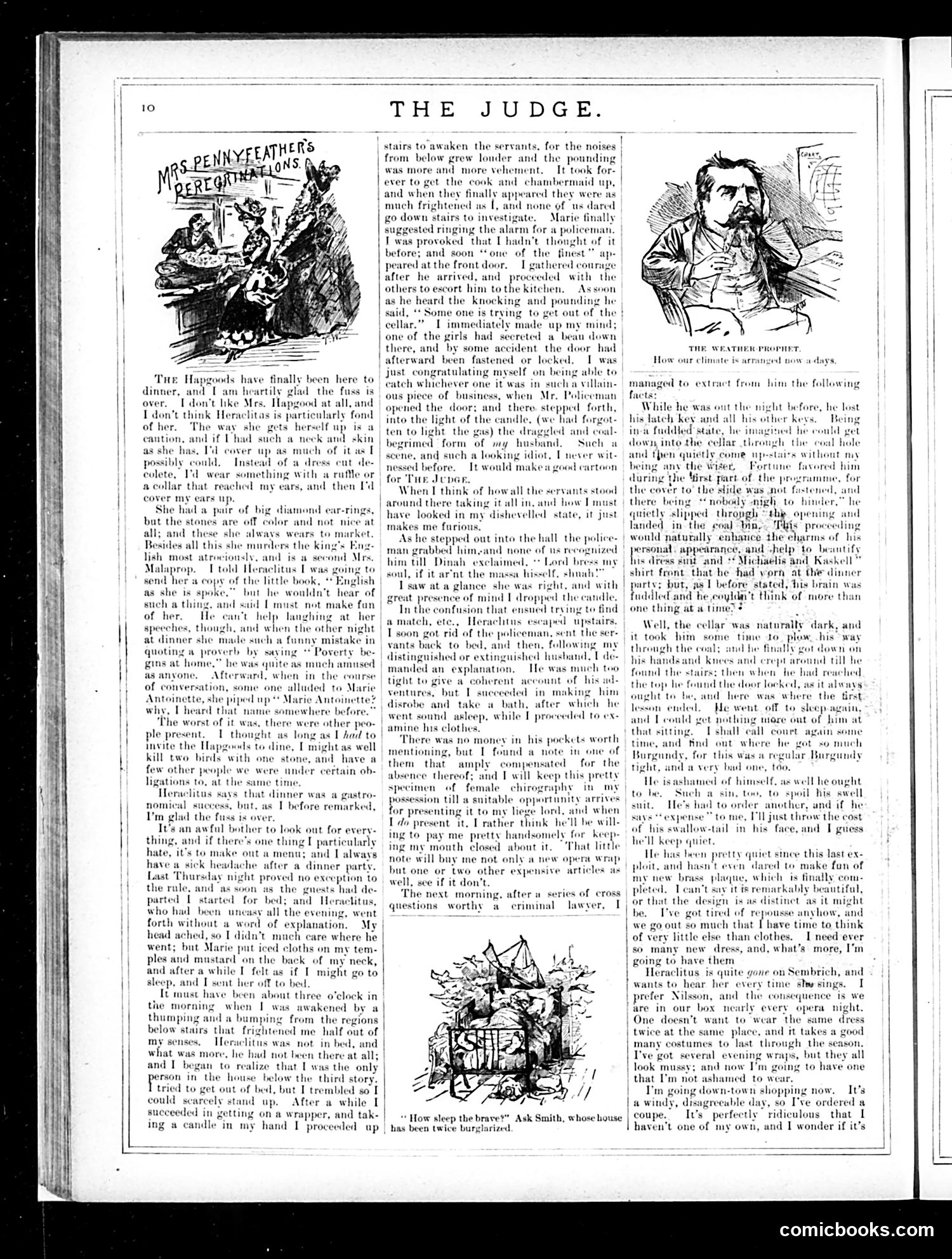
This page contains a domestic humor narrative illustrated with period sketches. The main text is a first-person account by a society woman describing an embarrassing dinner with the Hapgoods and subsequent chaos at her home. The satire targets **upper-class social pretension**: The narrator criticizes Mrs. Hapgood's appearance (oversized jewelry, poor fashion choices, malapropisms) while obsessing over social obligations and dinner etiquette. The humor derives from the narrator's snobbery being undercut by domestic disorder—servants misbehaving, unexplained nighttime commotion, and ultimately her husband Heraclitus arriving home filthy and disoriented, requiring police intervention. The cartoons illustrate key moments: "Mrs. Pennyfeather's Exhortations" shows gossipy society women, and another depicts the chaotic scene at the stairwell. The joke is fundamentally **ironic**: while the narrator judges others' vulgarity and maintains social pretenses, her own household descends into farce, and her husband's unexplained adventure suggests marital complications she's desperate to rationalize away.
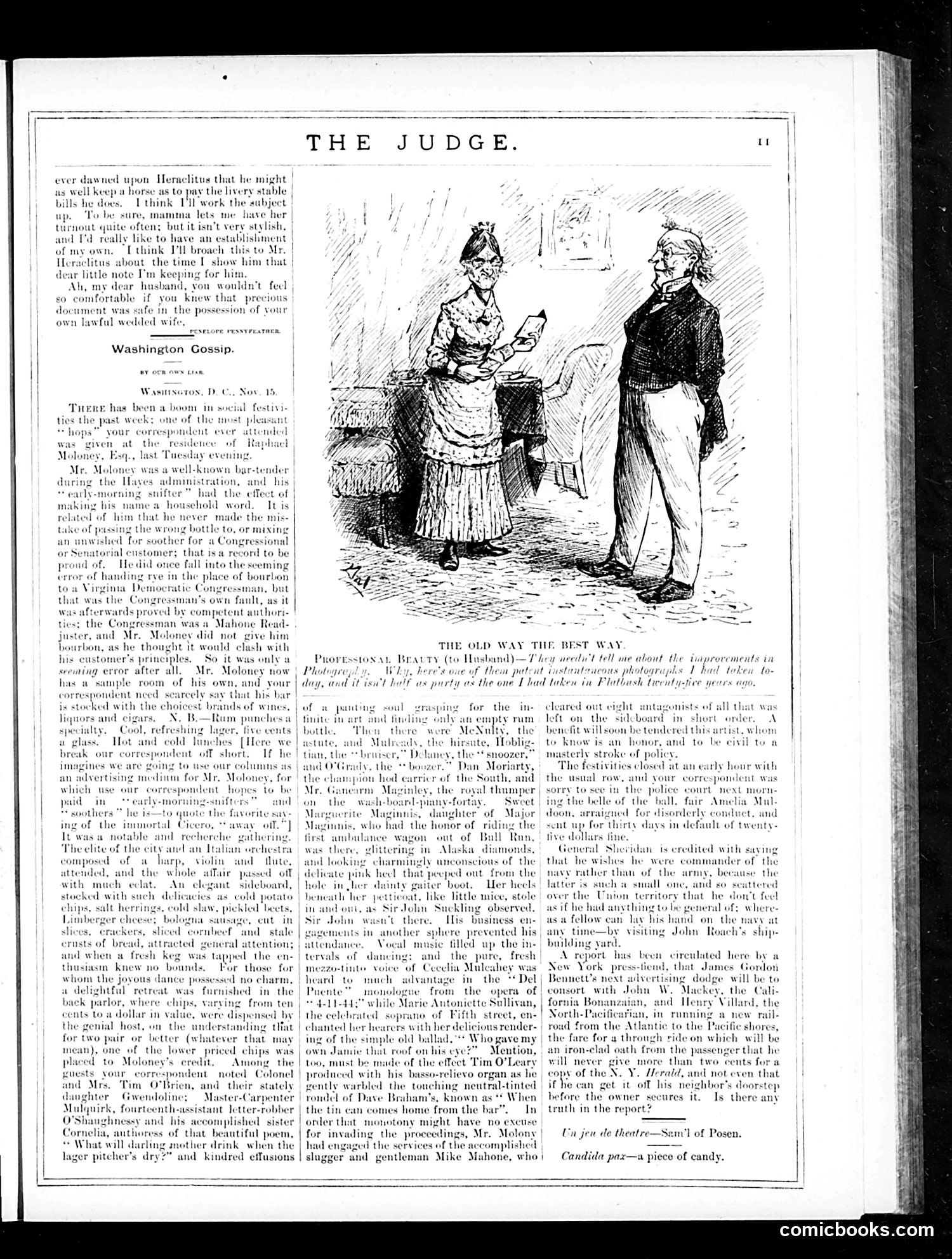
This page from Judge satirizes Washington D.C. social gossip and etiquette, circa 1880s. **Main Cartoon:** Titled "The Old Way the Best Way," it depicts a wife (labeled "Professional Beauty") showing her husband photographs, implying she's displaying her social accomplishments or romantic conquests. The satire targets wealthy women's vanity and their obsession with documenting social status through photography. **Gossip Column:** The lengthy "Washington Gossip" section ridicules the pretensions of D.C.'s elite—specifically a bartender named Moloney who gained prominence during the Hayes administration. The satire mocks his aspirations to high society, detailing an elaborate party with cheap refreshments ("cold potato salad, pickled beets") served alongside fine wines. **Key Targets:** The piece lampoons both newly wealthy social climbers and the Washington establishment's superficiality, suggesting that refined appearances mask modest or questionable origins. Names like "Gwendoline" and references to "Bull Run" (Civil War battle) ground the satire in contemporary American society. The overall message: Washington society is performative and ridiculous.
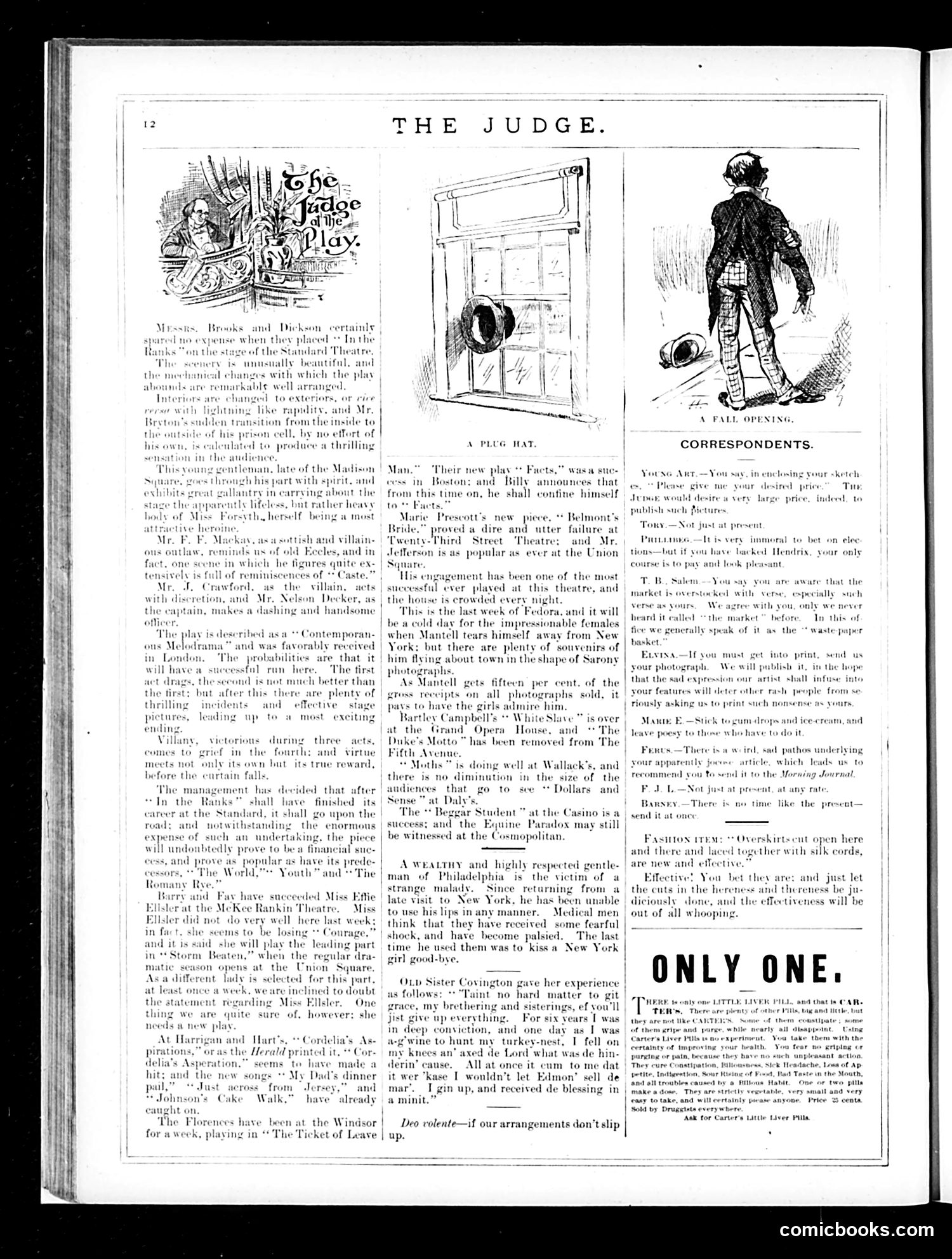
This page from *Judge* magazine features theatrical criticism and society gossip typical of the publication's satirical coverage. **Main Content:** The lead article discusses recent Broadway productions and performers, including reviews of plays at various theaters (the Standard, Grand Opera House, Wallack's). It mentions specific actors like Mr. F. F. Mackay and Bartley Campbell's works, critiquing both dramatic quality and performers' egos—notably mocking Richard Mansell's vanity regarding photograph sales (he receives 15% of gross receipts). **The Cartoons:** Two illustrations appear: one showing "The Judge at Play" (theatrical scene-setting) and another titled "A Pale Opening" depicting a figure at a doorway—likely satirizing some social awkwardness or embarrassment. **Correspondents Section:** Readers' letters address theatrical and social matters with satirical responses from the magazine's editors, maintaining *Judge*'s characteristic witty, somewhat mean-spirited commentary on public figures and social pretension. The overall tone mocks theatrical excess, vanity, and affectation—core themes of 1880s American satirical journalism.
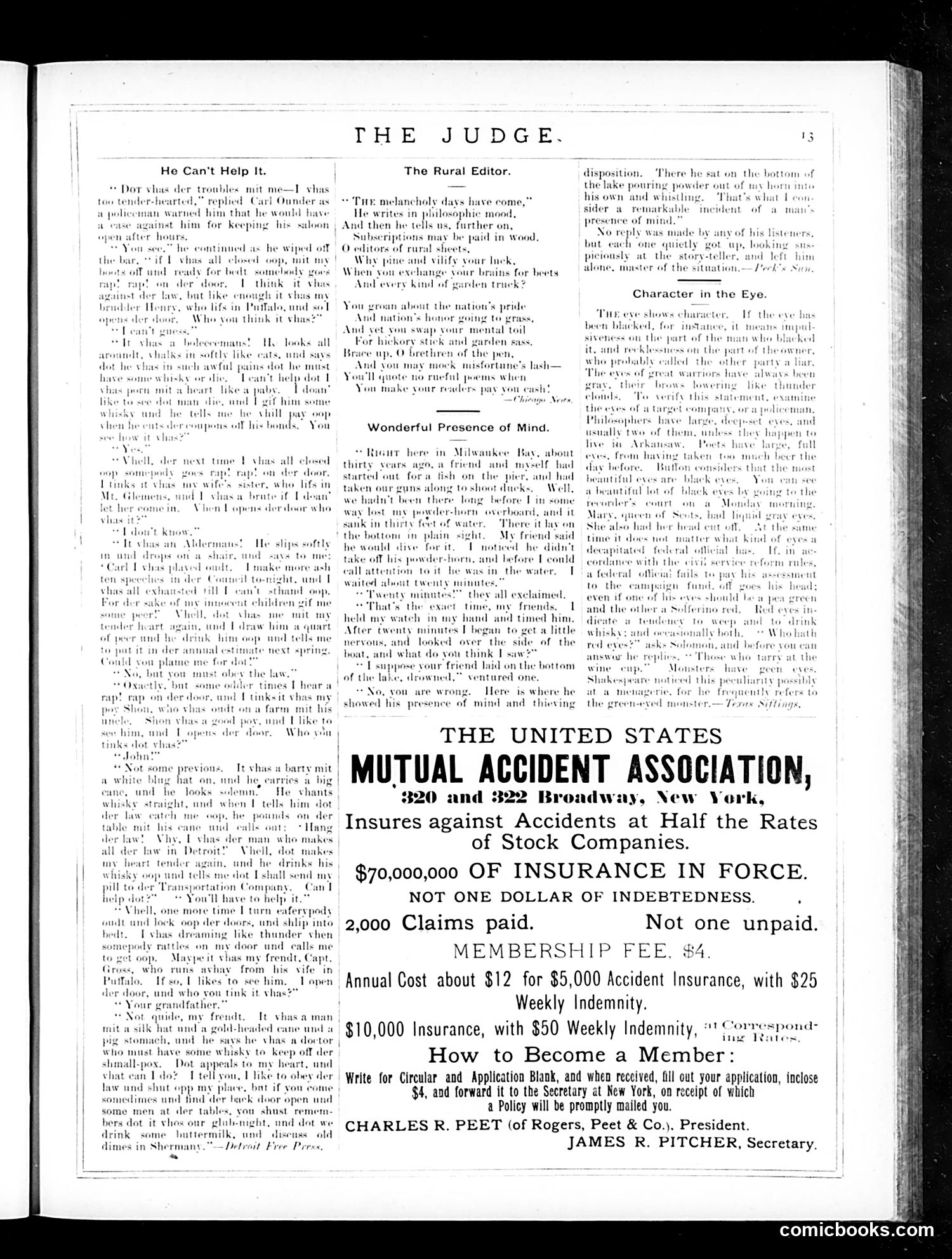
This page from *Judge* magazine contains three distinct pieces: **"He Can't Help It"** (left column): A dialect-humor piece featuring a German-accented bartender recounting how various customers—an alderman, a farmer, a riverboat captain—regularly slip into his bar after closing. The joke relies on immigrant working-class stereotypes and the absurdity of the bartender's helplessness despite his complaints. **"The Rural Editor"** and **"Wonderful Presence of Mind"** (center): Short humorous pieces mocking rural newspaper editors' financial desperation (accepting subscriptions in vegetables) and an anecdote about a man who, after losing his gunpowder in a lake, sits calmly on the bottom whistling—the "presence of mind" being his composure rather than any practical response. **"Character in the Eye"** (right): An editorial piece suggesting facial features—particularly eyes—reveal moral character, touching on topics like infidelity and federal corruption. **The Large Advertisement** (bottom half): A full-page ad for the United States Mutual Accident Association promoting accident insurance at competitive rates. The editorial content relies heavily on ethnic stereotypes and class-based humor typical of early 20th-century American satire.
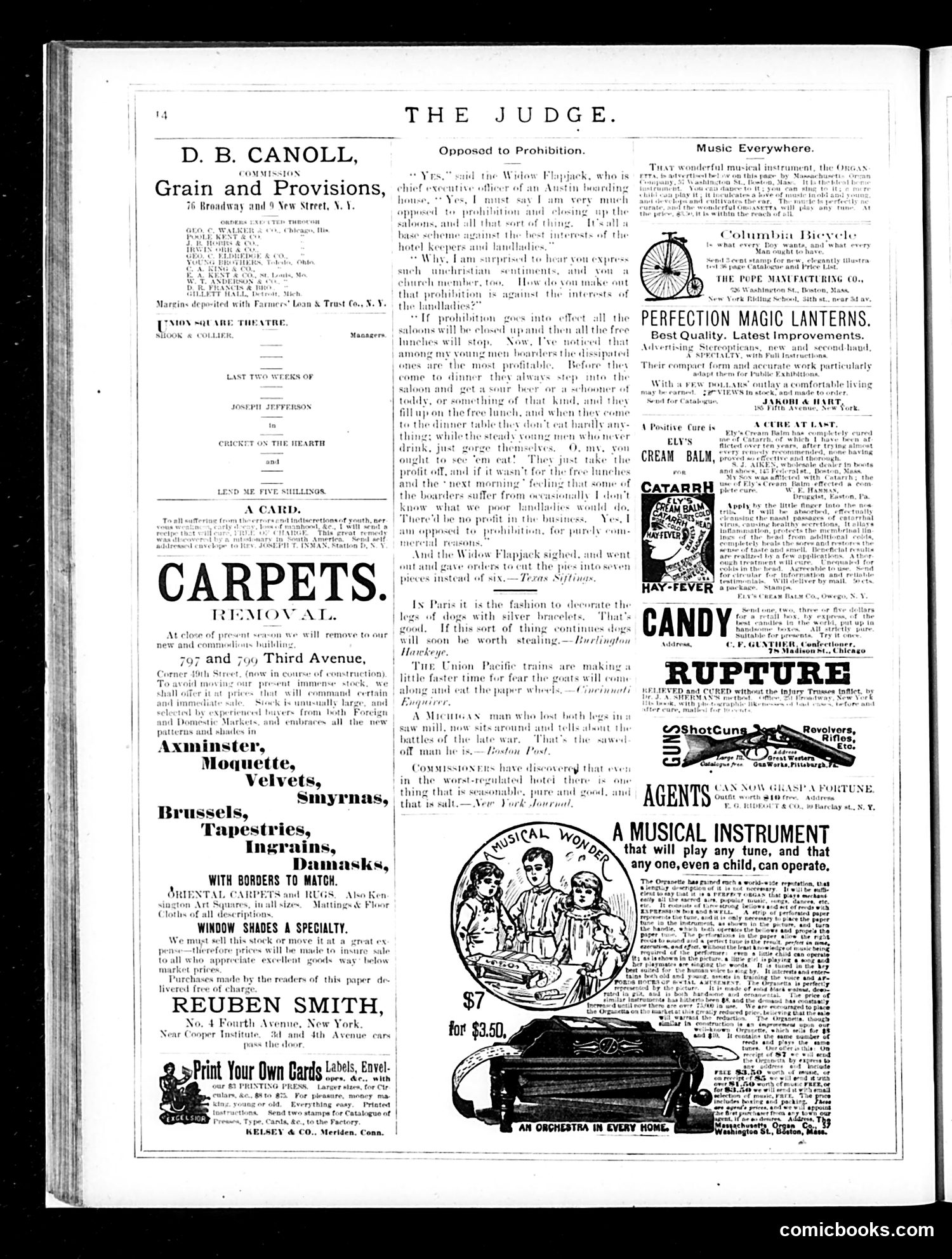
This page is primarily **advertising and commercial content** rather than political satire. The dominant feature is a large "CARPETS REMOVAL" advertisement for Reuben Smith's carpet business relocating to a new address on Third Avenue. The limited editorial content includes what appears to be a brief dialogue **opposing Prohibition**. A character (likely representing a hotel keeper or business owner) argues against prohibition by noting it would close establishments and harm landlords and business interests. This reflects the historical tension between Prohibition advocates and commercial interests that profited from alcohol sales. The page also includes various product advertisements typical of the era: Columbia bicycles, "Perfection Magic Lanterns" (early projection devices), a musical instrument that "any one, even a child, can operate," and patent/printing services. **For modern readers**: This shows Judge primarily functioned as a commercial advertising vehicle, with limited actual satirical political content on this particular page.
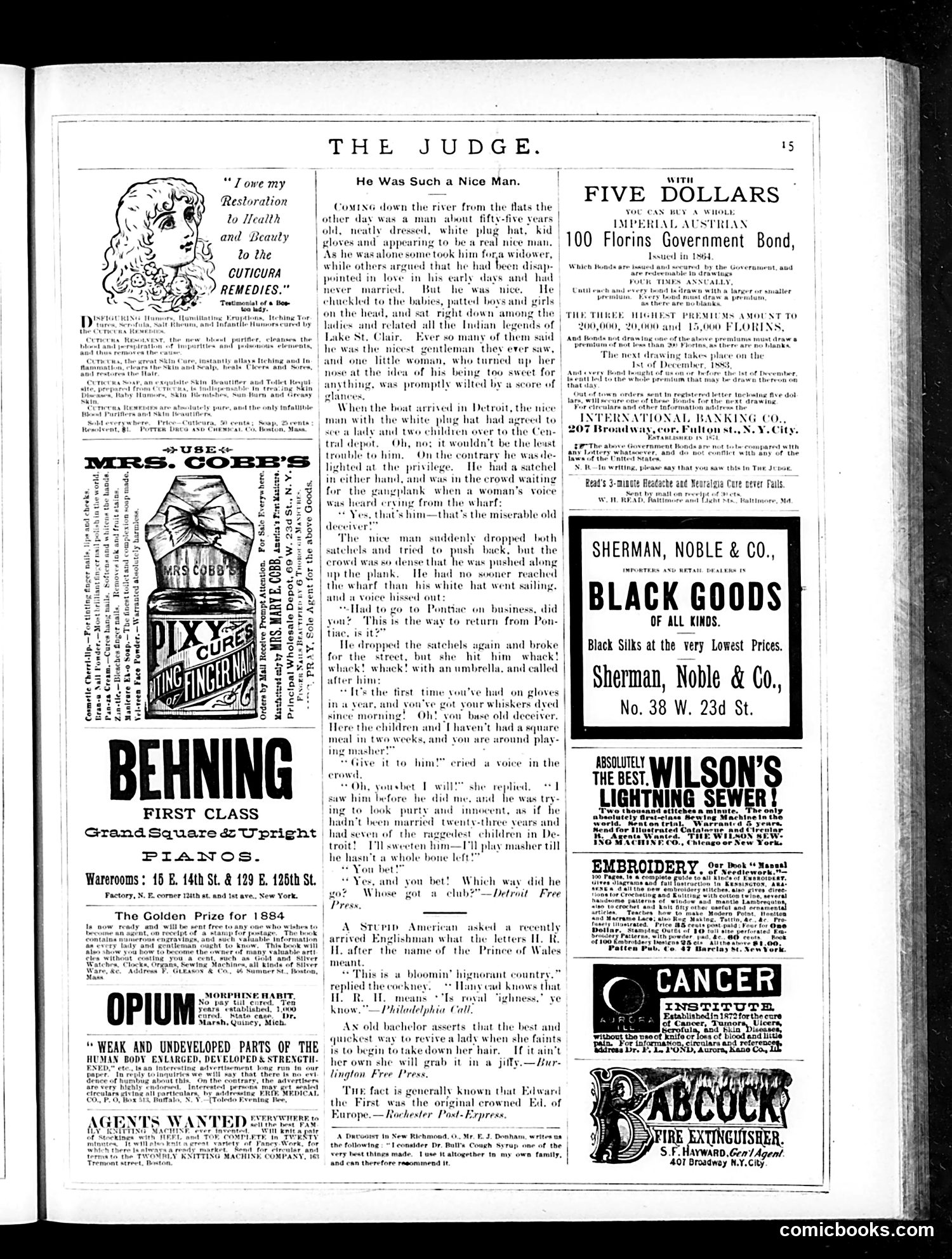
This page is primarily **advertising with one substantial satirical story**. The main story, "He Was Such a Nice Man," satirizes male deception and infidelity. A well-dressed gentleman in a white plug hat and gloves arrives at a dock, appearing respectable and genteel. However, a woman on the wharf—apparently his wife—exposes him as a fraud, revealing he's dyed his whiskers, worn gloves to hide his appearance, and neglected his family for two weeks while they've had no square meals. She publicly shames him with an umbrella attack. The satire targets hypocrisy: a man presenting himself as respectable and "nice" while abandoning domestic responsibility. The crowd's sympathetic reaction ("Give it to him!") suggests public judgment favored the wronged wife's public exposure of his deception. The remaining content consists of period advertisements for pianos, medical remedies (Cuticura), clothing, and financial instruments—typical of Judge magazine's revenue model.
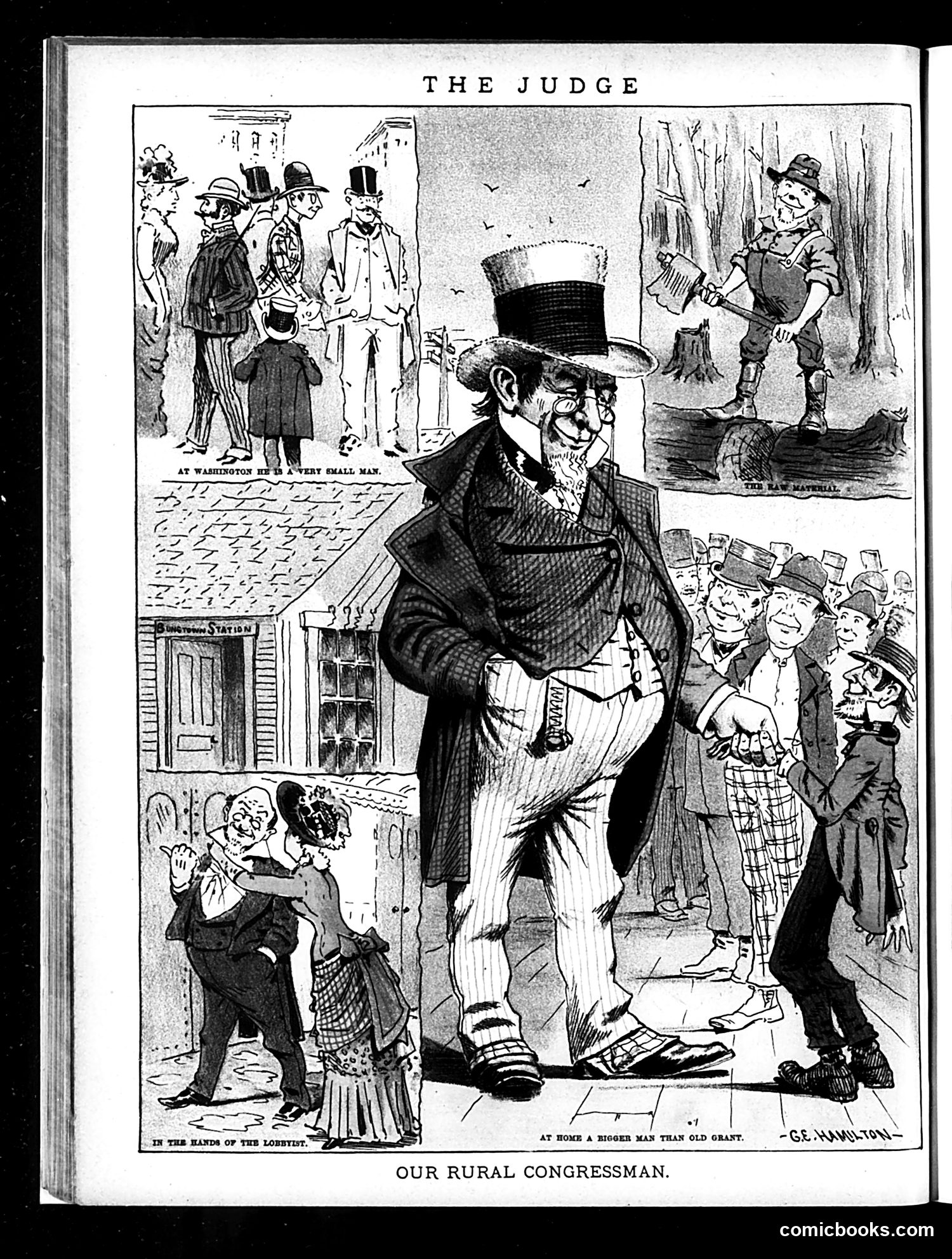
This satirical cartoon depicts a rural congressman depicted with exaggerated features—an ape-like face, mismatched clothing, and clownish proportions. The four vignettes contrast his behavior in different settings: - **At Washington**: He appears small and insignificant among well-dressed politicians - **At home**: He's portrayed as grandiose and self-important, "a bigger man than old Grant" (presumably President Ulysses S. Grant) - **Additional scenes** show him surrounded by admirers and constituents The satire mocks rural representatives as provincial, unsophisticated figures who inflate their own importance back home while being diminished in actual political power. The comparison to Grant emphasizes the congressman's delusions of grandeur. The cartoon ridicules the gap between rural politicians' local status and their actual Washington influence, treating them as buffoonish outsiders to proper governance.