
A complete issue · 16 pages · 1883
Judge — November 3, 1883
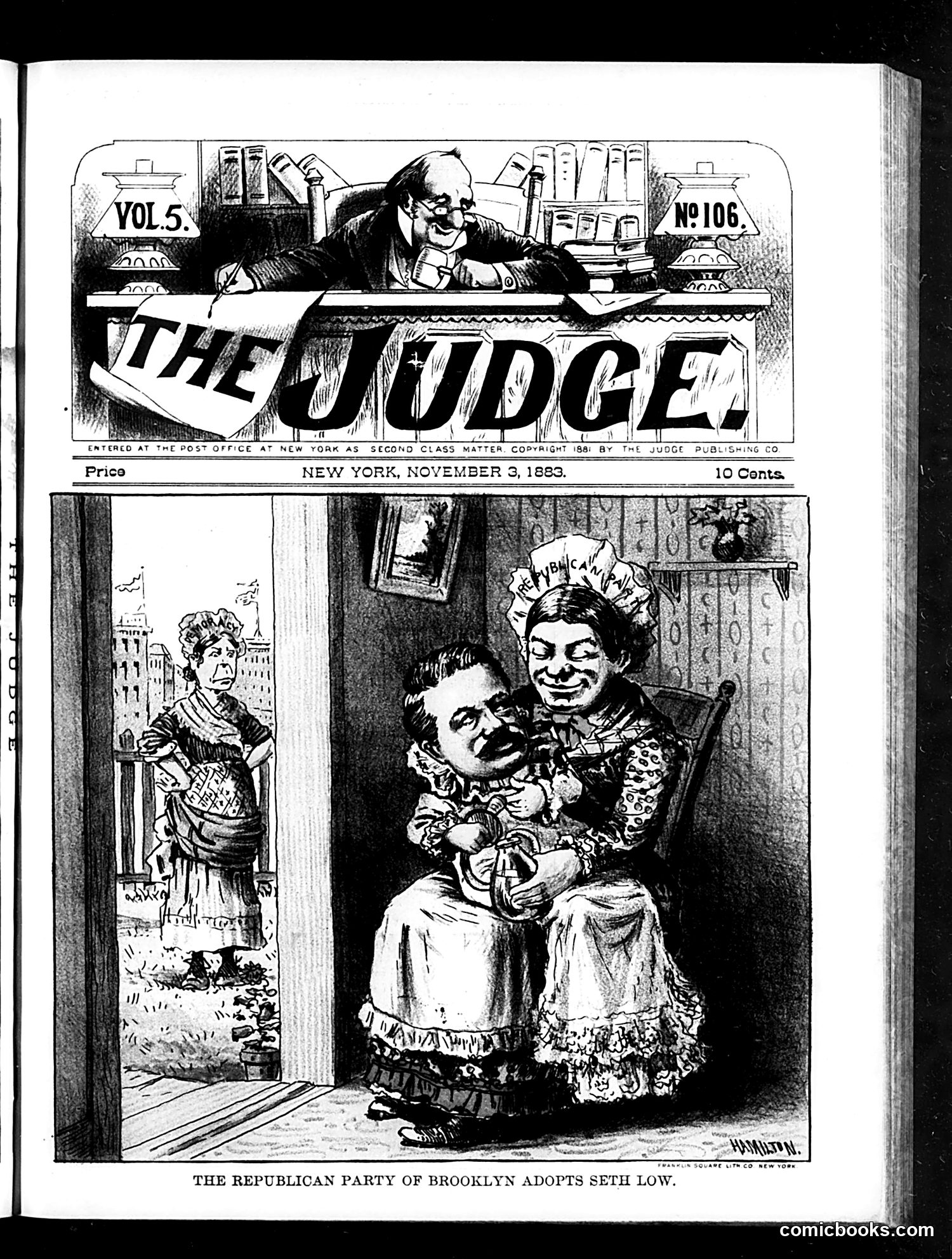
This November 1883 *Judge* cartoon satirizes the Brooklyn Republican Party's endorsement of Seth Low as a political candidate. The main illustration shows a woman labeled "Republican Party" (identifiable by her headwrap) holding a baby-faced man, depicted as an infant or child. This visual metaphor suggests the Republicans are "adopting" Low as their candidate, treating him as a newcomer or inexperienced figure they must nurture. The caricature's exaggerated features and infantilized portrayal mock Low as unsuitable or unprepared for the position. The satire criticizes the Republican Party's choice, implying they've adopted someone unqualified or inappropriate. The context suggests contemporary political controversy around Low's candidacy in Brooklyn politics during this period.
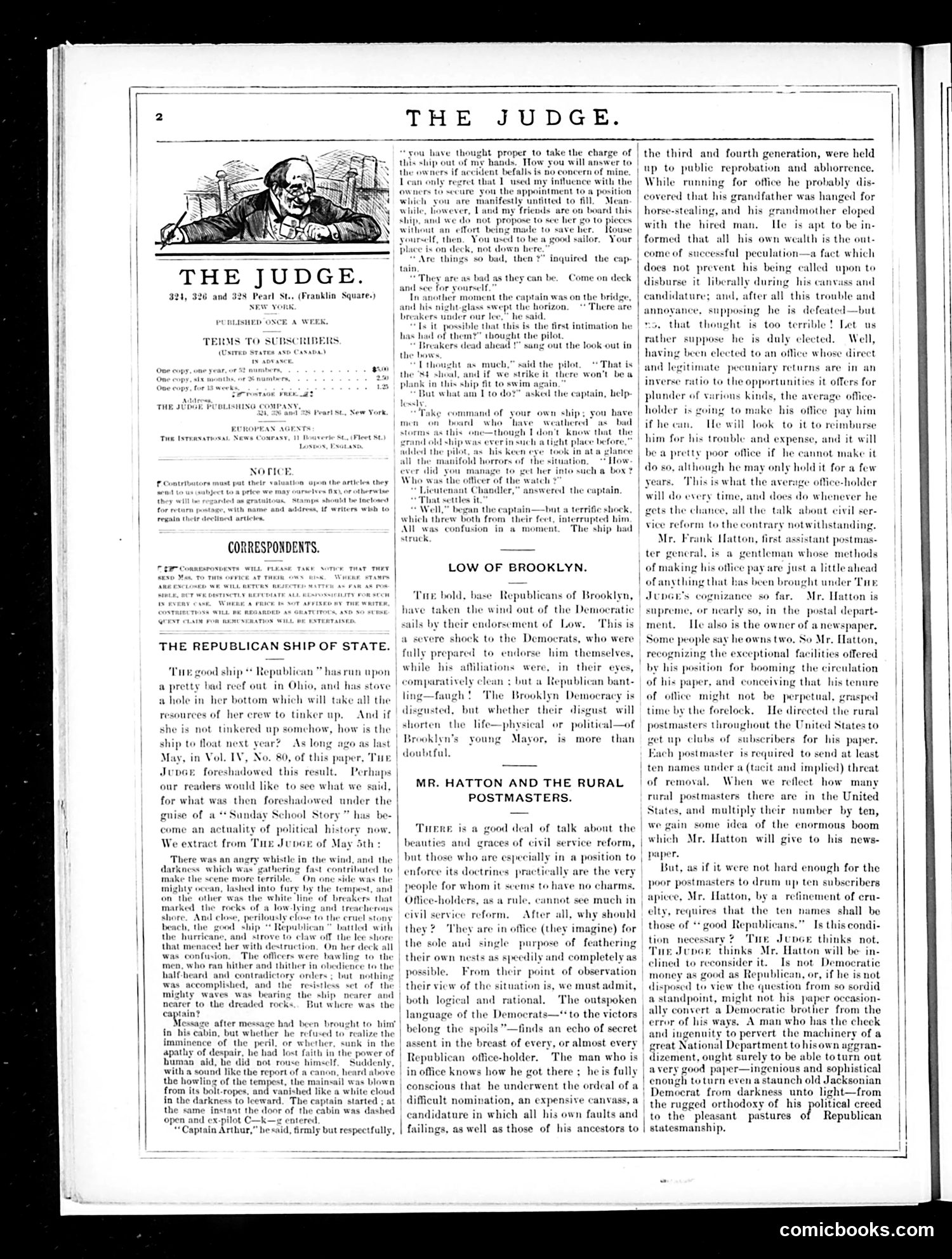
This page contains two political satires from Judge magazine (a weekly satirical publication): **"The Republican Ship of State"** uses an extended nautical metaphor about a Republican vessel running aground on Ohio rocks. The "ship" represents the Republican Party, damaged by political crisis. The unnamed "Captain Arthur" (likely President Chester Arthur) is criticized for inaction while an ex-pilot (possibly referencing a political rival) warns of imminent disaster. The satire attacks Republican leadership's failure to navigate political troubles. **"Low of Brooklyn"** mocks Brooklyn Democrats' shock at Republican endorsement of their own candidate, Low. The satire suggests Democratic disgust at this political move, questioning whether their outrage will damage the young Mayor's political prospects. Both pieces exemplify Judge's partisan Republican perspective, using humor to attack Democratic opponents and critique Republican leadership. The heavy literary/allegorical style was typical of 1880s-era political satire.
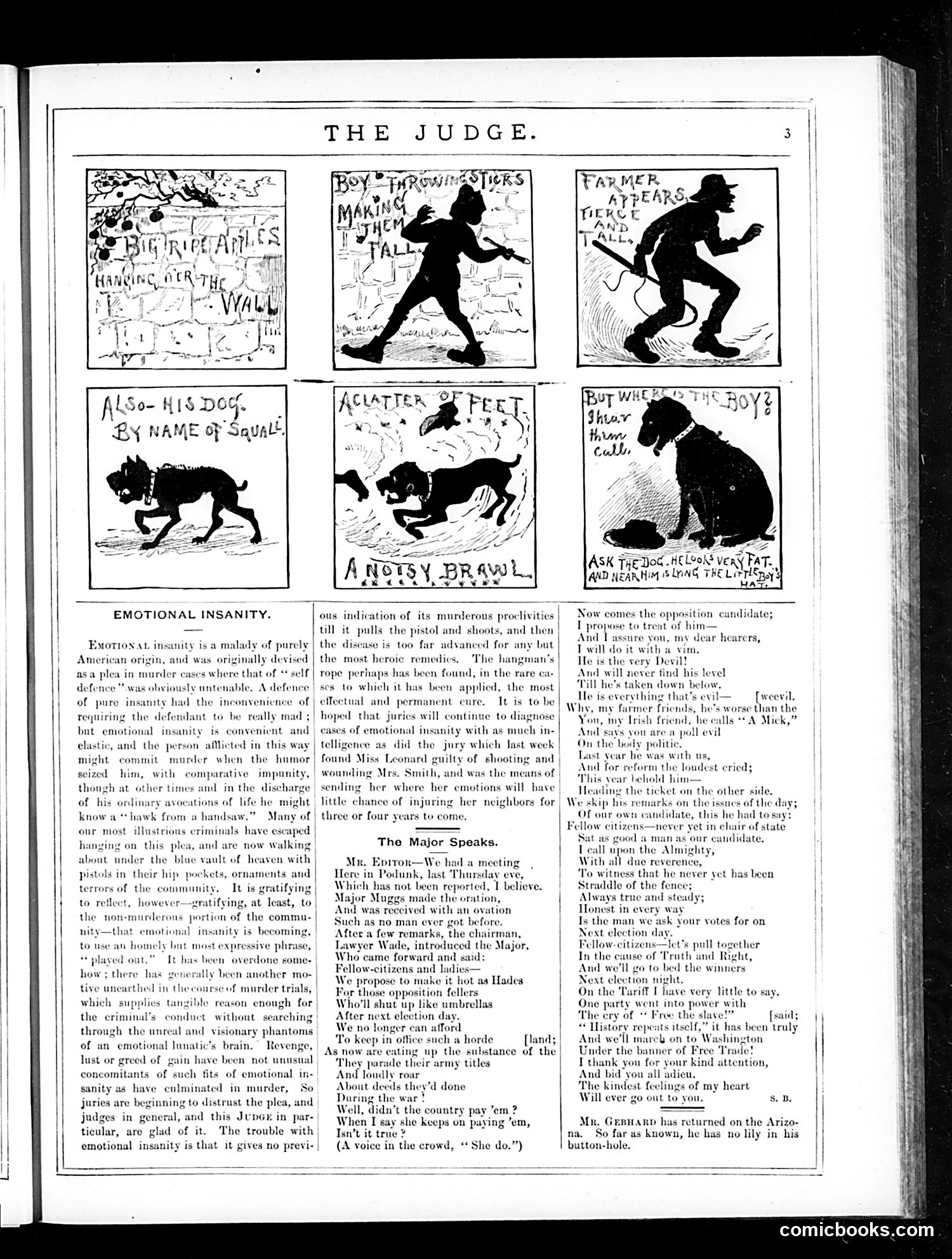
This page contains two distinct pieces of American satirical commentary: **"Emotional Insanity" (text article):** A critique of a legal defense gaining popularity in American murder trials. The author argues that "emotional insanity"—claiming temporary psychological breakdown caused one to kill—has become an overused escape for murderers, allowing guilty parties to avoid justice. Judge advocates for juries to distrust this plea, citing a recent case where a woman (Miss Leonard) was convicted of shooting Mrs. Smith despite emotional claims. The satire targets the legal system's leniency and Americans' apparent willingness to accept psychological excuses for murder. **"The Major Speaks" (comic strip + poem):** A political stump speech lampooning a generic political candidate. The Major makes bombastic, substance-free promises to "make it hot as Hades" for opposition candidates while offering no actual policy positions. The satire mocks standard campaign rhetoric—empty attacks on opponents, vague appeals to morality, and deflection from real issues like the tariff. This appears to be general political satire rather than targeting a specific candidate.
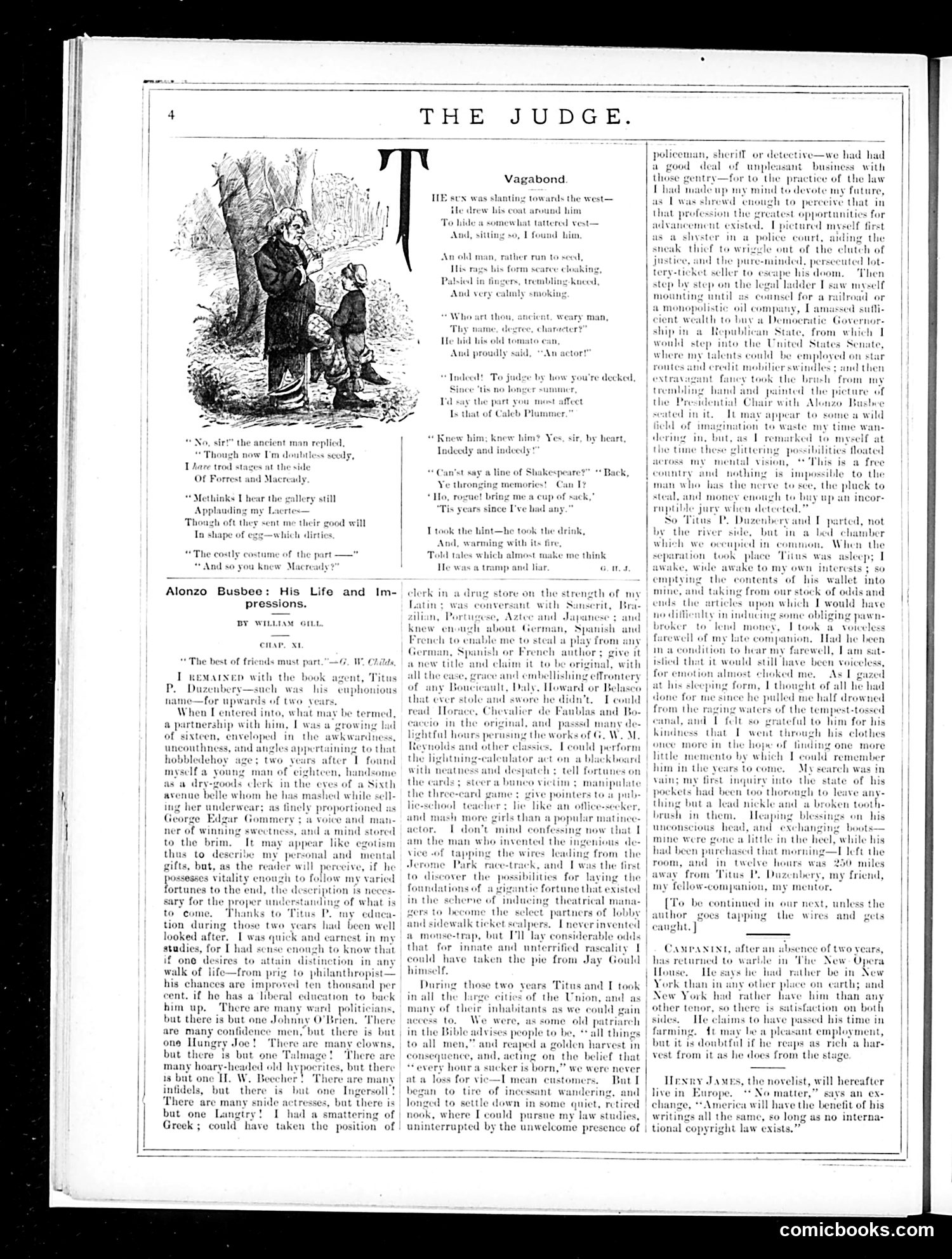
This page contains two unrelated pieces: **a poem/short story called "Vagabond"** (top left) and **the beginning of a serialized article titled "Alonzo Busbee: His Life and Impressions"** (main text). The "Vagabond" poem depicts an encounter between a well-dressed traveler and a ragged old man who claims to be an actor. The man quotes Shakespeare and theatrical references, revealing himself as a down-on-his-luck performer—likely satirizing the romantic notion of struggling artists. The humor comes from the contrast between his theatrical pretensions and his actual poverty. The Busbee article is a first-person memoir where the author boasts about his intelligence, education, and willingness to engage in shady dealings (wire-tapping for race-track information, card games, theatrical schemes). The satire targets social climbers and con-artists who use self-aggrandizing narratives to justify their moral compromises. The writing style itself—verbose and self-congratulatory—mocks this type of autobiography. Neither piece directly addresses current politics or specific historical figures.
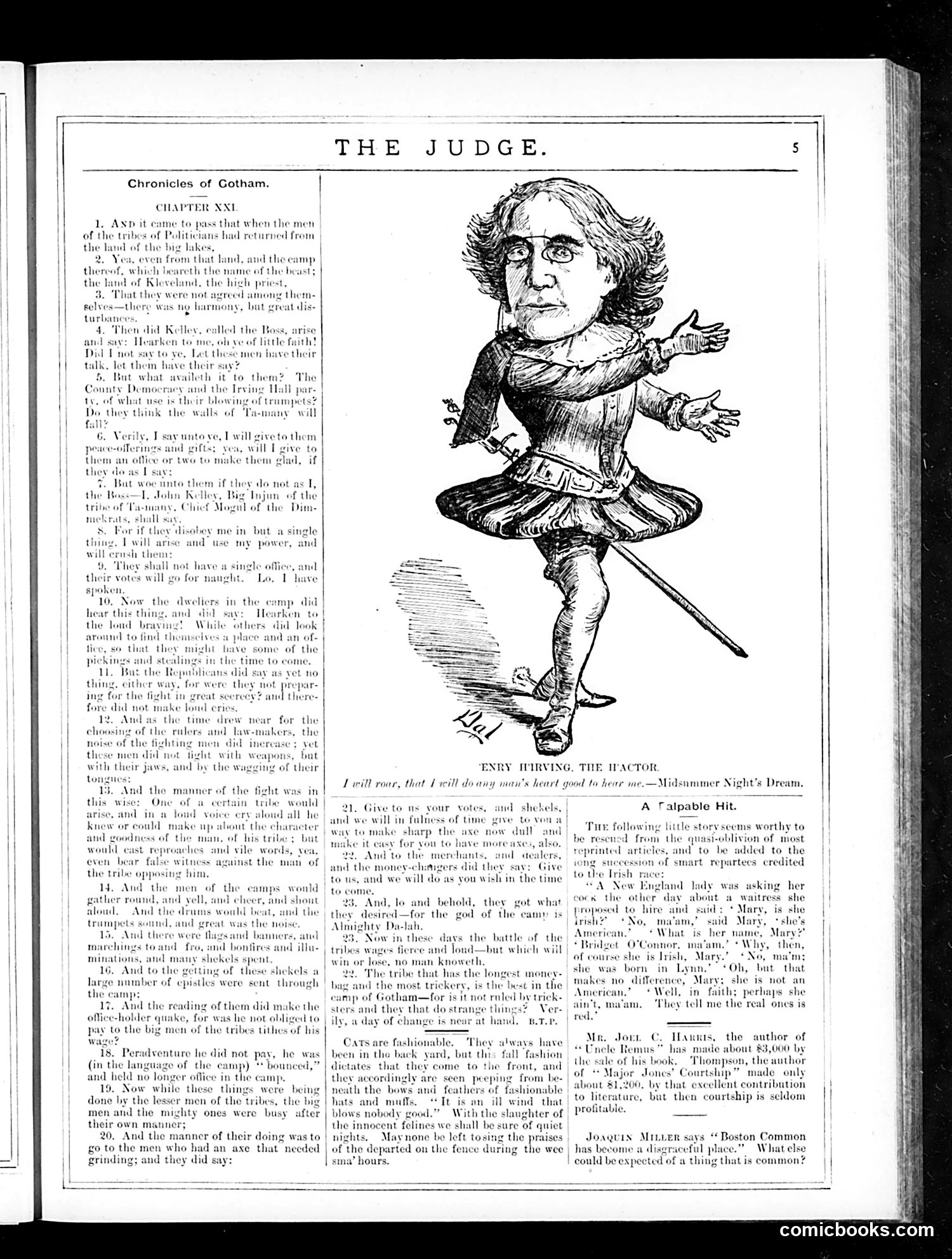
This page satirizes American political corruption during the Gilded Age. The central cartoon depicts **Henry Irving as "The Ifactor"** (likely referencing a corrupt political boss or "fixer"), shown as a theatrical, exaggerated figure—a common technique for mocking public figures. The accompanying text, styled as biblical chronicle ("Chronicles of Gotham"), mocks political conventions in a fictional camp. It describes politicians and party operatives engaging in bribery ("give to them an office or two to make them glad"), vote-buying with "shekels," and patronage systems. References to "tribes" fighting, "money-changers," and leaders making corrupt deals satirize the contemporary spoils system and machine politics. The satire targets both major parties' willingness to trade government positions for votes and money—a genuine scandal of late 19th-century American politics. The mock-biblical language elevates trivial corruption to mock-heroic absurdity, amplifying the critique. The page also includes unrelated lighter pieces ("Palpable Hit," cat fashion notes), typical of Judge's mixed-content format.
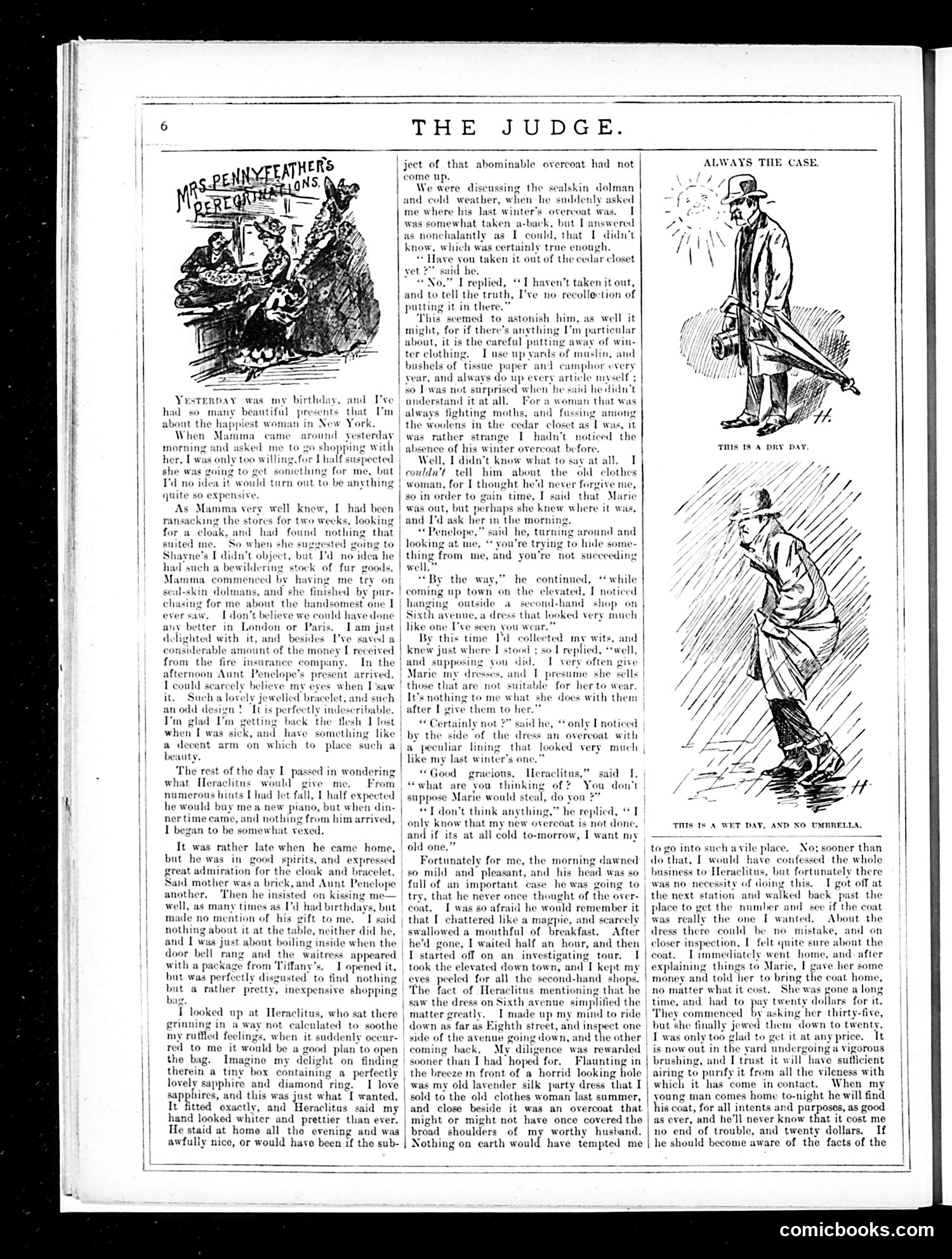
This page contains a serialized story titled "Mrs. Pennyfeather's Perplexities" rather than political satire. The narrative follows a wife's account of her birthday gifts and an ensuing marital awkwardness. The plot hinges on a missing winter overcoat: the husband gave his wife a sapphire ring (which delighted her), but when he mentions his lost sealskin overcoat, she becomes evasive. The wife had apparently given away or sold the old coat without his knowledge—possibly to a secondhand shop on Sixth Avenue—and now fears confession. The three small illustrations depict scenes from the story: women shopping, a man in an overcoat, and a woman in rain. **The humor is domestic rather than political:** it satirizes marital tension, the wife's casual disposition of her husband's property, and anxieties about material possessions. The "Judge" label suggests this is from Judge magazine's society/lifestyle section, focusing on upper-middle-class New York life rather than current events or politics.
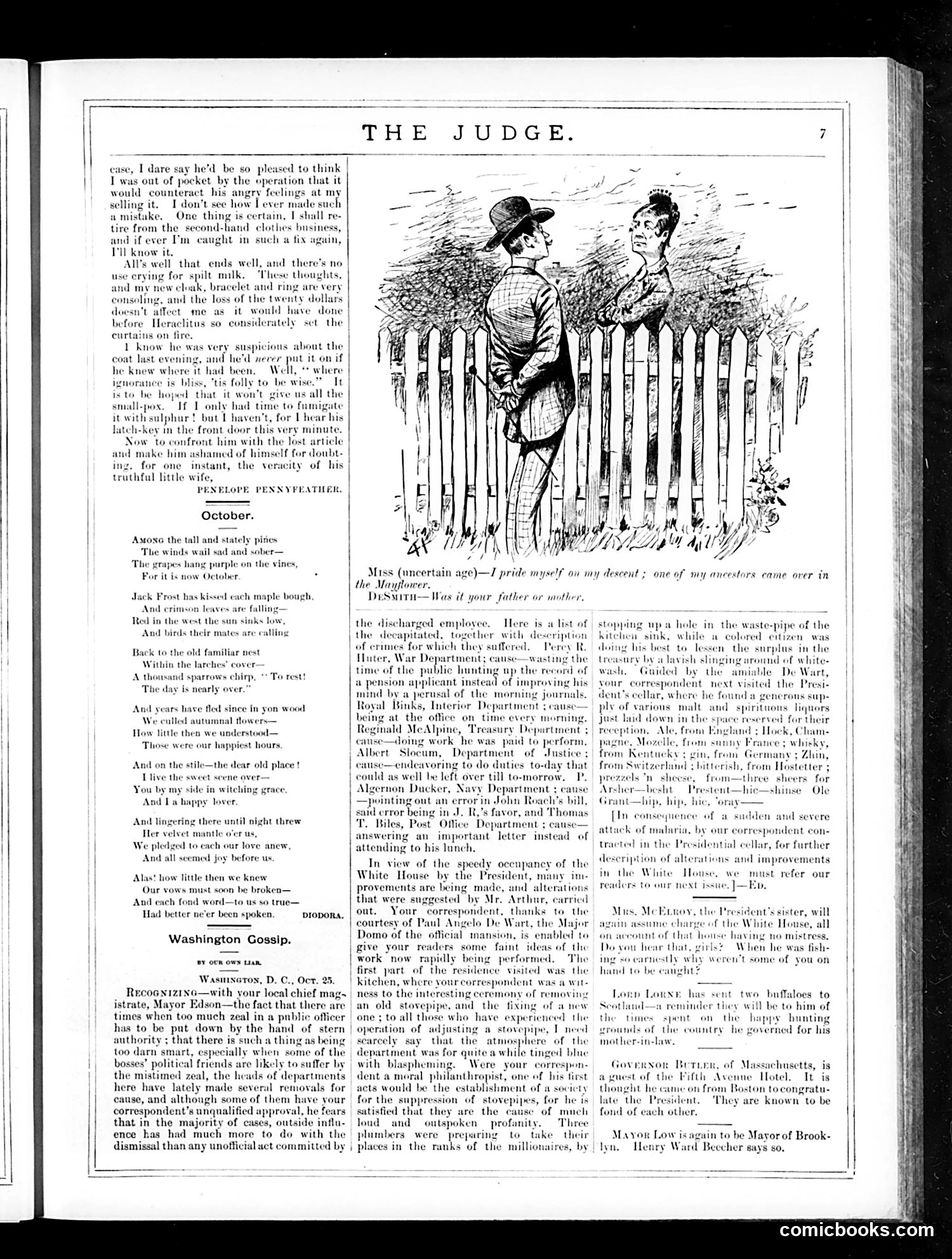
This page from *Judge* magazine contains satirical commentary on Washington bureaucracy and personnel management, circa October (likely 1880s based on context). **The Main Cartoon:** Depicts a domestic scene where a woman confronts her husband about a second-hand coat she sold, which apparently belonged to him. The satire mocks marital misunderstandings and domestic economy—she's bewildered by his anger, having unknowingly sold his garment. **"Washington Gossip" Section:** The real political satire. It ridicules President Arthur's administration for firing government employees, ostensibly for cause but actually due to political pressure from "bosses." The column lists discharged workers—Percy Hunter (War Department), Royal Binks (Interior), and others—with absurd reasons (one was "wasting time" on pension applications, another caught an error in someone's favor). The satirical point: these removals aren't genuine merit-based discipline but political patronage disguised as administrative reform. **Additional Content:** Poetry about October and lost romance; a brief joke about ancestry. The page satirizes corruption and hypocrisy in civil service management during the Gilded Age.
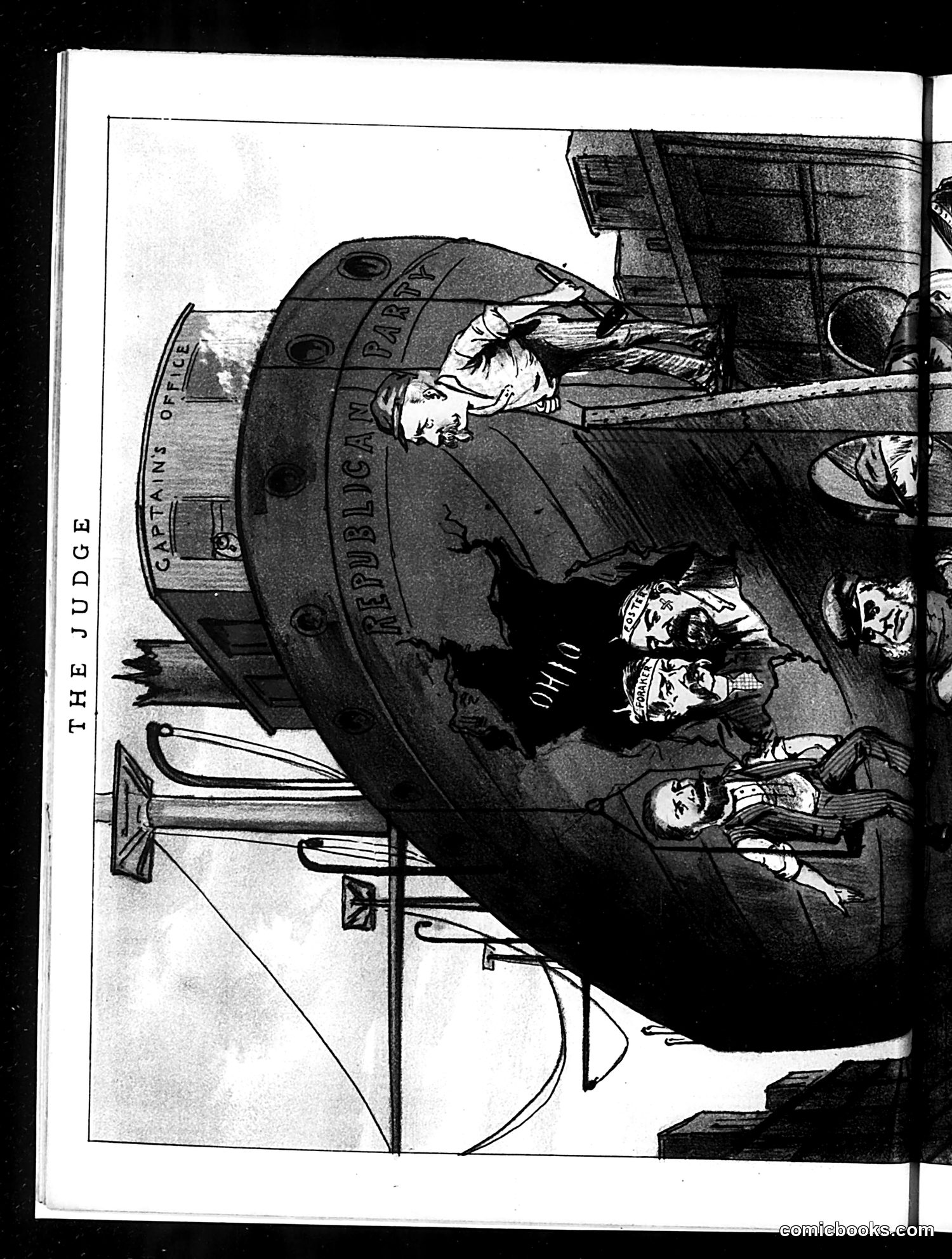
This page's OCR text is largely unreadable (appearing as random letters), making full interpretation difficult. However, the visible cartoon shows a judge presiding over what appears to be a barrel or container labeled "REPUBLICAN PARTY" with several figures depicted inside or around it. The title reads "THE JUDGE." This appears to be political satire commenting on Republican Party internal conflict or corruption, likely from the late 19th or early 20th century when *Judge* magazine was active. The barrel imagery suggests containment, crowding, or the party being "packed" with questionable figures. Without clearer text or date information, the specific political event or figures referenced remains unclear, though the satirical intent—criticism of Republican leadership or membership—is evident.
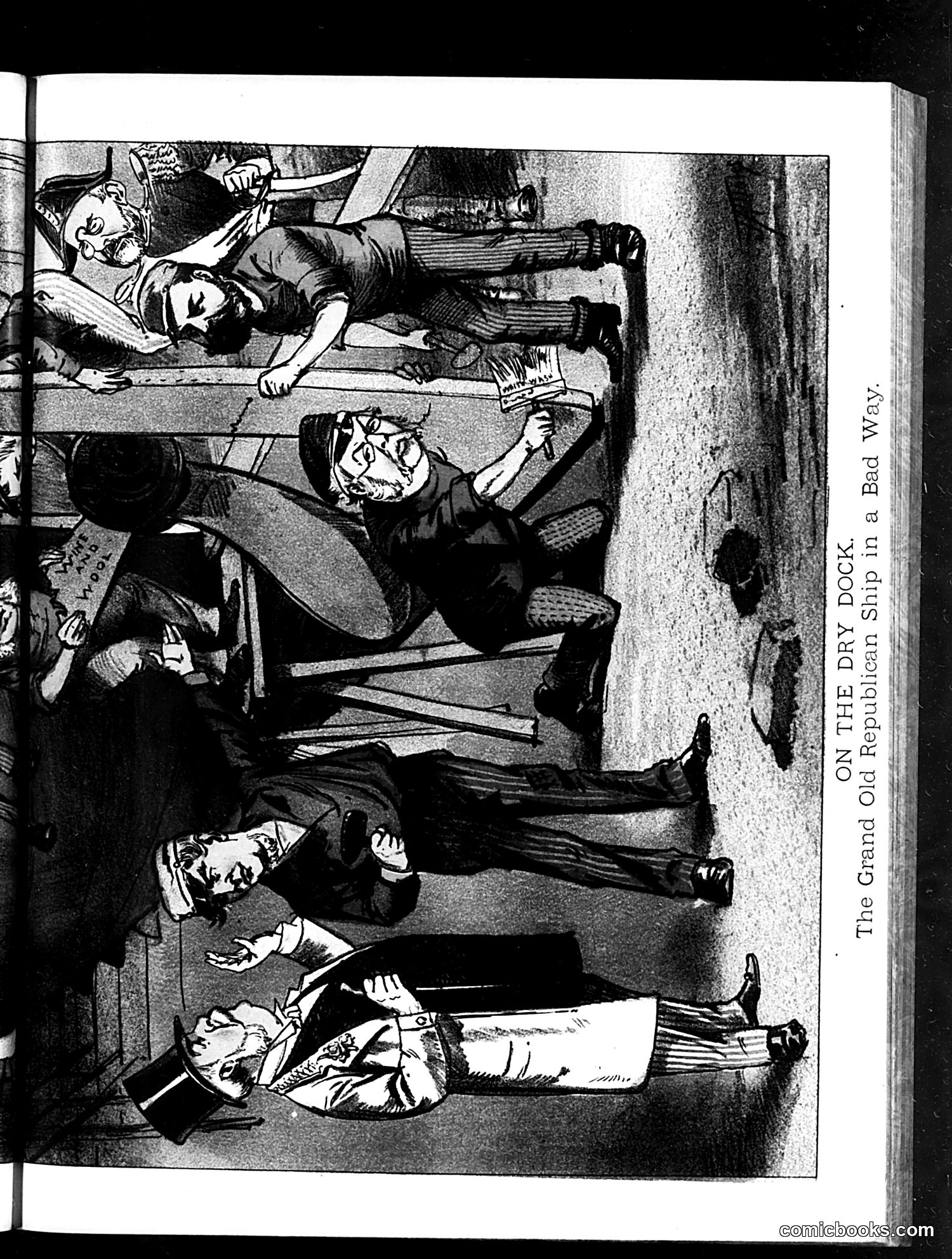
This page depicts "The Grand Oil Republican Ship in a Bed Way" — a political cartoon satirizing the Republican Party during what appears to be a crisis period (likely the Gilded Age, given Judge magazine's era). The illustration shows multiple figures in distress aboard or near a ship's bunk, apparently representing Republican leadership struggling with internal problems. The cartoon uses maritime disaster imagery — a common satirical device — to mock the party's dysfunction. The "oil" reference likely alludes to oil industry scandals or corruption involving Republican politicians, a frequent Judge target. The "bed way" (likely "bad way") emphasizes the party's dire situation. Without clearer identification of specific figures or a precise date visible on the page, I cannot definitively name which Republican leaders are caricatured, though the imagery suggests party infighting and incompetence during a scandal.
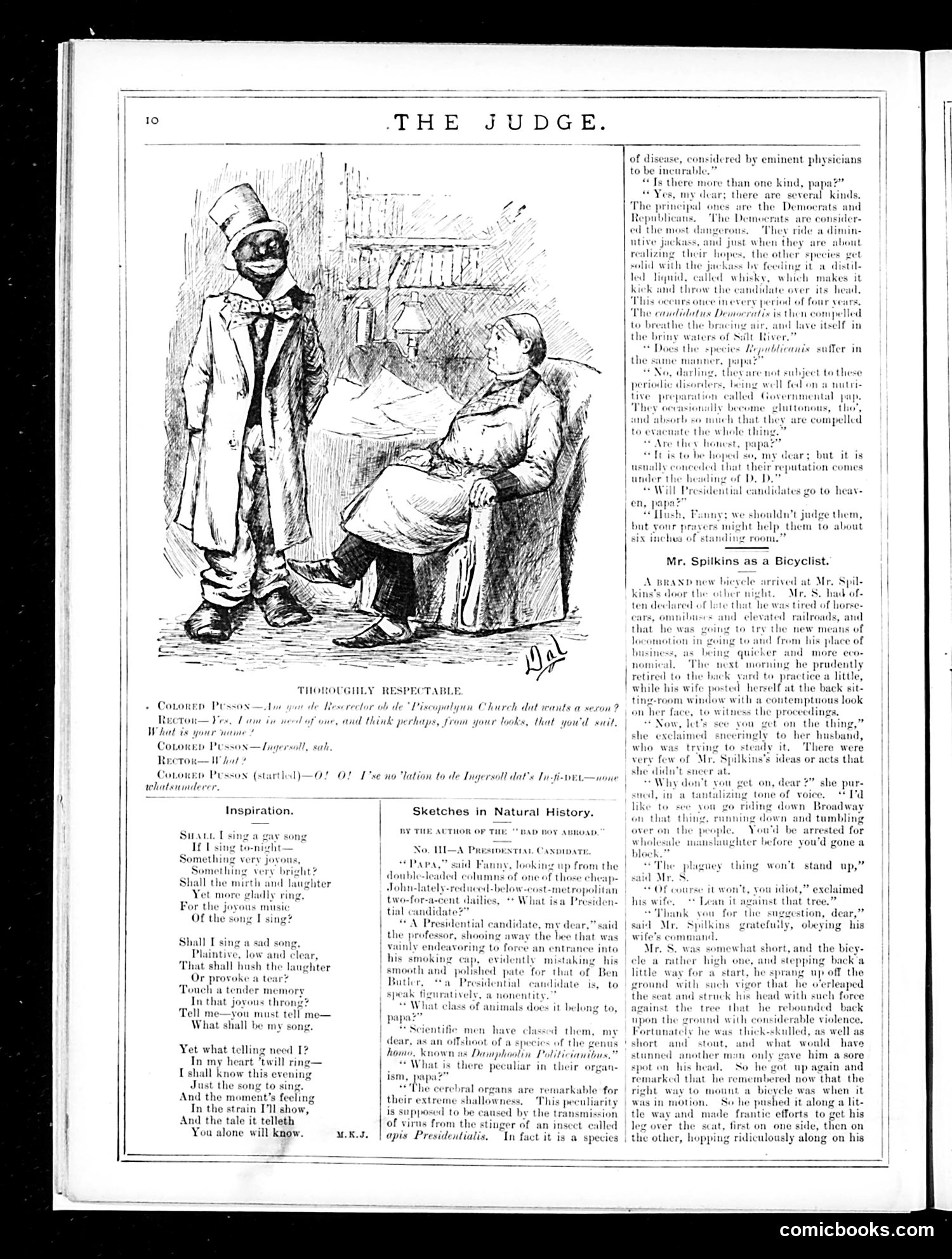
This page contains two satirical pieces targeting American politics and social behavior circa the 1880s-90s. ## Main Cartoon: "Thoroughly Respectable Colored Person" The top illustration depicts a well-dressed Black man speaking with a seated woman. The dialogue mocks racial stereotypes through exaggerated dialect, presenting him as seeking church employment. The satire appears to ridicule both the character's speech patterns and the absurdity of the scenario, reflecting Judge magazine's often crude racial humor typical of the era. ## "Mr. Spilkins as a Bicyclist" This longer sketch mocks a man attempting to ride a newly fashionable bicycle. His repeated failures—falling, hitting trees, struggling with mounting—satirize both the bicycle craze sweeping America and male incompetence. His wife's contemptuous observations underscore the humor. The piece reflects late-Victorian anxiety about technological novelty and masculinity. Both pieces use exaggeration and physical comedy characteristic of Judge's satirical approach to contemporary American life.
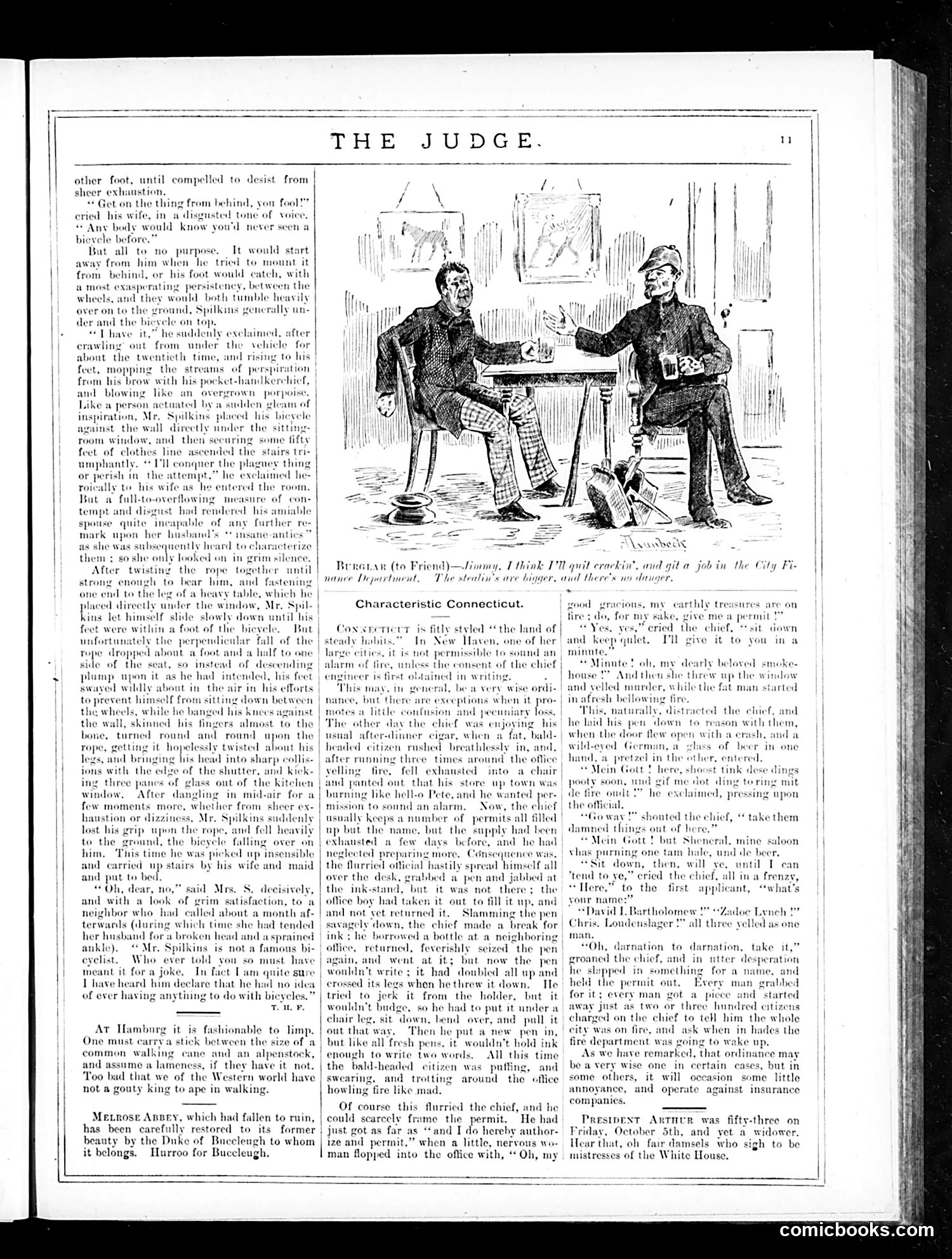
This page contains two distinct satirical pieces: **The Main Cartoon**: Depicts Mr. Spilkins attempting to learn bicycle riding—a fashionable but notoriously difficult pursuit in the 1890s. The accompanying text humorously chronicles his repeated failures: he struggles to mount the bicycle, attempts an absurd rope-slide technique from a window, and crashes repeatedly. His long-suffering wife witnesses his increasingly pathetic efforts with barely concealed disgust. **The Satire**: Mocks the bicycle craze sweeping America. Cycling was new, trendy, and genuinely challenging for adults—particularly men like Spilkins, whose bumbling incompetence and stubborn pride make him a figure of ridicule. The detailed slapstick narrative emphasizes how an ordinary, dignified man becomes undone by this modern invention. **Secondary Item**: "Characteristic Connecticut" satirizes bureaucratic absurdity, describing a fire chief's inability to issue alarm permits due to missing pens and ink—mocking petty official incompetence. The humor targets both technological anxiety and masculine pride during the bicycle's early adoption period.
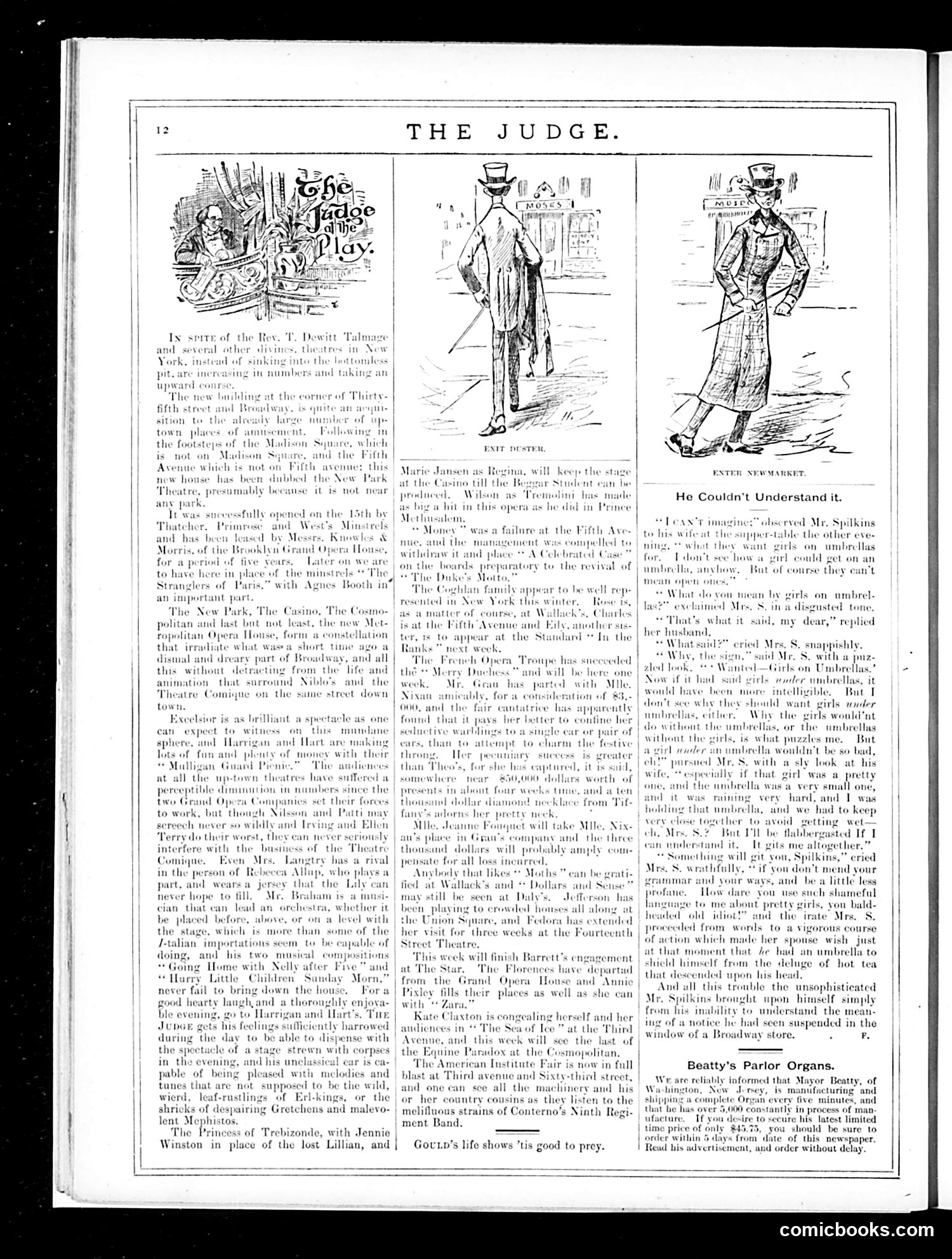
This page from *Judge* magazine focuses on **New York theater and entertainment gossip** rather than political satire. The main content reviews current theatrical productions and performers. The three sketches show characters in theatrical contexts: "Exit Newmarket," a woman in formal dress, and "He Couldn't Understand It"—a comic domestic exchange where Mr. Spilkins cannot grasp why his wife refers to girls carrying umbrellas differently ("umbrella" vs. "umbrellas"), finding the distinction nonsensical. The bulk of the page is theater criticism discussing opening shows, performers like Marie Jansen and Jennie Winston, and various opera and dramatic productions around New York. There are references to the Casino theater, Daly's, and other contemporary venues. The humor derives from theatrical in-jokes and social observation rather than political commentary—typical of *Judge's* lighter entertainment coverage in the 1880s-1890s era.
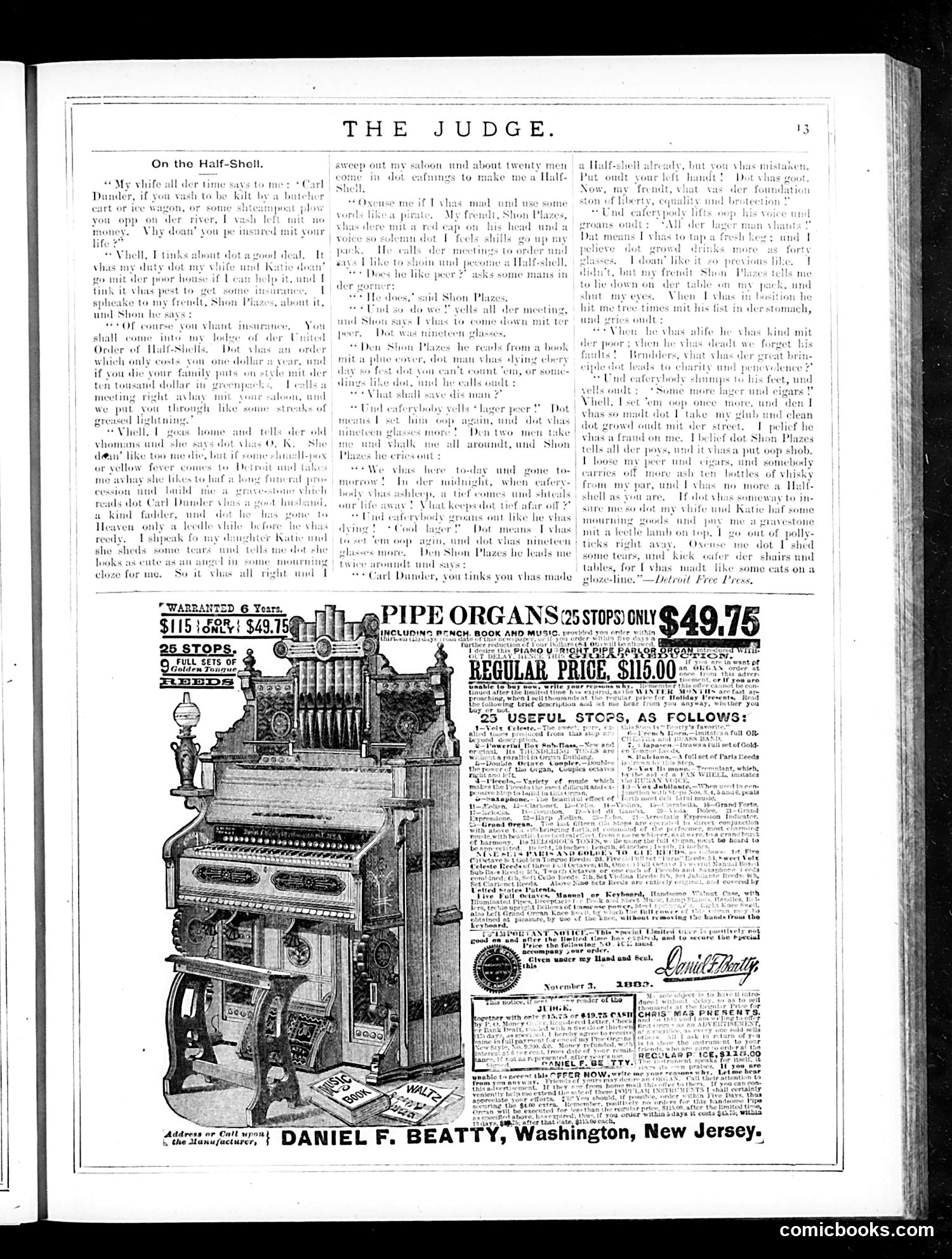
This is a comedic dialect story featuring a German-American character (indicated by heavy German-accented English: "vhas," "vhell," "dot," "vhy"). The narrative follows Carl Dunder's complaint to a bartender about his saloon's Half-Shell drinks special. **The Satire:** The joke appears to target both working-class immigrant culture and excessive alcohol consumption. Dunder recounts how his daughter Kate got drunk on Half-Shells, leading to disastrous consequences—she lost her modesty, spent money recklessly, and generally behaved scandalously. The humor derives from the contrast between his paternal concern and his obliviousness to the drinks' potency. **Historical Context:** This reflects early 1900s American attitudes toward German immigrants (through caricatured dialect) and anxieties about alcohol's social effects, particularly on women. The piece uses ethnic stereotyping common to *Judge* magazine's satirical approach. **The Advertisement:** A pipe organ manufacturer's ad dominates the lower half, unrelated to the story above.
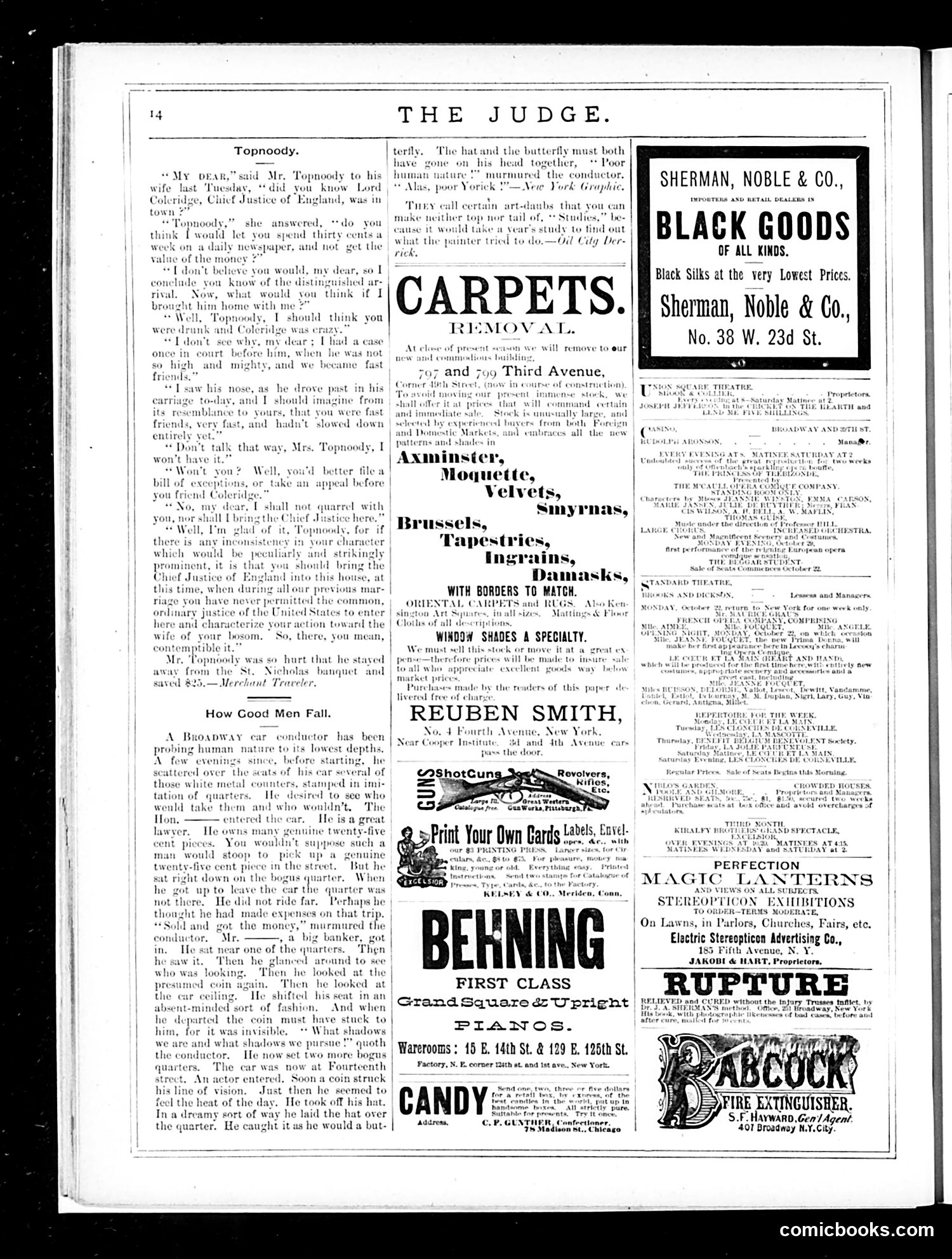
This page is primarily **advertising** with a brief humorous sketch titled "Topnoody" at the top. The sketch depicts a domestic disagreement between Mr. and Mrs. Topnoody about spending thirty cents on a newspaper. Mr. Topnoody references "Chief Justice of England" and legal concepts (filing "exceptions," taking an "appeal") to humorously frame their marital dispute in courtroom language. The joke satirizes how couples transform trivial financial disagreements into elaborate legal-sounding arguments. The rest of the page consists entirely of **period advertisements** for carpets, pianos, candy, fire extinguishers, black goods/fabrics, and other merchandise typical of late 19th-century retail. There are no other cartoons or political commentary visible. The page demonstrates *Judge* magazine's business model: satirical content subsidized by commercial advertising.
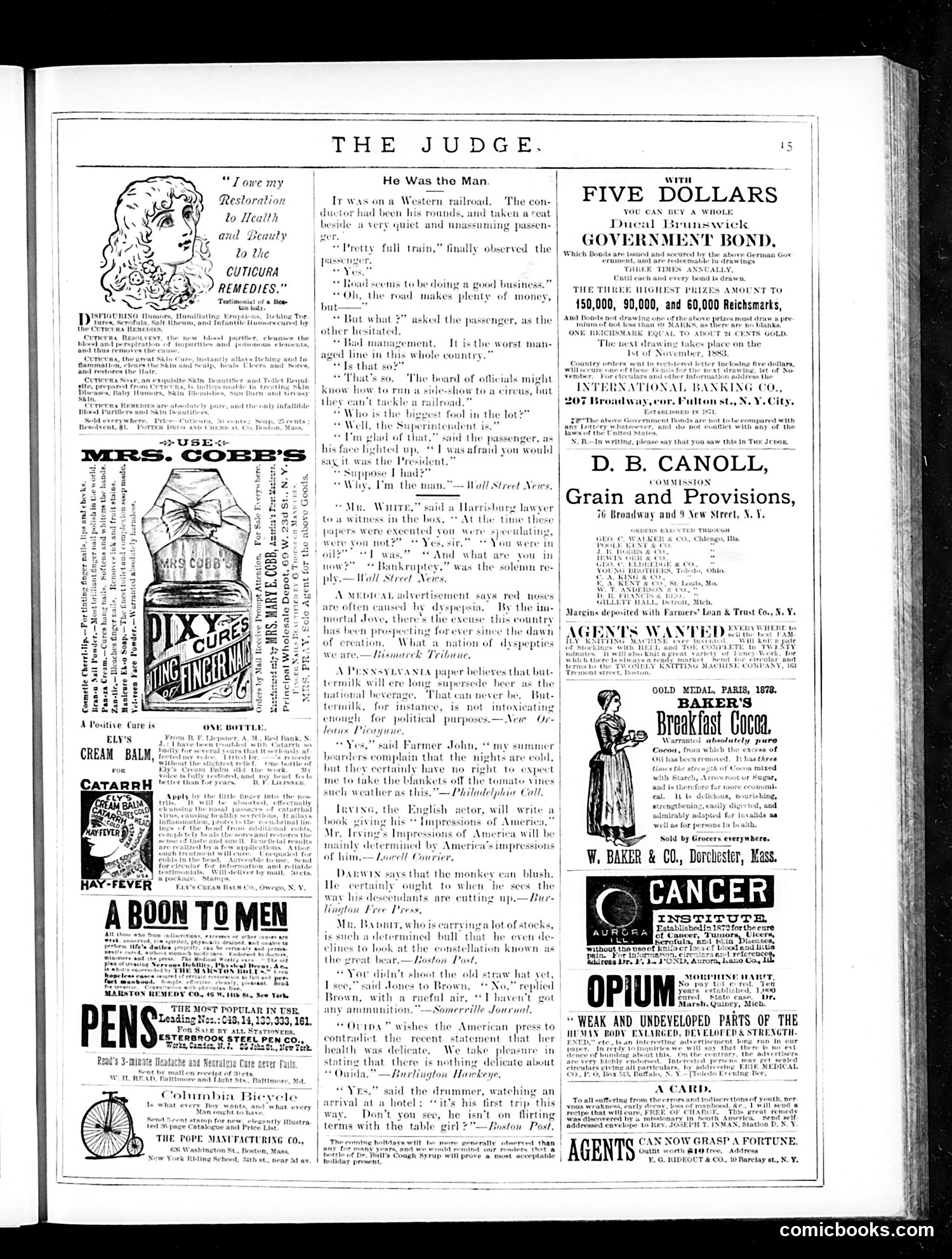
This page is primarily **advertising** with a brief satirical anecdote titled "He Was the Man" occupying the center column. The joke concerns a railroad conductor and passenger discussing the train's poor performance. When asked who's responsible, the conductor identifies "the man"—eventually revealed to be the President (of the railroad). The satire mocks bureaucratic buck-passing: each official blames "the man" above him, creating a circular deflection of responsibility where no one accepts accountability for mismanagement. The humor reflects late 19th-century American skepticism of corporate management and institutional hierarchy. It's a straightforward joke about how organizational failures get blamed on an abstract "the man" rather than specific individuals taking responsibility. The rest of the page consists of patent medicine advertisements (Cuticura, Ely's Cream Balm), a bicycle ad, and financial notices—typical Judge magazine content mixing satire with commercial appeals.
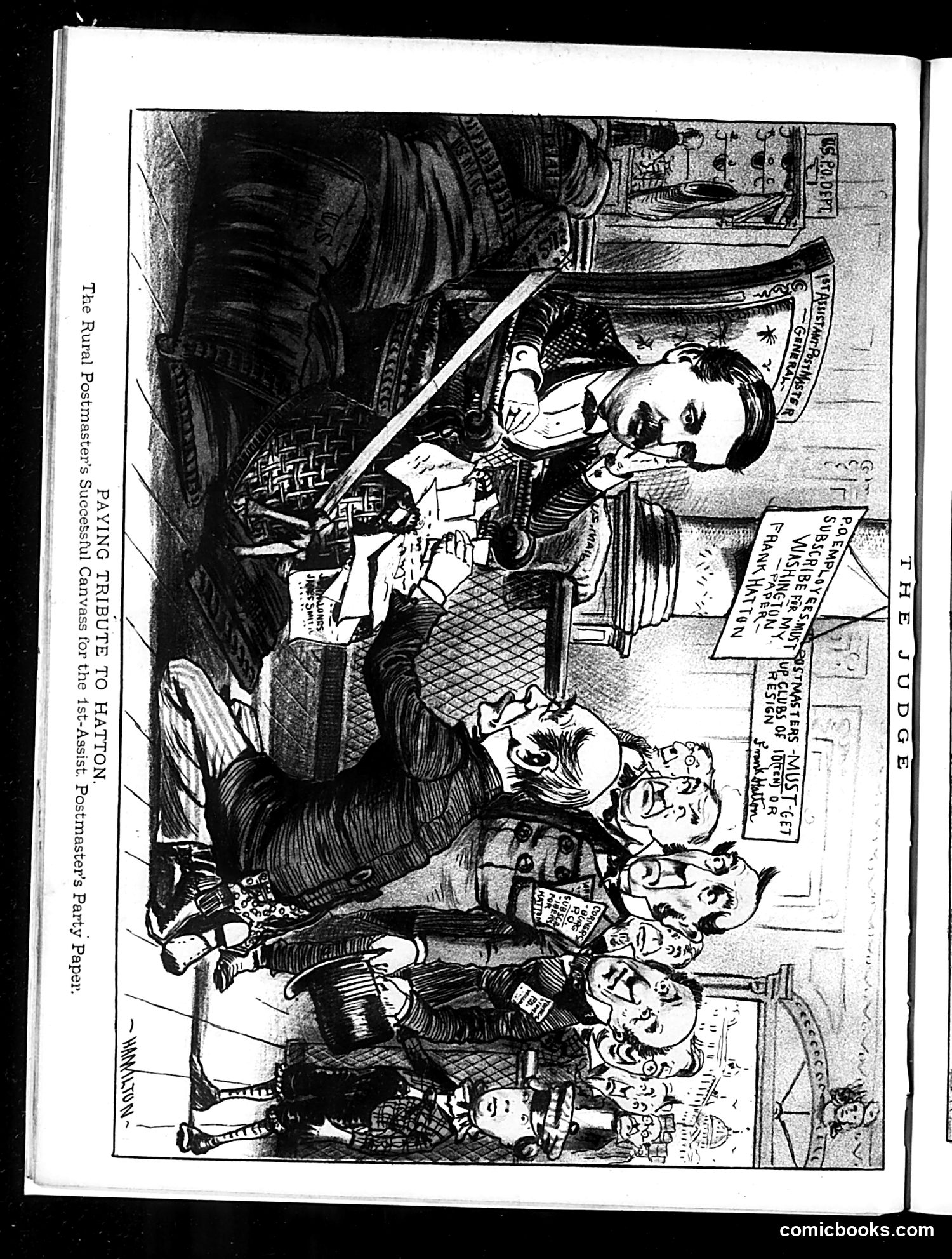
This is a satirical cartoon titled "Paying Tribute to Hatton," depicting what appears to be a rural postmaster successfully lobbying or "canvassing" (collecting contributions) for support of an "Assistant Postmaster's Party" publication. The cartoon criticizes the practice of using public office-holders to fundraise for partisan political publications—essentially coercing contributions from subordinate federal employees for political purposes. The central figure appears to be the postmaster pressuring various rural workers or assistants into "paying tribute" (contributing money). The satire targets the corrupt patronage system where federal positions like postmaster were used for political gain, with subordinates expected to support party organs financially. The title's reference to "Hatton" likely indicates a specific postmaster being lampooned, though without additional context I cannot confirm his identity. The cartoon mocks this abuse of bureaucratic hierarchy for party fundraising.