
A complete issue · 16 pages · 1883
Judge — September 22, 1883
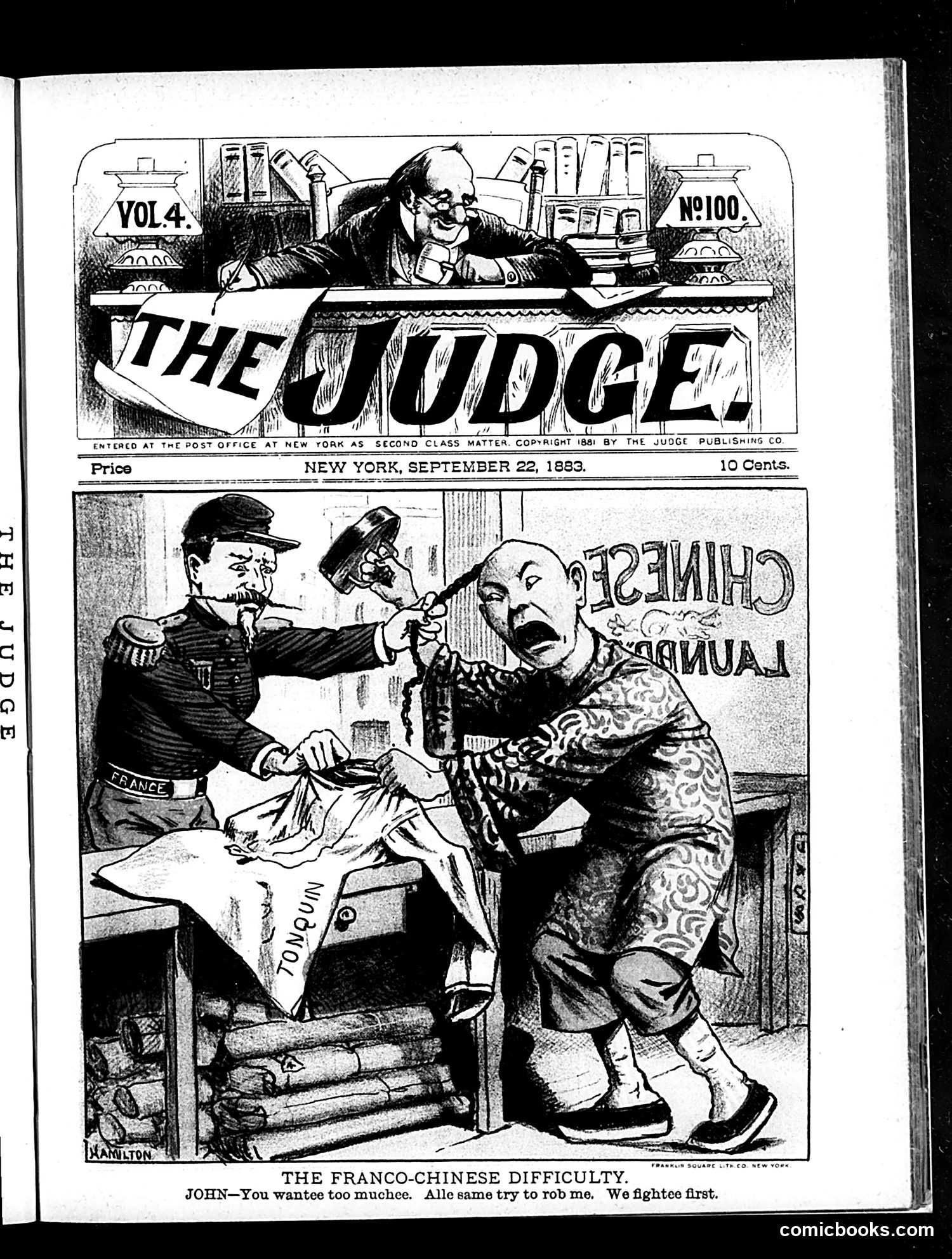
This political cartoon from *The Judge* (September 22, 1893) satirizes international tensions between France and China. The left figure, labeled "France," wears a military uniform with epaulettes. The right figure, labeled "China," wears traditional Chinese robes and appears distressed. France threatens China with a hammer while holding what appears to be a document labeled "Tonkin" (a French colonial territory in Indochina that was a major point of Franco-Chinese conflict in the 1880s-90s). The caption reads: "JOHN—You wantee too muchee. All same try to rob me. We fightee first," using period-typical stereotypical "pidgin English" dialogue to mock the dispute. The cartoon depicts Western imperial aggression—France attempting to coerce China through military intimidation over colonial disputes.
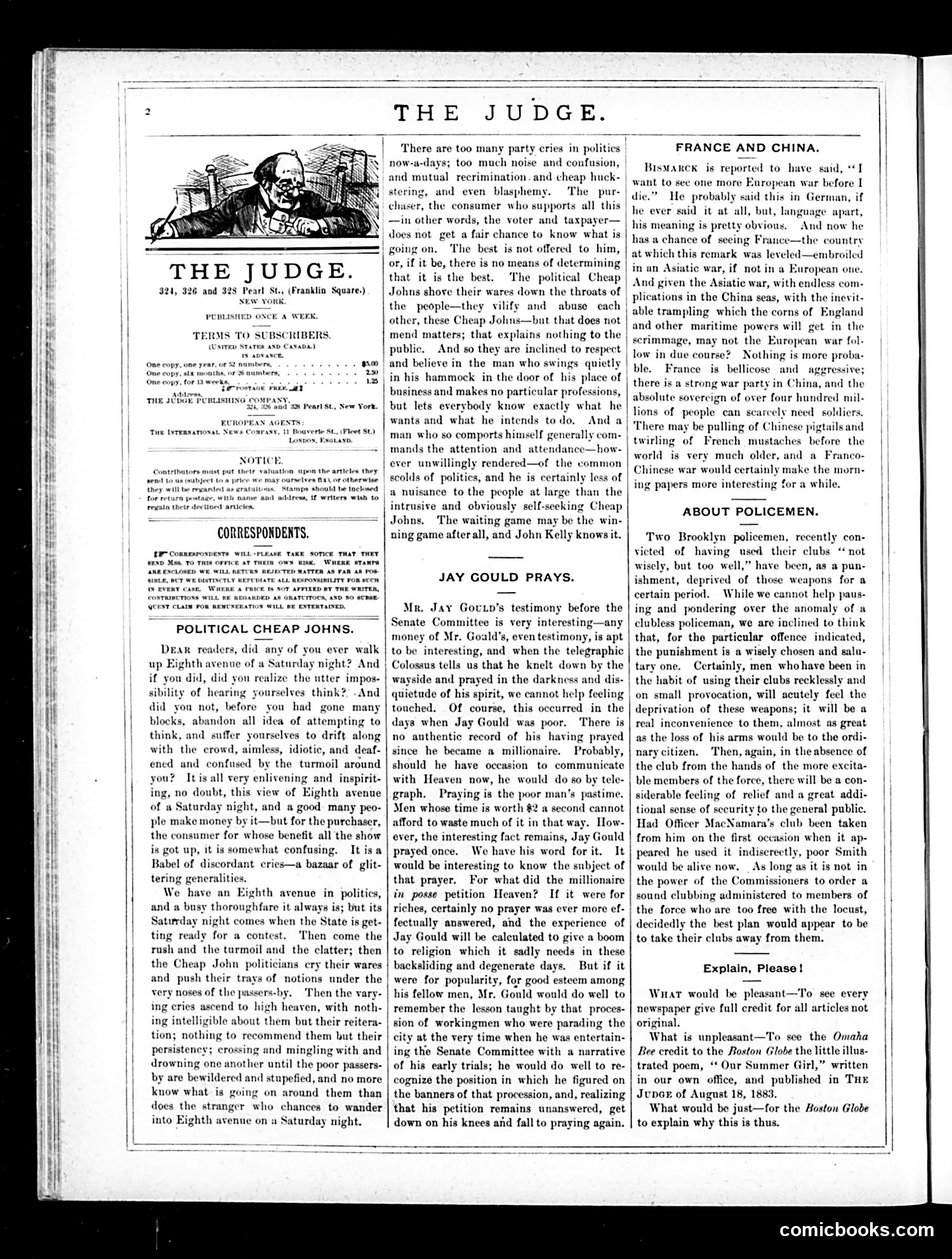
This page from *Judge* satirizes American politics as a chaotic "Eighth Avenue" marketplace where politicians ("Cheap Johns"—a period term for hucksters) shout competing claims to confuse voters rather than inform them. The main editorial compares election season noise to Saturday night street vendors hawking wares—all clamor and "glittering generalities" with no substance. The second piece mocks Jay Gould's Senate testimony, where the railroad magnate claimed he'd knelt in prayer during business difficulties. The satire suggests Gould's sudden piety is performative—that wealthy businessmen adopt religiosity strategically when convenient, much like politicians adopt whatever positions sell best. The tone implies skepticism about the millionaire's genuine spiritual conversion. Both pieces critique how power brokers manipulate public opinion through noise and theater rather than honest discourse.
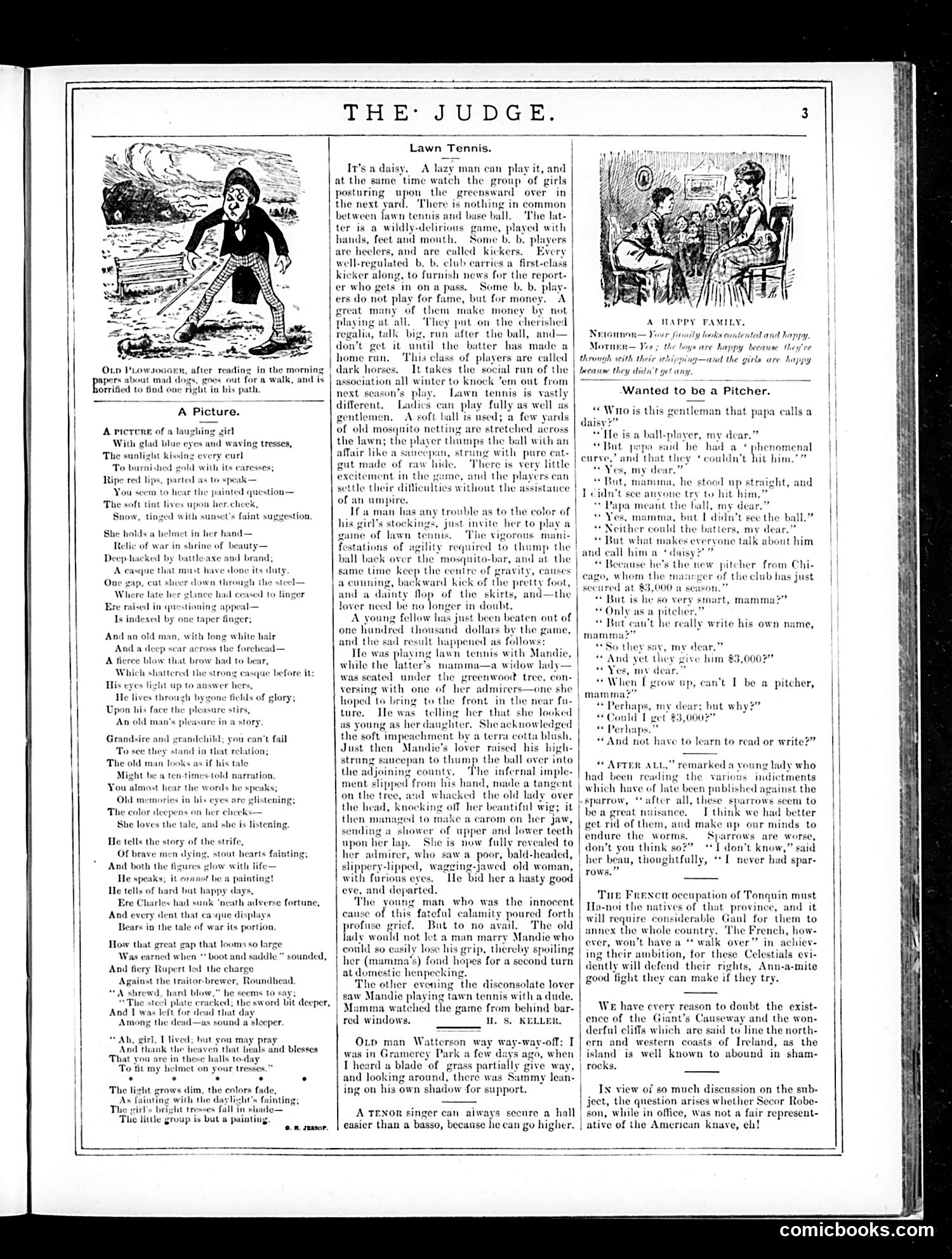
This page from *Judge* magazine contains two distinct pieces: **Left side:** A sentimental poem with illustration titled "Old Ploughshare" depicts an elderly man showing a young girl a dented military helmet, narrating stories of his wartime service under King Charles (likely Charles I during the English Civil War). The helmet bears scars from "the traitor-brewer, Roundhead" — references to the 17th-century conflict. It's a nostalgic, patriotic narrative romanticizing military sacrifice. **Right side:** "Lawn Tennis" satirizes the fashionable sport as lazy and socially performative. The satire mocks players' pretense and notes that ladies use it partly to display their legs. A cautionary anecdote warns that a young man lost $100,000 while playing lawn tennis — distracted by a woman's appearance rather than the game. The contrast reflects *Judge's* satirical approach: mixing sentimental nationalism with sharp social criticism of contemporary leisure practices and gender dynamics.
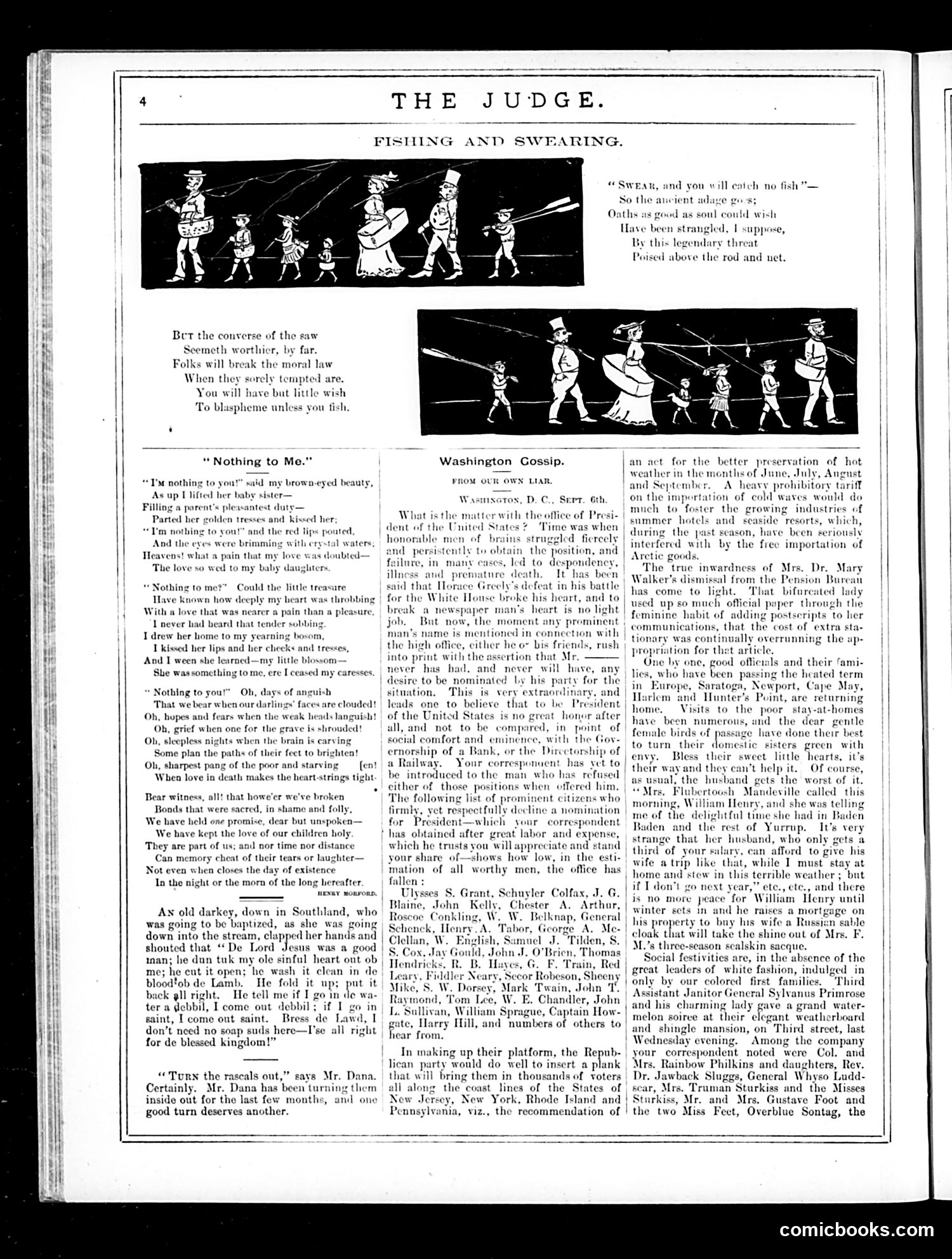
This page presents two satirical pieces on moral behavior: **Top Section - "Fishing and Swearing":** The illustrated strips and accompanying verse mock the folk saying "swear and you'll catch no fish." The satire suggests that people break moral laws when tempted, implying that fishermen (and by extension, anyone) will abandon ethics when pursuing their desires—contradicting the old adage about virtue bringing reward. **Bottom Section - "Washington Gossip":** This biting political commentary mocks prominent politicians who publicly deny presidential ambitions. The author notes the absurdity: whenever someone's name surfaces for the presidency, they immediately deny wanting it—yet these same men would eagerly accept lesser positions like bank governorships or railway directorships. The satire suggests the presidency is now so undesirable that politicians must be convinced *not* to want it, a reversal of historical precedent when honorable men competed fiercely for the office. The piece appears to reference political figures of the 1870s era, including Horace Greeley's failed 1872 presidential campaign.
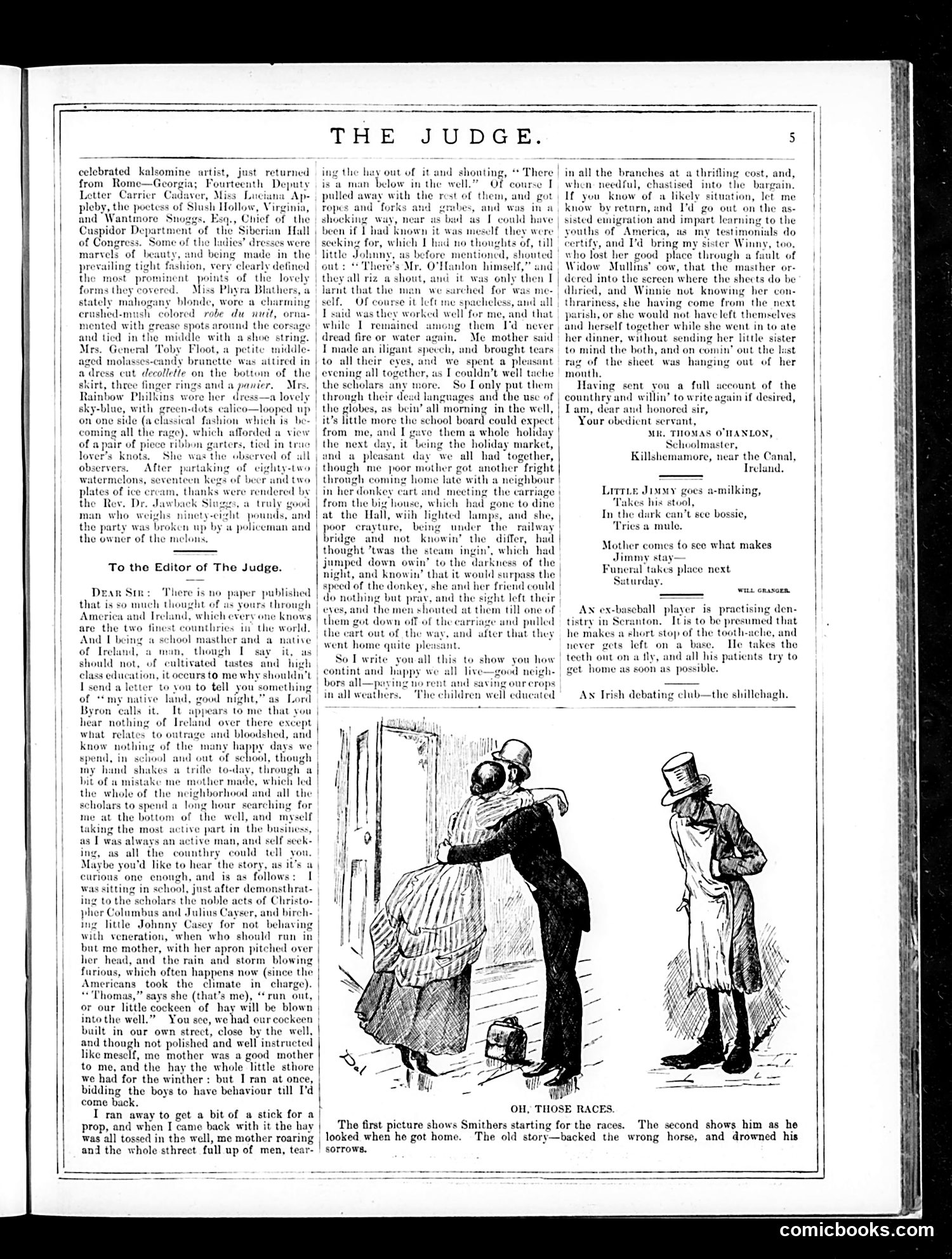
This page contains two distinct pieces of content: **Main Letter & Story**: A lengthy letter from "Mr. Thomas O'Hanlon," an Irish schoolmaster, recounting anecdotes about his village life near Dublin—including a mishap where neighbors search a well for a man who turns out to be O'Hanlon himself, and his mother's frightening encounter with a steam engine she mistakes for something else. The humor derives from Irish dialect humor and rural naïveté, reflecting 19th-century American attitudes toward Irish immigrants. **The Cartoon "Oh, Those Races"**: Two panels depicting a man (Smithers) preparing for horse races, then being found drowned after "backing the wrong horse." This is a double-meaning joke: literal horse-racing failure combined with financial ruin—a common Victorian satirical trope about gambling and poor financial decisions. Both pieces exemplify Judge's brand of ethnic stereotyping and working-class mockery typical of Gilded Age American humor.
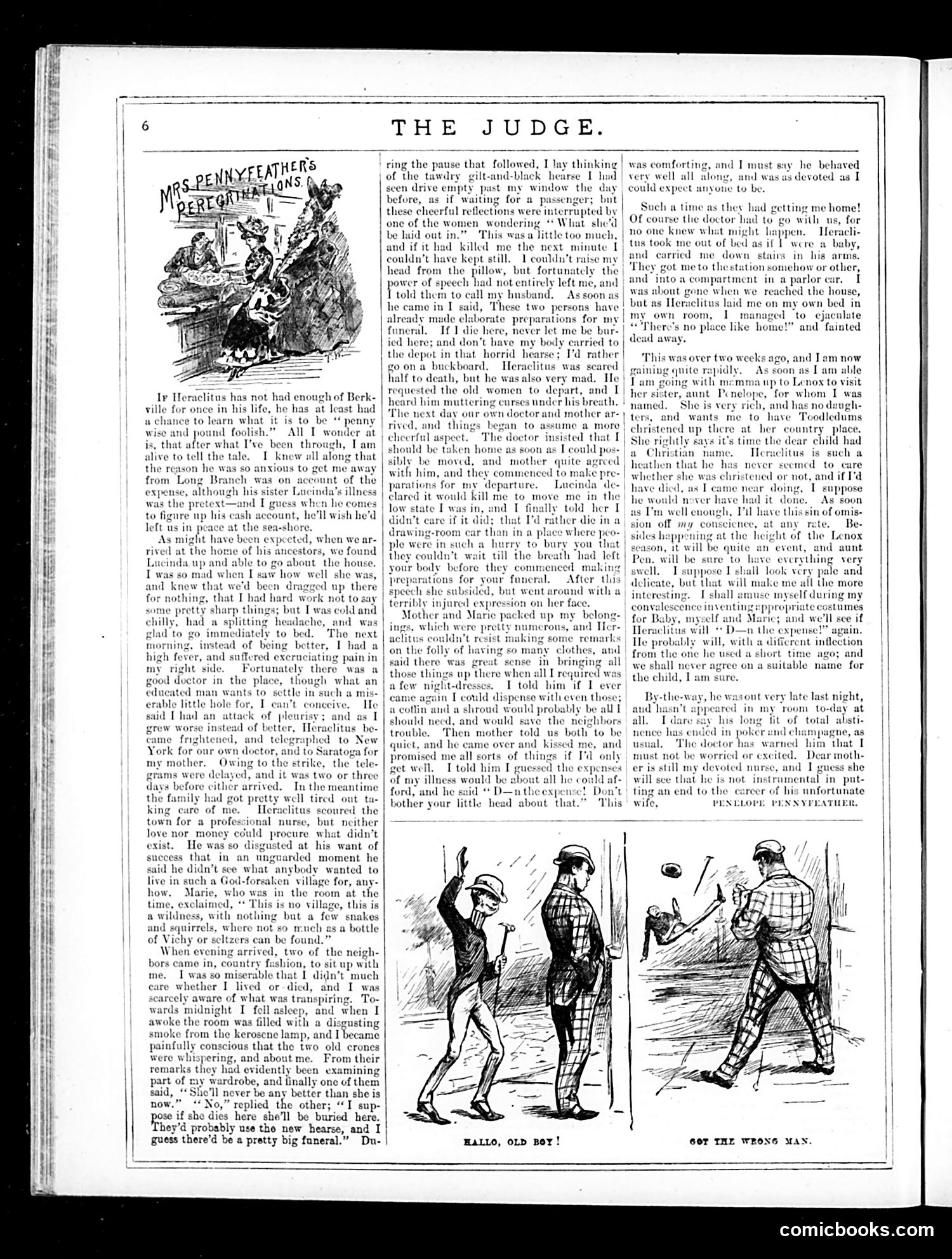
This page contains a serialized story titled "Mrs. Pennyfeather's Peregrinations" about a woman recovering from pleurisy (lung infection) in a small, rural village. The narrative satirizes provincial life and small-town society. The humor centers on two elderly village women who sit with the bedridden narrator and, examining her wardrobe, callously discuss her likely death and funeral arrangements—speaking as if she cannot hear them. One remarks they'd "probably use the new hearse" and there'd be "a pretty big funeral." The satire targets rural ignorance and lack of medical resources—the town has no professional nurse or proper supplies, forcing the husband to telegraph for their own doctor from the city. The village is characterized as primitive ("nothing but a few snakes and squirrels"). The two illustrations show a golf scene labeled "Hallo, Old Boy!" and "Got the Wrong Man," likely illustrating a separate humorous anecdote. The overall tone mocks rural backwardness while presenting urban characters' superiority through their dismay at provincial conditions.
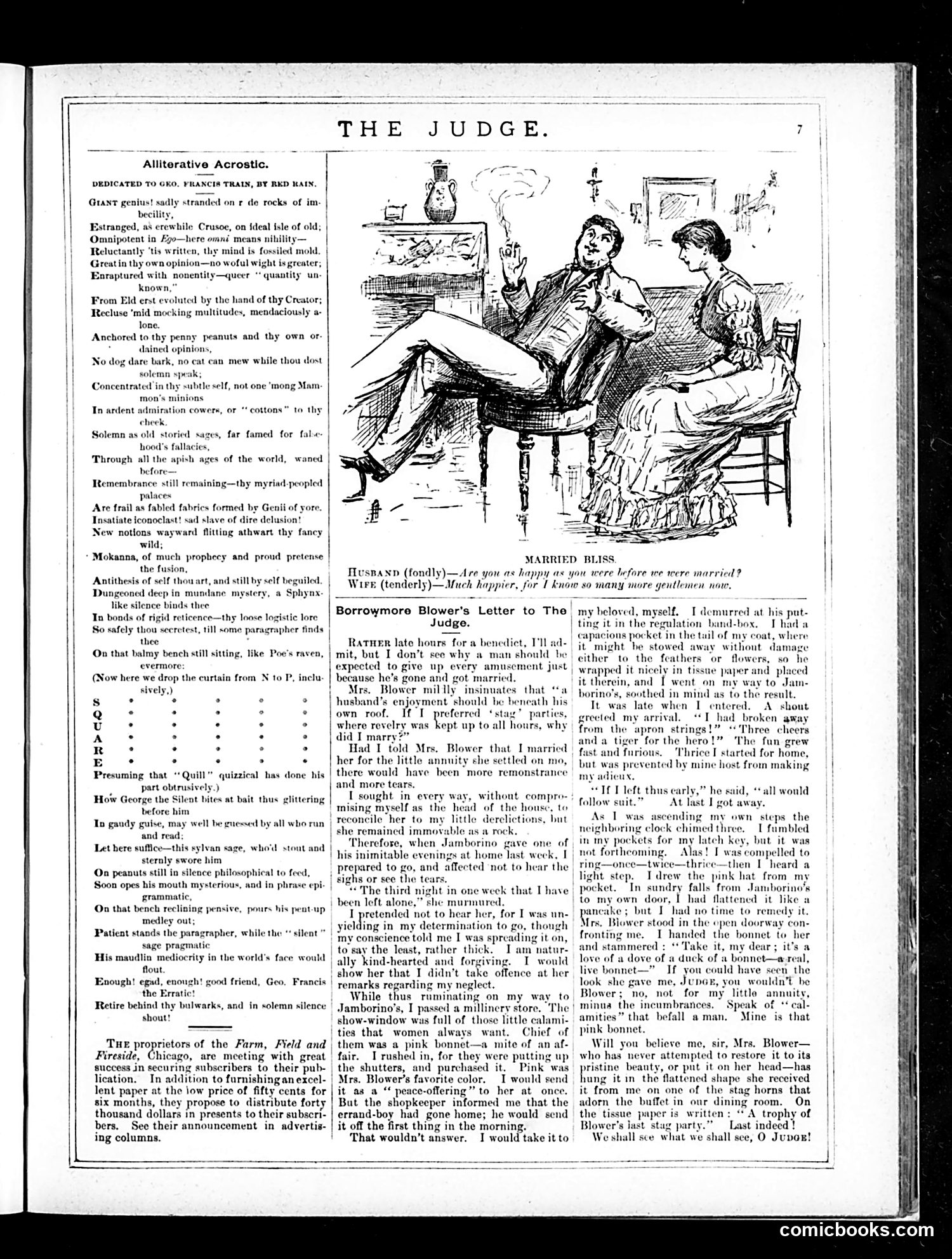
This *Judge* page contains satirical verse and domestic humor typical of late 19th-century American magazines. The **"Alliterative Acrostic"** is a scathing personal attack poem (acrostic spelling "GEORGE FRANCIS TRAIN") mocking someone for arrogance, delusion, and self-absorption. "Train" appears to be a public figure of that era, though his specific notoriety isn't immediately clear from context alone. The **"Married Bliss"** cartoon jokes about a wife's marital unhappiness: when asked if she's happier now than before marriage, she replies she's actually *more* content because she now knows "many more gentlemen"—implying infidelity or that marriage hasn't restricted her social life as expected. **"Borrowmore Blower's Letter"** is a humorous first-person account from a husband defending his attendance at late-night social events despite his wife's complaints about being left alone. He justifies prioritizing entertainment over domestic life, presenting his selfishness as reasonable. The tone throughout is cynical about marriage, class pretension, and social hypocrisy—common *Judge* themes satirizing Victorian respectability.
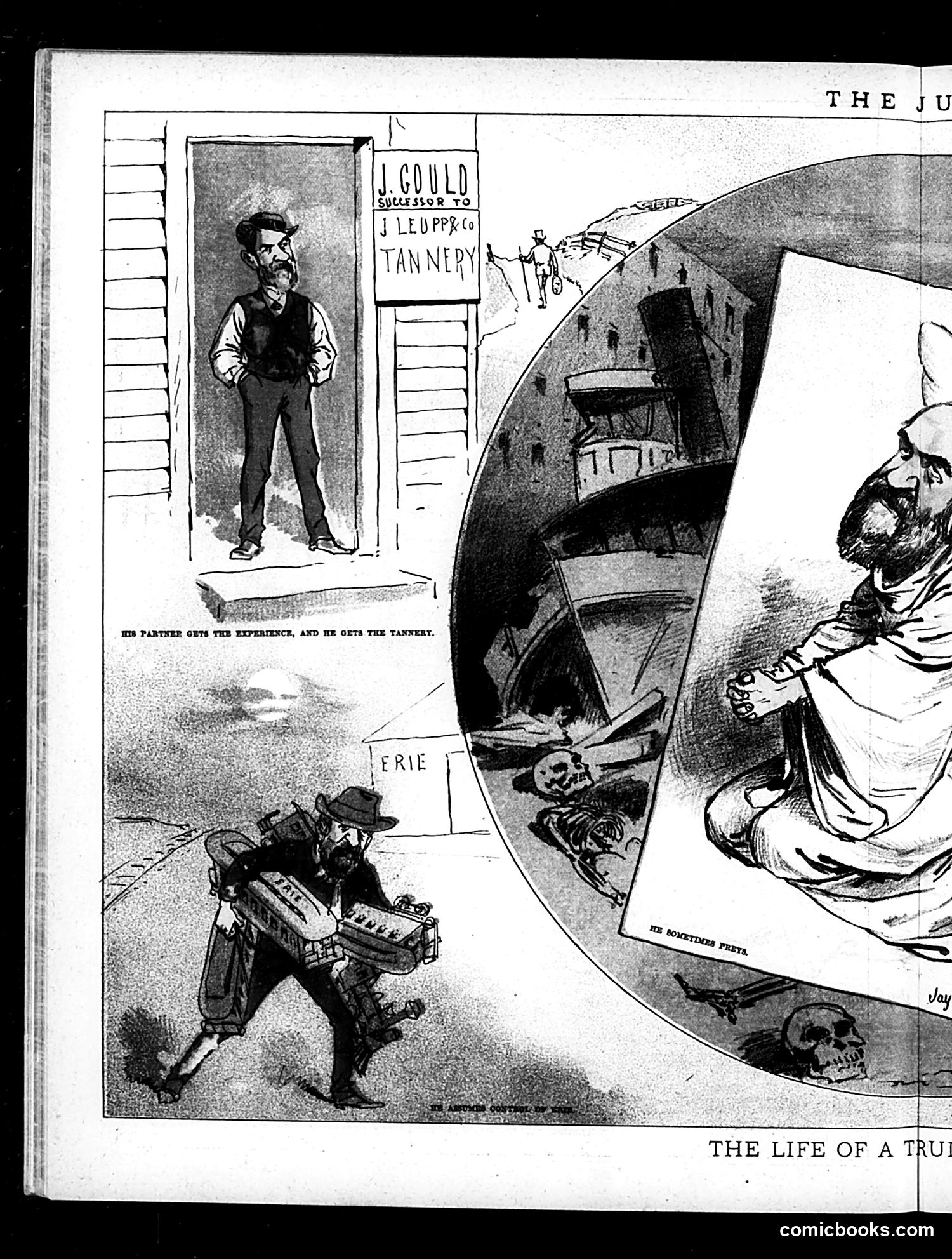
This appears to be a satirical comic strip titled "The Life of a Tramp" showing a narrative sequence. The top panel depicts a man at a tannery business (successor to J. Leupp & Co.). The caption "His partner gets the experience, and he gets the tannery" suggests commentary on unfair business dealings or inheritance. The lower panels show a figure carrying what appears to be stolen goods, likely illustrating consequences or the "tramp's" downward spiral. The skull imagery on the right suggests darker outcomes. This satirizes Gilded Age business practices—specifically how one party profits while another bears actual labor ("experience"), or critiques inequality in commercial ventures. The progression from business owner to criminal suggests social commentary on economic desperation or moral decline, though specific individuals referenced remain unclear without additional historical context.
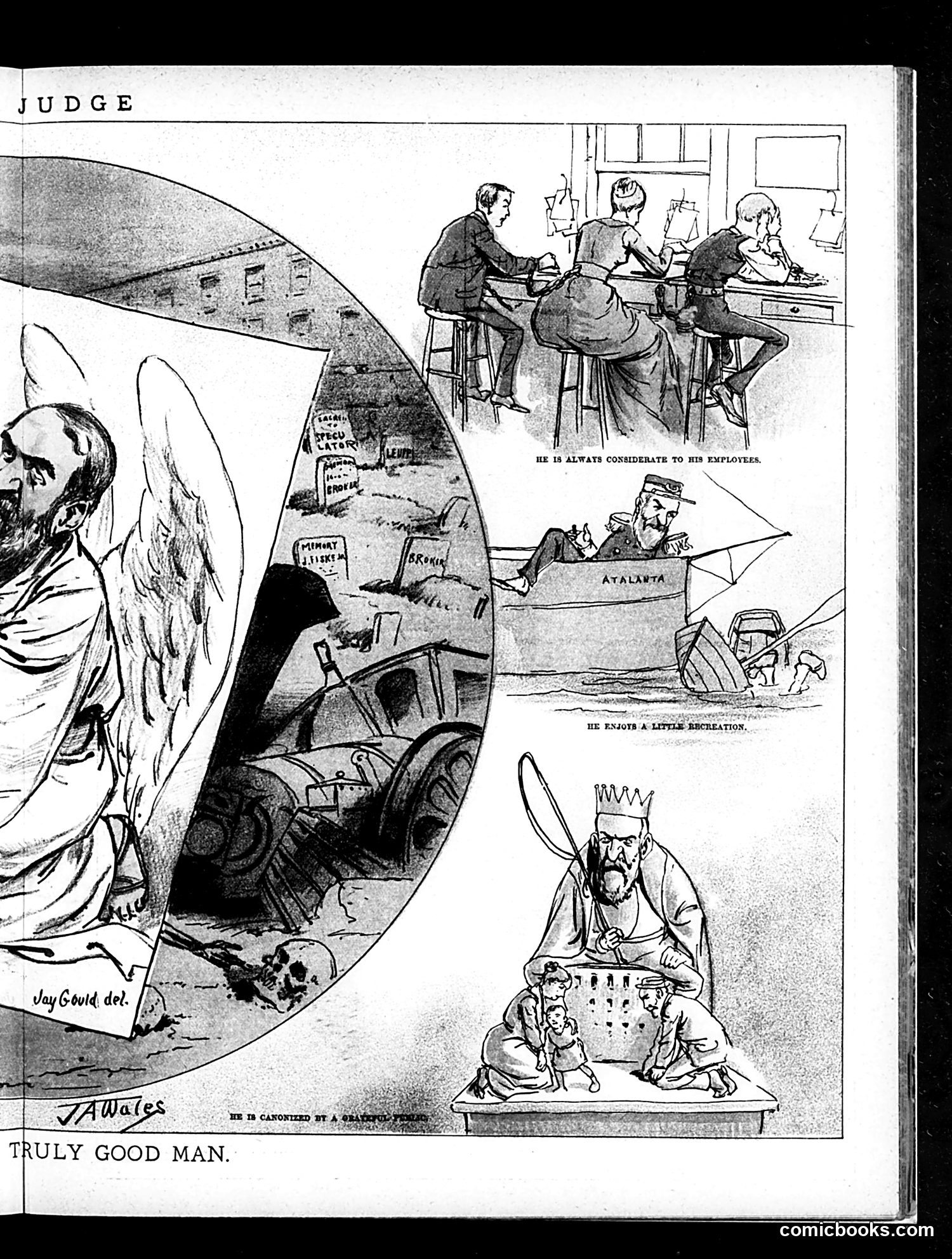
This Judge magazine satirical piece depicts an idealized employer through contrasting scenes. The top panel shows "He is Always Considerate to His Employees"—a well-dressed businessman supervising workers at desks. The middle panel, "He Enjoys a Little Recreation," shows him boating labeled "ATLANTA." The bottom panel, "He is Canonized by a Grateful Public," depicts him as a crowned, saintly figure worshipped by small figures. The satire is ironic: the cartoon mocks excessive praise of wealthy industrialists who receive public adulation for basic decency toward workers. The angel wings on the left margin reinforce the absurdist canonization. The piece likely critiques the early 20th-century tendency to lionize businessmen as moral exemplars, suggesting such veneration was unwarranted even for merely competent, non-abusive employers.
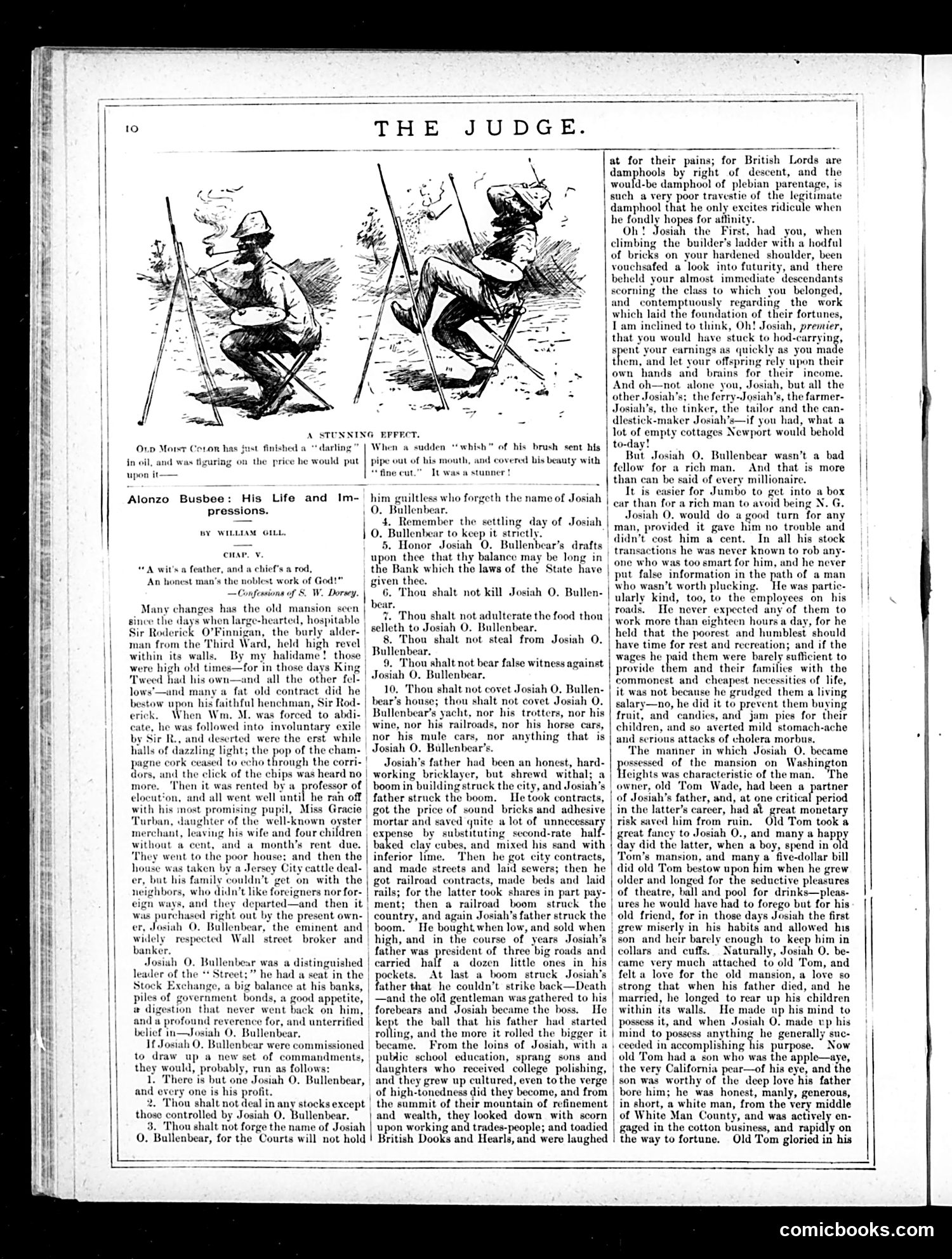
This page satirizes **Gilded Age wealth and corruption**, specifically targeting stock exchange operators and unscrupulous businessmen. The two cartoons illustrate contrasting paths to fortune: **"A Stunning Effect"** (top): Shows a painter accidentally hitting someone with his brush—a visual joke about unexpected consequences. **"Josiah O. Bullenbear: His Life and Impressions"** (main text): A scathing satirical biography of a fictional Wall Street broker who represents the archetypal corrupt financier. Bullenbear rises from his honest bricklayer father through real estate speculation and railroad contracts, accumulating wealth through shrewd dealings and dishonest substitutions (cheap materials, fraudulent contracts). The parody "Ten Commandments" mocks his self-worship and absolute greed. The satire criticizes how wealthy speculators prioritize profit over ethics, control markets, and command absolute loyalty. Judge magazine targets the financial elite's moral bankruptcy during an era of rampant stock manipulation and corruption.
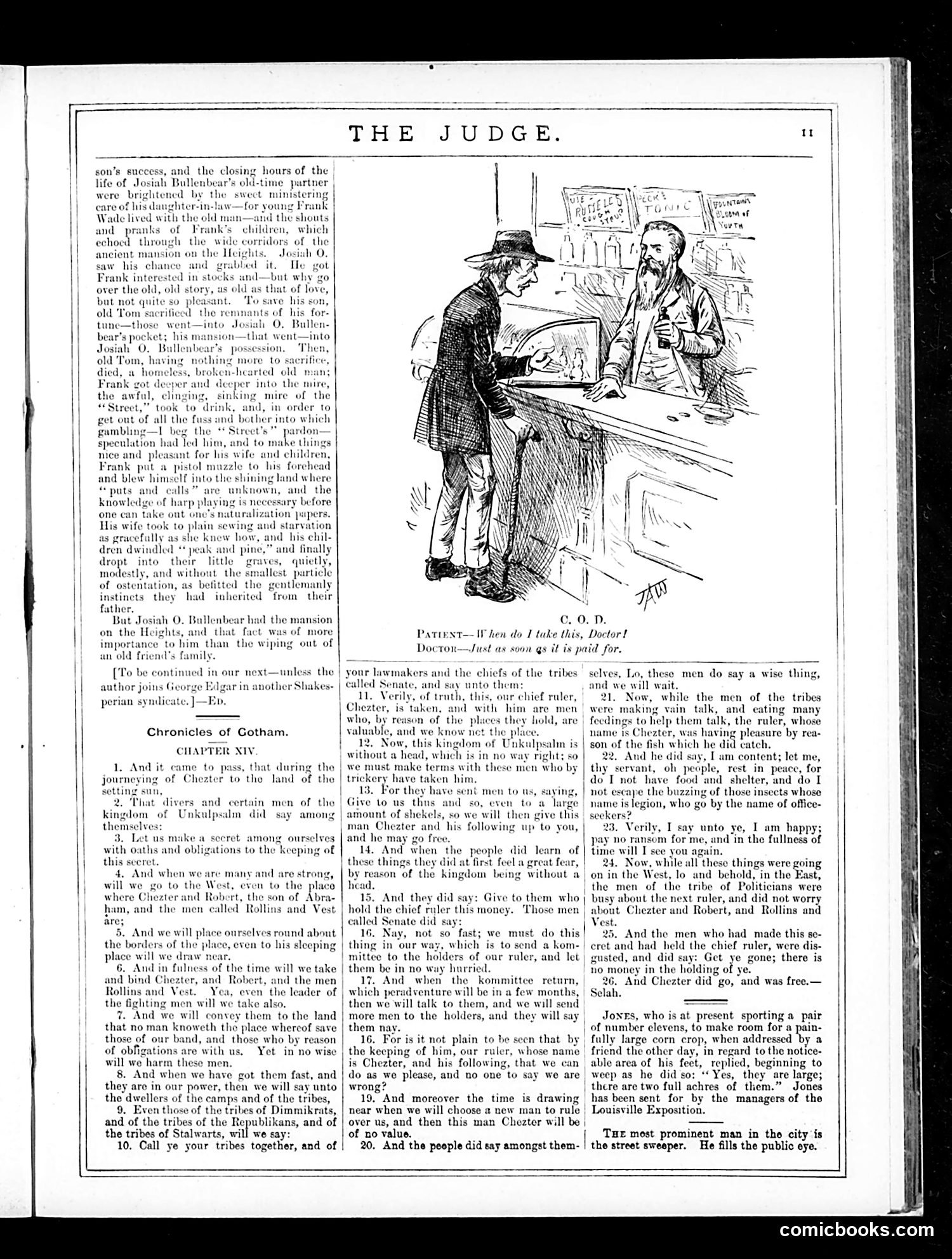
This page contains two main elements: **Top Cartoon:** A satirical medical scene showing a patient asking a doctor "When do I take this, Doctor?" The doctor replies "Just as soon as it is paid for"—a straightforward joke mocking American healthcare's focus on payment over patient care. **"Chronicles of Gotham" Serial:** A mock-biblical narrative parodying political corruption. Written in King James Bible style, it describes unnamed political figures (appearing to reference Reconstruction-era or Gilded Age scandals) conspiring to kidnap a leader named "Chezter" to extort ransom from politicians. The text satirizes political chicanery, bribery, and lawmakers' ineffectual response to crime through endless committees rather than action. The biblical pastiche style was Judge magazine's typical approach to mocking contemporary politics by framing corrupt dealings as ancient religious drama. Without additional context, the specific politicians and events referenced are unclear, though the kidnapping plot suggests a real contemporary scandal.
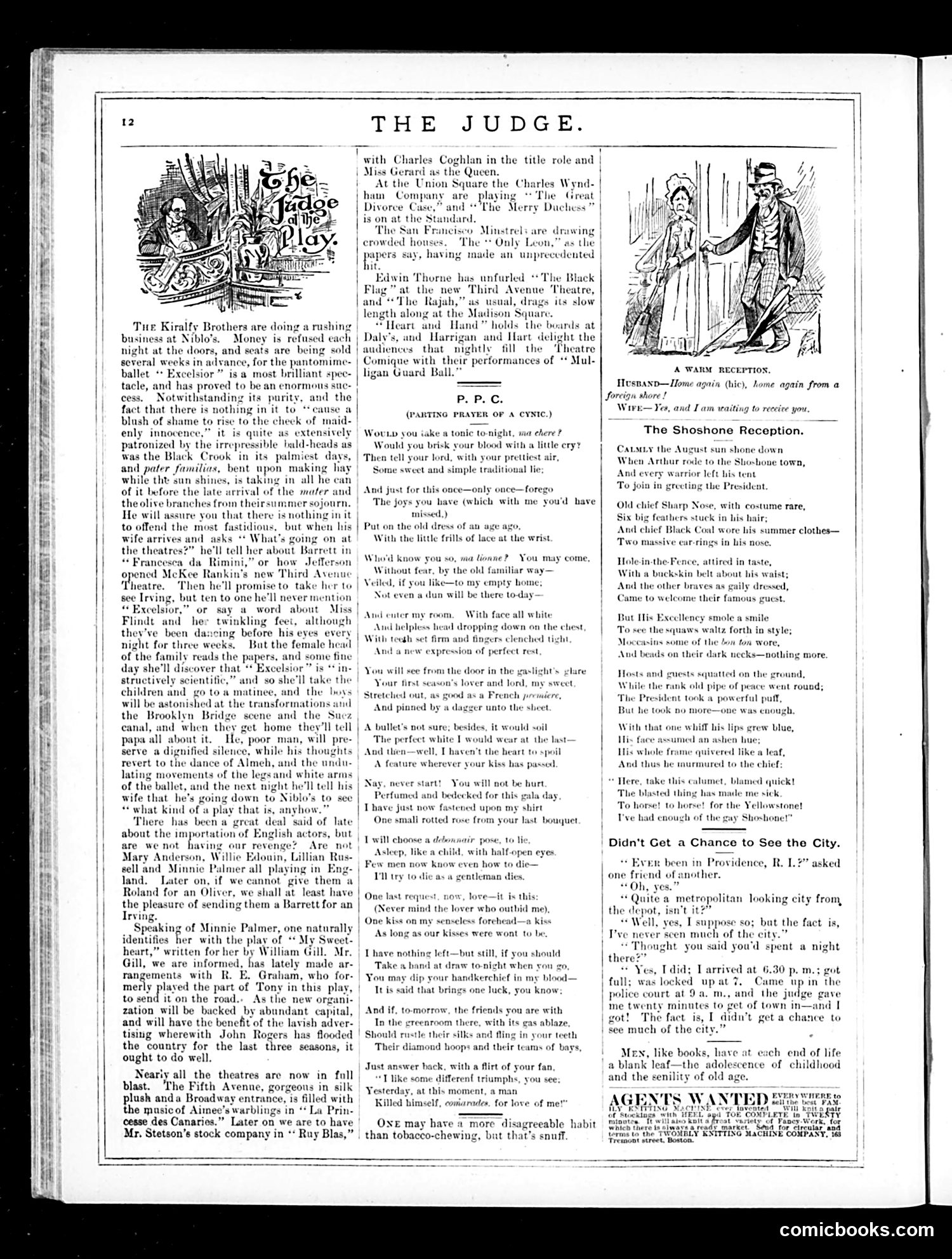
This page from the satirical magazine *Judge* primarily consists of **theatrical reviews and gossip**, not political cartoons. The content focuses on New York theater productions circa the 1880s. The main text discusses popular entertainments: the Kiralfy Brothers' pantomime ballet "Excelsior" at Niblo's Theatre, the San Francisco Minstrels, and various other stage productions. The satirical angle targets **middle-class hypocrisy**—particularly men who claim theatrical performances are wholesome while secretly attending for scandalous reasons (notably the dance sequences), then hiding their interest from wives. The small poem "Parting Prayer of a Cynic" mocks romantic deception within marriages. The right-hand section contains theatrical sketches and advertisements. The overall satire targets **Victorian-era double standards** regarding morality, entertainment, and gender roles in urban leisure culture. This reflects *Judge*'s typical social commentary on American middle-class pretense and contradiction.
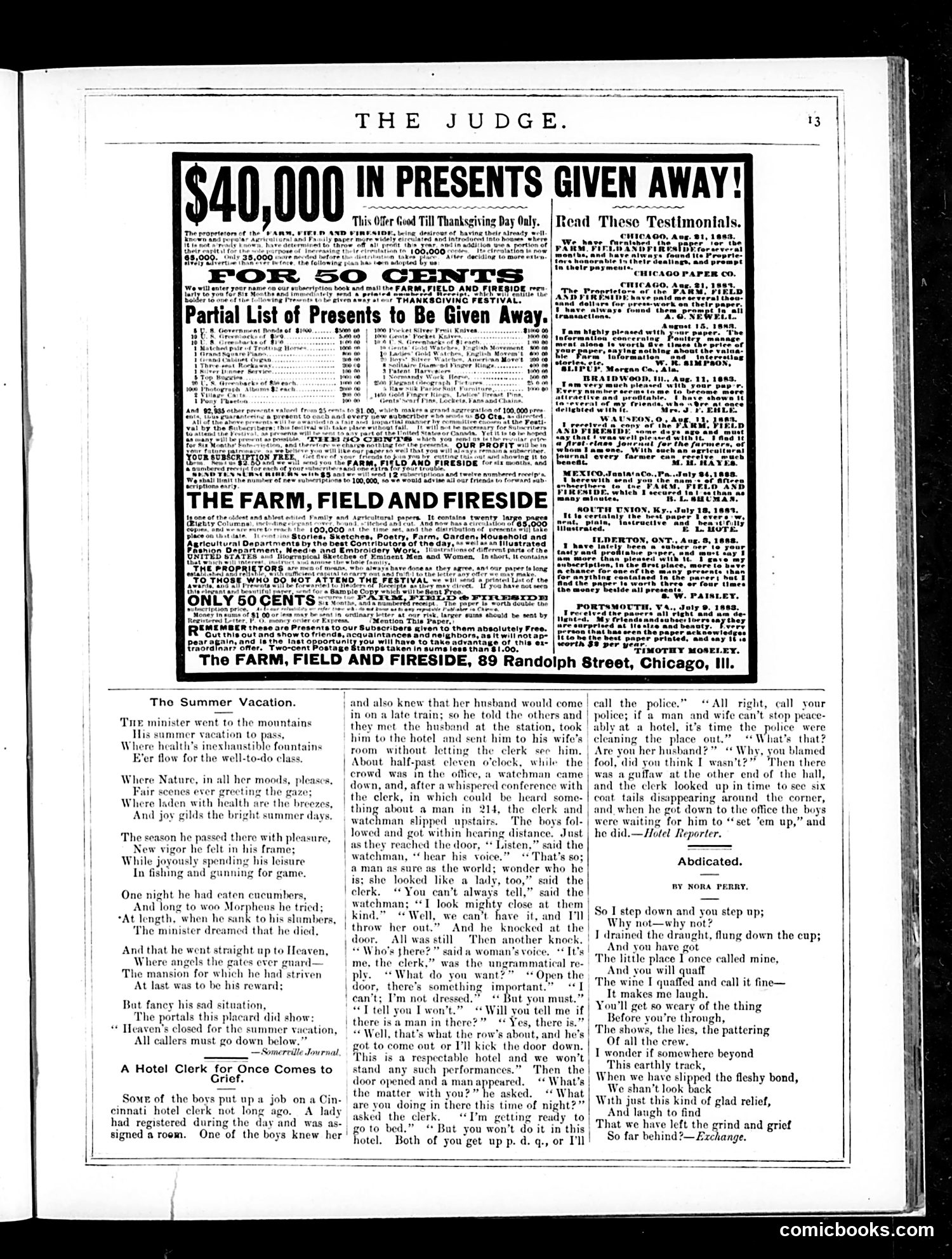
This page is primarily **advertising and light humor**, not political satire. The dominant content is a large advertisement for *Farm, Field and Fireside* magazine offering $40,000 in prizes for subscription renewals (valid until Thanksgiving). This occupies roughly half the page. The remaining editorial content consists of three humorous anecdotes: 1. **"The Summer Vacation"** — A clergyman dreams heaven is closed for summer, must "go down below" — mild religious humor about vacation season. 2. **"A Hotel Clerk for Once Comes to Grief"** — A practical joke where hotel staff are pranked: they discover a "man" in a woman's room and threaten expulsion, only to learn it's her legitimate husband. The joke's humor derives from the clerk's embarrassment at being fooled. 3. **"Abdicated"** — A short poem about romantic disappointment. None of this contains identifiable political figures or commentary. This is a typical late-19th-century magazine mixing promotional content with genteel, family-friendly humor.
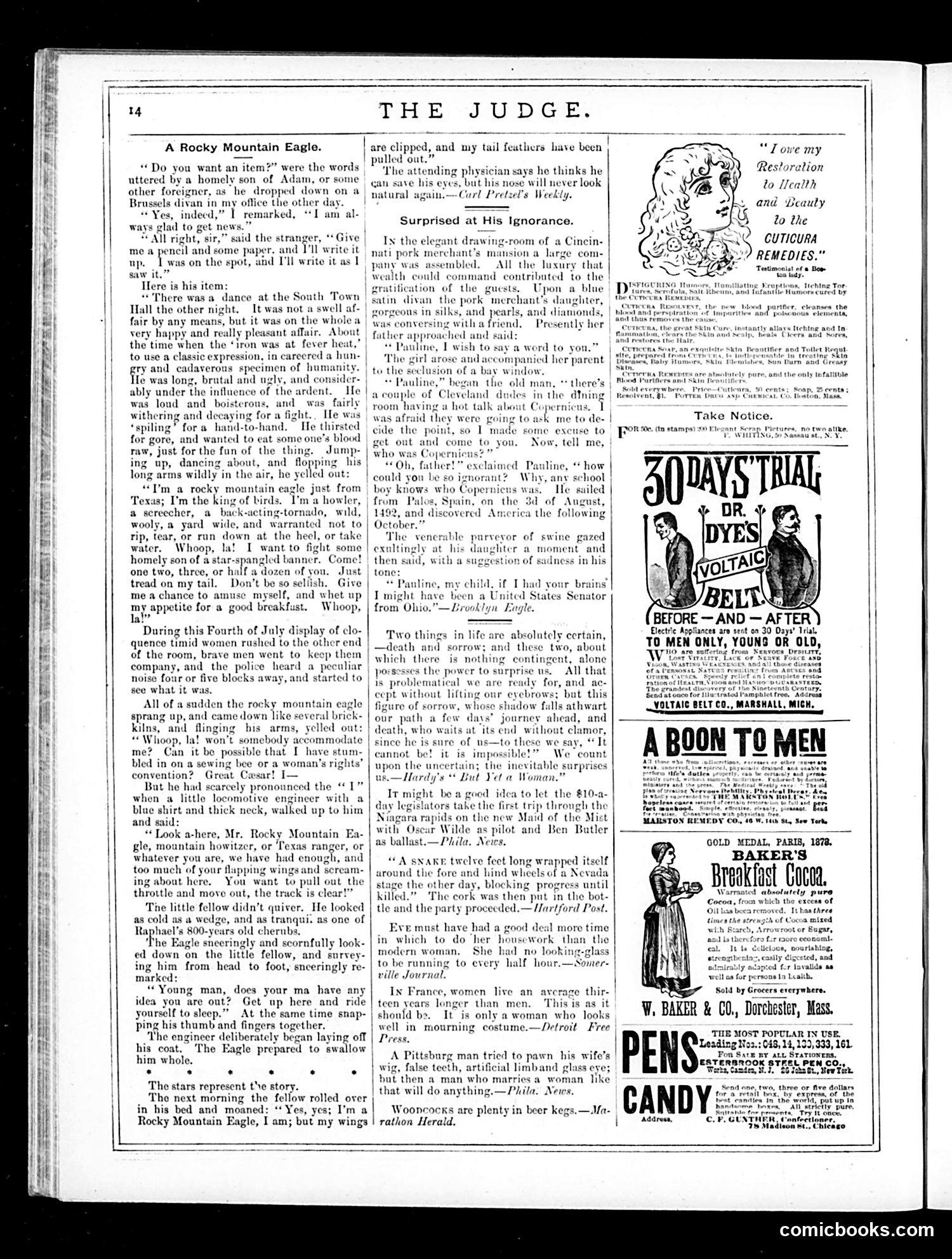
This page contains a humorous short story satirizing Western frontier braggadocio. The narrative mocks a stereotypical "Rocky Mountain Eagle"—a rowdy, boastful frontiersman who enters a town dance hall loudly proclaiming his toughness with exaggerated claims ("I'm a rocky mountain eagle... king of bird... wooly, a yard wide"). The joke's payoff is deflating: after terrorizing the refined crowd with aggressive posturing, he's humbled in an actual fight by a small, quiet locomotive engineer who simply tells him to leave. The next morning, the braggart admits defeat—his "wings are clipped, and my tail feathers have been pulled out." **The satire targets**: Western frontier mythology and masculine bluster. By contrasting the loudmouth's empty threats with the engineer's quiet competence, the writer ridicules performative toughness and suggests genuine strength requires no theatrical announcement. The page also includes period advertisements (cocoa, candy, pens, dyes) typical of Judge's commercial content.
This is primarily an **advertising and humor-filled page** from Judge magazine, with no single dominant political cartoon. Instead, it contains multiple brief jokes and advertisements typical of 1880s American magazines. The humor pieces are short, topical observations: one mocks a Republican political figure (the "Republican party" joke), another satirizes German seriousness about opera, and several gently ridicule domestic life and human nature—a bald man scratching his head, newlyweds' awkwardness, wives managing husbands, etc. The advertisements for cosmetics, pianos, and patent medicines reflect Gilded Age consumer culture. The **cancer "cure" ad** is particularly notable to modern readers as pseudoscientific—representing an era before medical regulation. Overall, the page reflects Judge's formula: lighthearted social satire targeting middle-class American life, with advertising revenue supporting the publication. No specific identifiable political figures appear, making this a representative sample of the magazine's humor rather than a focused commentary on particular events or individuals.
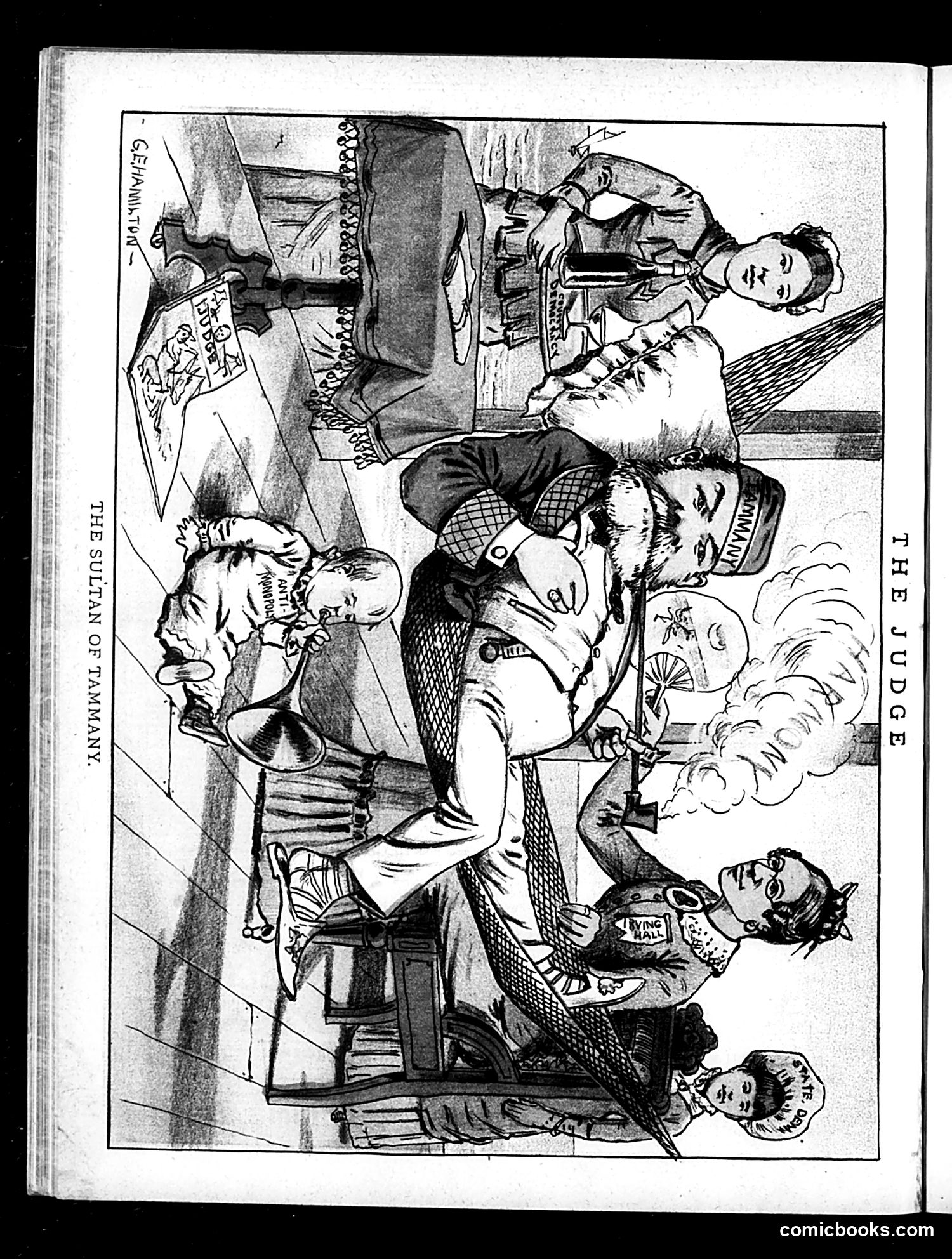
This political cartoon satirizes **Tammany Hall**, the powerful Democratic political machine that controlled New York City politics. The central figure appears to be a corrupt Tammany leader depicted as an Oriental "sultan" — a common racist caricature device in Gilded Age satire suggesting despotism and foreign corruption. The cartoon criticizes Tammany Hall's: - Authoritarian control over city politics - Exploitation of immigrant voters (suggested by the caricatured figures) - Corrupt patronage system - General moral depravity The "sultan" comparison implies Tammany bosses ruled like tyrants, treating the city as personal property while enriching themselves. This reflects late-19th century reformist criticism of urban political machines as fundamentally un-American and corrupt institutions.