
Judge, 1883-09-22 · page 2 of 16
Judge — September 22, 1883 — page 2: what you’re looking at
What you’re looking at
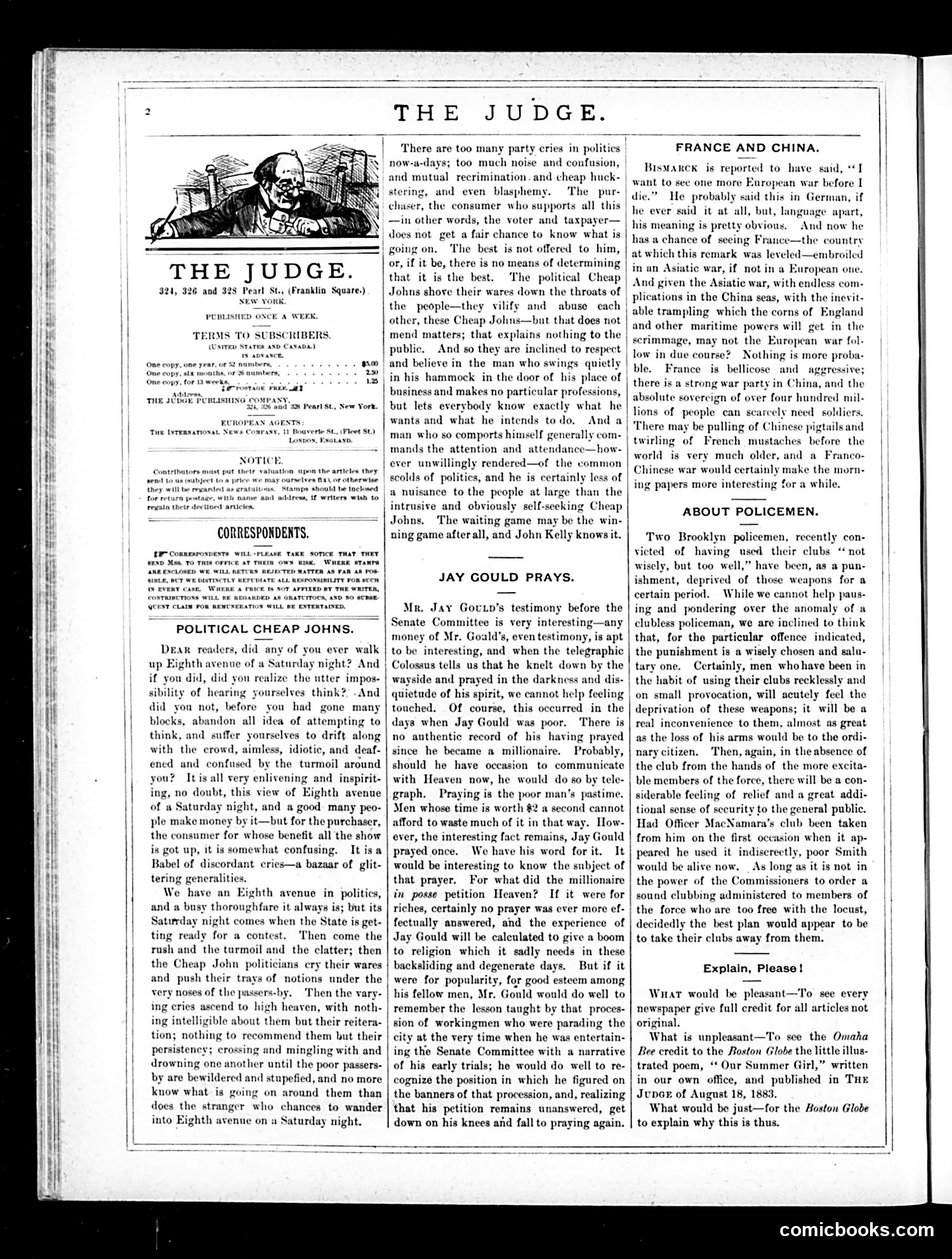
This page from *Judge* satirizes American politics as a chaotic "Eighth Avenue" marketplace where politicians ("Cheap Johns"—a period term for hucksters) shout competing claims to confuse voters rather than inform them. The main editorial compares election season noise to Saturday night street vendors hawking wares—all clamor and "glittering generalities" with no substance. The second piece mocks Jay Gould's Senate testimony, where the railroad magnate claimed he'd knelt in prayer during business difficulties. The satire suggests Gould's sudden piety is performative—that wealthy businessmen adopt religiosity strategically when convenient, much like politicians adopt whatever positions sell best. The tone implies skepticism about the millionaire's genuine spiritual conversion. Both pieces critique how power brokers manipulate public opinion through noise and theater rather than honest discourse.
📄 Transcribed text from this page (OCR, searchable)
Machine-transcribed from the original scan — historical spelling and the odd misread are preserved.
THE JUDGE. going on. 924, $26 and Pearl St NEW YORK, (Franklin Square.) PUBLISHED ONCE A WERK. TERMS TO SUBSCRIBERS. (Uyrrep States axp Caxapa) fy apvasce. NOTICE, t thete valuation upon the articles they | we may ourselves Ox). oF otherwise anid address, tf writers wish to | articles, CORRESPONDENTS. Ter ConnesrosESTs WILL-FLEASE TAKE SOMICE THAT THEY exp Mea To THUS OFFICE AT THEIR OWN RISK. WHERE STARTS AREESCLOSED WE WILL RETURN REJECTED MATTER AS TAR AS Fos * TE ALL RESPONSIMILITY FOR SCCM te nvexy case W WT AYVINED RY THE WRITER, POLITICAL CHEAP JOHNS. Dear readers, did any of you ever walk up Eighth avenue of a Saturday night? And if you did, did you realize the utter impos- sibility of hearing urselves think? -And did you not, before you had gone many blocks, abandon all idea of attempting to think, and suffer yourselves to drift along with the crowd, aimless, idiotic, and deaf- ened and confused by the turmoil around you? Itis all very enlivening and inspirit- ing, no doubt, this view of hth avenue of a Saturday night, and a good many peo- ple make money by it—but for the purchaser, the consumer for whose benefit all the show is got up, it is somewhat confusing. It is a Babel of discordant cries—a bazaar of glit- tering generalities. We have an Eighth avenue in politics, and a busy thoroughfare it always is; but its Saturday night comes when the State is get- ting ready for a contest. Then come the rush and the turmoil and the clatter; then the Cheap John politicians cry their wares and push their trays of notions under the very noses of the passers-by. ‘Then the vary- ing cries ascend to high heaven, with noth- ing intelligible about them but their reitera- | tion; nothing to recommend them but their | persistency; crossing and mingling with and drowning one another until the poor passers- by are bewildered and stupefied, and no more know what is going on around them than does the stranger who chances to wander into Eighth avenue on a Saturday night. | man who so comports himself generall There are too many party cries in politics now-a-days; too much noise and confusion, and mutual recrimination.and cheap huck- stering, and even blasphemy. ‘The pur- chaser, the consumer who supports all this —in other words, the voter and taxpayer— does not get a fair chance to know what is The best is not offered to him, or, if it be, there is no means of determining that it is the best. The political Cheap Johns shove their wares down the throats of the people—they vilify and abuse each other, these Cheap Johns—but that does not mend matters; that explains nothing to the public. And so they are inclined to respect and believe in the man who swings quietly | in his hammock in the door of his place of business and makes no particular professions, but lets everybody know exactly what he wants and what he intends todo. And a com- mands the attention and attendance—how- | ever unwillingly rendered—of the common scolds of politics, and he is certainly less of a nuisance to the people at large than the intrusive and obviously self-seeking Cheap Johns. The waiting game may be the win- ning game afterall, and John Kelly knows it. JAY GOULD PRAYS. Mr. Jay Govtn’s testimony before the Senate Committee is very interesting—any mone: to be interesting, and when the telegraphic Colossus tells us that he knelt down by the wayside and prayed in the darkness and dis quietude of his spirit, we cannot help feeling touched. Of course, this occurred in the days when Jay Gould was poor. ‘There is no authentic record of his having prayed since he became a millionaire. Probably, should he have occasion to communicate with Heaven now, he would do so by tele- | graph. Praying is the poor man’s pastime. Men whose time is worth $2 a second cannot afford to waste much of it in that way. How- ever, the interesting fact remains, Jay Gould prayed once. We have his word for it. It would be interesting to know the subject of that prayer. For what did the millionaire in posse petition Heaven? If it were for riches, certainly no prayer was ever more ef. fectually answered, and the experience of Jay Gould will be calculated to give a boom to religion which it sadly needs in these backsliding and degenerate days. But if it were for popularity, for good esteem among his fellow men, Mr. Gould would do well to remember the lesson taught by that proces- sion of workingmen who were parading the city at the very time when he was entertain- ing the Senate Committee with a narrative of his early trials; he would do well to re- cognize the position in which he figured on the banners of that procession, and, realizing that his petition remains unanswered, get down on his knees and fall to praying again. y of Mr. Gould’s, even testimony, is apt | | lions of people can sc FRANCE AND CHINA, Bismarck is reported to have said, ‘1 d he ever said it at all, but, langu: his meaning is pretty obvious. And now he has a chance of seeing France—the country at which this remark was leveled—embroiled ap: | in an Asiatic war, if not in a European one. And given the Asiatic war, with endless com- plications in the China seas, with the inevit- able trampling which the corns of England and other maritime powers will get in the scrimmage, may not the European war fol- low in due course? Nothing is more prob ble. France and aggressive; there is a strong war party in China, and the absolute sovereign of over four hundred mil- is bellicose rely need soldiers. ‘There may be pulling of Chinese pigtails and twirling of French mustaches before the world is very much older, and a Franco- Chinese war would certainly make the morn- ing papers more interesting for a while. ABOUT POLICEMEN. Two Brooklyn policemen, recently con- victed of having used their clubs “not wisely, but too well,” have been, as a pun- ishment, deprived of those weapons for a certain period. While we cannot help paus- ing and pondering over the anomaly of a clubless policeman, we are inclined to think that, for the particular offence indicated, the punishment is a wisely chosen and salu- tary one. Certainly, men whohave been in the habit of using their clubs recklessly and on small provocation, will acutely feel the deprivation of these weapons; it will be a real inconvenience to them, almost as great as the loss of his arms would be to the ordi- nary citizen, Then, again, in the absence of the club from the hands of the more excita- ble members of the force, there will be a con- siderable feeling of relief and a great addi- tional sense of security to the general public. Had Officer MacNamara’s club been taken from him on the first occasion when it ap- peared he used it indiserectly, poor Smith would be alive no As long as it is not in the power of the Commissioners to order a sound clubbing administered to members of he force who are too free with the locust, decidedly the best plan would appear to be to take their clubs away from them. Explain, Please! Wuart would be pleasant—To see every newspaper give full credit for all articles not original. What is unpleasant—To see the Omaha Bee credit to the Boston Globe the little illus- trated poem, ‘ Our Summer Girl,” written in our own office, and published in THE JupoE of August 18, 1883. What would be just—for the Boston Globe to explain why this is thus. comicbooks.com