
A complete issue · 16 pages · 1883
Judge — September 1, 1883
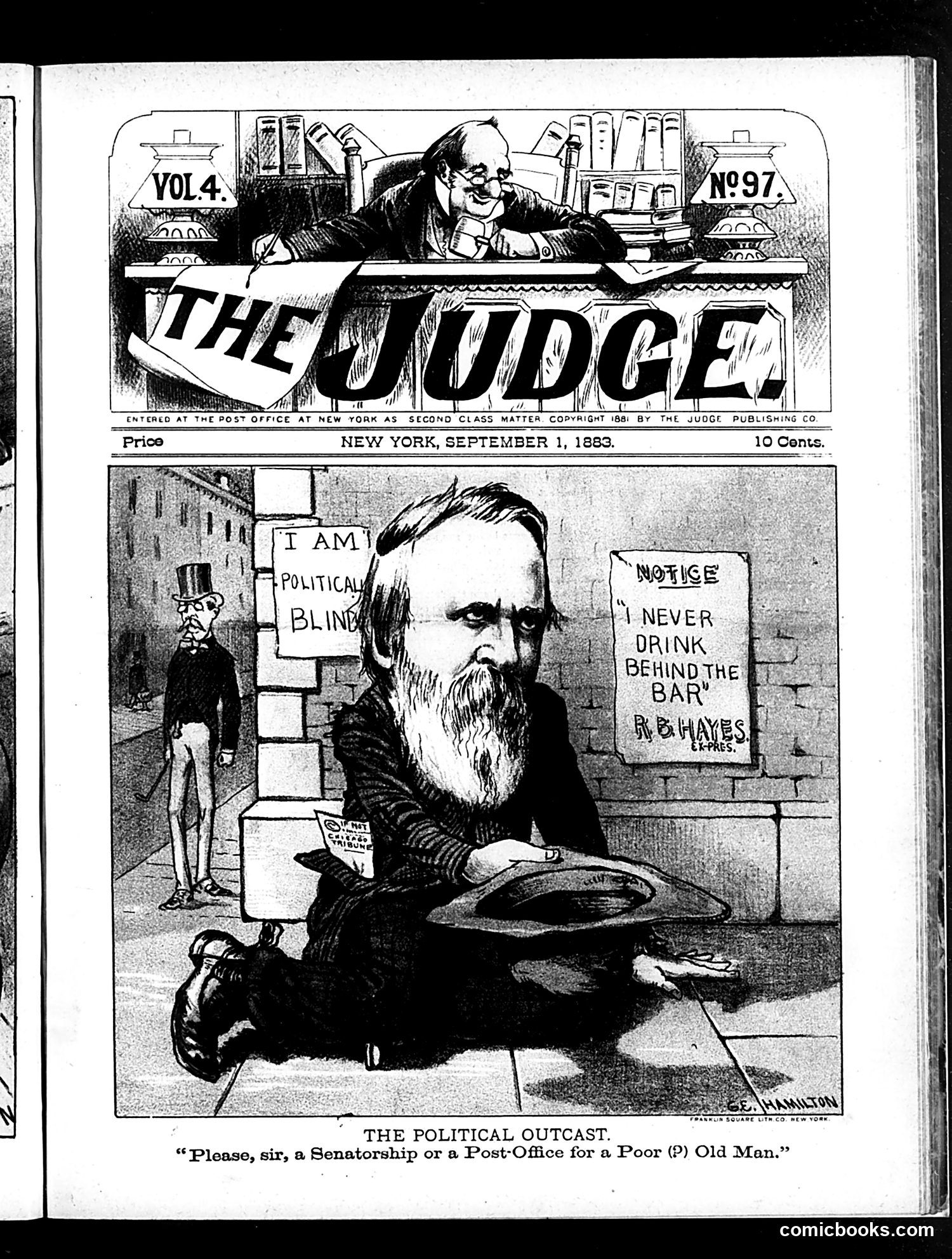
This cartoon satirizes political patronage and joblessness. The central figure, a bearded man labeled "I AM A POLITICAL BLIND," represents someone claiming blindness as reason for government employment. He's literally depicted as blind, sitting on the street with a beggar's cup, holding a sign reading "NOTICE: I NEVER DRINK BEHIND THE BAR" (attributed to "R.B. Hayes" — likely former President Rutherford B. Hayes). The cartoon mocks the era's practice of politicians granting sinecures (cushy jobs) to supporters and the disabled. The caption's plea — "Please, sir, a Senatorship or a Post-Office for a Poor (P) Old Man" — ridicules how people exploited political connections and claimed hardship to obtain government positions. The satire targets both corrupt patronage and fraudulent disability claims.
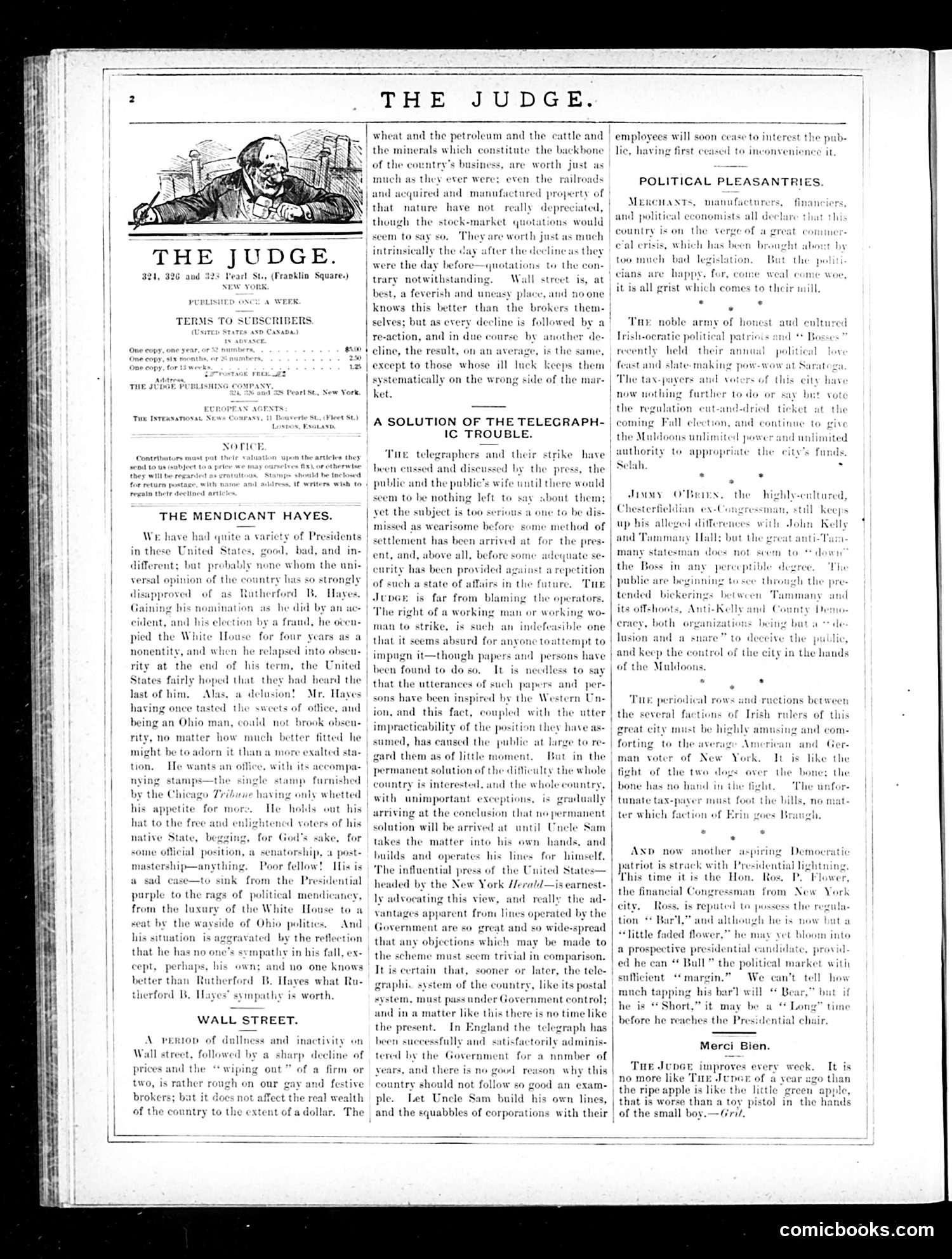
This page contains **political commentary** rather than cartoons. The masthead shows *The Judge* magazine's publication details from New York. **Main articles:** 1. **"The Mendicant Hayes"** attacks former President Rutherford B. Hayes as a desperate office-seeker. After losing the presidency (apparently through disputed means—"fraud"), Hayes now begs for any government position: senatorship, postmaster, anything. The satire mocks his fall from "purple to rags of political mendicity." 2. **"Wall Street"** criticizes financial inactivity and brokers' speculation, arguing real wealth comes from actual business (minerals, cattle, railroads), not market quotations. 3. **"A Solution of the Telegraph-ic Trouble"** addresses the recent telegraph operators' strike. The piece argues the telegraph system should operate under government control (like the postal service), dismissing private operators' complaints as Western Union propaganda. The overall tone reflects Gilded Age concerns: corrupt politics, financial speculation, and labor disputes.
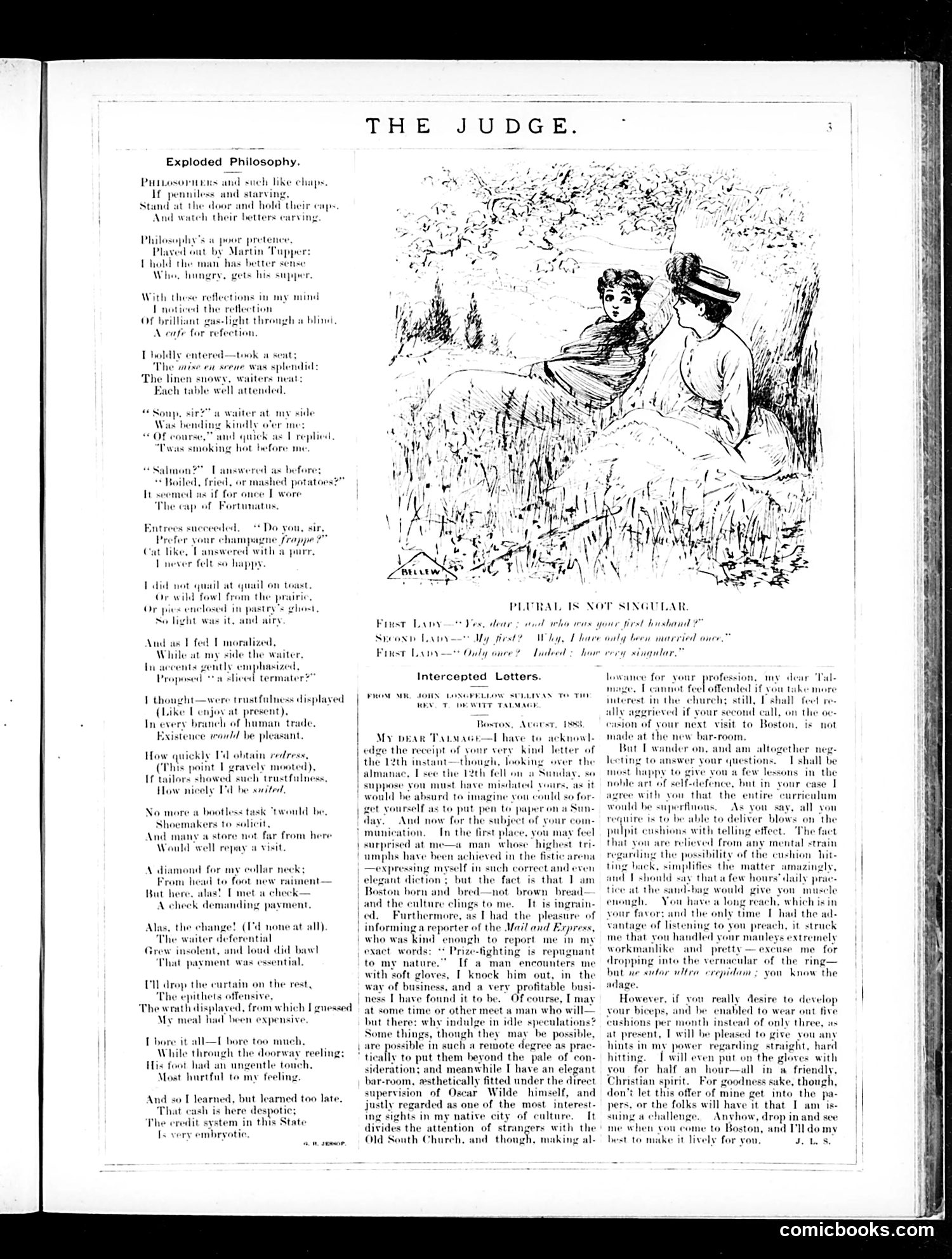
This page contains satirical commentary on American social pretensions and materialism in the Gilded Age (circa 1883, based on the letter date). **"Exploded Philosophy"** is a narrative poem mocking a poor philosopher who enters a restaurant. Despite his lofty philosophical ideals about poverty and virtue, he's overwhelmed by fine dining—salmon, champagne, elaborate service. The satire: once confronted with luxury, his noble principles evaporate. The punchline reveals the bitter reality: he cannot pay, gets humiliated by the waiter's foot, and learns that in America, cash is "despotic" and credit barely exists. **"Plural Is Not Singular"** appears to be a brief joke about marriage, likely referencing infidelity or remarriage. **"Intercepted Letters"** features correspondence between John L. Sullivan (the famous boxer) and likely Thomas DeWitt Talmage (a prominent Brooklyn preacher). Sullivan defends his boxing profession against moral objections, boasting of his elegant bar-room and cultural refinement—a humorous juxtaposition of brute-force boxing with aesthetic pretension. The letter mocks how wealthy, powerful men justify questionable activities through claims of culture and sophistication.
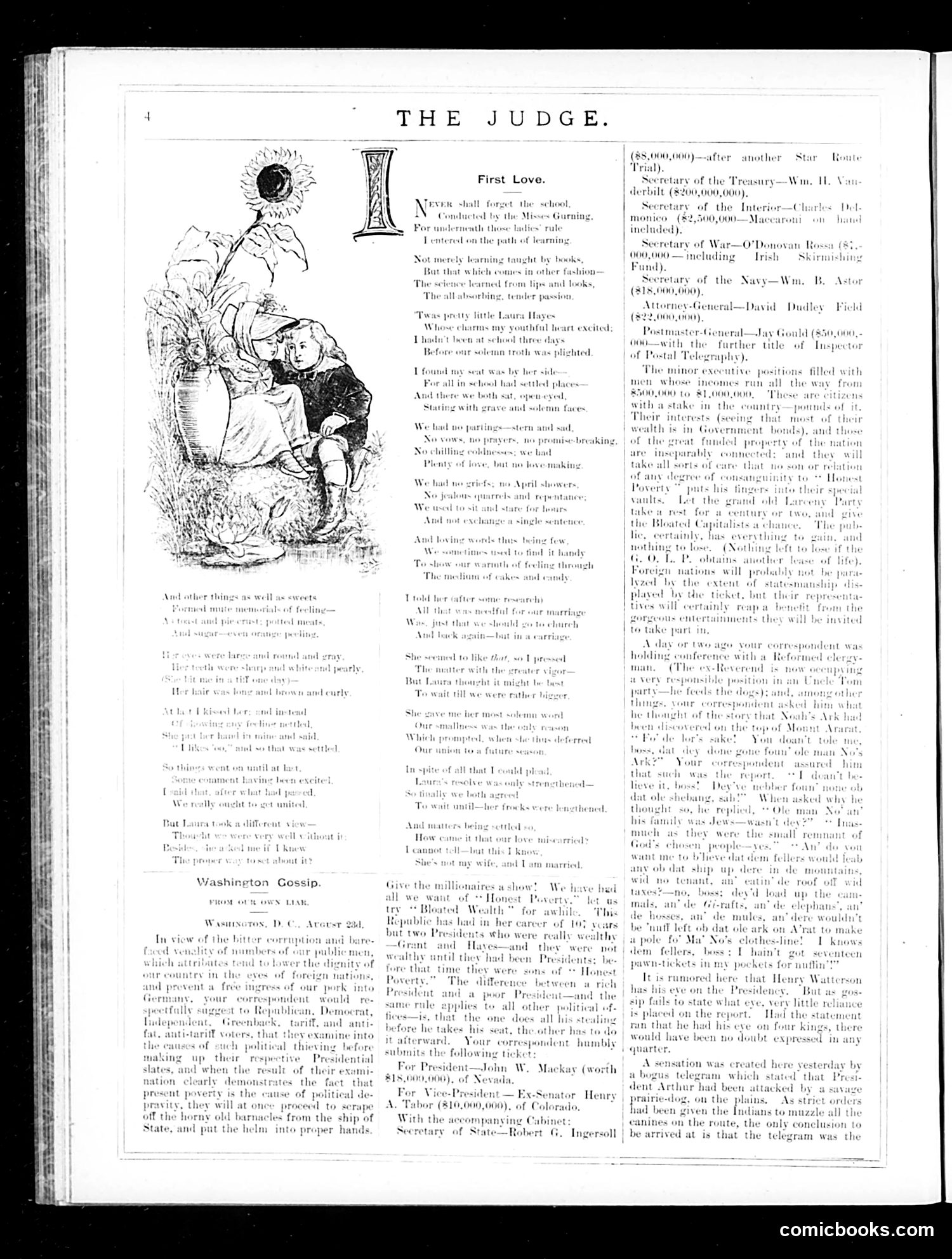
The main image is an illustrated poem titled "First Love," depicting a nostalgic scene of young romance—a boy and girl in an innocent pastoral setting. The poem celebrates schoolyard affection and early courtship. Below this, the "Washington Gossip" section satirizes President Chester Arthur's cabinet appointments by listing their wealth alongside their positions. The satire's point: these officials are extraordinarily wealthy individuals (Vanderbilt worth $320 million, etc.), suggesting the administration is stacked with the richest Americans rather than merit-based selections. The gossip also mocks the irony that multiple past Presidents became wealthy *after* leaving office, while Arthur's appointees were already fabulously rich *before* taking positions—implying cronyism and that government service for the wealthy is about maintaining power rather than public service. The juxtaposition of innocent "First Love" against venal political appointments creates the satirical contrast typical of Judge magazine's social criticism.
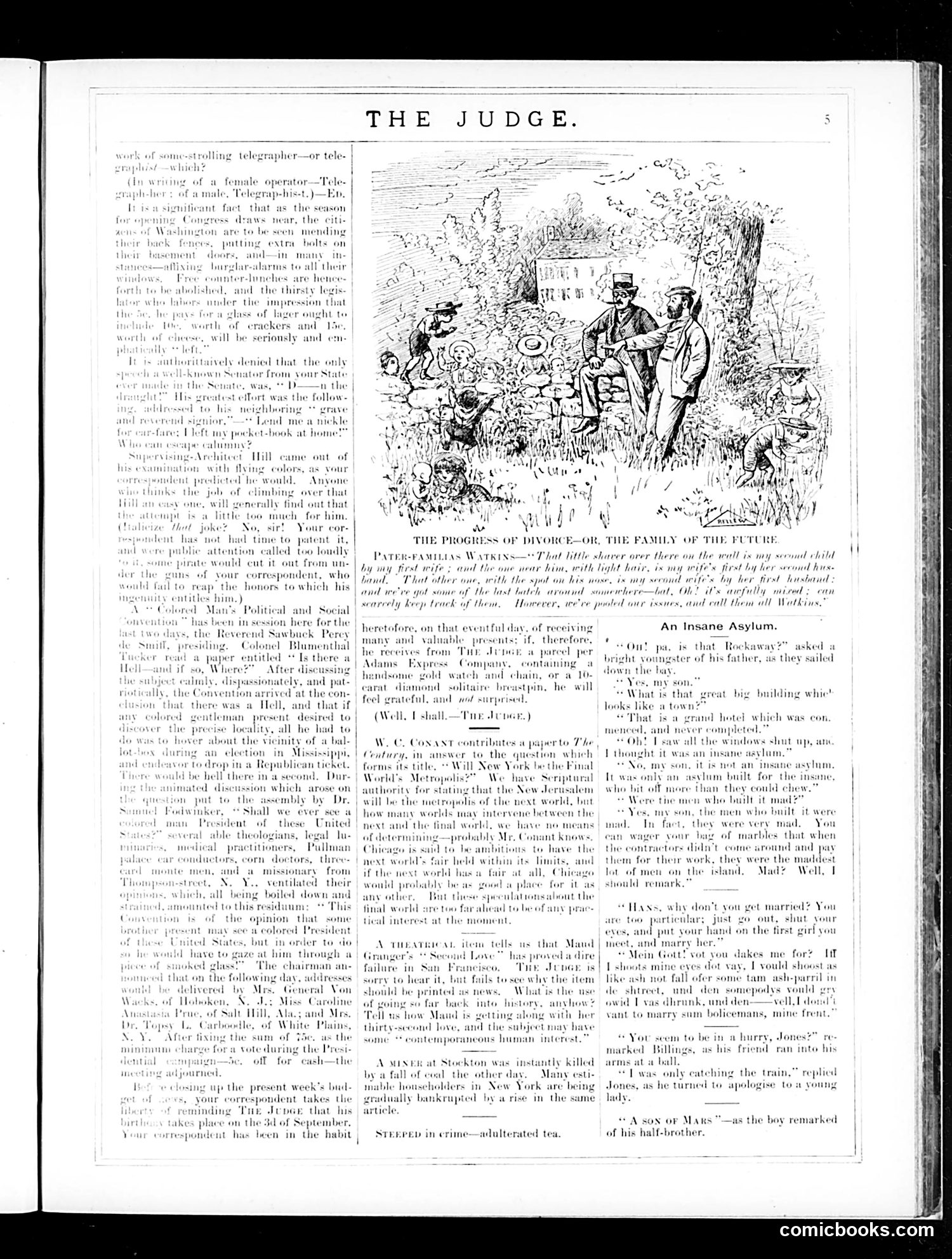
This page contains three satirical pieces typical of 1890s-era Judge magazine humor: **"The Progress of Divorce"** mocks the epidemic of divorces among the wealthy, presenting a man with multiple ex-wives and illegitimate children, unable to keep track of his offspring. The satire targets the social chaos created by easy divorce among the upper classes. **"An Insane Asylum"** dialogue jokes play on verbal misunderstandings—a child mistakes a grand hotel for an insane asylum because of its wasteful construction; immigrants with thick accents create comic confusion about marriage and courtship. These exploit period stereotypes of Eastern European immigrants and reflect anxieties about assimilation. **"Steeped in Crime"** appears to be a brief social commentary piece, likely about food adulteration—a genuine public health scandal of the era. The cartoons reflect Judge's satirical focus on divorce, immigration, urban development, and consumer fraud—all concerns of Gilded Age America.
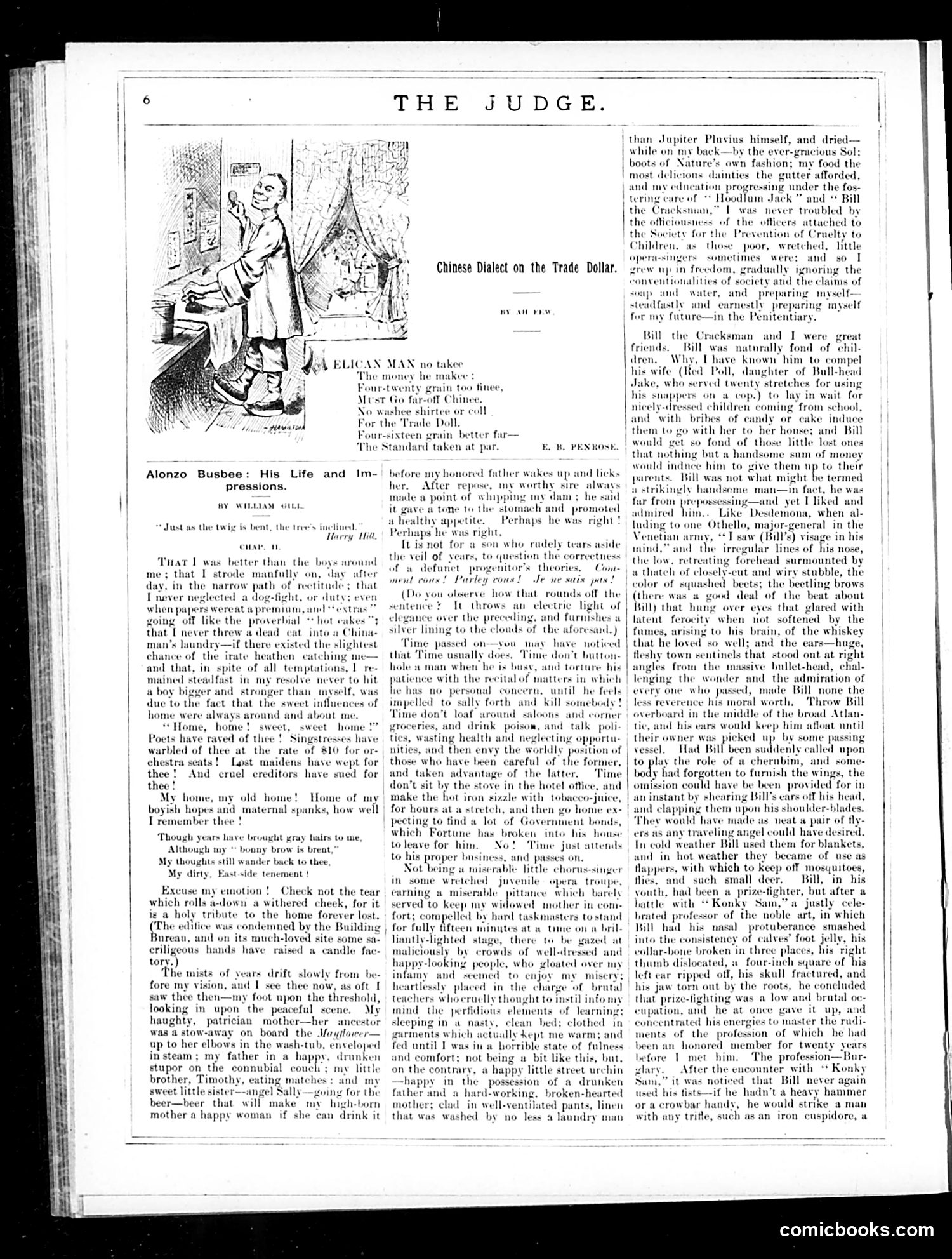
This page from *Judge* contains two separate satirical pieces reflecting late 19th-century American social commentary. **"Chinese Dialect on the Trade Dollar"** (top) mocks Chinese immigrants through racist caricature and broken English dialect. The cartoon appears to satirize economic anxieties around Chinese labor and currency, using exaggerated stereotypes common to the era's anti-Chinese sentiment. **"Alonzo Bushee: His Life and Impressions"** (bottom) is a serialized story about an orphan boy's harsh childhood and questionable moral education under street criminals ("Hoodlum Jack" and "Bill the Cracksman"). The narrative—written in first-person—appears designed as social satire exposing urban poverty, child neglect, and the brutalization of street children, likely critiquing both poverty conditions and the failure of contemporary charitable institutions to protect vulnerable youth.
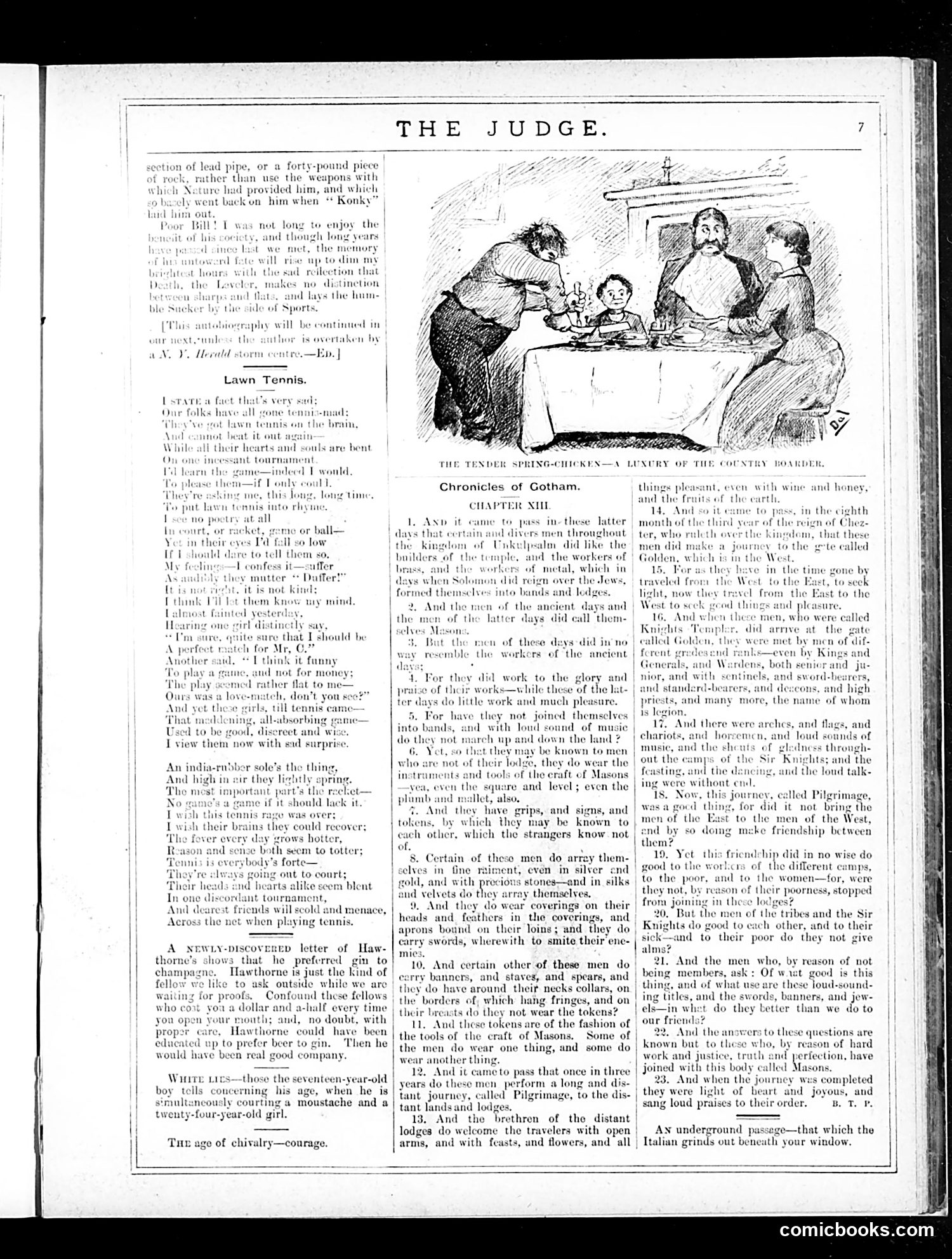
This page contains two distinct sections: **The Cartoon** (top): Titled "The Tender Spring-Chicken—A Luxury of the Country Boarder," depicts what appears to be a domestic scene where a woman serves food to two men at a table. The satire likely mocks rural or country boarding-house experiences, possibly commenting on overpriced, mediocre accommodations or food served to city visitors—a common Judge target. **The Text Content**: The page includes poetry about lawn tennis (mocking its popularity as a fad among the upper classes) and a serialized story called "Chronicles of Gotham, Chapter XIII" that parodies biblical language while describing Masonic lodges and their rituals. The mock-biblical tone ("And it came to pass...") satirizes Freemasonry, likely critiquing the fraternal organization's secrecy, elaborate ceremonies, and social pretension—recurring subjects of 19th-century satirical magazines. The combined content targets leisure activities and exclusive organizations favored by the wealthy, typical Judge fare of the era.
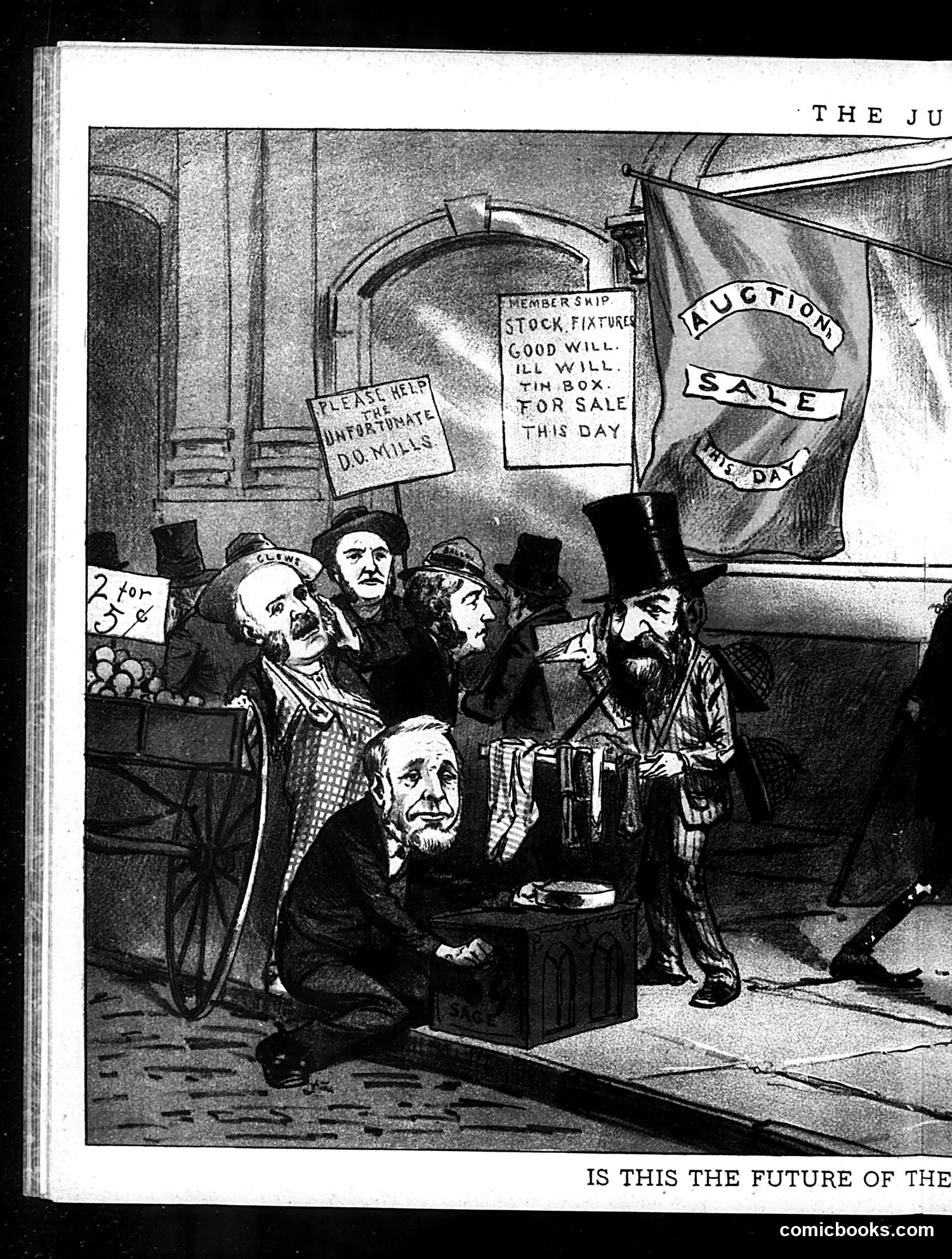
This cartoon depicts an auction scene during economic hardship. Desperate figures in worn clothing surround an auctioneer's platform where various items are being sold, including stock fixtures and tin boxes. Signs reading "Please Help the Unfortunate" and "D.O. Miller" suggest references to contemporary poverty or financial crisis. The satire critiques wealth disparity and economic desperation—impoverished people are forced to auction personal goods while the auctioneer profits. The caricatured faces and ragged clothing emphasize the subjects' economic desperation. The title fragment "IS THIS THE FUTURE OF THE..." (cut off) suggests the cartoon questions whether such poverty represents America's coming trajectory. The specific reference to "D.O. Miller" remains unclear without additional context, though it may indicate a named individual associated with the depicted economic situation.
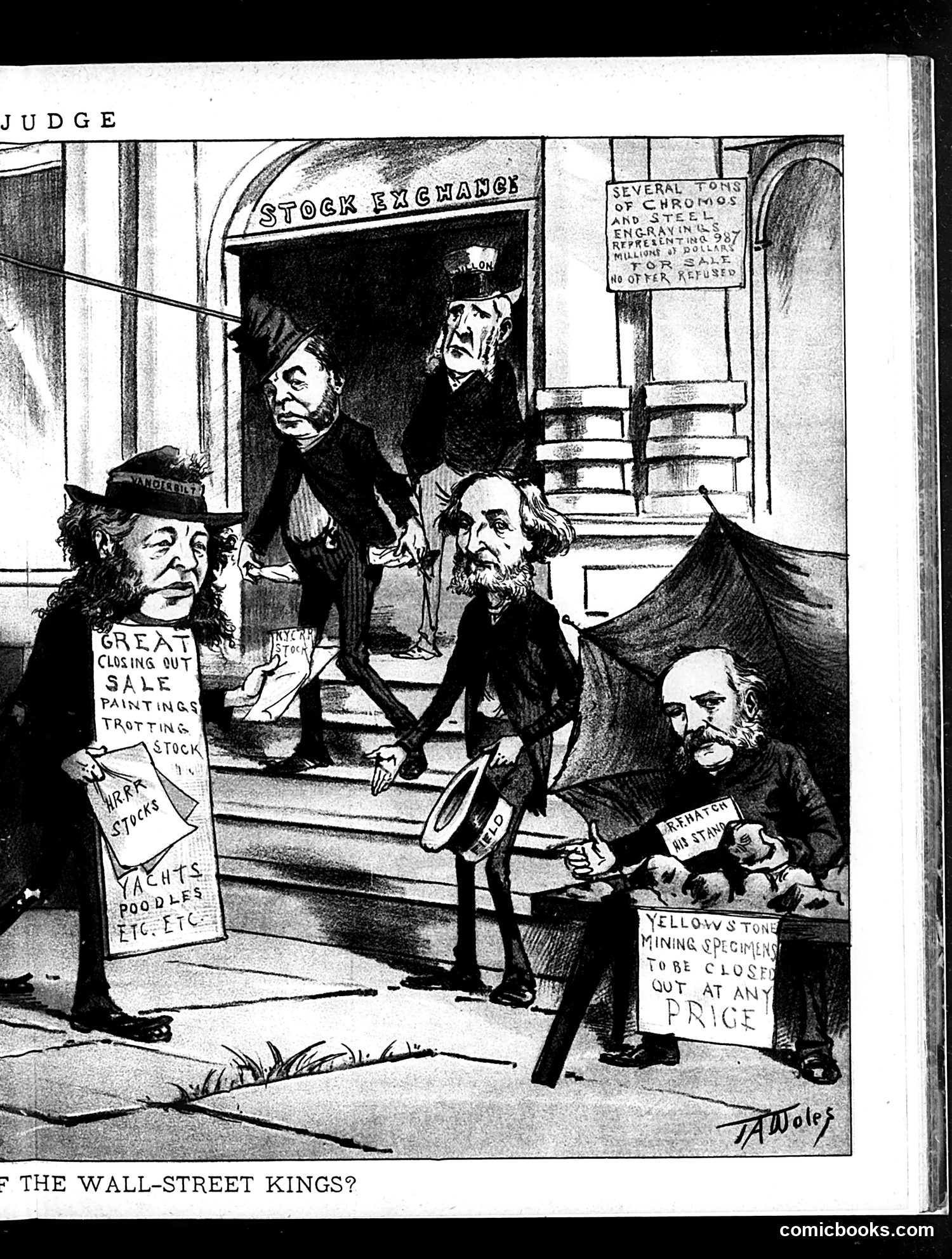
This political cartoon satirizes wealthy financiers and stock market speculators during what appears to be an economic downturn. The caricatured figures—depicted as shabby, desperate men—are liquidating assets at fire-sale prices outside the Stock Exchange. Their signs advertise "Great Closing Out Sale" of paintings, stocks, and other valuables, along with mining claims and chromos (cheap prints). The satire mocks Wall Street's powerful figures—traditionally called "kings"—reduced to street-level peddlers hawking worthless goods. The cartoon critiques both the collapse of speculative investments and the predatory practices of these financiers, suggesting their wealth and power are illusions that evaporate during market crashes. The title's question mark implies bitter irony: these aren't kings at all, just desperate hustlers.
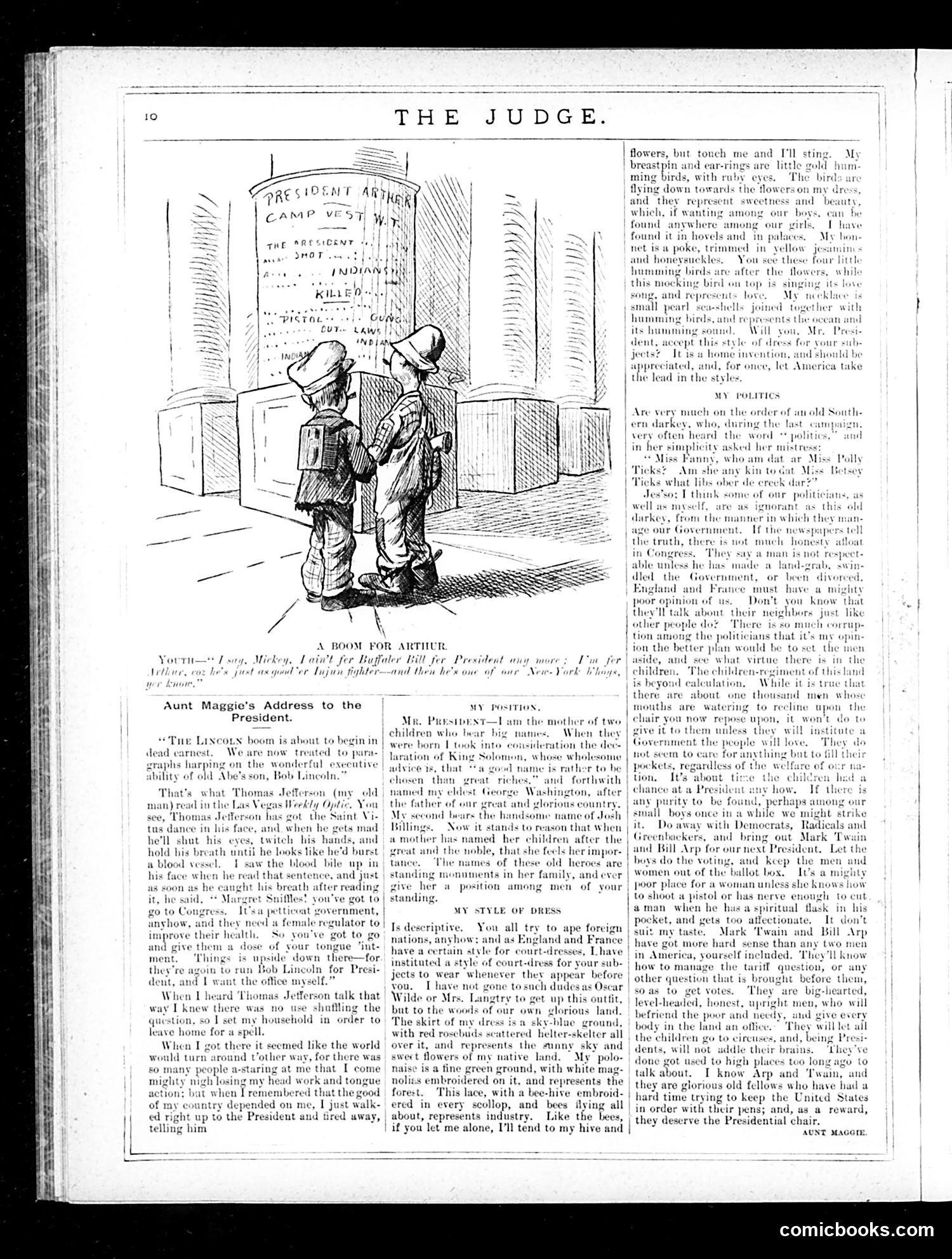
This page satirizes potential presidential candidates through two pieces featuring "Aunt Maggie," an older woman addressing the President. ## The Cartoon & Main Satire The sketch shows two men examining a wall listing presidential prospects (appears to include "Arthur," "Blaine," and others—likely Republican candidates from the 1880s). The text mocks the "Lincoln Boom"—speculation about nominating Robert Todd Lincoln for president solely because his father was Abraham Lincoln. ## Aunt Maggie's Critique Aunt Maggie ridicules this logic: she named her sons after King Solomon and George Washington, but "good names" don't make good leaders. She attacks politicians generally as ignorant and corrupt—preferring humorists like Mark Twain and "Bill Arp" (a pen name) as candidates instead of career politicians. ## Social Commentary Her dress description (sky-blue skirt with embroidered bees, representing industry) and her stated preference for women voting over current male politicians reflects late-19th-century women's suffrage arguments: women might govern more virtuously than the corrupt "Radicals" and "Democrats" currently in office. The piece satirizes both nepotistic political dynasties and male-dominated corruption in American governance.
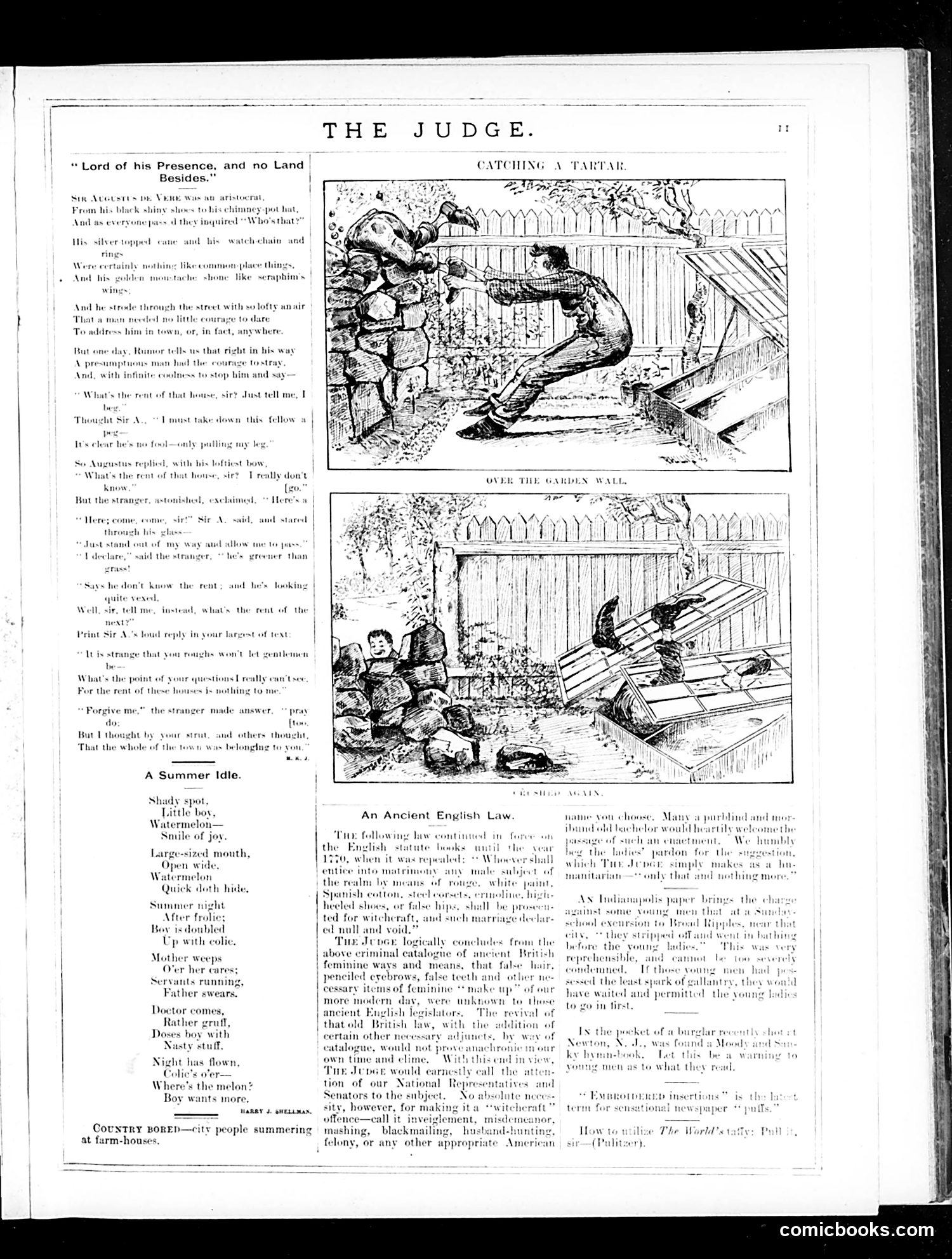
This satirical narrative cartoon mocks a pompous, vain gentleman (Sir Augustus) who struts through town with ostentatious displays of wealth—silver-topped cane, watch chain, expensive clothing. A stranger approaches asking practical questions about house rental costs, but Sir Augustus repeatedly refuses to answer, claiming ignorance while maintaining his affected superiority. The joke targets wealthy snobs who prioritize appearance and social pretense over genuine substance or practical knowledge. His refusal to acknowledge or engage with ordinary commerce (rent prices) satirizes the affectation of upper-class men who consider such matters beneath their notice, yet reveals their actual ignorance. The accompanying illustrations show him being chased or embarrassed—suggesting social comeuppance for his pretentiousness. The page also includes unrelated content: "A Summer Idle" (humorous observations about idle city people at farmhouses) and an article on ancient English witchcraft laws—typical Judge magazine miscellany.
This page contains a short humorous story illustrated at the top. The narrative describes a late-evening encounter on Fifth Avenue, New York, where a well-dressed man attempts to flirt with a lady by complimenting her appearance and asking about her dog. The satire targets courtship pretense and street flirtation. The man's opening gambit — praising her looks and making conversation about her pet — represents the manipulative social rituals of 19th-century urban seduction. His transparent flattery and false familiarity are mocked through the lady's cool response: she rebuffs him by suggesting he simply wants "warming" (attention). The joke hinges on exposing the artificiality of street-corner romantic posturing among the upper classes. The title "Warming His Ears" likely refers to the woman's implied criticism — he's being metaphorically warmed (rebuked) for his presumptuous behavior. The page also contains miscellaneous social commentary snippets typical of Judge's satirical format.
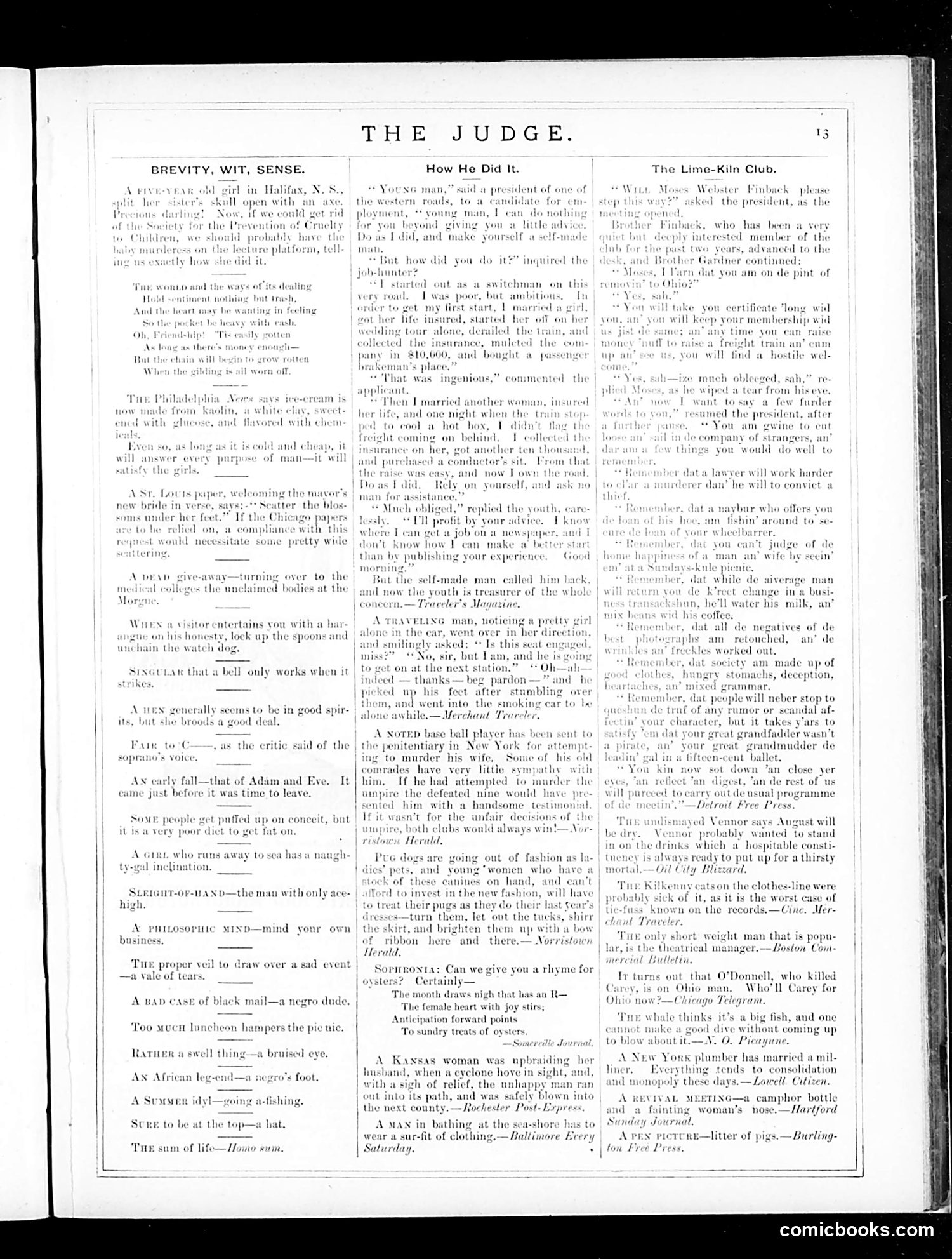
This page contains **satirical short items** rather than cartoons. The content mixes social commentary with humor typical of late 19th-century Judge magazine. Key sections include: **"How He Did It"** - A story mocking the "self-made man" myth. A young man describes climbing from switchman to wealth through opportunism (insuring things, then destroying them), rather than honest work—satirizing the era's celebration of ruthless capitalism. **"The Lime-Kiln Club"** - Appears to be a satirical dialogue featuring African American characters (evident from dialect spelling like "gwine," "earin'," "grandfadder"). This reflects Judge's racist humor typical of the period, presenting Black speakers as ignorant or comical. **Miscellaneous quips** - Short jokes about fashion, marriage, natural disasters, and human nature—standard filler content. The page exemplifies Judge's blend of **economic satire** (targeting greedy entrepreneurs) alongside **racist caricature**—reflecting the magazine's problematic but historically documented editorial perspective of its era.
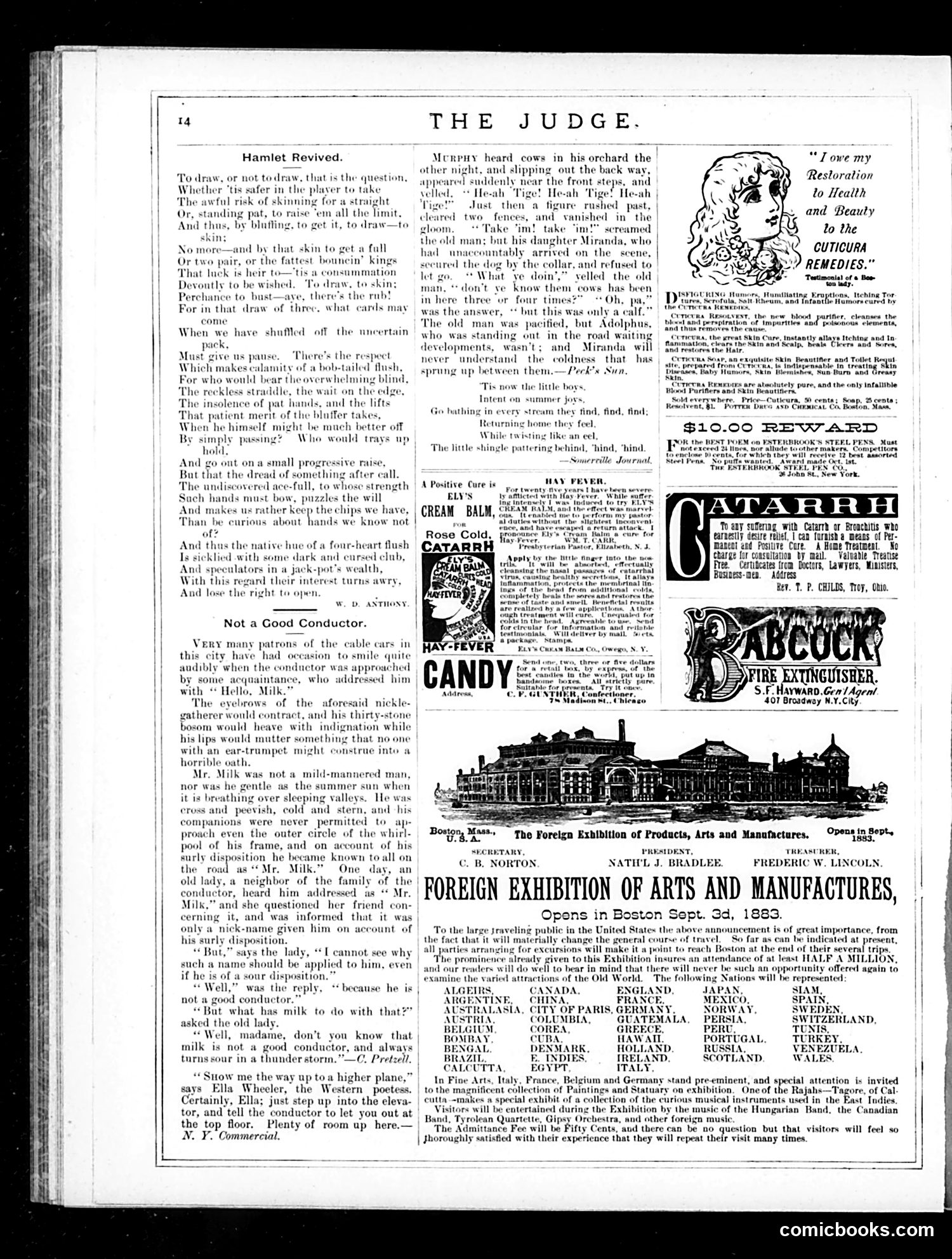
This page from **Judge** (a 19th-century satirical weekly) contains three main elements: ## "Hamlet Revived" A parody rewriting Shakespeare's "To be or not to be" soliloquy as poker/gambling slang—replacing existential questions with card-game terminology ("todraw," "skinning," "bluffing"). The satire mocks both pretentious Shakespeare quotations and gambling culture among the educated classes. ## "Not a Good Conductor" A brief social satire about a streetcar conductor nicknamed "Milk" who takes offense when a passenger greets him familiarly with "Hello, Milk." The joke illustrates class tensions: working-class employees resenting informal address from passengers, suggesting anxieties about social hierarchy and dignity in urban transit settings. ## Advertisements The remainder comprises period product ads (Cuticura remedies, Ely's Cream Balm for catarrh, candy) and an announcement of Boston's Foreign Exhibition of Arts and Manufactures (1883). The page reflects typical Judge content: literary parody, urban social observation, and commercial advertising targeting middle-class readers.
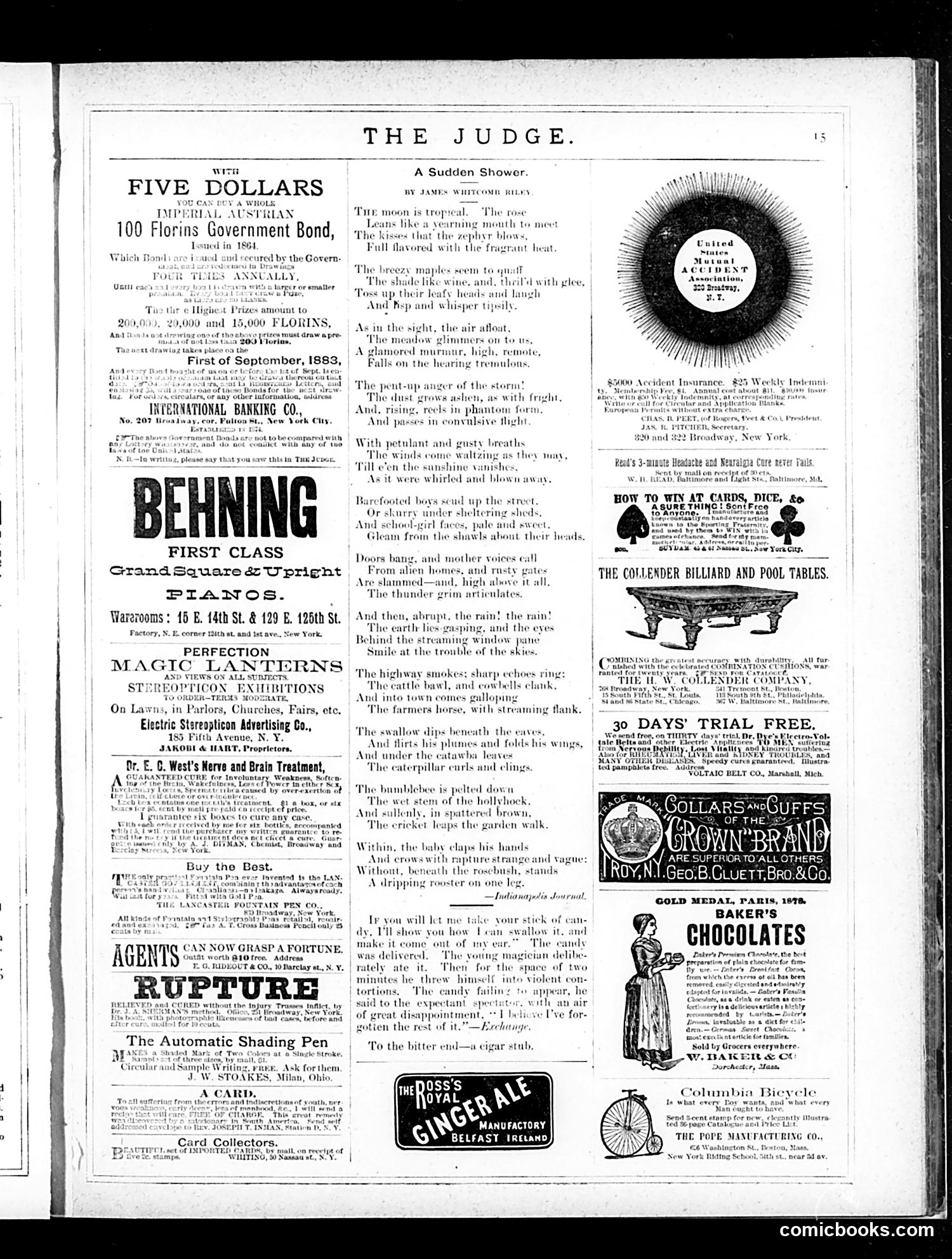
This page is primarily **advertising with one substantial poem**, not a political cartoon. The main content is "A Sudden Shower" by James Whitcomb Riley, a sentimental poem about a rainstorm's effects on rural American life—children playing, farmers' horses, nature responding dramatically. Riley was a popular Hoosier poet of the era, and Judge regularly published literary content alongside satire. The surrounding advertisements reflect 1880s consumer goods: Behning pianos, magic lanterns for exhibitions, a "nerve and brain treatment" (likely a patent medicine), rupture treatments, and food products (chocolates, ginger ale). These ads represent typical late-Victorian commercial pitches, some to modern readers appearing dubious or quackish. The **United States Accident Insurance** circular at top center advertises life/accident coverage—common in this period as industrial accidents were frequent and workers lacked protections. There is **no discernible political satire** on this page. It appears to be a standard issue mixing popular poetry, commercial advertisements, and insurance offerings typical of Judge's mid-era format.
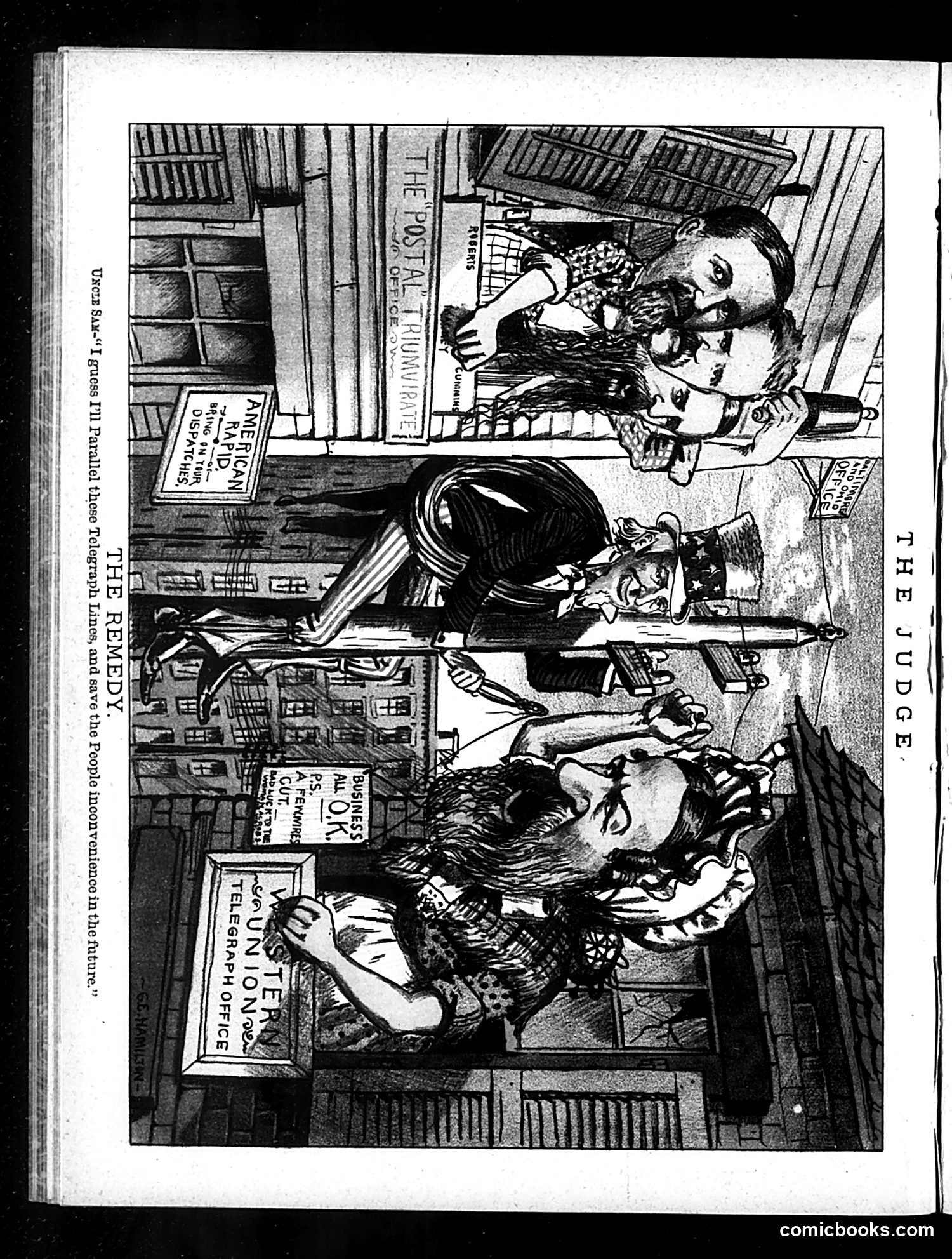
This Judge cartoon satirizes Uncle Sam's (representing the U.S. government) proposed solution to a problem involving telegraph lines. The figure, depicted with characteristic Uncle Sam appearance, suggests installing "parallel" telegraph lines to "save the people inconvenience in the future." The satire appears to mock government inefficiency or a superficial fix to infrastructure problems. Rather than addressing the root cause of telegraph service issues, Uncle Sam proposes merely duplicating existing systems—a remedy that merely sidesteps the actual problem rather than solving it. The cartoon's point seems to be criticizing government tendency toward wasteful, band-aid solutions that benefit connected parties rather than genuinely serving public needs. Without visible date markers, the specific telegraph dispute remains unclear, though this reflects late 19th-century infrastructure debates common in Judge's satirical commentary.