A complete issue · 16 pages · 1883
Judge — August 4, 1883
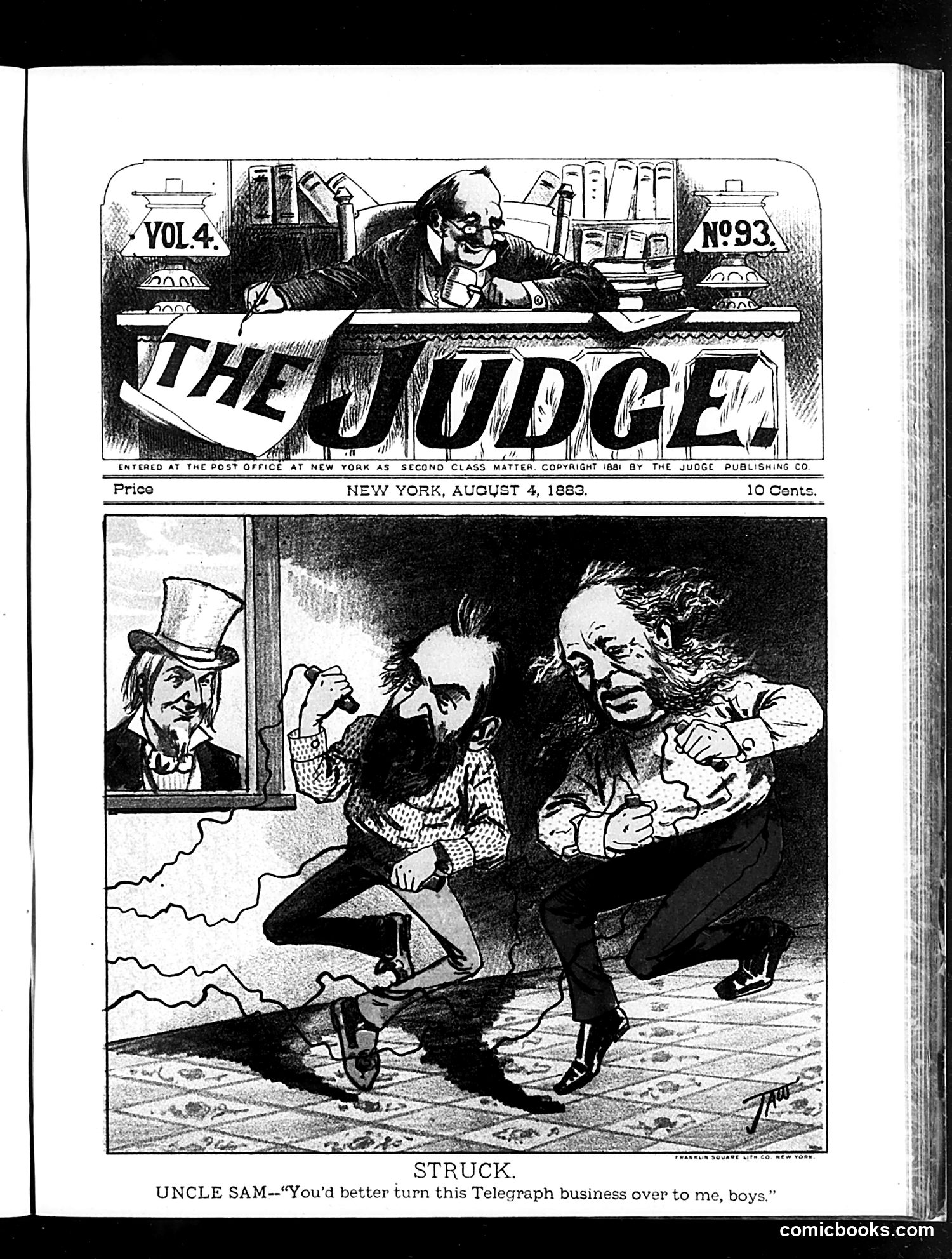
**The Cartoon "Struck":** This political satire depicts Uncle Sam (identifiable by his top hat, shown in the window) addressing two rough-looking men on the street—likely representing labor agitators or telegraph workers. One man holds a child, the other appears angry or confrontational. Uncle Sam warns them to "turn this Telegraph business over to me, boys." The cartoon satirizes labor disputes, probably referencing telegraph operator strikes that were occurring in the 1880s. The satire suggests that private labor conflicts were becoming so disruptive that federal government intervention was necessary. The "struck" title refers to workers striking (protesting), with the implication that such actions threatened essential national infrastructure and required governmental authority to resolve.
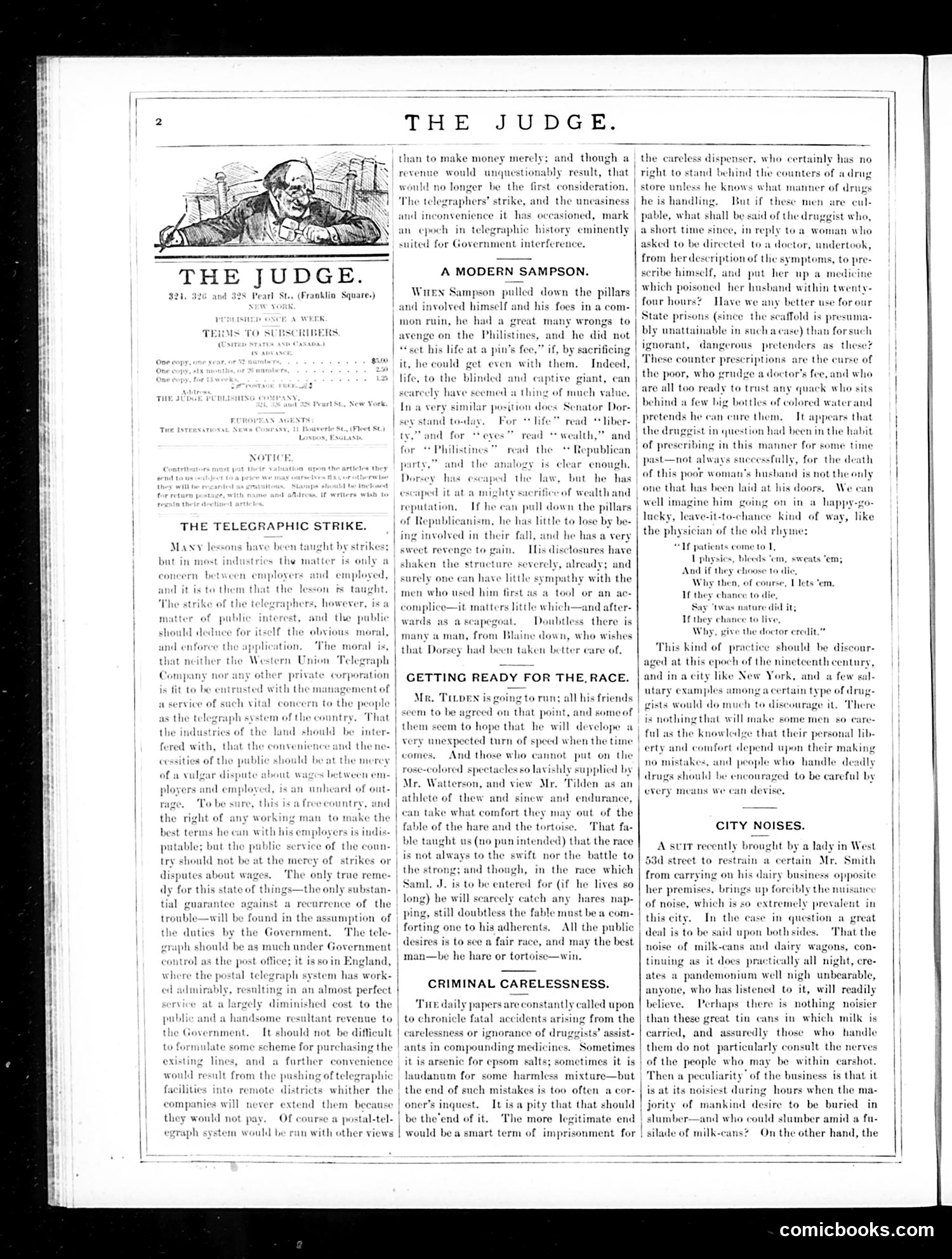
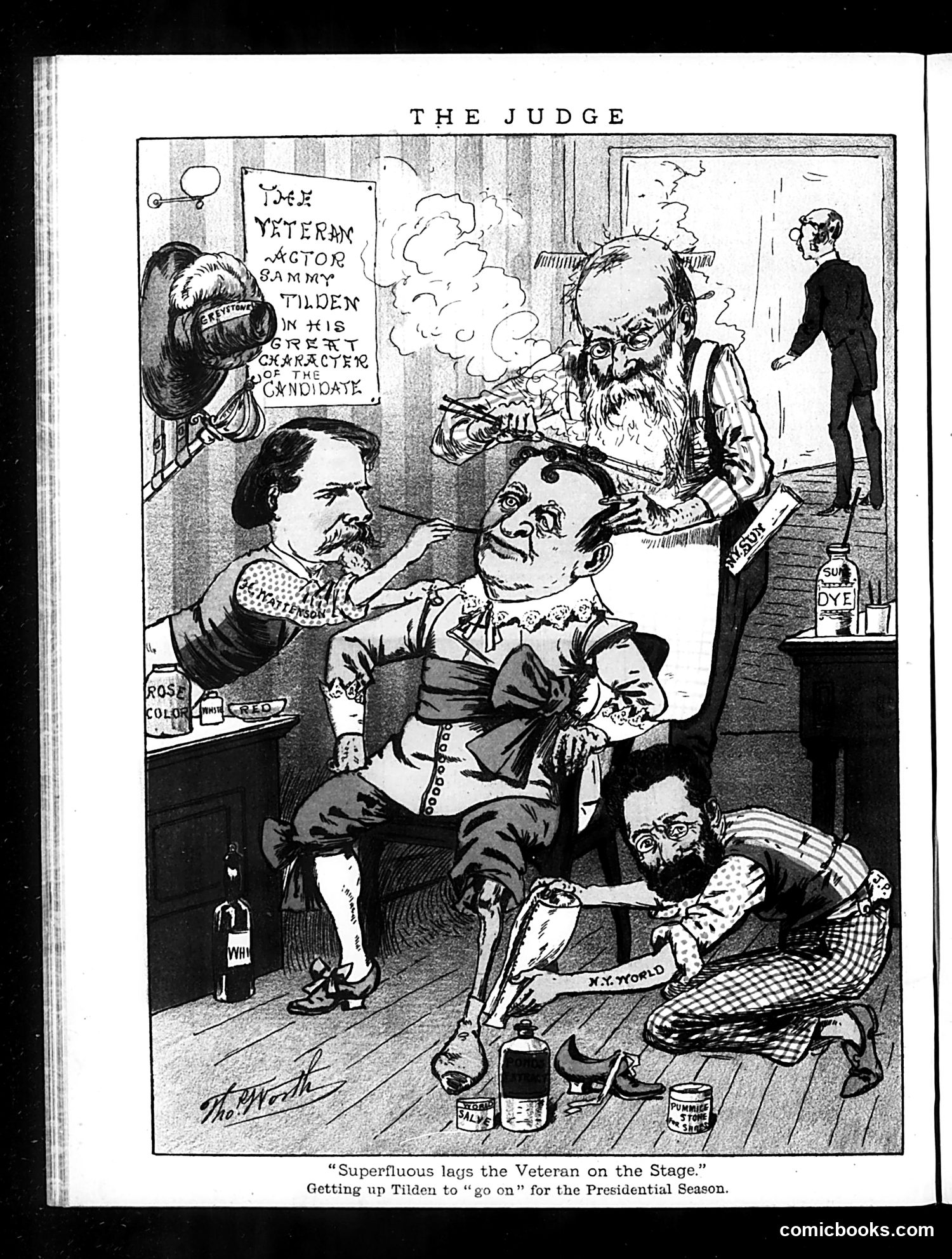
This page contains three distinct satirical pieces: **"The Telegraphic Strike"** argues that telegraph workers' strikes harm the public good. The editorial advocates government ownership of telegraph systems to prevent labor disputes from disrupting national communication—a progressive position for the era. **"A Modern Sampson"** compares Senator Dorsey to the Biblical figure who destroyed his enemies' temple at great personal cost. The satire suggests Dorsey, having been used as a political tool by the Republican Party, may now sabotage the party out of revenge, accepting mutual destruction for vindication. **"Getting Ready for the Race"** mocks Samuel Tilden's presidential ambitions, suggesting his age and frailty make him an unlikely candidate despite lavish support from newspaper editor Watterson. The tortoise-and-hare reference questions whether money alone ensures electoral victory. A brief item on "Criminal Carelessness" condemns pharmacy errors causing deaths from mistaken ingredients—calling for stricter standards in medicine compounding.
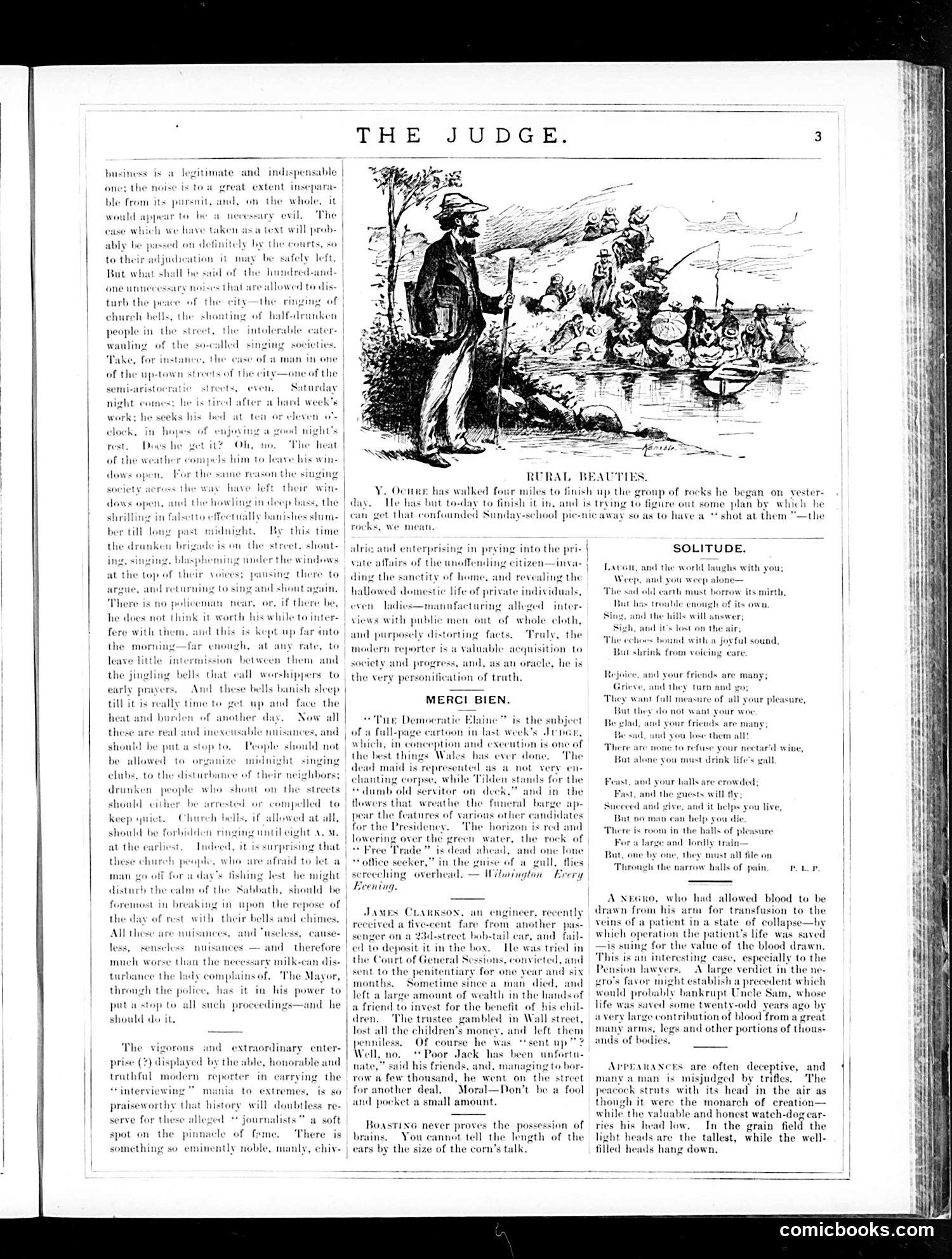
This page from *Judge* contains satirical commentary on urban noise pollution and several shorter pieces. The main cartoon, "Rural Beauties," depicts a man (likely an artist named "Y.") struggling to paint rocks while plagued by a nearby Sunday-school picnic—satirizing the difficulty of peaceful creative work in proximity to noisy public activities. The accompanying text criticizes unnecessary urban disturbances: church bells, drunken shouters, and singing societies that disrupt sleep and leisure. The satire argues these nuisances should be legally suppressible, particularly targeting hypocritical churchgoers who demand Sabbath quiet while operating noisy bells themselves. The shorter pieces mock contemporary figures and situations, including "The Democratic Elaine" (appears to reference political cartoons from the prior week) and anecdotes about an engineer and a streetcar fare dispute—typical *Judge* fare mixing politics, morality, and urban life complaints.
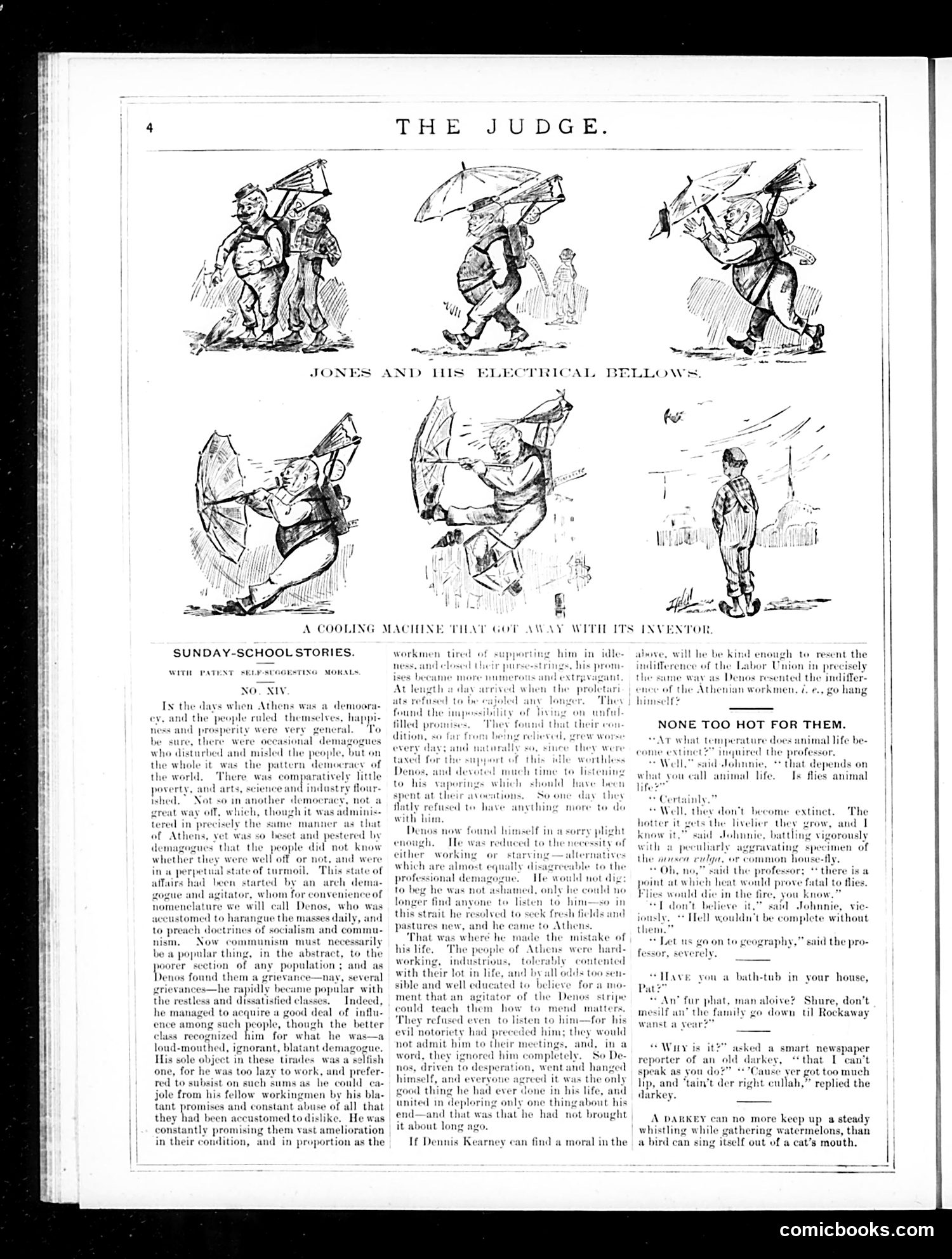
This page contains two distinct sections: **"Jones and His Electrical Bellows"** (top cartoons): A series of six comic illustrations depicting a man struggling with an umbrella-like "cooling machine" in various mishaps—being blown away, tangled, and inverted. The humor is slapstick: the inventor's device malfunctions spectacularly, ultimately getting away from him entirely. **"Sunday-School Stories: No. XIV"** (text with bottom illustration): A moral tale about ancient Athens featuring "Denos," an agitator/demagogue who exploits workers' grievances with empty communist promises. The story criticizes how Denos gains influence by blaming the wealthy, yet the educated working class ultimately reject him. He hangs himself—framed as just desserts. The narrative teaches that class agitation and demagogy are self-defeating. **The satire targets**: Socialist/communist agitators of the era, portraying them as dishonest rabble-rousers whose ideology collapses when confronted by reason. The moral lesson is explicitly didactic—warning against revolutionary rhetoric. Both sections use humor to advocate conservative, anti-radical positions typical of Judge magazine's era.
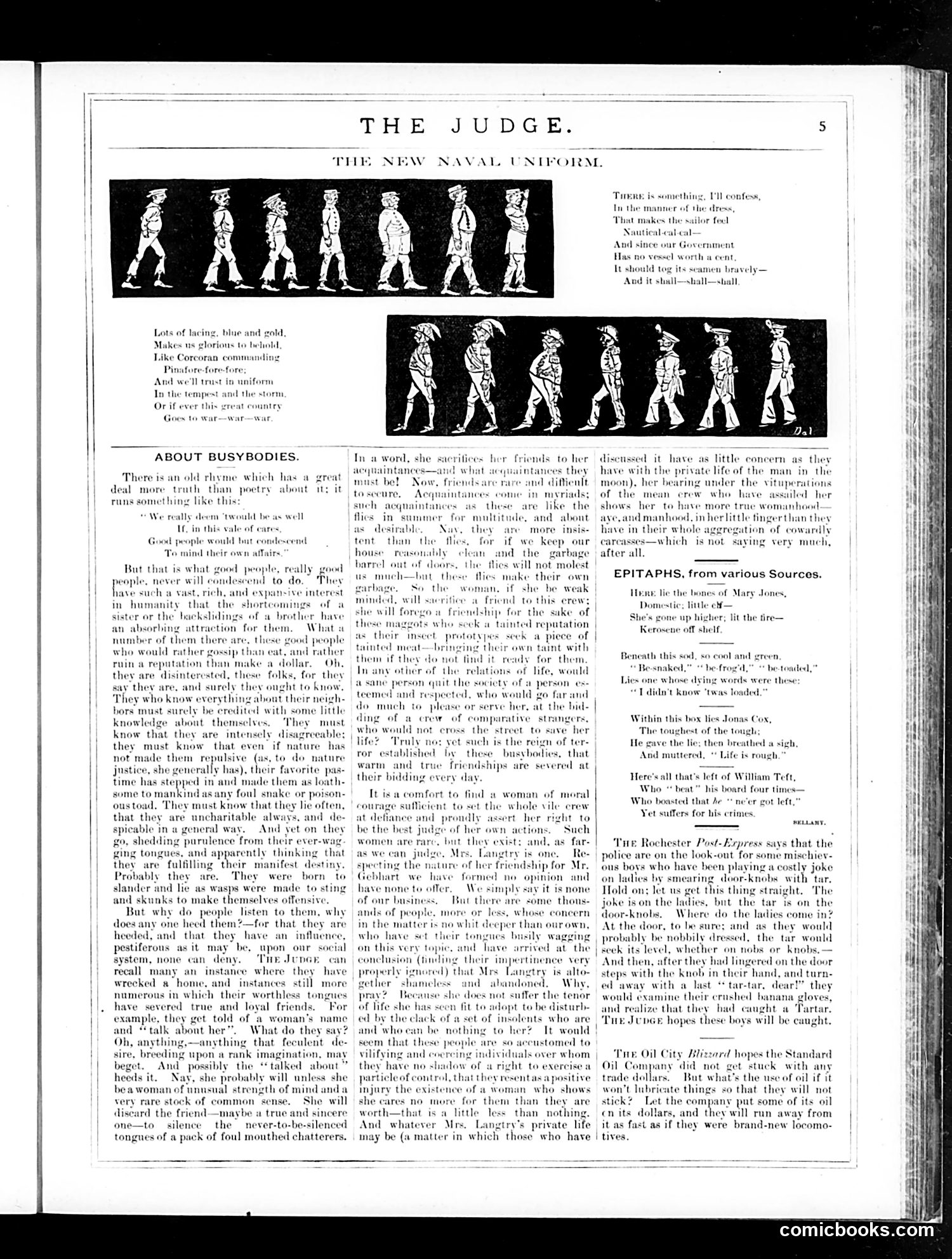
This page contains two distinct sections: **The Naval Uniform Cartoon** (top): Seven illustrated figures show sailors in what appears to be a new naval dress uniform design. The accompanying verse celebrates the uniform's appearance—"lace, blue and gold" that makes sailors "glorious to behold." The satire likely mocks either the aesthetic choices or cost of a recently adopted naval uniform, a topic of contemporary debate. **"About Busybodies"** (main text): This lengthy essay satirizes gossips and social meddlers—particularly women who spread rumors and destroy reputations through malicious talk. The piece defends Lillie Langtry (a famous actress involved in scandal) against busybodies' judgment of her private life, arguing that people have no right to control or judge her conduct. The satire criticizes society's tendency to listen to and believe vicious rumors spread by people with no legitimate authority over others' affairs. The central argument: moral courage requires ignoring gossips' opinions entirely.
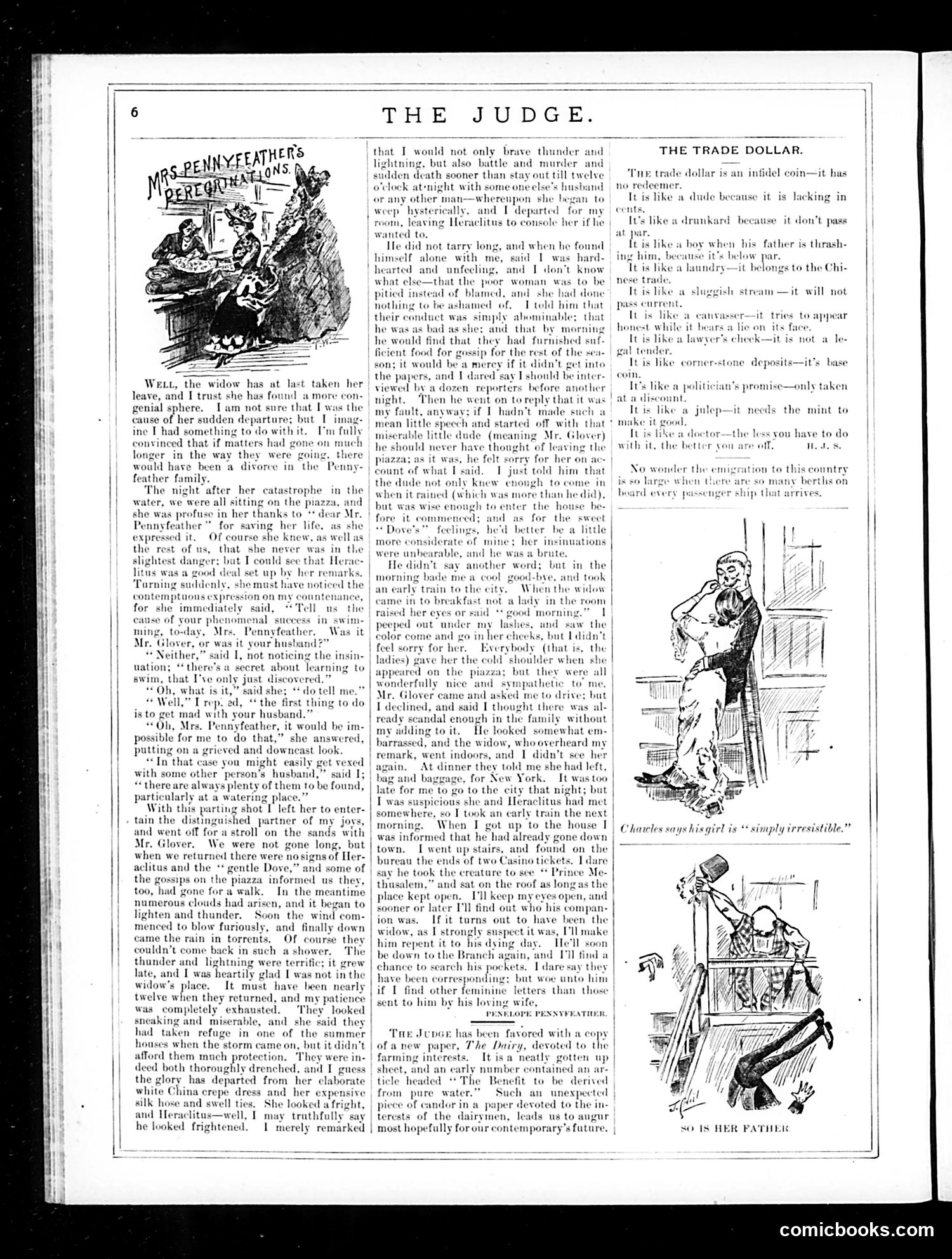
This page from *Judge* magazine satirizes two distinct subjects: **"The Trade Dollar"** (right column) is a brief satirical piece mocking the trade dollar—an actual U.S. coin introduced in the 1870s for Asian commerce. The satire compares the worthless coin to various disappointing things: a dude lacking cents, a father below par, laundered bills, a sluggish stream, a canvas pretending to be honest, a lawyer's check, and a corner-store deposit. The joke targets both the coin's lack of value and contemporary financial fraud. **The main narrative** (left) mocks Victorian-era society scandals. A gossipy narrator recounts how a woman ("the gentle Dove") and a man (Heraclitus) were caught in a compromising situation during a storm—their reputations ruined. The satire targets the era's rigid propriety, the narrator's self-righteous hypocrisy, and society's cruel judgment of moral transgressions. The illustrations show the scandal's domestic fallout.
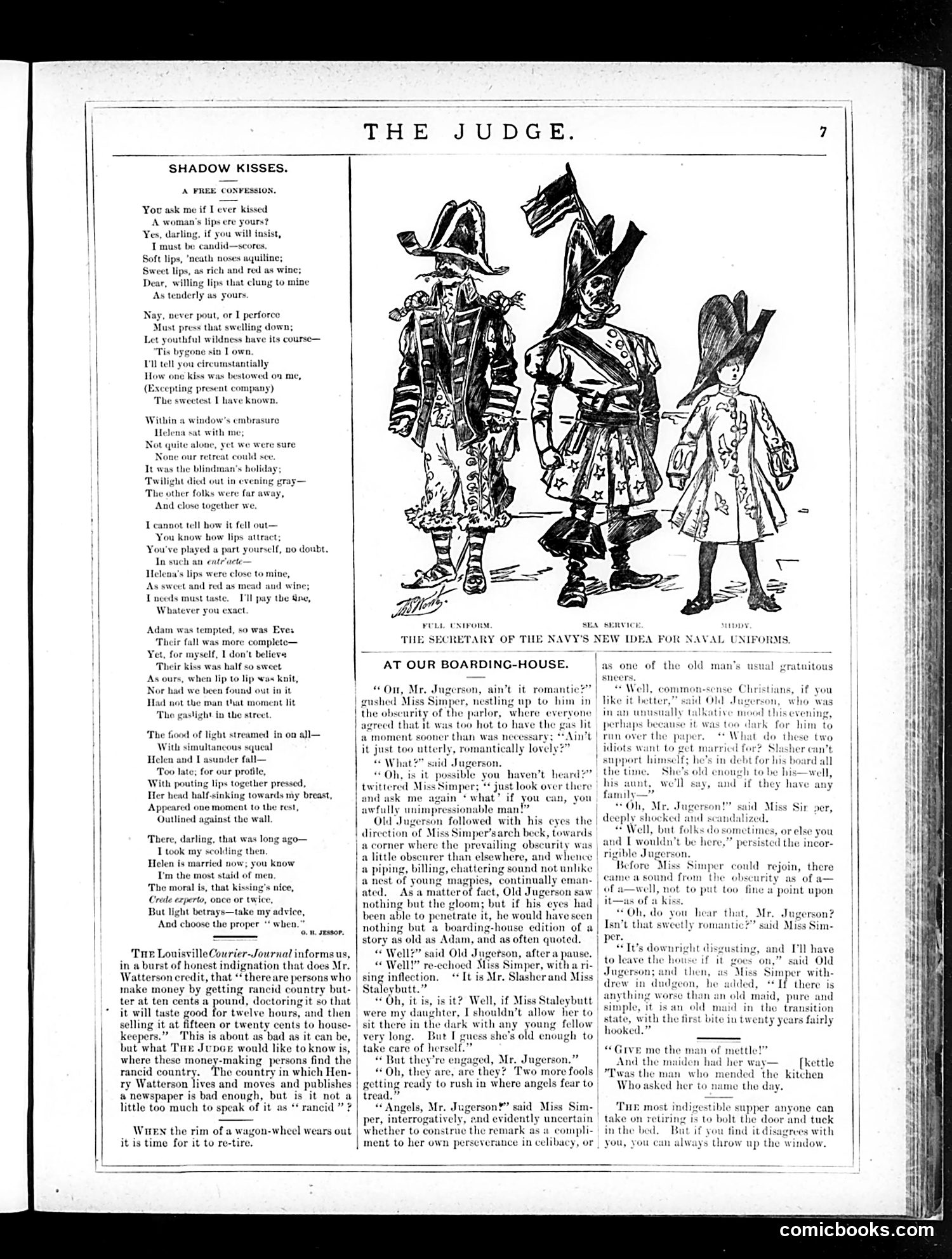
This Judge magazine page contains two separate pieces of humor: **"Shadow Kisses"** (left): A sentimental poem about a man confessing his romantic past to his sweetheart. The joke is that he recalls kissing a woman named Helena years ago, interrupted when a streetlight suddenly illuminated them. It's Victorian-era romantic melodrama, poking gentle fun at sentimental poetry and young lovers. **"At Our Boarding-House"** (right): A comic dialogue between Miss Simper (a gossipy boarder) and Old Jugerson. She romantically describes an engaged couple (Mr. Slasher and Miss Staleybutt) kissing in a dark corner, expecting Jugerson to find it charming. Instead, he cynically responds that they're "two more fools" rushing into engagement. The satire targets both romantic sentimentality and the practical skepticism of older generations toward young love. The illustration shows naval officers with female figures, appearing unrelated to the text content.
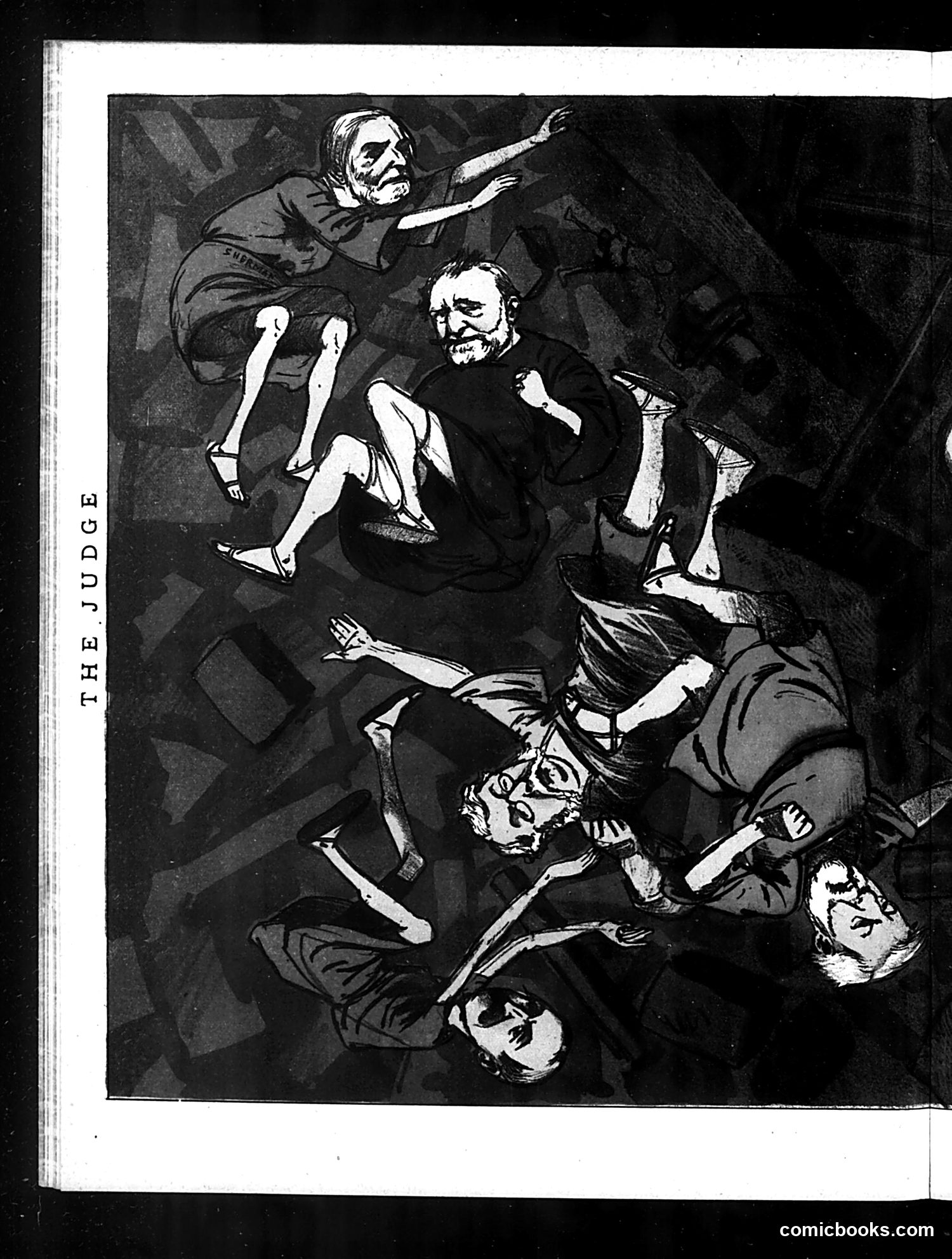
This appears to be a satirical illustration titled "THE JUDGE" depicting multiple figures in a hierarchical or falling composition. The central figure is a bearded man in formal dress, positioned above several other men who appear to be falling or descending below him. Without additional text or context visible on this page beyond the title, I cannot definitively identify the specific political figures or the particular event being satirized. The composition suggests commentary on power dynamics, authority, or a fall from grace, which was common in Judge magazine's political satire. To accurately explain the cartoon's specific meaning—who these figures represent and what historical event or controversy it references—I would need legible accompanying text or captions that are not clearly visible in this image.
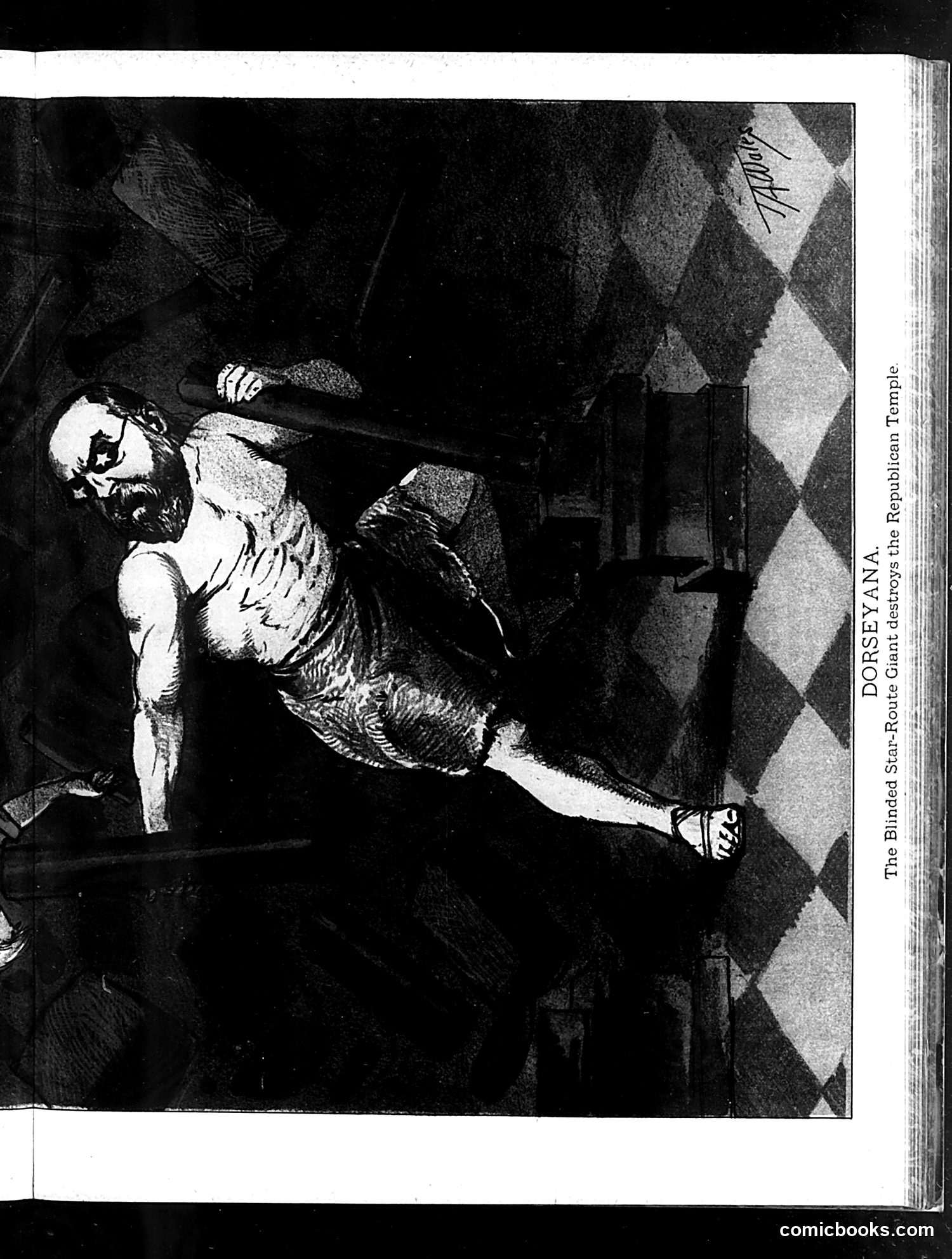
The OCR text appears corrupted and unreadable, so I'm relying on the image alone. This appears to be a political cartoon titled "The Blinded Sun-Rout Giant destroys the Republican Temple." The image shows a figure (likely representing a political force or movement) wielding what looks like a rifle or staff, positioned aggressively within an interior space marked by a diamond-patterned floor or wall. Without legible text or a clear date, I cannot definitively identify the specific political figures, historical event, or satirical point being made. The "Republican Temple" reference suggests this critiques Republican politics, but the identity of the "Blinded Sun-Rout Giant" and the exact historical context remain unclear to me. More information would be needed for accurate interpretation.
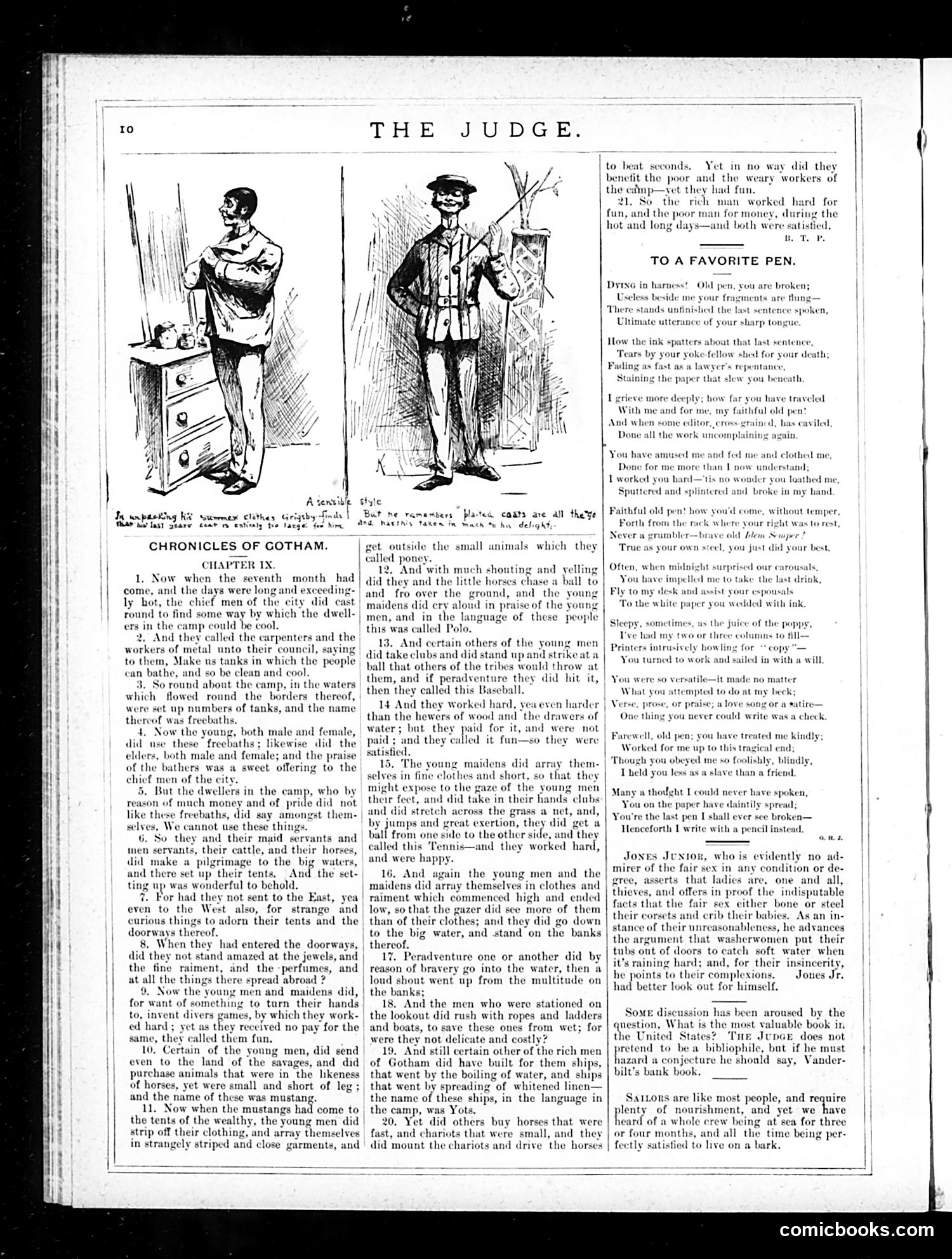
This page from *Judge* magazine satirizes wealthy New Yorkers' summer leisure activities during hot weather. The two illustrated figures represent the contrast between classes: a working-class person (left) and a wealthy person (right). The "Chronicles of Gotham" (a fictional New York) uses mock-biblical language to ridicule the rich. It describes how wealthy elites avoid public "freebaths" (public pools) used by common people, instead retreating to exclusive camps where they pursue expensive pastimes: polo on imported ponies, baseball, tennis, and swimming—all presented as "fun" (unpaid labor they somehow enjoy). The satire mocks how the wealthy exhaust themselves with leisure activities while dressing scantily and maintaining their pretensions of superiority. The biblical tone amplifies the absurdity, treating trivial summer sports with grandiose language, exposing the vanity and class divisions of Gilded Age New York society.
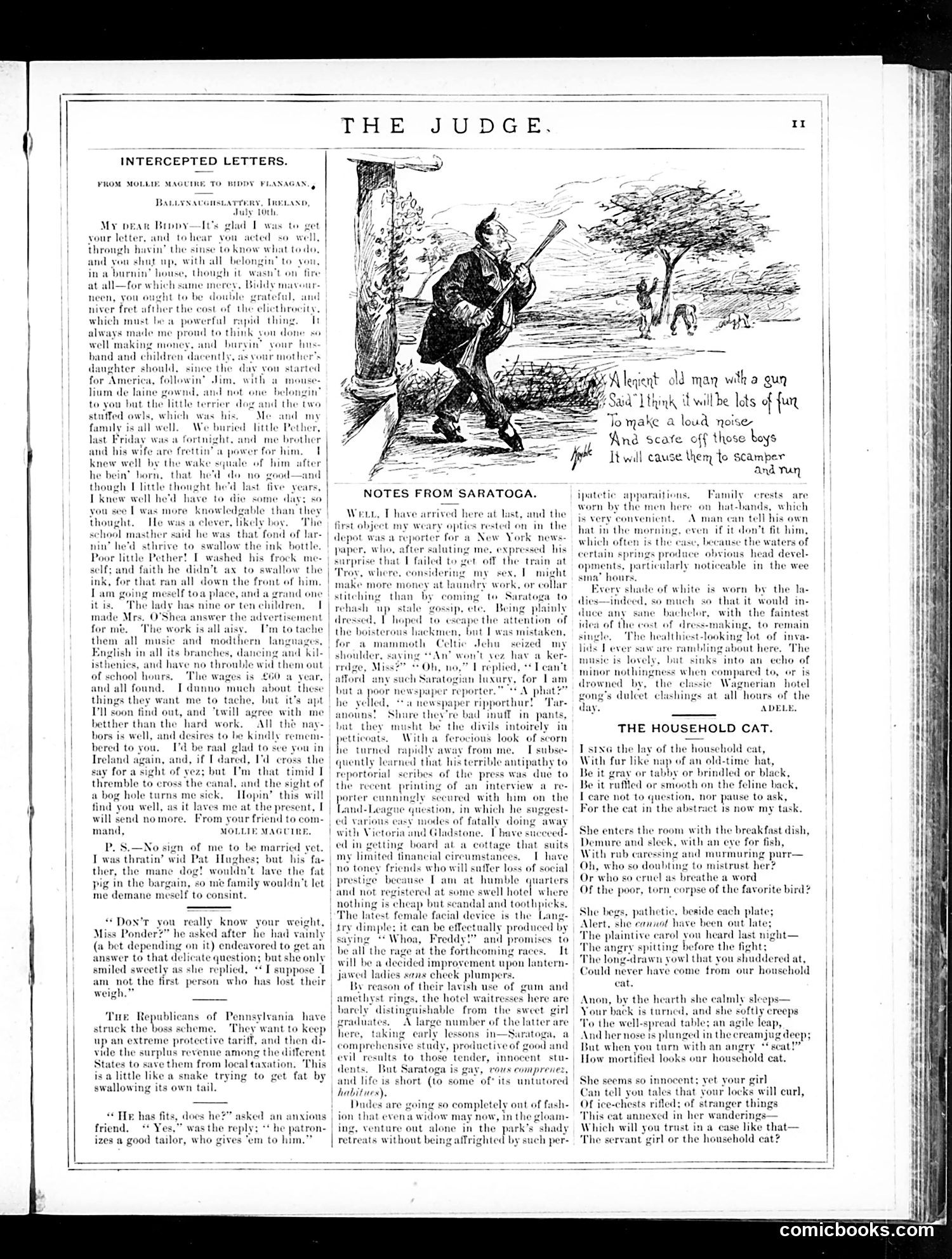
This page satirizes the **Molly Maguires**, an Irish-American secret society accused of labor violence in Pennsylvania coal mining regions. The "intercepted letters" mock Irish immigrants through heavy dialect and crude stereotypes. The main cartoon depicts an elderly Irish man with a rifle, captioned about making "loud noise" to "scare off those boys." This likely references Molly Maguire violence and vigilante rhetoric. The letters—supposedly from "Mollie Maguire" to "Biddy Flanagan"—ridicule Irish working-class life: poverty, child mortality, domestic labor, and illiteracy (misspellings throughout). References to "buryin' your husband" and murdered children invoke the actual violent reputation of the Molly Maguires. The "Notes from Saratoga" section contrasts wealthy leisure culture with working-class struggles, emphasizing class divisions. Overall, this represents **anti-Irish prejudice common in 1870s American satire**, depicting Irish immigrants as violent, ignorant, and dangerous through exaggerated dialect and dark humor about death and poverty.
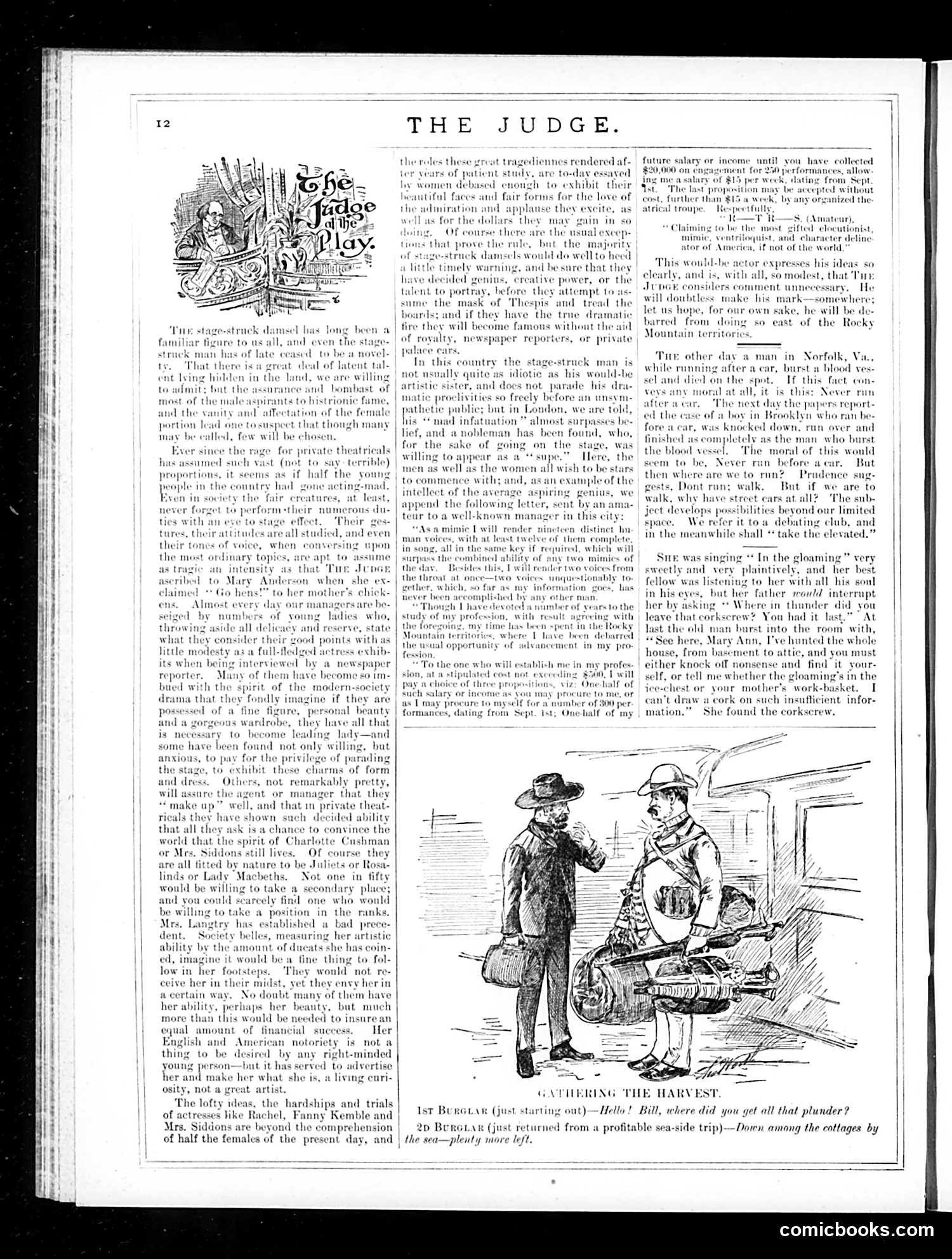
This page from the satirical magazine *Judge* contains two distinct pieces of social commentary: **Main Article: "The Judge at the Play"** Critiques stage-struck young women seeking theatrical careers. The author mocks their pretensions and lack of genuine talent, contrasting their "assurance and bombast" with male aspirants who, while equally delusional, at least maintain some discretion. The piece includes a sarcastic letter from an aspiring actress offering her services for minimal pay ($15/week), illustrating the desperation and naïveté of amateur performers seeking professional work. **Bottom Cartoon: "Gathering the Harvest"** Shows two working-class men (likely street vendors or laborers based on their attire and baskets). One asks the other where he obtained "all that plunder," with the response implying seaside commercial activity. This appears to satirize petty commerce or opportunistic profit-taking, though the specific reference is unclear. **Overall Theme:** The page mocks theatrical ambition and working-class economic schemes with characteristic *Judge* irreverence toward both aspiring performers and social pretension.
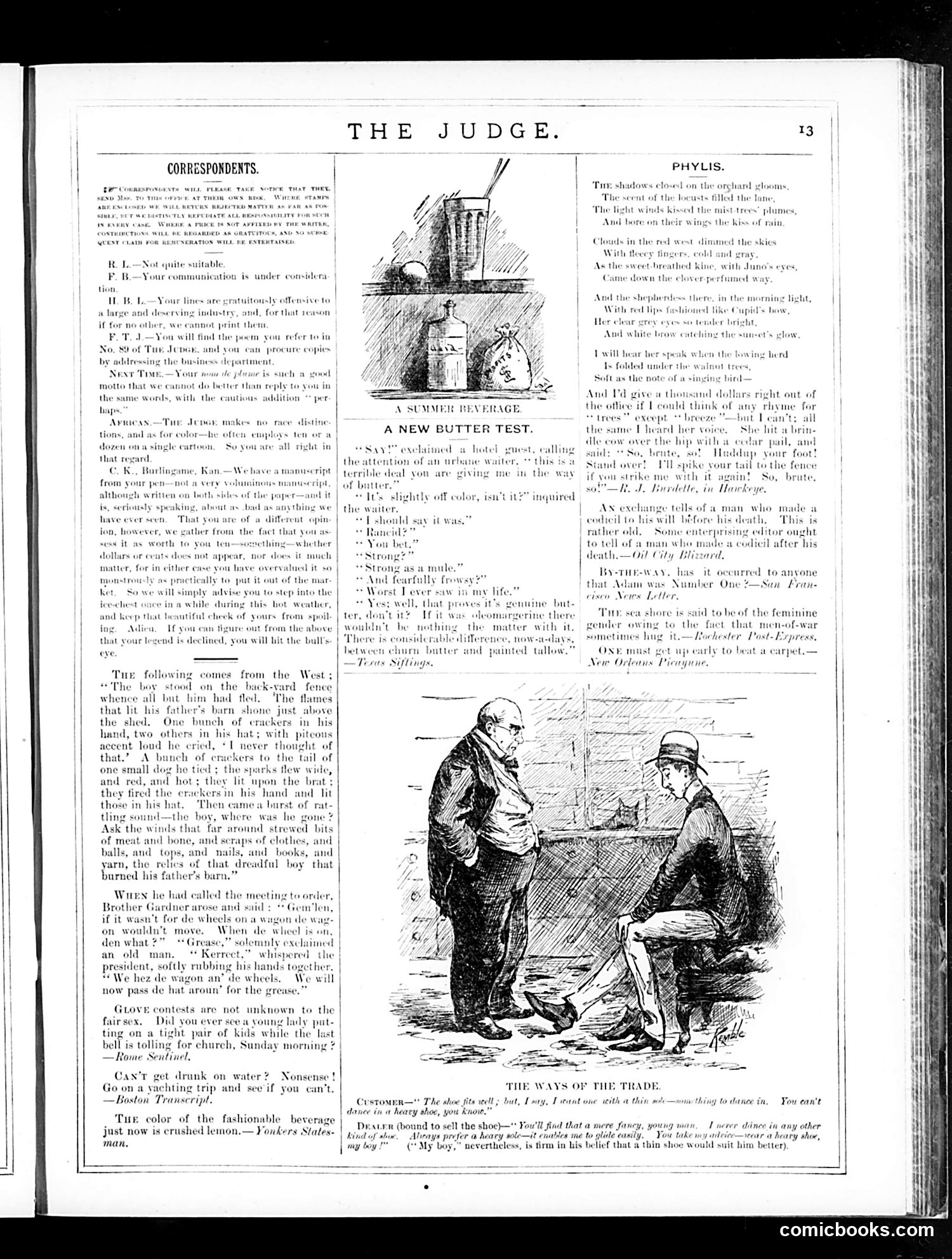
The cartoon depicts a shoe dealer attempting to sell an uncomfortable shoe to a customer by misrepresenting its quality. The customer complains the shoe is too tight and heavy, but the dealer insists it's "firm" and will be "better" for the foot—a transparent lie meant to make a difficult sale. The satire mocks dishonest commercial practices of the era: salesmen knowingly selling defective or unsuitable goods through false claims about durability or comfort. The customer's skepticism ("I don't dance in a heavy shoe") versus the dealer's evasive reassurance illustrates the inherent conflict between buyer and seller interests. This reflects Gilded Age concerns about consumer fraud and the exploitation of buyers by merchants prioritizing profit over honesty—a recurring theme in *Judge* magazine's social criticism.
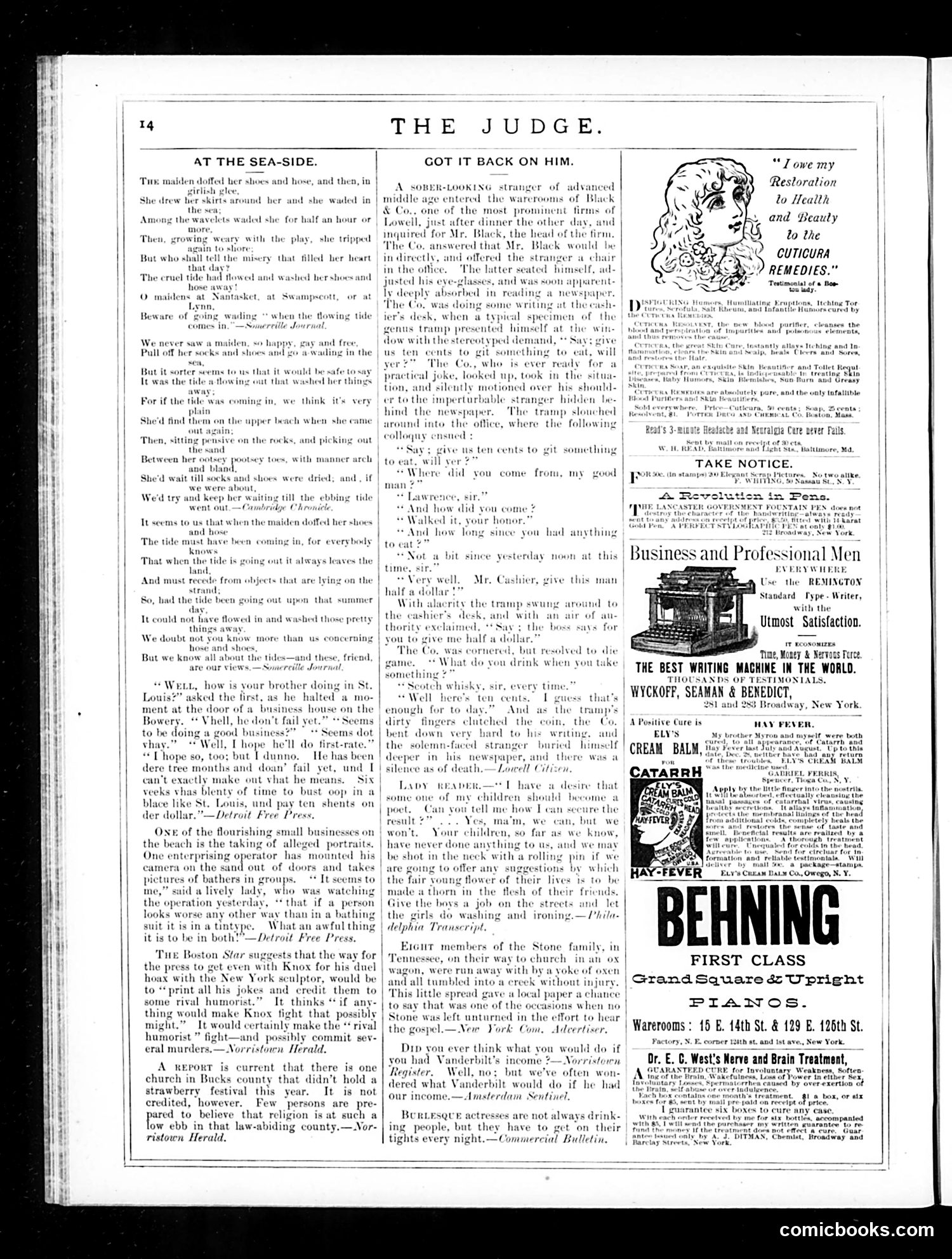
This page contains two distinct satirical pieces: ## "At the Sea-Side" (left column) A humorous poem about a maiden who wades into the ocean and loses her shoes and hose to the tide. The joke plays on Victorian modesty—she's embarrassed about her bare legs being exposed on the beach, yet this exposure is inevitable once her clothing floats away. The satire mocks prudish social conventions of the era. ## "Got It Back on Him" (center) A short story about a well-dressed stranger visiting a business office seeking Mr. Black. A tramp enters and steals the stranger's coat. When the stranger confronts him, the tramp turns the tables with sharp wit, essentially humiliating the "respectable" man through clever insults. The satire suggests that working-class cunning can outsmart middle-class pretension—a common Judge magazine theme. The remainder of the page consists primarily of **advertisements** for typewriters, skin remedies, and other products typical of 1880s-90s publications. No clear political cartoons are visible.
This is primarily an **advertising page** from Judge magazine, with one notable satirical poem taking up the center column. ## The Main Content: "A Little Too Much Rye" The poem is a **humorous verse about drunken behavior and fighting**, written as a parody of the Scottish song "Comin' Thro' the Rye." It uses the original's structure to mock men who become belligerent when intoxicated—suggesting that various professions (flunkeys, sculptors, writers) who drink and then fight behave foolishly and hypocritically. ## Supporting Editorial Section Below the poem, Judge prints a brief commentary on an actual legal question: **the monetary value of a stolen kiss**. This appears to reference a real court case or lawsuit, and Judge sardonically explores how juries might rate kisses differently based on the woman's age, status (widow vs. young woman), and circumstances. It's gentle social satire about legal absurdity. ## The Rest The page is dominated by period advertisements for Austrian bonds, musical boxes, writing inks, billiard tables, bicycles, and patent medicines (notably "Gastrine" for dyspepsia)—typical late-19th-century magazine fare.