
A complete issue · 16 pages · 1883
Judge — June 9, 1883
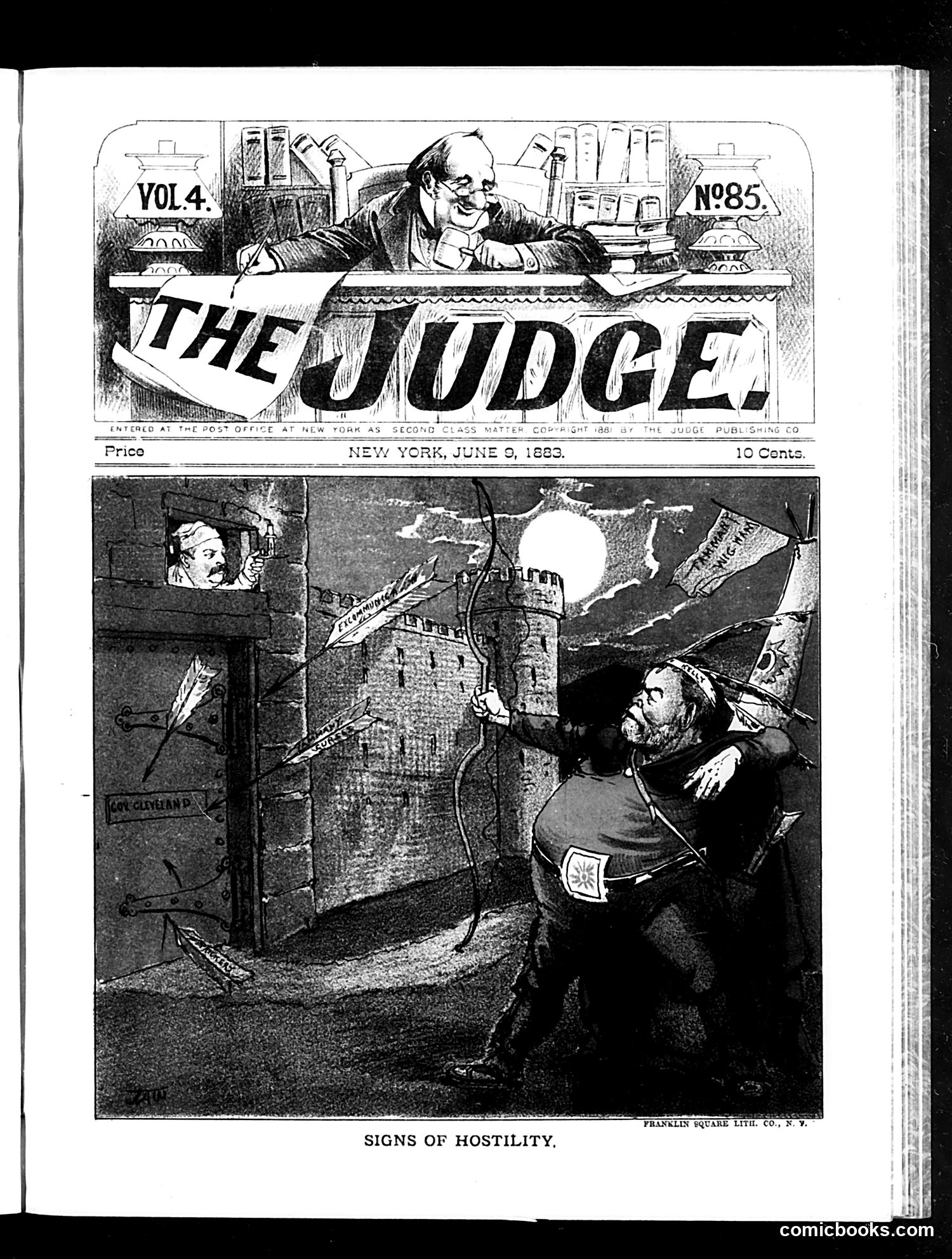
This satirical cartoon depicts a confrontation outside a fortified tower or castle. A man in period costume (appearing to be dressed as a historical or stereotypical figure) stands guard at an entrance marked with hostile symbols—arrows stuck in the door and walls. Another figure approaches from outside, also in period dress, apparently seeking entry or confrontation. The title "Signs of Hostility" is ironic: the literal arrows and barricades are "signs," but the cartoon likely comments on escalating tensions between groups during the 1893 period, possibly labor unrest, political conflict, or international relations. Without additional context, the specific historical reference remains unclear, but the medieval imagery suggests commentary on primitive or anachronistic antagonism.
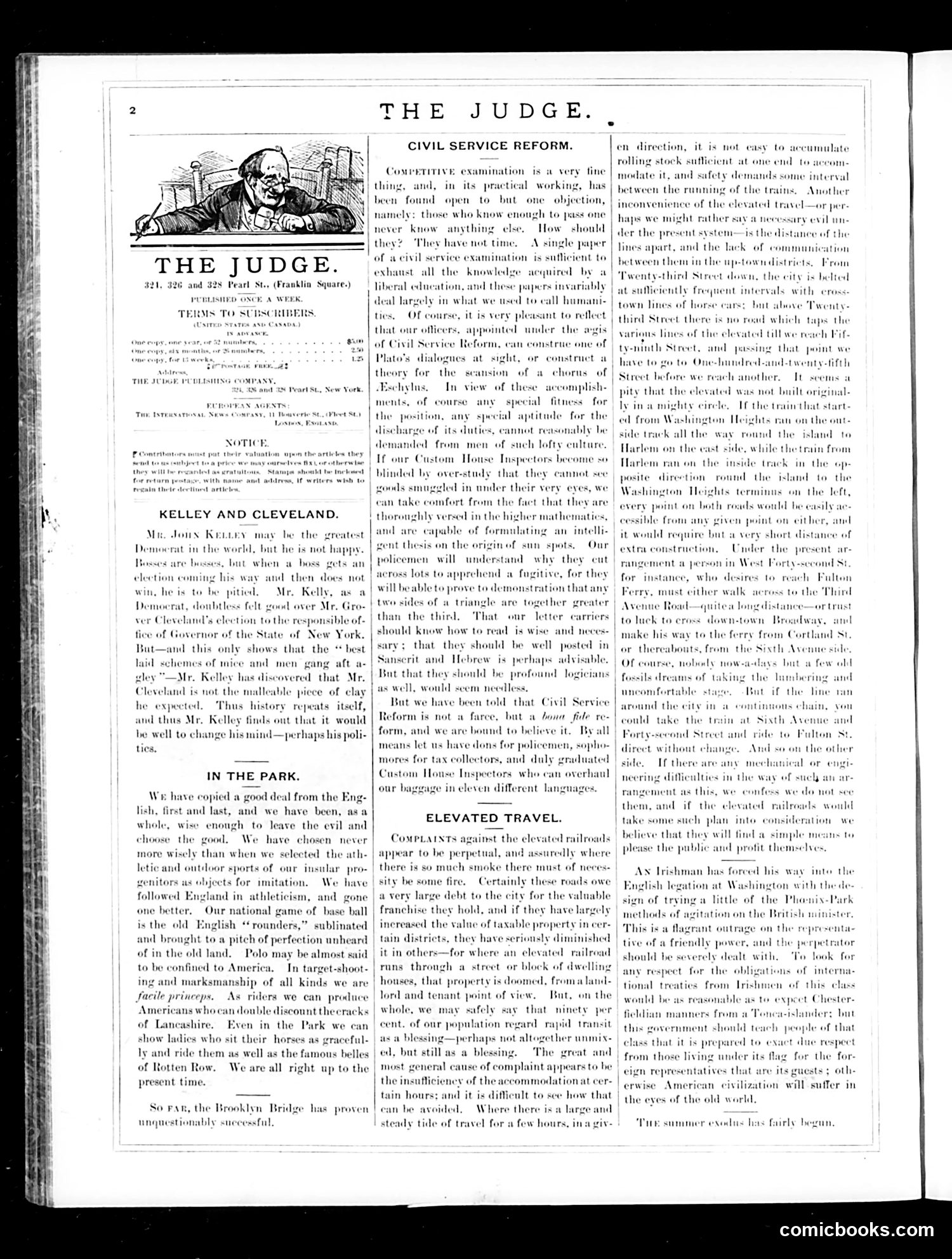
This page from the satirical magazine **Judge** contains three distinct sections critiquing American institutions: **"Civil Service Reform"** attacks the competitive examination system for government jobs. The satire argues that while civil service exams test narrow knowledge (mathematics, languages), they fail to assess practical competence. The piece mocks how Custom House Inspectors might excel at mathematics yet lack real-world capability—a commentary on bureaucratic inefficiency. **"Kelley and Cleveland"** references John Kelley, a New York Democratic political boss, and his disappointment that Grover Cleveland won the gubernatorial election instead of supporting Kelley's preferred candidate. The satire suggests Kelley expected Cleveland to be politically malleable ("clay") but found him independently-minded. **"Elevated Travel"** critiques New York's elevated railroad system, arguing its routing is inefficient and inconvenient for crosstown travel, forcing passengers into unnecessarily long journeys. The overall theme: institutions and leaders fail practical expectations despite technical accomplishments.
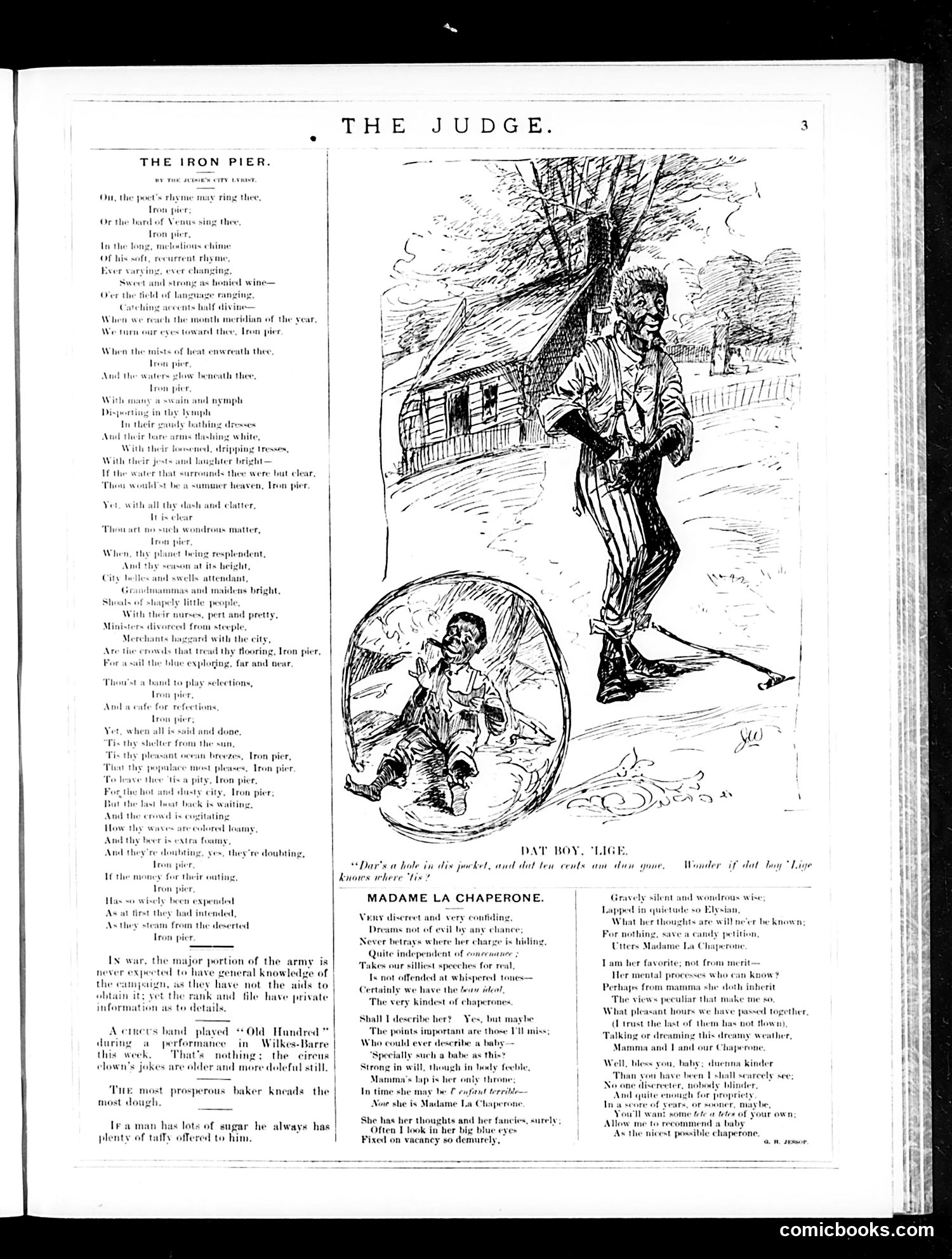
This page contains three distinct pieces of satirical content: **"The Iron Pier"** (left): A lengthy poem mocking a popular seaside attraction, likely Coney Island's famous pier. The satire celebrates the pier as a destination for working-class New Yorkers seeking relief from summer heat, while gently poking fun at the crowds, cheap entertainment, and beer consumption that define the experience. **"Dat Boy, 'Lige"** (center): A brief comic sketch featuring a Black child character (drawn in period racist caricature style) who has lost money in a jacket pocket—a simple joke relying on dialect humor typical of the era. **"Madame La Chaperone"** (right): A poem praising the role of the chaperone—an older woman responsible for supervising young unmarried women in public. The satire gently mocks the chaperone's quiet, enigmatic nature while ultimately celebrating her protective function in Victorian/Edwardian society. The page reflects Judge's mix of social observation, class-conscious humor, and period attitudes now considered offensive.
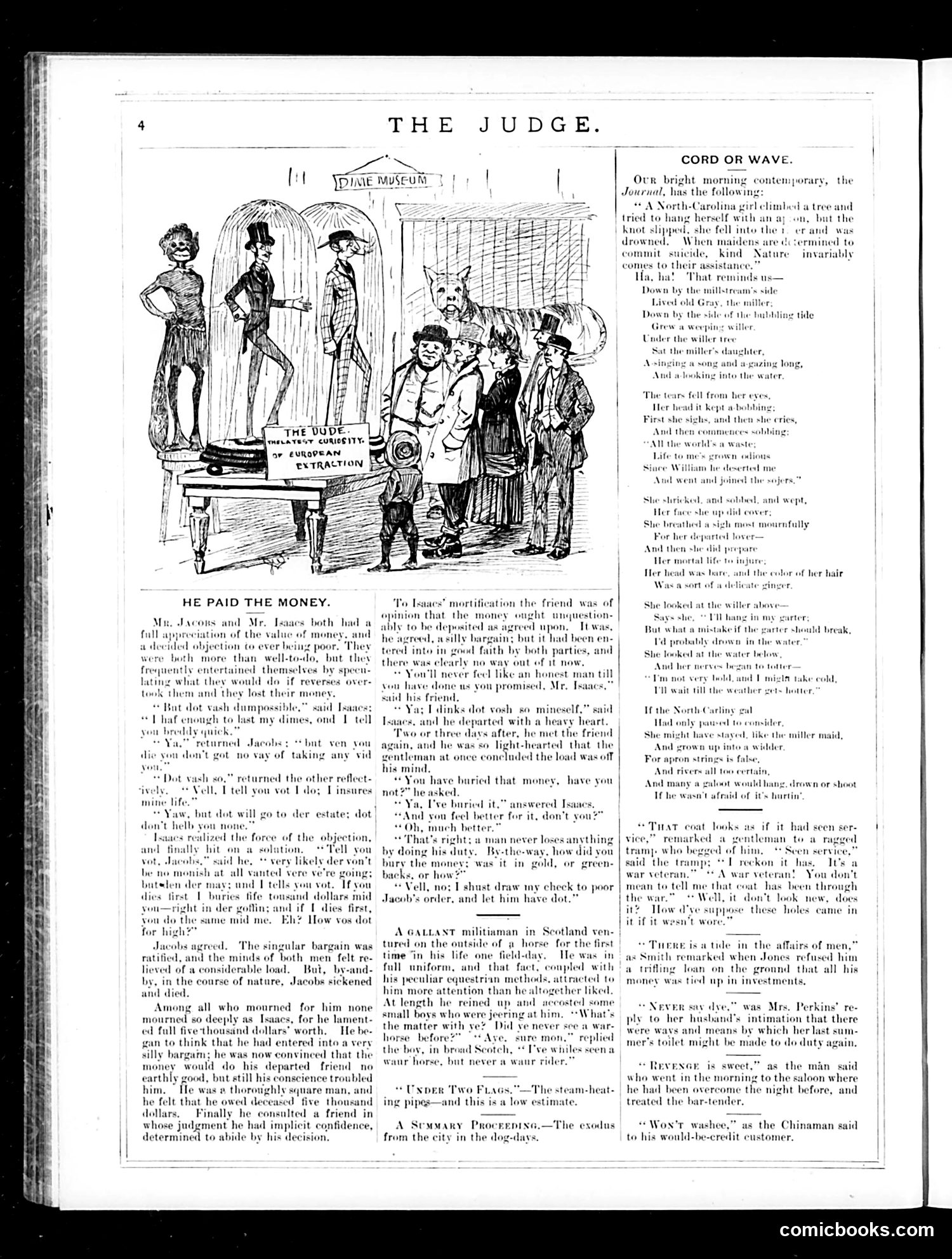
This page contains two distinct items: **"He Paid the Money"** (main cartoon): A satirical story about two German-immigrant businessmen (identifiable by their dialect spelling: "vosh," "dot," "vos") who make a macabre bargain—whoever dies first, the survivor must bury money with the corpse. When one dies, the other "buries" the money by depositing it in the dead man's name at a bank and simply withdrawing it. The joke mocks both the absurdity of the original agreement and the immigrant characters' perceived cunning in circumventing it. Judge frequently stereotyped German immigrants as comical figures with exaggerated accents. **"Cord or Wave"** (right column): A sentimental poem about a girl who attempts suicide by drowning, only to be saved by natural forces—her skirts keep her afloat. The poem ironically praises "kind Nature" for intervening. This appears to be social commentary on melodramatic suicide narratives that were common in 19th-century literature and journalism.
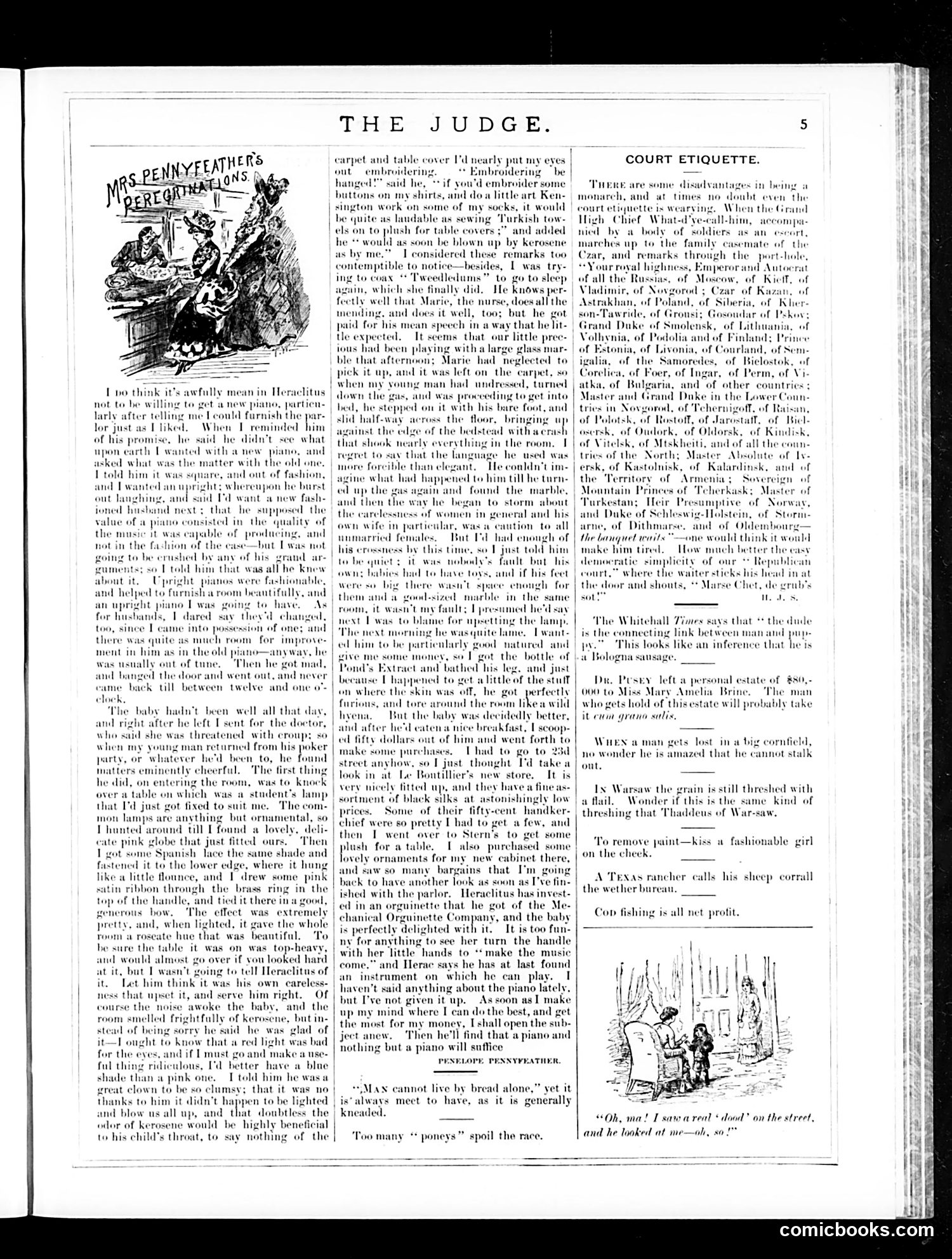
This page from *Judge* magazine contains two distinct sections: **Left side:** A humorous domestic essay by "Mrs. Pennyfeather" complaining about her husband's refusal to buy a new piano. She describes him knocking over furniture while drunk or negligent, his mean remarks about her embroidery, and his general inconsiderateness. The satire targets husbands' stinginess and domestic tyranny—common themes in Victorian-era humor. **Right side:** "Court Etiquette" section lists absurdly long titles of Russian nobility (Czar, Grand Dukes, etc.), mocking the elaborate Russian imperial court hierarchy. This likely references late 19th-century Russian autocratic pretension. The satire ridicules the excessive formality and title-inflation of monarchical systems. The cartoons illustrate these domestic and political absurdities in period style, though specific historical events aren't clearly identifiable without additional context.
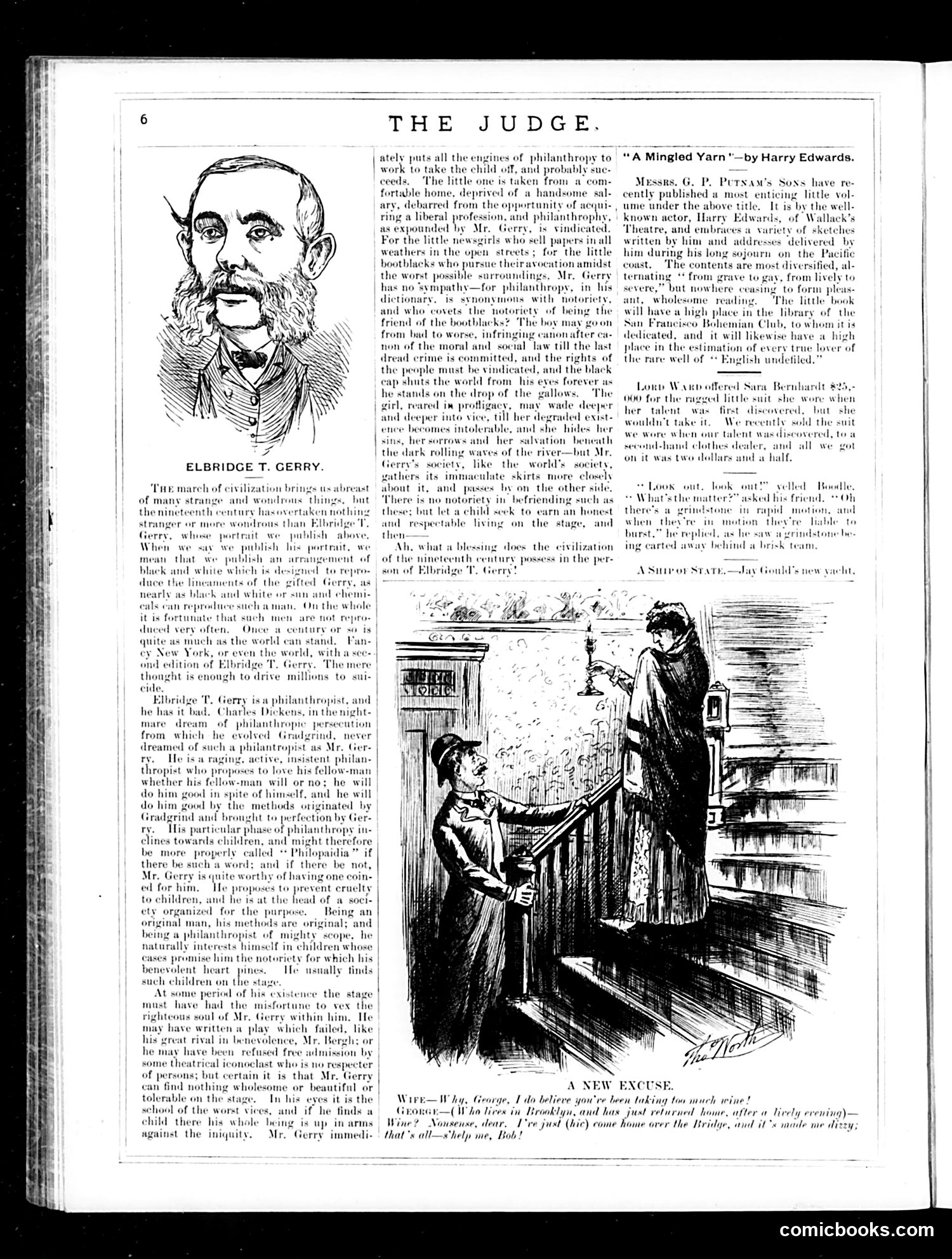
This page primarily features **"A New Excuse,"** a cartoon satirizing domestic disputes. The sketch shows a man returning home late, offering his wife an implausible explanation: he's been stuck on the Brooklyn Bridge after a lengthy evening, and now it's midnight. The humor lies in the transparent excuse—a recognizable domestic comedy of the era. The page's main content, however, focuses on **Elbridge T. Gerry**, a prominent philanthropist and child welfare advocate (founder of the Society for Prevention of Cruelty to Children). The lengthy biographical text presents Gerry as an overzealous philanthropist who pursues his mission "whether his fellow-man will or not." The satire suggests his charitable work, while well-intentioned, is aggressively intrusive and self-serving—driven more by desire for notoriety than genuine compassion. The comparison to Dickens's *Hard Times* character Gradgrind implies Gerry's methods are rigid and dogmatic rather than humanely thoughtful.
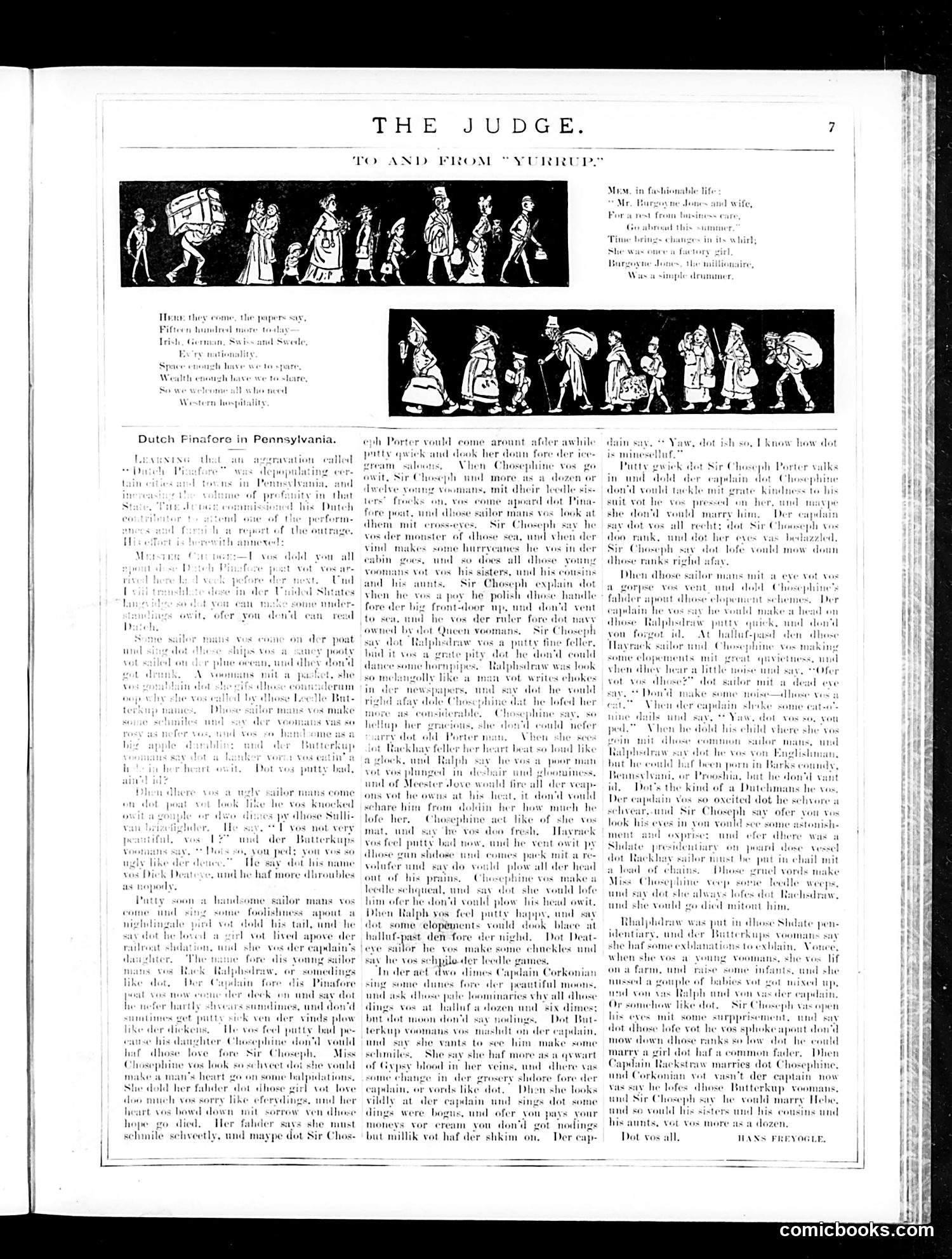
This appears to be a serialized romantic melodrama told in exaggerated German-Dutch dialect ("Yurrup" = Europe), a common satirical device in 19th-century American humor. The story follows Captain Chosephine's romantic entanglements involving sailors, Dutch financiers, and working-class characters. The satire likely targets: 1. **Sentimental European literature** — parodying overwrought romantic plots popular in translations 2. **Ethnic stereotyping** — using heavy German/Dutch dialect for comedic effect (typical of period humor) 3. **Class contrasts** — juxtaposing wealthy Dutch merchants ("Burgoyne de Jonx") with sailors and common folk 4. **Melodramatic excess** — the convoluted plot twists and emotional extremes mock serious romantic fiction The dual illustrations frame the narrative. Without clearer OCR of the garbled middle section, specific plot details remain unclear, but the overall tone mocks European pretension and overwrought storytelling conventions through linguistic parody.
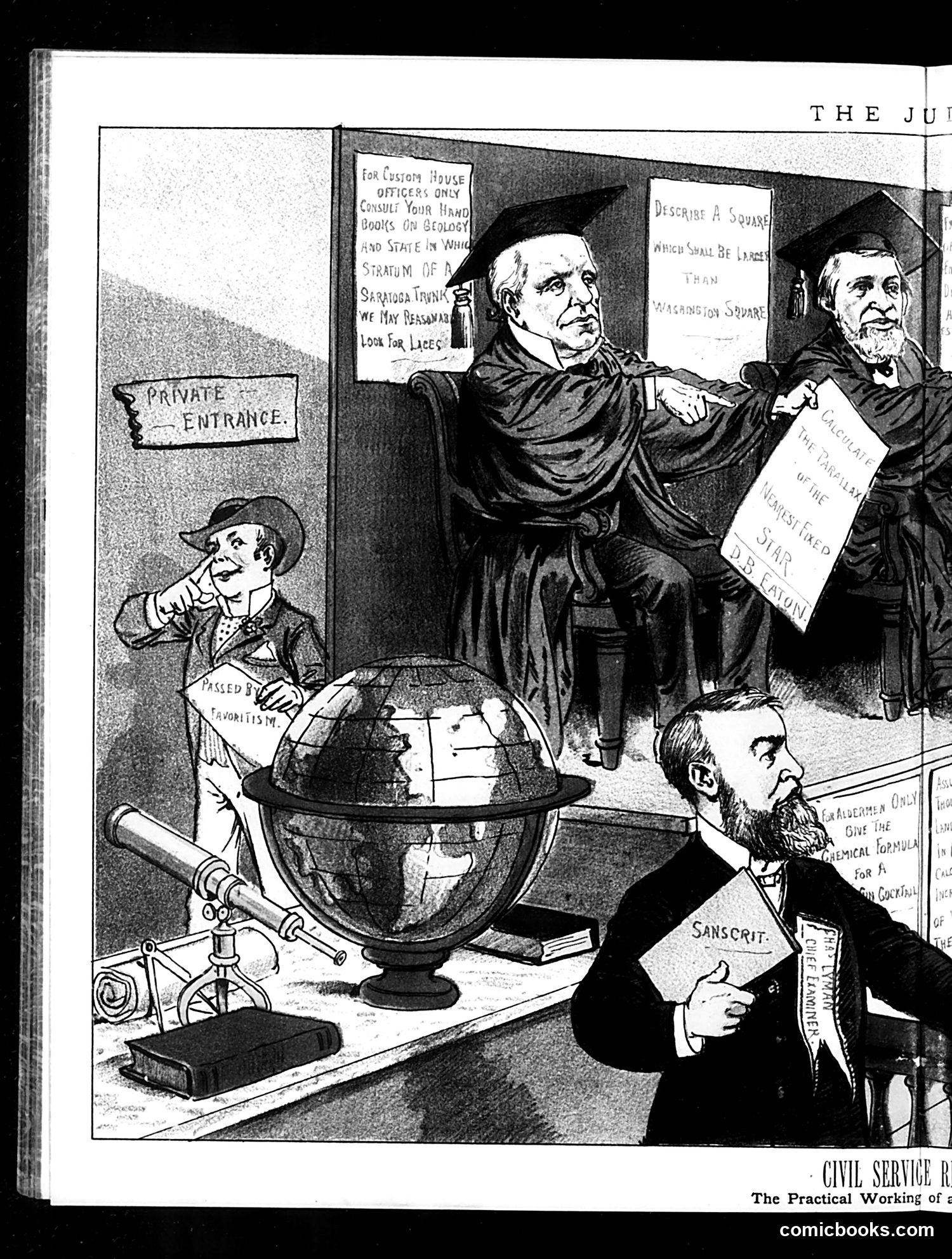
This cartoon satirizes Civil Service Reform, a late-19th-century movement to replace political patronage with merit-based government hiring. The scene depicts two scholarly figures in academic robes (likely representing reformers or Civil Service Commission officials) operating from a "Private Entrance," suggesting exclusive, insider access. A small figure labeled "Passed by Favoritism" sneaks in nearby, while a bearded man labeled "Sanscrit" (likely mocking overly intellectual requirements) stands below, apparently unable to meet the new standards. The globe and scientific instruments suggest the reformers' approach is highly theoretical and impractical. The satire implies that despite reform rhetoric, the old patronage system persists—just dressed up in academic language—and that the new merit standards are so obscure or rigorous they're almost impossible to meet, defeating reform's purpose.
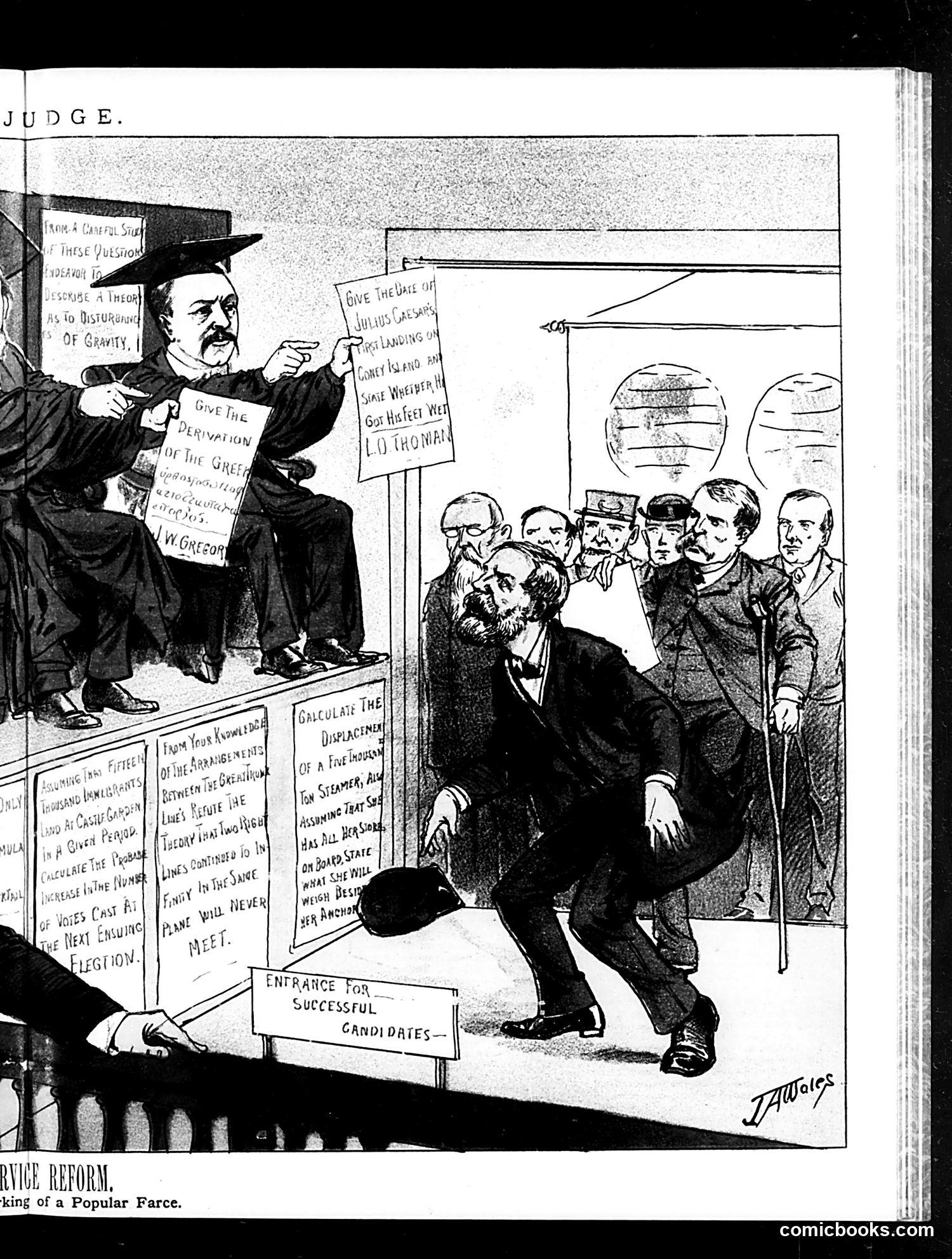
This cartoon satirizes judicial reform efforts, likely from the late 19th century. A pompous figure on a platform (labeled "Judge") displays various reform proposals while candidates queue below, labeled "Entrance for Successful Candidates." The visible signs reference complex judicial procedures and legal terminology—references to "gravity," "derivation of the Greeks," and calculations of "displacement." The satire suggests that judicial reform has become an absurdly complicated theatrical performance ("Popular Farce") rather than practical improvement. The crowd of waiting candidates implies these reforms create bureaucratic gatekeeping rather than genuine access to justice. The elaborate, incomprehensible signs mock how reform proposals obscure simple justice with jargon and pseudo-intellectual complexity. The overall message: judicial reform efforts are performative spectacle that actually blocks practical change.
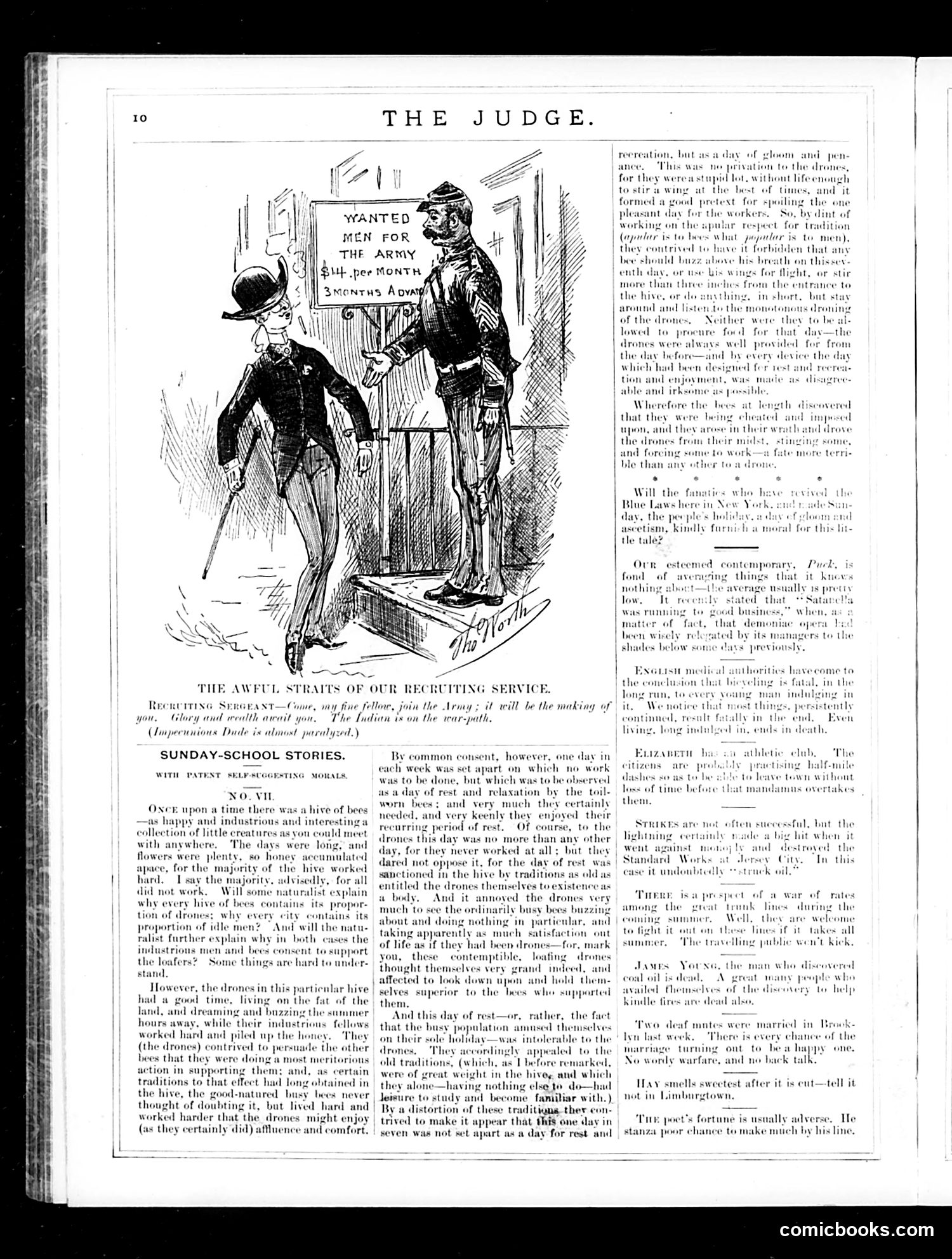
**Main Cartoon: "The Awful Straits of Our Recruiting Service"** This satirical illustration depicts a recruiting sergeant attempting to enlist an impoverished, poorly-dressed man for the Army. The sergeant promises "$11 per month" and "3 months advance"—modest compensation that reflects the difficulty the military faced attracting volunteers. The caption notes the "impecunious dude is almost paralyzed," suggesting the economic desperation even of poorly-dressed men meant recruitment remained challenging. The satire targets the U.S. Army's recruiting struggles during what appears to be the 1890s. The joke: even offering money upfront couldn't easily convince struggling civilians to enlist, exposing both military recruitment failures and widespread poverty. **"Sunday-School Stories" Section:** This fable uses a beehive allegory to critique labor practices. Drones (idle workers/parasites) exploit working bees by claiming a religious right to one day weekly rest—then manipulate this into avoiding all work. The moral satirizes those using tradition or religion to justify idleness while others labor.
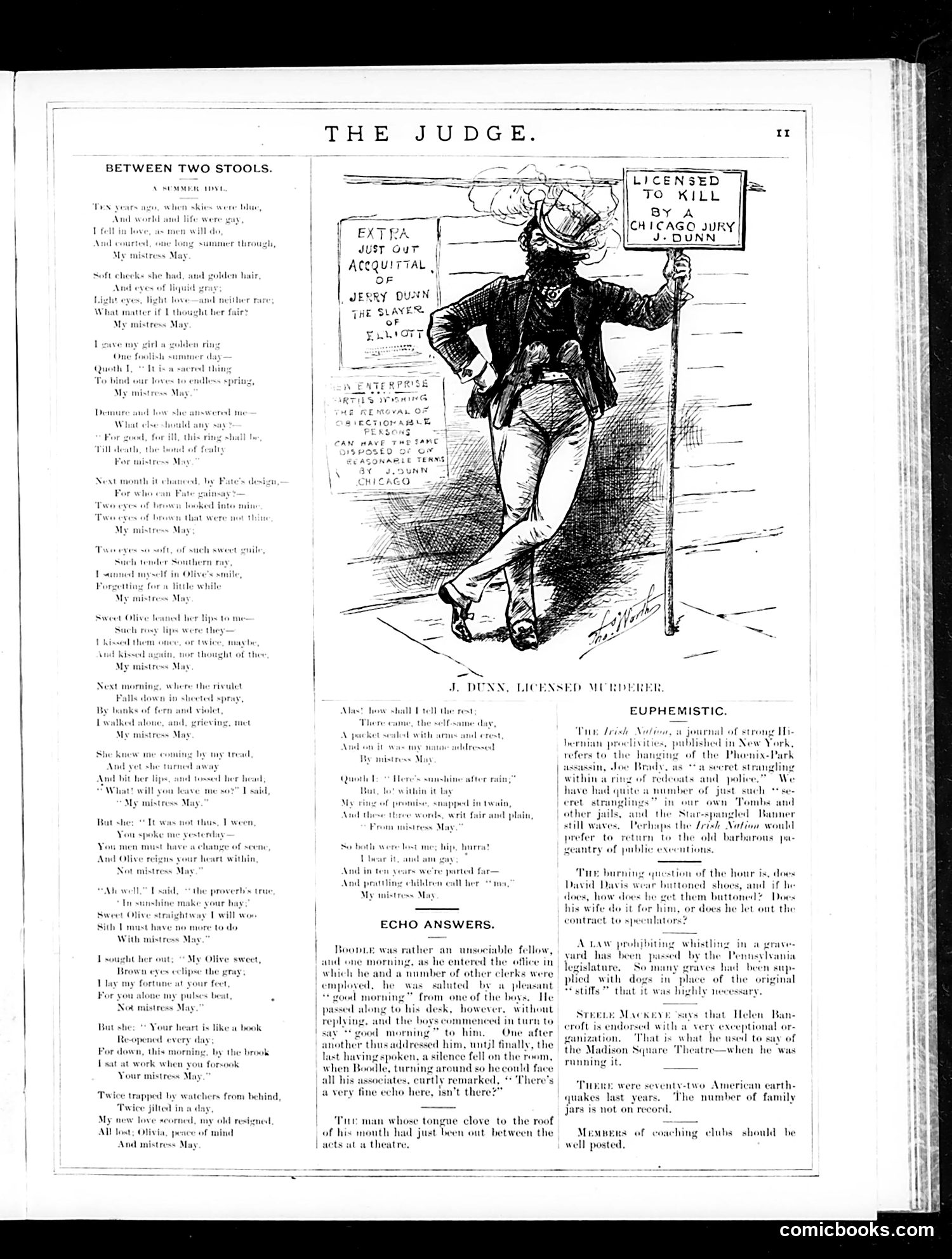
This page contains two distinct pieces of satire: **Main Cartoon: "J. Dunn, Licensed Murderer"** The large illustration depicts a figure holding a sign reading "Licensed to Kill by a Chicago Jury." This satirizes the acquittal of Jerry Dunn (likely a real criminal case), mocking how legal verdicts effectively grant murderers permission to kill. The "license" concept ridicules the judicial system's failure to convict. **Text Section: "Euphemistic"** This brief commentary criticizes how the *Irish Nation* newspaper euphemistically describes an assassin (Joe Brady) as someone engaged in "secret struggling" rather than plainly stating murder. The piece mocks this soft language and contrasts it with historical public executions, suggesting the Irish publication sanitizes violence. **Surrounding Content:** The page also includes a sentimental poem "Between Two Stools" about romantic infidelity, and "Echo Answers"—a humorous advice column addressing mundane questions about buttoning shoes and dog burials in graveyards. The overall theme criticizes how language obscures justice and violence.
This page from *Judge* (a late 19th-century American satirical weekly) contains theater criticism and a letters section rather than political cartoons. **Main Content:** The lead article critiques recent theatrical productions, particularly at the Standard Theatre, dismissing several plays as failures. It discusses actresses like Miss Barry and Kate Castleton, and mentions specific productions including "The Princess of Trebizonde" and military dramas. **The "Intercepted Letters" Section:** This satirical feature presents mock correspondence, notably one from "John O'Halloran" to "Dennis" in Ireland, mocking Irish-American dialect and stereotypes. The writer encourages his friend to leave Ireland and seek opportunities in America, specifically suggesting work at the *Herald* newspaper—likely a satirical jab at Irish immigrant labor and ethnic stereotyping common in 1870s-80s publications. **Historical Context:** This reflects *Judge*'s typical mix of theater gossip, reader correspondence, and ethnic humor targeting Irish immigrants—standard content for American satirical magazines of this era, though the stereotypes would be considered offensive today.
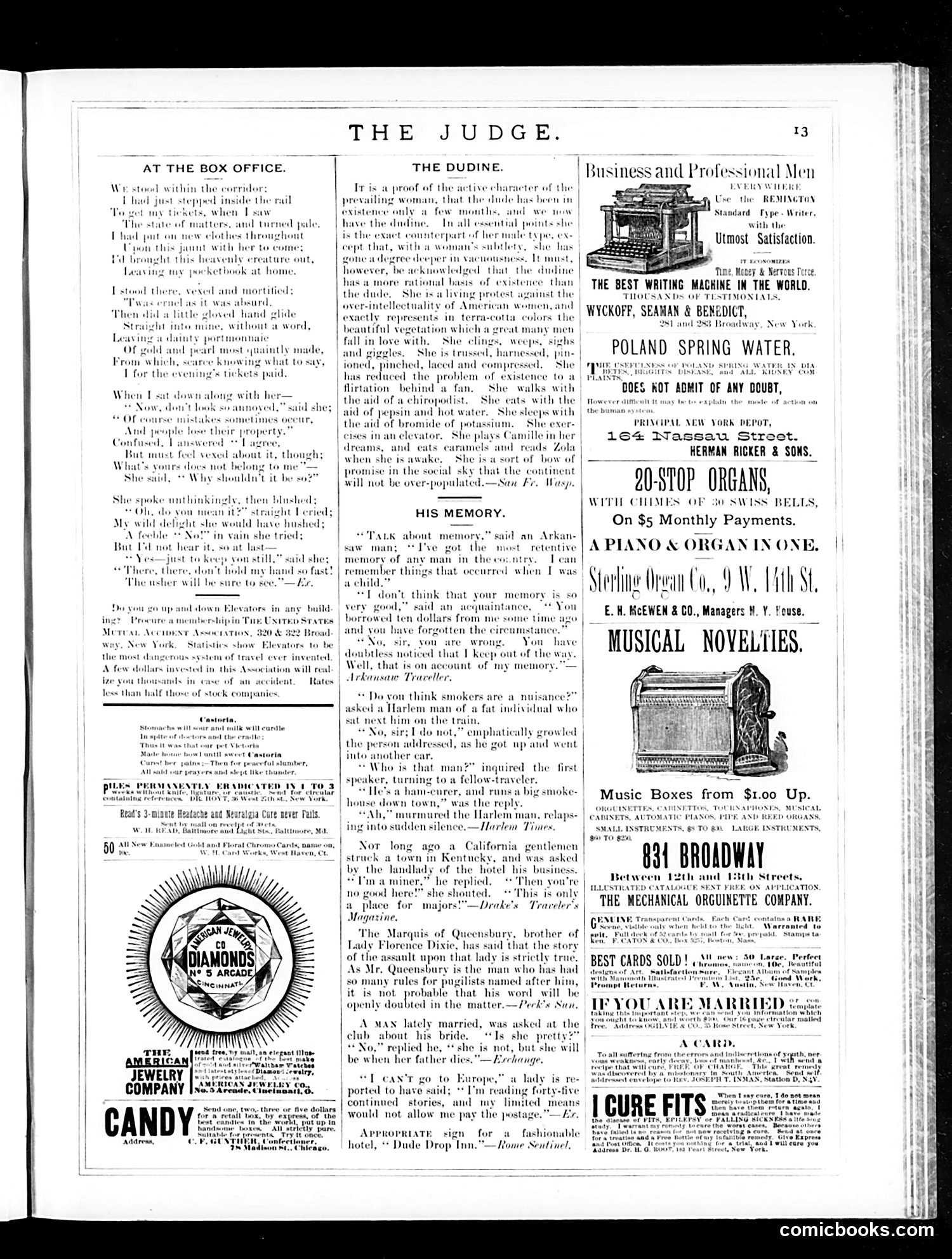
This page is primarily **advertising** with some satirical prose pieces interspersed. The main content includes: **"The Dudine"** — A satirical essay mocking the female equivalent of the "dude" (a fashionable, affected man). The piece humorously catalogs her affectations: she clings, weeps, sighs, is "trussed, harnessed, pinioned," eats pepsin with hot water, sleeps with bromide of potassium, and reduces "the problem of existence to a flirtation behind a fan." The satire targets 1890s society women who adopt exaggerated mannerisms and shallow interests. **"His Memory" and other anecdotes** — Brief humorous stories playing on memory lapses, mistaken identities, and social misunderstandings (a miner claiming to be a "major," confusion about marriage). **Extensive advertisements** — For typewriters (Remington), organs, pianos, music boxes, water, jewelry, and other products typical of the era. The page reflects late-19th-century American humor targeting fashionable society and gender stereotypes.
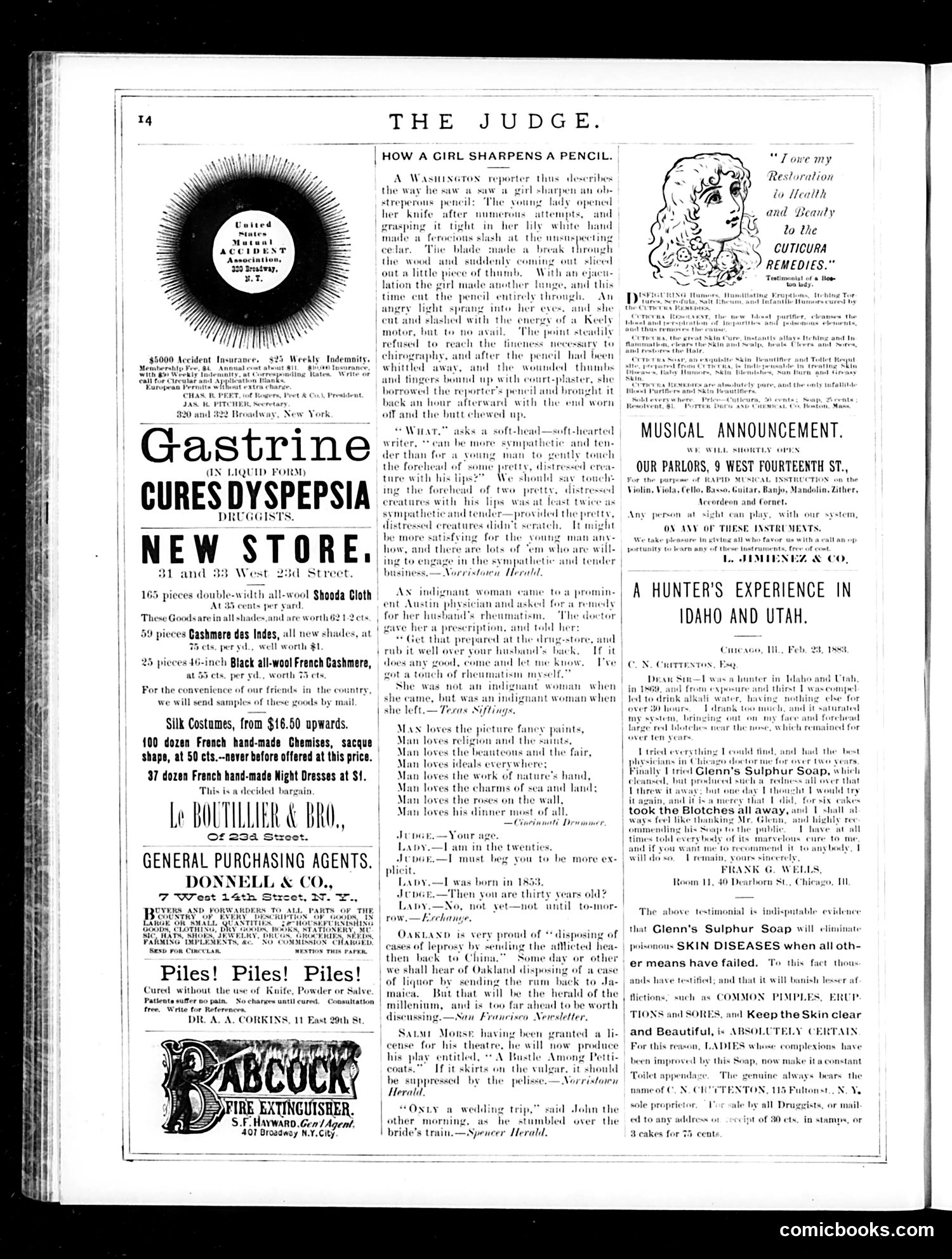
This page consists primarily of **advertisements and filler content** rather than substantive political cartoons. The main visual element is a circular illustration titled "HOW A GIRL SHARPENS A PENCIL," which presents a humorous domestic anecdote: a young woman's increasingly frantic attempts to sharpen a pencil result in cutting her thumb, after which she aggressively mangles the pencil. The joke appears to satirize **female incompetence at practical tasks**—a common theme in Victorian-era humor. The remainder of the page contains standard period advertisements for patent medicines (Gastrine for dyspepsia), fabric goods, musical instruction, and dubious medical treatments (piles cures, skin soap). A brief column titled "A HUNTER'S EXPERIENCE IN IDAHO AND UTAH" discusses hunting adventures, while scattered humor includes snippets about rheumatism remedies and marital situations. **No significant political satire or contemporary political figures are evident** on this page. It represents typical Judge magazine filler material from the 1880s era.
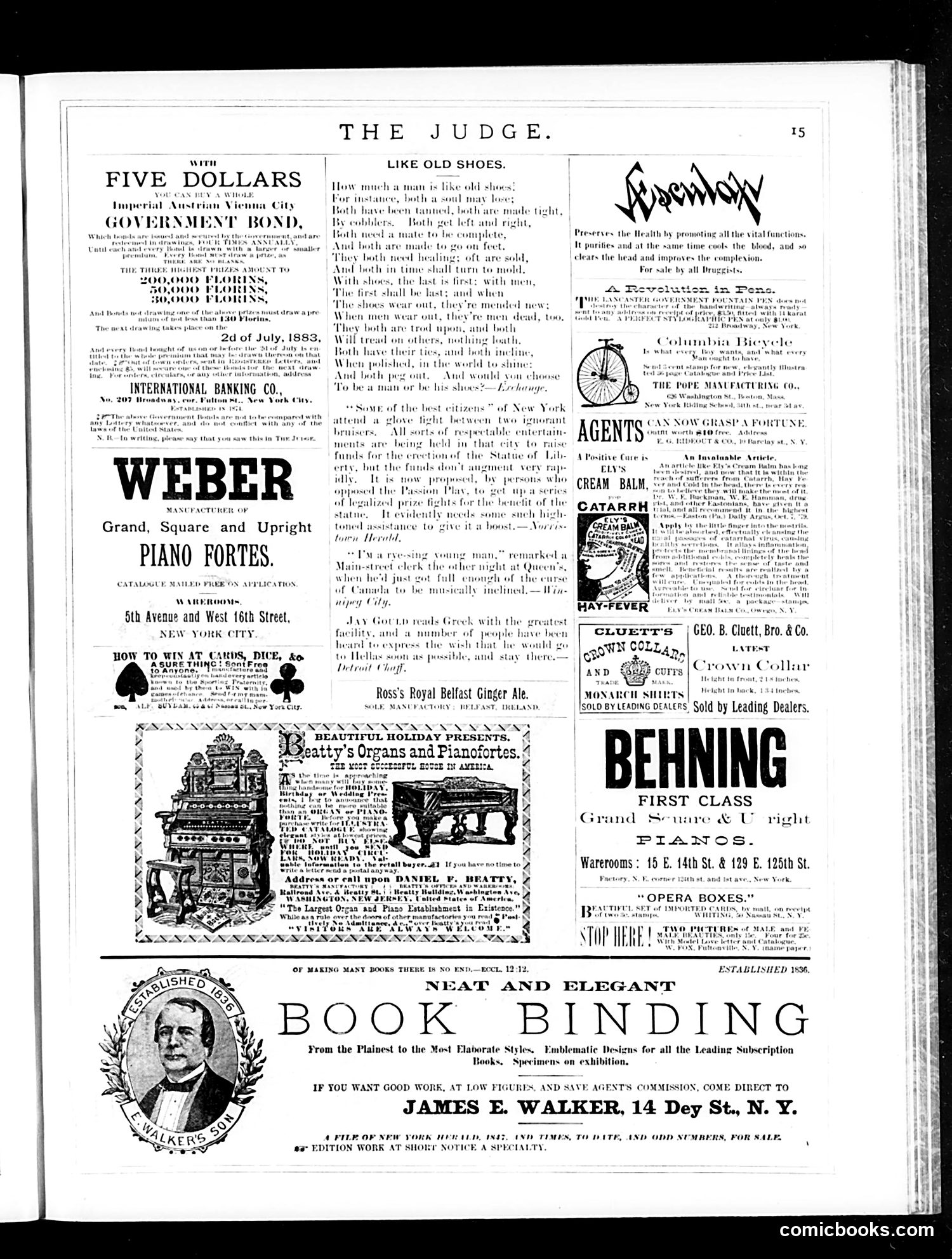
This page is primarily **advertisements and filler content** rather than political satire. The dominant visual element is a poem titled "Like Old Shoes," which uses a extended metaphor comparing men and shoes—both wear out, need repair, require mates to be complete, and eventually become useless. The poem appears to be lighthearted social commentary on aging and human nature, not pointed political satire. The page also includes a brief mention of New York "citizens" attending a glove fight (prizefighting), with an editorial note suggesting legalized prize fights need "such high-toned rice to give it a boost"—a veiled reference to the controversial status of boxing at this period. Otherwise, the page consists of typical 1880s advertisements: piano manufacturers (Weber, Behning), banking services, book binding, and patent medicines (Cream Balm, Hay-Fever treatment). **No specific political figures or major satirical cartoons are visible on this Judge page.**
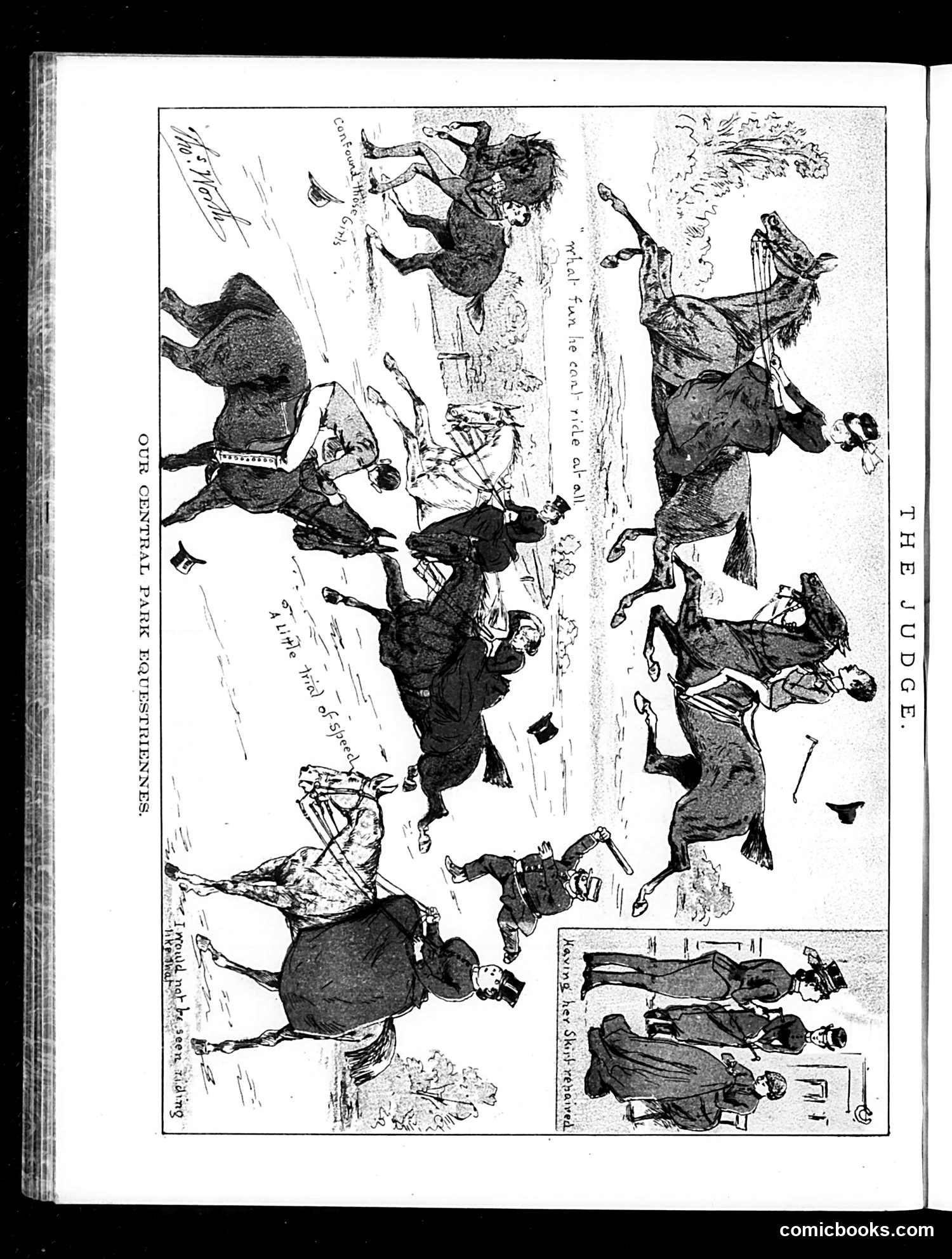
This satirical cartoon depicts a chaotic scene at Central Park, likely mocking the wealthy Rockefeller family's presence or activities there. The image shows multiple figures in period dress (appearing to be late 19th/early 20th century) engaged in various animated activities - some appearing to hide, others gesturing dramatically. The title references "Otto" and "Central Park Rockefellers," suggesting satire about prominent wealthy figures and their behavior in New York's famous park. The composition emphasizes social pretension and perhaps moral hypocrisy - a common Judge magazine target. The smaller panel at bottom right appears to show individual figure studies, possibly identifying specific people being caricatured. Without clearer OCR text or visible dates, the specific historical context remains partially unclear, though this reflects Judge's typical focus on mocking America's wealthy elite and their public conduct.