
A complete issue · 16 pages · 1883
Judge — June 2, 1883
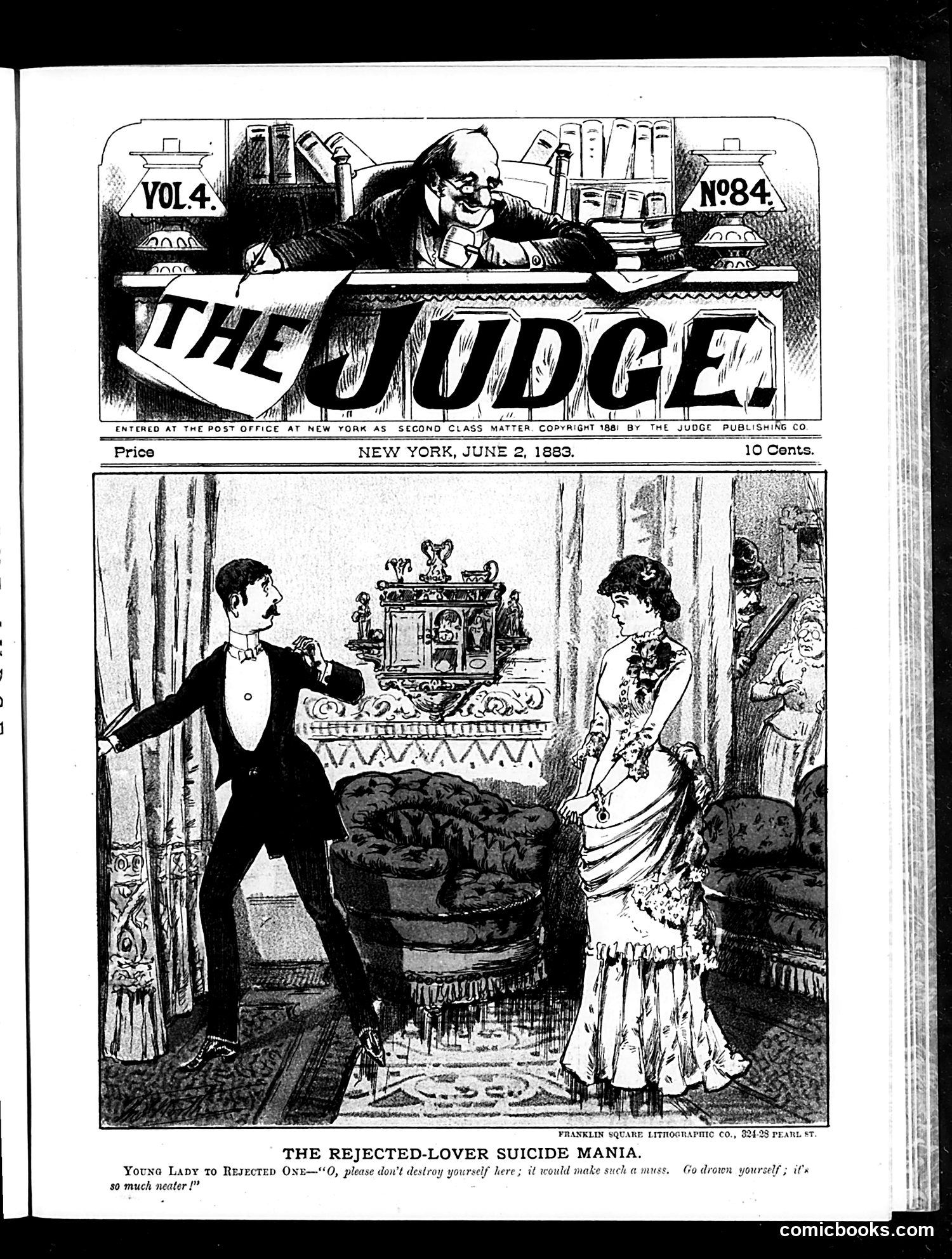
This 1883 *Judge* cartoon satirizes a contemporary social phenomenon: a perceived epidemic of suicides by rejected male lovers. The illustration shows a wealthy young man dramatically gesturing toward a woman in an elegant parlor, with the caption quoting her dismissive response: "O, please don't destroy yourself here; it would make such a mess." The satire mocks both the melodramatic desperation of spurned suitors and the apparent casualness with which society—particularly women of means—treated such threats. The cartoon suggests that suicide threats had become so common among rejected lovers that they were now treated as tedious inconveniences rather than genuine tragedies. The joke relies on the woman's practical concern about "mess" rather than emotional concern.
This page from *Judge* magazine contains editorial commentary on two contemporary issues: **The Savings Bank Bill**: The main article critiques proposed legislation that would allow savings banks to invest depositors' money in Wall Street speculation. The satire targets wealthy interests—particularly Mr. Elliott F. Shepard (identified as Vanderbilt's son-in-law)—who support the bill to generate investment capital. The piece argues the measure would benefit speculators while endangering working-class savings. The author contends that modest, safe interest rates better serve ordinary depositors than high-risk ventures promising larger returns. **The Billiards Section**: A lighter piece celebrating billiards as a respectable sport gaining popularity among New York's working classes, contrasting it with concerns that it might be associated with gambling or vice. The page reflects *Judge*'s progressive stance against robber-baron capitalism and advocacy for ordinary workers' financial security.
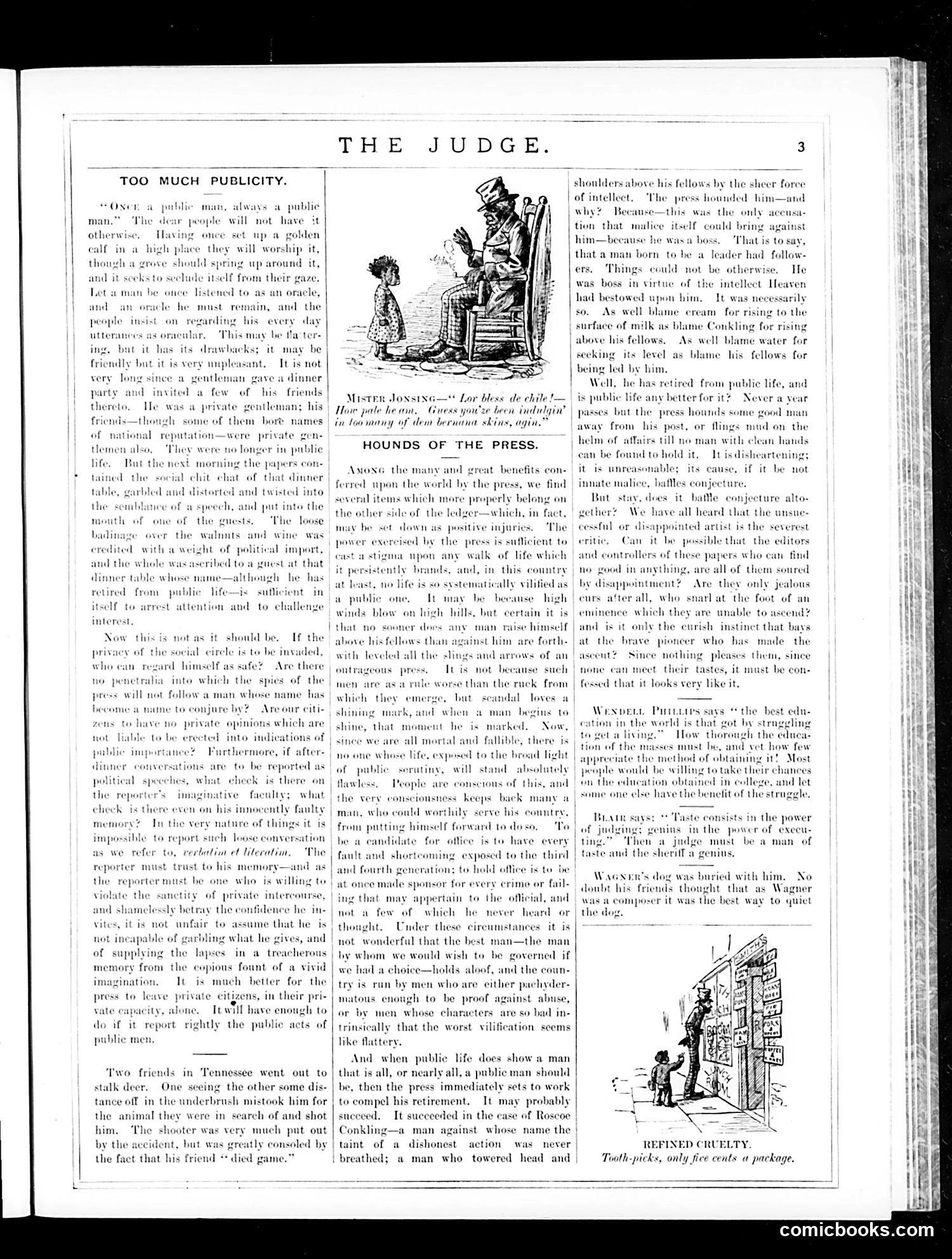
This page contains two satirical pieces about public life and press scrutiny in America. **"Too Much Publicity"** criticizes how public figures lose privacy. Once someone achieves prominence, the public obsesses over them. The anecdote illustrates the problem: dinner party conversations involving ex-public figures are later misreported in newspapers, distorting private remarks. The cartoon shows a small child confronting a seated man, captioned with dialect humor about overindulgence. The piece argues this invasive publicity makes capable people avoid public service—the country suffers because qualified candidates refuse office to protect their privacy. **"Hounds of the Press"** attacks journalists as destructive. The press wields enormous power to vilify public figures, exposing every minor fault to scrutiny. The piece suggests even good men cannot survive this exposure unblemished. The cartoon depicts people at what appears to be a notice board or public space, relating to how reputations are publicly displayed and damaged. Both pieces express anxiety about how modern media threatens both individual privacy and competent governance.
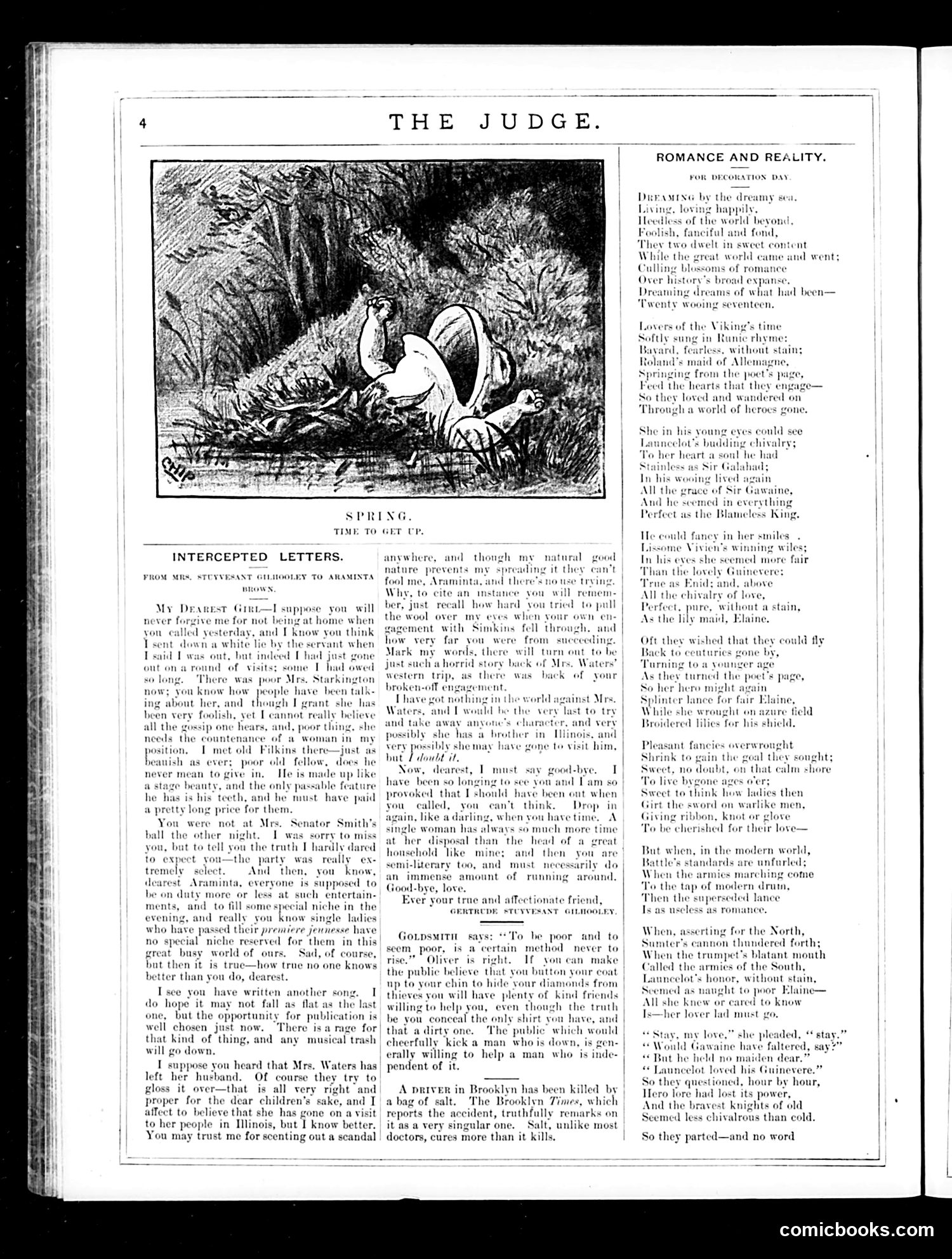
This page from *Judge* contains social satire through intercepted letters mocking wealthy New York society women. The fictional correspondence between "Mrs. Stuyvesant Gilmooley" and "Araminta" ridicules the pretensions and cattiness of elite circles—gossiping about a scandalous woman ("Mrs. Waters"), dismissing aging unmarried women as having "no special niche" in society, and discussing failed romantic engagements. The satire targets class hypocrisy: women performing poverty to seem virtuous while hiding wealth, and society's cruelty toward those fallen from status. The accompanying poem "Romance and Reality" contrasts idealized romantic fantasy with harsh reality—a typical *Judge* format juxtaposing Victorian sentimentality against cynical commentary. The cartoonish illustration depicts leisure-class idleness. The overall message critiques Gilded Age social climbing, female cattiness, and the artificiality of "society" conventions among the wealthy.
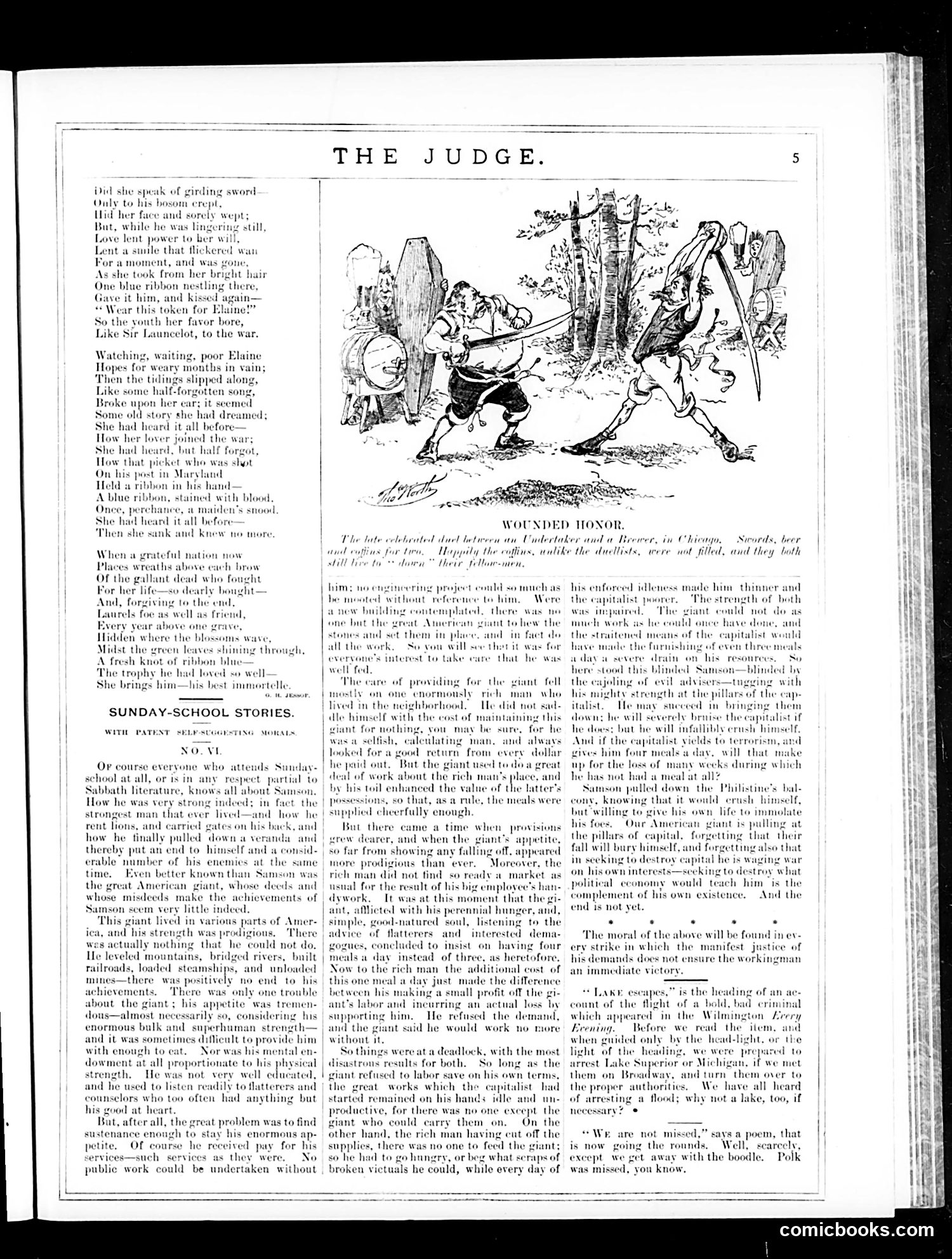
This page features two distinct pieces. The main cartoon, titled "Wounded Honor," depicts a duel between an undertaker and a brewer in Chicago. The satirical point appears to be mockery of a *real duel* fought over a trivial matter—the caption notes that unlike the combatants, the coffins (humorously) survived. The accompanying text story, "Sunday-School Stories," uses a tall-tale format about a giant to allegorically discuss labor disputes. It describes a conflict between a wealthy capitalist employer and a giant worker who demands four meals daily instead of three. The giant refuses to work without this pay increase; the rich man won't pay it. The satire critiques both labor unionism and capitalist inflexibility, showing how both parties suffer from deadlock over reasonable negotiation. Both pieces use exaggeration and absurdity to mock contemporary social conflicts—dueling over honor and labor-management disputes—presenting them as ridiculous when examined closely.
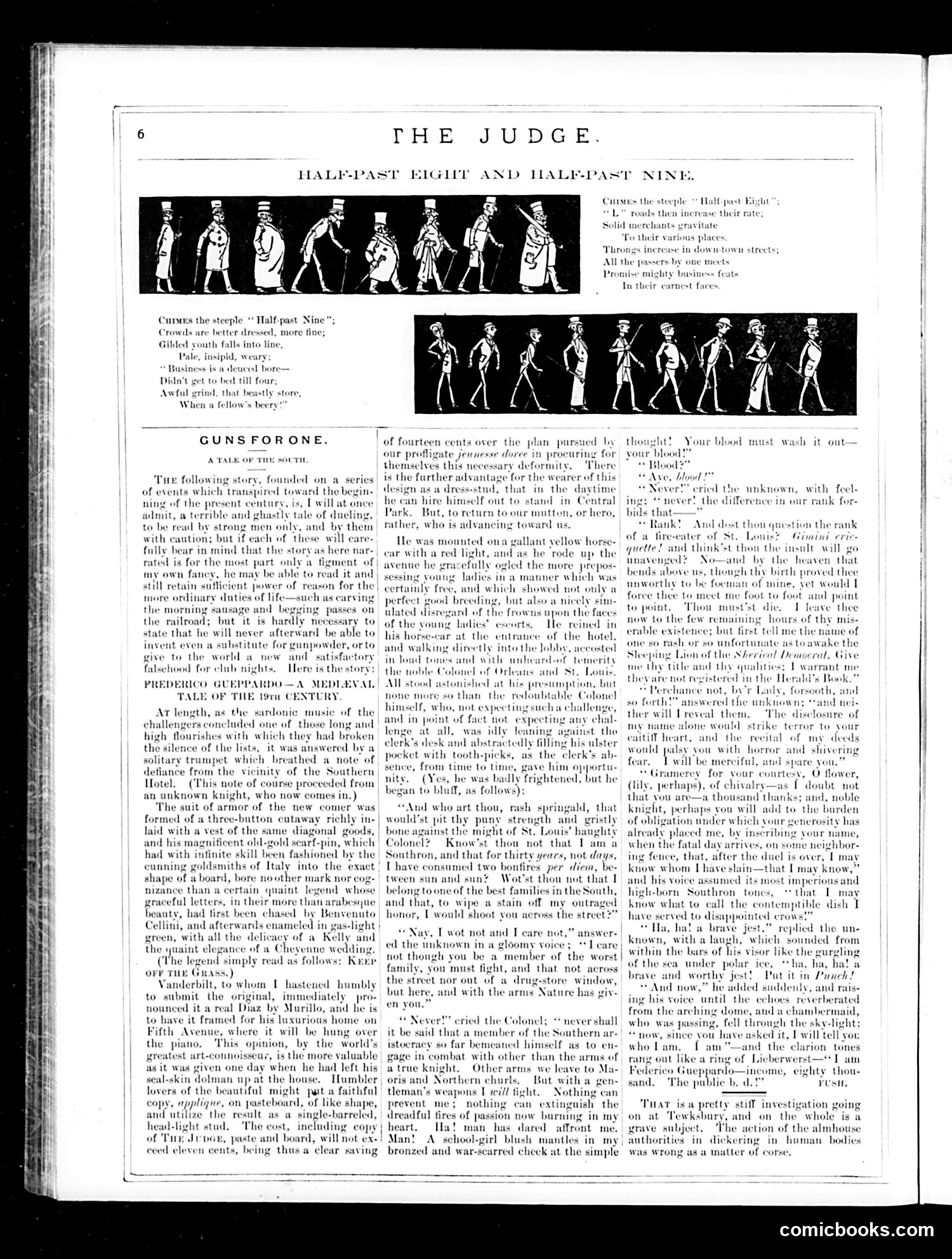
This page satirizes the social behavior of "gilded youth"—wealthy young men of the era. The two illustrated strips at top show how the same bell-chimes ("Half-past Eight" and "Half-past Nine") trigger different responses: solid merchants increase their work pace and business activity, while idle young gentlemen grow progressively more dissolute, beery, and unable to function. The satire mocks the leisure class's uselessness and moral decay—their drunkenness, late nights, and general inability to contribute to society. The contrast is stark: productive working men versus parasitic dandies. The lower section, "Guns for One," appears to be a serialized melodramatic story about dueling—likely satirizing the absurd honor codes and violent customs of the Southern gentry, with exaggerated formal language and overwrought masculine posturing. The narrative voice repeatedly interrupts to mock the protagonist's affected speech and ridiculous grievances. Together, these pieces lampoon both idle wealthy youth and anachronistic Southern aristocratic traditions.
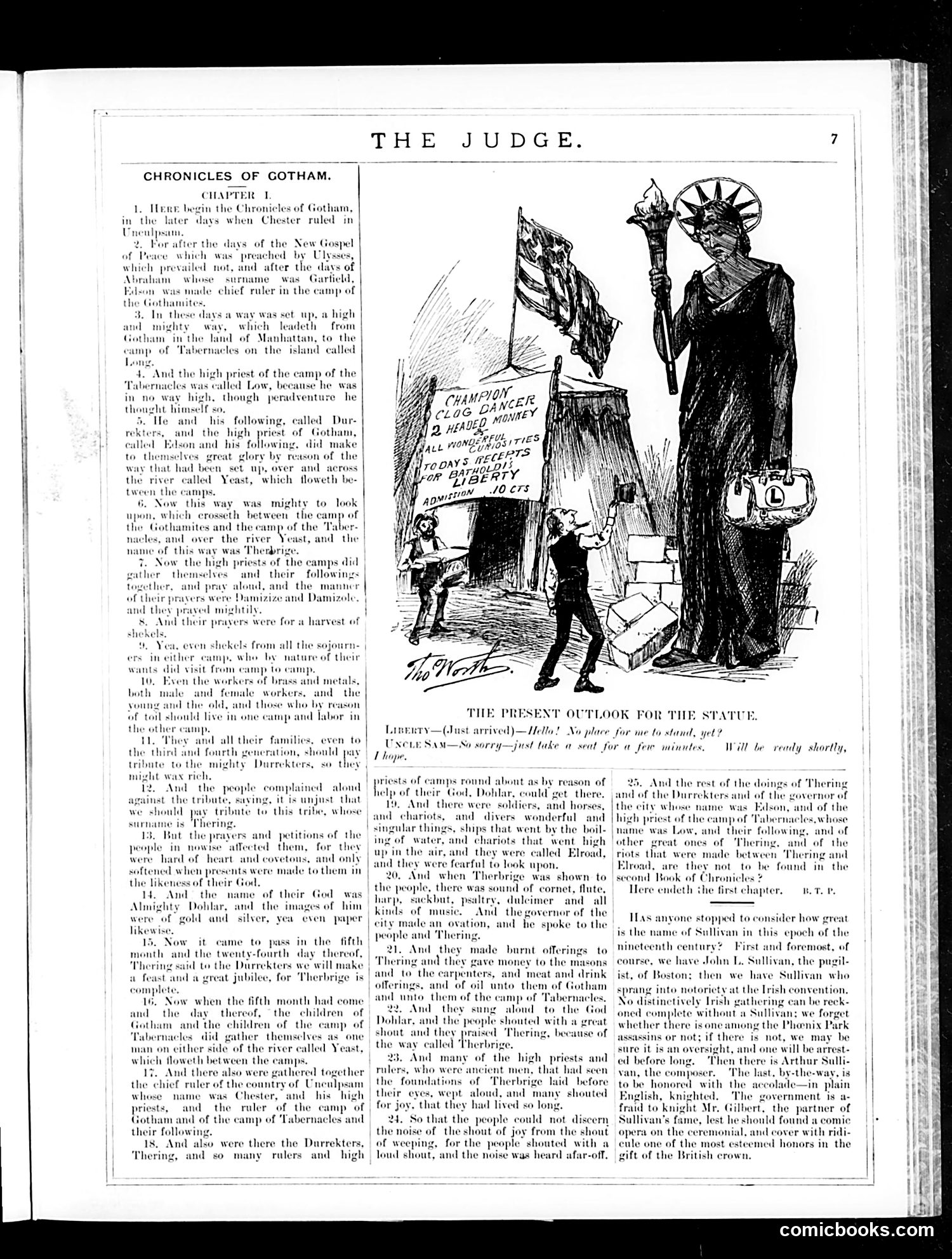
This page parodies the Biblical "Chronicles" format to satirize New York City politics and a public works project—likely the construction of the **Brooklyn Bridge** (completed 1883) or a similar major infrastructure development. "Gotham" = New York City. Key figures appear to be: - **"Thering"** = likely Mayor Gould or similar political figure - **"Low"** = appears to reference a camp/faction leader - **"Durrekters"** = political bosses/machine politicians - **"Uncle Sam"** and **"Liberty"** = iconic American symbols shown observing developments The satire mocks how politicians: - Extracted tribute (taxes) from citizens - Used grand ceremonies and spectacle to legitimize projects - Involved corruption between contractors ("Durrekters"), workers, and officials - Generated public complaint about inequitable burden-sharing The biblical parody structure exaggerates political pomposity—treating mundane municipal corruption as momentous historical events worthy of sacred chronicles. The cartoon's point: New York's political machine operated with religious fervor and questionable ethics.
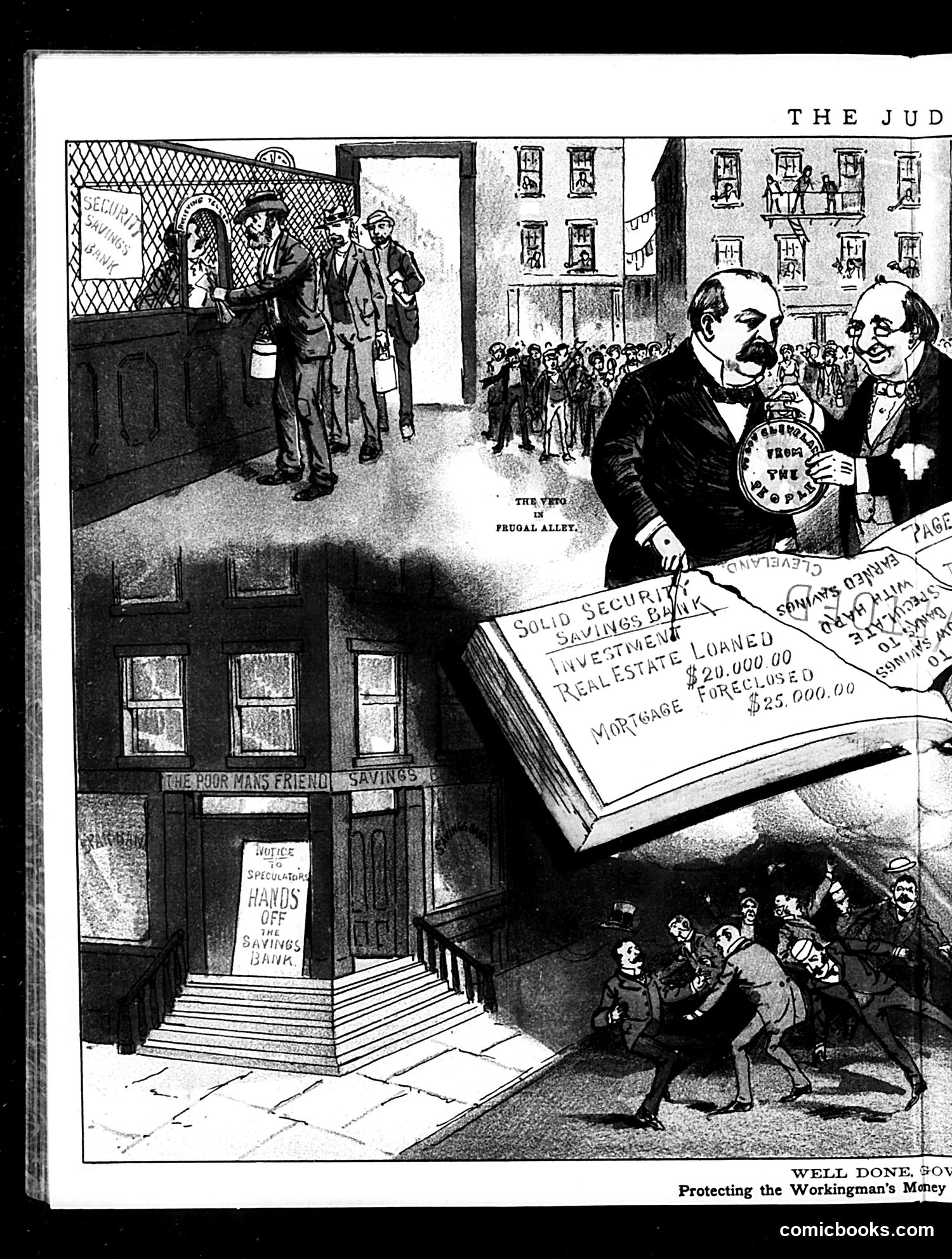
This Judge cartoon satirizes financial corruption and fraud targeting working-class savings. The left panel shows a "Savings Bank" with a sign warning "Notice to Speculators" and "Hands Off the Savings Bank"—ironically, as poor people queue outside. The right panel depicts two well-dressed men (likely bankers or financial officials) with documents showing "Solid Security," "Investment Loaned," and "Mortgage Foreclosed" for $20,000-$25,000. A seal reading "Approved from THE" suggests official endorsement of their schemes. Below, poor families are evicted or dispossessed, illustrating how fraudulent financial practices and foreclosures devastated working-class people. The title's irony—"Protecting the Workingman's Money"—criticizes how institutions claiming to safeguard workers' savings actually enabled their exploitation through risky investments and foreclosures during financial instability.
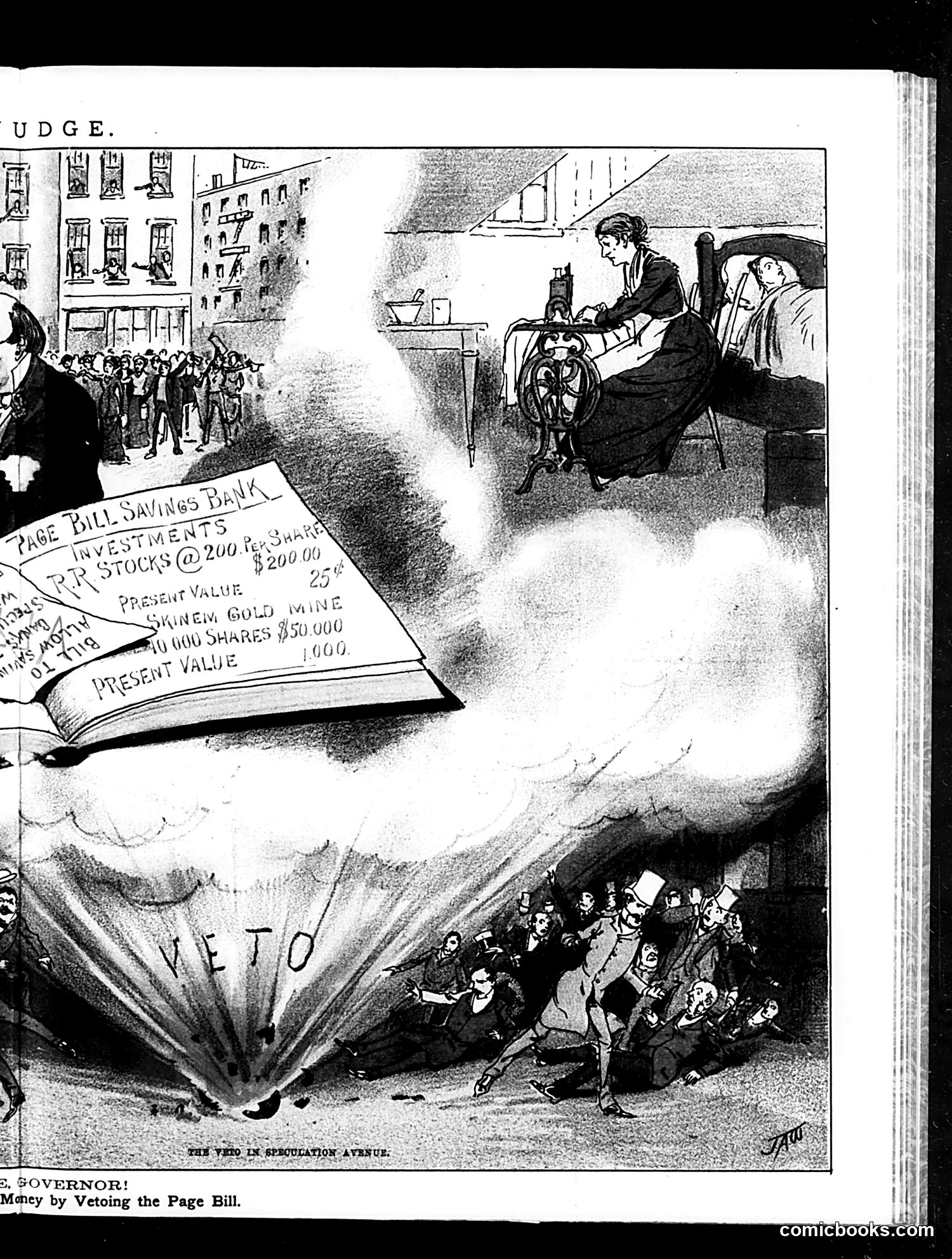
This cartoon satirizes a governor's veto of the "Page Bill" (likely labor or reform legislation). The top panel shows a judge presiding over what appears to be a courtroom or official proceeding. The bottom panel depicts an explosion labeled "VETO IN RESOLUTION AVENUE," with crowds of people fleeing. The ledger visible in the left panel lists "Page Bill Savings Bank Investments" with mining stocks and gold shares—suggesting the governor prioritized wealthy financial interests over the bill's apparent public benefit. The satire's point: by vetoing the Page Bill, the governor protected rich investors' profits while literally "exploding" in the faces of ordinary citizens below. The cartoon criticizes using executive power to serve moneyed elites rather than the public good.
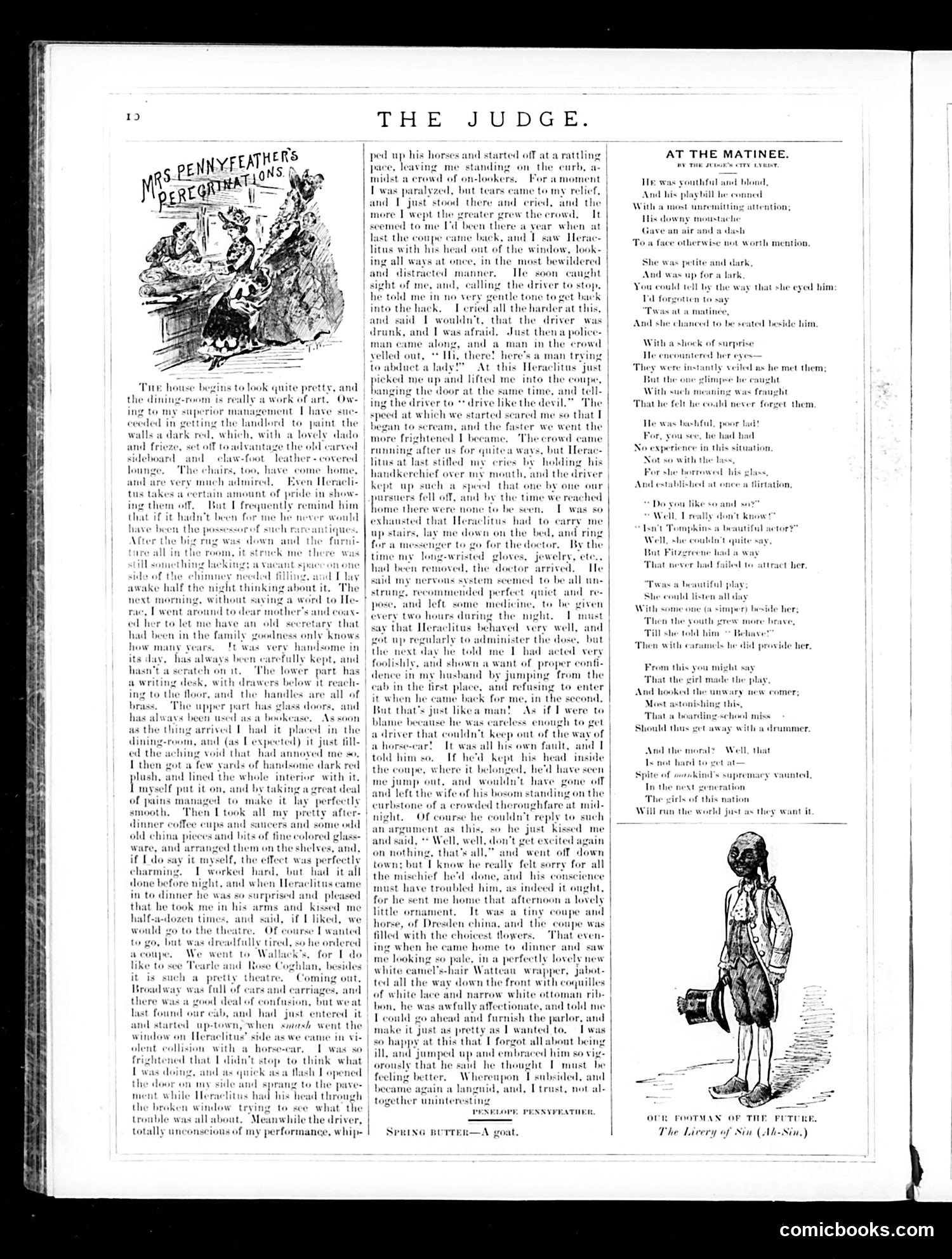
This page contains two distinct pieces: a serialized story titled "Mrs. Pennyfeather's Peregrinations" (left) and a poem titled "At the Matinee" (right). The main narrative describes a woman's domestic adventure: she decorates her home, then experiences a dramatic carriage accident in New York City. When her husband Heraclitus rescues her after a collision with a streetcar, she panics and jumps from the cab. He carries her home; a doctor treats her for shock. Humorously, the narrative suggests the woman acted improperly by refusing to re-enter the carriage, implying she should have trusted her husband's judgment rather than her own instincts. The poem on the right is a romantic description of an attractive woman at a theater matinee, noting her physical beauty and composure. Both pieces reflect late 19th/early 20th-century attitudes: women as domestic decorators, anxious during urban chaos, and dependent on male protection and approval—all presented as humorous content for *Judge's* satirical readership.
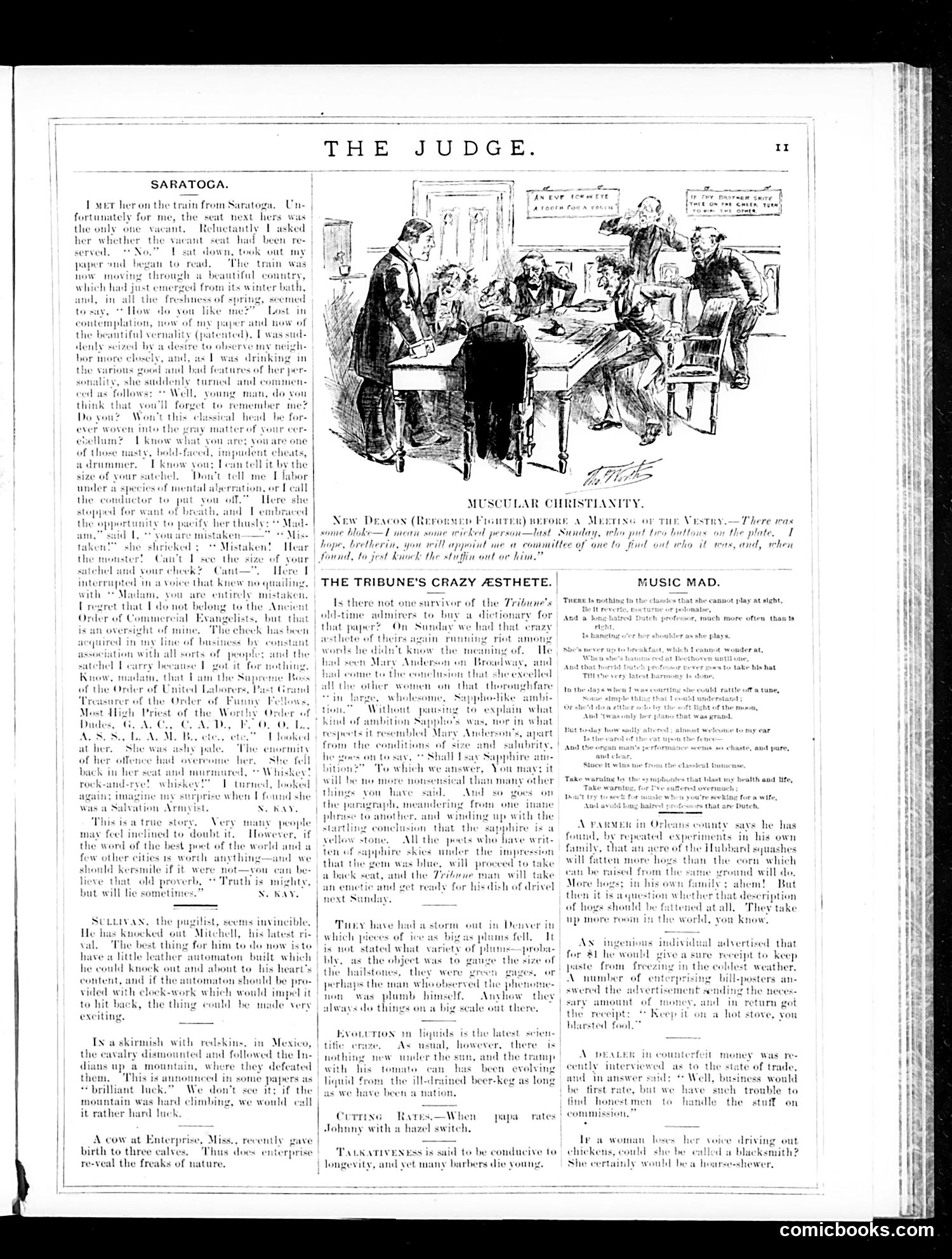
This page contains multiple satirical pieces typical of late 19th-century American humor magazine *Judge*: **"Saratoga"** (left column): A social satire about a man meeting a woman on a train who lectures him about his appearance, assuming he's a swindler based on his shabby satchel. The joke relies on class-based assumptions and the woman's aggressive, judgmental nature—satirizing both pretentious social climbing and hasty character judgments. **"The Tribune's Crazy Aesthete"**: Mocks the *Chicago Tribune* for employing an eccentric aesthete critic who admired an actress (Mary Anderson) and absurdly compares other women to her. The satire targets both the aestheticism movement and newspaper critics' overwrought, subjective opinions. **"Muscular Christianity"**: A brief anecdote about a reformed boxer donating only two buttons to a church collection, satirizing both the "muscular Christianity" movement (promoting physical vigor alongside faith) and reformed criminals' questionable sincerity. The remaining short items are brief jokes about everyday absurdities—automaton toys, geography, and talkativeness. These pieces exemplify *Judge's* social criticism through humor targeting pretension, foolishness, and hypocrisy among Americans.
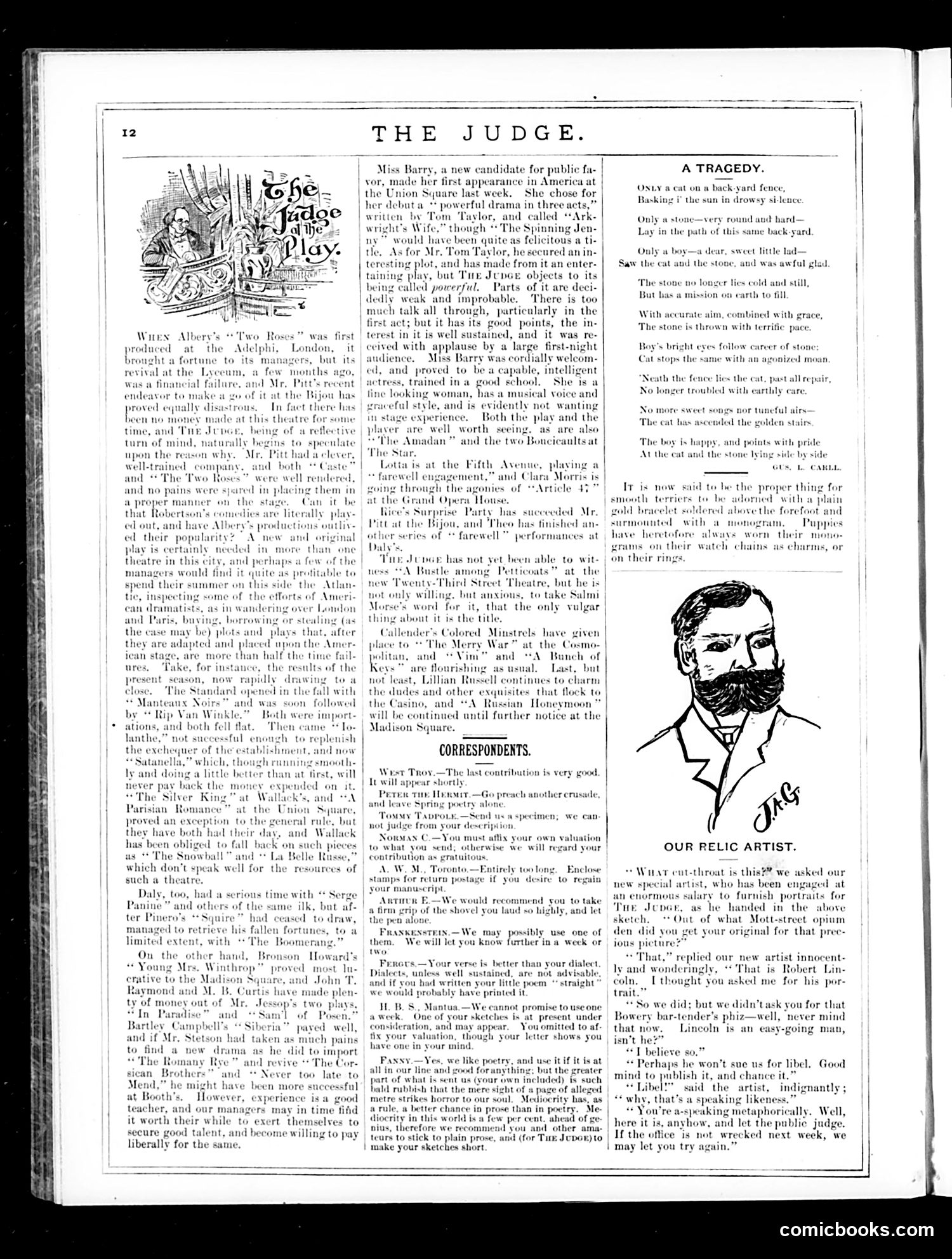
This page contains theater reviews rather than political cartoons. The main text discusses the business failures of New York theaters (the Lyceum, Union Square, Wallack's, and Daly's) and criticizes theater managers for not investing in quality new American drama. The piece notes that while imported European plays and star-driven revivals have occasionally succeeded, managers refuse to pay adequate salaries for promising domestic playwrights and actors. Judge's theater critic laments this short-sighted economics, arguing that theaters like the Lyceum would prosper if managers invested in original works and developed talent properly. The "Our Relic Artist" portrait at right appears to be a cartoonist's self-portrait, and the "Correspondents" section contains brief editorial responses to reader submissions about poetry and theatrical criticism. The satire targets American theater management's timidity and financial myopia rather than specific political figures.
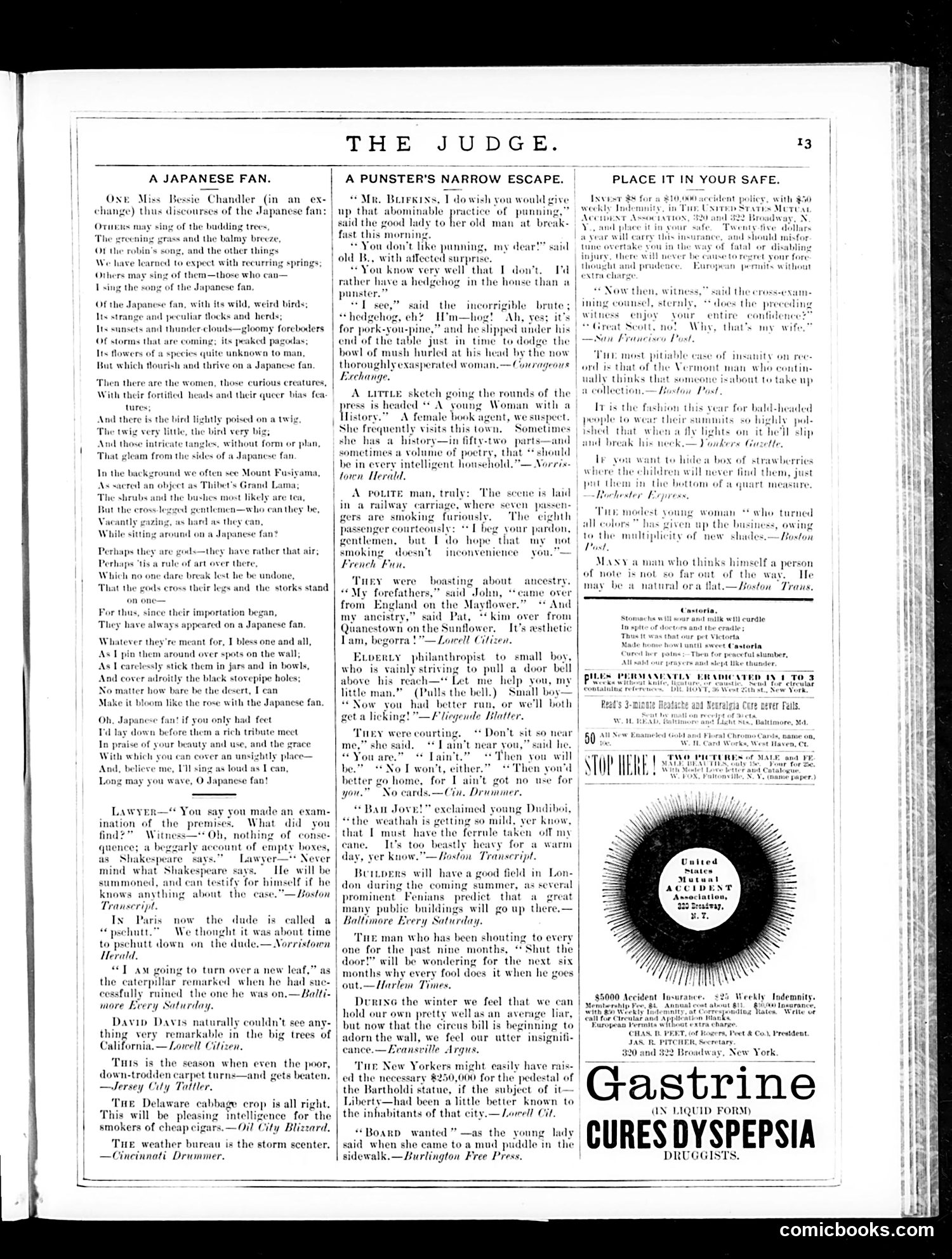
This page from *Judge* magazine contains primarily **humorous short pieces and advertisements** rather than political cartoons. The main content includes: - **"A Japanese Fan"** - A light poem celebrating decorative Japanese fans as trendy home décor, reflecting late 19th-century American fascination with Japanese aesthetics (the "Japonisme" craze). - **"A Punster's Narrow Escape"** - A domestic humor piece where a man makes a pun ("pork-you-pine" for porcupine) and narrowly avoids his wife's angry retaliation—typical Victorian-era slapstick humor about marital discord. - Various **short jokes and quips** on mundane topics (lawyers, weather, crops, etc.)—standard *Judge* filler content. The page reflects *Judge*'s format as a **general-interest humor magazine** mixing social satire with genteel domestic comedy and wordplay. The Japanese fan content particularly showcases how Oriental design was fashionable among middle-class American readers of the era.
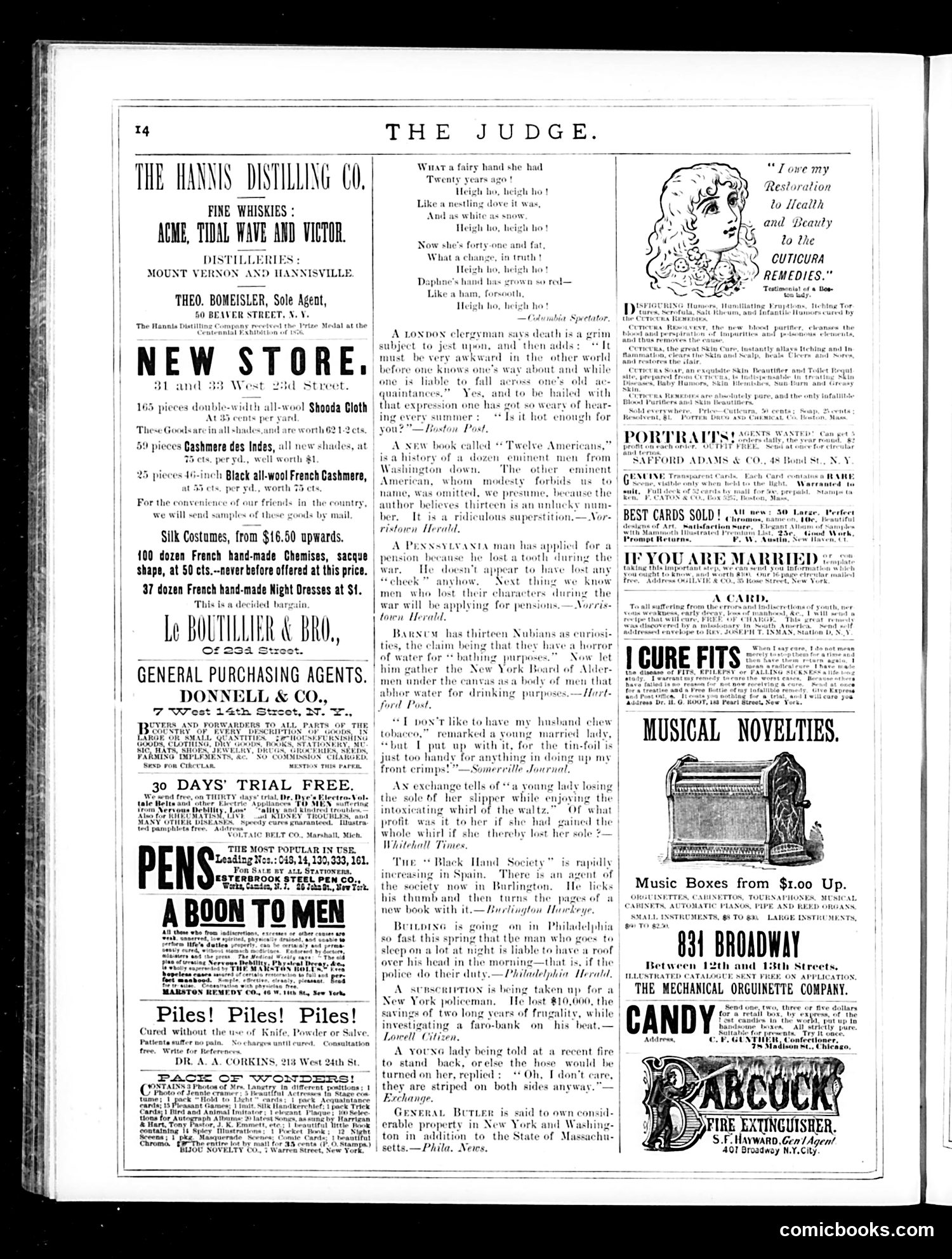
This page is primarily **advertising** with some interspersed **humorous anecdotes**, not political cartoons. The small illustrated portrait (upper right) appears to be a product endorsement for "Cuticura Remedies" - a period skincare line. The humor section contains short jokes and observations typical of late 19th-century satirical magazines: - A poem about a woman's aging ("Daphne's hand has grown so red— / Like a ham, forsooth") - Anecdotes about clerical mishaps, superstitions, and marital quirks - A joke about a young woman at a fire dismissing safety warnings These reflect common Victorian-era preoccupations: aging women, luck/superstition, marriage dynamics, and social propriety. The bulk of the page features merchant advertisements for clothing, whiskey, pens, music boxes, and medical remedies—typical of Judge's revenue model. There is **no evident political satire or cartooning** on this particular page; it functions as a standard magazine advertisement section with light comedic filler.
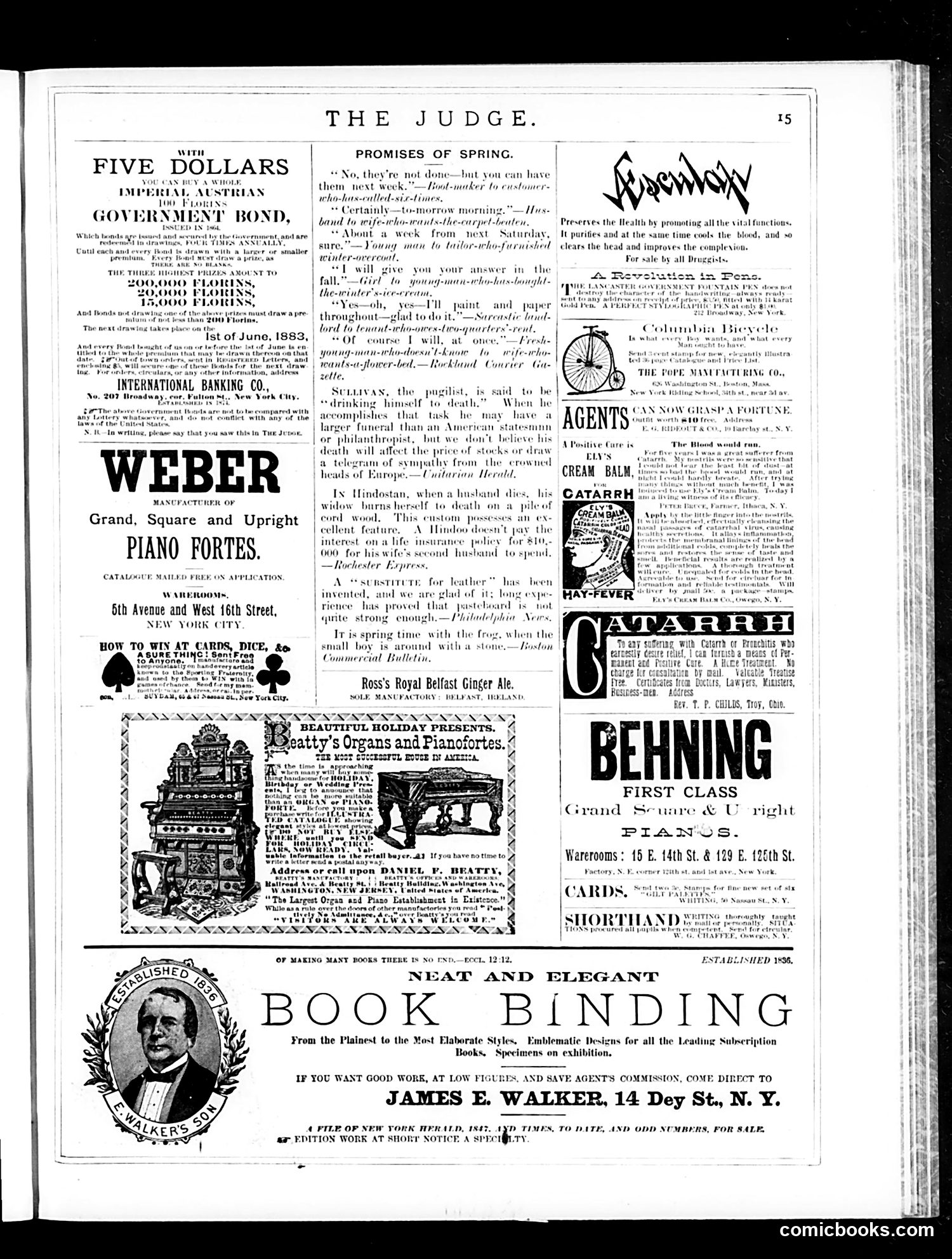
This is primarily an **advertising page** rather than a satirical cartoon spread. The page is dominated by commercial advertisements for pianos, organs, book binding, and other goods typical of 1880s New York. The only satirical content appears in the "PROMISES OF SPRING" section at the top—a series of brief, cynical one-liners mocking common social situations: bookmakers dodging customers, tailors delaying payment, landlords ignoring repair requests, and a pugilist (boxer) whose death supposedly won't affect stock prices. These are generic jabs at everyday frustrations rather than specific political commentary. The page also includes a reference to a Hindu practice (sati/widow-burning) presented as a curiosity. The rest is straightforward commercial content: Weber pianos, Catarh cream, Behning pianos, and book binding services. The James E. Walker book binding advertisement at bottom is particularly prominent. This reflects Judge's reliance on advertising revenue to subsidize its satirical content.
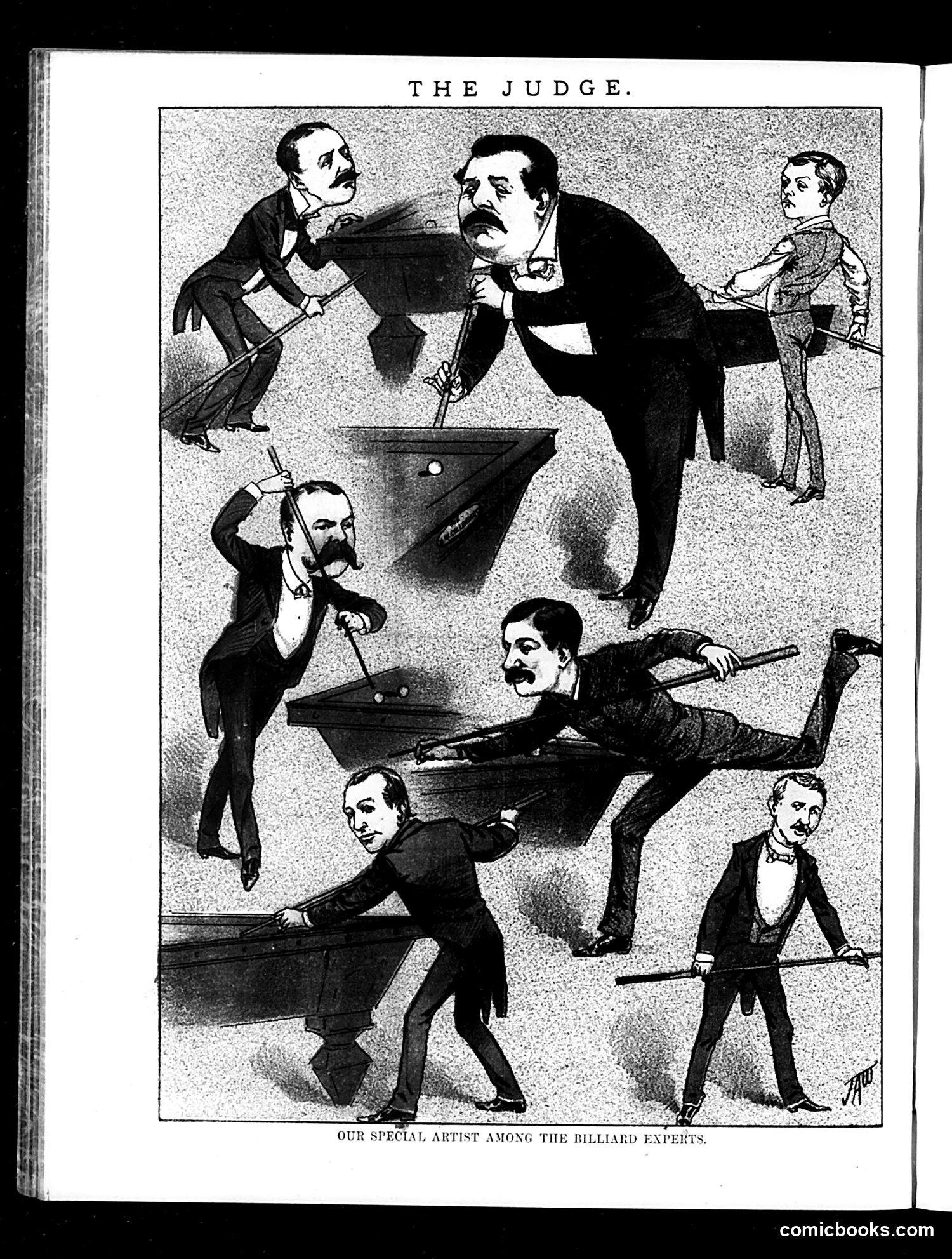
This *Judge* cartoon satirizes billiards (pool) players as skilled performers. The central figure—likely a notable billiards champion of the era—is depicted as "the special artist," surrounded by various poses showing trick shots and acrobatic playing positions. The men contort themselves in exaggerated, theatrical stances while manipulating cues and balls, treating the game as performance art rather than sport. The satire appears to mock both the pretentiousness of calling a billiards player an "artist" and the theatrical showmanship that professional players employed to entertain audiences. The elaborate physical contortions suggest the players are more concerned with spectacle than legitimate skill, ridiculing the elevation of billiards from a casual game to a celebrated spectator sport with celebrity practitioners.