
A complete issue · 17 pages · 1883
Judge — April 21, 1883
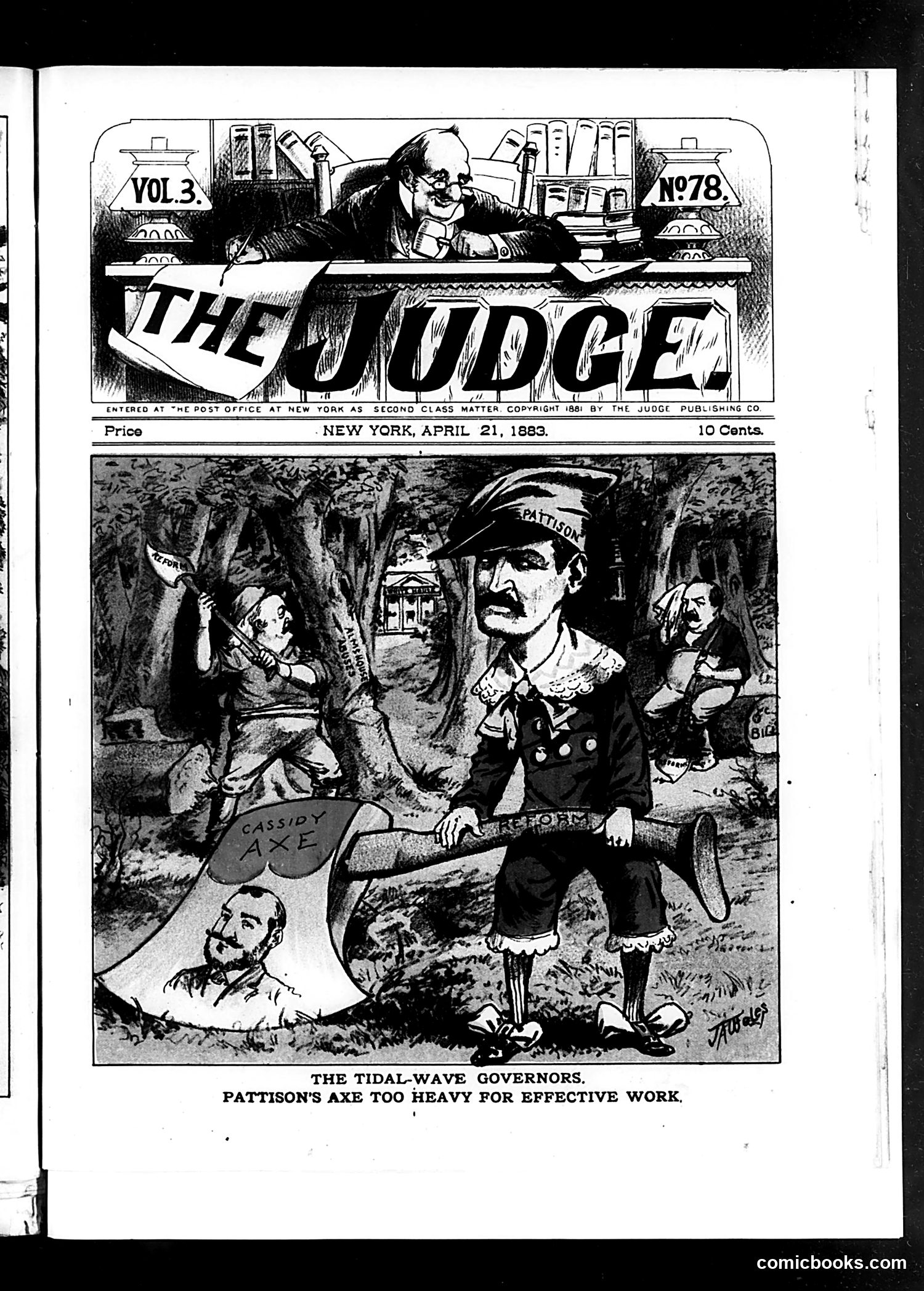
This political cartoon satirizes what it labels "The Tidal-Wave Governors" and claims "Pattison's Axe Too Heavy for Effective Work." The central military figure appears to be a governor wielding an axe labeled "Pattison," likely referencing Samuel J. Pattison, a contemporary political figure. Smaller figures surround him in a wooded setting, some labeled with what appear to be political positions or names (text is difficult to read precisely). The satire suggests that Pattison's administrative efforts—represented as an axe meant for cutting/reform—are either too blunt an instrument or ineffective for proper governance. The "tidal-wave" reference likely alludes to a sudden shift in political power or elections. The cartoon criticizes Pattison's governing approach as crude or counterproductive compared to more nuanced political work needed.
This page contains three distinct editorial pieces rather than cartoons proper: **"A Tidal-Wave Governor"** criticizes Pennsylvania's young Governor (likely Pattison, serving 1883-1887) for failing to wield his reform axe effectively despite promising action against long-standing state evils. **"The Newsgatherer"** defends newspaper reporters against outdated negative stereotypes. The *New York Sun* had recently acknowledged that modern reporters—contrary to their reputation as vagabonds from twenty years prior—are industrious, gentlemanly professionals who endure poor conditions and must converse intelligently with prominent figures while denied home comforts. **"The Red Flag"** appears incomplete in the OCR but likely addresses socialist or radical movements, suggesting such ideologies exploit citizens' grievances. The page also includes tributes to recently deceased figures (Peter Cooper, Jerome Buck) and notes on the President's Florida visit. This is primarily serious political commentary rather than humorous satire—*Judge's* editorial voice here educates readers on contemporary reform debates and journalistic standards.
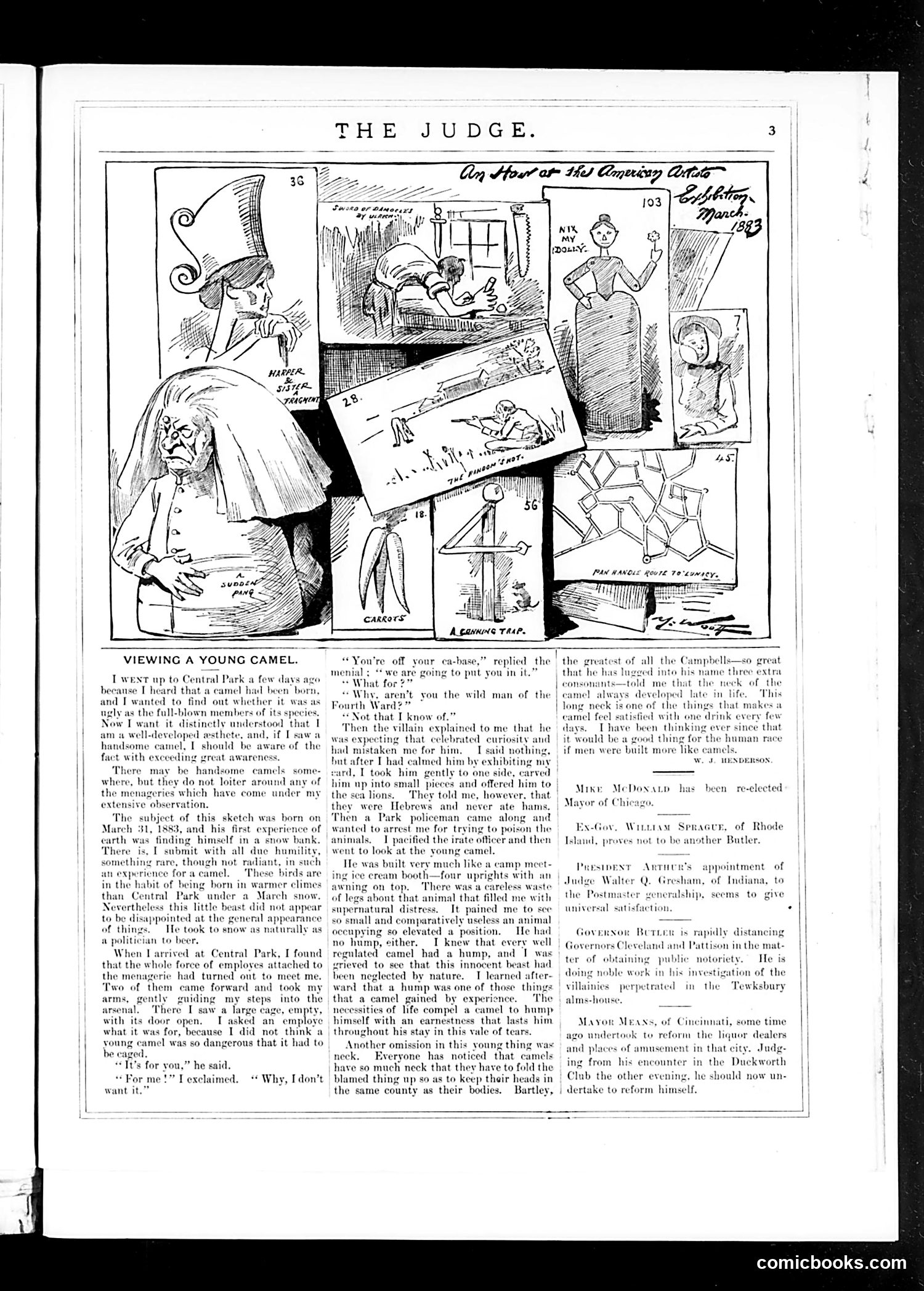
This page satirizes the author's visit to Central Park to see a newborn camel. The humor operates on multiple levels: **The Main Joke:** A Park employee mistakes the well-dressed, aesthete narrator for "the wild man of the Fourth Ward" and tries to cage him instead of the camel. The narrator responds by violently attacking the employee, then attempts to poison sea lions (who refuse because they're "Hebrews"). **The Social Satire:** The piece mocks both the narrator's pretentious "well-developed aesthetic" sensibility and the absurdity of urban zoo management. It criticizes the camel itself for lacking expected features (no hump, insufficient neck), treating the animal's inadequacy as amusing. **The Political Briefs:** Brief notices mention Mike McDonald's re-election as Chicago Mayor, Governor Butler's investigation into Tewksbury almshouse corruption, and Mayor Means of Cincinnati needing self-reform—typical Judge critiques of contemporary political figures. The cartoon's crude humor reflects 1880s attitudes toward both animals and working-class ("Fourth Ward") people.
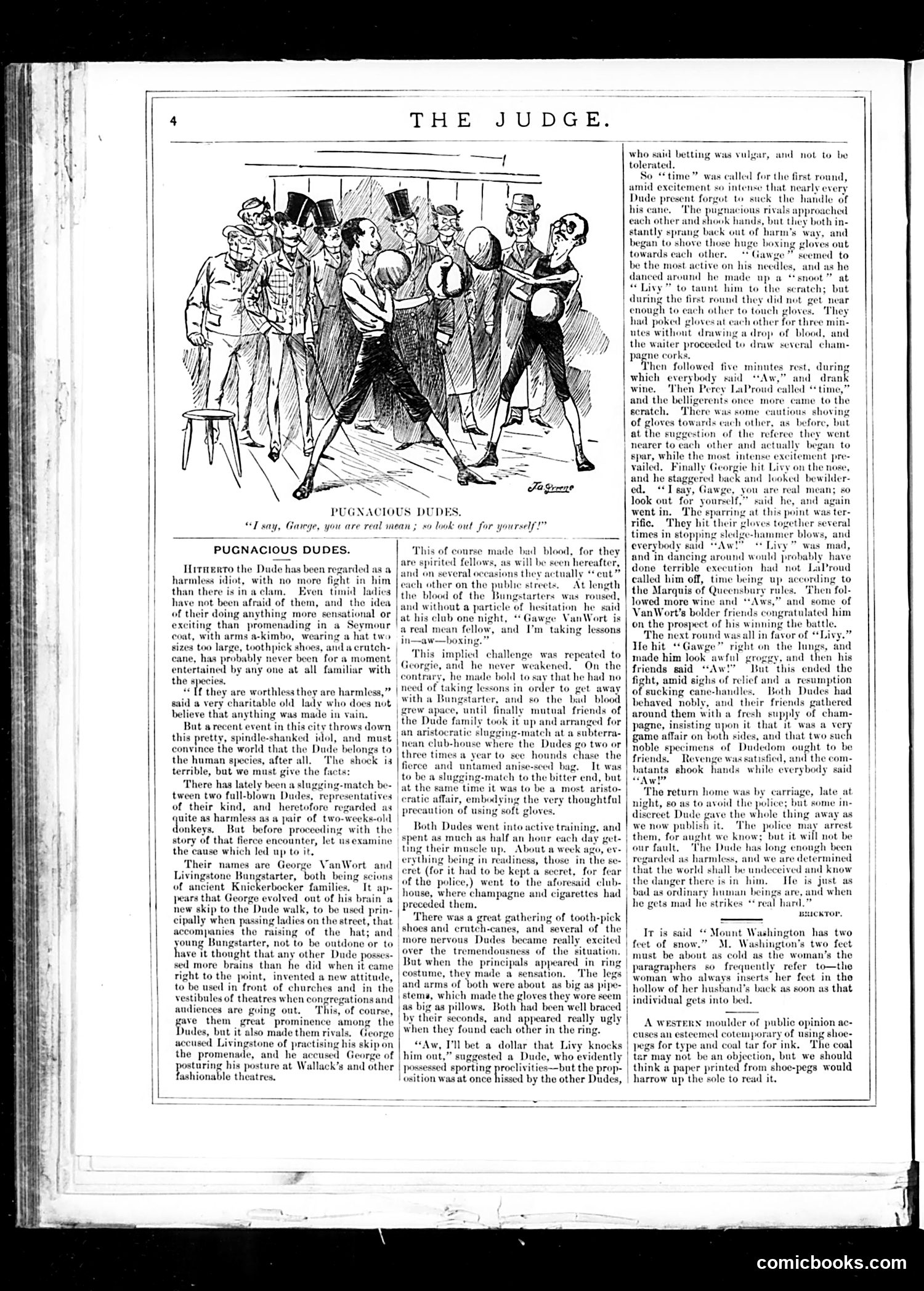
This satirical piece mocks fashionable young men ("Dudes") of the era—specifically two named George VanWort and Livingstone Bungstarter—who were previously dismissed as harmless dandies but prove otherwise through an actual fistfight. The satire targets their affectations: wearing oversized hats, thin-soled shoes, and canes while strolling through city streets. Their feud begins over competing "attitudes" (poses) they invented for display outside churches and theaters—supposedly marking them as fashionable innovators among their social set. The joke culminates in an absurdly inept boxing match: despite rounds of posturing and seconds' preparation, they barely make contact, merely "poking gloves" without landing blows. The cartoon ridicules how these pretentious, style-obsessed men, having fashioned themselves as rivals, prove completely incompetent at actual physical confrontation—their carefully cultivated toughness is performative nonsense.
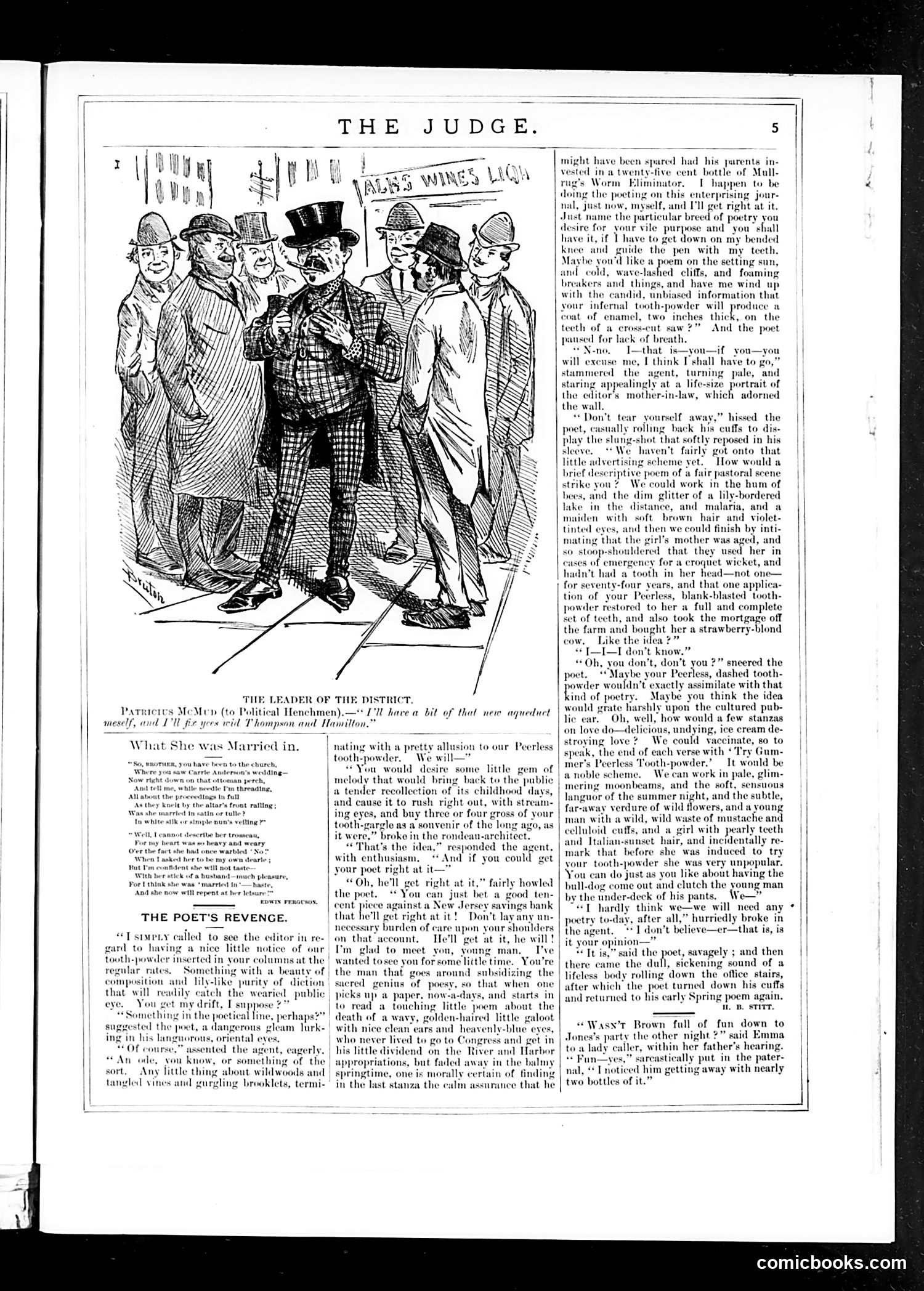
This page satirizes the commercialization of poetry and advertising's encroachment on artistic integrity. The central cartoon depicts "the leader of the district" (a political operative) pressuring a poet to write promotional verses for "Peerless Tooth-Powder." The satire works on two levels: First, it mocks the poet's desperation—he's willing to compose flowery, sentimental poetry about a mundane product. Second, it ridicules advertisers' expectations that art should serve commercial purposes, with the agent dismissing genuine poetic concerns and demanding the poet simply "get right at it." The humor escalates absurdly: the agent suggests increasingly ridiculous advertising angles (love poems, references to the product's effects on an old woman's teeth), culminating in the poet literally throwing the agent down the stairs—then resuming his "Spring poem" as if nothing happened. This reflects late-19th-century anxieties about how industrial capitalism was commodifying American culture and corrupting artistic values through advertising's growing influence.
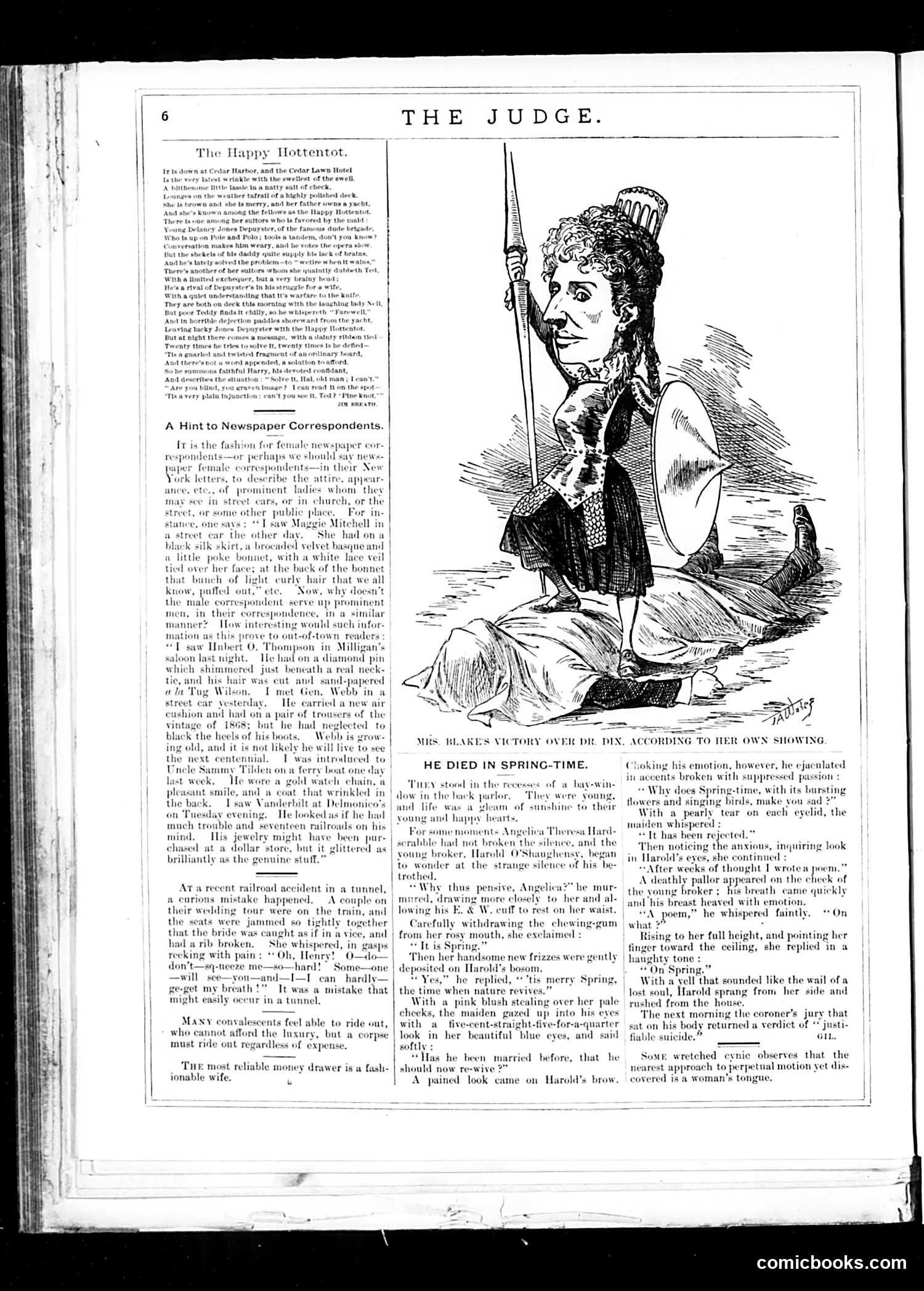
This page satirizes Victorian sentimentality and women's intellectual pretensions. The main story depicts a melodramatic courtship where a young woman, Angelica Theresa Hardscrabble, drives her fiancé Harold to suicide—not through betrayal, but by reading him her poem titled "On Spring." The satire mocks both excessive romantic conventions (the overwrought dialogue, emotional displays) and the notion that a woman writing poetry represents genuine intellectual achievement. The coroner's verdict of "justifiable suicide" is the darkly comic punchline: her poem is *so bad* that death seems reasonable. The page also contains lighter jabs at newspaper fashion correspondents (why describe only women's clothing?) and a cynical closing quip about women's constant talking. The overall thrust: ridicule of pretentious amateur female writers and Victorian melodrama's absurdity.
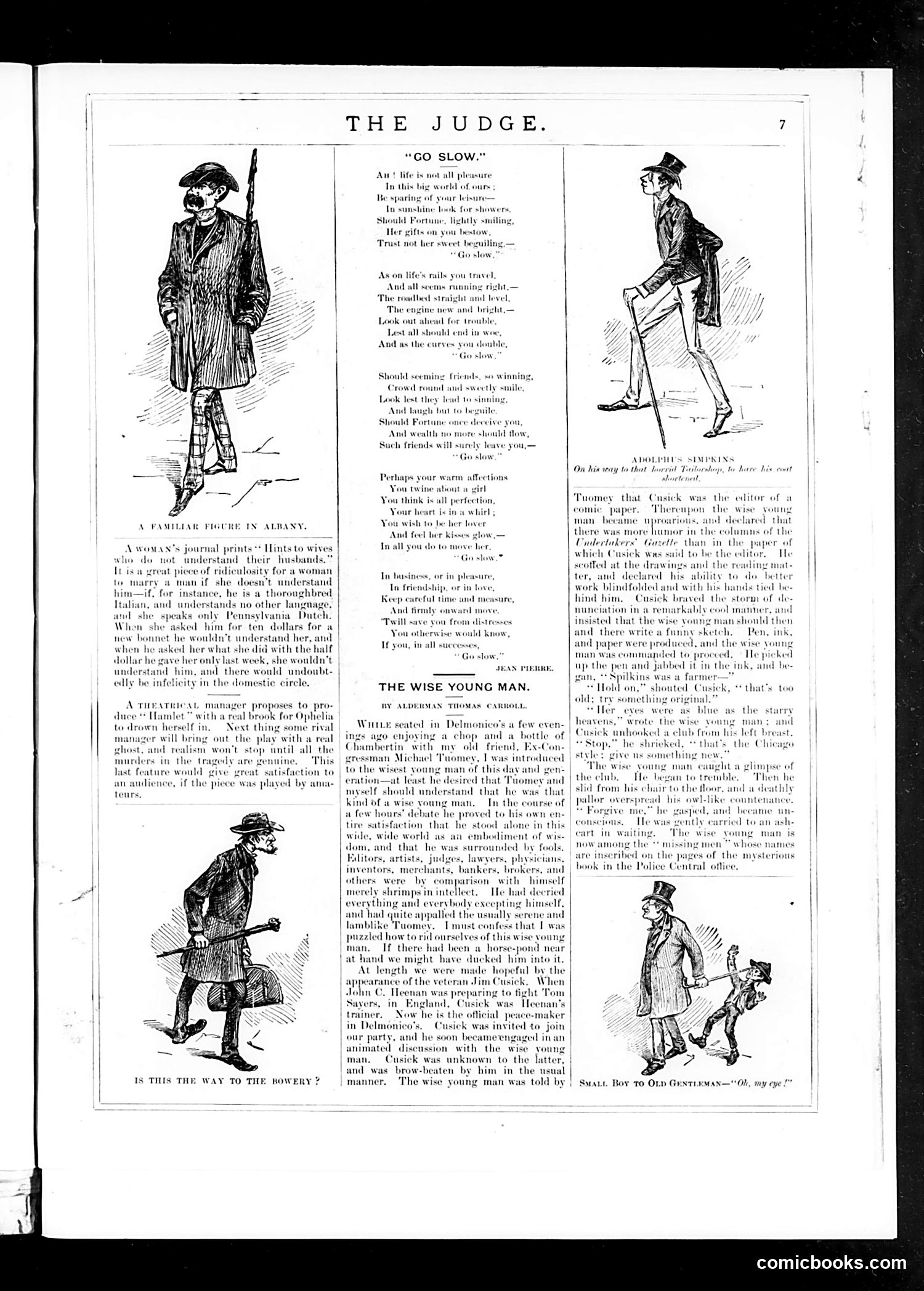
This page features a satirical story by Alderman Thomas Carroll mocking a pompous, self-proclaimed intellectual. The narrative describes a dinner where the protagonist—an insufferably arrogant man who disparages everyone around him as intellectual inferiors—is challenged to write something original. When asked to compose a humorous sketch, he begins with a cliché ("Spilkins was a farmer"), is criticized for lack of originality, and becomes so embarrassed and distressed that he collapses into unconsciousness and must be taken away in an ash cart. The satire targets pretentious know-it-alls who critique others harshly while proving incapable of producing anything of merit themselves. The accompanying illustrations show various character types (the familiar Albany figure, the stockbroker) representing the social milieu Judge magazine regularly lampooned. The piece exemplifies the magazine's use of humorous social commentary to deflate human vanity and pomposity.
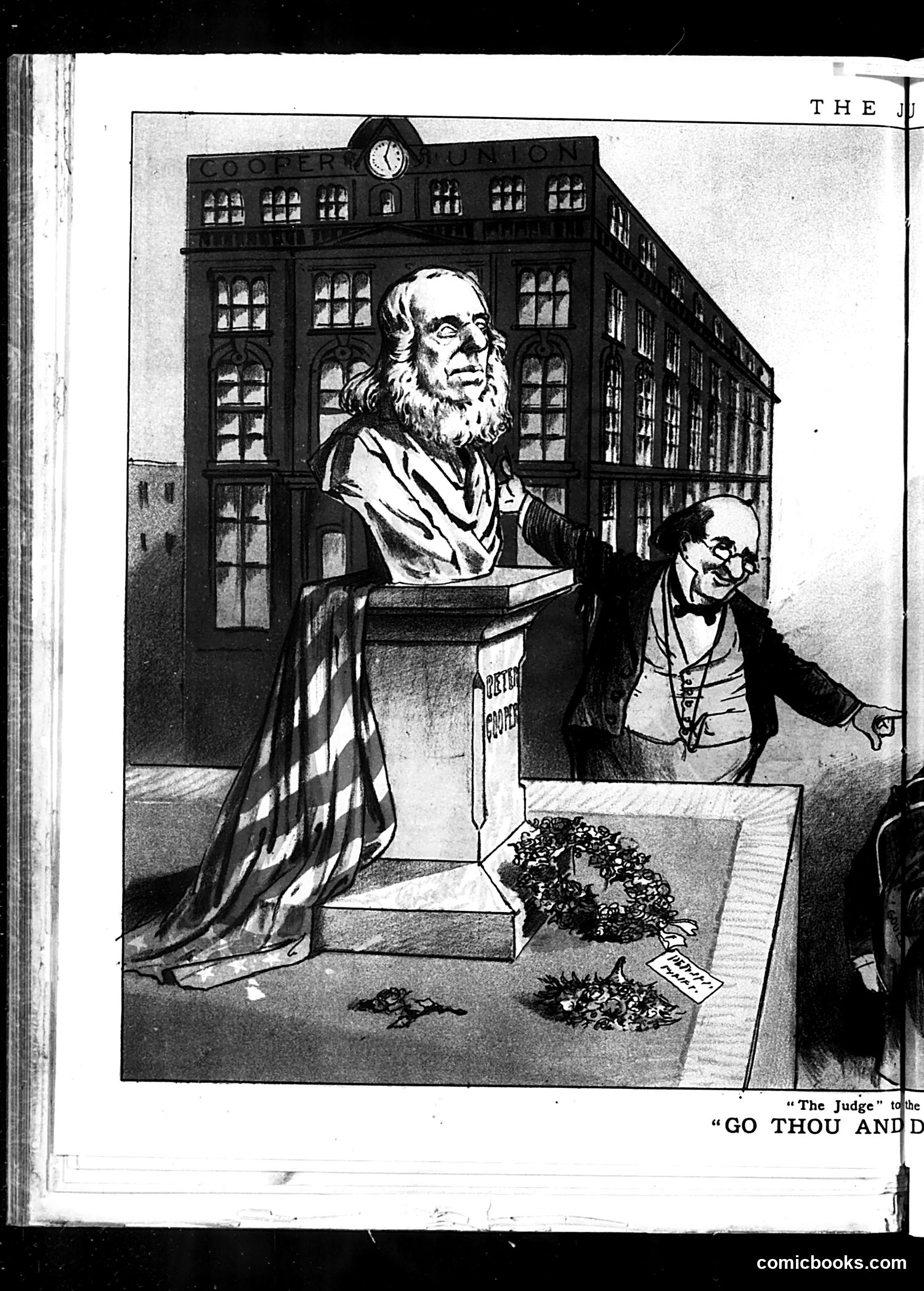
This appears to be a satirical cartoon from *Judge* magazine featuring a bearded bust (likely representing a historical or political figure) labeled "Boston" or similar, positioned in front of a Cooperation building. A well-dressed man gestures toward it with apparent reverence or irony. The OCR text is too corrupted to read the specific caption clearly, though "GO THOU AND" suggests biblical or moral language, common in *Judge's* satirical commentary. Without legible text, I cannot definitively identify the specific figure, political event, or satirical point being made. The cartoon appears to comment on civic institutions, local politics, or historical commemoration, but the exact target and critique remain unclear from this image alone.
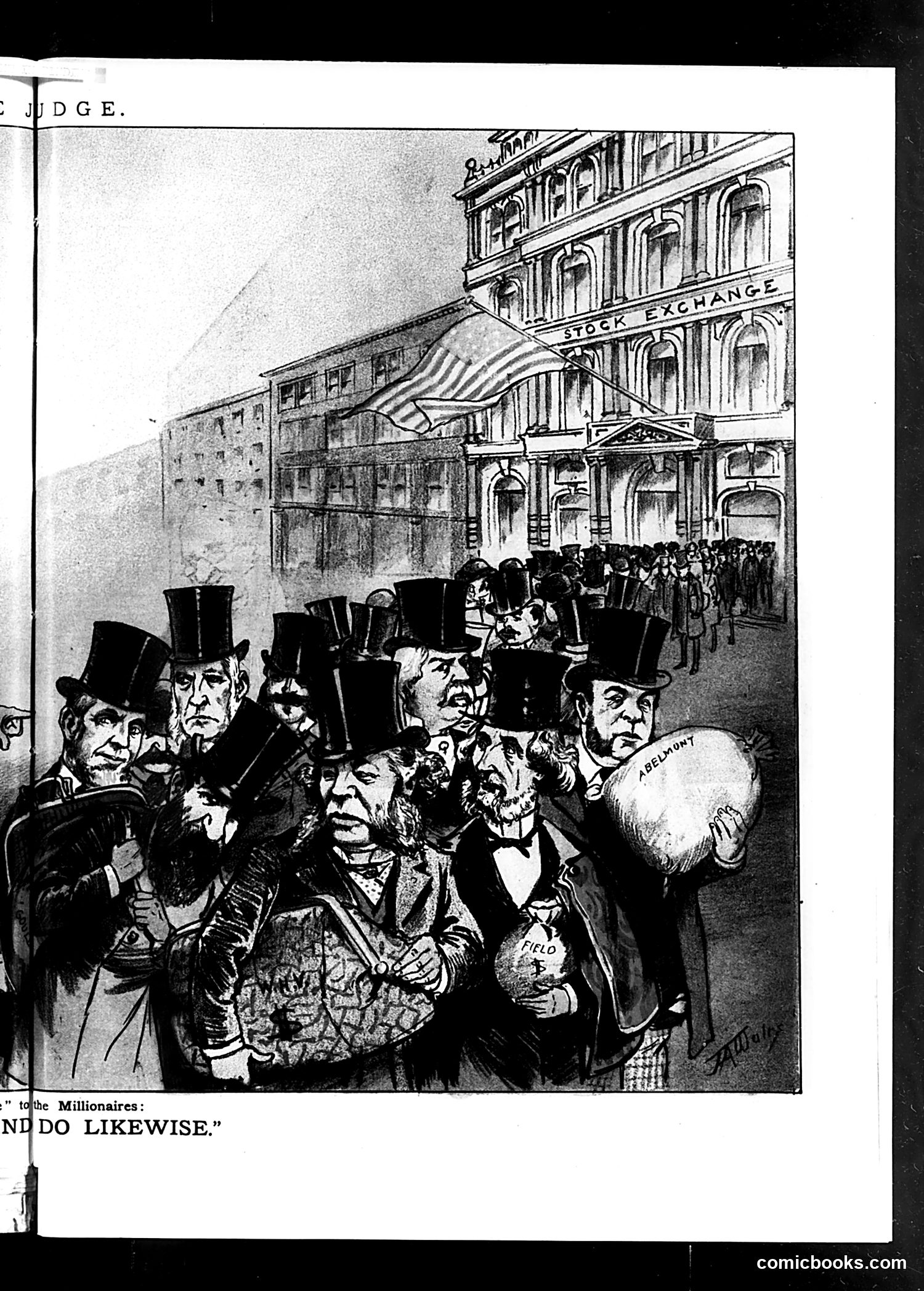
This **Judge** magazine cartoon satirizes wealthy financiers and industrialists gathering outside the Stock Exchange building. The men wear top hats and formal dress, carrying bags labeled with terms like "ABORT" and "PLOD"—likely representing financial schemes or exploitative business practices. The caption reads "to the Millionaires: 'AND DO LIKEWISE,'" suggesting ironic commentary on how the wealthy conduct business versus moral or ethical standards. The American flag flying over the Stock Exchange emphasizes the national character of this critique. The crowd of ordinary people in the background contrasts with the caricatured, exaggerated features of the wealthy men in front, a common Judge technique to mock the financial elite. This appears to critique Gilded Age wealth accumulation and questionable business ethics.
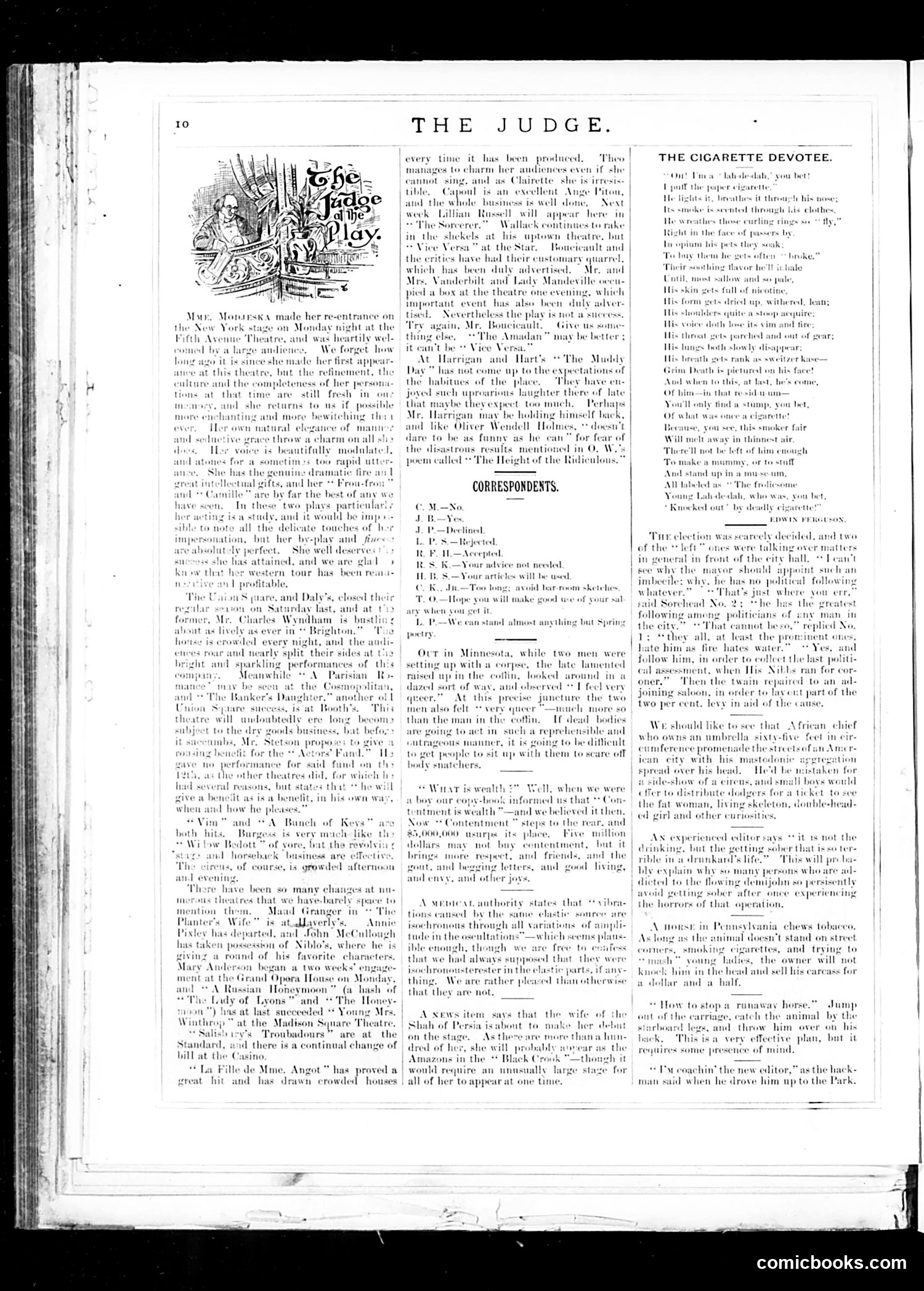
This page contains a humorous verse-poem mocking the habits of cigarette smokers. The poem follows a man's progressive deterioration from casual smoking, describing how cigarettes affect him physically: his throat becomes parched, his lungs fail, his strength diminishes, and he gradually wastes away. The satire targets the Victorian-era glamorization of cigarettes as fashionable and sophisticated. By exaggerating the physical consequences—death ultimately resulting from "a deadly cigarette"—the poem satirizes smokers' denial of obvious health dangers and their continued indulgence despite visible decline. This reflects late 19th-century medical and moral concerns about cigarettes as a new, seemingly harmless vice that was actually destructive. The joking, rhyming format was typical of *Judge*'s approach to social criticism—making serious warnings palatable through humor while mocking both the habit and those addicted to it.
This page is primarily **advertising**, with minimal editorial content or cartoons. The few jokes present are casual racial stereotypes common to 1880s publications: - A brief anecdote mocking a Black coachman's dialect ("yaas, mas'r") and depicting him as dim-witted - A joke about a woman using a bootjack as decorative "antique" wall art The bulk of the page consists of advertisements for: - Knox hats (prominent) - Webster's Unabridged Dictionary - Mining stock ("New England and Colorado Mining Company") - Baker's Breakfast Cocoa - Furniture and carpets - Behning pianos - Various other consumer goods There is no identifiable political cartoon or sophisticated satire here. The page reflects typical late-19th-century advertising practices and the casual, dehumanizing racial humor that pervaded mainstream American publications of the era—elements modern readers would find offensive rather than amusing.
This page is primarily **advertising**, not editorial content or political cartoons. It's from an issue of Judge, the American satirical magazine, but this particular page showcases commercial advertisements rather than satire. The visible content includes: - **"A Conundrum"** by Edwin Ferguson: A brief humorous poem about a "dude" and his wife, playing on the era's definition of a "dude" as an affected, fashionable man - **Insurance and services ads**: Mutual Accident Association, piano companies (Haines, Weber, Beatty's), and patent medicines (Hale's Honey, consumption remedies, hair dye) - **Lists of famous opera singers**: Names like Adelina Patti and Clara Louise Kellogg, likely endorsing pianos or performances The page reflects late-19th-century advertising conventions and consumer goods. Without clear political cartoons or editorial material visible, this appears to be a revenue-generating advertisements section rather than Judge's satirical core content.
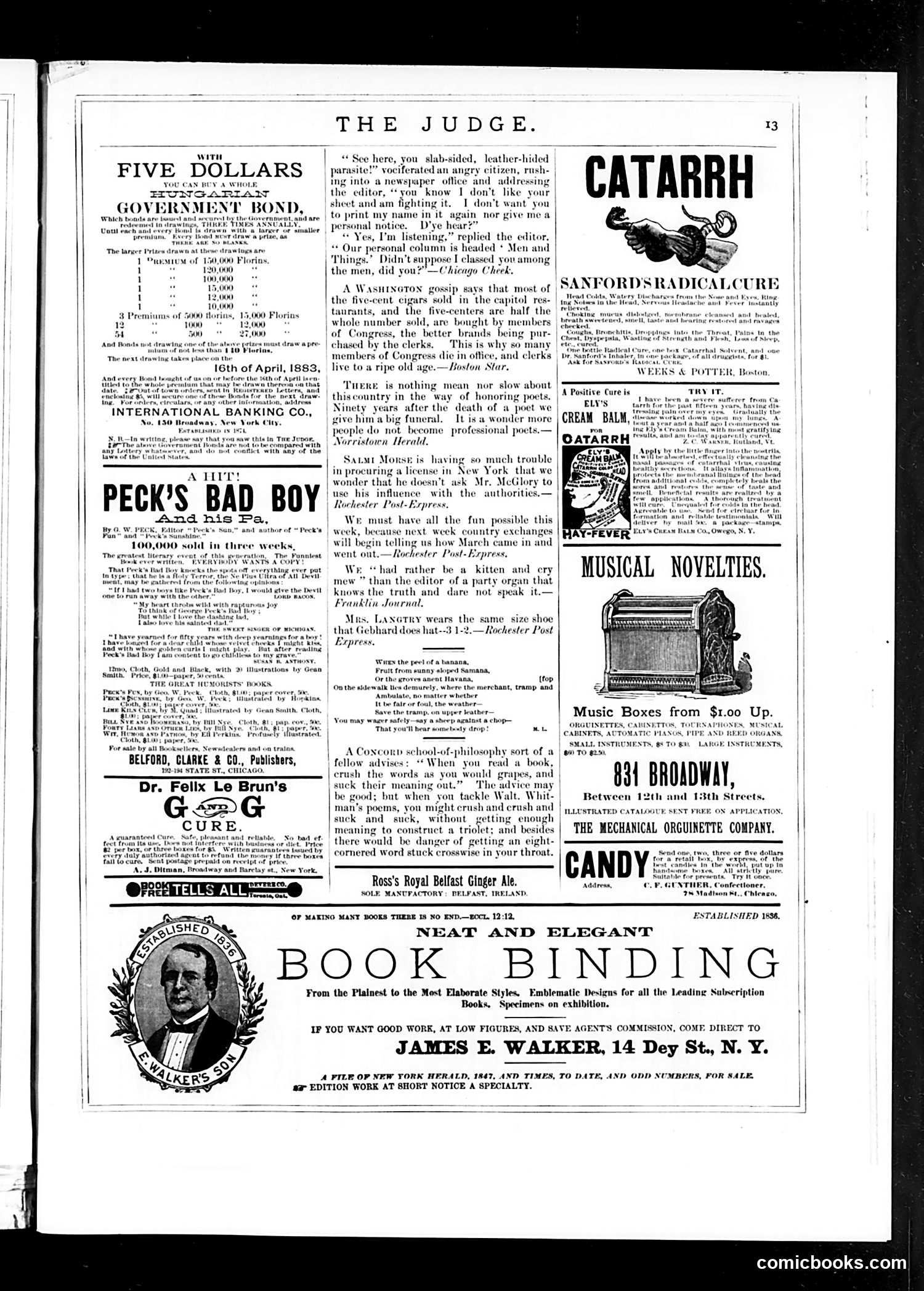
This is primarily an **advertising page** from Judge magazine (page 13), with brief satirical snippets interspersed among commercial notices. The humor relies on **political and social commentary**: - **Congressional cigar consumption**: A gossip item mocks Congress members' indulgence—they buy expensive cigars while clerks buy cheaper ones, sarcastically suggesting this explains why members "live to a ripe old age." - **Poets and funerals**: Judge jokes that America waits 90 years after a poet dies to honor them with a funeral, wondering why more people don't become poets given this delayed recognition. - **Salmon Morse and licensing**: A brief jab at someone struggling to obtain a New York license, possibly referencing bureaucratic red tape. - **Party newspaper editors**: A quip mocking editors of partisan newspapers who "know the truth and dare not speak it"—critiquing journalistic dishonesty. The page is dominated by **advertisements** for government bonds, Peck's Bad Boy (serialized fiction), Dr. Felix Le Brun's Cough remedy, music boxes, book binding, and candy—typical late 19th-century magazine revenue sources.
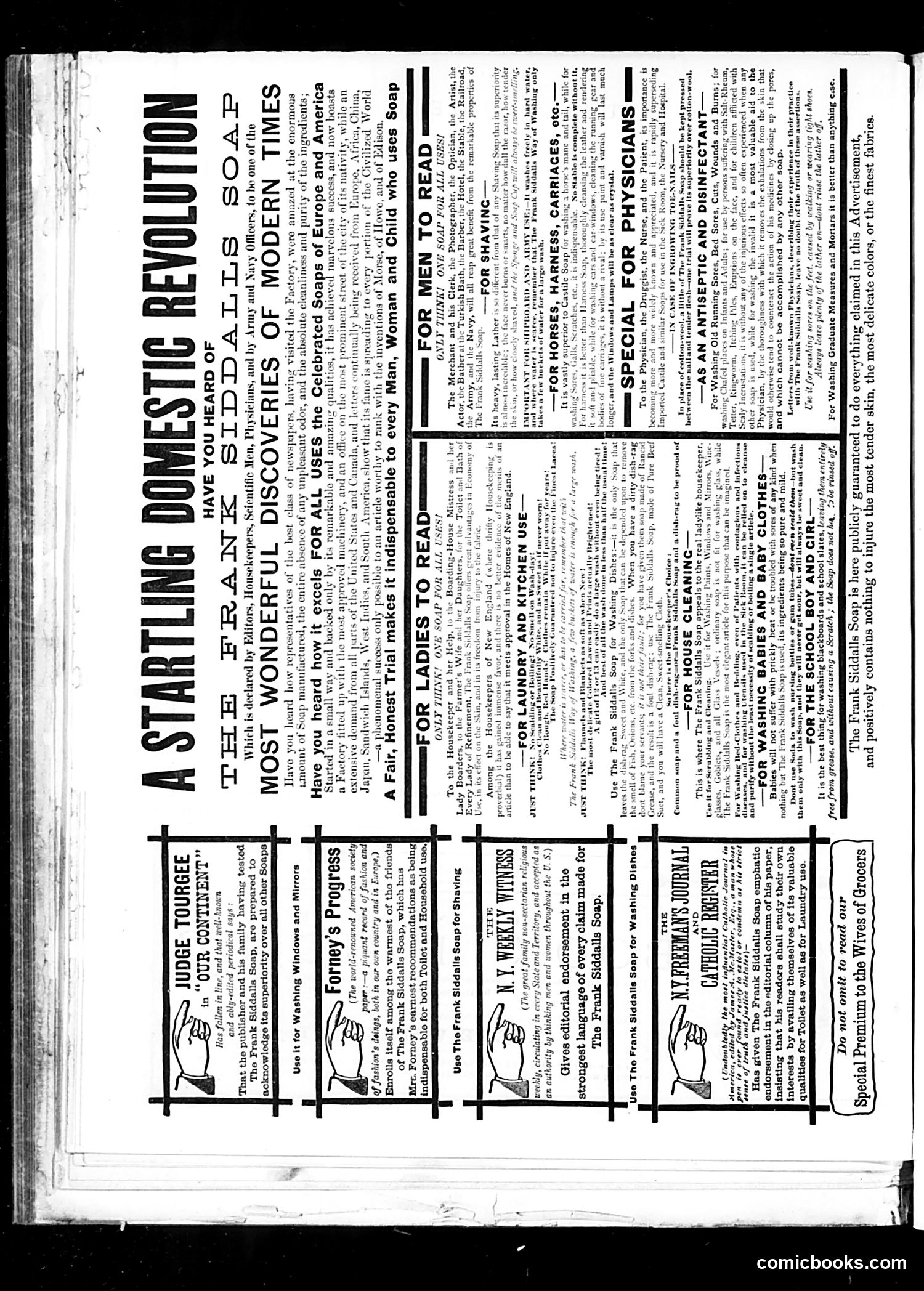
This appears to be a Judge magazine page from the early 20th century satirizing women's suffrage and domestic upheaval. The large headline "A STARTLING DOMESTIC REVOLUTION" frames several sections mocking the "Women's Lib" movement of that era. The content includes mock advice columns and satirical scenarios about women demanding voting rights and household independence. References to "For Men to Read" and "For Ladies to Read" suggest gender-divided messaging. The cartoons likely depict exaggerated domestic chaos—men doing housework, women in political roles—presented as absurd consequences of women's suffrage. The satirical tone reflects anti-suffrage sentiment common in Judge during this period, using humor to ridicule women's political aspirations as threats to traditional family structure. Multiple sections with hand gestures suggest different character voices delivering the satire.
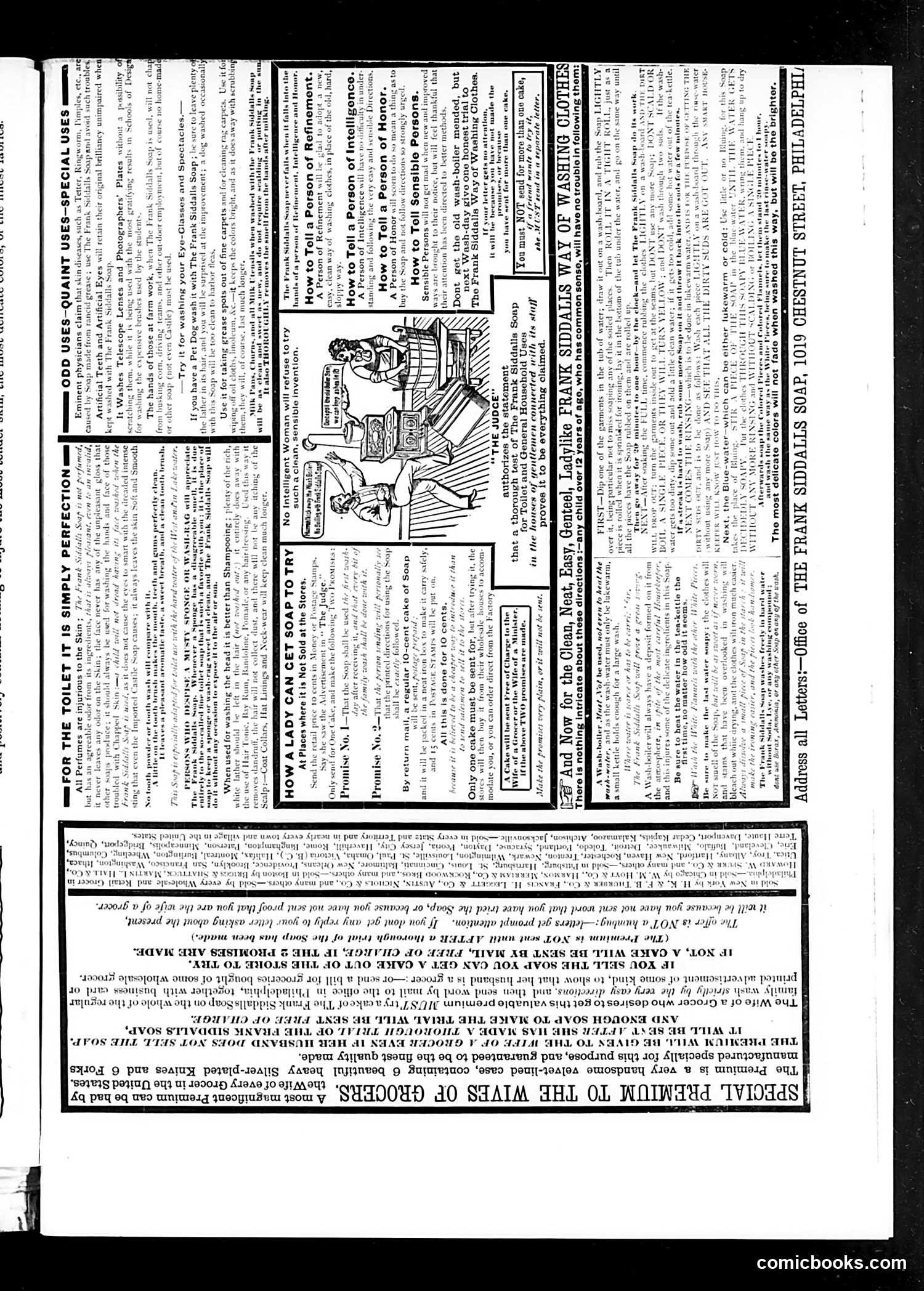
This page is primarily **advertising for Frank Siddalls Soap**, not political satire. The content includes: **Main Advertisement:** A product endorsement for a soap brand claiming to revolutionize laundry. The ad features illustrations of women demonstrating the "new way of washing clothes" and includes text about how to identify "a person of refinement" (implying refined women use this soap). **The Satire (subtle):** The humor lies in the pretentious framing—the ad mockingly suggests that refined ladies recognize each other partly by their washing methods and product choices. This gently satirizes consumer culture and the marketing tactic of linking soap purchases to social status and gentility. **Context for modern readers:** Late 19th-century advertisers routinely appealed to women's desires for respectability and refinement. Judge magazine often mocked such advertising excess, so running this ad with its exaggerated claims about soap determining one's social standing appears intentionally ironic. The page demonstrates how magazines financed themselves through advertising while simultaneously satirizing commercial culture.
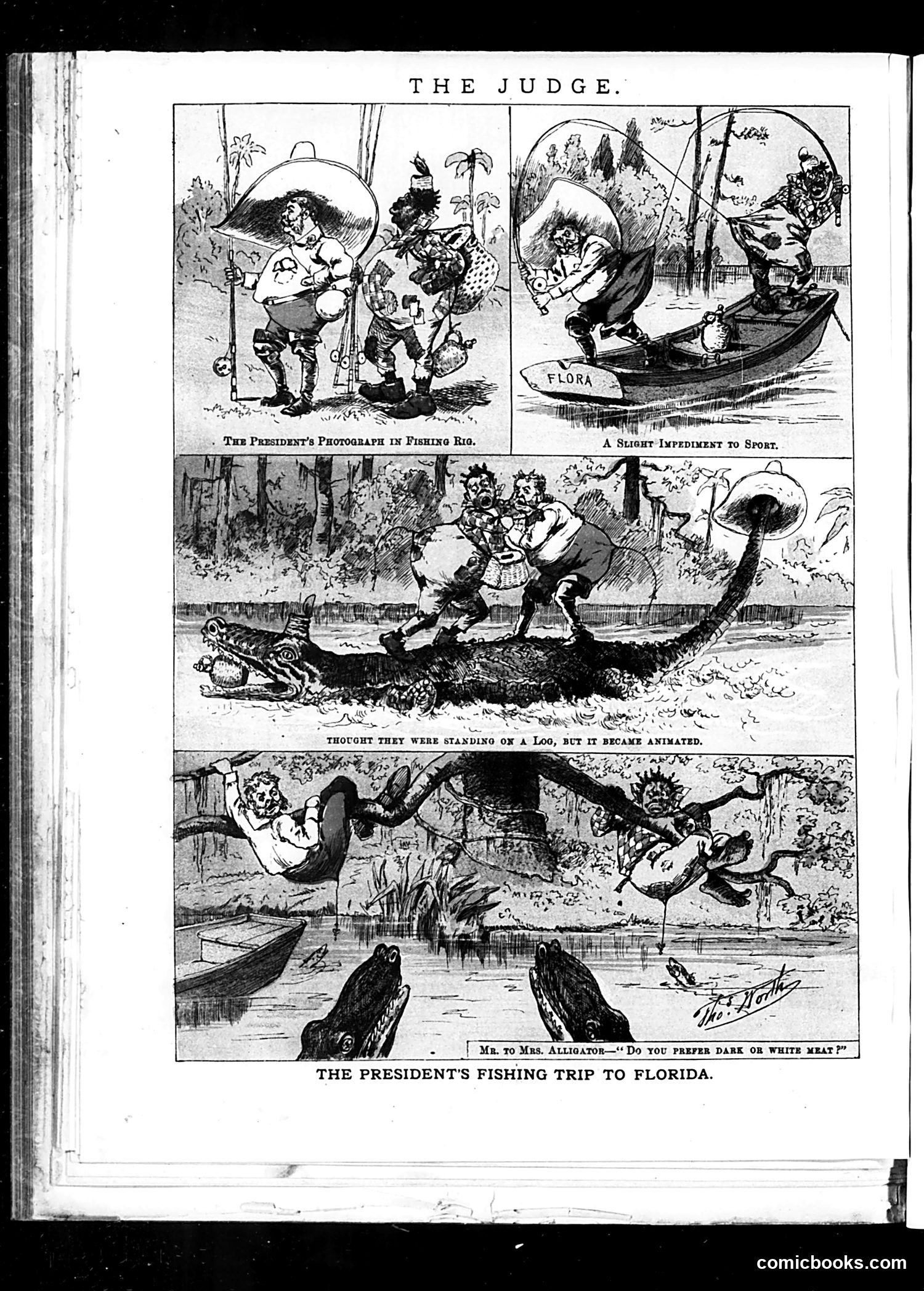
This is a satirical comic sequence mocking a U.S. President's fishing vacation to Florida. The cartoons depict increasingly absurd and dangerous mishaps: the President photographed fishing in Rio (upper left), a gondola excursion labeled "Flora" (upper right), encounters with an animated log that proves to be a crocodile (middle), and finally, alligators in the water asking about meat preferences (bottom). The satire ridicules the President for undertaking a frivolous leisure trip while presumably having serious duties. The dangerous wildlife encounters suggest incompetence or foolishness. The final alligator joke implies the President himself might become the "meat" in question—a dark humor suggesting the trip's inherent dangers or the President's vulnerability away from official duties.

I can see this is a blank or nearly blank page from Judge magazine, with only the "comicbooks.com" watermark visible at the bottom. There is no discernible cartoon, illustration, text content, or other material to analyze on this page itself. Without visible satirical content, figures, captions, or historical references to examine, I cannot identify any political or social commentary, explain any jokes, or discuss the historical context this page might contain. This appears to be either a blank page from the publication, a scanning artifact, or a page that did not reproduce clearly in the digitization process.