
A complete issue · 16 pages · 1883
Judge — April 14, 1883
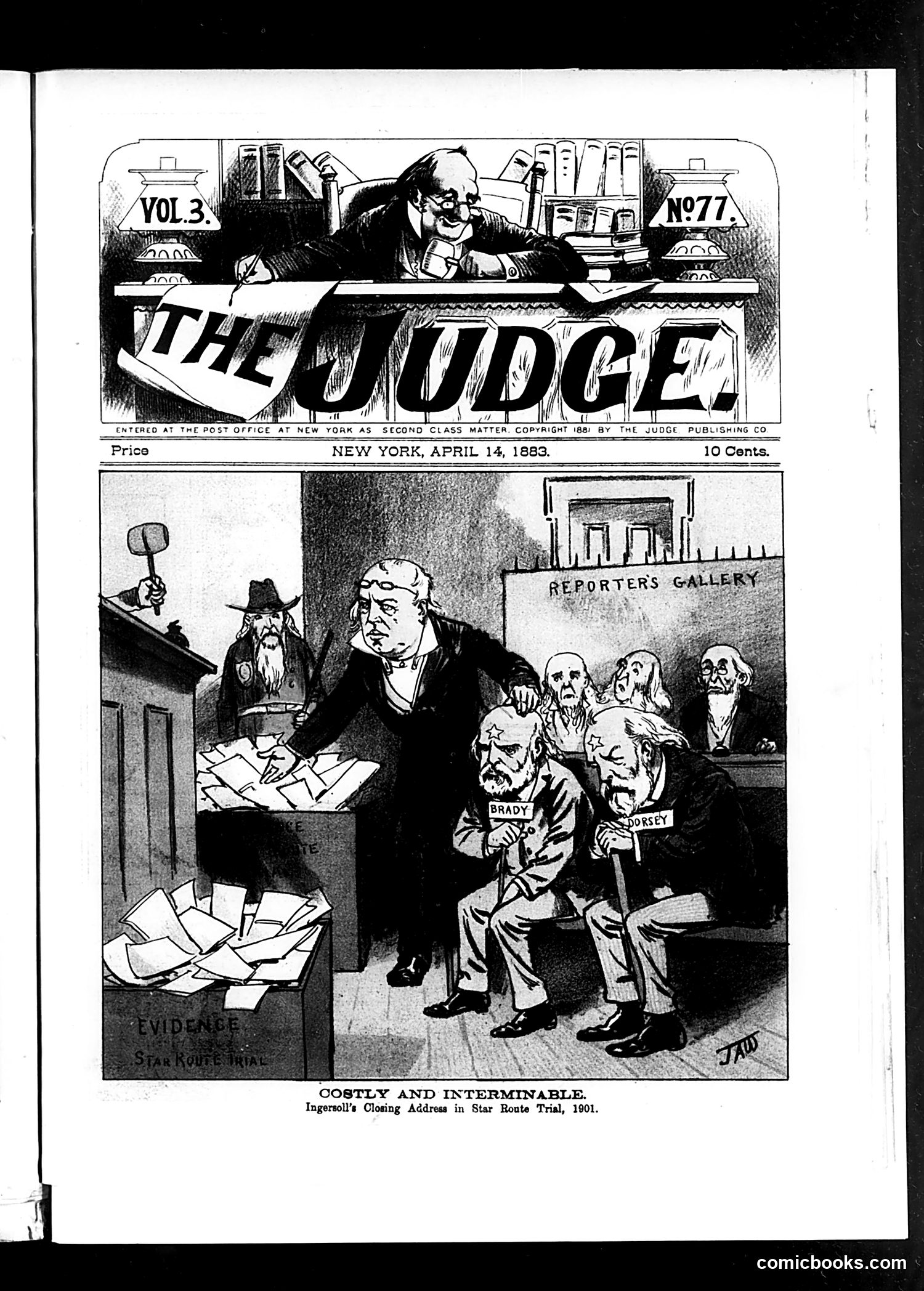
This cartoon satirizes the **Star Route Mail Trial of 1881**, a major corruption scandal. The image shows a courtroom scene titled "COSTLY AND INTERMINABLE: Ingersoll's Closing Address in Star Route Trial, 1881." The cartoon depicts what appears to be **Robert G. Ingersoll** (the famous lawyer and orator) delivering closing arguments. Two figures are labeled "BRADY" and "DORSEY"—likely defendants or associates involved in the Star Route fraud scheme, where post office contractors allegedly inflated mail delivery costs. The satire criticizes the trial's extraordinary expense and length. The "Evidence" documents overflowing on the left suggest the case's complexity. The cartoon mocks both the criminal conspiracy and the legal system's inability to efficiently resolve it, with Ingersoll's lengthy oratory contributing to costs.
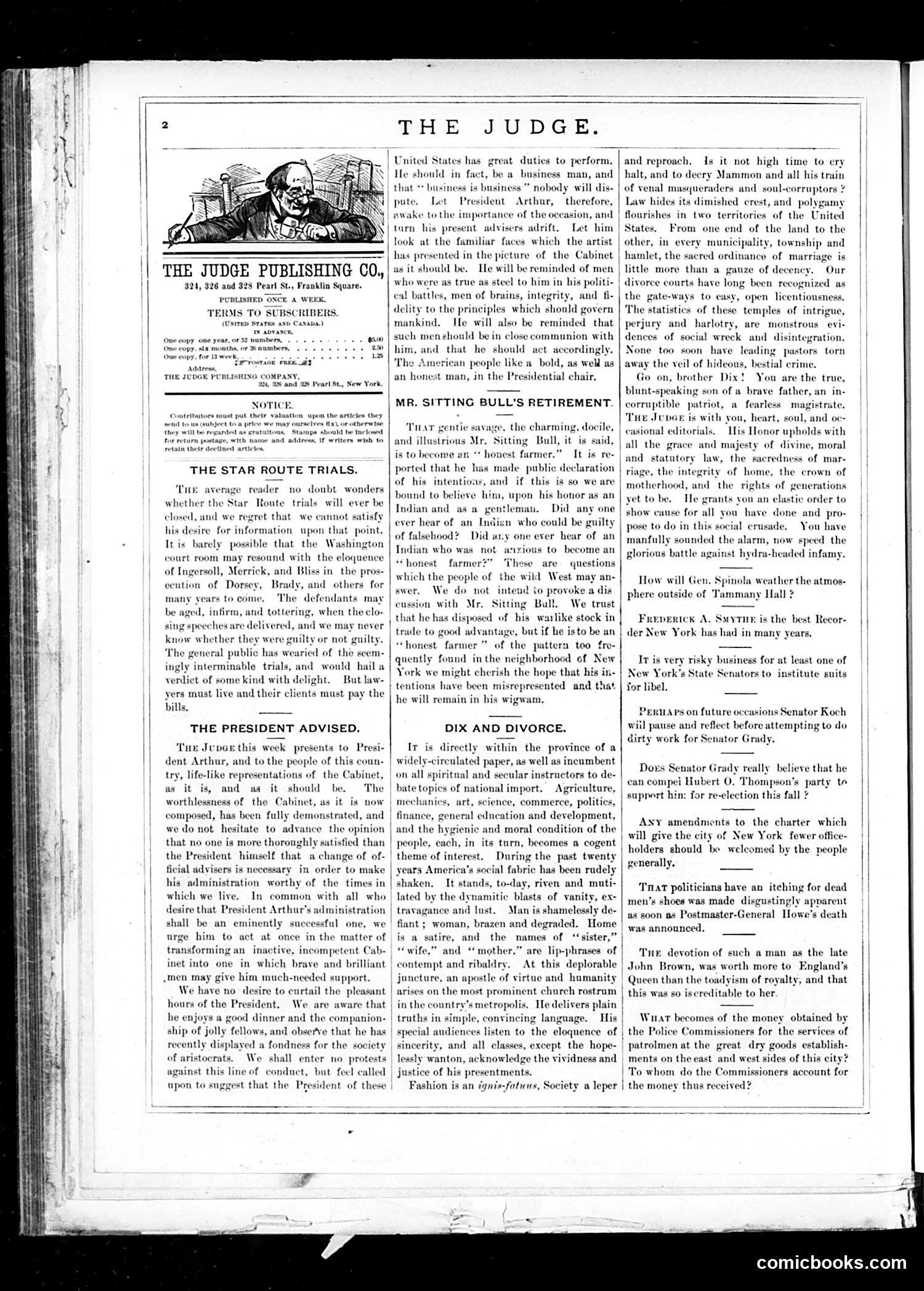
This page from **Judge** (a satirical weekly) primarily contains editorial commentary on contemporary political issues rather than illustrated cartoons. **Main Content:** 1. **"The Star Route Trials"** - Mocks the seemingly endless legal proceedings against government officials (Dorsey, Brady, and others) accused of mail-route fraud. The satire suggests trials drag on endlessly while lawyers profit. 2. **"The President Advised"** - Critiques President Chester Arthur's cabinet as incompetent and urges him to replace his advisers with capable men. The text suggests Arthur wastes time socializing rather than governing seriously. 3. **"Mr. Sitting Bull's Retirement"** - Sarcastically questions whether the famous Native American leader can genuinely become an "honest farmer," implying skepticism about Native Americans' capacity or sincerity. **Context:** This appears to be from Arthur's presidency (1881-1885), addressing his reputation for insufficient engagement with executive duties and patronage-based cabinet appointments.
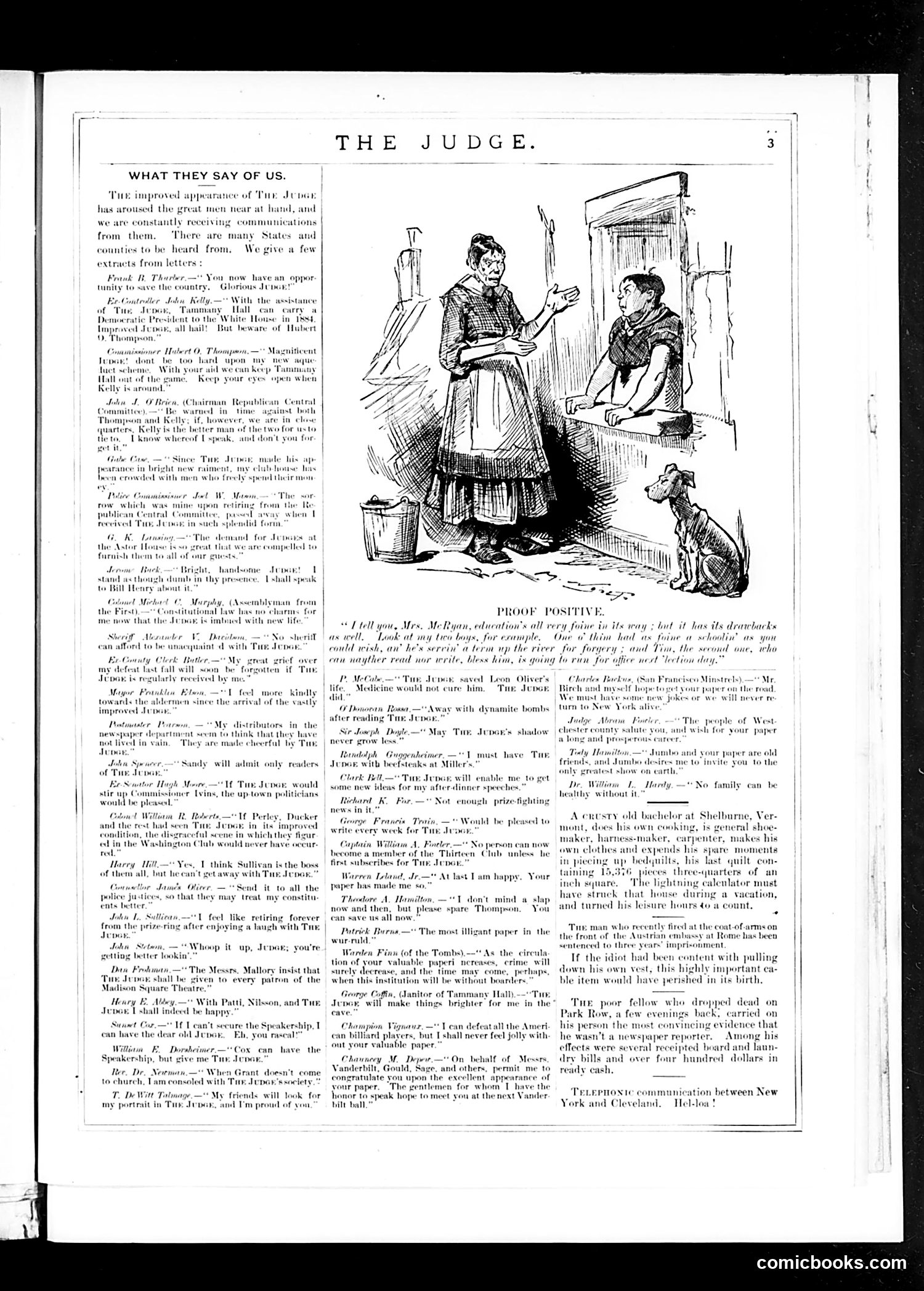
This page showcases **testimonials praising The Judge magazine itself**—a self-promotional feature common in 19th-century publications. The cartoon illustrates the magazine's claimed influence among New York's political and social elite. **The central image** depicts a woman (personifying The Judge or its editor) receiving visitors—politicians, businessmen, and officials—suggesting the publication's importance in civic circles. **Key references include:** - **Tammany Hall** figures (Democratic machine politicians) - **Republican leaders** (John J. O'Brien, Kelly) - **New York officials** (Sheriff, City Clerk) - **Prominent citizens** (Vanderbilt, Grant, Patti) **The satire works on two levels:** First, these "testimonials" are transparently self-written flattery. Second, the quoted praise is often backhanded—politicians admit they use The Judge for cynical purposes (speeches, favors, influence) rather than enlightenment. The cartoon mocks both The Judge's vanity and the hypocrisy of powerful men exploiting media. The overall message: powerful New York elites depend on The Judge, whether they admit it or not.
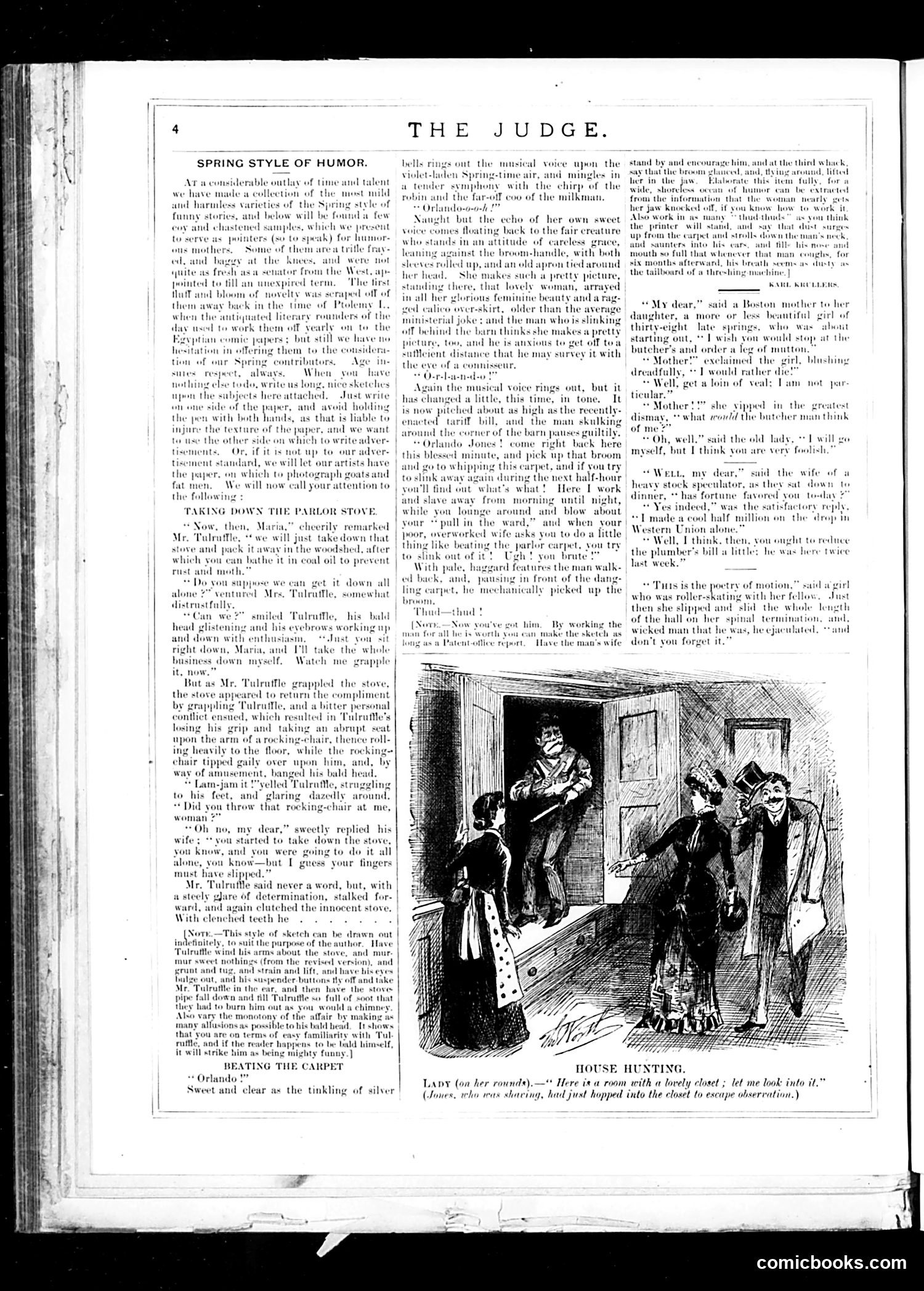
This page contains three humorous sketches satirizing domestic life in late 19th-century America: **"Taking Down the Parlor Stove"** mocks the tensions between husbands and wives during spring house-cleaning. Mr. Tulruffle, attempting to disassemble the stove for storage, becomes entangled in domestic conflict with his wife Maria, resulting in physical comedy (falling furniture, getting stuck in pipes). The satire targets male incompetence at household tasks and the friction arising from couples' conflicting approaches to spring cleaning. **"Spring Style of Humor"** (text section) mocks overly elaborate comedic construction in contemporary publications, critiquing writers who laboriously build simple jokes through excessive detail. **"House Hunting"** depicts a young woman's mortification at being seen entering a butcher shop—apparently shameful because unmarried women shouldn't be purchasing meat, suggesting impropriety. Her concern about "what the butcher man think[s]" satirizes Victorian propriety anxieties. The cartoons target middle-class domestic anxiety, gender roles, and social propriety through exaggerated situations.
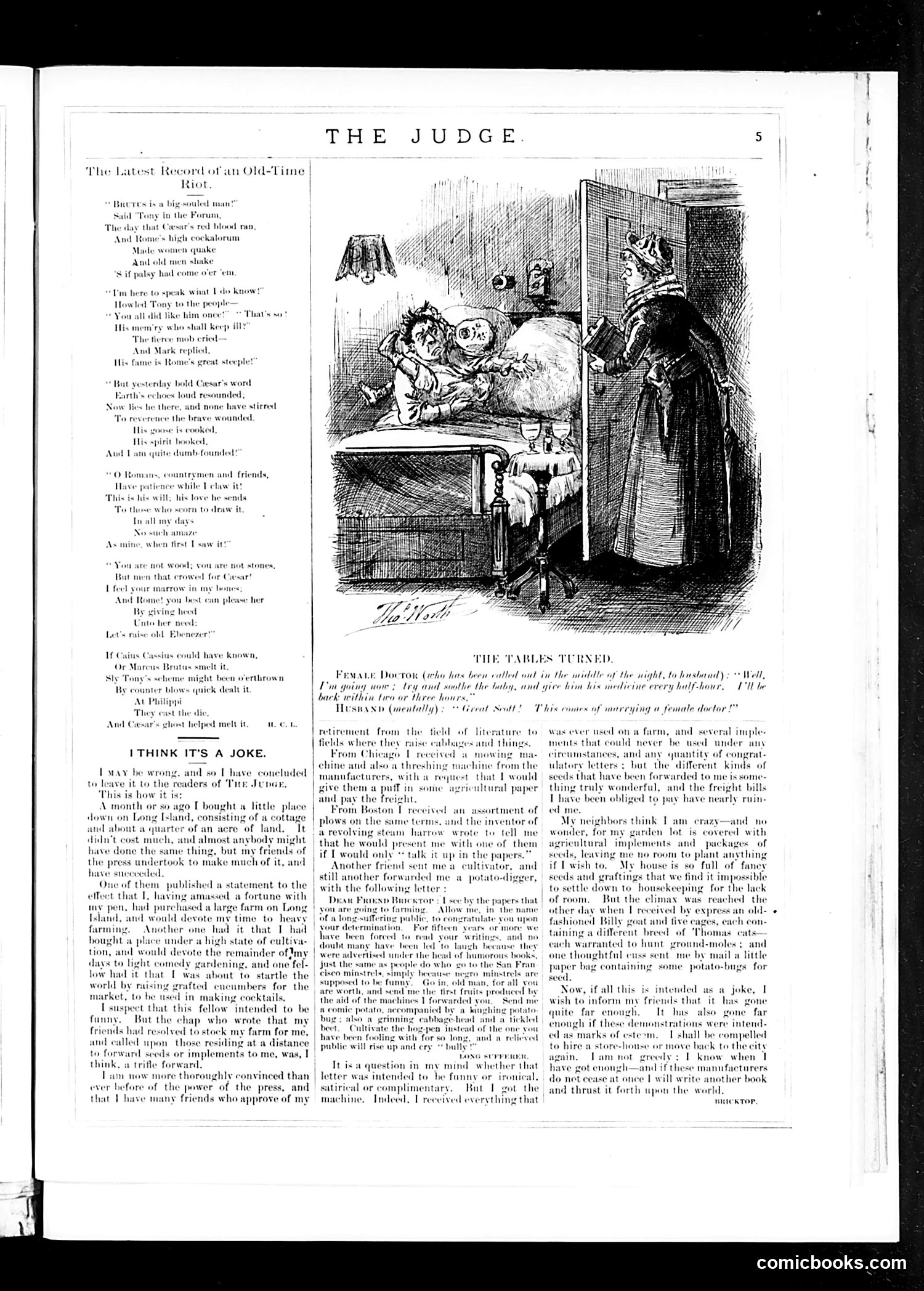
This Judge magazine page contains two distinct pieces: **"I Think It's a Joke"** is a humorous essay where the author describes buying a modest cottage on Long Island. The press sensationalized it as a "large farm," prompting well-meaning readers to send him agricultural equipment (plows, harrows, cultivators) based on the exaggerated newspaper accounts. The author satirizes the press's power to distort reality and how readers uncritically accept what they read, leading to absurd consequences. **"The Tables Turned"** is a cartoon joke about role reversal: a female doctor leaves her husband with instructions to care for their baby and give medicine "every half-hour," then departs on a house call. The husband mentally exclaims this is what comes from "marrying a female doctor"—inverting traditional gender roles where wives waited home while husbands worked. The satire mocks resistance to women in professional medicine by depicting domestic disruption as the "punishment" for such ambition. Both pieces reflect late 19th/early 20th-century anxieties about press reliability and changing social structures.
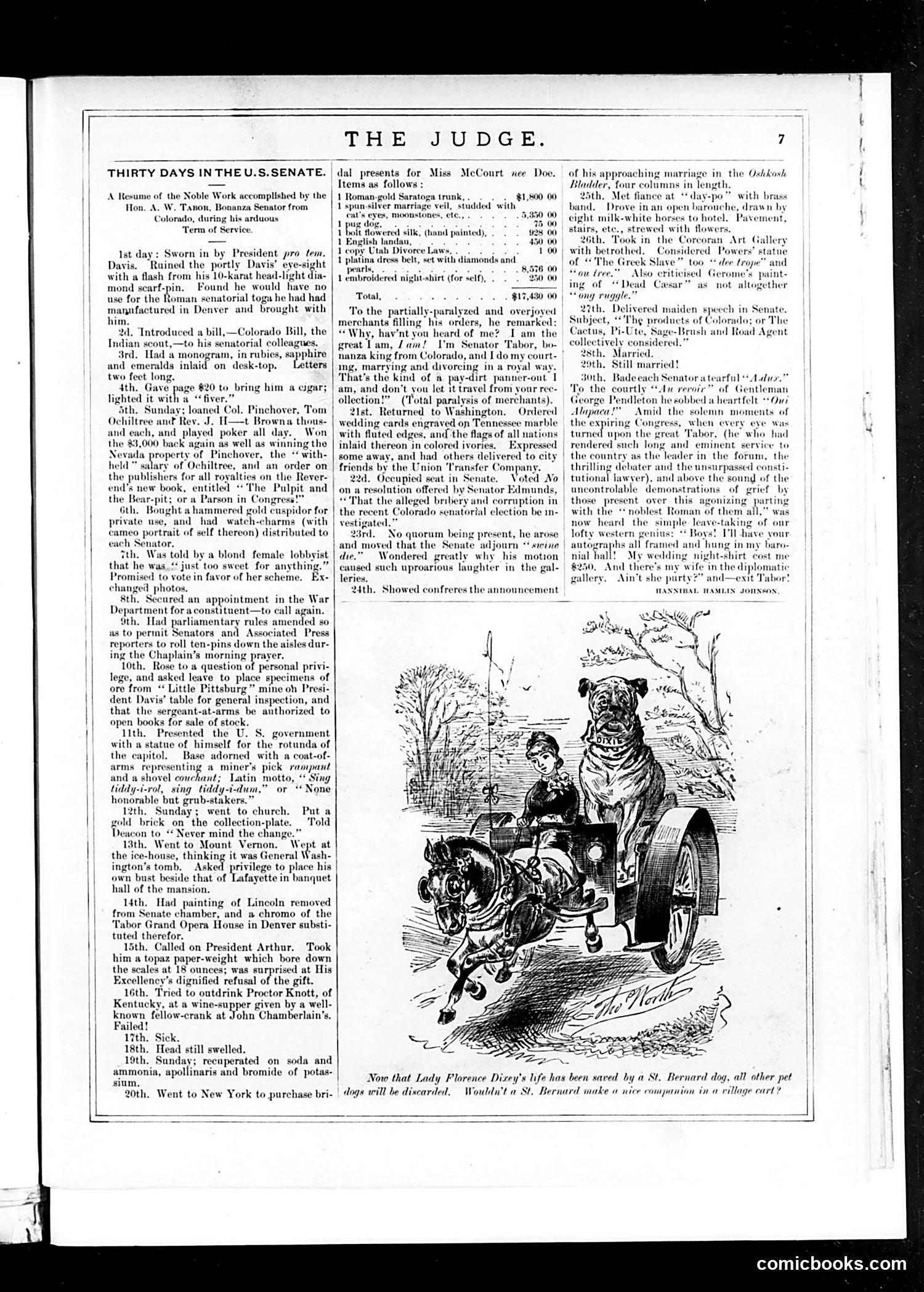
This page mocks **Senator A.W. Tabor**, a Colorado "Bonanza Senator" (wealthy mining magnate newly elected to office). The cartoon catalogues his absurd first month in the Senate, satirizing his vulgar ostentation and complete unsuitability for public service. Tabor's behavior includes: blinding colleagues with his diamond pin, bribing officials with poker winnings and mining stock, attempting to install his mistress's portrait in the Capitol, placing his mine's chromo over Lincoln's portrait, failing to outdrink other senators, and repeatedly getting sick from excess. The satire targets the **Gilded Age problem** of enormously wealthy industrialists buying their way into politics with zero governmental experience or decorum. The closing illustration shows him with a St. Bernard dog—likely referencing his absurd pretensions. The final caption jokes that even a dog would make better company than Tabor in refined society.
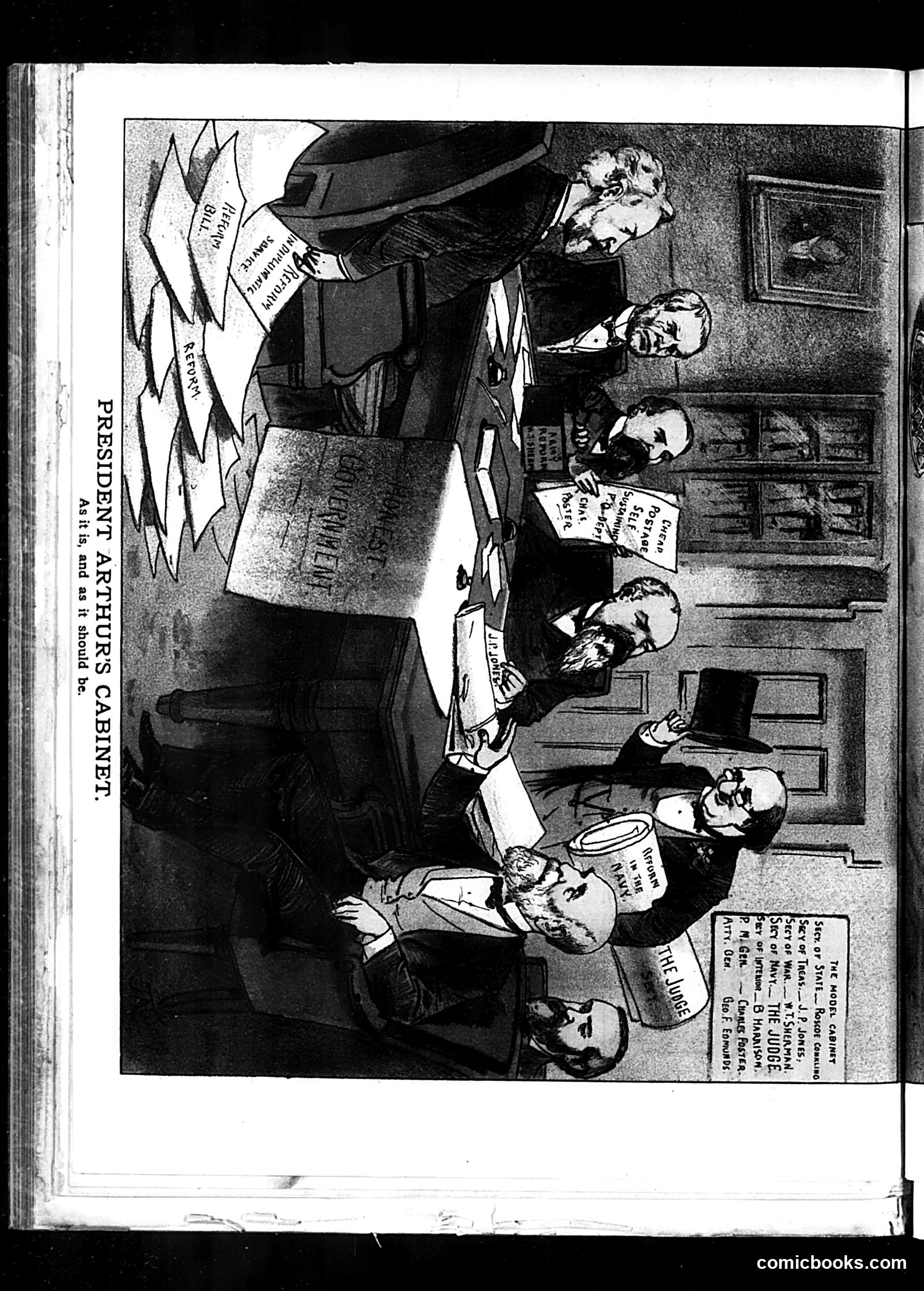
This Judge magazine cartoon satirizes President Chester Arthur's actual cabinet appointments, presenting them as "The Model Cabinet" with mock-serious labels. The image appears to show Arthur presiding over various political figures labeled with cabinet positions. The satire likely mocked the quality or appropriateness of Arthur's real cabinet choices—a common target for Judge's political humor. By presenting them as an ideal "model," the cartoonists employed irony to criticize the selections. The visible names (Sherman, Jones, Edmunds, etc.) were actual or proposed appointees whose qualifications or political alignments apparently drew the magazine's skepticism. This reflects the Gilded Age political climate where cabinet appointments were frequently criticized as patronage-driven rather than merit-based.
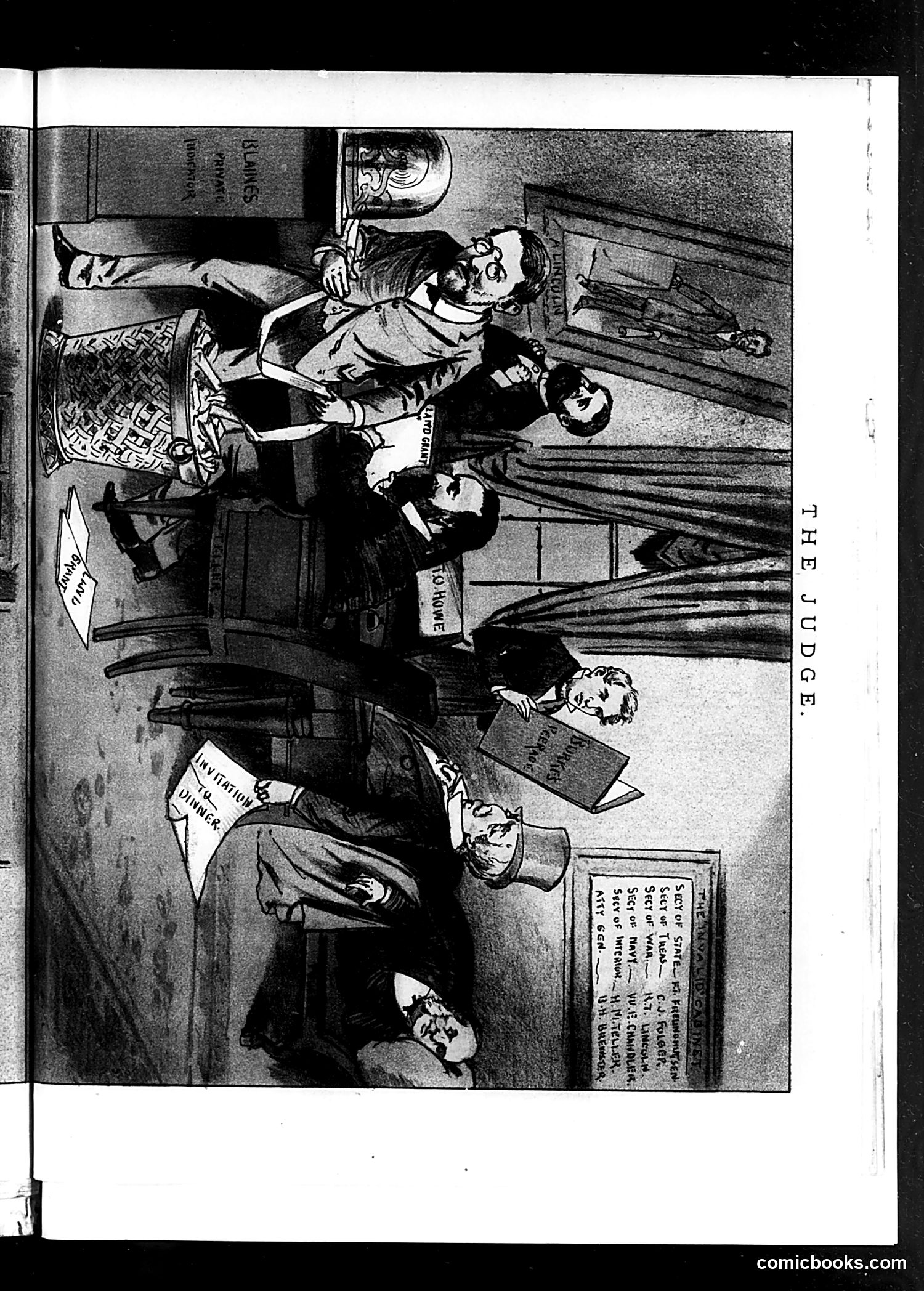
This page is titled "THE JUDGE" and appears to be a satirical illustration, though the OCR text is too corrupted to read clearly. The image shows what appears to be a courtroom or legal proceeding scene with multiple figures in formal dress. The composition suggests a commentary on the judicial system or legal process, which was a common subject for *Judge* magazine's political satire. The figures appear to be caricatured officials or lawyers, though specific identities cannot be determined from the visible elements. The scene's setup—with figures arranged around what seems to be a judicial setting—implies commentary on how justice was administered or perceived during the period this was published. Without legible text, the specific satirical point remains unclear, but the theatrical arrangement suggests criticism of legal proceedings or judicial authority.
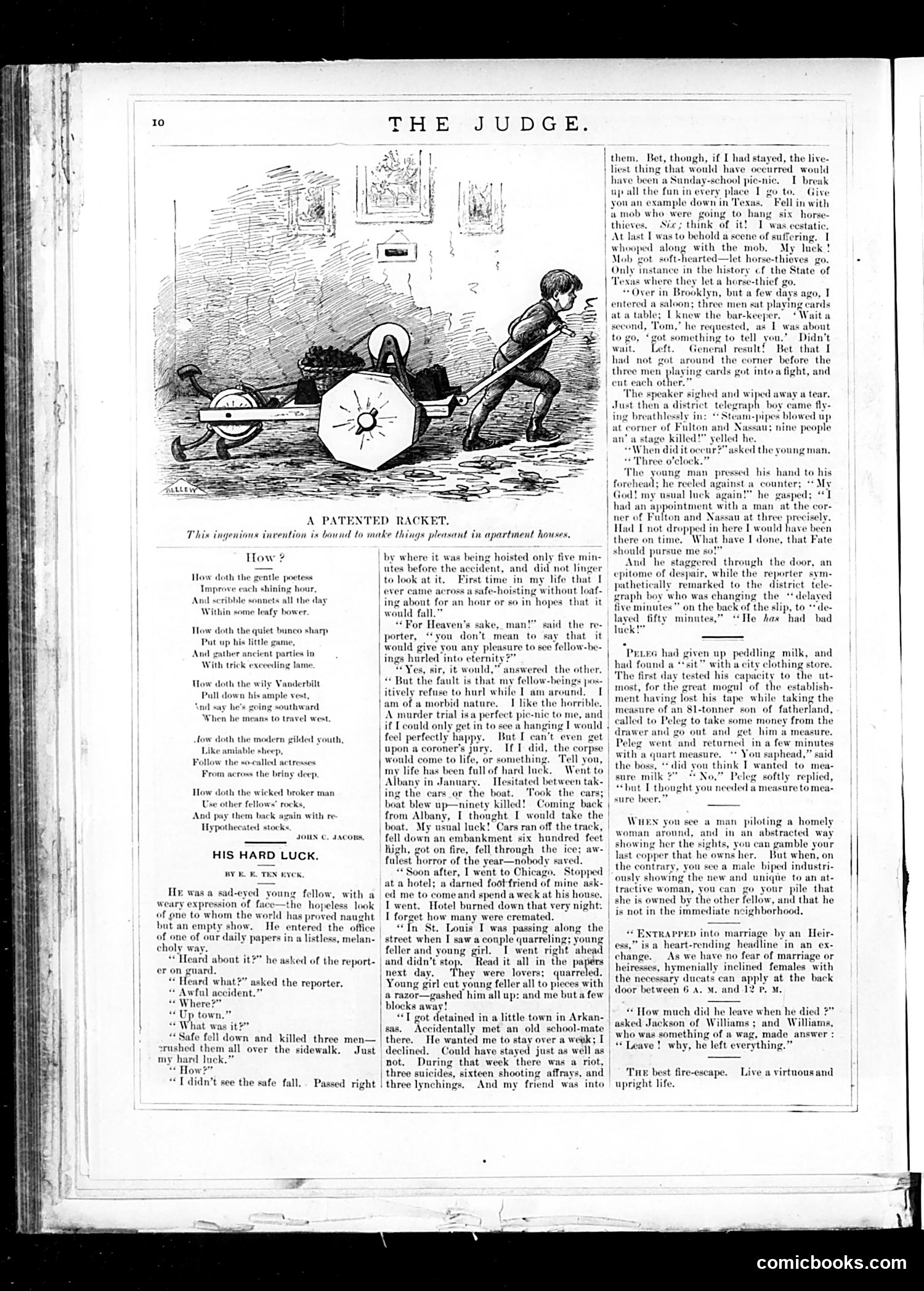
This page contains two satirical pieces from Judge magazine. **"A Patented Racket"** (top) mocks apartment dwellers' complaints through doggerel verse. The illustration shows a man struggling with an elaborate mechanical contraption—a "patented" device supposedly designed to make apartment living pleasant. The satire targets the proliferation of dubious gadgets marketed to urban residents as solutions to overcrowded tenement living. **"His Hard Luck"** (below) tells an anecdotal story in prose of a perpetually unlucky man who encounters misfortune everywhere—missed appointments, accidents, deaths. It's a darkly comic commentary on fatalism and the notion that some people seem born to bad luck. The repeated catalog of disasters serves as social commentary on fate versus personal responsibility in the Gilded Age, when many blamed circumstance rather than their own choices for poverty or failure. Both pieces are characteristic Judge satire: cynical, focused on urban middle-class anxieties, and skeptical of easy solutions or excuses.
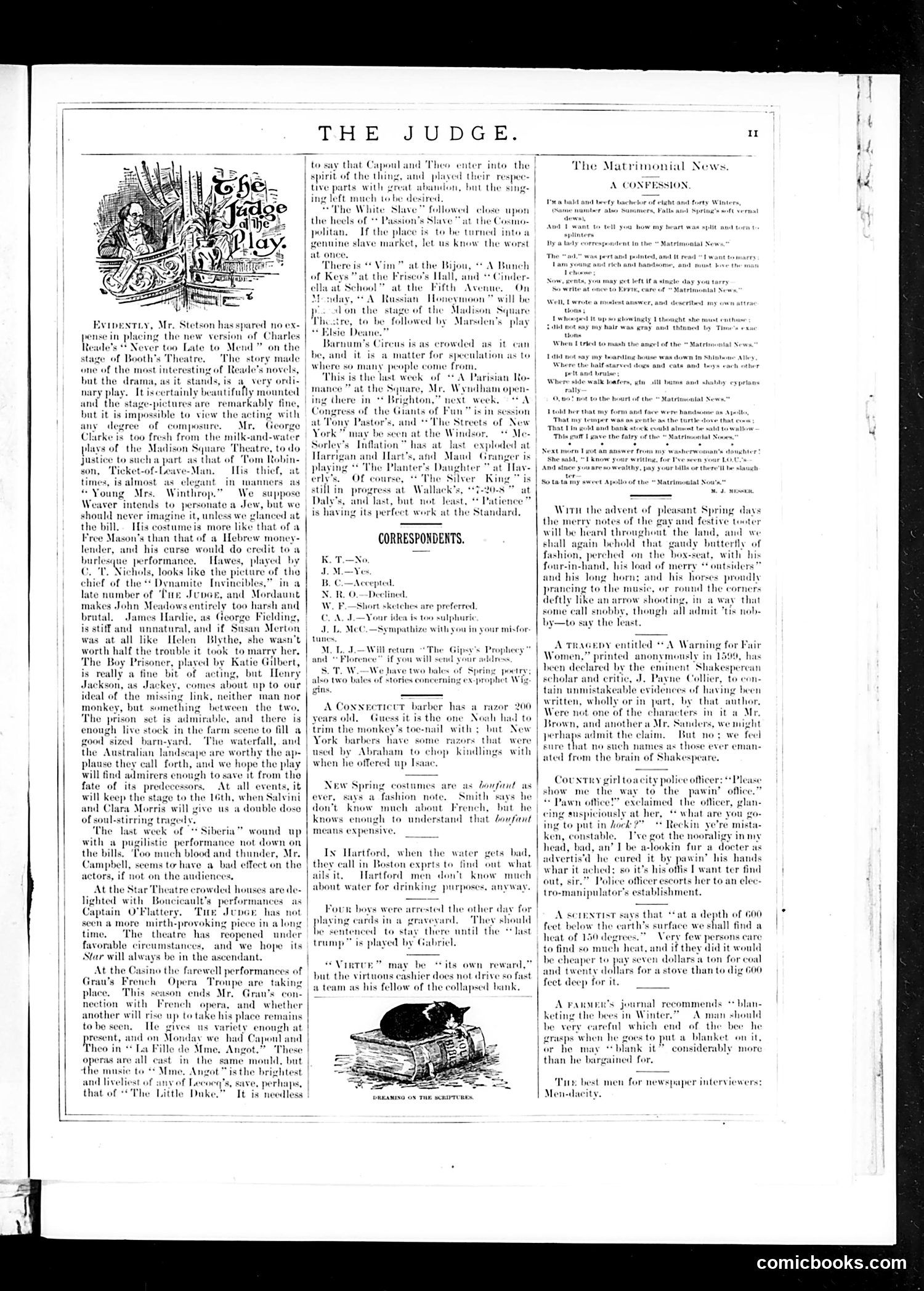
This page from *Judge* magazine contains theater reviews and a "Matrimonial News" column alongside a small illustration of a figure drawing on scriptures. **Main Content:** The left column discusses various theatrical performances, critiquing actors like Mr. Stetson and James Herne in productions at New York venues (Madison Square Theatre, Wallack's, Daly's). The reviews use contemporary standards of dramatic performance, praising some actors' naturalism while criticizing others' artificiality. **The "Matrimonial News" Section:** This appears to be a humorous advice column about courtship and marriage, using euphemistic language typical of Victorian-era satire. References to "outsiders," "four-in-hand," and "horses" suggest coded romantic/social commentary. **The Illustration:** The small engraving labeled "DRAWING ON THE SCRIPTURES" shows a figure at what appears to be a desk or lectern, likely satirizing someone misusing religious texts—though the exact target is unclear. **Overall Context:** This is typical of *Judge's* mix of theater criticism, social satire, and advice humor aimed at educated urban readers of the period.
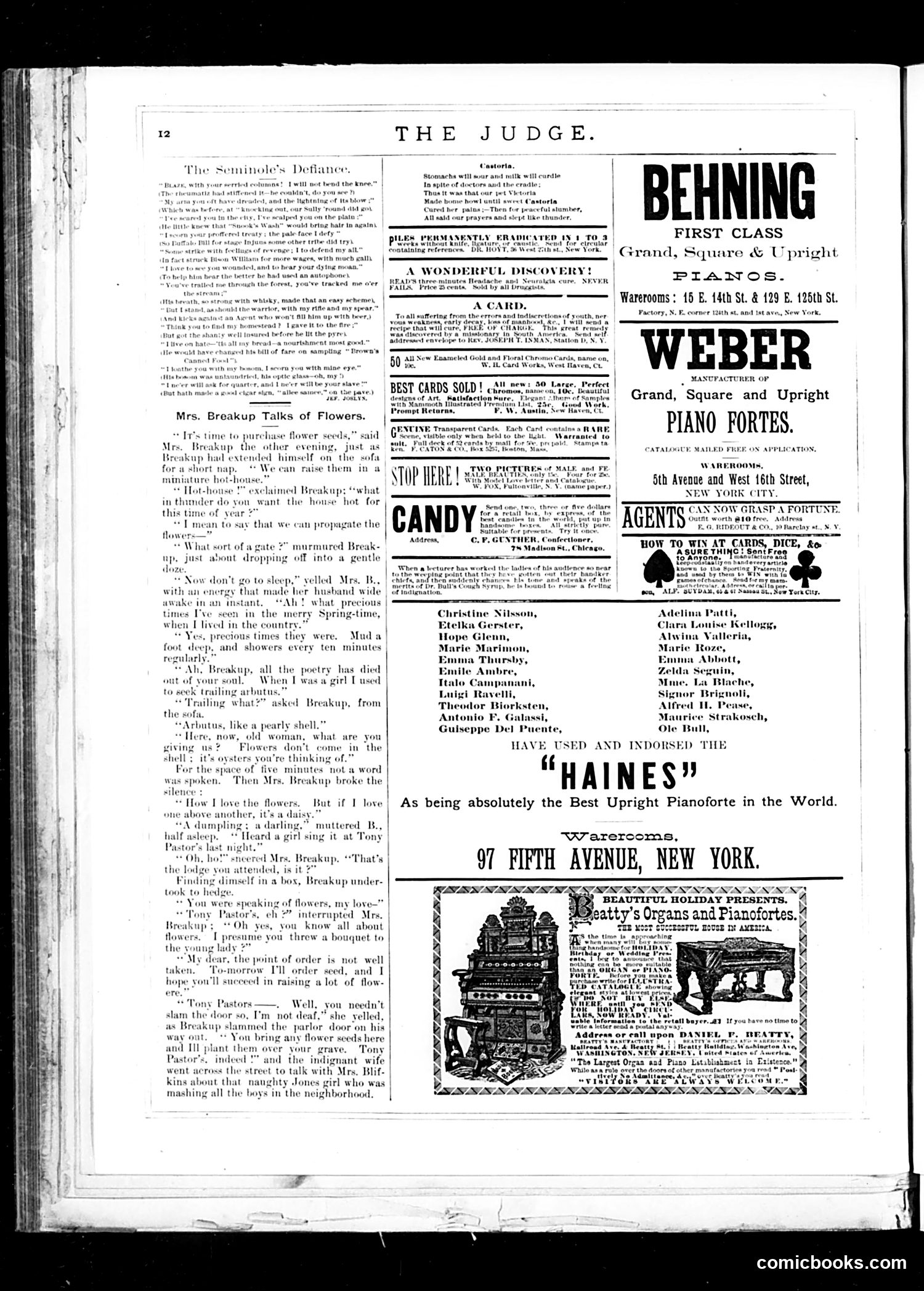
This page is primarily **advertising**, featuring piano and music product promotions typical of late 19th-century magazines. The main content is a domestic humor piece titled "Mrs. Breakup Talks of Flowers." ## The Cartoon/Story "Mrs. Breakup Talks of Flowers" is a marital comedy sketch satirizing the romantic idealism of women versus practical domestic reality. Mrs. Breakup wants to grow flowers indoors during winter—a hobby her husband finds frivolous and expensive. The humor derives from her flowery, nostalgic language about "trailing arbutus, like a pearly shell" contrasted with his gruff pragmatism ("what's the use?"). The satire mocks Victorian-era domestic tensions: wives' sentimental pursuits versus husbands' cost-consciousness, and the gap between romantic spring memories and harsh winter realities. When she threatens to slam doors and withhold affection, it reinforces period stereotypes about women using emotional manipulation in marriages. The page contains no political satire—only this gentle domestic humor alongside advertisements for pianos and patent medicines, typical Judge magazine fare from this era.
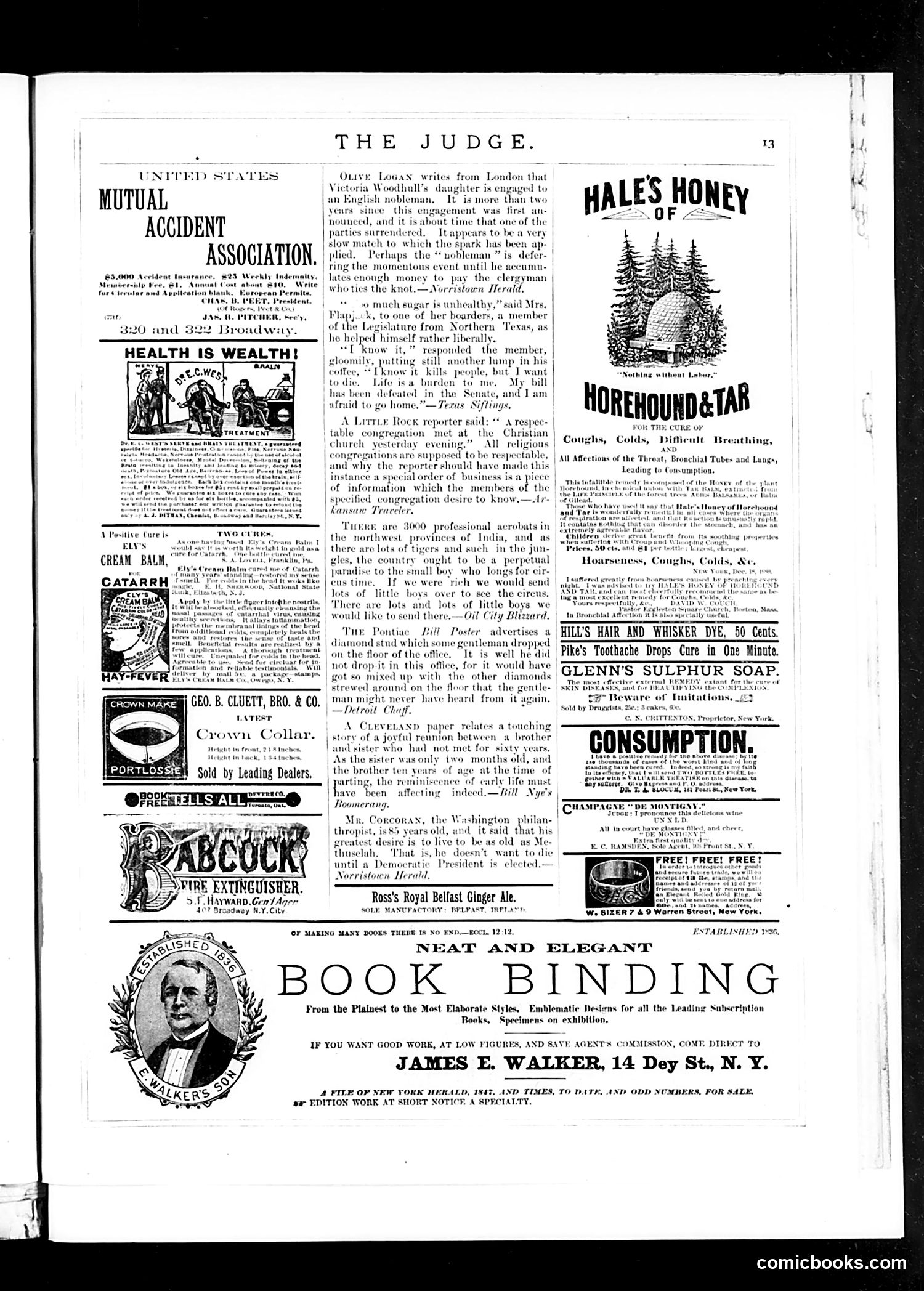
This page is **primarily advertisements** with brief satirical commentary interspersed. The visible content includes: **Satirical items:** Short gossip-column style jokes about contemporary figures and social situations—including references to Victoria Woodhull's daughter's engagement to an English nobleman, a congressman's depression about a defeated Senate bill, and various humorous anecdotes about human behavior. **Advertisements:** The bulk of the page features patent medicines (Hale's Honey, Horehound & Tar for coughs; Ely's Cream Balm; consumption "cure"), personal products (Hill's Hair and Whisker Dye; Pike's Toothache Drops; Glenn's Sulphur Soap), and services (book binding, fire extinguisher). These ads are typical of late 19th-century Judge content. **Notable:** The page includes an "Established 1786" book-binding advertisement—likely a dating clue—and reflects the magazine's reliance on advertising revenue alongside satirical content mocking contemporary society.
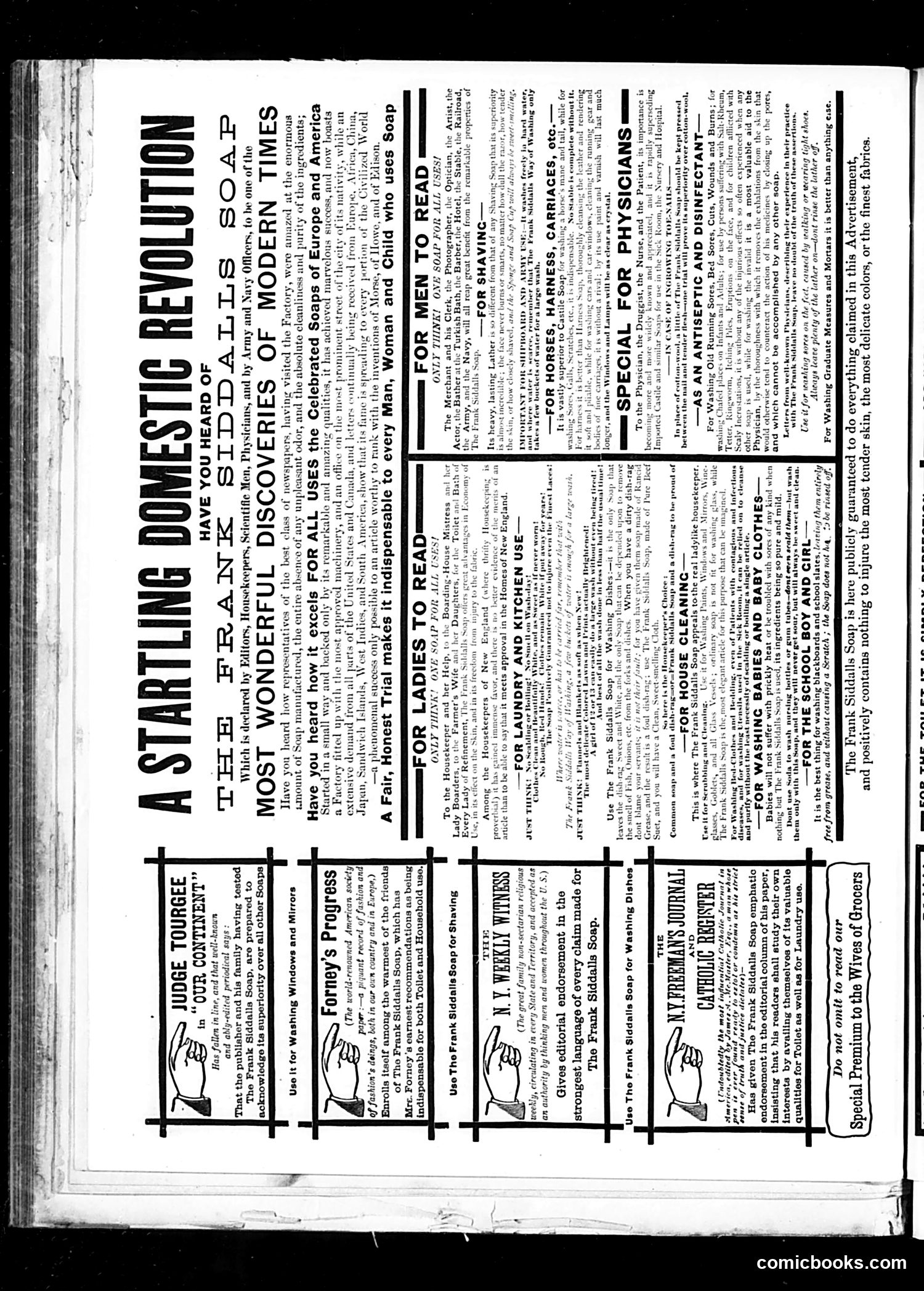
This appears to be a satirical advertisement or editorial piece from Judge magazine promoting domestic products and services. The OCR text is severely corrupted and largely illegible, making precise interpretation difficult. From what's visible in the layout, the piece contains multiple sections with illustrated hands (a recurring visual motif in Judge), discussing various household items and conveniences. The headline references a "domestic revolution," likely satirizing Americans' fascination with modern labor-saving devices and consumer goods. The repeated hand illustrations suggest the piece advocates for specific products or services to ease housework. The satirical angle probably mocks either the overselling of these products as revolutionary, or critiques changing domestic life in early 20th-century America. Without legible OCR text, I cannot identify specific products, companies, or the precise satirical target with confidence.
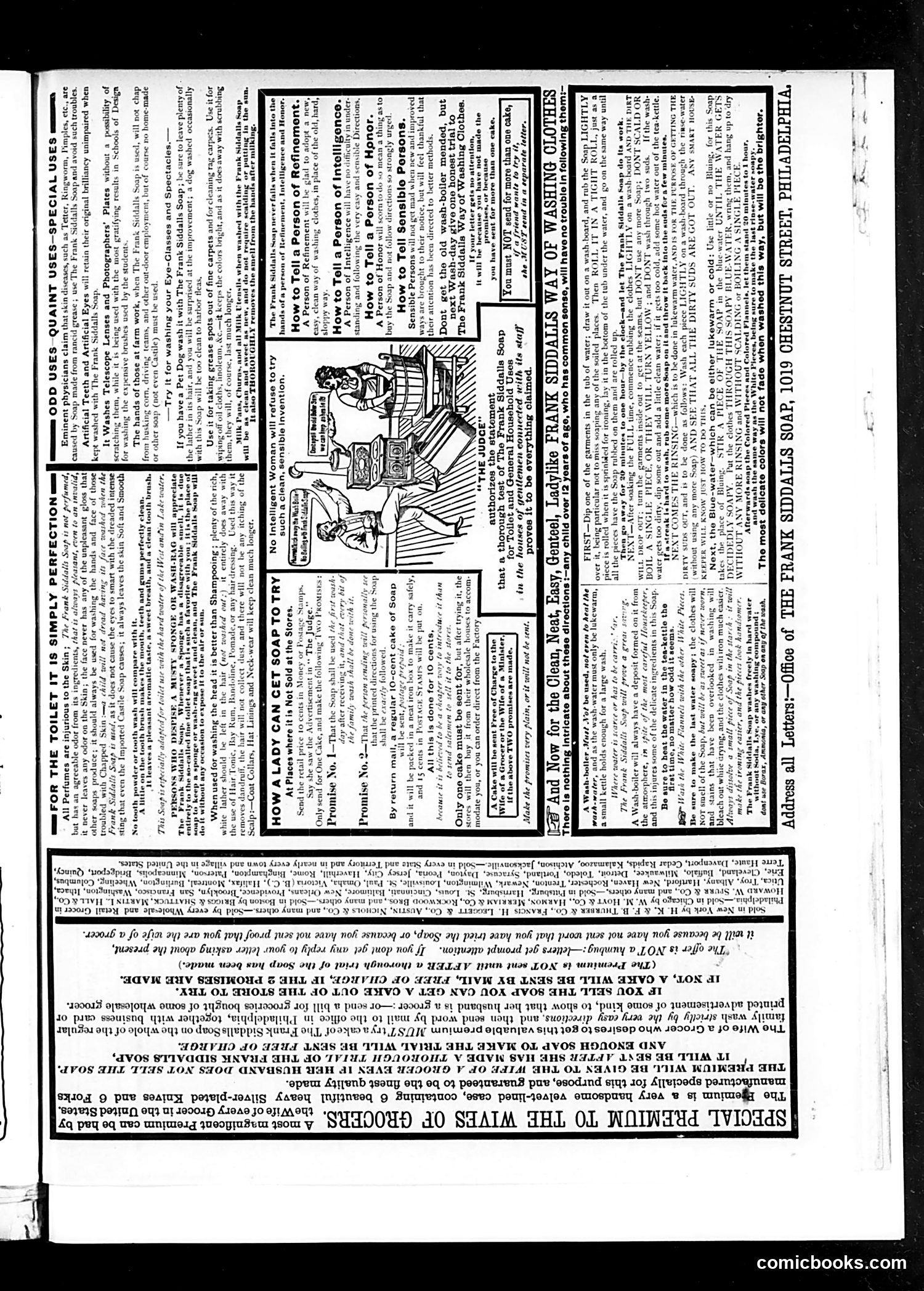
This page is primarily **advertising and classified notices** rather than editorial cartoons. The OCR text is heavily corrupted and largely unreadable, making specific identification of content difficult. However, visible elements include: - **Small illustrations** appear embedded within advertisement sections, typical of Judge's mixed format - **Text headers** reference topics like "HOW A CABINET IS FORMED" and various social/political commentary sections - The layout shows **multiple advertisement blocks** interspersed with what appear to be brief humorous pieces or advice columns Without legible OCR text or clearer image resolution, I cannot confidently identify specific political figures, events, or the satirical targets. The page appears to be from an early 20th-century issue given the typography and layout style, but the specific date and content remain unclear from this reproduction. **This page requires higher image quality or original publication information to analyze accurately.**
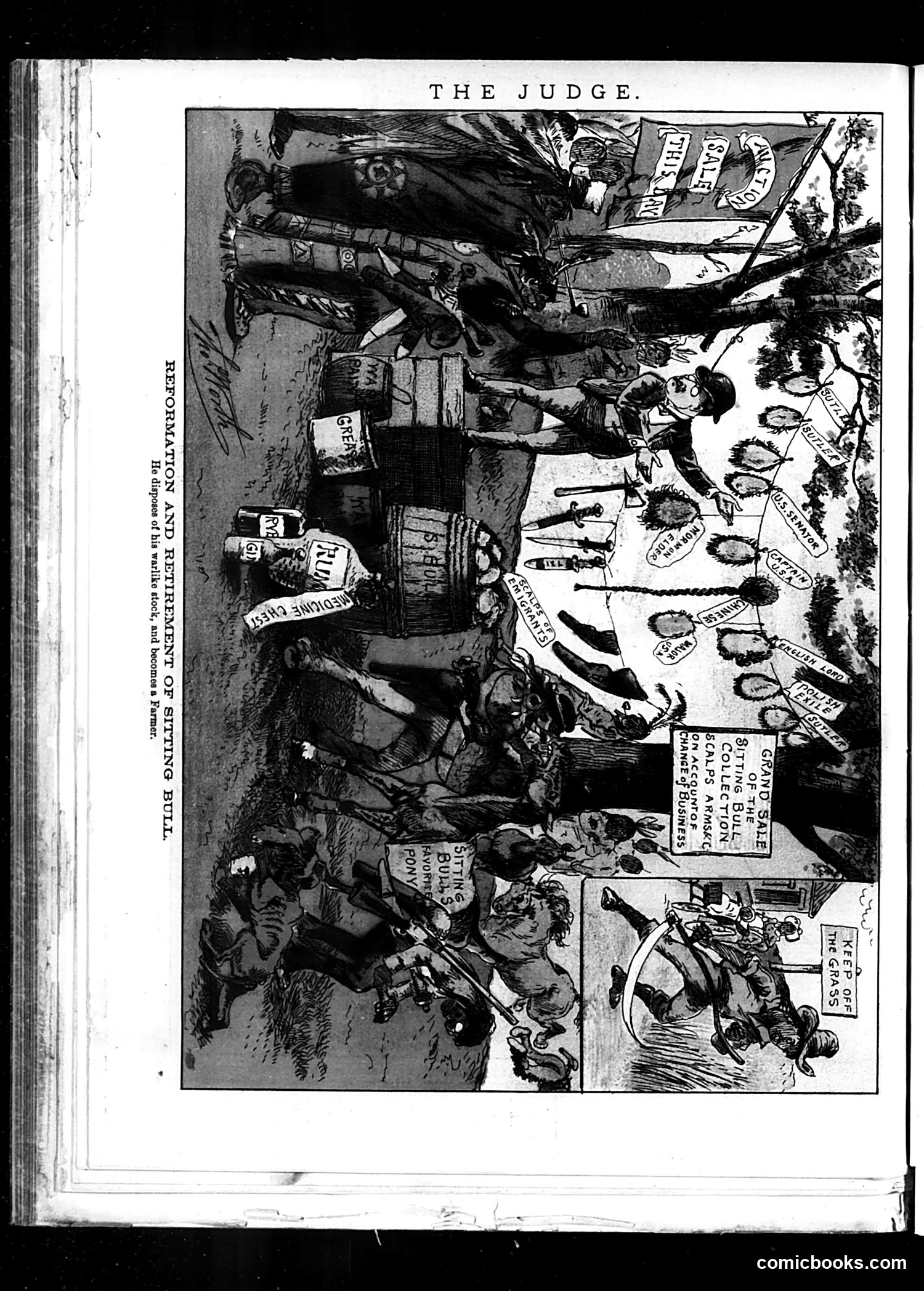
This satirical cartoon depicts **Sitting Bull**, the famous Lakota Sioux leader, as the central figure. The cartoon's title indicates it mocks his supposed "reformation and retirement" into farming. The satire appears to lampoon the U.S. government's assimilationist policies toward Native Americans—specifically the pressure to abandon traditional ways and adopt European-American agricultural lifestyles. The visible text references selling "scalps," "arms," and other "warlike stock," treating indigenous culture as mere inventory to be liquidated. The surrounding figures and labels (though OCR text is unclear) likely represent government officials, settlers, or other parties profiting from this forced "civilization" process. The humor is bitterly ironic: it presents cultural erasure as commercial transaction, mocking both the policy's violence and Sitting Bull's supposedly willing participation. This reflects late-19th-century attitudes about Native American assimilation.