
A complete issue · 16 pages · 1883
Judge — March 10, 1883
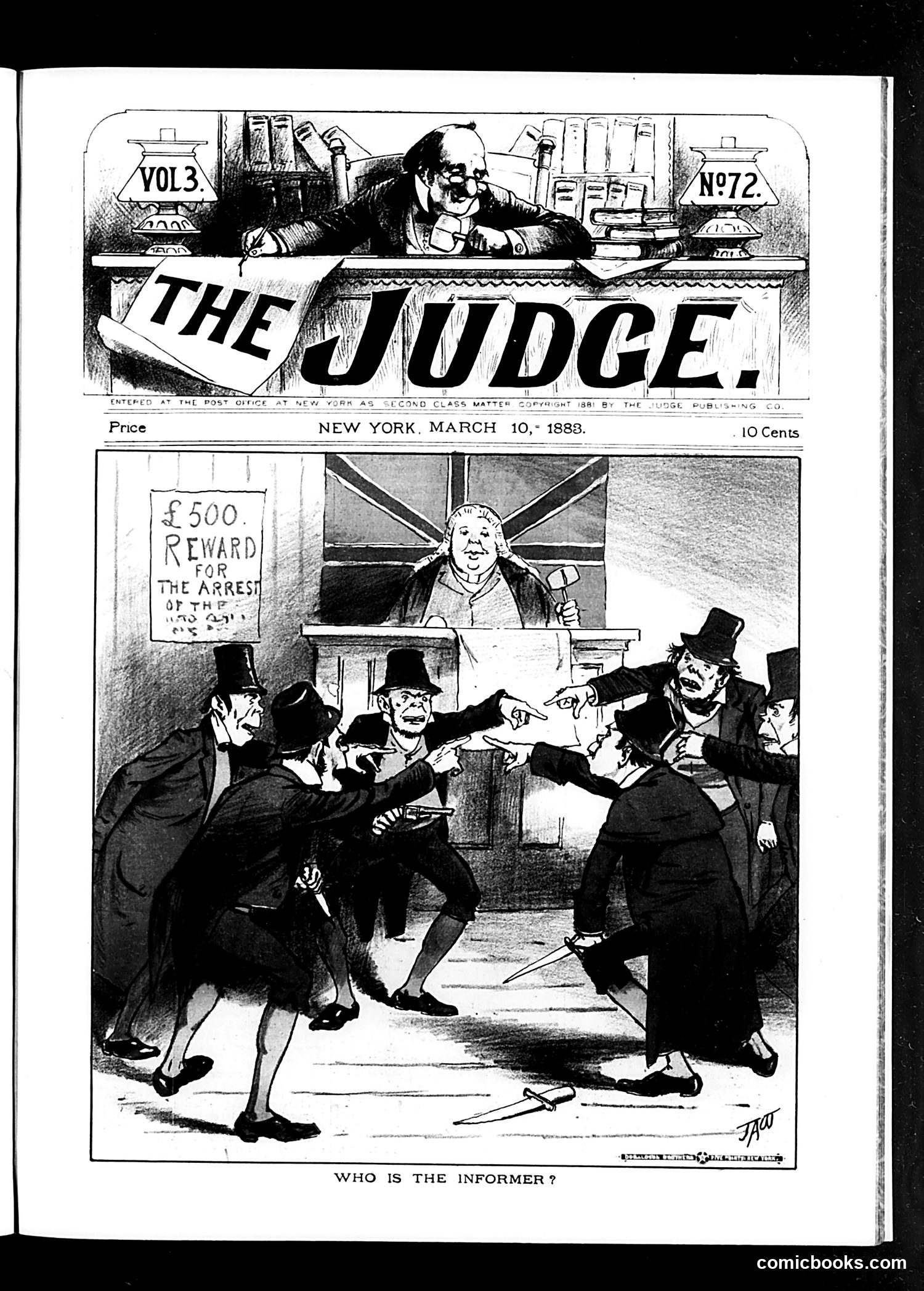
This cartoon depicts a courtroom scene centered on a £500 reward notice for arrest of an unnamed person. The judge presides while well-dressed men in top hats below appear to be accusing or confronting one another, with gestures suggesting heated debate or suspicion. The caption "Who Is the Informer?" indicates the satire targets uncertainty about identifying an informant or whistleblower in some contemporary case. The exaggerated caricatures and dramatic body language suggest mutual accusation among the figures—each potentially the guilty party. Without additional context identifying the specific 1888 incident referenced, the cartoon's exact political target remains unclear, though it likely mocks either a sensational criminal case or political scandal involving conflicting testimony and reward-seeking behavior.
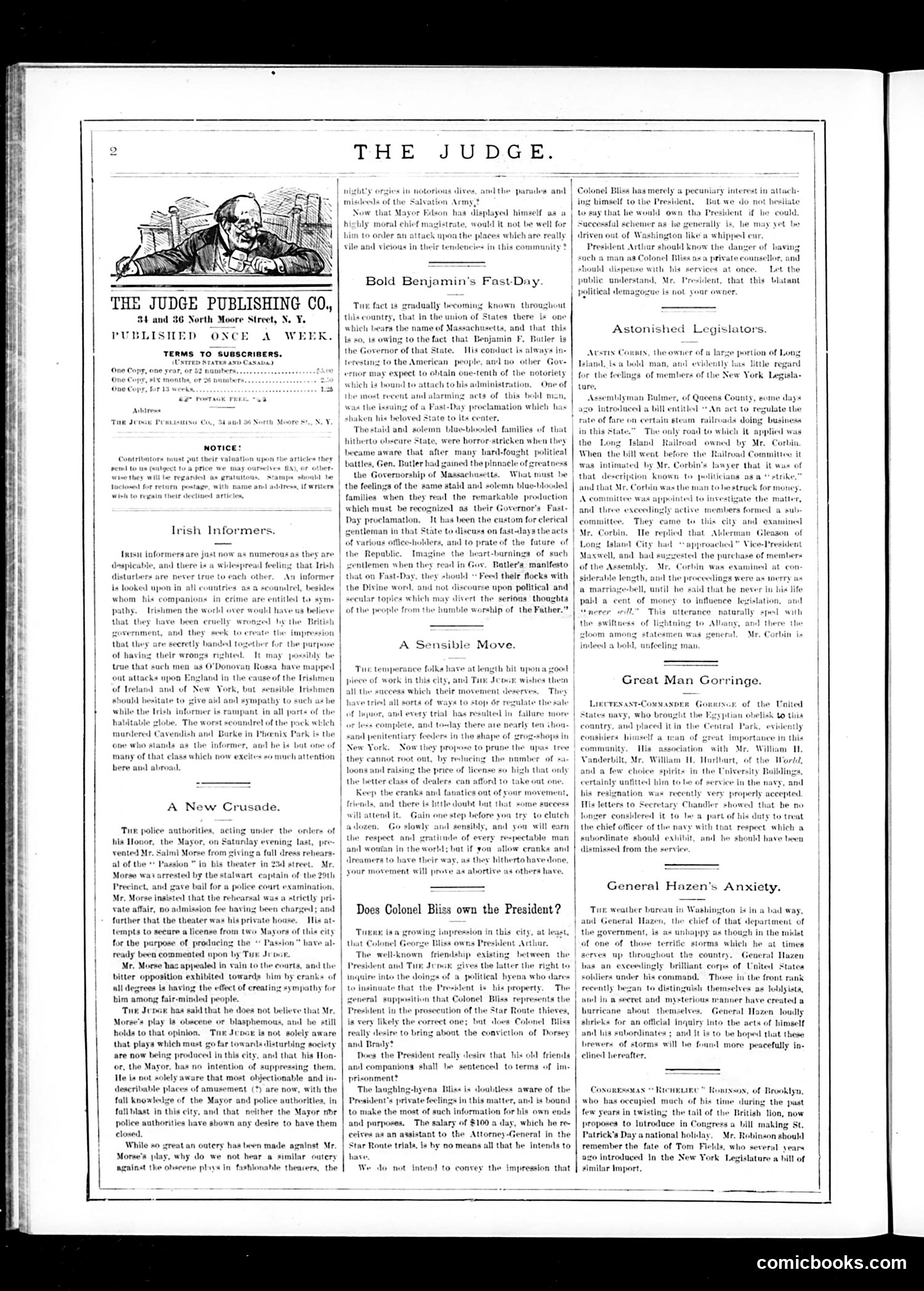
This page from the satirical magazine *Judge* contains several political commentaries: **"Bold Benjamin's Fast-Day"** mocks Massachusetts Governor Benjamin Butler for issuing a proclamation declaring a fast day. The satire suggests Butler's proclamation is hypocritical and will disturb the "staid and solemn" citizens of Massachusetts by requiring religious observance while discussing secular political topics—implying Butler uses religion opportunistically. **"Irish Informers"** criticizes Irish informants who betray nationalist causes to British authorities, labeling them society's worst scoundrels. This likely references contemporary Irish independence tensions and the controversial Phoenix Park murders (1882). **"A New Crusade"** reports on Mayor's attempts to suppress Salmi Morse's theatrical production of "The Passion," suggesting overzealous moral policing. The piece critiques inconsistent enforcement of obscenity laws. **"Does Colonel Bliss own the President?"** questions whether Colonel Bliss inappropriately influences President Arthur through their relationship, raising concerns about nepotism and conflicted interests in government. The page reflects 1880s American anxieties about corruption, religious hypocrisy, and political favoritism.
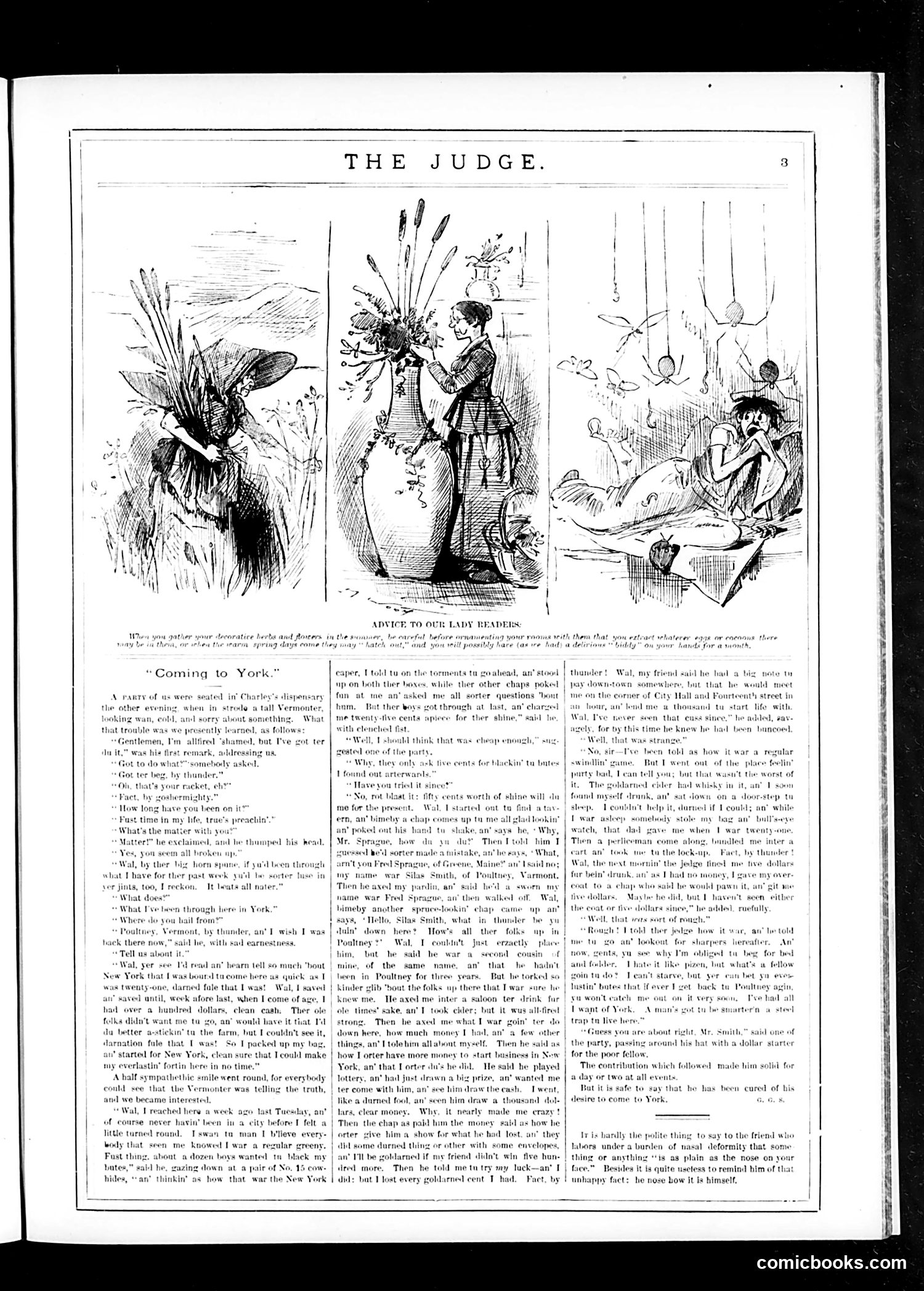
This page presents a cautionary tale titled "Coming to York" [likely York, Vermont], featuring three illustrated panels and accompanying narrative text. The story depicts a naive rural Vermonter who travels to New York City seeking fortune. The satire targets both the countryman's gullibility and urban con artists. The protagonist, Silas Smith from Poultney, Vermont, is swindled by city slickers who exploit his trusting nature. After winning money in a lottery (likely a scam), he's manipulated into various schemes—the text references him being robbed repeatedly through fraudulent business propositions and false friendships. The cartoon illustrates his progressive deterioration: the first panel shows him arriving hopefully; the middle depicts his encounters with smooth-talking city folk; the final panel suggests his defeat and desperation. The piece satirizes the collision between rural innocence and urban vice, a common theme in 19th-century American humor. It warns "lady readers" against similar deceptions, positioning the rural character as both sympathetic and foolish for his inability to recognize obvious con games.
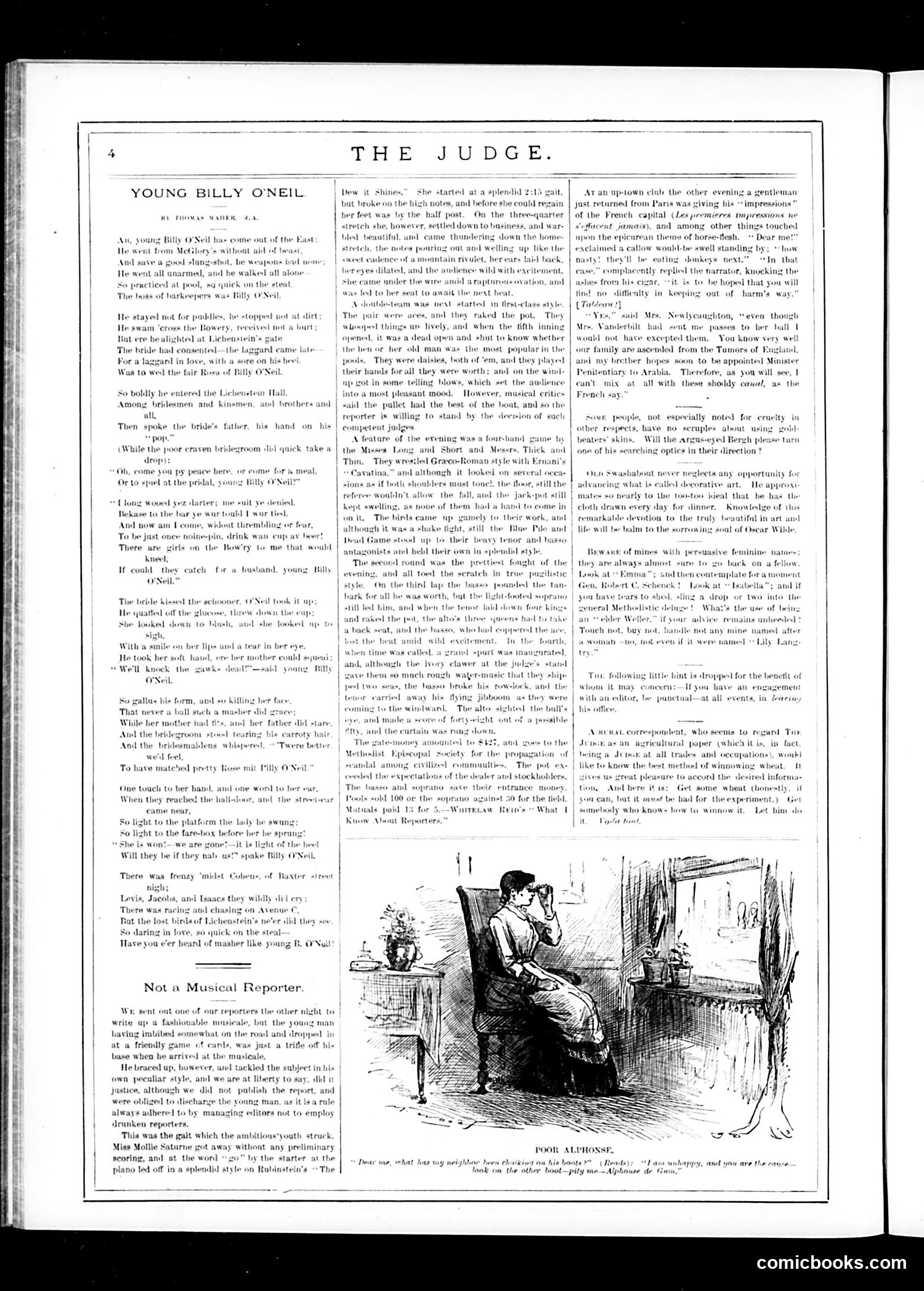
This Judge magazine page contains two satirical stories about working-class New York characters, typical of the era's popular entertainment. **"Young Billy O'Neil"** tells of a Bowery man who woos and wins a woman named Rosa, but loses her (and money) in a card game on their wedding day. The satire mocks both the recklessness of working-class romance and gambling culture. **"Not a Musical Reporter"** satirizes Judge's own profession. A drunk reporter is sent to cover a musical event but arrives intoxicated. The piece jokes about unreliable journalists—a common target of satirical magazines, which criticized rival papers and their unprofessional staff. The story suggests even inebriated reporters could file acceptable reports, poking fun at journalistic standards of the time. Both stories reflect Judge's comedic focus on lower-class city life, with crude humor and moral lessons about vice (gambling, drinking). The accompanying sketch illustrates a man at a piano, likely depicting the musical reporter scene.
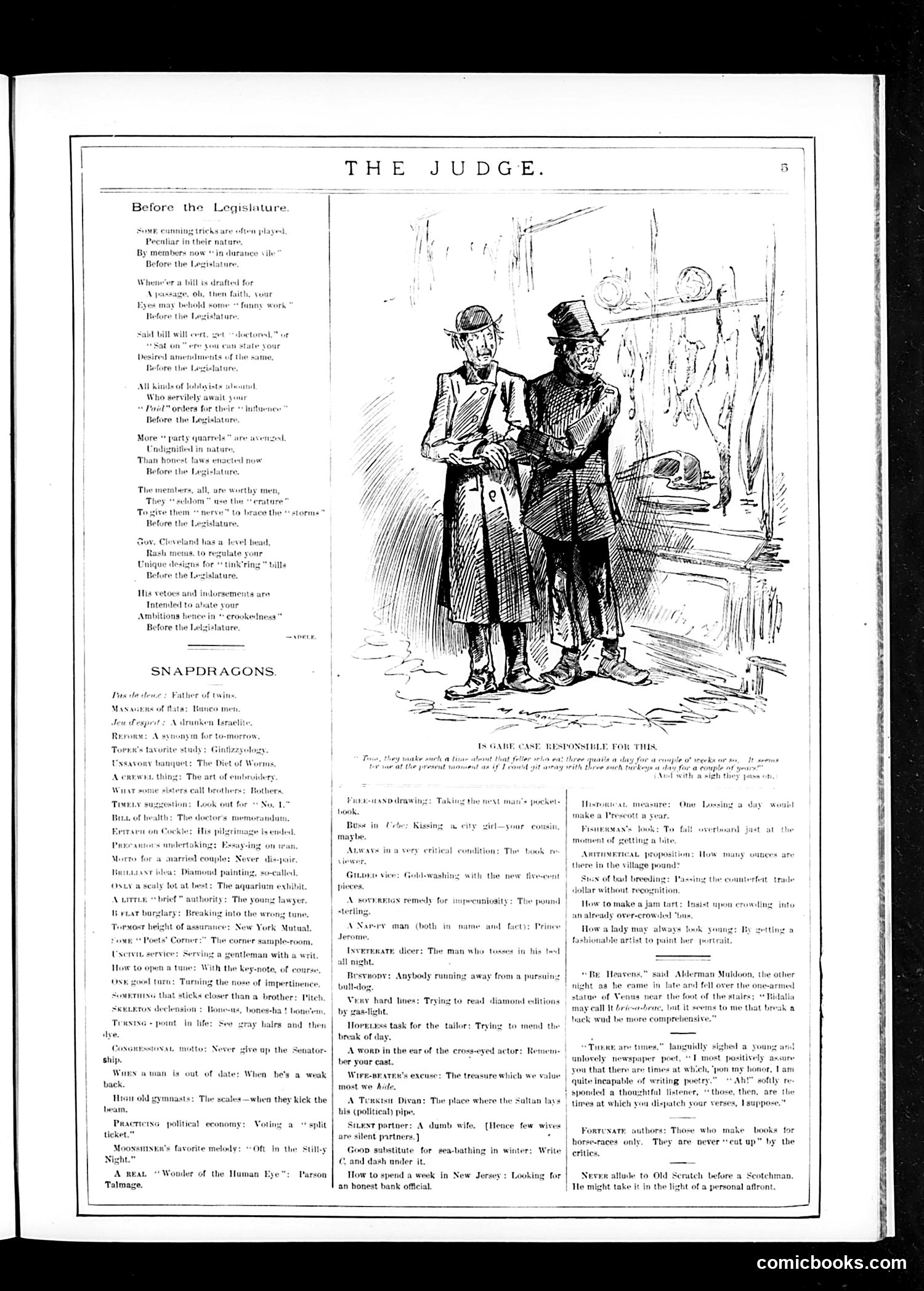
This page satirizes members of the state legislature through a central cartoon and accompanying "wit" definitions. The main illustration shows two shabby, poorly-dressed men (appearing to represent corrupt legislators) standing together, captioned "Is Gabe Case Responsible for This?"—likely referencing a specific scandal or legislative figure of the era. The surrounding text consists of cynical one-liners mocking legislative behavior: how bills are drafted through "cunning tricks," how members use "insurance clubs" to hide misconduct, and how legislators manipulate procedures "before the Legislature." The overall point is clear: American state legislatures of this period (likely late 19th century) were corrupt, incompetent bodies where shabby characters engaged in underhanded dealing. The satire targets both specific individuals and the general moral failure of legislative institutions. Without knowing who "Gabe Case" was specifically, the page's message about legislative corruption and personal dishonesty remains evident.
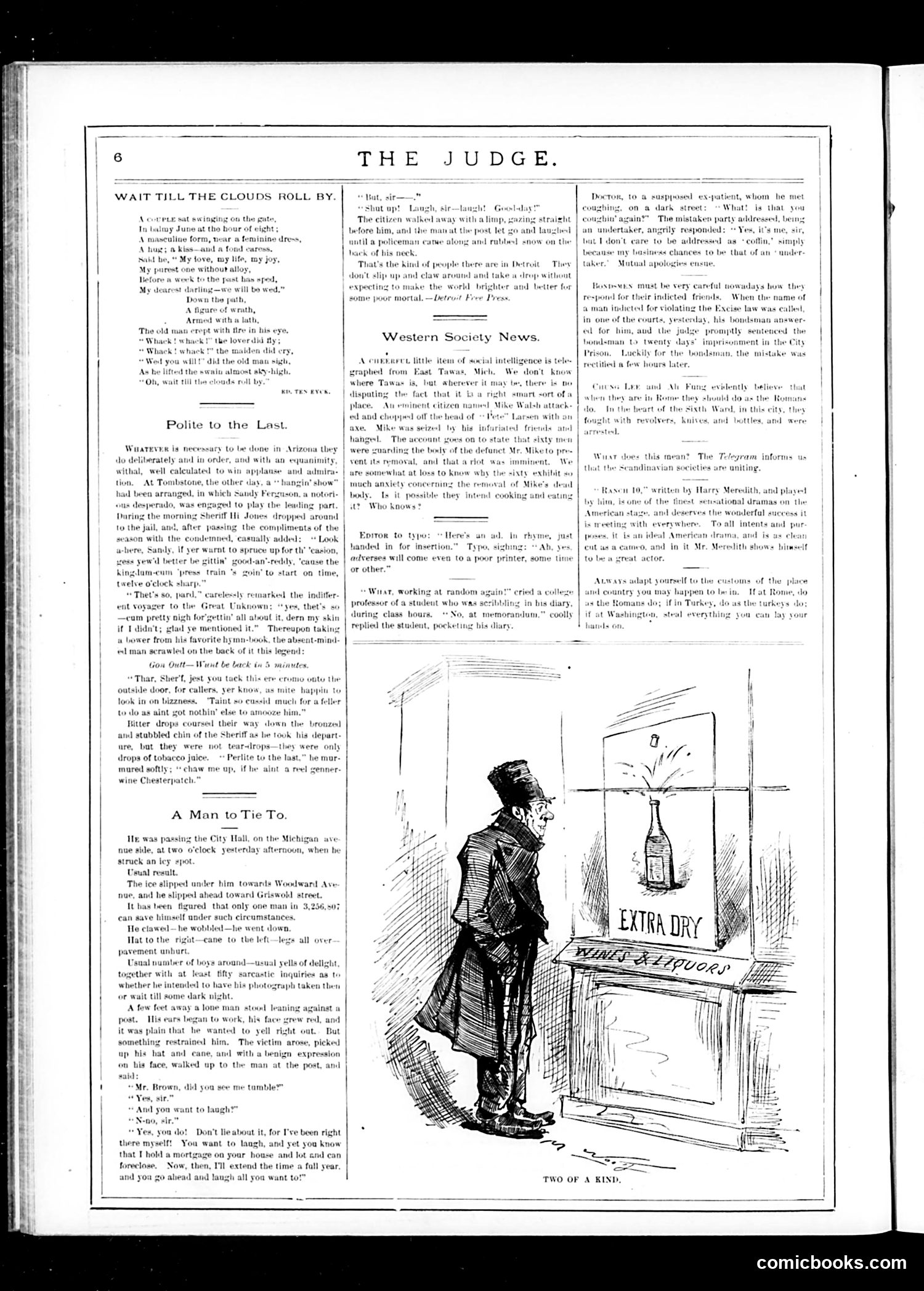
This page contains several satirical pieces typical of Judge's late 19th-century humor: **"Wait Till the Clouds Roll By"** presents a comedic domestic scene where a young couple's romantic moment is interrupted by the girl's father, who beats the suitor with a cane—a common trope mocking courtship customs and paternal authority. **"Polite to the Last"** satirizes frontier violence in Arizona/Tombstone, describing a condemned man's execution with exaggerated civility (scheduling it for noon sharp, writing polite farewell notes). This mocks the American West's reputation for lawlessness while simultaneously critiquing its peculiar etiquette even during capital punishment. **"A Man to Tie To"** relates an anecdote about a man who tumbles into a Michigan sewer but maintains composure afterward, restraining his anger despite humiliation. The joke satirizes repressed masculine pride and stoic dignity in embarrassing situations. **"Western Society News"** briefly reports on a dispute in East Tawas, Michigan involving a body and sixty men preventing its removal—likely satirizing small-town drama and sensational local incidents. The cartoons mock American social conventions, frontier culture, and male dignity.
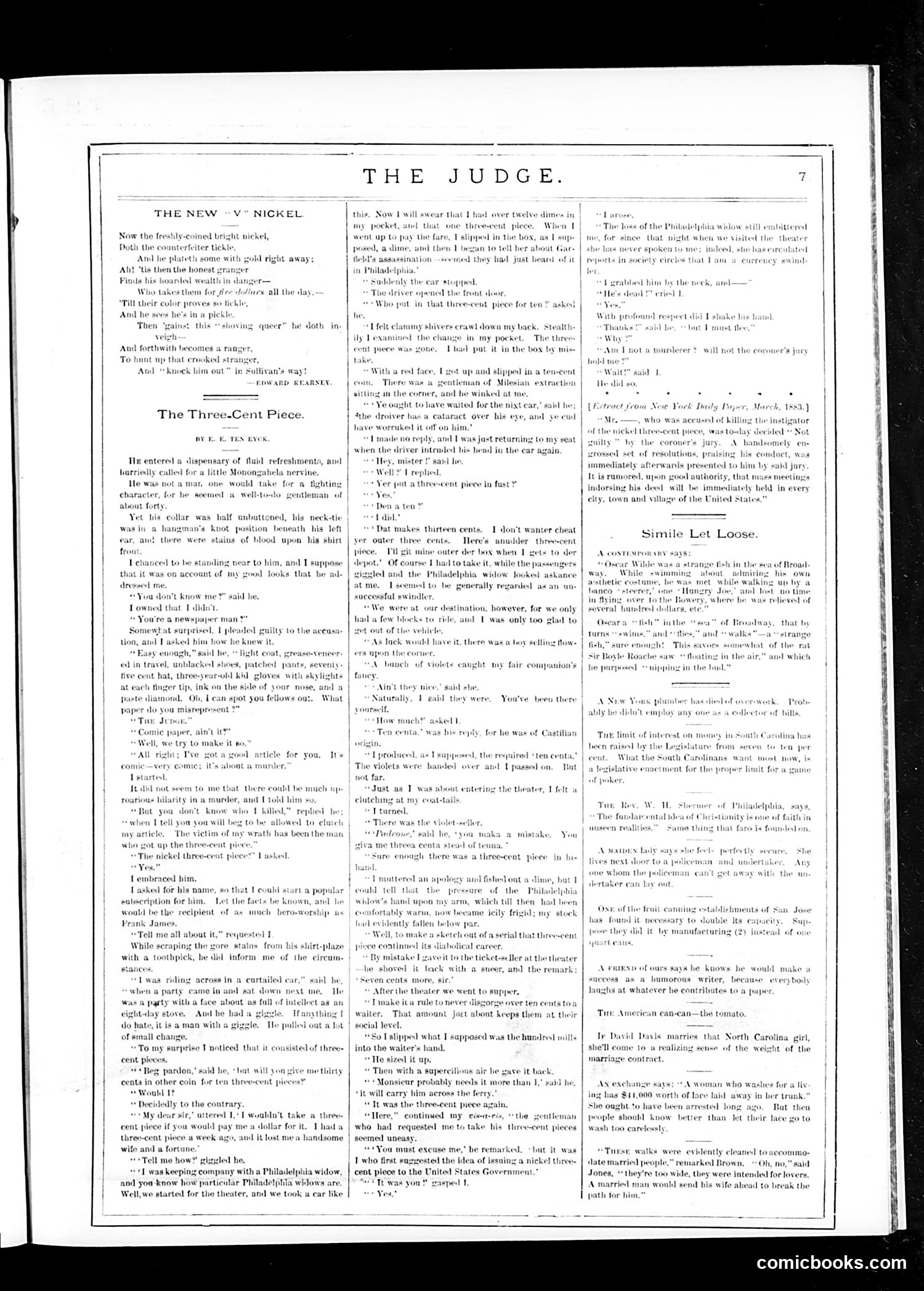
This page contains two satirical pieces about U.S. currency: **"The New 'V' Nickel"** and **"The Three-Cent Piece"** are humorous stories exploiting confusion over American coins. The satire targets the introduction of new currency denominations and public unfamiliarity with them. In "The Three-Cent Piece," a man tells of losing money—and a romantic opportunity with a Philadelphia widow—because he mistakenly paid her streetcar fare with a three-cent piece instead of a dime. The driver and other passengers mock him for the error. The joke satirizes both the impracticality of obscure coin denominations and the social embarrassment of financial mistakes. The humor relies on the absurdity of multiple similar-valued coins existing simultaneously, creating real opportunities for error and humiliation among ordinary people conducting daily transactions. This reflects genuine frustrations with 19th-century American currency complexity before standardization.
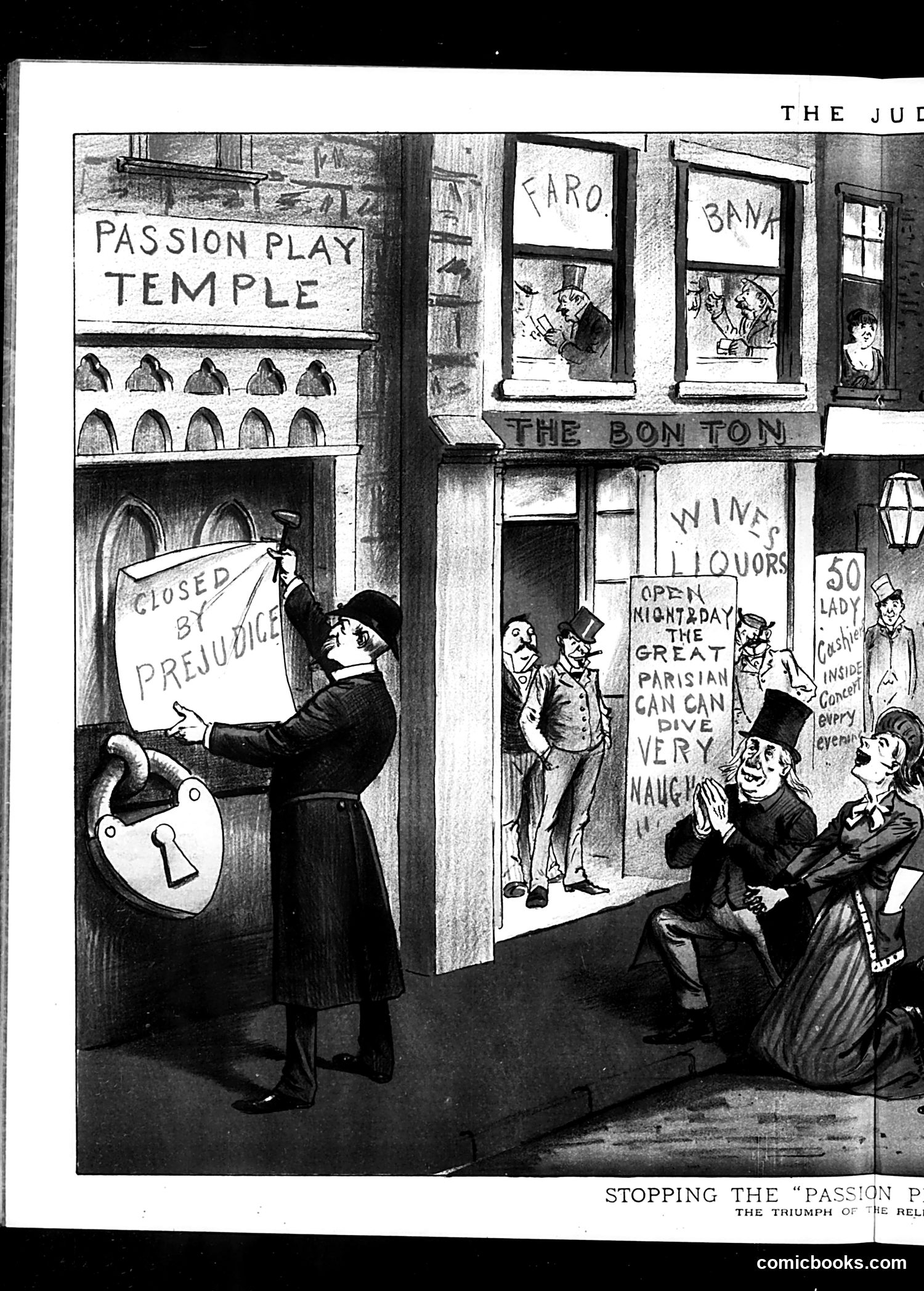
This cartoon satirizes religious censorship, specifically the closing of "The Passion Play Temple" by authorities citing "prejudice." The left panel shows an official posting a closure notice on a heart-shaped padlock, suggesting suppression of religious expression. The right panel depicts "The Bon Ton" establishment—a wine bar operating openly despite Prohibition—mocking the inconsistency: authorities aggressively shut down a religious venue while ignoring illegal alcohol sales. Signs advertise "Faro" (illegal gambling) and wines/liquors. The satire's point: authorities selectively enforced laws based on bias, tolerating vice while suppressing religion. This likely references early 20th-century controversies over banning "Passion Play" performances, which some deemed blasphemous or culturally problematic, while simultaneously tolerating speakeasies and crime.
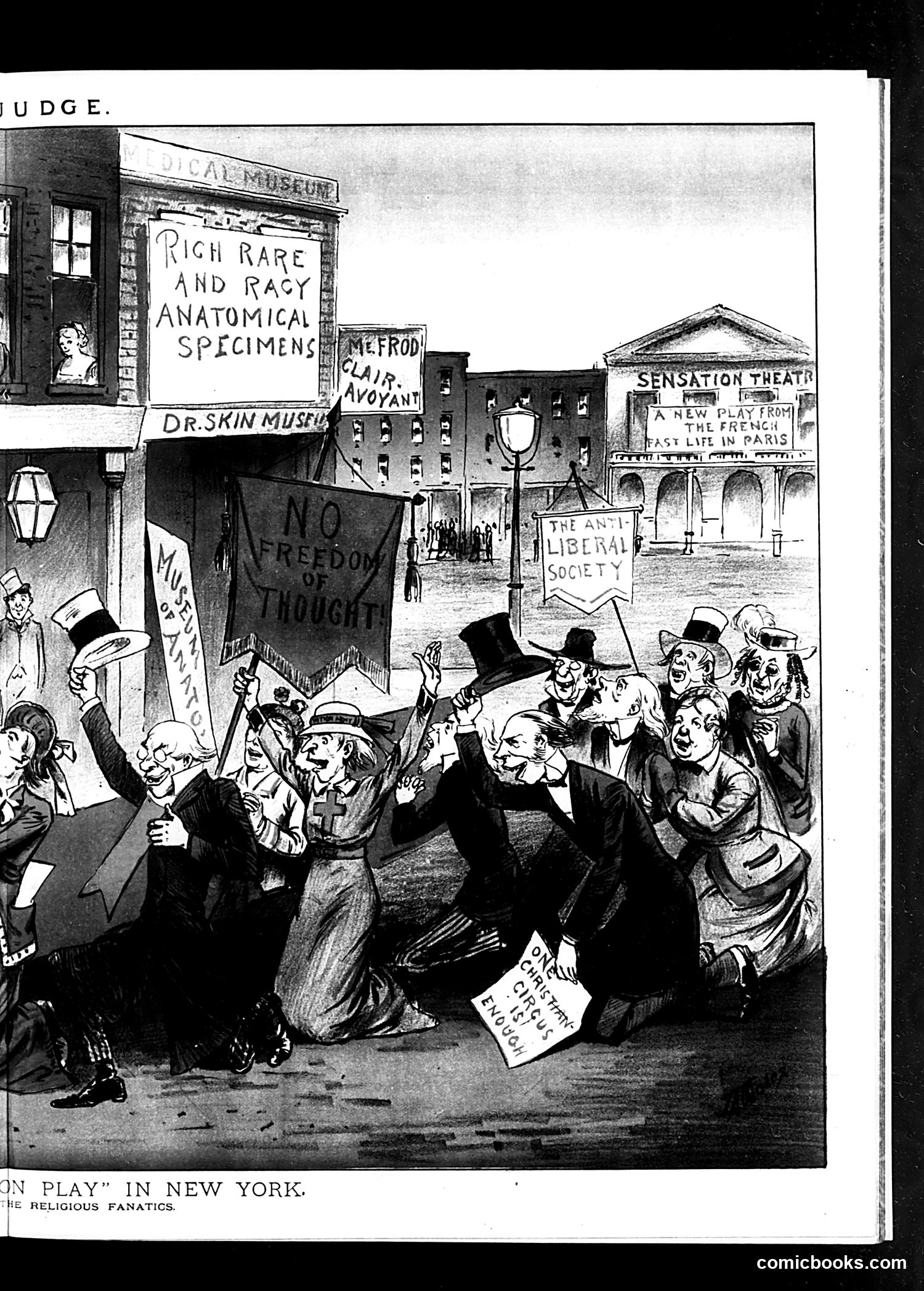
This satirical cartoon from *Judge* depicts a street protest scene with caricatured figures carrying banners labeled "NO FREEDOM OF THOUGHT" and "THE ANTI-LIBERAL SOCIETY." The protesters appear to be religious zealots attacking what the cartoonist calls "religious fanatics." The satire targets organized religious groups attempting to suppress theatrical productions in New York—likely referencing actual censorship efforts by conservative religious organizations against stage plays they deemed immoral or blasphemous. Visible storefronts include a "Dr. Skin Museum" advertising "anatomical specimens" and the "Sensation Theatre" promoting a "new play from the French." The cartoonist mocks the protesters as hypocritical "fanatics" while depicting them as grotesquely caricatured figures, suggesting their cause is absurd and their methods represent actual threats to intellectual freedom.
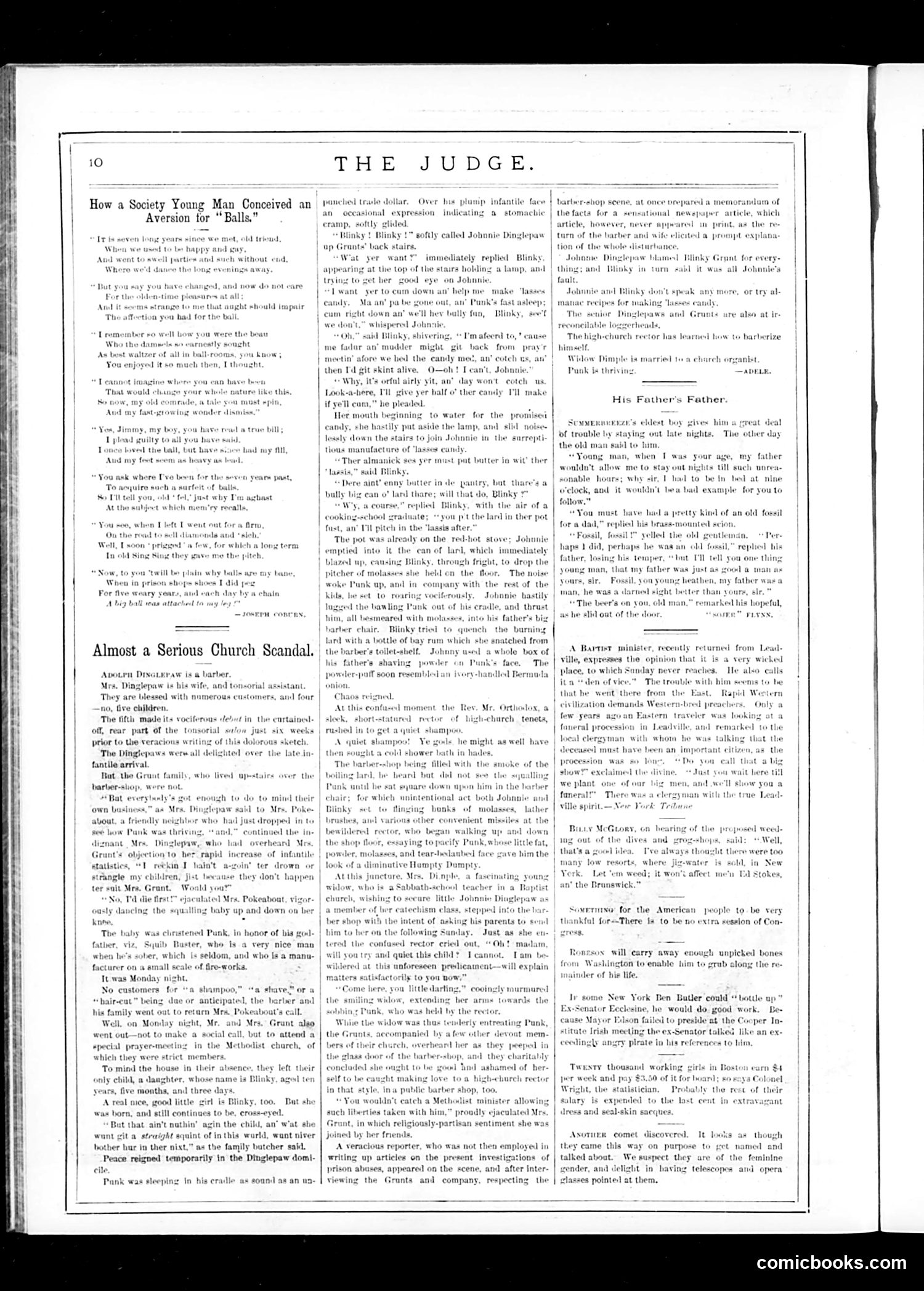
This page contains two separate stories from *Judge* magazine, a 19th-century American satirical publication. **"How a Society Young Man Conceived an Aversion for 'Balls'"** (top): A dialogue between old friends. One man explains why he now hates formal dances—a dramatic shift from his youth when he was the most sought-after dancer. The story appears to involve a mishap where children named Blinky and Johnny get into mischief, mixing shaving powder and molasses with a young man named Punk, resulting in a comedic mess. The satire mocks both the superficiality of high society dancing and the chaos of domestic life with unruly children. **"Almost a Serious Church Scandal"** (bottom): Centers on Aubrey Dinglepaw, a barber, and tensions between his family and the Grant family living upstairs. When the Grant children create a noisy disturbance, Mrs. Dinglepaw complains—leading to social friction. The satire satirizes petty neighborhood disputes and religious hypocrisy, with the rector appearing foolish amid the domestic turmoil. Both pieces ridicule Victorian social pretensions and domestic discord.
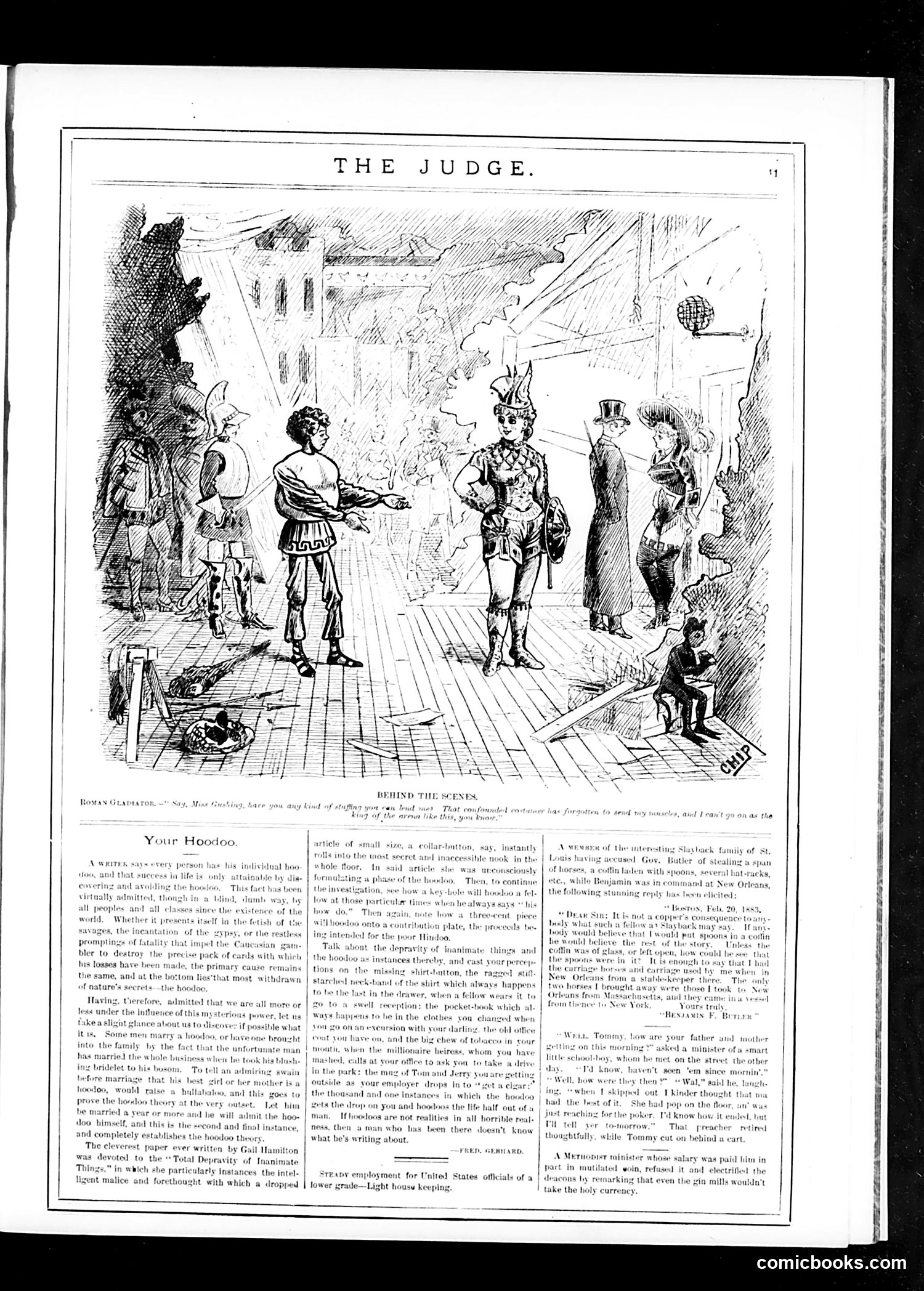
This page contains a satirical sketch titled "Behind the Scenes" depicting what appears to be a theatrical or vaudeville performance. The central figure is a performer in Roman/gladiatorial costume, surrounded by various characters including musicians, stagehands, and audience members in a backstage setting. The accompanying text discusses "Your Hoodoo"—apparently a theatrical production—and references to stage illusions, magicians (mentioning "Tom and Jerry"), and theatrical tricks. The satire mocks the artificiality of performance and entertainment, exposing the machinery behind public spectacle. The OCR text is too fragmented to identify specific political figures or events with certainty. Without clearer text or visible labels identifying the central performer or the production being mocked, the precise satirical target remains unclear, though it appears to critique theatrical deception and stage illusions generally.
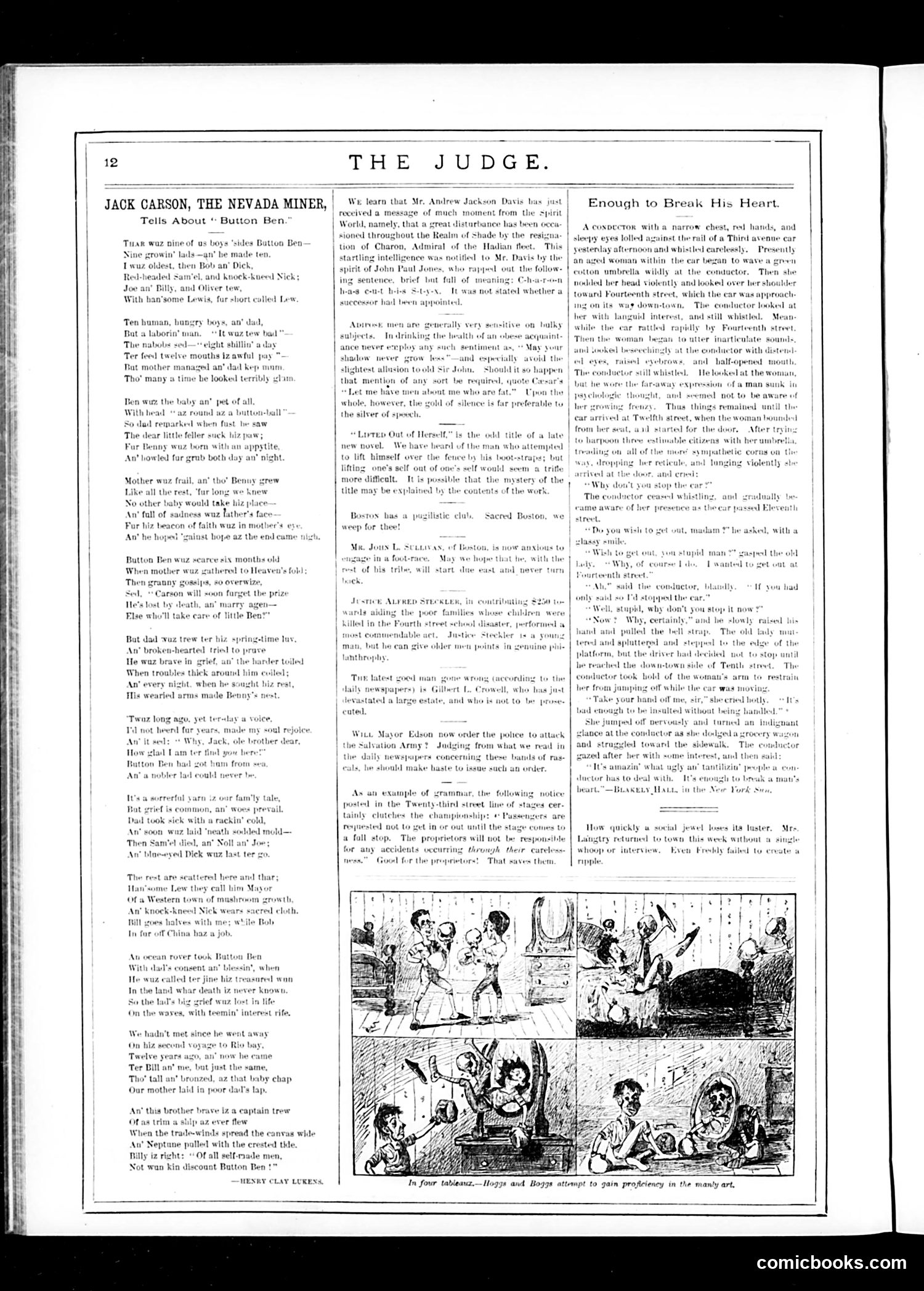
This page contains two distinct pieces. The main article is a sentimental poem by Henry Clay Lukens about "Button Ben," a poor boy from a large Western family who becomes a self-made man through hard work and perseverance. The narrative celebrates American bootstraps mythology—despite poverty and family tragedy, Ben rises through determination. The accompanying cartoon (bottom right) satirizes urban life, likely depicting working-class struggles or domestic comedy. The smaller article "Enough to Break His Heart" presents a satirical vignette: a woman on a Third Avenue streetcar exhibits exaggerated emotional dramatics over some minor slight from a conductor, her theatrical grief and "languid interest" mocking sentimental Victorian femininity and urban pretension. Together, these pieces represent *Judge* magazine's dual approach: celebrating rural American virtue while mocking urban affectation and excess emotion.
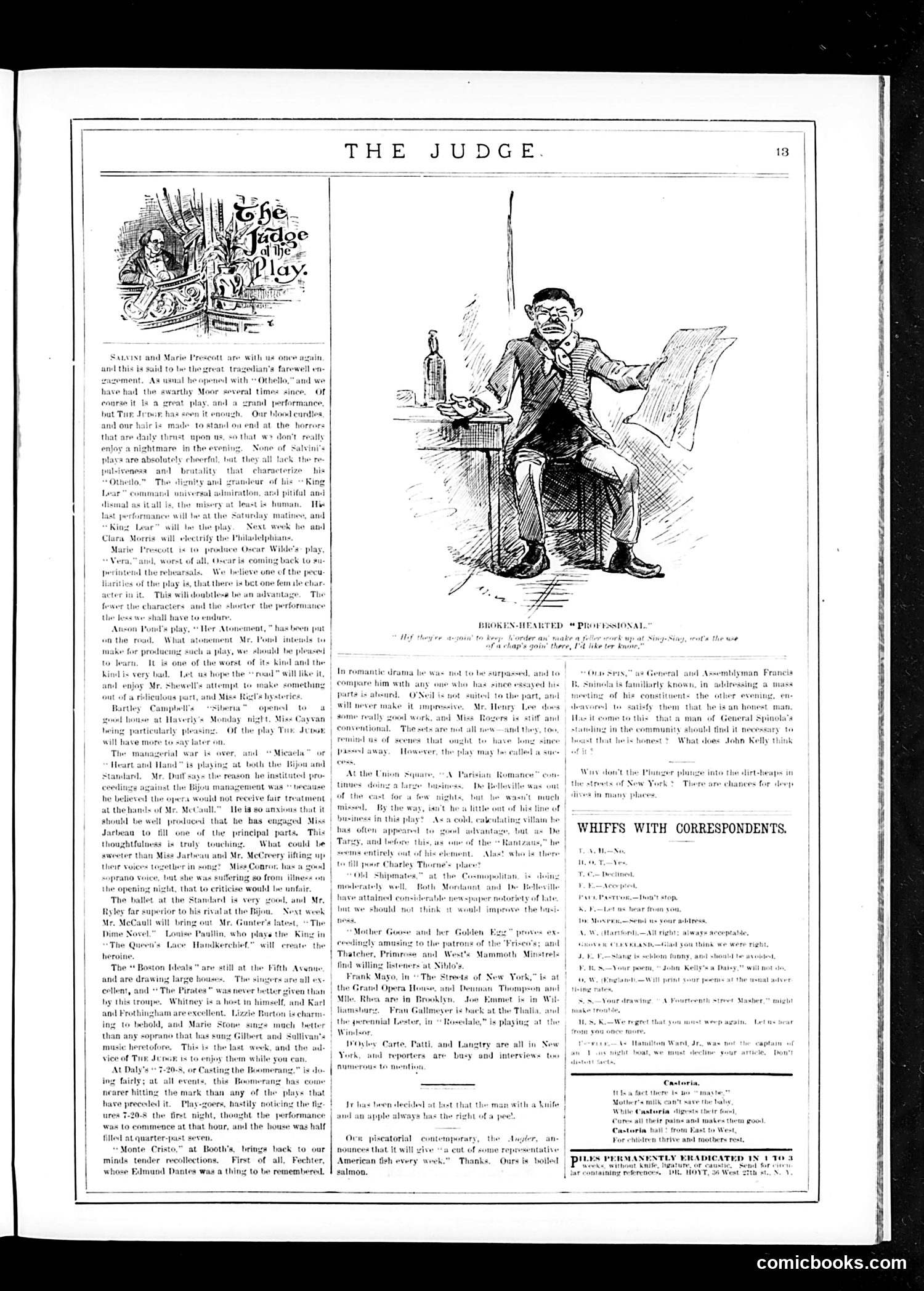
This is a theater criticism page from *Judge* magazine reviewing current Broadway productions. The main cartoon depicts a cynical theater critic slouched in his chair, holding a bottle, rendered as a broken-hearted "Pious Fraudal" — satirizing the pretentiousness or hypocritical moralizing of contemporary theater critics. The text reviews several plays, including Salvini's *Othello*, Oscar Wilde's work, and *Monte Cristo*. The critic expresses particular disdain for cheap melodrama and moralistic plays, while praising strong performances. The satire targets the theater world's excesses — overpraised actors, poorly-written scripts forced into production, and critics' inflated self-importance. The "Whiffs with Correspondents" section adds brief editorial quips, maintaining *Judge*'s irreverent tone toward both theatrical and social pretense.
This page is primarily **advertising**, not political satire. It's page 14 from *Judge* magazine and consists almost entirely of commercial advertisements for late 19th-century products and services. The ads include: - **Knox hats** (top): A major hatmaker advertising their "world renowned" hats as the "recognized standard of excellence" - **Patent medicines**: Hale's Honey, Horehound & Tar (for coughs/consumption), hair dye, toothache drops, and laxatives—typical of the era's unregulated medical marketplace - **Musical instruments**: Weber pianos, Beatty's organs, and music boxes - **Consumer goods**: Gloves, umbrellas, candy, soap There is **no visible political cartoon** on this page. The decorative header featuring what appears to be figures or classical imagery is typical period ornament, not satire. This represents how *Judge*'s revenue model relied heavily on advertising to offset publication costs, a common practice for 19th-century magazines.
This is primarily an **advertising page** from Judge magazine rather than a satirical cartoon page. The content consists almost entirely of commercial advertisements typical of the late 19th century. Notable ads include: - **Behning Pianos** (top left) - **Swaynes Pills** for blood purification and various ailments - **Dr. T. Felix Gouraud's Oriental Cream** (a skin bleaching/whitening product) - **Sanford's Radical Cure** for catarrh - **Babcock Fire Extinguisher** - **Crown Collar** advertisement - Various patent medicines and health products The page also advertises **James E. Walker's book binding services** at the bottom. There are no identifiable political cartoons or satirical commentary visible. The small illustrated vignettes are product endorsements rather than editorial satire. This appears to be a revenue page showcasing period advertisements, reflecting how 19th-century magazines funded operations through paid advertising.
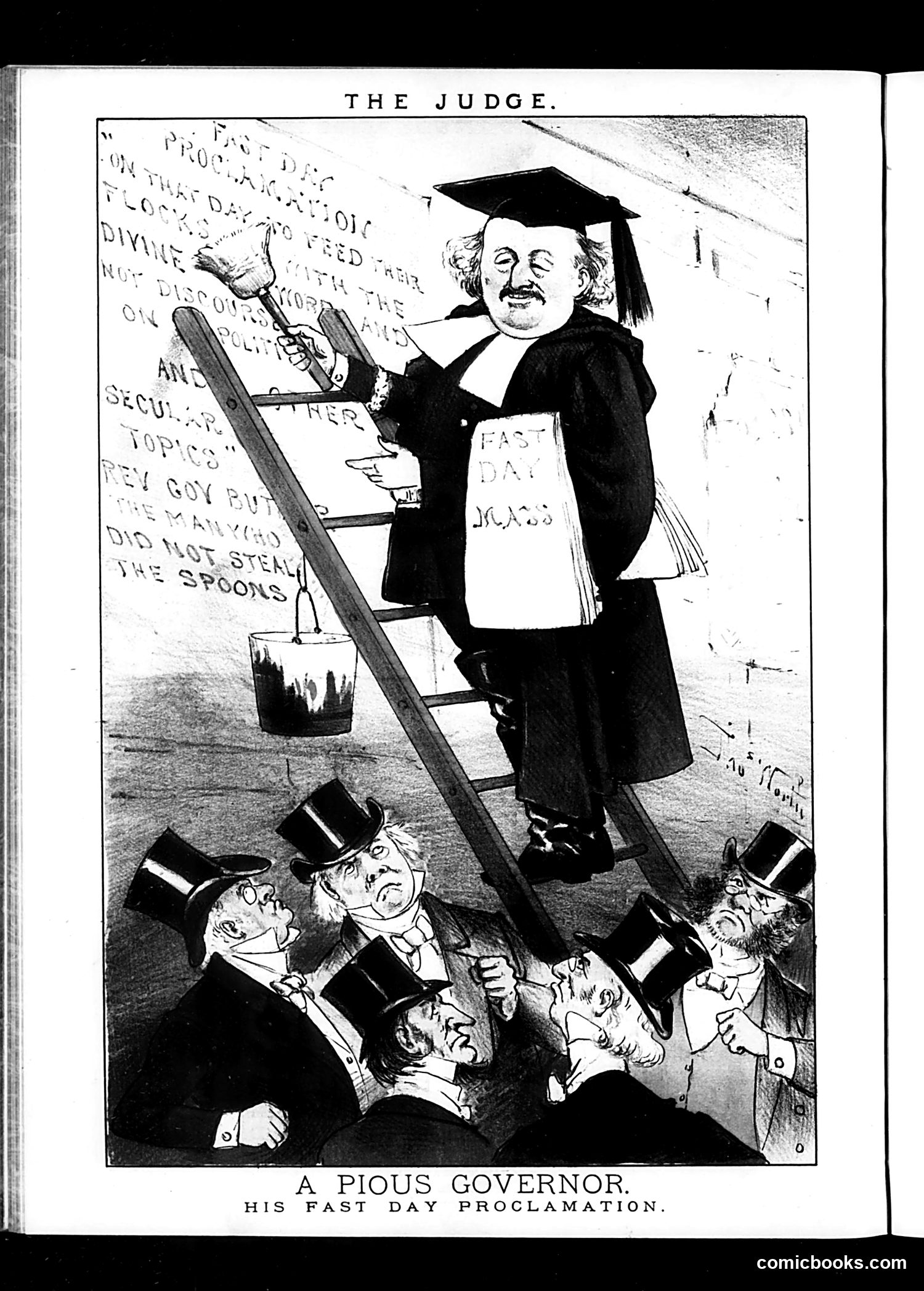
This satirical cartoon depicts a judge or governor atop a ladder, holding a paintbrush and an apron labeled "FAST DAY MASS," appearing to whitewash or paint over a wall of written proclamations. Below, five men in top hats look up skeptically. The satire criticizes the hypocrisy of a political leader who issues religious "fast day" proclamations (declarations calling for public fasting and prayer) while apparently engaged in covering up or concealing the truth—suggesting his piety is performative rather than genuine. The ladder, paint bucket, and whitewashing action symbolize covering up corruption or wrongdoing with false religious virtue. The officials below appear bemused or disapproving, implying this transparent attempt at moral credibility fooled no one. The cartoon mocks politicians who use religious declarations as political theater.