
A complete issue · 16 pages · 1882
Judge — August 26, 1882
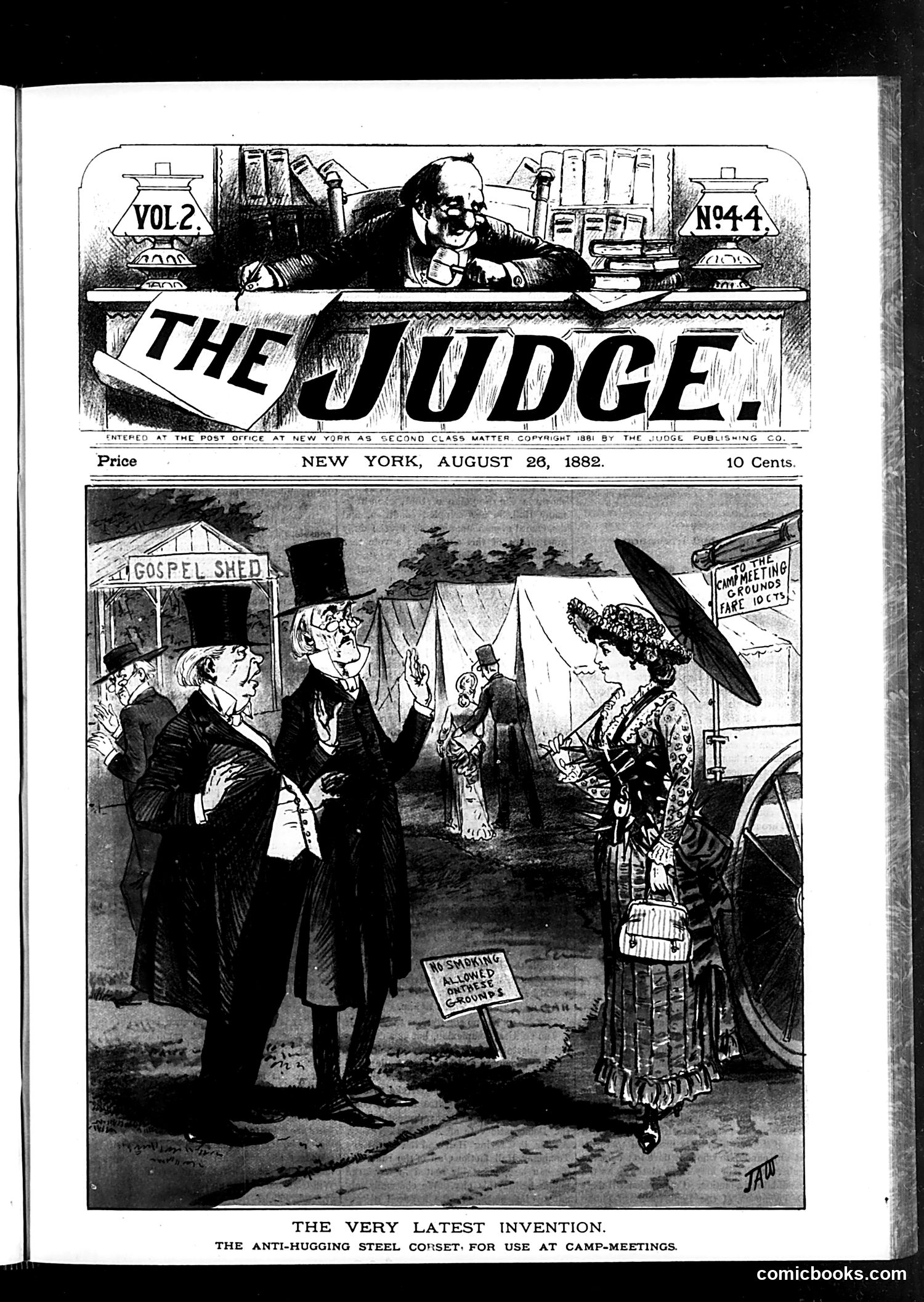
This cartoon satirizes camp meetings—popular religious revival gatherings of the era—by mocking the physical intimacy that occurred at these events. The "invention" is a steel corset designed to prevent hugging, presented as a humorous solution to unwanted physical contact. The scene shows a well-dressed woman wearing an exaggerated, armor-like corset device at a camp meeting (note the "Gospel Shed" sign). Two men appear to be reacting to or discussing this contraption, with tents visible in the background. The joke targets the perceived hypocrisy of religious gatherings: despite their spiritual purpose, camp meetings were notorious for romantic encounters and physical familiarity between attendees. The satire mocks both the behavior and the absurd "solution" proposed to control it.
This page features two satirical pieces from Judge magazine. The main cartoon, "The Latest Invention," mocks camp-meetings—religious revival gatherings popular in 19th-century America. The satire targets the sexual temptation ministers allegedly posed at these events. The "invention" depicted is a chastity device (a "barbed zone") that husbands could lock onto their wives to prevent flirtation with clergy during camp attendance. The humor relies on two layers: first, the absurdity of the mechanical solution itself; second, the implicit criticism of both lustful ministers and the hypocrisy of religious gatherings that supposedly required such protection. The article's mock-serious tone ("supplies a long-felt want") amplifies the satire. The page's other content discusses New York Democratic Party factionalism—specifically tensions between Tammany Hall and the County Democracy—reflecting contemporary political divisions Judge's readership would recognize.
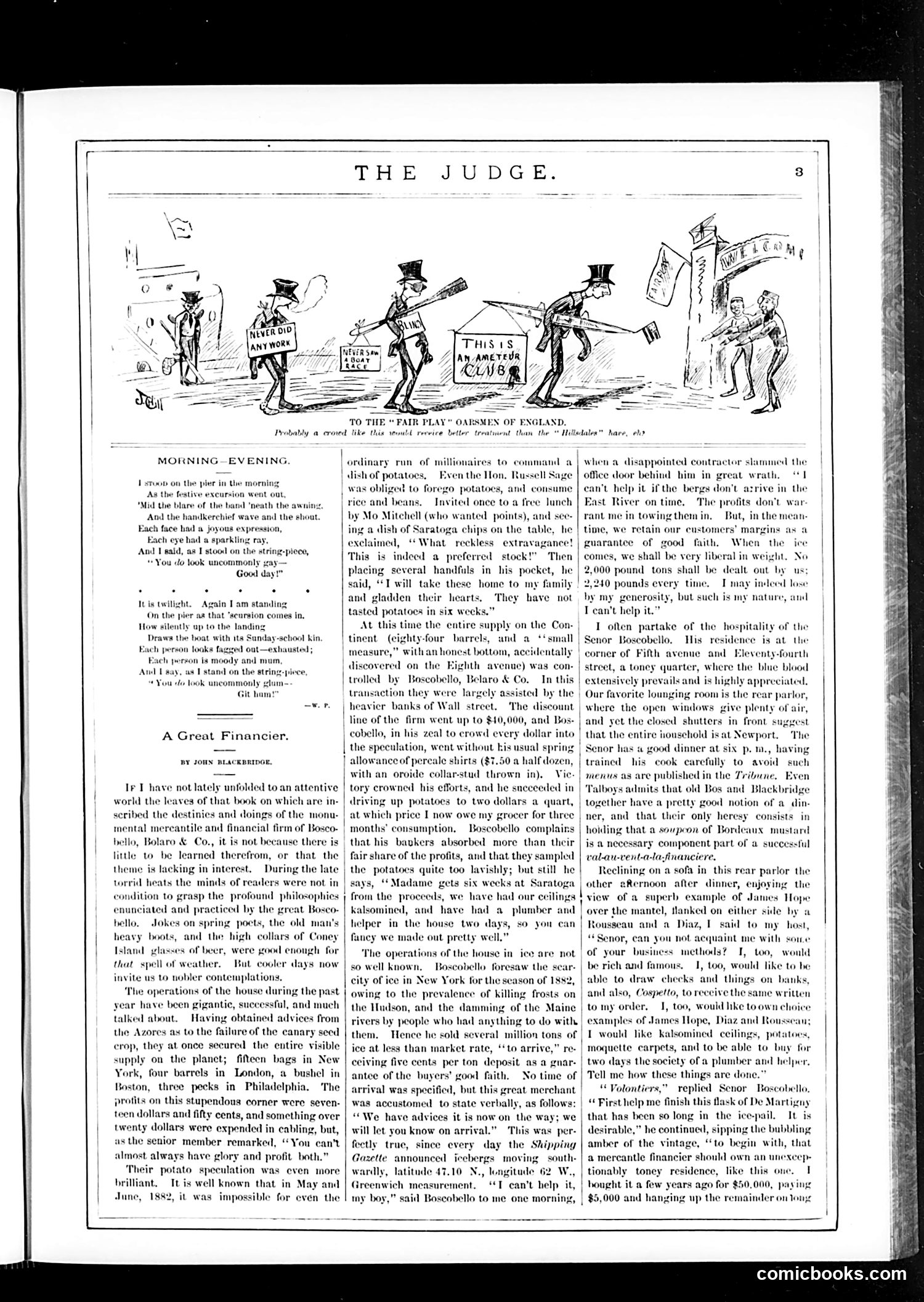
The top cartoon depicts a satirical scene showing figures in a rowing club, each holding oars or related equipment. The caption references "fair play" and oarsmanship in England, suggesting this mocks either incompetence or impropriety within English sporting clubs—possibly amateur rowing organizations. The accompanying article, "A Great Financier," satirizes financial speculation and market manipulation by the fictional firm Boscobello, Bolaro & Co. Through exaggerated examples (cornering canary seed, potatoes, and ice supplies), the piece ridicules how speculators artificially inflate prices and create artificial scarcities for profit. The potato scheme—driving prices to two dollars per quart—directly harms ordinary consumers while enriching financiers and their banker allies on Wall Street. The satire targets both reckless speculation and the complicity of major financial institutions in price manipulation during the Gilded Age.
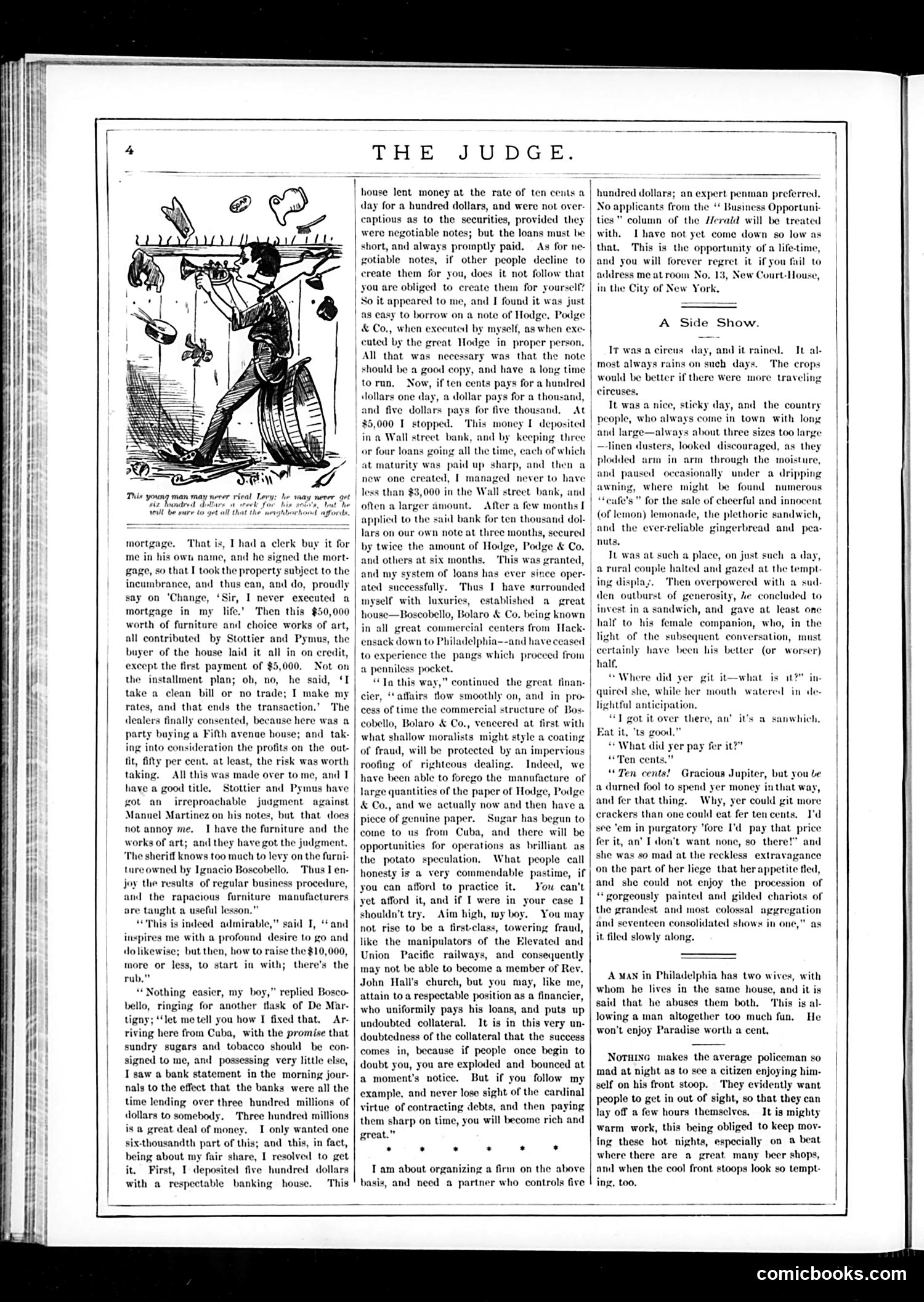
This page satirizes **financial fraud and moral hypocrisy** among the wealthy in Gilded Age New York. The main narrative features **Ignacio Boscobello**, a Cuban entrepreneur who boasts of his clever scheme to acquire a mansion and luxury furnishings through questionable methods. Boscobello's strategy involves: depositing modest sums in banks, creating forged promissory notes (signing for loans as if he were the established firm "Hodge, Podge & Co."), leveraging these fabricated securities to borrow large sums, and then buying property/goods on credit. He evades payment through legal technicalities—the furniture technically belongs to the dealers (who have a judgment against him), so sheriffs cannot seize it. The satire targets both his brazen criminality and society's complicity: banks lend carelessly, dealers accept excessive risk for profits, and he exploits legal loopholes unpunished. The cartoon illustrates the rampant speculation and financial manipulation that characterized the era's wealth accumulation, presented as a "useful lesson" in how the system actually rewards fraud.
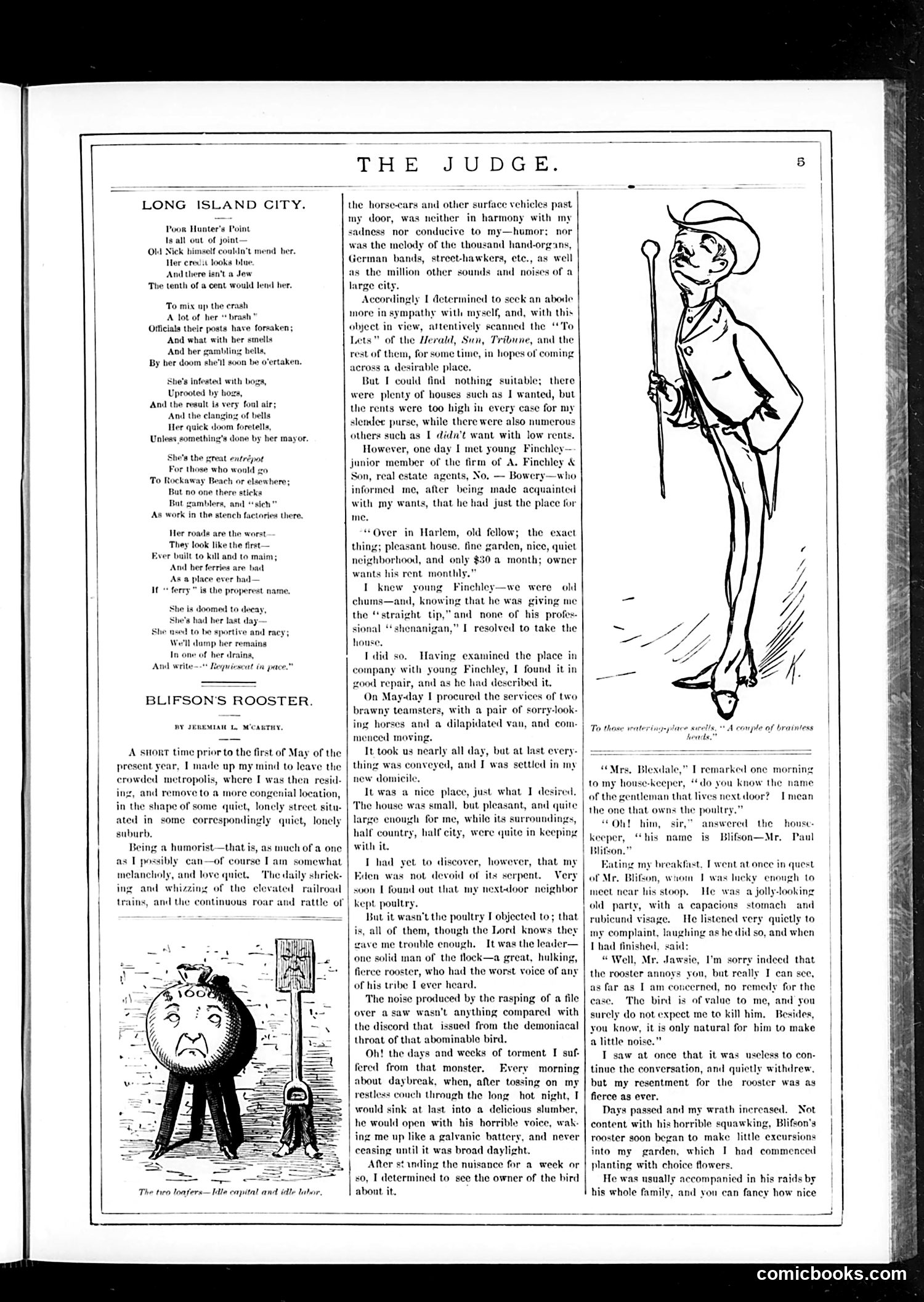
This page contains two separate pieces of satirical commentary: **"Long Island City"** (left column) is a scathing poem mocking Long Island City as a deteriorating, undesirable neighborhood. It attacks the area's infrastructure (terrible roads, bad ferries), pollution ("stench factories"), crime (gambling dens), and general decay. The satire suggests the city is dying and beyond redemption—ending with a Latin funeral phrase "Requiescat in pace" (rest in peace). **"Blifson's Rooster"** (main text) begins a humorous story about a city dweller seeking quiet suburban life. He hires a real estate agent (young Finchley) who finds him a cheap Harlem house. The narrator moves in May 1st, finding it pleasant—but discovers an unnamed problem with a neighbor's poultry (the story continues beyond this page). Both pieces satirize urban discomfort and the difficulty of finding suitable housing—concerns that would resonate with Judge's middle-class readership seeking respite from crowded, noisy cities.
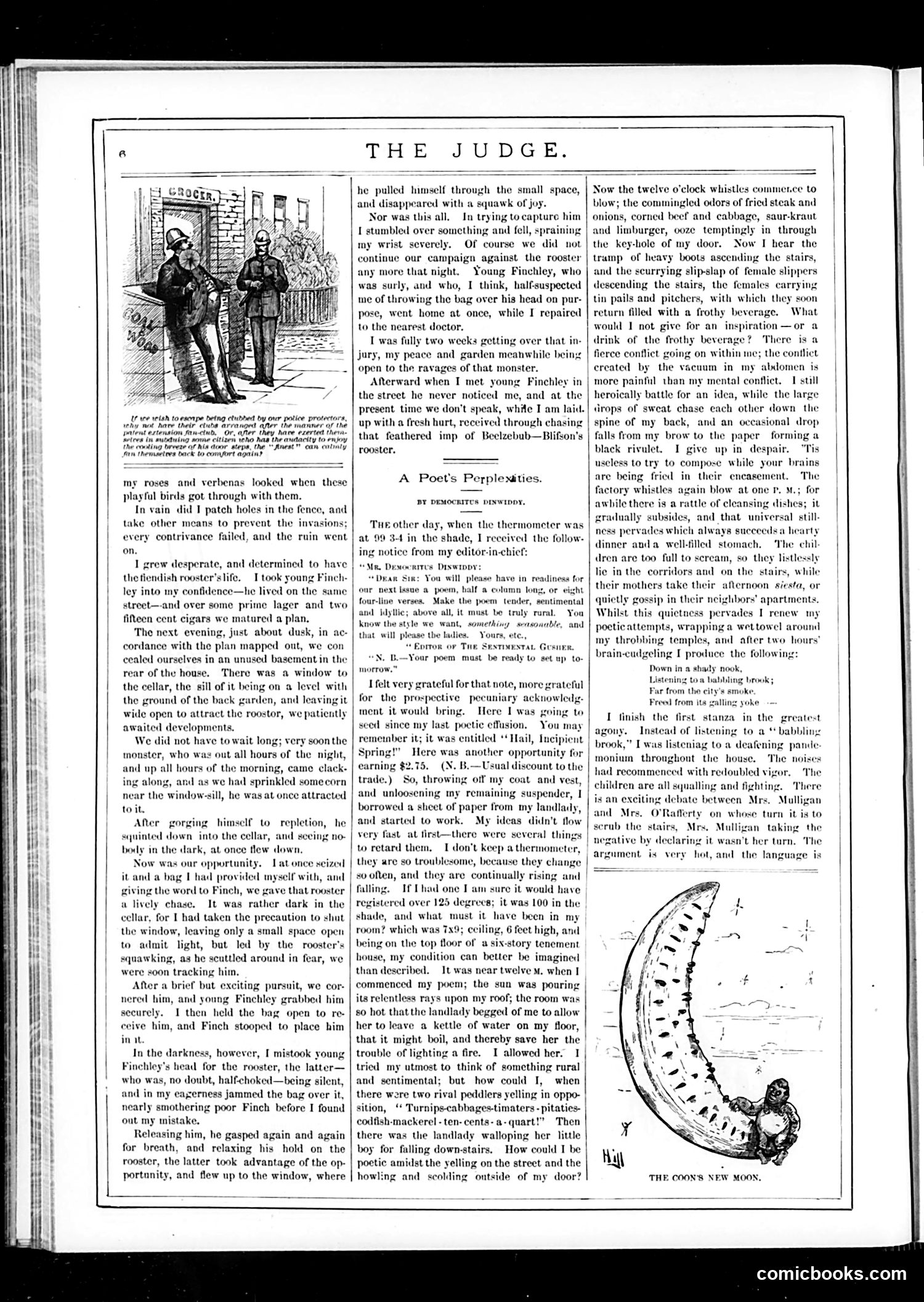
This page contains two humorous first-person narratives typical of Judge magazine's satirical style. **"The Judge" (main story):** The author describes a comedic misadventure attempting to trap and capture a destructive rooster that's ruining his garden. The slapstick humor peaks when, in darkness, he accidentally bags his friend Finchley's head instead of the rooster, nearly suffocating him. The rooster escapes anyway, the narrator sprains his wrist, and Finchley—suspecting he was bagged intentionally—never speaks to him again. The satire mocks suburban complaints and the bungling incompetence of ordinary people attempting practical solutions. **"A Poet's Perplexities":** The editor demands the narrator write a sentimental, rural poem—in 99-degree heat. The satire ridicules the disconnect between editorial demands and actual working conditions, poking fun at magazine editors' unrealistic expectations and flowery literary tastes. Both pieces exemplify Judge's humor: everyday frustrations exaggerated into absurd situations, with working-class or middle-class protagonists thwarted by circumstance and their own ineptitude.
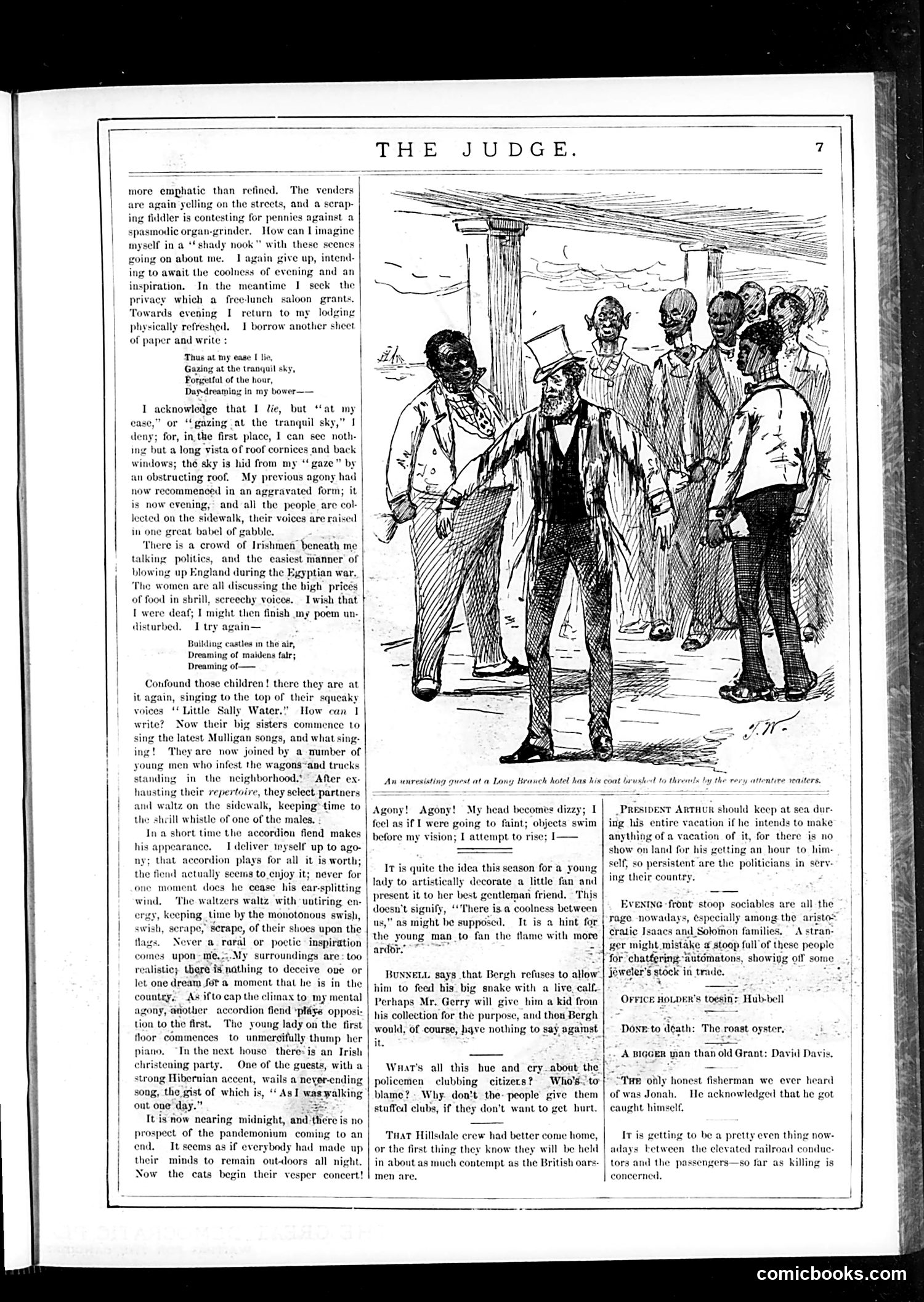
This page satirizes the impossibility of urban peace and quiet for New York's working poor. The author attempts to compose romantic poetry in a tenement neighborhood but is repeatedly thwarted by street noise: vendors, street musicians (organ-grinders and fiddlers), children singing, young people waltzing, accordionists, a piano player, Irish singing from a neighboring apartment, and finally cats yowling at midnight. The cartoon depicts a crowded street scene illustrating this cacophony. The satire mocks both the romantic literary aspirations of the middle class and the brutal reality of tenement living—the constant, unavoidable noise that prevents any escape or contemplation. References to "Bergh" and "Gerry" allude to animal welfare advocates (likely Henry Bergh of the ASPCA), suggesting ironic social commentary about selective concern for animals versus indifference to human suffering in crowded urban conditions.
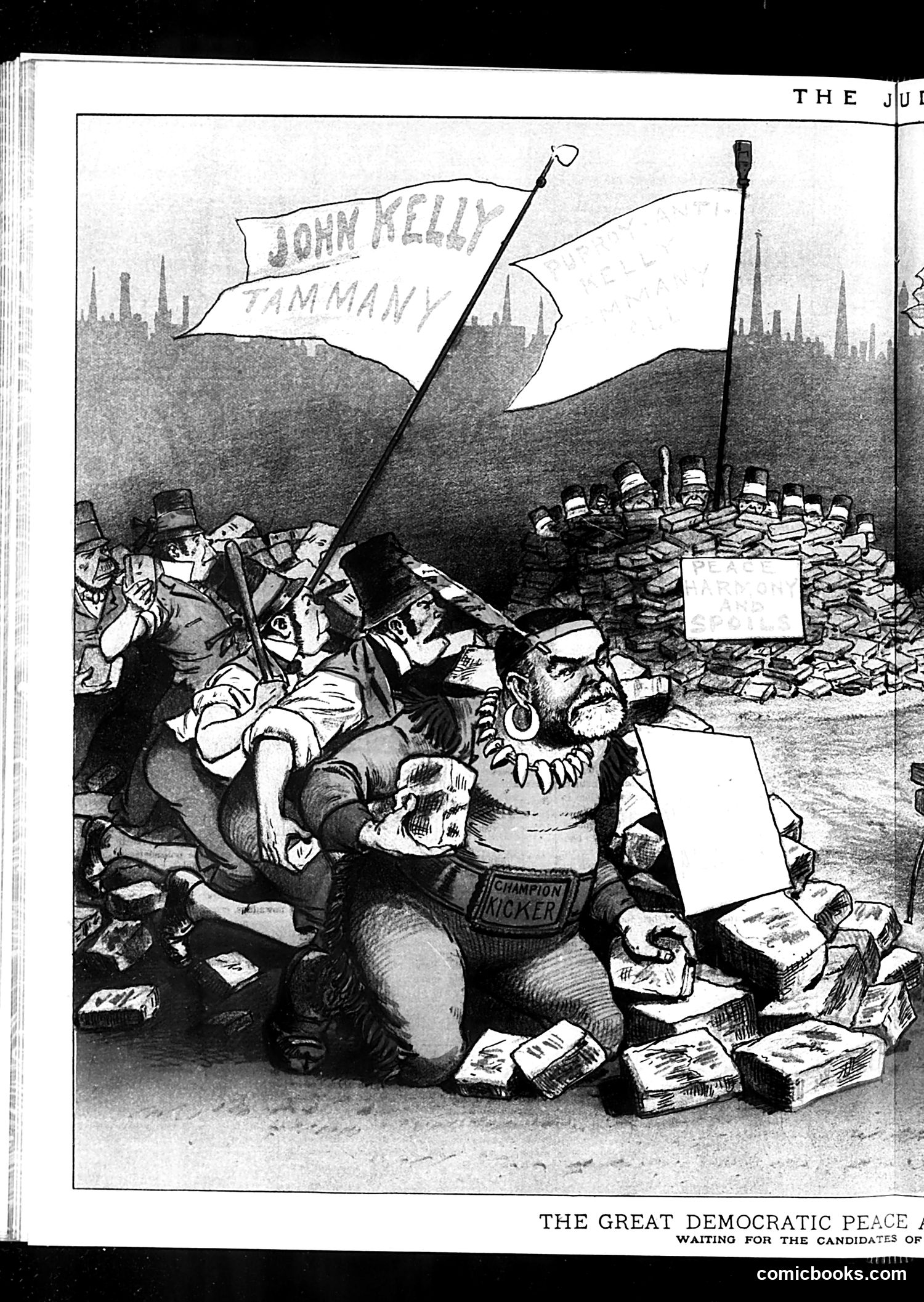
This political cartoon satirizes the Democratic Party's delay in selecting presidential candidates. The central figure, labeled "Champion Kicker," appears to be a pugilistic character surrounded by stacks of money and surrounded by figures in the background holding flags reading "John Kelly" and "Tammany." The satire suggests that Democratic infighting—represented by the "kicker" surrounded by wealth and competing interests—prevents the party from uniting behind candidates. The background figures with Tammany Hall references indicate corruption tied to New York Democratic machine politics. The cartoon mocks the party's internal divisions and the influence of political machines and money on candidate selection, implying that "peace" (unity) remains elusive while various factions vie for control.
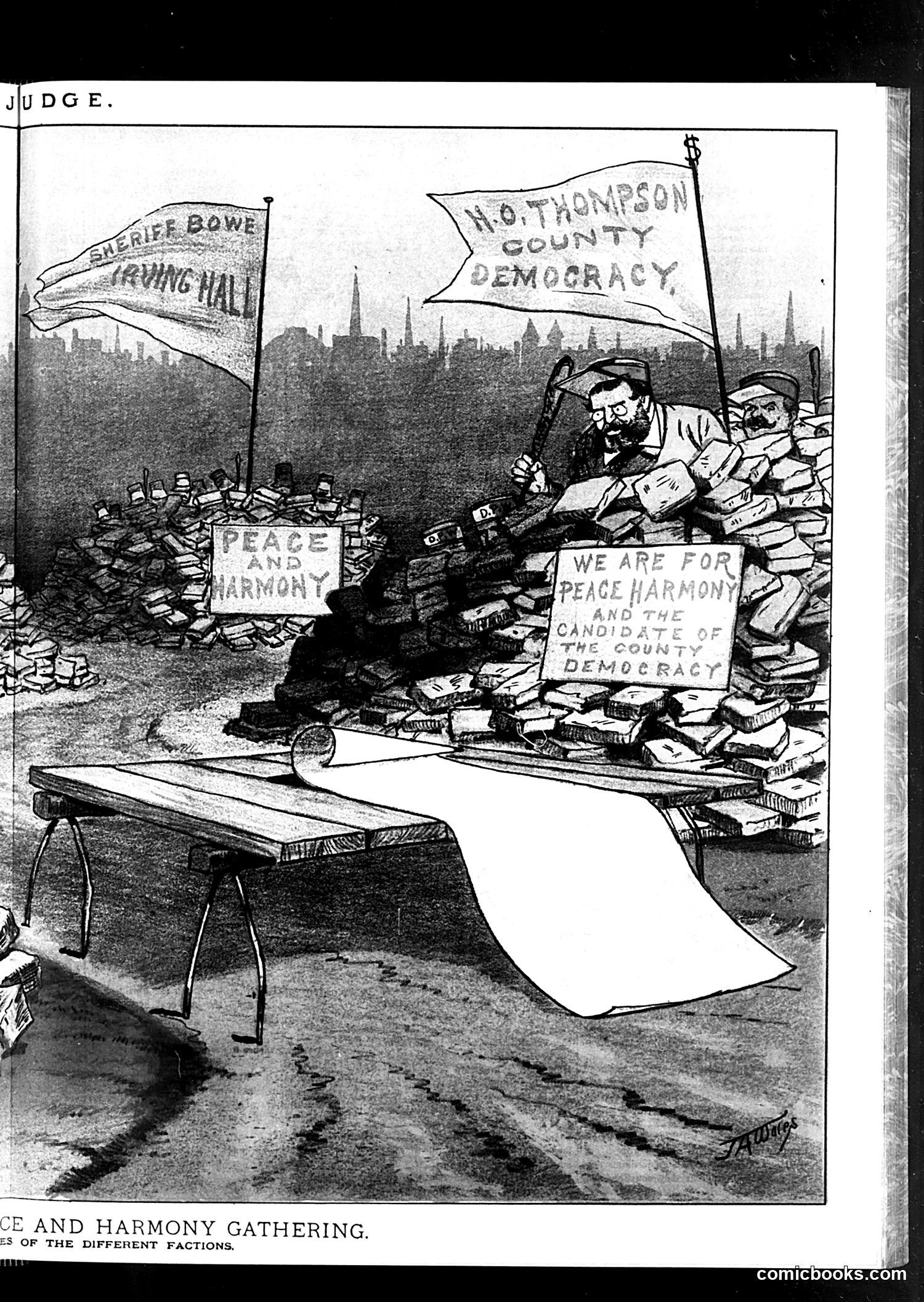
This Judge magazine cartoon satirizes a political gathering promoting "Peace and Harmony." The image shows two opposing political factions literally entrenched behind barricades of documents and materials, each holding flags representing different interests: "Sheriff Bowe Irving Hall" on the left and "No Thompson County Democracy" on the right. The satire's point is clear: despite proclamations of unity ("We are for Peace Harmony and the Candidate of the County Democracy"), the factions remain deeply divided and fortified against each other. The empty table in the foreground suggests their inability to actually meet or negotiate. The cartoon mocks the hypocrisy of claiming harmony while maintaining adversarial positions—a commentary on factional political infighting likely involving Thompson County elections or local Democratic Party disputes, though specific identities remain unclear without additional historical context.
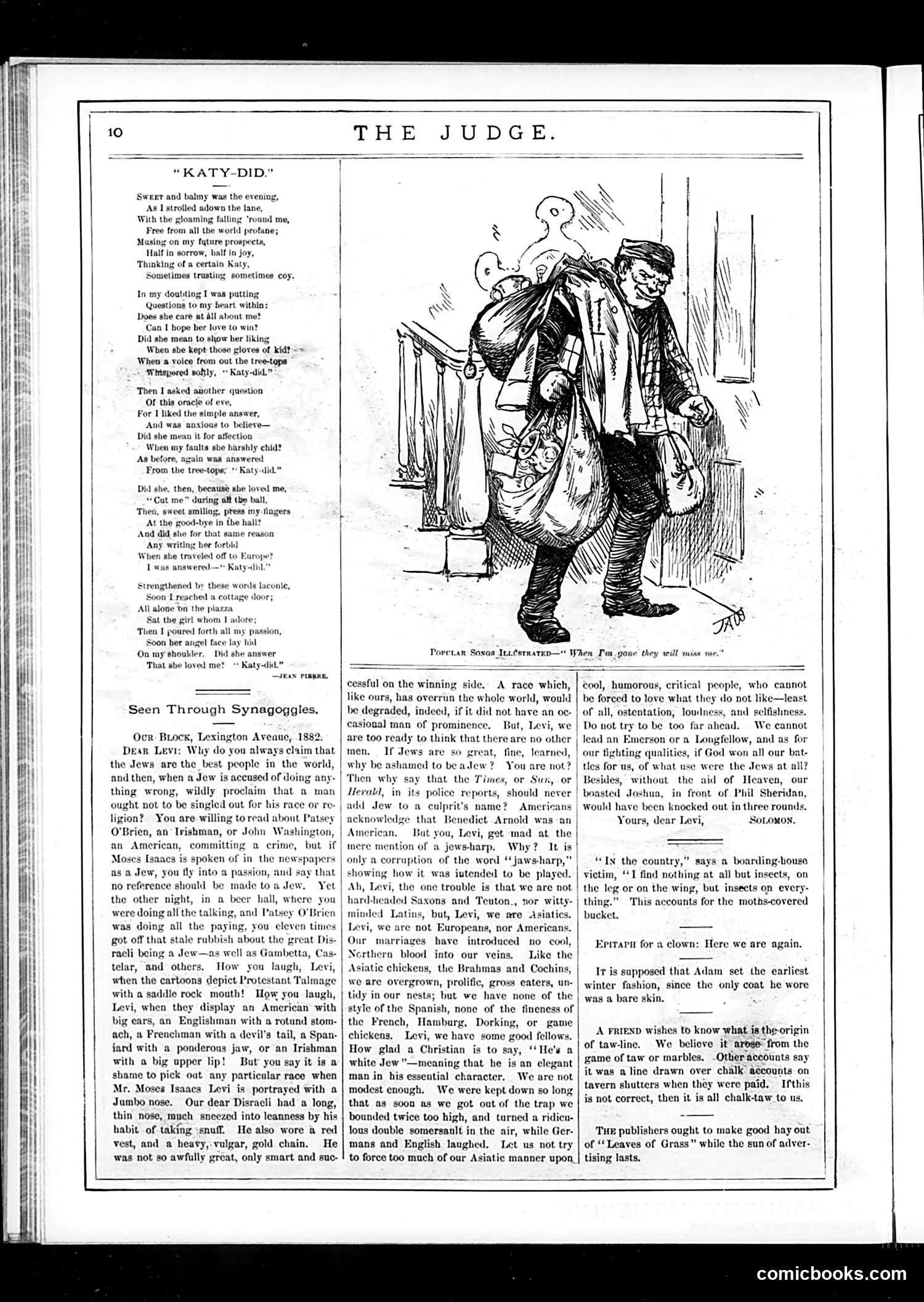
This page contains a sentimental poem "Katy-Did" (a pun on the insect sound) about a young man seeking romantic reassurance from nature, alongside a satirical letter titled "Seen Through Synagoggles." The main satire addresses Jewish identity and double standards. The letter writer ("Solomon") criticizes his friend Levi for hypocritical behavior: Levi proudly claims Jews are "the best people," yet protests whenever Jews are identified as such in news reports of crimes. Solomon points out that Levi accepts ethnic caricatures of Irish, English, French, and Spanish people in cartoons, but objects to Jewish caricatures—specifically mentioning the "Jumbo nose" stereotype and the term "jews-harp." Solomon argues this inconsistency stems from shame about Jewish identity, suggesting Levi should either accept that all groups are sometimes negatively portrayed, or object consistently to ethnic stereotyping across the board. The satire critiques selective outrage and argues for honest engagement with one's own heritage.
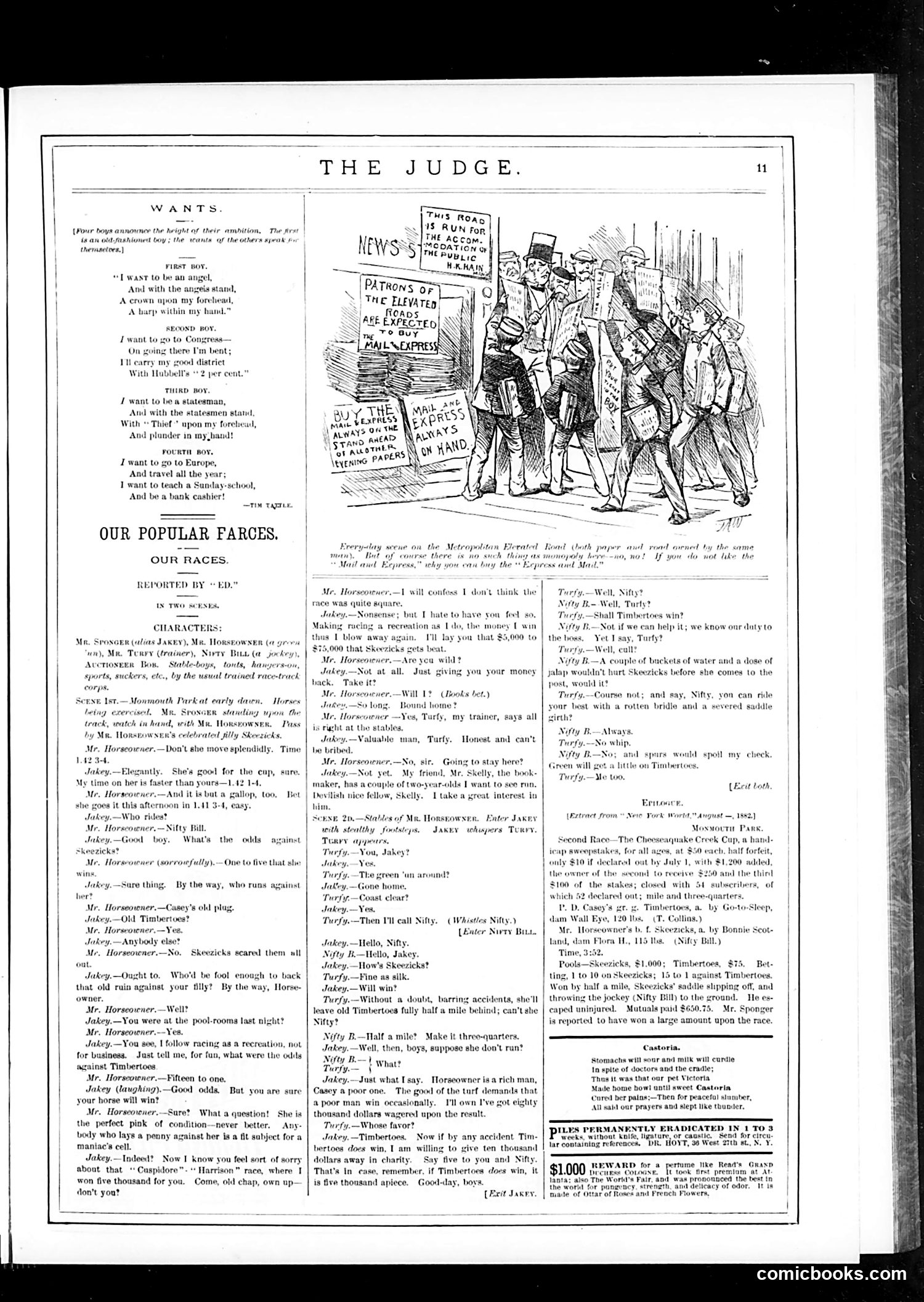
This page contains two distinct satirical pieces: **"Wants"** (left column) mocks ambitious American boys through four verses. Each boy desires something progressively corrupt: the first wants old-fashioned virtue; the second wants to enter Congress and profit through "Hubbell's 2 per cent" (likely referencing corrupt political kickbacks); the third explicitly wants to be a thief-statesman; the fourth wants European leisure funded by embezzlement as a bank cashier. The satire escalates from innocent ambition to outright criminality, suggesting American society corrupts youth progressively. **"Our Popular Farces: Our Races"** (right) depicts racetrack corruption. The dialogue between Mr. Horseowner, Jakey (a tout/gambler), and others reveals fixed races—characters discuss poisoning horses ("jalap"), using broken equipment, and bribing jockeys. The cartoon above shows crowds and signs advertising trains for spectators, suggesting widespread public participation in fraudulent betting. The satire exposes racing as organized crime rather than sport. Both pieces critique American institutions—politics and gambling—as fundamentally dishonest.
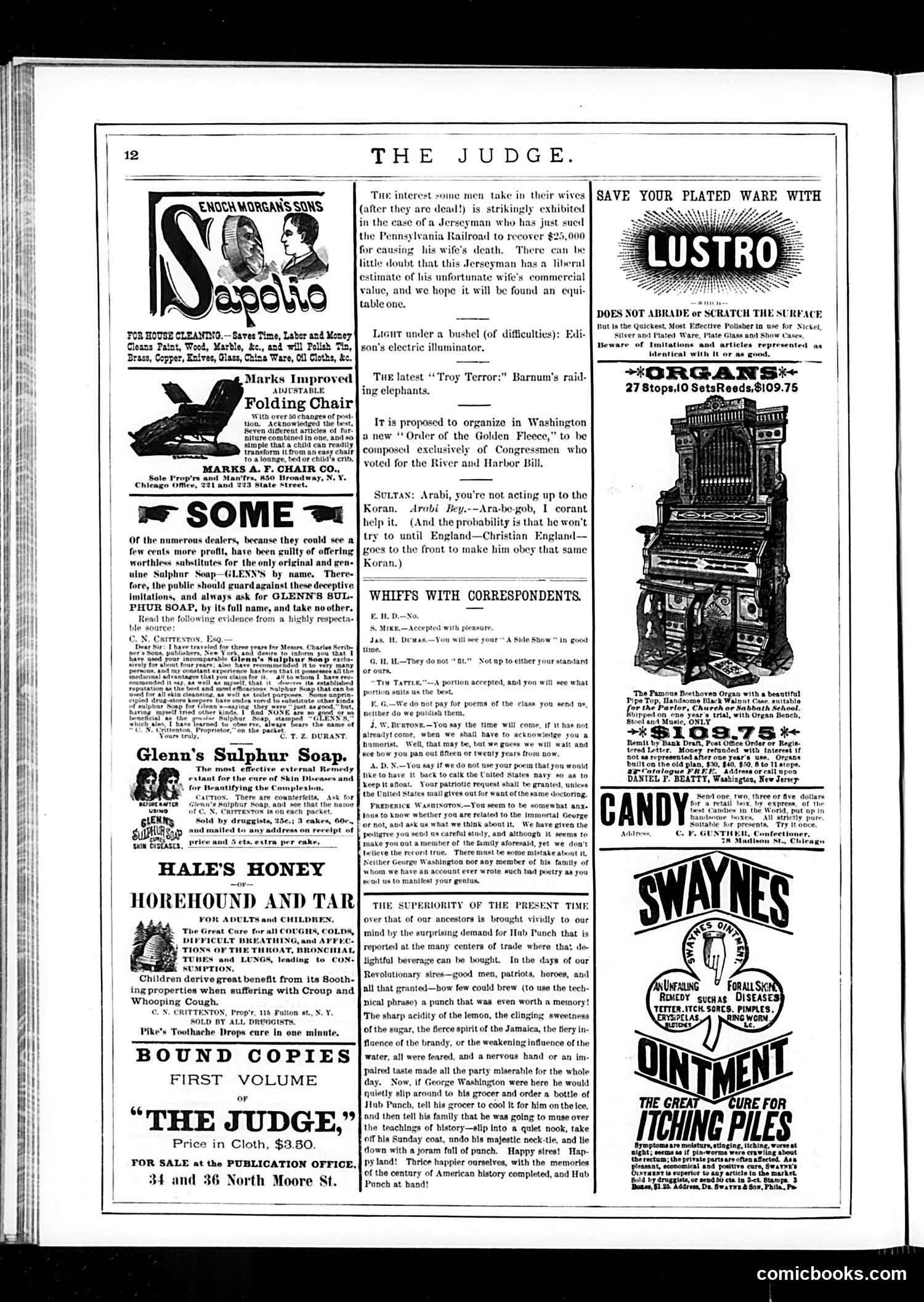
This page is primarily **advertisements and editorial content** rather than political cartoons. The main satirical pieces are short editorial quips: 1. **Jersey widower lawsuit**: A man sued the railroad for $25,000 over his wife's death—the editors sardonically note he had "a liberal estimate of his unfortunate wife's commercial value," mocking his mercenary motivation. 2. **"Order of the Golden Fleece"**: A proposed Washington organization exclusively for congressmen who voted for the River and Harbor Bill. The "fleece" reference is satirical—suggesting these politicians are fleecing the public through wasteful spending. 3. **Sultan Arabi Bey**: A brief joke about Egypt's Arabi Pasha (the "Troy Terror"), suggesting he won't obey Islamic law until forced by Christian England—commentary on colonial intervention in Egypt. The page is dominated by **patent medicine and furniture advertisements** typical of 1880s magazines, including Glenn's Sulphur Soap, folding chairs, and cough remedies. The "Whiffs with Correspondents" section contains rejected poem submissions with humorous rejection notes.
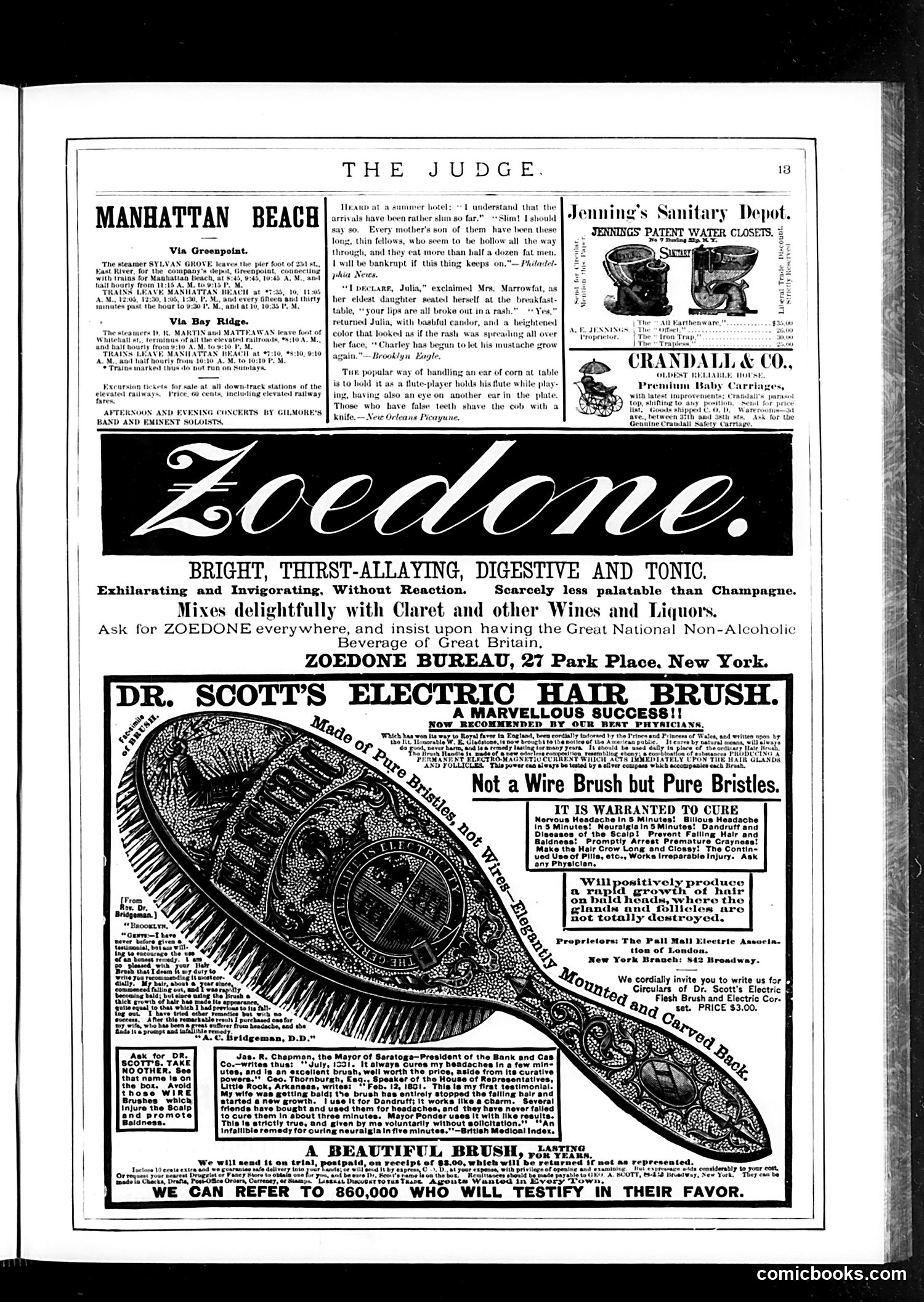
This is primarily an **advertising page** from Judge magazine, not a political cartoon. The page contains several patent medicine and product ads typical of late 19th-century publications. The top section includes brief humorous items about Manhattan Beach steamers and dining etiquette (handling corn at table). These are minor satirical notes rather than substantive commentary. The major content consists of advertisements: 1. **Zoedone** — a non-alcoholic "tonic" beverage marketed as digestive and invigorating, positioned as a British import and champagne alternative 2. **Dr. Scott's Electric Hair Brush** — a quack medical device claiming to restore hair growth on bald heads through electrical stimulation, with testimonials from supposed doctors and the mayor These ads reflect the era's widespread medical fraud and patent medicines with exaggerated or false health claims. Modern readers should note these represented accepted advertising practices before FDA regulation, exploiting consumer anxieties about health and appearance with unproven "electrical" or "scientific" treatments.
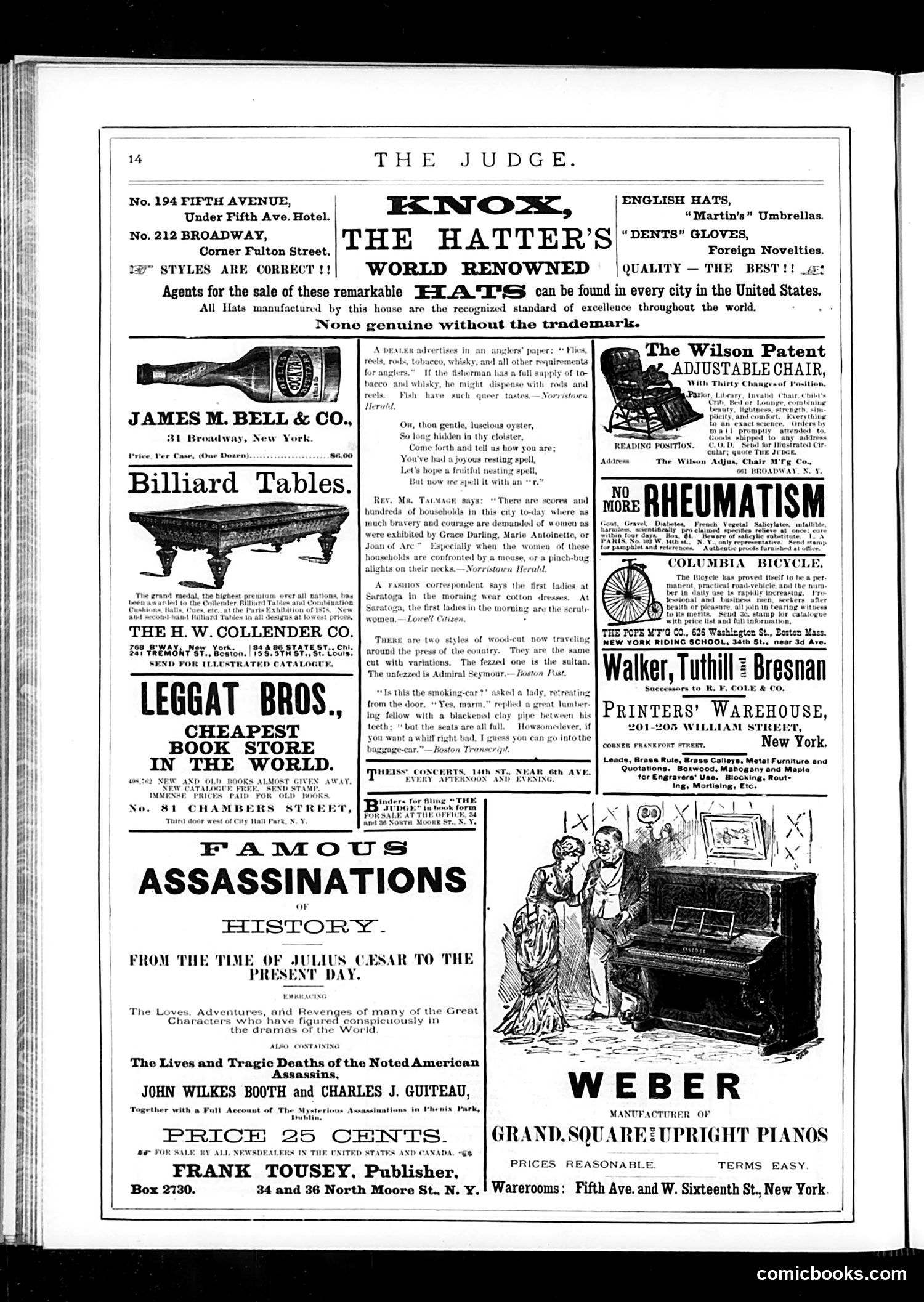
This page is **primarily advertising**, not satirical content. It contains commercial advertisements for various products and services typical of late 19th-century New York businesses: Knox hats, billiard tables, an adjustable chair, a bicycle, pianos, and printing services. The only substantial editorial content is an advertisement for **"Famous Assassinations of History"** — a 25-cent book covering historical assassins from Julius Caesar to contemporary American assassins John Wilkes Booth and Charles J. Guiteau, plus mysterious Dublin Phoenix Park murders. This appears to be sensationalist true-crime publishing, capitalizing on public fascination with assassination—a recurring anxiety in American life of that era. The page reflects Judge's business model: mixing satirical commentary (on other pages) with revenue-generating advertisements. The assassination book ad, while morbid by modern standards, was standard sensationalist publishing fare for the period.
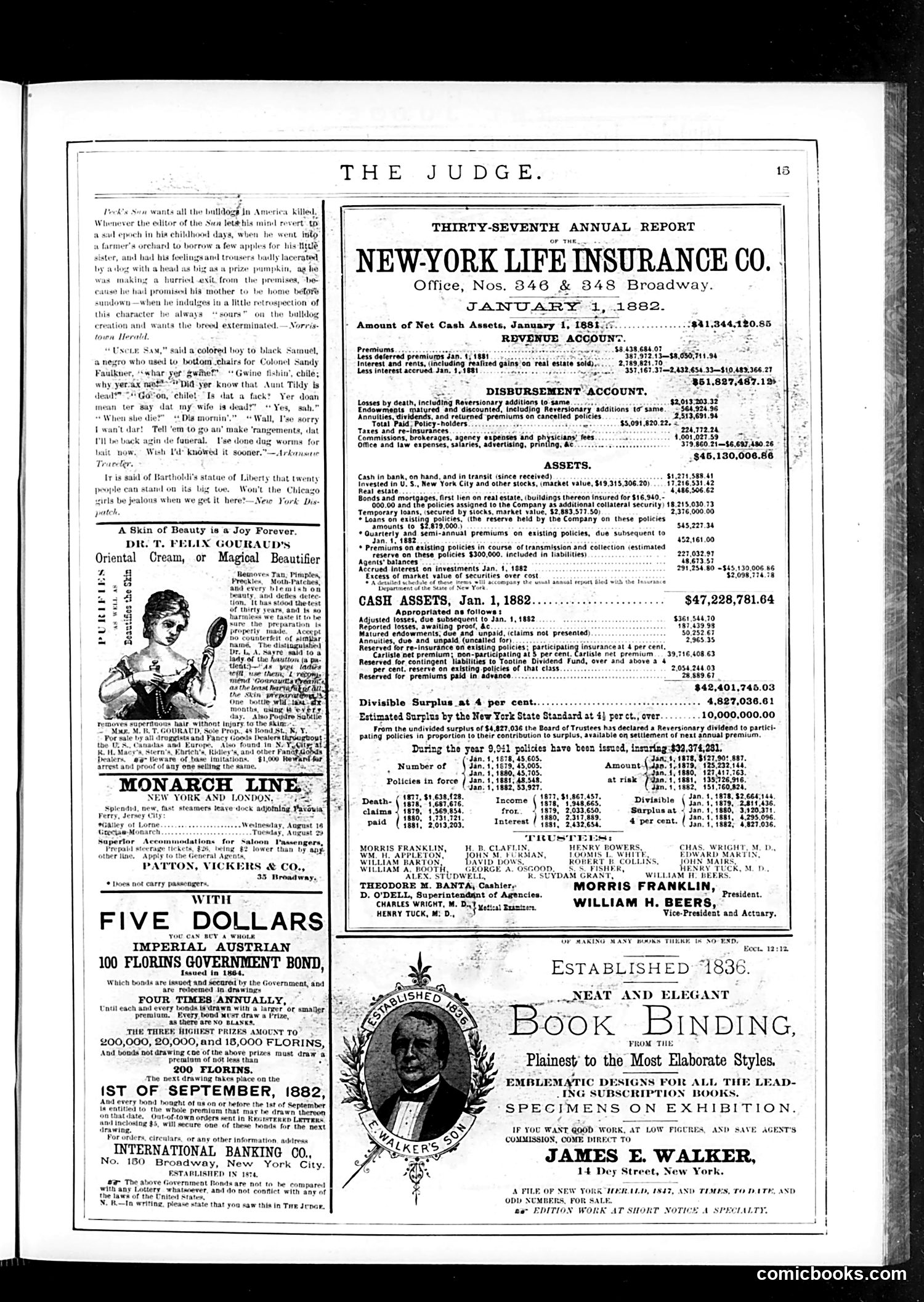
This page is primarily **advertisements and financial reports**, not satirical content. The dominant feature is the New-York Life Insurance Company's annual report, displaying assets, liabilities, and financial data. The small comic snippets scattered between ads are typical period humor: a man recalling childhood trauma from a bulldog attack (advocating their extermination); an exchange between Black characters about fishing and a wife's death (dialect humor common in 1880s publications, offensive by modern standards); and a joke about visitors to the Statue of Liberty. The advertisements themselves—for beauty cream, steamship lines, and Austrian government bonds—reflect contemporary commerce. The satirical magazine's actual content is minimal; the page functions largely as a revenue source through paid advertising and financial notices, typical of Judge's business model in the 1880s.
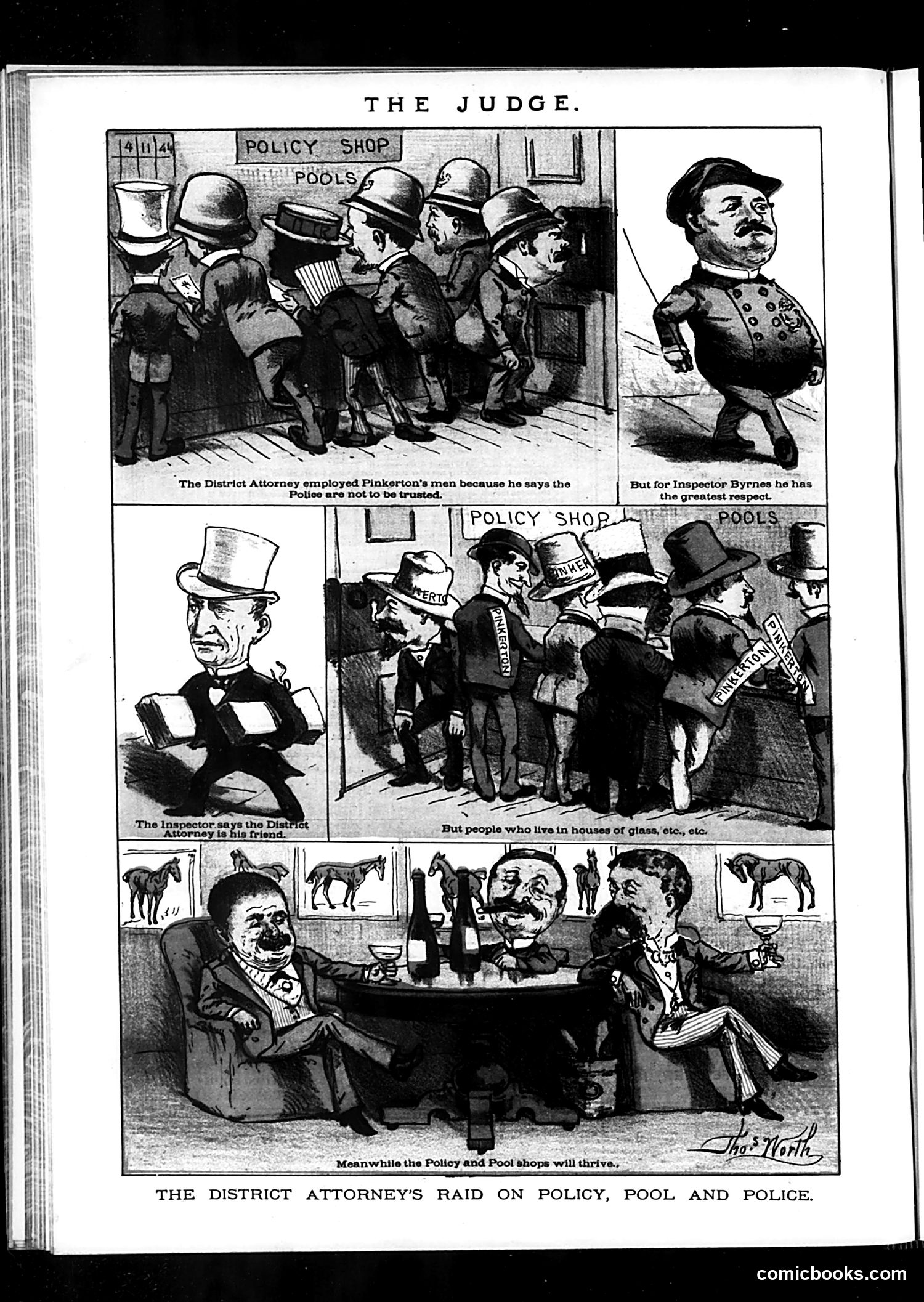
This satirical cartoon criticizes a District Attorney's corruption-fighting efforts as hypocritical theater. The DA employs Pinkerton detectives (private security) because he claims police can't be trusted, yet he publicly praises Inspector Byrnes—revealing selective trust based on politics rather than principle. The satire's core message: while authorities conduct visible raids on illegal "policy shops" (numbers gambling) and pool halls, the real corruption persists. The final panel shows well-dressed men toasting at a table, suggesting that policy and pool operations continue thriving regardless of raids—implying complicity between operators and officials. The cartoon suggests the raid is performative: designed to appear tough on crime while actual criminal enterprises operate undisturbed through corrupt arrangements.