
Pulp Fiction, 1913 · page 25 of 36
Cheer Boys Cheer: The Boys' Journal, No. 62 — page 25: what you’re looking at
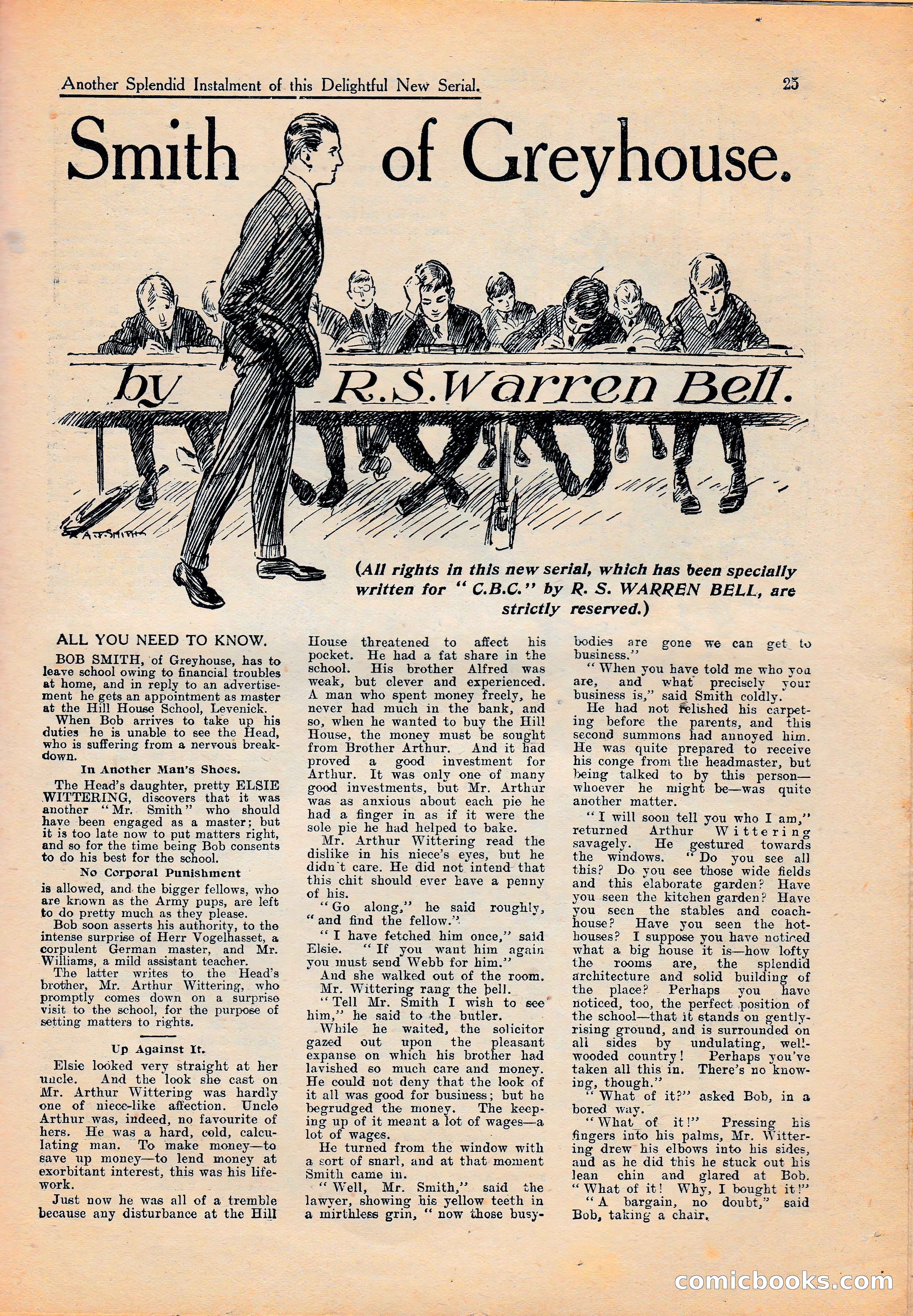
A restored page from Pulp Fiction, 1913. Page through the whole issue in the reader above.
📄 Transcribed text from this page (OCR, searchable)
Machine-transcribed from the original scan — historical spelling and the odd misread are preserved.
Another Splendid Instalment of this Delightful New Serial. ALL YOU NEED TO KNOW. BOB SMITH, of Greyhouse, has to leave school owing to financial troubles at home, and in reply to an advertise- ment he gets an appointment as master at the Hill House School, Levenick. When Bob arrives to take up his duties he is unable to see the Head, who is suffering from a nervous break- down. : In Another Man’s Shoes. The Head’s daughter, pretty ELSIE WITTERING, discovers that it was another ‘Mr. Smith” who should have been engaged as a master; but it is too late now to put matters right, and so for the time being Bob consents to do his best for the school. No Corporal Punishment is allowed, and. the bigger fellows, who are known as the Army pups, are left to do pretty much as they please. Bob soon asserts his authority, to the intense surprise of Herr Vogelhasset, a corpulent German master, and Mr. Williams, a mild assistant teacher. The latter writes to the MHead’s brother, Mr. Arthur Wittering, who promptly comes down on a surprise visit to the school, for the purpose of setting matters to rights. Up Against It. Elsie looked very straight at her uncle. And the look she cast on Mr. Arthur Wittering was hardly one of niece-like affection. Uncle Arthur was, indeed, no favourite of hers. He was a hard, celd, calcu- lating man. To make money—to save up money—to lend money at exorbitant interest, this was his lHfe- work, : Just now he was all of a tremble because any disturbance at the Hill House threatened to affect his pocket. He had a fat share in the school. His brother Alfred was weak, but clever and experienced. A man who spent money freely, he never had much in the bank, and so, when he wanted to buy the Hill House, the money must be sought from Brother Arthur. And it had proved a good investment for Arthur. It was only one of many good investments, but Mr. Arthur was as anxious about each pie he had a finger in as if it were the sole pie he had helped to bake. Mr. Arthur Wittering read the dislike in his niece’s eyes, but he didn t care. He did not intend that this chit should ever have a penny of his. ““Go along,” he said roughly, “and find the fellow.” ““T have fetched him once,” said Elsie. “If you want him again you must send Webb for him.”’ And she walked out of the room. Mr. Wittering rang the bell. ‘“*Tell Mr. Smith I wish to see’ him,” he said to the butler. While he waited, the solicitor gazed out upon the pleasant expanse on which his brother had lavished so much care and money. He could not deny that the look of it all was good for business; but he begrudged the money. The keep- ing up of it meant a lot of wages—a lot of wages. : He turned from the window with a sort of snarl, and at that moment Smith came in. “ Well, Mr. Smith,’’ said the lawyer, showing his yellow teeth in a mirthless grin, ‘‘ now those busy- of Greyhouse. (All rights in this new serial, which has been specially written for ‘‘ C.B.C.’’ by R. S. WARREN BELL, are strictly reserved.) 25 bodies are business.”’ “When you have told me who you are, and what precisely your business is,” said Smith coldly. He had not felished his carpet- ing before the parents, and this second summons had annoyed him. He was quite prepared to receive his conge from the headmaster, but being talked to by this person— whoever he might be—was quite another matter. ““T will soon tell you who I am,” returned Arthur Wittering savagely. He gestured towards the windows. “Do you see all this? Do you see those wide fields and this elaborate garden? Have you seen the kitchen garden? Have you seen the stables and coach- house? Have you seen the hot- houses? I suppose you have noticed what a big house it is—how lofty the rooms are, the splendid architecture and solid building of the place? Perhaps you res noticed, too, the perfect position of the school—that it stands on gently- rising ground, and is surrounded on ali sides by undulating, well- wooded country! Perhaps you’ve taken all this in. There’s no know- ing, though.” “What of it?’ asked Bob, in a bored way. “What of it!’ Pressing kis fingers into his palms, Mr. Witter- ing drew his elbows into his sides, and as he did this he stuck out his and glared at Bob. “What of it! Why, I bought it!” “A bargain, no doubt,” said Bob, taking a chair, get to gone we can g Jean chin im) W * (eloyina) 1G bo nr ks (e(a vlan) (G9) AUK _ OOO MRS HL GO)! 11)