
Pulp Fiction, 1913 · page 26 of 36
Cheer Boys Cheer: The Boys' Journal, No. 62 — page 26: what you’re looking at
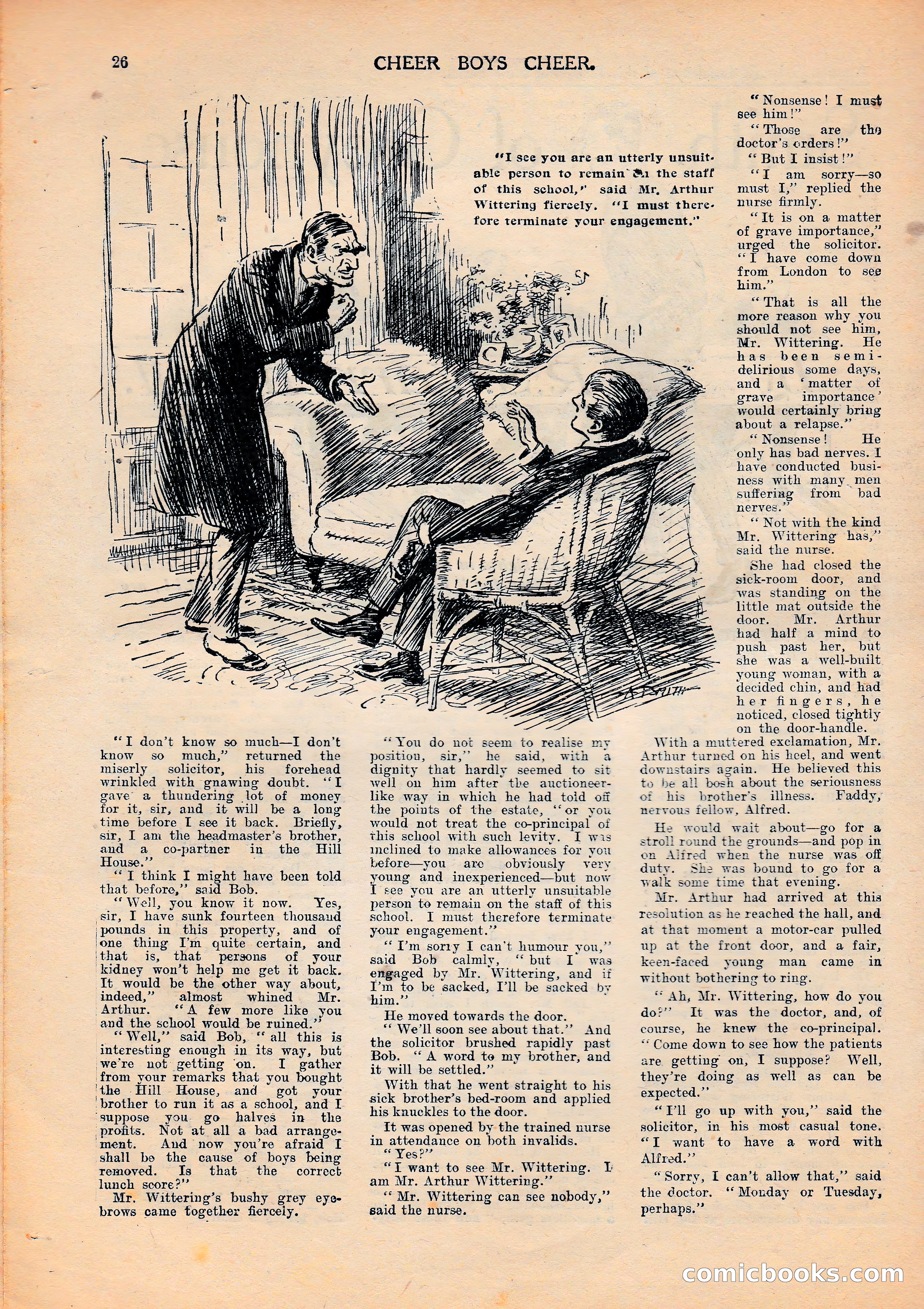
A restored page from Pulp Fiction, 1913. Page through the whole issue in the reader above.
📄 Transcribed text from this page (OCR, searchable)
Machine-transcribed from the original scan — historical spelling and the odd misread are preserved.
26 *T don’t know so much—I don’t know so much,’ returned the miserly solicitor, his forehead wrinkled with gnawing doubt. ‘I gave a thundering lot of money for it, sir, and it will be a long time before I see if back. Briefly, sir, J am the headmaster’s brother, and a co-partner in the Hill House.”’ “T think I might have been told that before,’ said Bob. : “Well, you know it now. Yes, sir, I have sunk fourteen thousaud ;pounds in this property, and of ‘one thing I’m quite certain, and ‘that is, that persons of your kidney won’t help me get it back. It would be the other way about, indeed,” almost whined Mr. Arthur. ‘A few more like you and the school would be ruined.” “Well,” said Bob, “ all this is interesting enough in its way, but we're not getting on. I gather from your remarks that you bought ithe -Hill House, and got your -brother to run it as a school, and I ‘suppose you. go halves in the ‘profits. Not at all a bad arrange- ‘ment. And now you're afraid I shall bo the cause of boys being removed. Is that the correct lunch score?” 5 Mr. Wittering’s bushy grey eye- brows came together fiercely. CHEER BOYS CHEER. of this school,” Wittering fiercely. “You do not seem to realise my position, sir,’ he said, with a dignity that hardly seemed to sit well on him after the auctioneer- like way in which he had toid of the points of the estate, ‘‘or you would not treat the co-principal of this school with such levity. I wis inclined to make allowances for you before—you are obviously very young and inexperienced—but now f see you are an utterly unsuitable person te remain on the staff of this school. J must therefore terminate your engagement.” **T’m sorry I can’t humour you,”’ said Bob calmly, “ but I was engaged by Mr. Wittering, and if I’m to be sacked, Pll be sacked by him.” He moved towards the door. ““ We'll soon see about that.’’ And the solicitor brushed rapidly past Bob. “A word te my brother, and it will be settled.” With that he went straight to his sick brother’s bed-room and applied his knuckles to the door. It was opened by the trained nurse in attendance on both invalids. “Yes?” “JT want to see Mr. Wittering. I am Mr. Arthur Wittering.” “* Mr. Wittering can see nobody,” said the nurse. 4 ¥ see you are an utterly unsuit- | able person to remain’ &: the staff “JT am said Mr, Arthur ‘I must there- fore terminate your engagement.” * Nonsense! I must see him!” “Those are tha doctor’s orders!” * But I insist !” sorry—so must I,” replied the nurse firmly. “It is on a matter of grave importance,” urged the solicitor. “T have come down from London to see him.” “That is all the more reason why you should not see him, Mr. Wittering. He has been semi- delirious some days, and a ‘matter of grave importance’ would certainly bring about a relapse.” ** Nonsense ! He only has bad nerves. I have conducted busi- ness with many. men sufferiag from bad nerves.” ' Not with the kind Mr. Wittering has,” said the nurse. She had closed the sick-room door, and was standing on the little mat outside the door. Mr. Arthur had half a mind to push past her, but she was a well-built young woman, with a decided chin, and had her fingers, he noticed, closed tightly on the door-handle. With a muttered exclamation, Mr. Arthur turned on his keel, and went downstairs again. He believed this to be all besh about the seriousness of his brother’s illness. Faddy, nervous fellow, Alfred. He would wait about—go for a stroll round the grounds—and pop in on Alfred when the nurse was off duty. She was bound to go for a walk some time that evening. : Mr. Arthur had arrived at this resolution as he reached the hall, and at that moment a motor-car pulled up at the front door, and a fair, keen-faced young man came in without bothering to ring. * Ah, Mr. Wittering, how do you do*’’ It was the doctor, and, of course, he knew the eco-principal. ** Come down to see how the patients are getting on, I suppose? Well, they’re doing as well as can be expected.” “Tl go up with you,” said the solicitor, in his most casual tone. “TI want to have a word with Alfred.’’ : “Sorry, I can’t allow that,” said the doctor. ‘“‘ Monday or Tuesday, perhaps.” (e(ayaa\Velaveay a’ KHKODTUUUKG LOKOKO)